 Beyond the toolkit: a systematic review of the public procurement of innovation processes
Abstract
This study proposes a theoretical framework to guide public procurement of innovation (PPI) processes, based on a systematic literature review aimed at advancing the perspectives presented in toolkits. A total of 189 articles from Scopus, Web of Science, and the CAPES Journals Portal databases were analyzed, of which 27 met the inclusion criteria. The results present a critical and integrative synthesis of the literature, which enabled the construction of a framework encompassing two complementary dimensions: a horizontal one, related to the political and institutional context, and a vertical one, referring to the specific stages of the procurement process. The framework offers an analytical perspective that integrates aspects previously treated in a fragmented manner, recognizing the interactive, non-linear, and reconfigurable nature of PPI. By addressing the limitations of normative approaches, the framework contributes to the consolidation of a more robust conceptual basis, capable of guiding public policies and fostering future research.
Keywords:
government purchase of innovation; public procurement of innovation; innovation policy; demand-pull innovation.
Resumo
Este estudo teve como objetivo propor um framework teórico de orientação do processo de compras públicas de inovação, fundamentado em uma revisão sistemática da literatura, de modo a contribuir para o aprimoramento das perspectivas presentes em toolkits. Foram analisados 189 artigos provenientes das bases Scopus, Web of Science e Portal de Periódicos da Coordenação de Aperfeiçoamento de Pessoal de Nível Superior (Capes), dos quais 27 atenderam aos critérios de inclusão. Os resultados apresentam uma síntese crítica e integrativa das abordagens da literatura, o que possibilitou a construção de um framework que articula duas dimensões complementares: uma horizontal, relacionada ao contexto político e institucional, e outra vertical, referente às etapas específicas do processo de aquisição. Propõe-se uma leitura analítica que integra aspectos antes tratados de forma fragmentada, reconhecendo a natureza interativa, não linear e sujeita a reconfigurações das compras públicas de inovação. Ao abordar as limitações das abordagens normativas, o framework fortalece a consolidação de uma base conceitual mais robusta, capaz de orientar políticas públicas e fomentar pesquisas futuras.
Palavras-chave:
compras governamentais de inovação; compras públicas de inovação; política de inovação; inovação pela demanda.
Resumen
Este estudio tuvo como objetivo proponer un marco teórico de orientación del proceso de compras públicas de innovación, fundamentado en una revisión sistemática de la literatura, con el fin de contribuir al perfeccionamiento de las perspectivas presentes en los toolkits. Se analizaron 189 artículos procedentes de las bases Scopus, Web of Science y el Portal de periódicos de Capes, de los cuales 27 cumplieron con los criterios de inclusión. Los resultados presentan una síntesis crítica e integradora de los enfoques de la literatura, lo que permitió la construcción de un marco que articula dos dimensiones complementarias: una horizontal, relacionada con el contexto político e institucional, y otra vertical, referente a las etapas específicas del proceso de adquisición. El marco propone una lectura analítica que integra aspectos previamente tratados de manera fragmentada, reconociendo el carácter interactivo, no lineal y sujeto a reconfiguraciones de las compras públicas de innovación. Al abordar las limitaciones de los enfoques normativos, el marco refuerza la consolidación de una base conceptual más sólida, capaz de orientar políticas públicas y fomentar investigaciones futuras.
Palabras clave:
compras gubernamentales de innovación; compras públicas de innovación; política de innovación; demanda inducida.
1. INTRODUCTION
The policies of science, technology and innovation have attracted growing interest from governments and researchers due to their potential impact on the economic growth of a country. Within this context, governments have been adopting a mix of industrial policies and science-and-technology policies to promote innovation, by means of specific instruments. Such instruments can be categorized in two main approaches: push (supply) e pull (demand), according to the categorization proposed by Edquist e Hommen (2000).
The policies of innovation supply-oriented do not necessarily demand a straight orientation from the State, as is the case with the granting of research scholarships (Edler & Georghiou, 2007). The policies demand-oriented in contrast, involves the leading of the State in the promotion of innovation, such as research awards aimed at specific themes of public interest (Edler & Georghiou, 2007). The fundamental difference between these two types of policies, is the role of the State: at times increasing the general conditions for innovation, without specific orientation (as in the case of research scholarships, typical of policies of supply); at other times, leading the innovative process to areas of bigger public interest (for instance the case of supply policies, which include, for example, thematic awards or procurements). The Public Procurement of Innovation (PPI) form part of the second group, acting like a strategic instrument which transforms the State’s purchasing power into a driver of development, by inducing the creation of innovative solutions, focused on concrete problems.
In your most common definition, PPI refers to the procurement of goods or services not yet present in the market, however that are capable of being developed within a defined timeframe (Edquist & Zabala-Iturriagagoitia, 2012; Rolfstam, 2012). It refers to the utilization of the State’s capacity to induce innovations through the purchasing power of the public sector. This capacity may be understood as the State’s ability to penetrate society and to implement political decisions, coordinating instruments and institutions to set goals, translate them into policies, and carry them out (Souza, 2017). In the context of PPI, this ranges from the qualified identification of public demands to the administration of complex contracts and the engagement with private and scientific stakeholders.
By means of PPI the state can foster technologies, expand markets and transform productive structures (Knutsson & Thomasson, 2013), as long as one demonstrates the capacity to coordinate the process in an innovative manner (Li et al., 2020).
Various guides and toolkits have been elaborated to support managers in this process, such as the better regulation guidelines by the European Commission (2021) and the Toolkit CT&I from the Attorney General Office of the State of São Paulo (2023). This type of document, increasingly common, can be interpreted as an integrated set of multiple tools that can be selected or combined to address complex problems. The toolkits integrate regulatory, economic and administrative instruments (Howlett et al., 2015). However, at times it lacks solid theoretical framework, adopting prescriptive approaches or normatives that ignores the contextual and institutional dynamics. By consequence, they end up neglecting the practices that shape the field of public procurement innovation, which compromises your adaptability to different administrative and cultural realities.
These gaps dialogues with the institutional obstacles observed in the Brazilian context, as pointed out in the Public Procurement of Innovation Journey, organized by the Federal Court of Accounts (TCU): the low utilization of public procurement innovation derives from, between other factors, the risk aversion by managers, the lack of knowledge and familiarity, along with the lack of consensus between different stakeholders about how to lead such processes (TCU & Instituto Serzedello Corrêa [ISC], 2022). These elements reinforce the need to deepen the theoretical understanding of the PPI process.
Despite the progress of using the public procurement of innovation as an instrument of public policy, gaps still remain between the practical guidelines and the challenges faced in the implementation, particularly outside North America and Europe (Li et al., 2020). Furthermore, there is a noticeable scarcity of a theoretical framework that enables the understanding of specific stages of the public procurement process and its challenges. Given the scenario, the research problem that conducts this article is: how the process of public procurement of innovation has been addressed in the academic literature, and in what ways this body of studies contribute to improving the perspectives adopted in toolkits?
The objective of this investigation is to propose a theoretical guideline framework of the process of public procurement of innovation, based on a systematic literature review, in order to contribute to the development of the perspectives adopted in toolkits. This study seeks to offer an integrative and critical view of the process, drawing on experiences documented in relevant studies. By bringing together and problematizing existing findings, it aims to address theoretical gaps and contribute to guiding both practice and future research on the subject (Elsbach & van Knippenberg, 2020).
2. THEORETICAL FRAMEWORK
The process of innovation is dynamic and multifaceted, emerging from scientific and technological progress, demands of market or organizational and political factors, as a result of complex interactions (Chidamber & Kon, 1994). In innovation policies this dynamic occurs by State’s actions oriented by supply and demand (Edquist & Hommen, 2000). Supply-oriented instruments include subsidies, tax incentives, scholarships, and support for science and technology institutions. Demand-oriented measures, in turn, encompass the creation of clusters, awards, technology procurement, and innovation-oriented public procurement (Edler & Georghiou, 2007).
The supply policies seek to create conditions so that companies and institutions can innovate with a relative degree of autonomy. In this perspective, the role of the State is limited to mitigating structural barriers, such as the lack of funding, infrastructure, or technical capacity, addressed by means of research and development incentives.
On the other hand, supply-oriented policies adopt a more active and targeted posture, whereby the State identifies specific public needs and channels innovation to meet them. The public procurement of innovations highlights, in this context, as a strategic instrument to guide markets in the search for solutions to collective challenges (Uyarra et al., 2020). This ‘pull’ of innovation denotes a shift in the understanding of the State’s role: from a mere mitigator of market failures or a regulatory actor to a proactive agent of economic and social transformation.
2.1 Public procurement of innovation as a means of materializing the entrepreneurial State
In this extended function, the State assumes a capacity to shape markets, direct resources and take risks, getting close with the concept of the Entrepreneurial State proposed by Mazzucato (2014). For the author, the entrepreneurial State is the one that is “capable of taking risks and creating a highly articulated system that leverages the most of the private sector for the national good over a medium and long-term horizon” (Mazzucato, 2014, p. 41). This definition aligns to the process of PPI, described by Georghiou et al. (2014), which starts with the identification of a demand or a public problem not resolved by the market, requiring the assumption of risks inherent to innovative production. Thereafter, suppliers are selected and solutions are implemented through a coordinated engagement during the development of innovation.
When innovating through PPIs, the State does not act in isolation, but rather within a network, mobilizing firms, universities, and social organizations for the co-creation of solutions (Georghiou et al., 2014; Kattel & Mazzucato, 2018). This process involves distinct forms of interaction with suppliers and different levels of technological maturity (Hommen & Rolfstam, 2008), presupposing that the actors involved share knowledge, learn together and cooperate throughout the stages of product and service development (Edquist & Zabala-Iturriagagoitia, 2012).
It is at this point that public procurement of innovation gains centrality: it highlights the strategic role of the entrepreneurial state in fostering innovation processes, going beyond mere funding to define problems, create ecosystems, and coordinate actors around strategic objectives.
2.2 Approaches and stages of innovation procurement
Public procurement of innovation does not constitute a homogeneous instrument, it varies according to the maturity level of the innovative solution and the technological development stage required. Traditionally, PPI involves the acquisition of products, processes, or services not yet available on the market, but based on technologies that have reached an advanced stage of development and are viable for implementation (Edler & Georghiou, 2007; Georghiou et al., 2014). In these scenarios, the State acts as the final procurer and direct client from the innovation.
When the solution for the public problem requires research, tests and validation before becoming marketable, PPI takes the form of Pre-Commercial Procurement (PCP), in which the State does not acquire the final product but contracts its development (Edler & Georghiou, 2007; Rauen, 2015). In Brazil this PPI approach is also known as technology procurement.
PCP seeks to reduce technological uncertainties and enable the transition from idea to proof of concept, fostering collaboration among the public, private, and scientific sectors. In both cases the dynamic nature of innovation requires that notices and contracts should be part of a continuous cycle, with rules compatible with the flexibility required by the process (Georghiou et al., 2014).
Although the literature lacks a standardized framework of stages for PPIs, it generally agrees on the presence of recurrent phases that capture the interactive and strategic character of the instrument. Box 1 summarizes the main contributions identified in the field, organizing the authors who describe common stages of the process.
It is noted, therefore, that despite the diversity of conceptual approaches, there is a relative consensus regarding three central phases (pre-contractual, contractual, and post-contractual), which represent the most consistent contributions of the specialized literature for the understanding of the process of PPI. Despite the advances observed in the academic literature, research about public procurement of innovation remains relatively fragmented, with the predominance of normative approaches or centered on specific cases, indicating the absence of integrative analysis that synthesizes these evidences within a more robust perspective.
3. METHODOLOGY
For the organization of this Systematic Literature Review (SLR), the Parsifal platform was used. Box 2 outlines the protocols adopted.
Peer-reviewed scientific articles published between 2019 and 2023 were analyzed. The time frame was defined based on the significant increase in publications on public procurement of innovation during this period, concentrating more recent debates that are relevant to understanding the contemporary challenges surrounding the topic. The keywords “public procurement of innovation” and “entrepreneurial State” were used in both Portuguese and English. The inclusion of the term “entrepreneurial State” expands the interdisciplinary approach by exploring the role of the state as an innovation agent. This perspective, rarely addressed in reviews on PPIs, provides a distinctive contribution of this study.
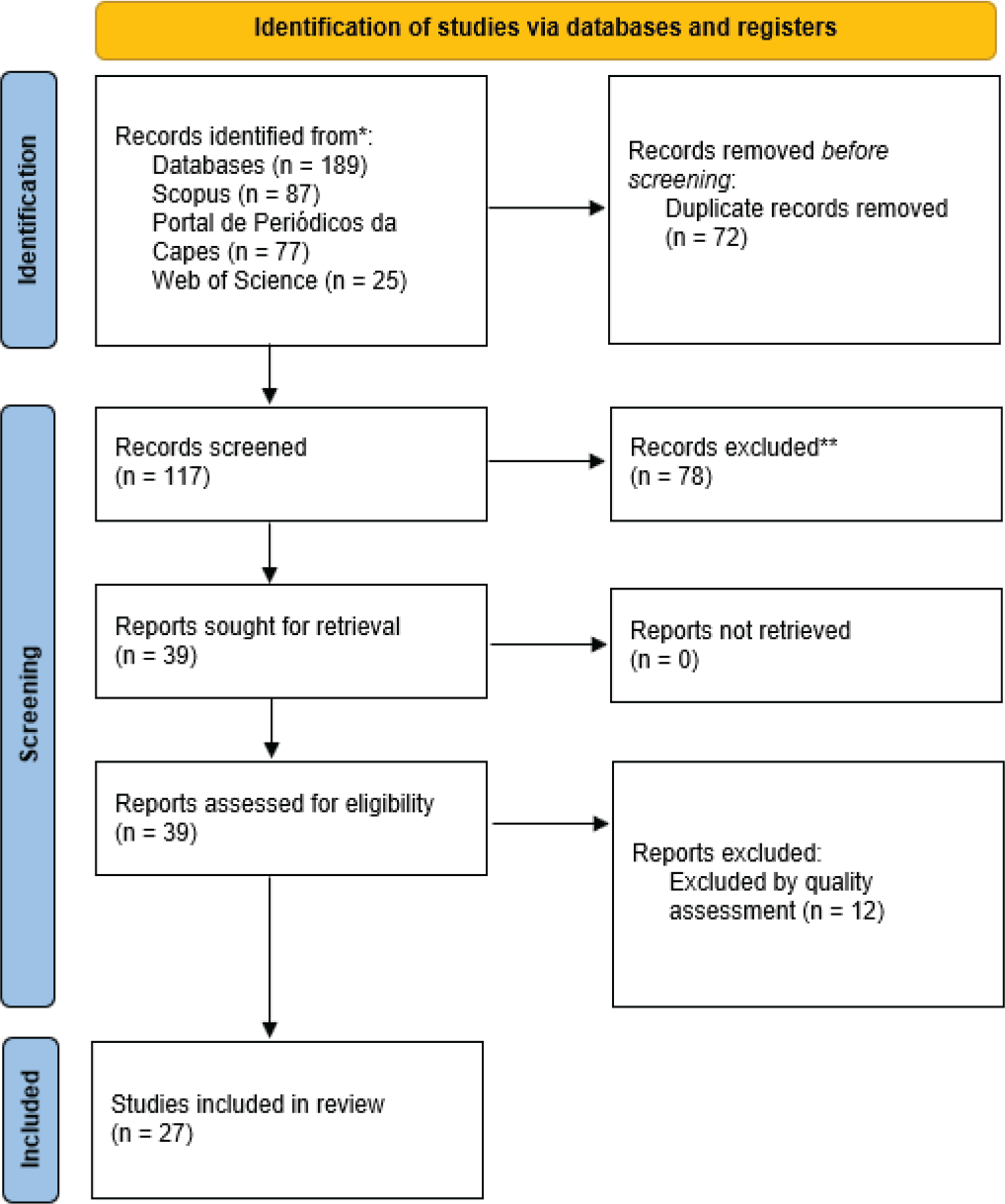
There is a variety of terms used to refer to PPI, which vary across countries and authors, making the range and selection of articles more challenging (Edquist & Zabala-Iturriagagoitia, 2020; Radicic, 2019). In total, 189 articles addressing the topic were identified, but 72 were duplicates, meaning they appeared as results in more than one database. After applying the inclusion and exclusion criteria presented in Box 2, 78 articles were excluded for falling outside the scope of analysis. This is due to the fact that many of the initially selected papers actually dealt with the theme of innovation in public procurement, rather than public procurement of innovation, an issue already highlighted by Suhonen et al. (2019).
To systematize the review, the Preferred Reporting Items for Systematic Reviews and Meta-Analyses (PRISMA 2020) protocol were used, as it offers internationally recognized guidelines to ensure transparency in the processes of identification, screening, eligibility, and inclusion of studies in systematic reviews (Haddaway et al., 2022). Figure 1 presents the relationship between the articles included and excluded in this review.

As illustrated in Figure 1, the filtered articles were evaluated regarding quality, considering criteria such as reference to “Public procurement of innovation”, entrepreneurial State perspective, challenges on public contracts, research gaps and number of citations. Each response was scored as 1 (yes), 0.5 (partially), or 0 (no), with a cutoff value of 2.5, resulting in the exclusion of 12 articles. Lastly, 27 articles were analysed, with information organized in a detailed box. The results of this analysis will be discussed below.
4. RESULTS
Within an initial sample of 189 articles identified through an extensive search across 3 databases, only 27 met the criteria of this review. The articles were analysed in matters of their theoretical and practical contributions, highlighting the main findings. The analysis of these studies indicates methodological trends, dominant themes and relevant contributions for the research field in public procurement of innovation.
The studies about PPI selected by this research were primarily focused on qualitative approaches, representing an attempt to map and understand this expanding field. This predominance of the phenomenon is still in the exploration phase, as new scenarios and new practices are identified. However, when we observe the methodological diversity applied and the geographical focus of the research, we perceive trends that reflect both the maturity and the gaps in the field.
Box 3 gathers the methods used in the studies, as well as their respective objects of analysis, objectives, and contributions.
Qualitative studies focus on case studies and documents, while quantitative studies use varied methods. There are gaps in mixed-methods approaches and in the analysis of the perceptions of government officials, society, and the media, which limits the understanding of the impacts of PPIs.
Box 3 corroborates the following analysis: although some of the studies analyzed in this research are theoretical essays and, therefore, do not present a delimited empirical object, it is observed that most empirical studies focus on contexts situated in Europe or the European Union itself. This means that the objects of research, such as policies, programs, local initiatives, or public procurement mechanisms, are mostly located in European countries (Archibugi et al., 2019; Babiča & Sceulovs, 2019; Crespi & Guarascio, 2019; Delina et al., 2021; Demircioglu & Vivona, 2021; Lymer et al., 2023; Pihlajamaa & Merisalo, 2021; Radicic, 2019; Sánchez-Carreira et al., 2019a; Sánchez-Carreira et al., 2019b; Schönfeld & Ferreira, 2021; Suhonen et al., 2019; Tammi et al., 2020; Uyarra et al., 2020; Winden & Carvalho, 2019). This geographic concentration points to a regional predominance in academic production on the subject, suggesting the need to broaden the contexts investigated in future studies in order to avoid the reproduction of a hegemony in knowledge, allowing for greater versatility in policies based on different circumstances.
By observing the frequency with which certain macro-themes emerge as motivators for the elaboration of the studies, it is possible to identify the perspectives that have been explored in the reviewed articles. Using an interpretative procedure, as described by Ramos (2013), three common categories were identified, highlighted in Box 4, through the improvement and generation of knowledge. The first category concerns the effectiveness and impact of PPIs. These studies analyze the effects of the instrument in stimulating innovation, as well as its performance in relation to other policies focused on the supply side.
The second category focuses on contract drafting. The articles grouped here address normative and strategic aspects of innovation procurement processes, proposing more flexible formats compatible with the uncertainty of innovative projects. Finally, the third category concerns business performance. The research in this group focuses on the perspective of companies, their challenges in their relationship with the public sector, and factors that influence their participation and success in public procurement processes for innovation.
These three categories reflect an integrated view of PPI as a public policy, addressing both the public and private axes of the process. More than 80% of the studies analyze the effectiveness and drafting of contracts, revealing an academic trajectory that evolves from valuing the instrument itself to seeking more effective ways of implementing it.
Highlights from studies on the effectiveness and impact of PPIs suggest that, in general, these purchases generate more positive results than other supply-side measures - for example, public policy instruments that subsidize or support supplier-side innovation without necessarily creating guaranteed demand. The positive impacts are particularly evident in terms of stimulating innovative efforts by companies, empowering suppliers, and promoting local development.Although regulations, local capabilities, and openness to foreign suppliers are challenges. In turn, contract drafting requires flexibility and planning, as the traditional model does not favor innovation. For effective business performance, co-creation, collaboration in R&D, and the development of trust-based relationships among participants stand out. The overview of research categories reinforces the complexity of public procurement of innovation and the need for an integrated approach that combines broad and specific dimensions.
5. DISCUSSION
Public procurement of innovation occurs through a multi-stage process that requires coordination between institutional capacities, definition of public objectives, and management of uncertainty. Based on the reviewed literature, we propose a theoretical framework that seeks to complement traditional toolkit models by incorporating the particularities, variations, and challenges identified in empirical and conceptual studies on the subject (Edler & Georghiou, 2007; Edquist & Zabala-Iturriagagoitia, 2012; Georghiou et al., 2014; Lember et al., 2015; Rolfstam, 2012).
Figure 2 provides an integrated representation of the processes involved in PPIs, organizing them into two complementary dimensions. The first is a horizontal, macro-level dimension that encompasses the broader political-institutional context in which the instrument operates, taking into account strategic guidelines, organizational capacities, and the articulation with industrial and innovation policies. The second is the vertical dimension, which systematizes specific stages of the procurement process, from the identification of demand to the implementation and evaluation of the acquired solution.This model results from the articulation of recurrent elements identified in the literature, which were previously dispersed. The framework incorporates phases that precede the procurement stage itself, such as the internal analysis of the requesting agency, as well as post-contract phases involving co-creation, monitoring, evaluation, and the dissemination of the knowledge generated.
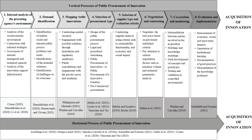
As noted by Georghiou et al. (2014), procuring innovative solutions requires that tender design, evaluation criteria, and procurement modes be compatible with the technological risks and uncertainties involved. In this sense, although the process presented here is depicted sequentially, its execution does not necessarily follow a linear order. Institutional policy changes, technical constraints, or unexpected developments may require reconfigurations along the way.
Thus, the framework proposed in Figure 2 contributes to the field by bringing together, in an integrated analytical structure, the main elements of the public procurement of innovation process identified in the literature. Its purpose is not to prescribe a step-by-step guide or replace normative toolkits, but to offer a systemic perspective that articulates the instrument’s strategic and operational dimensions, enabling an understanding of how governments can structure public demand as a driver of innovation in diverse contexts.
When adopting PPI as a public policy, it is recommended that the agency conduct a strategic analysis of the institutional and socioeconomic context, considering internal capacities and national guidelines. This analysis, not commonly recognized in PPI processes, is especially relevant in developing countries, where resource and capacity limitations can compromise effectiveness (Li et al., 2020). Strategies adopted should be adapted to local conditions, respecting their specificities (Daneshkohan et al., 2022).
Demand identification is one of the most critical steps in PPI, as it requires understanding the public problem to be addressed while recognizing that, in innovation contexts, the solution is not yet fully defined. Adopting a functional formulation of demand is essential, going beyond the mere identification of the problem (Edquist & Zabala-Iturriagagoitia, 2020). This involves defining criteria and parameters to guide the search for solutions, aligning the challenge with the public mission (Demircioglu & Vivona, 2021; Uyarra et al., 2020).
After defining the demand, it is necessary to identify viable innovation solutions, which requires prospecting and approaching potential suppliers or technology partners. Market research plays a central role in this stage, as it allows verification of whether solutions already exist that approximate what is being sought. When there is no readily available answer, the innovative nature of the demand is confirmed. Tools such as hackathons (Pihlajamaa & Merisalo, 2021), regulatory sandboxes or public consultations can be used to explore alternatives and broaden the engagement of external actors, such as startups, researchers, and innovative companies. One example is the Startup-in-Residence (SiR) program in Amsterdam, in which startups were challenged to develop solutions to urban problems and, after five months of collaboration, could sign contracts with the public administration (Winden & Carvalho, 2019).
The selection of the type of procurement is another crucial moment. The literature distinguishes two main modalities: public procurement of innovative solutions and pre-commercial public procurement (Delina et al., 2021; Veneziani & Vaz, 2023). The choice between these options should consider the technological maturity level of the solution, the strategic objectives of the contract, and the risks involved in the process (Lymer et al., 2023).
Supplier selection and evaluation criteria also require attention. Unlike traditional public procurement, in which the lowest price is often decisive, PPIs demand criteria that consider functionality, socioeconomic impacts, sustainability, and other aspects (Babiča & Sceulovs, 2019). Nevertheless, financial considerations should not be disregarded. Well-conducted negotiation processes can generate savings, even when price is not the sole focus (Delina et al., 2021). Negotiation and contracting stages must be structured in a way that balances public interests with the feasibility of the proposed solution. This includes careful attention to technical parameters, timelines, contractual responsibilities, and flexibility mechanisms. Once the contract is formalized, the co-creation and monitoring phase begins, involving continuous interaction between buyer and supplier, alignment meetings, joint prototype development, and testing in controlled environments. This phase is essential for managing the inherent unpredictability of the process and enabling ongoing adjustments.
Finally, the cycle concludes with the evaluation and implementation of the solution, which should include the measurement of economic, social, and innovation-related impacts, as well as the systematization of institutional learning. Documenting and disseminating the results not only enhances transparency but also strengthens internal capabilities and promotes the diffusion of good practices among public organizations.
The stages described here do not operate in isolation, but are interconnected through demand formulation, which directly influences the contracting approach, supplier selection, and evaluation criteria. Nevertheless, this interdependence does not, in itself, guarantee success. The effectiveness of PPIs depends on the public agency’s capacity to maintain a critical and adaptive stance throughout the process, revisiting decisions as new challenges and opportunities emerge.
6. FINAL CONSIDERATIONS
This study aimed to propose a theoretical framework to guide the public procurement of innovation process, grounded in a systematic literature review, in order to contribute to the refinement of perspectives present in existing toolkits. The review covered literature published between 2019 and 2023. A total of 189 articles were examined, of which 27 fully met the inclusion criteria. The review enabled reflection on public procurement of innovation as one of the materializations of the entrepreneurial state theory. As a theoretical contribution, this perspective broadens the conceptual foundations for understanding PPI not only as an instrument aimed at contractual efficiency-through its capacity to improve the quality of goods and services acquired and to tailor solutions to public needs-but also as a mechanism of institutional transformation, capable of reshaping the very logic of public-sector action. By making visible the active role of the State in assuming risks and fostering innovative solutions, it repositions the State as more than a mere regulator: it becomes a protagonist in the innovation process. Although they do not exhaust the scope of the entrepreneurial state theory, public procurement of innovation constitutes one of its most evident instruments, as it translates into practice the State’s capacity to coordinate actors, assume risks, and generate public value through innovation.
The second major contribution of this research was the development of a framework that considers the PPI process in an integrated manner, articulating two complementary dimensions. The horizontal dimension refers to the strategic context of the instrument’s use, including political and institutional factors and the state capacities required for its implementation. The vertical dimension corresponds to the specific stages of the procurement process, as identified in the literature. Most toolkits and operational guides, as well as part of the classical approach to PPI, structure the process only in a linear way, describing pre-contractual, contractual, and post-contractual sequences.
The framework proposed here shows that these steps can only be fully understood when analyzed in dialogue with the horizontal dimension, highlighting the interactive, non-linear nature of the process and its subject to reconfiguration. Thus, the intention is not to establish a new taxonomy of stages, but to provide an analytical perspective that integrates elements previously addressed in isolation, connecting them to the State’s strategic role and contributing to a more comprehensive conceptual understanding of PPI. As a theoretical and analytical contribution, the framework offers a valuable tool for grasping the complexity inherent in PPI and for informing future scholarly inquiry. It is further anticipated that the model may support public managers in developing more robust and context-sensitive strategies for fostering innovation through State action.
6.1 Research limitations
This research has limitations related to the choice of repositories, the absence of a common nomenclature for PPI and the selection criteria. The combination of databases with different coverages and the use of specific terms may have restricted the sample. Furthermore, there are limitations common to systematic reviews, such as the subjective definition of study selection criteria and the synthesis of robust data.
6.2 Future studies
It is recommended that future investigations empirically test the eight dynamics of the framework across different sectors and regions. There remain several gaps to be explored, including the effects of PPI in emerging economies; its impact on disruptive versus incremental innovation; its intersections with concepts such as open innovation and the entrepreneurial state; and ethical-legal considerations, as well as the perceptions of public actors, society, and the media regarding these initiatives.
-
Peer review report:
Reviewers:Denis Renato de Oliveira (Universidade Federal de Lavras, Lavras / MG - Brazil) https://orcid.org/0000-0001-9723-7650Ciro Campos Christo Fernandes (Escola Nacional de Administração Pública, Brasília / DF - Brazil) https://orcid.org/0000-0002-6344-9169The peer review report is available at this link Publons
-
[Translated version] Note: All quotes in English translated by this article’s translator.
ACKNOWLEDGMENTS
This article originates from research conducted within the Postgraduate Program in Administration at the Fluminense Federal University (PPGAd/UFF). This study did not receive financial support from public, commercial, or nonprofit funding agencies.
DATA AVAILABILITY
All data supporting the findings of this study have been published within the article itself.
References
-
Archibugi, D., Fillippetti, A., & Frenz, M. (2019). Investment in innovation for European recovery: a public policy priority. Science and Public Policy, 47(1), 92-102. https://doi.org/10.1093/scipol/scz049
» https://doi.org/10.1093/scipol/scz049 -
Babiča, V., & Sceulovs, D. (2019). Public procurement of innovation: selection of the sustainable alternative. Economics and Business, 33(1), 233-246. https://doi.org/10.2478/eb-2019-0017
» https://doi.org/10.2478/eb-2019-0017 -
Chidamber, S. R., & Kon, H. B. (1994). A research retrospective of innovation inception and success: the technology-push, demand-pull question. International Journal of Technology Management, 9(1), 94-112. https://doi.org/10.1504/IJTM.1994.025565
» https://doi.org/10.1504/IJTM.1994.025565 -
Comissão Europeia. (2021). Orientações sobre contratos públicos de inovação https://ec.europa.eu/docsroom/documents/45975
» https://ec.europa.eu/docsroom/documents/45975 -
Crespi, F., & Guarascio, D. (2019). The demand-pull effect of public procurement on innovation and industrial renewal. Industrial and Corporate Change, 28(4), 793-815. https://doi.org/10.1093/icc/dty055
» https://doi.org/10.1093/icc/dty055 -
Crisan, D. (2020). Buying with intent: public procurement for innovation by provincial and municipal governments. The School of Public Policy Publications, 13(18), 1-43. https://doi.org/10.11575/sppp.v13i0.69277
» https://doi.org/10.11575/sppp.v13i0.69277 -
Dai, X., Li, Y., & Chen, K. (2021). Direct demand-pull and indirect certification effects of public procurement for innovation. Technovation, 101, 102198. https://doi.org/10.1016/j.technovation.2020.102198
» https://doi.org/10.1016/j.technovation.2020.102198 -
Daneshkohan, H., Razavi, M. R., & Boushehri, A. (2022). Analyzing the effective factors to design public procurement of innovation policy: case studies oil, power and roads sectors. Journal of Improvement Management, 16(2), 131-161. https://doi.org/10.22034/jmi.2022.319347.2715
» https://doi.org/10.22034/jmi.2022.319347.2715 -
Delina, R., Gróf, M., & Dráb, R. (2021). Understanding the determinants and specifics of pre-commercial procurement. Journal of theoretical and applied electronic commerce research, 16(2), 80-100. https://doi.org/10.4067/S0718-18762021000200106
» https://doi.org/10.4067/S0718-18762021000200106 -
Demircioglu, M. A., & Vivona, R. (2021). Positioning public procurement as a procedural tool for innovation: an empirical study. Policy and Society, 40(3), 379-396, https://doi.org/10.1080/14494035.2021.1955465
» https://doi.org/10.1080/14494035.2021.1955465 -
Edler, J., & Georghiou, L. (2007). Public procurement and innovation - resurrecting the demand side. Research Policy, 36(7), 949-963. https://doi.org/10.1016/j.respol.2007.03.003
» https://doi.org/10.1016/j.respol.2007.03.003 -
Edquist, C., & Hommen, L. (2000). Public technology procurement and innovation theory. In C. Edquist, L. Hommen & S. Tsipouri (Eds.), Public technology procurement and innovation (Economics of Science, Technology and Innovation series, Vol. 16, pp. 5-70). Springer. https://doi.org/10.1007/978-1-4615-4611-5_2
» https://doi.org/10.1007/978-1-4615-4611-5_2 -
Edquist, C., & Zabala-Iturriagagoitia, J. M. (2012). Public procurement for innovation as mission-oriented innovation policy. Research policy, 41(10), 1757-1769. https://doi.org/10.1016/j.respol.2012.04.022
» https://doi.org/10.1016/j.respol.2012.04.022 -
Edquist, C., & Zabala-Iturriagagoitia, J. M. (2020). Functional procurement for innovation, welfare, and the environment. Science and Public Policy, 47(5), 595-603. https://doi.org/10.1093/scipol/scaa046
» https://doi.org/10.1093/scipol/scaa046 -
Elsbach, K. D., & Van Knippenberg, D. (2020). Creating high-impact literature reviews: an argument for ‘integrative reviews’. Journal of management studies, 57(6), 1277-1289. https://doi.org/10.1111/joms.12581
» https://doi.org/10.1111/joms.12581 -
Georghiou, L., Edler, J., Uyarra, E., & Yeow, J. (2014). Policy instruments for public procurement of innovation: choice, design and assessment. Technological Forecasting and Social Change, 86, 1-12. https://doi.org/10.1016/j.techfore.2013.09.018
» https://doi.org/10.1016/j.techfore.2013.09.018 -
Haddaway, N. R., Page, M. J., Pritchard, C. C., & McGuinness, L. A. (2022). PRISMA2020: um pacote R e aplicativo Shiny para produzir diagramas de fluxo compatíveis com PRISMA 2020, com interatividade para transparência digital otimizada. Open Synthesis Campbell Systematic Reviews, 18, e1230. https://doi.org/10.1002/cl2.1230
» https://doi.org/10.1002/cl2.1230 -
Hommen, L., & Rolfstam, M. (2008). Public procurement and innovation: towards a taxonomy. Journal of Public Procurement, 8(3), 17-56. https://doi.org/10.1108/JOPP-08-03-2008-B001
» https://doi.org/10.1108/JOPP-08-03-2008-B001 -
Howlett, M., Mukherjee, I., & Woo, J. J. (2015). From tools to toolkits in policy design studies: the new design orientation towards policy formulation research. Policy & Politics, 43(2), 291-311. https://doi.org/10.1332/147084414X13992869118596
» https://doi.org/10.1332/147084414X13992869118596 -
Kattel, R., & Mazzucato, M. (2018). Mission-oriented innovation policy and dynamic capabilities in the public sector. Industrial and Corporate Change, 27(5), 787-801. https://doi.org/10.1093/icc/dty032
» https://doi.org/10.1093/icc/dty032 -
Knutsson, H., & Thomasson, A. (2013). Innovation in the public procurement process: a study of the creation of innovation-friendly public procurement. Public Management Review, 16(2), 242-255. https://doi.org/10.1080/14719037.2013.806574
» https://doi.org/10.1080/14719037.2013.806574 -
Lember, V., Kattel, R., & Kalvet, T. (2015). Quo vadis public procurement of innovation? Innovation: The European Journal of Social Science Research, 28(3), 403-421. https://doi.org/10.1080/13511610.2015.1043245
» https://doi.org/10.1080/13511610.2015.1043245 -
Li, Y., Ribeiro, C. G., Rauen, A. T., & Inácio, E. I. Jr. (2020). Buying to develop: the experience of Brazil and China in using public procurement to drive innovation. International Journal of Innovation and Technology Management, 17(3), 2050021. https://doi.org/10.1142/S0219877020500212
» https://doi.org/10.1142/S0219877020500212 -
Lymer, G., Leliaert, F., Mergen, P., & Pijls, S. (2023). Pre-commercial procurement framework and European funding sources for European research infrastructure consortiums: insights from the DiSSCo ERIC development. Research Ideas and Outcomes, 9, e113294. https://doi.org/10.3897/rio.9.e113294
» https://doi.org/10.3897/rio.9.e113294 - Mazzucato, M. (2014). O estado empreendedor: desmascarando o mito do setor público vs. setor privado Portfólio Penguin.
-
Odei, S. A., Prazak, P., Soukal, I., & Hamplová, E. F. (2023). Do innovations and external collaboration influence public procurement contracts’ success? Evidence from catching-up Visegrád Group economies. Innovation: The European Journal of Social Science Research, 38(2), 808-830. https://doi.org/10.1080/13511610.2023.2238909
» https://doi.org/10.1080/13511610.2023.2238909 -
Ortega-Laurel, C. (2021). The state as a smart consumer to carry out public procurement of innovation. PAAKAT: Revista de Tecnología y Sociedad, 11(20). https://doi.org/10.32870/pk.a11n20.532
» https://doi.org/10.32870/pk.a11n20.532 -
Pihlajamaa, M., & Merisalo, M. (2021). Organizing innovation contests for public procurement of innovation-a case study of smart city hackathons in Tampere, Finland. European Planning Studies, 29(10), 1906-1924. https://doi.org/10.1080/09654313.2021.1894097
» https://doi.org/10.1080/09654313.2021.1894097 -
Procuradoria-Geral do Estado de São Paulo. (2023). Toolkit do Marco Legal de CT&I https://www.toolkitcti.org/
» https://www.toolkitcti.org/ -
Radicic, D. (2019). Effectiveness of public procurement of innovation versus supply-side innovation measures in manufacturing and service sectors. Science and Public Policy, 46(5), 732-746. https://doi.org/10.1093/scipol/scz026
» https://doi.org/10.1093/scipol/scz026 - Ramos, A. C. F. (2013). Lições aprendidas como alavancador do conhecimento organizacional: um estudo de caso com aquisições internacionais. In M. V. R. Rodriguez (Org.), Gestão do Conhecimento e Inovação nas Empresas Qualitymark.
-
Rauen, A. T. (2015). Compras públicas de P&D no Brasil: o uso do Artigo 20 da Lei de Inovação. In Instituto de Pesquisa Econômica Aplicada (Ed.), Radar: tecnologia, produção e comércio exterior (Nº 40, Cap. 2). https://portalantigo.ipea.gov.br/agencia/images/stories/PDFs/radar/150903_radar_40_cap2.pdf
» https://portalantigo.ipea.gov.br/agencia/images/stories/PDFs/radar/150903_radar_40_cap2.pdf -
Rocha, F. (2019). Compras governamentais para inovação aumentam o esforço inovador? Evidências ao caso brasileiro. Revista Brasileira de Inovação, 18(1), 37-62. http://dx.doi.org/10.20396/rbi.v18i1.8653575
» http://dx.doi.org/10.20396/rbi.v18i1.8653575 -
Rolfstam, M. (2012a). An institutional approach to research on public procurement of innovation. Innovation: The European Journal of Social Science Research, 25(3), 303-321. https://doi.org/10.1080/13511610.2012.717475
» https://doi.org/10.1080/13511610.2012.717475 -
Rolfstam, M. (2012b). Understanding public procurement of innovation: definitions, innovation types and interaction modes. Innovation Types and Interaction Modes http://dx.doi.org/10.2139/ssrn.2011488
» http://dx.doi.org/10.2139/ssrn.2011488 -
Sánchez-Carreira, M. D. C., Peñate-Valentín, M. C., & Varela-Vázquez, P. (2019a). Public procurement of innovation and regional development in peripheral areas. Innovation: The European Journal of Social Science Research, 32(1), 119-147. https://doi.org/10.1080/13511610.2018.1528142
» https://doi.org/10.1080/13511610.2018.1528142 -
Sánchez-Carreira, M. D. C., Peñate-Valentín, M. C., & Varela-Vázquez, P. (2019b). La compra pública de innovación: análisis de la experiencia de Galicia en el ámbito sanitario. Revista Galega de Economía, 28(2), 71-86. https://doi.org/10.15304/rge.28.2.6158
» https://doi.org/10.15304/rge.28.2.6158 -
Schönfeld, K. C., & Ferreira, A. (2021). Urban planning and European innovation policy: achieving sustainability, social inclusion, and economic growth? Sustainability, 13(3), 1137. https://doi.org/10.3390/su13031137
» https://doi.org/10.3390/su13031137 -
Souza, C. (2017). Modernização do Estado e construção de capacidade burocrática para a implementação de políticas federalizadas. Revista de Administração Pública, 51(1), 27-45. https://doi.org/10.1590/0034-7612150933
» https://doi.org/10.1590/0034-7612150933 -
Suhonen, N., Tammi, T., Saastamoinen, J., Pesu, J., Turtiainen, M., & Okkonen, L. (2019). Incentives and risk-sharing in public procurement of innovations: towards contracting strategy framework. Journal of Public Procurement, 19(2), 129-145. https://doi.org/10.1108/JOPP-06-2019-029
» https://doi.org/10.1108/JOPP-06-2019-029 -
Talebi, A., & Rezania, D. (2020). Governance of projects in public procurement of innovation a multi-level perspective. Journal of public procurement, 20(2), 187-206. https://doi.org/10.1108/JOPP-01-2019-0005
» https://doi.org/10.1108/JOPP-01-2019-0005 -
Talebi, A., Rezania, D., & Bragues, G. (2021). Value creation in public procurement of innovation: a case of engaging start-ups by a local government. Local Government Studies, 48(4), 655-679. https://doi.org/10.1080/03003930.2020.1870959
» https://doi.org/10.1080/03003930.2020.1870959 -
Tammi, T., Saastamoinen, J., & Reijonen, H. (2020). Public procurement as a vehicle of innovation - What does the inverted-U relationship between competition and innovativeness tell us? Technological Forecasting and Social Change, 153, 119922. https://doi.org/10.1016/j.techfore.2020.119922
» https://doi.org/10.1016/j.techfore.2020.119922 -
Tribunal de Contas da União; & Instituto Serzedello Corrêa. (2022). Jornada de compras públicas de inovação https://portal.tcu.gov.br/publicacoes-institucionais/cartilha-manual-ou-tutorial/jornada-de-compras-publicas-de-inovacao
» https://portal.tcu.gov.br/publicacoes-institucionais/cartilha-manual-ou-tutorial/jornada-de-compras-publicas-de-inovacao -
Uyarra, E., Zabala-Iturriagagoitia, J. M., Flanagan, K., & Magro, E. (2020). Public procurement, innovation and industrial policy: rationales, roles, capabilities and implementation. Research Policy, 49(1), 103844. https://doi.org/10.1016/j.respol.2019.103844
» https://doi.org/10.1016/j.respol.2019.103844 -
Veneziani, J., & Vaz, J. C. (2023). Public procurement of innovation in Latin America: a comparative analysis of the most innovative countries. In Proceedings of the 16º International Conference on Theory and Practice of Electronic Governance, Belo Horizonte, MG, Brasil. https://doi.org/10.1145/3614321.3614337
» https://doi.org/10.1145/3614321.3614337 -
Viríssimo, T., Baretta, J. V., Hoffmann, M. G., & Farias, J. S. (2023). Qual é mesmo o nosso problema? Desafios às compras públicas de inovação. Revista Alcance, 30(1), 103-115. https://doi.org/10.14210/alcance.v30n1(Jan/Abr).p104-117
» https://doi.org/10.14210/alcance.v30n1(Jan/Abr).p104-117 -
Winden, V. W., & Carvalho, L. (2019). Intermediation in public procurement of innovation: how Amsterdam’s startup-in-residence programme connects startups to urban challenges. Research Policy, 48(9), 103789. https://doi.org/10.1016/j.respol.2019.04.013
» https://doi.org/10.1016/j.respol.2019.04.013
-
Editor-in-chief:
Alketa Peci (Fundação Getulio Vargas, Rio de Janeiro / RJ - Brazil) https://orcid.org/0000-0002-0488-1744
-
Associate editor:
Gabriela Spanghero Lotta (Fundação Getulio Vargas, São Paulo / SP - Brazil) https://orcid.org/0000-0003-2801-1628

 Source: Elaborated by the authors based on
  Source: Elaborated by the authors.