 Impact of preceding regulatory instruments on the efficiency of basic sanitation service providers
Abstract
This article assesses the impact of the Municipal Basic Sanitation Plan (PMSB) and the Municipal Basic Sanitation Policy (PolMSB) on the efficiency of basic sanitation service providers in the municipalities of Santa Catarina. In the first stage, the Data Envelopment Analysis (DEA) method is used to obtain sanitation companies’ efficiency scores for the period from 2012 to 2020. In the second stage, the Tobit model is combined with the Differences in Differences (DiD) method to verify the effect of environmental variables, including PMSB and PolMSB, on the efficiency of signed contracts. The results show that regulation did not promote efficiency concerning maximizing the sector’s production - within the observed period - which showed a decline over the years. Another finding is that sanitation companies operated by municipal public authorities, with the exception of local authorities, demonstrate greater efficiency than private operators. Proof of economies of scale and scope in water and sewage services is also relevant.
Keywords:
sanitation; data envelopment analysis; regulation
Resumo
Avaliação do impacto do Plano Municipal de Saneamento Básico (PMSB) e da Política Municipal de Saneamento Básico (PolMSB) na eficiência das prestadoras de serviço de saneamento básico dos municípios de Santa Catarina. No primeiro estágio, emprega-se o método de Análise Envoltória de Dados (DEA) para obter os escores de eficiência das empresas de saneamento relativos ao período de 2012 a 2020. No segundo estágio, combina-se o modelo Tobit com o método de Diferenças em Diferenças (DiD) para verificar o efeito das variáveis ambientais, incluindo o PMSB e a PolMSB, na eficiência dos contratos firmados. Os resultados deste estudo mostram que a regulação não contribuiu para fomentar a eficiência em relação à maximização da produção do setor - dentro do período observado -, que apresentou declínio ao longo dos anos. Outro achado diz respeito ao fato de que as companhias de saneamento operado pelo poder público municipal, com exceção de autarquias, demonstram possuir mais eficiência que operadoras privadas. Também é relevante a comprovação de ganhos de escala e escopo nos serviços de água e esgoto.
Palavras-chave:
saneamento; análise envoltória de dados; regulação
Resumen
Evaluación del impacto del Plan Municipal de Saneamiento Básico (PMSB) y de la Política Municipal de Saneamiento Básico (PolMSB) en la eficiencia de los prestadores de servicios de saneamiento básico en los municipios de Santa Catarina. En una primera etapa se utiliza el método de análisis envolvente de datos (DEA) para obtener los puntajes de eficiencia de las empresas sanitarias para el periodo 2012 a 2020. En una segunda etapa se combina el modelo tobit con el método de diferencias en diferencias (DiD) para verificar el efecto de las variables ambientales, incluidas PMSB y PolMSB, sobre la eficiencia de los contratos firmados. Los resultados de este estudio muestran que la regulación no contribuyó a promover la eficiencia en relación con la maximización de la producción del sector -en el período observado-, que mostró una caída con el paso de los años. Otro hallazgo se refiere al hecho de que las empresas de saneamiento operadas por el poder público municipal, con excepción de las entidades autárquicas, demuestran una mayor eficiencia que los operadores privados. También es relevante la comprobación de ventajas de escala y alcance en los servicios de agua y alcantarillado.
Palabras clave:
saneamiento; análisis envolvente de datos; regulación
1. INTRODUCTION
Before the New Legal Framework for Water and Sanitation Services in Brazil, the main regulation of the sector only took place in 2007, with Law No. 11,445/2007. Although research has been carried out on this subject (Ponciano et al., 2019; Pontes, 2019; Saiani, 2012), there is a gap due to the lack of analysis on prior planning and legal instruments.
Considering the extent to which prior aspects of the service contract, such as the Municipal Basic Sanitation Plan (PMSB) and the Municipal Basic Sanitation Policy (PolMSB), are capable of encouraging better provision of the sanitation service, this study asked the following question: How do prior regulatory aspects, especially the PMSB and PolMSB, impact on variations in the efficiency of basic sanitation service providers in Santa Catarina?
The aim is to assess the impact of these regulations on the efficiency of basic sanitation service providers in the municipalities of Santa Catarina. To this end, the hypotheses described below were developed.
-
I. The companies providing water and sewage services in the municipalities of Santa Catarina recorded an increase in the efficiency index over the period analyzed.
-
II. The municipalities in Santa Catarina that have approved the PolMSB and the PMSB have achieved efficiency gains compared to the period prior to the implementation of these regulations.
-
III. Social participation, through the local establishment of municipal sanitation councils, under the terms of Law No. 11,445/2007, contributes to increased efficiency.
-
IV. The legal nature of sanitation service providers influences the efficiency of the sector, so that private operators tend to have better results than public ones.
-
V. In Santa Catarina’s sanitation sector, there are economies of scale and scope, indicating that increasing production and the variety of services offered by companies can generate a reduction in unit costs and greater efficiency in the management of resources.
The five hypotheses addressed in this study were based on previous research on the subject. With regard to hypotheses I, II and IV, it is important to highlight the contributions of Heinig (2021), Pontes (2019), Saiani (2012), and Salazar-Adams (2021). Hypothesis III was based on the research carried out by Lisboa et al. (2013). With regard to hypothesis V, the analyses by Liduares (2022) and Medeiros and Rodrigues (2019) are worth highlighting.
2. METHODOLOGICAL PROCEDURES
The following models were used in this research: data envelopment analysis (DEA), panel data, Tobit regression model, Differences in Differences (DiD). The DEA technique with variable returns to scale, output-oriented, was chosen considering the importance of expanding sanitation for the population. The DEA model is widespread in efficiency analysis work due to its flexibility of use, which does not require a specific production function and works with multiple inputs and outputs. The disadvantage of this model is that its statistical inference is not parametric and it is sensitive to outliers (Goh & See, 2021).
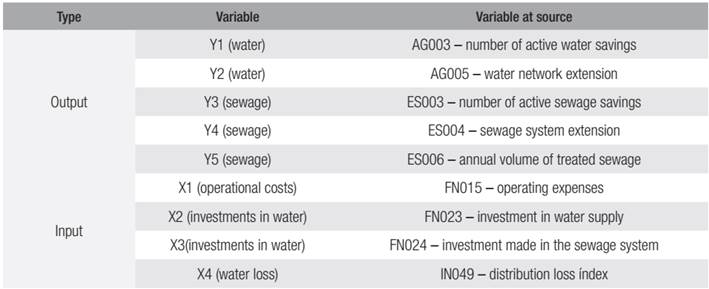
The DEA model variables shown in Box 1 are used in absolute terms, following the methodology proposed by Cruz et al. (2019b), Heinig (2021), and Medeiros and Rodrigues (2019). In the second stage, the possible variables that could influence the model are analyzed individually.

The sample was collected non-randomly, and the 86 sanitation service providers located in 83 municipalities in Santa Catarina that had complete information in the National Sanitation Information System (Sistema Nacional de Informações sobre Saneamento [SNIS]) during the period of analysis (2012 and 2020) were selected as Decision Making Units (DMUs). Initially, there were 139 municipalities with information available on SNIS for this period. However, 56 of them were discarded because they did not have information covering a minimum period of three years.
Documentary data was obtained from four sources: Casan, the state sanitation company; the website of the state regulatory agencies, in particular the Intermunicipal Sanitation Regulatory Agency (Aris) and the Santa Catarina Public Services Regulatory Agency (Aresc); the Municipal Laws website, for the collection of the PMSB and PolMSB; and the municipalities’ websites. All the municipalities in the sample have PMSBs and PolMSBs, as required by Law No. 11,445/2007. The years of enactment of these instruments, a variable used in the model, along with the treatment and control groups, are presented in a separate document (Rodrigues, 2023). The following information was extracted from the database of the Brazilian Institute of Geography and Statistics (Instituto Brasileiro de Geografia e Estatística [IBGE]): population estimate; proportion of citizens in urban areas, by municipality: regional classification.
The legal nature of the service providers is available on SNIS. During the period analyzed, in Santa Catarina there were 49 direct public administration companies, 40 autarchies, 10 private companies and 4 public companies or mixed-capital companies. Box 2 shows a brief distinction between the legal types mentioned.

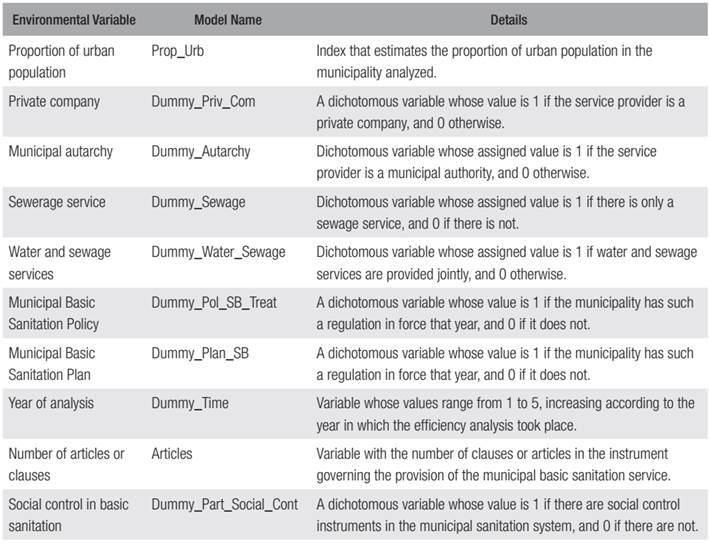
The application of the second-stage models took into account the efficiency result of the DEA analysis as the dependent variable. The variables collected in the contracts were used as independent variables, together with covariates, to control for other effects that may influence efficiency. In order to give robustness to the results obtained, different techniques widely used in DEA analysis were used. Although it was possible to use other models, we opted for those that allowed us to control for unobserved variables in measuring efficiency over time. In the case of the Tobit model, it was chosen because it is suitable for dealing with a dependent variable truncated between 0 and 1, a characteristic that makes it appropriate for circumventing the limitations inherent in the nature of the data. The DiD method was used to measure the possible causality between municipal sanitation rules (PMSB and PolMSB) and efficiency gains. The environmental variables selected to verify their effect on sanitation DMUs are shown in Box 3, and brief descriptive statistics are presented in Box 4.


3. RESULTS AND DISCUSSIONS
3.1. First stage of the DEA model
Table 1 gives an initial overview of the results.
Despite the small rise in the overall efficiency level in 2014, there was a constant reduction in the values obtained for the DEA over the period. Cruz et al. (2019a) and Heinig (2021) observed similar behavior in their studies.

In terms of the legal nature of the service provider (Figure 1), public companies and mixed-capital companies show greater efficiency. This result is controversial in the literature, since there are studies that point to greater efficiency in both the public and private sectors. Further comments on this result are made in subsection 3.3.

Regarding the efficiency obtained by segmentation of the type of service provided (Figure 2), the analysis shows that sewage service providers are the most efficient, followed by those offering water and sewage. Similar results were presented by Cruz et al. (2019b) and Medeiros and Rodrigues (2019). As for the efficiency of sewage service provision, one of the reasons for this scenario is the low level of universalization in Santa Catarina’s cities, so that the service is provided in the most productive regions, which are the urban centers.
3.2 Second stage of the DEA model
Table 2 shows the results of the Tobit model using cross-sectional data.
The expected effects are confirmed, namely: greater efficiency in municipalities with a higher proportion of urban population (Prop_Urb). This demonstrates the existence of economies of scale in the sector and the presence of economies of scope (Dummy_Sewage, Dummy_Water_Sewage), given that sanitation service providers that offer both water and sewage are more efficient. Cruz et al. (2019b) also found evidence of greater efficiency in the group of providers that supply services jointly.
In terms of the legal nature of the providers (Dummy_Priv_Comp, Dummy_Autarchy), despite not being statistically significant in all the cross-sectional models, there is an indication that, at least recently, private companies and public authorities have been less efficient. The result was different from that observed by Cruz et al. (2019b), Itaboraí (2021), and Saiani (2012): both the PMSB and the PolMSB were not relevant, which may indicate that these regulations had no effect on the provider’s efficiency.
The combination of the Tobit and Panel Data models makes it possible to assess the influence of individual and time factors on the dependent variable. Table 3 shows the results of the longitudinal analysis.
It can be seen that some of the significant variables are consistent with the findings of the cross-sectional model. Economies of scale and scope are present, with positive and significant results for the urban proportion and the joint provision of water and sewage services. Greater efficiency was found in the direct municipal management companies and in the public company. As for the regulatory instruments, the PMSB and PolMSB variables had no effect. In addition, the value of Matthews’ correlation coefficient was 0.47, indicating a moderate correlation.
Two DiD models were drawn up: one to assess the influence of the PMSB on the DEA efficiency indices and the other to observe the same effect with the PolMSB. Table 4 shows the results considering municipalities that have implemented the PMSB as the treatment group. To test the robustness of the model, the DEA index was measured using different sets of inputs. As can be seen, there is little variation in the results for the different inputs considered in the DEA model.
Some of the model’s results were similar to the previous ones, in particular confirming the existence of economies of scale and scope (Prop_Urb and Dummy_Water_Sewage). In turn, the treatment variable (DD), which verifies the causality between the implementation of the PMSB over the period and the level of efficiency of the providers, was not statistically significant, i.e. the regulatory instrument did not contribute to increasing the efficiency of the sector in Santa Catarina. On the contrary, there was a decrease in efficiency during the period analyzed, both in the treatment group and in the control group. Figure 3 illustrates the results obtained by applying this.
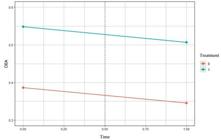
Average time trends after the implementation of the PMSB, according to the difference-in-differences method
However, there is significant evidence (Dummy_Plan_SB_Treat) that the existence of a PMSB prior to the period under analysis positively influences the efficiency of the providers in these municipalities. This result, combined with the reduction in efficiency over time, reinforces the possibility that the provisions of Law No. 11,445/2007 have not been enough to guarantee continuous efficiency gains.
Table 5 shows the last statistical analysis, which used as the treatment group the municipalities that enacted the PolMSB during the research period and as the control group those that had already sanctioned it previously.
The results presented in Table 5 reaffirm the existence of economies of scale and scope in the sanitation sector. The causality test indicated that there was no impact of implementing a PolMSB on the efficiency of the sanitation company.
3.3 Discussions
This research revealed that public companies, mixed-capital companies or direct administration demonstrate greater efficiency in service provision. Results favorable to public companies were also presented by Carvalho and Sampaio (2015), Marques and Simoes (2020), and Salazar-Adams (2021). In contrast, Cetrulo et al. (2019) and Cruz et al. (2019b) identified greater efficiency in private management.
The existence of economies of scale and scope was confirmed, which was also found in the studies by Cetrulo et al. (2019), Cruz et al. (2019b), Heinig (2021), Liduares (2022), and Medeiros and Rodrigues (2019).
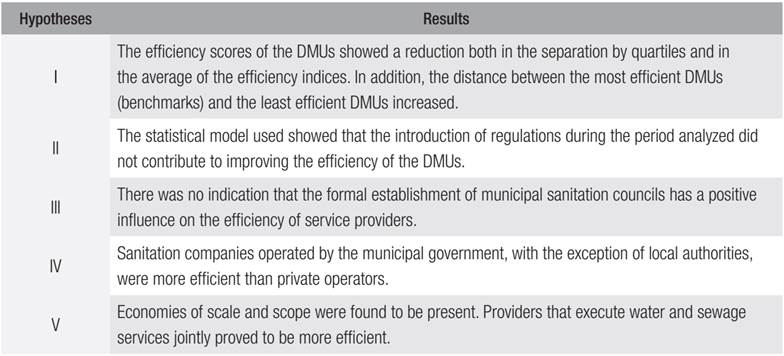
In this study, the methodology of segmenting the different forms of public management, a distinguishing feature of the research, made it possible to identify which of them is most efficient. In addition, unlike the private companies operating in Santa Catarina, public entities tend to jointly provide water and sewage services, which may favor their performance. The DEA technique was output-oriented and, considering the greater access of public entities to financing, it is suggested that the expansion of sanitation in the state is encouraged by this management structure. Another finding is the null impact of the PMSB and PolMSB on the efficiency of sanitation service providers, although there is favorable evidence that the existence of a PMSB prior to the period analyzed has a positive influence on the efficiency of the providers in these municipalities. Similar results were found by Heinig (2021) and Medeiros and Rodrigues (2019). Box 5 summarizes the results.

4. CONCLUSIONS
The aim of the article was to evaluate the results of the implementation of the PMSB and PolMSB in terms of efficiency on the part of the basic sanitation service providers in the municipalities of Santa Catarina. There was a systematic drop in efficiency rates over the period. This may indicate that the progress made under Law No. 11,445/2007 has been exhausted, making it necessary to adopt a new paradigm for the sanitation sector in order to reduce the chronic deficit that persists in Santa Catarina.
Municipalities that had previously instituted such regulations - before the period of analysis - achieved greater efficiency. These results suggest that the implementation of sanitation policies and regulations can lead to improvements in the efficiency of service providers, but the time required for their implementation is a factor to be considered.
The better performance in these localities demonstrates how the formality of a law is not enough to improve the service. It is possible that the municipalities that instituted it late only did so in order to comply with the law. There was therefore a lack of interest groups, as well as a lack of adequate technical staff to improve this public policy. Future research could analyze the content of these regulations and their drafting process.
It is also suggested that different methodologies be adopted, with models that take into account time as an influencing factor of previous regulatory instruments on efficiency, such as the staggered difference-in-difference method, as well as the inclusion of other variables, such as the assessment of water sources in each region and verification of the role of regulatory agencies.
Considering the drop in efficiency found in the survey, the institution of the New Legal Framework for Water and Sanitation Services is seen as positive, as it brings changes that boost investments in the area. The setting of universalization targets and the removal of barriers to the participation of private companies have boosted the expansion of the sector, which must be combined with efficiency gains to ensure affordable tariffs for users.
References
- Araújo, M. P. M., & Zveibil, V. Z. (2009). A relação titular-prestador nos serviços de Saneamento Básico. In B. S. Cordeiro (Org.), Lei Nacional de Saneamento Básico: Perspectivas para as políticas e gestão dos serviços públicos (Vol. 3, pp. 467-486). Ministério das Cidades.
-
Carvalho, A., & Sampaio, L. (2015). Paths to universalize water and sewage services in Brazil: The role of regulatory authorities in promoting efficient service. Utilities Policy, 34, 1-10. https://doi.org/10.1016/j.jup.2015.03.001
» https://doi.org/10.1016/j.jup.2015.03.001 - Cetrulo T. B., Marques R. C., & Malheiros T. F. (2019). An analytical review of the efficiency of water and sanitation utilities in developing countries. Water Research, 161, 372-380.
- Cruz, F., Seroa da Motta, R., & Marinho, A. (2019a, junho). Análise da Eficiência Técnica e da Produtividade dos Serviços de Água e Esgotos no Brasil de 2006 a 2013. IPEA - Pesquisa e Planejamento Econômico (PPE), 49(3), 81-106.
- Cruz, F., Seroa da Motta, R., & Marinho, A. (2019b). Eficiência Técnica dos Serviços de água e esgoto no Brasil por tipo de atuação e gestão. Econômica, 21(1), 45-63.
- Goh, K. H., & Se, K. F. (2021). Twenty years of water utility benchmarking: A bibliometric analysis of emerging interest in water research and collaboration. Journal of Cleaner Production, 284, 124711.
- Heinig, D. (2021). Avaliação de Políticas Públicas de Saneamento: a instituição do plano municipal de saneamento e o impacto na eficiência dos serviços de abastecimento de água em municípios catarinenses de pequeno porte (Dissertação de Mestrado). Universidade Tecnológica Federal do Paraná, Curitiba, PR, Brasil.
- Instituto Brasileiro de Geografia e Estatística. (2021). Índice de Atividades Turísticas Coordenação de População e Indicadores Sociais.
- Itaboraí, G. (2021). Impacto de indicadores socioeconômicos e estrutura contratual nos índices de cobertura de saneamento da Região Sudeste (Dissertação de Mestrado). Fundação Getulio Vargas, Rio de Janeiro, RJ, Brasil.
-
Lei nº 11.445, de 05 de janeiro de 2007 (2007). Estabelece as diretrizes nacionais para o saneamento básico; cria o Comitê Interministerial de Saneamento Básico; altera as Leis nos 6.766, de 19 de dezembro de 1979, 8.666, de 21 de junho de 1993, e 8.987, de 13 de fevereiro de 1995; e revoga a Lei nº 6.528, de 11 de maio de 1978. https://www.planalto.gov.br/ccivil_03/_ato2007-2010/2007/lei/l11445.htm
» https://www.planalto.gov.br/ccivil_03/_ato2007-2010/2007/lei/l11445.htm - Liduares, T. Q. (2022). Economias de escala na prestação regionalizada dos serviços de saneamento básico (Dissertação de Mestrado). Universidade de São Paulo, Ribeirão Preto, SP, Brasil.
- Lisboa, S. S., Heller, L., & Silveira, R. B. (2013). Desafios do planejamento municipal de saneamento básico em municípios de pequeno porte: a percepção dos gestores. Engenharia Sanitária e Ambiental, 18, 341-348.
- Marques, R. C., & Simões, P. (2020). Revisiting the Comparison of Public and Private Water Service Provision: An Empirical Study in Portugal. Water, 12, 1477.
- Medeiros, V., & Rodrigues, C. (2019). Políticas Públicas Municipais, Universalização e Eficiência no Setor de Saneamento Básico: uma análise para os municípios mineiros (Planejamento e Políticas Públicas, n. 53). Instituto de Pesquisa Econômica Aplicada.
-
Ponciano, F., Motta, R., & Marinho, A. (2019). Análise da Eficiência Técnica e da Produtividade dos Serviços de Água e Esgotos no Brasil de 2006 a 2013 (Pesquisa e Planejamento Econômico, n. 49). Instituto de Pesquisa Econômica Aplicada. https://repositorio.ipea.gov.br/handle/11058/9769
» https://repositorio.ipea.gov.br/handle/11058/9769 - Pontes, R. (2019). Impactos do Planejamento e da Regulação no Desempenho das Empresas do Setor de Saneamento (Tese de Doutorado). Universidade Federal de Viçosa, Viçosa, MG, Brasil.
-
Rodrigues, A. F. (2023). Impacto de instrumentos regulatórios prévios na eficiência dos prestadores de serviço de saneamento básico: um estudo com municípios de Santa Catarina (Tese de Doutorado). Universidade do Estado de Santa Catarina, Florianópolis, SC, Brasil. https://sistemabu.udesc.br/pergamumweb/vinculos/0000ac/0000acb3.pdf
» https://sistemabu.udesc.br/pergamumweb/vinculos/0000ac/0000acb3.pdf - Saiani, C. (2012). Competição política faz bem à saúde? Evidências dos determinantes e dos efeitos da privatização dos serviços de saneamento básico no Brasil (Tese de Doutorado). Fundação Getulio Vargas, São Paulo, SP, Brasil.
- Salazar-Adams, A. (2021). The efficiency of post-reform water utilities in Mexico. Utilities Policy, 68, 101153.
-
Sistema Nacional de Informações sobre Saneamento. (2021). Diagnóstico Temático: serviços de água e esgoto Visão Geral - ano de referência 2020 https://www.gov.br/cidades/pt-br/acesso-a-informacao/acoes-e-programas/saneamento/snis/produtos-do-snis/diagnosticos/DIAGNOSTICO_TEMATICO_VISAO_GERAL_AE_SNIS_2023.pdf
» https://www.gov.br/cidades/pt-br/acesso-a-informacao/acoes-e-programas/saneamento/snis/produtos-do-snis/diagnosticos/DIAGNOSTICO_TEMATICO_VISAO_GERAL_AE_SNIS_2023.pdf -
Sistema Nacional de Informações sobre Saneamento. (2022). Glossário de Informações - Água e Esgotos https://www.gov.br/cidades/pt-br/acesso-a-informacao/acoes-e-programas/saneamento/snis/produtos-do-snis/diagnosticos/Glossario_Informacoes_AE2022.pdf
» https://www.gov.br/cidades/pt-br/acesso-a-informacao/acoes-e-programas/saneamento/snis/produtos-do-snis/diagnosticos/Glossario_Informacoes_AE2022.pdf
ACKNOWLEDGMENTS
Reviewers:
Edited by
The data set that supports the results of this study is not publicly available.

 Source: Research data
 Source: Adapted from
  Source: Research data.
 Source: Research data.
 Source: Based on data from SNIS (2022).
 Source: Based on SNIS data (2022).
 Source: Based on data from IBGE (2021) and SNIS (2021).
 Source: Elaborated by the authors.