 Distribution of the diplomatic career across Brazilian embassies (1994-2022) Leopoldo Mateus da Silva Ribeiro
Abstract
This study investigates the capacity of Brazilian diplomats in Brazilian embassies around the world between 1994 and 2022. Data requested from the Ministry of Foreign Affairs by the Integrated Platform for Ombudsmanship and Access to Information (Fala.BR) was used. The data was tabulated, and the embassies with diplomats were grouped into five regions: Africa, America/Caribbean, Asia/Oceania, Europe, and the Middle East. The results demonstrated that, despite the strong increase in the number of embassies in Africa during the period, the proportion of diplomats in African embassies remained significantly lower compared to other regions. While the average number of diplomats in embassies in Africa with a career member assigned was always less than three, in Europe, it reached almost six, and in America/Caribbean, it exceeded this number. The results also demonstrated a strong growth trend in the number of diplomats stationed in embassies in America/Caribbean in the first terms of Fernando Henrique Cardoso (26%), Luiz Inácio Lula da Silva (29%), and Dilma Rousseff (25%), and a slow but permanent increase in the number of embassies with diplomats stationed in Asia/Oceania between 1994 and 2018 (10 to 24).
Keywords:
diplomats; embassies; Itamaraty
Resumo
Este estudo tem como objetivo investigar a lotação dos diplomatas brasileiros nas embaixadas do Brasil ao redor do mundo entre 1994 e 2022. Para tal, foram utilizados dados solicitados ao Ministério das Relações Exteriores pela Plataforma Integrada de Ouvidoria e Acesso à Informação (Fala.BR). Procedeu-se à tabulação dos dados e, também, ao agrupamento das embaixadas com diplomatas em cinco regiões: África, América/Caribe, Ásia/Oceania, Europa e Oriente Médio. Os resultados demonstraram que, a despeito da forte ampliação no número de embaixadas na África, no período, a proporção de diplomatas em embaixadas africanas continuou significativamente inferior em comparação com a das demais regiões. Enquanto a média de diplomatas em embaixadas da África em que havia algum membro da carreira lotado foi sempre inferior a três, na Europa alcançou quase seis e na América/Caribe superou esse número. Os resultados também demonstraram forte tendência de crescimento no número de diplomatas lotados em embaixadas na América/Caribe nos primeiros mandatos de Fernando Henrique Cardoso (26%), Luiz Inácio Lula da Silva (29%) e Dilma Rousseff (25%), e uma lenta, mas permanente ampliação no número de embaixadas com diplomatas lotados na Ásia/Oceania entre 1994 e 2018 (10 para 24).
Palavras-chave:
diplomatas; embaixadas; Itamaraty
Resumen
Este estudio tiene como objetivo investigar la asignación de los diplomáticos brasileños a las embajadas de Brasil en todo el mundo entre 1994 y 2022. Para ello, se utilizaron datos solicitados al Ministerio de Relaciones Exteriores por la Plataforma Integrada de Defensoría del Pueblo y Acceso a la Información (Fala.BR). Se tabularon los datos y se agruparon las embajadas con diplomáticos en cinco regiones: África, América/Caribe, Asia/Oceanía, Europa y Medio Oriente. Los resultados demostraron que, a pesar del fuerte aumento en el número de embajadas en África durante el período, la proporción de diplomáticos en las embajadas africanas siguió siendo significativamente menor en comparación con la de las otras regiones. Mientras que el número promedio de diplomáticos en las embajadas en África donde había un miembro de carrera asignado fue siempre inferior a tres, en Europa llegó a casi seis y en América/Caribe superó este número. Los resultados también demostraron una fuerte tendencia de crecimiento en el número de diplomáticos destinados en embajadas en América/Caribe durante los primeros mandatos de Fernando Henrique Cardoso (26%), Luiz Inácio Lula da Silva (29%) y Dilma Rousseff (25%), y un aumento lento pero permanente en el número de embajadas con diplomáticos asignados a Asia/Oceanía entre 1994 y 2018 (de 10 a 24).
Palabras clave:
diplomáticos; embajadas; Itamaraty
1. INTRODUCTION
Diplomats are civil servants of the Ministry of Foreign Affairs (MRE) responsible for diplomatic and consular activities, carried out through “[...] representation, negotiation, information, and protection of Brazilian interests in the international arena” (Law No. 11,440/2006, art. 3). According to Cheibub (1989, p. 97), diplomats are a professional group of the State that became gradually stronger throughout Brazilian history, due to “[...] certain aspects of the very process of formation of the Brazilian national State and, on the other hand, to factors regarding the evolution of both Brazilian diplomacy and the Ministry of Foreign Affairs”.
As members of an institution, diplomats “[...] tend to gain increasing autonomy both regarding the social system, and particular segments of this system and of the state apparatus itself” (Cheibub, 1985, p. 114). This situation increases their “[...] initiative to formulate and implement foreign policy while providing them with a certain capacity to ensure the continuity of this policy over time, by resisting sudden changes”.
The creation of the Rio Branco Institute (IRBr) in 1945 was one of the great historical milestones in the professionalization of diplomats. Approval in the public tender organized by IRBr enables entering the initial class of diplomacy and registration in the training course run by the institute (Law No. 11,440/2006, art. 35). Those approved begin their career in the position of third secretary, attend the course for two years, and are subject to a promotion structure that “[...] occurs every six months through a complex system that combines seniority and merit” (Lima, 2019, p. 491).
Some studies have addressed the profile of selection and career entrants. Bodine and Giannattasio (2022, p. 654) showed a recent change in selection by analyzing the period 1995-2015. In the first ten years, the exams selected “[...] candidates through ‘general culture’ questions, which emphasized a certain ‘cultural heritage’ considered as a sign of social distinction”. In the second half of the period, there was a standardization of new questions, “[...] moving away from the tacit demands of cultural refinement”. Lima and Oliveira (2018, p. 797) analyzed the social profiles and career patterns of the Brazilian diplomatic corps by using Cheibub’s study (1989) as a comparative reference. The results indicated that, among those admitted, there was an increase in the age group, a change in the proportion regarding the place of birth - with fewer born in Rio de Janeiro and more in São Paulo - and a growth in the number of graduates from University of São Paulo (USP) and University of Brasília (UnB), especially bachelors of law.
However, few studies have analyzed the distribution of Brazilian diplomats worldwide. Therefore, this study aimed to analyze variations in the distribution of members of the diplomatic career among Brazilian embassies, between 1994 and 2022, in order to understand in which regions of the world there was an increase or decrease in Brazilian diplomatic representation, and whether these changes were directly linked or not to an increase or reduction in the number of representations in different regions.
Brazilian embassies were divided in five regions, which had the following shares in the Brazilian trade balance between 2007 and 2017, according to Macan and Zilli (2019, p. 9): America/Caribbean: 34.5%; Asia/Oceania: 30.4%; Europe: 24.6%; Africa: 5.6%; and Middle East: 4%. The “undeclared country” classification accounted for 1%.
The role of embassies is to “[...] ensure the preservation of Brazil’s relations with State Governments”, and their main functions are “[...] representation, negotiation, information, and protection of Brazilian interests” (Decree No. 11,357/2023, Annex I, art. 57); that is, the exact attributions of the diplomatic career. They can also be assigned to carry out consular services.
Two other careers make up the Brazilian Foreign Service (SEB), but they have very different competencies from MRE’s main career. While chancellery officers carry out activities related to technical analysis and administrative management, chancellery assistants conduct technical and administrative support tasks (Law No. 11,440/2006).
2. METHOD
We used data referring to the overall number of members of the diplomatic career assigned to Brazilian embassies between 1994 and 2022, which we requested to MRE through the Integrated Platform for Ombudsman and Information Access (Fala.BR), a system by which the federal government answers requests for information, according to the Access to Information Act (LAI) (Law No. 12,527/2011).
Given that this study’s goal was to investigate the evolution of the distribution of Brazilian diplomats in embassies over that period, the request only included the number of these civil servants actually working at the embassies. No information was asked about the acting ambassadors, because, in addition to the fact that it is not compulsory to be a member of the diplomatic career to hold this position, it is a commissioned post whose appointment is up to the President of the Republic, with prior approval of the Federal Senate (Law No. 11,440/2006).
We tabulated the sent data and grouped embassies by world regions (Africa, America/Caribbean, Asia/Oceania, Europe, and Middle East). This division followed the classification used by the Alexandre Gusmão Foundation (FUNAG), an institution supervised by the Ministry of Foreign Affairs, responsible for “[...] carrying out and promoting studies and research on problems regarding international relations” (Law No. 5,717/1971, art. 1). For systematization purposes, data were analyzed by region in four-year periods, taking presidential terms as a reference to show the configuration of positions at the beginning and end of each period. Due to the impeachment of President Dilma Rousseff in 2016, and her replacement by Vice-president Michel Temer, we exceptionally analyzed that year’s data.
3. RESULTS
2.1. Initial scenario (1994)
At the end of 1994, there were Brazilian diplomats working in 82 embassies, more than half located in America/Caribbean or in Europe. These two regions also had more diplomats: 108 in the first and 120 in the second.

There was a clear disproportion between the number of diplomats in Africa and the two regions with most embassies. While the average number of diplomats per embassy in America/Caribbean was around five, and in Europe exactly five, in Africa the average was less than two diplomats per embassy with representation.
At the end of 1994, the Brazilian embassies with most diplomats were Washington (United States), with 21, and London (United Kingdom), with 15.
2.2. Fernando Henrique Cardoso Administration (1995-2002)
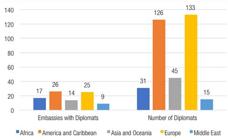
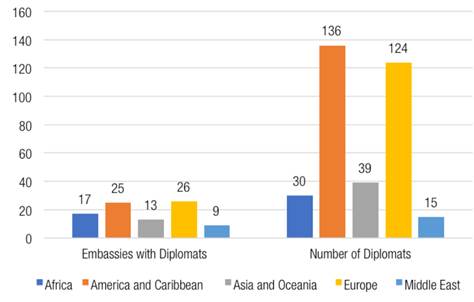
At the end of the first Fernando Henrique Cardoso (FHC) administration, the largest percentage increase in the number of embassies with diplomats occurred in Asia/Oceania (30%), rising from 31 to 39 diplomats (Graph 2).

There was a significant increase in America/Caribbean: the number of diplomats exceeded the total number in the European continent. Although the number of embassies with diplomats in the region had only increased from 22 to 25, the number of active diplomats rose from 108 to 136, a rise of 26%. This growth was driven especially by the increase in the number of diplomats based in Asunción (Paraguay) - from 4 to 11 -, La Paz (Bolivia) - from 4 to 7 -, and Lima (Peru) - from 3 to 6.
Such an expansion seems to be in line with the FHC government’s foreign policy priorities. As Vigevani et al. (2003, p. 39) explain, “[...] foreign policy had as its central axis, kept throughout the eight years of government, the rhetoric of strengthening Mercosur, and, especially in the second term, the relations with South America”.
Based on data sent by MRE and the tabulations made in 1998, there is a second embassy in Rome, called “Embassy in Rome/FAO”. Since this is in fact the Brazilian representation of the Food and Agriculture Organization of the United Nations (FAO), this information was not considered. The other Brazilian representations of international bodies sent separately by MRE were also excluded from the analysis.
By the end of the second FHC term, there was no significant change in Africa and Middle East. However, in Asia/Oceania the number of diplomats working showed a continuous growth, from 39 to 45. There was also a reversal in the figures for America/Caribbean and Europe: while America/Caribbean became the region with most diplomats in embassies, Europe once again exceeded it in terms of number of diplomats. In 2002, there were 91 embassies worldwide with diplomats on duty.
2.3. Lula da Silva Administration (2003-2010)
During the first Lula government (2003-2006), there were major changes in the distribution of members of the Brazilian diplomatic career among the embassies. This change was partly due to the increase in the number of Brazilian embassies in African countries. In that period, in addition to reopening embassies that had been closed during FHC’s term, the government “[...] opened diplomatic representations and a consulate-general, totaling 13 new posts, which increased the Brazilian diplomatic presence in the African continent from 18 to 30 embassies” (Ribeiro, 2010, p. 70).
However, proportionally, despite the increased presence of Brazilian diplomats in Africa, the disparity with America/Caribbean and Europe remained quite significant. At the end of 2006, there were only 57 Brazilian diplomats distributed in 26 embassies in Africa, while there were 163 in 27 embassies in America/Caribbean and 123 in 25 European embassies.

In percentage, although the number of embassies in these three regions was similar at the time, the distribution of Brazilian diplomats was as follows: 38% in America/Caribbean; 29% in Europe; and only 13% in Africa, a lower percentage than Asia/Oceania (14%), which had only sixteen embassies.
The growth in the number of diplomats in America/Caribbean embassies is another highlight of Lula’s first government. Although only one new embassy in the region received a diplomat, the number of career members increased from 126 to 163 (29%). This growth is mainly because the number of diplomats in the Buenos Aires embassy doubled in four years (from 13 to 26), and there was a 50% increase in the representation of in Bogotá (Colombia) and Mexico City (Mexico). Amorim (2010, p. 227) explains that, during Lula administration, South American integration was “[...] the main priority of Brazilian foreign policy”; no wonder Mercosur’s share of Brazilian foreign trade outperformed that of the United States.
During the second Lula administration (2007-2010), there was a significant increase in the number of embassies with diplomats in Africa, as well as in America/Caribbean, Asia/Oceania, and Europe. By the end of 2010, there were 123 embassies with diplomats, which shows an increase of 35% compared to the percentage at the end of 2002.
However, the uneven distribution between regions remained high. While in Africa the average number of diplomats per embassy was almost two, in Europe, where only three new embassies had received diplomats, there was an increase of 31 professionals in four years. This expansion can be explained by the significant rise in the number of diplomats in embassies such as Paris (France), which went from 9 to 19, and Moscow (Russia), from 9 to 13 diplomats.

An interesting phenomenon was also observed in America/Caribbean. Despite showing the biggest growth in the number of embassies with diplomats working between 2006 and 2010 - from 27 to 33 -, the number of representatives in the region decreased slightly. The rise in the number of embassies was mainly due to the creation of new Brazilian representations in the region during Lula administration (Amorim, 2010).
Another highlight is the growth in the number of embassies with diplomats in Asia/Oceania, which rose from 16 to 20, between 2006 and 2010. However, the total amount of diplomats in the region’s embassies also decreased - from 61 to 57.
2.4. Dilma Rousseff-Michel Temer Administration (2011-2018)
In the first Dilma Rousseff term, there was an increase in the number of embassies with diplomats in Asia/Oceania (from 20 to 23) and Europe (from 28 to 32). However, a trend observed in the first governments of presidents Lula (2003-2006) and FHC (1995-1998) was also evident in the first Dilma government (2011-2014): a large expansion in the number of Brazilian diplomats in America/Caribbean.

In the first FHC administration, there was a 26% increase in the number of diplomats in the America/Caribbean region; in the first Lula term, the growth was 29%, and during the first Dilma government, 25%. Between the end of 2010 and of 2014, the main factor was the increase in the number of diplomats at the embassies in Santiago (Chile), from 5 to 12, and Montevideo (Uruguay), from 6 to 11. However, during Dilma’s first term, “[...] Brazilian behavior towards South America showed changes and a visible reduction in regional activism” (Saraiva & Gomes, 2016, p. 82).
The two largest proportional expansions occurred in Asia/Oceania, with a 51% rise in the number of diplomats, and in Middle East, with a 38% increase. The main contributors to this growth were New Delhi (India), from 4 to 9 diplomats, and Tokyo (Japan), from 7 to 11. In the Middle East, there was an increase in the number of diplomats in Abu Dhabi (United Arab Emirates), from 2 to 5, and in Tehran (Iran), from 1 to 5.
In 2016, following the impeachment of President Dilma, vice-president Michel Temer took office until the end of 2018. Data analysis for 2016 indicates that, during Temer’s administration, the main trends observed in the 2015-2016 biennium were kept during 2017-2018: an increase in the number of diplomats in Africa, Asia/Oceania and Middle East.
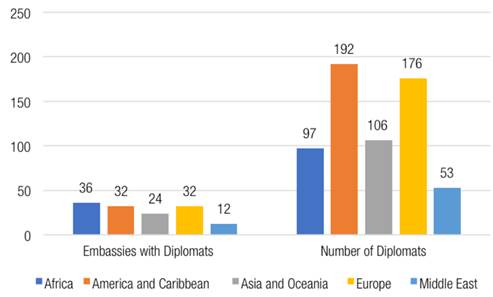
From 2014 to 2016, the number of diplomats in African embassies rose from 69 to 82, and from 2016 to 2018, from 82 to 97. In the first two years, only one new embassy in the region received a diplomat; in the second, three more were added. In Asia/Oceania, the rise in the number of diplomats was from 86 to 93 in the first biennium, and from 93 to 106 in the second, although just one new embassy received diplomats in the region over these four years. In the Middle East, although the number of embassies with diplomats remained the same in 2014, 2016, and 2018, the number of diplomats in the region grew from 36 to 43 between 2014 and 2016, and up to 53 between 2016 and 2018 - an increase of 47% in four years.

2.5. Jair Bolsonaro Administration (2019-2022)
At the end of 2018, Brazilian embassies had 624 diplomats located around the world; by the end of 2022, the amount had fallen to 583. There was a decrease in the number of diplomats in all regions analyzed, except for Europe - an increase from 176 to 184.
During Bolsonaro’s administration, there was also a decrease in the number of embassies with diplomats, in three of the five regions. In Africa, there was a drop from 36 to 33; in America/Caribbean, from 32 to 28; and in Asia/Oceania, from 24 to 23. This reduction was the consequence of closing some Brazilian embassies in Africa and America/Caribbean during that period (Decree No. 10,348/2020).

In America/Caribbean, there was the biggest reduction in the number of diplomats, with a drop from 13 to 10 in Bogotá (Colombia), and from 8 to 0 in Caracas (Venezuela), with the embassy closing in 2020.
4. CONCLUSION
The analysis of the variation in the number of Brazilian diplomats working in the period 1994-2022 enabled several conclusions. The first is that, despite the strong growth in the number of Brazilian embassies in Africa during that period, the proportional number of diplomats assigned to the region remained lower than in the other regions.
At the beginning of the analyzed period, in 1994, the number of embassies with diplomats in Africa was lower than the total number of embassies in Europe and America/Caribbean, and the average proportion of diplomats per embassy with representation was even lower. At that time, their average number in Africa was less than two, while in America/Caribbean and Europe it was around five.
During Lula’s administration, while the number of embassies with diplomats in Africa exceeded that of Europe, and practically reached the same level as America/Caribbean, the number of diplomats did not show similar growth. In America, the average number of diplomats reached six per embassy, while in Africa it was around two. In other words, although the relations between Brazil and Africa had achieved “[...] a prominent role in the foreign policy framework developed by the Luiz Inácio Lula da Silva administration” (Ribeiro, 2010, p. 55), the career responsible for embassies’ main activities remained with an average representation well below other continents.
The number of embassies in Africa continued to grow and, in the transition from Dilma’s government to Temer’s, it became the region with the most embassies with diplomats. However, embassies in Africa have never reached at least three diplomats, on average. In the case of America/Caribbean and Europe, the average remained around five or six. In other words, the growth in the number of Brazilian embassies in Africa was not sufficient to change the scenario of low career representation in that continent.
A second conclusion concerns the phenomenon of the strong growth in the number of diplomats assigned to America/Caribbean in the first mandates of the three presidents that were re-elected. In the first FHC government, there was a 26% increase, with growth mainly in South American countries, which was in line with its foreign policy (Vigevani et al., 2003). During the first Lula government, the 29% increase was also aligned with the priorities of the Brazilian foreign policy regarding South America (Amorim, 2010), since there was a large increase in representation, for example, in Argentina and Colombia. As for Dilma’s administration, the 25% increase does not seem to be the result of a foreign policy pillar, since there was a visible reduction of Brazilian activism in South America during that period, and some of the countries that most increased their number of diplomats were Chile and Uruguay (Saraiva & Gomes, 2016).
A third conclusion shows the slow but systematic growth in the number of embassies with diplomats in Asia/Oceania. This region was the only one among the five that increased the number of embassies with diplomats, in all graphs analyzed between 1994 and 2018, from 10 in 1994 to 24 in 2018. This movement is possibly related to the increased economic relevance of Asia for Brazil in recent decades, since the number of embassies in the region was much lower, even compared to regions with a smaller share in the Brazilian trade balance (Macan & Zilli, 2019).
There are also unique conclusions relating to specific governments. Under FHC’s administration, there was a significant increase in the number of Brazilian diplomats assigned to Asia/Oceania, with a percentage increase of almost 45%. Under Lula’s administration, the growth in the number of embassies in Asia/Oceania and Africa was not sufficient to effectively approach the average number of diplomats in those two regions to that of America/Caribbean and Europe. Under Dilma/Temer’s government, there was an increase in the number of diplomats in Africa, Asia/Oceania, and Middle East. Finally, under Bolsonaro’s government, while only in Europe was there a rise in the number of diplomats, there was a reduction in the number of embassies with representation, mainly in Africa and America/Caribbean.
References
-
Amorim, C.(2010) A política externa brasileira no governo do presidente Lula (2003-2010): uma visão geral. Revista Brasileira de Política Internacional, 53(Especial), 214-240. https://doi.org/10.1590/S0104-44782010000100005
» https://doi.org/10.1590/S0104-44782010000100005 - Bodine, C. S., & Giannattasio, A. R. C. (2022). O papel da herança cultural nos processos de ingresso na carreira diplomática brasileira entre 1995-2015. Revista de Administração Pública, 56(5), 654-682. https://doi.org/10.1590/0034-761220220076
-
Cheibub, Z. B. (1985). Diplomacia e construção institucional: o Itamaraty em uma perspectiva histórica. Dados - Revista de Ciências Sociais, 28(1), 113-131. https://edisciplinas.usp.br/mod/resource/view.php?id=3089790&forceview=1
» https://edisciplinas.usp.br/mod/resource/view.php?id=3089790&forceview=1 -
Cheibub, Z. B. (1989). A carreira diplomática no Brasil: o processo de burocratização do Itamaraty. Revista de Administração Pública, 23(2), 97-128. https://periodicos.fgv.br/rap/article/view/9157/8261
» https://periodicos.fgv.br/rap/article/view/9157/8261 -
Decreto nº 11.357, de 1º de janeiro de 2023 (2023). Aprova a Estrutura Regimental e o Quadro Demonstrativo dos Cargos em Comissão e das Funções de Confiança do Ministério das Relações Exteriores e remaneja cargos em comissão e funções de confiança. Brasília, DF. https://www.planalto.gov.br/ccivil_03/_ato2023-2026/2023/decreto/D11357.htm
» https://www.planalto.gov.br/ccivil_03/_ato2023-2026/2023/decreto/D11357.htm -
Decreto nº 10.348, de 13 de maio de 2020 (2020). Estabelece cumulatividades de Embaixadas do Brasil no Caribe e na África. Brasília, DF. https://www.planalto.gov.br/ccivil_03/_ato2019-2022/2020/decreto/d10348.htm
» https://www.planalto.gov.br/ccivil_03/_ato2019-2022/2020/decreto/d10348.htm -
Lei nº 5.717, de 26 de outubro de 1971 (1971). Autoriza a criação da Fundação Alexandre de Gusmão. Brasília, DF. https://www.planalto.gov.br/ccivil_03/leis/1970-1979/l5717.htm
» https://www.planalto.gov.br/ccivil_03/leis/1970-1979/l5717.htm -
Lei nº 11.440, de 29 de dezembro de 2006 (2006). Institui o Regime Jurídico dos Servidores do Serviço Exterior Brasileiro, altera a Lei nº 8.829, de 22 de dezembro de 1993, que cria, no Serviço Exterior Brasileiro, as Carreiras de Oficial de Chancelaria e de Assistente de Chancelaria, altera a Lei nº 8.829, de 22 de dezembro de 1993; revoga as Leis nºs 7.501, de 27 de junho de 1986, 9.888, de 8 de dezembro de 1999, e 10.872, de 25 de maio de 2004, e dispositivos das Leis nºs 8.028, de 12 de abril de 1990, 8.745, de 9 de dezembro de 1993, e 8.829, de 22 de dezembro de 1993; e dá outras providências. Brasília, DF. https://www.planalto.gov.br/ccivil_03/_ato2004-2006/2006/lei/l11440.htm
» https://www.planalto.gov.br/ccivil_03/_ato2004-2006/2006/lei/l11440.htm -
Lei nº 12.527, de 18 de novembro de 2011 (2011). Regula o acesso a informações previsto no inciso XXXIII do art. 5º, no inciso II do § 3º do art. 37 e no § 2º do art. 216 da Constituição Federal; altera a Lei nº 8.112, de 11 de dezembro de 1990; revoga a Lei nº 11.111, de 5 de maio de 2005, e dispositivos da Lei nº 8.159, de 8 de janeiro de 1991; e dá outras providências. Brasília, DF. http://www.planalto.gov.br/ccivil_03/_ato2011-2014/2011/ lei/l12527.htm
» http://www.planalto.gov.br/ccivil_03/_ato2011-2014/2011/ lei/l12527.htm -
Lima, R. C., & Oliveira, A. J. S. N. (2018). Manutenção e mudanças no Ministério das Relações Exteriores: perfis do corpo diplomático e padrões na carreira. Revista de Administração Pública, 52(5), 797-821. https://doi.org/10.1590/0034- 7612175199
» https://doi.org/10.1590/0034- 7612175199 -
Lima, Z. B. (2019). Burocratas, carreira e diplomacia: uma análise das trajetórias da elite do Ministério das Relações Exteriores. Revista do Serviço Público, 70(3), 486-510. Recuperado de https://repositorio.enap.gov.br/handle/1/5418
» https://repositorio.enap.gov.br/handle/1/5418 -
Macan, K., & Zilli, J. C. (2019). A dinâmica e as perspectivas dos negócios com o Oriente Médio. In Anais do 3º Congresso Sul Catarinense de Administração e Comércio Exterior, Criciúma, SC, Brasil. https://periodicos.unesc.net/ojs/index.php/admcomex/article/view/5229
» https://periodicos.unesc.net/ojs/index.php/admcomex/article/view/5229 -
Ministério das Relações Exteriores. (2024). Dados enviados pelo Ministério das Relações Exteriores para a Plataforma Integrada de Ouvidoria e Acesso à Informação (Fala.BR) https://falabr.cgu.gov.br
» https://falabr.cgu.gov.br -
Ribeiro, C. O. (2010). A política africana do Brasil no pós-Guerra Fria. Revista de Sociologia e Política, 18(35), 55-79. https://doi.org/10.1590/S0104-44782010000100005
» https://doi.org/10.1590/S0104-44782010000100005 -
Saraiva, M., & Z. S. B. Gomes. (2016). Os limites da política externa de Dilma Rousseff para a América do Sul. Relaciones Internacionales, 25(50), 81-97. https://revistas.unlp.edu.ar/RRII-IRI/article/view/2677/2494
» https://revistas.unlp.edu.ar/RRII-IRI/article/view/2677/2494 -
Vigevani, T., Oliveira, M. F. de, & Cintra, R. (2003). Política externa no período FHC: a busca de autonomia pela integração. Tempo Social, 15(2), 31-61. https://doi.org/10.1590/S0103-20702003000200003
» https://doi.org/10.1590/S0103-20702003000200003
The data set supporting the results of this study is not publicly available.

 Source: Ministério das Relações Exteriores (
 Source: Ministério das Relações Exteriores (
 Source: Ministério das Relações Exteriores (
 Source: Ministério das Relações Exteriores (
 Source: Ministério das Relações Exteriores (2024).
 Source: Ministério das Relações Exteriores (
 Source: Ministério das Relações Exteriores (2024).
 Source: Ministério das Relações Exteriores (