 Public inquiries and (historical) organizational research: contributions and methodological challenges
Abstract
Public inquiries offer a valuable data source for management research, particularly in understanding the challenges faced during significant events such as disasters or scandals. This study proposes a framework that positions public inquiries as both data sources and research roadmaps, addressing their results, discursive practices, and power dynamics. It also emphasizes the relevance of studying public inquiries and their reports for scholars concerned with organizational history. We present the roadmap proposal, a guide for researchers when using public inquiries as a data source, and as an essential component of the study. However, using public inquiries presents challenges, as various forces shape them and they should not be taken at face value. By examining the contributions and methodological challenges of using public inquiries in academic research, this study aims to foster their use in management research, particularly in contexts where collaboration between organizations and academia is limited.
Keywords:
public inquiry method; historical organizational research; parliamentary inquiry commission; events.
Resumo
Os inquéritos públicos oferecem uma fonte de dados valiosa para a pesquisa em administração, especialmente para compreender os desafios enfrentados durante eventos significativos, como desastres ou escândalos. Este estudo propõe um framework que posiciona os inquéritos públicos não apenas como fontes de dados, mas também como roadmaps, abordando seus resultados, práticas discursivas e dinâmicas de poder. O trabalho também enfatiza a relevância de inquéritos públicos e seus relatórios para pesquisadores interessados na história organizacional. Apresentamos a nossa proposta metodológica, um guia que serve como base para que pesquisadores utilize os inquéritos públicos como uma fonte de dados, mas também como um componente essencial do próprio estudo. No entanto, o uso desses inquéritos públicos também apresenta desafios, pois eles são moldados por diversas forças e não devem ser tomados ao pé da letra. Ao examinar as contribuições e os desafios metodológicos do uso de inquéritos públicos na pesquisa acadêmica, este estudo busca incentivar seu uso em administração, especialmente em contextos em que a colaboração entre organizações e academia é limitada.
Palavras-chave:
método inquérito público; pesquisa organizacional histórica; comissão parlamentar de inquérito; eventos.
Resumen
Las investigaciones públicas ofrecen una valiosa fuente de datos para la investigación en administración, especialmente para comprender los desafíos enfrentados durante eventos significativos como desastres o escándalos. Este estudio propone un marco que posiciona las investigaciones públicas no solo como fuentes de datos, sino también como hojas de ruta, abordando sus resultados, prácticas discursivas y dinámicas de poder. Asimismo, se destaca la relevancia de estudiar las investigaciones públicas y sus informes para los investigadores interesados en la historia organizacional. Presentamos nuestra propuesta metodológica, un roadmap que sirve como base para que los investigadores utilicen las investigaciones públicas como una fuente de datos, y también como un componente esencial del propio estudio. Sin embargo, el uso de estas investigaciones presenta desafíos, ya que están moldeadas por diversas fuerzas y no deben tomarse al pie de la letra. Al examinar los aportes y desafíos metodológicos del uso de las investigaciones públicas en la investigación académica, este estudio busca fomentar su utilización en la investigación en administración, especialmente en contextos donde la colaboración entre organizaciones y la academia es limitada.
Palabras clave:
método investigación pública; investigación organizacional histórica; comisión parlamentaria de investigación; eventos.
1. INTRODUCTION
Public inquiries are investigative processes that can be conducted by various types of organizations, such as States. According to Elliot and McGuinness (2002) these investigative procedures generally aim to uncover “the truth” about a particular fact, topic, or event, providing a sense of closure or comfort to those affected, and pursue the attribution of responsibility to those deemed accountable. However, since Gephart’s (1992) seminal work, scholars have recognized that public inquiries are complex processes in which truth and fact-finding are contested and shaped by various power dynamics (Ainsworth & Hardsy, 2012; Brown, 2000, 2004). Public inquiries provide multi-vocal, temporally-structured accounts, enabling longitudinal insights that capture organizational crises’ immediate and residual effects on stakeholders. Public inquiries, like any discourse, are shaped by sub-repetitious forces. The construction of meaning is made by the interplay between the text, author, and reader (Brown, 2004), so it should not be taken at face value.
In management and organization studies, public inquiries are typically examined for their role in legitimizing organizations after crises (Brown, 2004; Gephart, 2007). Because they are often conducted after significant events, such as disasters or scandals, they can provide information on multiple agents connected to these instances. Mostly, this data would be unavailable to researchers. For instance, the sources would not be willing to speak up, or the timeframe to develop a project and start fieldwork would make it challenging to gather the same data.
We argue that public inquiries are a rich data source for academic research, particularly in management and organization studies. Yet, their potential as comprehensive research frameworks remains underexplored. We focus on the public inquiry process as an object of reflection, the reports as memory artifacts, and the proceedings as “quasi-archives” (Barros, 2023). We address the question of how to engage public inquiries as data for research in management and organizational history, and what challenges arise from their use. We introduce a methodological tool that allows a layered analysis of organizational discourse and institutional memory. We establish our method by highlighting how public inquiries can encompass the cultural and historical context, discursive practices, and power relations, recognizing its constructed and contingent nature. We propose an approach that utilizes public inquiries as a roadmap to address key questions, including power, memory, and organizational legitimacy. We suggest using public inquiries as more than a data source or collection tool. Inspired by micro-history (e.g., Hargadon & Wadhwani, 2023), we develop a guide that can help researchers use public inquiries as a roadmap to leverage understanding of organizations and society.
We also highlight the contributions and methodological challenges of using public inquiries in management research. The investigation offers a guide for scholars to leverage these complex datasets for historical and contemporary organizational analysis. We focus on public inquiries as a source for studies in management and organization studies generally and to advance research in public administration. They are especially valuable for researchers interested in the past and engaging with history (Coraiola et al., 2021; Decker, 2016; Maclean et al., 2017; Rowlinson et al., 2014b), and memory studies (Coraiola & Murcia, 2020; Coraiola et al., 2023). They are particularly suited to organizational memory and historical analysis due to their institutionalized transparency, mandatory documentation of diverse perspectives, and the public nature of witness testimonies. These elements afford a glimpse into the forces that shape organizational memory and provide a narrative of events that other data sources rarely capture.
We argue that public inquiries are valuable for researchers looking to understand the long-term impacts of state shortcomings or violations, corporate malfeasance, the ongoing responsibility towards human rights abuse, and the broader field of state and corporate historic social responsibility (Costa & Silva, 2017; Phillips et al., 2020; Schrempf-Stirling & Buren, 2020; Silva et al., 2022). For research in public administration, public inquiries can advance interrogations surrounding governance practices, accountability mechanisms, and policy development in response to crises. They can also be the objects of investigations seeking to understand how the agents are endowed with the responsibility to analyze events and fulfill that duty.
Few studies have addressed how people in power use language within inquiries to influence narratives, reports, and legal frameworks (Brown, 2004). Authorities use their power to shape reports and the proceedings of inquiries. Therefore, public inquiries for research on history, memory, and organization studies are promising, but some attention points will also be highlighted. Additionally, public inquiries reveal how “ecologies of memory” are established after disasters and how they are disturbed by investigations into how the facts have developed (Coraiola et al., 2023). They also provide a new perspective for crisis studies (Buchanan & Denyer, 2013).
In the following section, we discuss the definition of public inquiry and examine its use in management research, highlighting its contributions and methodological challenges. We then present our proposal, in which the public inquiry can serve as a roadmap for scientific research. We conclude our essay by presenting our conclusions and suggesting avenues for future research.
2. PUBLIC INQUIRIES: HOW MANAGEMENT RESEARCH USES IT, THEIR CONTRIBUTIONS, AND METHODOLOGICAL CHALLENGES
Public inquiries are complex processes that can be understood from multiple perspectives. Therefore, in the following section, we present the contested definitions in the field of management and examine how these instruments have been employed in academic research, highlighting their contributions and methodological challenges.
2.1 Debating definitions
Inquiries are investigative processes conducted by different organizations, such as companies, parliaments, or the police. These are investigative procedures that can serve as a basis for collecting data on a topic or event, comfort those affected, assign blame to those responsible, or launch a smoke screen (Elliott & McGuinness, 2002). Thus, every inquiry represents an investigative process into a specific subject, conducted by a particular body or organization, such as a governmental commission (Gephart, 2007; Pommerolle, 2008; Ainsworth & Hardy, 2012; Stark & Yates, 2021). They vary across countries in many dimensions, including their transparency. That is why literature disputes the definition of inquiry, especially public inquiries. It is impossible to define a single set of features that is standard across all variations (Gephart, 2007; Walshe, 2019). However, as a rule of thumb, we highlight that public inquiries often allow access to information that is difficult to find. In this sense, public inquiries as sources for research are an underused resource that could advance our understanding of organizations.
This study discusses how inquiries, especially public inquiries, serve as data sources for academic research. We focus on a specific concept of public inquiry - the parliamentary public inquiry - which is primarily located within a nation’s legislative power. This kind of public inquiry emerged in Great Britain through public meetings and petitions calling on parliament to endorse a proposed enclosure of public lands (Gephart, 2007). They are part of the legislative and policy frameworks of state systems, which involve the development of extra-democratic political arrangements with the state and other interest groups (Gephart, 1992). All public inquiries differ, and parliamentary public inquiries have particularities (Walshe, 2019). They can have many functions, from framing political disputes to finding the truth, which might not be at the center of the process (Walshe, 2019). Differences between countries regarding the proposals and structures of the parliamentary public inquiry process are also possible (Walshe, 2019).
Therefore, here we focus on parliamentary public inquiries as investigations conducted by the government or a legislative body into a particular topic or event, primarily addressing problems or threats to the state and yielding policy lessons (Brown, 2004; Gephart, 2007; Stark & Yates, 2021). They are often conducted soon after grave findings or incidents, allowing people to collect time-sensitive data when it is still fresh and less subject to recall bias, or much later after the events (Gephart, 2007).
In this investigation, we ground our perspective in Brazilian parliamentary public inquiries conducted by legislative commissions. These commissions, typically born out of intense political conflicts, serve as a means for minority parties to hold the ruling coalition accountable. They are called Parliamentary Inquiry Commission (Comissão Parlamentar de Inquérito - CPI) that can “carry out investigations, determine diligences, carry out searches and seizures, move anywhere in the national territory, subpoena witnesses, carry out confrontations, determine breach of telephone, bank and tax secrecy and, in some circumstances, even decree imprisonment under specific circumstances, such as in flagrante delicto” (Alves, 2023, p. 163). According to the current Brazilian legal system, they are autonomous units, although associated with the legislature and established within it, limited by their duties (Nery, 2013). This means that their final report and activities concern the regular functioning of the parliament autonomously, and their decisions do not have to be considered by the legislative houses’ plenaries.
Hence, in the Brazilian case, the reports of public inquiries and the process leading to them are accessible. Of course, backstage negotiations would be accessed only through interviews or secondary sources, such as news coverage. However, the public inquiries conducted by legislative commissions in Brazil are fully documented and mostly accessible on dedicated websites, enabling researchers to examine the process of political negotiation and sensemaking closely. This Brazilian reality, which is also present in many other countries, is what draws the most attention to public inquiries as a method of academic research.
2.2 Potentials: public inquiry as a source of data in management research
One common characteristic of every public inquiry process is the production of data and materials. A document commonly called a “final report” contains general information about the investigation process, including the activities carried out, the main findings, and what should be done with this information. In addition to this document, which presents one version of the story, the public inquiry process generates other types of data, such as interviews, photos, videos, requests, and testimonies. For example, the parliamentary public inquiry process conducted by a commission in Brazil generates various documents, including those produced in investigation hearings, people’s testimonies, technical visits, and others. Thus, this is one of the first visible advantages of a public inquiry, as it serves as a data-collection tool.
These sources enable investigations to understand an event, an incident, a set of practices, its causes, and the subsequent government and corporate responses. That is why one of the central potentials of using public inquiries as a source of data for academic research is the breadth and depth of information they can provide.
Moreover, we highlight that employing public inquiries and the documents they produce is advantageous for research on violent contexts. As Abdelnour and Abu Moghli (2021) pointed out, conducting research in violent settings requires the researcher to assume significant responsibilities. Revisiting individuals’ trauma for scientific research can be problematic, especially when the researcher lacks the education or training to handle such extreme situations. Therefore, utilizing public inquiries in scientific research can be one strategy to circumvent these challenges.
Precisely because they offer a vast amount of information (Mueller et al., 2020, 2022), public inquiries can also be regarded as a valuable source of organizational data. They are not a panacea for solving all sorts of questions but produce data that might generate insights for management researchers, especially those concerned with history and memory (Coraiola & Derry, 2020; Coraiola & Murcia, 2020). Memory is a shared understanding of past events shaped by social and cultural factors (Mena et al., 2016). They are individually experienced but also shaped and maintained by collective remembrance (Rowlinson et al., 2014a).
Public inquiries can impact society and shape collective memory. By uncovering previously unknown information or providing a new perspective on past events, inquiries can create new memories and shift understandings. As a matter of record, they will also be a potential source that people or groups could revisit to reinterpret the past. Public inquiries can shape collective remembrance and understanding of history by creating new memories and serving as repositories for existing ones. In this way, inquiries serve as repositories while also engendering new memories. In this sense, inquiries “should be understood as a site of memory construction” (Mueller et al., 2020, p. 220).
An example of the richness of inquiries is a sequence of works by Brown (2000, 2004, 2005) and Gephart (1984, 1992, 2007), who prolifically engaged with inquiries and reports from diverse angles. Studies on disasters have also used materials from public inquiries to examine tragedies linked to organizations (Guimarães & Alves, 2014; Saes & Muradian, 2021) and to research on social responsibility and the regulation of business practices (Posthuma & Bignami, 2014). Additionally, Alves (2023) analyzed how public inquiry is constituted into a discursive arena to shape the understanding of disasters.
2.3 Some pitfalls: public inquiries as an agent that distorts communication
While we have presented some advantages of using public inquiries in management research, it is also important to highlight their potential pitfalls. Firstly, the inquiry process often involves the participation of multidisciplinary experts and various stakeholders; however, this diversity of expertise and standpoints is not necessarily reflected in the reports, which tend to be guided by a single logic of intelligibility (Mueller et al., 2020). That happens especially with marginalized or minority voices. They are subject to power disputes that are not necessarily transparent, and powerful actors or institutions may shape the inquiry’s findings or recommendations by influencing the inquiry process (Stark, 2020). For example, if specific stakeholders are excluded from the inquiry or their perspectives are not adequately represented (Walshe, 2019). That is why we consider public inquiries as possible agents that distort communication (Gephart, 1992).
Secondly, the public inquiry’s findings may have limited generalizability beyond the event’s context, thereby limiting the potential for analogy (Andone, 2016). They are often limited in scope. They may only consider a narrow range of issues or perspectives, failing to comprehensively understand the topic being studied, as not all truths emerged from the public inquiry (Gephart, 1992).
They often seek to construct actions as a series of logical steps, with cause-and-effect relationships that leave little room for the chaotic, creative ways people perform their tasks. This logic can be problematic, as it may oversimplify complex events and fail to capture the nuances and ambiguities of real-world situations. By focusing on linear cause-and-effect relationships, inquiries may overlook the multiple factors that contribute to disasters and crises, including human error, organizational culture, and external factors beyond the control of any one organization. They may also leave aside important and marginalized stakeholders.
Thirdly, the logic of the inquiry is similar but not identical to that of scientific discovery. It does not have to adhere to strict methodological standards, like sample selection, data collection, and analysis methods (Ainsworth & Hardy, 2012; Walshe, 2019). Additionally, legitimacy occupies center stage in inquiries (Sulitzeanu-Kenan & Holzman-Gazit, 2016). However, a critical challenge in using inquiries is accounting for political interests and power dynamics. That is not a reason to ignore these reports, but it adds the need to consider how political positioning frames debates and findings (Dwyer & Hardy, 2016; Dwyer et al., 2021; Mueller et al., 2020).
These potential downsides highlight the need for researchers to exercise caution when using data from public inquiries as a source for academic management research. It is essential to critically evaluate the quality, validity, and reliability of the data before drawing conclusions and making recommendations. We highlight that, despite these pitfalls, public inquiries can be part of academic research because they allow access to information that is typically difficult to find. However, public inquiries are often used merely as a “data collection tool,” meaning that researchers may rely solely on the data produced (e.g., documents, reports, interviews, photos, videos, requests, and testimonies).
The public inquiry and the materials produced throughout its process can be used for more than just data sources. We will present a different approach that views public inquiry as a roadmap for generating scientific data in academic research, rather than merely a tool for extracting data. In the proposed approach outlined below, there is also an attempt to neutralize the concept of “truth” that public inquiries often present when used solely as a data source. Additionally, we highlight the ongoing need for a structured approach to incorporating public inquiries into the scientific domain, given their historical and organizational importance.
3. PUBLIC INQUIRIES AS MORE THAN A DATA RESOURCE: A WAY TO DEVELOP (HISTORICAL) ORGANIZATIONAL RESEARCH
In conducting management research, there are numerous benefits to utilizing public inquiries - or, specifically, the data they produce. However, public inquiries are more than a data source for management research; they can serve as a roadmap for research, particularly for (historical) organizational research. Generally, public inquiry processes involve producing and disseminating a particular narrative of events constructed through various discursive practices, including testimony, evidence gathering, and report drafting. Public inquiry processes are considered monologues precisely because their final product is a report (Brown, 2004).
A public inquiry can show how people interpret risks and threats before and after a particular event. They are usually seen as a way for stakeholders to develop a shared understanding of an event and an instrument after crises to provide evidence of organizational practices (Gephart, 2007). They also serve as a means of organizational learning, connecting the events in question to lessons to be learned (Brown, 2005; Stark & Yates, 2021). Therefore, it can have organizational and inter-organizational consequences (Gephart, 2007), and that is why inquiries have long been understood through sensemaking lenses (e.g., Brown, 2000).
During the public inquiry process, the participants describe essential features of some events, making sense of them (Gephart, 2007). Sensemaking also occurs during public inquiries and post-inquiry when equivocality arises, established practices are revisited, and transformations are implemented (Dwyer et al., 2021). The public inquiry process can also become an object of sensemaking, as individuals and organizations seek to understand and interpret the recommendations and findings put forward by the inquiry commission. Post-inquiry sensemaking is complex and dynamic, often characterized by fluctuating levels of equivocality (Dwyer et al., 2021). As it unfolds, it affects the historical significance of the event and the public inquiry.
The public inquiry process involves discursive practices and power relations that shape how events are interpreted and understood (Mueller et al., 2022). Because it includes ceremonialism and performance, what is deemed truthful will be a political construct (Brown, 2004; Gephart, 1992; Turner, 1976). Moreover, the effects of one public inquiry can persist over time, shaping how events are remembered and understood in the historical record (Boudes & Laroche, 2009; Dwyer et al., 2021).
Public inquiries can have significant historical importance, not only in the specific events under investigation, but also in the broader social and political contexts in which they occur (e.g., Ginzburg, 2013). Authors have claimed that complex events call for rationalizations that are possible only after the event (Travadel et al., 2018). They also search and distribute responsibilities, a practice ripe with power disputes that shape how events, things, and people are understood (Mueller et al., 2022).
By distributing responsibilities to potential culprits and rationalizing complex events that generate social anxiety, public inquiries attempt to reorganize legitimacy. This is particularly important given that they are a form of public discourse. They can depoliticize disaster events, legitimize social institutions, and construct narratives emphasizing control capacity (Brown, 2004). However, public inquiries are often strategically deployed to blur the picture and buy governments time to address a hot issue (Stark, 2020). They produce social-psychological, political, and learning outcomes (Stark & Yates, 2021).
Therefore, they can be seen as a ritual that rationalizes the search for an understandable, acceptable answer within the context of power relations. They all exist to establish some truth around a fact or event:
The inquiry is […] a political form, a form of management, of exercising power which, through the judicial institution, has become a way, in Western culture, to authenticate truth, acquire things that will be considered truthful, and transmit them. The inquiry is a form of power-knowledge (Foucault, 2002, p. 78).
Foucault (2002) holds that truth is not just a matter of uncovering objective facts or evidence but a product of the discursive practices and power relations that shape the inquiry process. This understanding of truth has important implications for how we think about the role of inquiry in organizational learning, accountability, and the broader social and political context in which it occurs.
Public inquiries are a political and administrative practice deployed to find who did what in what context (Foucault, 2002) and a ritual to establish some truth about what happened (Gephart, 1992). However, it is also more. They produce a version of authoritative and trustworthy events. They are speech acts (Foucault, 1972), and all interactions within the inquiry must be understood as purposeful discourses that aim at achieving goals (Ainsworth & Hardy, 2012; Dwyer et al., 2021). This concern may apply to all textual data, but it need not be central to all investigations, as it should be when inspecting reports (Brown, 2004).
The public inquiry’s findings and recommendations are a constructed narrative shaped by various factors, including the political context, the regulatory framework, and the discursive practices employed during the inquiry process (Elliott & McGuinnes, 2002; Gephart, 1992). Most of all, they obey the logic of how truth is established (Foucault, 2002). Power dynamics are at play, and rules will regulate the discourses (Foucault, 1972). The Foucauldian notion of discourse helps us understand how power shapes how events are interpreted and understood (Foucault, 1972), because discursive performance is a strategic game of action, reaction, questions, and answers (Foucault, 2002).
Public inquiries are conducted under strict rules of intelligibility that can affect meanings and shape the narrative of events ultimately produced (Gephart, 1993). Therefore, they are not neutral or impartial spaces for sensemaking. For instance, Travadel et al. (2018) highlight that the investigation into the Fukushima Daiichi nuclear accident began to highlight the Japanese national shame over what took place. The probe departed from formalist logic right at the beginning of the investigation, as it was embedded with moral reasoning. Inquiries are also subject to regulations and standards governing validity, reliability, and authority, designed to ensure that the findings and recommendations produced by the inquiry are seen as credible and trustworthy (Brown, 2004).
While Travadel et al. (2018) compare the inquiry with “techno-scientific literature,” Walshe (2019) compares inquiries with the social sciences, highlighting overlaps between the two. These may include requirements for transparency and accountability, as well as rules governing the collection and analysis of evidence and testimony. The entity performing or leading the inquiry will also hold epistemic authority to determine truth from falsehood and causal relations, according to its interpretation of reality (Travadel et al., 2018).
Data produced in public inquiries often does not state the broader sociopolitical context in which the inquiry was conducted. Nevertheless, considering the historical context and the event’s social impact is critical to understanding the event and how it was investigated at the time. Therefore, the proposal presented here is based on Foucault’s (1972, 2002). This has important implications for how we think about the role of public inquiries in management research. The conclusions - the “truth” - produced by a commission and turned into a report are not a neutral representation of objective facts, but a constructed narrative shaped by various factors. The inquiry’s findings and recommendations must be scrutinized, taking into account the power relations that bring them to light. Questions about who is included and excluded, what lexical choices, discourses, and discursive practices are employed to shape the narrative of events, and what power relations are at play within the inquiry process are all relevant. Reflexivity, positioning the research within discursive networks, is also necessary. Reflexively approaching the inquiry source will also prevent researchers from mistakenly treating what has passed as having an objective existence, as Weatherbee (2012) highlights as a recurrent approach in management and organizational history. Therefore, we propose an approach in which public inquiries can contribute as a roadmap in (historical) organizational research.
4. PUBLIC INQUIRIES AS A ROADMAP TO (HISTORICAL) ORGANIZATIONAL RESEARCH
Public inquiries are not only a source. They can also serve as roadmaps for academic research, specifically for (historical) organization research. After selecting a public inquiry, the researcher can use it as a roadmap for their data collection. We outline a step-by-step process to assist researchers in using public inquiry as a roadmap for their research. This approach consists of different steps that involve constructing the dataset based on the selected public inquiry. However, it is important to note that these are suggested steps and not an exhaustive list. In other words, we aim to assist researchers in utilizing public inquiries in a different way, especially one that establishes a comparable standard method. By following these steps, researchers can gain a multidimensional perspective on the subject addressed in the public inquiry and a common practice that would allow them to compare and refine how to investigate these documents.
4.1 Steps to use a public inquiry as a roadmap
We suggest an approach comprising distinct steps and sequenced activities for organizational history and management researchers. See it below:

STEPS FOR ORGANIZATION HISTORY AND MANAGEMENT RESEARCHERS TO USE PUBLIC INQUIRIES AS A ROADMAP
4.1.1 Map all and select public inquiries related to the study object
This step is inspired by comparative qualitative case design and archival research traditions. Mapping documents is a recognized strategy for building a corpus of comparative cases or institutional events (e.g., Barros, 2023). This step aligns with a constructivist epistemology, in which the object of inquiry emerges through naming practices (Charmaz, 2006). From a Foucauldian perspective, mapping these inquiries is a technical and political act of tracing the object of study and how it can be investigated (Foucault, 1972, 2002).
The investigation can focus on a historical event, an incident, a company, or even an individual or a group. The first step of the research method is to map all public inquiries related to this object. Depending on the country and jurisdiction, public inquiries can have different names and structures. In Brazil, for example, there are judicial public inquiries and parliamentary public inquiries. Thus, mapping public inquiries related to the research will vary across studies and countries.
Alternatively, research can investigate how inquiries can produce truths about the objects they investigate. For instance, Edelman et al. (2011) examined legal records and found that the judiciary considers organizational compliance structures a satisfactory proxy for ruling on compliance with anti-discrimination laws. This alternative route would follow from the object (compliance, governance, or anti-discrimination laws, in that case) to the mapping of sufficient samples within the system. Mapping defines the boundaries of the investigation. Once all necessary inquiries related to the object have been mapped, the researcher will have their corpus (see Barros, 2023; Braun & Clarke, 2006). Incidents may draw attention from multiple inquiries, such as parliamentary commissions, civic committees, judicial inquiries, and others. In this sense, the research must acknowledge the inquiries it encompasses.
4.1.2 Select and justify the dataset
Through this strategy, researchers can narrow a broader universe of data into specific cases that allow meaningful comparison, theory-building, or elaboration. Researchers should also be attentive to heterogeneity in inquiry types and how these differences might shape the nature and status of the data produced (Stark, 2020).
The selection process should be reflexive, since it is shaped by positionality (Cunliffe, 2003). For example, a researcher focused on discourse might prioritize inquiries with extensive transcripts (e.g., Guimarães & Alves, 2014), while one examining organizational accountability might prioritize inquiries with formal rulings or sanctions (Edelman et al., 2011). These decisions should be acknowledged and justified, as they shape how the phenomenon under study is framed (Foucault, 2002; Gephart, 2007).
Selection criteria for inclusion in the dataset may vary, but should prioritize inquiries with publicly accessible data. Researchers must be transparent about these criteria, especially when choosing among overlapping inquiries or excluding investigations conducted under legal secrecy. The requirements may vary. However, it is advisable to prioritize public inquiries whose data is publicly accessible. While specific public inquiries may eventually have their data released, others, such as ongoing police investigations, may be conducted under secrecy, rendering their data unavailable. Any further selection criteria should be determined at the researcher’s discretion on how they want to build the corpus for the research. Once the corpus is established, the investigation will need to develop a subset within the data, creating their dataset for each different research within the same corpus (see Barros, 2023; Braun & Clarke, 2006).
4.1.3 Organize the data produced in the public inquiry process
Once the relevant public inquiries have been mapped and selected, the second methodological step is to organize the data produced by each inquiry. This stage is foundational to building a coherent analytical corpus. Researchers organize the data, including documents, photos, videos, and audio recordings from each public inquiry separately to construct what we refer to as scenarios. The organizing process is both a technical and a methodological step. It invites questions such as the use of pictures, videos, text, and numbers. Organizing becomes constitutive of the research process, creating affordances for how data will be interpreted, become analytically visible, and be ingrained into narratives.
Therefore, software such as Excel and Atlas.TI, Nvivo, or MaxQDA help organize the dataset. Documents can be grouped by type - transcriptions, reports, requests, and so on. Given that the researcher will likely be working with a large volume of data, a system of organization and categorization to facilitate future access and analysis is critical to ensure the data is manageable and retrievable.
4.1.4 Develop the scenario
This step is inspired by the Burkean dramatistic tradition explored by Wanderley and Barros (2020). Public events are analyzed as scenes composed of agents, acts, agencies, and purposes, aligning with the interpretive work seen in narrative sensemaking during post-crisis inquiries (Boudes & Laroche, 2009; Brown, 2005). The scenario becomes a narrative template organizing data and discourses into relational maps of actors, actions, and consequences. Moreover, constructing scenarios acknowledges the performative and epistemic dimensions of inquiries (Gephart, 1992).
The scenario organizes these elements to form a coherent analytical foundation for further interpretation. It serves as an explanatory framework, providing important information from the public inquiry, including people, events, organizations, entities, laws, and relevant figures. It is a reflexive, interpretive, and expository act to establish support for later methods applied to the data. First, the research constructs the scenario for each public inquiry, using final reports as a starting point. Reading this document enables the extraction of significant information about the object of study. After departing from the final report, other critical elements can further develop the scenario. Utilizing recordings of the meetings, testimonies, and other documents produced during the public inquiry is also an option. Ultimately, the choice will depend on what is available and what aligns with the research question and object of study. However, making initial contact with these data is crucial to establishing a comprehensive scenario, as the final report contains a summary (albeit lengthy) of the public inquiry process and its primary findings.
Constructing a timeline from the accounts and mapping the events, dates, and individuals involved is important. These actions resonate with microhistory’s temporal sensibility (Hargadon & Wadhwani, 2023) and memory work processes (Coraiola et al., 2023). Also, it is important to comprehend critical events, witnesses, and conclusions. Visual tools such as whiteboards, virtual boards, paper, and sticky notes can aid this stage. This stage can be descriptive, but it must establish a holistic view of the object. It is necessary to establish this process considering the researcher’s positionality and interpretive stance, who plays an active role in framing the construction of the scenario (Abdelnour & Abu Moghli, 2021; Barros et al., 2019; Cunliffe, 2003). We suggest considering the pentad method by Wanderley and Barros (2020) as an example of this approach. The authors’ work also constructs scenarios, establishing protagonists, antagonists, and other significant elements. If there are multiple inquiries about the same object, creating a separate scenario for each public inquiry will enable cross-referencing in the future.
4.1.5 Find additional information about each scenario
Once one or more scenarios have been created, we can proceed to the final step: finding additional possible information about the scenarios. This stage embraces methodological strategies from microhistory and contextual archival analysis (Coraiola et al., 2023; Hargadon & Wadhwani, 2023). It also draws on historical research in organizational studies that emphasizes the construction of contextually rich accounts through triangulation across public, journalistic, and legal records. In this stage, the researcher will examine each scenario and assess whether it is necessary to further enrich the gathered information with additional data.
We recommend that the researcher seek secondary information from sources, such as news articles, public interviews, and scientific research, focusing on those pieces that are highly pertinent to the research question. Every public inquiry and the data produced within it are embedded within a historical and cultural context that should not be overlooked. Therefore, contextualizing the scenario with information beyond the data produced in the public inquiry is vital.
Once the scenarios are constructed, the researcher will have additional data that complements the findings, in addition to the data provided by the public inquiry. Most importantly, the historical, cultural, and contextual aspects will be incorporated into the analyses, not merely the data extracted from the public inquiry’s files.
Accordingly, in Box 1 below, we present a summary of our roadmap proposal, along with its primary references:
Thus, the researcher may proceed to the data analysis procedures outlined below.
4.2 Strategies for data analysis
Once the researcher has organized all data produced during the public inquiry process and built scenarios, we consider the dataset ready for analysis. As mentioned, this proposal primarily focuses on qualitative data for exploration, description, or explanation. For this reason, the dataset produced can be subjected to the data analysis strategy chosen by the researcher. This step is not considered part of this proposal’s roadmap because we believe no single method or analysis strategy can be used in this context. Thus, it is up to the researcher to choose which method or analytical strategy to employ.
For example, some of the primary analytical method and strategies suggested by Gephart (2007) to analyze the data produced during the public inquiry process include: i) Narrative analysis: which focuses on communication and explores substantive views within documents; ii) Rhetorical analysis: often used as a complement to narrative analysis, emphasizing both sides of the communication process - speaking and understanding; iii) Ethnomethodology analysis: which centers on how individuals depict the world and shows interest in people’s intersubjective creation rather than the content itself; iv) Conversation analysis: based on ethnomethodology, assuming that people produce sensible and precise communication, focusing on the underlying properties of conversations that influence speakers and considering the production of conventional narratives and plausible deniability in public inquiry processes; and v) Critical theory analysis: rounded in Habermas’ critical theory on communication, which provides insight into the institutional legitimacy of events, the dynamics of re-legitimation and de-legitimation, and power constraints.
We would also like to emphasize other strategies that the researcher can select, such as thematic analysis (Braun & Clarke, 2006), critical discourse analysis (Fairclough, 1995), grounded theory (Charmaz, 2006), the Gioia method (Gioia et al., 2012), narrative analysis (Czarniaeska, 1997; Boje, 2001), ethnomethodological analysis (Samra-Fredericks, 2003), microhistory (Hargadon & Wadwani, 2023), and conversation analysis (Fisher, 1985). At this juncture, it is crucial to acknowledge that textual data is inherently opaque. Therefore, other possibilities include developing a set of tools and strategies for data analysis that better align with the research objective.
Still, the level of analysis and the depth of the fleshing out of underground themes will depend on the researcher’s method and reflexivity (Cunliffe, 2003). Furthermore, we acknowledge that the research objective permeates the entire process. However, at this stage, the researcher will delve into the data regarding the object, focusing on the research objective.
The research also needs to consider that although the preoccupation with the methods is superlative in management, especially compared to historiographic research, investigations in management and organizational history uphold dual integrity (MacLean et al., 2016). In this sense, if the records are treated as archives or “quasi-archives” (Barros, 2023), researchers must consider the idiosyncrasies of archival research (Barros et al., 2019; Decker, 2013; Nix & Decker, 2021). It is also essential to keep in mind the specific nature of discourses in inquiries and reports that produce judicial truths.
5. DEVELOPING A COMPREHENSIVE EXAMPLE: THE USE OF A PUBLIC INQUIRY AS A ROADMAP
Building on our proposal, we now present a comprehensive example of how a public inquiry can serve as a roadmap. For this purpose, we focus on a CPI (Comissão Parlamentar de Inquérito), the most common type of parliamentary inquiry commission in Brazil. This kind of public inquiry investigates a well-delineated question but may also examine accessory data (Lima et al., 2011). They have broad investigative powers, including the authority to demand confidential information. The regular functioning of the parliament does not bind its operations, and its decisions do not require a vote of the plenary of the legislative houses. They can suggest new laws, prosecutions, regulations, and other outcomes. CPIs produce multiple registers, such as documents, videos, images, and other records, which can be viewed as part of a collection. These also apply to other public inquiries in Brazil, such as those conducted by the Federal Police (Polícia Federal) and the Public Prosecutor’s Office (Ministério Público), if they are not subject to confidentiality rulings. Since our primary focus in this example is on CPIs, we present below an overview of CPIs’ access.
Public bodies must make such content available through communication platforms (e.g., their websites), and citizens can also request access under the Freedom of Information Law (Lei de Acesso à Informação [LAI], Lei nº 12.527, de 18 de novembro de 2011). Public inquiry materials, particularly CPIs, are usually available on the websites of Brazilian governmental bodies at the federal, state, and even municipal levels. Legislative bodies at every level of the Brazilian federation - including municipal, state, and federal assemblies - can initiate CPIs.
Once a topic or event of interest is selected, the researcher can verify whether any CPIs were conducted concerning the case. For instance, the websites of the city council, the state assembly, and both federal houses have sections dedicated to parliamentary activities, including standing committees and inquiry commissions. There, we can find all the materials from the CPIs that were conducted.
Box 2 illustrates the CPIs conducted by the Senate and the Federal Chamber of Deputies over the past five years.
We have selected a specific case: the collapse of a tailings dam operated by Vale S.A., which affected the city of Brumadinho, Minas Gerais (MG), Brazil. On January 25, 2019, the Córrego do Feijão dam collapsed in Brumadinho (MG). The dam, owned and operated by Vale S.A., contained 12.7 million m3 of tailings, making it the second-largest environmental disaster in the country and the worst industrial accident in terms of fatalities, with at least 270 deaths (Fontoura et al., 2019; Teixeira et al., 2020). The disaster has been scrutinized by academics ever since (e.g., Alves, 2023; Teixeira et al., 2020).
Several CPIs have been conducted since 2019, as well as other public inquiries, such as one led by the Public Prosecutor’s Office, which is still ongoing. For this example, we chose a CPI conducted by the City Council (Câmara Municipal de Brumadinho), which took place shortly after the disaster. The materials produced by this CPI can be accessed on the municipal chamber’s official website (Câmara Municipal de Brumadinho, 2019). Two documents are provided: the request to open the CPI and the final report produced. For illustrative purposes, this will be enough. However, triangulation of multiple inquiries can improve results. Some examples of other CPIs related to the event include those conducted by federal legislative bodies, the Legislative Assembly of the state of Minas Gerais (Assembleia Legislativa do Estado de Minas Gerais), and the Municipal CPI of Belo Horizonte (Câmara Municipal de Belo Horizonte), the state capital.
5.1 Selecting, justifying, and organizing the dataset
After mapping all public inquiries related to the topic of interest, organizing all the materials provided - including requests to open the inquiry, session recordings, testimonies, technical reports, and submitted documents - is essential. In this example, we used Atlas TI to organize the corpus, which comprised two text-based documents.
5.2 Developing the scenario
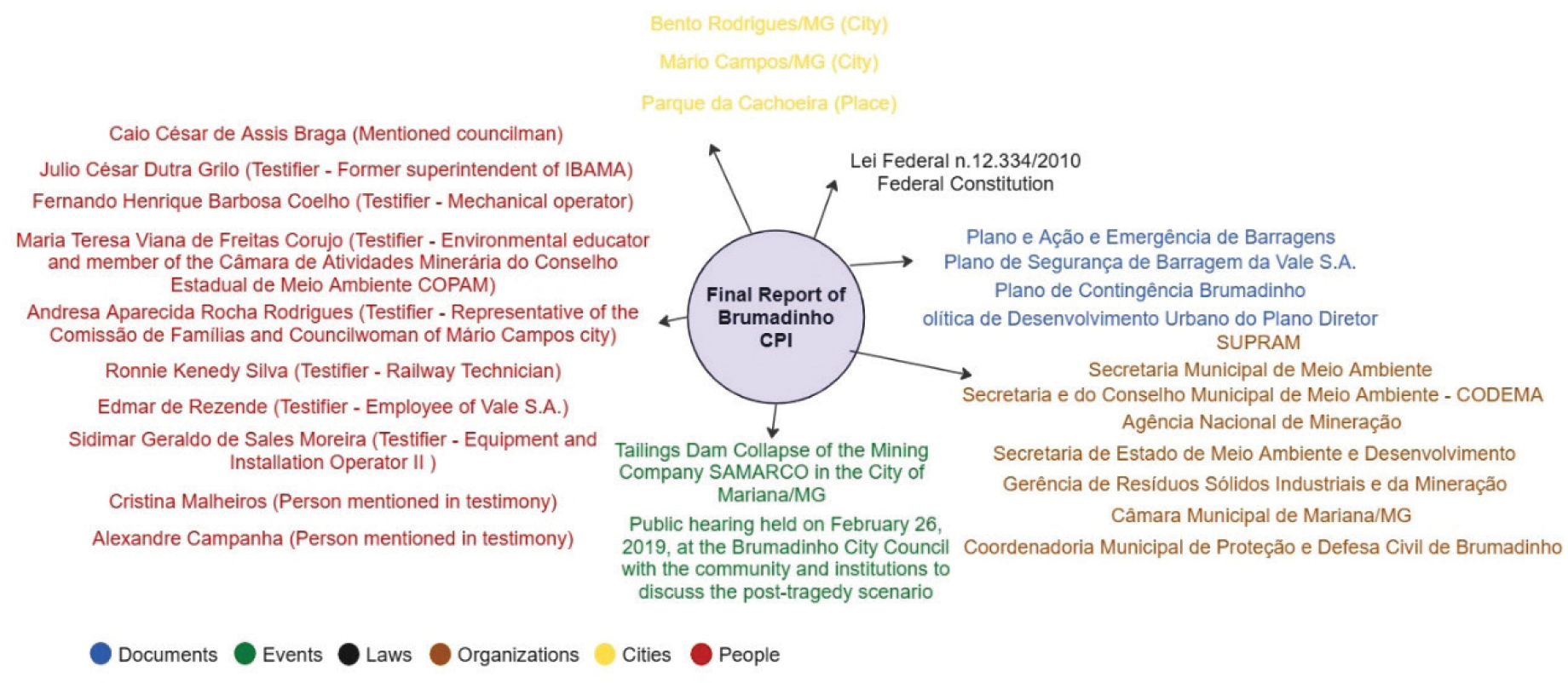
For this stage of scenario development, it is essential to begin with a thorough initial reading of the final report that has been made available. Using the qualitative data analysis software, Atlas.TI, we systematically coded the document to identify and categorize key elements relevant to the scenario’s construction. These included individuals, events, organizations, entities, legal references, and other significant figures mentioned throughout the report. Figure 2 illustrates an example of this coding process:
The figure above lists the main elements most effectively contributing to scenario construction: documents referenced in the final report, events, laws, organizations, cities, and individuals. This mapping enabled the collection of additional data not initially included in the CPI’s database. One example is Federal Law No. 12,334/2010 (Lei nº 12.334, de 20 de setembro de 2010), which, although mentioned and relevant to the case, was not among the documents provided by the legislative body. This law was added to the research database. Triangulating data cited in the CPI that are not part of its official documentation broadens the analytical scope and contextualizes the study. It enables researchers to situate the investigated event or case within its broader political, cultural, and historical framework.
In our example, the mentioned law provides various key definitions - such as ‘dam,’ ‘dam safety,’ and ‘potential damage’ - which, although referenced during the CPI process, were not explained. For instance, Article 2, item III of Federal Law No. 12,334/2010 (Lei nº 12.334, de 20 de setembro de 2010) defines dam safety as “the condition aimed at maintaining its structural and operational integrity and preserving life, health, property, and the environment.” Thus, preserving life is an integral part of safety - not only the dam’s structural integrity but also the safety of its personnel. Our preliminary analysis points to a structural failure of the dam on June 11, 2018, with the company having adopted strategies to maintain the dam’s structural safety (such as water drainage) but not addressing the other safety components outlined by law. Access to the legal shows additional relevant information not included in the final report or other CPI documents. Another example includes the Emergency Action Plan for Mining Dams (Plano de Ação de Emergência para Barragens de Mineração - PAEBM), which Vale S.A. is required to submit to regulatory agencies. These documents can be obtained through specialized agencies or accessed directly via the company’s website (Vale, n.d.), where plans for each company’s dams are available.
5.3 Finding additional information
After constructing the scenario and using it to guide the search for additional data, the next step is to gather broader contextual information. These data are typically general and are often used by researchers for cross-referencing. In the case study presented here, for example, a recent news article highlights the ongoing struggle of Afro-Brazilian communities for reparations (Vasconcelos, 2025). Additional sources of information may include news reports and other materials documenting the reparation process following the disaster. While these data are valuable for enriching the understanding of the case, they are not directly related to the CPI itself.
Therefore, researchers interested in triangulating data may incorporate this step into their methodology. However, this differs from approaches that treat the public inquiry as a roadmap for generating new data within the research process, because gathering data from public inquiries differs from collecting more general information about the case itself. In this sense, we hope that public inquiries will contribute to studies focused on historical and cultural contexts, as well as on the narrative of the case and its broader context.
6. CONCLUSIONS
This investigation makes two primary contributions. First, it introduces a structured framework for using public inquiries as research roadmaps, providing a systematic approach to leveraging the data they produce. We present a guide that researchers can use in this process. Second, it identifies and addresses methodological challenges, such as the influence of power dynamics and the constructed nature of inquiry narratives, offering a critical perspective on their use. Despite the methodological challenges (including biased data collection, opacity regarding truth-building, and partisan interference), public inquiry has proven valuable. These contributions include enhancing our understanding of the management challenges associated with large-scale disasters, their implications for corporate responsibility and governance, and collective memory. However, some pitfalls should not be ignored. On the contrary, to overcome these challenges, researchers must exercise caution, critically evaluate data quality, and reflexively contextualize it.
Furthermore, we discussed how public inquiries are shaped by power and discourse. By examining the discursive practices and power relations within the inquiry process, scholars can understand how events are constructed, how truth claims are legitimized, and how responsibility is allocated. This approach can enhance the understanding of the inquiry process, the report, and the social and political contexts in which they occur. Public inquiries and their findings provide insight into critical events in society, as they contain multiple data points that enable narratives to be structured from various angles. Accordingly, every record left by a public inquiry should be considered a monument (Foucault, 1972; LeGoff, 1992). These records were neither produced nor left as chance traces. They intentionally crystallize meanings, representing a conjunction of possibilities that could be remembered later.
Investigations using documents and other registers that do not require new firsthand data are especially significant in violent contexts and for researchers studying sensitive or controversial topics, as they can provide access to voices that might otherwise be difficult to reach or hear. It can also circumvent the difficulties connected to researching traumatic events, avoiding reviving these experiences in those affected (Abdelnour & Abu Moghli, 2021). Inquiries can be used to study the effects of public policies, the impact of government decisions, or the attitudes and opinions of stakeholders on a particular issue. They can also offer a window into how actors dealt with events in the past, even if it is necessary to consider the specific conditions that frame the production of discourses in these settings.
Improving access to public inquiry records through more user-friendly websites and diligent archival practices enhances their value as research tools, particularly given researchers’ challenges in accessing business archives, especially in developing countries like Brazil (Coraiola, 2012; Costa & Saraiva, 2011). Organizational scholars frequently highlight the scarcity of data necessary for critical analysis. With their comprehensive documentation and availability, public inquiries offer a promising alternative for studying pivotal events and their implications for organizations and societies.
-
Peer review report:
Reviewers:Ana Carina Gerardo da Silva Azevedo (Universidade Nova de Lisboa, Lisboa - Portugal) https://orcid.org/0000-0001-6632-6861One reviewer did not authorize the disclosure of their identity.The peer review report is available at this link Publons
-
[Original version]
ACKNOWLEDGEMENTS
This study was carried out with the support of the Conselho Nacional de Desenvolvimento Científico e Tecnológico (National Council for Scientific and Technological Development - CNPq), under grant no. 304487/2021-0 (bolsa produtividade). The author, Isabela Pontes, also gratefully acknowledges financial support from the Coordination for the Improvement of Higher Education Personnel - Brazil (Coordenação de Aperfeiçoamento de Pessoal de Nível Superior - CAPES - Brasil), through the Academic Excellence Program (Proex).
DATA AVAILABILITY
The entire data set supporting the results of this study was published in the article itself.
References
-
Abdelnour, S., & Abu Moghli, M. (2021). Researching violent contexts: a call for political reflexivity. Organization https://doi.org/10.1177/13505084211030646
» https://doi.org/10.1177/13505084211030646 -
Ainsworth, S., & Hardy, C. (2012). Subjects of inquiry: statistics, stories, and the production of knowledge. Organization Studies, 33(12), 1693-1714. https://doi.org/10.1177/0170840612457616
» https://doi.org/10.1177/0170840612457616 -
Alves, E. B. (2023). Gestão de espaço de fala e análise das condições de produção de versões sobre um crime corporativo: o caso do rompimento da barragem B1 da Vale S/A em Brumadinho (MG). Organizações & Sociedade, 30(104), 141-173. https://doi.org/10.1590/1984-92302023v30n0005pt
» https://doi.org/10.1590/1984-92302023v30n0005pt -
Andone, C. (2016). Argumentative patterns in the political domain: the case of European Parliamentary Committees of inquiry. Argumentation, 30(1), 45-60. https://doi.org/10.1007/s10503-015-9372-4
» https://doi.org/10.1007/s10503-015-9372-4 -
Barros, A. (2023). Researching with records in management and organisation studies: archives, data corpus, and reflexivity. In S. Decker, W. M. Foster, & E. Giovannoni (Eds.), Handbook of Historical Methods for Management (pp. 80-93). Edward Elgar Publishing. https://doi.org/10.4337/9781800883741.00013
» https://doi.org/10.4337/9781800883741.00013 -
Barros, A., Carneiro, A. de T., & Wanderley, S. (2019). Organizational archives and historical narratives. Qualitative Research in Organizations and Management: An International Journal, 14(3), 280-294. https://doi.org/10.1108/QROM-01-2018-1604
» https://doi.org/10.1108/QROM-01-2018-1604 - Boje, D. (2001). Narrative methods for organizational & communication research Sage.
-
Boudes, T., & Laroche, H. (2009). Taking off the heat: narrative sensemaking in post-crisis inquiry reports. Organization Studies, 30(4), 377-396. https://doi.org/10.1177/0170840608101141
» https://doi.org/10.1177/0170840608101141 -
Braun, V., & Clarke, V. (2006). Using thematic analysis in psychology. Qualitative Research in Psychology, 3(2), 47-77-101. https://doi.org/10.1191/1478088706qp063oa
» https://doi.org/10.1191/1478088706qp063oa -
Brown, A. D. (2000). Making sense of inquiry sensemaking. Journal of Management Studies, 37(1), 45-75. https://doi.org/10.1111/1467-6486.00172
» https://doi.org/10.1111/1467-6486.00172 -
Brown, A. D. (2004). Authoritative sensemaking in a public inquiry report. Organization Studies, 25(1), 95-112. https://doi.org/10.1177/0170840604038182
» https://doi.org/10.1177/0170840604038182 -
Brown, A. D. (2005). Making sense of the collapse of Barings Bank. Human Relations, 58(12), 1579-1604. https://doi.org/10.1177/0018726705061433
» https://doi.org/10.1177/0018726705061433 -
Buchanan, D. A., & Denyer, D. (2013). Researching tomorrow’s crisis. International Journal of Management Reviews, 15(2), 205-224. https://doi.org/10.1111/ijmr.12002
» https://doi.org/10.1111/ijmr.12002 -
Câmara Municipal de Brumadinho. (2019). Requerimento 001/2019 https://www.cmbrumadinho.mg.gov.br/atividade-legislativa/proposicoes/materia/1231
» https://www.cmbrumadinho.mg.gov.br/atividade-legislativa/proposicoes/materia/1231 - Charmaz, K. (2006). Constructing grounded theory: a practical guide through qualitative analyses SAGE Publications.
-
Coraiola, D. M. (2012). Importância dos arquivos empresariais para a pesquisa histórica em administração no Brasil. Cadernos EBAPE.BR, 10(2), 254-269. https://doi.org/10.1590/S1679-39512012000200002
» https://doi.org/10.1590/S1679-39512012000200002 -
Coraiola, D. M., Barros, A., Maclean, M., & Foster, W. M. (2021). History, memory and the past in management and organization studies. Revista de Administração de Empresas, 61(1), e00000002. https://doi.org/10.1590/s0034-759020210102
» https://doi.org/10.1590/s0034-759020210102 -
Coraiola, D. M., & Derry, R. (2020). Remembering to forget: the historic irresponsibility of U.S. big tobacco. Journal of Business Ethics, 166(2), 233-252. https://doi.org/10.1007/s10551-019-04323-4
» https://doi.org/10.1007/s10551-019-04323-4 -
Coraiola, D. M., Foster, W. M., Mena, S., Foroughi, H., & Rintamäki, J. (2023). Ecologies of memories: memory work within and between organizations and communities. Academy of Management Annals, 17(1), 373-404. https://doi.org/10.5465/annals.2021.0088
» https://doi.org/10.5465/annals.2021.0088 -
Coraiola, D. M., & Murcia, M. J. (2020). From organizational learning to organizational mnemonics: redrawing the boundaries of the field. Management Learning, 51(2), 227-240. https://doi.org/10.1177/1350507619889737
» https://doi.org/10.1177/1350507619889737 -
Costa, A. de S. M. da, & Saraiva, L. A. S. (2011). Memória e formalização social do passado nas organizações. Revista de Administração Pública, 45(6), 1761-1780. https://doi.org/10.1590/S0034-76122011000600007
» https://doi.org/10.1590/S0034-76122011000600007 -
Costa, A. de S. M. da, & Silva, M. A. de C. (2017). Empresas, violação dos direitos humanos e ditadura civil-militar brasileira: a perspectiva da Comissão Nacional da Verdade. Organizações & Sociedade, 25(84), 15-29. https://doi.org/10.1590/1984-9240841
» https://doi.org/10.1590/1984-9240841 -
Cunliffe, A. L. (2003). Reflexive inquiry in organization research: questions and possibilities. Human Relations, 56(8), 983-1003. https://doi.org/10.1177/00187267030568004
» https://doi.org/10.1177/00187267030568004 - Czarniaeska, B. (1997). Narrating the organization The University of Chicago Press.
-
Decker, S. (2013). The silence of the archives: business history, post-colonialism and archival ethnography. Management & Organizational History, 8(2), 155-173. https://doi.org/10.1080/17449359.2012.761491
» https://doi.org/10.1080/17449359.2012.761491 -
Decker, S. (2016). Paradigms lost: integrating history and organization studies. Management & Organizational History, 11(4), 364-379. https://doi.org/10.1080/17449359.2016.1263214
» https://doi.org/10.1080/17449359.2016.1263214 -
Dwyer, G., & Hardy, C. (2016). We have not lived long enough: sensemaking and learning from bushfire in Australia. Management Learning, 47(1), 45-64. https://doi.org/10.1177/1350507615577047
» https://doi.org/10.1177/1350507615577047 -
Dwyer, G., Hardy, C., & Maguire, S. (2021). Post-inquiry sensemaking: the case of the ‘black saturday’ bushfires. Organization Studies, 42(4), 637-661. https://doi.org/10.1177/0170840619896271
» https://doi.org/10.1177/0170840619896271 -
Edelman, L. B., Krieger, L. H., Eliason, S. R., Albiston, C. R., & Mellema, V. (2011). When organizations rule: judicial deference to institutionalized employment structures. American Journal of Sociology, 117(3), 888-954. https://doi.org/10.1086/661984
» https://doi.org/10.1086/661984 -
Elliott, D., & McGuinness, M. (2002), Public inquiry: panacea or placebo? Journal of Contingencies and Crisis Management, 10(1), 14-25. https://doi.org/10.1111/1468-5973.00177
» https://doi.org/10.1111/1468-5973.00177 - Fairclough, N. (1995). Critical discourse analyses: the critical study of language Logman.
-
Fisher, W. (1985). The narrative paradigm: in the beginning. Journal of Communication, 35(4), 74-89. https://doi.org/10.1111/j.1460-2466.1985.tb02974.x
» https://doi.org/10.1111/j.1460-2466.1985.tb02974.x -
Fontoura, Y., Naves, F., Teodósio, A. D. S. D. S., & Gomes, M. V. P. (2019). Da lama ao caos: Reflexões sobre a crise ambiental e as relações estado-empresa-sociedade. 6. https://doi.org/10.25113/farol.v6i15.5440
» https://doi.org/10.25113/farol.v6i15.5440 - Foucault, M. (1972). The archeology of knowledge and the discourse on language Pantheon Books.
- Foucault, M. (2002). A verdade e as formas jurídicas (3a ed.). NAU Editora.
-
Gephart, R. P., Jr. (1984). Making sense of organizationally based environmental disasters. Journal of Management, 10(2), 205-225. https://doi.org/10.1177/014920638401000205
» https://doi.org/10.1177/014920638401000205 -
Gephart, R. P., Jr. (1992). Sensemaking, communicative distortion, and the logic of public inquiry legitimation. Industrial Crisis Quarterly, 6(2), 115-135. https://doi.org/10.1177/108602669200600204
» https://doi.org/10.1177/108602669200600204 -
Gephart, R. P., Jr. (2007). Crisis sensemaking and the public inquiry. In C. M. Pearson, C. Roux-Dufort, & J. A. Clair. (Eds.), International Handbook of Organizational Crisis Management (pp. 123-160). SAGE Publications Inc. https://doi.org/10.4135/9781412982757.n5
» https://doi.org/10.4135/9781412982757.n5 - Ginzburg, C. (2013). The cheese and the worms: the cosmos of a sixteenth-century miller JHU Press.
-
Gioia, D. A., Corley, K. G., & Hamilton, A. L. (2012). Seeking qualitative rigor in inductive research. Organizational Research Methods, 16(1), 15-31. https://doi.org/10.1177/1094428112452151
» https://doi.org/10.1177/1094428112452151 -
Guimarães, P. C. V., & Alves, M. A. (2014). Narratives and sensemaking of an organizationally based environmental disaster in Brazil. Brazilian Administration Review, 11(2), 228-247. https://doi.org/10.5465/ambpp.2013.16704abstract
» https://doi.org/10.5465/ambpp.2013.16704abstract -
Hargadon, A. B., & Wadhwani, R. D. (2023). Theorizing with microhistory. Academy of Managament, 48(4), 681-696. https://doi.org/10.5465/amr.2019.0176
» https://doi.org/10.5465/amr.2019.0176 - LeGoff, J. (1992). History and memory Columbia University Press.
-
Lei nº 12.334, de 20 de setembro de 2010 (2010). Estabelece a Política Nacional de Segurança de Barragens destinadas à acumulação de água para quaisquer usos, à disposição final ou temporária de rejeitos e à acumulação de resíduos industriais, cria o Sistema Nacional de Informações sobre Segurança de Barragens e altera a redação do art. 35 da Lei no 9.433, de 8 de janeiro de 1997, e do art. 4o da Lei no 9.984, de 17 de julho de 2000. https://www.planalto.gov.br/ccivil_03/_ato2007-2010/2010/lei/l12334.htm
» https://www.planalto.gov.br/ccivil_03/_ato2007-2010/2010/lei/l12334.htm -
Lei nº 12.527, de 18 de novembro de 2011 (2011). Regula o acesso a informações previsto no inciso XXXIII do art. 5º, no inciso II do § 3º do art. 37 e no § 2º do art. 216 da Constituição Federal; altera a Lei nº 8.112, de 11 de dezembro de 1990; revoga a Lei nº 11.111, de 5 de maio de 2005, e dispositivos da Lei nº 8.159, de 8 de janeiro de 1991; e dá outras providências. https://www.planalto.gov.br/ccivil_03/_ato2011-2014/2011/lei/l12527.htm
» https://www.planalto.gov.br/ccivil_03/_ato2011-2014/2011/lei/l12527.htm -
Lima, E., Pieve, F., & Aguiar, J. (2011). A comissão parlamentar de inquérito no ordenamento jurídico: origem, histórico, atribuições e limites. Pensar - Revista de Ciências Jurídicas, 16(2), 477-508. https://doi.org/10.5020/2317-2150.2011.v16n2p477
» https://doi.org/10.5020/2317-2150.2011.v16n2p477 -
Maclean, M., Harvey, C., & Clegg, S. R. (2016). Conceptualizing Historical Organization Studies. Academy of Management Review, 41(4), 609-632. https://doi.org/10.5465/amr.2014.0133
» https://doi.org/10.5465/amr.2014.0133 -
Maclean, M., Harvey, C., & Clegg, S. R. (2017). Organization theory in business and management history: present status and future prospects. Business History Review, 91(3), 457-481. https://doi.org/10.1017/S0007680517001027
» https://doi.org/10.1017/S0007680517001027 -
Mena, S., Rintamäki, J., Fleming, P., & Spicer, A. (2016). On the forgetting of corporate irresponsibility. Academy of Management Review, 41(4), 720-738. https://doi.org/10.5465/amr.2014.0208
» https://doi.org/10.5465/amr.2014.0208 -
Mueller, F., Whittle, A., & Addison, S. (2020). Power relations in the production of historical context in disaster inquiry reporting. Journal of Management History, 27(2), 205-224. https://doi.org/10.1108/JMH-05-2020-0033
» https://doi.org/10.1108/JMH-05-2020-0033 -
Mueller, F., Whittle, A., & Addison, S. (2022). Official truth, applied deconstruction and post-inquiry sensemaking in the Mull of Kintyre helicopter crash. Human Relations, 76(7), 1050-1080. https://doi.org/10.1177/00187267221082881
» https://doi.org/10.1177/00187267221082881 -
Nery, L. (2013). Comissões parlamentares de inquérito: evolução histórica e disciplina constitucional. Direito UNIFACS - Debate Virtual, 158, 1-14. https://revistas.unifacs.br/index.php/redu/article/view/2733/1982
» https://revistas.unifacs.br/index.php/redu/article/view/2733/1982 -
Nix, A., & Decker, S. (2021). Using digital sources: the future of business history? Business History, 65(6), 1048-1071. https://doi.org/10.1080/00076791.2021.1909572
» https://doi.org/10.1080/00076791.2021.1909572 -
Phillips, R., Schrempf-Stirling, J., & Stutz, C. (2020). The past, history, and corporate social responsibility. Journal of Business Ethics, 166, 203-213. https://doi.org/10.1007/s10551-019-04319-0
» https://doi.org/10.1007/s10551-019-04319-0 -
Pommerolle, M. É. (2008). Les mobilisations de victimes de violences coloniales : investigations historiques et judiciaires et débats politiques postcoloniaux au Kenya. Raisons Politiques, 30(2), 107-129. https://doi.org/10.3917/rai.030.0107
» https://doi.org/10.3917/rai.030.0107 -
Posthuma, A., & Bignami, R. (2014). “Bridging the gap”? Public and private regulation of labour standards in apparel value chains in Brazil. Competition and Change, 18(4), 345-364. https://doi.org/10.1179/1024529414Z.00000000065
» https://doi.org/10.1179/1024529414Z.00000000065 -
Rowlinson, M., Casey, A., Hansen, P. H., & Mills, A. J. (2014a). Narratives and memory in organizations. Organization, 21(4), 441-446. https://doi.org/10.1177/1350508414527256
» https://doi.org/10.1177/1350508414527256 -
Rowlinson, M., Hassard, J., & Decker, S. (2014b). Research strategies for organizational history: a dialogue between historical theory and organization theory. Academy of Management Review, 39(3), 250-274. https://doi.org/10.5465/amr.2012.0203
» https://doi.org/10.5465/amr.2012.0203 -
Saes, B. M., & Muradian, R. (2021). What misguides environmental risk perceptions in corporations? Explaining the failure of Vale to prevent the two largest mining disasters in Brazil. Resources Policy, 72, 102022. https://doi.org/10.1016/j.resourpol.2021.102022
» https://doi.org/10.1016/j.resourpol.2021.102022 -
Samra-Fredericks, D. (2003). Strategizing as Lived Experience and Strategists’ Everyday Efforts to Shape Strategic Direction. Journal of Management Studies, 40(1), 141-174. https://doi.org/10.1111/1467-6486.t01-1-00007
» https://doi.org/10.1111/1467-6486.t01-1-00007 -
Schrempf-Stirling, J., & Buren, H. J. van (2020). Business and human rights scholarship in social issues in management: an analytical review. Business and Human Rights Journal, 5(1), 28-55. https://doi.org/10.1017/bhj.2019.23
» https://doi.org/10.1017/bhj.2019.23 -
Silva, M. A. de C., Campos, P. H. P., & Costa, A. (2022). Volkswagen and the dictatorship: the German automaker’ s collaboration with the repression of workers during the Brazilian civil-military regime. Revista Brasileira de História, 42(89), 141-164. https://doi.org/10.1590/1806-93472022v42n89-08
» https://doi.org/10.1590/1806-93472022v42n89-08 -
Stark, A. (2020). Left on the shelf: explaining the failure of public inquiry recommendations. Public Administration, 98(3), 609-624. https://doi.org/10.1111/padm.12630
» https://doi.org/10.1111/padm.12630 -
Stark, A., & Yates, S. (2021). Public inquiries as procedural policy tools. Policy and Society, 40(3), 345-361. https://doi.org/10.1080/14494035.2021.1955485
» https://doi.org/10.1080/14494035.2021.1955485 -
Sulitzeanu-Kenan, R., & Holzman-Gazit, Y. (2016). Form and content: institutional preferences and public opinion in a crisis inquiry. Administration and Society, 48(1), 3-30. https://doi.org/10.1177/0095399712469197
» https://doi.org/10.1177/0095399712469197 -
Vale. (n.d.). Plano de Ação de Emergência para Barragens de Mineração (PAEBM) https://saladeimprensa.vale.com/pt/esg/paebm
» https://saladeimprensa.vale.com/pt/esg/paebm -
Vasconcelos, A. C. (2025, maio 21). Povos de matriz africana atingidos pelo crime da Vale em Brumadinho (MG) lutam por reparação Brasil de Fato. https://www.brasildefato.com.br/2025/05/21/povos-de-matriz-africana-atingidos-pelo-crime-da-vale-em-brumadinho-mg-lutam-por-reparacao/
» https://www.brasildefato.com.br/2025/05/21/povos-de-matriz-africana-atingidos-pelo-crime-da-vale-em-brumadinho-mg-lutam-por-reparacao/ -
Teixeira, M. B. M., Rodrigues, T. M., Resende, I. M. P., Silva, A. J. B. da, & Teodósio, A. dos S. de S. (2020). Crime & castigo: Narrativas sobre o rompimento da barragem da Vale em Brumadinho. Revista Brasileira de Estudos Organizacionais, 7(3), 374-405. https://doi.org/10.21583/2447-4851.rbeo.2020.v7n3.334
» https://doi.org/10.21583/2447-4851.rbeo.2020.v7n3.334 -
Travadel, S., Guarnieri, F., & Portelli, A. (2018). Industrial safety and utopia: insights from the Fukushima Daiichi accident. Risk Analysis, 38(1), 56-70. https://doi.org/10.1111/risa.12821
» https://doi.org/10.1111/risa.12821 -
Turner, B. A. (1976). The organizational and interorganizational development of disasters. Administrative Science Quarterly, 21(3), 378-397. https://doi.org/10.2307/2391850
» https://doi.org/10.2307/2391850 -
Walshe, K. (2019). Public inquiry methods, processes and outputs: an epistemological critique. The Political Quarterly, 90(2), 210-215. https://doi.org/10.1111/1467-923X.12691
» https://doi.org/10.1111/1467-923X.12691 -
Wanderley, S., & Barros, A. (2020). The alliance for progress, modernization theory, and the history of management education: the case of CEPAL in Brazil. Management Learning, 51(1), 55-72. https://doi.org/10.1177/1350507619869013
» https://doi.org/10.1177/1350507619869013 -
Weatherbee, T. G. (2012). Caution! This historiography makes wide turns: historic turns and breaks in management and organization studies. Management & Organizational History, 7(3), 203-218. https://doi.org/10.1177/1744935912444356
» https://doi.org/10.1177/1744935912444356
-
Editor-in-chief:
Alketa Peci (Fundação Getulio Vargas, Rio de Janeiro / RJ - Brazil) https://orcid.org/0000-0002-0488-1744
-
Associate editor:
Gabriela Spanghero Lotta (Fundação Getulio Vargas, São Paulo / SP - Brazil) https://orcid.org/0000-0003-2801-1628

 Source: Elaborated by the authors.
 Source: Elaborated by the authors.