 Businesses against Peronism: resistance, interests, and interclass alliances within the Argentinean Economic and Social Council
Abstract
The Economic and Social Council was created in February 2021 by the Peronist Argentine government of President Alberto Fernández to establish a neo-developmentalist agenda through an alliance with the business elite, despite a tradition of dissent and confrontation. This research focuses on the role of businesses, exploring the main factors that have conditioned the council’s ability to build such an alliance. The research, based on a combination of semi-structured interviews, informal conversations, participant observation, and the analysis of 1095 newspaper articles, shows that the large business associations were not effectively incorporated into the neo-developmentalist agenda, nor were they interested in institutionalizing the council, which would have given support to the Peronist government. The limited results of the Economic and Social Council until its decline in 2022 are partly explained by the validity of the hierarchical, extractivist, and peripheral market economy, reinforced by the fragmented and sectoral representation of the business associations and the weakness of the government to lead an institutional change. In this sense, the council reinforced extractivist and dependent corporativism.
Keywords:
economic and social council; hierarchical market economy; business associations; peronism
Resumen
El Consejo Económico y Social fue creado en febrero de 2021 por el gobierno argentino peronista de Alberto Fernández para concertar una agenda neodesarrollista, en particular con la jerarquía empresarial, con la que se pretendía una alianza pese a la tradición de disenso y enfrentamiento. Centrado en el papel de las organizaciones empresariales, el estudio analiza cuáles han sido los principales factores que han condicionado la capacidad del foro para lograrlo. La investigación, basada en una combinación de entrevistas semiestructuradas, conversaciones informales y observación participante, además del análisis de 1095 artículos periodísticos, muestra que los grandes sindicatos empresariales no se adhirieron efectivamente a la agenda neodesarrollista ni tampoco estuvieron interesados en institucionalizar este foro que hubiera dado soporte al gobierno peronista. Los limitados resultados del Consejo Económico y Social hasta su declive en 2022 se explican en parte por la vigencia de la economía de mercado jerárquica, extractivista y periférica, reforzada por la representación fragmentada y sectorial de los sindicatos patronales y la debilidad del gobierno para liderar un cambio institucional. En ese sentido, el Consejo reforzó un corporativismo extractivista y dependiente.
Palabras clave:
consejo económico y social; economía de mercado jerárquica; empresarios; peronismo
Resumo
O Conselho Econômico e Social foi criado em fevereiro de 2021 pelo governo peronista de Alberto Fernández para chegar a um acordo sobre uma agenda neodesenvolvimentista, especialmente com a hierarquia empresarial, com a qual se buscou uma aliança apesar de uma tradição de dissidência e confronto. Com foco no papel das organizações empresariais, o estudo analisa os principais fatores que condicionaram a capacidade do fórum de alcançar esse objetivo. A pesquisa, baseada em uma combinação de entrevistas semiestruturadas, conversas informais e observação participante, além da análise de 1.095 artigos de jornais, mostra que os grandes sindicatos empresariais não aderiram efetivamente à agenda neodesenvolvimentista, nem estavam interessados em institucionalizar esse fórum, o que teria dado apoio ao governo peronista. Os resultados limitados do Conselho Econômico e Social até seu declínio em 2022 podem ser explicados, em parte, pela vigência da economia de mercado hierárquica, extrativista e periférica, reforçada pela representação fragmentada e setorial dos sindicatos patronais e pela fraqueza do governo em liderar mudanças institucionais. Nesse sentido, o Conselho reforçou um corporativismo extrativista e dependente.
Palavras-chave:
conselho econômico e social; economia de mercado hierárquica; empresários; peronismo
1. INTRODUCTION
The creation in February 2021 of the Economic and Social Council of the Argentine Republic (ESC-A) by the then Peronist president Alberto Fernández (2019-2023) has sought to institutionalise dialogue with corporatist organisations. In particular with the business hierarchy, traditionally hostile to Peronism (Bonvecchi & Giraudy, 2007).
ESCs are neo-corporatist institutions through which the state shares the elaboration of public policies with organisations with a capacity for socio-economic mobilisation and representation (Schmitter, 1989), especially business associations and trade unions. Despite the impact of globalisation and the progressive weakness of trade unions (Sánchez-Mosquera, 2024)social protection and industrial relations. The International Labour Organization (ILO, corporatism and its institutions have not necessarily declined in recent decades (Jahn, 2016). The ESCs are present in 161 countries and have a relevant historical trajectory (Guardiancich & Ghellab, 2020; Guardiancich & Molina, 2021). However, they have been little studied, and in Latin America only Brazil’s ESC has been the subject of analysis (Patschiki, 2016; Santos & Gugliano, 2015).
Likewise, in the case of the socio-economic organisations involved, studies have usually focused on trade unions. In fact, the literature points out that their good performance explains the success of the Northern European ESCs (Cho, 2019; Hemerijck & Vail, 2006) and their inadequacies the failure in Eastern Europe (Spasova & Tomini, 2013) and other parts of the world (Han et al., 2010; Kim & Van Der Westhuizen, 2017).The entrepreneurial role has been less studied, although it is equally essential.
In response to this lack of research, the main aim of this article is to analyse the main factors that have conditioned the ESC-A’s capacity to agree on a neo-developmentalist agenda with businessmen and, ultimately, to favour a change in Argentina’s institutional trajectory. To this end, it focuses on three centres of interest. First, the conflictive relationship between the Peronist government and the various fractions of capital represented in the ESC-A, especially in a country where heterogeneity of business representation is the rule (Dossi, 2012; Etchemendy, 2011). Secondly, the limits imposed by the hierarchical institutional model in Latin America’s third largest economy are analysed. Finally, and related to the above, it examines the government’s capacity to promote institutional change, in the context of the profound crisis in which Fernández’s presidency unfolded.
This research considers the Varieties of Capitalism approach, in which Argentina is framed within the Hierarchical Market Economies (HME) characteristic of Latin America (Schneider, 2009b) and the theoretical framework of agreements (normative covenants between the actors involved) and institutional change (Levitsky & Murillo, 2013; Murillo et al., 2021; Streeck & Thelen, 2005; Thelen, 2009). More specifically, we examine the interaction of the “hierarchical business groups” (Schneider, 2009a), and their representative organizations, with the Peronist government. On the one hand, we take into account for the analysis the Argentine development model, which, despite almost two decades of Peronist governments and neo-developmentalist proposals, maintains a trajectory based substantially on commodity extractivism (Munck, 2015; Treacy, 2015). (Munck, 2015; Treacy, 2022). Considering these limitations, and discounting the support of powerful trade unions and social movements (Etchemendy, 2011), Fernández’s government sought through the ESC-A to broaden its social base, including the business hierarchy. However, our analysis also takes into account, on the other hand, the approach and institutional arrangements that could favour coordination and change (Murillo et al., 2021; Thelen, 2009), despite the constraints of a hierarchical institutional and economic model, dependence on the global market and the inertia towards constant institutional substitution (Levitsky & Murillo, 2013) in the Latin American region.
The article starts from an initial hypothetical approach which considers that i) the sectoral and fragmented representation of business interests; ii) the hierarchical profile of the economy, dependent and extractivist; and iii) the shortcomings of the Peronist government in leading an institutional change to strengthen new institutional agreements have not allowed the ESC-A to agree a neo-developmentalist agenda with the business hierarchy. In order to contrast this initial approach, the method of analysis of the ESCs has been taken into account (Von-Zeschau & Sánchez-Mosquera, 2022) and a methodology combining semi-structured interviews, informal conversations and participant observation, together with the analysis of 1095 newspaper articles, was used as sources.
The results of this work have made it possible to assess the capacity of one of the large Latin American economies to institutionalise coordination with the business hierarchy, with the aim of redirecting the institutional trajectory of its business hierarchy (Madariaga, 2018; Murillo et al., 2021). In this sense, the resistance of the Latin American hierarchical and extractivist model to the attempt at institutionalised state coordination of a neo-developmentalist agenda has generated very limited results. Even the concessions to hierarchical business demands did not allow for their complicity with the government or their inclusion in the coalition of support sought by Peronism. In that sense, there were notable shortcomings in the Peronist government’s approach to and development of agreements that could effectively change the institutional trajectory, and its deep-rooted complementarities, of the Argentine economy. Far from the initial Peronist approach, the ESC-A has strengthened an extractivist and dependent corporatism during its brief existence. The end of Fernández’s term, in December 2023, has effectively suspended the activity of the forum, which, under the presidency of the new president of the Republic, Javier Milei, will probably be dragged along by the classic Latin American inertia of constant institutional replacement.
The article is structured as follows. After this introduction, a theoretical framework is defined that relates ESCs to institutional models of capitalism and business associations (and individual companies), as well as setting out the theory on institutional change, always with an emphasis on Latin American cases. The methodology of the work is then developed. Subsequently, the two years of activity of the ESC-A (2021-2022) are characterised, and the results of the government-entrepreneur articulation are presented. Finally, the results are discussed, highlighting the practical implications and conclusions of the work.
2. ESC AND BUSINESS ASSOCIATIONS IN HIERARCHICAL MARKET ECONOMIES
ESCs are institutions of coordinated economies (Hemerijck & Vail, 2006). In the 1990s, the Varieties of Capitalism literature established the dichotomy between liberal market economies (LMEs) and coordinated market economies (CMEs) (Hall & Soskice, 2001). This literature expanded and established different models depending on which elements were central to their economic performance (Lane, 2009; Visser, 2009; Wilkinson & Wood, 2017).
In European countries with coordinated economies, such as the so-called social democratic countries, ESCs are a key institution of social dialogue with employers and, of course, trade unions (Cho, 2019; Hemerijck & Vail, 2006). The importance of ESCs in southern Europe is less important, and their articulation with business associations uneven. In Europe’s ex-communist economies, ESCs were especially functional to business, as they legitimised the policies required for incorporation into the single market (Spasova & Tomini, 2013) and allowed the veto players (trade unions) to be incorporated into an illusory corporatism (Guardiancich & Ghellab, 2020). Something similar happened outside Europe: in South Africa (Kim & Van Der Westhuizen, 2017) and South Korea (Han et al., 2010) the ESCs legitimised a neoliberal agenda convenient for businessmen.
The experience of government-business coordination in Latin American ESCs is more recent. According to the literature, Latin American countries are considered Hierarchical Market Economies (HME) (Schneider, 2009b). Their hierarchical bias is determined by the control of a relatively small number of “hierarchical business groups” (Schneider, 2009a): primarily diversified, family-owned and controlled national business groups, and subsidiaries of multinational companies. Hierarchical control determines privileged -sometimes privatised- access to strategic inputs of capital, technology and a poorly regulated, unorganised, informal, high-turnover workforce.
Peripheral insertion (Madariaga, 2018) further reinforces the hierarchical segmentation between a formal, concentrated and transnationalised productive segment (generally exporters of raw materials), a formal productive segment of SMEs anchored to the domestic market, and a large informal segment, with low productivity and high labour insecurity (Economic Commission for Latin America and the Caribbean [CEPAL], 2004). This productive fragmentation is reproduced in the system of business representation, which is equally fragmented (Dossi, 2012; Palomino, 1988), favouring its weakness.
In a context of economic and political volatility, hierarchical business coordination provides flexibility, but does not create incentives for long-term company coordination. The presence of multinational companies hinders the institutionalisation of social dialogue in general (Guardiancich & Ghellab, 2020), as their strategic decisions are externally defined. In addition, the traditional leadership of large companies within business associations (Olson, 1965) is accentuated in HMEs and conditions their political positions (Dossi, 2012). Business coordination is reduced to influencing specific public policies, most of the time through informal channels. The so-called ‘other institutionalisation’ (O’Donnell, 1997) often conditioned the performance of Latin American institutions (Levitsky & Murillo, 2013).
Many Latin American governments at the beginning of this century attempted to modify the boundaries of hierarchical and dependent capitalism (Munck, 2015). Considering the state as a basic instrument of collective action, they sought to coordinate a neo-developmentalist proposal, understood as a strategy that combined productive industrialisation, strengthening of the domestic market and increased international competitiveness (Bresser-Pereira, 2010; Ebenau, 2014). In this sense, the alliance between the state and certain fractions of domestic industrial capital was considered indispensable in order to mobilise resources (Diniz, 2013; Patschiki, 2016). However, the region’s dependent condition posed limits to these policies. Latin America’s development trajectory, in principle, based substantially on commodity extractivism, was considered indispensable to mobilise resources (Munck, 2015; Treacy, 2022; Wainer & Belloni, 2022), discourages a coordinated neo-developmentalist agenda. But the introduction of new bodies and the institutional arrangements they may promote carry with them the possibility, at least in a theoretical way, of significantly altering the historical institutional trajectory. The ESC-A, as a forum for socio-economic coordination, was initially evaluated by the Peronist government as, among other things, an instrument to promote substantive change in the Argentine HME. Recovering a neo-developmentalist agenda that combined the promotion of industry, the domestic market and international competitiveness, objectives that were often in tension, could only be achieved through concertation.
It is relevant to consider in our theoretical framework the neo-institutionalist approach to the study of institutional change. In this way, the critical junctures model (Collier & Collier, 1991) or disrupted equilibrium, suggests that there are critical junctures at which a break with the past occurs and triggers change. Linked to the above, the concept of path dependency (Pierson, 2000) refers to the fact that new courses of action introduced in moments of crisis (change) become institutionalised until a new rupture of equilibrium occurs. But change does not only occur abruptly, i.e., during a crisis, but can also be gradual. In developed economies, slow and incremental change is more common than abrupt change (Fioretos et al., 2013; Streeck & Thelen, 2005; Thelen, 2009). It is precisely institutional stability over an extended period of time that allows actors with divergent (and even opposing) interests to mobilise their resources to influence institutions. Thelen (2009) points out that the direction of change is conditioned by the political coalitions on which institutions rely. Certain coalitions of support may lose weight over time, changing institutional functions (Streeck & Thelen, 2005).
Some authors suggest that this model can be useful for analysing institutional changes in Latin America (Gómez, 2015). However, they have also pointed to the factors that tend to hinder change, ranging from institutional weakness to the importation of foreign institutions (Mukand & Rodrik, 2005) or rapid and unilateral institutional design by the government (Grzymala-Busse, 2011). It is also common for institutions to be born “weak”, in critical contexts of extreme uncertainty. In Argentina, the historical fluctuations of power coalitions coalitions (O’Donnell, 1976; Portantiero, 1977) and the alternation of governments with radically opposing agendas (Bizberg, 2014) caused many formal rules to be vetoed or outright despised by the business hierarchy, the military or the Church. Even those institutions created with the support of large popular majorities may simply lack the time to extend their legitimacy in the face of a change of government (Balza, 2021).
In this sense, institutional change in the region is difficult to analyse under models of gradual change. In reality, change in Latin America is more akin to constant substitution (Levitsky & Murillo, 2013): institutions are continuously replaced by radical and abrupt reforms. High institutional uncertainty feeds back into hierarchical coordination (Schneider, 2009a): business hierarchy, especially, can derail institutional change. This “institutional instability trap” (Helmke, 2007) causes actors to develop expectations of instability and only rely on traditional informal channels of negotiation and agreement (O’Donnell, 1997).
The above leads us to a hypothetical approach that considers the achievement by the ESC-A of the objective of reaching a consensus on a neo-developmentalist agenda with business to be problematic. Such an approach is based, given this theoretical framework, on the sectoral and fragmented representation of business interests, the hierarchical, dependent and extractivist profile of Argentine capitalism and the shortcomings of the Peronist government in leading institutional change, factors that would have condemned the ESC-A to an insurmountable institutional weakness.
3. METHODOLOGY
In order to achieve the objectives, set and contrast our initial hypothetical approach, we followed a qualitative analysis methodology based on semi-structured interviews, participant observation and analysis of primary and secondary information from this organisation and the business associations.
Twelve semi-structured interviews were conducted with public and private representatives who participated in the ESC-A1. The interviews were not facilitated by the major business leaders, showing a certain opacity common to business associations in different countries (Sánchez-Mosquera, 2022). Given these limitations, emphasis was placed on indirect sources and, within them, interviewees representing a business typology other than large business conglomerates.
The interviews were complemented by informal conversations and participant observation. There was the opportunity to participate in the ESC-A dialogue tables, where sectoral positions and tensions between large business associations and individual companies were identified. In addition, 1095 news items on the Argentinean ESC throughout 2021 and 2022 were reviewed and analysed with NVivo software. The aim was to collect public statements from business representatives on the ESC-A.
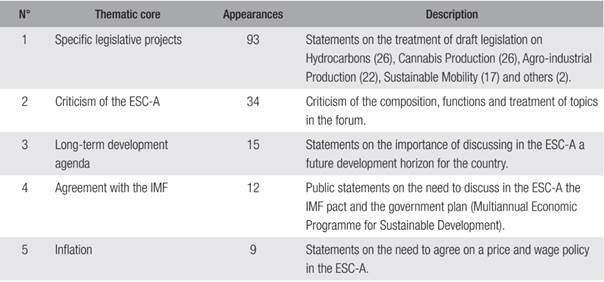
In addition, 1095 news items on the Argentinean ESC were reviewed for the entire year 2021 and 2022. The objective was to identify the main thematic cores of the business representatives in relation to the ESC-A. Google alerts were used to identify the 1095 news articles, based on keywords (Economic and Social Council, etc.). The initial articles went through multiple filters to corroborate their thematic appropriateness, resulting in a final sample of 236 articles (150 from 2021 and 86 from 2022). The content of these articles was coded with the support of the qualitative software Nvivo 12, and categorised in order to detect the most relevant nuclei and achieve a thematic synthesis that would allow for interpretation (Noblit et al., 1998; Thomas & Harden, 2008). The analysis presented in Box 2 (p. 18) made it possible to detect and classify the ESC-A-related themes most relevant to entrepreneurs, which enriched the information gathered by the other research strategies. The agenda-setting effectiveness of ESC-As is an identified but understudied dimension (Guardiancich & Molina, 2021; Santos & Gugliano, 2015) that we did examine for Argentinean business associations.
The business influence and effective coordination outcomes of the ESC-A are assessed in relation to the policies and draft laws discussed in the forum. The choice of cases analysed emerged from interviews, media review and forum documentation, both public and confidential. Given that Latin American hierarchical coordination focuses on specific policies (Schneider, 2009), we believe that analysing them will allow us to assess the extent to which employers, and which types of business associations and companies, have benefited from their participation in the ESC-A, as well as to assess the limits of the government’s ability to push for substantive institutional change.
4. ARGENTINE BUSINESS REPRESENTATION: FRAGMENTATION AND WEAKNESSES
In Argentina, the Peronist governments led the neo-developmentalist coalition in recent years (Collier & Handlin, 2015) with the majority support of trade unions and social movements. However, the competitive agro-export sector was opposed to any state intervention (Leiras & Cruzalegui, 2009). Industrialists, for their part, often supported agrarian demands (Wainer & Belloni, 2022). They offered oscillating support for industrialisation policies and frequently considered Peronism as a threat to their interests (Bonvecchi & Giraudy, 2007; Vommaro & Gené, 2017). SME organisations, although more interested in internal-market policies, also did not strongly support them (Bona, 2019).
This complex configuration of interests meant that the last two decades were marked by an oscillation between export-dependent and neo-developmentalist strategies, depending on each government. The industrial and marketinternal model of Néstor and Cristina Kirchner (2003-2015) was followed by Macri’s pro-business model that favoured commodity export strategies (2015-2019), a new return to marketinternal policies with Alberto Fernández (2019-2023), and, recently, a return to pro-business and radical antiestablishment policies with Javier Milei (from December 2023). The pendulum swings of economic policy favour institutional weakness, as noted in the theoretical framework. Certainly, some institutions, such as the ESC-A, adopt a dormant position, being revitalised by a given government, but falling into disuse or even being discontinued by the next one. This detracts from the operational and transformative capacity of the institutions.
However, despite this general oscillation, bipartite social dialogue in Argentina is stable. The relevance of its trade unions (Etchemendy, 2019; Schneider, 2009b) is exceptional by regional standards. The Peronist confederation CGT (Confederación General del Trabajo/General Confederation of Labor) prioritises the stability of the sectors in which it is represented and avoids direct confrontation with employers and their organisations (Fishwick & Urso, 2022). This trajectory of interclass dialogue guaranteed an initial support base for the ESC-A and, despite the weaknesses noted above, a certain initial viability for the project.
Business representation is more fragmented and with a lower membership than trade union representation (Etchemendy, 2011). However, the literature has shown that a centralised wage bargaining (Traxler, 2010) and powerful trade unionism (Croucher et al., 2006) incentivise the strengthening of business associations. Thus, in the strong bipartite social dialogue focused mainly on wages in Argentina’s segmented corporatism (Etchemendy & R. B. Collier, 2007)2 business associations retain a relevant role for firms (Dossi, 2012).
The Argentine Industrial Union (Unión Industrial Argentina [UIA]), which represents the large family-controlled national conglomerates (Cabrales, the Rocca family’s Techint Group and the Bulgheroni family’s Pan American oil company) and even subsidiaries of multinationals (such as FIAT), stands out for its relevance. The UIA is recognised as the interlocutor of a sector that represents 23.3% of GDP and generates 22.4% of registered work (World Bank, 2020). Ideologically, neoliberal postulates prevail (Bohoslavsky & Morresi, 2016), although there is also a tradition of negotiation and consensus with the CGT in formal and regulated labour sectors.
The agro-export sector accounts for 5.9% of GDP (World Bank, 2020), 67% of exports and 12.4% of direct employment (Argentine Agroindustrial Council, 2021). Until mid-2021, the Argentine Agroindustrial Council (Consejo Agroindustrial Argentino [CAA]) brought together the four main entities of the sector. Among all of them, the Argentine Rural Society (Sociedad Rural Argentina [SRA]), representative of the large landowners, has a historically predominant role (Palomino, 1988). However, the Argentine Agrarian Federation (Federación Agraria Argentina [FAA]), which represents small farmers, also plays an important role. With very different social bases and ideological principles, these organisations tend to ally over sectoral grievances.
The Argentine Chamber of Commerce (Cámara Argentina de Comercio [CAC]) and the Argentine Chamber of Construction (Cámara Argentina de la Construcción [CAMARCO]) complete the large business associations. The CAC does not represent a specific sector of the economy, but rather business interests in general and their proposals for greater economic liberalisation. CAMARCO, of large construction companies, also has neoliberal positions, although its companies are dependent on state investment in public infrastructure (Dossi, 2012).
Finally, the SME sector is characterised by the multiplicity and dispersion of its representation. 99.8% of firms in Argentina are SMEs and account for 77% of total employment, but they only account for 18% of total exports of goods (Arnoletto & Belacín, 2019), confirming their internal market anchorage. Two entities stand out in particular: the General Business Confederation of the Argentine Republic (Confederación General Empresaria de la República Argentina [CGERA]) and the Argentine Confederation of Medium Enterprises (Confederación Argentina de Mediana Empresa [CAME]). CGERA is the only business organisation with a strong Peronist affiliation. For its part, CAME maintains the usual neoliberal bias of the Argentine business community (Bona, 2019). However, many SME entrepreneurs do not identify with any of these entities and engage in dialogue with the government individually, or by forming other organisations.
In the following, we will assess the structure of business interest representation in the ESC-A and its influence on the policy and law-making process.
5. BUSINESSMEN AND THE ESC-A
All interviewees stressed that the constitution of the ESC-A was a unilateral decision by the government, with the intention of strengthening President Fernández internally and in the eyes of public opinion. They did not indicate, however, that there was a determination to bring about a significant change in the economic model and its trajectory. Fernández’s government was weakened by Peronism’s own internal contradictions. From the beginning of her presidency there was strong tension between “institutional” Peronism (trade unions, governorships) and “Kirchnerist” Peronism (controlling parliament and important ministries) led by Vice-President Cristina Kirchner.
Kirchner considered it necessary to impose himself on the business hierarchy in favour of his pro-internal market electoral base. Fernández, on the other hand, tried to manage business interests through social dialogue in the search for their support, even if this meant postponing her own socio-economic coalition. The rapprochement with the big business associations (including anti-Peronist ones) sought to consolidate Fernández’s autonomy vis-à-vis the more ‘anti-business’ (Kirchnerist) wing of Peronism. These contradictory strategies, as will be seen, came into permanent conflict in the context of a pressing economic crisis. In sum, institutional weakness (Balza, 2021; Mukand & Rodrik, 2005) of the ESC-A and a rapid and unilateral institutional design (Grzymala-Busse, 2011) combined from the outset.
The composition of the ESC-A was divided into segments of equivalent councillors: 10 businessmen, 10 workers and 10 plural organisations. According to interviewees, the third “plural” group was irrelevant. The initial parity was informally negotiated with the workers’ confederation CGT and the industrial UIA, the two main entities of Argentine corporatism (Etchemendy, 2011). As one government authority summed up: ‘The CGT and the UIA, that is the core that will always be there. The rest is more decoration’. The relationship between the CGT and the UIA is fluid, but also between this union and other business associations, such as CAMARCO and CAME.
The large business entities favoured the CGT’s over-representation in the ESC-A in order to displace the most combative trade union confederations: the Workers’ Central of Argentina (Central de Trabajadores de la Argentina [CTA]) and the Popular Economy Workers’ Union (Unión de Trabajadores y Trabajadoras de la Economía Popular [UTEP]). Also favoured by Fernández, CGT won eight of the ten councillors from the labour segment of the forum. However, this union displayed its usual “pragmatic autonomy” (Etchemendy & Collier, 2007). While it publicly supported the deliberations of the ESC-A, it sought to avoid confrontation with the businessmen and to avoid damaging their sectoral dialogues.
The agro-export sector also supported the creation of the ESC-A, seeing it as an opportunity to influence their sector’s policies, but without engaging in overall development strategies with the government (Canal Abierto, 2021).

Fernández privileged the representation of companies with dominant positions in the Argentine economy (of notable influence over the privileged representative organisations in the business segment of the council), despite the support they had given to the government of Mauricio Macri (2015-2019) (Vommaro & Gené, 2017) and their traditional neoliberal positions (Bohoslavsky & Morresi, 2016). The UIA, the government’s main business interlocutor, was over-represented (30% of the business segment). Although it represents only a specific sector of the business fabric, it incorporates the voice of dominant national and multinational conglomerates (the hierarchical business groups).
To promote exports, the government also included two agricultural representatives, one for the FAA3 and one for the CAA4 . There was one seat each for the CAC, CAMARCO and the multinational services company Accenture (which is not represented in a business association). The government excluded from the ESC-A the main financial institutions, the Association of Private Banks of Argentine Capital (Asociación de Bancos Argentinos [ADEBA]) and the Association of Banks of Argentina (Asociación de Bancos de la Argentina [ABA]). Ideologically neoliberal and with instruments to alter Argentina’s fickle exchange market, the aim was to isolate them.
Finally, the SME sector had only two seats in the ESC-A, occupied by CGERA and CAME, i.e., 20% of the business segment. The organisations representing SMEs and small agricultural producers that belong to the government’s social base (CGERA, FAA, and others) criticised this bias and rejected the privilege of the hierarchical business groups, crystallised in the hegemony of the UIA and the displacement of the organisations representing the national productive fabric, the SMEs. Interviewees from the Peronist CGERA, also annoyed at having to share the representation of SMEs with the neoliberal CAME, pointed out that “having a similar ideology, those who have come to govern have allowed themselves to be obscured by the big interests, by the big investments.” An SME leader who had left the forum pointed out that, “strictly speaking, the ESC operates as a bridge for dialogue with the business establishment” and questioned whether policies that were not favourable to big business could be implemented.
The undervaluing of SMEs is commonplace in many ESCs (Kim & Van Der Westhuizen, 2017). But Fernández’s privileging of hierarchical business groups impacted on his own social base. According to one SME businessman, this explained the negative results for the government coalition of the mid-term legislative elections in September 2021, which changed the balance of power in parliament and marked the decline of the government.
5.1 Tensions between strategic and short-term coordination
The tensions of the business segment in the ESC-A ratified the challenges of the government’s neo-developmentalist programme. The executive attempted to reconcile the different business interests, according to interviewees, without success. The poor institutionality of the forum did not contribute to understanding either: business associations frequently demanded a law passed by parliament to replace the decree creating the ESC-A, and to define the procedures for decision-making and the selection of councillors in order to reduce government arbitrariness. The large business associations, especially the industrial UIA, demanded a larger number of representatives and the elimination of the pluralistic segment of the ESC-A.
During the first months of the forum, the business community saw the ESC-A as a long-term coordination forum. They stated that the ESC-A should be used to think about strategic development issues (“What to do with energy? What to do with employment? What to do with exports?”) and to guarantee the stability of public policies (“we have to take a horizon where we design policies, where we have clear rules for many years”). This interest, reflected in the interviews, was also corroborated in one of the thematic nuclei identified in the newspaper articles (Box 2): on many occasions, business representatives declared themselves in favour of coordinating a long-term development agenda.
From the outset, large business associations, led by the UIA, demanded that the forum’s opinions be mandatory for the government. They argued that this was a way of guaranteeing the predictability of private investment, regardless of the political colour of the government. This interest, expressed in interviews, was also reflected in some media statements, albeit always strictly off the record.
Concerned about rising inflation, the CGERA together with other Peronist SME organisations, with the support of social movements (UTEP) and minority unions (CTA), tried to put debates on prices and wages on the agenda of the ESC-A. This interest was reflected in interviews, but also in newspaper articles (Box 2). The government rejected any attempt to address them at the forum, and was backed by the big business associations and the CGT. Wage issues were delegated to the Minimum Wage Commission and other labour institutions, where these corporatist bodies are predominant.
Given the ‘long-term focus’ of the forum, business associations with the leadership of the UIA proposed substantive (and controversial) debates on fiscal and labour issues, but not to change Argentina’s economy or strengthen its internal market. They sought, contrary to the government, to impose orthodox reforms on the public agenda and to favour the business hierarchy.
The UIA proposed that the ESC-A discuss a pro-business tax reform: simplification and reduction of the tax burden and business contributions to labour. The organisation was seconded by CAME and the agricultural associations of the CAA. However, the government never allowed such a wide-ranging discussion, and even less so in the Council. The Ministry of Economy granted tax reductions, but always specific ones, as in the case of hydrocarbons.
The UIA also proposed to discuss labour reform in the ESC-A, and had already initiated dialogue with the CGT. This union considered that the lack of formal job creation was a serious problem for trade union strength, and in order to favour it they were willing to reduce business charges. But the discussion in the ESC-A was not enabled by Fernández.
SMEs also wanted to introduce strategic issues into the ESC-A, but their position was in the absolute minority. The Peronist CGERA had a package of proposals aimed at deconcentrating and limiting economic foreignisation. The hierarchical business segment would not have supported it. But it was the government that also refused to have this debate, fearing confrontation with the UIA and other large entities. The context was not favourable to SME proposals: “We believe that there are two paths: to create SMEs and to de-monopolise. The government never talks about de-monopolising and never talks about creating SMEs”. What happened in the ESC-A coincides with the literature: SMEs have an accompanying role, never a leading role.
In this way, the articulation with the representative associations of the hierarchical business groups progressively focused, as suggested by the theory on HMEs, on punctual policies (Schneider, 2009b) and the government eventually accepted this. In the difficult post-pandemic context of 2021, business councillors supported and promoted only those proposals that were in their interests, ignoring the rest. The government, for its part, only presented the legislative projects to the councillors in order to transmit to public opinion that they had been “dealt with and discussed” in the Council.
In this sense, it was the government itself that curtailed the ESC-A’s operability by seeking to ensure that it did not provoke conflicts. “The idea was not to generate any kind of crossover or explosion”, which could hardly succeed in changing the institutional trajectory of the economy or favouring the development of the internal market to the detriment of the interests of the hierarchical companies. But the irrelevance of the debates also provoked numerous private and even public criticisms and those of big business, which are listed in Box 2.
As one Peronist business leader pointed out, the government was dominated by a “consensus fundamentalism” to deliberately obscure sectoral contradictions, especially within the business segment, where SMEs, large national conglomerates and multinationals coexist. A decaffeinated consensus, which agreed on nothing and therefore favoured the statu quo without bringing about any change. Statements by business representatives in the media confirmed what was reported in interviews. The meetings were on extremely heterogeneous topics, and generally linked to insubstantial issues5.
Moreover, the large business associations considered the ESC-A to be just one more instrument of articulation, in addition to other formal (the Minimum Wage Commission, the National Congress, etc.) and, above all, informal spaces already in existence where they could promote their interests (Vommaro & Gené, 2017). An interviewed councillor indicated: “the ESC is also complemented by traditional institutions [...] But there are several windows, several spaces where we are acting simultaneously.”
Moreover, the partial ineffectiveness of the Council led the hierarchical business groups (and their representative bodies) to resume and reinforce the usual channels of formal and, above all, informal articulation. In this sense, SME leaders pointed out: “How can we be looking at what is being discussed in the ESC and suddenly, in a parallel channel, things are being defined that are much more relevant than in the ESC?” The overlap between formal and informal institutions is common in Latin American economies, even more so in relation to big business (Levitsky & Murillo, 2013; O’Donnell, 1997).
For their part, the SMEs tried unsuccessfully to put the ESC-A on a higher level. Their demands only met with a response from one wing of the government. Kirchnerist legislators and public authorities, as will be discussed in the next section, modified or even blocked proposals by Fernández (and the hierarchical business groups) that were detrimental to SMEs.
5.2 Employer interests and proposals
Faced with the government’s refusal to discuss broad pro-market reforms in the ESC-A, large companies began to negotiate specific policies with Fernández, autonomously, inorganically and through informal channels. The analysis of the emerging business thematic clusters in the media corroborates the findings of the interviews and participant observation. Media discussion concentrated on sectoral legislative projects (Box 2).

Furthermore, the heterogeneity of business representation fragmented demands. Instead of discussing an overall package of laws, entities concentrated their pressure on a handful of sectoral and concrete proposals, as suggested by the literature on HMEs (Schneider, 2009a, 2009b).
But what is most relevant is that the most important business organisations forced the government to validate proposals with an extractivist and dependent profile in the ESC-A. Thus, in mid-2021, the Minister of Productive Development presented the hydrocarbons bill at the forum aimed at promoting the oil sector, with the backing of the associated companies, a small group of family conglomerates (Pluspetrol, Pan American Energy, Vista, Pampa Energía, Compañía General de Combustibles [CGC]), multinationals (Germany’s Wintershall Dea, France’s Total Austral, and to a lesser extent Brazil’s Petrobras) and the main public company (Yacimientos Públicos Fiscales [YPF]). The project ratified the consensus of the whole sector: to increase the price in the primary market. According to interviews, the legislative project arrived at the ESC-A plenary as a “closed issue”, the product of informal negotiations before and outside the Council.
The dispute between export and domestic energy supply has historically divided large exporting companies and internal market companies. In this sense, the Peronist SME entities protested: “for us, it is a productive problem. [...] For us, it is a tariff slashing.” The Kirchnerist parliamentarians supported the demand, denounced the concessions given to the multinationals and questioned their support for the law. In the end, internal resistance to the bill meant that, in May 2022, the president of the government decreed a softened alternative, focused on facilitating access to foreign currency for hydrocarbon investments. This did not satisfy large companies or SME business entities, and once again went beyond the scope of the Council.
The business hierarchy did not completely abandon corporatist representation when negotiating within the ESC-A. The large agro-exporters dominant in the business association CAA and the Ministry of Agriculture jointly presented a legislative project to promote agricultural exports (again as a closed issue). The small producers’ organisations, displaced from the debate, considered it to be a surrender to the concentrated primary sector (Canal Abierto, 2021). The SME associations joined in the criticism, but, once again, the hardest pressure came from the Kirchnerist wing of the government. The large agro-exporters of the CAA exerted intense pressure both outside and inside the ESC-A.
Pressure from Kirchner once again had an effect. Agro-exporting entities wanted a more ambitious law (Consejo Agroindustrial Argentino, 2021) and dissatisfaction with the final document led to the rejection of the SRA (representative of the large landowners) and other powerful associations, and the break-up of the CAA. The government threatened to raise export taxes on the sector to force its acceptance. The project was sent to parliament at the end of 2021, but, without the support of employers or Kirchnerism, it failed to prosper.
SMEs also submitted their proposals to the ESC-A. In fact, the law on the Promotion of the Hemp and Medical Cannabis Industry, which regulates investment and production, was the only one legislatively sanctioned (May 2022). The experience, however, demonstrated the weakness and lack of representativeness of SME organisations. As one SME leader pointed out, once again “the government went it alone, [...] there is no relevant SME advocacy either. It is what the government decides”.
5.3 Business reaction to government weakening
Defeat in the September 2021 legislative elections weakened the government’s capacity for corporatist coordination and rekindled internal tensions within Peronism. The business community, for its part, reacted to the expectation of a future victory of the liberal opposition in the upcoming presidential elections. In the course of 2022, the agreement with the IMF (understood by the Kirchnerist wing as a surrender), coupled with accumulated inflation of close to 100 per cent per year and the loss of real wages, exacerbated the conflicts.
If the ESC-A had been conceived to coordinate a long-term neo-developmentalist project with the business community, the government’s internal division made it impossible: “What can the ESC do to build consensus when the differences within the political front itself are so brutally visible,” synthesised a business leader. A ministerial authority interviewed concluded: “From weakness it is very difficult.”
Fernández’s decline in the second half of her term was seen by the large business associations as an opportunity to increase their influence. The UIA, the CAC and the agro-exporters publicly demanded that the ESC-A meet more regularly to discuss policies (Renou, 2021). Criticism in the media increased (almost two thirds of such articles are concentrated in 2022). In their content they were similar to those collected in the interviews: the composition of the plenary, the insubstantiality of the debates, the forum’s decisions not binding for the government, Fernández’s lack of leadership, etc. But now they were expressed openly.
Pushed by circumstances, the president increasingly relied on the business hierarchy and abandoned more progressive positions. According to SME leaders, “the Alberto [Fernández] - establishment link grew stronger and stronger.” However, the government did not adopt a pro-business policy either, although the neo-developmentalist project did enter a definitive dead end.
In a difficult context, the government relaunched the forum in April 2022 with the presence of Fernández. The call was the staging of an ‘armed peace’ between the big business and trade union organisations, concerned about governability. At the plenary meeting, the UIA and the CGT agreed on maximum prices for foodstuffs and also not to bring forward the bargaining commissions, so as not to add to inflationary pressure. The convening of the ESC-A did not go beyond a formal matter.
Throughout the presidential term, the UIA supported the government and the ESC-A, in contrast to other large associations (such as the more intransigent agro-exporting SRA). According to some interviewees, the support of large industrial companies should be seen as an incentive for Fernández to break with her vice-president, who is increasingly critical of the business community.
On the contrary, the government’s confrontation with the rest of the big business entities became more pronounced. The CAME pushed for the ESC-A to deal with labour reform, pointing to the “recurrent trade union conflicts that generate a context that undermines production” (TN24, 2022). In April 2022, agro-export entities led by the SRA, protesting against the government’s increase in soybean export taxes, occupied the main avenues of Buenos Aires with tractors.
In July 2022, after a deep governmental crisis, ministers loyal to Fernández resigned, including Gustavo Béliz, director of the ESC-A. The relationship with big business passed into the hands of Sergio Massa, the new economy minister with broad powers, who favoured non-state spaces for articulation (e.g., the Council of the Americas). The ESC-A was relegated. In the 2023 presidential elections, Sergio Massa, the Peronist presidential candidate, was defeated by Javier Milei, with a markedly pro-business profile.
6. DISCUSSION AND CONCLUSIONS
The ESC-A was intended to be an institution for the coordination of a neo-developmentalist agenda with the hierarchical business groups, traditionally hostile to Peronism. From a classical neo-corporatist approach (Guardiancich & Ghellab, 2020; Guardiancich & Molina, 2021; Jahn, 2016; Schmitter, 1989), the main representative business associations were convened. This article enriches the literature by addressing two scarcely studied topics: Latin American ESCs (Patschiki, 2016; Santos & Gugliano, 2015) and the role played by business community in these institutions (Cho, 2019; Spasova & Tomini, 2013).
The ESC-A has not satisfactorily fulfilled its objective of coordinating a neo-developmentalist agenda with business that would bring about institutional change. Given this theoretical framework, i) the sectoral and fragmented representation of business interests, ii) the hierarchical, dependent and extractivist profile of Argentine capitalism and iii) the shortcomings of the Peronist government in leading institutional change are factors that condemned the ESC-A to an insurmountable institutional weakness that conditioned its capacity for corporatist coordination.
With regard to the first factor, we could observe that the hierarchical segmentation of the economy (CEPAL, 2004; Madariaga, 2018) and the fragmentation of the productive fabric (Arnoletto & Belacín, 2019) are reproduced in the associative business fabric, which is equally fragmented and with a disparate representation of interests (Dossi, 2012; Etchemendy, 2011; Palomino, 1988). Of course, this fragmentation did not translate linearly into weakness, as business entities (especially the UIA, but also the SRA and others) played a significant role in brokering interests in many debates in the ESC-A, and even in its very constitution and in defining its composition.
However, hierarchical business groups played a leading and unifying role within business associations, in line with the literature (Clegg, 1976; Olson, 1965; Sisson, 1987). In this sense, the hierarchical institutional model accentuated its influence, and the UIA became, in practice, the mouthpiece of major business interests. In line with the literature (Kim & Van Der Westhuizen, 2017), SMEs and small farmers’ organisations played a completely secondary role, a fact that was encouraged by the government but encouraged by the hierarchical model of capitalism.
Thus, although business associations played a significant role, hierarchical business groups disengaged from them when they needed to, and alternated between corporatist representation and autonomous strategies. In addition to the heterogeneity of representation, there was a second factor: the constraints imposed by the HME on business coordination. When hierarchical businessmen realised that their representative organisations were not getting results in the ESC-A, they turned to other consolidated formal and especially informal channels (Vommaro & Gené, 2017) to negotiate policies directly with the government and the CGT. As the literature points out (Guardiancich & Molina, 2021) this erodes the credibility and representativeness of business associations, and thus the institutionalised and long-term socio-economic coordination proposal of the ESC-A. As the closed-door negotiation of the hydrocarbon bill demonstrates, large companies pursued autonomous strategies in addition to corporatist representation. The projects discussed also crystallised the dependent and extractivist profile of Argentine capitalism.
But the shortcomings of the Peronist government in leading institutional change were particularly decisive. This third factor condemned the ESC-A to an insurmountable institutional weakness. The ESC-A fits within the parameters that the literature has pointed out as strongly limiting institutional change. Its creation is framed within a new alternation of Argentine governments with radically opposed agendas (Bizberg, 2014) and within the historical fluctuation of their power coalitions (O’’Donnell, 1976; Portantiero, 1977). Moreover, on this occasion, its creation was more a result of internal political balance within the Peronist coalition in government (between its more centrist wing and the Kirchnerists) than of a desire to change the economic model. The forum quickly proved to be essentially an instrument to strengthen President Fernández internally vis-à-vis the Kirchnerist faction, and never favoured an effective change in the economy. The fragile presidential authority, in turn, forced a rapid and unilateral institutional design of the ESC-A by the government, another limitation pointed out by the literature (Grzymala-Busse, 2011). The critical and extremely uncertain context, marked by the pandemic and inflation, further favoured the extraordinary weakness of origin, a remarkably limiting element (Mukand & Rodrik, 2005). As if this were not enough, the forum also lacked the time to extend its legitimacy in the face of a negative electoral outcome in the mid-term elections (September 2021) and a subsequent change of government (December 2023), another limiting factor identified in other Latin American experiences (Balza, 2021).
The high level of institutional uncertainty, the product of a weak government and insurmountable internal contradictions, fed back into the sectoral and fragmented representation of business interests and hierarchical coordination. The business elite collaborated in the failure of institutional change: it reinforced the Fernández government’s expectations of instability and opted for the traditional channels of informal negotiation and agreement outside the representative organisations, which further eroded the corporatist forum. The ESC-A thus fell into the historical trap of Latin American institutional instability (Helmke, 2007).
Thus, the business hierarchy has had little incentive to institutionalise the ESC-A, let alone coordinate long-term policies there (Guardiancich & Ghellab, 2020), that challenge the foundations of the current Argentine development model. As suggested by interviews, participant observation of the dialogue roundtables and the thematic nuclei collected from the media analysis, the business hierarchy and its organisations participated in the ESC-A only on specific policies (Schneider, 2009a, 2009b) that responded to their interests. The hydrocarbon and agricultural export promotion legislative bills had an extractivist and dependent profile centred on the export of primary products. The big industrialists, as recent history indicates (Bohoslavsky & Morresi, 2016; Bonvecchi & Giraudy, 2007; Wainer & Belloni, 2022), supported extractivist and dependent proposals as they considered them pro-market, and never engaged with the ESC-A or the government in the discussion of a broader agenda.
Given this position of the Argentine business community, the article shows that, in a context of crisis, the weak and fragmented Fernández government was pushed even against its social base, by partially giving in to hierarchical business demands. When it debated substantive and strategic issues, the relative strength of the main business associations and big business (both domestic and foreign) prevailed over the a priori assumption. The literature shows that an economic coordination institution can serve to institutionalise pro-market reforms (Han et al., 2010; Kim & Van Der Westhuizen, 2017; Spasova & Tomini, 2013). In the same vein, the ESC-A of the Peronist government, when it did not fall into insubstantial debates, paradoxically favoured a pro-business corporatism with an extractivist and dependent profile that underlined precisely the most prominent negative elements of the Argentine economy it sought to change.
In this sense, the article incorporates the case of the ESC-A into the characteristic institutional weakness, the limitations of the changing institutional trajectory and the inability of Latin American economies to institutionalise the coordination with the business hierarchy necessary to redirect national accumulation processes (Wainer & Belloni, 2022). The study thus shows the historical limits of neo-developmentalist proposals to modify hierarchical and dependent capitalism in Argentina and in the region in general (Munck, 2015; O’Donnell, 1976). It also calls into question the viability of these alliances between the state and the industrial hierarchy, which are considered to be fundamental (Madariaga, 2018). As in other regional ESC experiences (Patschiki, 2016; Santos & Gugliano, 2015), institutionalised coordination between progressive governments and industrial hierarchy was a chimera due to the limitations discussed above. The ESC-A will probably not be able to avoid the inertia of the constant substitution of Latin American institutions (Levitsky & Murillo, 2013), in the face of the new change of government in Argentina.
References
-
Arnoletto, M., & Belacín, M. (2019). Panorama de las empresas en Argentina https://biblioteca.produccion.gob.ar/document/download/535
» https://biblioteca.produccion.gob.ar/document/download/535 - Balza, S. (2021). La consolidación de la precariedad laboral en la Argentina de la posconvertibilidad (2019-2003). Revista Latinoamericana de Antropología Del Trabajo 27-1, 1(10) 5
-
Barragan, F. (2021, 29 de noviembre). Hidrocarburos y agroindustria, los proyectos de ley que se debaten en el oficialismo. Ámbito Financiero https://www.ambito.com/economia/hidrocarburos/y-agroindustria-los-proyectos-ley-que-se-debaten-el-oficialismo-n5325774
» https://www.ambito.com/economia/hidrocarburos/y-agroindustria-los-proyectos-ley-que-se-debaten-el-oficialismo-n5325774 -
Bizberg, I. (2014). Types of Capitalism in Latin America. Interventions Économiques, 49, 1-31. https://doi.org/10.4000/interventionseconomiques.1772
» https://doi.org/10.4000/interventionseconomiques.1772 -
Bohoslavsky, E., & Morresi, S. (2016). El partido PRO y el triunfo de la nueva derecha en Argentina. Amérique Latine Histoire et Mémoire, 32, 1-11. https://doi.org/10.4000/alhim.5619
» https://doi.org/10.4000/alhim.5619 -
Bona, L. M. (2019). ¿Neoliberalismo hegemónico? Apuntes sobre el Estado, el bloque de poder y la economía política en la Argentina reciente (2016-2018). Revista Pilquen, 22(1), 39-54. http://revele.uncoma.edu.ar/htdoc/revele/index.php/Sociales/article/view/2242/58875
» http://revele.uncoma.edu.ar/htdoc/revele/index.php/Sociales/article/view/2242/58875 - Bonvecchi, A., & Giraudy, A. (2007). Argentina: Crecimiento económico y concentración del poder institucional. Revista de Ciencia Política, 27(Especial), 29-42.
- Bresser-Pereira, L. C. (2010). Globalización y competencia: apuntes para una macroecoomía estructuralista del desarrollo Instituto Di Tella - Siglo XXI.
-
Canal Abierto. (2021, 09 de diciembre). Ley de Agroindustria: “Es una claudicación ante los grandes grupos económicos” https://canalabierto.com.ar/2021/12/09/ley-de-agroindustria-es-una-claudicacion-ante-los-grandes-grupos-economicos/
» https://canalabierto.com.ar/2021/12/09/ley-de-agroindustria-es-una-claudicacion-ante-los-grandes-grupos-economicos/ - Comisión Económica para América Latina. (2004). Desarrollo productivo en economías abiertas
-
Consejo Económico y Social. (2022). Integrantes del CES https://www.argentina.gob.ar/consejo/integrantes
» https://www.argentina.gob.ar/consejo/integrantes - Cho, S. H. (2019). Roles and Tasks of Social Dialogue ‒in Case of Denmark and Netherlands. The Journal of Labor Law, 47, 261-301.
- Clegg, H. (1976). Trade Unions under Collective Bargaining Basil Blackwell.
- Collier, R. B., & Handlin, S. (2015) (Eds.). Reorganizing popular politics: participation and the new interest regime in Latin America Penn State University Press.
- Collier, R. B., & Collier, D. (1991). Shaping the Political Arena: Critical Junctures, the Labor Movement, and Regime Dynamics in Latin America Princeton University Press.
-
Consejo Agroindustrial Argentino. (2021, 31 de diciembre). Balance del año 2021 Consejo Agroindustrial Argentino. Agrositio https://www.agrositio.com.ar/noticia/220658-balance-del-ano-2021-consejo-agroindustrial-argentino
» https://www.agrositio.com.ar/noticia/220658-balance-del-ano-2021-consejo-agroindustrial-argentino -
Croucher, R., Tyson, S., & Wild, A. (2006). “Peak” employers’ organizations: International attempts at transferring experience. Economic and Industrial Democracy, 27(3), 463-484. https://doi.org/10.1177/0143831X06065964
» https://doi.org/10.1177/0143831X06065964 -
Diniz, E. (2013). Desenvolvimento e estado desenvolvimentista: Tensões e desafios da construção de um novo modelo para o brasil do século XXI. Revista de Sociologia e Politica, 21(47), 9-20. https://doi.org/10.1590/S0104-44782013000300002
» https://doi.org/10.1590/S0104-44782013000300002 -
Dossi, M. V. (2012). La Unión Industrial Argentina: su organización y vinculaciones con el mundo de las corporaciones empresarias (Documentos de Investigación Social, n. 19). CLACSO. https://biblioteca.clacso.edu.ar/Argentina/idaes-unsam/20171114033452/pdf_731.pdf
» https://biblioteca.clacso.edu.ar/Argentina/idaes-unsam/20171114033452/pdf_731.pdf -
Ebenau, M. (2014). Comparative capitalisms and Latin American neodevelopmentalism: A critical political economy view. Capital and Class, 38(1), 102-114. https://doi.org/10.1177/0309816813512591
» https://doi.org/10.1177/0309816813512591 - Etchemendy, S. (2011). El Dialogo Social y las Relaciones Laborales en Argentina 2003-2010. Estado, sindicatos y empresarios en perspectiva comparada Oficina Regional para América Latina y el Caribe, Programa Regional para la Promoción del Diálogo y la Cohesión Social en América Latina, Organización Internacional del Trabajo.
-
Etchemendy, S. (2019). The politics of popular coalitions: Unions and territorial social movements in post-neoliberal Latin America (2000-15). Journal of Latin American Studies, 52(1), 157-188. https://doi.org/10.1017/S0022216X19001007
» https://doi.org/10.1017/S0022216X19001007 -
Etchemendy, S., & Collier, R. B. (2007). Down but not out: Union resurgence and segmented neocorporatism in Argentina (2003-2007). Politics and Society, 35(3), 363-401. https://doi.org/10.1177/0032329207304318
» https://doi.org/10.1177/0032329207304318 - Fioretos, O., Falleti, T. G., & Sheingate, A. (2013). Historical Institutionalism in Political Science. In O. Fioretos, T. G. Falleti, & A. Sheingate (Eds.), Oxford Handbook of Historical Institutionalism Oxford University Press.
-
Fishwick, A., & Urso, L. D. (2022). Trade Union Solidarity in Crisis: The Generative Tensions of Worker Solidarities in Argentina. Work, Employment and Society, 38(1), 44-62. https://doi.org/10.1177/09500170221100935
» https://doi.org/10.1177/09500170221100935 -
Gavris, M., & Heyes, J. (2021). Varieties of labour administration in Europe and the consequences of the Great Recession. Economic and Industrial Democracy, 42(4), 1282-1304. https://doi.org/10.1177/0143831X19861749
» https://doi.org/10.1177/0143831X19861749 - Gómez, A. (2015). Enfoques recientes para el análisis del cambio institucional. La teoría distribucional del cambio gradual. Politica y Gobierno, 22(2), 391-415.
-
Grzymala-Busse, A. (2011). Time will tell? temporality and the analysis of causal mechanisms and processes Comparative Political Studies, 44(9), 1267-1297. https://doi.org/10.1177/0010414010390653
» https://doi.org/10.1177/0010414010390653 -
Guardiancich, I., & Ghellab, Y. (2020). Economic and social councils and the future of work: Current situation and definition of a research agenda. Rivista Italiana Di Politiche Pubbliche, 15(1), 101-122. https://doi.org/10.1483/96931
» https://doi.org/10.1483/96931 -
Guardiancich, I., & Molina, O. (2021). From gradual erosion to revitalization: National Social Dialogue Institutions and policy effectiveness. European Journal of Industrial Relations, 28(1), 85-103. https://doi.org/10.1177/09596801211018318
» https://doi.org/10.1177/09596801211018318 -
Hall, P., & Soskice, D. (2001). Varieties of capitalism: The institutional foundations of comparative advantage Oxford University Press. https://doi.org/10.4337/9781786439017.00020
» https://doi.org/10.4337/9781786439017.00020 -
Han, C., Jang, J., & Kim, S. (2010). Social dialogue and industrial relations in South Korea: Has the tripartite commission been successful? Asia Pacific Viewpoint, 51(3), 288-303. https://doi.org/10.1111/j.1467-8373.2010.01432.x
» https://doi.org/10.1111/j.1467-8373.2010.01432.x - Helmke, G. (2007, July). The Origins of Institutional Crises in Latin American: A Unified Strategic Model and Test University of Rochester.
- Hemerijck, A., & Vail, M. (2006). The forgotten center: State activism and corporatist adjustment in Holland and Germany. In J. D. Levy (Eds.), The State after Statism. New State Activities in the Age of Liberalization(pp. 57-92). Harvard University Press.
-
Jahn, D. (2016). Changing of the guard: Trends in corporatist arrangements in 42 highly industrialized societies from 1960 to 2010. Socio-Economic Review, 14(1), 47-71. https://doi.org/10.1093/ser/mwu028
» https://doi.org/10.1093/ser/mwu028 -
Kim, Y., & Van Der Westhuizen, J.(2017). Corporatism as a Crisis Response to Democratisation? Comparing the Rise and Fall of Corporatism in South Korea and South Africa. Politikon, 45(2), 291-308. https://doi.org/10.1080/02589346.2017.1398920
» https://doi.org/10.1080/02589346.2017.1398920 -
Lane, D. (2009). “Coloured Revolution” as a Political Phenomenon. Journal of Communist Studies and Transition Politics, 25(2-3), 113-135. https://doi.org/10.1080/13523270902860295
» https://doi.org/10.1080/13523270902860295 - Leiras, M., & Cruzalegui, I. (2009). Argentina: problemas macroeconómicos, conflicto social y debilitamiento de la coalición de gobierno. Revista de Ciencia Política, 29(2), 223-246.
-
Levitsky, S., & Murillo, M. (2013). Construyendo instituciones sobre cimientos débiles: lecciones desde América Latina. Politai, 5, 17-44. https://revistas.pucp.edu.pe/index.php/politai/article/view/14124
» https://revistas.pucp.edu.pe/index.php/politai/article/view/14124 - Madariaga, A. (2018). Variedades de capitalismo y sus contribuciones al estudio del desarrollo en América Latina. Política y Gobierno, 25(2), 441-468.
-
Ministerio de Trabajo. (2022). Cobertura e incidencia de los Convenios Colectivos de Trabajo https://www.argentina.gob.ar/trabajo/estadisticas/cobertura-e-incidencia-de-los-convenios-colectivos-de-trabajo
» https://www.argentina.gob.ar/trabajo/estadisticas/cobertura-e-incidencia-de-los-convenios-colectivos-de-trabajo -
Mukand, S. W., & Rodrik, D. (2005). In search of the holy grail: policy convergence, experimentation, and economic performance. American Economic Review, 95(1), 374-383. https://doi.org/10.1145/1216016.1216042
» https://doi.org/10.1145/1216016.1216042 -
Munck, R. (2015). Rethinking Latin America: Back to the Future? Latin American Perspectives, 42(4), 73-91. https://doi.org/10.1177/1540796915587000
» https://doi.org/10.1177/1540796915587000 - Murillo, V., Levitsky, S., & Brinks, D. (2021). La ley y la trampa en América Latina: Por qué optar por el debilitamiento institucional puede ser una estrategia política Siglo XXI Editores.
- Noblit, G. W., Hare, R. D., & Hare, R. D. (1998). Meta-ethnography: Synthesizing qualitative studies Sage.
- O’Donnell, G. (1997). Contrapuntos Paidós.
- O´Donnell, G. (1976). Estado y Alianzas en la Argentina 1956-1976 Cambridge University.
- Olson, M. (1965). The Logic of Collective Action: Public Goods and the Theory of Groups Harvard University Press.
-
Organización Internacional del Trabajo. (2021). Panorama laboral 2021. América Latina y el Caribe https://www.ilo.org/es/publications/panorama-laboral-2021-america-latina-y-el-caribe
» https://www.ilo.org/es/publications/panorama-laboral-2021-america-latina-y-el-caribe - Palomino, M. (1988). Tradición y poder. La Sociedad Rural Argentina (1955-1983). CISEA-Grupo Editor Latinoamericano.
- Patschiki, L. (2016). A burguesia e as gestões federais do PT: uma introdução ao Conselho de Desenvolvimento Econômico e Social. Anais Eletrônicos, 11(3), 604-626.
- Pierson, P. (2000). Increasing Returns, Path Dependence, and the Study of Politics. American Political Science Review, 94(2), 251-267.
- Portantiero, J. C. (1977). Economía y política en la crisis argentina: 1958-1973. Revista Mexicana de Sociología, 39(2), 531-565.
-
Renou, L. (2021, 17 de noviembre). El Gobierno reactiva el diálogo tripartito. Página 12 https://www.pagina12.com.ar/383133-el-gobierno-reactiva-el-dialogo-tripartito
» https://www.pagina12.com.ar/383133-el-gobierno-reactiva-el-dialogo-tripartito -
Ribeiro dos Santos, P., & Gugliano, A. A. (2015). Efetividade das políticas participativas no governo brasileiro: o Conselho de Desenvolvimento Econômico e Social. Revista de Sociologia e Política, 23(56), 3-19. https://doi.org/10.1590/1678-987315235601
» https://doi.org/10.1590/1678-987315235601 -
Sánchez-Mosquera, M. (2022). Somewhat more than path dependence: The Spanish employers’ peak organisation and social dialogue in light of the crisis of the industrial relations system. Economic and Industrial Democracy, 43(4), 1655-1675. https://doi.org/10.1177/0143831x211024717
» https://doi.org/10.1177/0143831x211024717 -
Sánchez-Mosquera, M. (2024). The influence of the political attitudes of workers and the effect of the Great Recession on the decision to join a trade union in Southern Europe. Economic and Industrial Democracy, 45(2), 579-599. https://doi.org/10.1177/0143831X231174473
» https://doi.org/10.1177/0143831X231174473 -
Schmitter, P. C. (1989). Still the Century of Corporatism? Government and Opposition, 24(1), 54-73. https://doi.org/10.1111/j.1477-7053.1989.tb00107.x
» https://doi.org/10.1111/j.1477-7053.1989.tb00107.x - Schneider, B. R. (2009a). A comparative political economy of diversified business groups, or how states organize big business. Review of International Political Economy, 16(2), 178-201.
-
Schneider, B. R. (2009b). Hierarchical market economies and varieties of capitalism in Latin America. Journal of Latin American Studies, 41(3), 553-575. https://doi.org/10.1017/S0022216X09990186
» https://doi.org/10.1017/S0022216X09990186 - Sisson, K. (1987). The management of collective bargaining: an international comparison Basil Blackwell.
-
Spasova, S., & Tomini, L. (2013). Building Social Dialogue Institutions in Bulgaria: Between EU Conditionality and Domestic Social Actors. Debatte, 21(1), 3-24. https://doi.org/10.1080/0965156X.2013.812313
» https://doi.org/10.1080/0965156X.2013.812313 - Streeck, W., & Thelen, K. (2005). Beyond Continuity: Institutional Change in Advanced Political Economies Oxford University Press.
-
Thelen, K. (2009). Institutional change in advanced political economies: First annual lecture of the BJIR. British Journal of Industrial Relations, 47(3), 471-498. https://doi.org/10.1111/j.1467-8543.2009.00746.x
» https://doi.org/10.1111/j.1467-8543.2009.00746.x -
Thomas, J., & Harden, A. (2008). Methods for the thematic synthesis of qualitative research in systematic reviews. BMC Medical Research Methodology, 8, 1-10. https://doi.org/10.1186/1471-2288-8-45
» https://doi.org/10.1186/1471-2288-8-45 -
TN24. (2022, 22 de febrero). La CAME recibió al presidente del Consejo Económico y Social https://www.tn24.com.ar/2022/02/la-came-recibio-al-presidente-del-consejo-economico-y-social/
» https://www.tn24.com.ar/2022/02/la-came-recibio-al-presidente-del-consejo-economico-y-social/ - Traxler, F. (2010). The long-term development of organised business and its implications for corporatism: A cross-national comparison of membership, activities and governing capacities of business interest associations. 1980-2001. European Journal of Political Research, 49(2), 151-173.
-
Treacy, M. (2022). Dependency Theory and the Critique of Neodevelopmentalism in Latin America. Latin American Perspectives, 49(1). https://doi.org/https://doi.org/10.1177/0094582X211066531
» https://doi.org/10.1177/0094582X211066531 -
Visser, Jelle. (2009). The quality of industrial relations and the Lisbon Strategy. In J. Visser(Ed.), Industrial relations in Europe 2008 (pp. 45-73). Office for Official Publications of the European Communities. https://doi.org/10.2767/54876
» https://doi.org/10.2767/54876 - Vommaro, G., & Gené, M. (2017). Artículos Ciencia Política Argentina: el Año de Cambiemos. Revista de Ciencia Política, 37(2), 231-254.
-
Von-Zeschau, J. F., & Sánchez-Mosquera, M. (2022). Los consejos económicos y sociales. Una revisión de la literatura centrada en su eficacia y evaluación. Revista de Administração Pública, 1-34. https://bibliotecadigital.fgv.br/ojs/index.php/rap/article/view/85925
» https://bibliotecadigital.fgv.br/ojs/index.php/rap/article/view/85925 -
Wainer, A., & Belloni, P. (2022). Balance-of-Payments Constraints as the Key to Dependency: The Case of Argentina. Latin American Perspectives, 49(2), 144-162. https://doi.org/10.1177/0094582X211069556
» https://doi.org/10.1177/0094582X211069556 -
Wilkinson, A., & Wood, G. (2017). Global trends and crises, comparative capitalism and HRM. International Journal of Human Resource Management, 28(18), 2503-2518. https://doi.org/10.1080/09585192.2017.1331624
» https://doi.org/10.1080/09585192.2017.1331624 -
World Bank. (2020, 14 de junio). Argentina Data https://datos.bancomundial.org/indicator/NV.IND.TOTL.ZS?locations=AR
» https://datos.bancomundial.org/indicator/NV.IND.TOTL.ZS?locations=AR
-
1
Interviews were anonymous. Interviews were conducted with: 3 representatives of formal workers; 3 representatives of SMEs; 1 representative of national universities; 3 government representatives; 2 junior informants.
-
2
Wage bargaining in Argentina takes place at the national and sectoral levels, and its coverage is close to 52% of total registered employment (Ministerio de Trabajo, 2022), higher than the Latin American average (Croucher et al., 2006; Etchemendy, 2011). Of course, the values must be qualified by a 42.5% rate of labour informality (International Labour Organisation, 2021). According to Etchemendy and Collier (2007) this situation reproduces a “segmented corporatism” in which there is a strong tripartite social dialogue, but a large part of the workers are left out.
-
3
The FAA is closer to the Peronist government, hence its differential seat.
-
4
At the end of 2021, the CAA broke up due to differences over the agribusiness bill discussed with the government.
-
5
There were 38 newspaper articles of this type: strict statements on topics unrelated to business interests (such as the code of ethics for judges, artificial intelligence, etc.), superficial mentions of the importance of consensus and dialogue, or general statements of support for the government.
Reviewers:
-
20
Leila Giandoni Ollaik (Ministério da Economia, Brasília / DF - Brazil) https://orcid.org/0000-0002-4894-0080
-
21
Ricardo Borges Gama Neto (Universidade Federal de Pernambuco, Recife / PE - Brazil) https://orcid.org/0000-0002-9361-9210
-
22
Three reviewers did not authorize the disclosure of their identities.
Edited by
The dataset linked to interviews and participant observation is not publicly available because it contains information that compromises the privacy of the research participants. The rest of the data was published in the article itself.

 Source: Economic and Social Council (ESC, 2022).
 Source: Elaborated by the authors based on the media review work.