 Reassessing the Brazilian bureaucratic public administration paradigm: legal-rational bureaucracy prior to 1930
Abstract
This article examines theoretical critiques and empirical evidence indicating the need to reassess the adequacy of the bureaucratic public administration (BPA) paradigm in Brazil. The BPA is one of the three paradigms of Brazil’s historical-administrative evolution, as defined by Bresser-Pereira. In his view, BPA emerges as highly rational in 1930 and becomes increasingly irrational after the 1988 Constitution. Bureaucratization is seen as an event rather than as a process, an assumption criticized both by historical research on bureaucracies (e.g., Crooks and Parsons) and by critical Weberian interpretations developed by Brazilian thinkers such as Guerreiro Ramos, Tragtenberg, and Prestes Motta. Our historical research, based on documents registered in the National Archives and the National Library databases, finds evidence of formal and legal rationalization in Brazil before 1930, supporting the critical interpretation. Historical records indicate rational claims for state action as a form of rational domination, defining jurisdiction and functional attributions, and designing a rational hierarchical organizational structure. There were four administrative reforms prior to 1930, whose ministerial departmentalization persists to the present day and confirms the bureaucratization process before the BPA. These findings indicate that the BPA, as a paradigm, requires reassessment.
Keywords:
bureaucratic public administration; paradigm; rationalization; bureaucracy; power
RESUMO
Este artigo discute críticas teóricas e evidências empíricas que apontam a necessidade de reavaliação da adequação do paradigma da Administração Pública Burocrática (APB) no Brasil. A APB é um dos três paradigmas da evolução histórico-administrativa brasileira definidos por Bresser-Pereira. Em sua análise, a APB surge extremamente racional, em 1930, e se torna irracional, sobretudo a partir de 1988, com a Constituição. A burocratização, portanto, seria um evento, e não um processo, o que é criticado nas pesquisas históricas sobre burocracias, como em Crooks e Parsons, e nas interpretações organizacionais críticas weberianas brasileiras, de Guerreiro Ramos, Tragtenberg e Prestes Motta. A pesquisa histórica, com base em documentos registrados na base de dados do Arquivo Nacional e da Biblioteca Nacional, apresenta evidências de racionalização formal e legal pré-1930 no Brasil, favorecendo a interpretação crítica. Encontra-se em documentos históricos o acionamento do Estado e de sua infraestrutura como forma de dominação racional, a definição de jurisdição e de atribuições funcionais, e a estruturação organizacional racional hierarquizada - com 4 reformas administrativas anteriores a 1930, cujas departamentalizações ministeriais alcançam os dias atuais e demonstram a burocratização antes da APB. Isso demonstra que a APB, como paradigma, precisa ser reavaliada.
Palavras-chave:
administração pública burocrática; paradigma; racionalização; burocracia; poder
Resumen
Este artículo analiza las críticas teóricas y la evidencia empírica que indican la necesidad de reevaluar el paradigma de la Administración pública burocrática (APB) en Brasil. La APB es uno de los tres paradigmas de la evolución histórico-administrativa brasileña, según la definición de Bresser-Pereira. Según él, la APB surgió como extremadamente racional en 1930 y se volvió irracional a partir de 1988, especialmente debido a la Constitución. La burocratización, por lo tanto, se considera un evento, y no un proceso, lo cual es criticado por investigaciones históricas sobre burocracias, como las de Crooks y Parsons, y en las interpretaciones weberianas críticas de pensadores brasileños (Guerreiro Ramos, Tragtenberg y Prestes Motta). La investigación histórica, basada en documentos registrados en las bases de datos del Archivo Nacional y la Biblioteca Nacional, presenta evidencia de una racionalización formal y legal antes de 1930 en Brasil, lo que favorece la interpretación crítica. Los documentos históricos indican reivindicaciones racionales de la acción del Estado como forma de dominación racional, definiendo la jurisdicción y las atribuciones funcionales, y diseñando una estructura organizativa jerárquica racional, con cuatro reformas administrativas anteriores a 1930, cuya departamentalización ministerial llega hasta la actualidad y confirma el proceso de burocratización anterior a la BPA. Esto demuestra que la APB, como paradigma, debe ser reevaluada.
Palabras clave:
administración pública burocrática; paradigma; racionalización; burocracia; poder
1. INTRODUCTION
Bresser-Pereira (1996, 1997, 2000, 2017, 2022) defines Bureaucratic Public Administration (BPA) as one of the three organizational paradigms of Brazil’s historical-administrative evolution. According to his analysis, BPA emerged from an extremely rational Weberian model adopted during the Vargas government reforms that began in 1930. However, it became unsustainably irrational and dysfunctional after the 1988 Constitution was adopted.
This interpretation differs from analyses of Weberian bureaucratization by Guerreiro Ramos (1960, 1984, 1946/2006, 1981/2022), Tragtenberg (1966, 1997, 2005, 1974/2006), and Prestes Motta (1986). These authors emphasize that bureaucracy is a form of power and control resulting from a long, erratic process of rationalization, rather than an isolated episode of applying a management model.
Based on this critical reading, the paradigmatic approach of BPA appears to exaggerate the simplification of bureaucracy, oscillating between idealized rationality and caricatured irrationality. This approach has little adherence to Weberian theory or the empirical evidence of historical administrative research in Brazil.
Therefore, the objective of this article is to present theoretical and empirical evidence that calls into question the sustainability of BPA as an inaugural paradigm of Weberian rationality in Brazil, requiring its reassessment. To this end, the article is divided into four sections, in addition to this introduction. The first part discusses the paradigmatic approach of BPA in Brazil according to Bresser-Pereira’s Weberian interpretation. The second part presents an analysis of bureaucracy in light of the critical Weberian interpretations of Guerreiro Ramos, Tragtenberg, and Prestes Motta. The third part presents evidence of pre-1930 rationalization based on historical documents and analyzed data from the Brazilian Public Administration Memory Project (MAPA) and the online collection of the National Archives Information System (SIAN), which is maintained by the Brazilian National Archives, as well as documents from the Brazilian Digital Newspaper Library (National Library). This evidence is more in line with Weber’s critical proposal than with the BPA paradigm. Finally, the concluding remarks are presented.
2. THE PARADIGM OF BUREAUCRATIC PUBLIC ADMINISTRATION IN BRAZIL
As discussed by Duarte and Zouain (2022), the paradigmatic approach was first adapted to public administration in Brazil by Tânia Keinert (1994), who was influenced by Nicholas Henry’s (1975) proposal for the United States. However, the most influential version in the organizational field was disseminated by Bresser-Pereira (1996, 1997, 1998, 2017, 2022) and the Latin American Center for Administration for Development (CLAD, 1999), following the public administration reform movement of the 1990s.
The CLAD (1999, p. 127) proposed changing the country’s “organizational paradigm” by evolving from Patrimonialist Public Administration (PPA) to Bureaucratic Public Administration (BPA) until reaching Managerial Public Administration (MPA). Although the original notion of a “paradigm” comes from philosopher of science Thomas Kuhn and relates to hegemonic practices, methods, and theories in a scientific field, Bresser-Pereira works with it more as a management model than a scientific paradigm.
According to Bresser-Pereira (1996, 1997, 2017, 2022) and the CLAD (1999), these organizational paradigms would have the following characteristics: a) PPA (1500-1930) would be centered on the state and be corrupt, wasteful, and inefficient due to its foundation in disorganized patrimonialism (the confusion between public and private property), which stems from the medieval Portuguese heritage, as discussed by Raymundo Faoro (1958/2021); b) BPA (1930-1995) would also be centered on the state and be formalistic, legalistic, and impersonal, as analyzed by Max Weber. It emerged in Brazil with the Vargas administrative reform of the 1930s. However, its legalistic excesses led to the dysfunctional irrationality of formal rigidity, as crystallized in the 1988 Constitution; and c) GPA (from 1995 onwards), a model developed by Bresser-Pereira, would be characterized as agile, flexible, democratic, and participatory, balancing the state and markets and resulting from the managerial reform of the 1990s when public management emerged in the country.
Administrative literature also refers to these models as the “three historical forms of administration” (Costin, 2010, p. 31). This reduces the efforts to rationalize Brazilian public administration to just three moments in the 20th century: the Administrative Department of Public Service (DASP) in 1936; Decree-Law No. 200 of February 25, 1967; and the Master Plan for State Apparatus Reform (PDRAE) in 1995 (Figure 1).

These paradigms would therefore combine administrative elements - principles and organizational techniques that differentiate each management model - such as managing the state as if it were private property (PPA), emphasizing the formal legalism of the state’s organizational structure (BPA), or encouraging the adoption of private-sector management techniques (GPA). They would also combine historical elements - institutional milestones of state administrative reform.
These paradigms would then have very different durations: 430 years of patrimonialism, 65 years of the bureaucratic model, and 30 years of managerialism. These durations suggest a historical process of model replacement, in which BPA emerges as “a replacement for patrimonial forms of state administration” (Bresser-Pereira, 1997, p. 348). The conservative modernization process carried out by Vargas is considered the starting point of this replacement process (Fonseca, 2007).
On this basis, it is argued that, in Brazilian public administration, “the first reform was the bureaucratic one in 1936” (Bresser-Pereira, 1996, p. 7) - that is, “the reform that Max Weber analyzed definitively” and that “rejected patrimonialist administration and made it professional” (Bresser-Pereira, 2017, p. 152). Following this event, a continuous process of formal exacerbation occurred, leading to an irrational management model. According to Bresser-Pereira (1996, pp. 9-16), this model culminated in the “bureaucratic setback of the 1988 Constitution,” a milestone of “extreme bureaucratic rigidity” in the country. The bureaucratic dysfunctions cited by Bresser-Pereira (1996, 1997) and the CLAD (1999) are primarily economic (e.g., the cost of the civil service, wage pressure, and social security resulting from the single legal regime) rather than Weberian aspects of bureaucracy (e.g., specialization, formalization, hierarchy, and impersonality).
This paradigmatic approach was widely disseminated throughout the country and continues to be reproduced in the literature, as evidenced by Table 1. Influenced by international literature, this approach identified a drive for bureaucratic rationalization in several countries around the world, particularly during the transition from the 19th to the 20th century. This concept was explored by Barzelay (1992), whose work was cited repeatedly by Bresser-Pereira (1996, 1997) and the CLAD (1999).
This view emphasizes the transitions between different modes of state organization, primarily identifying moments of legal rationality consolidation based on the institutionalization or diffusion of bureaucratic aspects analyzed by Weber. In Brazil, this moment was identified during the Vargas government, beginning in 1930. This idea is also demonstrated in Nunes’s (1997) discussion of bureaucratic insulation, in dialogue with Bresser-Pereira’s work.
However, there are indications that the paradigmatic claim of BPA as an isolated inaugural event of Weberian rationality in the country is questionable, both theoretically and historically. Contemporary criticism refers to this problem as a “staged” view that “does not capture the complexity of public administration, much less national specificities,” as Abrucio (2020, p. 16) argues.
From a theoretical standpoint, the view of bureaucratization as a unilateral episode defined from the top down by a bureaucratic elite is criticized. This idea had already been questioned by the Frankfurt School’s critical reading of Weber (1921/1999), especially by Adorno (2009), Marcuse (1964/2015), and Habermas (1981/2012a, 1981/2012b). These theorists revived the idea that bureaucracy is a form of power and control resulting from a long, conflictual, and erratic process of rationalization. In Brazil, this view was discussed by Guerreiro Ramos, Maurício Tragtenberg, and Fernando Prestes Motta.
Empirically, questions arise about the failure to acknowledge historical evidence of other Weberian characteristics of bureaucracy that existed in Brazil before 1930. These characteristics include the definition of jurisdiction, functional specialization, formalization, legalism, and the demand for state action to impose violence (both material and symbolic), exercise police power, and fulfill financial obligations. BPA ignores these elements as a paradigm due to its simplistic characterization as a management model opposed to patrimonialism. This leads to the disregard of all organizational complexity that existed during Brazil’s colonial and imperial periods. Recent historical research and available data sources related to Brazil’s administrative structure reinforce these questions. These theoretical and empirical points will be discussed below.
3. REASSESSING BUREAUCRATIC PUBLIC ADMINISTRATION IN BRAZIL: THE THEORETICAL DEBATE
As discussed by the authors (Dantas, 2022; Jasmin, 2021; Mascaro, 2024; Mata, 2017), the Weberian debate in Brazil is long-standing and diverse. Jasmin (2021, p. 789) identifies two primary trends. On the one hand, the heirs of the “institutional strand” founded by Raymundo Faoro (1958/2021) sought to “identify patrimonialism and the state” as “the solution to Brazil’s ‘delay’ in political reforms.” On the other hand, Jasmin (2021, pp. 789-790) discusses Florestan Fernandes, Maria Sylvia de Carvalho Franco, and José Murilo de Carvalho. These scholars conceived of a “societal” approach, in which the state is not autonomous and detached from society as Faoro (1958/2021) interpreted it. According to Faoro, the state is “the main cause of the country’s ills,” not society.
In the “societal” approach, Jasmin (2021, p. 790) explains that “the relations between the bureaucratic establishment and political elites would be much more complex.” However, the institutional strand does not dwell on these complexities. Therefore, the Weberian institutional and societal interpretations are similar to two approaches to public bureaucracy in Brazil.
One view emphasizes the characteristics of bureaucracy, such as formalism, impersonality, hierarchy, and legalism. The other view relates bureaucracy to the rationalization process of modernity and primarily understands it as a form of power. Bresser-Pereira (1996, 1997, 2017, 2022) is a leading figure in the first group and a member of the CLAD (1999). He was directly influenced by the institutional strand of Faoro (1958/2021), who attempted to establish a direct opposition between patrimonialism (seen as essentially corrupt and nepotistic) and bureaucracy (seen as essentially rational).
Based on these characteristics, he advocated for a bureaucratic approach to public administration. The works of Prestes Motta (1986), Maurício Tragtenberg (2005, 2006), and Guerreiro Ramos (1960, 1984, 1946/2006, 1981/2022) stand out in the second strand. These authors recover the idea of bureaucracy as the result of a long process of rationalization. This process impacts the formation of rational-legal domination, which is a form of exercising power and control in society.
Therefore, this second strand is similar to Weberian interpretations of the Frankfurt School (Adorno, 2009; Marcuse, 1964/2015) and, above all, Habermas (1981/2012a, 1981/2012b). It demonstrates that the concept of a Weberian management model did not exist for Weber himself because he analyzed a diverse, broad, and irregular rationalization process.
In Brazil, within the organizational field, the works of Prestes Motta (1986), Maurício Tragtenberg (2005, 1974/2006), and Guerreiro Ramos (1960, 1984, 1946/2006, 1981/2022) are more aligned with this understanding, as discussed by Faria and Meneghetti (2011) and Camara (2012). This perspective is also evident in contemporary sociology, particularly in the works of Michael Löwy (2014) and Jessé Souza (2022, 2024).
Despite writing a book on bureaucracy with Prestes Motta (Motta & Bresser-Pereira, 1980/2004), Bresser-Pereira favored an essayistic historical perspective, which is not based so much on empirical evidence (Silva & Pereira, 2021). This perspective highlights the generic characteristics of bureaucracy in Weber in order to compose a vision of the Brazilian bureaucratic state that aligns with Faoro’s institutional strand (1958/2021). However, based on the works of Ramos, Tragtenberg, and Motta, one can recover the Weberian trail of rationalization and social domination.
As discussed by Andrews (2000), Paula (2007), and Souza and Ornelas (2015), Guerreiro Ramos is the thinker who, among the three mentioned, presented the Weberian interpretation closest to the critical revival carried out by the Frankfurt School, especially through his dialogue with Habermas. According to Ramos (1946/2006, p. 268), Max Weber made “the most successful attempt to establish a sociological science of history.”
Within this analytical framework, studying the state means understanding the historical and empirical process of rationalization that culminates in the formation of “national power.” Ramos (1960, p. 18) discusses this concept based on Weber’s definition of power as “the opportunity that an individual or group has to impose their will on common action, even against the resistance of others who participate in it.”
The national power of the state is therefore a legal power legitimized by rational law, which only occurs in modernity. Ramos (1946/2006, p. 274) differentiates this from patrimonialism because, for him, “the patrimonial structure is pre-bureaucratic and therefore incompatible with rational economics, law, and fiscal policy.” This interpretation anticipates Jessé Souza’s (2022, 2024) contemporary critique of Brazilian patrimonialist anachronism. In this critique, Faoro’s (1958/2021) institutionalism transforms patrimonialism (a premodern concept) into a synonym for corruption (a modern concept) - something that Bresser-Pereira also does.
According to Souza (2024, p. 93), “one cannot speak of corruption in the modern sense before the French Revolution and the invention of the idea of popular sovereignty,” as “before that, it was unthinkable that public goods existed that belonged to everyone and could be stolen by private individuals.” Therefore, bureaucracy is not a 20th-century phenomenon, but rather a historical feature dating back to the formation of the modern nation-state.
As Paula (2008, p. 956) argues, Maurício Tragtenberg (1966, 1997, 2005, 1974/2006) was also “a discerning student of Weber” with whom he shared “concerns,” especially “regarding the problems of rationalization, secularization, and bureaucratization of social structures.” Tragtenberg (1974/2006, p. 139) therefore assertively concludes: “For Weber, bureaucracy is a type of power.”
According to Tragtenberg (1974/2006, p. 28), Weber was interested in how this form of power materializes through organizations as “an instrument of the dominant classes,” whether they are private companies or the state. Thus, the private sector becomes bureaucratized as well as the public sector, an idea that Weber himself defended in his concept of the disenchantment of the world. In this sense, public administration is a practical expression of the rational-legal domination of those who run the state. However, this does not mean that bureaucracy is exclusively a product of rationalization in the public sector.
Fernando Prestes Motta also views state bureaucracy as the result of a long process of rationalization and conflict. According to Motta (1981/2000, p. 25), “the creation of the state is, therefore, the confession that a society has entered into contradiction,” opposing the dispute between the economic power of the markets and the political power of the state. Thus, the author revives the discussion of bureaucracy within Weber’s analytical framework of historical forms of domination (traditional, charismatic, and rational-legal or legal-bureaucratic), arguing, in an organizational reading, that “domination is expressed as organization” (Motta, 1986, p. 68).
Therefore, rational-legal or legal-bureaucratic public administration is not an event, but rather a process of domination in motion. This process reflects an evolution of organizational modes that become increasingly formal, impersonal, and hierarchical over time. The focus of bureaucracy is control through rational domination in a continuous historical process of work specialization. This process does not occur as a rupture via the episodic application of a specific managerial model.
Prestes Motta (1986, 1981/2000), Tragtenberg (1980/2005, 1974/2006), and Guerreiro Ramos (1960, 1946/2006, 1981/2022) paved the way for a critical reinterpretation of Weber’s theory of bureaucracy in Brazil. However, the contribution of these authors is not in line with the paradigmatic approach established in the country.
Their historical perspective emphasizes complex evolution with advances and setbacks, aligning with recent historical research that highlights the administrative organization of Brazil during the colonial and imperial periods (Fragoso, 2024; Fragoso & Bicalho, 2022; Sampaio, 2020). This perspective is also supported by data from MAPA and the SIAN online collection, maintained by the Brazilian National Archives and National Library, as discussed below.
However, the paradigmatic approach proposed by Bresser-Pereira remains a relevant reference for identifying the major milestones in the transition of modes of organizing public administration in Brazil. This approach indicates the moments when the rational-legal emphasis (objectivity, impersonality, and technical standardization, as understood by the critical Weberian reading as instrumental rationality) spreads more deeply throughout the various instances of the national public sector. Table 2 below summarizes these two approaches.
4. HISTORICAL EMPIRICAL EVIDENCE: THE RATIONAL-LEGAL STATE BUREAUCRACY BEFORE 1930
As discussed by Costa and Costa (2016), Durant (2020), Mills and Novicevic (2020), and Raadschelders (2020), there has been a recent call to strengthen historical research in public administration, which has driven an increase in research on the historical formation of bureaucracies. Along these lines, Crooks and Parsons (2016) echo an analysis widely used in the humanities and social sciences (Blunt, 2021; Clegg et al., 2016; Cunha et al., 2023; Gratton et al., 2021; Jørgensen, 2012; Rego et al., 2010; Silva, 2024; Sousa, 2013; Warner, 2007; Yang, 2022). They emphasize the importance of historical research in addressing two simplistic views of the bureaucratic phenomenon. The first is the idealization of Weberian bureaucracy (extreme rationality), which Weber himself never did (Ringer, 2004). The second is the view of total dysfunctionality (extreme irrationality), as in Kafka.
An empirical historical analysis does not allow bureaucracy to be treated as a moment, whether rational or irrational, nor as an event that can be reduced to a complete rational utopia or a total irrational dystopia. Rather, it is necessary to analyze bureaucracy as the complex social phenomenon it is. Bureaucracy involves the exercise of power (domination) and results from a long process of rationalization (specialization, systematization, and formalization). This process coexists with traces of irrationality, as Chen (2024) analyzed in the bureaucratization of pre-Imperial China.
Goldstone and Haldon (2009, p. 9) point out that the maintenance of past empires shows that their survival depended on creating bureaucracies - that is, organizational command structures with rules, work specializations, hierarchies, and, above all, an organized “bureaucratic elite,” or technical leadership capable of “sustaining the formation of the state.”
Analyzing bureaucracy in this way changes how we understand the formation of Brazilian public administration. The organization of the colonial and imperial periods can be interpreted similarly to the model presented by Crooks and Parsons (2016): a prolonged process of bureaucratization as a means of exercising power and as a formal expression of Portuguese domination, and later, of the economic and political elite of independent Brazil.
The patrimonialist irrationality of the public sector was not broken 430 years after colonization began through administrative reorganization. From the beginning, there was rational domination that was not peaceful. It encountered resistance and contestation, including disputes between elites and opposition from dominated peoples and competing foreign forces. Thus, the bureaucratization process of the Brazilian state has its roots in the different rational strategies of domination (material and symbolic) that were used. The patrimonialist elements that existed at the time do not negate the predominance of rationality.
This interpretation aligns with the historiography proposed by the Old Regime in the Tropics (Antigo Regime nos Trópicos - ART) approach. This scientific historical research challenges the essayistic interpretation of Brazilian history. This interpretation includes the work of Faoro (1958/2021), which greatly influenced Bresser-Pereira. As discussed by Fragoso (2024), Fragoso and Bicalho (2022), and Sampaio (2020), the ART approach discusses historical, empirical evidence, such as official documents, letters, dispatches, communications, registry certificates, and so on, of the organization of Portuguese domination in Brazil. The ART approach highlights that the Portuguese imperial domination project was complex and rational. It was also characterized by various instances of power struggles spread across several continents (Pluricontinental Monarchy). This project was multifaceted and was influenced reciprocally by the network of relations between the colonies themselves and with the Kingdom. This complex dynamic expanded to the Empire and left organizational traces fundamental to the Republic. However, these traces were not merely patrimonial but also bureaucratic (Table 3).
Part of the problem with BPA is that it is a paradigm characterized in opposition to patrimonialism. Faoro (1958/2021) reduced patrimonialism to a conservative liberal interpretation synonymous with corruption, as discussed by Souza (2022, 2024). Faoro (1958/2021) interpreted the payments, titles, and appointments made by the Portuguese Crown as inherently corrupt and possible to overcome only through the adoption of impersonal rules.
However, recent historical research considers this approach an anachronism since, at the time, a logic prevailed that is currently referred to as the “gift economy” (Sampaio, 2020, p. 9) based on favors or the common good. These favors, graces, and gifts were medieval Portuguese institutions that rewarded services to the Crown considered relevant to the “common good” of society. The granting of these rewards “was not the result of liberality, but rather the fulfillment of a moral obligation to repay the services rendered by its vassals” (Sampaio, 2020, p. 9).
These institutions were formal and rationally grounded in law. As Fragoso (2024, p. 131) discusses, this was part of how the “ideal society” of the time was organized. Its perceptions naturalized “inequality.” “For the time,” Fragoso (2024, p. 131) states, “in that model of society, political leaders naturally had privileges because they took care of the respublica.” It was expected that there would be differences in treatment, symbolic recognition, and income. This does not mean that these practices were not questioned; it only reinforces the idea that one cannot project the contemporary view of corruption onto Portuguese patrimonialism to attribute its origin to it.
This oversimplification (corrupt patrimonialism versus bureaucratization) obscures the concept of bureaucracy as a rational means of power used for domination. This domination is formally activated via letters, requests, and orders and is substantiated and disseminated through recorded opinions and decisions. These elements of bureaucracy have been in place since the beginning of colonization. According to Weber (1946/1982, p. 230), “the administration of a modern office is based on written documents (‘the archives’), preserved in their original or draft form.”
In this sense, various modes of rational domination were formally articulated in pre-1930 organizational dynamics since the Colony. These dynamics were designed to impose domination. They were not invented in 1930, when the emphasis shifted to the impersonal reorganization of the federal public service. However, it is necessary to understand the various Weberian dimensions of the bureaucratic process.
Tragtenberg (1974/2006, p. 139) stated that “for Weber, bureaucracy implies the predominance of formalism, the existence of written rules, a hierarchical structure, a horizontal and vertical division of labor, and impersonality in the recruitment of staff.” Several of these aspects already existed in Brazil before 1930 (Araújo, 2021). Even the impersonal form of entry through public competitions was not invented in 1930 but rather expanded upon.
The Charter of April 20, 1758, already established rules for obtaining positions in the judiciary and treasury through competitive examinations (National Archives, 2022). As Maia (2021, p. 667) points out, “the public competitive examination became the official means of entry into some institutions, such as the National Treasury linked to the Ministry of Finance, from 1831 onward,” as determined in Article 96 of the Law of October 4, 1831. Similarly, Decree No. 1,387 of April 28, 1854, established rules for admission by competitive examination to the Medical Schools of the Empire in its articles 62 to 69 and 76 to 86.
Research conducted in the MAPA/SIAN databases involved direct consultations with each organizational structure available for each historical period analyzed (Colonial Brazil, the Empire, and the Old Republic). The legal basis of these structures was analyzed and confirmed through public information on the websites of the Federal Chamber and the Federal Government. Specific searches were also conducted for terms related to symbolic and material domination, such as favor, gift, and just war.
According to SIAN data, the positions of storekeeper and overseer were the first in Brazilian public administration. They were created in 1501 with specific formal duties (National Archives, 2022). The captain-general position in Brazil was created by a letter patent from King João III in 1530. Similarly, the General Government system designed a new administrative structure in 1548, which was formally created through regulations. This structure defined the specialized positions of governor-general, chief treasurer of the State of Brazil, treasurers, treasurer-general, and treasury judge.
Since 1549, appointments to the position of governor-general, since 1553 to the position of physician or surgeon-major, and since 1772 to the position of governor of captaincies were all formal, by royal charter, with specific duties. The Foundry houses and the Treasury of the Mines were established in 1603 by the first mineral land ordinance. The first court of appeals in the colony, the Court of Appeals of the State of Brazil, was established by decree in 1609. The flight of the Portuguese court to the Brazilian colony in 1808 led to major administrative restructuring implemented through decrees and decisions. This restructuring resulted in the establishment of the Royal Treasury, the State Secretariats for Foreign Affairs and War, and the State Secretariat for Naval Affairs and Overseas Domains, among other positions and bodies, in the Colony.
Table 4 presents examples of historical documents from the Overseas Historical Archive database. These documents demonstrate that the process of appointment to positions was formal, written, documented, approved, and published by 1630, as it still is today in the Brazilian civil service (doc. 3). Similarly, formal requests for favors and payments for services rendered were not considered corrupt or immoral but rather a rational duty of the state. The fulfillment of this duty was formally demanded via letters, requests, and permits. For instance, documents from 1638 and 1721 (docs. 4 and 6) request the habit of Christ with effective tenancy. This payment was made to a member of the Order of Christ, a religious and military order, demonstrating the rational combination of symbolic (religious), material (economic), and political (state) domination.
There was also the formal delegation of powers to exercise police powers of collection, inspection, and control, both for economic activities, such as the extraction of brazilwood in 1604 (doc. 1), and for administrative expenses in 1615 (doc. 2). Additionally, officials were appointed (Chief Treasurer) in 1630 (doc. 3), and records were organized in 1721 (doc. 5). These aspects are all bureaucratic elements discussed and analyzed by Weber.
Furthermore, one of the main proofs of bureaucracy as a rational-legal power is its formal activation to impose violence. One of its most concrete and historically documented manifestations occurred when it was used to combat the resistance of indigenous peoples in the colonial region. According to the ART interpretation, this helped shape the organizational structure of the General Government (Cosentino, 2014).
Tables 5 and 6 illustrate documents formally requesting the state’s activation as an organized, bureaucratic form of violent domination to establish “just wars” against indigenous peoples. These documents are rationally written, justified, and well-founded demands for state intervention, calling for the provision of weapons, ammunition, or payments to deliberately impose horror, extermination, and enslavement of indigenous peoples between 1651 and 1743.
Noteworthy is the rational combination of symbolic (religious) domination and (physical) violence, aiming to “punish the Barbarians” (Table 5, doc. 2) - as a means of defining difference as eliminable - vigorously, “with all our might” (Table 5, doc. 1), not only to exterminate but also “so that this spectacle may serve as a greater horror to them” (Table 6, doc. 1), promising enslavement as a reward - the “reward of the spoils” (Table 5, doc. 1) - in which “the captives shall be distributed” among those who participate in the confrontation (Table 6, doc. 1). These formal requests span almost a hundred years of the colonial period.
The SIAN databases provide empirical evidence demonstrating the rationalization and formalization of the Brazilian administrative structure since the colonial period. Research on organizational evolution in Brazilian public administration shows that the “administrative organization that was in place after the promulgation of the 1824 Constitution” indicated aspects that “laid the foundations for a bureaucratic state model that would still take time to consolidate” (Cabral, 2017, p. 31, emphasis added).
Claiming that Brazil’s first administrative reform only occurred in 1930 ignores all the administrative measures taken since 1822 to rationalize the civil service, as Cabral (2017) discusses and analyzes. These measures include the four administrative reforms of the Brazilian Empire, which took place: a) from 1822 to 1842, with the redistribution of duties, personnel, and restructuring of secretariats (Ordinance of September 15, 1828; Decision No. 77, of March 15, 1830; Law of October 4, 1831); b) from 1842 to 1859, with changes in the structures of the state secretariats, especially those of Justice, the Empire, and War, putting an end to the pre-Independence administrative structure (Decree No. 256, of November 30, 1842; Decree No. 2,368, of March 5, 1859); c) from 1859 to 1868, with the reorganization of the Public Treasury and the secretariats of Justice, Foreign Affairs, the Navy, the Empire, and War (Decree No. 1,067, of July 28, 1860; Decree No. 2,749, of February 16, 1861; Decree No. 4,154, of April 13, 1868); d) from 1868 to 1891, with the reduction of the state impacted by the expenses of the Paraguayan War and the transition to the Republic (Law No. 23, of October 30, 1891).
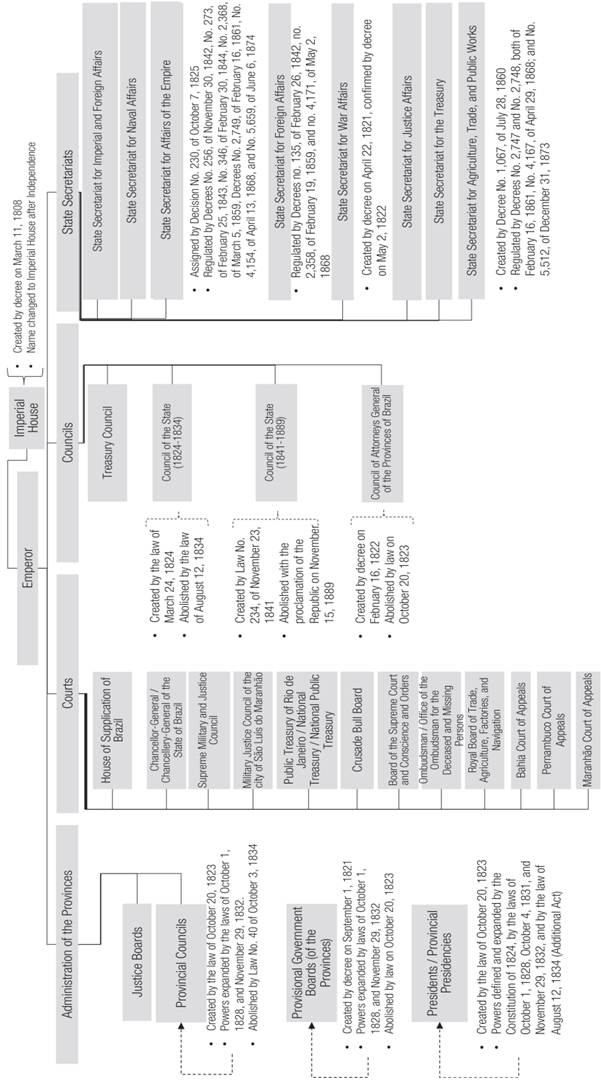
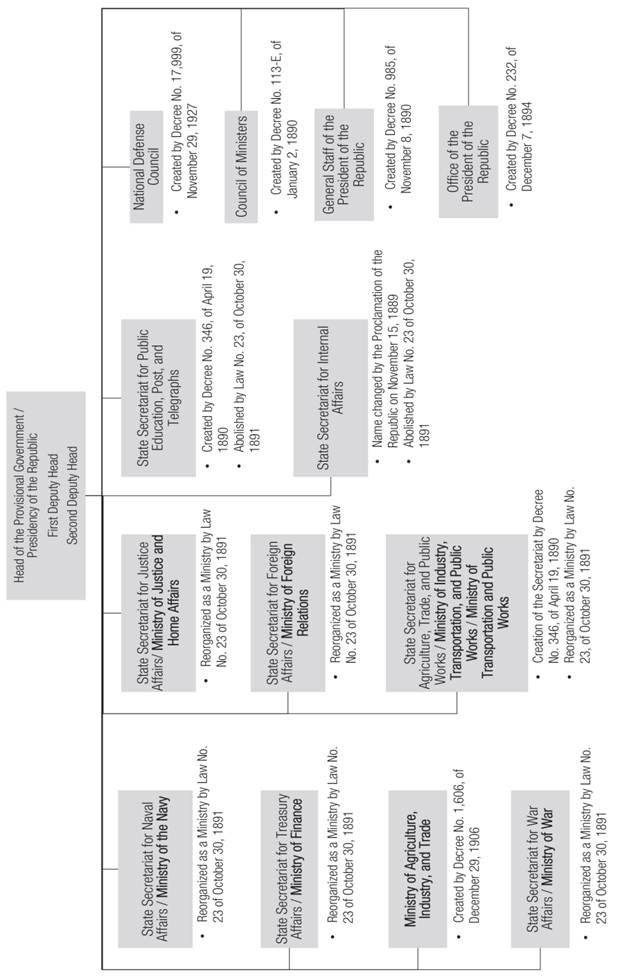
As Figures 2, 3, and 4 show, the Brazilian state was already organized into a hierarchical, rational-legal structure distributed according to labor specializations and based on law throughout the 19th century, a trend that intensified over time. Nomenclatures, attributions, and functions were specified in public norms and validated politically and legally. Even structures inherited from the colonial period, such as boards, treasurers and treasuries, chancelleries, and court bodies, were created by formal charters or regulations in the 18th century and reorganized via decrees and laws in the 19th century (see Figures 3 and 4).
By comparing Figures 2, 3, and 4, one can identify the efforts made by the various bodies throughout the state infrastructure to rationalize their processes. These bodies were in the process of being reduced and concentrated until they reached the format determined by the 1891 reform (Law No. 23, of October 30, 1891), which established the ministerial composition. This format has remained in place to this day, surviving even the administrative reforms of the 20th century, including the managerial reform of 1995 and the neoliberal reform of 2018-2019 (Law No. 13,502, of November 1, 2017; Law No. 13,709, of August 14, 2018; Provisional Measure No. 821, of February 26, 2018; Provisional Measure No. 869, of December 27, 2018; Provisional Measure No. 870, of January 1, 2019) (Carelli, 2022; Cittadino, 2023; Medeiros & Trebat, 2021; Rossi, 2024; Saad-Filho, 2020; Sátyro, 2021; Souza & Hoff, 2019; Søndergaard, 2021).
BRAZILIAN PUBLIC ADMINISTRATION AS A RATIONAL-LEGAL BUREAUCRACY BEFORE 1930: ORGANIZATIONAL STRUCTURE BETWEEN 1808 AND 1822

BRAZILIAN PUBLIC ADMINISTRATION AS A RATIONAL-LEGAL BUREAUCRACY BEFORE 1930: ORGANIZATIONAL STRUCTURE BETWEEN 1822 AND 1889

BRAZILIAN PUBLIC ADMINISTRATION AS A RATIONAL-LEGAL BUREAUCRACY AFTER 1930: ORGANIZATIONAL STRUCTURE BETWEEN 1930 AND 1945
5. FINAL CONSIDERATIONS
The BPA paradigm, defined by Bresser-Pereira in the 1990s, represents an important step toward understanding the evolution of public administration in Brazil. However, as historical interpretive disputes in bureaucracy studies demonstrate, it is sometimes interpreted very simplistically. It is viewed as oscillating between an overly rational Weberian model, which emerged in 1930 with the Vargas government’s administrative reform, and an irrationally dysfunctional Kafkaesque reality. This reality led to exhaustion beginning in 1988 with the promulgation of the Constitution. Some viewed this as a bureaucratic setback.
Nevertheless, historical interpretations of bureaucracy and the rationalization process present a more complex reading. For example, Habermas’s interpretation is based on Weber’s work. These interpretations understand bureaucratization as a long, dynamic process of modernization, rather than a bureaucratic moment. Guerreiro Ramos, Tragtenberg, and Prestes Motta’s analyses in Brazil pointed to this path, which BPA did not follow.
In the 30 years since the definition of BPA, new research and historical data on the organization of Brazilian public administration during the colonial and imperial periods have emerged. These records, housed in the National Archives and the National Library, cast doubt on the sustainability of the inaugural rational-bureaucratic moment in 1930. Interpretations of recent historical research, such as the ART approach, question the historical essayist reading of Brazil present in BPA, influenced by Faoro (1958/2021) in Bresser-Pereira. These interpretations also relativize the view of 430 years of irrational, corrupt patrimonialism overcome by administrative reorganization in 1930.
These new findings and interpretations suggest that the BPA paradigm - which views bureaucratization as an autonomous model that began in 1930, as opposed to an unchanging patrimonialism that lasted for nearly five centuries - needs to be reevaluated. This article demonstrates that contemporary Brazilian sociological debates have advanced discussions about Weber, and that empirical historical research through the MAPA and ART programs has brought new evidence and interpretations about Brazil’s past. This evidence shows that the rational effort to dominate the state was gradually structured bureaucratically.
Since colonial Brazil, formal communications and the rational legal action of the state have been used to establish symbolic and material domination over communal life. Positions, functions, and duties were legally established. A hierarchical organizational structure gradually formed and was maintained based on law and functional specializations since the Empire, when four administrative reforms took place, and advanced to the Republic. Even the impersonal selection process began in the 19th century. The reform of the 1930s accelerated bureaucratization but did not create it in Brazil.
However, there is still much to be explored. We must advance our knowledge of how these organizational structures have functioned over the years, their impacts, and their modes of specialization. Additionally, we must identify the levels of professionalization of typical state careers prior to 1930, such as in the military, the diplomatic corps, and the National Treasury. Recently, Bresser-Pereira (2022) reflected on his work, acknowledging his mistake in treating the crisis of the state as a crisis of the state in the economy because he accepted the Washington Consensus as truth. However, he maintained his diagnosis that the bureaucratic form in which the state was administered had contributed to a crisis of the state. Therefore, it is time to reassess in order to advance our knowledge of the country’s bureaucratization process.
In this sense, we suggest conducting empirical research to detect the path of the institutionalization of rational-bureaucratic domination prior to 1930 and to identify elements that have affected the organization of the administrative infrastructure of the state since colonization. For example, one could compare the impact of centuries of slavery on the organizational construction of the Brazilian state with patrimonialism, the element preferred by the paradigmatic approach.
Such research could lead to a more in-depth discussion of the adequacy of the paradigmatic view of public administration, not only in BPA but also in prior models, such as the alleged 430-year patrimonialist model. However, the sociology of domination has limitations in its approach to bureaucracy, one of which is the difficulty of identifying moments of transition between various modes of state organization.
Treating bureaucratization as a long, incremental process of rationalization may give the impression of relativizing the importance of major institutional changes, such as technological transformations, constitutional reforms, and political ruptures. Empirical research on these processes of institutional transformation from the perspective of the sociology of domination would refine the potential contribution of this alternative approach to understanding bureaucratization in the country.
ACKNOWLEDGMENTS
The authors would like to thank the reviewers who evaluated this work for their valuable contributions and recommendations, as well as the editorial staff of Revista de Administração Pública (RAP) for their coordination efforts.
References
- Abrucio, F. (2020). Prefácio. In P. Cavalcante & M. Santos (Orgs.), Reformas do Estado no Brasil (pp. 9-21). IPEA.
- Adorno, T. (2009). Indústria cultural e sociedade (5a ed.). Paz e Terra. (Obra original publicada 1944).
-
Amantino, M. (2006). As Guerras Justas e a escravidão indígena em Minas Gerais nos séculos XVIII e XIX. Varia Historia, 22(35), 189-206. https://doi.org/10.1590/S0104-87752006000100011
» https://doi.org/10.1590/S0104-87752006000100011 -
Andion, C. (2012). Por uma nova interpretação das mudanças de paradigma na administração pública. Cadernos EBAPE.BR, 10(1), 1-19. https://doi.org/10.1590/S1679-39512012000100003
» https://doi.org/10.1590/S1679-39512012000100003 -
Andrews, C. (2000). Revisiting Guerreiro Ramos’s the new science of organizations through habermasian lenses: a critical tribute. Administrative Theory & Praxis, 22(2), 246-272 https://doi.org/10.1080/10841806.2000.11643450
» https://doi.org/10.1080/10841806.2000.11643450 -
Andrews, C., & Kouzmin, A. (1998). O discurso da nova administração pública. Lua Nova, (45), 97-129. https://doi.org/10.1590/S0102-64451998000300005
» https://doi.org/10.1590/S0102-64451998000300005 -
Araújo, M. D. (2021). Colonialismo, administração e iluminismo: história da administração pública colonial e imperial [Tese de Doutorado, Universidade Positivo]. Repositório Cruzeiro do Sul Educacional. https://repositorio.cruzeirodosul.edu.br/handle/123456789/3980
» https://repositorio.cruzeirodosul.edu.br/handle/123456789/3980 -
Arquivo Nacional. (2022). Sistema de Informação do Arquivo Nacional - SIAN https://sian.an.gov.br/
» https://sian.an.gov.br/ -
Arruda, G., & Costa, A. (2022). A administração pública gerencial: análise da experiência das serventias extrajudiciais no Brasil. Revista de Direito Administrativo e Gestão Pública, 8(1), 56-78. https://doi.org/10.26668/IndexLawJournals/2526-0073/2022.v8i1.8848
» https://doi.org/10.26668/IndexLawJournals/2526-0073/2022.v8i1.8848 - Barzelay, M. (1992). Breaking through Bureaucracy University of California Press.
-
Blunt, P. (2021). Development undone: Weber, Kafka and the organisation of supply-side vested interests. Journal of Interdisciplinary Economics, 33(1), 74-102. https://doi.org/10.1177/0260107919896879
» https://doi.org/10.1177/0260107919896879 -
Botelho, T. (2020). Da administração pública burocrática à gerencial: o desafio da politização da burocracia no presidencialismo de coalizão. Libertas, 6(1), e-202009. https://periodicos.ufop.br/libertas/article/view/4314
» https://periodicos.ufop.br/libertas/article/view/4314 -
Botelho, T., & Held, T. (2021). Da administração pública burocrática à gerencial: o desafio da politização da burocracia no presidencialismo de coalizão. Revista do Direito, (63), 163-185. https://doi.org/10.17058/rdunisc.v0i63.14712
» https://doi.org/10.17058/rdunisc.v0i63.14712 -
Bresser-Pereira, L. (1996). Da administração pública burocrática à gerencial. Revista do Serviço Público, 47(1), 7-40. https://doi.org/10.21874/rsp.v47i1.702
» https://doi.org/10.21874/rsp.v47i1.702 -
Bresser-Pereira, L. (1997). Estratégia e estrutura para um novo Estado. Brazilian Journal of Political Economy, 17(3), 343-357. https://doi.org/10.1590/0101-31571997-0944
» https://doi.org/10.1590/0101-31571997-0944 -
Bresser-Pereira, L. (2000). A reforma gerencial do Estado de 1995. Revista de Administração Pública, 34(4), 7-26. https://periodicos.fgv.br/rap/article/view/6289
» https://periodicos.fgv.br/rap/article/view/6289 -
Bresser-Pereira, L. (2017). Reforma gerencial e legitimação do estado social. Revista de Administração Pública, 51(1), 147-156. https://doi.org/10.1590/0034-7612166376
» https://doi.org/10.1590/0034-7612166376 -
Bresser-Pereira, L. (2022). Revendo dois artigos sobre a Reforma Gerencial de 1995. Revista do Serviço Público, 73(b), 88-95. https://revista.enap.gov.br/index.php/RSP/article/view/7852
» https://revista.enap.gov.br/index.php/RSP/article/view/7852 -
Cabral, D. (2017). A administração e a construção do Estado Imperial: algumas considerações. In A. Camargo & D. Cabral (Orgs.), Guia da administração brasileira: Império e Governo Provisório (1822-1891) (pp. 11-31). Arquivo Nacional. https://bdan.an.gov.br/handle/123456789/263
» https://bdan.an.gov.br/handle/123456789/263 -
Camara, L. (2012). Ecos da contribuição de Guerreiro Ramos para a divulgação da obra de Weber no campo de estudos organizacionais (EOs). Revista de Administração Pública, 46(1), 315-331. https://doi.org/10.1590/S0034-76122012000100015
» https://doi.org/10.1590/S0034-76122012000100015 -
Carelli, R. (2022). A razão neoliberal e a justiça do trabalho: uma comparação entre o Chile de Pinochet e o Brasil de Temer-Bolsonaro. Revista da ABET, 20(2), 380-392. https://periodicos.ufpb.br/index.php/abet/article/view/62058/35019
» https://periodicos.ufpb.br/index.php/abet/article/view/62058/35019 -
Cavalcante, P. (2018). Inovações no Governo Federal durante a era pós nova gestão pública. Revista de Administração Contemporânea, 22(6), 885-902. https://doi.org/10.1590/1982-7849rac2018170391
» https://doi.org/10.1590/1982-7849rac2018170391 -
Cavalcante, P. (2020). O Plano Diretor da Reforma do Aparelho do Estado (PDRAE) à luz da literatura brasileira. In P. Cavalcante & M. Silva (Orgs.), Reformas do Estado no Brasil (pp. 39-53). Ipea. http://dx.doi.org/10.38116/978-65-5635-012-7cap1
» https://doi.org/10.38116/978-65-5635-012-7cap1 - Cavalcante, P. (2023). Public management reforms in Brazil: innovations, paralysis, and setbacks in the last 25 years. In S. Goldfinch (Ed.), Handbook of Public Administration Reform (pp. 373-389). Edward Elgar.
-
Centro Latino-Americano de Administração para o Desenvolvimento. (1999). Uma nova gestão pública para a América Latina. Revista do Serviço Público, 50(1), 121-144. https://revista.enap.gov.br/index.php/RSP/article/view/343
» https://revista.enap.gov.br/index.php/RSP/article/view/343 -
Chen, J. (2024). State formation and bureaucratization: evidence from Pre-imperial China. Journal of Economic History, 84(3), 690-726. https://doi.org/10.1017/S002205072400024X
» https://doi.org/10.1017/S002205072400024X -
Cittadino, M. (2023). O avanço do neoliberalismo no Brasil: governo Temer, uma ponte para o futuro e os reflexos econômicos e no mundo do trabalho (2016-2018). América Latina en la historia económica, 30(2), e1299. https://doi.org/10.18232/20073496.1299
» https://doi.org/10.18232/20073496.1299 -
Clegg, S., Cunha, M., Munro, I., Rego, A., & Sousa, M. (2016). Kafkaesque power and bureaucracy. Journal of Political Power, 9(2), 157-181. https://doi.org/10.1080/2158379X.2016.1191161
» https://doi.org/10.1080/2158379X.2016.1191161 - Cosentino, F. (2014). Construindo o Estado do Brasil: instituições, poderes locais e poderes centrais. In J. Fragoso & M. Gouvêa (Orgs.), O Brasil Colonial : volume 1, 1443-1580 (pp. 521-568). Civilização Brasileira.
-
Costa, F., & Costa, E. (2016). Nova história da administração pública brasileira: pressupostos teóricos e fontes alternativas. Revista de Administração Pública, 50(2), 215-236. https://doi.org/10.1590/0034-7612145021
» https://doi.org/10.1590/0034-7612145021 - Costin, C. (2010). Administração Pública Elsevier.
-
Coutinho, M. J. V. (2000). Administração pública voltada para o cidadão: quadro teórico-conceitual. Revista do Serviço Público, 51(3), 40-73. https://doi.org/10.21874/rsp.v51i3.331
» https://doi.org/10.21874/rsp.v51i3.331 - Crooks, P., & Parsons, T. (2016). Empires, bureaucracy, and the paradox of power. In P. Crooks & T. Parsons (Eds.), Empires and bureaucracy in world history: from late antiquity to the Twentieth Century (pp. 3-28). Cambridge University Press.
-
Cunha, M., Rego, A., Clegg, S., & Giustiniano, L. (2023). In a Kafkaesque catacomb: the killing of Ihor Homenyuk by the Portuguese customs and immigration bureaucracy. Journal of Political Power, 16(1), 23-46. https://doi.org/10.1080/2158379X.2022.2105497
» https://doi.org/10.1080/2158379X.2022.2105497 -
Dantas, F. (2022). Repensando o patrimonialismo: ainda uma chave explicativa do Estado brasileiro? Fórum Sociológico, (41), 15-24. https://doi.org/10.4000/sociologico.10732
» https://doi.org/10.4000/sociologico.10732 -
Drumond, A., Silveira, S., & Silva, E. (2014). Predominância ou coexistência? Modelos de administração pública brasileira na Política Nacional de Habitação. Revista de Administração Pública, 48(1), 3-25. https://doi.org/10.1590/S0034-76122014000100001
» https://doi.org/10.1590/S0034-76122014000100001 -
Duarte, A., & Zouain, D. (2022). Análise paradigmática do desenvolvimento do campo de administração pública no Brasil. Revista do Serviço Público, 73(3), 479-499. https://doi.org/10.21874/rsp.v73.i3.5603
» https://doi.org/10.21874/rsp.v73.i3.5603 - Durant, R. F. (2020). Building the compensatory state: an intellectual history and theory of American Administrative Reform Routledge.
-
Fadul, É. M. C., & Silva, L. P. (2008). Retomando o debate sobre a Reforma do Estado e a Nova Administração Pública. In Anais do 32º Encontro da Associação Nacional de Pós-Graduação e Pesquisa em Administração, Rio de Janeiro, RJ, Brasil. https://arquivo.anpad.org.br/abrir_pdf.php?e=ODc0Nw==
» https://arquivo.anpad.org.br/abrir_pdf.php?e=ODc0Nw== - Faoro, R. (2021). Os donos do poder Companhia das Letras (Originalmente publicado em 1958).
-
Faria, J., & Meneghetti, F. (2011). Burocracia como organização, poder e controle. Revista de Administração de Empresas, 51(5), 424-439. https://doi.org/10.1590/S0034-75902011000500002
» https://doi.org/10.1590/S0034-75902011000500002 -
Fonseca, P. (2007). O ecletismo inovador: Bresser-Pereira e o desenvolvimento brasileiro. Economia e Sociedade, 16(1), 1-43. https://doi.org/10.1590/S0104-06182007000100002
» https://doi.org/10.1590/S0104-06182007000100002 - Fragoso, J. (2014). La guerre est finie: notas para investigação em história Social na América lusa entre os séculos XVI e XVIII. InJ. Fragoso ; & M. Gouvêa (Orgs.), O Brasil Colonial : volume 1, 1443-1580 (pp. 7-37). Civilização Brasileira.
- Fragoso, J. (2024). A sociedade perfeita: as origens da desigualdade social no Brasil Contexto.
-
Fragoso, J., & Bicalho, M. (2022). Uma releitura do “Brasil colonial” a partir da obra de António Manuel Hespanha. Revista do Instituto de Estudos Brasileiros, (83), 41-56. https://doi.org/10.11606/issn.2316-901X.v1i83p41-56
» https://doi.org/10.11606/issn.2316-901X.v1i83p41-56 -
Fragoso, J., & Gouvêa, M. (2009). Monarquia pluricontinental e repúblicas: algumas reflexões sobre a América lusa nos séculos XVI-XVIII. Tempo, 14(27), 36-50. https://doi.org/10.1590/S1413-77042009000200004
» https://doi.org/10.1590/S1413-77042009000200004 - Fragoso, J., & Krause, T. (2014). Sistemas atlânticos e monarquias na época moderna: anotações preliminares. In J. Fragoso ; & M. Gouvêa. (Orgs.), O Brasil Colonial : volume 2, 1580-1720 (pp. 7-47). Civilização Brasileira.
- Goldstone, J., & Haldon, J. (2009). Ancient States, empires, and exploitation: problems and perspectives. In I. Morris & W. Scheidel (Eds.), The dynamics of ancient empires (pp. 3-29). Oxford University Press.
-
Gratton, G., Guiso, L., Michelacci, C., & Morelli, M. (2021). From Weber to Kafka: political instability and the overproduction of laws. American Economic Review, 111(9), 2964-3003. https://doi.org/10.1257/aer.20190672
» https://doi.org/10.1257/aer.20190672 -
Guimarães, T. (2000). A nova administração pública e a abordagem da competência. Revista de Administração Pública, 34(3), 125-140. https://periodicos.fgv.br/rap/article/view/6284
» https://periodicos.fgv.br/rap/article/view/6284 - Habermas, J. (2012a). Teoria do agir comunicativo, 1. WMF Martins Fontes (Obra original publicada 1981).
- Habermas, J. (2012b). Teoria do agir comunicativo, 2. WMF Martins Fontes. (Obra original publicada 1981).
-
Hable, A., & Oliveira, A. (2022). Análise da economia nos gastos públicos com o trabalho remoto no período da pandemia no governo federal à luz da Nova Administração Pública. Revista Foco, 15(1), e280. https://doi.org/10.54751/revistafoco.v15n1-002
» https://doi.org/10.54751/revistafoco.v15n1-002 -
Henry, N. (1975). Paradigms of public administration. Public Administration Review, 35(4), 378-386. https://doi.org/10.2307/974540
» https://doi.org/10.2307/974540 - Jasmin, M. (2021). Uma sociologia da ausência: Raymundo Faoro e Os donos do poder. In P. Faoro, Os donos do poder (pp. 783-797). Companhia das Letras.
-
Jørgensen, T. (2012). Weber and Kafka: the rational and the enigmatic bureaucracy. Public Administration, 90(1), 194-210. https://doi.org/10.1111/j.1467-9299.2011.01957.x
» https://doi.org/10.1111/j.1467-9299.2011.01957.x -
Karam, A., & Silva, C. (2019). Administração pública gerencial e o princípio democrático: implicações e desafios. Revista Acadêmica da Faculdade de Direito do Recife, 91(1), 137-156. https://doi.org/10.51359/2448-2307.2019.243956
» https://doi.org/10.51359/2448-2307.2019.243956 -
Keinert, T. M. M. (1994). Os paradigmas da administração pública no Brasil (1900-92). Revista de Administração De Empresas, 34(3), 41-48. https://doi.org/10.1590/S0034-75901994000300004
» https://doi.org/10.1590/S0034-75901994000300004 -
Lima, S. S., Fº., & Peixe, B. C. S. (2020). Análise de eficiência na gestão de recursos das Instituições Federais de Ensino Superior à luz da nova administração pública. Revista Contemporânea de Contabilidade, 17(43), 88-103. https://doi.org/10.5007/2175-8069.2020v17n43p88
» https://doi.org/10.5007/2175-8069.2020v17n43p88 - Löwy, M. (2014). A jaula de aço: Max Weber e o marxismo weberiano (M. Echalar, Trad.). Boitempo.
-
Maia, B. (2021). A institucionalização do concurso público no Brasil: uma análise sócio-histórica. Revista do Serviço Público, 72(3), 663-684. https://doi.org/10.21874/rsp.v72.i3.4639
» https://doi.org/10.21874/rsp.v72.i3.4639 - Marcuse, H. (2015). O homem unidimensional Edipro. (Obra original publicada 1964).
-
Mascarenhas, C., & Ribas, L. (2021). Transferências intergovernamentais de desempenho ou resultado: o federalismo fiscal da Nova Administração Pública. Revista de Direito Administrativo, 280(1), 89-119. https://doi.org/10.12660/rda.v280.2021.83679
» https://doi.org/10.12660/rda.v280.2021.83679 - Mascaro, A. L. (2024). Sociologia do Brasil Boitempo.
-
Mata, S. (2017). Relendo os clássicos em época de crise: raízes do Brasil, os donos do poder e as anomalias da consciência histórica brasileira. Cadernos da Escola do Legislativo, 19(32), 11-36. https://doi.org/10.29327/264759.19.32-1
» https://doi.org/10.29327/264759.19.32-1 - Matias-Pereira, J. (2008a). Manual de gestão pública contemporânea Atlas.
- Matias-Pereira, J. (2008b). Curso de administração pública Atlas.
-
Matias-Pereira, J. (2008c). Administração pública comparada: uma avaliação das reformas administrativas do Brasil, EUA e União Europeia. Revista De Administração Pública, 42(1), 61-82. https://doi.org/10.1590/S0034-76122008000100004
» https://doi.org/10.1590/S0034-76122008000100004 - Matias-Pereira, J. (2009). Finanças Públicas (4a ed.). Atlas.
- Matias-Pereira, J. (2014). Curso de Administração Pública (4a ed.). Atlas.
- Maximiano, A., & Nohara, I. (2021). Gestão pública Atlas.
-
Medeiros, P. (2006). Do modelo racional-legal ao paradigma pós-burocrático: reflexões sobre a burocracia estatal. Organizações & Sociedade, 13(37), 143-160. https://doi.org/10.1590/S1984-92302006000200008
» https://doi.org/10.1590/S1984-92302006000200008 -
Medeiros, C., & Trebat, N. (2021). The failures of neoliberalism in Brazil. Journal of Economic Issues, 55(2), 408-415. https://doi.org/10.1080/00213624.2021.1908803
» https://doi.org/10.1080/00213624.2021.1908803 -
Melo, A., Dolci, D., & Cerqueira, L. (2019). Escritórios de gestão de projetos no setor público à luz do paradigma da Nova Administração Pública. Revista Brasileira de Políticas Públicas e Internacionais, 4(1), 5-28. https://doi.org/10.22478/ufpb.2525-5584.2019v4n1.40549
» https://doi.org/10.22478/ufpb.2525-5584.2019v4n1.40549 - Mills, A., & Novicevic, M. (2020). Management and organizational history Routledge.
-
Miranda, M., Gonçalves, J., & Costa, D. (2020). Organização administrativa: a evolução da administração pública e sua modernização até administração gerencial e o advento do princípio da eficiência. Revista Processus de Estudos de Gestão, Jurídicos e Financeiros, 41(XI), 88-107. https://doi.org/10.5281/zenodo.4086002
» https://doi.org/10.5281/zenodo.4086002 - Motta. F. C. P. (2000). O que é burocracia. São Paulo: Brasiliense (Obra original publicada em 1981).
- Motta, F. C. P. (1986). Organização e poder Atlas.
- Motta, F. C. P., & Bresser-Pereira, L. C. (2004). Introdução à organização burocrática Thomson. (Obra original publicada 1980).
- Nunes, E. O. (1997). A gramática política do Brasil Zahar.
-
Oliveira, F. B., Sant’anna, A. S., & Vaz, S. L. (2010). Liderança no contexto da nova administração pública: uma análise sob a perspectiva de gestores públicos de Minas Gerais e Rio de Janeiro. Revista de Administração Pública, 44(6), 1453-1475. https://doi.org/10.1590/S0034-76122010000600009
» https://doi.org/10.1590/S0034-76122010000600009 -
Oliveira, K., & Paula, A. P. de (2014). Herbert Simon e os limites do critério de eficiência na nova administração pública. Cadernos Gestão Pública e Cidadania, 19(64), 113-126. https://doi.org/10.12660/cgpc.v19n64.12605
» https://doi.org/10.12660/cgpc.v19n64.12605 -
Paula, A. P. de (2007). Guerreiro Ramos: resgatando o pensamento de um sociólogo crítico das organizações. Organizações & Sociedade, 14(40), 169-188. https://doi.org/10.1590/S1984-92302007000100010
» https://doi.org/10.1590/S1984-92302007000100010 - Paula, A. P. de (2008). Teoria crítica nas organizações Thomson Learning.
- Paula, A. P. de (2020). Por uma nova gestão pública Fundação Getulio Vargas. (Obra original publicada 2005).
- Paludo, A., & Oliveira, A. (2021). Governança organizacional pública e planejamento estratégico Foco.
-
Pereira, S., & Correia, P. (2020). Movimentos Pós-Nova Gestão Pública: o novo serviço público. Lex Humana, 12(1), 69-85. https://seer.ucp.br/seer/index.php/LexHumana/article/view/1824
» https://seer.ucp.br/seer/index.php/LexHumana/article/view/1824 -
Porsse, M. C. S., & Klering, L. R. (2006). A abordagem da capacitação como um modelo alternativo à Nova Administração Pública para as ações públicas: um estudo de casos múltiplos. In Anais do 2º Encontro de Administração Pública e Governança, São Paulo, SP, Brasil. https://arquivo.anpad.org.br/abrir_pdf.php?e=NjYyOA==
» https://arquivo.anpad.org.br/abrir_pdf.php?e=NjYyOA== -
Prado, M. A., & Cruz, B. (2006). A Nova Administração Pública e a educação: a competição administrada e o gerencialismo no Reino Unido. In Anais do 2º Encontro de Administração Pública e Governança, São Paulo, SP, Brasil. https://arquivo.anpad.org.br/abrir_pdf.php?e=NjU4NA==
» https://arquivo.anpad.org.br/abrir_pdf.php?e=NjU4NA== - Raadschelders, J. (2020). The three ages of government University of Michigan Press.
- Ramos, A. G. (1960). O problema nacional do Brasil Saga.
-
Ramos, A. G. (1984). Modelos de homem e teoria administrativa. Revista de Administração Pública, 18(2), 3-12. https://periodicos.fgv.br/rap/article/view/10559
» https://periodicos.fgv.br/rap/article/view/10559 -
Ramos, A. G. (2006) A sociologia de Max Weber (sua importância para a teoria e a prática da Administração). Revista do Serviço Público, 57, (2), 267-282 (Obra original publicada 1946). https://doi.org/10.21874/rsp.v57i2.200
» https://doi.org/10.21874/rsp.v57i2.200 - Ramos, A. G. (2022). A nova ciência das organizações Enunciado. (Obra original publicada 1981).
- Rego, A., Cunha, M., & Wood, T.Jr. (2010). Kafka e o estranho mundo da burocracia Atlas.
-
Ribeiro, R., Silva, J. N., & Pereira, S. (2008). Estudo do comportamento das variáveis restritivas ao sucesso dos programas federais, executados pelos municípios, frente aos princípios da Nova Administração Pública. In Anais do 3º Encontro de Administração Pública e Governança, Salvador, BA, Brasil. https://arquivo.anpad.org.br/abrir_pdf.php?e=OTk5Ng==
» https://arquivo.anpad.org.br/abrir_pdf.php?e=OTk5Ng== - Ringer, F. K. (2004). Max Weber: an intellectual biography University of Chicago Press.
-
Rossi, P. (2024). O Brasil sob choque neoliberal (2015-2022). Anais do 29º Encontro Nacional de Economia Política (p. 60), Marabá, PA, Brasil. https://www.sep.org.br/01_sites/01/Caderno_de_Resumos_2024.pdf
» https://www.sep.org.br/01_sites/01/Caderno_de_Resumos_2024.pdf -
Saad-Filho, A. (2020). Varieties of neoliberalism in Brazil (2003-2019). Latin American Perspectives, 47(1), 9-27. https://doi.org/10.1177/0094582X19881968
» https://doi.org/10.1177/0094582X19881968 -
Sampaio, A. (2020). António Manuel Hespanha, o Antigo Regime luso e a historiografia brasileira: notas sobre um diálogo transatlântico. Topoi, 21(43), 7-14. https://doi.org/10.1590/2237-101X02104301
» https://doi.org/10.1590/2237-101X02104301 - Santos, M., Bicalho, M., & Gouvêa, M. (2014). Guerras na Europa e a reordenação político-administrativa. In J. Fragoso ; &M. Gouvêa. (Orgs.), O Brasil Colonial: volume 2, 1580-1720 (pp. 543-587). Civilização Brasileira
-
Saraiva, L., & Capelão, L. (2000). A nova administração pública e o foco no cidadão: burocracia x marketing? Revista de Administração Pública, 34(2). https://periodicos.fgv.br/rap/article/view/6269/4860
» https://periodicos.fgv.br/rap/article/view/6269/4860 -
Sátyro, N. (2021). The paradigmatic radical reform in Brazil’s social policies: the impact of the Temer administration. In N. Sátyro, E. del Pino; & C. Midaglia (Eds.), Latin American Social Policy Developments in the Twenty-First Century (pp. 317-340). Palgrave Macmillan. https://doi.org/10.1007/978-3-030-61270-2_11
» https://doi.org/10.1007/978-3-030-61270-2_11 -
Seabra, S. (2001). A nova administração pública e mudanças organizacionais. Revista de Administração Pública, 35(4), 19-43. https://periodicos.fgv.br/rap/article/view/6394/4979
» https://periodicos.fgv.br/rap/article/view/6394/4979 -
Silva, A. P. (2024). A estetização da burocracia em Huysmans e sua relação com Kafka. Rapsódia, (18), 71-90. https://doi.org/10.11606/issn.2447-9772.i18p71-90
» https://doi.org/10.11606/issn.2447-9772.i18p71-90 -
Silva, J. M. A. (2017). Administração pública e cultura patrimonialista. Revista Práticas de Administração Pública, 1(1), 25-41. https://doi.org/10.5902/2526629225590
» https://doi.org/10.5902/2526629225590 -
Silva, C., & Castro, L. (2019). Articulação entre problemática e conclusão em pesquisas sobre Nova Administração Pública: uma análise epistemológica. In Anais do 8º Encontro de Administração Pública e Governança, Fortaleza, CE, Brasil. https://arquivo.anpad.org.br/eventos.php?cod_evento=&cod_evento_edicao=94&cod_edicao_subsecao=1650
» https://arquivo.anpad.org.br/eventos.php?cod_evento=&cod_evento_edicao=94&cod_edicao_subsecao=1650 -
Silva, K. M., & Pereira, L. A. (2021). As novas abordagens teórico-metodológicas no estudo do Brasil colonial: a distância entre o debate acadêmico e o livro didático. Vozes, Pretérito & Devir, 12(1), 330-350. https://revistavozes.uespi.br/index.php/revistavozes/article/view/372
» https://revistavozes.uespi.br/index.php/revistavozes/article/view/372 -
Silva, P., & Santos, A. (2022). Epistemological possibilities of public administration theories: from paradigms to epistemic matrices. Organizações & Sociedade, 29(101), 277-296. https://doi.org/10.1590/1984-92302022v29n0012EN
» https://doi.org/10.1590/1984-92302022v29n0012EN -
Sousa, A. R. L. (2013). Franz Kafka e a burocracia weberiana. Revista Eletrônica de Estudos Literários, 2(12), 1-8. https://periodicos.ufes.br/reel/article/view/5347/3962
» https://periodicos.ufes.br/reel/article/view/5347/3962 - Souza, J. (2022). Brasil dos humilhados: uma denúncia da ideologia elitista (5a ed.). Civilização Brasileira.
- Souza, J. (2024). O pobre de direita: a vingança dos bastardos Civilização Brasileira.
-
Souza, G. C., & Ornelas, A. L. (2015). Alberto Guerreiro Ramos e a autonomia dos estudos organizacionais críticos brasileiros: escorços de uma trajetória intelectual. Cadernos EBAPE.BR, 13(3), 438-461. https://doi.org/10.1590/1679-395115869
» https://doi.org/10.1590/1679-395115869 -
Souza, M. B., & Hoff, T. S. R. (2019). O governo Temer e a volta do neoliberalismo no Brasil: possíveis consequências na habitação popular. Revista Brasileira de Gestão Urbana, (11), e20180023. https://doi.org/10.1590/2175-3369.011.e20180023
» https://doi.org/10.1590/2175-3369.011.e20180023 -
Søndergaard, N. (2021). Reforming in a democratic vacuum: the authoritarian neoliberalism of the Temer administration from 2016 to 2018. Globalizations, 18(4), 568-583. https://doi.org/10.1080/14747731.2020.1804155
» https://doi.org/10.1080/14747731.2020.1804155 -
Tragtenberg, M. (1966). O pensamento de Max Weber. Revista de História da USP, 32(65), 169-191. https://doi.org/10.11606/issn.2316-9141.rh.1966.124027
» https://doi.org/10.11606/issn.2316-9141.rh.1966.124027 - Tragtenberg, M. (1997). Apresentação. In M. Weber, Textos selecionados (pp. 5-15). Nova Cultural.
- Tragtenberg, M. (2005). Administração, poder e ideologia (3a ed.). UNESP.
- Tragtenberg, M. (2006). Burocracia e ideologia (2a ed.). UNESP. (Obra original publicada 1974)
-
Warner, M. (2007). Kafka, Weber and organization theory. Human Relations, 60(7), 1019-1038. https://doi.org/10.1177/0018726707081156
» https://doi.org/10.1177/0018726707081156 - Weber, M. (1982). Burocracia. In H. Gerth & C. Mills (Orgs.), Max Weber (pp. 229-282, 5a ed.). LTC. (Obra original publicada 1946)
- Weber, M. (1999). Economia e sociedade - vol. 2. Imprensa Oficial do Estado de São Paulo. (Obra original publicada 1921)
-
Yang, Y. (2022). Beyond Weber and Kafka: conceptualizing a critical realist model of bureaucracy. Administration & Society, 54(3), 500-521. https://doi.org/10.1177/00953997211024953
» https://doi.org/10.1177/00953997211024953
-
DATA AVAILABILITY
The entire dataset supporting the results of this study has been made publicly available through the Brazilian Public Administration Memory Project (MAPA), the online collection of the National Archives Information System (SIAN), which is maintained by the Brazilian National Archives, and the Brazilian Digital Newspaper Library (National Library). It can be accessed through the following links: https://mapa.an.gov.br/ and https://memoria.bn.gov.br
-
12
[Translated version] Note: All English quotes were translated by this article’s translator.
-
Reviewers:
Fernando de Souza Coelho (Universidade de São Paulo, São Paulo / SP - Brazil)
-
Reviewers:
One reviewer did not authorize the disclosure of their identity.
-
Peer review report:
The peer reviewreport is available at this link https://periodicos.fgv.br/rap/article/view/97069/90457
The entire dataset supporting the results of this study has been made publicly available through the Brazilian Public Administration Memory Project (MAPA), the online collection of the National Archives Information System (SIAN), which is maintained by the Brazilian National Archives, and the Brazilian Digital Newspaper Library (National Library). It can be accessed through the following links: https://mapa.an.gov.br/ and https://memoria.bn.gov.br

 Source: Elaborated by the authors based on
  Source: Elaborated by the authors based on MAPA and the SIAN online collection.
 Source: Elaborated by the authors based on MAPA and the SIAN online collection.
 Source: Elaborated by the authors based on MAPA and the SIAN online collection.