 Urban resilience in major events: COR-Rio’s performance in G20
Abstract
Organizing major international events in Brazil poses significant challenges to urban public management, requiring coordination among multiple institutions and the use of advanced technologies to ensure security and service continuity. This study examines the role of the Operations and Resilience Center (COR-Rio) during the 2024 G20 Leaders’ Summit in Rio de Janeiro. Based on a qualitative case study supported by institutional records, direct observation, and document analysis, the research examines the mechanisms of interinstitutional coordination, operational innovations, and the use of urban intelligence tools, such as video monitoring, analytical dashboards, and predictive analytics, to support integrated urban management. The findings show that the integration of more than forty agencies across the three levels of government contributed to ensuring safety, mobility, and the continuity of urban services during the event, highlighting an organizational model adaptable to other major event contexts.
Keywords:
intergovernmental coordination; urban resilience; major events management; institutional innovation
Resumo
A realização de grandes eventos internacionais no Brasil traz desafios significativos à gestão pública urbana, exigindo articulação entre múltiplas instituições e uso intensivo de tecnologias para garantir segurança e continuidade dos serviços. Este estudo analisa a atuação do Centro de Operações e Resiliência (COR-Rio) na preparação e execução da Cúpula de Líderes do G20, realizada no Rio de Janeiro em 2024. A pesquisa, de natureza qualitativa e delineamento descritivo, baseia-se em um estudo de caso sustentado por registros institucionais, observação direta e análise documental. O estudo examina os mecanismos de coordenação interinstitucional, as inovações operacionais e o uso de ferramentas de inteligência urbana, como videomonitoramento, painéis analíticos e análises preditivas, voltados à gestão integrada da cidade. Os resultados demonstram que a integração do COR-Rio com mais de 40 agências das 3 esferas de governo contribuiu para a garantia da segurança, mobilidade e continuidade dos serviços urbanos durante o evento, evidenciando um modelo organizacional passível de adaptação a outros contextos de grandes eventos.
Palavras-chave:
coordenação intergovernamental; resiliência urbana; gestão de grandes eventos; inovação institucional
Resumen
La realización de grandes eventos internacionales en Brasil genera desafíos significativos para la gestión pública urbana, que exige coordinación entre múltiples instituciones y uso intensivo de tecnologías para garantizar seguridad y continuidad de los servicios. Este estudio analiza la actuación del Centro de Operaciones y Resiliencia (COR-Rio) durante la Cumbre de Líderes del G20, celebrada en Río de Janeiro en 2024. Basado en un estudio de caso cualitativo sustentado en registros institucionales, observación directa y análisis documental, el artículo examina los mecanismos de coordinación interinstitucional, las innovaciones operativas y el uso de herramientas de inteligencia urbana. Los resultados muestran que la integración del COR-Rio con más de cuarenta agencias de los tres niveles de gobierno contribuyó a garantizar la seguridad, movilidad y continuidad de los servicios urbanos durante el evento, evidenciando un modelo organizacional adaptable a otros contextos de grandes eventos.
Palabras clave:
coordinación intergubernamental; resiliencia urbana; gestión de grandes eventos; innovación institucional
1. INTRODUCTION
Major international events hosted in urban centers pose significant challenges to public administration, particularly in developing countries. Beyond requiring adequate infrastructure and logistical capacity, such events demand rapid coordination among multiple institutions under intense national and international scrutiny. While they create opportunities for investment, city branding, and the acceleration of urban policies, they can also exacerbate social inequalities, expose institutional weaknesses, and generate intergovernmental tensions, highlighting the limits of state capacity (Gaffney, 2014; Toledo et al., 2015).
In Brazil, these tensions are intensified by the federal structure, characterized by decentralization, overlapping responsibilities, and longstanding coordination challenges. The effectiveness of public action depends on the mobilization of resources, interinstitutional alignment, and governance mechanisms capable of fostering integration and agile responses (Furtado et al., 2015; Souza, 2018; Lima & Rezende, 2021).
The city of Rio de Janeiro has played a central role in hosting major global events, including the Pan American Games (2007), Rio+20 (2012), the FIFA World Cup (2014), the Olympic Games (2016), and the G20 Summit (2024). The complexity of these events requires novel approaches to urban governance, integrating technology, data management, and multisectoral collaboration. In this context, the Centro de Operações e Resiliência do Rio de Janeiro (COR-Rio) stands out as a pioneering municipal initiative and a national and international reference in integrated urban operations (Prefeitura da Cidade do Rio de Janeiro, 2022).
Established in 2010, COR-Rio functions as the city’s operational hub, integrating federal, state, and municipal agencies in real time, as well as public service concessionaires, to mitigate risks and coordinate responses to critical situations (Prefeitura da Cidade do Rio de Janeiro, 2022).
The permanent operations desk at COR-Rio includes municipal agencies such as the Municipal Secretariat of Public Order, the Municipal Guard, the Municipal Urban Cleaning Company, the Traffic Engineering Company, Geo-Rio, the Subsecretariats of Civil Defense and Urban Conservation and Maintenance, and the Municipal Secretariats of Health, Education, Social Assistance, Environment, and Conservation. Public transportation concessionaires, including MetrôRio, SuperVia, Rio Ônibus, Lamsa, and the Municipal Secretariat of Transport, are also integrated. State-level institutions, notably the Military Police (PMERJ) and the Military Fire Department (CBMERJ), participate continuously, reinforcing intergovernmental coordination.
During major events, the operations desk expands to include additional municipal agencies, the Civil Police of the State of Rio de Janeiro (PCERJ), the State Secretariat of Public Security (SESP), and federal agencies such as the Federal Highway Police (PRF), the Federal Police, the Ministry of Foreign Affairs, the Brazilian Intelligence Agency (ABIN), the National Secretariat of Public Security (SENASP), and the Armed Forces. This expanded structure ensures continuous coordination, monitoring, and rapid response to crises (Prefeitura da Cidade do Rio de Janeiro, 2022).
COR-Rio’s performance during the G20 Summit was crucial to ensuring security, mobility, and urban flow across multiple simultaneous events, sensitive diplomatic movements, and high media exposure. This study examines COR-Rio’s role in integrated urban management during the G20, with a focus on interinstitutional coordination mechanisms and operational innovations implemented throughout the event.
2. MATERIALS AND METHODS
This study is applied qualitative research with a descriptive and exploratory design. A single case study approach was adopted (Gil, 2017; Yin, 2015), focusing on the performance of COR-Rio during the organization and execution of the G20 Summit. The analysis was conducted in two phases: Phase 1 covered 27 pre-summit events, from May to October 2024, which were essential for the maturation of operational strategies; Phase 2 encompassed the Summit and associated events - G20 Social, Urban 20, and Global Alliance Festival - during which urban operations were intensified and interinstitutional coordination mechanisms were tested at an expanded scale.
Data were collected from COR-Rio institutional records, including meeting minutes, operational plans, monitoring reports, urban intelligence dashboards, and audiovisual documentation. Thematic content analysis was employed, organizing the data into three categories: interinstitutional coordination, operational innovation, and real-time management (Bardin, 2016). Methodological triangulation - integrating institutional documents, field observations, and technical data - enhanced the validity and reliability of the findings.
Following Yin’s (2015) criteria, internal validity was ensured through inferences consistent with empirical evidence; external validity considered the analogical potential of the Rio de Janeiro case for other large urban events, and reliability was reinforced by the systematic documentation of data collection, categorization, and analysis procedures, allowing for methodological replicability.
The choice of a single-case study is justified by the uniqueness and complexity of the experience, particularly in a context of high diplomatic density, international visibility, and geopolitical sensitivity, which required extensive intergovernmental coordination and innovative approaches to urban management.
2.1 Generation of thermal maps
In Phase 1 of the project, COR-Rio developed dynamic thermal maps to depict the density of authorities, delegations, and population flows in critical areas and points of attention during the events. These maps were generated using a Business Intelligence (BI) platform that integrates multiple real-time databases, consolidating information from:
-
Georeferencing system: mapping diplomatic routes, urban impact zones, and sensitive areas.
-
Movement of authorities and delegations: data provided by the Ministry of Foreign Affairs (Itamaraty) and the Federal Highway Police (PRF), including the number of participants, accommodations, scheduled movements, and official agendas.
-
Predictive analysis and urban intelligence tools: integrated into the BI platform, enabling scenario simulations, crowd forecasts, and real-time adjustments to operational strategies.
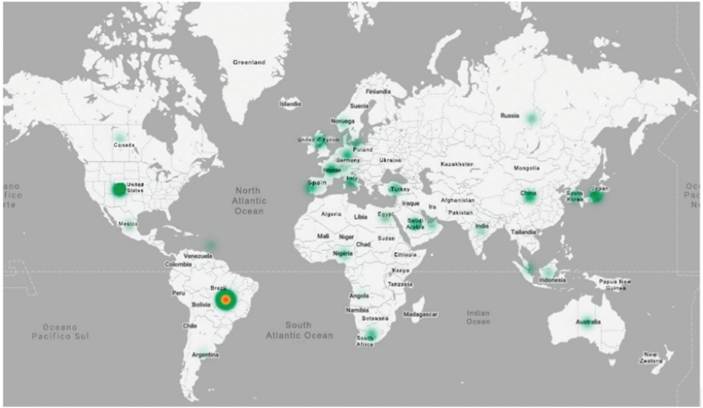
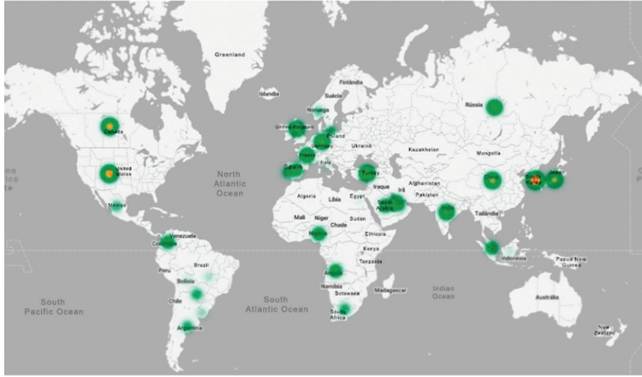
The thermal maps employ a progressive color scale, with red indicating areas of highest concentration of individuals by country of origin and G20 event locations. The selection of scale and resolution followed the criteria of Barua et al. (2023), prioritizing visual contrast and legibility in dense urban settings. These representations facilitated immediate interpretation of urban density patterns, supporting rapid and precise operational decision-making.
The methodology, developed within the context of this empirical case, combines principles of geotechnologies applied to urban management with urban intelligence practices derived from smart city frameworks (Maguire et al., 2015; Hashem et al., 2016; Barua et al., 2023).
2.2 Data analysis
The thermal maps were analyzed in conjunction with documentary and observational data, enabling the identification of movement patterns, critical operational points, logistical bottlenecks, and opportunities for institutional innovation. The integration of qualitative data (institutional narratives, protocols, and reports) and quantitative data (density metrics, movement flows, and delegation counts) allowed for a multidimensional and robust assessment of event planning and execution.
This methodological approach enhances the reliability and scientific rigor of the findings, supporting their analytical applicability to other large-scale urban events, while accounting for the institutional specificities of each context.
3. RESULTS AND DISCUSSION
3.1 Integrated operational planning
The COR-Rio held 90 operational meetings with representatives from over 40 agencies, including security forces, urban service providers, diplomatic institutions, and bodies from all three levels of government. These meetings aligned protocols and fostered interinstitutional collaboration.
Inter-agency integration was central to anticipating and mitigating logistical, security, health, and urban mobility risks. In this context, the adoption of multilevel governance stands out as an analytical framework for describing the observed coordination arrangements. This concept refers to the articulation between different levels of government and sectors of administration within interdependent systems. According to Hooghe and Marks (2003), multilevel governance involves “authority dispersed across multiple overlapping jurisdictions, which are not hierarchically organized but cooperate through coordination mechanisms.” This approach departs from the traditional hierarchical model, favoring collaborative arrangements.
In the case of the G20, this governance was operationalized both horizontally through coordination among municipal secretariats, service concessionaires, and specialized agencies and vertically through coordination among federal, state, and municipal bodies (Furtado et al., 2015). This arrangement helped mitigate recurring challenges of Brazilian federalism, such as overlapping responsibilities and difficulties in joint decision-making, while also optimizing resource allocation and promoting coordinated actions. (Souza, 2018; Lima & Rezende, 2021).
The COR-Rio’s performance represents an institutional arrangement oriented toward operational coordination, connecting different levels of government and technical actors. Building on previous experiences, the center consolidated its own procedures for mitigating urban impacts and responding to crises. The meetings ensured coherence of actions without compromising the provision of essential services.
During the event planning phase, critical areas were mapped, including airports, official hotels, diplomatic routes, event venues, protest points, and zones of high population density. Using historical data and predictive analysis, COR-Rio developed operational scenarios.
The overall strategy was structured around three interdependent axes:
-
Urban Security and Diplomatic Logistics.
-
Mobility and Monitoring.
-
Integrated Multisectoral Support.
This multidimensional planning facilitated the adaptation of urban operations to the demands of the event, positioning COR-Rio as an operational coordination center in situations of high organizational complexity.
3.2 City alert level change
The city alert level system is an operational warning tool designed to identify and respond to events affecting urban areas. It uses a color-coded scale to indicate the alert level: Level 1 (green) represents normal conditions, while Level 5 (purple) signals severe situations that exceed the municipal government’s immediate response capacity. For the G20, Level 2 was activated due to the enforcement of the Guarantee of Law and Order (GLO), as established by Rio Decree No. 53,525 (Decreto Rio nº 53.525/2023). In other words, from May to October 2024, Rio de Janeiro remained at Level 1; however, between November 13 and 19, during the G20 Leaders’ Summit, the city operated at Level 2.
The COR-Rio kept the public informed about the operational impacts on daily life and mobilized the relevant agencies accordingly. Operational teams remained on standby within the COR-Rio, monitoring the movement of delegations across the city and the points of attention for each event. During this operation, temporary closures of key roads were implemented (Prefeitura da Cidade do Rio de Janeiro, 2024a, 2024b, 2024c).
Once the planned operations concluded on November 20, the city’s operational level returned to Level 1, as the extraordinary interventions associated with the event were no longer required.
3.3 Real-Time operations
3.3.1 Digital infrastructure and operational intelligence
For the G20 events, COR-Rio developed integrated dashboards, monitoring systems, and predictive analysis tools, enabling centralized and responsive oversight of all operations. The application of urban intelligence in the diplomatic context enhanced the city’s capacity for real-time monitoring, risk anticipation, and inter-agency coordination, ensuring traceability of operational decisions.
By adopting a data-driven approach, shared protocols, and interinstitutional collaboration, COR-Rio consolidated its role as the central operational coordination hub in urban management during large-scale international events.
3.4 COR-Rio, Casp e Cesir
COR-Rio intensified its activities in the Situation Room, equipped with state-of-the-art technology, enabling real-time monitoring of the entire city and integrating major public services and security forces. For the G20 operation, six new agencies participated on-site: Abin (n = 1), Brazilian Army (n = 6), Intelligence of the Mayor’s Military House (n = 1), Brazilian Navy (n = 3), PCERJ (n = 2), and PRF (n = 20).
The inclusion of these agencies expanded the scope of interinstitutional coordination and operational monitoring, contributing to the security and efficiency of the Summit at every stage. This institutional arrangement facilitated route tracking, direct communication with escorts, and real-time operational decision-making.
In parallel, the Regional Integrated Security Executive Committee (CESIR) and the Public Security Area Coordination (CASP) were activated. Although distinct in nature and scope, COR-Rio, CESIR, and CASP operated in a coordinated and complementary manner. CESIR functioned as the decision-making center for institutional security actions, while CASP acted “[...] focusing on the protection of foreign dignitaries at the event site” (Portaria DG/PF nº 19.014, 2024, p. 91).
These two entities, regional and local, brought together representatives from COR-Rio, PRF, PMERJ, Federal Police, Abin, MRE, Navy, Army, Air Force, Municipal Guard, Ministry of Justice and Public Security, Senasp, and Sesp, forming an integrated nucleus for tactical and operational coordination in public security.
In this context, COR-Rio served as an informational support instance, providing operational data, georeferencing, real-time camera feeds, and predictive analyses to support decision-making by agencies responsible for institutional security and the protection of delegations.
3.5 Monitoring
Throughout this period, COR-Rio utilized its video monitoring system, which included more than 4,000 cameras distributed across the city. For the G20, 116 additional cameras were installed to reinforce urban monitoring, targeting areas previously identified as sensitive for the operation. These cameras were strategically positioned within specific perimeters to expand visual coverage across the 49 locations involved in the operation.
In the aerial dimension, four tactical drones and one helicopter were deployed to monitor diplomatic movements, with live image transmission to the decision-making centers. This monitoring approach contributed to risk anticipation, route validation, and support for tactical actions, helping prevent incidents during simultaneous movements.
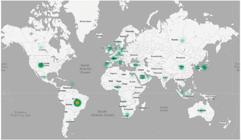
Over 260 days of operation, a total of 6,240 hours of monitoring were recorded, covering approximately 141,786 individuals. In Phase 1, prior to the Leaders’ Summit, 139,600 individuals were monitored, with Brazil hosting the largest number of authorities and foreign delegations during this period (Figure 1).
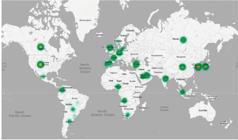
Phase 2 dynamics showed significant changes in the profile of delegations. South Korea led in the number of representatives present during the G20 Leaders’ Summit, followed by the United States, Canada, Japan, and China (Figure 2). In this stage, operational actions focused on monitoring the movements and schedules of 67 high-criticality authorities — including heads of state, ministers, princes, and directors — as well as 2,119 members of the respective delegations involved in security and logistics operations.
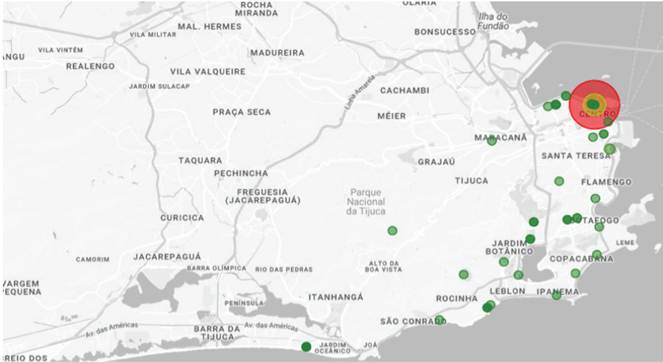
Another relevant aspect concerns the geographical concentration of activities and operational flows associated with the G20. The city center of Rio de Janeiro concentrated the highest volume of movements related to official agendas and event logistics in both phases (Figure 3).
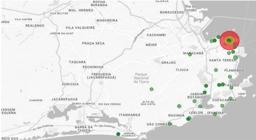
HEAT MAP OF NEIGHBORHOODS WITH THE HIGHEST CONCENTRATION OF INDIVIDUALS DURING PHASES 1 AND 2 OF THE G20
The organization of the G20 Summit imposed operational challenges on local public authorities that transcended traditional urban planning dimensions, requiring expanded, continuous, and effective interinstitutional coordination. In this context, COR-Rio played a strategic role in promoting resilient operational conditions throughout the event. This performance, however, did not occur in isolation; it was grounded in prior experiences that highlighted the importance of integrated planning, shared protocols, and intersectoral governance to mitigate the urban impacts of large-scale events.
Rio de Janeiro’s experience in hosting major sporting events — such as the 2014 FIFA World Cup and the 2016 Olympic Games — generated cumulative institutional learning, particularly regarding regulatory adaptation, the refinement of intergovernmental coordination arrangements, and the strengthening of intersectoral governance (Toledo et al., 2015). These experiences contributed to consolidating operational command-and-control structures that currently underpin COR-Rio’s performance in international diplomatic agendas, including the G20 Summit.
In this regard, Inaba and Inaba (2024) argue that urban resilience — understood as the capacity of cities to absorb impacts, adapt to dynamic scenarios, and restore essential functions in critical situations — depends not only on physical infrastructure but also on robust institutional frameworks capable of fostering cooperation among multiple actors and levels of government. In the case of Rio de Janeiro, COR-Rio represents such an integrative institutional arrangement, functioning as a permanent platform for interinstitutional coordination and enabling integrated and timely responses in high-complexity scenarios such as the G20 Summit.
Regarding the direct impacts of the event on daily urban dynamics, Rio de Janeiro maintained operational stability throughout the G20 period. Mota et al. (2020) identify urban mobility as one of the most sensitive sectors in contexts characterized by temporary concentrations of large population flows. Their empirical findings demonstrate that large-scale events can generate significant traffic disruptions, requiring prior planning and coordinated interventions to minimize congestion, interference with daily commuting patterns, and road safety risks. These findings align with the operational practices adopted by the Municipality of Rio de Janeiro, which — based on inputs from competent agencies and supported by COR-Rio — implemented an integrated mobility and monitoring plan. This plan included strategic road closures, contingency measures, and intensive use of video surveillance to ensure real-time coordination.
Overall, COR-Rio’s performance during the G20 reflects an incremental process of institutional learning and continuous refinement of interinstitutional coordination practices, supported by previous large-event experiences and grounded in principles of urban resilience. Its role during the Summit reinforced the city’s preventive and responsive capacities, demonstrating institutional maturity in the management of high-complexity international events.
4. CONCLUSION
The hosting of the G20 Leaders’ Summit in Rio de Janeiro reaffirmed the strategic role of global cities as relevant actors in contemporary diplomacy, demonstrating that urban governance has become a central dimension in the organization of high-complexity international agendas. Beyond serving as the venue for a major international event, the municipality demonstrated consolidated institutional capacity, effective intergovernmental articulation, and technical-operational competence to coordinate complex solutions within a context of heightened logistical, political, and symbolic demands.
COR-Rio’s performance was instrumental to the effectiveness of this arrangement. By integrating, in real time, more than 40 institutions across three levels of government, as well as essential service concessionaires, and operating through intelligent systems, analytical dashboards, and extensive video surveillance infrastructure, the center enabled rapid responses, continuous interinstitutional coordination, and integrated management of urban mobility and public security. This structure minimized disruptions to daily urban life and consolidated COR-Rio as an operational mechanism of multilevel and multisectoral governance, fostering preventive and coordinated actions that ensured predictability and urban fluidity throughout the event.
Finally, the lessons derived from this experience contribute to the academic debate on state capacity and urban resilience in high-complexity contexts. The case provides empirical evidence of how cities in developing countries can structure robust, data-driven institutional networks supported by technological innovation to manage large-scale diplomatic events. In this regard, Rio de Janeiro emerges as both an analytical and operational reference, with potential replicability for metropolitan areas seeking to assume a more prominent role in global diplomatic and geopolitical agendas.
ACKNOWLEDGMENTS
The authors thank the Rio de Janeiro Operations and Resilience Center (COR-Rio) for its institutional collaboration and for granting access to the data used in this research.
References
- Bardin, L. (2016). Análise de conteúdo (L. A. Reto, A. Pinheiro, Trad.). Edições 70. (Obra original publicada 1977).
-
Barua, G., Pingel, T., & Limb, T. (2023). Urban thermal map design considerations: color, shading, and resolution. Cartography and Geographic Information Science, 51(4), 549-564. https://doi.org/10.1080/15230406.2023.2267418
» https://doi.org/10.1080/15230406.2023.2267418 -
Decreto Rio nº 53.525, de 15 de novembro de 2023 (2023). Dispõe sobre os Estágios Operacionais para situações de risco, urgência e emergência, no âmbito do Município do Rio de Janeiro, e dá outras providências. https://doweb.rio.rj.gov.br/apifront/portal/edicoes/imprimir_materia/1005199/6070
» https://doweb.rio.rj.gov.br/apifront/portal/edicoes/imprimir_materia/1005199/6070 - Furtado, C. A., Sakowski, P. A. M., & Tóvolli, M. H. (2015). Governança federativa e políticas públicas em contextos complexos Instituto de Pesquisa Econômica Aplicada.
- Gaffney, C. (2014). A copa do mundo FIFA 2014 no Brasil: entre o espetáculo e a resistência. Le Monde Diplomatique Brasil, (78), 12-14.
- Gil, A. C. (2017). Métodos e técnicas de pesquisa social (7a ed.). Atlas.
-
Hashem, I. A. T., Yaqoob, I., Anuar, N. B., Mokhtar, S., Gani, A., & Khan, S. U. (2016). The rise of “big data” on cloud computing: review and open research issues. Information Systems, 47, 98-115. https://doi.org/10.1016/j.is.2014.07.006
» https://doi.org/10.1016/j.is.2014.07.006 -
Hooghe, L., & Marks, G. (2003). Unraveling the central state, but how? Types of multi-level governance. American Political Science Review, 97(2), 233-243. https://doi.org/10.1017/S0003055403000649
» https://doi.org/10.1017/S0003055403000649 - Lima, L. F., & Rezende, F. (2021). Desafios da coordenação intergovernamental: lições da pandemia de Covid-19 no Brasil Escola Nacional de Administração Pública.
- Maguire, D. J., Rhind, D. W., Longley, P., & Goodchild, M. F. (2015). Geographic information systems and science (3rd ed.). Wiley.
-
Mota, L. S., Fernandes, R. P., & Carvalho, T. M. (2020). Mobilidade urbana em grandes eventos: evidências do Rio de Janeiro. Revista Brasileira de Gestão Urbana, 12, e20190363. https://doi.org/10.1590/2175-3369.012.e20190363
» https://doi.org/10.1590/2175-3369.012.e20190363 -
Portaria DG/PF nº 19.014, de 6 de novembro de 2024 (2024). https://pesquisa.in.gov.br/imprensa/jsp/visualiza/index.jsp?data=13/11/2024&jornal= 515&pagina=91&totalArquivos=157
» https://pesquisa.in.gov.br/imprensa/jsp/visualiza/index.jsp?data=13/11/2024&jornal= 515&pagina=91&totalArquivos=157 -
Prefeitura da Cidade do Rio de Janeiro. (2022). História Centro de Operações e Resiliência. https://cor.rio/historia
» https://cor.rio/historia -
Prefeitura da Cidade do Rio de Janeiro. (2024a, 13 de novembro). Município do Rio entrou em Estágio 2 às 12h desta quarta-feira (13/11) devido aos eventos do G20 Centro de Operações e Resiliência. https://cor.rio/municipio-do-rio-entrou-em-estagio-2-as-12h-desta-quarta-feira-13-11-devido-aos-eventos-do-g20/
» https://cor.rio/municipio-do-rio-entrou-em-estagio-2-as-12h-desta-quarta-feira-13-11-devido-aos-eventos-do-g20/ -
Prefeitura da Cidade do Rio de Janeiro. (2024b, 20 de novembro). Município do Rio retornou ao Estágio 1 às 12h desta quarta-feira, dia 20 de novembro de 2024 [Post]. Instagram. https://www.instagram.com/p/DCmPQ1NOVWr/
» https://www.instagram.com/p/DCmPQ1NOVWr/ -
Prefeitura da Cidade do Rio de Janeiro. (2024c, 12 de novembro). Confira o planejamento de trânsito entre os dias 14 a 20 de novembro; interdições começam na quinta (14) Centro de Operações e Resiliência. https://cor.rio/confira-o-planejamento-de-transito-entre-os-dias-14-a-20-de-novembro-interdicoes-comecam-na-quinta-14/
» https://cor.rio/confira-o-planejamento-de-transito-entre-os-dias-14-a-20-de-novembro-interdicoes-comecam-na-quinta-14/ - Souza, C. (2018). Governos e sociedades locais em contextos federativos: capacidades institucionais e políticas públicas no Brasil Fundação Getulio Vargas.
- Toledo, L., Grix, J., & Bega, D. (2015). Megaeventos esportivos, urbanismo e política: a cidade como palco da governança global. Revista Brasileira de Ciências do Esporte, 37(2), 144-151.
- Yin, R. K. (2015). Estudo de caso: planejamento e métodos (5a ed.). Bookman.
-
21
[Translated version] Note: All English quotes were translated by this article’s translator.
-
Reviewers:
João Mendes Rocha Neto (Universidade de Brasília, Brasília / DF - Brazil)
-
Reviewers:
One reviewer did not authorize the disclosure of their identity.
-
Peer review report:
The peer review report is available at this link https://periodicos.fgv.br/rap/article/view/97069/90457
-
DATA AVAILABILITY
The data that support the findings of this study are available upon reasonable request to the Rio de Janeiro Operations and Resilience Center (COR-Rio). The data are not publicly available due to their institutional and sensitive nature, as they involve operational and security-related information.
The data that support the findings of this study are available upon reasonable request to the Rio de Janeiro Operations and Resilience Center (COR-Rio). The data are not publicly available due to their institutional and sensitive nature, as they involve operational and security-related information.

 Source: Elaborated by the authors.
 Source: Elaborated by the authors.
 Source: Elaborated by the authors.