 Comparative analysis of the industrial and innovation policies in South Korea and Brazil
Abstract
South Korea stands out on the international stage due to substantial economic and social improvements over recent decades. A factor considered fundamental to the evolution of quality of life standards in South Korea is the long-term planning executed through its Five-Year Plans following the Korean War. The implementation of these Plans strengthened national industry and allocated high volumes of public investment to science and innovation, ensuring an increase in total factor productivity. Conversely, Brazil remains caught in the underdevelopment trap, showing limited progress in economic and social aspects, and lacking continuous long-term public policy planning for industrialization and innovation. This study was based on the literature regarding development and the countries’ national plans. The results demonstrate that institutional continuity, long-term State coordination, the strengthening of technological capabilities, and investment in education, industry, and research and development were decisive for South Korean progress. This article contributes to the debate by identifying lessons for the Brazilian context and reinforcing the importance of forward-looking State policies to promote sustainable development and innovation.
Keywords:
development; innovation; public investment; industrial policy
Resumo
A Coreia do Sul se destaca no cenário internacional devido a uma substancial melhoria nos aspectos econômicos e sociais nas últimas décadas. Um fator tido como fundamental para a evolução dos padrões de qualidade de vida na Coreia do Sul é o planejamento de longo prazo executado por meio dos planos quinquenais após a Guerra da Coreia. A implementação desses Planos fortaleceu a indústria nacional e destinou altos volumes de investimento público à ciência e inovação, garantindo o aumento da produtividade total dos fatores. Por outro lado, o Brasil permanece preso à armadilha do subdesenvolvimento, com avanços limitados em aspectos econômicos e sociais, e com carência de planejamento contínuo de políticas públicas para industrialização e inovação a longo prazo. O estudo baseou-se em literatura sobre desenvolvimento e sobre os planos nacionais dos países. Os resultados mostram que a continuidade institucional, a coordenação de longo prazo do Estado, o fortalecimento de capacidades tecnológicas e o investimento em educação, indústria e pesquisa e desenvolvimento foram determinantes para o avanço sul-coreano. O artigo contribui para o debate ao identificar lições no contexto brasileiro e ao reforçar a importância de políticas de Estado orientadas por visão de futuro para promover desenvolvimento sustentável e inovação.
Palavras-chave:
desenvolvimento; inovação; investimento público; política industrial
Resumen
Corea del Sur se destaca en el escenario internacional debido a una mejora sustancial en sus aspectos económicos y sociales en las últimas décadas. Un factor considerado fundamental para la evolución de los estándares de calidad de vida en Corea del Sur es la planificación a largo plazo ejecutada mediante los planes quinquenales tras la Guerra de Corea. La implementación de estos planes fortaleció la industria nacional y destinó altos volúmenes de inversión pública a la ciencia y la innovación, garantizando el aumento de la productividad total de los factores. Por otro lado, Brasil permanece atrapado en la trampa del subdesarrollo, con avances limitados en los aspectos económicos y sociales, y con una carencia de planificación continua de políticas públicas para la industrialización e innovación a largo plazo. El estudio se basó en la literatura sobre desarrollo y en los planes nacionales de ambos países. Los resultados muestran que la continuidad institucional, la coordinación estatal a largo plazo, el fortalecimiento de las capacidades tecnológicas y la inversión en educación, industria e investigación y desarrollo fueron determinantes para el avance surcoreano. El artículo contribuye al debate al identificar lecciones para el contexto brasileño y al reforzar la importancia de las políticas de Estado orientadas por una visión de futuro para promover el desarrollo sostenible y la innovación.
Palabras clave:
desarrollo; innovación; inversión pública; política industrial
1. INTRODUCTION
Korea’s history is marked by numerous invasions and periods of foreign domination. For centuries, the Korean peninsula was under Chinese influence, especially during the Tang (618-907) and later the Ming (1368-1644) dynasties. Nevertheless, Korea maintained its independence through the Joseon dynasty (1392-1897), which ruled for more than 500 years.
Throughout the 20th century, Korea was subjected to Japanese colonization between 1890 and 1945, and with the end of the Second World War, it was divided into a communist north and a capitalist south. Tensions between the two Koreas culminated in the Korean War (1950-1953), a devastating conflict that resulted in the definitive separation of the peninsula and the destruction of South Korea’s infrastructure.
Over the past 50 years, South Korea has emerged as one of the most successful cases of economic development in the world. The country transformed from a war-ravaged economy into an industrial powerhouse with high rates of growth, human development, and innovation (Amsden, 1989; World Bank, 1993). This progress was driven by state-led industrial and Research, Development, and Innovation (RD&I) policies, structured in short planning cycles of approximately five years, which, taken together, proved to be aligned with a long-term national development strategy (Evans, 1995; Kim & Vogel, 2011).
Brazil’s history is also marked by colonization. In 1500, the territory was “discovered” by the Portuguese, beginning a period (1500-1822) in which the metropolis extensively exploited natural resources such as brazilwood, sugarcane, and gold.
Brazil’s independence came in 1822, proclaimed by Dom Pedro I, son of the King of Portugal; however, the country retained social and economic structures inherited from colonialism, including the monarchy itself and slavery. After the Proclamation of the Republic, Brazil maintained an economic model with strong similarities to the monarchic period, and only with the 1929 crisis did it begin a limited industrialization process. In the following decades, the country experienced alternating periods of encouragement and discouragement of industrialization, resulting in the current scenario of limited development and dependence on commodity exports. Today, the colonial past has left deep marks — such as inequality, social stigmas, and dependence on extractivist economic models — that were not overcome with the republic and democracy (Furtado, 2007).
In 1950, both Brazil and South Korea were countries with predominantly agrarian economies and precarious socioeconomic indicators. Brazil had approximately 52 million inhabitants and an urbanization rate of 36%; South Korea, with 20 million inhabitants and an even lower urbanization rate of approximately 30%, was facing the devastating consequences of the Korean War (Maddison, 2001; World Bank, 2025).
A comparison of Gross Domestic Product (GDP) per capita demonstrates South Korea’s remarkable progress over the following decades. In 1950, South Korea’s GDP per capita stood at US$ 854, lower than Brazil’s (US$ 1,020) and the world average (approximately US$ 1,500). Today, South Korea’s value is three times the world average, while Brazil’s evolution has been close to the global mean (Figure 1) (World Bank, 2025).
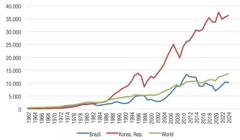
COMPARISON OF GDP PER CAPITA EVOLUTION BETWEEN BRAZIL, SOUTH KOREA AND THE WORLD AVERAGE (US$)
Comparing social indicators, it becomes evident that from 1950 to the present, South Korea has achieved significant improvements in quality of life. Indicators such as life expectancy (Figure 2) illustrate this clearly.

The transformation of South Korea from an underdeveloped, agrarian country into a diverse and dynamic economy, with social indicators close to those of developed countries, was the result of a set of public policies and long-term strategies combined with short and medium-term actions over decades (Amsden, 1989).
From the 1960s onwards, South Korea implemented industrial and innovation policies through five-year plans and massive investments in education and technology, enabling an unprecedented economic and social transformation. Meanwhile, Brazil failed to consolidate an effective long-term strategy and made no significant progress in economic development (Amsden, 1989; Bresser-Pereira, 2020).
Countries that have achieved significant improvements in economic and social aspects share a state role tied to a long-term vision, associated with planning, targets, programs, and intermediate strategies. This ensures sustainable structural transformations. State planning models guided by long-term targets rely on strong articulation between industrial, educational, and innovation policies, as is evident in the South Korean case (Amsden, 1989; Rodrik, 2007).
This approach allows the state to assume a coordinating and growth-inducing role, creating the institutional, financial, and technological conditions for overcoming middle-income traps and dependence on primary-export models (Bresser-Pereira, 2020; Mazzucato, 2013).
In the Brazilian context, the absence of continuity and coordination in development strategies has been identified as one of the main obstacles to the consolidation of a national project integrating innovation, reindustrialization, and social inclusion (Suzigan & Furtado, 2006).
Given this context, it becomes necessary to reflect on successful international experiences and their possible lessons for Brazil, to establish a future vision for the country based on sustainability, innovation, and social justice (Ministério do Planejamento, Desenvolvimento e Gestão, 2018).
This study seeks to answer the following research question: how can South Korea’s development experience, particularly the coordination of industrial and innovation policy, contribute to overcoming Brazil’s long-term sustainable development challenges?
The investigation seeks to understand which elements of the South Korean model are prioritários para a realidade brasileira, e quais limitações estruturais e institucionais condicionam essa aproximação.
Although several studies on late development exist, there is still a scarcity of works that systematically compare this model to the Brazilian case, especially combining historical, institutional, and industrial policy dimensions. Much of the Brazilian literature focuses on isolated analyses of productive sectors, but few studies articulate these discussions from a long-term planning comparative perspective. This article therefore seeks to fill that gap by proposing an analysis that integrates the central features of the Korean trajectory with Brazil’s contemporary challenges.
2. THEORETICAL FRAMEWORK
The comparison between the industrial and innovation policies of South Korea and Brazil is essential for understanding the challenges and opportunities of economic development in countries with distinct trajectories that at one point shared similar characteristics of underdevelopment.
In this context, this article aims to comparatively analyze the strategies adopted by both countries in industrial and innovation policy; to characterize the key elements of South Korea’s planning model; to promote a critical reflection on the transposition of such a model considering Brazil’s political-institutional, historical, and social particularities; and to contribute to the debate on the Brazil 2050 Strategy, offering empirical and conceptual inputs for its improvement.
An important factor in the analysis is the historical contextualization of both countries’ development processes, exploring the economic, political, and social challenges faced throughout the 20th century in South Korea and comparing them with the Brazilian context. Understanding this landscape is essential for identifying the factors that influence strategic decisions and the paths taken or yet to be taken by each nation.
In this regard, the article analyzes the main elements of South Korea’s industrial and innovation policies and the role of government planning, investments in education and Research and Development (R&D), and the strengthening of large national corporations (chaebols) in productive modernization. Based on this analysis, South Korea’s long-term planning approach is compared with the Brazilian experience, seeking to identify explanatory factors of South Korean performance relevant to the Brazilian case.
In fulfilling these objectives, the article seeks not only to draw a parallel between South Korea’s and Brazil’s trajectories, but also to stimulate an informed debate on coherent, continuous industrial and innovation policies aimed at building a more competitive and sustainable future for Brazil.
In the field of economic development, authors such as Amsden (1989) and Evans (1995) highlight the importance of comparing national trajectories to understand how industrial policies contribute to growth. This article adopts a qualitative and historical comparative perspective, examining the strategies of South Korea and Brazil through variables such as state planning, R&D investment, and state-private sector articulation, following the approach to institutions and development proposed by Chang (1994) and North (1990).
The study is based on bibliographical and documentary research, drawing on primary and secondary sources such as academic studies, institutional publications, and economic and social databases (Landman, 2008).
In this regard, an analysis is conducted of the historical and structural context, as well as an examination of the political and economic conditions of South Korea between 1950 and 1996, the year the last five-year plan ended, highlighting factors that shaped its development trajectory in comparison with Brazil. A discussion of the differences and similarities between the social, geopolitical, and economic contexts of South Korea and Brazil during the second half of the 20th century is promoted.
To ensure the study’s consistency, specific criteria were used in the selection of sources. Regarding academic literature, priority was given to classic works on late development and state planning, as well as Brazilian studies on industrial policy, institutions, and long-term planning.
The comparison between the cases was structured according to the following analytical dimensions: long-term state planning and coordination mechanisms; industrial policy, financing instruments, protection, and performance targets; investment in science, technology, and innovation; and human capital and education, examining the alignment of higher education with industrial demands.
It should be noted that the chosen approach presents inherent limitations of the qualitative and comparative method selected. The study does not include econometric analysis capable of estimating causal relationships or direct quantitative effects between policies and outcomes.
It is important to emphasize that international experiences should not be mechanically replicated but may offer useful lessons when adapted to specific national realities. Thus, by contrasting the models, this study seeks to contribute to the debate on possible pathways toward more innovative, inclusive, and sustainable development in Brazil in the formulation and implementation of long-term policies.
Furthermore, the comparison between only two countries with profoundly different historical and institutional trajectories implies limits of generalization and risks of oversimplification.
Finally, the analysis is based on available documents and consolidated literature, which may leave out relevant contextual nuances or evolving contemporary dynamics. Acknowledging these limitations reinforces the transparency and scientific rigor of this study.
3. RESULTS AND DISCUSSION
3.1 Medium and Long-Term Planning in South Korea
The Korean peninsula is historically home to a single person who became separated after the Second World War with the division into what are now the Democratic People’s Republic of Korea in the north and the Republic of Korea in the south.
Aligned with the capitalist bloc, South Korea had an essentially agrarian export model during the First Republic (1948-1960), led by the authoritarian Syngman Rhee. This period was characterized by post-colonial and post-war reconstruction, marked by political instability, dependence on foreign aid, and initial attempts at industrialization. The economic model of this period combined limited state intervention, welfarism, and protectionist policies, but without consistent industrial planning.
In 1960, massive protests during the so-called April Revolution led to the fall of Rhee. After a brief parliamentary experience following democratic elections in 1960, the country saw the return of dictatorship in 1961. Led by General Park Chung-Hee, who seized power in a military coup, the country began implementing a developmentalist model.
Under this new regime, a planning process was initiated for South Korea with the introduction of five-year plans, which would culminate in the accelerated economic growth known as the “Miracle of the Han.” The First Five-Year Plan, between 1962 and 1966, essentially sought to promote import substitution, supported by an industrialization process with foreign capital backing. The aid provided by the capitalist bloc to South Korea, especially from the United States, was based on a geopolitical aspect of combating communist influence in the region.
The scale of this support can be seen by examining only the financial resources received by South Korea, which totaled more than US$ 325 million in 1959, compared to US$ 83 million for all of Latin America (Woo, 1991). Foreign aid throughout the 1950s and 1960s maintained considerable levels, as can be seen in Table 1, particularly in the post-war period, when it reached US$ 12 per capita between 1953 and 1958, making the first two five-year plans financially sustainable.
During this period, the government established the institutional foundations for centralized economic planning, creating directed credit mechanisms and investing in basic infrastructure (Woo, 1991). The average annual GDP growth of 7.8% during this period demonstrated the initial effectiveness of the model, although the economy retained significant dependence on foreign aid.
In addition to financial support, the United States established a permanent military presence in South Korea in the post-war period — which continues to this day — participating in the process of reorganizing the armed forces in line with the strategic interests of the Western bloc during the Cold War (Cumings, 1997).
The Second Five-Year Plan (1967-1971) was launched with the objective of continuing the industrialization process, this time with a reduction in dependence on foreign capital. The emphasis on import-substituting industries was partially redirected toward the export of light manufactures. The promotion of exports based on labor-intensive industries was the coherent option given South Korea’s abundant and disciplined labor force (Amsden, 1989). In this context, Korea began to transform into a country with an export-oriented industrial base, following the Japanese model of the time.
Insufficient domestic savings consolidated an inevitable and growing dependence on foreign capital for the establishment of import-substituting industries. Basic input industries were set up through joint investment with foreign capital, which was attracted by cheap labor, tax exemptions, and profit repatriation incentives (Tho, 1988).
With the creation of the Korea Trade-Investment Promotion Agency (KOTRA) and the subsidized credit system for the chaebols — large family business conglomerates such as Samsung, Hyundai, and LG — the entrepreneur-state that would become a hallmark of the Korean model was consolidated (Evans, 1995). The results were significant: exports jumped from US$ 250 million in 1967 to US$ 1 billion in 1971, with average GDP growth reaching 9.6% per year.
This plan was enormously successful in macroeconomic terms however, the establishment of import-substituting industries had a perverse effect on the balance of payments, increasing imports of capital goods and raw materials. Rapid economic growth was accompanied by growing dependence on foreign capital.
The Third Five-Year Plan (1972-1976), in turn, centered its strategy on the development of the electronics, heavy, and chemical industries. The objective was to reduce dependence on imported raw materials, machinery, and equipment by restructuring the industrial composition and prioritizing more sophisticated, higher-value-added products.
The Fourth Five-Year Plan (1977-1981) emphasized technological innovation, improvements in administrative efficiency, and the maintenance of trade surpluses. It also established household appliances and machinery, which would play a critical role in South Korean development in the 1980s.
During the Fourth Five-Year Plan, South Korea underwent a change in leadership following the assassination of Park Chung-Hee in 1979. After a brief interlude, General Chun Doo-Hwan took power in 1980, continuing both the industrial and development policies of the previous government and the repression and authoritarianism characteristic of the regime.
From the 1980s onwards, the five-year plans underwent significant reorientation, with the Fifth Five-Year Plan (1982-1986) and the Sixth Five-Year Plan (1987-1991) promoting gradual economic liberalization, reduced state control, and a greater emphasis on high-technology industries. This transition coincided with the process of political democratization and the return of democracy in 1987 (Koo, 1993).
Democratization brought to the country pressures for greater income distribution and labor rights, forcing a rebalancing of government priorities. If previously economic growth had justified authoritarian measures and income concentration, the new context demanded more robust social policies without abandoning industrial competitiveness.
In this sense, the Sixth Plan included, for the first time, explicit social welfare targets, while simultaneously accelerating investments in technology to maintain South Korea’s competitive advantage (Kwon, 1999). However, redemocratization also exposed weaknesses in the consolidated industrialization model built in the previous decades regarding the chaebols. Previously unquestioned allies of the state, they were now being challenged for monopolistic practices and corruption. In this context, the tensions between democracy, equity, and economic growth became evident (Haggard & Kaufman, 1995).
The Seventh Five-Year Plan (1992-1996) was the last, subsequently replaced by more flexible, market-oriented policies, and marked a definitive transition in South Korean industry, now with an emphasis on technological innovation.
Amsden (1989) and Kim (1997) highlighted that South Korea’s success was not the result of isolated policies, but of an integrated vision that linked industrial targets to human capital formation and technological capacity-building. What can be observed is that, in the conjuncture of the second half of the 20th century, five-year economic planning associated with long-term continuity — articulating consistent state planning with massive investments in education and R&D — proved to be successful.
This does not exempt the South Korean model from criticism, which goes beyond the chaebols. Despite the developmental leap, the country has struggled with social issues. High workloads and young people’s dissatisfaction with life in the country reveal significant social problems. Furthermore, the country has one of the lowest birth rates in the world.
Since the First Five-Year Plan, the Korean government established an explicit link between qualified education and industrial development. The 1968 educational reform, which massively expanded technical and vocational education, was directly aligned with the needs of nascent industries (Woo, 1991).
In addition to strong public incentives and investments in reverse engineering and adaptation of foreign technologies, South Korea instituted policies that required companies to reinvest part of their profits in R&D.
These approaches were intensified in subsequent plans with the creation of the Korea Advanced Institute of Science and Technology (KAIST) and the establishment of a system of technology parks connecting universities, research institutes, and companies (Evans, 1995).
The evolution of R&D investment reveals a deliberate strategy of transition from imitation to innovation across the five-year plans. In the early plans, R&D spending did not exceed 0.5% of GDP. However, from the Fifth Plan onwards, this proportion jumped to 2%, with emphasis on strategic sectors such as semiconductors and telecommunications (Chang, 1994). In the Sixth Plan, the Science and Technology Promotion Act (1989) was enacted, raising R&D investment to 3% of GDP, a level comparable to the world’s leading investing countries (World Bank, 1999).
It is worth noting that educational and technological targets were revised in each plan in line with industrial evolution. When Korea entered the heavy industry phase in the 1970s, the expansion of engineering education was prioritized; in the high-technology phase of the following decade, computer science and basic research became the focus (Kim, 1997). In keeping with this, the creation of the National Science and Technology Council in 1967 coordinated actions among the government, universities, and companies, ensuring that human resources training met productive demands (Amsden, 1989).
As a result of this R&D orientation, South Korea went from 11 patents registered in the United States in 1976 to 3,642 in 1996 (United States Patent and Trademark Office, 1997). Furthermore, total productivity factors grew at annual rates of 2.8% between the 1960s and 1990s, more than double the world average (World Bank, 1993). As Wade (1990) argues, this case demonstrates that educational and technological policies only achieve full impact when embedded in a comprehensive, long-term industrial strategy.
This created a virtuous spiral in which qualified education fed companies’ technological absorption capacity, which in turn demanded an even more specialized labor force. Today, South Korea ranks among the world leaders in global education rankings (1st in the Program for International Student Assessment - PISA) and innovation (5th in theGlobal Innovation Index).
From the 1960s onwards, the Korean government adopted an approach that offered the chaebols subsidized credit, protection from foreign competition, and exclusive licenses for strategic sectors, in exchange for meeting production and export targets, investing in technological capacity-building, and generating employment in priority sectors (Amsden, 1989; Evans, 1995; Kim, 1997). The evolution of the chaebols in this period can be divided into three phases:
-
Light Industry Phase (1960s): chaebols such as Daewoo and Samsung led the production of textiles and basic electronics, meeting the export targets of the First and Second Plans.
-
Heavy Industry Phase (1970s): conglomerates such as Hyundai (shipbuilding) and POSCO (steel) were essential to the success of the Heavy Chemical Industry Drive (Third Plan). The government provided financing and assumed initial risks, while the chaebols executed large-scale projects (Chang, 1994).
-
High-Technology Phase (1980s and 1990s): throughout the Fifth and Sixth Plans, companies such as Samsung Electronics and LG invested in R&D for semiconductors and telecommunications, making South Korea a global leader in these sectors (World Bank, 1999).
Doubts persist about the consequences of chaebol policies, but the fact is that industrial concentration facilitated coordination between the government and the private sector, and the large conglomerates offered benefits for the implementation of an export-oriented model. These gains were associated with economies of scale, guided industrial diversification, and faster recognition of Korean companies in international markets (World Bank, 1987).
Another criticism concerns the reduction of competitiveness and the concentration of economic and political power. This dominance stifled small and medium enterprises, limiting decentralized innovation and economic diversification. Today, the five largest chaebols account for approximately 60% of South Korea’s GDP, a concentration that distorts the market and hinders fair competition (Kim, 2005).
The close relationship between chaebols and the state has been identified as a cause of recurring scandals involving bribery, tax evasion, and political manipulation. Cases such as Samsung (which led to the imprisonment of a company heir in 2017) and Lotte (involved in bribery schemes) reveal how opaque corporate governance structures have allowed owning families to control business empires with little transparency (Oh & Rowley, 2024).
Another argument concerns the excessive dependence on chaebols, which made the South Korean economy vulnerable to external shocks. During the 1997 Asian financial crisis, several conglomerates such as Daewoo collapsed, revealing unsustainable financial leverage and misallocation of resources. Despite post-crisis reforms, many chaebols continue to operate with high levels of debt, such as Hyundai, whose net debt reached US$ 95 billion in 2023 (Hyundai Motor Company, 2024).
It should be noted, however, that similar dynamics of economic concentration and political influence also manifest in other capitalist economies, even those considered advanced, as evidenced by the subprime crisis of the 2000s in the United States, marked by the centrality of large financial institutions and the need for state intervention to prevent systemic collapse. In this sense, the chaebols should be understood less as a Korean singularity and more as an expression of the inherent concentration of the capitalist system, whose effects depend on the regulatory framework and the state’s capacity for coordination and oversight.
After the end of the five-year plans and with the consolidation of a democratic model associated with the challenges of the 1990s, such as the Asian financial crisis, South Korea continued to implement short-term plans but aligned with a continuity in favor of industry and innovation.
3.2 Medium- and Long-Term Planning in Brazil
Brazil’s trajectory has been marked by attempts to institutionalize long-term planning, though these attempts have frequently been limited by structural challenges, institutional discontinuity, and political instability.
The first major milestone in this field was the Targets Plan (Plano de Metas, 1956-1961), launched during the government of Juscelino Kubitschek. Inspired by a developmentalist vision and the Economic Commission for Latin America and the Caribbean (ECLAC) idea of industrialization through import substitution (Bielschowsky, 2000), the plan organized 30 targets distributed across 5 strategic sectors (energy, transportation, food, basic industry, and education), as well as the construction of Brasília as a symbol of territorial integration and the country’s internalization. This cycle was fundamental in consolidating a diversified urban industrial base, although it also contributed to increased external debt.
The Targets Plan established rapid industrialization as its guiding directive, combining state investment in infrastructure with incentives for the establishment of foreign companies in the automotive and capital goods sectors. Although successful in expanding industrial capacity, this model consolidated an international insertion based on technological and foreign capital dependency.
During the military regime (1964-1985), the National Development Plans (PND I and II) (1972-1979) deepened this orientation, now with greater decision-making centralization and corporate support. The PND II represented the apex of the regime’s planning model, focusing on mega-investments in infrastructure and technology, such as the construction of the Rio-Niterói Bridge and the Itaipu Dam (Draibe, 1985).
The PND I was conceived during a period of strong economic growth, associated with the so-called “Brazilian economic miracle.” Its guidelines were directed toward consolidating the industrialization process, with an emphasis on infrastructure expansion. The plan prioritized investments in transportation, energy, and telecommunications, seeking to remove logistical bottlenecks. It also maintained the strategy of attracting foreign direct investment, especially in sectors such as automotive, contributing to the expansion of productive capacity. The state’s role, although relevant, operated in articulation with domestic and international private capital.
The PND II, on the other hand, was formulated in a significantly different context, marked by the 1973 oil crisis and deteriorating external conditions. Faced with the vulnerability of the Brazilian economy to import dependence, the plan adopted a more explicit import substitution strategy in basic sectors. Priority shifted to heavy industry, with intensive investments in steel, petrochemicals, fertilizers, mining, and energy. During this period, the state led highly complex projects through large state-owned enterprises.
The difference between the two plans lies in the profile of priority sectors. While the PND I sought to sustain growth through the expansion of infrastructure and already-consolidated industry, the PND II was oriented toward transforming the productive base with a reduction of external dependencies. This shift also implied an intensification in the use of external financing, increasing indebtedness.
In this context, state-owned enterprises such as Petrobras (oil and gas sector), Eletrobras (electricity sector), and Telebras (telecommunication sector) played a central role in the formation of productive chains. What can be noted is that investment in science, technology, and innovation remained relatively limited, with low articulation between universities, companies, and the state, which restricted the broader diffusion of these capabilities.
From the 1980s onwards, with the exhaustion of the financing model based on external debt, Brazil began experiencing a weakening of its planning culture. Subsequent attempts, such as the Brazil 2020 Plan, developed during the Fernando Henrique Cardoso (FHC) government in 1996, and the Greater Brazil Plan (Plano Brasil Maior, 2011-2014), launched during the Dilma Rousseff government, sought to restore the strategic coordination of national development (Ministério do Planejamento, Desenvolvimento e Gestão, 2018; Sicsú et al., 2012).
Brazil 2020 presented characteristics of prospective planning with an emphasis on building long-term scenarios. Unlike classic developmentalist plans based on quantitative targets and direct intervention, Brazil 2020 sought to guide state action through broad strategic guidelines aligned with the context of economic opening and macroeconomic stabilization. Its approach reflected heterodox conception, prioritizing the creation of a favorable environment for private investment and international insertion. The plan had limited impact due to the absence of binding instruments and articulation with the public budget.
The Greater Brazil Plan (Plano Brasil Maior) represented a more explicit attempt to resume elements of active industrial policy, focusing on reindustrialization, innovation, and increasing the competitiveness of the Brazilian economy. The plan incorporated a broad set of instruments, including tax exemptions, subsidized financing, export incentives, and support innovation, reflecting an effort to reconstitute the industrial policy mix.
Unlike Brazil 2020, it presented greater operational density and articulation with concrete economic instruments. However, its implementation revealed significant limitations. Institutional fragmentation, low inter-ministerial coordination, and the absence of an objective strategy for prioritizing sectors or technological missions reduced its effectiveness.
In the field of education, although Brazil has significantly expanded access to basic and higher education over recent decades, structural challenges persist regarding quality and the training of human resources in strategic areas. The formation of qualified human capital was not integrated into development strategies, limiting the country’s capacity to advance in knowledge-intensive sectors.
Regarding R&D investment, Brazil made important institutional advances, such as the creation of Sectoral Funds, the strengthening of agencies like the Funding Authority for Studies and Projects (Finep) and the National Council for Scientific and Technological Development (CNPq), and the implementation of legal frameworks to stimulate innovation. What was not observed, however, was R&D investment as a driver of the plans implemented in Brazil.
In general, Brazil’s planning history reveals a pattern of discontinuity, institutional fragmentation, and low capacity to coordinate public policies. As Bresser-Pereira (2020) highlights, the absence of a consistent national project integrating economic growth with income distribution, technological innovation, and sovereignty has been a central obstacle to the country’s sustainable development. This gap contrasts with experiences such as the South Korean one, in which the state played a long-term coordinating role, articulating industrial, educational, and technological policies with strategic vision and institutional continuity.
3.3 Comparison of Medium- and Long-Term Planning in Brazil and South Korea
The comparison between Brazil and South Korea should not be interpreted as an opposition between political regimes, but as an analysis of distinct institutional trajectories, built in different historical and geopolitical contexts.
In the Brazilian case, the external environment and, in particular, US foreign policy also exerted significant influence, in the context of the Cold War, on the political and economic process throughout the 20th century. From the 1950s onwards, the bilateral relationship was marked by a combination of economic cooperation, political alignment, and geopolitical constraints, which influenced national development strategies (Bandeira, 2013; Fico, 2008).
Unlike the South Korean case, in which US support was associated with economic reconstruction and military security, US intervention in Latin America occurred in a more ambiguous manner. In Brazil, although there were cooperation and financing initiatives — such as support for infrastructure projects and the creation of multilateral credit institutions — US foreign policy frequently prioritized political stability and the countering of projects considered heterodox or autonomist.
The most recent initiative, the Brazil 2050 Strategy (Ministério do Planejamento e Orçamento, n.d.), represents an effort to create an integrated vision of sustainable development, with targets for decarbonization, productivity increases, inequality reduction, and reduced dependence on commodity exports, potentially repositioning the country on the global stage by aligning economic competitiveness with the United Nations Sustainable Development Goals (SDGs). However, historical challenges persist, such as discontinuity between governments, the lack of stable financing sources, and the difficulty of articulating sectoral policies coherently.
This instability contrasts sharply with South Korea’s successful experience, which maintained its five-year plans with methodological consistency and alignment between the state and the private sector. Unlike the five-year plans, which initially focused on accelerated industrialization, Brazil’s proposal aims to reconcile economic growth, environmental sustainability, and the reduction of structural inequalities.
The concentration of government support in strategic sectors and state-business partnerships with objective targets are elements that could be adapted to the Brazilian reality. A divergence is noted between the political models: authoritarian in the Korean case and democratic in Brazil.
Brazilian democracy is shaped by what is known as coalition presidentialism, a structural element of the country’s institutional formation that influences the formulation and implementation of long-term planning strategies. This arrangement, marked by party fragmentation and the need for broad legislative coalitions, tends to introduce greater complexity and instability in decision-making, especially in policies that demand coordination and continuity. It is, therefore, a persistent characteristic of the Brazilian political trajectory, and not merely a temporary limitation.
South Korea’s development process was shaped by an institutional arrangement that combined strong state intervention, decision-making centralization, and an authoritarian political regime during a significant part of the accelerated industrialization period. In this historical context, the state coordinated resource allocation to strategic sectors, imposed strict conditionalities on the productive sector, and sustained consistent industrial policies over time.
South Korea structured its economic development around thechaebols, which became pillars of national industrialization. Meanwhile, the Brazil 2050 Strategy does not foresee the promotion of a “national champions” policy. By moving away from this approach, the country seeks a different path, prioritizing macroeconomic sustainability and balanced growth, distancing itself from sensitive issues that have been called into question in South Korea. In Brazil, the focus is on increasing investments in infrastructure, technology, and clean energy, without relying on conglomerates.
Another contrast lies in the context of climate change. South Korean industrialization occurred during a period of lower environmental pressure, allowing sustainability agendas to be ignored. The Brazil 2050 Strategy, on the other hand, must reconcile growth with decarbonization — challenges that require innovation and integrated planning.
The Strategy requires clear direction, oriented toward building social and economic advantages compatible with the country’s potential. In this regard, Brazil’s position as a world leader in biodiversity constitutes a strategic opportunity, both for the country’s international positioning as a reference in biome preservation and for promoting the development of green and sustainability-based industries.
Finally, national security was a central factor for South Korea, which viewed its industrial development as a means of protecting itself against external threats. Investments in heavy industries and technology had a more pronounced strategic-military component. Throughout the second half of the 20th century, Brazilian development included a defense and national sovereignty component, with examples such as Petrobras, Embraer, and the nuclear program. From the current perspective, however, national security plays a central role in economic and industrial development. Nevertheless, increased military spending in recent years and a potential repositioning of middle powers like Brazil on the global stage could alter this situation.
South Korea’s experience offers important lessons for Brazil. Among the most promising elements for adaptation are the formulation of national development plans with long-term alignment and monitoring mechanisms; the emphasis on human capital formation and the valorization of technical and scientific education; the creation of coordination instruments between the state, the productive sector, and research institutions; and the prioritization of strategic sectors for selective industrial policies, based on already-existing capabilities.
Although the cultural element may be considered decisive for the country’s success in recent decades, Acemoglu and Robinson (2012) emphasize how South Korea overcame underdevelopment with solid, centralized political and economic institutions that abandoned the extractive model that existed before the Korean War.
Brazil, on the other hand, remains tied to institutions that favor extractive models. The Brazil 2050 Strategy will not guarantee development but must be associated with the transformation from an extractive model to a more inclusive one — through the long-term strengthening of industrial sectors and encouraging innovation through state incentive mechanisms.
It is important to note that Brazil has a considerable innovation ecosystem, with principles like KAIST, as well as a legal and public policy framework to stimulate innovation. What can be observed, however, is the absence of results comparable to those achieved in South Korea. In this regard, reflection is needed on adopting another South Korean strategy: directing resources toward research and training aligned with the objective of developing specific sectors, especially in STEM (Science, Technology, Engineering, and Mathematics).
Another fundamental lesson concerns the role of the state as a coordinating agent of development, articulating strategic investments, defining sectoral priorities, and promoting integration between government, the productive sector, and research institutions. In Brazil, this could translate into more sophisticated selective industrial policies focused on sectors of high economic complexity with potential to raise national productivity.
Finally, Table 2 below consolidates the comparison between South Korean and Brazilian industrial and innovation policies.
South Korea’s experience highlights that development requires not only economic policies, but profound institutional reforms capable of creating an environment favorable to innovation, reducing inefficiencies, and consolidating a cohesive national project. For Brazil, this implies confronting historical challenges related to institutional fragmentation and the volatility of government priorities.
4. CONCLUSION
By reconstructing national trajectories from the mid-20th century, the study sought to demonstrate how different institutional arrangements, geopolitical contexts, and state capacities conditioned the outcomes observed in each country.
The South Korean experience indicates that the success of its industrialization cannot be attributed to a single factor, but to the combination of continuous state planning; selective industrial policy instruments; strong articulation between education, science, technology, and industry; as well as a favorable external context. These elements enabled the Korean state to coordinate investments, discipline the private sector, and promote the progressive elevation of productive complexity.
In the Brazilian case, the historical analysis reveals the existence of multiple planning and industrialization attempts, though marked by institutional discontinuity, decisional fragmentation, and persistent difficulties in intertemporal coordination.
The comparison between the two cases suggests that performance differences do not stem merely from the quality of planning itself, but from the institutional environment that sustains its implementation over time. In this sense, the main lesson drawn from the South Korean experience does not reside in the replication of specific instruments such as the chaebols, but in the centrality attributed to strategic coordination, policy continuity, and the deliberate building of state and technological capacities.
The study’s findings indicate that the advancement of a long-term development strategy in Brazil requires the strengthening of permanent state coordination mechanisms capable of continuously integrating industrial, educational, and science, technology, and innovation policies, beyond political cycles. The consolidation of a national innovation system articulated with the industrialization process, associated with the definition of sectoral priorities, objective targets, and long-term financing instruments, proves central to guiding productive transformation in sectors of greater economic complexity.
In this context, the institutionalization of the Brazil 2050 Strategy and the construction of cross-party commitments emerge as fundamental conditions for ensuring predictability and coherence in state action, in line with the South Korean experience of articulation between industrial policy, education, and innovation.
As a further development of this research, future studies may deepen the analysis of the institutional mechanisms that condition the continuity and effectiveness of long-term development strategies, with particular attention to intergovernmental coordination and federative arrangements. Expanded comparative investigations, including other countries that adopted successful industrial and innovation policies in different historical and geopolitical contexts, may offer additional evidence on the factors that favor the construction of state capacities.
Additionally, empirical research focused on evaluating specific instruments — such as public procurement for innovation, mission-oriented financing, and green transition policies — may contribute to enriching the debate on the adaptation of international experiences to the Brazilian case.
References
-
Acemoglu, D., & Robinson, J. A. (2012). Why nations fail: the origins of power, prosperity, and poverty. ASEAN Economic Bulletin, 29(2), 168-170. https://doi.org/10.1355/ae29-2j
» https://doi.org/10.1355/ae29-2j - Amsden, A. H. (1989). Asia’s next giant: South Korea and late industrialization Oxford University.
- Banco Nacional de Desenvolvimento Econômico e Social. (2019). Financiamento do desenvolvimento BNDES.
- Bandeira, L. A. M. (2013). Formação do império americano Civilização Brasileira.
- Bank of Korea. (1969). Economic statistics yearbook Han’guk Ŭnhaeng, Chosabu.
- Bielschowsky, R. (2000). Pensamento econômico brasileiro: O ciclo ideológico do desenvolvimentismo (4th ed.). Contraponto.
- Bresser-Pereira, L. C. (2020). A construção política do Brasil: sociedade, economia e Estado desde a Independência Ed. 34.
- Chang, H.-J. (1994). The political economy of industrial policy Palgrave Macmillan.
- Cumings, B. (1997). Korea’s place in the sun: a modern history W. W. Norton & Company.
- Draibe, S. (1985). Rumos e metamorfoses: um estudo sobre a constituição do Estado e as alternativas da industrialização no Brasil (1930-1960) Paz e Terra.
-
Evans, P. (1995). Embedded autonomy: states and industrial transformation Princeton University. https://doi.org/10.1515/9781400821723
» https://doi.org/10.1515/9781400821723 - Fico, C. (2008). O grande irmão: da operação Brother Sam aos anos de chumbo Civilização Brasileira.
- Furtado, C. (2007). Formação econômica do Brasil (34th ed.). Companhia das Letras.
-
Haggard, S., & Kaufman, R. R. (1995). The political economy of democratic transitions Princeton University. https://doi.org/10.1515/9780691188010
» https://doi.org/10.1515/9780691188010 -
Hyundai Motor Company. (2024). 2023 consolidated financial statements - Year ended December 31 https://www.hyundai.com/worldwide/en/company/ir/financial-information
» https://www.hyundai.com/worldwide/en/company/ir/financial-information - Kim, E. M. (1997). Big business, strong state: collusion and conflict in South Korean development, 1960-1990 State University of New York Press.
- Kim, H.-A. (2005). Korea’s development under Park Chung Hee: rapid industrialization, 1961-79 Routledge.
-
Kim, B.-K., & Vogel, E. F. (2011). The Park Chung Hee era: the transformation of South Korea Harvard University Press. https://doi.org/10.4159/harvard.9780674061064
» https://doi.org/10.4159/harvard.9780674061064 - Koo, H. (1993). State and society in contemporary Korea Cornell University Press.
-
Kwon, H.-J. (1999). The welfare state in Korea: the politics of legitimation Palgrave Macmillan. https://doi.org/10.1057/9780230374294
» https://doi.org/10.1057/9780230374294 -
Landman, T. (2008). Issues and methods in comparative politics: an introduction Routledge. https://doi.org/10.4324/9780203929780
» https://doi.org/10.4324/9780203929780 -
Maddison, A. (2001). The world economy: a millennial perspective OECD. https://doi.org/10.1787/9789264189980-en
» https://doi.org/10.1787/9789264189980-en - Mazzucato, M. (2013). The entrepreneurial state: debunking public vs. private sector myths Anthem.
-
Ministério do Planejamento e Orçamento. (s.d.). Estratégia Brasil 2050 https://www.gov.br/planejamento/pt-br/assuntos/planejamento/Brasil2050
» https://www.gov.br/planejamento/pt-br/assuntos/planejamento/Brasil2050 -
Ministério do Planejamento, Desenvolvimento e Gestão. (2018). Estratégia nacional de desenvolvimento econômico e social (ENDES) http://antigo.sudam.gov.br/conteudo/menus/retratil/planos-desenvolvimento/prda/arquivos/2019/estrategia-nacional-de-desenvolvimento-economico-e-social.pdf
» http://antigo.sudam.gov.br/conteudo/menus/retratil/planos-desenvolvimento/prda/arquivos/2019/estrategia-nacional-de-desenvolvimento-economico-e-social.pdf -
North, D. C. (1990). Institutions, institutional change and economic performance Cambridge University Press. https://doi.org/10.1017/CBO9780511808678
» https://doi.org/10.1017/CBO9780511808678 -
Oh, I., & Rowley, C. (2024). Corporate governance and firm legitimacy: Chaebol governance and political corruption in South Korea. Georgetown Journal of International Affairs, 25(1), 87-93. https://doi.org/10.1353/gia.2024.a9
» https://doi.org/10.1353/gia.2024.a9 -
Rodrik, D. (2007). One economics, many recipes: globalization, institutions, and economic growth Princeton University. https://doi.org/10.2307/j.ctvcm4jbh
» https://doi.org/10.2307/j.ctvcm4jbh - Sicsú, J., Paula, L. F., & Michel, R. (2005). Novo-desenvolvimentismo: Um projeto nacional de crescimento com equidade social Manole; Fundação Konrad Adenauer.
- Suzigan, W.; Furtado, J. Política industrial e desenvolvimento. Revista de Economia Política, 26(2), 163-185, 2006.
- Tho, T. van. (1988). Export-oriented growth and technical progress in Korea (OECD Development Centre Papers, No. 5). OECD.
-
United States Patent and Trademark Office. (1997). Annual report 1997 https://www.uspto.gov/sites/default/files/about/stratplan/ar/1997annualreport.pdf
» https://www.uspto.gov/sites/default/files/about/stratplan/ar/1997annualreport.pdf -
Wade, R. (1990). Governing the market: economic theory and the role of government in East Asian industrialization Princeton University Press. https://doi.org/10.1515/9780691187181
» https://doi.org/10.1515/9780691187181 - Woo, M. J.-E. (1991). Race to the swift: State and finance in Korean industrialization Columbia University Press.
- World Bank. (1987). Korea: managing the industrial transition
- World Bank. (1993). The East Asian miracle: economic growth and public policy
- World Bank. (1999). Korea and the knowledge-based economy: making the transition
-
World Bank. (2025) World Bank Open Data https://data.worldbank.org/
» https://data.worldbank.org/
-
RESEARCH DATA AVAILABILITY
The entire dataset supporting the results of this study has been published within the article itself.
-
ARTIFICIAL INTELLIGENCE USAGE
The artificial intelligence tools ChatGPT and DeepSeek were used to assist with the technical and grammatical revision of the text, and with the normalization and formatting of references to the required standard. The translation of this article was assisted by the AI tool Claude and reviewed by the author.
-
11
[Translated version with artificial intelligence usage]
-
Reviewers:
Beatriz de Castro Fialho, Fundação Oswaldo Cruz, Rio de Janeiro, RJ, Brazil; Jackson De Toni, Agencia Brasileira de Desenvolvimento Industrial, Brasília, DF, Brazil
-
Peer review report:
The peer review report is available at https://periodicos.fgv.br/rap/article/view/97069/90457
The entire dataset supporting the results of this study has been published within the article itself.
Data citations
World Bank. (2025) World Bank Open Data https://data.worldbank.org/

 Source: Elaborated by the author based on World Bank (
 Source: Elaborated by the author based on World Bank (2025).