 Health outcomes of umbilical cord clamping techniques in preterm neonates: meta-analysis
SUMMARY
OBJECTIVE: The aim of this study was to determine the effect of umbilical cord clamping time and milking on blood parameters in preterm neonates.
METHODS: A literature search was conducted between July and September 2024 in four databases. The search was performed using MeSH-based keywords.
RESULTS: In this study, the results of 14 studies covering a total of 1,609 preterm neonates were analyzed. Follow-up after intervention showed no statistically significant difference in hemoglobin (standardized mean difference=0.22, 95%CI 0.04–0.48, Z=1.65, p=0.10) and bilirubin (standardized mean difference=0.22, 95%CI 0.30–0.74, Z=0.82, p=0.41) between the groups. There was a statistically significant difference in ferritin (standardized mean difference=0.73, 95%CI 0.30–1.15, Z=3.37, p=0.00008) and hematocrit (standardized mean difference=0.30, 95%CI 0.05–0.54, Z=2.41, p=0.02) values, and the effect size was positive. According to the subgroup analysis of the combined results of the studies, it was seen that there was no statistically significant difference in the adverse health outcomes in preterms (OR 0.92, 95%CI 0.74–1.15, Z=0.72, p=0.47).
CONCLUSION: From the analysis, it can be observed that late cord clamping and cord milking can prevent premature anemia by increasing hematocrit and ferritin formation in preterm newborns.
KEYWORDS:
Prematurity; Umbilical cord milking; Cord clamping; Hemoglobin; Hematocrit; Ferritin; Bilirubin
INTRODUCTION
Babies born before completing the 37th week of pregnancy in the womb are considered premature1. These babies have low hemoglobin (Hb) values, which is defined as premature anemia. Anemia of prematurity has been associated with low Hb values at birth for gestational age, short erythrocyte lifespan, low endogenous erythropoietin, hyporegenerative bone marrow, medical complications, iatrogenic blood loss, and rapid growth2,3.
The two most common interventions to ensure placental perfusion at birth are milking and late clamping of the umbilical cord. Delaying cord clamping for at least 30–60 s in term infants is beneficial in terms of keeping Hb levels and iron stores high in the first months, and iron deficiency anemia is less common in infants whose cords are clamped late. In preterm infants, late cord clamping can increase erythrocytes, reduce transfusion requirements and the incidence of necrotizing enterocolitis, and reduce the development of intraventricular hemorrhage (IVH). Therefore, in the ACOG recommendations updated in 2020, it is advised to wait at least 30–60 s after birth for term and healthy preterm infants and clamp the cord. No side effects were observed with late clamping in term and preterm infants other than polycythemia and non-serious hyperbilirubinemia. Although the ideal cord clamping time in premature babies is not clearly known, early clamping (<30 s) is not recommended2-7.
Cord milking is performed by gently milking the umbilical cord 2–4 times at a constant speed while keeping it at a distance of 20–30 cm toward the newborn5,6. It has been stated that umbilical cord milking (UCM) increases the risk of IVH and respiratory distress syndrome in extremely premature infants and may have side effects due to polycythemia. The literature on the effect of umbilical cord interventions to reduce anemia, which continues to be a threat for premature infants, is still contradictory8. The aim of this study was to systematically review and meta-analyze the results regarding the effect of umbilical cord clamping time and milking on blood parameters in premature newborns.
METHODS
Eligibility criteria
The studies to be included in the study were decided by taking into account the PICOS criteria:
Participant (P): Preterm newborns: The criteria for the inclusion of preterm newborns in the study were as follows: (1) no chromosomal anomaly, (2) no congenital anomaly, (3) 37 gestational week (GW) small, (4) no placental anomaly, and (4) no Rh nonconformity.
Intervention (I): Cord clamping (1): UCM and (2): delayed cord clamping (DCC).
Comparison (C): (1) Immediate cord clamping (ICG) and (2) DCC.
Outcomes (O): (1): Hb, (2) hematocrit (3) peak bilirubin level, (4) serum ferritin, (5) IVH, (6) necrotizing enterocolitis, (7) anemia, (8) respiratory distress syndrome, (9) patent ductus arteriosus, and (10) neonatal polycythemia.
Study design (S): Randomized controlled trials (RCTs) were included.
Search strategy
This systematic review and meta-analysis included full-text accessible RCTs published in academic journals. The literature review was conducted between July and September 2024 using four electronic databases (PubMed, CINAHL, Scopus, and ULAKBIM). For the literature review, first of all, the keywords in the Medical Subject Headings 2023 thesaurus were determined. The keywords were "preterm" AND "infant" OR "baby" OR" newborn" OR "delayed cord clamping" OR "Cord milking" OR "immediate cord clamping" OR "blood parameters" OR "hemoglobin" OR "hematocrit" OR "bilirubin" OR "ferritin."
Data analysis
Review Manager 5.4.1 software was used to analyze the articles. For binary variables (effective rate), relative risk ratio (RR) and 95%CI were used as effect indicators. For continuous variables, weighted standardized mean difference (SMD) or mean difference (MD) with 95%CI was used as an effect indicator. Heterogeneity testing was performed using I2 value and Q test. When I2≥50%, some heterogeneity was considered, and a random-effects model was used, while when I2≤50%, the included articles were considered homogeneous and a fixed-effects model was used. The risk of bias for each area was classified as "low risk," "high risk," or "uncertain risk" according to the decision criteria in the "bias risk" assessment tool.
RESULTS
Literature review
Study characteristics
This systematic review and meta-analysis included 14 studies on preterm newborns, in which a total of 1,609 preterm newborns were included to review the results on the effect of umbilical cord clamping time and milking on blood parameters and to evaluate the available evidence. In all the studies included in the analysis, preterm newborns were treated with an intervention related to early or late cord clamping or cord milking7,9-22 (Table 1).
Characteristics and main findings of the studies included in the systematic review and meta-analysis (n=14).
Outcomes
Hb and hematocrit were assessed in all studies included in the analysis7,9-22. Six studies reported bilirubin levels and three studies reported ferritin value.
Blood parameters
A total of 3 of the reviewed studies reported ferritin, 6 bilirubin, 12 Hb (g/dL), and 10 hematocrit results. When the mean pooled results of the studies were examined, a high level of heterogeneity was found (I2=84%, p<0.00001). There was a statistically significant difference in ferritin (SMD=0.73, 95%CI 0.30–1.15, Z=3.37, p=0.00008) and hematocrit (SMD=0.30, 95%CI 0.05–0.54, Z=2.41, p=0.02) values and the effect size was positive (Figure 1).

Forest plot for comparison: meta-analysis results on the effect of interventions on hematological parameters.
Preterm health outcomes
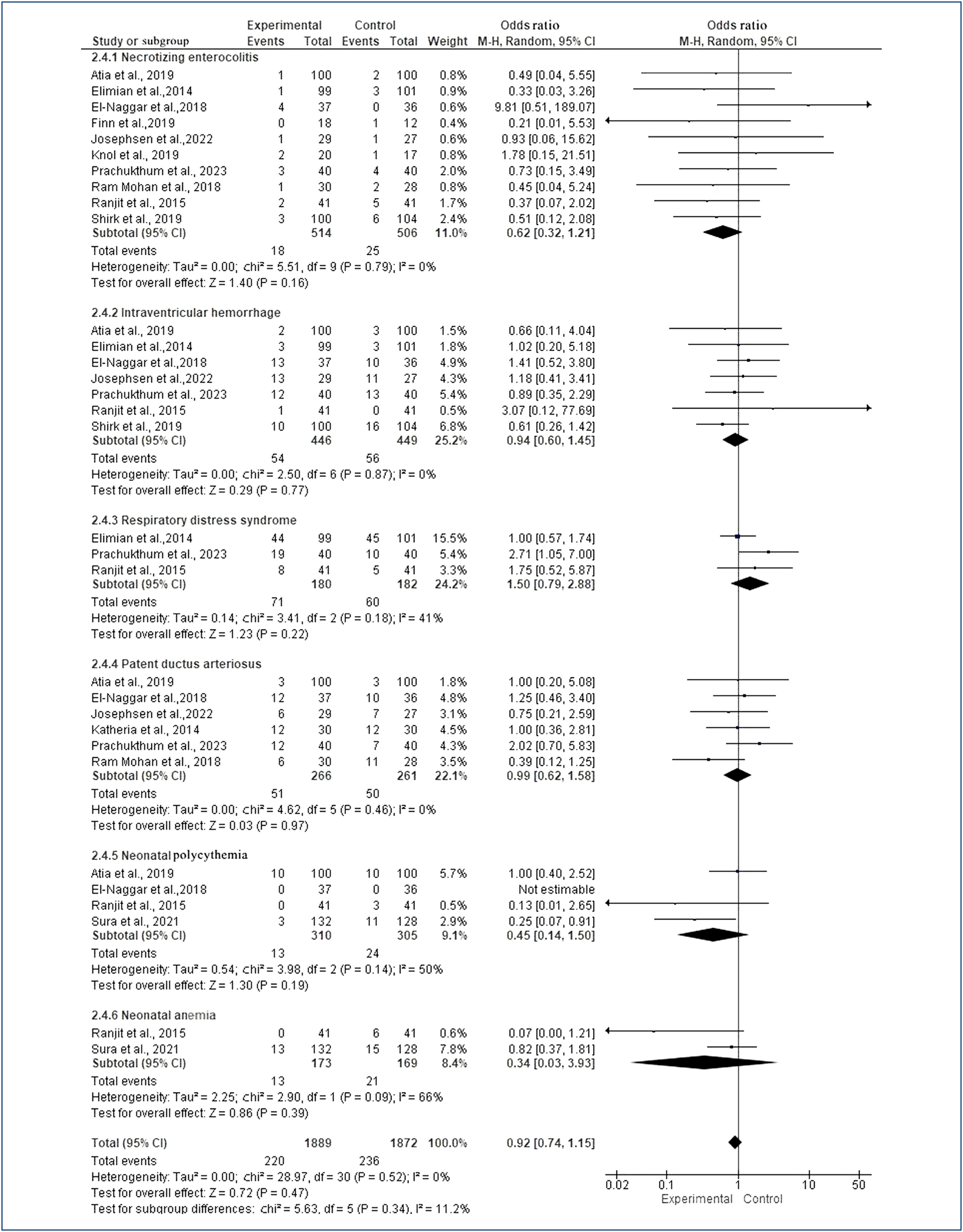
The results regarding the adverse health outcomes of necrotizing enterocolitis, IVH, respiratory distress syndrome, patent ductus arteriosus, neonatal polycythemia, and neonatal anemia are depicted in Figure 2. According to the subgroup analysis of the combined results of the studies, it was seen that there was no statistically significant difference in the adverse health outcomes in preterms (OR 0.92, 95%CI 0.74–1.15, Z=0.72, p=0.47; Figure 2).

Forest plot of comparison: meta-analysis results on the effect of interventions on preterm health outcomes.
Risk-of-bias assessment
In the 13 studies included in the analysis, it was seen that there was a sufficient method for randomly assigning preterm newborns to groups7,9-14,16-22. Therefore, the risk of side-keeping was evaluated as low in these studies. In the study by Kilicdag et al.15, it was determined that there was an unclear risk of favoritism since there was no explanation for randomization. In all studies, since it was assigned to groups using sequentially numbered and sealed opaque envelopes, bias assessed the risk as low. While blindness was not required in participants due to the nature of the study, the risk was low because 13 studies provided blindness in terms of statisticians and randomization.
DISCUSSION
It is recommended not to perform early cord clamping in order to increase survival rates and reduce morbidity in preterm newborns23. The aim of this study was to determine the effect of umbilical cord clamping time and milking on blood parameters in preterm neonates (PNs). In this meta-analysis, late cord clamping and cord milking increased Hb, hematocrit, and ferritin levels in preterm infants. Additionally, there was no difference in the incidence of negative health outcomes compared to the control group.
A meta-analysis of 18 RCTs on early and late cord clamping reported that blood transfusion rates decreased by 10% and hematocrit increased by 2.7% with late cord clamping2. Another meta-analysis indicated that late cord clamping may improve hematological parameters in preterm infants; however, further studies on cord milking are needed. The ideal umbilical cord interventions for preterm infants are not yet clearly defined, but early clamping may be harmful. In the meta-analysis by Gomersall et al.24, it was found that late cord clamping reduced the need for blood transfusion and increased Hb levels in term and late preterm infants. Another meta-analysis reported that cord milking reduces the need for blood transfusion in PNs25. Furthermore, a meta-analysis conducted on term infants showed that cord milking improved hematological outcomes more than DCC26. In summary, both late cord clamping and cord milking may help prevent premature anemia by increasing hematocrit and ferritin levels in preterm infants. Regarding Hb levels, a positive effect size was observed, indicating that these interventions may increase Hb values.
A meta-analysis study on early and late cord clamping reported that in-hospital mortality decreased with late clamping, but no effects were found on IVH, chronic lung disease, necrotizing enterocolitis, or retinopathy2. Another meta-analysis found that the duration of cord clamping increased the risk of respiratory distress syndrome in term and late preterm infants24. Another meta-analysis reported that late cord clamping reduced the risk of mortality in preterm infants compared to ICG27. Additionally, a meta-analysis study indicated that cord milking increased the risk of intracranial hemorrhage, particularly in preterm infants born at earlier gestational ages, compared to DCC25. Another meta-analysis similarly reported that DCC reduced IVH in preterm infants compared with immediate clamping28. Although the findings in this study are consistent with the existing literature, further research is needed to better define the optimal interventions for PNs.
CONCLUSION
From this analysis, it can be said that late cord clamping and UCM may prevent premature anemia by increasing hematocrit and ferritin formation in preterm newborns. Based on Hb results, it was found that late cord clamping and UCM may increase Hb values since the effect size was positive in addition to the power of causing negative health performance.
REFERENCES
-
1 World Health Organization. "Preterm birth". 2018. [cited on 2024 May 05]. Available from: https://www.who.int/news-room/fact-sheets/detail/preterm-birth#:~:text=Preterm%20is%20defined%20as%20babies,(32%20to%2037%20weeks)
» https://www.who.int/news-room/fact-sheets/detail/preterm-birth#:~:text=Preterm%20is%20defined%20as%20babies,(32%20to%2037%20weeks) -
2 Fogarty M, Osborn DA, Askie L, Seidler AL, Hunter K, Lui K, et al. Delayed vs early umbilical cord clamping for preterm infants: a systematic review and meta-analysis. Am J Obstet Gynecol. 2018;218(1):1-18. https://doi.org/10.1016/j.ajog.2017.10.231
» https://doi.org/10.1016/j.ajog.2017.10.231 - 3 Ozdemir OM. Anemia in prematurity and transfusion policies. Pamukkale Med J. 2022;15(2):2.
-
4 Wyckoff MH, Wyllie J, Aziz K, Almeida MF, Fabres J, Fawke J, et al. Neonatal life support: 2020 international consensus on cardiopulmonary resuscitation and emergency cardiovascular care science with treatment recommendations. Circulation. 2020;142(16_Suppl_1):S185-221. https://doi.org/10.1161/CIR.0000000000000895
» https://doi.org/10.1161/CIR.0000000000000895 -
5 Zerra PE, Josephson CD. Transfusion in neonatal patients: review of evidence-based guidelines. Clin Lab Med. 2021;41(1):15-34. https://doi.org/10.1016/j.cll.2020.10.002
» https://doi.org/10.1016/j.cll.2020.10.002 -
6 Saito-Benz M, Flanagan P, Berry MJ. Management of anaemia in pre-term infants. Br J Haematol. 2020;188(3):354-66. https://doi.org/10.1111/bjh.16233
» https://doi.org/10.1111/bjh.16233 -
7 Katheria A, Reister F, Essers J, Mendler M, Hummler H, Subramaniam A, et al. Association of umbilical cord milking vs delayed umbilical cord clamping with death or severe intraventricular hemorrhage among preterm infants. JAMA. 2019;322(19):1877-86. https://doi.org/10.1001/jama.2019.16004
» https://doi.org/10.1001/jama.2019.16004 -
8 Marshall S, Lang AM, Perez M, Saugstad OD. Delivery room handling of the newborn. J Perinat Med. 2019;48(1):1-10. https://doi.org/10.1515/jpm-2019-0304
» https://doi.org/10.1515/jpm-2019-0304 -
9 Atia H, Badawie A, Elsaid O, Kashef M, Alhaddad N, Gomaa M. The hematological impact of umbilical cord milking versus delayed cord clamping in premature neonates: a randomized controlled trial. BMC Pregnancy Childbirth. 2022;22(1):714. https://doi.org/10.1186/s12884-022-05046-7
» https://doi.org/10.1186/s12884-022-05046-7 -
10 Finn D, Ryan DH, Pavel A, O’Toole JM, Livingstone V, Boylan GB, et al. Clamping the umbilical cord in premature deliveries (CUPiD): neuromonitoring in the immediate newborn period in a randomized, controlled trial of preterm infants born at <32 weeks of gestation. J Pediatr. 2019;208:121-6.e2. https://doi.org/10.1016/j.jpeds.2018.12.039
» https://doi.org/10.1016/j.jpeds.2018.12.039 -
11 El-Naggar W, Simpson D, Hussain A, Armson A, Dodds L, Warren A, et al. Cord milking versus immediate clamping in preterm infants: a randomised controlled trial. Arch Dis Child Fetal Neonatal Ed. 2019;104(2):F145-50. https://doi.org/10.1136/archdischild-2018-314757
» https://doi.org/10.1136/archdischild-2018-314757 -
12 Elimian A, Goodman J, Escobedo M, Nightingale L, Knudtson E, Williams M. Immediate compared with delayed cord clamping in the preterm neonate: a randomized controlled trial. Obstet Gynecol. 2014;124(6):1075-9. https://doi.org/10.1097/AOG.0000000000000556
» https://doi.org/10.1097/AOG.0000000000000556 -
13 Josephsen JB, Potter S, Armbrecht ES, Al-Hosni M. Umbilical cord milking in extremely preterm infants: a randomized controlled trial comparing cord milking with immediate cord clamping. Am J Perinatol. 2022;39(4):436-43. https://doi.org/10.1055/s-0040-1716484
» https://doi.org/10.1055/s-0040-1716484 -
14 Katheria AC, Leone TA, Woelkers D, Garey DM, Rich W, Finer NN. The effects of umbilical cord milking on hemodynamics and neonatal outcomes in premature neonates. J Pediatr. 2014;164(5):1045-50.e1. https://doi.org/10.1016/j.jpeds.2014.01.024
» https://doi.org/10.1016/j.jpeds.2014.01.024 -
15 Kilicdag H, Gulcan H, Hanta D, Torer B, Gokmen Z, Ozdemir SI, et al. Is umbilical cord milking always an advantage? J Matern Fetal Neonatal Med. 2016;29(4):615-8. https://doi.org/10.3109/14767058.2015.1012067
» https://doi.org/10.3109/14767058.2015.1012067 -
16 Knol R, Brouwer E, Akker T, DeKoninck P, Geloven N, Polglase GR, et al. Physiological-based cord clamping in very preterm infants - Randomised controlled trial on effectiveness of stabilisation. Resuscitation. 2020;147:26-33. https://doi.org/10.1016/j.resuscitation.2019.12.007
» https://doi.org/10.1016/j.resuscitation.2019.12.007 -
17 Kumar B, Upadhyay A, Gothwal S, Jaiswal V, Joshi P, Dubey K. Umbilical cord milking and hematological parameters in moderate to late preterm neonates: a randomized controlled trial. Indian Pediatr. 2015;52(9):753-7. https://doi.org/10.1007/s13312-015-0711-1
» https://doi.org/10.1007/s13312-015-0711-1 -
18 Prachukthum S, Tanprasertkul C, Somprasit C. Premature infants receiving delayed cord clamping with and without cord milking: a randomized control trial. BMC Pediatr. 2023;23(1):123. https://doi.org/10.1186/s12887-023-03933-2
» https://doi.org/10.1186/s12887-023-03933-2 -
19 Shirk SK, Manolis SA, Lambers DS, Smith KL. Delayed clamping vs milking of umbilical cord in preterm infants: a randomized controlled trial. Am J Obstet Gynecol. 2019;220(5):482.e1-8. https://doi.org/10.1016/j.ajog.2019.01.234
» https://doi.org/10.1016/j.ajog.2019.01.234 -
20 Sura M, Osoti A, Gachuno O, Musoke R, Kagema F, Gwako G, et al. Effect of umbilical cord milking versus delayed cord clamping on preterm neonates in Kenya: a randomized controlled trial. PLoS One. 2021;16(1):e0246109. https://doi.org/10.1371/journal.pone.0246109
» https://doi.org/10.1371/journal.pone.0246109 -
21 Ranjit T, Nesargi S, Rao PN, Sahoo JP, Ashok C, Chandrakala BS, et al. Effect of early versus delayed cord clamping on hematological status of preterm infants at 6 wk of age. Indian J Pediatr. 2015;82(1):29-34. https://doi.org/10.1007/s12098-013-1329-8
» https://doi.org/10.1007/s12098-013-1329-8 -
22 Ram Mohan G, Shashidhar A, Chandrakala BS, Nesargi S, Suman Rao PN. Umbilical cord milking in preterm neonates requiring resuscitation: a randomized controlled trial. Resuscitation. 2018;130:88-91. https://doi.org/10.1016/j.resuscitation.2018.07.003
» https://doi.org/10.1016/j.resuscitation.2018.07.003 -
23 Seidler AL, Gyte GML, Rabe H, Díaz-Rossello JL, Duley L, Aziz K, et al. Umbilical cord management for newborns <34 weeks’ gestation: a meta-analysis. Pediatrics. 2021;147(3):e20200576. https://doi.org/10.1542/peds.2020-0576
» https://doi.org/10.1542/peds.2020-0576 -
24 Gomersall J, Berber S, Middleton P, McDonald SJ, Niermeyer S, El-Naggar W, et al. Umbilical cord management at term and late preterm birth: a meta-analysis. pediatrics. 2021;147(3):e2020015404. https://doi.org/10.1542/peds.2020-015404
» https://doi.org/10.1542/peds.2020-015404 -
25 Balasubramanian H, Ananthan A, Jain V, Rao SC, Kabra N. Umbilical cord milking in preterm infants: a systematic review and meta-analysis. Arch Dis Child Fetal Neonatal Ed. 2020;105(6):572-80. https://doi.org/10.1136/archdischild-2019-318627
» https://doi.org/10.1136/archdischild-2019-318627 -
26 Jeevan A, Ananthan A, Bhuwan M, Balasubramanian H, Rao S, Kabra NS. Umbilical cord milking versus delayed cord clamping in term and late-preterm infants: a systematic review and meta-analysis. J Matern Fetal Neonatal Med. 2022;35(25):5478-88. https://doi.org/10.1080/14767058.2021.1884676
» https://doi.org/10.1080/14767058.2021.1884676 -
27 Seidler AL, Aberoumand M, Hunter KE, Barba A, Libesman S, Williams JG, et al. Deferred cord clamping, cord milking, and immediate cord clamping at preterm birth: a systematic review and individual participant data meta-analysis. Lancet. 2023;402(10418):2209-22. https://doi.org/10.1016/S0140-6736(23)02468-6
» https://doi.org/10.1016/S0140-6736(23)02468-6 -
28 Jasani B, Torgalkar R, Ye XY, Syed S, Shah PS. Association of umbilical cord management strategies with outcomes of preterm infants: a systematic review and network meta-analysis. JAMA Pediatr. 2021;175(4):e210102. https://doi.org/10.1001/jamapediatrics.2021.0102
» https://doi.org/10.1001/jamapediatrics.2021.0102