 Evolution of the use of conversational agents in business education: Past, present, and future
Abstract
Purpose: The primary objective of this article is to answer the proposed research questions by analyzing the publications on artificial intelligence (AI), education, business, and conversational agents (CAs) or chatbots within the Scopus database to identify the most frequent terms used by scholars over the years, as well as to classify the research evolution based on the most important thematic trends.
Originality/value: The study contributes to the literature by offering insights into the thematic landscape of AI-related research across multiple domains. By employing a comprehensive methodology, the article provides a nuanced understanding of the intersection between AI, education, business, and CAs.
Design/methodology/approach: The methodology comprises two main components. Firstly, topic modeling is applied by the year of publication to summaries of articles meeting the search criteria. Secondly, grounded theory coding was used to categorize generated themes into more meaningful classifications. This dual approach ensures a rigorous data analysis and facilitates the identification of overarching thematic trends.
Findings: The results reveal five thematic trends investigated in the analyzed publications: 1. student-centered learning in higher education; 2. interactive methods using the natural language processing (NLP) approach; 3. technological solutions and ChatGPT in a university context; 4. enhancing education through intelligent platforms; and 5. challenges for social and academic integration of AI tools. Additionally, the study proposes a research agenda with some questions as future avenues of inquiry.
Keywords:
artificial intelligence; education; business; chatbots; literature review
Resumo
Objetivo: O objetivo principal deste artigo é responder às questões de pesquisa propostas analisando as publicações sobre inteligência artificial (IA), educação, negócios e agentes conversacionais (CAs) ou chatbots no banco de dados Scopus, a fim de identificar os termos mais frequentes usados por acadêmicos ao longo dos anos, bem como classificar a evolução da pesquisa com base nas tendências temáticas mais importantes.
Originalidade/valor: O estudo contribui para a literatura ao oferecer insights sobre o cenário temático da pesquisa relacionada à IA em vários domínios. Ao empregar uma metodologia abrangente, o artigo fornece uma compreensão diferenciada da intersecção entre IA, educação, negócios e CAs.
Design/metodologia/abordagem: A metodologia compreende dois componentes principais. Primeiro, a modelagem de tópicos é aplicada por ano de publicação a resumos de artigos que atendem aos critérios de pesquisa. Segundo, a codificação da teoria fundamentada é utilizada para categorizar temas gerados em classificações mais significativas. Essa abordagem dupla garante uma análise rigorosa dos dados e facilita a identificação de tendências temáticas abrangentes.
Resultados: Os resultados revelam cinco tendências temáticas investigadas nas publicações analisadas: 1. aprendizagem centrada no aluno no ensino superior; 2. métodos interativos usando a abordagem de processa-mento de linguagem natural (PNL); 3. soluções tecnológicas e ChatGPT em um contexto universitário; 4. aprimoramento da educação por meio de plataformas inteligentes; e 5. desafios para a integração social e acadêmica de ferramentas de IA. Além disso, o estudo propõe uma agenda de pesquisa com algumas questões como futuras vias de investigação.
Palavras-chave:
inteligência artificial; educação; negócios; chatbots; revisão de literatura
INTRODUCTION
In the era of artificial intelligence (AI) and automation, the use of conversational AI agents has become an increasingly common practice in organi-zations. These agents, also known as chatbots, virtual assistants, or conversational agents (CAs), can be defined as a technology that (i) leverages deep learning models to (ii) generate human-like content using images, words, etc., in response to (iii) complex and varied prompts, which may be in various languages or may contain instructions and/or questions (Lim et al., 2023). In recent years, many tools that use AI have become popular for various purposes, such as creating original text and using large language models (LLMs) that can generate large amounts of new text based on the questions and/or instructions provided (Perkins, 2023).
Technological advances have facilitated the increase in the adoption of AI in various industries in the form of CAs, achieving significant advances in the operational productivity of all types of organizations (Bouschery et al., 2023). CAs are creating opportunities to save costs, improve service quality, and increase user engagement (Bavaresco et al., 2020), revolutionizing traditional marketing and sales activities and processes. This has been reflected in academic publications that explore their characteristics, customer perceptions, and intentions to adopt CAs (Lee & Choi, 2017), how these tools are being used in purchasing decisions (Sands et al., 2021), and in improving customer satisfaction (Chung et al., 2020). Education could also benefit from CAs in support of academic writing (McKnight, 2021) and in the possibility of co-creating future educational scenarios (Godwin-Jones, 2022).
Lim et al. (2023) indicate that CAs are emerging as a transformative innovation, something that occurred similarly with the Internet and smartphones. In this context, it is imperative to truly reinvent and transform the future of education where generative AI is embraced rather than rejected. In this sense, it is essential to adapt training programs and higher education institutions to make the most of the potential of CAs, guaranteeing updated and relevant training in a constantly evolving technological environment, which will help close the gap between education and labor market needs. With CAs rapidly emerging as transformative innovations, we have an unbeatable opportunity to reinvent and transform education as we know it (Lim et al., 2023).
Therefore, it is necessary to know the evolution of knowledge on this topic, for which we will analyze the publications in Scopus to answer the following research questions: What has been the evolution of the most frequent terms about AI, business, education, and chatbots per year? How can we classify the topics studied based on the publications made? To address such questions, this article will review the growing literature on that topic from 2010 to March 2024 in the Scopus database using topic modeling, which is an unsupervised machine learning algorithm that does not require prior annotations or labeling of the documents to be analyzed, since all topics arise from the statistical structure of the data analyzed (Sun & Yin, 2017).
ANTECEDENTS
Topic modeling
Traditionally, a literature review was done manually, being a very time-consuming process and dependent on the number of participants who carried it out; hence, we can infer that, in most cases, the number of articles analyzed was low (Asmussen & Møller, 2019). Most existing literature review methodologies include inclusion and exclusion criteria to justify that the analyzed articles really meet the desired thematic areas (Sarkis-Onofre et al., 2021). With the development of AI and machine learning, traditional problems, such as exploratory analysis of a large set of documents, can be addressed by drastically reducing researchers’ time (Asmussen & Møller, 2019) while at the same time allowing to include a greater number of articles to analyze, since by replacing human processing with computational proces-sing, reliability increases, and time cost is reduced (DiMaggio et al., 2013).
Topic modeling is an unsupervised machine learning technique that has proven to be a valuable tool for exploratory analysis of a large set of documents (Koltsova & Koltcov, 2013). Pirola et al. (2020) found that, among all the algorithms available within topic modeling, latent dirichlet allocation (LDA) represents the simplest method (Blei et al., 2003), the most popular and used (Grimmer, 2010; Jacobi et al., 2016), and with applications in a wide variety of situations (Bohorquez-Lopez, 2022; Zhou et al., 2017). The objective of the LDA algorithm is to obtain a representation of the corpus by inferring the underlying thematic clusters without any a priori knowledge (Maier et al., 2018); hence, we can highlight three key concepts: corpus, group of documents analyzed; document, individual element within the corpus; and terms, words within the documents (Pirola et al., 2020).
It is important to highlight that the use of topic modeling does not provide a complete meaning of the analyzed text, but rather an overview of the underlying themes (Asmussen & Møller, 2019). DiMaggio et al. (2013) argued that the use of topic modeling is more useful than precise since the result must simplify the input data in a way that is interpretable by researchers and that serves for use in later, more sophisticated analysis processes. One of the strengths of topic modeling is that it is more transparent, replicable, and less ambiguous than manual or taxonomy-based categorizations (Walker et al., 2019). To achieve this, Maier et al. (2018) suggested that a good pre-processing phase of the corpus must be carried out, eliminating terms that do not add value or hinder the procedure; then, the model parameters must be appropriately chosen as well as the number of topics, which is essential to be able to interpret the results appropriately; and, a thematic expert must be included as a participant in the analysis, to interpret and validate the obtained results (DiMaggio et al., 2013).
Natural language processing, AI, and CAs in business education
Natural language processing (NLP) models emerged in the 1950s. However, in the 21st century, they made significant advances thanks to the development of machine learning techniques and efficient management of large data sets (Kang et al., 2020). NLP models are relevant to higher education because they can transform teaching and learning by achieving persona-lization, on-demand support, as well as the development of CAs to provide help and information when everyone needs it (Fuchs, 2023). In this context, it is increasingly relevant for students to acquire skills such as understanding AI, to be able to quickly adapt to changing needs in the business environment (Alshare & Sewailem, 2018). Therefore, incorporating AI and other skills into business education becomes a necessity. Those who acquire these skills will have a much better chance of success in today’s competitive world (Sollosy & McInerney, 2022) because organizations will need employees who understand AI concepts and methods, using their knowledge to take advantage of CAs (Ransbotham et al., 2017).
With the advancement of technology, data collection is growing at an exponential rate, resulting in companies needing to recruit people with skills to manage large datasets so that they can make evidence-based decisions, increasing labor market demand for people with these skills (Clayton & Clopton, 2019; Henry & Venkatraman, 2015). However, there is a gap between desired jobs, necessary skills, training provided, and jobs offered (Chamorro-Premuzic & Frankiewiez, 2019), which will only worsen if changes are not made in business schools. Currently, AI is impacting more and more aspects of business and daily life. Still, there is no consensus on which aspects of AI should be included in business education, as many business programs focus on the use of AI tools when the essential thing is to teach and train the student in the interpretation and use of the results of these technologies, focusing on the development of critical thinking and analytical skills of students in an interdisciplinary environment (Sollosy & McInerney, 2022).
The United States launched an AI Initiative in 2019 with the mission to promote its leadership in the research, development, and application of AI, highlighting the initiative related to “providing education and training opportunities to prepare the American workforce for the new era of AI” (National Science & Technology Council, 2019). However, this is not the prevailing global reality in executive education, as a survey of business school deans shows that many of them have difficulty incorporating AI training into business education (Stine et al., 2019). This may be because AI-related textbooks offered by major publishers are written for technical audiences or only present a high-level view of AI technologies, so one of the key challenges is finding materials with enough technical details for non-technical audiences (Xu & Babaian, 2021).
Another issue to consider is that the main method of teaching AI in computer science and engineering is programming because understanding the algorithms and methods used in AI is essential for a deeper understanding of the logic and mechanisms of AI techniques, its possible biases, limitations, and ethical implications (Xu & Babaian, 2021). Without that understanding, any user could only consider AI as a black box, leaving critical decisions in the hands of machines (Burton et al., 2017), which can be problematic, with biases and ethical implications. In business education, one of the most used teaching methods worldwide is the case method, which can be used to present AI concepts and techniques at a conceptual level but makes it difficult for students to obtain the necessary understanding of the techniques for employing AI to assist with decision making and problem-solving (Xu & Babaian, 2021); hence, there are important challenges and opportunities that might be highlighted.
Challenges and opportunities
Many studies have analyzed the opportunities and challenges of using AI through CAs, most of which use ChatGPT, highlighting situations related to language processing, ethical issues, academic honesty, writing and composing texts, accessibility of students and teachers, personalized learning, student monitoring, among many other possibilities (AlAfnan et al., 2023; Cotton et al., 2024; Fuchs, 2023; Islam & Islam, 2024; Lund & Wang, 2023). In this context, prompt engineering has become popular, as it is related to the level of detail and adequate construction of input texts for CAs in such a way as to produce precise and relevant results (Short & Short, 2023). As in any innovation, there will be certain skills that will be less in demand, such as when researchers stopped performing statistical analyses manually, others must be developed and/or enhanced, and others, such as creativity and origi-nality, as well as productive interactions with other people, will likely continue to be important for conducting relevant and innovative research (Dis et al., 2023).
Another challenge that higher education institutions face is that CAs can lead to a decrease in academic integrity, tempting students to use this tool to generate complete documents instead of doing the work themselves (Perkins, 2023). Luitse and Denkena (2021) consider broader ethical concerns related to LLMs, which would also apply to CAs, about how higher education institutions can encourage or discourage their use through their institutional policies, making ethical judgments about whether their use may or may not be considered acceptable (Perkins, 2023). Dis et al. (2023) recommend that all research groups should discuss and test CAs for themselves to become familiar with the tool, especially at this stage where clear rules on its use have not yet been defined since they must be determined the best practices to use it with honesty, integrity, and transparency, even proposing some rules for its use.
McKnight (2021) recognizes the need to train students and teachers to use CAs to enhance their creative writing skills. However, to achieve this, transparent policies must be developed at the institutional level and even at the national level to clearly define what can and cannot be done when carrying out work with the help of CAs, as well as the level of reporting required to avoid any breach of these policies, reducing the likelihood that they will result in academic misconduct (Perkins, 2023). On the other hand, awareness must be raised in the academic world to demand transparency in the use of CAs, especially regarding the authorship of research (Dis et al., 2023). Finally, it should be noted that this tool does not do everything well since it has been shown that when it is asked to put references in the text produced, it includes invented and incorrect references (Perkins, 2023).
METHODOLOGY
In this research, the Scopus database has been used to identify the main articles published on AI, business, education, and chatbots because it is used in the main international rankings as a synonym for quality publications and because it contains more journals than Web of Science, offering access to a greater variety of articles (Mongeon & Paul-Hus, 2016). To identify the articles to analyze, we use the keywords “artificial intelligence” AND business* AND education* AND (“conversational agent*” OR chatbot*), considering the asterisk to include all words that begin with that set of characters. With these keywords, we obtained 61 scientific articles that were published from 2010 to March 2024.
Abstracts of the selected articles were loaded into the R software since they contain the most relevant information about articles and can be conside-red their proxies (Sun & Yin, 2017). This practice is common in previous studies, which also applied topic modeling to abstracts of academic articles to identify trends in education and other fields (e.g., Rains et al., 2020; Takei et al., 2024; Yau et al., 2014). To reinforce this decision, Cao et al. (2023) conducted a study comparing the results obtained from applying this technique in full-text articles and their respective summaries, finding that there is a similarity in the results between both cases, which increased when more documents were analyzed. Then, the first methodological component was to apply topic modeling to the summaries organized by year of publication, using the LDA algorithm, which is one of the most popular algorithms used for the discovery of latent data and the search for relationships between words in large groups of text documents (Jelodar et al., 2019). The last methodological component was to apply grounded theory coding to the topics generated in the previous step (Jiang et al., 2021) in such a way that the resulting topics are grouped into higher-order concepts to achieve a better understanding of the evolution of the academic discourse on AI, business, education, and chatbots. Figure 1 shows the research methodology used and the results of each component.

FINDINGS
Following the recommendations of Maier et al. (2018), a pre-processing of the analyzed corpus was carried out, eliminating words such as dates, names of publishers, and numerical results, among others. The second recom-mendation is to choose the appropriate parameters and the optimal number of topics, for which a simulation of topic modeling was carried out with different values for a number of topics (from 2 to 50) to find the most appropriate one. As can be seen in Figure 2, the optimal number of topics is 9 for this study. The third recommendation was also met.

After running the LDA algorithm with the number of topics set to 9, the main words that are part of each topic are shown in Figure 3 with their respective contribution (beta) per topic. It is important to underscore that there are some similarities between the words displayed in each topic; for example, “learning” and “students” appear in several of the identified topics but with different weights (beta) in terms of the importance of each word per topic. In each topic, we notice that the most important words are those where the bar is larger; for example, in topic 1, the most important word is “processes”, while in topic 6 the most important word is “students”.

Until now, we have been analyzing the composition of the topics based on the words that define them, according to the beta value (how frequently each word appears in each topic). Next, it is time to know the relationships between topics and years, for which the “gamma” metric is used (how important each topic is for each year). For example, topic 6 was assigned to 2010 with a proportion of 55% importance, so the other topics were not as relevant for that year. We can visually inspect how well our unsupervised machine learning technique was able to distinguish between the topics for each year (Figure 4). Ideally, each year should have a single topic assigned or at least have a main topic, but that is not always possible since, in the same year, the publications can deal with various topics. We can even notice that topics have been repeated over the years. Another case that affects the classi-fication is that few articles are in a specific year; hence, the algorithm cannot classify the topics discussed accurately because the evidence is not conclusive. For example, 2010 has a predominant theme exclusively, while 2019 and 2022 share the same predominant theme, but with different levels of importance.

As we can see, there is a diversity of topics studied over the years, and the priorities of the topics studied changes depending on the context in which the articles were written. To complete the second methodological component, the most important words of each theme were ordered, assigning an appropriate label for each theme in the open coding step of the grounded theory, considering the background of how technological advances have driven the use of AI and CAs, as well as the gap between what is taught in business schools and what is demanded by companies. Next, in the axial coding step, the similarities between the various defined labels were identified to obtain concepts of a higher level of abstraction (see Table 1). Finally, these concepts were organized in such a way that the evolution of the central themes investigated by the articles published in Scopus, related to AI, business, education, and chatbots can be visualized.
DISCUSSION
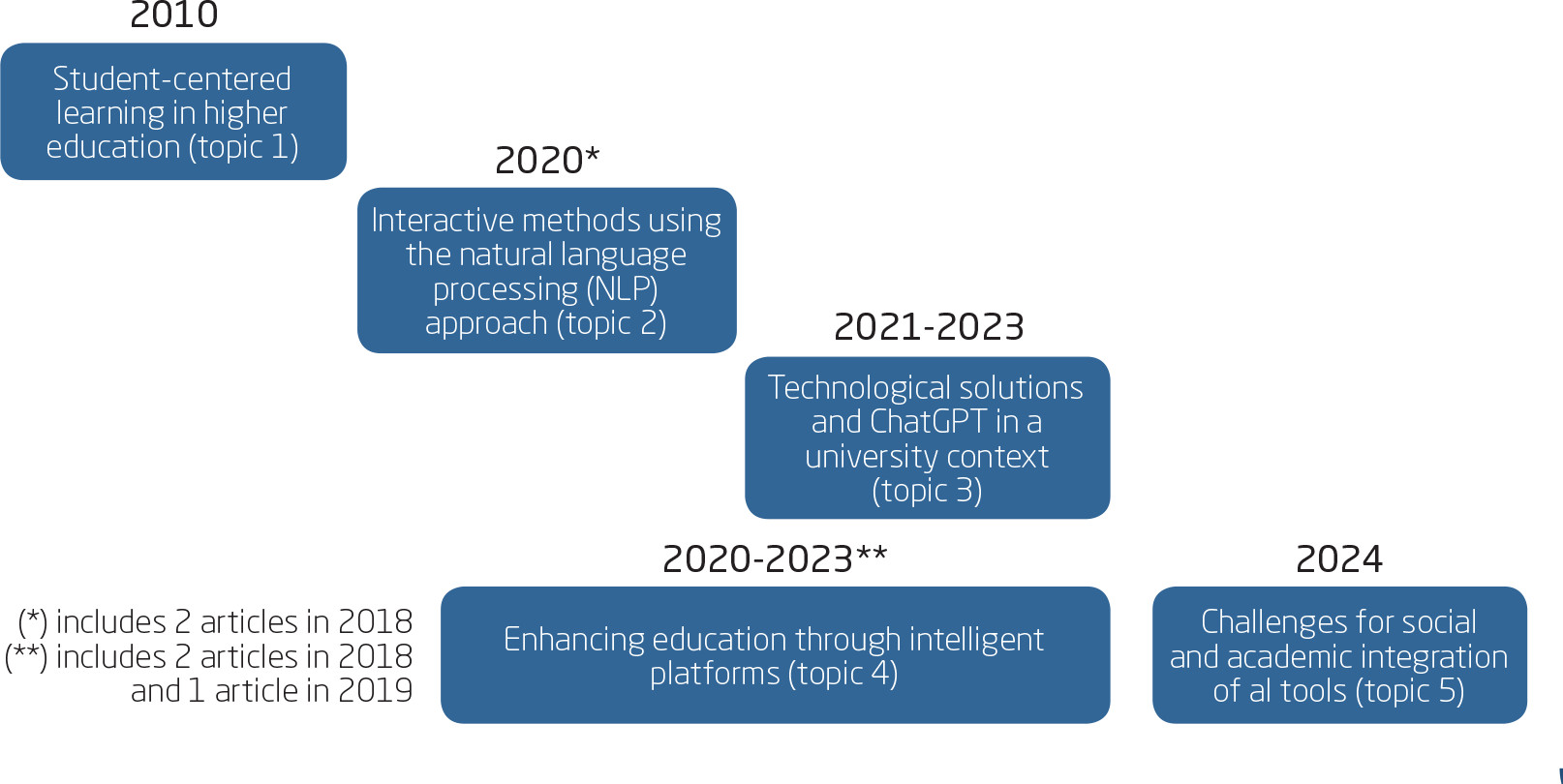
Figure 5 shows the thematic evolution of published articles in Scopus related to AI, business, education, and chatbots, where we can highlight five blocks across time: student-centered learning in higher education; interactive methods using the NLP approach; technological solutions and ChatGPT in a university context; enhancing education through intelligent platforms; and challenges for social and academic integration of AI tools.

Student-centered learning in higher education (topic 1)
This block highlights that the motivation and commitment of students are essential to achieve the objectives of the teaching-learning process; howe-ver, many teachers face different generations of students who learn and process information differently (Crown et al., 2010). In this context, online chats can be very useful for students to feel comfortable, especially those that pretend to be intelligent called chatbots since students have the opportunity to interact with the chatbot using their own words. The chatbot aims to learn the language style used by students that can be most effective in transmitting content to other students (Crown et al., 2010).
In 2010, we found only one article that meets the defined search criteria in this study. However, we know that, in computer science, we can find other articles on AI and CAs, but focused more on the technical part than its application in education. As an explanation, it should be noted that chatbots at this stage were difficult to develop, so their use and functionalities were limited, as well as research on the topic in areas other than science and engineering.
Interactive methods using the natural language processing (NLP) approach (topic 2)
This block focuses on the fact that communication between humans and computers has been progressing thanks to AI, machine learning, and NLP, ensuring that chatbots can be used to reduce dependence on the teacher as a tutor and allowing learning to be offered to students with an intelligent approach (Waseem Ashfaque et al., 2020), helping machines make sense of unstructured online data (Cempaka Sari et al., 2020), including natural language understanding (human-to-machine) and natural language generation (machine-to-human), adopting the style of communication between humans, which makes users feel heard (Schuetzler et al., 2020) and increases the difficulty to recognize that they are interacting with chatbots (Waseem Ashfaque et al., 2020).
In 2020, chatbots have a level of development much higher than in the previous stage, which is evidenced by a greater number of publications on the topic. Still, they are not yet considered CAs due to the difficulty of developing and implementing them is much smaller than in the last decade, and many of them have adopted an anthropomorphic communication style; developers have not yet reached a level of development where CAs can maintain a fluid conversation with people in such a way that they are practically indistinguishable from humans.
Technological solutions and ChatGPT in a university context (topic 3)
The use of AI has allowed the educational sector to put itself at the forefront, incorporating virtual conversational tools as a means of tutoring the final works of university students (Artiles Rodríguez et al., 2021), helping the development of new educational strategies that can be applied to multiple disciplines (Dong et al., 2022), which must take into account three key characteristics in the uses of AI in teaching: procedural level, related to teaching-learning processes; prototypical level, related to the AI tool itself; and practical level, associated with the actual context where the solution will be implemented (Zhao & Nazir, 2022). However, as often happens with technological innovations, no one expected something to radically change the rules of the game, and that was precisely what happened with the emergence of ChatGPT.
ChatGPT is a large language model capable of generating text that resembles human language, allowing it to maintain conversations with people and revolutionizing human-computer interactions (Rudolph et al., 2023). Lund and Wang (2023) stated that, since its launch, ChatGPT has gained popularity among millions of people; however, it has not only received praise for its benefits and possible applications but has also been criticized for its limitations and potential problems, especially in the field of education, since students have used it to generate essays, answers to papers and exams (Limna et al., 2023a), posing new challenges for educational institutions by making changes in the form of evaluation, as well as reinforcing academic ethics and integrity through the development of clear policies and guidelines (Adeshola & Praise Adepoju, 2023).
Among its benefits, we can highlight that ChatGPT can be used to crea-te personalized exams or questionnaires according to the level of each student, or to help with writing and academic research, being able to summarize articles and extract key points, saving students time to concentrate on analysis, and interpretation (Limna et al., 2023a). However, ChatGPT should not be used as a substitute for the intelligence and creativity of human beings but rather as a complement to academic writing because its results may be imprecise; hence, it is recommended that the generated content always be verified (Limna et al., 2023a). It should be noted that ChatGPT has some limitations: limited understanding of the context, difficulty recognizing and generating sarcasm and irony, and lack of precision in understanding the nuances of complex, jargon-specific questions, among others (Huang et al., 2023).
In this context, the need arises to understand and analyze three key aspects related to the strategic use of CAs in the educational sector. First, it is essential that the people who interact with CAs understand how they work, how to make the most of their capabilities, and be equipped with the skills necessary to interact and collaborate effectively with them. Second, while CAs offer benefits, they also raise concerns about data privacy, information confidentiality, and ethical decision-making. Therefore, it is crucial to thoroughly examine and understand these implications to ensure its use is responsible, transparent, and meets ethical and legal standards. Third, it is necessary for educational institutions to understand how to integrate CAs into their study and training programs. This involves evaluating the current offering, identifying areas that require updating, and developing effective strategies to prepare future professionals to use and collaborate with CAs effectively.
Enhancing education through intelligent platforms (topic 4)
With so many tools available for developing CAs today, creating and deploying a chatbot can seem quite simple; however, giving it the correct information so that it can act as an educational tutor is not trivial, as information on how to design a chatbot as a tutor is scarce and scattered on the internet, focusing on implementation rather than knowledge design and modeling, which is essential, since having a conversation with a tutor is quite different from talking with a sales agent (Sánchez-Díaz et al., 2018). Currently, chatbot technology is used for different purposes, as it provides easily accessible services for all types of audiences and is especially useful in intelligent tutoring systems, facilitating student learning and teachers’ activities (Waseem Ashfaque et al., 2020).
Li et al. (2020) examined the combination of virtual education and AI tools to clarify the problems faced by students in this educational format, finding that AI plays an important role in supporting learning from offline mode to online mode, improving the value of online teaching as perceived by students (Zhao & Nazir, 2022). Chen et al. (2023) argued that positive social interaction and relationships between students and teachers enhance student learning. In this context, the use of intelligent platforms can improve the experience of all those involved, ensuring not only that students learn at their own pace, but also that tutors can dedicate themselves to activities where they generate greater value for students (Limna et al., 2023b).
Although CAs can be used in various educational activities, previous research studied various teaching-learning scenarios to determine where they can be most helpful and useful, and found that most studies were focused on their use for language learning (Chen et al., 2023). Sun et al. (2021) proposed an intelligent virtual English teaching framework, assisted by deep learning, to help students improve their English language skills while demons-trating how valuable everyone’s information is and to propose personalized learning paths supported by improved student grades. This is an example of what can be achieved with the help of AI in education, so we have many opportunities to continue exploring.
Bouschery et al. (2023) consider that CAs can be seen as the evolution of the open innovation paradigm since LLMs can interact with different data sources, learning from them and allowing this type of AI to act as a knowledge intermediary between different stakeholders and encouraging the creation of new knowledge (Waardenburg et al., 2021). Therefore, in an environment where interaction with CAs becomes increasingly common, it is essential to identify the skills that future employees and managers must have to adopt and strategically use CAs. Understanding these skills will allow organizations to appropriately train their staff, ensuring effective adoption and use of CAs. It is essential to adapt training programs and higher education institutions to make the most of the potential of CAs, guaran-teeing updated and relevant training in a constantly evolving turbulent environment, which will help close the gap between education and the needs of the labor market.
Challenges for social and academic integration of AI tools (topic 5)
There is a lack of comprehensive research on how AI-based tools can be effectively integrated into the classroom to enhance personalized learning experiences (Abulibdeh et al., 2024). At the same time, we can find the proliferation of the use of AI writing software (AIWS) due to its ability to learn, correct, and generate content, increasing the productivity and efficiency of its users through functions such as grammar review, detection plagiarism, and language suggestions (Papakonstantinidis et al., 2024). These authors argued that previous studies confirm the potential of these AI-powered tools to change academic writing practices; therefore, integrating AIWS in educational settings can help students, particularly non-native speakers, overcome language barriers, improving their writing skills.
Higher education institutions are in the process of adapting to the changing landscape of Industry 4.0, seeking to integrate AI tools to reshape learning experiences, fostering innovation, and preparing people with adaptive and analytical thinking to cope with the complexities of the digital age; however, it is necessary to value ethics, curricular design, continuous learning, and industry alignment (Abulibdeh et al., 2024). In addition, there is also a risk that AI-generated content continues to contain errors, inaccuracies, and misleading or unsupported information, as well as the algorithms used may contain biases that perpetuate discriminatory or biased language, having important ethical implications (Papakonstantinidis et al., 2024). Therefore, one of the lines of future research is the study of ethics in AI to make it more trustworthy, transparent, explainable, fair, and privacypreserving.
Schlimbach et al. (2024) designed CAs intended to provide social companionship, focusing on an educational tool allowing greater interaction and engagement of participants, for which they applied the theory of computers as social actors (CASA) and the theory of social presence. These theories are very useful to figure out interactions between CAs and human beings because the first theory explains that when humans treat computers as if they were social beings by applying social norms to them, they generate positive perceptions, while the second theory, it is suggested that the media can affect the degree to which people perceive that they are interacting with actual individuals, which impacts how people perceive and respond to a technological tool, such as CAs (Schlimbach et al., 2024). Therefore, to realize the potential of CAs, more research is needed to understand the implications of interactions between CAs and humans and the potential benefits and problems of anthropomorphizing AI.
CONCLUSIONS
This study analyzes the abstracts of 61 articles published from 2010 to March 2024 in Scopus on AI, business, education, and chatbots so that the two proposed research questions were answered. The first, about the evolution of the most frequent terms on said topic per year, can be seen in Table 1, where the most important topics have been ordered, and you can see their evolution over time. The second, regarding the classification of the topics studied based on Scopus publications, is the result of the application of topic modeling and the coding of grounded theory, which can be seen in Figure 5, where the five predominant thematic areas in this discipline are shown: student-centered learning in higher education; interactive methods using the NLP approach; technological solutions and ChatGPT in a university context; enhancing education through intelligent platforms; and challenges for social and academic integration of AI tools.
The main contribution of this study is the systematization of everything published in Scopus about AI, business, education, and chatbots into a thematic evolutionary model. In this model, the first thematic trend shows a study where this research line begins to be defined, considering that the level of development reached by chatbots at that time was incipient. The second thematic trend highlights the use of NLP as a fundamental tool to show the level of development of chatbots; however, these still have a way to go to be considered CAs. The third thematic trend underscores the emergence of ChatGPT as a paradigm for the evolution of CAs, showing that although it has evolved a lot, LLMs have several limitations, of which one must be aware to get the most out of CAs. The fourth thematic trend features intelligent platforms, which can improve the experience of students and teachers due to their high level of personalization. Unfortunately, a massive implementation of this type of solution has not yet been achieved. The fifth thematic trend raises questions about the future of CAs, proposing two research lines on ethics in AI and the potential benefits and problems of anthropomorphizing AI due to the gap between what is taught in business schools and the knowledge companies currently require.
Theoretical development and research agenda
Many of the most complex problems that companies have today are multidisciplinary; hence, to solve them, an interdisciplinary collaboration of people with different profiles and backgrounds is needed to optimize the use of AI and CAs. In this context, business schools have the obligation to train students to understand changing business needs, equipping their students with the ability to explain their findings in an understandable way, obtaining lessons learned and communicating them to the rest of the organi-zation appropriately (Chiang et al., 2012). It is utopian to believe that a business school can prepare its students with all the skills necessary for all jobs in all sectors; hence, they should focus on preparing their students with skills that allow them to take advantage of potential job opportunities in any sector, focusing on developing practical knowledge about AI tools and techniques used in the business environment, so that students can critically analyze problems, making recommendations and making decisions to improve their organizations (Sollosy & McInerney, 2022).
When seeking to carry out scientific research, the ability to process and analyze large volumes of data is essential; in this endeavor, ChatGPT and CAs can transform how researchers interact and interpret data (Salvagno et al., 2023), allowing the collection and synthesis of data from multiple sources in a much faster way, increasing the efficiency of the research process (Ray, 2023), and analyzing historical data to identify underlying patterns to gene-rate predictions evolution of the data (Kim, 2023). Therefore, CAs can revolutionize the traditional way of doing research and publishing, creating interesting opportunities since they could accelerate the innovation process, reducing publication times, and helping people to write more fluently in a language other than their own, among other features (Dis et al., 2023). Table 2 summarizes the main topics covered in the research agenda and shows some questions for further research.
Susarla et al. (2023) analyzed the most important challenges. They showed the undesirable results that may arise when using generative AI to support research, highlighting that caution must be exercised when using this tool in problem formulation, research design, methodological criticism, summaries of manuscripts, and literature reviews. The same situation happens when CAs are used in research, undermining the quality and transparen-cy of research because CAs produce hallucinations, which means texts that are very good from a grammatical point of view but often inaccurate or incorrect, which can distort scientific facts and promote misinformation (Dis et al., 2023); hence, a collaborative process of curation and editorials is suggested to minimize hallucinations. LLMs were trained (Ray, 2023), perpetuating gender stereotypes (Gross, 2023) and showing biases in race, religion, or even in terms of political orientation (Motoki et al., 2024).
Bouschery et al. (2023) argued that, among the different types of AI, LLMs can provide exciting opportunities for an innovation process enhanced by specific characteristics of this AI. This versatility makes CAs an especially useful AI in knowledge-intensive work, allowing a more data-based approach to innovation (Kakatkar et al., 2020). Lim et al. (2023) highlighted four paradoxes that should be studied in depth: Paradox 1, CAs are both a friend and an enemy, since it will depend on the use let it are given; Paradox 2, CAs are capable but dependent; they can do many things, but they depend on the input we give them, which makes prompt engineering very important; Paradox 3, CAs are accessible and at the same time restrictive, with current abilities not all people will be able to take full advantage of them; and Paradox 4, CAs become more popular when are more criticized, noise generated around these tools makes people want to try them (Lim et al., 2023).
Another issue that should be explored in depth by future studies has to do with ethical concerns regarding the use of CAs, as well as the obligations and duties that arise when people are working with AI (Siau & Wang, 2020). Fui-Hoon Nah et al. (2023) highlight the main challenges and ethical issues associated with generative AI and CAs, including harmful or inappropriate content, prejudices and biases, over-reliance on training data, and the wide-ning digital divide. Other authors add intellectual property and authorship, misuse and abuse, privacy and security, transparency, and explainability (Crawford et al., 2023; Liebrenz et al., 2023). Therefore, we face a great challenge since the uses of CA are multiple and complex, where the ethical principles of each institution could define whether they should be used or not (Perkins, 2023), encouraging or discouraging their use through institutional policies (Luitse & Denkena, 2021).
-
RAM does not have information about open data regarding this manuscript.
-
RAM does not have permission from the authors or evaluators to publish this article’s review.
REFERENCES
-
Abulibdeh, A., Zaidan, E., & Abulibdeh, R. (2024). Navigating the confluen-ce of artificial intelligence and education for sustainable development in the era of industry 4.0: Challenges, opportunities, and ethical dimensions. Journal of Cleaner Production, 437, 140527. https://doi.org/10.1016/j.jclepro.2023.140527
» https://doi.org/10.1631/FITEE.1601125 -
Adeshola, I., & Praise Adepoju, A. (2023). The opportunities and challenges of ChatGPT in education. Interactive Learning Environments https://doi.org/10.1080/10494820.2023.2253858
» https://doi.org/10.1080/10494820.2023.2253858 -
AlAfnan, M. A., Dishari, S., Jovic, M., & Lomidze, K. (2023). ChatGPT as an Educational Tool: Opportunities, challenges, and recommendations for communication, business writing, and composition courses. Journal of Artificial Intelligence and Technology, 3(2), 60-68. https://doi.org/10.37965/jait.2023.0184
» https://doi.org/10.37965/jait.2023.0184 -
Alshare, K., & Sewailem, M. F. (2018). A gap analysis of business students’ skills in the 21st Century: A case study of Qatar. Academy of Educational Leadership Journal, 22(1), 1-22. https://www.abacademies.org/articles/a-gap-analysis-of-business-students-skills-in-the-21st-century-a-case-study-of-qatar-6974.html
» https://www.abacademies.org/articles/a-gap-analysis-of-business-students-skills-in-the-21st-century-a-case-study-of-qatar-6974.html -
Artiles Rodríguez, J., Guerra Santana, M., Aguiar Perera, M. V., & Rodríguez Pulido, J. (2021). Agente conversacional virtual: La inteligencia artificial para el aprendizaje autónomo. Pixel-Bit: Revista de Medios y Educación, 62, 107-144. https://doi.org/10.12795/pixelbit.86171
» https://doi.org/10.12795/pixelbit.86171 -
Asmussen, C. B., & Møller, C. (2019). Smart literature review: A practical topic modeling approach to exploratory literature review. Journal of Big Data, 6, Article 93. https://doi.org/10.1186/s40537-019-0255-7
» https://doi.org/10.1186/s40537-019-0255-7 -
Bavaresco, R., Silveira, D., Reis, E., Barbosa, J., Righi, R., Costa, C., Antunes, R., Gomes, M., Gatti, C., Vanzin, M., Junior, S. C., Silva, E., & Moreira, C. (2020). Conversational agents in business: A systematic literature review and future research directions. Computer Science Review, 36, 100239. https://doi.org/10.1016/j.cosrev.2020.100239
» https://doi.org/10.1016/j.cosrev.2020.100239 -
Blei, D. M., Ng, A. Y., & Jordan, M. I. (2003). Latent Dirichlet allocation. Journal of Machine Learning Research, 3, 993-1022. http://www.jmlr.org/papers/volume3/blei03a/blei03a.pdf
» http://www.jmlr.org/papers/volume3/blei03a/blei03a.pdf -
Bohorquez-Lopez, V. W. (2022). Knowing the past to write the future: Risks and challenges related with social media governance in government. Digital Policy, Regulation and Governance, 24(4), 337-354. https://doi.org/10.1108/DPRG-10-2021-0124
» https://doi.org/10.1108/DPRG-10-2021-0124 -
Bouschery, S. G., Blazevic, V., & Piller, F. T. (2023). Augmenting human innovation teams with artificial intelligence: Exploring transformer-based language models. Journal of Product Innovation Management, 40(2), 139-153. https://doi.org/10.1111/jpim.12656
» https://doi.org/10.1111/jpim.12656 -
Burton, E., Goldsmith, J., Koenig, S., Kuipers, B., Mattei, N., & Walsh, T. (2017). Ethical considerations in Artificial Intelligence courses. AI Magazine, 38(2), 22-34. https://doi.org/10.1609/aimag.v38i2.2731
» https://doi.org/10.1609/aimag.v38i2.2731 -
Cao, Q., Cheng, X., & Liao, S. (2023). A comparison study of topic modeling based literature analysis by using full texts and abstracts of scientific articles: A case of COVID-19 research. Library Hi Tech, 41(2), 543-569. https://doi.org/10.1108/LHT-03-2022-0144
» https://doi.org/10.1108/LHT-03-2022-0144 -
Chen, Y., Jensen, S., Albert, L. J., Gupta, S., & Lee, T. (2023). Artificial Intelligence (AI) student assistants in the classroom: Designing chatbots to support student success. Information Systems Frontier, 25, 161-182. https://doi.org/10.1007/s10796-022-10291-4
» https://doi.org/10.1007/s10796-022-10291-4 -
Cempaka Sari, A., Virnilia, N., Tanti Susanto, J., Anderson Phiedono, K., & Kevin Hartono, T. (2020). Chatbot developments in the business world. Advances in Science, Technology and Engineering Systems Journal, 5(6), 627-635. https://doi.org/10.25046/aj050676
» https://doi.org/10.25046/aj050676 -
Chamorro-Premuzic, T., & Frankiewiez, B. (2019). 6 reasons why higher education needs to be disrupted. Harvard Business Review https://hbr.org/2019/11/6-reasons-why-higher-education-needs-to-be-disrupted
» https://hbr.org/2019/11/6-reasons-why-higher-education-needs-to-be-disrupted -
Chiang, R. H., Goes, P., & Stohr, E. A. (2012). Business intelligence and analytics education, and program development: A unique opportunity for the information systems discipline. ACM Transactions on Management Information Systems (TMIS), 3(3), 1-13. https://doi.org/10.1145/2361256.2361257
» https://doi.org/10.1145/2361256.2361257 -
Chung, M., Ko, E., Joung, H., & Kim, S. J. (2020). Chatbot e-service and customer satisfaction regarding luxury brands. Journal of Business Research, 117, 587-595. https://doi.org/10.1016/j.jbusres.2018.10.004
» https://doi.org/10.1016/j.jbusres.2018.10.004 -
Clayton, P. R., & Clopton, J. (2019). Business curriculum redesign: Integrating data analytics. The Journal of Education for Business, 94(1), 57-63. https://doi.org/10.1080/08832323.2018.1502142
» https://doi.org/10.1080/08832323.2018.1502142 -
Cotton, D. R. E., Cotton, P. A., & Shipway, J. R. (2024). Chatting and cheating: Ensuring academic integrity in the era of ChatGPT. Innovations in Education and Teaching International, 61(2), 228-239. https://doi.org/10.1080/14703297.2023.2190148
» https://doi.org/10.1080/14703297.2023.2190148 -
Crawford, J., Cowling, M., & Allen, K. (2023). Leadership is needed for ethical ChatGPT: Character, assessment, and learning using artificial intelligence (AI). Journal of University Teaching & Learning Practice, 20(3). https://doi.org/10.53761/1.20.3.02
» https://doi.org/10.53761/1.20.3.02 - Crown, S., Fuentes, A., Jones, R., Nambiar, R., & Crown, D. (2010). Anne G. Neering: Interactive chatbot to motivate and engage engineering students Pro-ceedings of the ASEE Annual Conference and Exposition, June 20-23, Code 81438.
-
DiMaggio, P., Nag, M., & Blei, D. (2013). Exploiting affinities between topic modeling and the sociological perspective on culture: Application to newspaper coverage of U.S. government arts funding. Poetics, 41(6), 570-606. https://doi.org/10.1016/j.poetic.2013.08.004
» https://doi.org/10.1016/j.poetic.2013.08.004 -
Dis, E. A. M., van, Bollen, J., Rooij, R., van, Zuidema, W., & Bockting, C. L. (2023). ChatGPT: Five priorities for research. Nature, 614, 224-226. https://doi.org/10.1038/d41586-023-00288-7
» https://doi.org/10.1038/d41586-023-00288-7 -
Dong, Y., Yu, X., Alharbi, A., & Ahmad, S. (2022). AI-based production and application of English multimode online reading using multi-criteria decision support system. Soft Computing, 26, 10927-10937. https://doi.org/10.1007/s00500-022-07209-2
» https://doi.org/10.1007/s00500-022-07209-2 -
Fui-Hoon Nah, F., Zheng, R., Cai, J., Siau, K., & Chen, L. (2023). Generative AI and ChatGPT: Applications, challenges, and AI-human collaboration. Journal of Information Technology Case and Application Research, 25(3), 277-304. https://doi.org/10.1080/15228053.2023.2233814
» https://doi.org/10.1080/15228053.2023.2233814 -
Fuchs, K. (2023). Exploring the opportunities and challenges of NLP models in higher education: Is Chat GPT a blessing or a curse? Frontiers in Education, 8, 1166682. https://doi.org/10.3389/feduc.2023.1166682
» https://doi.org/10.3389/feduc.2023.1166682 -
Godwin-Jones, R. (2022). Partnering with AI: Intelligent writing assistance and instructed language learning. Language Learning & Technology, 26(2), 5-24. https://doi.org/10125/73474
» https://doi.org/10125/73474 -
Grimmer, J. (2010). A Bayesian hierarchical topic model for political texts: Measuring expressed agendas in senate press releases. Political Analysis, 18(1), 1-35. https://doi.org/10.1093/pan/mpp034
» https://doi.org/10.1093/pan/mpp034 -
Gross, N. (2023). What ChatGPT tells us about gender: A cautionary tale about performativity and gender biases in AI. Social Sciences, 12(8), Article 435. https://doi.org/10.3390/socsci12080435
» https://doi.org/10.3390/socsci12080435 -
Henry, R., & Venkatraman, S. (2015). Big data analytics the next big learning opportunity. Journal of Management Information & Decision Sciences, 18(2), 15-27. https://www.abacademies.org/articles/jmidsvol18no2-2015.pdf
» https://www.abacademies.org/articles/jmidsvol18no2-2015.pdf -
Huang, F., Kwak, H., & An, J. (2023). Is ChatGPT better than human annotators? Potential and limitations of ChatGPT in explaining implicit hate speech Proceedings of the ACM Web Conference 2023 (pp. 294-297). ACM Digital Library. https://doi.org/10.1145/3543873.3587368
» https://doi.org/10.1145/3543873.3587368 -
Islam, I., & Islam, M. N. (2024). Exploring the opportunities and challenges of ChatGPT in academia. Discovery Education, 3, Article 31. https://doi.org/10.1007/s44217-024-00114-w
» https://doi.org/10.1007/s44217-024-00114-w -
Jacobi, C., Atteveldt, W., van, & Welbers, K. (2016). Quantitative analysis of large amounts of journalistic texts using topic modeling. Digital Journalism, 4(1), 89-106. https://doi.org/10.1080/21670811.2015.1093271
» https://doi.org/10.1080/21670811.2015.1093271 -
Jiang, J., Adam, M., & Benlian, A. (2021). Algoactivistic practices in ridesharing: A topic modeling & grounded theory approach Proceedings of European Conference on Information Systems (ECIS). https://aisel.aisnet.org/ecis2021_rp/1/
» https://aisel.aisnet.org/ecis2021_rp/1/ -
Jelodar, H., Wang, Y., Yuan, C., Feng, X., & Jiang, X. (2019). Latent Dirichlet Allocation (LDA) and topic modeling: Models, applications, a survey. Multimedia Tools and Applications, 78(11), 15169-15211. https://doi.org/10.1007/s11042-018-6894-4
» https://doi.org/10.1007/s11042-018-6894-4 -
Kakatkar, C., Bilgram, V., & Füller, J. (2020). Innovation analytics: Leveraging artificial intelligence in the innovation process. Business Horizons, 63(2), 171-181. https://doi.org/10.1016/j.bushor.2019.10.006
» https://doi.org/10.1016/j.bushor.2019.10.006 -
Kang, Y., Cai, Z., Tan, C. W., Huang, Q., & Liu, H. (2020). Natural language processing (NLP) in management research: A literature review. Journal of Management Analytics, 7(2), 139-172. https://doi.org/10.1080/23270012.2020.1756939
» https://doi.org/10.1080/23270012.2020.1756939 -
Kim, S. G. (2023). Using ChatGPT for language editing in scientific articles. Maxillofacial Plastic and Reconstructive Surgery, 45, Article 13. https://doi.org/10.1186/s40902-023-00381-x
» https://doi.org/10.1186/s40902-023-00381-x -
Koltsova, O., & Koltcov, S. (2013). Mapping the public agenda with topic modeling: The case of the Russian Live Journal. Policy & Internet, 5(2), 207-227. https://doi.org/10.1002/1944-2866.POI331
» https://doi.org/10.1002/1944-2866.POI331 -
Lee, S., & Choi, J. (2017). Enhancing user experience with conversational agent for movie recommendation: Effects of self-disclosure and reciprocity. International Journal Of Human-computer Studies, 103, 95-105. https://doi.org/10.1016/j.ijhcs.2017.02.005
» https://doi.org/10.1016/j.ijhcs.2017.02.005 -
Li, S., Yan, M., Zhang, X., & Li, Z. (2020). Analysis on the application of AI technology in online education under the public epidemic crisis International Conference on Innovative Technologies and Learning, pp. 296-305, Porto, Portugal. https://doi.org/10.1007/978-3-030-63885-6_34
» https://doi.org/10.1007/978-3-030-63885-6_34 -
Liebrenz, M., Schleifer, R., Buadze, A., Bhugra, D., & Smith, A. (2023). Gene-rating scholarly content with ChatGPT: Ethical challenges for medical publishing. THE LANCET Digital Health, 5(3), e105-e106. https://doi.org/10.1016/S2589-7500(23)00019-5
» https://doi.org/10.1016/S2589-7500(23)00019-5 -
Lim, W. M., Gunasekara, A., Pallant, J. L., Pallant, J. I., & Pechenkina, E. (2023). Generative AI and the future of education: Ragnarök or reformation? A paradoxical perspective from management educators. The International Journal of Management Education, 21(2), 100790. https://doi.org/10.1016/j.ijme.2023.100790
» https://doi.org/10.1016/j.ijme.2023.100790 -
Limna, P., Kraiwanit, T., Jangjarat, K., & Shaengchart, Y. (2023a). Applying ChatGPT as a new business strategy: A great power comes with great responsibility. Corporate & Business Strategy Review, 4(4), 218-226. https://doi.org/10.22495/cbsrv4i4siart2
» https://doi.org/10.22495/cbsrv4i4siart2 -
Limna, P., Kraiwanit, T., Jangjarat, K., Prapasiri, K., & Piyawatjana, C. (2023b). The use of ChatGPT in the digital era: Perspectives on chatbot implementation. Journal of Applied Learning and Teaching, 6(1), 64-74. https://doi.org/10.37074/jalt.2023.6.1.32
» https://doi.org/10.37074/jalt.2023.6.1.32 -
Luitse, D., & Denkena, W. (2021). The great Transformer: Examining the role of large language models in the political economy of AI. Big Data & Society, 8(2). https://doi.org/10.1177/20539517211047734
» https://doi.org/10.1177/20539517211047734 -
Lund, B. D., & Wang, T. (2023). Chatting about ChatGPT: How may AI and GPT impact academia and libraries? Library Hi Tech News, 40(3), 26-29. https://doi.org/10.1108/LHTN-01-2023-0009
» https://doi.org/10.1108/LHTN-01-2023-0009 -
Maier, D., Waldherr, A., Miltner, P., Wiedemann, G., Niekler, A., Keinert, A., & Adam, S. (2018). Applying LDA topic modeling in communication research: Toward a valid and reliable methodology. Communication Methods and Measures, 12(2-3), 93-118. https://doi.org/10.1080/19312458.2018.1430754
» https://doi.org/10.1080/19312458.2018.1430754 -
McKnight, L. (2021). Electric sheep? Humans, robots, artificial intelligence, and the future of writing. Changing English, 28(4), 442-455. https://doi.org/10.1080/1358684X.2021.1941768
» https://doi.org/10.1080/1358684X.2021.1941768 -
Mongeon, P., & Paul-Hus, A. (2016). The journal coverage of web of science and scopus: A comparative analysis. Scientometrics, 106(1), 213-228. https://doi.org/10.1007/s11192-015-1765-5
» https://doi.org/10.1007/s11192-015-1765-5 -
Motoki, F., Pinho Neto, V., & Rodrigues, V. (2024). More human than human: Measuring ChatGPT political bias. Public Choice, 198, 3-23. https://doi.org/10.1007/s11127-023-01097-2
» https://doi.org/10.1007/s11127-023-01097-2 -
National Science & Technology Council. (2019). The national artificial intelligence research and development strategic plan: 2019 update National Science & Technology Council. https://www.nitrd.gov/pubs/National-AI-RD-Strategy-2019.pdf
» https://www.nitrd.gov/pubs/National-AI-RD-Strategy-2019.pdf -
Papakonstantinidis, S., Kwiatek, P., & Spathopoulou, F. (2024). Embrace or resist? Drivers of artificial intelligence writing software adoption in academic and non-academic contexts. Contemporary Educational Technology, 16(2), ep495. https://doi.org/10.30935/cedtech/14250
» https://doi.org/10.30935/cedtech/14250 -
Perkins, M. (2023). Academic integrity considerations of AI large language models in the post-pandemic era: ChatGPT and beyond. Journal of University Teaching & Learning Practice, 20(2). https://doi.org/10.53761/1.20.02.07
» https://doi.org/10.53761/1.20.02.07 -
Pirola, F., Boucher, X., Wiesner, S., & Pezzotta, G. (2020). Digital technologies in product-service systems: A literature review and a research agenda. Computers in Industry, 123, 103301. https://doi.org/10.1016/j.compind.2020.103301
» https://doi.org/10.1016/j.compind.2020.103301 -
Rains, S. A., Keating, D. M., Banas, J. A., Richards, A. S., & Palomares, N. A. (2020). The state and evolution of communication research a topic mode-ling analysis of 20,000 journal article abstracts from 1918-2015. Computational Communication Research, 2(2), 203-234. https://computationalcommunication.org/ccr/article/view/39
» https://computationalcommunication.org/ccr/article/view/39 -
Ransbotham, S., Kiron, D., Gerbert, P., & Reeves, M. (2017). Reshaping business with artificial intelligence. MIT Sloan Management Review, 59(1), 1-17. https://sloanreview.mit.edu/projects/reshaping-business-withartificial-intelligence/
» https://sloanreview.mit.edu/projects/reshaping-business-withartificial-intelligence/ -
Ray, P. P. (2023). ChatGPT: A comprehensive review on background, applications, key challenges, bias, ethics, limitations and future scope. Internet of Things and Cyber-Physical Systems, 3, 121-154. https://doi.org/10.1016/j.iotcps.2023.04.003
» https://doi.org/10.1016/j.iotcps.2023.04.003 -
Rudolph, J., Tan, S., & Tan, S. (2023). ChatGPT: Bullshit spewer or the end of traditional assessments in higher education? Journal of Applied Learning and Teaching, 6(1), 1-22. https://doi.org/10.37074/jalt.2023.6.1.9
» https://doi.org/10.37074/jalt.2023.6.1.9 -
Salvagno, M., Taccone, F. S. & Gerli, A. G. (2023). Can artificial intelligence help for scientific writing? Critical Care, 27, Article 75. https://doi.org/10.1186/s13054-023-04380-2
» https://doi.org/10.1186/s13054-023-04380-2 -
Sánchez-Díaz, X., Ayala-Bastidas, G., Fonseca-Ortiz, P., & Garrido, L. (2018). A knowledge-based methodology for building a conversational chatbot as an intelligent tutor. Lecture Notes in Computer Science, 165-175. https://doi.org/10.1007/978-3-030-04497-8_14
» https://doi.org/10.1007/978-3-030-04497-8_14 -
Sands, S., Ferraro, C., Campbell, C., & Tsao, H.-Y. (2021). Managing the human-chatbot divide: How service scripts influence service experience. Journal of Service Management, 32(2), 246-264. https://doi.org/10.1108/JOSM-06-2019-0203
» https://doi.org/10.1108/JOSM-06-2019-0203 -
Sarkis-Onofre, R., Catalá-López, F., Aromataris, E., & Lockwood, C. (2021). How to properly use the PRISMA Statement. Systematic Reviews, 10, Article 117. https://doi.org/10.1186/s13643-021-01671-z
» https://doi.org/10.1186/s13643-021-01671-z -
Schlimbach, R., Lange, T. C., Wagner, F., Robra-Bissantz, S., & Schoormann, T. (2024). An educational business model ideation tool: Insights from a design science project. Communications of the Association for Information Systems, 54, Article 26. https://doi.org/10.17705/1CAIS.05423
» https://doi.org/10.17705/1CAIS.05423 -
Schuetzler, R. M., Grimes, G. M., & Giboney, J. S. (2020). The impact of chatbot conversational skill on engagement and perceived humanness. Journal of Management Information Systems, 37(3), 875-900. https://doi.org/10.1080/07421222.2020.1790204
» https://doi.org/10.1080/07421222.2020.1790204 -
Short, C. E. & Short, J. C. (2023). The artificially intelligent entrepreneur: ChatGPT, prompt engineering, and entrepreneurial rhetoric creation. Journal of Business Venturing Insights, 19, e00388. https://doi.org/10.1016/j.jbvi.2023.e00388
» https://doi.org/10.1016/j.jbvi.2023.e00388 -
Siau, K., & Wang, W. (2020). Artificial intelligence (AI) ethics: Ethics of AI and ethical AI. Journal of Database Management, 31(2), 74-87. https://doi.org/10.4018/JDM.2020040105
» https://doi.org/10.4018/JDM.2020040105 -
Sollosy, M., & McInerney, M. (2022). Artificial intelligence and business education: What should be taught. The International Journal of Management Education, 20(3), 100720. https://doi.org/10.1016/j.ijme.2022.100720
» https://doi.org/10.1016/j.ijme.2022.100720 -
Stine, J., Trumbore, A., Woll, T., & Sambucetti, H. (2019). Implications of artificial intelligence on business schools and lifelong learning AACSB. https://uniconexed.org/wp-content/uploads/2022/02/AI-Life-long-learning-Final-Report-11.04.19.pdf
» https://uniconexed.org/wp-content/uploads/2022/02/AI-Life-long-learning-Final-Report-11.04.19.pdf -
Sun, L., & Yin, Y. (2017). Discovering themes and trends in transportation research using topic modeling. Transportation Research Part C: Emerging Technologies, 77, 49-66. https://doi.org/10.1016/j.trc.2017.01.013
» https://doi.org/10.1016/j.trc.2017.01.013 -
Sun, Z., Anbarasan, M., & Praveen Kumar, D. (2021). Design of online intelligent English teaching platform based on artificial intelligence techniques. Computational Intelligence, 37(3), 1166-1180. https://doi.org/10.1111/coin.12351
» https://doi.org/10.1111/coin.12351 -
Susarla, A., Gopal, R., Thatcher, J. B., & Sarker, S. (2023). The Janus effect of generative AI: Charting the path for responsible conduct of scholarly activities in information systems. Information Systems Research, 34(2), 1-10. https://doi.org/10.1287/isre.2023.ed.v34.n2
» https://doi.org/10.1287/isre.2023v34.n2 -
Takei, M., Porter, S. R., Umbach, P. D., & Nakano, J. (2024). Understanding themes in postsecondary research using topic modeling and journal abstracts. Research in Higher Education, 65, 510-551. https://doi.org/10.1007/s11162-023-09761-8
» https://doi.org/10.1007/s11162-023-09761-8 -
Waardenburg, L., Huysman, M., & Sergeeva, A. V. (2021). In the land of the blind, the one-eyed man is king: Knowledge brokerage in the age of learning algorithms. Organization Science, 33(1), 59-82. https://doi.org/10.1287/orsc.2021.1544
» https://doi.org/10.1287/orsc.2021.1544 -
Walker, R. M., Chandra, Y., Zhang, J., & Witteloostuijn, A. (2019). Topic modeling the research-practice gap in public administration. Public Adminis-tration Review, 79(6), 931-937. https://doi.org/10.1111/puar.13095
» https://doi.org/10.1111/puar.13095 -
Waseem Ashfaque, M., Tharewal, S., Iqhbal, S., & Kayte, C. N. (2020). A review on techniques, characteristics and approaches of an intelligent tutoring chatbot system Proceedings of the 2020 International Conference on Smart Innovations in Design, Environment, Management, Planning and Computing, ICSIDEMPC 2020, pp. 258-262, 30 October 2020. https://doi.org/10.1109/ICSIDEMPC49020.2020.9299583
» https://doi.org/10.1109/ICSIDEMPC49020.2020.9299583 -
Xu, J. J., & Babaian, T. (2021). Artificial intelligence in business curriculum: The pedagogy and learning outcomes. The International Journal of Management Education, 19(3), 100550. https://doi.org/10.1016/j.ijme.2021.100550
» https://doi.org/10.1016/j.ijme.2021.100550 -
Yau, C.-K., Porter, A., Newman, N., & Suominen, A. (2014). Clustering scien-tific documents with topic modeling. Scientometrics, 100(3), 767-786. https://doi.org/10.1007/s11192-014-1321-8
» https://doi.org/10.1007/s11192-014-1321-8 -
Zhao, Q., & Nazir, S. (2022). English multimode production and usage by artificial intelligence and online reading for sustaining effectiveness. Mobile Information Systems, 6780502. https://doi.org/10.1155/2022/6780502
» https://doi.org/10.1155/2022/6780502 -
Zhou, H-k., Yu, H-m., & Hu, R. (2017). Topic discovery and evolution in scientific literature based on content and citations. Frontiers of Information Technology & Electronic Engineering, 18, 1511-1524. https://doi.org/10.1631/FITEE.1601125
» https://doi.org/10.1631/FITEE.1601125
Edited by
-
EDITORIAL BOARDEditor-in-chiefFellipe Silva MartinsAssociated editorRicardo Limongi França CoelhoTechnical supportVitória Batista Santos Silva
-
EDITORIAL PRODUCTIONPublishing coordinationJéssica DamettaEditorial internBruna Silva de AngelisCopy editorIrina Migliari (Bardo Editorial)Layout designerEmapGraphic designerLibro