
 CAN MNES ACHIEVE PERFORMANCE THROUGH DIGITAL BUSINESS STRATEGY IN CHINA’S INSTITUTIONAL ENVIRONMENT?
ABSTRACT
Few details are known regarding the timing and means by which multinational enterprises (MNEs) doing business in China can attain performance via digital business strategies. This study addresses this gap by exploring how digital business strategy affects enterprise performance in light of organizational learning. A theoretical model was empirically tested using hierarchical regression analysis and two-stage data from 305 MNEs. The findings showed that implementing a digital business strategy significantly enhances MNEs’ performance, with exploitative and exploratory learning as key mediators. The formal institutional distance adversely affects the connection between digital business strategy and both forms of learning, whereas informal institutional distance enhances this relationship. Consequently, MNEs should strive to mitigate the potential adverse effects of highly coercive formal institutional environments and leverage the flexible and dynamic nature of informal institutional environments to maximize the proactive role of digital business strategy in boosting performance. This paper aids in the research on digital business strategy and offers practical insights for MNEs in designing and implementing effective digital strategy.
Keywords:
digital business strategy; organizational learning; institutional distance; multinational enterprises; performance
RESUMO
Pouco se sabe sobre como e quando as empresas multinacionais (EMNs) atuando na China podem melhorar seu desempenho por meio de estratégias de negócio digital. O presente estudo aborda esse tema ao explorar os mecanismos pelos quais esse tipo de estratégia influencia o desempenho das empresas à luz da aprendizagem organizacional. Nesse sentido, a pesquisa buscou testar um modelo teórico utilizando-se de análise de regressão hierárquica e de dados em duas etapas obtidos de 305 EMNs. Os resultados mostraram que a implementação de estratégias de negócio digital aprimora significativamente o desempenho das EMNs, sendo que a aprendizagem de otimização (exploitative learning) e a aprendizagem exploratório (exploratory learning) são elementos essenciais na mediação desse processo. A distância institucional formal tem efeitos negativos na relação entre as estratégias de negócio digitais e ambas as formas de aprendizagem, enquanto que a distância institucional informal fortalece essa relação. Consequentemente, as EMNs devem buscar reduzir potenciais efeitos negativos de ambientes institucionais formais altamente coercitivos, enquanto trabalham para aproveitar ao máximo a flexibilidade e o dinamismo próprio dos ambientes institucionais informais para alcançar um melhor desempenho ao assumir um papel proativo nas estratégias de negócio digitais. Este estudo contribui para a literatura sobre as estratégias de negócio digitais e oferece insights sobre a elaboração e implementação de estratégias digitais efetivas para EMNs.
Palavras-chave:
estratégias de negócio digitais; aprendizagem organizacional; distância institucional; empresas multinacionais; desempenho
RESUMEN
El conocimiento sobre cómo y cuándo las empresas multinacionales (MNE) que operan en China pueden mejorar su desempeño mediante estrategias de negocio digital es limitado. Este estudio aborda esta brecha analizando los mecanismos a través de los cuales dichas estrategias influyen en el desempeño empresarial desde la perspectiva del aprendizaje organizacional. Con análisis de regresión jerárquica y datos en dos etapas de 305 MNE, se validó empíricamente el modelo teórico. Los resultados revelan que la implementación de estrategias de negocio digital mejora significativamente el desempeño de las MNE, con el aprendizaje exploratorio y explotativo como mediadores clave. Además, la distancia institucional formal modera negativamente esta relación, mientras que la distancia institucional informal la modera positivamente. En consecuencia, las MNE deben minimizar los efectos negativos de los entornos institucionales formales coercitivos y aprovechar la flexibilidad de los entornos institucionales informales para maximizar el impacto positivo de las estrategias digitales en el desempeño. Este estudio contribuye a la literatura sobre estrategias de negocio digital y proporciona recomendaciones prácticas para el diseño e implementación de estrategias digitales efectivas en las MNE.
Palabras clave:
estrategia de negocio digital; aprendizaje organizativo; distancia institucional; empresas multinacionales; rendimiento
INTRODUCTION
Given the competitive advantages that multinational enterprises (MNEs) possess in economies of scale, knowledge acquisition, and learning, research into corporate internationalization has flourished (Arzubiaga et al., 2021). The advancement of contemporary digital technologies has introduced innovative business models and opportunities but has exacerbated the possible harmful consequences and competition globally. Scholars have explored the antecedents, outcomes, and mechanisms affecting MNEs’ international performance in the digital era (Bauweraerts et al., 2022). However, to date, much of the academic focus is on the nuances of technology (Blichfeldt & Faullant, 2021). While these studies highlight digital technologies’ role in performance, they overlook non-technical factors, especially strategic considerations. Indeed, strategy encompasses a holistic understanding of an organization’s cognition, essence, and actions (Ukko et al., 2019). To comprehend internationalization strategies in the digital age, scholars suggest integrating digital strategies with business development strategies (Bharadwaj et al., 2013).
Existing research found that MNEs need to formulate sound business strategies to cope with the changing international market dynamics (Bharadwaj et al., 2013). Digital business strategy is defined as an integrated collection of strategic plans and moves designed to utilize digital technologies to fulfill business objectives and improve the level of competition (Mithas et al., 2013). Nevertheless, MNEs face challenges adapting digital solutions to local conditions, with outcomes dependent on host country environments (Surdu & Narula, 2021). Current research examines digital business strategy implementation in developed countries, with a limited focus on emerging markets facing relatively immature markets and infrastructure (Goldman et al., 2021). China presents unique challenges for digital business strategy implementation by MNEs, including cultural, regulatory, and technological complexities (Li et al., 2022). However, research on the management and internal mechanisms of MNEs in China during the transitional period for improving performance through digital strategy is limited. Ignoring the uniqueness of implementing digital business strategy in different host countries may lead to an insufficient understanding of the diversity of the global market and a lack of guiding significance for the actual strategic decision-making of MNEs in China. In addition, discussions on digital business strategy have been focused on theoretical frameworks and practical studies, with limited empirical evidence on its mechanisms and boundary conditions, especially in improving international performance in complex institutional settings (Pagani, 2013; Prashar & Hamid, 2025). Therefore, this study investigates the specific mechanisms and contextual factors influencing the performance improvement of MNEs in China through digital business strategy.
Despite progress in digital business strategy research (Rong & Liu, 2024; Wielgos et al., 2021), gaps remain in understanding why some MNEs succeed with digital strategies while others do not. The internationalization process involves acquiring and integrating knowledge across borders (Surdu & Narula, 2021), where unpredictability in outcomes is influenced by organizational learning (Arzubiaga et al., 2021; Chung et al., 2019). Therefore, this study’s objective is to bridge this gap by positing that the digital business strategy of MNEs constitutes an organizational learning process dependent on ambidextrous learning (i.e., exploitative and exploratory learning) to identify and exploit new product/market opportunities, thereby enhancing international performance. Ambidextrous learning helps internationalizing firms interact with the new environments of host countries (Arzubiaga et al., 2021). Undoubtedly, the institutional environment during internationalization is a key factor influencing MNEs’ strategic choices and performance (Peng, 2003; Surdu & Narula, 2021). In this study, we introduce formal and informal institutional distance as moderating variables to clarify how different levels of institutional disparities influence digital business strategies’ impact on performance. Formal institutional distance stands for differences in laws and regulations characterized by enforceability. Firms often passively adapt by sacrificing efficiency and cost minimization to gain legitimacy (Zhang & Yang, 2021), thereby undermining the potential value of digital business strategies. In contrast, informal institutional distance reflects differences in norms and cognition (Yang et al., 2012), characterized by malleability and dynamism. This study integrates exploitative and exploratory learning with organizational learning and institutional theories to better understand the connection between digital strategies and firm performance, particularly regarding institutional distances in host countries.
This research adds significantly to the international business and organizational learning literature. First, this study transcends mere technical or functional strategy considerations, offering a nuanced understanding of how the integration strategies of digital technologies and business models can act as catalysts for enhancing the performance of multinational corporations in China (Knight & Liesch, 2016; Prashar & Hamid, 2025). Second, the study fills gaps in research on organizational learning by showing the mediating role of exploitative and exploratory learning between digital business strategies and performance, which addresses scholars’ calls for a more thorough comprehension of the antecedents, processes, and outcomes of organizational learning in an international context (Arzubiaga et al., 2021; Chung et al., 2019). Third, this research seeks to clarify the limits within which digital business strategies improve or fail to improve the performance of these multinational corporations, namely institutional distance. Incorporating the moderating variable of institutional distance supports the logic and impact mechanisms of both formal and informal institutional distances’ heterogeneity while responding to calls for research emphasizing the situation-dependent nature of the relationship between internationalization and performance (Bauweraerts et al., 2022). Our findings also offer practical strategic guidance for MNEs operating in China, inspiring them to maximize the advantages of digital business strategies to enhance international performance.
LITERATURE REVIEW
Digital business strategy
Digital business strategy emphasizes the integration of digital technologies with business strategies to address the challenges of digitalization arising from innovation and technology (Ukko et al., 2019). It has become a critical management priority for organizations (Holopainen et al., 2023). This study follows the framework proposed by Bharadwaj et al. (2013), defining digital business strategy as the organizational strategy developed and implemented to create differentiated value by utilizing digital resources. This suggests that digital business strategy should not be viewed merely as a functional-level strategy but as “a clear, broad, and organization-wide strategy”(Bharadwaj et al., 2013). Unlike traditional business strategies, firms implementing a digital business strategy emphasize appropriate investment in digital infrastructure and technologies to manage risks and uncertainties in international markets (Chi et al., 2022), leveraging their strengths in complex and diverse host-country environments. This requires companies to simultaneously develop new organizational capabilities through learning as they expand their business.
Digital business strategy and firm performance
First, existing literature mainly addresses the technical aspects of digital technologies (Iranmanesh et al., 2022), neglecting their integration with strategy. Empirical evidence indicates that digital technologies significantly contribute to business model innovation, positively influencing performance and customer satisfaction (Facin et al., 2022). Nevertheless, strategic considerations and other non-technical factors are frequently ignored in these studies. Further, there is no agreement among scholars on how to best combine digital technology with corporate strategy. At the strategic level, Ukko et al. (2019) found that digital business strategy’s direct effect on performance is insignificant, emphasizing the need for mediating (e.g., IT capabilities) or moderating mechanisms (e.g., sustainability strategies), while Chi et al. (2022) and Holopainen et al. (2023) report a significant positive effect. Technologically, studies highlight the positive impact of digital technologies on performance (Nwankpa & Datta, 2017). Further investigation is needed on the direct effects, with contextual factors potentially explaining the discrepancies. Third, existing studies on digital business strategies are mainly based on case studies and limited empirical data, especially regarding emerging markets like China. Mies et al. (2024) identified four types of digital business strategies and their impact on performance. Amarilli et al. (2023) examined the co-evolution of strategies and socio-technical systems, emphasizing factors like executive commitment. Nwankpa and Datta (2017) found that IT capabilities affect performance, but the relationship varies across strategy levels. These findings indicate a gap in systematically studying how digital strategies affect firm performance.
HYPOTHESES DEVELOPMENT
Digital business strategy and firm performance
Digital business strategy is devised and used by leveraging digital resources to craft differentiated value (Bharadwaj et al., 2013). Reflecting on various perspectives of digital business strategy, we define digital managerial capability and digital operational capability as the primary aspects of digital business strategy. Managerial capability stands for the capacity of managers to employ digitalization in company plans, employee mindset and skills, and the workplace. At the same time, operational capability denotes the enterprise’s ability to combine digitalization into its whole business processes and corporate strategy (Ukko et al., 2019).
First, digital managerial capability enhances the adaptability of MNEs in the host country market. As an organizational-level strategy, digital business strategy has a strong guiding effect on firm behavior (Bharadwaj et al., 2013), encouraging the enhancement of employee digital literacy and work efficiency through digital means, enabling them to adapt well to the labor demands and cultural background of the host country market. In China, MNEs’ digital business strategies are often encouraged and supported by government policies. As a result, MNEs implementing digital business strategies can optimize their internal digital infrastructure, for example, utilizing cloud computing services, internal social media platforms, and collaboration tools to ensure employees can easily access company resources, enabling real-time communication and information sharing. This facilitates employees in subsidiaries located in different geographical regions to share business-related knowledge and best practices using digital infrastructure, fully leveraging intellectual capital for company development and innovation (Mies et al., 2024).
Second, digital operational capability enhances the optimization of business processes, boosting production efficiency and reducing operational costs. In the host country market, MNEs face diverse supply chains and production processes, and digital technologies like the Internet of Things (IoT), AI, and big data analytics can help enterprises monitor and optimize these processes in real time, improving overall operational efficiency. Through digital supply chain management, companies can reduce inventory, optimize production schedules, and more accurately forecast market demand, avoiding resource waste (Wedel & Kannan, 2016).
Third, the synergy between digital managerial and operational capability contributes to intelligent decision-making, improving a firm’s responsiveness and decision-making efficiency. Through big data analytics and AI, MNEs can conduct in-depth analyses of market trends, consumer behavior, and competitive dynamics, making data-driven decisions (Mies et al., 2024). MNEs can adjust their decisions on product development, marketing, and resource allocation based on real-time data to adapt to the changes and demands in the host country market. For example, real-time digital business strategies enable MNEs to obtain up-to-the-minute wisdom regarding customer behavior, market trends, and competitive landscapes through vast databases and data mining techniques (Lamberton & Stephen, 2016). In particular, in the Chinese market, where consumer demand fluctuates greatly, digital business strategies help enterprises achieve dynamic adjustments, thus enhancing market responsiveness. Therefore, we came up with the following hypothesis:
H1: Using a digital business strategy improves MNEs’ performance in China.
The mediating effect of exploitative and exploratory learning
As a concrete manifestation of globalization, MNEs possess the advantage of a “knowledge bundle,” enabling them to gain a wide array of information and new insights from multiple sources to innovate and gain a competitive edge (Bauweraerts et al., 2022). Research indicates that organizational learning, which involves acquiring and utilizing knowledge, is a key driver influencing organizational performance (Arzubiaga et al., 2021). Organizational learning is the pursuit of exploitative and exploratory learning, focusing on how organizations acquire, process, store, and apply knowledge to improve their performance and adaptability (March, 1991). In the context of implementing digital business strategy, organizational learning underpins the enhanced synergistic capabilities of MNEs, whereas a lack of learning capability results in the ineffective allocation of organizational resources (Larkin, 2020). Thus, this study posits that the digital business strategy of MNEs relies on the process of acquiring and utilizing new knowledge and market opportunities through organizational learning to enhance their international performance.
Drawing on organizational learning theory, exploitative learning necessitates a reduction in variation and an increase in efficiency. It highlights the significance of enhancing and optimizing current understanding, skills, and resources by MNEs (March, 1991). Digital business strategies reveal bottlenecks and inefficiencies within business processes, providing clearer insights for optimizing these processes (Holopainen et al., 2023). For example, IKEA’s promotion of its digital home design tools in China (e.g., online planning tools and AR) enhances the shopping experience for customers and provides IKEA with a wealth of user behavior data, aiding the company with an understanding of the needs of the Chinese market, allowing for rapid iteration and innovation. Digital business strategies also facilitate the accumulation and flow of knowledge and experience within MNEs through digital platforms, internal networks, and digital collaboration tools, laying the foundation for exploitative learning in organizing, disseminating, and utilizing collective knowledge (Atuahene-Gima & Murray, 2007). Through accessible interactive interfaces and communication tools, digital business strategies help enterprises operating in China establish cross-border cooperative networks, facilitating business expansion and optimal resource allocation (Bharadwaj et al., 2013). The collaboration (digital ecosystem) between Microsoft and Huawei in the fields of cloud computing and artificial intelligence is another exemplary case. We therefore posited that:
H2a: The exploitative learning of MNEs operating in China is positively influenced by digital business strategies, leading to improved performance.
In contrast, exploratory learning emphasizes the pursuit of new knowledge and transformation (March, 1991). Digital business strategies inherently support this learning model. On the one hand, digital technologies, for instance, AI, machine learning, and big data analytics, assist MNEs operating in China in filtering high-value knowledge and deeply mining critical information about local user purchasing behavior, market trends, and competitive dynamics (Bharadwaj et al., 2013). Furthermore, data processing and analysis offer a deeper comprehension on a larger scale of consumer behavior, market trends, and the optimization of decision-making processes (Mithas et al., 2013). Exploratory learning, built upon digital business strategies, aids multinational corporations in devising product and service solutions that meet the unique market demands of local contexts (Surdu & Narula, 2021). For instance, Tesla established its first Gigafactory in Shanghai, China (Gigafactory 3), and collected a large amount of consumer data in real-time through Over-The-Air (OTA) technology to help it carry out targeted technological improvement and localized R&D innovation. On the other hand, establishing partnerships with local digital agencies provides multinational companies with the resource conditions for exploratory learning (Blichfeldt & Faullant, 2021). Through partnerships with regional technology firms, MNEs can gain deep insights into grassroots markets, develop innovative digital solutions tailored to local market needs, and more accurately understand the subtle differences between Chinese digital consumers. For example, Procter & Gamble (P&G) has gained a broad user base, a mature logistics network, and a wealth of digital marketing platforms and tools by establishing partnerships with China’s Alibaba and JD.COM, which is conducive to P&G’s brand promotion in China market. Therefore, we propose the hypothesis:
H2b: Digital business strategy positively influences the exploratory learning of multinational enterprises in China, thereby enhancing performance.
The moderating role of the institutional distance
Peng (2003) highlighted that institutional distance, reflecting differences in the institutional environments between countries, significantly influences the strategic choices and performance of multinational corporations during internationalization. To deeply analyze the impact of digital business strategies on international performance in different institutional environments, this study characterizes the institutional setting of MNEs through formal and informal institutional distances. Dissimilarities in domestic and foreign rules, regulations, enforcement, arbitration, and regulatory rigor constitute formal institutional distance. Cultural differences between the home and host countries can lead to informal institutional distance. These differences manifest in different norms of behavior, values, beliefs, customs, and traditions (Aguilera-Caracuel et al., 2013).
Formal institutions are characterized by coerciveness and asymmetric power, displaying greater durability, relative stability, and resistance to change or influence (Aguilera-Caracuel et al., 2013). Against formal institutional distance, firms are less inclined to actively adjust to institutional differences at the expense of low costs and high efficiency. Consequently, a significant formal institutional distance presents MNEs with the liability of foreignness, making it challenging to achieve operational legitimacy in host countries and increasing the obstacles to organizational learning through digital business strategies. The absence of credibility means a deficiency in social support and resources from local stakeholders due to limited recognition (Delmas & Montes-Sancho, 2011). Therefore, when considering social acceptability, multinational corporations are concerned about unfamiliar aspects of home country laws, regulations, and practices to avoid misconduct in host countries. On the one hand, a greater formal distance leads to increased uncertainty in legal environments, administrative procedures, and tax policies encountered by MNEs in host countries, hindering the implementation of digital business strategies (Yang et al., 2012). As the formal institutional distance between countries widens, MNEs often need to spend more time and resources adapting to local legal requirements and may even need to redesign their digital business strategies to comply with local regulations. This leads to increased information-gathering costs and difficulty in resource acquisition, thereby impeding the efficiency of knowledge coordination, integration, transformation, and utilization, which is unfavorable for exploitative learning (Zhang & Yang, 2021). On the other hand, in environments with significant formal institutional distance, MNEs may struggle to effectively transfer knowledge accumulated in their home countries to host countries, thereby obstructing the learning processes of MNEs in host countries. From this, we can deduce the following hypothesis:
H3a: The correlation between exploitative learning and digital business strategy is negatively moderated by formal institutional distance.
The degree of formal institutional differences poses challenges to the exploratory learning processes of MNCs aimed at developing new knowledge in host country markets. On the one hand, the distance in formal institutions increases market ambiguity, hindering MNCs’ ability to understand the behavior of local consumers and interpret market information in the host country. As the distance grows, MNCs may become uncertain about how host country regulations and laws affect economic transactions (Luo, 2005), struggle to assess the market behavior of local channel members, and may lack confidence in evaluating and interpreting market information as well as looking ahead to potential market movements in the host country. Such market ambiguities make it difficult for MNCs to engage in exploratory learning through digital business strategies and to develop new products or services that align with local consumer preferences. On the other hand, organizational learning theory suggests that exploratory learning is crucial for organizations to adapt to new environments and address uncertainties (March, 1991). However, in host countries with a significant distance from formal institutions, the differences in formal institutions and legal risks faced by MNCs may increase the costs and risks associated with learning, dampening their enthusiasm for engaging in exploratory learning. Host countries frequently impose stringent reviews and restrictions on acquisitions by Chinese companies in sensitive industries and technologies for strict intellectual property protection. Therefore, we suggest the hypothesis:
H3b: The formal institutional distance has a negative moderating effect on the relationship between digital business strategy and exploratory learning.
Informal institutions refer to the unwritten norms, tacit rules, social values, behavioral standards, and cultural aspects present within social groups, organizational bodies, or governmental agencies (Zhang & Yang, 2021). These unwritten regulations and cultural knowledge resources are largely embedded within the organizational fabric of local businesses in host countries, exerting significant influence on economic behaviors (Aguilera-Caracuel et al., 2013). It is evident that, in comparison to formal institutions, informal institutions possess greater dynamism and malleability, allowing for continuous evolution. Consequently, businesses no longer passively face differences in informal institutions but tend to leverage their agency, reshaping institutions according to their unique characteristics and interests. As the distance of informal institutions increases, international business management becomes more complex, rendering traditional business strategies inadequate. In contrast, digital business strategies enable multinational corporations to utilize digital platforms and tools to establish cross-cultural networks of trust and communication with local partners, facilitating rapid integration into local markets and acquiring local business standards and practices. Furthermore, the partnership-sharing mechanisms established by digital business strategies are advantageous for multinational corporations to solve problems and improve processes using existing knowledge, promoting an exploitative learning process for internal integration and collaboration (Park & Luo, 2001). Hence, the following hypothesis is proposed:
H4a: The informal institutional distance has a positive moderating effect on the relationship between digital business strategy and exploitative learning.
Generally speaking, host countries with a high distance in informal institutions tend to contain more diversified and heterogeneous resources, providing a fertile environment for exploratory learning. On the one hand, the environment of high distance in informal institutions stimulates the enthusiasm and subjective initiative of MNEs (Zhang & Yang, 2021), compelling them to utilize digital business strategies for the efficient cooperation and synthesis of information and technology with host country firms, thereby acquiring a wealth of diverse knowledge. Such diversified knowledge enables firms to address new challenges, try new methods and experimental strategies, and foster exploratory learning (Arzubiaga et al., 2021). Exploratory learning, which deviates from a firm’s original technological trajectory, carries certain risks but can help firms fully leverage the advantages of heterogeneous knowledge (March, 1991). Therefore, a higher distance in informal institutions motivates companies to explore new fields while providing them with sufficient foundational knowledge to back up these investigations, which leads to more innovative MNEs. However, host countries with a greater distance in informal institutions may present more opportunities and potential benefits (Gao et al., 2022). The undeveloped nature of the market offers more space for MNEs to explore and develop new business models, market positioning, and product innovations. In this context, digital business strategies can provide a quicker, more flexible response, promoting effective exploratory learning to meet the needs of consumers under different cultures and values. Therefore, we propose the hypothesis:
H4b: With the help of informal institutional distance, the correlation between digital business strategies and exploratory learning is moderated positively.
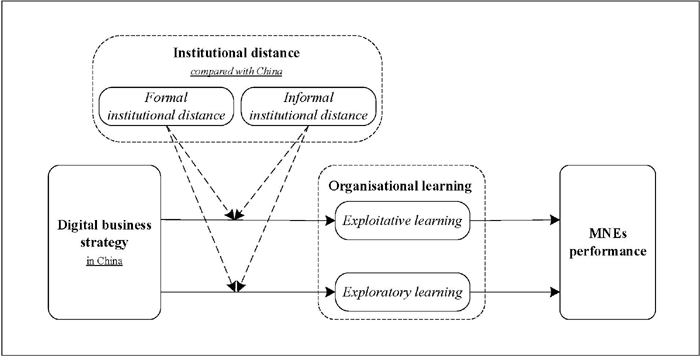
Figure 1 displays the research model.
METHODS
Data collection and sample
Data collection was carried out in China, from MNEs operating in the country across various sectors, seeking to contribute to the global literature on MNEs. Respondents came from firms with headquarters in the US, Russia, and other regions, and the participant MNEs operated across industries like construction, manufacturing, and finance. To ensure reliability, we targeted middle and senior managers, including CEOs, who possess a comprehensive understanding of the company’s operations. Data collection was conducted in collaboration with Credamo, a reputable Chinese survey organization that distributed the questionnaire to a random sample of MNEs in China, with compensation provided upon completion. The survey included sections on purpose, research institution, company information, scale items, and acknowledgments. The self-administered questionnaire could lead to response biases. To minimize bias, we offered a small incentive (CNY 50) for responses. In accordance with ethical principles, we assured participants of confidentiality and that responses would be used solely for academic purposes.
The survey was conducted in two waves. The first was in September 2022, asking managers to complete scales on digital business strategy, institutional distance, organizational learning, and control variables. Out of 412 questionnaires distributed, 357 valid responses were obtained, with exclusions for incomplete, identical, or biased responses. Long-term follow-up surveys and interviews with business managers/CEOs revealed that most companies take at least a year to develop digital strategies before measurable results emerge. The second wave commenced in September 2023, with 357 questionnaires distributed to the same MNEs, yielding 305 valid responses (see Table 1).
Variables
The scales employed in the paper primarily referenced established foreign scales and were structured as a five-point Likert scale, and the possible responses were 1 (strongly disagree) to 5 (strongly agree). The scales required appropriate revision in accordance with the research condition of this paper, which enhanced the dependability of the research data.
Digital business strategy
Drawing on the study by Ukko et al. (2019), we conducted a six-item scale for measurement. A representative item included, “In China, our firm is well-acquainted with the advancement and implementation of digital technologies.” In the analysis, Cronbach’s a was 0.848.
Institutional distance
Yang et al. (2012) categorized institutional distance into two dimensions: formal institutional distance (FID) and informal institutional distance (IID). FID comprises five items, including the representative statement, “Arbitration is fairer in China”; IID consists of five items, exemplified by the statement, “The overall cooperation between buyers is stronger in China.” In the analysis, Cronbach’s a values were 0.878 and 0.886, respectively.
Exploitative and exploratory learning
Adapted from Atuahene-Gima and Murray (2007), exploitative learning and exploratory learning were both measured with three items. Measurement items for exploitative learning involved items like “We look for common and widely verified methods and solutions within our marketplace.” Exploratory learning included “We gather new information and ideas that surpass our existing experiences in the market and business opportunities.”In this study, Cronbach’s a was 0.722 and 0.798, respectively.
Firm performance
We used six items to assess the firm’s performance, following the methodology of Perdana et al. (2022). Typical items like “The adoption of a digital business strategy has led to a marked increase in customer retention metrics.” In this study, Cronbach’s a was 0.873.
Control variables
We include firm size, firm age, firm type, and home country as control variables to ensure the research findings are more accountable since these factors may impact both ambidextrous learning and firm performance. Given the significant influence of the environmental characteristics of the locations where MNEs operate on their strategic choices and performance (Peng, 2003), this study incorporates environmental turbulence (market and technological) as the control variable. The market turbulence was measured with six items derived from the scale established by Jaworski and Kohli (1993), for example, “Our clientele consistently seeks novel products and innovations.” Technology turbulence was measured with five items, such as “Technological changes present substantial prospects in our industry.” In this study, Cronbach’s a was 0.864 and 0.856, respectively. According to the arguments (Lyles, 2014), we also considered organizational memory as a control variable. We broke down organizational memory into two dimensions, organizational memory level (OML) and organizational memory dispersion (OMD), based on the research of Moorman and Miner (1997). The organizational memory level had three items, including the following typical item: “Members possess extensive insights regarding the digital business strategy deployed by the firm.” The organizational memory included three items, including typical items such as “Members reach a collective agreement on the specific measures of digital business strategy.” In the analysis, Cronbach’s α was 0.708 and 0.776, respectively.
RESULTS
Reliability and validity analysis
The scales successfully underwent factor analysis, yielding factor loadings exceeding 0.7. The findings indicated that Cronbach’s a value, factor load, construct reliability (CR), and average variance extracted (AVE) for all factors satisfied the criteria. Secondly, we included a potential factor to evaluate common method bias. The model’s fitting parameters were: Δ(χ2/df) = 0.050, ΔCFI = 0.001, ΔTLI = 0.001, and ΔRMSEA = 0.003. There was little to no variation, and the common method bias was adequately controlled. The confirmatory factor analysis presented that the fitting degree of the six-factor model (χ2/df = 1.892, CFI = 0.923, TLI = 0.913, RMSEA = 0.054, SRMR = 0.045) fulfilled the criteria and surpassed other models. Great discriminant validity was indicated by the six factors in this study (Table 2).
Descriptive statistics and correlation analysis
The correlation analysis (Table 3) presented that digital business strategy was positively and significantly correlated to firm performance (r = 0.391, p < 0.001). In addition, digital business strategy was significantly positively correlated with exploitative and exploratory learning (r = 0.250, p < 0.001; r = 0.255, p < 0.001). The exploitative and exploratory learning was positively and significantly correlated to firm performance (r = 0.305, p < 0.001; r = 0.375, p < 0.001). There was some preliminary evidence for the hypotheses from checking the correlation between variables.
Endogenous test
To assess the possibility of endogeneity, we employed the Durbin-Wu-Hausman test. The simultaneous equation indicated that we must test the endogenous moderating variables since the firm performance was a dependent variable. Regression analysis was carried out using digital business strategy and other control variables as independent variables and formal and informal institutional distance as dependent variables. The residuals of formal institutional distance and informal institutional distance of regulatory variables were obtained and retained. Then, the firm performance regressed, and the influence coefficient of the above residual on firm performance was obtained. The results showed that the residuals of formal institutional distance (β = -0.037, p > 0.05) and informal institutional distance (β = -0.061, p > 0.05) were not significant to the regression coefficient of firm performance, which indicated that this study had controlled endogenous problems to some extent.
Control variable analysis
We included control variables such as enterprise characteristics, market and technology turbulence, and organizational memory to assess their impact on firm performance before hypothesis testing. As shown in Table 4, Technology turbulence negatively affected performance (β = -0.196, p < 0.001, M1), highlighting the importance of a stable technical environment for digital strategy implementation. Market and technology turbulence negatively impacted exploratory learning (β = -0.186, p < 0.01; β = -0.208, p < 0.001, M7), suggesting a stable environment reduces the risk of radical exploration. Finally, location positively influenced performance (β = 0.119, p < 0.01, M1), with East Asian multinational companies performing better in China due to similarities in environment and policies.
Direct effect test
Table 4 shows that digital business strategy had a significantly positive effect on firm performance (β = 0.386, p < 0.001, M2), so H1 was confirmed. Then, the digital business strategy had a significantly positive impact on exploitative and exploratory learning (β = 0.247, p < 0.001, M5; β = 0.258, p < 0.001, M8). ‘In addition, exploitative and exploratory learning had a significantly positive impact on firm performance (β = 0.169, p < 0.01, M3; β = 0.210, p < 0.001, M3). The aforementioned direct effect test results established the foundation for the mediating effect test.
Mediating effect test
We used hierarchical regression to test the mediating role of exploitative and exploratory learning (Table 4). The outcomes illustrated that digital business strategy greatly impacted firm performance, but the coefficient lowered (β = 0.290, p < 0.001, M3). Meanwhile, exploitative and exploratory learning had a significant positive impact on firm performance (β = 0.169, p < 0.01, M3; β = 0.210, p < 0.001, M3), thus, H2a and H2b were confirmed. The bootstrap method was used to estimate and test the mediating effect (Preacher & Hayes, 2008). We configured the bootstrap sample size to 5,000 times and established a 95% confidence level for the confidence interval. We found that (Table 5): The direct effect of digital business strategy on firm performance was 0.308 (95%CI[0.195, 0.421]). The indirect effect of digital business strategy on firm performance through exploitative learning was 0.044 (95%CI[0.014, 0.093]), and through exploratory learning was 0.068 (95%CI[0.027, 0.136]). It was once again confirmed that H2a and H2b.
Moderating effect test
It was found that (Table 4) the interaction of formal institutional distance and digital business strategy had a negative and significant impact on exploitative learning (β = -0.289, p < 0.001, M6), indicating that formal institutional distance weakened the positive relationship between digital business strategy and exploitative learning. Therefore, H3a was confirmed. We also found that the interaction of formal institutional distance and digital business strategy had a negative and significant impact on exploratory learning (β = -0.213, p < 0.01, M9), indicating H3b was confirmed. However, the interaction of informal institutional distance and digital business strategy had a positive and significant impact on exploitative learning (β = 0.240, p < 0.001, M6), indicating that informal institutional distance strengthened the positive relationship between digital business strategy and exploitative learning. Therefore, H4a was confirmed. We also found that the interaction of informal institutional distance and digital business strategy had a negative and significant impact on exploratory learning (β = 0.306, p < 0.001, M9), therefore, H4b was confirmed. Finally, we drew diagrams that directly show the moderation effect (Figure 2, A,B,C,D).

Robustness test
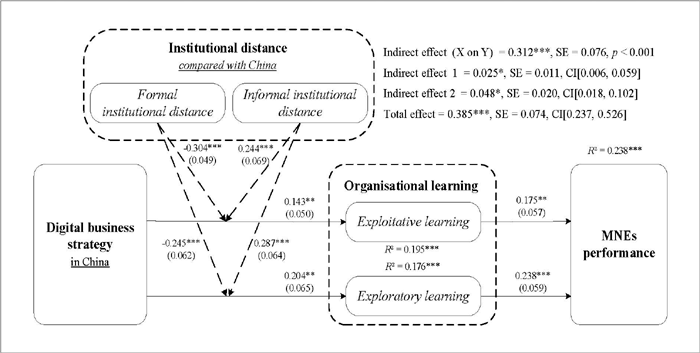
We investigated the robustness using structural equation models (SEM). The model fitting index (2/df = 2.375, CFI = 0.926, TLI = 0.913, SRMR = 0.047, RMSEA = 0.051) complies with the criteria. With a β = 0.312, SE = 0.076, p = 0.001, the study (Figure 3) revealed that digital business strategy had a notable positive impact on firm performance. Via exploitative learning, it was also discovered that the indirect impact of digital business strategy on firm performance was 0.025 (95% CI[0.006, 0.059]); and through exploratory learning, was 0.48 (95% CI[0.018, 0.102]). Furthermore, the interaction of formal institutional distance and digital business strategy had a negative and significant effect on exploitative learning (β = 0.304, p < 0.001) and exploratory learning (β = 0.287, p < 0.001). These were quite compatible with the outcomes of hierarchical regression, thus, all hypotheses were confirmed and passed the robustness test.

CONCLUSION
Important findings from this study are as follows. This study finds that digital business strategies positively impact MNE performance in China by integrating digital resources with core strategies, enhancing competitiveness (Bharadwaj et al., 2013). With China’s push for digital infrastructure and government incentives, MNEs adopting digital strategies align with the local market, reinforcing the importance of digital strategies in multinational success (Bharadwaj et al., 2013; Shuyan et al., 2023). Second, the internationalization of digital strategies involves exploitative and exploratory learning processes. Exploitative learning helps MNEs adapt to the host environment, while exploratory learning enables MNEs to leverage new digital opportunities and update capabilities (Arzubiaga et al., 2021; Chung et al., 2019). Third, the relationship between digital strategies and ambidextrous learning is moderated by formal and informal institutional distances. Formal distance imposes rigidity, limiting legitimacy acquisition, while informal distance offers flexibility, enabling MNEs to foster trust and cooperation, aiding ambidextrous learning.
Theoretical implications
This study shifts the research focus to an inclusive and embedded digital business strategy, integrating digital technologies with internationalization and organizational learning. The rise of digitalization in multinational corporations has sparked growing interest in its role in firm performance (Shuyan et al., 2023). However, competitive advantage does not rely solely on technology and services (Prashar & Hamid, 2025). The integration of technology and business models is crucial for global expansion (Knight & Liesch, 2016). This study offers fresh insights into MNEs’ digital strategies, responding to calls for studies on better integration of internationalization strategies in firm performance (Bauweraerts et al., 2022). China’s unique hybrid institutional environment presents an opportunity to explore these dynamics. Building upon a South African study (Rong & Liu, 2024) that established the effectiveness of digital business strategies through ambidextrous learning mechanisms under organizational memory constraints, this China-based research reveals critical cross-cultural divergences in institutional distance. Chinese complex institutional landscape, involving formal regulations and informal norms, provides a challenging context for multinational corporations. Examining the mechanisms and boundary conditions of digital strategy implementation in such an environment contributes to international business literature and provides actionable insights for MNEs facing similar challenges.
Subsequently, this study advances organizational learning literature by highlighting the mediating role of exploitative and exploratory learning in the relationship between digital business strategies and performance outcomes. It addresses the gap in research on how digital business strategies influence profitability globally. The effectiveness of digital strategies depends on these learning processes for knowledge integration and collaborative reconstruction. The research contributes to the call for greater interaction between internationalization and organizational learning (Arzubiaga et al., 2021; Rong & Liu, 2024).
Finally, the research conclusions help to further understand the boundary conditions of digital business strategy by revealing the heterogeneous moderation of formal and informal institutional distance on the link between digital business strategy and organizational learning. Specifically, this research focuses on the dual boundary effects of institutional distance, which makes up for the deficiency of previous studies that ignored its potential positive impact (Trąpczyński & Banalieva, 2016). This is in line with the view of Li et al. (2020) that institutional distance has negative effects, such as lack of legitimacy and information asymmetry, and positive effects, such as institutional arbitrage and knowledge accumulation. Additionally, we demonstrate how formal and informal institutional distances play distinct moderating functions beyond the traditional view that the two are homogeneous in the existing research. The longevity and consistency of formal institutions are greater, whereas informal institutions are more malleable and likely to be altered and leveraged. Thus, MNEs are more likely to exploit the integrative and reconfigurative potentials of digital business strategies, enhancing international performance through co-creation of institutions. Therefore, this study echoes previous literature by identifying the heterogeneity between formal and informal institutional distance (Liou et al., 2016).
Practical implications
This study offers practical insights for MNEs in digitalization and international performance, emphasizing the need to tailor strategies for the Chinese market. MNEs should invest in local talent, form partnerships, and use data analytics to understand and predict consumer behavior. For example, P&G’s collaboration with JD.com has enhanced its logistics and digital marketing capabilities, leading to a wider user base and sustainable growth.
Second, this study suggests that MNEs operating in China effectively integrate exploitative and exploratory learning to enhance business performance. Given China’s economic and societal complexity and diversity, firms are advised to adopt a dual-track strategy. MNEs should continually optimize existing operational processes, distribution channels, and customer understanding through exploitative learning. Concurrently, they should adapt to and gain insights into the dynamic market’s new trends, cultural nuances, and emerging tendencies through exploratory learning. Such a complementary approach enables these companies to flexibly respond to the continuous changes in the Chinese market, leveraging their accumulated experience and knowledge base to create value.
Third, MNEs in China must adapt learning strategies to account for varying formal and informal institutional distances. In environments with formal institutional distance, MNEs should form teams to ensure legal compliance in business operations. In environments with informal institutional distance, MNEs should build trustful relationships with local partners through digital strategies to leverage resources and explore new opportunities. Digital strategies help MNEs adapt to the Chinese environment, balancing risks and opportunities. The conclusions offer insights for businesses in other emerging economies. Although focused on manufacturing, construction, and finance, the insights are relevant to other sectors like retail and tourism.
Limitations and directions for future research
While the regression results strongly supported the research hypotheses, this study falls short in detailing the specific implementation processes of digital business strategies within multinational corporations. Future research should integrate in-depth interviews with industry practitioners, digital business strategy experts, and detailed case studies (Pagani, 2013). Moreover, despite efforts to minimize response bias, self-reported data from respondents may still be influenced by several factors, such as social desirability bias, subjectivity bias, and recall bias. Future studies might explore and develop methods to objectively measure research variables, such as incorporating feedback mechanisms in multinational corporations to obtain objective digital business strategy performance indicators. Additionally, the reliance on cross-sectional data limits the ability to capture the dynamic nature and long-term effects of digital strategy implementation, raising endogeneity concerns. Future research should incorporate longitudinal designs to clarify causal relationships and explore the impact of digital strategies on organizational learning and long-term performance. Finally, since this study primarily focuses on MNEs in China, which may operate differently in other host countries with varied institutional environments (Gao et al., 2022), further study might assess the relationship between digital business strategies and performance across different industries within distinct host country contexts.
-
FUNDING
This research was funded by the National Natural Science Foundation of China Project(72072086),Henan Provincial Soft Science Research Project (Project No.: 252400411273); Henan Provincial Philosophy and Social Sciences Planning Project Special Project (Project No.: 2024ZZX006); Henan Provincial Social Science Federation Research Project (Project No.: SKL-2024-1888)
-
Evaluated through a double-anonymized peer review.
-
The Peer Review Report is available at this link
REFERENCES
-
Aguilera-Caracuel, J., Hurtado-Torres, N. E., Aragón-Correa, J. A., & Rugman, A. M. (2013). Differentiated effects of formal and informal institutional distance between countries on the environmental performance of multinational enterprises. Journal of Business Research, 66(12), 2657-2665. https://doi.org/10.1016/j.jbusres.2013.04.002
» https://doi.org/10.1016/j.jbusres.2013.04.002 -
Amarilli, F., Hooff, B. van den, & Vliet, M. van. (2023). Business-IT alignment as a coevolution process: An empirical study. The Journal of Strategic information Systems, 32(2), 101776. https://doi.org/10.1016/j.jsis.2023.101776
» https://doi.org/10.1016/j.jsis.2023.101776 -
Arzubiaga, U., Castillo-Apraiz, J., & Palma-Ruiz, J. M. (2021). Organisational learning as a mediator in the host-home country similarity-international firm performance link: The role of exploration and exploitation. European Business Review, 33(3), 409-426. https://doi.org/10.1108/EBR-09-2019-0238
» https://doi.org/10.1108/EBR-09-2019-0238 -
Atuahene-Gima, K., & Murray, J. (2007). Exploratory and exploitative learning in new product development: A social capital perspective on new technology ventures in China. Journal of international Marketing, 15(2), 1-29. https://doi.org/10.1509/jimk.15.2.1
» https://doi.org/10.1509/jimk.15.2.1 -
Bauweraerts, J., Arzubiaga, U., & Diaz-Moriana, V. (2022). Unveiling the global focus-performance relationship in family firms: The role of the board of directors. International Business Review, 31(4), 101977. https://doi.org/10.1016/j.ibusrev.2022.101977
» https://doi.org/10.1016/j.ibusrev.2022.101977 -
Bharadwaj, A., Sawy, O. A. El, Pavlou, P. A., & Venkatraman, N. (2013). Digital business strategy: Toward a next generation of insights. MIS Quarterly, 37(2), 471-482. https:/doi.org/10.25300/misq/2013/37:2.3
» https://doi.org/10.25300/misq/2013/37:2.3 -
Blichfeldt, H., & Faullant, R. (2021). Performance effects of digital technology adoption and product & service innovation: A process-industry perspective. Technovation, 105, 102275. https://doi.org/10.1016/j.technovation.2021
» https://doi.org/10.1016/j.technovation.2021 -
Chi, M., Zhao, J., Huang, R., Li, Y., & Liu, Y. (2022). Digital business strategy as an initiator of e-business value creation. International Journal of Mobile Communications, 20(5), 609-637. https://doi.org/10.1504/IJMC.2022.125422
» https://doi.org/10.1504/IJMC.2022.125422 -
Chung, H. F. L., Ding, Z., & Ma, X. (2019). Organisational learning and export performance of emerging market entrepreneurial firms: The roles of RBV mechanism and decision-making approach. European Journal of Marketing, 53(2), 257-278. https://doi.org/10.1108/EJM-08-2017-0496
» https://doi.org/10.1108/EJM-08-2017-0496 -
Delmas, M. A., & Montes-Sancho, M. J. (2011). An institutional perspective on the diffusion of international management system standards: The case of the environmental management standard ISO 14001. Business Ethics Quarterly, 21(1), 103-132. https://doi.org/10.5840/beq20112115
» https://doi.org/10.5840/beq20112115 -
Facin, A. L. F., Barbosa, A. P. F. P. L., Matsumoto, C., Cruz, A. F. S. D. G., & Salerno, M. S. (2022). Featured topics in research on digital transformation: Evidence from a bibliometric study and content analysis. RAE-Revista de Administração de Empresas, 62, e2021-0112. https://doi.org/10.1590/S0034-759020220602x
» https://doi.org/10.1590/S0034-759020220602x -
Gao, J., Wang, T., Jia, Y., & Wang, C. L. (2022). How and when do exporters benefit from an international adaptation strategy? The moderating effect of formal and informal institutional distance. international Marketing Review, 39(6), 1390-1416. https://doi.org/10.1108/IMR-01-2021-0007
» https://doi.org/10.1108/IMR-01-2021-0007 -
Goldman, S., Herk, H. Van, Verhagen, T., & Weltevreden, J. (2021). Strategic orientations and digital marketing tactics in cross-border e-commerce: Comparing developed and emerging markets. international Small Business Journal: Researching Entrepreneurship, 39(4), 350-371. https://doi.org/10.1177/0266242620962658
» https://doi.org/10.1177/0266242620962658 -
Holopainen, M., Saunila, M., & Ukko, J. (2023). Facilitating performance measurement and management through digital business strategy. Measuring Business Excellence, 27(2), 246-260. https://doi.org/10.1108/MBE-01-2022-0015
» https://doi.org/10.1108/MBE-01-2022-0015 -
Iranmanesh, M., Ghobakhloo, M., Nilashi, M., Tseng, M.-L., Yadegaridehkordi, E., & Leung, N. (2022). Applications of disruptive digital technologies in hotel industry: A systematic review. International Journal of Hospitality Management, 107, 103304. https://doi.org/10.1016/j.ijhm.2022.103304
» https://doi.org/10.1016/j.ijhm.2022.103304 -
Jaworski, B., & Kohli, A. (1993). Market orientation: Antecedents and consequences. Journal of Marketing, 57(3), 53-70. https://doi.org/10.2307/1251854
» https://doi.org/10.2307/1251854 -
Knight, G. A., & Liesch, P. W. (2016). Internationalization: From incremental to born global. Journal of World Business, 51(1), 93-102. https://doi.org/10.1016/j.jwb.2015.08.011
» https://doi.org/10.1016/j.jwb.2015.08.011 -
Lamberton, C., & Stephen, A. (2016). A thematic exploration of digital, social media, and mobile marketing: Research evolution from 2000 to 2015 and an agenda for future inquiry. Journal of Marketing, 80(6), 146-172. https://doi.org/10.1509/jm.15.0415
» https://doi.org/10.1509/jm.15.0415 -
Larkin, R. (2020). Knowledge transfer effects of clustering in dual configuration MNEs. International Journal of Hospitality Management, 90, 102649. https://doi.org/10.1016/j.ijhm.2020.102649
» https://doi.org/10.1016/j.ijhm.2020.102649 -
Li, L., Hsu, C., Mao, J., & Zhang, W. (2022). Contextualising digital innovation in today’s China: Local practices and global contributions. Information Systems Journal, 32(3), 623-629. https://doi.org/10.1111/isj.12379
» https://doi.org/10.1111/isj.12379 -
Li, W., Wang, C., Ren, Q., & Zhao, D. (2020). Institutional distance and cross-border M&A performance: A dynamic perspective. Journal of International Financial Markets, Institutions and Money, 66, 101207. https://doi.org/10.1016/j.intfin.2020.101207
» https://doi.org/10.1016/j.intfin.2020.101207 -
Liou, R. S., Chao, M. C. H., & Yang, M. (2016). Emerging economies and institutional quality: Assessing the differential effects of institutional distances on ownership strategy. Journal of World Business, 51(4), 600-611. https://doi.org/10.1016/j.jwb.2016.03.001
» https://doi.org/10.1016/j.jwb.2016.03.001 -
Luo, Y. (2005). Transactional characteristics, institutional environment and joint venture contracts. Journal of International Business Studies, 36, 209-230. https://doi.org/10.1057/palgrave.jibs.8400125
» https://doi.org/10.1057/palgrave.jibs.8400125 -
Lyles, M. A. (2014). Organizational Learning, knowledge creation, problem formulation and innovation in messy problems. European Management Journal, 32(1), 132-136. https://doi.org/10.1016/j.emj.2013.05.003
» https://doi.org/10.1016/j.emj.2013.05.003 -
March, J. (1991). Exploration and exploitation in organizational learning. Organization Science, 2(1), 71-87. https://doi.org/10.1287/orsc2.1.71
» https://doi.org/10.1287/orsc2.1.71 -
Mies, Y. A., Hausberg, J. P., & Packmohr, S. (2024). Digitising miles and snow: Using cluster analysis to empirically derive digital business strategy types. Technology Analysis & Strategic Management, 36(11), 3922-3935. https://doi.org/10.1080/09537325.2023.2234508
» https://doi.org/10.1080/09537325.2023.2234508 -
Mithas, S., Tafti, A., & Mitchell, W. (2013). How a firm’s competitive environment and digital strategic posture influence digital business strategy. MIS quarterly, 37(2), 511-536. https://doi.org/10.25300/MISQ/2013/37.2.09
» https://doi.org/10.25300/MISQ/2013/37.2.09 -
Moorman, C., & Miner, A. (1997). The impact of organizational memory on new product performance and creativity. Journal of Marketing Research, 34(1), 91-106. https://doi.org/10.2307/3152067
» https://doi.org/10.2307/3152067 -
Nwankpa, J. K., & Datta, P. (2017). Balancing exploration and exploitation of it resources: The influence of digital business intensity on perceived organizational performance. European Journal of Information Systems, 26(5), 469-488. https://doi.org/10.1057/s41303-017-0049-y
» https://doi.org/10.1057/s41303-017-0049-y -
Pagani, M. (2013). Digital business strategy and value creation: Framing the dynamic cycle of control points. MIS Quarterly, 37(2), 617-632. https://doi.org/10.25300/MISQ/2013/37.2.13
» https://doi.org/10.25300/MISQ/2013/37.2.13 -
Peng, M. W. (2003). Institutional transitions and strategic choices. Academy of Management Review, 28(2), 275-296. https://doi.org/10.2307/30040713
» https://doi.org/10.2307/30040713 -
Perdana, A., Lee, H., Koh, S., & Arisandi, D. (2022). Data analytics in small and mid-size enterprises: Enablers and inhibitors for business value and firm performance. International Journal of Accounting Information Systems, 44, 100547. https://doi.org/10.1016/j.accinf.2021.100547
» https://doi.org/10.1016/j.accinf.2021.100547 -
Prashar, S., & Hamid, A. B. A. (2025). Promoting businesses beyond borders: Multinationals’ perspectives. FIIB Business Review, 14(2), 128-141. https://doi.org/10.1177/23197145221097245
» https://doi.org/10.1177/23197145221097245 -
Rong, K., & Liu, R. (2024). Why do Chinese multinationals in South Africa get benefits from digital business strategy? South African Journal of Economic and Management Sciences, 27(1), 5473. https://doi.org/10.4102/sajems.v27i1.5473
» https://doi.org/10.4102/sajems.v27i1.5473 -
Shuyan, Y., Tiebo, S., & Xiaojie, W. (2023). The institutional motivation and process of digital transformation of enterprises. Science Research Management, 44(9), 39. https://doi.org/10.1201/9781351029148-4
» https://doi.org/10.1201/9781351029148-4 -
Surdu, I., & Narula, R. (2021). Organizational learning, unlearning and re-internationalization timing: Differences between emerging- versus developed-market MNEs. Journal of International Management, 27(3), 100784. https://doi.org/10.1016/j.intman.2020.100784
» https://doi.org/10.1016/j.intman.2020.100784 -
Trąpczyński, P., & Banalieva, E. R. (2016). Institutional difference, organizational experience, and foreign affiliate performance: Evidence from Polish firms. Journal of World Business, 51(5), 826-842. https://doi.org/10.1016/j.jwb.2016.07.013
» https://doi.org/10.1016/j.jwb.2016.07.013 -
Ukko, J., Nasiri, M., Saunila, M., & Rantala, T. (2019). Sustainability strategy as a moderator in the relationship between digital business strategy and financial performance. Journal of Cleaner Production, 236, 117626. https://doi.org/10.1016/j.jclepro.2019.117626
» https://doi.org/10.1016/j.jclepro.2019.117626 -
Wedel, M., & Kannan, P. (2016). Marketing analytics for data-rich environments. Journal of Marketing, 80(6), 97-121. https://doi.org/10.1509/jm.15.0413
» https://doi.org/10.1509/jm.15.0413 -
Wielgos, D. M., Homburg, C., & Kuehnl, C. (2021). Digital business capability: Its impact on firm and customer performance. Journal of the Academy of Marketing Science, 49(4), 762-789. https://doi.org/10.1007/s11747-021-00771-5
» https://doi.org/10.1007/s11747-021-00771-5 -
Yang, Z., Su, C., & Fam, K. S. (2012). Dealing with institutional distances in international marketing channels: Governance strategies that engender legitimacy and efficiency. Journal of Marketing, 76(3), 41-55. https://doi.org/10.1509/jm.10.0033
» https://doi.org/10.1509/jm.10.0033 -
Zhang, H., & Yang, H. (2021). Cross-border M&As and technological innovation: The moderating roles of formal and informal institutional distance. Journal of Knowledge Management, 26(5), 1280-1305. https://doi.org/10.1108/JKM-12-2020-0905
» https://doi.org/10.1108/JKM-12-2020-0905
Edited by
-
Associate Editor:
Mohammad Falahat

 Note: Digital business strategy (DBS), formal institutional distance (FID), informal institutional distance (IID), exploratory learning (ERL), exploitative learning (EIL).
 Note:N = 305; * p < 0.05, ** p < 0.01, *** p < 0.001.