 RELIGIOSITY AND INNOVATION: EMPIRICAL EVIDENCE FROM SMALL AND MEDIUM-SIZED ENTERPRISES IN NIGERIA
ABSTRACT
This empirical investigation examined the relationship between dimensions of religiosity and innovation among Small and Medium-sized Enterprises (SMEs) in Nigeria. It explored how different dimensions -cognitive, normative, and regulatory- of religiosity are connected to innovation within SMEs. Using a sample of 393 SMEs in the southwest region of Nigeria, data were collected via questionnaires administered through stratified sampling proportional to size. The study analyzed religiosity’ dimensions and their influence on innovation outcomes. The findings revealed significant connections between dimensions of religiosity and innovation among SMEs. Firstly, the cognitive dimension of religiosity indicated a considerable influence on innovative behaviours (t = 2.320, p < .001). Secondly, the normative dimension of religiosity substantially impacted innovation outcomes among SMEs (t= 8.397, p < .001). Lastly, the regulatory dimension of religiosity emerged as a robust predictor (t = 5.558, p < .001), underlining its substantial role in driving innovative behaviours among SMEs in Nigeria. These findings contribute to understanding the complex relationship between religiosity and innovation, particularly within the SME sector in Nigeria. The study is unique because it used primary data, applied the Religiosity-Innovation Dynamics (RID) theory and SMEs’ firm and individual innovativeness characteristics to examine dimensions of religiosity-innovation relationship.
Keywords:
innovation; dimensions of religiosity; cognitive dimension; normative dimension
RESUMO
Esta investigação empírica examinou a relação entre as dimensões da religiosidade e a inovação entre as Pequenas e Médias Empresas (PMEs) na Nigéria. Explorou como diferentes dimensões da religiosidade - cognitiva, normativa e reguladora - estão conectadas à inovação dentro das PMEs. Utilizando uma amostra de 393 PMEs na região sudoeste da Nigéria, os dados foram coletados em questionários administrados por meio de amostragem estratificada proporcional ao tamanho. O estudo analisou as dimensões da religiosidade e sua influência nos resultados de inovação. As descobertas revelaram conexões significativas entre as dimensões da religiosidade e a inovação entre as PMEs. Em primeiro lugar, a dimensão cognitiva da religiosidade indicou uma influência considerável nos comportamentos inovadores (t = 2.320, p < .001). Em segundo lugar, a dimensão normativa da religiosidade impactou substancialmente os resultados da inovação entre as PMEs (t= 8.397, p < .001). Por último, a dimensão reguladora da religiosidade emergiu como um preditor robusto (t = 5.558, p < .001), sublinhando seu papel substancial em impulsionar comportamentos inovadores entre as PMEs na Nigéria. Essas descobertas contribuem para a compreensão da complexa relação entre religiosidade e inovação, particularmente dentro do setor de PMEs na Nigéria. Também fornecem insights sobre como políticas e práticas poderiam fomentar a inovação dentro das PMEs, considerando as dimensões da religiosidade no desenvolvimento de estratégias para promover comportamentos inovadores.
Palavras-chaves:
inovação; dimensões da religião; dimensão cognitiva; dimensão normativa; dimensão regulatória
RESUMEN
Esta investigación empírica examinó la relación entre las dimensiones de la religiosidad y la innovación entre las pymes en Nigeria. Se exploró cómo diferentes dimensiones de la religiosidad ‒cognitiva, normativa y reguladora‒ están conectadas con la innovación dentro de las pymes. Utilizando una muestra de 393 pymes en la región suroeste de Nigeria, se recopilaron datos a través de cuestionarios administrados mediante un muestreo estratificado proporcional al tamaño. El estudio analizó las dimensiones de la religiosidad y su influencia en los resultados de la innovación. Los hallazgos revelaron conexiones significativas entre las dimensiones de la religiosidad y la innovación entre las pymes. En primer lugar, la dimensión cognitiva de la religiosidad indicó una influencia considerable en los comportamientos innovadores (t = 2.320, p < .001). En segundo lugar, la dimensión normativa de la religiosidad impactó sustancialmente en los resultados de la innovación entre las pymes (t = 8.397, p < .001). Por último, la dimensión reguladora de la religiosidad surgió como un predictor robusto (t = 5.558, p < .001), subrayando su papel sustancial en impulsar comportamientos innovadores entre las pymes en Nigeria. Estos hallazgos contribuyen a comprender la compleja relación entre la religiosidad y la innovación, particularmente dentro del sector pymes en Nigeria. También proporcionan ideas sobre cómo las políticas y prácticas podrían fomentar la innovación dentro de las pymes al considerar las dimensiones de la religiosidad en el desarrollo de estrategias para promover comportamientos innovadores.
Palabras clave:
innovación; dimensiones de la religión; dimensión cognitiva; dimensión normativa; dimensión reguladora
INTRODUCTION
How does religiosity influence the innovative practices and strategies of small and medium-sized enterprises (SMEs)? Attempts have been made to answer this question through empirical investigations to provide empirical information on the relationship by focusing on the impact of religion on either firm-level or individual innovativeness. For instance, Bénabou et al. (2015) used the World Values Survey’s five waves to examine the relationships between the eleven pointers of openness to innovation and religiosity’s five measures in some countries and discovered that religiosity was substantially connected to fewer favourable opinions of innovation. This is consistent with their previous findings (Bénabou et al., 2013), in which a substantial negative religiosity-innovation relationship was discovered among all states in the United States. Other researchers (Audretsch et al., 2007; Okulicz-Kozaryn, 2015) found that religiosity hampers an individual’s creativity because it places a strong emphasis on traditions and rules, while innovation or creativity entails challenging regulations and traditions that are the bedrocks of religiosity when searching for a process or product breakthrough. Assouad and Parboteeah (2018) examined the influence of religion on firm-level innovativeness. They utilized a method of institutional profile of a country. They focused on religiosity’s normative, regulative, and cognitive dimensions and their relationship with firm-level innovation in a sample of businesses from 30 nations. They discovered a limited relationship between a firm-level construct and religiosity. Recio-Román et al. (2019), through an empirical investigation conducted in Europe, found that European policy-makers were subjugated by the old-style innovation approach, which gained a demand-side perspective to enhance natives’ awareness and acceptance of innovation. The authors concluded that the religiosity-innovation relationship was not substantially strong once there was a control for religious affiliation. Noussair et al. (2013) reported that practising and committed religious people are risk averters because they see outcomes of innovative processes as unfavourable, which they will not want to associate with.
However, these attempts are characterized by one limitation or the other. There is no uniform specific empirical information on the influence of religiosity on innovation, as there were contradictory findings from the literature. Also, prior empirical studies focused on developed economies. No reference was made to developing economies, particularly African countries, even though empirical studies can be repeated in different geographical locations and explore differences in cultural and structural factors (Anning-Dorson, 2018). Recio-Román et al. (2019) concluded that the religiosity-innovation relationship was not substantially strong, while Assouad and Parboteeah (2018) discovered a partial relationship between a firm-level construct and religion while others (Bénabou et. al., 2015) submitted that religiosity was substantially connected to fewer favourable innovation opinions. Aside from the above discovery from the previous empirical investigations, another gap was that the existing studies often dichotomize between firm-level and individual-level innovativeness, overlooking SMEs where the owner-operator dynamic blurs these distinctions.
Moreover, Hilary and Hui (2009) opined that decisions are being made by persons within firms, and others also submitted (Assouad & Parboteeah, 2018) that these persons are susceptible to religious environments’ influences where they live and via their relationships with other members of the society. In a nutshell, SMEs present an excellent example of a sector with both firmand individual-level innovativeness. Of particular interest to this study is the empirical investigation carried out by Assouad and Parboteeah (2018) in Europe, which deployed the three dimensions of religiosity to assess the effect of religiosity on innovation. The study used secondary data and was inhibited by the availability of data via the World Values Survey (WVS), and the three dimensions of religiosity were not efficiently and effectively captured by the data obtained for the analysis as against the use of primary data where the richness of the dimensions of religiosity will be efficiently represented via primary data.
Small and Medium Enterprises (SMEs) are essential for Nigeria’s economic development. According to the National Bureau of Statistics (NBS, 2019), SME is described as any enterprise with a maximum asset base of one billion Naira (N1,000,000,000.00) (not including land and working capital) and employing between 10 and 199 staff. These firms are seen as crucial for fostering economic development, generating job opportunities, and mitigating poverty in the country. SMEs substantially contribute to Nigeria’s Gross Domestic Product (GDP), job generation, and foreign direct investment (FDI) potential. However, the SMEs’ performance in Nigeria is subjected to various forces, including access to finance, infrastructure, and government policies. According to the NBS report, SMEs in Nigeria indirectly contribute to an enormous 48% of the GDP, improve per capita income, and account for 84% of employment.
Focusing on how religiosity influences the innovative practices and strategies of small and medium-sized enterprises (SMEs), this empirical investigation used primary data that effectively and efficiently captured the three dimensions of religiosity. The data were obtained through a questionnaire administered via stratified sampling to 393 SMEs in 137 local government areas in Southwestern Nigeria. SMEs are from a sector combining individualand firm-level innovativeness attributes from a country with more than 250 ethnic groups and multifaceted religious inclinations. The gaps noted in the literature concerning this study aligned with at least three of the seven dimensions of research gaps, as stated by Miles (2017). These are population, knowledge, methodological, practical-knowledge conflict, theoretical, empirical, and evidence gaps. Specifically, this empirical study tackled four gaps. First, it filled the methodological gap by using primary data to collect data on the three dimensions of religiosity and employed structural equation modelling for the analysis. Also, the study was carried out amongst SMEs that combined the attributes of both individual-level and firm-level innovativeness. Second, it filled the population gap by surveying one of the developing economies with cultural diversity (Anning-Dorson, 2018). Third, this empirical investigation also filled the evidence gap occasioned by the controversy arising from diverse empirical findings from the prior attempts to answer how religiosity influences innovation. Finally, it also proposed the Religiosity-Innovation Dynamics (RID) theory to understand the interplay between religiosity and innovation.
This paper contributes to theory by proposing the Religiosity-Innovation Dynamics (RID) theory, which enhances understanding of the interplay between religiosity and innovation by integrating the cognitive, normative, and regulatory dimensions derived from work on legitimacy and institutional theory (Ahlstrom et al., 2008; Scott, 2013). Furthermore, it contributes empirical evidence by utilizing primary data collected from SMEs in a culturally diverse developing economy. It addresses a methodological gap and provides insights into both individual-level and firm-level innovativeness. Additionally, this study fills a population gap by examining the impact of religiosity on innovation in a context that has received limited attention (Anning-Dorson, 2018). Finally, it addresses the evidence gap in existing literature caused by conflicting findings regarding the influence of religiosity on innovation, offering clearer insights into these dynamics.
LITERATURE REVIEW
Religiosity
All over the world, religious people are individuals whose actions, reactions, ways of life, approaches, and dispositions are inspired by a supreme being. This is similar to the actions of innovators in developed or developing economies, as their innovative activities are also the products of inspiration. Despite this outward similarity, Okulicz-Kozaryn (2015) and Audretsch et al. (2007) reported generally unfavourable findings for the religiosity-innovation relationship, albeit under limited conditions.
Iannaccone (2006) propounded a definition of religion or religiosity that is accepted worldwide. The author defined it as any set of actions, beliefs, and institutions shared and rooted in faith in supernatural beings. Kelley and DeGraaf (1997) opined that religiosity provides social institutions vital to the provision of norms that guide members of a society. The authors added that the norms evolved from the religions’ teachings and prescribed ways to live a hard-working life. The norms produce an appropriate environment that creates boundaries to show acceptable and deviant behaviours. Anyone who intends to have a good rapport in society must strive to live and act according to the acceptable behaviours of the community. Researchers that include Raghupathi and Raghupathi (2017), Okulicz-Kozaryn (2015), and Herbig and Dunphy (1998) viewed religiosity as a solid and powerful weapon that can shape the values of an individual and a society. The authors added that religiosity plays a vital role in manipulating individuals’ social or spiritual outcomes, even that of a country (McCloskey, 2006). Others said that innovation or creativity is essential in determining a developing or developed country’s technological, economic, and social developments, irrespective of the country’s religiosity level, though it may play a positive role in innovation through its encouraging of increased acceptance of innovation and betterment (Mokyr, 2016; Tomizawa et al., 2020).
Dimensions of religiosity
The study by Faulkner and Jong (1966) stands out in the literature on religion, presenting an approach to the topic with five different dimensions. The dimensions are beliefs (ideological), ritualistic (church attendance, etc.), knowledge aspects (intellectual), experiential (arousing emotions), and consequential (the possibility of genuine dedication to individual behaviour and religion). The study by Assouad and Parboteeah (2018) is aligned with Faulkner and Jong (1966). The authors discuss the three dimensions of religiosity suggested by Cornwall et al. (1986), which include the aspects of knowledge (cognitive dimension), feelings (affective dimension), and implementation (behavioural dimension). This study also adopted these three dimensions of religiosity to examine the relationship between religiosity and innovation among SMEs in Nigeria (cf. Assouad & Parboteeah, 2018).
Innovation
Innovation is changing something by introducing new processes, thoughts, or products. This study sees innovation as the ability to generate innovative goods and services or innovative methods of producing goods and services to meet customers’ needs. Innovation is a significant competitive strategy that a firm willing to compete in a global market cannot ignore and it is a significant driver of economic development of developing and developed nations of the world (Ahlstrom, 2010; Schumpeter, 1934).
Innovation, a critical energy of organisational success and economic development, encompasses introducing new processes, products, or ideas. Schumpeter (1934) pioneered the concept of "creative destruction", stressing that innovation energises economic growth by replacing old structures with new ones. Schumpeter (1934) discovered five types of innovations: methods, sources of supply, markets, new products, and organizational forms. Rogers (1962) pioneered the diffusion of innovations theory, stressing the features that influence the acceptance of innovations, such as compatibility and relative advantage. Chesbrough (2003) presented open innovation, promoting the application of external and internal ideas and pathways to market, opposing the traditional closed innovation model.
Innovation can be classified into process, product, incremental, and radical innovation. Product innovation encompasses evolving significantly or enhancing new goods or services. Process innovation concentrates on new or enhanced manufacturing or delivery methods. Incremental innovation involves small-scale enhancements, improving effectiveness without basically altering current structures, while radical innovation involves breakthroughs that substantially change industry practices.
Internal and external factors impact innovation. The internal factors include the firm’s investment in research and development (R&D), leadership, and organisational culture. Higher R&D expenses correlate with superior innovation capacity (Cohen & Levinthal, 1990). A culture that inspires inventiveness and risk-taking nurtures innovation (Amabile, 1998). Effective management practices and visionary leadership also play vital roles (Tidd & Bessant, 2013). Among external factors influencing innovation are technological advancements, market demand, and the regulatory environment. Market demand for new products drives firms to innovate (Porter, 1985), while technological advancements produce new opportunities (Christensen, 1997). Helpful government policies can also inspire innovation (Mazzucato, 2013).Measuring innovation encompasses applying many proxies, such as the number of patents filed, the effect on firm performance, new product introductions, and R&D expenditure. R&D expenses show the financial obligation to innovation. The quantity of patents shows the output of innovative activities. New product introductions quantify the palpable results of innovation efforts, and the influence on firm performance measures the economic benefits of innovation (Organization for Economic Cooperation and Development OECD/Eurostat, 2018).
Innovation and religiosity
Across the world, religious individuals shape their actions, reactions, lifestyles, and decision-making processes based on inspiration from a supreme being. Similarly, innovators-whether in developed or developing economies-derive their creative drive from inspiration. Despite this conceptual similarity, studies have reported a negative correlation between religiosity and innovation (Okulicz-Kozaryn, 2015; Audretsch et al., 2007). However, these findings are often context-dependent, and this study seeks to further examine the nuances of this relationship.
Several researchers (Okulicz-Kozaryn, 2015; Raghupathi & Raghupathi, 2017) hold that religiosity can be a strong and powerful weapon that can shape an individual’s or a society’s values. The authors also argued that religiosity plays an important role in manipulating either social or spiritual outcomes of a society or even a country. They added that innovation or creativity is an important factor in determining the technological, economic, and social developments of either a developing or developed country, which can be encouraged by the level of religiosity of the country (McCloskey, 2006).For Bénabou et al. (2015), innovation or creativity is converting one’s idea into what the customers or consumers can term value-added solutions. Recio-Román et al. (2019) described the association connecting religiosity and innovation as tense because their research focused on innovation’s economic and social dimensions. Another controversy was introduced to the discussion on the association connecting religiosity to innovation when Merton (1938) submitted that the association is being mediated by science. This is because the practices and dogmas of religiosity are not convincing compared to scientific discoveries. The status of empirical investigations on the association connecting religiosity to innovation in Nigeria and Africa confirms the position advanced by Tracey (2012) that researchers had been reluctant to investigate the interplay among the variables, hence this study.
Theoretical justification
The Religiosity-Innovation Dynamics (RID) theory, developed as part of this study, draws on insights from multiple disciplines, including the sociology of religion, organizational behaviour, and innovation studies. This theory builds on foundation works such as Pargament’s (1997) study on the psychological dimensions of religion, North’s (1990) institutional theory on the role of formal and informal rules in shaping behaviour, and Schumpeter’s (1934) theory of innovation, which highlights the role of individuals in driving creative change. By integrating these perspectives, the RID theory offers a novel framework to understand how religiosity influences innovation across various contexts.
The RID theory introduces three dimensions -cognitive, normative, and regulatory- of religiosity and their respective impacts on innovation. The cognitive dimension reflects the influence of internal religious beliefs and spirituality, which can inspire ethical and sustainable innovation (Weber, 1905) but may hinder creativity if beliefs become too rigid. The normative dimension emphasizes adherence to religious norms and participation in communal activities, which aligns with Putnam’s (2000) work on social capital, showing how networks and trust foster innovative behaviour, although they can also discourage questioning. The regulatory dimension captures the role of formal religious obligations and institutional frameworks, drawing on Scott’s (2013) institutional theory to illustrate how structured rules and leadership practices promote trust and ethical risk-taking (McCloskey, 2006).
The RID theory provides a nuanced understanding of how religiosity interacts with innovation by accounting for the complex ways these dimensions’ function and intersect in different settings. It offers a fresh contribution to the literature on entrepreneurship and innovation, particularly in contexts where religiosity plays a significant role, such as Nigerian SMEs. This framework bridges gaps in prior research and also invites further empirical validation and application across different cultural and economic environments.
Hypotheses development
Cognitive dimension of religiosity and innovation
The cognitive dimension of religiosity consists of intellectual and conscious factors determining how religious individuals perceive the world. It comprises worldviews, beliefs, and value systems based on the existence of supernatural beings and forces that superintend their fates, needs, and values. Religiosity often conserves knowledge and traditions passed down through generations, influencing how persons interpret their experiences and make decisions.
The cognitive dimension of religiosity significantly impacts individuals’ beliefs of supernatural forces or entities, often in esoteric doctrines, for instance, the belief in a supreme being or afterlife (Assouad & Parboteeah, 2018; Tzeng & Yin, 2008). These beliefs are deeply ingrained and reflect a high level of faith. These authors argued that unceasing devotion to a specific perspective of a religion can cultivate a tendency toward blind faith. The authors draw a parallel between this blind faith and the traits of innovators, who often have faith in unverified concepts, trust their instincts, and are driven by their imaginations and impulses.
Walter et al. (2011, Williams and McGuire (2010), Herbig and Dunphy (1998), and Keller and Holland (1978) highlighted many traits that are communal to successful innovators that are also evident in religious persons. These traits comprise steadfastness, trust in others, a cooperative spirit, a strong work ethic, honesty, and willpower. The authors argued that these characteristics enhance a person’s competence to develop, execute, and lead a successful innovation process. For example, willpower and steadfastness can drive persistence in innovation efforts, while a cooperative spirit and trust in others can foster collaborative innovation environments.Despite these theoretical proclamations, there has been a lack of empirical investigation that used both the individual-level and firm-level characteristics provided by SMEs in developing or developed nations, the context of Africa, and particularly Nigeria, where the interplay between religiosity and innovation might exhibit unique dynamics. Consequently, this study seeks to fill this empirical gap by examining the interplay between the cognitive dimension of religiosity and innovation among SME owners in Nigeria. Therefore, it is hypothesized:
-
H1: The cognitive dimension of religiosity is positively related to the innovation activities of SME owners.
Normative dimension of religiosity and innovation
The normative dimension of religiosity denotes the practices and behaviours that persons participate in as part of their religious observance. According to Parboteeah et al. (2009), this dimension is demonstrated in activities such as attendance at worship centers, regular praying, and other ritualistic practices. These activities are often used as pointers for people’s varying gradations of religiosity.
Jong et al. (1976) argued that a committed religious person’s beliefs are probably reflected in their actions and reactions due to their continued relationship with their religious communities. The authors emphasized that religious practices such as attending spiritual services, praying, and providing material, mental, and monetary assistance to their communities are fundamental to the normative dimension of religiosity.
Assouad et al. (2018), Walter et al. (2011, and Dakhli and Clercq (2004) suggested that a person’s continuous participation in religious activities encourages and shows social characteristics that can support the processes of innovation. They argued that participation in a religious society offers individuals opportunities to build networks and social capital, which are crucial for innovation. These networks facilitate the exchange of ideas, resources, and support, fostering an environment conducive to innovative thinking and activities.
Despite these theoretical proclamations, there has been a lack of empirical investigation that used both individual-level and firm-level characteristics provided by SMEs in developing or developed countries, the context of Africa, and particularly Nigeria, where the dynamics of religiosity and innovation might offer some differences from previous findings from Europe or more developed economies (McCloskey, 2006). Therefore, this investigation attempts to fill this gap by examining the impact of the ’normative dimension of religiosity on SME owners’ innovation activities in developing economies, particularly those of Africa, where religion can take on a normative and even regulatory basis (McCloskey, 2006; Scott, 2013; Weber, 1905). Therefore, it is hypothesized:
-
H2: The normative dimension of religiosity is positively related to the innovation activities of SME owners.
Regulatory dimension of religiosity and innovation
The regulatory dimension of religiosity denotes the guidelines, laws, and regulations that oversee religious behaviour within a specific setting. Kostova (1997, 1999) posited that the regulatory dimension comprises various legal and regulatory contexts that control individual and collective behaviours. This idea was extended to the sphere of religion, describing the regulatory aspect as a system of laws and guidelines establishing procedures within religious frameworks (Assouad & Parboteeah, 2018).
Finke (1990) and Stark and Finke (2000) further argued that the regulatory dimension of religiosity is evident in the state’s regulation of religious activities. For instance, in countries like Egypt, where there is a state religion, the government controls the religious market by selecting and approving leaders of religious societies. This regulation impacts the behaviours and practices of religious adherents, ensuring compliance with established norms and procedures. These authors suggest that adherence to the regulatory dimension of religiosity can stimulate traits, attitudes, and behaviours characteristic of innovators. Compliance with religious regulations can foster discipline, adherence to structured processes, and a systematic approach to problem-solving, all of which are valuable in innovation.However, the regulatory dimension of religiosity, particularly the state’s regulation of religious activities, still needs to be fully operational in Nigeria and many other African countries. Consequently, the assertions made by the authors mentioned above have yet to be empirically investigated within the framework, which has individual and firm-level characteristics as exemplified in SMEs within the African context, specifically Nigeria. This research attempts to address this gap by investigating the influence of the regulatory dimension of religiosity on SME owners’ innovation activities in Nigeria. Therefore, it is hypothesized:
-
H3: The regulatory dimension of religiosity is positively related to the innovation activities of SME owners.
METHODOLOGY
Small and medium-sized enterprises
Because of their firm-level and individual-level characteristics, SMEs were chosen to attain the objectives and test the hypotheses designed for this study. SMEs perform a significant role in developing economies of both developed and developing nations as they contribute to creating jobs, growth of the economy, and innovative ideas, products, services, or techniques (NBS, 2019). Otite (1990) and Bangura (n.d.) submitted that Nigeria has a varied religious and cultural landscape, and this study opined that this diversity offers an ideal framework for investigating how religiosity interconnects with the innovative practices and strategies of businesses, most importantly SMEs.
Research design
This study used a quantitative research design via survey methodology. This design helps to test hypotheses and examine the relationships between dimensions of religiosity and innovation among SMEs in Southwestern Nigeria. Structural equation modelling (SEM) was used for data analysis to assess the structural relationships between the measured variables and latent constructs. Quantitative research design is suitable for studies that use statistical methods to establish patterns and relationships among variables (Creswell, 2014).
Study area
The study was conducted in Nigeria’s Southwestern region, encompassing six states: Ekiti, Lagos, Ogun, Ondo, Osun, and Oyo. The region is known as Nigeria’s commercial hub due to its significant economic activities and natural resources such as oil, natural gas reserves, gold, and bitumen. According to the NBS (2020), the projected population of Southwestern Nigeria was 38,788,518.
Population and sampling
The population for the study consisted of SMEs in Southwestern Nigeria. According to the NBS (2019), there are 23,289 SMEs in the region.
To determine the sample size, Slovin’s formula was applied:
N is the study’s population; the error margin is denoted by e, and the sample size is n. Where N is 23,289 and e represented by a confidence level of 95% (0.05) is used. Therefore,
Thus, the sample size for the study was determined to be 393 SMEs.
Data collection instrument
The study’s survey targeted owners of SMEs in all six states in Southwestern Nigeria as they are seen as individuals and firms becoming the most appropriate informants on the three dimensions of religiosity and their influences. The instrument that benefited from the works of Assouad and Parboteeah (2018) and Parboteeah et al. (2009) was divided into five sections: Section A: Socio-demographic characteristics of the respondents. Section B: Constructs related to the cognitive dimension of religiosity. Section C: Statements on the normative dimension of religiosity. Section D: Constructs on the regulatory dimension of religiosity. Section E: Constructs related to innovation. Both Religiosity and Innovation were measured using a 5-point Likert scale. For religiosity, respondents indicated their level of agreement with statements across three dimensions (cognitive, normative, and regulatory) on a scale ranging from 1 = Strongly Disagree to 5 = Strongly Agree. Similarly, for innovation, participants rated the extent of innovative practices within their enterprises on a 5-point Likert scale, with responses ranging from 1 = Not at All to 5 = To a Very Great Extent. These scales were designed to capture the intensity of perceptions and behaviours relevant to each construct. The questionnaire was reviewed by experts in the field to ensure content validity, following the guidelines by DeVellis (2016) on scale development. Reliability was assessed using Cronbach’s Alpha reliability test to ensure the dimensions’ consistency.
Procedure
The validated questionnaire was distributed to the selected SMEs in Southwestern Nigeria. The questionnaire was administered using stratified random sampling using local government areas as strata. The stratification was used to ensure inclusivity. The appropriate data was methodologically collected as the research assistants selected from the six states were adequately educated and trained to collect data from all six states in Southwestern Nigeria. The survey instrument was designed to capture data on the three dimensions of religiosity and their influences on innovation. Data collection involved direct administration of the questionnaires to ensure a high response rate and accuracy of the data collected. Structural equation modelling (SEM) was employed for data analysis. SEM is a comprehensive statistical technique to assess structural relationships between measured variables and latent constructs. SEM is appropriate for complex models and hypothesis testing regarding relationships among multiple variables (Kline, 2015).
DATA ANALYSIS AND INTERPRETATION
Demographic characteristics of the respondents
The study’s demographic characteristics are presented in Table 3. Regarding religion, most interviewees identified as Christians, comprising 68.6% of the sample, followed by Muslims with 26.7%. Traditionalists and those with other religious affiliations were 3.5% and 1.2%, respectively. When examining years of practice of religion, a significant portion of respondents reported practising their religion for 15 years or more, constituting 79.1% of the sample. A smaller proportion had practiced for 10-14 years (14.0%), while fewer respondents reported practicing for 1-9 years, with no participants indicating less than a year of practice. The sample was balanced in gender, with males accounting for 51.2% and females for 48.8% of the respondents. Regarding age distribution, most respondents fell within the 40-59 age group, representing 48.8% of the sample. Participants under 20 comprised 17.4%, while those aged 20-39 years and 60 years and above constituted 23.3% and 10.5%, respectively. Ultimately, considering educational qualifications, respondents with a school certificate represented the largest group at 41.9%, followed by those with HND/BSc qualifications at 26.7%. Other qualifications such as OND/HSC/NCE, MBA/MPA/Masters, and Ph.Ds were reported by smaller sample proportions.
Assessment of measurement model
The measurement model in the study assesses the reliability and validity of the constructs used, including innovation and the cognitive, normative, and regulatory dimensions. Reliability is demonstrated through Cronbach’s Alpha values, all exceeding the acceptable threshold of 0.7, indicating internal consistency among the items. Composite Reliability (CR) values, ranging from 0.836 to 0.925, further confirm the reliability of the constructs. Validity is established through the Average Variance Extracted (AVE), with values above 0.5, indicating that the constructs capture more variance than error; most values are consistent with the rule of thumb (Hair et al., 2009). The measurement model tests the items’ loadings, the average variance extracted (AVE), and the composite reliability (CR) accordingly.
Table 5 reports the findings of the discriminant analysis using the Fornell and Lacker criterion. Discriminant validity is verified using the Fornell and Larcker criterion, where the square roots of the AVE for each construct are more significant than the correlations with other constructs, affirming that the constructs are distinct and measure different concepts. This table shows the measurement model test carried out in the initial stage.
RESULTS
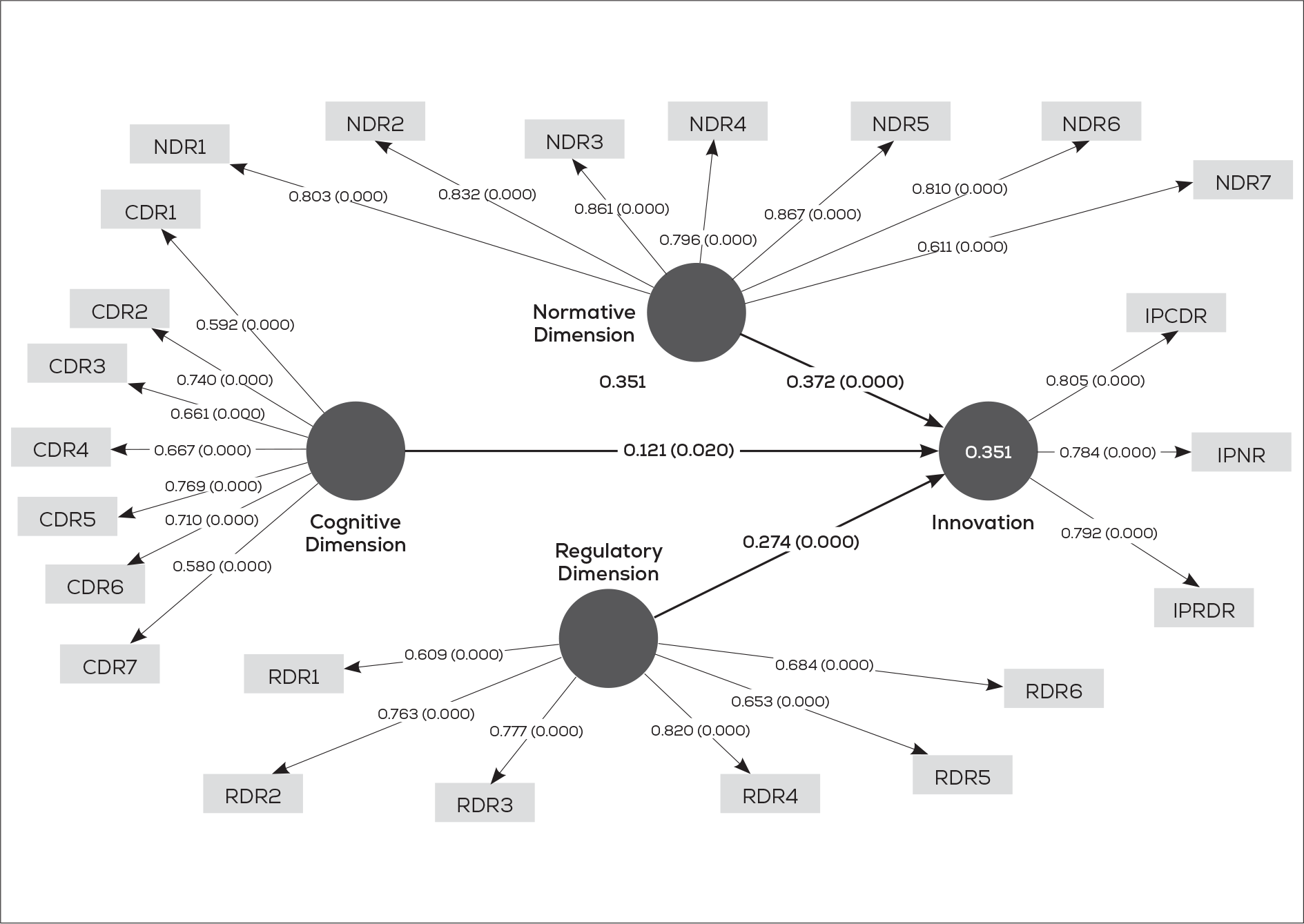
The first hypothesis proposes that the cognitive religiosity dimension, encompassing personal beliefs, spiritual understanding, and awareness, positively influences the innovation endeavours of Nigerian SME owners. This dimension encompasses the internalized convictions and religious knowledge that can potentially enhance SME owners’ ability to generate innovative ideas and solutions. Empirical analysis confirms this positive correlation, yielding a statistically significant path coefficient (β = 0.121, t = 2.320, p = 0.020). The t-value exceeds the critical threshold, indicating a substantial and meaningful relationship. Moreover, the p-value suggests a low likelihood of observing this result by chance. These findings support the notion that the cognitive dimension of religiosity makes a modest yet significant contribution to the innovative capabilities of Nigerian SME owners.
The second hypothesis posits that adherence to communal religious norms and societal expectations - a key aspect of religiosity - positively impacts the innovation activities of Nigerian SME owners. This dimension explores how religious communities’ values and expectations influence business practices, potentially motivating SME owners to adopt innovative strategies to meet these expectations. Empirical analysis confirms a significant positive correlation between this dimension and innovation activities. The path coefficient (β = 0.372) indicates a substantial positive effect, supported by a high t-value (8.397) and an extremely low p-value (p < 0.001). These results suggest that SME owners who align their business practices with religious norms and expectations are more likely to engage in innovation. This alignment may create social pressure or motivation to innovate, driven by the desire to meet communal expectations or adhere to shared religious principles. This finding underscores the significance of societal and religious norms in driving innovation among Nigerian SMEs. The third hypothesis proposes that adherence to religious rules, practices, and institutional frameworks significantly influences the innovation activities of Nigerian SME owners. This dimension examines how structured religious guidelines shape behaviour, suggesting that compliance with these rules could provide direction and stability, fostering entrepreneurial creativity and innovation. Empirical analysis supports this hypothesis, revealing a statistically significant positive correlation between the regulatory dimension of religiosity and innovation activities (β = 0.274, t = 5.558, p < 0.001). The path coefficient indicates a moderate positive influence, while the t-value substantially exceeds the critical threshold, signifying a robust relationship. The extremely low p-value confirms the statistical significance, implying that the observed relationship is highly unlikely to be due to chance. These findings suggest that religious regulations provide SME owners with a structured framework for decision-making and innovation, offering stability and clear guidelines that enable entrepreneurs to confidently explore new ideas within socially acceptable boundaries. This highlights the potential of religious institutions and frameworks to support innovation within Nigeria’s SME sector. The results are summarized in Table 6 and Figure 1.

DISCUSSION
This study empirically explored how different dimensions of religiosity-cognitive, normative, and regulatory-affect the innovation of SME owners in Nigeria. The results indicate that all the three dimensions have a positive and significant impact on innovation. Specifically, the normative dimension shows the strongest influence (β = 0.372), followed by the regulatory dimension (β = 0.274) and the cognitive dimension (β = 0.121). These findings suggest that not only do personal beliefs and values (cognitive dimension) play a role, but adherence to religious norms and expectations (normative) and compliance with religious regulations (regulatory) also contribute meaningfully to innovative practices among SME owners.
This finding proposes that the cognitive dimension of religiosity plays a substantial role in manipulating innovative behaviours and results that follow. In summary, this outcome shows a strong and meaningful connection between the cognitive dimension of religion or religiosity and innovation. The cognitive dimension of religiosity seems to be a substantial prognosticator of innovation, elucidating a distinguished portion of the erraticism in innovation results. This finding aligns with previous empirical findings (e.g. Assouad & Parboteeah, 2018; Tzeng et al, 2008; Walter et al., 2011). This work affirmed that anyone with such firm conviction depicts a strong level of faith and that continued faithfulness to a specific dimension of religiosity can help to fashion a society to enhance the capability to evolve a successfully innovative society. For the normative dimension of religiosity, the results show that it plays a substantial role in enhancing innovative behaviours and results. These outcomes indicate that the normative dimension of religiosity is a robust and substantial prognosticator of innovation. This elucidates a distinguished percentage of the erraticism in innovation results, signifying that religiosity, mostly importantly its normative part, may inspire individuals’ attitudes, behaviours, and decision-making procedures connected to innovation. This finding aligned with the previous empirical outcomes of Parboteeah et al. (2009), Assouad and Parboteeah (2018), Walter et al. (2011), and Dakhli and Clercq (2004). These authors discovered that individuals’ continued propinquity to religion will promote and reflect social life’s features that can support innovation processes. The authors also opined that involvement in a religious society allows an individual to build a network and social capital (McCloskey, 2013).
Also, the finding shows that the regulatory dimension of religiosity plays a substantial role in influencing innovative behaviours. In a nutshell, this result reveals that the regulatory dimension of religiosity is a robust and substantial prognosticator of innovation. This elucidates a distinguished percentage of the erraticism detected in innovation results, signifying that religiosity, most notably its regulatory dimension, may impact individuals’ behaviours, attitudes, and decision-making procedures connected to innovation. This empirical discovery aligns with Kostova (1997), Assouad and Parboteeah (2018), Finke (1990), and Stark and Fink (2000). These authors opined that the regulatory dimension has to do with various sets of laws and regulations that control people’s behaviours within a particular environment. The authors mentioned above observed that compliance with the regulatory dimension of religiosity by various religious adherents stimulates some traits, attitudes, and behaviours that are evident in the life of an innovator.
Contributions
This study offers novel insights and advancements in the fields of entrepreneurship, religiosity, and innovation, particularly regarding the interplay between religiosity and innovation among Nigerian SMEs. The key contributions are as follows:
This work contributes to empirical knowledge by utilizing primary data to investigate the religiosity-innovation relationship within Nigerian SMEs. Unlike previous studies that relied on secondary data, this approach provides current and specific insights into the SME sector, enabling direct observations and interactions. The findings offer a more accurate and nuanced understanding of how religiosity influences innovation in this context. It also makes a theoretical contribution by applying the Religiosity-Innovation Dynamics (RID) theory. This novel framework provides a structured approach to exploring how different dimensions of religiosity—cognitive, normative, and regulatory—impact innovation within SMEs. By offering a new perspective, the RID theory enriches existing knowledge, clarifying the mechanisms through which religiosity shapes entrepreneurial innovation.
The cognitive dimension demonstrates how personal beliefs and religious knowledge foster entrepreneurial creativity. The normative dimension also emphasizes the role of communal religious norms and values in driving innovation. Finally, the regulatory dimension illustrates how religious regulations and institutional frameworks create a structured environment conducive to innovative behaviour. It also contributes to understanding firm and individual innovativeness by examining both levels concurrently. The dual-level analysis demonstrates how individual religiosity translates into organizational innovation practices, emphasizing the interconnectedness of personal beliefs and collective business outcomes. The study provides context-specific insights by focusing on SMEs in Nigeria, where religiosity plays a significant role in shaping both daily life and business practices. By examining this unique context, the findings contribute to the global discourse on the influence of religiosity on innovation and offer valuable lessons for similar cultural and economic environments.
Limitations and future research
This study acknowledges several limitations, which can suggest future research. First, relying on self-reported data from SME owners may lead to response bias, particularly given the sensitive nature of religiosity. Second, the cross-sectional design restricts the ability to establish causality between religiosity and innovation. Third, although focusing on Nigerian SMEs provides valuable insights, the findings may not be directly applicable to other cultural or economic contexts, and research should be conducted elsewhere, outside of Africa. Finally, this study focuses on three dimensions of religiosity, which could neglect other potential aspects, such as the emotional or experiential dimensions. Future research can address these limitations by employing longitudinal designs, incorporating qualitative methods, or examining broader dimensions and contexts, particularly through comparative research (Horak & Ahlstrom, in press; McCloskey, 2006).
CONCLUSION
This study reveals a statistically significant connection between religiosity and innovation among SME owners in Nigeria. Specifically, the cognitive, normative, and regulatory dimensions of religiosity all play a significant role in shaping innovative behaviours. The findings suggest that SME owners can leverage these dimensions of religiosity to enhance their innovativeness.
The study’s results indicate that 35.1% of the variance in innovation can be explained by these dimensions of religiosity. This underscores the potential for SMEs to harness the positive aspects of religiosity to foster innovation. Business leaders and policy-makers may consider integrating religious values and norms into strategies to create environments that support innovative thinking and practices. Innovation is a vital catalyst for driving firm performance and economic growth. As emphasized by Ahlstrom (2010), business innovation is instrumental in propelling societal development and economic progress, ultimately yielding sustainable growth and a competitive edge. This study’s findings reinforce the imperative of nurturing innovation within SMEs, as it fortifies individual businesses and bolsters the overall economic ecosystem.
If this paper offers one key takeaway, it is that religiosity significantly influences innovation in SMEs through its cognitive, normative, and regulatory dimensions. This highlights the need for researchers to consider religiosity as a critical factor in studies on entrepreneurship and innovation, particularly in culturally and religiously grounded economies. The introduction of the Religiosity-Innovation Dynamics (RID) theory provides a novel framework for analyzing this multidimensional relationship. Future research can build on this framework to explore the relationship between religiosity and innovation in other contexts. In practical terms, SME owners and policy-makers can utilize religious norms and frameworks to foster innovative behaviours and build supportive structures that encourage sustainable business growth.
-
The reviewers did not authorize disclosure of their identity and peer review report.
-
Evaluated through a double-anonymized peer review.
REFERENCES
-
Ahlstrom, D. (2010). Innovation and growth: How business contributes to society. Academy of Management Perspectives, 24(3), 11-24. https://doi.org/10.5465/AMP.2010.52842948
» https://doi.org/10.5465/AMP.2010.52842948 -
Ahlstrom, D., Bruton, G. D., & Yeh, K. S. (2008). Private firms in China: Building legitimacy in an emerging economy. Journal of World Business, 43(4), 385-399. https://doi.org/10.1016/j.jwb.2008.03.001
» https://doi.org/10.1016/j.jwb.2008.03.001 - Amabile, T. M. (1998). How to kill creativity. Harvard Business Review, 76(5), 77-87.
-
Anning-Dorson, T. (2018). Innovation and competitive advantage creation: The role of organisational leadership in service firms from emerging markets. International Marketing Review, 35(1), 88-109. https://doi.org/10.1108/IMR-11-2015-0262
» https://doi.org/10.1108/IMR-11-2015-0262 -
Assouad, A., & Parboteeah, K. P. (2018). Religion and innovation: A country institutional approach. Journal of Management, Spirituality and Religion, 15, 20-37. https://doi.org/10.1080/14766086.2017.1378589
» https://doi.org/10.1080/14766086.2017.1378589 - Audretsch, D. B., Bönte, W., & Tamvada, J. P. (2007). Religion and entrepreneurship (Discussion Paper No. 6378). CEPR.
- Bangura, Y. (n.d.). Ethnic structure and governance of the public sector: African and other experiences Issues Paper, UNRISD, Geneva.
- Bénabou, R., Ticchi, D., & Vindigni, A. (2013). Forbidden fruits: The political economy of science, religion, and growth (NBER Working Paper Series n. 80).
-
Bénabou, R., Ticchi, D., & Vindigni, A. (2015). Moral values and economic behaviour: Religion and innovation. American Economic Review: Papers & Proceedings, 105, 346-351. https://doi.org/10.1257/aer.p20151032
» https://doi.org/10.1257/aer.p20151032 - Chesbrough, H. W. (2003). Open innovation: The new imperative for creating and profiting from technology Harvard Business School Press.
- Christensen, C. M. (1997). The innovator’s dilemma: When new technologies cause great firms to fail Harvard Business Review Press.
- Cohen, W. M., & Levinthal, D. A. (1990). Absorptive capacity: A new perspective on learning and innovation. Administrative Science Quarterly, 35(1), 128-152.
-
Cornwall, M., Albrecht, S. L., Pitcher, B. L., & Cunningham, P. H. (1986). The dimensions of religiosity: A conceptual model and empirical test. Review of Religious Research, 27, 226-244. https://doi.org/10.2307/3511418
» https://doi.org/10.2307/3511418 - Creswell, J. W. (2014). Research design: Qualitative, quantitative and mixed methods approaches (4th ed.). Sage.
-
Dakhli, M., & Clercq, D. De. (2004). Human capital, social capital, and innovation: A multi-country study. Entrepreneurship & Regional Development, 16(2), 107-128. https://doi.org/10.1080/08985620410001677835
» https://doi.org/10.1080/08985620410001677835 - DeVellis, R. F. (2016). Scale development: Theory and applications (Vol. 26). Sage.
-
Faulkner, J. E., & Jong, G. F. De. (1966). Religiosity in 5-D: An empirical analysis. Social Forces, 45(2), 246-254. https://doi.org/10.2307/2574395
» https://doi.org/10.2307/2574395 -
Finke, R. (1990). Religious deregulation: Origins and consequences. Journal of Church and State, 32(3), 609. https://doi.org/10.1093/jcs/32.3.609
» https://doi.org/10.1093/jcs/32.3.609 - Hair, J. F., Hult, G. T. M., Ringle, C. M., & Sarstedt, M. (2014). A primer on partial least squares structural equation modeling (PLS-SEM) SAGE Publications.
-
Herbig, P., & Dunphy, S. (1998). Culture and innovation. Cross Cultural Management: An International Journal, 5(4), 13-21. https://doi.org/10.1108/13527609810796844
» https://doi.org/10.1108/13527609810796844 -
Hilary, G., & Hui, K. W. (2009). Does religion matter in corporate decision-making in America? Journal of Financial Economics, 93(3), 455-473. https://doi.org/10.1016/j.jfineco.2008.10.001
» https://doi.org/10.1016/j.jfineco.2008.10.001 - Horak, S., & Ahlstrom, D. (in press). Measuring interrater reliability in international management research: Challenges, solutions, applications. European Journal of International Management
- Iannaccone, L. R. (2006). The market for martyrs. Interdisciplinary Journal of Research on Religion, 2(4), 1-28.
-
Jong, G. F. De, Faulkner, J. E., & Warland, R. H. (1976). Dimensions of religiosity reconsidered: Evidence from a cross-cultural study. Social Forces, 54(4), 866-889. https://doi.org/10.1093/sf/54.4.866
» https://doi.org/10.1093/sf/54.4.866 -
Keller, R. T., & Holland, W. E. (1978). Individual characteristics of innovativeness and communication in research and development organizations. Journal of Applied Psychology, 63(6), 759-762. https://doi.org/10.1037/0021-9010.63.6.759
» https://doi.org/10.1037/0021-9010.63.6.759 -
Kelley, J., & De Graaf, N. D. (1997). National context, parental socialization, and religious belief: Results from 15 nations. American Sociological Review, 62(4), 639-659. https://doi.org/10.2307/2657431
» https://doi.org/10.2307/2657431 - Kline, R. B. (2015). Principles and practice of structural equation modeling (4th ed.). Guilford Publications.
-
Kostova, T. (1997). Country institutional profiles: Concept and measurement. Academy of Management Proceedings, 97, 180-184. https://doi.org/10.5465/ambpp.1997.4981338
» https://doi.org/10.5465/ambpp.1997.4981338 -
Kostova, T. (1999). Transnational transfer of strategic organisational practices: Perspective. The Academy of Management Review, 24, 308-324. https://doi.org/10.5465/amr.1999.1893938
» https://doi.org/10.5465/amr.1999.1893938 - Mazzucato, M. (2013). The entrepreneurial state: Debunking public vs. private sector myths Anthem Press.
- McCloskey, D. N. (2006). The bourgeois virtues: Ethics for an age of commerce University of Chicago Press.
-
McCloskey, D. N. (2013). Tunzelmann, Schumpeter, and the hockey stick. Research Policy, 42(10), 1706-1715. https://doi.org/10.1016/j.respol.2013.08.009
» https://doi.org/10.1016/j.respol.2013.08.009 -
Merton, R. K. (1938). Science, technology, and society in seventeenth-century England. Osiris, 4(1), 360-632. https://doi.org/10.1086/368419
» https://doi.org/10.1086/368419 -
Miles, D. A. (2017). A taxonomy of research gaps: Identifying and defining the seven research gaps methodological gap. Journal of Research Methods and Strategies https://www.researchgate.net/publication/319244623
» https://www.researchgate.net/publication/319244623 - Mokyr, J. (2016). A culture of growth: The origins of the modern economy Princeton University Press.
- National Bureau of Statistics. (2019). National survey of micro small & medium enterprises (MSMES)
- National Bureau of Statistics. (2020). Demographic statistical bulletin
- North, D. C. (1990). Institutions, institutional change, and economic performance Cambridge University Press.
-
Noussair, C. N., Trautmann, S. T., Kuilen, G. van de, & Vellekoop, N. (2013). Risk aversion and religion. Journal of Risk and Uncertainty, 47(2), 165-183. https://www.jstor.org/stable/43550182
» https://www.jstor.org/stable/43550182 - Organisation for Economic Co-operation and Development/Eurostat. (2018). Oslo manual (2018): Guidelines for collecting, reporting and using data on innovation (4th ed.). The Measurement of Scientific, Technological and Innovation Activities, OECD Publishing/Eurostat.
-
Okulicz-Kozaryn, A. (2015). The more religiosity, the less creativity across US countries. Business Creativity and the Creative Economy, 1(1), 81-87. https://doi.org/10.7282/T3J67JW2
» https://doi.org/10.7282/T3J67JW2 - Otite, O. (1990). Ethnic pluralism and ethnicity in Nigeria Shancson. Ibadan
-
Parboteeah, K. P., Hoegl, M., & Cullen, J. B. (2009). Religious dimensions and work obligation: A country institutional profile model. Human Relations, 62(1), 119-148. https://doi.org/10.1177/0018726708099515
» https://doi.org/10.1177/0018726708099515 - Pargament, K. I. (1997). The psychology of religion and coping: Theory, research, and practice Guilford Press.
- Porter, M. E. (1985). Competitive advantage: Creating and sustaining superior performance Free Press.
- Putnam, R. D. (2000). Bowling alone: The collapse and revival of American community Simon and Schuster.
-
Raghupathi, V., and Raghupathi, W. (2017). Innovation at country-level: association between economic development and patents. J. Innov. Entrep. 6:4. doi: 10.1186/s13731-017-0065-0
» https://doi.org/10.1186/s13731-017-0065-0 -
Recio-Román, M., & Román-González, M. R. (2019). Religion and innovation in Europe: Implications for product life-cycle management. Religions, 10(10), 589. https://doi.org/10.3390/rel10100589
» https://doi.org/10.3390/rel10100589 - Rogers, E.M. (1962). Diffusion of Innovations Free Press, New York.
- Schumpeter, J. A. (1934). The theory of economic development: An inquiry into profits, capital, credit, interest, and the business cycle Harvard University Press.
- Scott, W. R. (2013). Institutions and organizations: Ideas, interests, and identities Sage Publications.
- Stark, R., & Finke, R. (2000). Acts of faith: Explaining the human side of religion University of California Press.
- Tidd, J., & Bessant, J. (2013). Managing innovation: Integrating technological, market and organizational change John Wiley.
- Tomizawa, A., Zhao, L., Bassellier, G., & Ahlstrom, D. (2020). Economic growth, innovation, institutions, and the Great Enrichment. Asia Pacific Journal of Management, 37(1), 7-31.
-
Tracey, P. (2012). Religion and organization: A critical review of current trends and future directions. The Academy of Management Annals, 6(1), 87-134. https://doi.org/10.1080/19416520.2012.660761
» https://doi.org/10.1080/19416520.2012.660761 -
Tzeng, H.-M., & Yin, C.-Y. (2008). Religious activities of inpatients and their family visitors in Taiwan. Journal of Holistic Nursing, 26(2), 98-106. https://doi.org/10.1177/0898010107301614
» https://doi.org/10.1177/0898010107301614 -
Walter, A., Parboteeah, K. P., Riesenhuber, F., & Hoegl, M. (2011). Championship behaviors and innovation success: An empirical investigation of university spin-offs. Journal of Product Innovation Management, 28(5), 586-598. https://doi.org/10.1111/j.1540-5885.2011.00826.x
» https://doi.org/10.1111/j.1540-5885.2011.00826.x - Weber, M. (1905). The protestant ethic and the spirit of capitalism Scribner’s Press.
-
Williams, L., & McGuire, S. (2010). Economic creativity and innovation implementation: The entrepreneurial drivers of growth? Evidence from 63 countries. Small Business Economics, 34(4), 391-412. https://doi.org/10.1007/s11187-008-9145-7
» https://doi.org/10.1007/s11187-008-9145-7
Edited by
-
Associate Editor:
David Ahlstrom