 THE CHALLENGES OF THE TRANSITION TO THE CIRCULAR ECONOMY IN THE ELECTRICAL AND ELECTRONIC WASTE SECTOR IN BRAZIL
ABSTRACT
Waste electrical and electronic equipment (WEEE) is currently one of the fastest-growing municipal solid waste streams in Brazil. This study aims to identify the existing challenges in the Brazilian WEEE revaluation chain from the point of view of different stakeholders in the context of the transition to the circular economy. To this end, qualitative research was conducted, whose data were collected through semistructured interviews with different stakeholders (n = 12). Data analysis was performed using the SODA (Strategic Options Development Analysis) approach. The results pointed to the existence of challenges related to logistics, industry regulation, the consumer, the market, and EEE design. The research contributes to the analysis and decision-making regarding the addressing of solutions for the improvement of the chain by players in the public and private sectors that can contribute to the movement of the transition to the circular economy.
Keywords:
challenges; circular economy transition; e-waste; revalorization; SODA.
RESUMO
Os resíduos de equipamentos eletroeletrônicos (REEE) atualmente figuram como um dos fluxos de resíduos sólidos urbanos em mais rápido crescimento no Brasil. Este estudo objetiva identificar os gargalos existentes da cadeia de revalorização de REEE brasileira na visão de diferentes stakeholders no contexto da transição para a economia circular. Para tanto, realizou-se pesquisa qualitativa, cujos dados foram coletados por meio de entrevistas semiestruturadas com diferentes stakeholders (n = 12). A análise dos dados utilizou a abordagem Strategic Options Development Analysis (SODA). Os resultados apontaram para a existência de desafios relacionados à logística, à regulamentação do setor, ao consumidor, ao mercado e ao design dos equipamentos eletroeletrônicos (EEE). A pesquisa contribui para a análise e a tomada de decisões referentes ao endereçamento de soluções para o aprimoramento da cadeia por atores dos setores público e privado que podem contribuir no movimento da transição para a economia circular.
Palavras-chave:
desafios; transição para a economia circular; lixo eletrônico; revalorização; SODA.
RESUMEN
Los residuos de aparatos eléctricos y electrónicos (RAEE) son actualmente uno de los flujos de residuos sólidos urbanos de más rápido crecimiento en Brasil. Este estudio busca identificar los desafíos en la cadena de revalorización de RAEE brasileña desde la perspectiva de diferentes actores en el contexto de la transición a la economía circular. Para ello, se realizó una investigación cualitativa mediante entrevistas semiestructuradas con distintos actores (n = 12). Se utilizó el enfoque SODA (Strategic Options Development Analysis) para analizar los datos. Los resultados señalan desafíos en logística, regulación de la industria, comportamiento del consumidor, mercado y diseño de AEE. La investigación contribuye al análisis y la toma de decisiones respecto del abordaje de soluciones para mejorar la cadena, por parte de actores de los sectores público y privado que puedan contribuir al movimiento de transición hacia la economía circular.
Palabras clave:
desafíos; transición hacia la economía circular; residuos electrónicos; revalorización; SODA.
INTRODUCTION
The circular economy (CE) has emerged as a socio-technical approach to achieving economic and environmental sustainability, proposing a system that is restorative and regenerative by intention and design (Jesus & Mendonça, 2018). Developed and developing countries are at different stages in their transition to CE. The former have already solved a few challenges that developing countries still face, such as waste management and reverse logistics. Thus, although CE is a disruptive concept that aims to transform the concept of the product and drastically reduce waste, it is important to emphasize that the failure to include reverse logistics planning from its conception becomes a barrier to the effective transition to CE (Guarnieri et al., 2023).
According to the Ellen MacArthur Foundation (EMF), the transition to CE in Brazil has the potential to generate economic, social, and environmental benefits across various economic activities (EMF, 2017), including the management of waste from electrical and electronic equipment (WEEE) (Anandh et al., 2021; Bressanelli et al., 2020; Shittu et al., 2021; Singh et al., 2020). WEEE, or electronic waste, currently ranks as one of the fastest-growing streams of municipal solid waste in Brazil and globally, becoming a problem for both developed and developing countries (Nowakowski & Mrówczyńska, 2018; Ottoni et al., 2020). The rapid technological advancements and innovations in the sector also lead to quick obsolescence. However, this reduction in the lifecycle of these products, without proper consideration for their revalorization, results in an increase in waste generation (Santos et al., 2021).
In 2019, the volume of WEEE generated globally was 53.6 Mt (approximately 7.3 kg per person), a 15% increase since 2014, and it is expected to double by 2030. Brazil contributed 16.36% of the electronic waste in the Americas, with a per capita average of 10.2 kg (Forti et al., 2020). According to Green Eletron (2021), a company managing Reverse Logistics for Electronic Equipment, founded by the Brazilian Association of Electrical and Electronic Industries (in Portuguese, Associação Brasileira da Indústria Elétrica e Eletrônica - Abinee), only 3% of the WEEE generated in the country is reintroduced into formal value chains. When this happens, high-value materials from electronic product circuit boards are exported for industrial recycling, while only lower-value materials, such as plastics and glass, are directed to the national industry (EMF, 2017).
The organizational field is characterized by a low level of institutionalization, as Brazil still lacks an effective plan for the implementation of a Circular Economy (CE). The processing of the National Circular Economy Policy (in Portuguese, Política Nacional de Economia Circular - PNEC) began in March 2024 on an urgent basis in the National Congress; therefore, its transition is occurring in an incremental and reactive manner, making it necessary to adopt institutionalized measures that consider the technical and economic aspects of CE in order to produce effective results in engaging all involved stakeholders. In this context, the following question arises: “What are the challenges for the transition to a circular economy in the e-waste sector in Brazil?”
This article aims to identify the existing bottlenecks in the Brazilian WEEE (Waste Electrical and Electronic Equipment) value recovery chain from the perspective of different stakeholders in the context of the transition to CE. To this end, an inductive, applied, exploratory-descriptive, and qualitative approach was used, with data collected through semi-structured interviews with stakeholders from the Reverse Logistics System (RLS) for this type of waste in Brazil. The data were analyzed using the Strategic Options and Development Analysis (SODA) approach, derived from Soft Operational Research.
Its results contribute, from a practical standpoint to addressing solutions aimed at improving the value recovery chain by both public and private actors. Thus, it is understood that the propositions generated in this study can contribute to the transition movement toward CE in the electrical and electronic equipment (EEE) sector.
THEORETICAL FRAMEWORK
The Brazilian normative institutional environment, with regard to waste management and recycling, is currently at a stage of implementing relevant regulatory frameworks established by Law No. 12,305/2010, which created the Brazilian Politic National Solid Waste Policy (BPSWM) (Rebehy et al., 2019). The BPSWM defines a set of principles, objectives, and instruments that must be adopted for environmentally sound and integrated solid waste management by the federal, state, and municipal entities (Brito et al., 2022; Guarnieri et al., 2020).
The BPSWM itself does not specify quantitative targets or deadlines for implementing its principles for waste subject to the establishment of reverse logistics, such as WEEE (Xavier et al., 2021). These aspects should be defined through sectoral agreements, which are “contractual agreements made between the public authorities and manufacturers, importers, distributors, or retailers, with a view to implementing the shared responsibility for the product lifecycle” (Law No.. 12,305, 2010, art. 3).
The Brazilian reality faces several challenges to the implementation of sectoral agreements, among which is the lack of adequate reverse logistics systems for WEEE in most cities across the country (Ottoni et al., 2020). Rebehy et al. (2019) highlight that, from the industry’s perspective, the main challenges are: i) the concentration of recycling companies in the South and Southeast regions of Brazil, which increases transportation costs for waste from other regions of the country; ii) high operational costs related to logistics, material recovery, and sales; iii) the low added value of recovered items compared to high operational costs; iv) the vast geographic dispersion of waste; and v) limited government support for selective waste collection.
From the government’s perspective, the main challenges are: i) the low institutional capacity of municipalities; ii) low financial sustainability rates, iii) the limited auditing capacity of public entities; iv) the lack of tax incentives and credit for reverse logistics and recycling; v) low private sector stakeholder adherence to sectoral agreements; and vi) the lack of communication with citizens regarding the costs of waste management and the importance of their active participation (Rebehy et al., 2019).
It is important to note that BPSWM does not explicitly address the concept of CE and is based on the principle of extended producer responsibility (Xavier et al., 2021). Caiado et al. (2017) note that Brazilian legislation, unlike most European countries, opted for shared responsibility over the product lifecycle rather than extended producer responsibility (EPR), which differs mainly in terms of the actor responsible for the collection and transportation of waste discarded by consumers (Polzer et al., 2016). Guarnieri et al. (2020) point out that, although not explicit, elements of the CE concept have been identified in the BPSWM.
CE, however, proposes that generated waste not only be reduced but also reintegrated into the production chain through sustainable business processes. Thus, policies focused on this issue primarily aim at waste treatment and the elimination of residuals through approaches that coordinate the interests of stakeholders in a central entity with the goal of keeping them engaged in their responsibilities (Hartley et al., 2020; Modgil et al., 2021; Rebehy et al., 2019).
Lieder and Rashid (2016) note that the feasibility of implementing CE strategies is dependent, from a top-down perspective, on legislation and public policies, support infrastructure, and social awareness and from a bottom-up perspective, on collaborative business models, product design, supply chains, and information and communication technologies.
In line with this, the studies by Meyer and Rowan (1977) and DiMaggio and Powell (1983) suggest that organizations are social actors influenced by their institutional context. Therefore, policies, plans, and institutions, which provide a set of social understandings in the form of rules, norms, and ideologies, can be seen as rationalized myths recognized and accepted by the involved parties in society (Greenwood et al., 2008; Meyer & Rowan, 1977). The incorporation of these elements, due to their external legitimacy, by organizations through intersectoral coordination mechanisms promotes the establishment of organizational fields and, in turn, drives paradigm shifts as they stimulate isomorphic changes among key suppliers, resources, consumers, regulatory institutions, and other organizations producing similar products or services (DiMaggio & Powell, 1983).
Guarnieri et al. (2023) emphasize the importance of national guidelines to drive the transition to CE. In Brazil, the draft of the PNEC bill is currently under review in the National Congress, with direct involvement from the private sector through the National Confederation of Industries and the Brazilian Association of Technical Standards, among other organizations. In March 2024, the respective Bill No. 1,874/2022, authored by the Environment Committee, was subject to symbolic voting and approved by the Senate Plenary with the goal of promoting more conscious resource use and prioritizing more durable, recyclable and renewable products (Agência Senado, 2024). Currently, the bill is attached to Bill No. 1,755/2022 in the Chamber of Deputies, awaiting the creation of a temporary committee for further review of its merits and constitutionality, plenary voting, and presentation for presidential sanction (Câmara dos Deputados, 2024).
Although the processing of the National Circular Economy Policy (PNEC) may take an extended period, similar to the timeline for the enactment of the National Solid Waste Policy (PNRS), it is important to highlight that the current agenda has contributed to the emergence of other intersectoral coordination mechanisms, such as the National Circular Economy Strategy (in Portuguese, Estratégia Nacional de Economia Circular - ENEC), established through Federal Decree No. 12,082, dated June 27, 2024, as part of the New Industry Brazil (NIB) policy of the Ministry of Development, Industry, Trade, and Services (MDIC). The ENEC outlines the need to create the National Circular Economy Forum, which will be tasked with developing a National Circular Economy Plan for implementing the circular economy in Brazil, including setting goals, standards, and indicators (Agência Gov, 2024; Decree No 12,082, 2024).
METHODOLOGY
The research conducted is classified as inductive, starting from particular data that have been sufficiently verified and aiming to infer a general truth not contained within the examined parts (Marconi & Lakatos, 2003). In terms of purpose, the research is classified as applied, as it “aims to generate knowledge for practical application and directed toward solving specific problems” (Silva & Menezes, 2005, p. 20). In terms of level, the research is classified as exploratory since it seeks to broaden the understanding of the problem, making it more explicit and allowing for the formulation of hypotheses, and descriptive, as it is concerned with describing the characteristics of the phenomenon to identify relationships between variables (Silva & Menezes, 2005).
Regarding the approach to the problem, the research is classified as qualitative, as it explores and understands the meaning that individuals or groups subjectively attribute to social or human problems (Creswell & Creswell, 2018).
Data collection was conducted through interviews, which are considered an essentially qualitative technical procedure in which the researcher presents themselves to an individual and methodically asks questions in the form of an asymmetric dialogue, with the aim of obtaining data pertinent to scientific investigation (Gil, 2008; Marconi & Lakatos, 2003). Flick (2013) mentions a variation of this technique, the semi-structured interview, in which the interviewer prepares a set of questions to meet the intended purpose of the interview but is not limited to these questions. Therefore, for this research, semi-structured interviews were conducted based on a script previously planned by the researchers, based on a systematic literature review, and consisting of 25 questions.
The semi-structured interview script was submitted for validation by experts, aiming to obtain an evaluation from technical specialists regarding criteria such as clarity of language, practical relevance, and theoretical importance (Greco et al., 2015), in addition to organization, clarity, objectivity, readability, and understanding of the content (Hermida & Araújo, 2006). The selection of experts was based on the quantity and quality of publications in national and international scientific journals, verified through the Lattes Platform in January 2023. Invitations for script validation were sent to eight experts, and six of them responded. The feedback received was evaluated and incorporated into the final version of the instrument used for data collection.
It is worth noting that the semi-structured interview script was not submitted for analysis by the Ethics Committee of the institution to which the researchers are affiliated, based on Resolution No. 510/2016 of the National Health Council ( in Portuguese, Conselho Nacional de Saúde - CNS), which exempts public opinion research with unidentified participants from being registered or evaluated by the National Research Ethics Committee system - CEP/Conep (CNS, 2016).
The sample for the research was formed using the snowball technique, which is a nonprobability sampling method where an initial group of individuals from a population repeatedly refers others until saturation is reached (Thompson, 2012). Initially, a survey was conducted to identify representatives from relevant organizations (n = 8), specifically stakeholders from the reverse logistics system (RLS) for WEEE in Brazil, as suggested by Souza et al. (2015). These representatives were contacted via phone, email, and/or LinkedIn profile to invite them to participate in the interview.
Using the Snowball sampling method, a total of 29 individuals were invited to participate in the research, with their contact information shared by the participants who referred them. Of these, 17 individuals were contacted based on their relevance and the frequency with which they were recommended. In the end, 12 interviews were conducted (Table 1), representing approximately 71% of the total stakeholders referred, a number at which theoretical saturation or data saturation was reached. According to Bowen (2008), saturation occurs when participants are continuously included in the study until the data set is complete, meaning that there is replication or redundancy of data and nothing new is added.
The interviews were conducted remotely, in a virtual format, which allowed for a broader reach of stakeholders. For this purpose, the Microsoft Teams® platform was used, as it enables recording and real-time transcription of speech for later categorization and analysis.
The interview transcriptions were tabulated using Microsoft Excel® software. Once tabulated, the data underwent content analysis, a procedure used for interpreting textual data from qualitative research. This process unfolds in three main phases: i) the pre-analysis phase, in which the researcher performs a preliminary reading of the records to prepare them for analysis and formulate hypotheses; ii) the exploration phase, in which the records are coded through cutting, numbering, and classification; and iii) the data treatment phase, in which the data is interpreted and inferences are made, granting validity and meaning (Bardin, 2011; Mozzato & Grzybovski, 2011). After treatment, the data were imported into CMAPTools® software (Version 6.04) for the creation of cognitive maps based on the SODA approach for problem structuring.
The choice of SODA was justified by its focus on supporting problem structuring and perception, as it offers greater interaction and understanding of the problem to the stakeholders, who have different interests and perspectives, aiming to establish an action plan to address solutions (Guarnieri et al., 2016). The application of the SODA method is composed of the following fundamental steps: i) the development of individual cognitive maps based on the data obtained from the interviews; ii) the consolidation of individual maps into a consolidated map; and iii) the presentation of the maps to the interviewees for consensus and agreement on the analysis resulting from the consolidated map (Vidal, 2005). The cognitive maps were presented to the interviewees for review, validation, and consensus via email. The feedback received was analyzed by the researchers to improve the diagrams.
RESULTS
To understand the bottlenecks in the Brazilian WEEE revaluation chain, the research participants were asked who the main actors involved in the WEEE revaluation chain in Brazil are. The responses referred to nine different actors identified in the literature: i) waste pickers (either organized in cooperatives or not); ii) consumers; iii) distributors; iv) managing entities; v) manufacturers; vi) importers; vii) reverse manufacturing operators; viii) recyclers; and ix) retailers. Among these, manufacturers and recyclers were the most frequently mentioned actors (n = 5), while managing entities and importers were the least mentioned (n = 2), as illustrated in Figure 1.

During the interviews, it was highlighted that the actions of these actors are interdependent and complementary and that all of them are equally important, such that the suboptimal performance of one actor impacts the entire chain.
All the actors involved in the revaluation chain are important. The very name says it: ‘chain.’ In the absence of one link, the chain becomes weak (INT007).
The role of manufacturers, as pointed out by five interviewees, is central to the chain, as they bear the pressure to supply the equipment that, at the end of its useful life, generates waste. Moreover, these actors are the ones who demand raw materials, design product projects, and establish production processes that affect the ways and levels of performance of the other links in the chain.
The role of importers consists of injecting EEE, parts, and supplies into the national market. However, it was pointed out that these actors are not controlled, monitored, or held accountable in the same way as the others. As a consequence, this creates unfair competition with manufacturers, distributors, and retailers, who incur costs associated with fulfilling the responsibilities established by the sectoral agreement, later regulated by Decree No. 10.240/2020.
It is necessary to have an import control mechanism, as is done with light bulbs, for electronic devices. I believe that, without this, the Brazilian manufacturing sector suffers a competitiveness loss that the sectoral agreement was unable to prevent and protect (INT011).
The role of distributors and retailers lies in moving EEEs (Electrical and Electronic Equipment) to the market. Being closer to the users of the equipment, some interviewees pointed out that these actors bear greater responsibility for communication and for mobilizing consumers in raising awareness about the proper disposal of goods after use.
The retailer is the information link with the consumer and should assume responsibility for what they are selling. Today, retail should be more engaged in educating the consumer and offering products and services that have some commitment to the issue of circular economy (INT001).
The role of consumers was highlighted in terms of their responsibility for proper disposal to enable the functioning of the other links in the chain, as well as their decision to purchase. It is important to note that the term “consumer” was used in reference to the user of EEEs, and, for this reason, it includes individuals, companies, and state entities.
If the user, like me, you, companies, or the government, doesn’t dispose of it, the equipment ‘is dead at home [sic]. (INT006).
The role of waste pickers (either organized in cooperatives or not) is to collect WEEE for proper treatment.
To revalue a particular product or material, you have to obtain it. So, in some way, the process starts with actors like material waste pickers (INT003).
Two interviewees distinguished the role of reverse manufacturing operators from that of recyclers. Reverse manufacturing operators focus on disassembling and sorting materials, while recyclers are described as actors whose role is related to the transformation of the components extracted from the equipment. These components are treated and reintegrated into production chains as secondary raw materials, which reduces the need for extracting virgin raw materials from the environment. However, it is important to highlight that the participation of these actors is not mutually exclusive, meaning there are organizations that perform both roles.
There are companies that recycle plastics and metals, and there are companies that recover precious metals. These are various companies, but the first link is the one that disassembles and sorts the materials, which are sometimes called recyclers, but that’s the wrong term. They are dismantlers or, the correct term, reverse manufacturing operators (INT003).
Finally, the role of the management entity refers to the implementation of the RLS by connecting the links in the chain. In the Brazilian model, according to the text of Decree No. 10,240/2020, the companies that manufacture, import, sell or distribute electrical and electronic products that adhere to the sector agreement finance the RLS by transferring funds to these organizations, which are responsible for approving operators and recyclers, implementing voluntary delivery points and carrying out end-user education campaigns.
When asked about the existing challenges in this chain, the participants unanimously responded affirmatively, but they disagreed on the specifics of the obstacles and challenges. In identifying the obstacles and challenges in the revaluation chain, five types of bottlenecks were identified, related to: i) logistics, ii) sector regulation, iii) the consumer, iv) the market, and v) the design of EEEs, as detailed in Table 2.
According to the participants in the research, the bottlenecks related to logistics are primarily concerned with Brazil’s geographical dimensions, which make transportation costs a potential barrier to the flow of goods and materials from the collection point to the disassembly, sorting, and treatment location.
Brazil is almost like a continent, right? [sic]. Most of the continent is here in Brazil. The industries are mostly concentrated in the Southeast region, with some in the South, but consumers are spread across the entire country. So, the cost of shipping electronic waste from Manaus to be recycled in São Paulo, for example, is almost non-existent, it’s too expensive, and the operation becomes unfeasible (INT006).
Bottlenecks related to sector regulation involve the lack of government economic incentives, the lack of enforcement of legal compliance, the accountability of importers, and cumulative taxation.
Government economic incentives were mentioned by the interviewees in reference to the development of recycling projects; domestic technology for the refining of precious materials; product design projects that incorporate the principles of CE in a sustainable manner; and local reverse manufacturing industries. The interviewees acknowledged that adapting the production processes for the design and manufacturing of EEE, as well as post-end-of-life treatment procedures, carries a cost that is ultimately passed on to the consumer, making these products more expensive than those that do not adopt the same principles, potentially rendering the operation unfeasible. For this reason, the economic incentives mentioned are aimed at relieving the burden on the actors within the e-waste recovery chain. The specific incentive mechanisms cited by the research participants will be discussed further later in this study.
If there isn’t an incentive, a benefit, for companies to adopt these practices, it won’t happen. This is because today one company that adopts all these practices is spending exactly the same as another. If this company that practices all these concepts had some kind of benefit, it would certainly do much more and this would encourage the other companies that do nothing. So, today we don’t have a public policy that encourages companies, there’s no (INT003).
Supervision was pointed out as a weak point in the current regulatory environment, as there is no consistent enforcement or potential penalties for all actors operating in the market.
We can’t just keep blaming or pointing fingers at the companies that are doing things right. On one side, we have a group of companies that have come together, created a management body, and are implementing, operating, and investing heavily in this. On the other side, there’s a huge group that isn’t doing anything and isn’t being held accountable for it. Until there is real enforcement, with accountability and penalties for those who are doing nothing, the (sector agreement) will lose credibility, right? [sic], It will lose its trustworthiness (INT001).
According to four interviewees, importers are responsible for injecting a large quantity of EEE, parts, and materials into the market. However, there is no effective enforcement regarding the collection of these products, in contrast to the requirements placed on domestic manufacturers operating in the market.
The importer is hiding, they are a free rider in this story. They are completely unchecked. Yet, they are flooding the market with electronic products. We have estimates from Abinee that say around 40% of the market is imported. And who is responsible for reverse logistics and, eventually, circularity, right? [sic] (INT011).
Cumulative taxation refers to the characteristic of the current tax system, which taxes all stages of the supply chain in the same way as the extraction of virgin raw materials in the direct logistics cycle, resulting in what’s called “double taxation”. This, in turn, disproportionately burdens the e-waste recovery chain.
Today, there’s taxation when reverse logistics is carried out, the same as when you extract virgin raw materials. Every stage of the chain is taxed: the person who collects, the person who transports, the person who recycles, and then the person who reuses the material [sic]. All these taxes end up making recycled raw materials sometimes more expensive than virgin raw materials (INT003).
According to the interviewees, the bottlenecks related to consumers include a lack of awareness regarding consumption and waste disposal, a lack of knowledge about proper disposal procedures, a negative view of remanufactured and recycled products or those containing recycled material; and the tendency to hold on to EEE and/or its waste at home.
The consumer also has an important role to play, which is to dispose of products correctly. They also need to accept products that contain recycled content and not hold any prejudice against it (INT008).
As pointed out, particularly by the interviewees representing the business sector, the bottlenecks related to the market include unfair competition with informal actors, the lack of incentives for consumers, the lack of communication with consumers, the geographic concentration of actors in the South and Southeast regions; and the disincentive to a repair culture.
Unfair competition with informal actors arises from individuals (organized or not) who operate parallel to the formal chain. Because they operate informally, these actors do not undergo environmental licensing processes and are not taxed, which exempts them from the costs that burden formal actors. The lack of control and oversight of informal actors’ activities creates negative externalities for the chain itself, such as the failure to fully recover parts and components from collected EEE and the exposure of those involved to the risks associated with unprotected contact with hazardous materials and components.
If my competitor operates entirely informally, only shows their certificate, and doesn’t guarantee anything about proper disposal, I will never be able to compete with that company because, obviously, their costs will be infinitely lower than mine. We need this entire chain to be held to the same standards. Only then can we have real costs and fair competition. Otherwise, there’s no way to move out of informality. This sector will be entirely dominated by the informal economy (INT001).
A portion of these informal actors is motivated by self-sufficiency, and for this reason, formalizing these actors within the current regulatory and economic context could make their operations unfeasible, thus threatening their survival.
We need to understand informality. This has been happening even before the circular economy was a thing. Associations and cooperatives of waste pickers emerged due to the need to add value to something that had no value and generate income. In other words, they arose out of subsistence conditions. Many of the members of these organizations don’t necessarily want to formalize, and many of those who are in the informal sector actually meet the demands we need. If they were to formalize, it would be an added cost, and they would cease to exist. This has already happened in Brazil, and it’s not something we want (INT002).
The lack of incentives and the lack of communication with consumers were identified as market-related bottlenecks since, according to the interviewees and in line with the principle of shared responsibility, it is the responsibility of these actors (manufacturers, importers, distributors, and retailers) to develop marketing strategies to provide information, raise awareness, and encourage proper disposal. In this regard, three interviewees highlighted the insufficiency of the actions taken by distributors and retailers, who, due to their position in the supply chain with direct contact with consumers, play a crucial role in educating and raising consumer awareness.
The geographic concentration of actors in the reverse manufacturing industry in the South and Southeast regions of the country is the result of industrialization policies and processes that focused on these areas, which, in turn, hindered the development of businesses in other parts of Brazil. The effects of this bottleneck are exacerbated by the continental dimensions of the country, which, as previously mentioned, make the logistics costs for transporting goods and materials between collection and treatment sites unfeasible for the operation.
The disincentive to a repair culture refers to the deliberate practice by companies in the EEE sector to dismantle their technical assistance and repair networks, as well as the sale of parts, pieces, and components.
It would be very important for manufacturers and importers to reinstate their technical assistance networks and product warranty commitments. This should be mandated by law like France is doing with strong pressure for the right to repair (INT012).
The “Right to Repair,” mentioned by the interviewee, refers to a movement that began in the United States and later spread to Europe, advocating for consumers’ right to decide on the maintenance and repair of their equipment. In 2022, New York became the first U.S. state to officially recognize the right to repair electronic products through the Digital Fair Repair Act. Later, three other states also passed laws to guarantee the right to repair (Svensson-Hoglund et al., 2021).
The bottlenecks related to EEE design concern the way these products are currently made, with the use of specific (non-universal) parts and a variety of different materials that are mixed together, making it difficult to separate, extract, and reintroduce them into the production chain as secondary raw materials. Additionally, parts and components are often bonded using adhesives and difficult-to-dismantle joints. Finally, some interviewees pointed out that material identification and classification are not practiced during assembly.
Products are not made to be reused because the business model didn’t see value in this, so it’s a problem with business design. Product design is a derivative of business design. So, before thinking about the product, you have to think: “What is this product for? Who uses it?”. We need to step back a little and rethink how things are produced and brought to market (INT004).
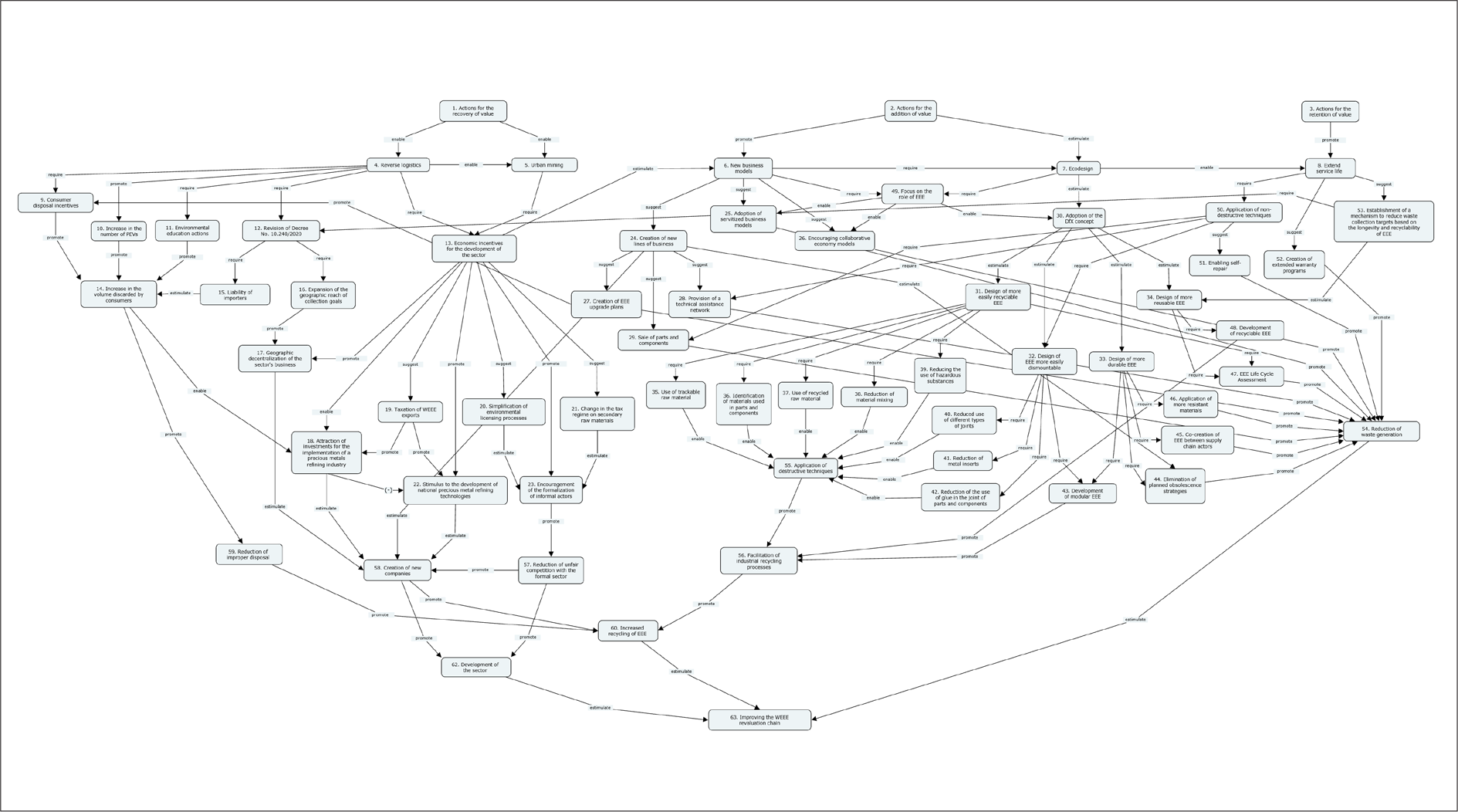
Based on the challenges mentioned by the interviewees and the potential solutions within the scope of the CE, the data from the interview transcriptions, once processed and coded, were imported into the CMAPTools® software to create individual cognitive maps, which were then consolidated using the SODA (Strategic Options Development and Analysis) approach.
In the consolidated map, three clusters of circular strategies were identified, defined as a grouping of constructs with the greatest number of connections among them, sharing a common idea or area of concern (Rieg & Araújo, 2003). The clusters identified in Figure 2, illustrated at the top of the map, relate to the theoretical framework that defines CE. They are i) actions for value recovery, ii) actions for value addition, and iii) actions for value retention. At the bottom, the constructs illustrate the final objectives or the problems that need to be overcome, as seen from the stakeholders’ perspective.

DISCUSSION
The design of EEE was identified as one of the main bottlenecks in the e-waste recovery chain in Brazil, primarily due to the lack of universal parts, the absence of material identification and classification, the use of diverse materials, material mixtures, and the use of adhesives and joints that hinder disassembly. These characteristics align with the argument made by Leal et al. (2020), who suggest that products are not sufficiently designed to be integrated into their recovery chains.
However, the feasibility of overcoming these challenges depends on revising the current regulatory framework to ensure that it contributes to overcoming the identified bottlenecks. Although during the interviews, the appropriateness of the shared responsibility model adopted in Brazil was raised in comparison to the Extended Producer Responsibility (EPR) model used in European countries, Rebehy et al. (2019) argue that the principles outlined by the BPSWM are consistent with and aligned to those observed in developed countries.
Thus, the need for a revision of the regulatory framework is justified by the convergence of the research results with the observations made by Xavier et al. (2021) about the lack of specification for quantitative targets and deadlines for implementing the principles of BPSWM by Ottoni et al. (2020) about the absence of proper RLS systems for e-waste in most cities across the country, and by Rebehy et al. (2019) about the challenges faced by the industry, namely: i) the concentration of recycling companies in the South and Southeast regions of Brazil, which increases transportation costs for waste from other regions of the country; ii) high operational costs related to logistics, material recovery, and sales; iii) the low added value of recovered items compared to the high operational costs; iv) the vast geographic dispersion of e-waste; and v) the lack of government support for selective waste collection. Furthermore, as pointed out by Guarnieri et al. (2023), a national directive focused on CE would strengthen the transition movement, which is what is expected from the bill currently under consideration in the National Congress this year. However, for effective results to be achieved, regulation and the organization and integration of stakeholders toward a common goal are essential.
The strategies for overcoming the challenges in the e-waste recovery chain cited by the interviewees involve implementing actions that enable the addition, recovery, and retention of value from EEE. Recovery actions represent essential contextual requirements or factors that improve the e-waste recovery chain, facilitating reverse logistics and urban mining processes. Value-addition actions represent solutions to meet human needs sustainably, influenced by new business models and the integration of eco-design. Finally, retention actions promote the extension of the lifespan of equipment, requiring solutions that can directly influence their design and manufacturing processes.
This focus on value maximization reflects an evolution of the CE 3.0 concept proposed by Reike et al. (2018), which highlights the potential of the Circular Economy to curb the growth in resource usage under the argument of economic gains. In this new paradigm, we see a search for the optimization of natural resources through manufacturing processes and business models integrated with new technologies, improvements in product design, targeting consumer groups, monitoring and tracking product activities; providing technical support; offering predictive and preventive maintenance; optimizing product use; upgrading products; and enhancing activities of renewal at the end of the product lifecycle (Bressanelli et al., 2018).
The State was identified as an enabler of the entire recovery chain, which includes waste pickers (whether organized in cooperatives or not), consumers, distributors, management entities, manufacturers, importers, reverse manufacturing operators, recyclers, and retailers. From an institutional perspective, mechanisms of coercive isomorphism can be effective for structuring the organizational field, provided that legitimate and effective regulation and oversight instruments are proposed (Meyer & Rowan, 1977). The reality depicted by the interviewees presents a scenario in which the absence of rationalized myths hinders the effective institutionalization of principles. Companies employing the strategies mentioned do so through proactive individual goals and a specific strategic orientation, without influencing other actors in the field through mimetic isomorphism processes.
In analyzing the challenges related to consumers, the findings of the research converge with the challenges identified in the study by Vieira et al. (2020), which examined the main barriers during the implementation of reverse logistics for e-waste from the consumer’s perspective and pointed to the lack of public education on reverse logistics as the primary challenge. As highlighted, the shared responsibility concept applied in the BPSWM, was chosen, which holds consumers accountable for the disposal of e-waste without promoting incentives from manufacturers, unlike models that extend responsibility to producers (Law No. 12,305, 2010). As a consequence, this leads to the retention (or non-disposal) of waste, preventing the flow of the chain.
Other difficulties identified by Vieira et al. (2020) regarding e-waste retailers in Brazil are still present in the recovery chain, as identified in this research: the lack of economic incentives and investments mentioned by the interviewees, as well as the lack of government economic incentives.
As pointed out by some authors during the transition to the CE, there are certain limits related to the bottlenecks identified by the interviewees, such as design, maintenance, and repair, among others (Geissdoerfer et al., 2017; Ghisellini et al., 2016). Thus, the design-related bottlenecks hinder the process in the e-waste recovery chain and, consequently, move the country further from the transition to CE, a system that has a restorative nature through design (EMF, 2015; Jesus & Mendonça, 2018). Therefore, the institutionalization of CE becomes even more important, which in Brazil is expected to occur through the national directive currently under consideration in the National Congress, the PNEC (National Circular Economy Policy). It is also noteworthy that, in September 2023, Brazil joined the Stakeholders Coalition for the transition to CE in Latin America and the Caribbean, which could also serve as a driving factor for the EEE sector to organize itself and implement CE concepts in the chain, taking reverse logistics into account from the design stage.
FINAL CONSIDERATIONS
The aim of this research was to identify the main challenges facing the Brazilian EEE waste recovery chain by conducting semi-structured interviews with stakeholders in the LRS of this type of waste in Brazil, in the context of the transition to the circular economy.
The results pointed to the existence of five different types of bottlenecks related to logistics, sector regulation, consumers, the market, and the design of electronic equipment. It is worth noting that the research employed a qualitative approach for data collection, drawing inferences from the data gathered through interviews with a sample of 12 stakeholders. Quantitative research or studies with different stakeholder samples could expand upon the results observed.
This research makes a practical contribution by identifying the key actors in the Brazilian e-waste recovery chain and their respective roles, as well as the challenges existing within this chain. The results obtained can support analysis and decision-making aimed at addressing solutions, both by private sector actors and public policymakers, in order to create a favourable environment for the transition to the circular economy in the EEE sector.
As part of the ongoing process for the institutionalization of the PNEC (in English, National Circular Economy Policy), the findings of the study point, among other things, to the need for the creation of a specific economic activity classification for recycling, strengthening the mechanisms for overseeing compliance with the provisions outlined in the sectoral agreement and its ensuing regulations, establishing collection targets for manufacturers linked to the recyclability of the equipment they inject into the national market, defining the responsibilities of importers, and including the recycling agenda in the tax reform discussions.
Future qualitative studies could explore the issue from the perspective of other problem structuring methods. Alternatively, the SODA approach could be used within a single organization (e.g., manufacturer, importer, distributor, or retailer) to structure the problem in a scenario with less actor heterogeneity. Additionally, qualitative studies could focus on analyzing the economic feasibility of implementing the proposed strategies from the perspective of businesses, as well as the viability of economic incentives and government subsidies to stimulate sector development from the perspective of public authorities.
-
Evaluated through a double-anonymized peer review.
-
The reviewers did not authorize disclosure of their peer review report.
ACKNOWLEDGMENTS
We acknowledge the Brazilian National Council for Scientific and Technological Development (CNPq) and National Coordination for the Improvement of Higher Education (CAPES) for the scholarships provided for some authors.
References
-
Agência Gov. (2024). Governo Federal lança a Estratégia Nacional de Economia Circular https://agenciagov.ebc.com.br/noticias/202406/governo-federal-lanca-a-estrategia-nacional-de-economia-circular-1
» https://agenciagov.ebc.com.br/noticias/202406/governo-federal-lanca-a-estrategia-nacional-de-economia-circular-1 -
Agência Senado. (2024). Senado aprova Política Nacional de Economia Circular; texto vai à Câmara.https://www12.senado.leg.br/noticias/materias/2024/03/19/senado-aprova-politica-nacional-deeconomia-circular-texto-vai-a-camara
» https://www12.senado.leg.br/noticias/materias/2024/03/19/senado-aprova-politica-nacional-deeconomia-circular-texto-vai-a-camara -
Anandh, G., PrasannaVenkatesan, S., Goh, M., & Mathiyazhagan, K. (2021). Reuse assessment of WEEE: Systematic review of emerging themes and research directions. Journal of Environmental Management, 287, 112335. https://doi.org/10.1016/j.jenvman.2021.112335
» https://doi.org/10.1016/j.jenvman.2021.112335 - Bardin, L. (2011). Análise do conteúdo. Grupo Almedina.
-
Bowen, G. A. (2008). Naturalistic inquiry and the saturation concept: A research note. Qualitative Research, 8(1), 137-152. https://doi.org/10.1177/1468794107085301
» https://doi.org/10.1177/1468794107085301 -
Bressanelli, G., Adrodegari, F., Perona, M., & Saccani, N. (2018). Exploring how usage-focused business models enable circular economy through digital technologies. Sustainability (Switzerland), 10(3). https://doi.org/10.3390/su10030639
» https://doi.org/10.3390/su10030639 -
Bressanelli, G., Saccani, N., Pigosso, D. C. A., & Perona, M. (2020). Circular Economy in the WEEE industry: A systematic literature review and a research agenda. Sustainable Production and Consumption, 23, 174-188. https://doi.org/10.1016/j.spc.2020.05.007
» https://doi.org/10.1016/j.spc.2020.05.007 -
Brito, J. L. R. de, Ruiz, M. S., Kniess, C. T., & Santos, M. R. dos. (2022). Reverse remanufacturing of electrical and electronic equipment and the circular economy. Revista de Gestão, 29(4), 380-394.https://doi.org/10.1108/REGE-02-2020-0011
» https://doi.org/10.1108/REGE-02-2020-0011 -
Câmara dos Deputados. (2024). Ficha de tramitação: 1.874/2022. Câmara dos Deputados. https://www.camara.leg.br/proposicoesWeb/fichadetramitacao?idProposicao=2422879
» https://www.camara.leg.br/proposicoesWeb/fichadetramitacao?idProposicao=2422879 -
Caiado, N., Guarnieri, P., Xavier, L. H., & Chaves, G. de L. D. (2017). A characterization of the Brazilian market of reverse logistic credits (RLC) and an analogy with the existing carbon credit market. Resources, Conservation and Recycling, 118, 47-59. https://doi.org/10.1016/j.resconrec.2016.11.021
» https://doi.org/10.1016/j.resconrec.2016.11.021 -
Conselho Nacional de Saúde. (2016). Resolução n. 510, de 7 de abril de 2016. Dispõe sobre a pesquisa em Ciências Humanas e Sociais. Ministério da Saúde. https://conselho.saude.gov.br/resolucoes/2016/Reso510.pdf
» https://conselho.saude.gov.br/resolucoes/2016/Reso510.pdf - Creswell, J. W., & Creswell, J. D. (2018). Research design: Qualitative, quantitative and mixed methods approaches (5a ed.). Sage Publications.
- Decreto n. 12.082, de 27 de junho de 2024.(2024). Institui a Estratégia Nacional de Economia Circular
-
DiMaggio, P. J., & Powell, W. W. (1983). The Iron Cage revisited: Institutional isomorphism and collective rationality in organizational fields. American Sociological Review, 48(2), 147-160. https://doi.org/10.1515/9780691229270-005
» https://doi.org/10.1515/9780691229270-005 - Flick, U. (2013). Introdução à metodologia de pesquisa: Um guia para iniciantes. Penso.
- Forti, V., Baldé, C. P., Kuehr, R., & Bel, G. (2020). The Global E-waste Monitor 2020: Quantities, flows and the circular economy potential United Nations University (UNU)/United Nations Institute for Training and Research (UNITAR) - Co-hosted SCYCLE Programme, International Telecommunication Union (ITU) & International Solid Waste Association (ISWA).
-
Fundação Ellen MacArthur. (2015). Circularity indicators: An approach to measuring circularity. cowes https://www.ellenmacarthurfoundation.org/assets/downloads/insight/Circularity-Indicators_Methodology_May2015.pdf
» https://www.ellenmacarthurfoundation.org/assets/downloads/insight/Circularity-Indicators_Methodology_May2015.pdf -
Fundação Ellen MacArthur. (2017). Uma economia circular no Brasil: Uma abordagem exploratória inicial.https://archive.ellenmacarthurfoundation.org/assets/downloads/languages/Uma-EconomiaCircular-no-Brasil_Uma-Exploracao-Inicial.pdf
» https://archive.ellenmacarthurfoundation.org/assets/downloads/languages/Uma-EconomiaCircular-no-Brasil_Uma-Exploracao-Inicial.pdf -
Geissdoerfer, M., Savaget, P., Bocken, N. M., & Hultink, E. J. (2017). The Circular Economy: A new sustainability paradigm? Journal of Cleaner Production, 143, 757-768. https://doi.org/10.1016/j.jclepro.2016.12.048
» https://doi.org/10.1016/j.jclepro.2016.12.048 -
Ghisellini, P., Cialani, C., & Ulgiati, S. (2016). A review on circular economy: The expected transition to a balanced interplay of environmental and economic systems. Journal of Cleaner Production, 114, 11-32. https://doi.org/10.1016/j.jclepro.2015.09.007
» https://doi.org/10.1016/j.jclepro.2015.09.007 - Gil, A. C. (2008). Métodos e técnicas de pesquisa social. In Métodos e técnicas de pesquisa social (6a ed., Vol. 264). Editora Atlas.
-
Greco, P. J., Morales, J. C. P., Aburachid, L. M. C., & Silva, S. R. da. (2015). Evidência de validade do teste de conhecimento tático processual para orientação esportiva. Revista Brasileira de Educação Física e Esporte, 29(2), 313-324.https://doi.org/10.1590/1807-55092015000200313
» https://doi.org/10.1590/1807-55092015000200313 - Green Eletron. (2021). Resíduos eletrônicos no Brasil - 2021.
- Greenwood, R., Oliver, C., Sahlin, K., & Suddaby, R. (2008). Introduction. In The Sage handbook of organizational institutionalism (pp. 1-34). Sage.
-
Guarnieri, P., Bianchini, A., Rossi, J., Silva, L. C. e, Trojan, F., Lizot, M., & Vieira, B. de O. (2023). Transitioning towards a circular economy under a multicriteria and the new institutional theory perspective: A comparison between Italy and Brazil. Journal of Cleaner Production, 409, 137094. https://doi.org/10.1016/j.jclepro.2023.137094
» https://doi.org/10.1016/j.jclepro.2023.137094 -
Guarnieri, P., Cerqueira-Streit, J. A., & Batista, L. C. (2020). Reverse logistics and the sectoral agreement of packaging industry in Brazil towards a transition to circular economy. Resources, Conservation and Recycling, 153(outubro 2020), 104541. https://doi.org/10.1016/j.resconrec.2019.104541
» https://doi.org/10.1016/j.resconrec.2019.104541 -
Guarnieri, P., Silva, L. C. e, & Levino, N. A. (2016). Analysis of electronic waste reverse logistics decisions using Strategic Options Development Analysis methodology: A Brazilian case. Journal of Cleaner Production, 133, 1105-1117. https://doi.org/10.1016/j.jclepro.2016.06.025
» https://doi.org/10.1016/j.jclepro.2016.06.025 - Hartley, K., van Santen, R., & Kirchherr, J. (2020). Policies for transitioning towards a circular economy: Expectations from the European Union (EU). Resources, conservation and recycling, 155, 104634.
-
Hermida, P. M. V., & Araújo, I. E. M. (2006). Elaboração e validação do instrumento de entrevista de enfermagem. Revista Brasileira de Enfermagem, 59(3), 314-320.https://doi.org/10.1590/s003471672006000300012
» https://doi.org/10.1590/s003471672006000300012 -
Jesus, A. de, & Mendonça, S. (2018). Lost in transition? Drivers and barriers in the eco-innovation road to the circular economy. Ecological Economics, 145(agosto 2018), 75-89. https://doi.org/10.1016/j.ecolecon.2017.08.001
» https://doi.org/10.1016/j.ecolecon.2017.08.001 -
Leal, J. M., Pompidou, S., Charbuillet, C., & Perry, N. (2020). Design for and from recycling: A circular ecodesign approach to improve the circular economy. SUSTAINABILITY, 12(23), 1-30. https://doi.org/10.3390/su12239861
» https://doi.org/10.3390/su12239861 - Lei n. 12.305, de 2 de agosto de 2010. (2010). Institui a Política Nacional de Resíduos Sólidos; altera a Lei n. 9.605, de 12 de fevereiro de 1998; e dá outras providências.
- Lieder, M., & Rashid, A. (2016). Towards circular economy implementation: a comprehensive review in context of manufacturing industry. Journal of cleaner production, 115, 36-51.
- Marconi, M., & Lakatos, E. (2003). Fundamentos de metodologia científica. Editora Atlas S. A.
-
Meyer, J. W., & Rowan, B. (1977). Institutionalized organizations: Formal structure as myth and ceremony. American Journal of Sociology, 83(2), 340-363. https://doi.org/10.1086/226550
» https://doi.org/10.1086/226550 - Modgil, S., Gupta, S., Sivarajah, U., & Bhushan, B. (2021). Big data-enabled large-scale group decision making for circular economy: An emerging market context. Technological Forecasting and Social Change, 166, 120607.
-
Mozzato, A. R., & Grzybovski, D. (2011). Análise de conteúdo como técnica de análise de dados qualitativos no campo da Administração: Potencial e desafios. Revista de Administração Contemporânea, 15(4), 761-765.https://doi.org/10.1590/s1415-65552011000400012
» https://doi.org/10.1590/s1415-65552011000400012 -
Nowakowski, P., & Mrówczyńska, B. (2018). Towards sustainable WEEE collection and transportation methods in circular economy: Comparative study for rural and urban settlements. Resources, Conservation and Recycling, 135(janeiro 2018), 93-107. https://doi.org/10.1016/j.resconrec.2017.12.016
» https://doi.org/10.1016/j.resconrec.2017.12.016 -
Ottoni, M., Dias, P., & Xavier, L. H. (2020). A circular approach to the e-waste valorization through urban mining in Rio de Janeiro, Brazil. Journal of Cleaner Production, 261, 120990. https://doi.org/10.1016/j.jclepro.2020.120990
» https://doi.org/10.1016/j.jclepro.2020.120990 - Polzer, V. R., Pisani, M. A. J., & Persson, K. M. (2016). The importance of extended producer responsibility and the national policy of solid waste in Brazil. International Journal of Environment and Waste Management, 18(2), 101-119.
-
Rebehy, P. C. P. W., Lima, S. A. dos S., Novi, J. C., & Salgado, A. P., Jr. (2019, junho). Reverse logistics systems in Brazil: Comparative study and interest of multistakeholders. Journal of Environmental Management, 250, 109223. https://doi.org/10.1016/j.jenvman.2019.06.124
» https://doi.org/10.1016/j.jenvman.2019.06.124 -
Reike, D., Vermeulen, W. J., & Witjes, S. (2018). The circular economy: new or refurbished as CE 3.0?-exploring controversies in the conceptualization of the circular economy through a focus on history and resource value retention options. Resources, conservation and recycling, 135, 246-264. https://doi.org/10.1016/j.resconrec.2017.08.027
» https://doi.org/10.1016/j.resconrec.2017.08.027 -
Rieg, D. L., & Araújo, T. de, Filho. (2003). Mapas cognitivos como ferramenta de estruturação e resolução de problemas: O caso da pró-reitoria de extensão da UFSCar. Gestão & Produção, 10(2), 145-162. https://doi.org/10.1590/S0104-530X2003000200003
» https://doi.org/10.1590/S0104-530X2003000200003 -
Santos, R. H. M., Guarnieri, P., & Streit, J. A. C. (2021). Obsolescência programada e percebida: Um levantamento sobre a percepção do ciclo de vida com usuários de aparelhos celulares. Gestão & Planejamento-G&P, 22(1), 69-86. https://doi.org/10.53706/gep.v.21.5886
» https://doi.org/10.53706/gep.v.21.5886 -
Shittu, O. S., Williams, I. D., Shaw, P., Montiero, N., & Creffield, R. (2021). Demonstrating reuse of EEE in a distinct urban mine: a case study. Detritus, 15(15), 78-93.https://doi.org/10.31025/26114135/2021.15091
» https://doi.org/10.31025/26114135/2021.15091 - Silva, E. L., & Menezes, E. M. (2005). Metodologia da pesquisa e elaboração de dissertação (4a ed.). Universidade Federal de Santa Catarina.
-
Singh, A., Panchal, R., & Naik, M. (2020). Circular economy potential of e-waste collectors, dismantlers, and recyclers of Maharashtra: A case study. Environmental Science and Pollution Research, 27(17), 22081-22099. https://doi.org/10.1007/s11356-020-08320-3
» https://doi.org/10.1007/s11356-020-08320-3 -
Souza, R. G., Rosenhead, J., Salhofer, S. P., Valle, R. A. B., & Lins, M. P. E. (2015). Definition of sustainability impact categories based on stakeholder perspectives. Journal of Cleaner Production, 105, 41-51. https://doi.org/10.1016/j.jclepro.2014.09.051
» https://doi.org/10.1016/j.jclepro.2014.09.051 -
Svensson-Hoglund, S., Richter, J. L., Maitre-Ekern, E., Russell, J. D., Pihlajarinne, T., & Dalhammar, C. (2021). Barriers, enablers and market governance: A review of the policy landscape for repair of consumer electronics in the EU and the U.S. Journal of Cleaner Production, 288, 125488. https://doi.org/10.1016/j.jclepro.2020.125488
» https://doi.org/10.1016/j.jclepro.2020.125488 - Thompson, S. (2012). Sampling (3a ed.). Wiley.
-
Vidal, R. V. V. (2005). Soft or approaches. Engevista, 7(1), 4-20. https://doi.org/10.22409/engevista.v7i1.153
» https://doi.org/10.22409/engevista.v7i1.153 -
Vieira, B. D. O., Guarnieri, P., Silva, L. C. e, & Alfinito, S. (2020). Prioritizing barriers to be solved to the implementation of reverse logistics of e-waste in Brazil under a multicriteria decision aid approach. Sustainability, 12(10), 4337. https://doi.org/10.3390/su12104337
» https://doi.org/10.3390/su12104337 -
Xavier, L. H., Ottoni, M., & Lepawsky, J. (2021). Circular economy and e-waste management in the Americas: Brazilian and Canadian frameworks. Journal of Cleaner Production, 297, 126570.https://doi.org/10.1016/j.jclepro.2021.126570
» https://doi.org/10.1016/j.jclepro.2021.126570
Edited by
-
Guest editors:
Susana Carla Farias Pereira, Simone Sehnem, Ana Beatriz Lopes de Sousa Jabbour, Valentina Gomes Haensel Schmitt and, Fanny Saruchera


 Source: Developed with CMAPTools® software.