 THE INFORMATION CONTENT OF LOSSES VERSUS PROFITS AND THE DENOMINATOR EFFECT OF RISK
ABSTRACT
In this paper, we investigate the information content of losses and the denominator effect of risk on earnings informativeness. The information content of losses tends to be lower than profits since the firms’ market value is better explained by liquidation value rather than earnings news. Similarly, earnings of high-risk firms tend to be less informative since risk influences the discount rate of valuation models. Through a sample of 436 Brazilian public firms (4,086 firm-year observations), the results demonstrate that risk influences how earnings from companies reporting losses and profits are perceived, showing that losses are less informative than profits for low and medium-risk firms, while this difference disappears for high-risk firms. We attribute these results to the explanation of the liquidation or abandonment option, which is corroborated by our analyses. We also tested two alternative explanations for the low informativeness of losses (accounting conservatism and hidden assets) and observed that neither of the explanations are corroborated by our findings. Our results contribute to accounting and finance literature, providing evidence that high-risk firms are valued similarly to loss firms in terms of earnings informativeness, which has not been previously demonstrated.
Keywords:
earnings response coefficient; loss; earnings news; risk; liquidation option
RESUMO
Este estudo investiga o conteúdo informacional dos prejuízos e o efeito denominador do risco na informatividade dos lucros. O conteúdo informacional dos prejuízos tende a ser menor do que o dos lucros, visto que o valor de mercado dessas empresas pode ser mais bem explicado pelo valor de liquidação do que pelas boas e más notícias contidas no lucro. Da mesma forma, os lucros de empresas de alto risco tendem a ser menos informativos, pois o risco influencia a taxa de desconto dos modelos de valuation. Por meio de uma amostra de 436 empresas brasileiras de capital aberto (4.086 observações anuais), verifica-se que o coeficiente de resposta aos lucros (ERC) dos prejuízos reportados é menor do que o dos lucros apenas para empresas de baixo e médio risco. Para empresas de alto risco, não há essa diferença. Também são testadas duas explicações alternativas para a baixa informatividade dos prejuízos (conservadorismo contábil e ativos ocultos), que não são corroboradas pelos principais achados. Esses resultados contribuem para a literatura de contabilidade e finanças, fornecendo evidências de que empresas de alto risco são avaliadas de modo semelhante a empresas com prejuízo em termos de informatividade dos lucros, o que ainda não havia sido demonstrado anteriormente.
Palavras-chave:
coeficiente de resposta aos lucros; prejuízo; notícias nos lucros; risco; opção de liquidação
RESUMEN
Este estudio investiga el contenido informativo de las pérdidas y el efecto del denominador del riesgo en la informatividad de las ganancias. El contenido informativo de las pérdidas tiende a ser menor que el de las ganancias, ya que el valor de mercado de estas empresas se explica mejor por el valor de liquidación que por las noticias de las ganancias. De manera similar, las ganancias de las empresas de alto riesgo tienden a ser menos informativas, ya que el riesgo influye en la tasa de descuento de los modelos de valoración. A través de una muestra de 436 empresas brasileñas de capital abierto (4.086 observaciones año-empresa), se observa que el coeficiente de respuesta a las ganancias (ERC) de las pérdidas reportadas es menor que el de las ganancias solo para empresas de bajo y mediano riesgo, mientras que para las empresas de alto riesgo tal diferencia desaparece. También se prueban dos explicaciones alternativas para la baja informatividad de las pérdidas (conservadurismo contable y activos ocultos). Estos resultados contribuyen a la literatura de contabilidad y finanzas, proporcionando evidencia de que las empresas de alto riesgo son valoradas de manera similar a las empresas con pérdidas en términos de la informatividad de las ganancias, lo cual no había sido demostrado previamente.
Palabras clave:
coeficiente de respuesta a las ganancias; perdidas; noticias en las ganancias; riesgo; opción de liquidación
INTRODUCTION
The identification of firms that report profit (hereafter, profit firms) and those that report losses (hereafter, loss firms) offers a fundamental view on the viability of business activities since losses cannot be sustained forever (Kettunen et al., 2021). The literature has documented that losses are less informative than profits for three main reasons: (1) liquidation or abandonment implies that the liquidation value of loss firms explains their market value better than earnings news (Hayn, 1995; Joos & Plesko, 2005); (2) losses driven by accounting conservatism make earnings less persistent and then less informative (Basu, 1997; Gu et al., 2023; Kothari, 2001); and (3) losses are common in firms with hidden assets, in which current earnings may have a small or even a negative relation with stock returns (Darrough & Ye, 2007; Jiang & Stark, 2013; Wu et al., 2010).
More recently, Barth et al. (2023) document that accounting earnings (the bottom-line of income statements) have declined in relevance, whereas other elements of financial statements have increased. Prior literature partially explains the lower informativeness of earnings by the reporting of losses (Gu et al., 2023, Lawrence et al., 2018; Srivastava, 2023) and the firm’ risk levels (Ariff et al., 2013; Chambers et al, 2005). However, there is still a lack of studies that explore the interactive effect of risk and loss-reporting on earnings informativeness since these components simultaneously affect the decision-making process of investors and portfolio managers in capital allocation and regulators in defining public protection, particularly in emerging countries, such as Brazil, which is characterized by high levels of risk, uncertainty, and governmental protectionism, and low levels of financial disclosure and governance.
Specifically, Brazil often adopts official loan programs to provide liquidity to firms, which can prolong loss reporting, as documented in the international literature (Acharya et al., 2019, Caballero et al., 2008, Zoller-Rydzek & Keller, 2020). For example, in 2016, the Brazilian Development Bank (BNDES), an official federal institution, announced the creation of a BRL 5 billion line to allow the purchase of companies in financial difficulty and undergoing judicial recovery, while the bank, at that moment, was already creditor of at least five of the largest judicial recovery processes in Brazil (Rosa, 2016). More recently, to deal with the consequences of the COVID-19 pandemic, the BNDES contributed BRL 154.8 billion to the Brazilian economy in 2020, which represents 2.1% of the Brazilian GDP of the same year and includes loans and guarantees for businesses (Barboza et al., 2021).
This paper provides a novel investigation of the difference between the information content of losses versus profits and the simultaneous effect of risk on this difference. By using a sample of 436 Brazilian public firms from 2001 to 2021 (4,086 firm-year observations), we find that the information content of losses, captured by the Earnings Response Coefficient (ERC) (i.e., how strongly stock prices respond to earnings) is lower than the information content of profits for firms with a low and medium level of risk, which is consistent with previous literature (Hayn, 1995; Joos & Plesko, 2005).
We also find a negative association between risk and ERC, consistent with previous literature indicating that the information content of riskier firms is lower (Ariff et al., 2013, Pimentel, 2015). This result can be explained by the effect of risk on ERC that stems from the dividend-based model of firms’ value. Firm risk can affect both the numerator and denominator of the dividend model, which can create a positive association (numerator effect) or negative association (denominator effect) between risk and ERC. Nevertheless, we find that, in Brazil, the denominator effect overlaps the numerator effect, which means that risk is negatively related to ERC, which is different from Chambers et al. (2005) results in the United States. Additionally, our results support the notion that the difference between the ERC of losses and profits decreases when firm risk increases. This evidence explains how investors assess high-risk firms under a denominator effect, in which the effect of risk on the discount rate is so high that the valuation of these firms is similar to the valuation of loss firms, i.e., ERC is zero.
We also conducted two analyses for the alternative explanations for the low informativeness of losses. First, we tested whether conditional conservatism could be the main explanation of our evidence. We used the persistence model of conditional conservatism proposed by Basu (1997) to analyze the association between losses and conditional conservatism. Even though negative earnings news is, on average, higher for loss firms, we found that they exhibit a lower degree of conditional conservatism. This shows that the low information content of losses does not primarily come from conservative financial reporting practices. Second, we tested the hidden assets explanation for the information content of losses. We used two proxies (listing age and industry) and found that neither variable explained ERC in loss firms. This suggests that the main driver of our results is the explanation of the liquidation or abandonment option.
By providing evidence of the informational differences between losses and profits and the role of risk in this relation, the results documented in this paper contribute to earnings informativeness literature in emerging economies, such as the Brazilian case, which tend to adopt protectionist and welfare policies (Teles & Mussolini, 2012). We also contribute to explaining the valuation of loss and high-risk firms, which can be substantially different from profitable and low-risk firms. Prior literature has documented the role of persistence (Pimentel & Aguiar, 2016), size (Miralles-Quiros et al., 2017), and extreme daily returns (Berggrun et al., 2019) on the valuation strategies of Brazilian investors. However, to the best of our knowledge, no previous study has addressed the liquidation value issue in emerging economies from the perspective of loss report and risk, and it is also an open research venue to international literature. We also extend previous literature by addressing the difference in risk-ERC relation of losses versus profits. Where previous studies are focused on developed markets, where investors’ protection tends to be higher and, therefore, both earnings and stock prices tend to be more informative (Cahan et al., 2009; DeFond et al., 2007), our results corroborate the international notion that abandonment (or adaptation) is the main explanation for the information content of losses, which is consistent with a small presence of knowledge-based economy (i.e., less hidden assets) in less developed countries (Barkhordari et al., 2019; Carlsson et al., 2009).
RELATED LITERATURE AND HYPOTHESES
Informativeness of loss
The recurrent losses condition has theoretical and practical consequences requiring specific approaches to assess firms’ value (e.g., liquidation value). Some aspects of the valuation of profit firms may not apply to loss firms (Darrough & Ye, 2007; Hayn, 1995; Wu et al., 2010), forcing special considerations for academics and practitioners. Loss firms can operate for long periods due to (1) the expectation of loss-reversal to long-term future benefits, especially in small and early-stage life cycle firms (Klein & Marquardt, 2006), or due to (2) social, economic, and political costs involved with firms’ bankruptcy (Cárdenas, 2021). Specifically, official institutions may implement protectionist policies and survival actions to mitigate these social, economic, and political costs, thus entering a vicious cycle (Amato & Fantacci, 2016; Cárdenas, 2021). These protectionist and welfare policies provided by official institutions tend to generate political gains for institutions and politicians, especially in countries where poverty and inequality are significant, such as the case of the Brazilian economy (Teles & Mussolini, 2012). Accounting literature provides three main explanations for the information content of losses discussed here: (1) Abandonment/adaptation, (2) hidden assets, and (3) conditional conservatism. These explanations are not mutually exclusive but we address some aspects of them in our analyses.
According to Hayn (1995), “losses are likely to be considered temporary since shareholders can always liquidate the firm rather than suffer from indefinite losses” (p. 126). Specifically, this liquidation, or abandonment, implies that equity holders can sell their shares at a price commensurate with the market value of the net assets of the firm and that “when a loss is reported, the stock price will not necessarily drop to zero nor decline proportionally to the change in earnings” (Hayn, 1995, p. 127). Consequently, observed losses are temporary because only firms expecting to improve their operations will survive (or continue in the market) and revert to poor performance over time (Kothari, 2001).
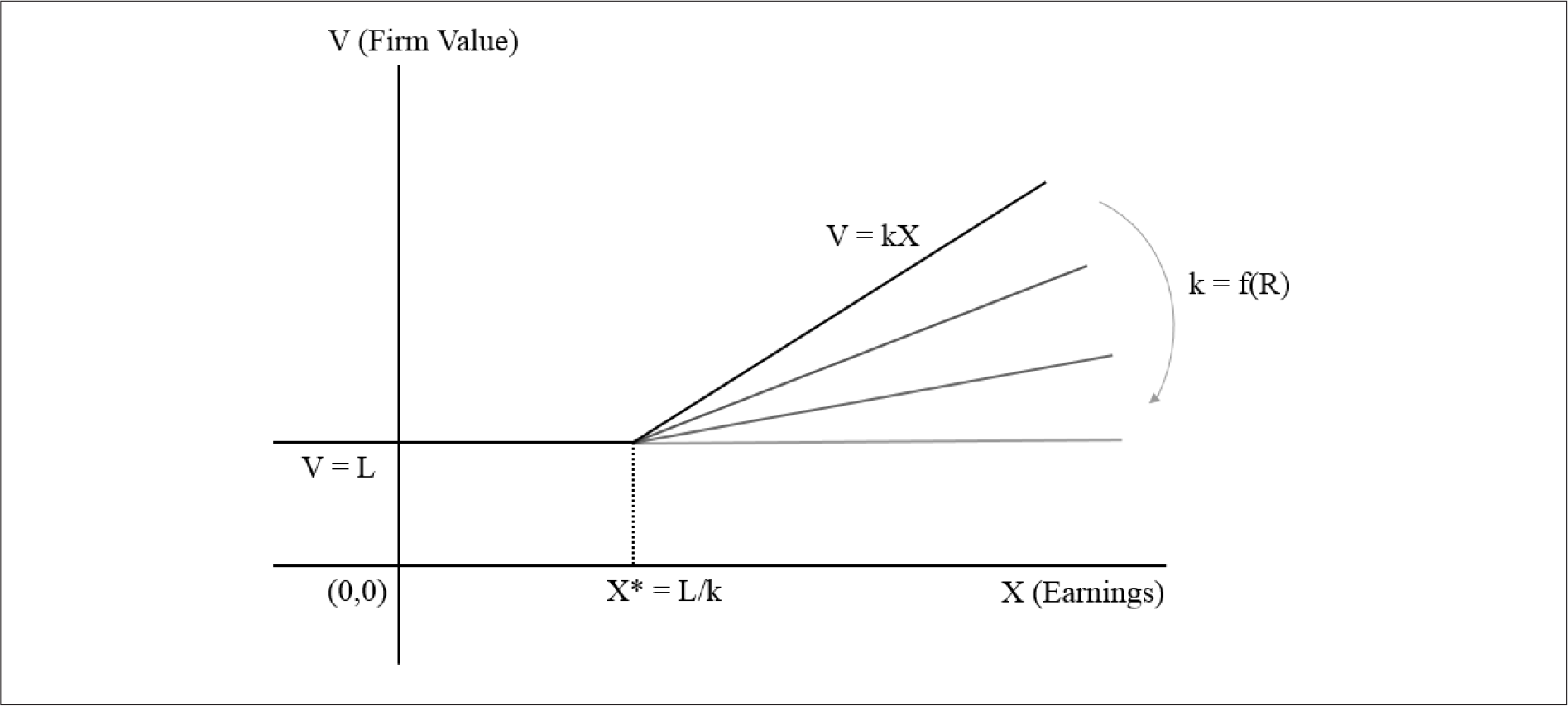
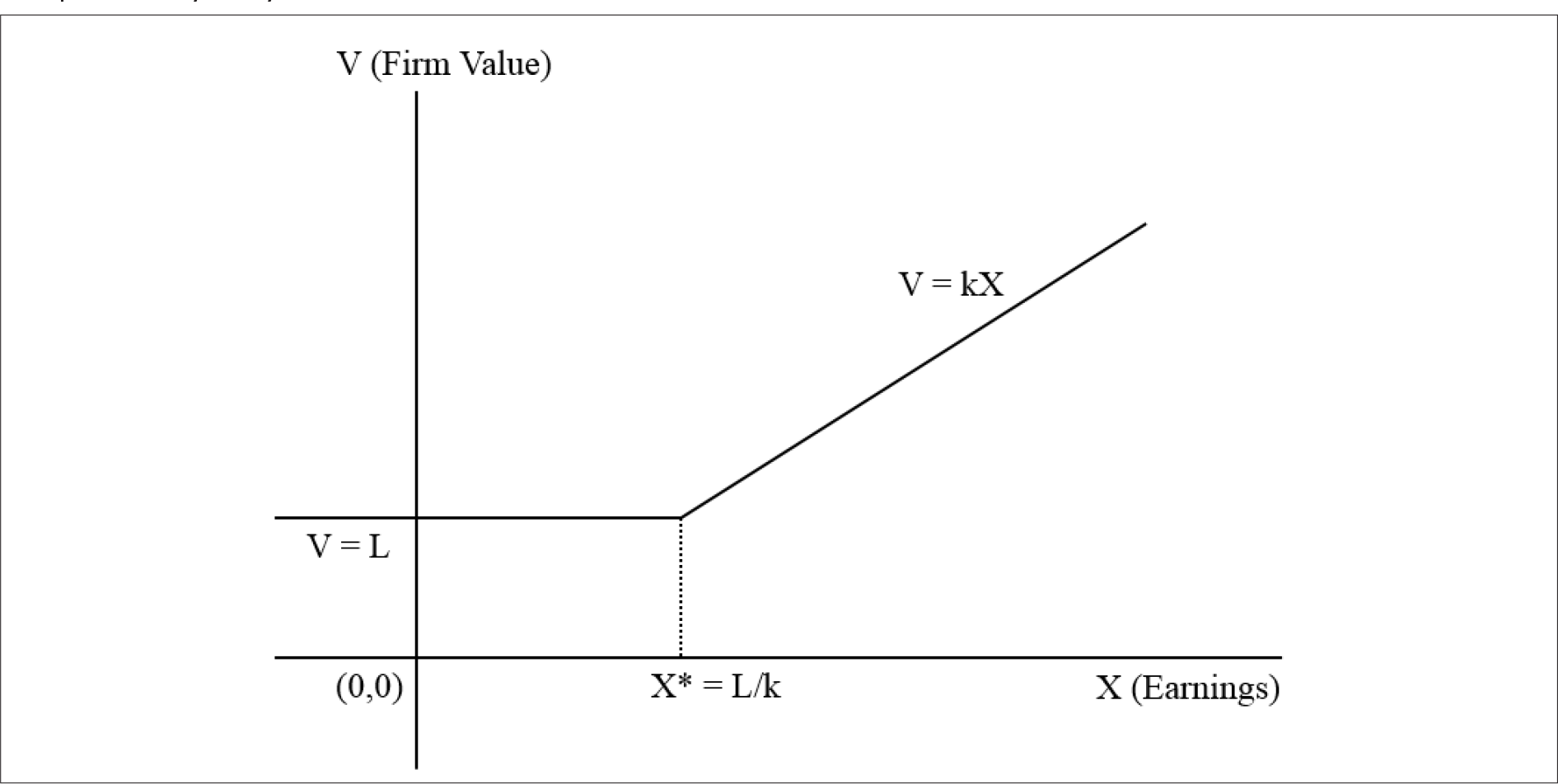
The explanation proposed by Hayn (1995) is formulated in a simple model in which the firm’s value, V, is determined by its earnings, X, or its liquidation value, L, when the level of expected earnings is below the level of earning in which liquidation option is triggered, X*. Figure 1 illustrates this model.

Relation between Firm Value and Earnings in the Presence of a Liquidation Option L Proposed by Hayn (1995)

The abandonment option proposed and evidenced by Hayn (1995) is corroborated in several other studies. Berger et al. (1996) and Collins et al. (1999) find that investors assess firms under abandonment option through book value of equity (rather than future cash flows), which explains the low association between earnings and stock price in loss firms. Burgstahler and Dichev (1997) expanded Hayn’s (1995) findings with their adaptation hypothesis, in which firms tend to adapt their resources when the book value is close to the market value of net assets. In this condition, current earnings tend to be less informative, and the liquidation value turns out to be the base of firm value since the current use of net assets is less likely to persist. Moreover, Joos and Plesko (2005) find that investors assess the probability of losses being reversed and that earnings news is more relevant for investors’ valuation to the extent that this probability increases.
Another branch of studies argues that the low information content of losses is not always caused by firms that are facing liquidation or financial distress as abandonment and adaptation proposes suggest, but it is rather a consequence of a knowledge-based economy (Darrough & Ye, 2007; Jiang & Stark, 2013; Wu et al., 2010). From this perspective, a good indicator of the future profitability of these firms is the so-called “hidden assets” (i.e., intangible assets not recognized in the balance sheet), which is a more relevant source of information for firms’ valuation. Nevertheless, even from this perspective, current earnings are not a good indicator of future performance, and earnings news tends to be less informative or negatively related to future profitability. Darrough and Ye (2007) document that research and development (R&D) expenditures, nonrecurring charges, the sales growth ratio, and business sustainability proxies are value-relevant items for loss firms in the US market. Additionally, Jian and Stark (2013) find that the book value of loss firms has a lower valuation weight as both R&D intensity and dividend payments increase, suggesting that the abandonment option does not fully explain the information content of losses. Moreover, Klein and Marquardt (2006) show that nonaccounting factors, such as real firm performance, market coverage, and business cycle, tend to play the dominant role in explaining accounting loss factors.
Since accounting recognition criteria have evolved to anticipate losses, but not gains, losses are recognized more often and more quickly by accounting systems, and this early recognition approximates recognition of the market value of firms compared to gains (Ball et al., 2000; Basu, 1997; Martinez et al., 2022), reinforcing that accounting losses tend to be transitory (less permanent) and thus induces negative autocorrelation in earnings (Kothari, 2001). More recently, Srivastava (2023) and Gu et al. (2023) have documented that the low information content of losses comes from intangible-driven losses, in which firms must recognize intangible investments as expenses due to conservative accounting practices. These arguments suggest that the low information content of losses can be related to accounting conservatism (Klein & Marquardt, 2006). Moreover, recent empirical evidence analyzes a variety of implications of accounting losses; for instance, Kettunen et al. (2021) show that employee retention contributes to loss reversal of poor-performance firms, and Ghosh and Wang (2019) document that losses are positively associated with CEO turnover and increasing in board activity, therefore, declining performance calls for strong actions and CEOs have incentives to avoid losses, including by managing earnings. However, Lawrence et al. (2018) argue that conservatism of losses is also an empirical implication of the adaptation hypothesis to the extent that adaptation involves real reductions in working capital that lead to negative accounting accruals.
Based on the three main explanations: (1) abandonment/adaptation option, (2) hidden assets, and (3) conditional conservatism, we argue that current earnings are less informative for loss firms in comparison with profit firms. Following the previous literature and assuming that ERC is usually positive for average firms, we establish our first hypothesis, proposing that ERC is lower for loss firms in relation to profit firms, which indicates that losses are less informative than profit assuming that ERC of profit firms are, on average, positive. Hence, we establish the first hypothesis as follows:
-
H1: ERC is lower for loss firms than profit firms.
Earnings response coefficient, risk, and loss effect
The literature evidences that ERC is negatively associated with firm risk (Ariff et al., 2013; Pimentel, 2015). This is consistent with the notion that “since investors look to current earnings as an indicator of future firm performance and share returns, the riskier these future returns are, the lower investors’ reaction to a given amount of unexpected earnings will be” (Scott, 2015, p. 163-164).
However, this relationship is not as clear as it seems. Systematic risk can also be associated with earnings news informativeness since it increases the stock returns’ sensibility when announcing firms (Savor & Wilson, 2016). Moreover, information risk can increase market reaction to earnings news since it contributes to the price discovery process (Zhang et al., 2013). Based on these perspectives, earnings news has a bigger impact on the stock prices of riskier firms since, for these firms, the market reaction tends to be higher per unit of earnings surprise (Zhang et al., 2013).
Chambers et al. (2005) summarize these two contrasting views of the risk and ERC relationship into the numerator and denominator effects. These terms are a reference to the standard valuation model, in which expected dividends are discounted at risk-adjusted rates, as follows:
Where
Pit (yt) = price of firm i at time t, given yt,
Et (dit |yt) = date t expectations of future dividends, given yt,
yt = a particular information set,
ri = the risk-adjusted discount rate for firm i.
The numerator effect of risk on ERC comes from its influence on the impact of dividend revisions on stock price captured by Et (dit |yt). On the other hand, the denominator effect comes from the influence of risk on the discount rate captured by ri. Pimentel (2015) documents that in Brazil, the denominator effect overlaps the numerator effect, which explains a negative association between total risk and ERC. However, the implication of the abandonment option hypothesis is that the firm value is better assessed by the liquidation value of net assets rather than the future earnings expectations when it comes to loss firms. As the relationship between the firm risk and ERC is based on the dividend model, for loss firms, this relation tends to be zero since liquidation value is a better predictor of firm value (Hayn, 1995; Joos & Plesko, 2005).
We formulate this relation, including the risk effect in Hayn’s (1995) simple model of the relation between earnings and firm value and assuming a denominator effect of risk on ERC. In a model in which the ERC of profit firms, k, decreases with risk, R, the difference between the ERC of losses versus profits also decreases with risk.
Thus, the second hypothesis is proposed in a parsimonious form as follows:
-
H2: The difference between ERC of losses versus profits is less pronounced in riskier firms.
The “denominator effect” represents the influence of risk on the discount rate, which adjusts the present value of future earnings and dividends. By contrast, the “numerator effect” reflects the impact of risk on the earnings themselves, particularly through revisions to expected dividends. Our work adds to understanding how risk influences the stock price reaction to earnings news, especially in firms experiencing losses or financial distress. This framework allows us to propose new hypotheses regarding the differential impact of earnings news in high-risk firms, thus advancing the literature by highlighting how market reactions to earnings surprises vary based on a firm’s risk profile. Furthermore, the study addresses a gap in the literature regarding the role of risk in shaping the informativeness of earnings, especially in high-risk contexts where traditional valuation models may be less effective.
EMPIRICAL APPROACH
Sample
Our sample comprises all Brazilian public firms from 2001 to 2021. We collected all data from the Economatica® database. The first dataset comprised 856 firms. After excluding missing data, the final sample comprises 436 firms (4,086 firm-year observations). A substantial part of missing values come from stock price variables due to liquidity issues or simply because they were not public firms in the whole sample period. We kept banks in our sample since the liquidation option explanation also applies to them, and our main variables are not differently calculated for the financial industry compared to other industries. However, we also ran additional analyses excluding banks and the results were qualitatively the same as those presented in the tables.
Regression model
ERC is estimated by a regression model where unexpected earnings (UX) explain unexpected returns (UR). The coefficient on UX estimates the relationship between earnings news and firm value as follows:
In Equation 2, i and t index firm and year, respectively. Following previous research, UX is the unexpected earnings, which is measured as the change in earnings from year t-1 to t deflated by the stock price of the firm i at the end of the year t (Basu, 1997; Pimentel, 2015). UR is the unexpected return on firm i from 9 months before year-end t to three months after year-end t. The UR measurement details are provided in the following section. β2 captures the ERC. Unlike Hayn (1995), who uses stock returns and earnings, we use unexpected returns and earnings news to eliminate the earnings’ offsetting on cash flow news and discount rate news, as documented in Li (2020). By using earnings surprises (instead of earnings), we aim to exclude the part of earnings that was already incorporated in the stock prices due to market efficiency. Moreover, by using unexpected returns, we also isolate the part of the market reaction that is idiosyncratic (specific to the firm), following the notion of the market model.
In order to test our research hypotheses, we include moderating effects in Equation 2. As ERC is a parameter of the model, the moderating effects allow us to test the determinants of ERC. First, we include a binary variable for loss reporting as an indicator that the liquidation value is higher than the expected value of earnings (Hayn, 1995) and then the total risk variable (Chambers et al., 2005; Pimentel, 2015). Following previous literature (Mian & Sankaraguruswamy, 2012; Pimentel, 2015), we also include a set of control variables associated with ERC. Then we estimate Equation 3:
In Equation 3, i and t index firm and year respectively. UR and UX are calculated as previously mentioned. LOSS is a binary variable equal 1 if the firm i reports a loss in the year t and zero otherwise. TRK is the ranked firm’s total risk. Unlike Hayn (1995), who uses bond rating as a measure of firm risk, which has empirical limitations as acknowledged by the author, we use the variance of the stock returns. The control variables include firm size (SIZE), market-to-book ratio (MTB), earnings volatility (EVOL), and IFRS mandatory adoption (IFRS). All variables included in Equation 3 interact with UX to test their relationship with ERC (i.e., moderating effect).
Our first hypothesis (H1) is that losses and ERC are negatively related, which is captured by the β4 parameter in Equation 3. Assuming that β2 is positive, a negative β4 indicates that losses are less informative than profits since β4 captures the difference in ERC of losses over profits, i.e., whether β4 > 0, the average ERC of losses (β2 + β4) is necessarily lower than profit (β2) since for all β2 + β4 > 2 for all β4 > 0. The interaction between UX and TRK (β6) measures the relationship between TRK and ERC, which captures the denominator effect of risk on ERC.
Our second hypothesis (H2) is that the TRK moderates the relation between ERC and LOSS. We test H2 in two ways. First, we run Equation 3 by subsamples based on the quintiles of the TRK variable. Moreover, we also estimate Equation 4, which interacts UX, TRK and LOSS to capture the moderating effect of TRK on UX × LOSS, as follows:
In Equation 4, TRK moderates the relationship between LOSS and ERC. This moderating effect is captured by the β8 parameter. A negative β8 indicates that the difference between ERC of losses versus profit decreases as TRK increases.
Table 1 reports the definition of the variables necessary for estimating the regression models.
Measuring unexpected returns
Unexpected returns are measured as the difference between the expected annual stock return and the annual stock return. The expected return is estimated through the market model as follows:
In Equation 5, the expected stock return is the predicted stock return using the market return (Rm) and the estimated α and β. Thus, ɛ represents the difference between the expected stock return and the stock return (Ri), i.e., the unexpected return. Then, Equation 5, the market model, falls into the following components:
Rit = Stock Return
E(R)it = αit+ βit Rmt = Expected Stock Return
ɛit = Unexpected Stock Return (UR)
Following previous literature (Chambers et al., 2005; Collins & Kothari, 1989), we estimate Equation 5 using monthly returns of the 48 months previous April of the year t, accepting at least 24 monthly returns to estimate the parameters α and β. Thus, the parameters of Equation 5 vary across years and firms. Specifically, monthly returns capture the long-term association between marker and stock-specific, and beta measured by daily returns can be biased (Collins & Kothari, 1989; Scholes & Williams,1977).
RESULTS
Descriptive analysis
Table 2 reports the descriptive analysis of all variables used in our study by loss and profitable firm-year observations. Loss firm years represent 26% of all observations in our sample.
UR and UX are strongly affected by outliers, creating high standard deviations and distorting means substantially. Therefore, we conduct a winsorization at 1% of both variables. TRK mean is significantly higher for loss firm years (p-value < 0.05), consistent with the notion that total risk and reporting losses are correlated. Regarding rank, the mean and median of TRK are in the lower (upper) half of the rank distribution of total risk for loss (profitable) firm years.
We conduct an analysis of the persistence of loss reporting within firms. Table 3 summarizes the main results of this analysis. Each row presents the number of firms according to the respective level of persistence of losses and the average risk of each group of firms. The first row (All) presents the number of firms that reported loss in all periods that these firms were included in our sample, while the last row (None) presents the number of firms that reported profits in all periods that these firms were included in our sample.
Our sample comprises 436 firms. 8% of these firms reported losses in all periods, and 61% (100-39) reported losses, at least, in one reported earnings. The average risk of the firms increases with the persistence of losses. Firms that only reported profits have an average TRK significantly lower (0.35) than firms that only reported losses (0.86).
ERC of loss firms versus profit firms
Table 4 reports the first regression models that aim to test H1 regarding the lower information content of losses over profits. We first estimate the average sample ERC (1), then we include LOSS and its interaction with UX (2), controls (3) and run the model in a subsample without banks (4).
The coefficient on UX, which captures the ERC, is positive and statistically significant in all models. Its average value (0.042) increases to 0.073 with the inclusion of LOSS and its interaction term (2) and to 0.284 with the inclusion of all control variables (3). H1 is supported in models 2 and 4 since UX × LOSS coefficient is negative (p-value < 0.05). It is not supported in model 3, which includes all control variables and all firms. In model 2, the coefficient on UX captures the average ERC of profit firms (0.073), while the coefficient on UX × LOSS captures the difference between the ERC of losses over profits (-0.055). Thus, the ERC of loss firms is the sum of these coefficients (0.018), which is not statistically significant. This is consistent with Hayn (1995) since loss firms are evaluated by its liquidation value and earnings news is not informative for those firms. However, the difference in ERC of losses versus profits is strongly driven by our control variables since it disappears after control for them. Moreover, the coefficient on UX × TRK is negative (p-value < 0.10), which is consistent with Pimentel (2015) for the Brazilian context, in which the denominator effect overlaps the numerator effect of risk on ERC.
To analyze the interaction of risk and losses, we run the model by subsamples based on TRK quintiles. Table 5 reports the results of this analysis.
Table 5 shows that in the lowest TRK quintiles (1, 2, and 3), where ERC is higher due to the lower effect of risk on the discount rate, there is evidence of a difference between the ERC of losses versus profits captured by the coefficient on UX × LOSS, corroborating H1. However, as risk increases, the ERC of profit firms decreases and gets close to the ERC of loss firms, and the difference is zero, as shown in the highest TRK quintiles (4 and 5), which is consistent with H2.
Table 6 reports the complete specification of our regression model, which is based on the notion that the difference between ERC of losses versus profits decreases with risk. We run the model with the triple interaction (UX × LOSS × TRK) without control variables (1), then controlling for fixed effects (2), with all controls (3), and for a subsample without banks (4).
We also run a model with a squared term of TRK (untabulated), and the results are the same as our main results. In model 3, UX × LOSS captures the difference between the ERC of losses over profits (H1) when TRK is equal to zero, i.e., the lowest TRK value of our sample. For this level of risk, the estimated difference between ERC of losses over profits is -0.669 (p-value<0.01). When TRK is equal to 1, i.e., the highest TRK value of our sample, the estimated difference between ERC of losses versus profits changes to 0.098 (0.767-0.669). Consistent with H2, under the denominator effect of risk on ERC, as TRK increases, the difference between ERC of losses versus profit decreases.
Conditional conservatism and losses
Basu (1997) finds that negative earnings news has less information content than positive earnings news. He argues that accounting systems tend to recognize bad news timelier than good news which introduces a higher degree of transitoriness into negative earnings news. Our analysis focuses on reporting losses, which does not necessarily imply a higher degree of conservatism. However, in our sample, earnings news is negative on average for loss firm years and positive on average for profitable firm years (Table 2). If loss firms exhibit a higher degree of conditional conservatism, then the transitory components introduced by conservative practice could drive our results. Thus, we include an analysis of the association between conditional conservatism and losses.
We adopt the persistence model of accounting measures conditional on news proposed by Basu (1997) to test the association between conditional conservatism and losses because this model focuses on the transitoriness consequence of conservative practices (Martinez et al., 2022). The model tested whether negative earning news is less persistent (more transitory) than positive earnings, and it is established as follows:
Equation 6 measures the level of transitoriness of earnings news (UX) through an autoregressive analysis in which UX is the dependent variable and lagged UX is an independent variable. The model differentiates positive from negative UX through a binary variable (NEG) equal to 1 if UX is negative and zero otherwise. When β4 is negative, negative UX has a higher reversion tendency attributed to conservative practices. We include a binary variable (LOSS) into the model that indicates loss firm years to test the association between losses and conditional conservatism. We also run a second model with three control variables related to conservatism: size, market-to-book, and IFRS adoption. All variables are defined in Table 1. Table 7 reports the results.
The coefficient that captures the differential tendency of reversion of earnings news (β4) indicates that negative earnings news is less persistent than positive earnings news (β4 = -0.013 (1); p-value<0.01) which is consistent with Basu (1997) and corroborates that financial reporting is conservative on average. β8 indicates the association between conditional conservatism and losses. A positive (negative) value of β8 suggests that losses and conservatism have a negative (positive) association. Thus, our results indicate that loss observations are less conservative than profitable ones (β8 = 0.028 (2); β8 = 0.181 (3); p-value < 0.01). This result does not support the notion that loss firms tend to be more conservative, suggesting that our results regarding the low information content of losses do not come from conditional conservatism. It is important to stress that this model does not test the value-relevance of conservative practices, which is not in the scope of our study. Instead, we test whether conservatism is the main factor explaining our previous results, which does not seem to be the case. However, based on previous literature, it is still plausible that conservatism explains ERC variability within loss firms. However, based on our results, it is not plausible that conservatism explains the low information content of losses in relation to profits.
Hidden assets and losses informativeness
Recent literature regarding the informativeness of losses claims that the low ERC of losses also stems from firms that are expanding their business and adopting strategies to increase market share, develop new products or product differentiation, increase advertising, etc. (Darrough & Ye, 2007; Jiang & Stark, 2013; Wu et al., 2010). Those firms report losses as a consequence of strategies that aim to increase earnings in the long term instead of financial distress or bankruptcy. Thus, the increase in losses may indicate better performance in the future and may produce a negative association between ERC and losses. It is important to note that this explanation is also related to accounting conservatism since losses reported under these conditions are a consequence of the non-recognition of the so-called hidden assets or intangibles.
Nevertheless, we analyze the hidden assets hypothesis for the low informativeness of losses using dummies for listing age and industry. Firms that were recently listed tend to expand their activities, which may trigger the mentioned strategies. Moreover, some industries tend to invest in hidden assets (e.g., R&D investments) more than others. This can be used to differentiate firms that report losses because of hidden assets, financial distress, or liquidation. Thus, we use a binary equal to 1 whether the firm industry is one of the four major sectors in R&D investment according to the 2022 EU Industrial R&D Investment Scoreboard and zero otherwise. Table 8 reports the results for both analyses.
Neither test was significant, which suggests that the hidden assets explanation is not driven our results, and it is more likely that the liquidation or abandonment option is the main reason losses are less informative in Brazil.
CONCLUSION
The increasing number of firms reporting losses demands more studies on how investors assess these firms. Our study explores key aspects of the informativeness of losses and risky firms in an emerging market context and sheds light on mechanisms not previously addressed. Particularly, by including the effect of risk in Hayn’s (1995) explanation for the differences between losses and profit informativeness, we propose and find that risk decreases the difference between losses and profit information content. Thus, unlike in developed markets, in Brazil, the average ERC may be low due to the joint effect of risk and loss reporting.
One of the consequences of these results is showing that valuation models, directly or indirectly based on current earnings trends, may underperform valuation models based on the liquidation value. Investors are not willing to negotiate a stock based on its value calculated on future earnings discounted by risk when this value is lower than the liquidation value. Thus, our study highlights the importance of liquidation value in conditions where the two main factors that can decrease earnings informativeness change: persistence/sustainability (connected to the notion of temporary losses) and risk (associated with the discount applied to future earnings). Moreover, the relevance of liquidation value is not only associated with a reduction in earnings informativeness but also a potential increase in the informational capacity of other financial statement elements, such as the book value of equity, which can serve as a crucial base for establishing a liquidation value.
In summary, this study provides a nuanced perspective on the valuation of loss-reporting and high-risk firms, particularly in emerging markets like Brazil. By incorporating the interplay between loss reporting, risk, and liquidation value, we offer a comprehensive framework for understanding investor behavior under these conditions. This contribution is particularly relevant given the unique economic and institutional environment of emerging markets, where protectionist policies and welfare measures often alter traditional valuation dynamics.
There are several avenues for future research that could build upon the findings of this study. One potential direction is to explore the role of conditional conservatism and hidden assets more directly through targeted analyses. In our study, these were included as indirect tests of alternative explanations, which we believe provide valuable context for understanding the informativeness of losses and the effect of risk on earnings. However, a more in-depth examination of conservatism, particularly in the Brazilian context, and a closer look at hidden assets, such as intangible assets or underreported resources, could offer further insights into these mechanisms. Future work could also extend these ideas by testing these concepts in different settings or industries to better understand their generalizability.
Our results have some important limitations. We are using loss reporting as an indicator that the liquidation value is higher than expected earnings. Hayn (1995) analyzed the likelihood of liquidation, which is unobservable, and found similar results as those using the loss variable. Our results do not conduct a similar analysis because of the absence of data. However, we included a set of control variables that Hayn (1995) did not take into account and our results are still consistent with the abandonment option explanation. Our study does not aim to assure any causal link. Instead, we intend to provide evidence of the abandonment option for the observed low informativeness of losses, which can be attributed to more than one explanation that we try to eliminate through controls and using different types of association tests.
-
The Peer Review Report is available at this link https://zenodo.org/records/14996407
-
Reviewers: Jose Alves Dantas , Universidade de Brasília, Departamento de Ciências Contábeis e Atuariais, Brasília, DF, Brazil. The second reviewer did not authorize disclosure of their identity and peer review report. Micael Jardim, Fundação Getulio Vargas, Escola Brasileira de Administração Pública e de Empresas, Rio de Janeiro, RJ, Brazil
-
Evaluated through a double-anonymized peer review.
ACKNOWLEDGEMENTS
We sincerely appreciate the valuable feedback received during the XVI AnpCont Congress in 2023.
-
FUNDING
This study was financed in part by the Coordenação de Aperfeiçoamento de Pessoal de Nível Superior - Brasil (CAPES) - Finance Code 001
REFERENCES
-
Acharya, V. V., Eisert, T., Eufinger, C., & Hirsch, C. (2019). Whatever it takes: The real effects of unconventional monetary policy. The Review of Financial Studies, 32(9), 3366-3411. https://doi.org/10.1093/rfs/hhz005
» https://doi.org/10.1093/rfs/hhz005 -
Amato, M., & Fantacci, L. (2016). Failures on the market and market failures: A complementary currency for bankruptcy procedures. Cambridge Journal of Economics, 40(5), 1377-1395. https://doi.org/10.1093/cje/bew029
» https://doi.org/10.1093/cje/bew029 -
Ariff, M., Fah, C. F., & Ni, S. W. (2013). Earnings response coefficient of OECD banks: Tests extended to include bank risk factors. Advances in Accounting, 29(1), 97-107. https://doi.org/10.1016/j.adiac.2013.03.003
» https://doi.org/10.1016/j.adiac.2013.03.003 -
Ball, R., Kothari, S., & Robin, A. (2000). The effect of international institutional factors on properties of accounting earnings. Journal of Accounting and Economics, 29(1), 1-51. https://doi.org/10.1016/S0165-4101(00)00012-4
» https://doi.org/10.1016/S0165-4101(00)00012-4 -
Barboza, R. D. M., Ambrozio, A. M. H. P., Maciel, F. G., & Ferreira, S. G. (2021). O BNDES e a Covid-19: Uma atuação anticíclica, temporária e focalizada.http://web.bndes.gov.br/bib/jspui/handle/1408/21983
» http://web.bndes.gov.br/bib/jspui/handle/1408/21983 -
Barkhordari, S., Fattahi, M., & Azimi, N. A. (2019). The impact of knowledge-based economy on growth performance: Evidence from MENA countries. Journal of the Knowledge Economy, 10(3), 1168-1182. https://doi.org/10.1007/s13132-018-0522-4
» https://doi.org/10.1007/s13132-018-0522-4 -
Barth, M. E., Li, K., & McClure, C. G. (2023). Evolution in value relevance of accounting information. The Accounting Review, 98(1), 1-28. https://doi.org/10.2308/TAR-2019-0521
» https://doi.org/10.2308/TAR-2019-0521 -
Basu, S. (1997). The conservatism principle and the asymmetric timeliness of earnings. Journal of Accounting and Economics, 24(1), 3-37. https://doi.org/10.1016/S0165-4101(97)00014-1
» https://doi.org/10.1016/S0165-4101(97)00014-1 -
Berger, P. G., Ofek, E., & Swary, I. (1996). Investor valuation of the abandonment option. Journal of Financial Economics, 42(2), 259-287. https://doi.org/10.1016/0304-405X(96)00877-X
» https://doi.org/10.1016/0304-405X(96)00877-X -
Berggrun, L., Cardona, E., & Lizarzaburu, E. (2019). Extreme daily returns and the cross-section of expected returns: Evidence from Brazil. Journal of Business Research, 102, 201-211. https://doi.org/10.1016/j.jbusres.2017.07.005
» https://doi.org/10.1016/j.jbusres.2017.07.005 -
Burgstahler, D. C., & Dichev, I. D. (1997). Earnings, adaptation and equity value. Accounting review, 72(2) 187-215. https://www.jstor.org/stable/248552
» https://www.jstor.org/stable/248552 -
Caballero, R. J., Hoshi, T., & Kashyap, A. K. (2008). Zombie lending and depressed restructuring in Japan. American Economic Review, 98(5), 1943-1977. https://doi.org/10.1257/aer.98.5.1943
» https://doi.org/10.1257/aer.98.5.1943 -
Cahan, S. F., Emanuel, D., & Sun, J. (2009). The effect of earnings quality and country-level institutions on the value relevance of earnings. Review of Quantitative Finance and Accounting, 33, 371-391. https://doi.org/10.1007/s11156-009-0117-z
» https://doi.org/10.1007/s11156-009-0117-z -
Cárdenas, M. H. D. la G. (2021). Are zombie companies in Mexico the same as in the rest of the World? Revista Brasileira de Gestão de Negócios, 23(4), 635-653. https://doi.org/10.7819/rbgn.v23i4.4137
» https://doi.org/10.7819/rbgn.v23i4.4137 -
Carlsson, B., Acs, Z. J., Audretsch, D. B., & Braunerhjelm, P. (2009). Knowledge creation, entrepreneurship, and economic growth: a historical review. Industrial and Corporate Change, 18(6), 1193-1229. https://doi.org/10.1093/icc/dtp043
» https://doi.org/10.1093/icc/dtp043 -
Chambers, D. J., Freeman, R. N., & Koch, A. S. (2005). The effect of risk on price responses to unexpected earnings. Journal of Accounting, Auditing and Finance, 20(4), 461-482. https://doi.org/10.1177/0148558X0502000408
» https://doi.org/10.1177/0148558X0502000408 -
Collins, D. W., & Kothari, S. P. (1989). An analysis of intertemporal and cross-sectional determinants of earnings response coefficients. Journal of Accounting and Economics, 11(2/3), 143-181. https://doi.org/10.1016/0165-4101(89)90004-9
» https://doi.org/10.1016/0165-4101(89)90004-9 -
Collins, D. W., Pincus, M., & Xie, H. (1999). Equity valuation and negative earnings: The role of book value of equity. The Accounting Review, 74(1), 29-61. https://doi.org/10.2308/accr.1999.74.1.29
» https://doi.org/10.2308/accr.1999.74.1.29 -
Darrough, M., & Ye, J. (2007). Valuation of loss firms in a knowledge-based economy. Review of Accounting Studies, 12(1), 61-93. https://doi.org/10.1007/s11142-006-9022-z
» https://doi.org/10.1007/s11142-006-9022-z -
DeFond, M., Hung, M., & Trezevant, R. (2007). Investor protection and the information content of annual earnings announcements: International evidence. Journal of Accounting and Economics, 43(1), 37-67. https://doi.org/10.1016/j.jacceco.2006.09.001
» https://doi.org/10.1016/j.jacceco.2006.09.001 -
Ghosh, A. Al, & Wang, J. (2019). Accounting losses as a heuristic for managerial failure: Evidence from CEO turnovers. Journal of Financial and Quantitative Analysis, 54(2), 877-906. https://doi.org/10.1017/S0022109018000728
» https://doi.org/10.1017/S0022109018000728 -
Gu, F., Lev, B., & Zhu, C. (2023). All losses are not alike: Real versus accounting-driven reported losses. Review of Accounting Studies, 28(3), 1141-1189. https://doi.org/10.1007/s11142-023-09799-0
» https://doi.org/10.1007/s11142-023-09799-0 -
Hayn, C. (1995). The information content of losses. Journal of Accounting and Economics, 20(2), 125-153. https://doi.org/10.1016/0165-4101(95)00397-2
» https://doi.org/10.1016/0165-4101(95)00397-2 -
Jiang, W., & Stark, A. W. (2013). Dividends, research and development expenditures, and the value relevance of book value for UK loss-making firms. The British Accounting Review, 45(2), 112-124. https://doi.org/10.1016/j.bar.2013.03.003
» https://doi.org/10.1016/j.bar.2013.03.003 -
Joos, P., & Plesko, G. A. (2005). Valuing loss firms. The Accounting Review, 80(3), 847-870. https://doi.org/10.2308/accr.2005.80.3.847
» https://doi.org/10.2308/accr.2005.80.3.847 -
Kettunen, J., Martikainen, M., & Voulgaris, G. (2021, June). Employment policies in private loss firms: Return to profitability and the role of family CEOs. Journal of Business Research, 135, 373-390. https://doi.org/10.1016/j.jbusres.2021.06.029
» https://doi.org/10.1016/j.jbusres.2021.06.029 -
Klein, A., & Marquardt, C. A. (2006). Fundamentals of accounting losses. Accounting Review, 81(1), 179-206. https://doi.org/10.2308/accr.2006.81.1.179
» https://doi.org/10.2308/accr.2006.81.1.179 -
Kothari, S. P. (2001). Capital markets research in accounting. Journal of Accounting and Economics, 31(1/3), 105-231. https://doi.org/10.1016/S0165-4101(01)00030-1
» https://doi.org/10.1016/S0165-4101(01)00030-1 -
Lawrence, A., Sloan, R., & Sun, E. (2018). Why are losses less persistent than profits? Curtailments vs. conservatism. Management Science, 64(2), 673-694. https://doi.org/10.1287/mnsc.2016.2624
» https://doi.org/10.1287/mnsc.2016.2624 -
Li, B. (2020). Separating information about cash flows from information about risk in losses. Management Science, 67(6), 3570-3595. https://doi.org/10.1287/mnsc.2020.3597
» https://doi.org/10.1287/mnsc.2020.3597 -
Martinez, A. L., Santana, J. L. , Júnior, & Sena, T. R. (2022). Agressividade tributária como fator determinante do conservadorismo condicional no Brasil. Revista Contabilidade & Finanças, 33(90), 1-16. https://doi.org/10.1590/1808-057x20221484.en
» https://doi.org/10.1590/1808-057x20221484.en -
Mian, G. M., & Sankaraguruswamy, S. (2012). Investor sentiment and stock market response to earnings news. The Accounting Review, 87(4), 1357-1384. https://doi.org/10.2308/accr-50158
» https://doi.org/10.2308/accr-50158 -
Miralles-Quiros, M. D. M., Miralles-Quiros, J. L., & Goncalves, L. M. (2017). Revisiting the size effect in the Bovespa. RAE-Revista de Administração de Empresas, 57, 317-329. https://doi.org/10.1590/S0034-759020170403
» https://doi.org/10.1590/S0034-759020170403 -
Pimentel, R. C. (2015). Unexpected earnings, stock returns, and risk in the Brazilian capital market. Revista Contabilidade e Finanças, 26(69), 290-303. https://doi.org/10.1590/1808-057x201501270
» https://doi.org/10.1590/1808-057x201501270 -
Pimentel, R. C., & Aguiar, A. B. D. (2016). The role of earnings persistence in valuation accuracy and the time horizon. RAE-Revista de Administração de Empresas, 56, 71-86. https://doi.org/10.1590/S0034-759020160107
» https://doi.org/10.1590/S0034-759020160107 -
Rosa, B. (2016, August 27). BNDES tem pelo menos R$ 4 bilhões a receber de empresas em dificuldades. O Globo https://oglobo.globo.com/economia/bndes-tem-pelo-menos-4-bihoes-receber-de-empresas-em-dificuldades-20003378
» https://oglobo.globo.com/economia/bndes-tem-pelo-menos-4-bihoes-receber-de-empresas-em-dificuldades-20003378 -
Savor, P., & Wilson, M. (2016). Earnings announcements and systematic risk. The Journal of Finance, 71(1), 83-138. https://doi.org/10.1111/jofi.12361
» https://doi.org/10.1111/jofi.12361 -
Scholes, M., & Williams, J. (1977). Estimating betas from nonsynchronous data. Journal of Financial Economics, 5(3), 309-327. https://doi.org/10.1016/0304-405X(77)90041-1
» https://doi.org/10.1016/0304-405X(77)90041-1 - Scott, W. R. (2015). Financial accounting theory 7th edition. Pearson.
-
Srivastava, A. (2023). Trivialization of the bottom line and losing relevance of losses. Review of Accounting Studies, 28(3), 1190-1208. https://doi.org/10.1007/s11142-023-09794-5
» https://doi.org/10.1007/s11142-023-09794-5 - Teles, V. K., & Mussolini, C. C. (2012). Infrastructure and productivity in Latin America: Is there a relationship in the long run? Journal of Economic Studies, 39(1), 44-62.
-
Wu, H., Fargher, N., & Wright, S. (2010). Accounting for investments and the relevance of losses to firm value. The International Journal of Accounting, 45(1), 104-127. https://doi.org/10.1016/j.intacc.2010.01.005
» https://doi.org/10.1016/j.intacc.2010.01.005 -
Zhang, Q., Cai, C. X., & Keasey, K. (2013). Market reaction to earnings news: A unified test of information risk and transaction costs. Journal of Accounting and Economics, 56(2/3), 251-266. https://doi.org/10.1016/j.jacceco.2013.08.002
» https://doi.org/10.1016/j.jacceco.2013.08.002 -
Zoller-Rydzek, B., & Keller, F. (2020). COVID-19: Guaranteed loans and zombie firms. CESifo Economic Studies, 66(4), 322-364. https://doi.org/10.1093/cesifo/ifaa014
» https://doi.org/10.1093/cesifo/ifaa014
Edited by
-
Associate Editor:
Emanuela Giacomini

 Note:
Note: