 TRANSITION TO THE CIRCULAR ECONOMY IN BRAZIL: A MULTICRITERIA DECISION MODEL FROM THE PERSPECTIVE OF NEW INSTITUTIONAL THEORY
ABSTRACT
This study proposes a decision-making model for prioritizing strategies for the transition to a circular economy in Brazil, an emerging economy located in the Global South. The model is structured in three stages: (i) analysis of strategies versus criteria across environmental, economic, social, and technical dimensions, based on the New Institutional Theory (NIT); (ii) application of the ELECTRE method using the scale validated by Guarnieri et al. (2023); and (iii) analysis of the institutional context and formulation of recommendations. The results indicate a prioritisation of more reactive strategies, reflecting the Brazilian context. This study contributes to deepening the understanding of the transition to a circular economy and proposes a model applicable to the development of strategies, policies, and action plans aligned with regional specificities, being useful for researchers and other stakeholders involved in the process.
Keywords:
circular economy; circular economy transition; policies for circular economy; strategies; sustainability
RESUMO
Este estudo propõe um modelo de decisão para priorizar estratégias de transição à economia circular no Brasil, uma economia emergente localizada no Sul Global. O modelo envolve três etapas: i) análise de estratégias vs. critérios nas dimensões ambiental, econômica, social e técnica, à luz da Nova Teoria Institucional (NTI); ii) aplicação do método Electre com escala validada por Guarnieri et al. (2023); e iii) análise do contexto institucional e formulação de recomendações. Os resultados revelam a priorização de estratégias reativas, refletindo o contexto brasileiro. O estudo contribui ao aprofundar o entendimento sobre a transição para a economia circular e ao oferecer um modelo aplicável ao desenvolvimento de estratégias, políticas e planos de ação alinhados às especificidades regionais, sendo útil para pesquisadores e demais stakeholders envolvidos no processo.
Palavras-chave:
economia circular; transição da economia circular; políticas para a economia circular; estratégias; sustentabilidade
RESUMEN
Este estudio propone un modelo de decisión para priorizar estrategias de transición hacia una economía circular en Brasil, una economía emergente ubicada en el sur global. El modelo se estructura en tres etapas: (i) análisis de estrategias versus criterios en las dimensiones ambiental, económica, social y técnica, a la luz de la nueva teoría institucional (NTI); (ii) aplicación del método ELECTRE utilizando la escala validada por Guarnieri et al. (2023); y (iii) análisis del contexto institucional y formulación de recomendaciones. Los resultados indican la priorización de estrategias más reactivas, en consonancia con el contexto brasileño. El estudio contribuye a profundizar la comprensión del proceso de transición hacia la economía circular y propone un modelo aplicable al desarrollo de estrategias, políticas y planes de acción alineados a las especificidades regionales, siendo útil para investigadores y demás actores involucrados en el proceso.
Palabras clave
economía circular; transición a la economía circular; políticas de economía circular; estrategias; sostenibilidad
INTRODUCTION
The adoption of a more resilient, circular, and low-carbon economic model has become a priority for both companies and governments. Over the past decade, various institutions and governmental bodies have presented action plans and legislative proposals aimed at enabling the transition from a linear economy to a circular economy (CE) (Ellen MacArthur Foundation, 2022). In this context, several studies have analysed this transition movement (Guarnieri et al., 2023; Mhatre et al., 2021; Morales & Sossa, 2020). Despite the growing interest from legislators, policymakers, researchers, and consultants, authors such as Korhonen et al. (2018) and Reike et al. (2018) point to the lack of a coherent theoretical foundation for the CE concept. For this transition to be effective, the involvement of various stakeholders is essential-both through top-down actions (government) and bottom-up initiatives (users, consumers, citizens, companies, associations, etc.)-alongside the adoption of enabling strategies (República Portuguesa, 2022).
The presence of the CE is notably more established in the political, intellectual, and managerial agendas of developed nations, especially in the Global North, such as the European Union, Japan, and the United Kingdom (Ibanescu et al., 2018; Reike et al., 2018). In contrast, most countries in the Global South are still at early stages regarding the adoption of practices and policies related to waste management (Abdulrahman et al., 2014; Ferri et al., 2015), indicating that the CE debate in these contexts is still incipient. Currently, there is a noticeable lack of well-established regulations and guidelines at regional and national levels (Guarnieri et al., 2020). Although some countries have focused on waste management and relevant legislation, as well as on the transition from a linear to a circular economic model (Kumar et al., 2019; Reike et al., 2018; Zhang et al., 2012), most efforts remain concentrated on identifying barriers and driving factors for CE implementation, mainly through micro-level experiences, such as in the case of China (Abubakar, 2018). Therefore, there is a clear need to deepen investigations into the particularities of emerging and developing economies to highlight their specific characteristics in the face of a literature largely centred on macro-level analyses.
While most of the literature addressing the CE transition at the micro level in developed countries originates in Europe, in developing nations it largely comes from China. At the meso level, Japan stands out, particularly with regard to industrial eco-parks (Cerqueira-Streit et al., 2021; Guarnieri et al., 2023). However, macro-level analyses remain limited, representing a major research gap. Thus, investigations into how regional particularities can be integrated into the development of CE strategies at national, regional, state, and municipal levels become essential, offering a more comprehensive and integrated view of the transition at the macro scale.
Accordingly, this study proposes a decision-making model to prioritise CE transition strategies in Brazil, an emerging economy located in the Global South. The model involves three stages: i) analysis of strategies versus criteria across environmental, economic, social, and technical dimensions, in light of the New Institutional Theory (NIT); ii) application of the Electre method with a scale validated by Guarnieri et al. (2023), in which the authors examined the institutionalisation of the CE transition at the macro level by comparing Brazil and Italy; and iii) analysis of the institutional context and formulation of recommendations.
The main contributions of this article include the recognition of the need for strategies, policies, and action plans for CE transition to consider regional particularities and dynamics; the theoretical contribution through the analysis of strategies from the perspective of NIT, clarifying how external and internal factors shape the institutionalisation of CE initiatives; the practical contribution of providing insights to support stakeholders in decision-making aimed at promoting more resilient and sustainable production and consumption models; and the social contribution of highlighting specific barriers faced by Global South countries, such as Brazil, within the global CE movement.
THEORETICAL BACKGROUND
The Global Transition to a Circular Economy (CE)
The circular economy (CE) is a production and consumption model aimed at optimising the use of natural, social, and energy resources, operating sustainably through the implementation of cyclical material flows, the use of renewable energy sources, and the reuse of waste. Its implementation can generate positive impacts across the environmental, economic, and social dimensions of sustainability. The objective is to reduce resource consumption at the source and, at the end of the process, produce higher-quality waste that can be reintroduced as inputs for new products and processes, thus operating within sustainable limits (Korhonen et al., 2018, pp. 38-39).
Such initiatives should align with the goals outlined in the United Nations 2030 Agenda for Sustainable Development, particularly those related to Sustainable Development Goals (SDGs) 9 and 12. In line with this, Kirchherr et al. (2017) emphasise that the transition to a CE can be analysed at three levels, seeking a balance between the environmental, social, and economic dimensions of sustainability: i) macro - at global and regional scale (countries, regions); ii) meso - within eco-industrial parks; and iii) micro - focusing on individual companies and products. The European Union leads this movement through policies such as the Circular Economy Action Plan (2015) and the Green Deal (2019) (European Commission, 2019). In parallel, other countries have been adopting specific regulations and strategies to promote circular practices, albeit with varying levels of institutionalisation.
In Latin America, the CE presents an opportunity to address structural challenges related to urbanisation and dependence on commodities. In 2021, the Latin America and Caribbean Circular Economy Coalition was established, coordinated by the United Nations Environment Programme (UNEP), focusing on supporting regional projects and strengthening micro, small, and medium-sized enterprises. Brazil joined the coalition in September 2023, reaffirming its commitment to the circular agenda under the current government. It is worth noting that Brazil had already taken a significant step in 2010 with the enactment of the National Solid Waste Policy (PNRS), which incorporated principles aligned with the CE. Given this context, it becomes crucial to deepen the study of the CE transition in emerging countries, considering their specific institutional, economic, and environmental realities.
In this regard, it is essential to broaden the understanding of the transition to a CE in emerging countries such as Brazil, whose institutional, economic, and environmental conditions differ significantly from the more consolidated experiences observed in the Global North.
Transition to the Circular Economy (CE) in Brazil
Despite Brazilian studies, such as the survey conducted by the National Confederation of Industry (CNI, 2019), which states that 76.4% of industries in the country undertake some form of CE-related activity, it is important to highlight that the majority of these practices focus on recycling and reverse logistics. This is corroborated by Guarnieri et al. (2020), in their analysis of the sectoral agreement on general packaging in Brazil, which is one of the most advanced following the enactment of the National Solid Waste Policy (PNRS). Furthermore, in the study by Guarnieri et al. (2023), which compares the institutionalisation of the CE transition in Italy and Brazil, it becomes evident that Brazil is still at an early stage in this process.
The transition to a CE in Brazil requires greater attention to the social and economic dimensions, as well as the development of appropriate incentives and regulations (Ferri et al., 2015). Although the PNRS mandates reverse logistics, its implementation continues to face significant barriers, limiting progress in CE even after 14 years since its enactment. When reverse logistics is inadequately structured, it becomes a hindrance to reintegrating waste into production and commercial cycles.
At the institutional level, recent advances are noteworthy. In March 2023, the Federal Senate approved, through a symbolic vote, the bill establishing the National Circular Economy Policy (PNEC), the result of an articulation involving the private sector, with active participation from the CNI, the Brazilian Association of Technical Standards (ABNT), and other entities. Originating in the Environment Committee (CMA), the bill proposes the promotion of the conscious use of resources, encouraging sustainable, recyclable, and renewable products. The proposal is currently under review in the Chamber of Deputies, with approval expected in 2024. Complementing this development, in June 2024, Decree-Law No. 12,082 was enacted, establishing the National Circular Economy Strategy (ENEC), thereby consolidating a significant regulatory milestone for the circular agenda in Brazil.
Although the potential of CE is undeniable, several barriers may hinder its adoption in both developed and developing countries, across micro, meso, and macro levels. It is therefore essential to recognise and overcome these barriers in order to fully achieve the CE transition. Ritzén and Sandström (2017) identify the following barriers: i) financial (measurement of financial benefits of CE, financial profitability), ii) structural (lack of information exchange, unclear distribution of responsibilities), iii) operational (infrastructure/supply chain management, reverse logistics), iv) attitudinal (sustainability perception, risk aversion), and v) technological (product design/integration into production processes).
In this sense, it is necessary to analyse the enabling factors and the different levels of institutionalisation in which developed and developing countries find themselves. Analysing countries’ macro environments and the mechanisms that facilitate or hinder the CE transition can help indicate appropriate strategies for each context. For this purpose, New Institutional Theory (NIT) has proven to be a suitable theoretical lens. The following section presents the main aspects of NIT.
New Institutional Theory (NIT)
According to NIT, organisations are embedded in social and political contexts that may encourage them to adopt similar practices, reflecting the norms, beliefs, and customs established in the broader environment (Powell & Colyvas, 2007). In the context of this study, this perspective is particularly relevant, as, although the transition to CE is a global movement, strategies, policies, and action plans must necessarily consider regional specificities and developments.
Isomorphism, a central concept in NIT, refers to the impact of the organisational environment on the adoption of institutional practices (DiMaggio & Powell, 1983). In the context of the CE transition, the macro environment and isomorphic mechanisms can either facilitate or inhibit this process. DiMaggio and Powell (1983) distinguish three types of isomorphism: coercive, resulting from political pressures; mimetic, associated with the imitation of successful practices in the face of uncertainty; and normative, driven by professionalisation initiatives and the need to meet emerging societal expectations. These mechanisms, however, do not operate in isolation but rather overlap and interact dynamically.
From the NIT perspective, the environment shapes organisations by influencing both action structures and cognitive/perceptual frameworks (DiMaggio & Powell, 1991). The technical environment, focused on efficiency and performance, interacts with the institutional environment, where organisational legitimacy is built through the adoption of widely accepted norms and practices.
NIT provides a valuable theoretical framework for understanding how organisations and institutions shape, and are shaped by, the environment in the adoption of circular practices. The transition to CE, in addition to requiring technological and economic advances, depends on institutional legitimation. Isomorphic mechanisms explain why certain countries or sectors adopt, or resist, circular strategies: coercive isomorphism arises from environmental regulations; mimetic, from the emulation of foreign models; and normative, from the dissemination of sustainability-related standards. Thus, NIT enables the analysis of how institutional factors, such as regulatory pressures, uncertainty, and cultural values, influence the prioritisation of strategies, especially in emerging countries like Brazil.
Lastly, we highlight the work of Hofer et al. (2024), in which the authors cite studies showing that the application of corporate sustainability targets (CSTs), when viewed through the lens of New Institutional Theory, is useful for analysing the interrelationship between sustainability goals, executive remuneration, and sustainable business strategies.
METHODOLOGICAL DESIGN
This study can be classified as applied in nature, as it investigates real-world phenomena that require an in-depth understanding. In terms of its objectives, it is classified as descriptive, as it seeks to characterise the current stage of the transition to the circular economy (CE) and propose a multicriteria decision-making model based on environmental, social, economic, and technical criteria. The approach is mixed (qualitative and quantitative), considering both numerical data and the qualitative analysis of specific variables. The technical procedures involved a literature review and a survey, with data collection carried out through a closed-ended questionnaire and documentary analysis.
The proposed model comprises three stages: (i) analysis of strategies versus criteria across the environmental, economic, social, and technical dimensions, in light of New Institutional Theory (NIT); (ii) application of the Electre method using the scale validated by Guarnieri et al. (2023), in which the authors studied the institutionalisation of the CE transition at the macro level by comparing Brazil and Italy; and (iii) analysis of the institutional context and formulation of recommendations. Although the population could not be defined, the target audience comprised specialists working in sustainability and CE across the primary, secondary, tertiary, quaternary, and quinary sectors. The sample is non-probabilistic and does not intend to generalise the results to a broader population.
Accessibility and representativeness guided the sampling criteria in this study. To this end, the snowball sampling technique was employed, in which key informants recommend new potential participants. Initially, professionals active in CE and sustainability in Brazil were identified via the LinkedIn social network. These professionals were invited to participate in the study and were also asked to forward the questionnaire to other stakeholders engaged with the theme in the country. These stakeholders could operate in any segments of the primary, secondary, tertiary, quaternary, or quinary sectors, provided they had experience or were active in the fields of sustainability and CE. This approach is justified by the study’s focus on the macro-level transition to sustainability, which requires a holistic understanding of the environment, conditions, and strategies at the national or regional level.
For data collection, a Free and Informed Consent Form (FICF) was made available, explaining the purpose of the study and ensuring the full anonymity of respondents. It was emphasised that the results would be analysed in aggregate form and that the protection guidelines for participants, as established by Resolution No. 674/2022 of the Brazilian National Research Ethics Commission (CONEP), would be fully respected. Respondents were asked to confirm their agreement to participate in the research and to confirm that they had sufficient knowledge to complete the questionnaire. Those who did not meet the criteria outlined in the screening questions were excluded from the sample.
The data collection instrument used was the questionnaire validated by Guarnieri et al. (2023), composed of closed-ended questions structured on a five-point Likert scale, where 1 represents the lowest level and 5 the highest. The questionnaire aimed to analyse which strategies would be prioritised by stakeholders involved in the CE transition in the Brazilian context. A total of 24 strategies were evaluated against 10 criteria distributed across the environmental, social, economic, and technical dimensions. The questionnaire was disseminated via social media platforms (LinkedIn, Facebook, ResearchGate, and WhatsApp) and also via email, targeting specific groups working in CE and sustainability.
A total of 72 responses were obtained, of which 50 originated from the quaternary and quinary sectors. The quaternary sector includes intellectual activities such as information generation and sharing, while the quinary sector encompasses non-profit services such as health, education, culture, (unpaid) research, public security, and non-governmental organisations (NGOs). The primary, secondary, and tertiary sectors accounted for 22 responses. Given that CE is a relatively recent concept, greater engagement was observed from sectors based on intellectual activities, which are traditionally more knowledge-intensive and pioneering in the adoption of new concepts and strategies. Most respondents reported a level of knowledge ranging from very high to neutral concerning CE. Among the participating stakeholders, the most represented segments were academia, consultancies, government, financial institutions, and NGOs, in that order. Data analysis was carried out using operational research techniques, specifically Multicriteria Decision Support (MCDS). The chosen method was Electre IV, which is recommended for situations involving a family of pseudo-criteria and is particularly suitable when decision-makers are unable or uncertain about providing information on the relative importance of the criteria. As such, no weight (wj) is assigned in the Electre IV method. Its application requires the elicitation of decision-makers’ preferences, with the 24 strategies/alternatives assessed against a set of criteria (environmental, social, economic, and technical) to build a payoff matrix. This evaluation was conducted using the five-point Likert scale developed by Guarnieri et al. (2023).
Following this procedure, the Electre IV method-based on the outranking approach-generated a ranking, which was subsequently analysed through the theoretical lens of NIT, with the top-ranking alternatives receiving the highest scores. This method assumes no trade-offs between criteria, meaning that all ten criteria must perform consistently well for a strategy to be prioritised at the top of the ranking. This ensures that strategies with very high evaluations in economic and technical dimensions, for instance, are not compensated for by poor performance in environmental and social aspects.
The result produced by the Electre IV method is derived from a complete ascending and descending preorder, with careful consideration given to the ranking directions. Rankings were evaluated using the formula [(n+1) - position] for Benefit and the original position for Cost. The ten core CE-related criteria were ordered using three consolidation techniques (median, mean, and geometric mean), with the latter showing more consistent results (Figueira et al., 2016).
PROPOSED DECISION MODEL FOR THE PRIORITISATION OF STRATEGIES SUPPORTING THE TRANSITION TO THE CIRCULAR ECONOMY (CE)
Although the transition to the circular economy is a global movement, strategies and policies must be adapted to regional specificities. Decision models for the prioritisation of macro-level strategies are essential in view of resource constraints and the need to integrate the environmental, social, economic, and technical dimensions of sustainability. From a theoretical perspective, the isomorphic mechanisms proposed by DiMaggio and Powell (1983) help explain how external and internal contexts shape the institutionalisation of strategies, influencing their degree of proactivity or reactivity.
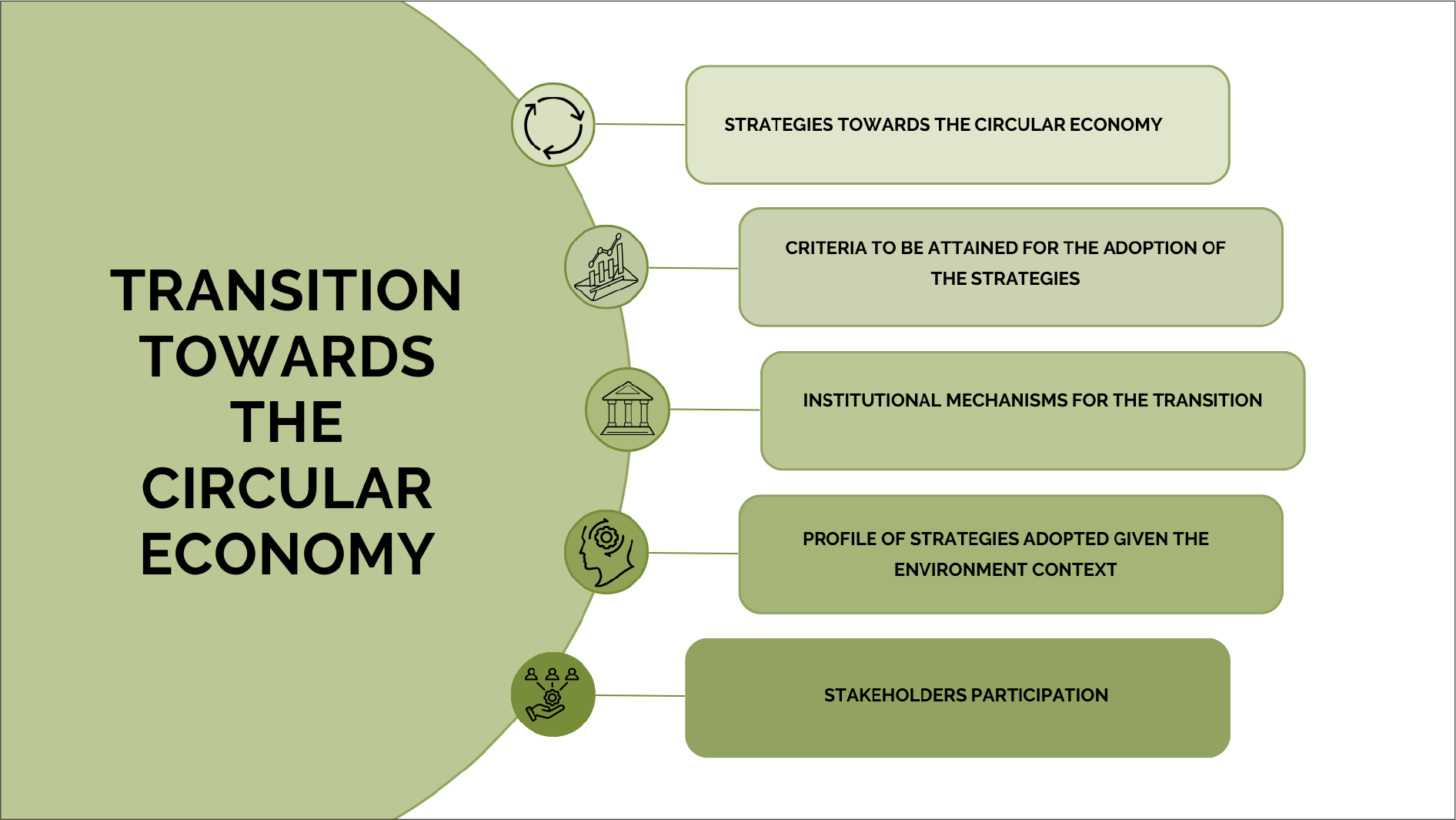
From a practical standpoint, the proposed model supports decision-making through the elicitation process of stakeholder preferences involved in the transition. This assessment is based on a set of criteria distributed across the four dimensions of sustainability, taking into account regional specificities and promoting the selection of strategies that contribute to building a more robust and sustainable production and consumption model, as illustrated in Figure 1.
Decision-Making Model for the Prioritisation of Strategies Conducive to the Transition towards a Circular Economy
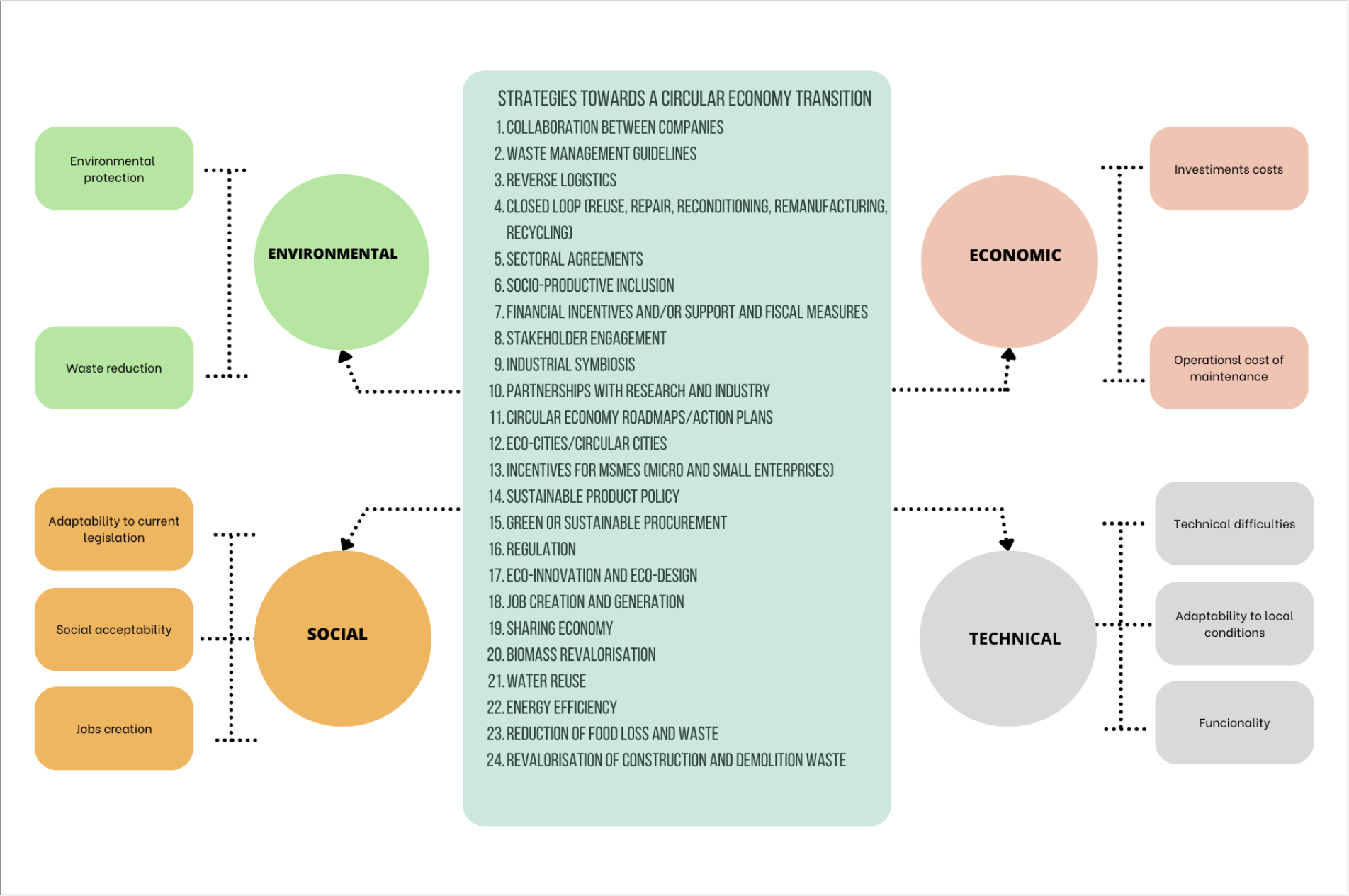
The model comprises three stages: (i) analysis of strategies versus criteria within the environmental, economic, social, and technical dimensions, under the lens of NIT; (ii) application of the Electre method using the scale validated by Guarnieri et al. (2023); and (iii) analysis of the institutional context and formulation of recommendations. Figure 2 presents the strategies versus evaluation criteria. It is worth noting that the strategies were based on the study conducted by Guarnieri, Bianchini, and Rossi (2020), and the criteria were derived from the study by Guarnieri et al. (2023); both informed the development of the validated scale proposed by Guarnieri et al. (2023).

Table 1 presents the description of the criteria shown in Figure 2.
When the evaluation of alternatives (strategies) versus criteria (environmental, social, economic, and technical) is applied, as illustrated in Figure 2, a payoff matrix is generated, which is used by the Electre method to construct the prioritisation ranking.
The analysis of differences between developed and developing countries, considering both enabling factors and barriers, contributes to a better understanding of the varied economic realities faced in adhering to global initiatives. This perspective also opens opportunities for developed nations to support developing countries in tackling global challenges such as plastic pollution, climate change, biodiversity loss, food insecurity, and social inequalities, thus promoting a fairer transition. In this context, the proposed decision model may guide stakeholders, particularly public and private managers, in reaching consensus to direct strategies towards the transition to the circular economy.
APPLICATION OF THE DECISION MODEL TO THE BRAZILIAN CASE
Among the ordering options generated by the Electre IV method (median, geometric mean, and arithmetic mean), the geometric mean was selected. This choice is based on the understanding that average values may not adequately reflect data behaviour in certain situations, especially when outliers are present, which may distort the arithmetic mean and compromise the reliability of the rankings.
The ranking generated using the geometric mean can be seen in Table 3. It is important to highlight that gaps may appear in the ranking sequence where ties occurred. Additionally, the vector refers to a score representing the overall performance of each alternative, based on pairwise comparisons, and can be interpreted as an aggregate performance score, meaning that the higher the score, the better positioned the strategy will be in the ranking.
It can be observed that the strategy “Reduction of food losses and waste” held the top position in the ranking, based on stakeholder evaluations across environmental, social, economic, and technical criteria. This reflects concerns about food insecurity in a country that is one of the world’s leading food producers and boasts rich biodiversity and abundant resources. According to the Food and Agriculture Organisation (FAO, 2023), over 55% of households in Brazil were experiencing varying levels of food insecurity by the end of 2020, marking an increase from 36.7% in 2018. Severe food insecurity was evident in 9% of households by late 2020, corresponding to approximately 19 million individuals. Additionally, rising unemployment and falling incomes led to a deterioration in diet quality among Brazilians living below the poverty line.
The “Stakeholder engagement” strategy ranked second-a result explained by the core premise of Law N˚ 12.305 (2010) on the National Solid Waste Policy, which enshrines the principle of ‘shared responsibility’ encompassing all actors involved in the production and consumption of a product. This strategy tied with “Job creation/generation”, also in second place, reflecting concerns over high unemployment rates, especially following the Covid 19 pandemic, which exacerbated food insecurity as noted by the FAO (2023).
Strategies such as “Socio-productive inclusion” (fourth), “Waste management guidelines” (fifth), “Valorisation of construction and demolition waste” (sixth), and “Reverse logistics” (seventh) directly align with provisions of Law N˚ 12.305 (2010), designed to ensure environmental protection and address problems arising from the linear production and consumption model. Although the concept of a circular economy requires a disruption in production-consumption thinking, an abrupt change is not deemed feasible. Thus, the prioritisation of these strategies demonstrates stakeholders’ recognition of the need for a transitional period before adopting more disruptive CE strategies, such as eco-innovation and eco-design, which were positioned at number 22, the bottom of the ranking. Socio-productive inclusion is widely discussed in Brazil, with a large vulnerable population. It was an instrument envisaged in the PNRS to integrate informal waste pickers (‘catadores’) into reverse logistics operations. In Brazil, these workers are responsible for collecting and recycling over 90% of solid waste (IPEA, 2017). As Guarnieri et al. (2020) emphasise, although the PNRS does not explicitly mention CE, its principles are aligned with this approach. The policy represented an initial step towards the discussions underpinning the proposed PNEC, essential for transitioning to new and more disruptive production and consumption patterns.
The “Sharing economy” (eighth) and “Green or sustainable procurement” (ninth) are principles and instruments anticipated in the PNEC, currently under consideration in the National Congress with expected finalisation in 2025, and in Decree N˚ 12,082/2024, which regulates the national CE strategy. The sharing economy is crucial to resource reduction, as it allows consumers to use products without ownership. Green procurement is essential for fostering market innovations and ensuring that products/services meet new standards: energy efficiency, reduced or reused water, sustainable resource use, waste reduction, design for disassembly and recycling, and valorisation of by products. In Brazil, Bill N˚ 1,874/2022 mandates sustainable procurement and the new Public Procurement Law, No 14,133/2021, specifically in Article 11 encourages innovation and sustainable national development, while Article 144 allows for variable remuneration linked to sustainability and quality criteria in contracts. Government procurement is estimated to represent around 12.5% of Brazil’s GDP (Ribeiro & Inácio, 2019, p. 7), highlighting its transformative potential in public policy.
The “Incentives, financial support and fiscal measures” strategy was ranked tenth by Brazilian stakeholders. Brazil has implemented reverse-logistics credit instruments since 2017 (Caiado et al., 2017), yet only since Decree N˚ 11,413 of 13 February 2023, which instituted the Reverse Logistics Recycling Credit Certificate, has this measure been institutionalised. The decree also introduced the Packaging Structuring and Recycling Certificate and the Future Mass Credit Certificate. However, there remains no policy granting tax exemptions or discounts on raw materials sourced from reverse logistics. Also tied in tenth place were the strategies “Industrial symbiosis” and “Sustainable product policy.” These strategies lack national public support but have isolated initiatives in some states, such as Minas Gerais, which strongly promotes industrial symbiosis through eco-industrial parks.
In 12th place was “Closed-loop (reuse, repair, reconditioning, remanufacturing, recycling),” followed by “Incentives for SMEs” (13th), “Sectoral agreements” (15th) and “Water reuse” (16th). The 12th and 15th strategies are tools of the PNRS. Sectoral agreements relate to stakeholder engagement and help operationalise shared responsibility. SMEs’ support is already public policy in Brazil through Complementary Law N˚ 123/2006, amended by Law N˚ 147/2014, which simplifies procurement processes for SMEs-vital for employment and income generation. Job creation was ranked second, underscoring its importance. Water reuse ranked 16th perhaps due to Brazil’s abundant water resources, despite seasonal scarcity.
The strategy “Inter-firm collaboration” occupied 17th position, signalling moderate concern. However, it is crucial for implementing strategies like industrial symbiosis, waste valorisation and food waste reduction. “Regulation” ranked 18th; enforcement remains a challenge in Brazil, illustrated by recent environmental disasters in Brumadinho, Mariana, and Maceió (Guarnieri & Levino, 2023).
Three strategies tied at 19th place: “Biomass valorisation,” “Ecocities or circular cities,” and “Partnerships with research and industry.” Valorising biomass for energy has potential for rural economies, but is of moderate importance given other energy sources and high implementation costs. Nonetheless, it can support regional development. Ecocities require significant changes in urban planning and mobility, challenges in a country structured around a linear economic model, currently struggling with stormwater drainage, waste and water-resource management, impacting vulnerable populations and increasing risks such as dengue outbreaks. Partnerships with research and industry are a priority in the draft PNEC and Decree N˚ 12,082/2024.
At the bottom of the ranking were “Eco innovation and eco design” (22nd), “Roadmaps and action plans for the circular economy” (23rd), and “Energy efficiency” (24th). Eco-innovation and eco-design epitomise the disruptive CE concept, aiming to minimise waste and enable reintegration of by products into production. While literature debates the feasibility of zero waste (Zaman, 2015; Zhang et al., 2012), Zaman (2015) asserts that zero waste remains a holistic, evolving approach aiming for waste minimisation rather than elimination. The low prioritisation of roadmaps and action plans suggests that the absence of a national strategy may delay their adoption until PNEC is enacted, though this gap has been addressed by Decree N˚ 12,082/2024. “Energy efficiency” may rank last as Brazil benefits from a diverse and historically sustainable energy matrix, resulting in a favourable position compared with global averages.
DISCUSSION
According to Guarnieri et al. (2023), strategies for the transition to the circular economy (CE) can be divided into proactive and reactive types. Proactive strategies are strategic, long-term, and promote disruptive changes in design, business models, and urban planning, and may or may not depend on legislation. They alter the way products and services are produced and consumed, as well as the way companies are managed and cities are planned. Examples include: eco-innovation and eco-design, eco-cities or circular cities, industrial symbiosis, sustainable product policy, partnerships with research and industry, sharing economy, green and/or sustainable procurement, energy efficiency, closed-loop strategies, incentives targeted at SMEs, financial support and fiscal measures (Amui et al., 2017; Ellen MacArthur Foundation, 2013, 2015; Guarnieri et al., 2023; Sehnem et al., 2019).
Reactive strategies, on the other hand, are tactical, shortto medium-term, and focus on addressing problems arising from the linear economy, based on the extract-manufacture-consume-dispose model. They generally require legal or institutional backing. In such a context-marked by waste accumulation at the end of the cycle and chronic losses-landfills and end-of-life waste management structures remain provisionally necessary. The absence of such systems can pose a significant barrier to implementing CE in its broader conception. These measures represent a necessary temporary solution, preventing irregular disposal of waste that could compromise environmental and public health safety, and undermine the credibility of circular policies.
These strategies are particularly common in developing and underdeveloped countries, where solid waste management, emissions control, and chronic resource waste have yet to be adequately addressed. As such, the following strategies can be considered disruptive: waste management guidelines and policies, water reuse, reduction of food waste and losses, construction and demolition waste management, reverse logistics, socio-productive inclusion (of vulnerable populations), and job creation/generation (Ellen MacArthur Foundation, 2013, 2015; Guarnieri et al., 2020; Guarnieri et al., 2023).
The combination of institutional challenges in Brazil-such as resource shortages, enforcement failures, poor infrastructure, economic pressures, and low public awareness-highlights the barriers faced by Global South countries in managing waste and adopting CE. Still at an early stage, these nations require support from the international community to develop effective guidelines and move towards a more sustainable model of production and consumption. This transition, led by countries like China and others in the Global North, demands the engagement of all stakeholders in a fair process based on equity, inclusion, and respect for human rights, ensuring shared benefits regardless of development levels.
Within the context of New Institutional Theory (NIT), the advancement of CE in Brazil occurs through mimetic isomorphism, with the adoption of practices from developed countries, particularly in the Global North. This movement is driven by the perception that Brazilian firms adopting more proactive behaviours-highlighted by Sehnem et al. (2019)-tend to perform better in managing critical success factors for CE.
Nevertheless, the discourse around CE in Brazil has been facilitated by the recent implementation of the National Solid Waste Policy (PNRS). While it does not explicitly reference CE, it incorporates principles that favour its future adoption (Guarnieri et al., 2020). Despite sectoral initiatives and the progression of Bill No. 1,874/2022, which establishes the National Circular Economy Policy (PNEC), and the recent Decree N˚. 12,082/2024, which created the National Circular Economy Strategy (ENEC), effective implementation faces obstacles. In this context, Brazil tends to replicate successful foreign models, such as those adopted by the European Union. Italy, for instance, has advanced CE strategies driven by plans like the Green Deal and specific legislation, as highlighted by Guarnieri et al. (2023). In contrast, actions in Brazil remain concentrated on reactive measures such as waste management and reverse logistics, suggesting that progress may rely on international pressure and leadership by example. Barriers such as regulatory inefficiencies and the lack of fiscal incentives can be exemplified by the fragmentation between state and federal legislation, which hinders the implementation of integrated reverse logistics strategies.
The challenge, therefore, lies in promoting a national policy that not only imitates foreign practices but also integrates the specificities of the Brazilian context, fostering sustainability education, high-level managerial support, and an understanding of national dynamics. In this regard, mimetic isomorphism can serve as a useful tool to accelerate the transition; however, adopting a fully standardised model must be balanced with local innovations that address Brazil’s unique challenges.
Still, according to Guarnieri et al. (2023), NIT recognises that organisations operate within social and political contexts that influence their adoption of practices such as CE, shaped by prevailing norms and values, particularly those from the Global North. In the Global South, however, this transition demands a fair and sustainable approach adapted to local realities. By cultivating a favourable macro-level environment, a positive foundation is created for implementing strategies at the meso and micro levels.
This transition, however, requires time, stakeholder engagement, and conceptual alignment. Brazil’s new policy framework points towards a redesign of industrial and consumption policies, encompassing the entire product life cycle, from design to waste revalorisation, and demanding a paradigm shift (Reike et al., 2018). In this scenario, a decision model that integrates environmental, social, economic, and technical criteria can guide strategy prioritisation, support decisions aligned with macro-level objectives, and promote an effective and sustainable transition.
CONCLUDING REMARKS
The findings of this study may offer crucial support to entities responsible for policy-making related to the circular economy (CE) at the macro level. Indeed, they may serve as a basis for an assessment that takes into account the perspectives of the various stakeholders involved, in order to determine which strategies conducive to CE should be prioritised in public policies to facilitate the transition movement. While the results provide valuable insights, it is important to acknowledge that the sample size constitutes a limitation of the study.
To achieve optimal efficiency, it is vital that such strategies integrate both top-down (government-led) and bottom-up (user-led, business-led, and institution-led) approaches. However, it is observed that a national-level, macro-scale directive can foster a favourable environment for transition processes at the meso and micro levels.
The proposition of a decision-making model aimed at prioritising strategies based on criteria across the environmental, social, economic, and technical dimensions may guide the allocation of incentives, the development of regulatory frameworks, and the establishment of targets in national and regional plans for the transition to CE, in order to provide:
-
i) priority identification: assists in identifying those strategies that are most pertinent and crucial for achieving CE goals, taking into account regional specificities and the macro context;
-
ii) holistic assessment: enables a comprehensive analysis of strategies by considering various dimensions, such as environmental, social, economic, and technical aspects, thereby assessing their impacts across different areas and their potential to foster sustainable benefits;
-
iii) evidence-based decision-making: establishes a structured approach to informed decision-making, with well-defined steps and transparent criteria for assessing both strategies and context;
-
iv) alignment with goals and values: by integrating criteria from environmental, social, economic, and technical perspectives, the model ensures that prioritised strategies align with the objectives and values of national or regional guidelines; and
-
v) transparency and accountability: enhances clarity in the decision-making process by articulating the criteria and rationale behind the selection of prioritised strategies, thereby facilitating accountability and improving communication with both internal and external stakeholders.
This article contributes by proposing a model that considers regional specificities when developing strategies, policies, and action plans for the transition to CE. Theoretically, it examines how New Institutional Theory (NIT) can explain the influence of external and internal environments on the adoption of strategies for this transition. Moreover, it seeks to provide practical insights for stakeholders engaged in the transition, enabling them to make informed decisions about strategies to promote a more resilient and sustainable model of production and consumption, while considering regional particularities.
By focusing on countries in the Global South, such as Brazil, the article highlights the barriers and challenges these countries face when engaging in a global movement, offering opportunities to address global challenges such as plastic pollution, climate change, and social inequalities. Finally, the discussion on economic incentives and regulation may be further expanded through recommendations for reforms, such as subsidies, tax benefits, and mandatory targets for circular practices.
-
The authors did not agree to the publication of the review reports for the approved manuscript.
-
Evaluated through a double-anonymized peer review. Guest editors: Susana Carla Farias Pereira, Simone Sehnem, Ana Beatriz Lopes de Sousa Jabbour, Valentina Gomes Haensel Schmitt and, Fanny Saruchera
ACKNOWLEDGEMENTS
The authors are grateful for the organisation supporting this study: Brazilian Council for Scientific and Technological Development (CNPq, Conselho Nacional de Desenvolvimento Científico e Tecnológico).
-
FUNDING
Brazilian Council for Scientific and Technological Development (CNPq, Conselho Nacional de Desenvolvimento Científico e Tecnológico).
References
-
Abdulrahman, M.D., Gunasekaran, A., Subramanian, N. (2014). Critical barriers in implementing reverse logistics in the Chinese manufacturing sectors. International Journal of Production Economics, 147, 460e471. https://doi.org/10.1016/j.ijpe.2012.08.003
» https://doi.org/10.1016/j.ijpe.2012.08.003 - Abubakar, F. H. (2018). An investigation into the drivers, barriers and policy implications of circular economy using a mixed-mode research approach (Doctoral dissertation, University of Sheffield).
-
Amui, L. B. L., Jabbour, C. J. C., de Sousa Jabbour, A. B. L., & Kannan, D. (2017). Sustainability as a dynamic organizational capability: a systematic review and a future agenda toward a sustainable transition. Journal of cleaner production, 142, 308-322. https://doi.org/10.1016/j.jclepro.2016.07.103
» https://doi.org/10.1016/j.jclepro.2016.07.103 -
Caiado, N., Guarnieri, P., Xavier, L. H., & Chaves, G. D. L. D. (2017). A characterization of the Brazilian market of reverse logistic credits (RLC) and an analogy with the existing carbon credit market. Resources, Conservation and Recycling, 118, 47-59. https://doi.org/10.1016/j.resconrec.2016.11.021
» https://doi.org/10.1016/j.resconrec.2016.11.021 -
Cerqueira-Streit, J. A., Endo, G. Y., Guarnieri, P., & Batista, L. (2021). Sustainable supply chain management in the route for a circular economy: an integrative literature review. Logistics, 5(4), 81. https://doi.org/10.3390/logistics5040081
» https://doi.org/10.3390/logistics5040081 -
Confederação Nacional da Indústria. (2019). Pesquisa sobre economia circular na indústria brasileira.https://bucket-gw-cni-static-cms-si.s3.amazonaws.com/media/filer_public/a5/ab/a5abebbb-3bc9-4aed-9f2f-8914358d2f00/economia_circular-_pesquisa_cni_2.pdf
» https://bucket-gw-cni-static-cms-si.s3.amazonaws.com/media/filer_public/a5/ab/a5abebbb-3bc9-4aed-9f2f-8914358d2f00/economia_circular-_pesquisa_cni_2.pdf -
DiMaggio, P. J., & Powell, W. W. (1983). The iron cage revisited: Institutional isomorphism and collective rationality in organizational fields. American Sociological Review, 48(2), 147-160. https://doi.org/10.2307/2095101
» https://doi.org/10.2307/2095101 -
Ellen MacArthur Foundation. (2022). Uma economia circular no Brasil: Uma abordagem exploratória inicial (A circular economy in Brazil: An exploratory initial approach) Rede CE100 Brazil. https://www.ellenmacarthurfoundation.org/assets/downloads/languages/Uma-Economia-Circular-no-Brasil_Uma-Exploracao-Inicial.pdf
» https://www.ellenmacarthurfoundation.org/assets/downloads/languages/Uma-Economia-Circular-no-Brasil_Uma-Exploracao-Inicial.pdf -
European Comission. (2019). The European Green Deal: COM(2019) 640 final https://ec.europa.eu/info/sites/info/files/european-green-deal-communication_en.pdf
» https://ec.europa.eu/info/sites/info/files/european-green-deal-communication_en.pdf -
Ferri, G. L., Chaves, G. D. L. D., & Ribeiro, G. M. (2015). Reverse logistics network for municipal solid waste management: The inclusion of waste pickers as a Brazilian legal requirement. Waste Management, 40, 173-191. https://doi.org/10.1016/j.wasman.2015.02.036
» https://doi.org/10.1016/j.wasman.2015.02.036 - Figueira, J. R., Mousseau, V., & Roy, B. (2016). ELECTRE methods. In S. Greco, M. Ehrgott, & J. Figueira (Eds.), Multiple criteria decision analysis: State of the art surveys (pp. 155-185). Springer
-
Food and Agriculture Organization (2023). Brasil em resumo https://www.fao.org/brasil/fao-no-brasil/brasil-em-resumo/es/#:~:text=Mais%20da%20metade%20dos%20domic%C3%ADlios,a%2019%20milh%C3%B5es%20de%20brasileiros
» https://www.fao.org/brasil/fao-no-brasil/brasil-em-resumo/es/#:~:text=Mais%20da%20metade%20dos%20domic%C3%ADlios,a%2019%20milh%C3%B5es%20de%20brasileiros - Guarnieri, P., Bianchini, A., Rossi, J. (2020). The institutionalization of the transition towards circular economy: A comparison between Italy and Brazil. In Proceedings of the 5th Symposium on Urban Mining and Circular Economy (pp. 1-20). Eurowaste Srl.
-
Guarnieri, P., Bianchini, A., Rossi, J., Silva, L. C. e, Trojan, F., Lizot, M., & Vieira, B. de O. (2023). Transitioning towards a circular economy under a multicriteria and the new institutional theory perspective: A comparison between Italy and Brazil. Journal of Cleaner Production, 409, 137094. https://doi.org/10.1016/j.jclepro.2023.137094Get rights and content
» https://doi.org/10.1016/j.jclepro.2023.137094Get rights and content -
Guarnieri, P., Cerqueira-Streit, J. A., & Batista, L. C. (2020). Reverse logistics and the sectoral agreement of packaging industry in Brazil towards a transition to circular economy. Resources, Conservation and Recycling, 153, 104541. https://doi.org/10.1016/j.resconrec.2019.104541
» https://doi.org/10.1016/j.resconrec.2019.104541 - Guarnieri, P., & Levino, N. (2023). Responsabilidade corporativa de empresa no setor mineral. In N. A. Levino & M. E. Fontana (Orgs.), A cidade engolida: Desastre ocasionado pela extração irregular de minas de sal-gema em Maceió-AL: uma discussão inicial. Pedro & João Editores.
-
Hofer, A., Ewald A., & Velte, P. (2024). Sustainability-oriented targets in executive compensation: Symbolic measures or significant catalyst for a sustainable transition? Qualitative Research in Accounting & Management, 21(5), 465-493. https://doi.org/10.1108/QRAM-06-2023-0105
» https://doi.org/10.1108/QRAM-06-2023-0105 -
Ibanescu, D., Cailean, D., Teodosiu, C., & Fiore, S. (2018). Assessment of the waste electrical and electronic equipment management systems profile and sustainability in developed and developing European Union countries. Waste management, 73, 39-53. https://doi.org/10.1016/j.wasman.2017.12.022
» https://doi.org/10.1016/j.wasman.2017.12.022 -
Instituto de Pesquisa Econômica Aplicada. (2017). Os catadores no Brasil: características demográficas e socioeconômicas dos coletores de material reciclável, classificadores de resíduos e varredores a partir do censo demográfico de 2010. https://repositorio.ipea.gov.br/handle/11058/7819?mode=full
» https://repositorio.ipea.gov.br/handle/11058/7819?mode=full - Jepperson, R. L., & Meyer, J. W. (2021). Institutional theory: The cultural construction of organizations, states, and identities Cambridge University Press.
-
Kirchherr, J., Reike, D., & Hekkert, M. (2017). Conceptualizing the circular economy: An analysis of 114 definitions. Resources, conservation and recycling, 127, 221-232. https://doi.org/10.1016/j.resconrec.2017.09.005
» https://doi.org/10.1016/j.resconrec.2017.09.005 -
Korhonen, J., Nuur, C., Feldmann, A., & Birkie, S. E. (2018). Circular economy as an essentially contested concept. Journal of Cleaner Production, 175, 544-552. https://doi.org/10.1016/j.jclepro.2017.12.111
» https://doi.org/10.1016/j.jclepro.2017.12.111 -
Kumar, V., Sezersan, I., Garza-Reyes, J. A., Gonzalez, E. D., & Al-Shboul, M. D. A. (2019). Circular economy in the manufacturing sector: benefits, opportunities and barriers. Management decision, 57(4), 1067-1086. https://doi.org/10.1108/MD-09-2018-1070
» https://doi.org/10.1108/MD-09-2018-1070 -
Lei n. 12.305, de 2 de agosto de 2010. (2010). Brasília, DF. https://www.planalto.gov.br/ccivil_03/_Ato2007-2010/2010/Lei/L12305.htm#art33%C2%A71
» https://www.planalto.gov.br/ccivil_03/_Ato2007-2010/2010/Lei/L12305.htm#art33%C2%A71 -
Mhatre, P., Panchal, R., Singh, A., & Bibyan, S. (2021). A systematic literature review on the circular economy initiatives in the European Union. Sustainable Production and Consumption, 26, 187-202. https://doi.org/10.1016/j.spc.2020.09.008
» https://doi.org/10.1016/j.spc.2020.09.008 -
Morales, C. M. B., & Sossa, J. W. Z. (2020). Circular economy in Latin America: A systematic literature review. Business Strategy and the Environment, 29(6), 2479-2497. https://doi.org/10.1002/bse.2515
» https://doi.org/10.1002/bse.2515 -
Powell, W. W., Owen-Smith, J., & Colyvas, J. A. (2007). Innovaton and emulation: Lessons from American universities in selling private rights to public knowledge. Minerva, 45(2), 121-142. https://doi.org/10.1007/s11024-007-9034-2
» https://doi.org/10.1007/s11024-007-9034-2 -
Reike, D., Vermeulen, W. J., & Witjes, S. (2018). The circular economy: New or refurbished as CE 3.0? Exploring controversies in the conceptualization of the circular economy through a focus on history and resource value retention options. Resources, Conservation and Recycling, 135, 246-264. https://doi.org/10.1016/j.resconrec.2017.08.027
» https://doi.org/10.1016/j.resconrec.2017.08.027 -
República Portuguesa. (2022). Liderar a transição: Plano de ação para a economia circular em Portugal 2017-2020. https://www.portugal.gov.pt/download-ficheiros/ficheiro.aspx?v=71fc795e-90a7-48ab-acd8-e49cbbb83d1f
» https://www.portugal.gov.pt/download-ficheiros/ficheiro.aspx?v=71fc795e-90a7-48ab-acd8-e49cbbb83d1f -
Ribeiro, C. G., & Inácio Júnior, E. (2019). Política de offset em compras governamentais: uma análise exploratória. https://repositorio.ipea.gov.br/bitstream/11058/9216/1/td_2473.pdf
» https://repositorio.ipea.gov.br/bitstream/11058/9216/1/td_2473.pdf -
Ritzén, S., & Sandström, G. Ö. (2017). Barriers to the Circular Economy: Integration of perspectives and domains. Procedia Cirp, 64, 7-12. https://doi.org/10.1016/j.procir.2017.03.005
» https://doi.org/10.1016/j.procir.2017.03.005 -
Sehnem, S., Vazquez-Brust, D., Pereira, S. C. F., & Campos, L. M. (2019). Circular economy: benefits, impacts and overlapping. Supply Chain Management: An International Journal, 24(6), 784-804. https://doi.org/10.1108/SCM-06-2018-0213
» https://doi.org/10.1108/SCM-06-2018-0213 -
Zaman, A. U. (2015). A comprehensive review of the development of zero waste management: lessons learned and guidelines. Journal of Cleaner Production, 91, 12-25. https://doi.org/10.1016/j.jclepro.2014.12.013
» https://doi.org/10.1016/j.jclepro.2014.12.013 -
Zhang, K., Schnoor, J. L., & Zeng, E. Y. (2012). E-waste recycling: where does it go from here? Environmental Science & Technology, 46(20), 10861-10867. https://doi.org/10.1021/es303166s
» https://doi.org/10.1021/es303166s

 Note: This research
 Note: Adapted from