
 Organizing-with Nature: A Study on the Ecologies of Practices in Brazilian Conservation Units
ABSTRACT
Objective: this article aims to investigate the ways in which organizing-with nature is mobilized within the ecologies of conservation/preservation practices in Brazilian conservation units (CUs).
Theoretical approach: drawing inspiration from Donna Haraway and Isabelle Stengers, we propose a perspective on organizing that blurs the boundaries of the nature-culture divide. Guided by the understanding that all organizing is inherently organizing-with - necessarily involving practices of composition - and that certain modes of organizing give rise to more-than-human modes of existence and frictions between diverse worlds, we introduce the notion of organizing-with nature as an analytical-conceptual tool for understanding the ecologies of conservation/preservation practices within CUs.
Method: the empirical body of the study was constructed through semi-structured interviews with individuals directly involved in conservation/preservation work in Brazilian CUs. The data were analyzed qualitatively in dialogue with literature reviews and documentary research.
Results: organizing-with nature in CUs is mobilized through the coexistence of more-than-human life forms within the ecologies of conservation/preservation practices. In these ecologies, the frictions between worlds generate zones of mutual capture and constraint, whose outcomes are deeply entangled with relationships of territorial belonging.
Conclusions: this article contributes to the field of organizational studies by discussing how organizing processes are (re)produced in becoming-with, within the relational networks that emerge from the frictions among ecologies of conservation/preservation practices. Finally, we explore the cosmopolitical implications of our study for addressing the complexities involved in the management of conservation units.
Keywords:
organizing; becoming-with; nature; ecologies of practices; conservation units
RESUMO
Objetivo: o objetivo deste artigo foi investigar os modos pelos quais o organizar-com a natureza é mobilizado nas ecologias das práticas de conservação/preservação em unidades de conservação (UCs) brasileiras.
Marco teórico: nos inspiramos em Donna Haraway e Isabelle Stengers para propor uma perspectiva de organizar que borra as fronteiras da cisão natureza-cultura. Nessa inspiração, ao entendermos que todo organizar é um organizar-com, implicando necessariamente práticas de composições, e que há modos de organizar que engendram modos de existências mais que humanos e atritos entre mundos diversos, propomos a noção de organizar-com a natureza como ferramenta analítico-conceitual para a compreensão das ecologias das práticas de conservação/preservação nas UCs.
Método: o corpo empírico foi produzido a partir de entrevistas semiestruturadas com pessoas que trabalham diretamente com as práticas de conservação/preservação em diferentes UCs brasileiras, e analisado qualitativamente em diálogo com levantamentos bibliográficos e documentais.
Resultados: o organizar-com a natureza nas UCs é mobilizado no coexistir de vidas mais que humanas nas ecologias das práticas de conservação/preservação. Nessas ecologias, os atritos entre mundos produzem zonas de entrecapturas e restrições, cujos desdobramentos estão intimamente implicados nas relações de pertencimento aos territórios.
Conclusões: este artigo contribui para o campo dos estudos organizacionais ao discutir modos pelos quais os processos organizativos são (re)produzidos em devir-com, nas redes de relações que emergem dos atritos de ecologias de práticas voltadas para a conservação/preservação ambiental. Por fim, discutimos as implicações cosmopolíticas de nosso estudo para as complexidades que envolvem a gestão das UCs.
Palavras-chave:
organizar; devir-com; natureza; ecologia das práticas; unidades de conservação
INTRODUCTION
The possibility of the Anthropocene, which describes a new geological epoch characterized by the predominant influence of human activities on the planet, is supported by a series of scientific data that show significant changes in terrestrial systems (Rockström et al., 2023; Steffen & Crutzen, 2007). One of the most notable aspects of this new epoch is the increase in greenhouse gas emissions, which are responsible for accelerating climate change. Data from National Aeronautics and Space Administration (NASA, 2023) show that since the beginning of the Industrial Revolution, carbon dioxide (CO₂) in the atmosphere have increased from 280 ppm to over 415 ppm, an unprecedented rise in Earth’s recent history. The latest report from the Intergovernmental Panel on Climate Change (IPCC) shows that the global average temperature has risen by about 1.1 °C above pre-industrial levels (IPCC, 2021). Each year, the planet loses approximately 10 million hectares of forest, and the International Union for Conservation of Nature (IUCN, 2021) estimates that around 1 million species of animals and plants are currently at risk of extinction.
All these data illustrate that the growing human pressure on the planet after the consolidation of the industrial world, characterized by climate change, biodiversity loss, and ecosystem degradation, makes Conservation Units (CUs) essential in the Anthropocene. These territories play a fundamental role in mitigating the effects of climate change and serve as spaces for biodiversity conservation/preservation (Law no. 9,985, 2000 / Lei n. 9.985, 2000; WWF Brasil, 2023). Brazil has a network of CUs considered one of the largest in the world, home to about 20% of the planet’s fauna and flora species, distributed in ecosystems such as the Amazon, the Cerrado, and the Atlantic Forest (WWF Brasil, 2023). According to the National System of Conservation Units (SNUC), around 30% of Brazilian territory consists of CUs (Law no. 9,985, 2000 / Lei n. 9.985, 2000). These protected areas not only ensure the conservation/preservation of biodiversity but are also crucial for the well-being of local communities by promoting economic and social sustainability.
The management of CUs is configured through organizational practices whose main objective is the conservation/preservation of biodiversity, involving actions such as environmental education, research, inspection, visitation (tourism), species monitoring, etc. (Law no. 9,985, 2000 / Lei n. 9.985, 2000). These are processes (co)constructed in the constant daily interaction between people and nature, requiring democratic models of environmental governance that differ from the classic models already institutionalized in the area of management (Stürmer & Serva, 2024). We understand these characteristics as generating constant tension around taken-for-granted ideas about the relationship between organizational processes and what is conventionally understood as nature. Looking at these organizations makes it possible to problematize theoretical and empirical silences imposed on more-than-human agencies in organizational studies (Fantinel, 2020; Good & Thorpe, 2020; Wright et al., 2018), as well as broaden knowledge and perspectives on environmental conservation/preservation practices. This knowledge and these practices are reproduced in CUs (Steinhardt et al., 2022), but remain largely unexplored in organizational studies (Matarazzo & Serva, 2021; Stürmer & Serva, 2024).
Considering the urgency in the field of administration to (re)imagine ecological solutions in the face of the challenges of the Anthropocene (Banerjee & Arjaliès, 2021; De Cock et al., 2021), possibilities are opening up for us to break with modern Western thinking that instrumentalizes nature in the knowledge and practices related to management and organizations (Good & Thorpe, 2020). It was through organized human action, that is, through organizational processes, that we produced the possibility of the Anthropocene (Figueiredo et al., 2020). In this article, we shift our focus from large corporations responsible for catastrophes and disaster crimes to the importance of examining forms of organizing that continuously challenge the administrative knowledge and practices grounded in beliefs about the separability of humans and nature (Leite & Fantinel, 2024; Roux-Rosier et al., 2018). We approach this as a mode of organizing-with that unsettles such boundaries, turning our attention here to CUs.
The objective of this article is to examine how organizing-with nature is mobilized within the ecologies of conservation and preservation practices in Brazilian CUs. We align with the perspective that management and organizational practices emerge from transitory interweavings - relational practices that articulate more-than-human agencies within situated material arrangements (Gherardi & Laasch, 2022). To advance this approach, we draw on Donna Haraway’s notion of becoming-with, which envisions humans not as isolated entities but as beings continually transforming in relation to others, within complex networks of interdependence that shape ecologies and relations across diverse forms of life (Haraway, 2023). Building on this insight, we develop the idea of organizing-with nature as an approach that expands our understanding of how organizational processes are entangled with more-than-human agencies, through relations of becoming-with embedded in ecologies of situated practices.
By aligning ourselves with the ecology of practices, we seek to understand organizing-with nature in CUs based on the reading of dynamic and complex fields, in which different practices interact in a situational and contingent manner, shaping realities that are collectively constructed and producing zones of inter-captures and restrictions (Stengers, 2005). Thus, the ecology of practices allowed us to understand the socio-environmental dynamics surrounding environmental conservation and preservation in the CUs, from an analytical lens that revealed the relationships among the different ways of producing belonging in the territory (e.g., human communities, water, flora, fauna, institutions, laws, artifacts, etc.). This research, which is part of a larger project focused on interactions between organizational processes and nature agencies, combines semi-structured interviews, bibliographic surveys, and document reviews in its empirical composition. As a data analysis strategy, we used the qualitative coding approach, given its potential for dense description of complex and multifaceted social phenomena (Corbin & Strauss, 1990).
The relevance of this article lies in (cosmo)politically disputing the notion of organizing, discussing it not from the centrality of the human, but in symbiotic webs with other forms of life (Haraway, 2023). We are moving toward a necessary ontological (re)thinking of the very concept of organizing in the face of the Anthropocene (Good & Thorpe, 2020). Here, we develop an organizing-with nature that recognizes that more-than-human lives intertwine, reproduce, cohabit, and are in relations of becoming-with (Haraway, 2023). We contribute to the field of organizational studies by discussing ways in which organizational processes are (re)produced in becoming-with, in networks of relationships that emerge from the frictions of ecologies, from practices aimed at building sustainable relationships between people, organizations, and nature (Good & Thorpe, 2020; Wright et al., 2018). Finally, we discuss the implications of our study for the complexities of CU management (Stürmer & Serva, 2024), particularly regarding the tensions that arise in relations with traditional communities (Rodríguez Cáceres, 2023; Seixas et al., 2020; Silva, 2019).
ORGANIZING-WITH NATURE AND THE ECOLOGIES OF PRACTICES OF PRESERVATION AND CONSERVATION
This article takes a procedural/relational perspective on the organizational phenomenon (Gherardi & Laasch, 2022), focusing on the substantive processes that are constantly under construction and that make up organizing (Sandberg & Tsoukas, 2015; Weick, 2012) rather than superficial readings that understand organizations as stable and homogeneous entities, when they are, on the contrary, unstable and heterogeneous (Czarniawska, 2008). Based on the ontology of becoming, organizing shifts the understanding of a study of the organization as a starting point (a priori reality) and comes to understand this phenomenon as a procedural/relational field involving different distributed agencies. In other words, organizational practice is the result of a transitory interweaving between people, rules, laws, artifacts, technologies, etc. (Alcadipani & Tureta, 2009; Duarte & Alcadipani, 2016).
With this movement, we broaden our theoretical lens and study organizing as a process and product that intertwines more-than-human agencies, something still largely unexplored in organizational studies (Leite & Fantinel, 2024). Thus, we seek to highlight the organizational processes that are produced in the relationships between humans and other animals, as well as other living beings, technical artifacts, landscapes, and ecosystems that emerge as fields of dynamic and co-evolutionary interactions from which we can learn about organizing. The literature in the field has already highlighted this by discussing organizational phenomena based on the relationships between humans and animals (Doré & Michalon, 2017; Fantinel, 2020; Sage et al., 2016), or even on the relationships between humans and geologies (Jensen & Sandström, 2020).
Inspired by becoming-with (Haraway, 2023) we propose that organizing in CUs is a web of contingent encounters in which humans, animals, plants, and territories co-construct realities in continuous, intertwined becomings. By focusing on the co-production of worlds through multispecies encounters, becoming-with moves beyond an exclusively human-centric view, revealing organizing as a network of relational practices. For example, everyday management gestures - such as species monitoring or conflict mediation - only exist because humans, other living beings, artifacts, and territories are collectively woven into these processes, a dynamic we call organizing-with nature.
To develop a theoretical framework that could analyze these practices in which organizing-with nature in CUs is constituted, we turned to Stengers (2005) ecology of practices. Her approach shows us how every practice is simultaneously the producer and the product of a specific ecology, i.e., a set of material conditions, knowledge, and political forces that make it possible. In CUs, for example, the practice of ‘environmental enforcement’ is not an isolated act: it emerges from an ecology that includes legislation, monitoring technologies, the behavior of endangered species, and human practices produced in and around certain territories. Similarly, this practice modifies the ecology in which it occurs (creating new animal routes, adjustments to legal norms, construction of new environmental management plans, etc.).
Here, the ecology of practices reveals its cosmopolitical character: tensions in CUs (such as conflicts between traditional communities and conservation/preservation policies, for example) arise from the friction among worlds. Therefore, it is not a simple negotiation activity around the production of a common good, but rather the way in which the production of zones jeopardizes the relationships of belonging in a given territory, in the ways of inhabiting a given practice. By describing them, we not only expose organizing-with nature in action but also question what and who is at stake in these ecologies. In this sense, we understand that all organizing is always organizing-with, although not all agencies are completely visible (Good & Thorpe, 2020; Wright et al., 2018). Hence, our conceptual perspective of organizing-with what we conventionally call ‘nature’ in this cosmopolitical proposition.
This perspective forces us to abandon the illusion of the ‘neutral manager’ or ‘conservation/preservation as a simple act of control,’ since, in the webs of becoming-with, even the most bureaucratic protocols of CUs are practices in composition with winds, seeds, mycelia, and protests (Haraway, 2023; Tsing, 2018). If organizing is a becoming that includes more-than-human agencies (Wright et al., 2018), this becoming can be understood in these ecologies of practices in a situated way, in these precarious attempts at mediation between worlds in friction. The organizing-with nature that we develop starts from a symbiotic lens for the study of the webs in which human and non-human lives intertwine, reproduce, (co)evolve, (co)inhabit, and exist in relations of becoming-with (Haraway, 2023). Here, we take a cosmopolitical perspective to think from other thoughts to produce other perspectives, with intersecting ecologies of practices (Stengers, 2015), by adding to the ontological becoming of the perspective of organizing (Duarte & Alcadipani, 2016; Tsoukas & Chia, 2002) a dimension about the nature of life that is still lacking (Wright et al., 2018).
Inspired by Isabelle Stengers’ work on the ecology of practices (Stengers, 2005), we used this concept as an analytical lens to understand how diverse practices - whether scientific, political, managerial, or even those related to survival - are shaped and evolve within dynamic material and knowledge environments. The ecology of practices invites us to observe how every practice is simultaneously the producer and the product of a specific environment: a set of material conditions, power relations, and modes of knowledge that make it possible and, at the same time, limit it. Practices produce inter-captures (mutual connections between agencies and their respective mutual modifications) and constraints (limits that arise from these connections and jeopardize belonging) to each other, revealing how different practices establish relationships of mutual modulation, effectively reconfiguring the terms of their existence through often conflicting encounters (Stengers, 2005). These reciprocal captures do not follow the logic of unidirectional causal determination, but rather one of complex interference. Each practice simultaneously establishes conditions of possibility for other practices (conservation norms create parameters for scientific research in CUs, impose material limits - the migratory behavior of certain exotic species jeopardizes other ways of inhabiting the territory - or generate unexpected effects through friction, as when enforcement protocols can stimulate new routes for illegal hunting).
In the ecologies of CU practices, traditional knowledge and scientific protocols can collide, producing unexpected hybrids; technical artifacts can alter animal ways of life, which in turn may require adjustments to the research protocols themselves; environmental legislation can create exclusion zones that paradoxically intensify land conflicts. In this sense, as we can see, these ‘inter-captures’ are not necessarily harmonious: while they produce possibilities, they can also produce violent exclusions. These ecologies rub against practices that manage to impose themselves as ‘mandatory’ (such as technical reports on environmental licensing), practices that are commonly marginalized (such as traditional management methods), while improvised compositions may emerge in the interstices of these ecologies. Mineral extraction in a territory, for example, is not an isolated act, but a practice that emerges from a particular ecology (market laws, drilling technologies, global demands, etc.) and which, in turn, radically redefines the ecology and belonging where it is inserted, restricting or rendering other practices unfeasible, such as traditional agriculture or indigenous rituals (Blaser & Cadena, 2018). Then, how can we produce politics in these times marked by what Isabelle Stengers calls “infernal choices”? How can we think about politics while capitalist hegemony oscillates between condemning the population to hunger and poverty or giving in to mining, monoculture, and agribusiness?
A cosmopolitical openness to indeterminacy can reactivate areas of experience devastated by capitalism and modernity (Pignarre & Stengers, 2013). This approach presupposes a radical openness between worlds, allowing for the emergence of the unknown. Cosmopolitics implies a willingness to engage with new demands and decisions that arise when previously marginalized entities make their claims. This can manifest as political action demanding the demarcation of indigenous lands, plants that insist on growing in undesignated areas, or animals that refuse to act as expected, such as a jaguar approaching a human community. The cosmos, more than a specific way of intervening, implies an openness to this indeterminacy, allowing new modes of existence to intervene without knowing in advance what they might be (Stengers, 2018).
Such openness takes on radical urgency on a planet where ecological crises reveal, on a daily basis, the political limits of the nature/culture dichotomy (Latour, 2020). In the zones of ruin of the Anthropocene (Tsing, 2018, 2021), humans and non-humans are compelled, out of material necessity, to reinvent their survival in practices that challenge modern scripts. It is in these improvised (re)connections, in these becomings-with between species, lands, and knowledge, that Haraway (2023) dadvocates the formation of kinships in webs, connections in strings, whether through life, art, science, or politics. Unlikely partnerships, thinking with other thoughts, in the arts of survival, in becoming-with humans-mushrooms (Tsing, 2018), in becoming-with humans-animals (Haraway, 2021), in becoming-with humans-rivers (Krenak, 2022). These are stories that allow us to connect other stories beyond the sad anthropocentric narratives (Haraway, 2023), imaginaries that allow us to think of new futures (Krenak, 2022).
In this tangle of threads that mix old and recent textures, we are impelled to investigate organizing-with as an alternative to the onto-epistemicides of nature in Management (Wright et al., 2018). The dichotomy between nature and culture, which is the hallmark of modern thought, has produced the ecological crises and therefore cannot be their solution (Banerjee & Arjaliès, 2021; Ergene et al., 2021). The stories we connect to compose with these knowledges are those that emerge from the preservation/conservation practices entangled in the CUs (Rodríguez Cáceres, 2023; Steinhardt et al., 2022), whose unfolding in organizational studies has been scarcely explored (Matarazzo & Sales, 2021; Stürmer & Serva, 2024). It is in these in-between places, where the threads tangle and remake themselves (Haraway, 2023), that Stengers’ (2018) cosmopolitics finds its materiality as a daily challenge to compose worlds where multiple forms of life can flourish without reproducing the violence of the modern project.
METHOD
In line with the objective of this article, the analysis of organizing starts from the assumption that organizational processes are heterogeneous and transitory, opening up space for the study of those that occur in their interactions with more-than-human agencies (Fantinel, 2020). The organizing approach is consistent with qualitative research approaches and methods (Czarniawska, 2008). Starting from the organizing perspective (Duarte & Alcadipani, 2016), we seek in this study the interconnection between the different organizational processes intertwined from the statements of our interlocutors in the field, the relational ontologies (Good & Thorpe, 2020) entangled in the agencies of people, water, fauna, flora, climate, and material arrangements.
In our empirical journey, we interviewed people who work directly with preservation and conservation practices in different CUs. In terms of selection, the first author, who has already worked in research in the area of environmental conservation and preservation, sought recommendations for possible interviewees among his work contacts. Subsequently, these people recommended other people who fit the selection profile, in accordance with the convenience selection approach of the snowball sampling technique (Coleman, 1958). We sought to diversify the profile of respondents in order to learn about different views on organizing-with nature and the ecologies of practices. Thus, the people we interviewed work in different activities related to conservation and preservation in the CUs, such as inspection, species monitoring, ecotourism, environmental education, and management, as shown in Table 1.
The interviews were conducted in May and June 2023. This research adopted a semi-structured interview model, which follows pre-established scripts but remains open to topics that emerge from intersubjective relationships (Fontana & Frey, 2011). To construct the script, we used two sets of questions. In the first, we explored general information about the people and their organizational role, as well as a summary of the strengths and challenges faced by the CU. This block allowed us to learn about the main activities involving contact with nature that exist in the organization’s daily routine, as well as the main challenges associated with biodiversity conservation/preservation. The second block, “Organizing-with nature in the daily work of CUs,” has a more focused approach to the research question. In this part of the script, for each question, the interviewer asked people to give practical examples. The idea was to create an environment in which the interviewee would tell stories that would allow us to understand the symbolic/material elements that cut across the proposed research problem (Fontana & Frey, 2011). Concurrently with the interviews, we conducted a bibliographic survey of articles investigating the organizational processes of Brazilian CUs, as well as mapping the main regulatory milestones, with the aim of interacting with the interviews in our analytical journey.
As a data analysis strategy, we used the coding approach, given its potential for dense description of complex social phenomena in qualitative research (Corbin & Strauss, 1990). This approach has its roots in symbolic interactionism, based on the assumption that social phenomena are in constant motion, which dialogues with the organizing-with approach adopted in this research. Coding allowed us to explore different processes of organizing-with nature in the CUs as units of analysis, enabling the construction of theoretical frameworks capable of explaining the similarities and differences between the processes, as well as the different conditions of their (re)productions - a movement that is at the heart of coding analysis (Corbin & Strauss, 1990; Glaser & Strauss, 2006).
Three major steps then supported the analysis: (1) open coding; (2) axial coding; and (3) selective coding (Corbin & Strauss, 1990). Regarding the first step, carried out by the first author, the analysis process began with extensive readings of the entire empirical body. Next, seeking to highlight the processes of organizing-with nature, the two authors created conceptual labels based on the agency of natural elements. In this stage, in which events/actions/interactions are compared in terms of similarities and differences (Corbin & Strauss, 1990), we constructed 27 conceptual labels. The main ones involve organizing-with natural elements around: the production of affections and conflicts; the influences of capitalism; the influences of the state and public policies; educational practices; the daily routine of organizing-with; organizing-with traditional and scientific knowledge; conflicts with traditional communities; socio-material agencies; and the interfaces between organizing-with and tourism practices. We also highlight the main processes that were labeled: inspecting, researching, fishing, hunting, managing, planting, educating, raising awareness, and practicing tourism.
After creating the labels and organizing them in a Microsoft Excel spreadsheet, we constructed memos (notes) for each label. The objective was, based on the constant comparison method (Glaser & Strauss, 2006), to draw up an analytical framework of the organizing processes with a focus on establishing similarities and differences to construct categories around the phenomena under analysis. In each memo, summaries were constructed of the main points of analysis that emerged from the empirical data, as well as the interconnections between the labels in terms of theoretical possibilities. This stage allowed us to take the final step in open coding: the construction of categories and subcategories.
The categories constructed were: (a) organizing-with flora and earth; (b) organizing-with animals; (c) organizing-with water. In terms of analysis, by relating the memos, it was possible to perceive the similarities between the processes of organizing-with the natural elements highlighted in the labels. PTo illustrate the procedure, we will use the movement we made to arrive at the category ‘organizing-with animals.’ The memos from the labels ‘traditional knowledge x organizing-with animals,’ ‘scientific knowledge x organizing-with animals,’ and ‘socio-materiality x organizing-with animals,’ in their interactions and similarities, allowed us to construct the subcategory ‘the daily life of organizing-with animals.’ The same procedure was performed to arrive at the subcategory ‘education, awareness, and affections in organizing-with animals,’ based on labels involving art, education, and the production of affections in organizing-with animals. We followed the same procedure for the construction of the other categories. The memos were also fundamental for the second step of the analysis: axial coding (Corbin & Strauss, 1990).
Following the constant comparison method (Glaser & Strauss, 2006), it was possible to establish the relationships between the constructed categories. The first relationship occurred due to the very constitution of the phenomenon under analysis, that is, although in distinct categories, land, flora, animals, and water constitute interconnected ecosystems and ecologies of practices. The other relationships between categories were constructed assuming the intersections of the subcategories as a common thread. For example, the production of affections in organizing-with nature emerged in all three categories. Thus, it was possible to highlight that, although they are distinct elements, affections traverse the relations of becoming-with between humans, land, flora, fauna, and water. The same happened with the role of tourism in organizing-with nature in all the CUs under analysis. In total, six analysis notes were constructed between the categories.
In the last step of the analysis - selective coding - which aims to synthesize the central argument (Corbin & Strauss, 1990), we showed how the categories (organizing-with flora and earth, organizing-with animals, organizing-with water) are linked to the central argument of the study. In general, at this stage, it was possible to construct the analysis that, in the CUs, the conditions of the relationship between humans and nature are permeated by coexistence, that is, more-than-human agencies are produced in different processes of becoming-with articulated in conservation/preservation practices. In addition, these processes are intertwined in ecologies of practices that produce zones of inter-captures and restrictions, the ramifications of which we present in the following topics.
PRESENTATION OF RESULTS: A BRIEF OVERVIEW OF THE DILEMMAS FACING BRAZILIAN CUS
Literature on CUs often cites Yellowstone National Park in the United States (1872) as a key milestone in the establishment of global nature protection areas (Diegues, 2003). While so-called ‘natural’ spaces, protected for human contemplation, existed long before Yellowstone’s official designation (Villas Boas & Mattos, 2021), the American model became a global reference. This was particularly true in Latin America, which now holds the largest proportion of the world’s protected areas (Canto-Silva & Silva, 2017; Diegues, 2003). The paradigm that guided the creation of Brazil’s first CUs was based on this modern, North American preservationist model (Diegues, 2003).
Preservationist models render invisible the history and ways of producing the world of traditional communities, which have long resided and resisted with nature in areas demarcated for preservation (Brito, 2008). Indigenous peoples, quilombolas, riverine communities, caiçaras, shellfish gatherers, Pomeranians, among many other traditional communities scattered throughout Brazil, are forced to change their ways of life due to the preservationist approach (Silva, 2019). Represented by the technical power of the modern state, the preservationist model considers these populations to be threats to local biodiversity, therefore viewing them as undesirable in these landscapes (Arruda, 1999). This is a view that does not recognize the centrality of these same communities’ participation in biodiversity, by failing to recognize their knowledge and ancestral practices, while at the same time reproducing a perspective that CUs are natural spaces that serve to perpetuate the capitalist system (Brito, 2008; Diegues, 2003; Rodríguez Cáceres, 2023).
The history and management of CUs in Brazil are, therefore, marked by various conflicts between the demarcation of natural areas and the traditional populations residing within them. These clashes arise from the overlapping interests - political, private, human, and more-than-human - that are articulated in the midst of these confrontations (Seixas et al., 2020). These conflicts underscore the crucial role of organized resistance from traditional communities against the preservationist perspective. This resistance materialized in the creation of the National System of CUs (SNUC) by Law no. 9,985, (2000) / Lei n. 9.985 (2000), a political instrument that resulted from intense historical struggles led by Indigenous, quilombola, rubber tapper, riverine, caiçara, and other voices (Prado et al., 2020; Rodríguez Cáceres, 2023; Seixas et al., 2020).
The SNUC (Law no. 9,985, 2000 / Lei n. 9.985, 2000), as well as its complementary decree (Decree no. 4,340, 2002 / Decreto n. 4.340, 2002), emerged as a result of different points of view and perspectives related to environmental preservation, the multiple ways of establishing relationships between cultures and nature, and the need for sustainable development in these areas (Diegues, 2003; Seixas et al., 2020). It is important to highlight the crucial role that the creation of the SNUC played in the implementation of CUs in Brazil, as it standardized management models and expanded the possibilities for creating preserved areas throughout the country (Matarazzo & Sales, 2021).
Given the various conflicts surrounding the history of nature preservation in Brazilian territory, there are currently two major categories of CUs defined under the terms of the National System of Conservation Units (SNUC): integral protection (IP) - a preservationist model, whose main objective is total preservation, imposing strict restrictions on human management within its territory; and sustainable use (SU) - a conservationist model, which promotes the appropriate use of natural resources in harmony with local communities and their diverse ways of living with nature in these spaces (Law no. 9,985, 2000). The possibility of sustainable use models reflects the reconciliation between nature protection and the economic and social utilization of protected areas (Brito, 2008). Currently, the main organizational processes developed within CUs across both classifications include: (a) tourism, (b) environmental education, (c) research, and (d) monitoring, as these are considered core activities for CUs according to SNUC (Law no. 9,985, 2000). In addition to these processes, we turn our attention to others that emerged from the interviews, as follows.
Organizing-with nature in CUs
No derradeiro pôr do Sol
A natureza vem cantar
Dê meia-volta você, ah
Vamos fazer outros planos (sayonara, saravá, saravá)
Juntos (sayonara, saravá, saravá)
(Dança de Airumã, por BaianaSystem)
Before presenting the interviews, it is necessary to highlight the writing strategy adopted. Although treated as distinct categories in the coding process, we chose to write the text based on the notes of relationships we established between the categories in the axial coding process, as they were fundamental to the construction of the central argument of our study. Thus, we believe that the chain of ideas based on the notes on the relationships between categories allows for a more organic and cohesive reading in terms of the paths through which we constructed our argument and our discussions. In addition, we also sought a style of writing more consistent with the idea of becoming-with, to show the entanglements of more-than-human agencies and the zones that emerge from the frictions of the ecologies of conservation and preservation practices.
As presented in the methodology section, the interviewees work in different conservation/preservation activities in the CUs. E1, E2, and E3 carry out their activities in the Amazon rainforest. Researching, monitoring, inspecting, raising awareness, and guiding tourists are among their main practices in a forest that has a unique ecological dynamic. The Amazon rainforest is greatly influenced by the water regime and, during some periods of the year, it is submerged. This characteristic of the region, combined with conservation/preservation guidelines, means that these people’s activities involve “total and complete” (E2) interaction with nature. In addition, the forces of nature determine how the processes of organizing-with will be. For example, researching in the forest requires sensitivity to know that the day’s planning may be interfered with by natural agencies.
It is a characteristic of the region, the weather changing very quickly. Now it’s sunny, let’s go? In five minutes, a wind comes and a big black cloud is approaching. In 15 minutes, it’s pouring rain, a hell of a wind! Then the river itself starts to make waves, which the locals call ‘panzeiro.’ Then it gets dangerous. Trees start falling! It looks like chaos. Then, eventually, we end up changing our plans because of it (E1).
In addition to water, non-human animals (jaguars, fish, ants, etc.) and plant species also contribute to organizing-with nature in Amazonian CUs. Similarly, the force of the water (tides) and the period when whales migrate to Abrolhos (BA) for reproduction and nursing affect the daily lives of E5, who researches and educates about these species. The climate, water, geosite (sand dunes), among many other elements, are intertwined in the daily lives of E4 and E6 in the State Parks in Espírito Santo (ES). “We also interact with the abiotic environment, the gel, geo-conservation, the landscape, the relief, the water. And that’s what everyday life is like.” What we want to highlight here is that, although these are different activities and territories, it is clear that there is a composition with more-than-human agencies for the production of the ecologies of conservation/preservation practices in the CUs under analysis, as well as the centrality of traditional knowledge for the constitution of these ecologies.
CUs are preservation and conservation areas created in regions where communities have lived for a long time (Law no. 9,985, 2000 / Lei n. 9.985, 2000). These communities have learned to live with that region throughout their history. Therefore, they have mastered knowledge acquired through life, experience, and belonging to the territory (Diegues, 2003). The centrality of this knowledge is present in predicting the tides with the moon, predicting rainfall with trees and the sun, knowledge about animal behavior, building paths to enter the forest, among many other ways of organizing together. “And the native, he doesn’t know scientific knowledge, he doesn’t have that information. But he experiences it” (E4). They know the families of plants, the families of animals, being with the waters and with the forest; they know precisely because they live in a relationship of becoming-with (Haraway, 2023) nature. E2, the ‘father of the forest,’ descends from the original peoples and offers us an example of this ancestral knowledge:
Here we know how to find our way when we are lost in the middle of the forest. ... We know how to identify through the trees, because here in the Amazon it rains a lot. So it’s very interesting, in the northern part the trees are always wet, always full of legumes. And in the southern part they are dry. So through the trees we have this great knowledge, you understand? (E2).
In addition to locating with trees, we highlight the knowledge of the quilombola peoples who help establish fire management guidelines; these people “use fire to their advantage” (E6) and “enable us to create prevention practices during periods of drought,” which are fundamental for the construction of fire prevention and containment strategies. In Itaúnas (ES), the ‘hunting engineers’ (as they call themselves) use the wind to smell the species, assisting in environmental inspection work (E4); without them, this process would be practically “impossible.” In the Amazon, traditional knowledge about ants helps in the production of natural and sustainable repellents (E2); it also allows researchers to get closer to jaguars in the forest.
In short, organizing-with nature mobilizes knowledge (traditional and scientific), which sometimes clashes and sometimes complements each other, that is, it produces inter-captures in the friction among worlds of ecological practices (Stengers, 2005). The following example illustrates a situation that corroborates this argument.
This issue of jaguars climbing trees and living there for months. When my boss, who started this project here, talked to the local folks, they already said this: When it’s full, the jaguars climb trees and live there. And then the science folks said, “No! When it’s full, the jaguars must swim and go to dry land!” So we went there, captured the jaguars, put collars on them, and the first jaguar we monitored stayed up in the trees and didn’t leave. It was the same with the second and third. And with the fifteenth! (E1)
The previous excerpt mentions a situation where traditional and scientific knowledge about jaguars’ habits in the forest came into friction: After all, could they or could they not live in the treetops during flood periods? In these scenarios, as the interview shows, technology can assume a conciliatory role in these constructions of knowledge with nature. The project at the Mamirauá Institute currently studies jaguar behavior by using a composition of these different types of knowledge. E1 mentions that these encounters allow them to know “where the jaguar is walking, the size of its living area, the type of habitat it prefers, if there is an area it has more affinity for, and if there is an area it is avoiding. All of this, in the long term, helps in making decisions about the species’ conservation.”
The encounter of these knowledges also made it possible to reconstitute the restinga (sandbank forest) in Itaúnas (ES), with the use of a weed species in the dunes (geosite), in a composition of traditional and scientific knowledges. Initially, the park’s analysts doubted that this composition could work. On the other hand, exotic species, considered invasive to ecosystems because they are not native to them, produce zones of restriction, as they prevent the reproduction of other species in the territory for their own proliferation. This is the case of acacias and the African catfish in Espírito Santo (ES) and the wild boar in Amazonian CUs, whose unfolding centers on the construction of strategic plans to control the reproduction of these species. That is, in the encounters of these more-than-human ecologies of practices, conservation/preservation strategies need to create new routes, to the point of defining the necessity to suppress acacias in the Itaúnas State Park (ES) - IP Unit (E4 and E6). Conversely, the very agency of the species perpetuates practices for conservation/preservation in the territory.
“The audiovisual understanding has been increasingly valued in this science matter. I am starting to see more of this movement of projects that are evolving conditions, that are evolving with the species” (E5). To monitor the behavior of jaguars and whales, for example, cameras, computers, and GPS are among the socio-material agencies that allow for the production of knowledge that is not separated from the species, the sea, the river, the land, or nature. In addition, digital tools have been utilized for the production of environmental awareness and education. In the Amazon, several audiovisual productions have been used as a strategy to show the Brazilian population the richness of the diversity of the peoples who live there. This resulted in a greater rapprochement of the local community with jaguars through community-based tourism, in which the natives of the region assume the protagonism of the practices of the ventures.
In the case of the Abrolhos archipelago (BA), E5 is currently dedicating efforts to audiovisual productions that allow, even from a distance, for closer contact between people and the richness of life that exists there. “One of the tools we use, which is more a matter of technology, is virtual reality. This image you see, it is an awareness tool.” All the people who participated in this research, each from specific contexts and activities, highlighted the importance of affections for raising awareness about the conservation/preservation of nature. However, organizing-with nature in the CUs under analysis is also permeated by conflicts, friction among worlds that involve the ecologies of preservation and conservation practices.
Affections and conflicts in organizing-with nature in CUs
Organizing-with nature in CUs mobilizes practices of affective composition and multispecies care (Haraway, 2021). The people we interviewed reported relationships of ‘love’ with the pirarucu fish, the Brazil nut, the açaí, the jaguar, the forest, the river, and the waterfall.. “You get a guy, a sixty-year-old man, super healthy, with a great mind, and he says, like, I am so proud to say that I am an açaí gatherer” (E3). These relationships of ‘love’ are produced in the organizing-with nature, in different processes such as researching, planting, fishing, hunting, inspecting, and guiding tourists. These are ecologies of practices that are produced in these zones of inter-captures and restrictions, in the friction among different ways of inhabiting and belonging to each practice (Stengers, 2005). During the interview, E5 became very emotional when describing a day of research in Abrolhos (BA), permeated by a relationship of love and alterity with the animals; becoming-with (Haraway, 2023).
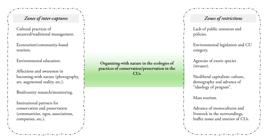
Diagram - Organizing-with nature in the ecologies of conservation and preservation practices in CUs.
It’s no use getting there and having the most incredible image when you are bothering the animal. It’s something we wouldn’t do to ourselves ... So, we get there, we find a position, and we lie on the ground for two or three hours and see incredible things. We learn all the time. ... Because my agency at that moment was completely strange. ... I will forever keep in my memory every whale, every encounter, every protected natural place, that has a wild nature, that has an atmosphere, and that filled me with hope, filled me with meaning, and this is something I will keep forever! [the interviewee cried at this moment] (E5).
Affective practices are also mobilized to create awareness in people who participate in organizing-with nature. The interviews indicate that art, education, and tourism are possible ways to mediate these (re)significations. “I really believe that feeling is a key, a little door to make a person susceptible to looking at the world, to the expansion of ideas” (E5), which can be opened with poetry, photography, or a documentary, according to the interviewees. Education with nature can also be observed in the processes of organizing-with. E4 and E6 highlight the importance of environmental education programs in state parks (ES). “We work mainly with children; we work with them until they become an adult who understands awareness (E4).” The volunteer program is also considered a relevant practice for awareness, since in contact with nature, the urban people in the project begin “to interact, to participate in a recovery project, because they plant a tree” (E6) and “awaken” to the need for conservation and preservation.
Tourism in organizing-with nature is also mobilized to affect, as it is seen by agencies like the Chico Mendes Institute for Biodiversity Conservation (ICMBio) as a driver of environmental awareness (Fróes & Moreira, 2024). For example, E1 highlighted that jaguar observation tourism is being used in the Amazon for the preservation of jaguars, and E5 reported that the same movement is taking place in Abrolhos (BA) with whales. The idea is to create ‘conscious tourism,’ instead of ‘predatory’ tourism. E6 reported a similar organizing-with nature in the Espírito Santo mountains: “at all times we are interacting, drawing attention to the field, drawing attention to how these CUs produce water, which is important for their lives”; and E2 with ants in the Amazon rainforest: “here we have this natural ant and it is very interesting to preserve it, you know? Why? Because it has several benefits, for health or even for a ritual.” On the other hand, tourism can also present risks.
In Itaúnas (ES), New Year’s Eve, which mobilizes thousands of people to the village (Iema, 2007), puts the geosite at risk due to the enormous amount of garbage produced (E4 and E6). Hunting and sport fishing put the preservation of various species in the Amazon rainforest at risk (E1, E2, and E3). The great dilemma for the management of CUs lies in balancing tourist activity. On the one hand, it generates income for the local community, but on the other, it poses a risk to preservation/conservation (Bedim, 2007). Besides tourism, it was possible to identify other conflicting relations that traverse organizing-with nature in the CUs. These conflicts are largely produced by the lack of public policies and the advance of neoliberal ideology in the context of traditional communities (Diegues, 2003; Rodríguez Cáceres, 2023).
The lack of public resources and investments leads communities to improperly exploit nature. Predatory hunting presents a challenge to conservation/preservation, according to E4 and E3. The very legislation of the CUs ends up becoming a catalyst for the production of conflict since, if the CU is characterized as a Protected Area (PI), the management of nature is largely prohibited in the territory (Law no. 9,985, 2000 / Lei n. 9.985, 2000). The communities that have lived in these spaces for a long time end up being ‘strangled’ (E4), as they have no alternative source of income. Added to this, the state also does not provide living conditions for these populations: “because there is little resource,” there is a lack of living conditions for these people (E3). The consequence is that many who live in traditional communities, who have a central role in the conservation/preservation of nature, choose to migrate from the region (E1 and E5). Or still, many others who decide to stay there end up adopting a neoliberal ideology of exploitation, giving in to the “capitalist system itself, the agribusiness thing, they are going to put cattle inside the reserve, this is already there, there’s no point in us denying it” (E3). Thus, the conservation/preservation of nature in these units ends up being put at risk precisely by those who have the greatest potential to organize-with and become-with it. In the next section, we will discuss the implications of these issues.
DISCUSSION: THEORETICAL AND PRACTICAL IMPLICATIONS
As the findings of this research reveal, the organizing of biodiversity preservation and conservation in CUs is not an exclusively human endeavor, but a doing-with multiple more-than-human actors, organic and inorganic, interconnected in ecologies of practices. Territories, laws, tides, plants, animals, and local knowledge are constitutive parts of an ecology of practices in constant becoming-with. In these inter-captures, restrictions emerge: the fauna and flora deviate from expectations, the tides rewrite the plans, and management protocols are strained by other ways of knowing. Far from being obstacles, these limitations are guides that show how we can act and what we should take into account in each situation. The ecology of conservation and preservation practices in CUs shows the importance of learning to work with these dynamics, not against them. The important thing here is not to dominate the dynamics, but to learn to be affected by them, to compose with them (Stengers, 2023).
As part of our objectives in this study, we developed a diagram that strives to capture the complexity of these relationships, and from it we organized our analyses. The diagram serves as an analytical tool to identify points of friction and composition in the CUs, which we call, in Stengers’s (2005) nomenclature, zones of restrictions and inter-captures. With it, we offer a map to navigate the complexities that are discussed next. It serves as a guide to identify both the recurrent patterns and the singularities that arise in each specific context of conservation/preservation. What might seem chaotic at first glance reveals, through this model, a relational order in which each element, by imposing its limits and possibilities, actively participates in the daily construction of the ecology of conservation/preservation practices. The following discussion explores these intersections, using empirical data to illustrate how the ecologies of these practices materialize in the daily life of CUs.
In general, the process of selective coding allowed us to arrive at the central argument that organizing-with nature in CUs is mobilized in the coexistence of more-than-human lives in the ecologies of conservation and preservation practices. In these ecologies, friction among worlds produces zones of inter-captures and restrictions, whose unfolding is intimately involved in the relationships of belonging to territories. The reports presented evidence that researching, monitoring, inspecting, raising awareness, doing activism, educating, and guiding tourists, etc., are processes (co)produced by more-than-human agencies, that is, in compositions of organizing-with. In this sense, this study contributes to the field by demonstrating the centrality of these agencies for organizational practices articulated with environmental sustainability, something still incipient in organizational studies (Good & Thorpe, 2020; Leite & Fantinel, 2024; Wright et al., 2018). Furthermore, it is important to highlight that organizing-with mobilizes traditional knowledge for its productions, precisely because these knowledges (Krenak, 2022) are produced in becoming-with relations (Haraway, 2023) that cross time and resist the imperatives of modernity and capitalism.
In the ecology of organizing-with nature in CUs, a complex web is constituted in which zones of inter-captures constantly negotiate with layers of material, political, and onto-epistemological restrictions. This dynamic illustrates the argument that every practice only exists as an active response to the restrictions that constitute it, whether they are traditional fire regimes that challenge bureaucratic temporalities, or animal behaviors that subvert scientific monitoring protocols. In traditional communities, as was seen, ancestral knowledges for fire management and reading ecosystems come into tension with environmental legislation and strategic conservation and preservation planning, which frequently ignore the specific temporalities of ecological cycles. This dynamic reveals that these restrictions, far from being mere obstacles, act as cosmopolitical forces that continuously reconfigure the ecologies of preservation and conservation practices.
Neoliberal capitalism emerges in our analysis as a kind of structuring restriction, a force that not only limits, but radically reconfigures the very field of the possible in these conservation and preservation practices, imposing ‘infernal choices’ (preserve without dignified living conditions or destroy to survive) on traditional communities and their relationships of belonging to the territory. Paradoxically, the very legislation and state policies can also end up restricting traditional management and accelerating degradation processes. In the interstices, however, inter-captures emerge, with researchers learning with communities to interpret the signs of plants and animals; community-based tourism building multispecies kinships; and traditional ecological calendars challenging the rigidity of institutional schedules.
The so-called ‘invasive species’ or ‘exotic species’ also operate in our analysis as restrictions in these ecologies. Normally seen as problems to be eliminated, they strain and force scientists and communities to rethink the criteria for conservation and preservation together, especially because their agencies put the ways of existing and belonging in the territory at risk. In the same way, the unpredictable behavior of animals like jaguars, which refuse to follow pre-established scientific models, makes visible the insufficiency of conventional monitoring approaches already institutionalized in scientific practice. In these frictions among diverse worlds, within the ecologies of practices, traditional knowledges reveal themselves not as alternatives to science, but as inter-captures that make becoming-with explicit as a fundamental onto-epistemic condition in the ecology of practices of CUs. When a traditional expert interprets the signs of jaguars or reads ecological indicators to predict climate changes, they engage in a living practice that actively responds to the specific restrictions of that ecosystem.
Tourism, in the analysis we produced, dramatically exemplifies the ecology of practices in tension and action. In our field findings, community-based tourism, connected to more-than-human agents and the rhythms of the territory, frequently emerged in opposition to mass tourism, to the commodification of nature, and to the perpetuation of neoliberal logic based on large enterprises and the ‘ideology of progress.’ This duality manifests the core of cosmopolitics in CUs: every practice of conservation and preservation is necessarily a precarious negotiation between worlds in friction, where solutions are never definitive but must be constantly recreated in the relationships between humans, laws, animals, plants, territories, climatic phenomena, etc.
Traditional knowledges, such as knowing how to locate oneself and perform immersions in the forest with trees; knowing the behavior of rivers and tides with the moon, the wind, and the sun; knowing how to locate animals by their smell, embody what Haraway (2023) conceptualizes as becoming-with. These cognitive and symbolic/material practices only exist insofar as they intertwine with more-than-human agencies in the territory. In them, humans learn to think-with the winds, to listen-with the rivers, and to plan-with the reproductive cycles of species. The persistence of these knowledges in CUs, despite centuries of marginalization under the colonial label of ‘savagery’ (Krenak, 2022), challenges the anthropocentric foundations of environmental management and allows for the production of other imaginaries for organizational doing (Banerjee & Arjaliès, 2021; Wright et al., 2018), other possibilities for the construction of worlds and the production of knowledges (Haraway, 2023).
Paradoxically, as Diegues (2003) shows, public policies continue to treat these communities as threats to biodiversity, reproducing the onto-epistemic violence that separates scientific knowledge from traditional ecological knowledge, precisely when the socio-environmental crisis we are experiencing demands relational possibilities (Wright et al., 2018). In this sense, each act of orientation by the stars or prediction by animal behavior represents not only ancestral technology, but also an act of cosmopolitical resistance (Stengers, 2018) against the capitalist simplification of ecosystems in light of the precepts of modern rationality. The reports from the people we interviewed evidence the centrality of these traditional knowledges for the daily management and organization in CUs.
We understand that the notion of organizing-with nature offers a transformative framework for administrative thought, shifting it from a logic of control to a relational epistemology capable of composing with knowledges and doings that have not traditionally dialogued with our theories and concepts. This perspective reveals that CUs function as living laboratories of cosmopolitics in action, in which scientific and traditional knowledges recombine into new onto-epistemic configurations. The paradigmatic case of the jaguars at the Mamirauá Institute (AM) illustrates this dynamic: when researchers abandoned their predictive models and opened up to local knowledges about animal behavior during floods, they not only corrected scientific misconceptions but also co-created a new monitoring methodology, a science in becoming-with the species (Haraway, 2023). The cosmopolitical encounter among ecologies of practices (Stengers, 2018) that involved openness to the production of what is possible showed the possibilities that arise between scientific and ancestral practices, whose results were positive for human-jaguar relations. The composition of these knowledges with scientific ones can help in the construction of a science that ‘evolves with species,’ different from what happens in the administrative status quo (Marquesan & Figueiredo, 2018), a producer of the Anthropocene that instrumentalizes so-called nature for the interests of a few humans (De Cock et al., 2021).
Education, art, and tourism, combined with technological agencies, when mediated by a relational approach, can potentiate awareness and (re)significations about the importance of conservation and preservation of what we understand as nature. From these vectors emerge kinships (Haraway, 2023), multispecies ontologies (Tsing, 2018) in which students, researchers, tourists, etc., (re)signify the importance of nature in their lives by organizing-with them in the here and now (Good & Thorpe, 2020). In this sense, CUs cease to be simply ‘protected spaces’ and assume a relevant role in bringing humans closer to their natural constitution through the production of affections. The reports show that tourism, on the one hand, drives conservation by generating income for the communities. On the other, depending on the type of tourism practiced, it is a threat to the relationships of belonging to the territory (Bedim, 2007). In contrast to ‘sport fishing,’ our research showed the richness of life flourishing in the human-jaguar encounter sustained by community-based tourism. In a scenario of anthropocentric catastrophes, it makes sense to turn to the production of cosmopolitics, alternatives thought with other thoughts (Stengers, 2015), such as those that happen in organizing-with nature in the CUs analyzed.
In addition, the reports allow us to state that the lack of income generation in traditional communities ends up producing a series of ‘infernal alternatives’ (Pignarre & Stengers, 2013), situations conceived and directed to allow no choice beyond resignation. These are choices where both alternatives are harmful: deforesting the forest or starving, for example. These infernal alternatives, naturalized in the imaginary of populations through the belief and continuous repetition (by the public sector, the media, and many other actors relevant to capitalist hegemony) that access to goods and services for a dignified life, or the obtaining of economic opportunities, occurs solely and exclusively through the commercial exploitation of the forest. They are the materialization of unequal power relations in capitalist and neoliberal societies, in which entrepreneurial logic overrides the collective experiences of living and belonging (Krenak, 2022).
The proposal of IP CUs, by establishing a normative rigidity that prohibits any form of traditional use of resources, creates a paradox: precisely those communities whose knowledges and becoming-with practices (Haraway, 2023) have sustained biodiversity for generations (Arruda, 1999) are now penalized in the name of preservation. This, combined with the lack of access to goods and services necessary for the maintenance of these populations, causes them, who are fundamental to the maintenance of biodiversity, to be ‘strangled.’ The consequence is that hunting, inadequate water use, deforestation for the construction of pastures, among other organizings-with, become the ‘infernal’ alternatives for these people. The reports also indicate that the lack of public policies brings great challenges to the management of the CUs. In the interim, the state emerges as an important figure that can make investments in public policies that stimulate preservation/conservation through the strengthening of traditional communities (Diegues, 2003), as was shown by the potential of community-based tourism. Otherwise, the preservation and conservation of nature in these CUs ends up being put at risk precisely by those who have the greatest potential to organize and become-with it (Haraway, 2023).
More and more, the communities of the CUs are replacing family agriculture as a central economic practice for the construction of ventures aimed at environmental tourism and gastronomy (Rodríguez Cáceres, 2023). One of the consequences of these transformations is that the buffer zones - the area surrounding the delimited area for conservation and preservation (Law no. 9,985, 2000 / Lei n. 9.985, 2000) - become a target for real estate speculation (Silva, 2019). Traditional communities are eventually forced to withdraw from their original locations to urban peripheries, precisely because they cannot keep up with the high inflationary movement resulting from these transformations (Diegues, 2003).
The reports show that more and more, the new generations of these communities are moving toward an urban life, which represents not only a demographic change but an onto-epistemic rupture. The double pressure of neoliberalism and colonial environmental management is progressively erasing traditional knowledges, woven over centuries of becoming-with ecosystems. From the perspective of the ecology of practices, this exodus configures a rupture in the regimes of attention and response to the ecological imperatives that sustain conservation and preservation practices. The deterioration of traditional knowledges thus represents the collapse of an entire ecology of practices, in which the very capacity to cultivate the modes of attention necessary to respond to the zones of friction and specific negotiations of each ecosystem is lost. This cognitive erosion, in addition to being a cultural loss, represents a threat to the very capacity to reinvent organizational models in the face of the ecological crisis (Banerjee & Arjaliès, 2021; Wright et al., 2018). It is precisely when the need to expand shared management mechanisms (Stürmer & Serva, 2024) is most evident that the material conditions for their reproduction become unsustainable.
The ecology of practices (Stengers, 2005) invites us to understand CUs as cosmopolitical arenas in which multiple ecological rationalities confront and recombine. What we propose here is a cosmopolitical gaze that allows for an opening between worlds, for the exposure of what they nurture and exclude, so that the state can effectively be capable of promoting sustainable management of these areas (Brito, 2008). In other words, we advocate for the proposition of cosmopolitics, of a diplomatically shared management that recognizes how much its practices produce inter-captures and restrictions on the relationships of belonging to territories. In this way, the central axis of cosmopolitics in CUs shows itself as a continuous process of precarious negotiation, a shared doing that demands the recognition of the limits of human control.
Conservation and preservation reveal themselves as practices in constant transformation, continuously reconfigured in the dynamics between more-than-human agents, between institutional norms and unpredictable ecological phenomena. Far from definitive solutions, what emerges are experimental arrangements, in which each restriction must be taken into account to collectively rethink the possibilities of coexistence. In CUs, as in all threatened ecosystems, the fundamental challenge resides in the capacity to rebuild ways of existence, not from perspectives of domination, but through sensitive attention to the complex networks of interdependence that sustain these ecologies of practices. Cosmopolitics thus configures itself as a daily practice of relational responsibility, in which the essential thing is to maintain the possibility for life, in all its diversity, to continue weaving its own conditions of existence, with or without our intervention.
CONCLUSION
In this article, drawing on Donna Haraway’s becoming-with and Isabelle Stengers’s ecology of practices, we show how organizing-with nature in CUs is mobilized in the coexistence of more-than-human lives in the ecologies of conservation and preservation practices. In these ecologies, friction among worlds produces zones of inter-captures and restrictions, whose unfolding is intimately involved in relationships of belonging to the territories. We show how organizing-with arises from the capacity to respond attentively to the specific restrictions imposed by each situated arrangement, in which management practices are necessarily inserted into an ecology of practices that is situated, partial, and relational.
Our analysis shows organizers-with who reject the modern fiction of the nature-culture split in favor of an engagement with the ecologies of practices that have always already intertwined them. By following the traces of these practices in CUs, we pay attention to something that dominant thought systematically disqualifies: knowledges that only exist insofar as they respond, with precision and care, to the singular demands imposed by each ecosystem. In CUs, organizing-with is multiple: with traditional communities, monitored species, the very rhythms of the territory. It is organizing-with in a way that cultivates the capacity to respond to multiple voices, whether human or not, that compose the world.
The findings of this research show that to contest (cosmo)politically organizing requires, above all, recognizing it as a field of negotiation in tension, among conflicting worlds. It is not, therefore, about seeking consensus or harmonious mediations, but about assuming the character of friction in these encounters, and the continuous reconfiguration among more-than-human practices. The cosmopolitics we advocate materializes in three fundamental gestures: the refusal of infernal alternatives; the valorization of zones of inter-captures; and the creation of modes of relational governance.
To refuse the ‘infernal alternatives’ imposed by neoliberalism implies creating spaces where other questions can emerge, born from attentive listening to the restrictions imposed by the very ecologies we seek to conserve. To value the zones of inter-captures means recognizing them as privileged spaces for practical reinvention. In the case of CUs, when scientific protocols learn from traditional knowledges, when management plans bend to the rhythms of the tides, or when public policies incorporate the regimes of attention of local communities, we are witnessing the emergence of an organizing-with that can resist modernist simplifications. Finally, creating modes of relational governance involves producing management practices radically based on active listening. It is about replacing traditional management models, which are centralized, rigid, and anthropocentric, with organizational practices that institutionalize the response to the voices of the ecosystem. In this sense, it is good to remember that CUs appear as microcosms of a larger dispute: the one that opposes, on one side, the fantasy of control that marked the modern management of territories, and, on the other, the cosmopolitical recognition of being part of ecologies always in becoming-with. This opposition is revealed not only in CUs but also in other organizational forms.
This is why we want our proposal of organizing-with not to be restricted to CUs, as we understand that it offers possibilities for management in various other institutional contexts, replacing models centered on hierarchy and control with administrative practices based on continuous negotiation with more-than-human agents. It would imply, for example, the development of logistics and production plans that internalize restrictions imposed by ecological chains (such as water scarcity or affected species’ behaviors), converting sustainability reports into tools for active listening to the territories where they operate. In the public sector, for instance, it could demand budgets and policies that not only tolerate but depend on continuous adjustments in the face of climatic phenomena, social movements, and other non-human agencies.
Considering this analysis, we show in a concrete way the possibility of questioning the classic nature-culture split, proposing an approach that embraces what is habitually silenced, but which can contribute to the construction of new possibilities for life. We hope that organizing-with, and especially organizing-with nature, can contribute to the fields of management and organizational studies with an engagement with knowledges and existences that are not limited to our own, although these still appear very timidly in our theories. Our intention is for this and other initiatives to engage these fields of knowledge in the practice of cosmic politics with a disposition to deal with indeterminacy, reactivating zones of experience in a direction not toward the probable, but toward the possible (Stengers, 2018).
We recognize, however, that despite our efforts to include the agencies of nature in organizing-with in this work, by limiting our research to interviews and documents, we run the risk of continuing to silence many other voices. In this sense, we suggest for future studies the application of immersive methodologies allowing for greater intimacy with nature, such as multispecies ethnography (Kirksey & Helmreich, 2010). The invitation we make is for us, researchers of organizations, to remain in the discomfort of thinking about alternatives in the Anthropocene. Agroecologies, permacultures, ecological activisms, quilombos, villages are phenomena that can contribute to the const\ruction of new imaginaries for the field. In other words, we leave an invitation to weave threads in becoming-with, staying with the urgencies of a planet in ruination (Haraway, 2023).
Acknowledgments
We thank the more-than-human lives that participated, directly or indirectly, in the composition of this research.
REFERENCES
-
Alcadipani, R., & Tureta, C. (2009). Teoria ator-rede e análise organizacional: Contribuições e possibilidades de pesquisa no Brasil. Organizações & Sociedade, 16(51), 647-664. https://doi.org/10.1590/S1984-92302009000400003
» https://doi.org/10.1590/S1984-92302009000400003 -
Arruda, R. (1999). “Populações tradicionais” e a proteção dos recursos naturais em unidades de conservação. Ambiente & Sociedade, 5, 79-92. https://doi.org/10.1590/S1414-753X1999000200007
» https://doi.org/10.1590/S1414-753X1999000200007 -
Banerjee, S. B., & Arjaliès, D.-L. (2021). Celebrating the end of enlightenment: Organization theory in the age of the Anthropocene and Gaia (and why neither is the solution to our ecological crisis). Organization Theory, 2(4), 263178772110367. https://doi.org/10.1177/26317877211036714
» https://doi.org/10.1177/26317877211036714 -
Bedim, B. P. (2007). O espaço capitalista da natureza e seu (contra)uso turístico: a dialética da visitação pública em áreas protegidas - um ensaio teórico. Caderno Virtual De Turismo, 7(3). https://www.ivt.coppe.ufrj.br/caderno/article/view/234
» https://www.ivt.coppe.ufrj.br/caderno/article/view/234 -
Blaser, M., & Cadena, M. (Orgs.). (2018). A world of many worlds. Duke University Press. https://doi.org/10.1515/9781478004318
» https://doi.org/10.1515/9781478004318 - Brito, D. (2008). Conflitos em unidades de conservação. Revista Eletrônica de Humanidades do Curso de Ciências Sociais da UNIFAP, 1(1), 1-12
-
Canto-Silva, C. R., & Silva, J. S. (2017). Panorama da visitação e da condução de visitantes em Parques brasileiros. Revista Brasileira de Pesquisa em Turismo, 11(2), 365-386. https://doi.org/10.7784/rbtur.v11i2.1286
» https://doi.org/10.7784/rbtur.v11i2.1286 -
Coleman, J. S. (1958). Relational analysis: The study of social organizations with survey methods. Human Organization, 17(4), 28-36. https://doi.org/10.17730/humo.17.4.q5604m676260q8n7
» https://doi.org/10.17730/humo.17.4.q5604m676260q8n7 -
Corbin, J., & Strauss, A. (1990). Grounded theory research: Procedures, canons, and evaluative criteria. Qualitative Sociology, 13(1), 3-21. https://doi.org/10.1007/BF00988593
» https://doi.org/10.1007/BF00988593 -
Czarniawska, B. (2008). Organizing: How to study it and how to write about it. Qualitative Research in Organizations and Management: An International Journal, 3(1), 4-20. https://doi.org/10.1108/17465640810870364
» https://doi.org/10.1108/17465640810870364 -
Decreto n. 4.340, de 22 de Agosto de 2002. (2002). Regulamenta artigos da Lei nº 9.985, de 18 de julho de 2000, que dispõe sobre o Sistema Nacional de Unidades de Conservação da Natureza - SNUC, e dá outras providências. Diário Oficial da União. http://www.planalto.gov.br/ccivil_03/decreto/2002/d4340.htm
» http://www.planalto.gov.br/ccivil_03/decreto/2002/d4340.htm -
De Cock, C., Nyberg, D., & Wright, C. (2021). Disrupting climate change futures: Conceptual tools for lost histories. Organization, 28(3), 468-482. https://doi.org/10.1177/1350508419883377
» https://doi.org/10.1177/1350508419883377 - Diegues, A. C. (2003). Mito moderno da natureza intocada (5a edição). ANNABLUME.
-
Doré, A., & Michalon, J. (2017). What makes human-animal relations ‘organizational’? The de-scription of anthrozootechnical agencements. Organization, 24(6), 761-780. https://doi.org/10.1177/1350508416670249
» https://doi.org/10.1177/1350508416670249 -
Duarte, M. F., & Alcadipani, R. (2016). Contribuições do organizar (organizing) para os Estudos Organizacionais. Organizações & Sociedade, 23(76), 57-72. https://doi.org/10.1590/1984-9230763
» https://doi.org/10.1590/1984-9230763 -
Ergene, S., Banerjee, S. B., & Hoffman, A. J. (2021). (Un)Sustainability and organization studies: Towards a radical engagement. Organization Studies, 42(8), 1319-1335. https://doi.org/10.1177/0170840620937892
» https://doi.org/10.1177/0170840620937892 - Fantinel, L. (2020). O organizar multiespécie da cidade. In L. Saraiva & I. Ana, História, práticas sociais e gestão das/nas cidades (pp. 297-344). Barlavento.
-
Figueiredo, M. D., Marquesan, F. F. S., & Imas, J. M. (2020). Anthropocene and “development”: Intertwined trajectories since the beginning of the great acceleration. Revista de Administração Contemporânea, 24(5), 400-413. https://doi.org/10.1590/1982-7849rac2020190400
» https://doi.org/10.1590/1982-7849rac2020190400 - Fontana, A., & Frey, J. (2011). The interview: From neutral stance to political involvement. In N. K. Denzin, & Y. S. Lincoln (Orgs.), The Sage handbook of qualitative research (pp. 695-725). Thousand Oaks: Sage.
-
Fróes, C. S. D. S., & Moreira, S. M. (2024). Explorando os fatores críticos de sucesso que afetam a visitação em Unidades de Conservação Estaduais em Minas Gerais. Turismo: Visão e Ação, 26, e19558. https://doi.org/10.14210/tva.v26.19558
» https://doi.org/10.14210/tva.v26.19558 -
Gherardi, S., & Laasch, O. (2022). Responsible management-as-practice: Mobilizing a post humanist approach. Journal of Business Ethics, 181, 269-281. https://doi.org/10.1007/s10551-021-04945-7
» https://doi.org/10.1007/s10551-021-04945-7 - Glaser, B., & Strauss, A. (2006). The discovery of grounded theory: Strategy for qualitative research. Aldine.
-
Good, J., & Thorpe, A. (2020). The nature of organizing: A relational approach to understanding business sustainability. Organization & Environment, 33(3), 359-383. https://doi.org/10.1177/1086026619858858
» https://doi.org/10.1177/1086026619858858 - Haraway, D. (2021). O manifesto das espécies companheiras: Cachorros, pessoas e alteridade significativa (1a edição). Bazar do Tempo.
- Haraway, D. J. (2023). Ficar com o problema: Fazer parentes no chthluceno (1a edição). N-1 Edições.
- Instituto Estadual de Meio Ambiente e Recursos Hídricos (Espírito Santo). (2007). Plano de manejo do Parque Estadual de Itaúnas. Estado do Espírito Santo.
-
Intergovernmental Panel on Climate Change. (2021). Climate Change 2021: The Physical Science Basis. Contribution of Working Group I to the Sixth Assessment Report of the Intergovernmental Panel on Climate Change. Cambridge University Press. https://www.ipcc.ch/report/ar6/wg1/
» https://www.ipcc.ch/report/ar6/wg1/ -
International Union for Conservation of Nature. (2021). The IUCN Red List of Threatened Species. https://www.iucnredlist.org
» https://www.iucnredlist.org -
Jensen, T., & Sandström, J. (2020). Organizing rocks: Actor-network theory and space. Organization, 27(5), 701-716. https://doi.org/10.1177/1350508419842715
» https://doi.org/10.1177/1350508419842715 -
Kirksey, S. E., & Helmreich, S. (2010). The emergence of multispecies ethnography. Cultural Anthropology, 25(4), 545-576. https://doi.org/10.1111/j.1548-1360.2010.01069.x
» https://doi.org/10.1111/j.1548-1360.2010.01069.x - Krenak, A. (2022). Futuro ancestral (1a edição). Companhia das Letras.
- Latour, B. (2020). Diante de Gaia: Oito conferências sobre a natureza no Antropoceno. Ubu Editora.
-
Lei n. 9.985 de 18 de Julho de 2000. (2000). Regulamenta o art. 225, § 1º, incisos I, II, III e VII da Constituição Federal, institui o Sistema Nacional de Unidades de Conservação da Natureza e dá outras providências. Diário Oficial da União. http://www.planalto.gov.br/ccivil_03/leis/l9985.htm
» http://www.planalto.gov.br/ccivil_03/leis/l9985.htm -
Leite, M. C. O., & Fantinel, L. D. (2024). Organizar em ruínas: Contribuições de abordagens multiespécies na Administração. Revista de Administração Contemporânea, 28(1), e230243. https://doi.org/10.1590/1982-7849rac2024230243.por
» https://doi.org/10.1590/1982-7849rac2024230243.por -
Marquesan, F. F. S., & Figueiredo, M. D. (2018). Do ecoambientalismo à sustentabilidade: Notas críticas sobre a relação organização-natureza nos estudos organizacionais. Organizações & Sociedade, 25(85), 264-286. https://doi.org/10.1590/1984-9250855
» https://doi.org/10.1590/1984-9250855 -
Matarazzo, G., & Sales, G. (2021). Antropoceno e organizações: Reflexões sobre governança ambiental em unidades de conservação. Revista Gestão & Conexões, 9(3), 32-51. https://doi.org/10.47456/regec.2317-5087.2020.9.3.31641.32-51
» https://doi.org/10.47456/regec.2317-5087.2020.9.3.31641.32-51 -
Matarazzo, G., & Serva, M. (2021). Unidades de conservação ambiental - Uma análise pragmatista da gestão e dos modos de existência organizacional de uma estação ecológica. Organizações & Sociedade, 28(98), 607-626. https://doi.org/10.1590/1984-92302021v28n9806pt
» https://doi.org/10.1590/1984-92302021v28n9806pt -
National Aeronautics and Space Administration. (2023). Global climate change: Vital signs of the planet. National Aeronautics and Space Administration. https://climate.nasa.gov
» https://climate.nasa.gov - Pignarre, P., & Stengers, I. (2013). Capitalist sorcery: Breaking the spell. Palgrave Macmillan.
-
Prado, D. S., Araujo, L. G. D., Chamy, P., Dias, A. C. E., & Seixas, C. S. (2020). Social participation in management councils of protected areas: Normative advances and the perspective of ICMBio Environmental officers. Ambiente & Sociedade, 23, e00362. https://doi.org/10.1590/1809-4422asoc20180036r2vu2020l5ao
» https://doi.org/10.1590/1809-4422asoc20180036r2vu2020l5ao -
Rockström, J., Gupta, J., Qin, D., Lade, S. J., Abrams, J. F., Andersen, L. S., Armstrong McKay, D. I., Bai, X., Bala, G., Bunn, S. E., Ciobanu, D., DeClerck, F., Ebi, K., Gifford, L., Gordon, C., Hasan, S., Kanie, N., Lenton, T. M., Loriani, S., … Zhang, X. (2023). Safe and just Earth system boundaries. Nature, 619(7968), 102-111. https://doi.org/10.1038/s41586-023-06083-8
» https://doi.org/10.1038/s41586-023-06083-8 -
Rodríguez Cáceres, L. S. (2023). O “sertão carioca”: Da ruralidade à conservação ambiental no contexto da expansão urbana no Rio de Janeiro. Horizontes Antropológicos, 29(66), e660406. https://doi.org/10.1590/1806-9983e660406
» https://doi.org/10.1590/1806-9983e660406 -
Roux-Rosier, A., Azambuja, R., & Islam, G. (2018). Alternative visions: Permaculture as imaginaries of the Anthropocene. Organization, 25(4), 550-572. https://doi.org/10.1177/1350508418778647
» https://doi.org/10.1177/1350508418778647 -
Sage, D., Justesen, L., Dainty, A., Tryggestad, K., & Mouritsen, J. (2016). Organizing space and time through relational human-animal boundary work: Exclusion, invitation and disturbance. Organization, 23(3), 434-450. https://doi.org/10.1177/1350508416629449
» https://doi.org/10.1177/1350508416629449 -
Sandberg, J., & Tsoukas, H. (2015). Making sense of the sensemaking perspective: Its constituents, limitations, and opportunities for further development: Making sense of sensemaking perspective. Journal of Organizational Behavior, 36(S1), S6-S32. https://doi.org/10.1002/job.1937
» https://doi.org/10.1002/job.1937 -
Seixas, C. S., Prado, D. S., Joly, C. A., May, P. H., Neves, E. M. S. C., & Teixeira, L. R. (2020). Governança ambiental no Brasil: Rumo aos objetivos do desenvolvimento sustentável (ODS)? Cadernos Gestão Pública e Cidadania, 25(81). https://doi.org/10.12660/cgpc.v25n81.81404
» https://doi.org/10.12660/cgpc.v25n81.81404 -
Silva, A. T. R. D. (2019). Áreas protegidas, populações tradicionais da Amazônia e novos arranjos conservacionistas. Revista Brasileira de Ciências Sociais, 34(99), e349905. https://doi.org/10.1590/349905/2019
» https://doi.org/10.1590/349905/2019 - Steffen, W., & Crutzen, P. J. (2007). The Anthropocene: Are humans now overwhelming the great forces of nature? Ambio, 36(8), 614-621.
-
Steinhardt, M., Pratt, S., & Ramp, D. (2022). Re-thinking felid-human entanglements through the lenses of compassionate conservation and multispecies studies. Animals, 12(21), 2996. https://doi.org/10.3390/ani12212996
» https://doi.org/10.3390/ani12212996 -
Stengers, I. (2005). Introductory notes on an ecology of practices. Cultural Studies Review, 11(1), 1. https://doi.org/10.5130/csr.v11i1.3459
» https://doi.org/10.5130/csr.v11i1.3459 - Stengers, I. (2015). No Tempo das Catástrofes (1a edição). Cosac & Naify.
-
Stengers, I. (2018). A proposição cosmopolítica. Revista do Instituto de Estudos Brasileiros, 69, 442-464. https://doi.org/10.11606/issn.2316-901X.v0i69p442-464
» https://doi.org/10.11606/issn.2316-901X.v0i69p442-464 - Stengers, I. (2023). Uma outra ciência é possível: Manifesto por uma desaceleração das ciências. Bazar do Tempo.
-
Stürmer, J., & Serva, M. (2024). Environmental governance that emerges from action: Pragmatist studies in protected areas. Revista de Administração Contemporânea, 28(5), e240105. https://doi.org/10.1590/1982-7849rac2024240105.en
» https://doi.org/10.1590/1982-7849rac2024240105.en -
Tsing, A. (2018). Paisagens arruinadas (e a delicada arte de coletar cogumelos). Cadernos do LEPAARQ (UFPEL), 15(30), 366. https://doi.org/10.15210/lepaarq.v15i30.13315
» https://doi.org/10.15210/lepaarq.v15i30.13315 -
Tsing, A. L. (2021). O antropoceno mais que humano. Ilha Revista de Antropologia, 23(1), 176-191. https://doi.org/10.5007/2175-8034.2021.e75732
» https://doi.org/10.5007/2175-8034.2021.e75732 -
Tsoukas, H., & Chia, R. (2002). On organizational becoming: Rethinking organizational change. Organization Science, 13(5), 567-582. https://doi.org/10.1287/orsc.13.5.567.7810
» https://doi.org/10.1287/orsc.13.5.567.7810 -
Villas Boas, G., & Mattos, C. (2021). A(s) natureza(s) da APA Macaé de Cima (Rio de Janeiro - Brasil): Percepções, dilemas e conflitos. Sociedade & Natureza, 33, e56556. https://doi.org/10.14393/SN-v33-2021-56556
» https://doi.org/10.14393/SN-v33-2021-56556 -
Weick, K. E. (2012). Organized sensemaking: A commentary on processes of interpretive work. Human Relations, 65(1), 141-153. https://doi.org/10.1177/0018726711424235
» https://doi.org/10.1177/0018726711424235 -
Wright, C., Nyberg, D., Rickards, L., & Freund, J. (2018). Organizing in the Anthropocene. Organization, 25(4), 455-471. https://doi.org/10.1177/1350508418779649
» https://doi.org/10.1177/1350508418779649 -
WWF Brasil. (2023). Unidades de conservação e a biodiversidade brasileira. WWF Brasil. https://www.wwf.org.br/como_voce_pode_ajudar/unidades_de_conservacao
» https://www.wwf.org.br/como_voce_pode_ajudar/unidades_de_conservacao
-
Funding
We thank the Coordenação de Aperfeiçoamento de Pessoal de Nível Superior (CAPES) for providing financial support for the development of this research.
-
Peer Review Method
This content was evaluated using the double-blind peer review process. The disclosure of the reviewers’ information on the first page, as well as the Peer Review Report, is made only after concluding the evaluation process, and with the voluntary consent of the respective reviewers and authors.
-
Plagiarism Check
RAC maintains the practice of submitting all documents approved for publication to the plagiarism check, using specific tools, e.g.: iThenticate.
-
Data Availability
The authors claim that all data used in the research have been made publicly available, and can be accessed via the Harvard Dataverse platform:Cabacine, Filipe; Fantinel, Letícia, 2025, "Replication Data for: Organizing-with Nature: A Study on the Ecologies of Practices in Brazilian Conservation Units published by RAC-Revista de Administração Contemporânea", Harvard Dataverse, V1.RAC encourages data sharing but, in compliance with ethical principles, it does not demand the disclosure of any means of identifying research subjects, preserving the privacy of research subjects. The practice of open data is to enable the reproducibility of results, and to ensure the unrestricted transparency of the results of the published research, without requiring the identity of research subjects.
-
Cite as:
Cabacine, F., & Fantinel, L. D. (2025). Organizing-with nature: A study on the ecologies of practices in Brazilian conservation units. Revista de Administração Contemporânea, 29(5), e240350. https://doi.org/10.1590/1982-7849rac2025240350.en
-
JEL Code:
M21
-
Peer Review Report:
The disclosure of the Peer Review Report was not authorized by its reviewers.

Edited by
-
Editor-in-Chief:
Paula Chimenti (Universidade Federal do Rio de Janeiro, COPPEAD, Brazil) https://orcid.org/0000-0002-6492-4072
-
Associate Editor:
Denize Grzybovski (Instituto Federal de Educação Ciência e Tecnologia do Rio Grande do Sul, Brazil) https://orcid.org/0000-0003-3798-1810
The authors claim that all data used in the research have been made publicly available, and can be accessed via the Harvard Dataverse platform:
Cabacine, Filipe; Fantinel, Letícia, 2025, "Replication Data for: Organizing-with Nature: A Study on the Ecologies of Practices in Brazilian Conservation Units published by RAC-Revista de Administração Contemporânea", Harvard Dataverse, V1.
https://doi.org/10.7910/DVN/N5SGGL
RAC encourages data sharing but, in compliance with ethical principles, it does not demand the disclosure of any means of identifying research subjects, preserving the privacy of research subjects. The practice of open data is to enable the reproducibility of results, and to ensure the unrestricted transparency of the results of the published research, without requiring the identity of research subjects.

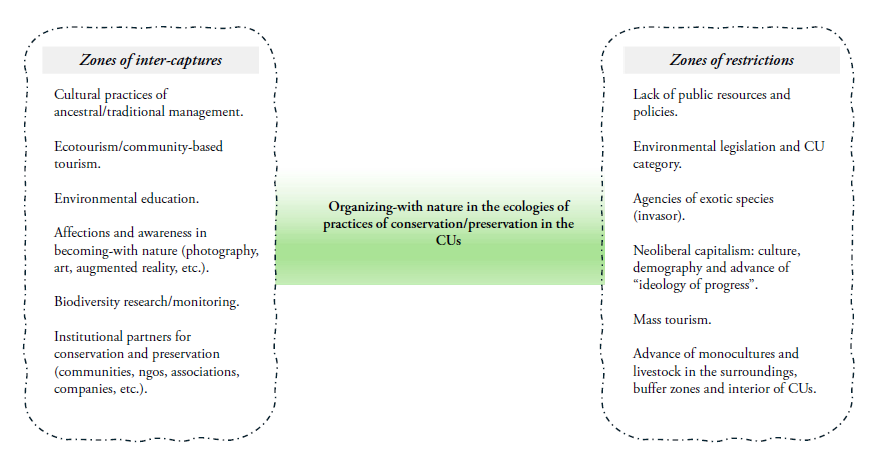 Source: Elaborated by the authors.