
 STEM: Scientific Database for Technical Vocational Education and Training at the Secondary Level
ABSTRACT
Objective: the fields of science, technology, engineering, and mathematics (STEM) influence economic, social, and scientific development. Research on these subjects is mostly found in primary, secondary, and higher education, as compared to vocational education and training, especially in secondary technical programs. The absence of a national classification that enables the identification of STEM courses limits the advancement of knowledge at other levels. This article proposes a method and a scientific database for secondary technical courses that facilitate the identification of STEM-related courses at the national level.
Method: the design science research methodology was employed to propose a method and instantiation (base), wherein courses in the 4th National Catalog of Technical Courses were classified according to the International Standard Classification of Education Fields of Education and Training 2013. A longitudinal case study (2018-2021) was performed to evaluate the adoption of the database in the context of Federal Institutes of Education, Science, and Technology. This study examined the representation of women in STEM fields within secondary technical courses, illustrating the usefulness, applicability, and efficacy of the artifacts.
Results: the resulting database constitutes a national classification structure aligned with international standards that enables research on the educational pathway of students in secondary technical programs in STEM areas in Brazil.
Conclusions: evidence and indicators play a pivotal role in the identification and acknowledgment of problems. The article proposes a strategy to broaden the application of standardized analyses in educational research and planning about STEM fields, aiming to promote a public policy agenda in education.
Keywords:
secondary technical courses; scientific database; design science research; STEM; agenda-setting
RESUMO
Objetivo: as áreas de ciência, tecnologia, engenharia e matemática (STEM) têm impacto no desenvolvimento econômico, social e científico. Estudos sobre essas áreas na educação são frequentes na educação básica e superior, quando comparados à educação profissional e tecnológica, especialmente sobre cursos técnicos de nível médio. A ausência de uma classificação nacional que permita identificar esses cursos limita a ampliação do conhecimento em outros níveis. Este artigo propõe um método e cria uma base de dados técnico-científica de cursos técnicos de nível médio que possibilita identificar cursos nas áreas de STEM em nível nacional.
Método: utilizou-se a metodologia design science research, propondo método e instanciação (base), na qual os cursos do 4º Catálogo Nacional de Cursos Técnicos foram classificados segundo o International Standard Classification of Education Fields of Education and Training 2013. Um estudo de caso longitudinal (2018-2021) sobre a presença feminina nas áreas de STEM na Educação Profissional Técnica de Nível Médio foi realizado para avaliar a implementação da base no contexto dos Institutos Federais de Educação, Ciência e Tecnologia, demonstrando a utilidade, a aplicabilidade e a eficácia dos artefatos.
Resultados: a base resultante constitui uma estrutura de classificação nacional, alinhada a parâmetros internacionais, que viabiliza a realização de estudos sobre a trajetória educacional de estudantes de cursos técnicos de nível médio nessas áreas no Brasil.
Conclusões: evidências e indicadores são fundamentais para definir e reconhecer um problema. O artigo propõe uma estratégia para expandir análises padronizadas para pesquisa e planejamento educacional sobre STEM e impulsionar uma agenda de políticas públicas na educação.
Palavras-chave:
cursos técnicos de nível médio; base de dados técnico-científica; design science research; STEM; formação da agenda
INTRODUCTION
Economic development and scientific knowledge are directly related to global competitive leadership in major economies, which raises concerns about training in strategic fields such as science, technology, engineering, and mathematics (STEM) (Wong et al., 2016; Xie & Killewald, 2012). The relevance of these fields is reflected in studies that address academic training and its impact on economic, social, and technological performance, as well as on innovation and security (Agasisti & Bertoletti, 2022; Bacovic et al., 2022; Kuschel et al., 2020; Podobnik et al., 2023; Xie et al., 2015).
In the field of education, studies on these areas are more frequent in basic and higher education than in technical vocational education and training (TVET) (Abd Majid et al., 2024; Freeman et al., 2019; Zhan et al., 2022). This situation is similar in Brazil, where research on STEM has gained relevance over the last 10 years (Pugliese, 2020; Unbehaum et al., 2023), with emphasis on basic education (Cunha et al., 2014; Delucia et al., 2017; Nicolete et al., 2017; Pasinato & Trentin, 2020) and higher education (Colnago et al., 2011; Custodio & Bonini, 2019; Junges et al., 2023; Manhães et al., 2015; Manhães et al., 2021; Nascimento et al., 2023).
However, regarding TVET, particularly in the context of technical courses, initiatives remain modest and limited in scope, with the institutional level designated as the unit of analysis (Borges et al., 2019; Silva et al., 2018). There is a lack of a clear definition of the concept of STEM and of a classification system adopted to categorize these courses (Koonce et al., 2011; Muñoz Rojas, 2023; Xie et al., 2015), with most studies addressing courses that are clearly related to these areas, such as technical computer science.
The absence of a tool that allows courses in this group to be selected restricts the expansion of knowledge about these areas at the technical secondary level. Brazil has the 4th National Catalog of Technical Courses (CNCT); however, due to its organization and methodology, it does not allow for the identification of courses associated with STEM, representing an obstacle to the expansion of the study (Ministério da Educação, 2020).
The document is currently being restructured with the aim of expanding the division of the structure into sublevels of classification to adapt the document to the international classification structure, increasing the number of levels from two to four, given that the current configuration limits technological segmentation (Parecer CNE/CP n. 3, 2024; Parecer CNE/CP n. 7, 2020; Resolução CNE/CP n. 1, 2021). However, the new proposal does not address the discussion examined in this study, since the revision does not allow for the identification of STEM courses.
The amendment uses the structure of the International Standard Classification of Education Adapted for Undergraduate and Sequential Specific Training Courses (Cine Brasil), developed by the National Institute for Educational Studies and Research Anísio Teixeira (Inep) and based on international classification standards - namely, the International Standard Classification of Education - Fields of Education and Training (ISCED-F 2013) - as inspiration to reorganize the existing catalog, but does not classify the courses according to this instrument (Parecer CNE/CP n. 3, 2024; Resolução CNE/CP n. 2, 2024). Even so, this may be considered a first attempt to bring the catalogs into line with international standards.
At the higher education level, Cine Brasil enables the identification and classification of bachelor’s and licensure programs, in addition to technology degrees listed in the 3rd National Catalog of Higher Education Technology Courses (CNCST), which can be grouped as STEM. However, this application does not extend to secondary technical programs (Instituto Nacional de Estudos e Pesquisas Educacionais Anísio Teixeira [Inep], 2021). The document uses the methodology of the International Standard Classification of Education (ISCED), a standard classification that allows the grouping, collection, and analysis of educational statistics at national and international levels (Inep, 2021; Schneider, 2013).
In this context, Cine Brasil employs the ISCED-F 2013 classification system, which encompasses education and training domains, facilitating the categorization of educational programs and qualifications according to educational levels and training areas (Inep, 2021). ISCED-F 2013 encompasses secondary, post-secondary, and higher education levels, as well as initial and continuing education, professional qualifications, and vocational education, consistent with the scope of TVET offerings and facilitating the categorization of knowledge areas such as STEM (Muñoz Rojas, 2023; Unesco Institute for Statistics [Unesco IFS], 2014; OECD/Eurostat/Unesco Institute for Statistics, 2015).
Cine Brasil data can be used to disseminate data from the Higher Education Census (Censup), identify and select undergraduate courses for the National Student Performance Exam (Enade), and select undergraduate course evaluators, in addition to allowing comparisons of educational statistics between countries. However, it applies only at the higher and sequential levels and cannot be used at other levels, leaving a gap (Inep, 2021).
Given this scenario, a reference framework is needed to identify courses in the STEM grouping at the secondary technical level, enabling parameterized research on educational trajectories, dropout rates in these areas, and the barriers commonly faced by certain groups (Bendl & Schmidt, 2010; Çelik & Watson, 2021; Lykkegaard & Ulriksen, 2019; Metcalf, 2010; Sáinz et al., 2022). The absence of an official national classification that includes secondary technical professional education (STPE) represents an obstacle to further studies on contemporary issues, such as gender inequalities in these areas.
While women represent the majority of undergraduate students, they are underrepresented in engineering, production and construction, and information and communication technologies (ICT) fields (Inep, 2023a, 2023b). Furthermore, women are less inclined to enter STEM fields during their educational journey, and when they do, they are less likely to complete their education, creating a funnel or filter when moving from secondary to higher education and, later, to a professional career (Bergeron & Gordon, 2017; Blickenstaff, 2005; Vooren et al., 2022).
However, without an instrument that allows for this identification, it becomes difficult to determine whether the problem observed at the higher level is also present in secondary-level technical courses in Brazil. Thus, this study proposes a method and a technical-scientific database of secondary-level technical courses, resulting from the exchange and integration of related data which, once organized, reframes knowledge in the scientific field in an accessible way (Coordenação de Aperfeiçoamento de Pessoal de Nível Superior [CAPES], 2019; Porter, 2000). The proposal will facilitate the identification of secondary-level technical courses in STEM at the national level, according to the ISCED-F 2013 international classification standard.
With this strategy, it is hoped to enhance the identification of problems through analysis and to support the proposal of public policies focused on TVET, thereby strengthening STEM fields at the secondary technical level. Identifying these courses will make it possible to conduct population-based studies on student presence at national, subnational, and institutional levels, and to assess the impact of policies when the database is applied to national education datasets, such as the Nilo Peçanha Platform (PNP), and to institutional evaluation methods. This will provide opportunities for analyses aligned with Sustainable Development Goals (SDGs) 4 (quality education) and 5 (gender equality), established in the UN 2030 Agenda.
The database has the potential to generate value for the formation of a national STEM agenda. It contributes to the planning, implementation, monitoring, and evaluation of public policies focused on TVET and on the institutions that make up the Federal Network for Professional, Scientific, and Technological Education (Federal Network), which play a significant role at the regional and local levels (Lei n. 11.892, 2008), comprising 41 institutions and 682 units. The instrument can also be used to analyze the offerings of the Sistema S, which is part of TVET.
Therefore, in addition to the method and database, this article also presents the application of the database in a longitudinal case study (2018-2021) on the presence of women in STEM fields at STPE, evaluating its implementation in the context of the Federal Institutes of Education, Science, and Technology (Federal Institutes or IF) and investigating whether the problem exists at this level.
Finally, this initiative can be understood as an innovation in public administration, since it aims to respond to government shortcomings, solve wicked problems, and provide better services to promote social and economic development at the national and subnational levels (Cavalcante & Cunha, 2017). In addition, innovation in public administration can be considered radical, incremental, improvement, recombination, or formalization innovation (Gallouj & Weinstein, 1997).
The database consists of a recombination innovation by combining features from two classifications, generating value through an instrument that will allow researchers and policymakers to produce data for understanding STEM and studies in other areas covered by the classification at the secondary technical level (Gallouj & Weinstein, 1997).
THEORETICAL BACKGROUND
Agenda setting in education
Agenda setting is a critical stage in the public policy decision-making process and can be categorized into three types: systemic agenda, governmental agenda, and decision-making agenda (Capella, 2018). The first refers to a set of issues that receive attention from society and are considered to be within the competence of the government (Capella, 2018). Conversely, the governmental agenda encompasses issues deemed significant by decision-makers at the local, state, or federal levels, thereby capturing the government’s attention (Capella, 2018). The governmental agenda includes the decision-making agenda, which addresses topics that are ready for decision-making by policymakers - these are specialized or sectoral agendas (Capella, 2018).
Agenda-setting research is developed in relation to three spheres: media, public, and governmental (Capella & Brasil, 2018). To facilitate public policy agenda setting, five key aspects must be present (Kingdon, 2014; Zohlnhöfer et al., 2022). These are three independent streams - the problem stream, the policy stream, and the political stream - in addition to policy entrepreneurs and the window of opportunity (arising from the coupling of the problem and political streams) (Zahariadis et al., 2023).
The first stream deals with the recognition of an issue as legitimate, in which the view of a problem and its framing impact its understanding (Zahariadis et al., 2023). The policy stream refers to the identification and selection of viable alternatives that are technically accepted by the community and financially feasible to implement (Kingdon, 2014). The political stream, on the other hand, concerns political ideas provided by political communities, such as public officials, politicians, academics, the media, and civil society, among others (Herweg, 2016).
This whole scenario relies on the important role played by policy entrepreneurs, who are key actors in promoting change, given their willingness to invest resources such as time, money, and energy to promote alternatives, whether or not they are part of the political community (Kingdon, 2014; Zahariadis et al., 2023). It is important to note that these actors can also act by denying or blocking an agenda in its formation process (Capella, 2016).
From this perspective, recognition of a problem depends on its framing (Kingdon, 2014), in which (1) systematic evidence and indicators, (2) focusing events, crisis or disaster situations, symbols, or personal experiences of public policymakers, and (3) feedback on actions taken by the government are essential elements for an issue to attract the attention of entrepreneurs and emerge as a problem (Zahariadis et al., 2023).
Given this, the lack of a tool that enables the recognition of the existence of a problem and even its assessment limits knowledge about its presence (Kingdon, 2014). The absence of a classification system that allows for the identification of secondary-level technical courses considered STEM hinders the performance of educational analyses, making it difficult to produce evidence.
This acronym, related to the fields of education and work, gained notoriety in 1986 due to the National Academy of Sciences’ (NAS) concern with the number of graduates in these programs and their impact on the economic development of the United States (National Science Board, 1987; Zhan et al., 2022). The debate about the definition of STEM and the classification of the specific areas that make up the field also gained ground in academia, given the need for a clear definition and classification of a still confusing construct used for both research and educational assessment (Aguilera & Ortiz-Revilla, 2021; Breiner et al., 2012; Koonce et al., 2011). The definitions encompass different approaches, depending on the actors involved, and are subdivided into two areas: educational and professional (Breiner et al., 2012; English, 2016; Koonce et al., 2011).
Despite the different concepts, in the field of education, the acronym is related to teaching and learning, covering educational activities considered formal and informal, from preschool to postdoctoral studies, in an integrated manner and applied to the reality of the student, with the aim of fostering the training of teachers, students, and professionals to improve competitiveness at a global level (Aguilera & Ortiz-Revilla, 2021; Breiner et al., 2012; Gonzalez & Kuenzi, 2012; Kuenzi, 2008). In line with this discussion, the absence of a clear definition and classification of these areas is also present in TVET, especially in identifying which secondary-level technical courses can be considered STEM, which creates obstacles for the proposal of government policies or national strategies related to policy agenda setting in education.
In this context, indicators, especially those addressing social aspects, are pertinent for identifying problems such as inequalities, evaluating the effectiveness and efficiency of government policies, and serving as instruments for communicating evidence for scientific and management understanding, with particular emphasis on the necessity for valid, reliable, and scientifically rigorous measures (Parahos et al., 2013). In the field of education, academic statistical indicators, management indicators relating to teachers and students, scientific production, affirmative action, and internationalization support decision-making by governmental and non-governmental actors in the political arena (Zucatto et al., 2021).
From this standpoint, the development of an instrument that facilitates the identification of programs associated with STEM domains in STPE is imperative for the organization of data and to ensure the incorporation of the problem into the public policy agenda. It is evident that the efficacy of this strategy is contingent upon a systematic approach to the organization of information within the framework of knowledge organization systems (KOS).
Knowledge organization systems
KOS are systematic solutions that facilitate the organization of different types of information to enable knowledge management (Hodge, 2000). Their development is guided by theoretical principles derived from classification theory, concept theory, and terminology, which guide conceptual aggregations based on their characteristics, degrees of similarity, or discrepancies (Lima & Maculan, 2017). Therefore, KOS provide a methodological basis for overcoming the current classification gap.
Soergel (2009) posits that the primary function of KOS is to enhance communication by facilitating the acquisition and assimilation of information, in addition to developing the conceptual frameworks necessary for conducting research. Furthermore, they serve to classify, providing a basis for political and social action, and can be applied in public policy planning and decision-making, among other areas. The different structures of KOS can be used to organize, index, catalog, and search, as well as to enable learning, modeling, and reflection on organized and schematized knowledge, not only by repeating structures from the past, but also by forming new semantic structures that provide access to previously unnoticed information (Hodge, 2000; Zeng, 2008).
In this scenario, the application of KOS in education includes repositories such as digital libraries (Soergel, 2009) and the “identification and declaration of objectives related to cognitive development” (Ferraz & Belhot, 2010, p. 421) through Bloom’s taxonomy. It is also present in the representation of scientific and educational organizations based on ontological modeling, presenting performance indicators (Globa et al., 2022); in the educational classification of areas and training programs (Inep, 2021; UNESCO Institute for Statistics, 2014); and in classifications that evaluate the performance of educational institutions (Guimarães, 2020).
Therefore, given that knowledge must be organized in a manner that conveys the underlying information to be useful (Soergel, 2009), it is important to emphasize that classifications play a significant role in educational planning and statistics. In this context, establishing a classification becomes strategic for producing evidence that feeds into the problem flow, allowing for the recognition of urgency and, consequently, strengthening the formation of an agenda on STEM in TVET.
METHODOLOGICAL PROCEDURES
The development of this proposal was guided by the design science research (DSR) method, which involves problem-solving through the creation and evaluation of an artifact (Hevner et al., 2004). This methodology has been employed in a variety of disciplines, including educational planning research (Fahd & Miah, 2023; Fahd et al., 2021), and in supporting decision-making processes (Miah et al., 2016).
Peffers et al. (2007) emphasize that an artifact can be “any object designed with a built-in solution to an understood research problem” (p. 49), that is, an innovation based on technical, social, and/or informational resources, or even an object resulting from the combination of these resources (Järvinen, 2007). Thus, the proposal deals with a systematic method or procedure for application in a specific context, with the objective of solving a problem, and an instantiation that implements constructs, models, or methods, demonstrating their feasibility and applicability in a real situation (Hevner et al., 2004).
The database can be used for research, as well as for educational management and planning purposes (Aken, 2004). In accordance with Peffers et al. (2007), the demonstration of the instantiation can be accompanied by a case study, aiming to test the artifact in the real world, which is the objective of this work. Thus, the study followed the design of Peffers et al. (2007), with the following steps: (1) identification of the problem and its motivation and (2) definition of the solution, both presented in the introduction; (3) development of the solution (artifact), described in the design and development of the artifact; (4) demonstration of the solution, presented in the results; (5) evaluation of the artifact, described below and carried out through a case study; and (6) communication, described below, according to Table 1.
The evaluation was conducted to verify the effectiveness of the artifact in solving the problem for which it was designed. To this end, the objectives of the solution were compared with the results obtained through its application (Peffers et al., 2007). The evaluation methodology employed adheres to the guidelines outlined by Venable et al. (2016), which encompass four distinct steps: (1) defining the evaluation objectives; (2) selecting the strategy; (3) defining the attributes to be evaluated; and (4) conducting the evaluation. This step aims to verify its usefulness, applicability, and effectiveness in a real scenario (Hevner et al., 2004).
According to Venable et al. (2016), the evaluation strategy must consider the timing, purpose, and form of evaluation of an artifact. In this sense, the strategy adopted occurred only once, at the end of the process, and was termed ‘quick and simple,’ given that the application of the artifact is effective only after its completion, in addition to involving low social and technical risk.
The evaluation was conducted ex post and was summative, due to the need to compare the design and the result based on it, and naturalistic, that is, based on the analysis of data from Federal Institutes to analyze the performance of the artifact (Venable et al., 2016). The instantiation was demonstrated through the application of the technical-scientific database in the longitudinal analysis (2018-2021) of enrollments in STEM technical courses at the secondary level in the 38 Federal Institutes, using data from the PNP, which compiles official statistics from the Federal Network.
The microdata were collected annually from the Ministry of Education (MEC) Open Data Portal. This decision was influenced by the possibility that students may change their course of study during their training period, which, in turn, results in alterations to their enrollment records and subsequent impacts on admissions analysis, as asserted by Moraes et al. (2020). The analysis encompassed a total of 369,522 enrollment records
The enrollment of students in secondary technical courses aged over 15 was analyzed to demonstrate the general areas most sought after by gender, the trend in female attendance, and the courses most and least sought after by female students in STEM areas. For the analysis, the definition of STEM for TVET from the UNESCO International Project on Technical and Vocational Education (UNEVOC) was applied, which understands STEM as the training of students to pursue professions that require STEM-related skills (Unesco/Unevoc, 2020).
The study covered secondary-level technical courses classified in the following general areas: (05) natural sciences, mathematics, and statistics; (06) information and communication technologies; (07) engineering, manufacturing, and construction; and (08) agriculture, forestry, fisheries, and veterinary science (Unesco/Unevoc, 2020). Communication refers to the dissemination of knowledge, which is relevant for research, planning, and management purposes (Hevner et al., 2004), through two deliverables: the publication of an article communicating the method and demonstrating the application of the instantiation, and the availability of the technical-scientific database on the Mendeley Data platform (DOI).
Design science research: Implementation of the method in a case study
Artifact design and development
The proposal outlines methodologies and illustrative cases for educational research, management, and planning. The initial phase of the study entailed an examination of the methodology employed in the Manual for the Classification of Undergraduate and Sequential Courses - Cine Brasil; however, its scope covers only undergraduate and sequential courses. This stage began with an analysis of the literature on the appropriate definition and classification for the development of the database.
Next, the structure of ISCED-F 2013 and the CNCT was described, and a comparison between the two was made, which served to relate the instruments. As a result of this relationship, it became feasible to analyze female participation in STEM technical courses at the Federal Institutes using the database developed.
ISCED-F 2013 framework overview
The ISCED was designed for planning, analyzing, and evaluating educational policies, conducting studies, and assisting in decision-making, regardless of the structure of the educational system and the country’s level of economic development (Schneider, 2013).
The instrument employs a classification system that organizes educational programs and their respective qualifications into nine levels, ranging from early childhood education (level 0) to doctoral studies (level 8) (Unesco Institute for Statistics [Unesco IFS], 2015). ISCED-F 2013 uses the same classification as ISCED 2011 (UNESCO Institute for Statistics, 2014). This study focuses on secondary-level technical courses, corresponding to ISCED levels 3 and 4.
The ISCED-F 2013 structure features a three-level hierarchy, subdivided into 11 general areas, 29 specific areas, and 80 detailed areas, which allow for the classification of qualifications and content-focused education programs, as shown in Table 2 (UNESCO Institute for Statistics, 2014; Unesco Institute for Statistics, 2015).
General areas cover broad fields of knowledge, such as education, arts, and humanities; specific areas are particular categories within these fields of knowledge; and detailed areas correspond to the disciplinary specialization of specific categories (UNESCO Institute for Statistics, 2014).
At the detailed area level, there is a structure composed of the following elements: description of the detailed area; descriptor of programs and qualifications; and inclusions and exclusions within the area. In general, the classification of educational programs, at any educational level, is carried out according to the main subject studied, observing the predominance of credits or learning time (UNESCO Institute for Statistics, 2014).
CNCT framework
The catalog is the national classification that regulates the offering of technical secondary courses in EPT (Ministério da Educação, 2020). It is organized into technological areas (major thematic areas), based on interdisciplinary convergence (Decreto n. 5.773, 2006; Decreto n. 9.235, 2017; Lei n. 9.394, 1996; Machado, 2010; Parecer n. 277, 2006).
The document combines the socio-occupational structure and the required training, with a view to supporting course planning by educational institutions, guiding students in their academic and professional choices, and assisting the productive sector in identifying the appropriate professional profile for hiring (Ministério da Educação, 2020; Resolução CNE/CEB n. 3, 2008; Resolução CNE/CP n. 1, 2021). Accordingly, the catalog is structured around the interdependence among scientific, cultural, and professional domains, thereby establishing a nexus between knowledge domains and professional practice (Machado, 2010).
The CNCT is organized into two levels (technological axis and courses), with 13 axes and 215 technical courses, according to the latest edition of the catalog (Ministério da Educação, 2020). The first level specifies the technological axis, while the second level presents the following information: the course description; the characterization of the course according to the professional profile; the minimum course load; the prerequisites for admission; the professional legislation and standards relevant to professional practice; the training itineraries and intermediate certifications related to continuing education; the field of activity; the occupations listed in the Brazilian Classification of Occupations (CBO); the minimum necessary infrastructure; and the previous names of the courses (Ministério da Educação, 2020), as illustrated in Table 3.
A comparison of ISCED-F and CNCT structures
In order to establish a relationship between the instruments used to create the database, a comparison of the structures is necessary, as shown in Table 4. It is noteworthy that both structures are similar in terms of aggregation at the first level, as they encompass broader domains of knowledge areas.
However, the catalog does not present a subdivision into technological subfields, which could be closer to specific areas. With regard to the detailed areas, it should be noted that these are more specific domains that describe the thematic content and present programs and qualifications related to the area, including examples that allow areas and courses to be categorized.
The classification of courses necessitates the consideration of elements that facilitate the establishment of relationships between different classifications. Two elements facilitate this link. According to ISCED-F 2013: (1) the detailed description of the area for classifying programs or qualifications and (2) the classification of programs and qualifications according to their main content (examples, inclusions, and exclusions). In the CNCT, these were: (1) the description of the course according to the professional profile and (2) the course descriptor.
Hence, the possibilities for relationships between national and international instruments are noted, aiming for the proposed method and technical-scientific database to classify the courses in the catalog according to ISCED-F 2013, as shown in Table 5.
From this standpoint, the link that will be presented in the research results can be observed.
RESULTS
In order to achieve the proposed development, the secondary-level technical courses in the 4th edition of the catalog were classified according to the parameters described in the Monitoring Manual (ISCED-F 2013) (UNESCO Institute for Statistics, 2014) and in the document Detailed Description of Educational Areas and Qualifications (ISCED-F 2013) (UNESCO Institute for Statistics, 2015). According to these instruments, classification should be carried out according to the central theme studied, determined based on the predominance of credits or learning time, when available (UNESCO Institute for Statistics, 2014).
In the absence of this information, the program or qualification is recognized by its title, which incorporates elements from its curriculum structure and syllabus; or, when no field predominates, it can be classified as interdisciplinary. The manual also guides the adoption of criteria for classification when a course offers equal attention to more than one field of concentration, such as priority by content, learning objectives, object of interest, learning methods, and tools and techniques used (UNESCO Institute for Statistics, 2014).
In this scenario, the present study was based on the course descriptor and the course description according to the professional profile, elements contained in the catalog, due to the lack of detailed information about the program, such as the predominance of credits or learning time.
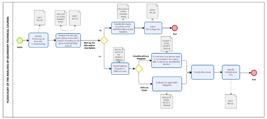
Thus, the following steps were taken for classification:
1. Identification of CNCT technological areas and corresponding secondary-level technical courses
This stage identified all courses in the 13 technological areas.
2. Analysis of CNCT courses according to the ISCED-F 2013 structure
The classification of educational programs was determined by the primary subject studied, based on: (1) identification of the title and (2) analysis of the description of secondary-level technical courses in the catalog, according to the Monitoring Manual (ISCED-F 2013) (UNESCO Institute for Statistics, 2014) and the document Detailed Description of ISCED-F 2013 Educational Areas and Qualifications (UNESCO Institute for Statistics, 2015).
The skills and professional profiles established in the CNCT were classified according to the 11 general areas, 29 specific areas, and 80 detailed areas of ISCED-F 2013. Aspects related to the breakdown of the course load for each program could not be evaluated, as the CNCT does not provide this information. In addition, the initial correspondence between the general areas (ISCED-F 2013) and the technological axes (CNCT) was not carried out, since the groupings adopt different classification formats.
3. Correspondence between CNCT courses and ISCED-F
Classification of secondary-level technical courses in the catalog according to the general areas, specific areas, and detailed areas of ISCED-F 2013.
4. Faceted classification of courses
The classification of courses was carried out considering the codes of the detailed area of ISCED-F 2013; inclusion of a separator digit (.); initials of the general areas; separator digit (.); and a sequential identification number.
5. Correspondence between the general areas of ISCED-F 2013 and the technological axes of the CNCT
In this last phase, it was possible to identify the technological axes related to each general area of ISCED-F 2013.
Thus, all courses in the 4th catalog were classified according to the international instrument, allowing the identification and selection of secondary-level technical courses in the most diverse forms of grouping, also covering the areas of STEM knowledge, as demonstrated in Figure 1.
The database is presented in two ways: (1) focusing on ISCED-F 2013 (international context) and (2) focusing on the CNCT (national context). The following elements are present in both presentations: general code; general area; specific code; detailed code; detailed area; course code; course label; and technological axis. The national context was prioritized for the presentation, as shown in Figure 2.
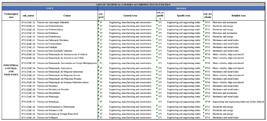
Illustration of the database with technical courses from the CNCT’s industrial control and processes technological axis, classified according to ISCED-F 2013 (demonstration focused on the CNCT).
Moreover, the relationship between general areas and technological axes was demonstrated in two dimensions (national and international).
Figure 3 illustrates the national focus. The database was published in Excel format on Mendeley Data (DOI).

Artifact evaluation: Analysis of female participation in STEM in EPT at Federal Institutes
The evaluation phase entails the implementation of the proposed artifact in a real-world context to ascertain its usefulness, applicability, and effectiveness in addressing the problem (Hevner et al., 2004). In this context, an analysis of enrollment data for secondary-level technical courses identified as STEM at the Federal Institutes is presented
Figure 4 presents the analysis of enrollment data, categorized by year and general area, according to gender, from 2018 to 2021. A notable increase in female participation is observed in courses classified as (05) natural sciences, mathematics, and statistics; however, fluctuations in enrollment are evident throughout the analyzed period, with an overall decline in enrollment volume over the four-year span. Furthermore, a consistent rise in female enrollment in courses classified as (08) agriculture, forestry, fisheries, and veterinary science is observed, with women exhibiting a marked predominance throughout the period under study. Unlike the previous case, this category has a medium enrollment volume.
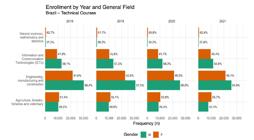
Conversely, the data reveal that, despite the limited participation of women in courses classified under the general category (06) information and communication technologies, there has been an increase in the presence of this group, with slight fluctuation in the period studied and an average enrollment volume. Finally, with respect to the courses classified as (07) engineering, manufacturing, and construction, there is a consistent increase in female enrollment, although males remain predominant, accompanied by a high enrollment volume.
Therefore, it is evident that women are enrolling in secondary-level technical courses in STEM at Federal Institutes, with a notable emphasis on the areas of (05) natural sciences, mathematics, and statistics and (08) agriculture, forestry, fisheries, and veterinary science, ranging from low to medium enrollment volumes. Additionally, despite the preponderance of males in the fields of (06) information and communication technologies and (07) engineering, manufacturing, and construction, there has been an increase in the presence of women.
A positive trend has been observed in the participation of women in STEM technical courses, indicating an increase in their presence, as illustrated in Figure 5. However, there has been a decline in the number of female students enrolling, indicating a decrease in demand for STEM technical courses at Federal Institutes, despite a slight recovery in 2021. It should be noted that, during this period, the country was affected by the COVID-19 pandemic crisis (World Health Organization [WHO], 2020), which had affected students’ trajectory (Santos et al., 2022).

Figure 6 shows the five courses with the highest and the five courses with the lowest proportion of female enrollments in the period from 2018 to 2021. The courses Garment and Apparel Production Technician, Confectionery Technician, and Landscape Design Technician have the highest proportion of women in the four years analyzed, followed by the courses Food Processing Technician and Viticulture and Enology Technician, present in three years.
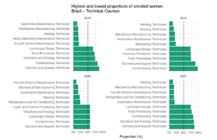
STEM technical courses with the highest and lowest proportion of women enrolled per year in Brazil.
On the other hand, the Automotive Maintenance Technician, Mechanical Manufacturing Technician, and Welding Technician courses have the lowest proportions in all years. Furthermore, the courses Welding Technician and Aircraft Airframe Maintenance Technician have a low proportion of female students in three years. All courses in Figure 6 are classified as (07) engineering, manufacturing, and construction and (08) agriculture, forestry, fisheries, and veterinary science.
The method enabled the creation of a technical-scientific database, allowing for the classification of all secondary-level technical courses in the 4th edition of the catalog. The efficacy of this approach is evidenced by its capacity to present these courses in accordance with international classification systems and to satisfy the requirements of the STEM grouping. The applicability and effectiveness of the database were evaluated based on its ability to support longitudinal data analysis, according to a case study, meeting the parameters of ex post, summative, and naturalistic evaluation (Venable et al., 2016).
The database facilitates the expansion of studies in STEM fields in a standardized manner, with applications at the institutional, regional, and national levels, as outlined in the extant literature. It allows for the development of evidence for educational planning on STEM at the technical secondary level, a feat that was previously unattainable with the CNCT due to its structure limitations.
The absence of this instrument hindered the ability to recognize that the underrepresentation of women was a reality in STPE. This strategy underscores the underrepresentation of women in these fields, with the objective of contributing to a public policy agenda in education that enhances the presence of this demographic in these disciplines. This contribution is linked to the problem stream by making it visible to policymakers and leaders in TVET (Zahariadis et al., 2023; Zucatto et al., 2021).
Thus, when using the instrument, it is noted that women exhibited a higher presence in areas (05) natural sciences, mathematics, and statistics and (08) agriculture, forestry, fisheries, and veterinary science; however, with low to medium enrollment volumes compared to the other general areas in this study. A positive trend in female participation is observed, but it is accompanied by a decline in the number of female students enrolling, indicating a decline in demand for technical courses in STEM at Federal Institutes, with a slight recovery in 2021.
Furthermore, the presence of women is more pronounced in courses classified as ‘feminine,’ a phenomenon that can be attributed to cultural and social influences (Cheryan et al., 2017). This phenomenon may be indicative of the roles and expectations attributed to behavior, values, and choices associated with gender stereotypes (Bueno, 1996; Cheryan et al., 2011; Rosado, 2012); self-esteem issues resulting from not feeling that they belong to that environment (Rodríguez, 2006); and the absence of female role models in these areas (Carvalho & Mourão, 2020).
FINAL CONSIDERATIONS
Research on STEM has gained relevance due to its impact on society and on the development of countries. There are many studies on these areas in basic and higher education, but they are still limited in relation to technical courses at the secondary level in Brazil. However, no standardized studies with national analysis were found.
It was found that the current national classification instrument for these courses, the CNCT, does not cover the STEM grouping, limiting studies on these areas in professional and technological education. Nonetheless, an international classification system for higher education facilitates the grouping of these institutions. In this context, the proposal sought to address this gap by presenting a technical-scientific database of secondary-level technical courses that facilitates systematic analysis at the national level, encompassing areas classified as STEM. This initiative aims to promote advances in research and educational management in STEM areas in TVET.
The database stems from the need for strategies to increase awareness of the low representation of women in technical secondary education. The aim is to generate evidence to shed light on the problem. In addition, the initiative fosters advancements in parameterized studies on educational trajectories and dropout rates in these areas, in order to define the problem of female underrepresentation and contribute to a policy agenda on the topic in education.
The present article employed the DSR methodology to propose a method and develop the database, including an evaluation stage to assess the effectiveness of the artifacts in identifying STEM courses and implementing a study with EPT data. The study was constrained by the unavailability of certain resources in the catalog for the classification of courses according to ISCED-F 2013; nevertheless, two key elements facilitated the relationship between the instruments. Hence, it is recommended that future research apply the database to advance knowledge about STEM in Brazil, especially after 2021, as well as to conduct studies in other areas covered by the international classification.
REFERENCES
-
Abd Majid, M. Z., Kasavan, S., & Siron, R. (2024). Bibliometric analysis and science mapping of global scientific publications on technical vocational education training (TVET). Library Hi Tech, 42(1), 8-32. https://doi.org/10.1108/lht-12-2021-0485
» https://doi.org/10.1108/lht-12-2021-0485 -
Agasisti, T., & Bertoletti, A. (2022). Higher education and economic growth: A longitudinal study of European regions 2000-2017. Socio-Economic Planning Sciences, 81, 100940. https://doi.org/10.1016/j.seps.2020.100940
» https://doi.org/10.1016/j.seps.2020.100940 -
Aguilera, D., & Ortiz-Revilla, J. (2021). STEM vs. STEAM education and student creativity: A systematic literature review. Education Sciences, 11(7), 331. https://doi.org/10.3390/educsci11070331
» https://doi.org/10.3390/educsci11070331 -
Aken, J. E. V. (2004). Management research based on the paradigm of the design sciences: The quest for field‐tested and grounded technological rules. Journal of Management Studies, 41(2), 219-246. https://doi.org/10.1111/j.1467-6486.2004.00430.x
» https://doi.org/10.1111/j.1467-6486.2004.00430.x -
Bacovic, M., Andrijasevic, Z., & Pejovic, B. (2022). STEM education and growth in Europe. Journal of the Knowledge Economy, 13(3), 2348-2371. Bacovic, M., Andrijasevic, Z., & Pejovic, B. (2022). STEM education and growth in Europe. Journal of the Knowledge Economy, 13(3), 2348-2371. https://doi.org/10.1007/s13132-021-00817-7
» https://doi.org/10.1007/s13132-021-00817-7 -
Bendl, R., & Schmidt, A. (2010). From ‘Glass Ceilings’ to ‘Firewalls’- Different Metaphors for Describing Discrimination. Gender, Work & Organization, 17(5), 612-634. https://doi.org/10.1111/j.1468-0432.2010.00520.x
» https://doi.org/10.1111/j.1468-0432.2010.00520.x -
Bergeron, L., & Gordon, M. (2017). Establishing a STEM pipeline: Trends in male and female enrollment and performance in higher level secondary STEM courses. International Journal of Science and Mathematics Education, 15(3), 433-450. https://doi.org/10.1007/s10763-015-9693-7
» https://doi.org/10.1007/s10763-015-9693-7 -
Blickenstaff, J.C. (2005). Women and science careers: leaky pipeline or gender filter?. Gender and Education, 17(4), 369-386. https://doi.org/10.1080/09540250500145072
» https://doi.org/10.1080/09540250500145072 -
Borges, M. R. Neto, Carvalho, P., & Costa, R. (2019). Implementation and evaluation of the first renewable energy systems technical course in Brazil. IEEE Access, 7, 46538-46549. https://doi.org/10.1109/ACCESS.2019.2908623
» https://doi.org/10.1109/ACCESS.2019.2908623 -
Breiner, J. M., Harkness, S. S., Johnson, C. C., & Koehler, C. M. (2012). What is STEM? A discussion about conceptions of STEM in education and partnerships. School Science and Mathematics, 112(1), 3-11. https://doi.org/10.1111/j.1949-8594.2011.00109.x
» https://doi.org/10.1111/j.1949-8594.2011.00109.x -
Bueno, C. G. (1996). El género y el prestigio profesional. Reis, 75, 215-233. https://doi.org/10.2307/40184034
» https://doi.org/10.2307/40184034 -
Capella, A. C. N. (2016). Agenda-setting policy: Strategies and agenda denial mechanisms. Organizações & Sociedade, 23(79), 675-691. https://doi.org/10.1590/1984-9230713
» https://doi.org/10.1590/1984-9230713 - Capella, A. C. N. (2018). Formulação de políticas públicas. Enap.
-
Capella, A. C. N., & Brasil, F. G. (2018). Agenda-setting: Mídia e opinião pública na dinâmica de políticas públicas. Compolítica, 8(1), 123-146. https://doi.org/10.21878/compolitica.2018.8.1.236
» https://doi.org/10.21878/compolitica.2018.8.1.236 -
Carvalho, S., & Mourão, L. (2020). Trajetória profissional de mulheres cientistas à luz dos estereótipos de gênero. Psicologia em Estudo, 25, 656-674. https://doi.org/10.4025/psicolestud.v25i0.46325
» https://doi.org/10.4025/psicolestud.v25i0.46325 - Cavalcante, P., & Cunha, B. (2017). É preciso inovar no governo, mas por quê? In Inovação no setor público: Teoria, tendências e casos no Brasil. ENAP, pp. 15-32.
-
Çelik, H., & Watson, F. (2021). Understanding the leaky pipeline system: behavioural ecological approach to the social marketing of women thriving in STEM careers. Journal of Social Marketing, 11(4), 616-632. https://doi.org/10.1108/JSOCM-03-2021-0051
» https://doi.org/10.1108/JSOCM-03-2021-0051 -
Cheryan, S., Ziegler, S. A., Montoya, A. K., & Jiang, L. (2017). Why are some STEM fields more gender balanced than others? Psychological bulletin, 143(1), 1. https://doi.org/10.1037/bul0000052
» https://doi.org/10.1037/bul0000052 -
Cheryan, S., Siy, J. O., Vichayapai, M., Drury, B. J., & Kim, S. (2011). Do female and male role models who embody STEM stereotypes hinder women’s anticipated success in STEM? Social Psychological and Personality Science, 2(6), 656-664. https://doi.org/10.1177/1948550611405218
» https://doi.org/10.1177/1948550611405218 -
Colnago, M., Lages, C. F. A., Picoli, H. S., Benvenuto, G. A., Ghetti, T. B., & Casaca, W. C. D. O. (2022). Um estudo de gênero a partir da distribuição de bolsas do programa universidade para todos. Proceeding Series of the Brazilian Society of Computational and Applied Mathematics, 9(1), 010318-1. https://doi.org/10.5540/03.2022.009.01.0318
» https://doi.org/10.5540/03.2022.009.01.0318 - Coordenação de Aperfeiçoamento de Pessoal de Nível Superior. (2019). Produção técnica-grupo de trabalho: Relatório. MEC.
-
Cunha, M. B., Peres, O. M. R., Giordan, M., Bertoldo, R. R., Quadros Marques, G., & Duncke, A. C. (2014). As mulheres na ciência: O interesse das estudantes brasileiras pela carreira científica. Educación Química, 25(4), 407-417. https://doi.org/10.1016/S0187-893X(14)70060-6
» https://doi.org/10.1016/S0187-893X(14)70060-6 -
Custodio, C., & Bonini, P. (2019). Educação superior e trabalho em Santa Catarina: Um enfoque nas carreiras de aplicação direta de ciência e tecnologia. Textos de Economia, 22(1), 82-112. http://dx.doi.org/10.5007/2175-8085.2019v22n1p82
» http://dx.doi.org/10.5007/2175-8085.2019v22n1p82 -
Decreto n. 5.773, de 9 de maio de 2006 (2006). Dispõe sobre o exercício das funções de regulação, supervisão e avaliação de instituições de educação superior e cursos superiores de graduação e sequenciais no sistema federal de ensino. Presidência da República. http://www.planalto.gov.br/ccivil_03/_Ato2004-2006/2006/Decreto/D5773.htm
» http://www.planalto.gov.br/ccivil_03/_Ato2004-2006/2006/Decreto/D5773.htm -
Decreto n. 9.235, de 14 de março de 2017. (2017). Dispõe sobre o exercício das funções de regulação, supervisão e avaliação das instituições de educação superior e dos cursos superiores de graduação e de pós-graduação no sistema federal de ensino. Presidência da República. https://www.planalto.gov.br/ccivil_03/_ato2015-2018/2017/decreto/d9235.htm
» https://www.planalto.gov.br/ccivil_03/_ato2015-2018/2017/decreto/d9235.htm -
Delucia, J., Silva, M. M., Estevam, B. C., Alves, G. C., Bárbara, M. M., Tiera, V. A., & Gois, J. (2017). Olimpíada científica como influência formativa no ensino básico. Revista Ciências & Ideias, 8(1), 177-194. https://revistascientificas.ifrj.edu.br/index.php/reci/article/view/687
» https://revistascientificas.ifrj.edu.br/index.php/reci/article/view/687 -
English, L. D. (2016). STEM education K-12: Perspectives on integration. International Journal of STEM Education, 3(1), 1-8. https://doi.org/10.1186/s40594-016-0036-1
» https://doi.org/10.1186/s40594-016-0036-1 -
Fahd, K., & Miah, S. J. (2023). Designing and evaluating a big data analytics approach for predicting students’ success factors. Journal of Big Data, 10(1), 159. https://doi.org/10.1186/s40537-023-00835-z
» https://doi.org/10.1186/s40537-023-00835-z -
Fahd, K., Miah, S. J., Ahmed, K., Venkatraman, S., & Miao, Y. (2021). Integrating design science research and design-based research frameworks for developing education support systems. Education and Information Technologies, 26, 4027-4048. https://doi.org/10.1007/s10639-021-10442-1
» https://doi.org/10.1007/s10639-021-10442-1 -
Ferraz, A. P. D. C. M., & Belhot, R. V. (2010). Taxonomia de Bloom: Revisão teórica e apresentação das adequações do instrumento para definição de objetivos instrucionais. Gestão & Produção, 17(2), 421-431. https://doi.org/10.1590/S0104-530X2010000200015
» https://doi.org/10.1590/S0104-530X2010000200015 -
Freeman, B., Marginson, S., & Tytler, R. (2019). An international view of STEM education. In STEM Education 2.0 (pp. 350-363). Brill Sense. https://doi.org/10.1163/9789004405400_019
» https://doi.org/10.1163/9789004405400_019 -
Gallouj, F., & Weinstein, O. (1997). Innovation in services. Research Policy, 26(4-5), 537-556. https://doi.org/10.1016/s0048-7333(97)00030-9
» https://doi.org/10.1016/s0048-7333(97)00030-9 -
Globa, L., Novogrudska, R., Popova, M., Zadoienko, B., & Junfeng, Y. (2022). Ontology-driven approach to research and educational organization information representation. In Progress in image processing, pattern recognition and communication systems: Proceedings of the Conference (CORES, IP&C, ACS) - June 28-30, 2021 (Vol. 12, pp. 318-329). Springer International Publishing. https://doi.org/10.1007/978-3-030-81523-3_31
» https://doi.org/10.1007/978-3-030-81523-3_31 -
Gonzalez, H. B., & Kuenzi, J. J. (2012). Science, technology, engineering, and mathematics (STEM) education: A primer. Congressional Research Service, Library of Congress. https://files.eric.ed.gov/fulltext/ED593605.pdf
» https://files.eric.ed.gov/fulltext/ED593605.pdf -
Guimarães, J. A. C. (2020). Os rankings universitários como sistemas de organização do conhecimento: Considerações teóricas. Informação & Sociedade: Estudos, 30(4), 1-23. https://doi.org/10.22478/ufpb.1809-4783.2020v30n4.57187
» https://doi.org/10.22478/ufpb.1809-4783.2020v30n4.57187 -
Herweg, N. (2016). Clarifying the concept of policy-communities in the multiple-streams framework. In R. Zohlnhöfer & F. W. Rüb (Eds.), Decision-making under ambiguity and time constraints: Assessing the multiple-streams framework (pp. 125-145). ECPR Press. https://www.sfu.ca/~howlett/documents/Pass%2005.pdf#page=141
» https://www.sfu.ca/~howlett/documents/Pass%2005.pdf#page=141 -
Hevner, A. R., March, S. T., Park, J., & Ram, S. (2004). Design science in information systems research. MIS Quarterly, 28(1), 75-105. https://doi.org/10.2307/25148625
» https://doi.org/10.2307/25148625 - Hodge, G. M. (2000). Systems of knowledge organization for digital libraries: Beyond traditional authority files (No. 91). Digital Library Federation.
-
Instituto Nacional de Estudos e Pesquisas Educacionais Anísio Teixeira. (2021). Cine Brasil. https://www.gov.br/inep/pt-br/areas-de-atuacao/pesquisas-estatisticas-e-indicadores/cine-brasil/cine-brasil
» https://www.gov.br/inep/pt-br/areas-de-atuacao/pesquisas-estatisticas-e-indicadores/cine-brasil/cine-brasil -
Instituto Nacional de Estudos e Pesquisas Educacionais Anísio Teixeira (2023a). Censo da Educação Superior 2023. Tabelas de Divulgação: Tabela 3.06 - Número de Ingressos por Processo Seletivo, de Matrículas e de Concluintes em Cursos. https://download.inep.gov.br/educacao_superior/censo_superior/documentos/2023/tabelas_de_divulgacao_censo_da_educacao_superior_2023.xls
» https://download.inep.gov.br/educacao_superior/censo_superior/documentos/2023/tabelas_de_divulgacao_censo_da_educacao_superior_2023.xls -
Instituto Nacional de Estudos e Pesquisas Educacionais Anísio Teixeira (2023b). Apresentação da Coletiva de Imprensa do Censo da Educação Superior 2023. https://download.inep.gov.br/educacao_superior/censo_superior/documentos/2023/apresentacao_censo_da_educacao_superior_2023.pdf
» https://download.inep.gov.br/educacao_superior/censo_superior/documentos/2023/apresentacao_censo_da_educacao_superior_2023.pdf -
Junges, D. D. L. V., Rosa, L. P., & Grocinotti, V. G. (2023). A percepção de mulheres estudantes em cursos de graduação das áreas STEM. Amazônia: Revista de Educação em Ciências e Matemáticas, 19(42), 102-117. http://dx.doi.org/10.18542/amazrecm.v19i42.13635
» http://dx.doi.org/10.18542/amazrecm.v19i42.13635 -
Järvinen, P. (2007). Action Research is Similar to Design Science. Quality & Quantity, 41(1), 37-54. https://doi.org/10.1007/s11135-005-5427-1
» https://doi.org/10.1007/s11135-005-5427-1 - Kingdon, J. W. (2014). Agendas, alternatives, and public policies (2nd ed.). Pearson New International Edition. Pearson Education Limited.
-
Koonce, D. A., Zhou, J., Anderson, C. D., Hening, D. A., & Conley, V. M. (2011). What is STEM? In 2011 ASEE Annual Conference & Exposition (pp. 22-1684). https://doi.org/10.18260/1-2--18582
» https://doi.org/10.18260/1-2--18582 -
Kuenzi, J. J. (2008). Science, technology, engineering, and mathematics (STEM) education: Background, federal policy, and legislative action. Congressional Research Service. https://www.everycrsreport.com/reports/RL33434.html
» https://www.everycrsreport.com/reports/RL33434.html -
Kuschel, K., Ettl, K., Díaz-García, C., & Alsos, G. A. (2020). Stemming the gender gap in STEM entrepreneurship: Insights into women’s entrepreneurship in science, technology, engineering and mathematics. International Entrepreneurship and Management Journal, 16(1), 1-15. https://doi.org/10.1007/s11365-020-00642-5
» https://doi.org/10.1007/s11365-020-00642-5 -
Lei n. 11.892 de 29 de dezembro de 2008. (2008). Institui a Rede Federal de Educação Profissional, Científica e Tecnológica, cria os Institutos Federais de Educação, Ciência e Tecnologia, e dá outras providências. Presidência da República. https://www.planalto.gov.br/ccivil_03/_ato2007-2010/2008/lei/l11892.htm
» https://www.planalto.gov.br/ccivil_03/_ato2007-2010/2008/lei/l11892.htm -
Lei n. 9.394, de 20 de dezembro de 1996. (1996). Estabelece as diretrizes e bases da educação nacional. Presidência da República. https://www.planalto.gov.br/ccivil_03/leis/l9394.htm
» https://www.planalto.gov.br/ccivil_03/leis/l9394.htm -
Lima, G. Â. , & Maculan, B. C. M. S. (2017). Estudo comparativo das estruturas semânticas em diferentes sistemas de organização do conhecimento. Ciência da Informação, 46(1). https://revista.ibict.br/ciinf/article/view/4014
» https://revista.ibict.br/ciinf/article/view/4014 -
Lykkegaard, E., & Ulriksen, L. (2019). In and out of the STEM pipeline: A longitudinal study of a misleading metaphor. International Journal of Science Education, 41(12), 1600-1625. https://doi.org/10.1080/09500693.2019.1622054
» https://doi.org/10.1080/09500693.2019.1622054 -
Machado, L. R. D. S. (2010). Organização da educação profissional e tecnológica por eixos tecnológicos. Linhas Críticas, 16(1), 89-108. http://educa.fcc.org.br/scielo.php?pid=S1981-04312010000100006&script=sci_abstract&tlng=en
» http://educa.fcc.org.br/scielo.php?pid=S1981-04312010000100006&script=sci_abstract&tlng=en -
Manhães, L. M. B., Zavaleta, J., Cerceau, R., Costa, R. J. M., & Cruz, S. M. S. (2021). Investigating STEM courses performance in Brazilians higher education. In International Conference on Computer Supported Education (pp. 212-231). Springer International Publishing. https://doi.org/10.1007/978-3-031-14756-2_11
» https://doi.org/10.1007/978-3-031-14756-2_11 -
Manhães, L. M. B, Cruz, S. M. S., & Zimbrão, G. (2015). Towards automatic prediction of student performance in STEM undergraduate degree programs. Proceedings of the 30th Annual ACM Symposium on Applied Computing, 1, 247-253. https://doi.org/10.1145/2695664.2695918
» https://doi.org/10.1145/2695664.2695918 -
Metcalf, H. (2010). Stuck in the Pipeline: A Critical Review of STEM Workforce Literature. InterActions: UCLA Journal of Education and Information Studies, 6(2). https://doi.org/10.5070/d462000681
» https://doi.org/10.5070/d462000681 -
Miah, S. J., McGrath, G. M., & Kerr, D. (2016). Design science research for decision support systems development: Recent publication trends in the premier IS journals. Australasian Journal of Information Systems, 20, 1-14. https://doi.org/10.3127/ajis.v20i0.1482
» https://doi.org/10.3127/ajis.v20i0.1482 -
Ministério da Educação. (2020). Catálogo Nacional de Cursos Técnicos (4ª ed.). MEC. https://www.gov.br/mec/pt-br/acesso-a-informacao/institucional/estrutura-organizacional/orgaos-especificos-singulares/secretaria-de-educacao-profissional/catalogos-nacionais-de-cursos/catalogo-nacional-de-cursos-tecnicos-cntc
» https://www.gov.br/mec/pt-br/acesso-a-informacao/institucional/estrutura-organizacional/orgaos-especificos-singulares/secretaria-de-educacao-profissional/catalogos-nacionais-de-cursos/catalogo-nacional-de-cursos-tecnicos-cntc -
Moraes, G. H., Almeida, S. C. L., Alves, T. E., Lima, M. V. S., Filho, R. P. R., Juliatto, M. A., Botelho, A. F., Junior, W. T. S., Bermejo, P. H. S., Godoy, D. F., Gallindo, É. L., Ribeiro, F. P., Kenchian, G., Silva, J. C., Souza, I. R. M. S., Leão, P. H. A., Silva, S. S. (2020). Plataforma Nilo Peçanha: Guia de referência metodológica. Editora Evobiz. http://dadosabertos.mec.gov.br/images/pdf/grm-2020-isbn-revisado.pdf
» http://dadosabertos.mec.gov.br/images/pdf/grm-2020-isbn-revisado.pdf -
Muñoz Rojas, C. (2023). Public policies for gender equality in science, technology, engineering and mathematics (STEM): challenges for the economic autonomy of women and transformative recovery in Latin America”, Gender Affairs series, No. 161 (LC/TS.2021/158), Santiago, Economic Commission for Latin America and the Caribbean (ECLAC). https://hdl.handle.net/11362/68676
» https://hdl.handle.net/11362/68676 -
Nascimento, L. M. A., Lima, Y. O., Barbosa, C. E., Costa, L. F. C., Santos, A. M., Galeno, L., Xexéo, G. B., & Souza, J. M. (2023). Paridade de gênero no ensino superior em STEM no Brasil: Uma análise de 10 anos. In Anais do XVII Women in Information Technology (pp. 217-227). SBC. https://doi.org/10.5753/wit.2023.229472
» https://doi.org/10.5753/wit.2023.229472 -
National Science Board (US), Task Committee on Undergraduate Science, & Engineering Education. (1987). Undergraduate science, mathematics, and engineering education: Source materials (Vol. 2). National Science Board, Task Committee on Undergraduate Science and Engineering Education. https://www.nsf.gov/nsb/publications/1986/nsb0386.pdf
» https://www.nsf.gov/nsb/publications/1986/nsb0386.pdf -
Nicolete, P. C., Bilessimo, S. M. S., Silva Cristiano, M. A., Simão, J. P. S., & Silva, J. B. (2017). Technology integration actions in mathematics teaching in Brazilian basic education: Stimulating STEM disciplines. Revista de Educación a Distancia (RED), 52. https://doi.org/10.6018/red/52/7
» https://doi.org/10.6018/red/52/7 -
OECD/Eurostat/UNESCO Institute for Statistics. (2015). ISCED 2011 operational manual: Guidelines for classifying national education programmes and related qualifications. OECD Publishing. https://doi.org/10.1787/9789264228368-en
» https://doi.org/10.1787/9789264228368-en -
Parahos, R., Figueiredo Filho, D. B., da Rocha, E. C., Silva, J. A., Júnior, & Maia, R. G. (2013). Construindo indicadores sociais: Uma revisão da bibliografia especializada. Perspectivas: Revista de Ciências Sociais, 44, 55-76. https://periodicos.fclar.unesp.br/perspectivas/article/view/7406
» https://periodicos.fclar.unesp.br/perspectivas/article/view/7406 -
Pasinato, L. B., & Trentin, M. A. S. (2020). A robótica na escola: Promovendo o raciocínio lógico e articulando a tecnologia na educação básica por meio de um desafio relâmpago. Educitec - Revista de Estudos e Pesquisas sobre Ensino Tecnológico, 6, e094420. https://doi.org/10.31417/educitec.v6i.944
» https://doi.org/10.31417/educitec.v6i.944 -
Parecer n. 277, de 7 de dezembro de 2006. (2006). Nova forma de organização da educação profissional e tecnológica de graduação. Ministério da Educação. http://portal.mec.gov.br/cne/arquivos/pdf/pces277_06.pdf
» http://portal.mec.gov.br/cne/arquivos/pdf/pces277_06.pdf -
Parecer CNE/CP n. 7, de 19 de maio de 2020. (2020). Diretrizes Curriculares Nacionais para a Educação Profissional e Tecnológica, a partir da Lei n.º 11.741/2008, que deu nova redação à Lei de Diretrizes e Bases da Educação Nacional (LDB). Ministério da Educação. http://portal.mec.gov.br/index.php?option=com_docman&view=download&alias=151591-pcp007-20&category_slug=julho-2020-pdf&Itemid=30192
» http://portal.mec.gov.br/index.php?option=com_docman&view=download&alias=151591-pcp007-20&category_slug=julho-2020-pdf&Itemid=30192 -
Parecer CNE/CP n. 3, de 23 de janeiro de 2024. (2024). Reexame do Parecer CNE/CP n.º 19, de 11 de abril de 2023, que reexaminou o Parecer CNE/CP n.º 30, de 8 de novembro de 2022, que tratou da proposta de estruturação dos Catálogos Nacionais de Cursos de Educação Profissional e Tecnológica em áreas tecnológicas, Eixos Tecnológicos e as Áreas Tecnológicas Organizadoras do Catálogo de Cursos Técnicos e Tecnológicos. Ministério da Educação. http://portal.mec.gov.br/index.php?option=com_docman&view=download&alias=255211-pcp003-24&category_slug=janeiro-2024&Itemid=30192
» http://portal.mec.gov.br/index.php?option=com_docman&view=download&alias=255211-pcp003-24&category_slug=janeiro-2024&Itemid=30192 -
Peffers, K., Tuunanen, T., Rothenberger, M. A., & Chatterjee, S. (2007). A design science research methodology for information systems research. Journal of Management Information Systems, 24(3), 45-77. https://doi.org/10.2753/MIS0742-1222240302
» https://doi.org/10.2753/MIS0742-1222240302 -
Podobnik, B., Dabić, M., Wild, D., & Di Matteo, T. (2023). The impact of STEM on the growth of wealth at varying scales, ranging from individuals to firms and countries: The performance of STEM firms during the pandemic across different markets. Technology in Society, 72, 102148. https://doi.org/10.1016/j.techsoc.2022.102148
» https://doi.org/10.1016/j.techsoc.2022.102148 - Porter, J. H. (2000). Scientific databases. In Ecological data: Design, management and processing (pp. 48-69). Chapman & Hall/CRC.
-
Pugliese, G. (2020). STEM education-um panorama e sua relação com a educação brasileira. Currículo sem Fronteiras, 20(1), 209-232. http://dx.doi.org/10.35786/1645-1384.v20.n1.12
» http://dx.doi.org/10.35786/1645-1384.v20.n1.12 -
Resolução CNE/CEB n. 3, de 9 de julho de 2008. (2008). Dispõe sobre a instituição e implantação do Catálogo Nacional de Cursos Técnicos de Nível Médio. Ministério da Educação. http://portal.mec.gov.br/index.php?option=com_docman&view=download&alias=10940-rceb003-08&category_slug=maio-2012-pdf&Itemid=30192
» http://portal.mec.gov.br/index.php?option=com_docman&view=download&alias=10940-rceb003-08&category_slug=maio-2012-pdf&Itemid=30192 -
Resolução CNE/CP n. 1, de 5 de janeiro de 2021. (2021). Define as Diretrizes Curriculares Nacionais Gerais para a Educação Profissional e Tecnológica. Ministério da Educação. http://portal.mec.gov.br/index.php?option=com_docman&view=download&alias=167931-rcp001-21&category_slug=janeiro-2021-pdf&Itemid=30192
» http://portal.mec.gov.br/index.php?option=com_docman&view=download&alias=167931-rcp001-21&category_slug=janeiro-2021-pdf&Itemid=30192 -
Resolução CNE/CP n. 2, de 4 de abril de 2024. (2024). Dispõe sobre a incorporação aos Catálogos Nacionais de Cursos Técnicos (CNCT) e de Cursos Superiores de Tecnologia (CST), de Áreas Tecnológicas aos respectivos Eixos Tecnológicos. Ministério da Educação. https://www.gov.br/mec/pt-br/cne/resolucoes-cp-2024
» https://www.gov.br/mec/pt-br/cne/resolucoes-cp-2024 -
Rodríguez, S. E. (2006). Convivencia y relaciones desiguales. In Género y currículo: Aportaciones del género al estudio y práctica del currículo (pp. 153-168). Akal. https://books.google.es/books?isbn=8446020580
» https://books.google.es/books?isbn=8446020580 -
Rosado, C. (2012). Género, orientación educativa y profesional. Revista Mexicana de Orientación Educativa, 9(22), 36-41. http://pepsic.bvsalud.org/pdf/remo/v9n22/a06.pdf
» http://pepsic.bvsalud.org/pdf/remo/v9n22/a06.pdf -
Sáinz, M., Fàbregues, S., Romano, M. J., & López, B. S. (2022). Interventions to increase young people’s interest in STEM: A scoping review. Frontiers in Psychology, 13, 954996. https://doi.org/10.3389/fpsyg.2022.954996
» https://doi.org/10.3389/fpsyg.2022.954996 -
Sanders, M. (2009). STEM, STEM education, STEMmania. The Technology Teacher, 68(4), 20-26. https://eric.ed.gov/?id=EJ821633
» https://eric.ed.gov/?id=EJ821633 -
Santos, R., Albuquerque, A. E. M., & Moraes, G. H. (2022). Impactos da pandemia na oferta e no desenvolvimento de cursos técnicos. Cadernos de Estudos e Pesquisas em Políticas Educacionais, 7. https://doi.org/10.24109/9786558010630.ceppe.v7.5579
» https://doi.org/10.24109/9786558010630.ceppe.v7.5579 -
Schneider, S. L. (2013). The International Standard Classification of Education 2011. In E. Birkelund (Ed.), Class and stratification analysis (Vol. 30, pp. 365-379). Emerald Group Publishing Limited. https://doi.org/10.1108/S0195-6310(2013)0000030017
» https://doi.org/10.1108/S0195-6310(2013)0000030017 - Silva, E. A. A., Oliveira, S. C. M., Berenguel, O. L., Giancoli, A. P. M., & Souza, T. D. P. (2018). Promovendo a participação de mulheres nos cursos de exatas do IFSP, campus Bragança Paulista. In 10º Congreso de la Mujer Latinoamericana en Computación (LAWCC). SBC.
-
Soergel, D. (2009). Digital libraries and knowledge organization. In Semantic digital libraries (pp. 9-39). Springer. https://doi.org/10.1007/978-3-540-85434-0_2
» https://doi.org/10.1007/978-3-540-85434-0_2 - Unbehaum, S., Gava, T. M., & Artes, A. (2023). Panorama de educação STEM no Brasil [livro eletrônico]. British Council Brasil, Fundação Carlos Chagas. 1ª ed. British Council Brasil.
-
UNESCO Institute for Statistics. (2014). ISCED Fields of Education and Training 2013 (ISCED-F 2013): Manual to accompany the International Standard Classification of Education 2011. UNESCO Institute for Statistics. https://doi.org/10.15220/978-92-9189-150-4-en
» https://doi.org/10.15220/978-92-9189-150-4-en -
UNESCO Institute for Statistics. (2015). International Standard Classification of Education: Fields of Education and Training 2013 (ISCED-F 2013) Detailed Field Descriptions. UNESCO Institute for Statistics. https://doi.org/10.15220/978-92-9189-179-5-en
» https://doi.org/10.15220/978-92-9189-179-5-en -
UNESCO-UNEVOC. (2020). Boosting gender equality in science and technology: A challenge for TVET programmes and careers. UNESCO-UNEVOC International Centre for TVET. https://unevoc.unesco.org/home/UNEVOC+Publications/lang=en/akt=detail/qs=6430
» https://unevoc.unesco.org/home/UNEVOC+Publications/lang=en/akt=detail/qs=6430 -
Venable, J., Pries-Heje, J., & Baskerville, R. (2016). FEDS: A framework for evaluation in design science research. European Journal of Information Systems, 25(1), 77-89. https://doi.org/10.1057/ejis.2014.36
» https://doi.org/10.1057/ejis.2014.36 -
Vooren, M., Haelermans, C., Groot, W., & van den Brink, H. M. (2022). Comparing success of female students to their male counterparts in the STEM fields: An empirical analysis from enrollment until graduation using longitudinal register data. International Journal of STEM Education, 9(1), 1-17. https://doi.org/10.1186/s40594-021-00318-8
» https://doi.org/10.1186/s40594-021-00318-8 -
Wong, V., Dillon, J., & King, H. (2016). STEM in England: Meanings and motivations in the policy arena. International Journal of Science Education, 38(15), 2346-2366. https://doi.org/10.1080/09500693.2016.1242818
» https://doi.org/10.1080/09500693.2016.1242818 -
World Health Organization. (2020). WHO Director-General’s opening remarks at the media briefing on COVID-19 - 11 March 2020. World Health Organization. https://www.who.int/director-general/speeches/detail/who-director-general-s-opening-remarks-at-the-media-briefing-on-covid-19---11-march-2020
» https://www.who.int/director-general/speeches/detail/who-director-general-s-opening-remarks-at-the-media-briefing-on-covid-19---11-march-2020 - Xie, Y., & Killewald, A. A. (2012). Is American science in decline? Harvard University Press.
-
Xie, Y., Fang, M., & Shauman, K. (2015). STEM education. Annual Review of Sociology, 41, 331-357.https://doi.org/10.1146/annurev-soc-071312-145659
» https://doi.org/10.1146/annurev-soc-071312-145659 - Zahariadis, N., Herweg, N., Zohlnhöfer, R., & Petridou, E. (Eds.). (2023). A modern guide to the multiple streams framework. Edward Elgar Publishing.
-
Zeng, M. L. (2008). Knowledge organization systems (KOS). Knowledge Organization, 35(2-3), 160-182. https://doi.org/10.5771/0943-7444-2008-2-3-160
» https://doi.org/10.5771/0943-7444-2008-2-3-160 -
Zhan, Z., Shen, W., Xu, Z., Niu, S., & You, G. (2022). A bibliometric analysis of the global landscape on STEM education (2004-2021): Towards global distribution, subject integration, and research trends. Asia Pacific Journal of Innovation and Entrepreneurship, 16(2), 171-203. https://doi.org/10.1108/APJIE-08-2022-0090
» https://doi.org/10.1108/APJIE-08-2022-0090 -
Zohlnhöfer, R., Herweg, N., & Zahariadis, N. (2022). How to conduct a multiple streams study. In C. M. Weible & P. A. Sabatier (Eds.), Methods of the policy process (pp. 23-50). Routledge. https://doi.org/10.4324/9781003269083
» https://doi.org/10.4324/9781003269083 -
Zucatto, L. C., Francisco, N. A., Severo, A. M., & Lamberty, C. (2021). Políticas públicas para Ct&I e os desafios dos gestores numa universidade: Uma análise a partir dos Múltiplos Fluxos de Kingdon. Revista de Administração, Contabilidade e Economia da Fundace, 12(1), 88-101. https://doi.org/10.13059/racef.v12i1.664
» https://doi.org/10.13059/racef.v12i1.664
-
Funding
The authors reported that there was no funding for the research in this article.
-
Plagiarism Check
RAC maintains the practice of submitting all documents approved for publication to the plagiarism check, using specific tools, e.g.: iThenticate.
-
Peer Review Method
This content was evaluated using the double-blind peer review process. The disclosure of the reviewers’ information on the first page, as well as the Peer Review Report, is made only after concluding the evaluation process, and with the voluntary consent of the respective reviewers and authors.
-
Data Availability
The authors claim that all data used in the research have been made publicly available, and can be accessed via the Harvard Dataverse platform:Trigo da Fonseca, Jéssica; Midlej, Suylan, 2025, "Replication Data for: STEM: Scientific Database for Technical Vocational Education and Training at the Secondary Level published by Revista de Administração Contemporânea", Harvard Dataverse, V1.RAC encourages data sharing but, in compliance with ethical principles, it does not demand the disclosure of any means of identifying research subjects, preserving the privacy of research subjects. The practice of open data is to enable the reproducibility of results, and to ensure the unrestricted transparency of the results of the published research, without requiring the identity of research subjects.
-
Cite as:
Fonseca, J. T., & Midlej e Silva, S. A. (2026). STEM: Scientific database for technical vocational education and training at the secondary level. Revista de Administração Contemporânea, 30(1), e240135. https://doi.org/10.1590/1982-7849rac2026250135.en
-
JEL Code:
I21, I24, I28.
-
Peer Review Report:
The disclosure of the Peer Review Report was not authorized by its reviewers.

Edited by
-
Editor-in-chief:
Paula Chimenti (Universidade Federal do Rio de Janeiro, COPPEAD, Brazil) https://orcid.org/0000-0002-6492-4072
-
Associate Editor:
Gustavo Motta (Universidade Federal Fluminense, Brazil) https://orcid.org/0000-0003-1393-143X
The authors claim that all data used in the research have been made publicly available, and can be accessed via the Harvard Dataverse platform:
Trigo da Fonseca, Jéssica; Midlej, Suylan, 2025, "Replication Data for: STEM: Scientific Database for Technical Vocational Education and Training at the Secondary Level published by Revista de Administração Contemporânea", Harvard Dataverse, V1.
https://doi.org/10.7910/DVN/ZQU5DA
RAC encourages data sharing but, in compliance with ethical principles, it does not demand the disclosure of any means of identifying research subjects, preserving the privacy of research subjects. The practice of open data is to enable the reproducibility of results, and to ensure the unrestricted transparency of the results of the published research, without requiring the identity of research subjects.
History
-
Received
10 Apr 2025 -
Reviewed
03 July 2025 -
Accepted
12 Aug 2025 -
Published
05 Dec 2025 -
Accepted
26 Jan 2026

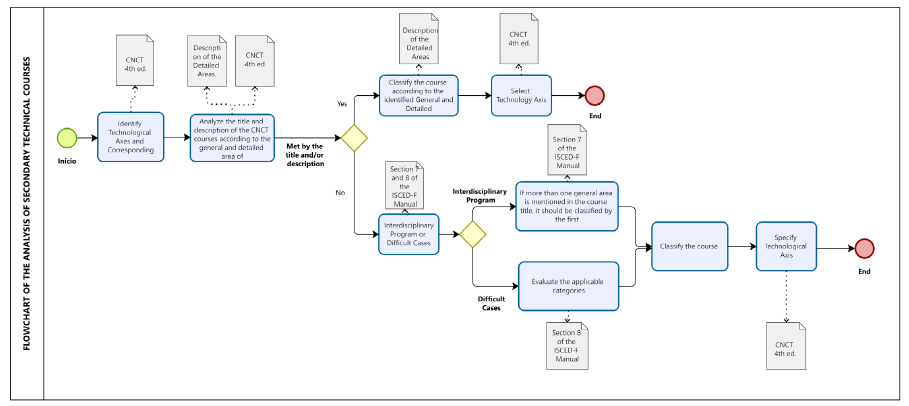 Source: Prepared by the authorsin Bizagi. Illustration of the steps for classifying courses according to the method proposed based on ISCED-F 2013.
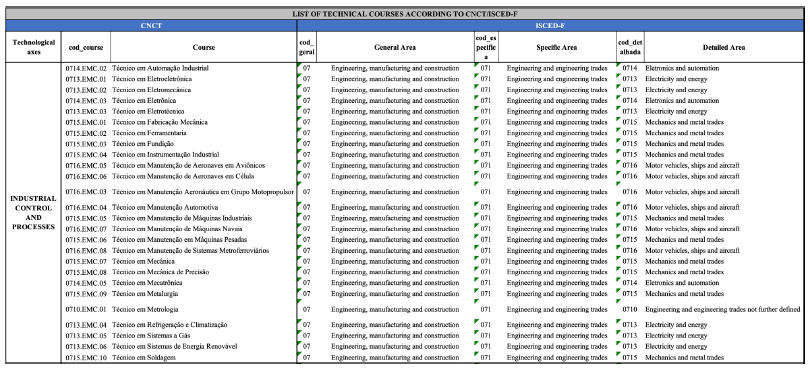 Source: Technical-scientific database developed by the authors.
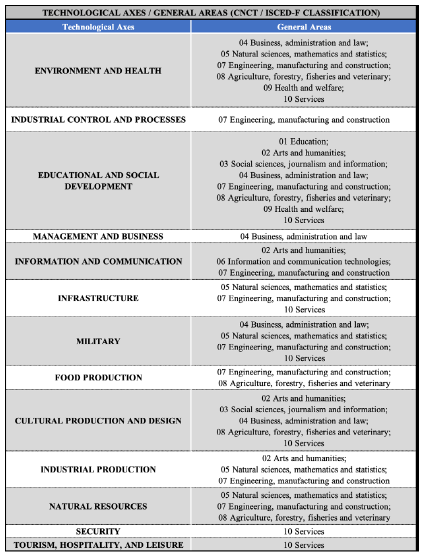 Source: Prepared by the authors
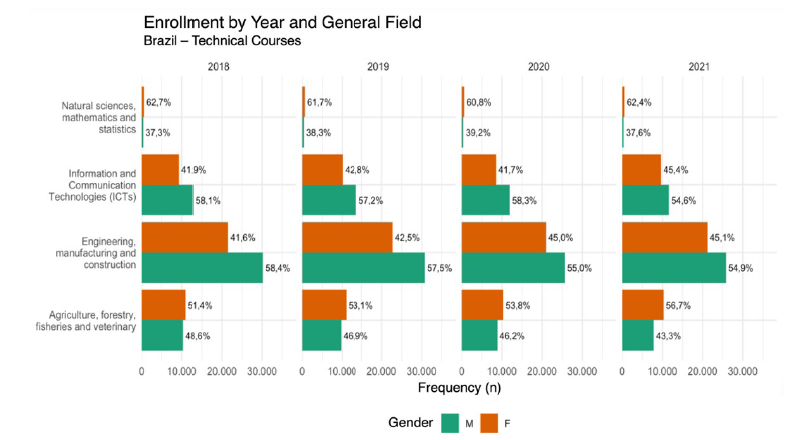 Source: Grouped bar chart for absolute (n) and relative (%) frequencies of enrollments in Brazil from 2018 to 2021, according to the gender of the enrolled student and the general area. Technical course. N = 369,522.
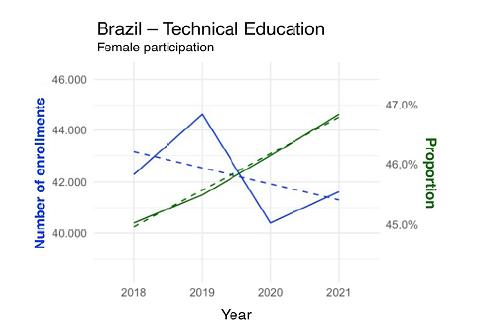 Source: Line graph showing the frequency (n and %) of female enrollments in Brazil in the period from 2018 to 2021 in technical education. The dotted lines indicate the linear trend of the data. N = 369,522.
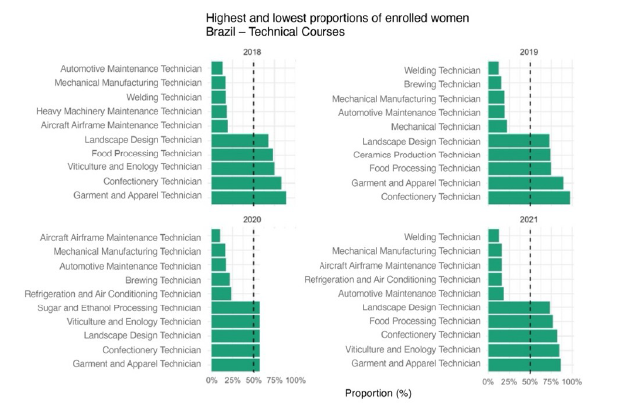 Source: Bar chart showing the proportion (%) of women enrolled in each course in Brazil from 2018 to 2021. The graph shows the five courses with the highest and the five courses with the lowest proportion of women per year. Technical course. N = 369,522.