 Carbon Credit and Macaúba Palm Tree: Advancing ESG in Green Cattle Production
ABSTRACT
This case aims to explore the intersection between the financial sustainability of cattle production, the sale of carbon credits, and the cultivation of macaúba palm trees. The case identifies challenges and opportunities for ESG (environmental, social, and governance) practices in the context of contemporary agribusiness. The account involves a Brazilian rural farmer and presents the planting process and integration of macaúba palm with beef cattle production, the concept of the carbon market, and the social externalities of the project. The case raises the following dilemma: How to balance the economic potential of macaúba palm trees and their byproducts with the mission of producing cattle in an ecologically responsible manner while positioning favorably in the carbon credit market? The pedagogical objectives focus on analyzing the economic, financial, and environmental feasibility of integrating green cattle production and macaúba palm cultivation, understanding the dynamics and implications of carbon credits in the national agribusiness context, and reflecting on the importance and challenges of implementing ESG practices in agribusiness, this way stimulating the decision-making capacity in complex and multidimensional scenarios. The case can be applied in undergraduate and graduate level courses in finance and related fields. The case is recommended to encourage students to reflect on the financial structures and challenges of implementing the sale of carbon credits for small rural landowners.
Keywords:
financial sustainability; carbon credit; macaúba palm; ESG; contemporary agribusiness
RESUMO
Este caso tem por objetivo explorar a interseção entre a sustentabilidade financeira da produção de gado, a venda de crédito de carbono e o cultivo da macaúba. O caso identifica desafios e oportunidades para as práticas de ESG (ambiental, social e governança) no contexto da agropecuária contemporânea. O relato envolve um produtor rural brasileiro e apresenta o processo de plantação e integração da macaúba com a produção do gado de corte, o conceito de mercado de carbono e as externalidades sociais do projeto. O caso levanta o dilema: Como equilibrar o potencial econômico da macaúba e seus subprodutos com a missão de produzir gado de maneira ecologicamente responsável, ao mesmo tempo que se posiciona favoravelmente no mercado de créditos de carbono? Os objetivos pedagógicos se concentram em analisar a viabilidade econômica, financeira e ambiental da integração entre a produção de gado verde e o cultivo da macaúba, entender a dinâmica e as implicações dos créditos de carbono no contexto agropecuário nacional, refletir sobre a importância e os desafios de implementar práticas ESG na agropecuária, e estimular a capacidade de tomada de decisão em cenários complexos e multidimensionais. O caso pode ser aplicado em cursos de graduação e de pós-graduação em finanças e áreas afins. O caso é recomendado para incentivar os alunos a refletir sobre as estruturas financeiras e os desafios da implantação da venda de crédito de carbono para pequenos proprietários rurais.
Palavras-chave:
sustentabilidade financeira; crédito de carbono; macaúba; ESG; agropecuária contemporânea
INTRODUCTION
While savoring freshly baked cheese bread, Jules Peixoto engaged in a conversation with his colleague, Jackson Freitas. They were talking about strategies to enhance the profitability and sustainability of Jules’ livestock farm in Minas Gerais, Brazil. In contrast to other regions, the topographical elevations inherent to Minas Gerais impose significant challenges to large-scale beef production that require modern technological investments with low returns.
They spent some time discussing various possibilities for expanding the farm’s business. They considered creating a tourist area on part of the farm where they could build bungalows for sale. They also thought of taking advantage of the existing number of macaúba palm trees to produce and sell oil from the macaúba fruit.
As Jules sipped a hot cup of coffee, he began to think about his desire to see the local community grow along with the farm. Jules had a deep affection for the community where he lived and felt sorry for the few opportunities local residents had to improve their lives. He knew, however, that increasing the community’s income would involve a significant partnership among the farm, the local residents, and a third party.
Jules’ eyes momentarily shifted to the children in the adjoining room, albeit with an abstracted behavior. Entertained by a cartoon on TV, the children found amusement in the actions of Saci-pererê - an emblematic figure in Brazilian folklore. This character, a boy with a red cap, was running through the forest hopping on his one leg, doing various tricks. However, he was admired for his commitment to preserving Brazil’s forests. Jules found himself drawing parallels between Saci-pererê’s distant forest efforts and his own aspirations for reforestation on the farm.
Jules was lost in thought about the costs of reforesting the farm when his attention was captivated by Jackson’s voice, “...what about engaging with Reflora? The enterprise has shown enthusiasm for investing in carbon credit projects here on the farm. In particular, they expressed a notable interest in reforestation with the macaúba palm, which is underutilized here on the farm.”
As his colleague spoke, a dilemma began to dominate Jules’ thoughts, intensifying the stomachache he felt from the black coffee he was drinking. He recognized that the decision to delve into the carbon credit market through macaúba palm reforestation came with risks and uncertainties, but the prospect of a promising future for him and the community was also tangible.
With a degree in business administration and architecture and the support of his economist friend, Jules felt able to evaluate the economic feasibility of the business. On the other hand, the boldness required for such a decision not only had implications for the Cachoeirinha Farm, but could also have repercussions across the entire local community.
CACHOEIRINHA FARM
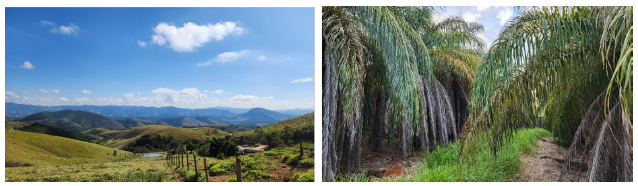
The Cachoeirinha Farm was situated in Olaria, a municipality in the state of Minas Gerais with a population of 1,945 residents and a per capita gross domestic product (GDP) of US$ 3,394.1 A significant portion of the farm’s land was acquired in the early 2000s by its former owner, Mr. Orlando Arruda. At that time, the farm covered 2,224 acres, characterized by limited flat terrains and expansive pastures nestled in hills. The farm name, cachoeirinha, was derived from the presence of over one hundred natural springs that turned into rivers (termed cachoeirinha in Portuguese) within the property.
In the mid-2000s, the former owner was interested in initiating a beef cattle breeding project incorporating an integrated approach encompassing agriculture, livestock, and pasture. After securing the investment needed to raise cattle, he got help from the agronomy department at the Federal University of Viçosa2 to choose the specific grains to be used in this integrated system.
During that period, Leonardo Pimentel was pursuing his doctoral studies. As a part of his research internship, he helped Mr. Orlando cultivate the macaúba palm on the farm. The main objective was to take advantage of various benefits of this palm tree. Since it is a native species, it would require fewer chemicals, thus promoting more sustainable agricultural practices. Additionally, the palm’s deep root system could help prevent soil erosion, improve soil fertility, and increase water retention, making it an asset for soil conservation. Macaúba palms are also suitable for multi-cropping systems as they provide shade and act as windbreaks for other crops.
Mr. Orlando was aware of some challenges associated with this decision. The palms would take some years to begin fruiting, requiring a long-term investment. Also, the palm’s economic value could lead to monoculture practices, which could harm biodiversity. Additionally, their tall stature would necessitate specialized tools or manual labor for harvesting, potentially increasing operational costs.
Despite these challenges, Mr. Orlando was committed to the potential benefits of the macaúba palms. He thought that the extra source of income would come from the production of biofuel extracted from the macaúba palm nuts. The macaúba palm fruit is valuable for producing biofuel and edible oil, which can diversify income sources for the farmer. To this end, Mr. Orlando entered a collaboration with a Spanish company with a capital investment of approximately US$ 56 million expected in the region by 2016. As a result, this venture was expected to generate 1,700 direct and indirect job opportunities through the expansion of cultivation and the establishment of new facilities. However, following the financial crisis of 2008, the company discontinued its involvement in the project, leaving behind a vast macaúba palm plantation of 741 acres.
With the company’s exit, the project was discontinued, causing most palm trees to die due to lack of maintenance and inadequate care.
Jules bought the farm at the end of 2018 for US$ 1.4 million (see Figure 1 for photographs of the Cachoeirinha Farm). At the beginning of 2023, Jules hired the Federal University of Viçosa to count the existing palm trees and discovered that there were still 74 acres of living palm trees.
JULES NEEDS REVENUE
Shortly after acquiring the farm, Jules showed little enthusiasm for making it profitable. In the context of the COVID-19 pandemic, he and his partners directed resources toward building houses near the Serra Negra da Mantiqueira State Park conservation area. The project was aimed at a public that wanted privacy and to live close to nature. The architectural project was meticulously designed to promote sustainable, energy-self-sufficient housing. This initiative was welcomed by Olaria’s municipal administration and the general population who identified the potential benefits of this development.
However, following an unforeseen incident involving one of the partners, the real estate venture faced abrupt cessation. Consequently, Jules was compelled to reevaluate his strategies concerning the Cachoeirinha Farm and its potential avenues for revenue generation. Until then, the farm had been a consistent financial liability, accruing monthly expenses of approximately US$ 60,000.
In the initial phase, Jules’ investment strategy for the farm focused on raising Nelore cattle. Later, he was presented with the possibility of raising cattle in confinement since with this method it was possible to carry out up to three confinement cycles a year. The farm has the capacity to accommodate up to 1,000 head of cattle in this system, each with an average weight of 16 @ (arrobas). To make it work, Jules would need an initial investment of US$ 120,000 toward infrastructural developments accompanied by an annual maintenance expenditure amounting to 2% of the revenue in addition to a US$ 420,000 outlay for cattle procurement. By Jules’ computations, the annual feed expenses would be approximately US$ 246,600, necessitating working capital amounting to 5% of the total revenue.
Jules also evaluated an alternative project to build ecological bungalows on the farm. The farm’s proximity to a national preservation area and the opportunity for close nature experiences were quite attractive. A designated area could be allocated for developing these bungalows to create a luxury condominium. In this case, Jules intended to invite local community members to build restaurants and offer guided tours within the community, enhancing the overall experience for visitors while providing economic opportunities for residents. However, the construction could be complex due to strict regulations and permits, making the investment process time-consuming. Jules needed to carefully consider the environmental impacts, adhere to construction restrictions, and manage waste properly. For this project, Jules estimated a per-unit investment of US$ 60,000 paired with a maintenance fee of US$ 100 per unit. He projected a potential selling price of US$ 88,000 per bungalow after accounting for a sales commission fee of 8%. Jules intended to personally finance all the capital expenditures, including infrastructure development and utilities. While this approach would give him greater control over the project, it also meant shouldering significant upfront and ongoing expenses.
CARBON CREDITS
Jules’ first contact with the carbon market came from his interactions with the American non-governmental organization The Nature Conservancy3 (TNC). TNC explained to Jules that a carbon credit was a permit allowing the emission of one ton of CO2 or its equivalent. Its aim is to reduce global emissions by enabling companies that lower their emissions to sell excess credits to those exceeding their limits. Traded on regulated or voluntary markets, these credits can help cap emissions set by governments or regulators.
In addition, TNC explained that the benefits of this market include encouraging greenhouse gas reductions, providing economic incentives for innovation, and supporting sustainable development projects. On the other hand, TNC explained that the risks would involve market volatility, integrity issues with credit verification, and the complexity of compliance.
TNC offered Jules to sell carbon credits from environmentally protected areas such as streams and springs. The positive side of investing in riparian forest was that it would provide significant environmental benefits such as improving water quality, reducing erosion, enhancing biodiversity, and contributing to carbon sequestration, while also reducing cattle deaths from snake bites. However, the restoration and maintenance of riparian forests were costly, potentially outweighing the revenue from carbon credits, thus raising concerns about the financial viability of the investment. The project also required technical expertise and strict adherence to certification standards with the added risk of market volatility affecting carbon credit prices and demand, further impacting the financial feasibility of the investment.
After several discussions, the company agreed to finance the purchase of posts and wire for the fences while Jules would provide the labor needed for the work. Given that Jules’ property covered approximately 494 acres of preserved land, the planned investment would be structured as an initial disbursement of US$ 20,000 followed by four successive installments of US$ 12,000 each. Maintenance requirements would manifest from the third-year post-initiation of the planting, incurring an annual cost of US$ 400. Additionally, the agreement stipulated that TNC would reimburse Jules an amount of US$ 48,000 over a three-year period with half the amount disbursed in the first year and the remainder distributed over the subsequent years. Since TNC would be shouldering the investment, they would be entitled to 70% of the proceeds from the sale of carbon credits.
Coinciding with this period, Jules was approached by an environmental start-up called Reflora4 that worked with companies interested in offsetting their greenhouse gas emissions. They saw the Cachoeirinha Farm as an opportunity to create a business model involving the reforestation of pastures. The company was trying to persuade Jules that with their support he could sell the carbon credits from the existent macaúba palm trees on the carbon market. Given the farm’s ample land available for reforestation, the company recognized an opportunity to broaden the scope of carbon credit sales.
Selling carbon credits on the international market required the expertise of experienced consultants and obtaining certification for these credits was both costly and complex. That’s why Reflora’s financial support would be important for the success of the project. Moreover, the company explained that the revenue from carbon credits would take some time as it depended on the growth of the plants. During that time, Jules would not be able to use the space.
Since Reflora aimed to replicate Cachoeirinha Farm’s business model across other small farms in the future, the partnership with Jules was designed as a pilot project. The necessary investments would require US$ 300,000 for the area’s certification, another US$ 200,000 in the first year, and US$ 600,000, respectively, in the subsequent two years. Maintenance costs were projected at 10% of the revenue. According to the project’s estimates, for a carbon sequestration rate of 0.35 tons of carbon per tree, there was the potential to sell carbon credits at an average rate of 10 dollars per ton.
Motivated by the desire to leave a positive environmental legacy for future generations and by the potential to contribute to increase per capita income in Olaria, Jules negotiated a share of carbon credit to be distributed to the local community. Reflora agreed to reimburse 75% of the investment costs and to distribute part of the proceeds to improve the Olaria community’s infrastructure. The distribution of revenues was settled at 15% for Reflora, 10% for the community of Olaria, 5% for the partners, and the remaining balance for Jules. The community would benefit from the growing global demand for carbon credits. Moreover, Jules was committed to involving the community in every stage of the farm’s operations from planting macaúba palm trees all the way to processing and producing goods derived from them. The opportunity costs for Jules and the city of Olaria were calculated to reach 8% and 6%, respectively.
SUSTAINABILITY AND PROFITABILITY
The conversations with the companies TNC and Reflora were fundamental to Jules’ thinking about the next steps for the farm. Up to that point, the farm had only incurred expenses and there was still a lot of work to be done.
Jules was looking forward to the partnership with TNC. According to the Brazilian Forest Code,5 river springs are designated as permanent preservation areas, so Jules was obliged to make this investment sooner or later. That’s why the prospect of raising some money through the partnership with TNC could turn the burden into a bonus.
Jules sensed that Reflora’s proposal sounded interesting, but he wasn’t very clear about the magnitude. So, he met with his partners Jackson and Bruno Rodrigues to discuss whether they could integrate the reforestation project into the farm’s activities. Initially, they thought that certifying the farm on the carbon market could give it a competitive advantage when selling cattle. This is because the cattle’s gas emissions would be offset by the carbon sequestration from reforestation, and this would mean that they could earn an additional 15% income from raising ‘green cattle.’ When selling these cattle, having a market differentiation could attract consumers who value sustainable practices.
Another critical point discussed among the partners was that reforestation could be done with the macaúba palm tree (Acrocomia aculeata, or macaw palm). Although the productivity of the macaúba palm per acre is lower than that of other palms, each acre planted helps conserve the rainforest. In addition, by providing shade, the macaúba palm can reduce cattle water consumption. Moreover, as a native species, this tree increases biodiversity by providing food and shelter for wildlife.
After considering this expansion option, the partners consulted with Professor Leonardo from the Federal University of Viçosa, who guided them on profiting from using the macaúba palm coconut to produce processed oil. Jules would have abundant macaúba palm resources, ensuring a sustainable and accessible supply of raw material for oil production. The growing market demand for macaúba oil in industries such as cosmetics, food, and biofuels could present a promising opportunity to diversify income streams and reduce reliance on a single investment. Considering a 198-acre plot, they estimated an initial investment of US$ 300,000 with maintenance costs of 2% of revenue and annual depreciation of US$ 10,000. Sales, general, and administrative costs would constitute 12% of expenses with a working capital requirement of US$ 24,000. The partners would be subject to a 0.25% tax on the farm and an 18% sales tax. Initially it was decided that each partner would contribute equally to the investment costs and to the revenue obtained. There was a risk that they would need another investor, which could be both time-consuming and challenging to secure.
Finally, the professor also explained that the market for macaúba oil could face competition from other vegetable oils, requiring careful assessment of the competitive landscape and demand levels. Furthermore, macaúba oil prices could be volatile, thus affecting profitability, and Jules needed to be cautious of the risks associated with monoculture practices.
DECISION TIME
Jules was committed to balancing profitability with social and environmental responsibility. He believed that incorporating sustainable practices such as reforestation and carbon credit sales would enhance the farm’s long-term viability. Willing to invest further and forge strategic partnerships, if necessary, Jules was convinced that this approach would deliver significant benefits to both the environment and the local community.
Jules was facing a difficult decision, but he had collected enough information to decide (see https://doi.org/10.7910/DVN/ILD2SN for the assumptions and financial model, respectively). He also recognized that his decision would not be based solely on quantitative factors; he would need to take qualitative aspects into account. He knew he needed to act quickly because selling carbon credits through macaúba palm reforestation would require significant investments in revitalization, including replanting and special care to avoid further losses in the plantation. If he didn’t take immediate action, the ripe coconuts risked rotting and becoming unusable.
As he reflected on his decision, Jules believed that his choice would have both visible and invisible consequences. The trickster spirit of Saci-pererê served as a reminder that, beyond the personal aspects, he should also consider the cultural and social impacts of his actions.
LEARNING OBJECTIVES
This case was developed to be used in undergraduate and graduate level courses in the field of finance. The case can be applied during sections that address the concepts related to decision-making in sustainable problems.
By the end of the discussion, students are expected to achieve the following objectives:
-
(a) Explain the profitability of reforesting land with macaúba palms, assessing their potential as a distinct asset class.
-
(b) Calculate the net present value (NPV) and internal rate of return (IRR) for each business opportunity related to the Cachoeirinha Farm.
-
(c) Use both quantitative and qualitative critical thinking skills to analyze the business model for selling carbon credits on rural properties and its feasibility.
-
(d) Assess the potential positive externalities of carbon credit sales for Jules and the local community considering the broader social and environmental impacts.
The discussion of this case enables the development of the six skills of the cognitive domain according to the original taxonomy proposed by Bloom (1956), namely: (a) knowledge, recalling of theories and concepts; (b) comprehension, understanding whether by interpretation or extrapolation; (c) application of financial rules, methods, and models; (d) analysis of case alternatives; (e) synthesis of the problem situation; and (f) evaluation of the situation and proposal of an action plan.
The case has two additional supplements in Excel format: (Product 4000 is a student spreadsheet containing the data-based tables presented in the case (https://doi.org/10.7910/DVN/ILD2SN); (2) Product 4001 is restricted to instructors only and contains data-based tables from this Teaching Note.
ASSIGNMENT QUESTIONS
It is supposed that the students will receive and prepare the case before meeting in class. The teacher can, at his/her discretion, provide students with the listed assignment questions (AQ) along with the case, to guide them in individual prior preparation.
AQ 1: Should the pursuit of profit in reforestation efforts be considered beneficial, or is it more appropriate for governments and private philanthropists to take responsibility for reforestation?
AQ 2: What would be the real benefits for the environment and the local community of the Cachoeirinha Farm?
AQ 3: Is it possible to reconcile profitability with social and environmental responsibility in the case of the Cachoeirinha Farm?
AQ 4: As a friend of Jules, would you recommend investing in carbon sales? Why?
PROTAGONIST AND SOURCE OF INFORMATION
This teaching case was based on real facts. For its development, primary data were collected through semi-structured interviews with Jules Peixoto, the property owner, and his associates. Notably, five interviews were conducted using Google Meets, each averaging 70 minutes, complemented by phone conversations, each lasting around 30 minutes. Additionally, secondary sources such as carbon credit pricing and reports were incorporated.
In the formulation of this case, we adopted a BRL/USD exchange rate of 5 and equated 1 acre to 0.4047 hectares for consistency.
TEACHING PLAN
For a compelling discussion, it is recommended that the case be read before class so that students have prior contact with the context to be worked on. During the first reading, students are encouraged to highlight the main points of the case and reflect on the economic and financial viability of each of the farm’s business lines. It is also essential that the instructor guide the application of the case, allowing the decision-making process to involve the residents of the local community.
The case can be structured to start with a broad perspective and gradually zoom in on specific details as it progresses. Initially, students can be encouraged to contemplate the overall advantages and disadvantages of for-profit reforestation. Subsequently, they can delve deeper into Jule’s problem. Table 1 of this teaching note shows the time proposed for analyzing and discussing the case. It is supposed that the students will receive and prepare the case before meeting in class.
OPENING OF CASE DISCUSSION IN PLENARY
At the beginning of the discussion, it is suggested that the instructor ask small groups (of three or four students) to reflect on the characteristics of reforestation practices linked to cultivating the macaúba palm. To do this, the instructor could ask: ‘What are the benefits of planting macaúba palm for farmers?’ Student responses may encompass aspects such as:
(+) Native to Brazil, it requires fewer chemicals, promoting sustainable agriculture.
(+) Macaúba palm fruits offer biofuel, edible oil, diversifying farmer income sources.
(+) The deep roots prevent erosion, enhancing soil fertility and water retention.
(+) Macaúba palm suits multi-cropping, offering shade and windbreaks.
(-) Macaúba palm trees take years to fruit.
(-) The economic value may encourage monoculture practices.
(-) Tall trees require specialized tools or manual labor.
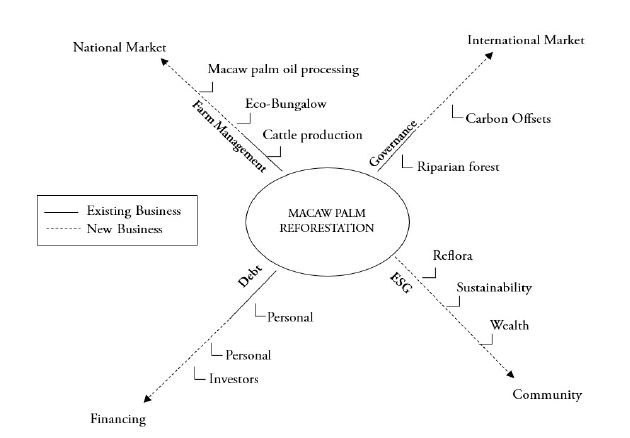
The instructor can list the topics raised by the students to start building a comparison chart to be filled in by the end of the discussion. This question provides an opportunity for the instructor to mark the word ‘reforestation of the macaúba palm (macaw) tree’ as a keyword. See Figure 1 of the class discussion plan. The student’s contributions will be added to the board as they occur during the plenary discussion.
It is important to note that instructors may choose to supplement the discussion with additional insights from relevant literature and further elaboration on certain topics as needed such as the work of Cabrera et al. (2022) and Fernández-Coppel et al. (2018), among others.
QUESTIONS FOR PLENARY DISCUSSION
Below is a set of main discussion questions designed to stimulate a comprehensive analysis of the case with the entire class. However, they can be modified at the instructor’s wish to improve their suitability for the teaching plan.
Question 1: Is the new business opportunity brought about by selling carbon credits from macaúba palm reforestation economically viable?
Question 2: How will the Olaria community benefit from Jules’ objectives?
Question 3: What external factors or unforeseen challenges might influence Jules’ decision-making regarding the sustainable practices he wishes to implement?
DISCUSSION OF THE QUESTIONS
Question 1: Is the new business opportunity brought about by selling carbon credits from macaúba palm reforestation economically viable?
The objective of this question is to map the financial impact of planting macaúba palm trees for the farmer owner. To do so, the instructor can ask some transition questions (TQ) so students can become engaged in discussions that analyze the operational model and the different business lines both qualitatively and quantitatively. To facilitate this analysis, students should have already filled out a form prior to the class session, which will serve as the foundation for the quantitative examination (https://doi.org/10.7910/DVN/ILD2SN).
Refer to teaching note for a complete financial model of the Cachoeirinha Farm constructed using the assumptions from the form available at https://doi.org/10.7910/DVN/ILD2SN. The following are potential qualitative and quantitative considerations for each of the Cachoeirinha Farm’s business lines.
To prepare the students for the discussions and enrich the debate, the instructor can choose to present the concepts of financial viability. The financial viability principles apply to the farm’s operations. Jules expresses his concerns about his property’s financial sustainability, emphasizing the need to diversify his income avenues. An understanding of NPV and IRR empowers students to evaluate the financial soundness of various initiatives and to project the potential profitability of the farm’s investments. Net present value (NPV) is the difference between the present value of cash inflows and the present value of cash outflows over a period. Its formula is given by equation 1, where C t is the net cash inflow during the period t (t=1…T) and C 0 is the total initial investment costs.
By contrast, the internal rate of return (IRR) is a calculation used to estimate the profitability of potential investments. Its formula is given by equation 2.
For a richer awareness of NPV and IRR, we suggest the works of Damodaran (2012) and Magni (2020). Moreover, we recommend supplemental readings for an in-depth exploration of Jules’ operational segments such as studies by Ruviaro et al. (2020) and Cardoso et al. (2016) on cattle production as well as the work of Pegas and Castley (2014) for insights into eco-tourism.
In addition, environmental considerations can be supported after a literature review of Carnell (2010) and Oliveira Silva et al. (2016). This pillar is associated with the role of reforestation for-profit using the macaúba palm tree, emphasizing the significance of diminishing carbon footprints in contemporary agriculture and its ramifications on climate change. Initially, we advise instructors to guide students toward literature emphasizing the urgency of curtailing carbon dioxide emissions, providing a particular focus on Brazil’s contributions. Exploring ESG (environmental, social, and governance) readings will enable students to connect with the farm’s dedication to sustainability, for which Cerri et al. (2009) come highly recommended. Subsequent readings might include insights on reforestation and farmer responsibilities, referencing works such as Pinto et al. (2010).
Table 2 presents the potential qualitative and quantitative considerations for the overall business of Cachoeirinha Farm.
Suggested time allocation for teaching the case. Potential quantitative and qualitative insights for the case.
After understanding the farm’s existing and potential investment lines, students could shift their attention to evaluating the potential revenue of the Cachoeirinha Farm. To this end, the following transition question is suggested in order to guide student discussion:
TQ 1.1: How does the integrated business approach increase the overall economic viability of Jules’ farm?
Table 3 outlines the possible qualitative and quantitative factors relevant to the overall business of Cachoeirinha Farm.
At the end of this part, the instructor can mark the words ‘Cattle production: Existing, personally financed,’ ‘Riparian forest: Existing, funded by TNC, international governance,’ ‘Eco-bungalow: New, personally financed,’ ‘Carbon offsets: New, funded by Reflora, international governance,’ ‘Oil processing of macaúba palm: New, financial support from partners,’ as keywords.
Question 2: How will the Olaria community benefit from Jules’ objectives?
The second question’s objective is to encourage students to examine the broader social and environmental impacts of Jules’ actions and decisions. By focusing on the Olaria community, the question prompts an analysis centered on the ‘social’ aspect of ESG issues.
To answer this question in more depth, the instructor can suggest that the students read Dohrn (2013) and Zainal’s (2021) work. These readings can help the instructor to frame the transition to sustainable production systems as an environmental conservation strategy and a catalyst for community growth. The focus is on the social pillar of ESG. Key areas include improving community welfare via urban farming, using informal socialization methods such as word of mouth (WoM), and leveraging collaboration with governmental and private entities. These initiatives can be a model for community-driven economic development, despite challenges like limited resources and land.
Similarly, these articles emphasize sustainable agricultural practices that contribute to environmental conservation, while also fostering community development through job creation and improved living standards. Additionally, it addresses the cultural preservation aspect by supporting local heritage and traditional farming practices. Thus, both works provide rich material to explore topics such as community-driven sustainability, collaborative efforts between government and private sectors, and the broader impact of small-scale initiatives on local economies and ecosystems.
The following transition question is suggested in order to guide the students’ discussion:
TQ 2.1: What are the consequences of Jules’ decisions and activities for the local community?
By asking this question, students are pushed to consider the potential positive or negative consequences of Jules’ objectives on the local community. This could encompass areas such as employment opportunities, community development, health, safety, education, and even cultural preservation. Here, students can debate the advantages and disadvantages of investing in for-profit reforestation for the Olaria people considering both financial and social aspects.
After analyzing the direct impact of Jules’ investments on the community, students can be encouraged to think about other externalities related to job creation and partnerships, for example. To do this, the instructor could ask the following transition question to lead students into this line of thinking:
TQ 2.2: How can adopting sustainable agricultural practices related to the macaúba palm influence the socio-economic dynamics of the Olaria community in terms of partnerships, investment opportunities, and job creation?
Here students are encouraged to consider that by venturing into the carbon credit market, Jules introduces a new economic avenue that, if successful, can be emulated by other farmers, potentially bringing additional revenue streams into the community. In addition, sustainable agricultural practices aligned with ESG principles can attract partnerships, subsidies, or investments that can further strengthen the community’s economic status. Furthermore, by focusing on environmentally conscious methods, there is the potential for job creation in new sectors within the community such as jobs supporting sustainable agriculture, carbon credit verification, or jobs related to the processing of macaúba palm products.
The following are potential qualitative and quantitative considerations for each transition question.
At the end of this part, the instructor can mark the words of ESG: ‘E - positive environmental legacy,’ ‘S - increase in per capita income,’ ‘G - international governance’ as keywords. Here, the instructor can build the discussion progresses, as a comprehensive visual representation, allowing students to gain a holistic understanding of the entire business from various perspectives. The instructor can point to the notes taken on the board from the students’ contributions (https://doi.org/10.7910/DVN/ILD2SN).
Question 3: What external factors or unforeseen challenges might influence Jules’ decision-making regarding the sustainable practices he wishes to implement?
The third question’s objective is to map a variety of external factors that may impact the decision-making process. For instance, economic fluctuations such as changes in the market prices for carbon credits or macaúba palm products could either incentivize or deter his sustainable initiatives. In this case, the work of Carnell (2010) can help students gain a deeper understanding of the topic. Additionally, for insights into the particulars of carbon credit sales by farmers, Ribeiro et al.’s (2012) article is a good suggestion. Carbon credits are permits that represent the right to emit a specific amount of carbon dioxide (CO2) or other greenhouse gases (GHGs). One carbon credit typically corresponds to one metric ton of CO2 or its equivalent in other GHGs. They are part of market-based approaches aimed at reducing overall greenhouse gas emissions and combating climate change.
In addition, we suggest an analysis of the macaúba palm tree and its byproducts, drawing on the research from Colombo et al. (2018), Fernández-Coppel et al. (2018), and Cabrera et al. (2022). The macaúba palm tree (Acrocomia aculeata), native to South America, is a valuable plant known for its versatility and resilience in tropical climates. It produces a range of byproducts, including oil from its fruit, which is used for cooking, cosmetics, and biodiesel; edible fruits; natural fibers for crafts and ropes; and timber for construction. Additionally, the byproducts of oil extraction serve as protein-rich animal feed. The cultivation of the macaúba palm supports sustainable development, contributes to carbon sequestration, and aids in restoring degraded lands.
To guide the student discussion, the instructor may ask the following transition question:
TQ 3.1: What is the farmer’s ‘future net gain’ assuming a price of 12 USD per ton, a 14% cost reimbursement, and a 20% maintenance for the carbon credit business line? What if the scenario were a price of 8 USD per ton, a cost reimbursement of 13%, and a maintenance of 11%?
The instructor may now delve into a sensitivity analysis using the previously mentioned scenarios. To illustrate, under the first scenario, the NPV and IRR for the carbon credit stand at US$ 16,018 and 8.4%, respectively. In this case, the farm NPV is minus US$ 1,164. In contrast, the second scenario yields values of minus US$ 270,935 and 1.4% for the carbon credit with an NPV of minus US$ 284,438 for the farm. After evaluating all potential scenarios (refer to https://doi.org/10.7910/DVN/ILD2SN), the data implies that opting to sell carbon credits entails significant risks and costs for Jules, especially in the absence of support from Reflora.
Next, students can be encouraged to think about other factors that could also affect Jules’ decision. The professor can ask students to think about different scenarios to analyze the sensitivity of the assumptions used or consider the qualitative factors that can also impact the decision analysis. In this case, the instructor may ask the following transition question:
TQ 3.2: What qualitative factors should be considered?
While there is no right or wrong answer, the students may highlight factors such as regulatory changes or governmental incentives as pivotal elements. Additionally, the local community’s stance - whether supportive or opposed to Jules’ initiatives due to cultural or economic considerations - could influence the project’s execution. Environmental variables such as unexpected climatic changes impacting the growth of the macaúba palm or sudden pest infestations could introduce complications. Furthermore, international standards or trends in sustainability and ESG could either bolster or impede his strategic approach.
CLOSING OF THE DISCUSSION
At the end of the discussion, the instructor can propose a final vote on whether the students would personally invest in for-profit reforestation with the macaúba palm tree. The instructor can ask if any students have changed their initial position and encourage them to share the factors or arguments that influenced their shift.
KEY TAKE-AWAYS
-
In financial decisions, it is critical to estimate all relevant cash flows, including opportunity costs.
-
Most decisions can be evaluated quantitatively using NPV and IRR concepts to supplement qualitative considerations.
-
In this particular case, the quantitative analysis suggests that the integration of cattle production with carbon credit selling from the macaúba palm is a risky and costly decision if the owner does not have the cost support of a company like Reflora. On the other hand, if the market price is appealing, there could be significant net benefits such as if the carbon prices rise faster than the operation costs.
-
There are qualitative benefits and costs to the local community associated with selling carbon credit, which must be considered along with the quantitative analysis.
REFERENCES
- Bloom, B. S. (1956). Taxonomy of educational objectives, handbook: The cognitive domain. David McKay.
-
Cabrera, O. G., Grimaldi, L. M., Grimaldi, R., & Ribeiro, A. P. B. (2022). Macaúba (Acrocomia aculeata): Biology, Oil Processing, and Technological Potential. In M. Hasanuzzaman & K. Nahar, Oilseed Crops-Uses, Biology and Production. IntechOpen. https://doi.org/10.5772/intechopen.105540
» https://doi.org/10.5772/intechopen.105540 -
Cardoso, A. S., Berndt, A., Leytem, A., Alves, B. J., Carvalho, I. D. N., Barros Soares, L. H. & Boddey, R. M. (2016). Impact of the intensification of beef production in Brazil on greenhouse gas emissions and land use. Agricultural Systems, 143, 86-96. https://doi.org/10.1016/j.agsy.2015.12.007
» https://doi.org/10.1016/j.agsy.2015.12.007 - Carnell, R. (2010). The role of forests in carbon capture and climate change. Nova Science Publishers.
-
Cerri, C. C., Maia, S. M. F., Galdos, M. V., Cerri, C. E. P., Feigl, B. J., & Bernoux, M. (2009). Brazilian greenhouse gas emissions: The importance of agriculture and livestock. Scientia Agricola, 66(6), 831-843. https://doi.org/10.1590/S0103-90162009000600017
» https://doi.org/10.1590/S0103-90162009000600017 -
Colombo, C. A., Berton, L. H. C., Diaz, B. G., & Ferrari, R. A. (2018). Macaúba: A promising tropical palm for the production of vegetable oil. OCL, 25(1), D108. https://doi.org/10.1051/ocl/2017038
» https://doi.org/10.1051/ocl/2017038 - Damodaran, A. (2012). Investment valuation: Tools and techniques for determining the value of any asset (Vol. 666). John Wiley & Sons.
-
Dohrn, C. (2013). A case study of small-scale coffee production: Coffee farming as a potential tool for environmental conservation and community development in rural Minas Gerais, Brazil. Interdisciplinary Environmental Review, 14(1), 1-31. https://doi.org/10.1504/IER.2013.054121
» https://doi.org/10.1504/IER.2013.054121 -
Fernández-Coppel, I. A., Barbosa-Evaristo, A., Corrêa-Guimarães, A., Martín-Gil, J., Navas-Gracia, L. M., & Martín-Ramos, P. (2018). Life cycle analysis of Macaúba palm cultivation: A promising crop for biofuel production. Industrial Crops and Products, 125, 556-566. https://doi.org/10.1016/j.indcrop.2018.09.036
» https://doi.org/10.1016/j.indcrop.2018.09.036 - Magni, C. A. (2020). Investment decisions and the logic of valuation (Vol. 689). Springer International Publishing.
-
Oliveira Silva, R., Barioni, L. G., Hall, J. A., Folegatti Matsuura, M., Zanett Albertini, T., Fernandes, F. A., & Moran, D. (2016). Increasing beef production could lower greenhouse gas emissions in Brazil if decoupled from deforestation. Nature Climate Change, 6, 493-497. https://doi.org/10.1038/nclimate2916
» https://doi.org/10.1038/nclimate2916 -
Pegas, F. D. V., & Castley, J. G. (2014). Ecotourism as a conservation tool and its adoption by private protected areas in Brazil. Journal of Sustainable Tourism, 22(4), 604-625. https://doi.org/10.1080/09669582.2013.875550
» https://doi.org/10.1080/09669582.2013.875550 - Pinto, A., Magalhaes, M., & Ringler, C. (2010). Potential of carbon markets for small farmers: A literature review. International Fund for Agricultural Development.
- Ribeiro, S. C., Jacovine, L. A. G., & Vilar, M. B. (2012). Forest carbon credits generation in Brazil: The case of small farmers. In R. Muradian & L. Rival, Governing the Provision of Ecosystem Services (pp. 395-417). Springer Netherlands.
-
Ruviaro, C. F., Leis, C. M., Florindo, T. J., Medeiros Florindo, G. I. B., Costa, J. S., Tang, W. Z. & Soares, S. R. (2020). Life cycle cost analysis of dairy production systems in Southern Brazil. Science of the Total Environment, 741, 140273. https://doi.org/10.1016/j.scitotenv.2020.140273
» https://doi.org/10.1016/j.scitotenv.2020.140273 -
Zainal, A. G., Wijaya, T., Frasetyat, V., Nasution, N. A., & Yanfika, H. (2021). Community empowerment communication model in urban agricultural management in the city of bandar Lampung. Proceedings of the 2nd International Indonesia Conference on Interdisciplinary Studies (IICIS 2021). Atlantis Press. https://doi.org/10.2991/assehr.k.211206.034
» https://doi.org/10.2991/assehr.k.211206.034
-
Funding
The authors reported that there was no funding for the research in this article.
-
Plagiarism Check
RAC maintains the practice of submitting all documents approved for publication to the plagiarism check, using specific tools, e.g.: iThenticate.
-
Peer Review Method
This content was evaluated using the double-blind peer review process. The disclosure of the reviewers’ information on the first page, as well as the Peer Review Report, is made only after concluding the evaluation process, and with the voluntary consent of the respective reviewers and authors.
-
Data Availability
The authors claim that all data used in the research have been made publicly available, and can be accessed via the Harvard Dataverse platform:Vasconcelos, Glaucia Fernandes; Almeida, Victor, 2024, "Replication Data for: "Carbon Credit & Macaúba Palm Tree: Advancing ESG in Green Cattle Production" published by RAC-Revista de Administração Contemporânea, Harvard Dataverse, V1.RAC encourages data sharing but, in compliance with ethical principles, it does not demand the disclosure of any means of identifying research subjects, preserving the privacy of research subjects. The practice of open data is to enable the reproducibility of results, and to ensure the unrestricted transparency of the results of the published research, without requiring the identity of research subjects.
-
JEL code:
Q12, Q15, Q56.
-
Peer Review Report:
The Peer Review Report is available at this external URL.
-
Cite as:
Vasconcelos, G. F., & Almeida, V. (2024). Carbon credit and macaúba palm tree: Advancing ESG in green cattle production. Revista de Administração Contemporânea, 28(5), e240116. https://doi.org/10.1590/1982-7849rac2024240116.en
-
Discipline:
Administration
-
Subject:
Carbon Credit Markets; Agribusiness
-
Industry:
Agribusiness
-
Geography:
Minas Gerais, Brazil

NOTES
-
1
Instituto Brasileiro de Geografia e Estatística. (2023). População. https://cidades.ibge.gov.br/brasil/mg/olaria/panorama
-
2
Federal University of Viçosa. (2023). University. https://www.ufv.br
-
3
The Nature Conservancy. (2023). Restaurar ecossistemas para combater mudanças climáticas. https://www.tnc.org.br
-
4
Reflora. (2023). REFLORA Programme. https://floradobrasil.jbrj.gov.br/
-
5
Law no. 12.651/2012 from May 25, 2012. (2012). Proteção da vegetação nativa. https://www.planalto.gov.br/ccivil_03/_ato2011-2014/2012/lei/l12651.htm
Edited by
-
Editor-in-chief:
Paula Chimenti (Universidade Federal do Rio de Janeiro, COPPEAD, Brazil) https://orcid.org/0000-0002-6492-4072
-
Guest Editor:
Clarice Kogut (Pontifícia Universidade Católica do Rio de Janeiro, IAG, Brazil) https://orcid.org/0000-0002-4760-654X
The authors claim that all data used in the research have been made publicly available, and can be accessed via the Harvard Dataverse platform:
Vasconcelos, Glaucia Fernandes; Almeida, Victor, 2024, "Replication Data for: "Carbon Credit & Macaúba Palm Tree: Advancing ESG in Green Cattle Production" published by RAC-Revista de Administração Contemporânea, Harvard Dataverse, V1.
https://doi.org/10.7910/DVN/ILD2SN
RAC encourages data sharing but, in compliance with ethical principles, it does not demand the disclosure of any means of identifying research subjects, preserving the privacy of research subjects. The practice of open data is to enable the reproducibility of results, and to ensure the unrestricted transparency of the results of the published research, without requiring the identity of research subjects.