
 Transformations in the Social Space of the Deans of Universities in the Southeast of Brazil
ABSTRACT
Objective: this article examines transformations in the social space of presidents and rectors of higher education institutions in Southeast Brazil between 1990 and 2019.
Theoretical approach: drawing on Pierre Bourdieu’s sociology, the study analyzes the distribution of capital and power relations among these university leaders, assuming that their configuration reflects broader changes in the structure and dynamics of the Brazilian university field.
Method: the research combines qualitative and quantitative approaches. Data on academic, professional, and institutional trajectories of university deans were collected from Lattes CVs curriculaand complementary sources, then analyzed through multiple correspondence analysis (MCA).
Results: the findings reveal a space structured by two main oppositions: between a pole associated with higher volumes of scientific capital and another linked to political and economic capital; the other contrasting between agents from biological and health sciences, especially medicine, with and those from engineering, exact STEM sciences, and the humanities. Over the analyzed period, scientific capital became increasingly valued, particularly in public universities.
Conclusion: the results qualify dominant interpretations of declining university autonomy and higher education commodification. Rather than indicating a homogeneous weakening of the academic field, the findings point to a reconfiguration marked by polarization between private institutions, more oriented toward political-economic capital, and public universities, where scientific-academic criteria increasingly legitimize university leaders.
Keywords:
higher education institutions; elite; educational administrators; Bourdieu
RESUMO
Objetivos: o artigo examina as transformações no espaço social dos reitores de instituições de ensino superior da região Sudeste do Brasil entre 1990 e 2019.
Marco teórico: com base na abordagem sociológica de Pierre Bourdieu, analisa-se a distribuição de capitais e as relações de poder entre esses dirigentes universitários, assumindo que sua configuração expressa mudanças mais amplas na estrutura e na dinâmica do campo universitário brasileiro.
Método: a pesquisa combina abordagens qualitativa e quantitativa. Os dados sobre trajetórias acadêmicas, profissionais e institucionais dos reitores foram coletados em currículos Lattes e fontes complementares, sendo posteriormente categorizados e analisados por meio da técnica de análise de correspondências múltiplas (ACM).
Resultados: identificou-se um espaço estruturado por duas oposições principais: uma entre um polo associado ao capital científico e outro ligado ao capital político e econômico; outra entre agentes das áreas biológicas e da saúde, especialmente medicina, e agentes das engenharias, ciências exatas e humanidades. Ao longo do período analisado, observa-se crescente valorização do capital científico, sobretudo nas universidades públicas.
Conclusões: os resultados relativizam diagnósticos sobre perda homogênea da autonomia universitária e mercantilização do ensino superior, apontando uma reconfiguração marcada pela polarização entre instituições privadas, mais orientadas por capitais político-econômicos, e universidades públicas, nas quais critérios científico-acadêmicos ganham centralidade na legitimação dos dirigentes.
Palavras-chave:
instituições de ensino superior; elite; administradores educacionais; Bourdieu
INTRODUCTION
In recent decades, several Brazilian researchers have sought to understand the transformations within their field of activity. Among the main findings of these analyses are the advancement of privatization trends associated with the expansion of the higher education market (Almeida, 2008; Carvalho, 2013; Costa, 2018; Oliveira, 2017), the diffusion of managerialism in academic administration (Carlotto, 2014), the expansion of enrollment in higher education and technological programs (Carlotto, 2021; Silva, 2019), the adoption of inclusion policies for historically excluded social groups and the resulting diversification of the student profile (Catani et al., 2006; Silva, 2023), the increasing internationalization of universities (Azevedo et al., 2017; Farias et al., 2020), and the expansion of distance education (Mendonça et al., 2019; Trevisol & Toledo, 2021), among other interrelated transformations.
Existing research has paid limited attention to a key agent that concentrates influence within organizations in the field: rectors and/or presidents of higher education institutions. Understanding the profiles of these agents provides important insights into the effectiveness of legitimate power within these organizations. In public universities, rectors are elected by the academic community, which expresses preferences for certain profiles over others through electoral processes. In private institutions, the selection of these leaders tends to be more concentrated among controlling groups or voting members of associations and foundations, reflecting the dominant vision of these groups, which must be accepted by other organizational members.
Despite the extensive body of research on recent transformations in Brazilian higher education, most studies have focused on public policies, institutional expansion, marketization, and changes in academic labor conditions. Comparatively, little attention has been given to the governing elites occupying central positions in university governance, who are responsible for mediating relationships between the state, the market, and the academic community. The analysis of these agents is particularly relevant because their profiles, trajectories, and forms of capital tend to express legitimate modes of exercising power within each segment of the university field, as well as the hierarchies and cleavages that structure it.
The purpose of this study is to analyze transformations in the social space of rectors of higher education institutions in Southeastern Brazil between 1990 and 2019. The research is grounded in Pierre Bourdieu’s sociological framework, investigating the dynamics of the university field through a comparative analysis of rectors’ trajectories and forms of capital. The forms of capital within the academic field described by Bourdieu (2017) are taken as key analytical references. To systematically compare rectors’ profiles over time, multiple correspondence analysis (MCA), a relational statistical technique consistent with Bourdieu’s theoretical approach and allowing for the modeling of profiles and forms of power in terms of their relative positions within a mapped social space, is employed (Lebaron, 2009).
The analytical strategy adopted in this study is similar to that employed by Hey (2007). However, while the author focused on the analysis of faculty members in general and their scientific production, this study concentrates on agents occupying the top administrative positions within universities. As highlighted by authors such as Fligstein (1990) and Bourdieu (2005), the evaluation of the profiles of organizational elites can be key to revealing changes in the dynamics of organizations and the fields in which they are embedded. Given the existence of structured hierarchies within organizations, the trajectories, positions, and social dispositions of these agents tend to reflect the dominant managerial conceptions prevailing within these collectives in specific historical periods.
The results of the analysis indicate a growing importance of more strictly scientific forms of capital and dispositions within structures of university dominance, suggesting an increase in the autonomy of the academic field in relation to other segments of the field of power. This finding challenges the prevailing interpretation in the literature regarding the loss of university autonomy due to the increasing influence of economic power and processes of higher education commodification in recent decades (Almeida, 2008; Carvalho, 2013; Costa, 2018; Oliveira, 2017). It is observed that the opening to private sector entrants since the 1990s has, to some extent, been counterbalanced by the growing scientific autonomy of public universities. The combination of these processes may result in an increasing polarization of the field, divided between economic and political power, concentrated in private groups, and scientific power, associated with public universities.
REVIEW OF THE LITERATURE
The approach developed by the French sociologist Pierre Bourdieu has inspired a wide range of academic works across diverse fields of knowledge. The notion of field plays a central role in this perspective and has been widely used to explain a variety of social spaces. Bourdieu (2008) conceptualized the field as a space composed of a set of distinct and coexisting positions, determined by the possession of different forms of capital. It consists of a structured set of power relations in which agents holding different perspectives struggle to define dominant conceptions, which tend to become ‘naturalized,’ thereby rendering disputes unequal (Bourdieu & Wacquant, 1992). Dominant agents act to preserve existing configurations of power, benefiting from established conventions, whereas dominated agents tend to challenge them by opposing prevailing views (Bourdieu & Wacquant, 1992; Sapiro, 2020).
Within this ‘game,’ agents rely on different competitive resources - forms of capital - and the concept of field can only be understood in relation to that of capital (Candido et al., 2017; Machado-da-Silva et al., 2010; Misoczky, 2003). In Bourdieu’s perspective, different forms of capital operate within the field, notably economic capital, cultural capital, and social capital (Bourdieu, 2005, 2008, 2017). The field is also a site of position-taking, which occurs through habitus - systems of socially acquired dispositions and schemes that structure agents’ perceptions, evaluations, and actions (Bourdieu & Wacquant, 1992). The accumulation of experiences throughout an individual’s trajectory within a given social space leads to the internalization of its structure and social position, shaping their perception of the world.
The dynamics of different fields are relatively autonomous, which favors the reproduction of relations of domination. However, these spaces are interconnected within what Bourdieu calls the field of power, a specific field composed of dominant agents from various fields, in which struggles take place over the configuration of dominant ideologies and the division of the labor of social domination (Bourdieu, 1996). Within this field, agents holding different forms of capital compete for supremacy, defining the conversion rates between different forms of power (Bourdieu, 2008).
Among Bourdieu’s various empirical studies, some are dedicated to what he calls the academic field. In The State Nobility: Elite Schools in the Field of Power, Bourdieu (1996) examined the French higher education field between the 1960s and 1980s, demonstrating the mechanisms of elite reproduction through higher education institutions. However, it was in Homo academicus that he most clearly conveyed his understanding of the power relations and struggles that take place within higher education institutions. In this work, the author analyzed the French university system from the 1950s to the 1970s. The study addresses the relative positions of higher education institutions, the forces competing for domination within the field, and the strategies of capital accumulation employed by agents.
Bourdieu (2017) defines the academic field as a space constituted by a set of university powers that may be more or less effective depending on their relations within the field of power. On the one hand are temporal or political forms of capital, associated with the occupation of positions of authority within university management structures and other institutions in the higher education field. On the other hand are atemporal forms of power, linked to scientific prestige, acquired through recognition by peers and by established academic institutions.
A large body of research has been developed based on Bourdieu’s notion of the university field. Among the most frequent themes are the relationship between social class and access to higher education (Bathmaker et al., 2013; Jin & Ball, 2020; Reay et al., 2009; Silva, 2019), academic leadership and governance (Floyd & Preston, 2019; Floyd, 2011; Rowlands, 2013, 2017), and conflict relations (Collyer, 2014).
In Brazil, the topic has been approached from different perspectives. Catani (2011) defines the Brazilian university field as:
... an institutional apparatus ensured by the Brazilian state, which guarantees the production, circulation (and even the consumption) of the symbolic goods inherent to it, encompassing the set of public and private higher education institutions, in their various levels, formats, and forms; national and state funding and research support agencies; state bodies responsible for evaluating educational policies; sectors of the Ministry of Education dedicated to higher education and research institutes with similar purposes; the sectors or chambers of Education Councils at different levels; professional associations and entities (CRUB, ANDIFES, ANDES/SN, ABMES, ANUP, ABRUC, ANAMEC, ANAFI, SEMESP, etc.); and governmental commissions (pp. 198-199 translated by the authors).
Other national studies have examined the space of scientific production (Barata et al., 2014; Caregnato et al., 2016; Cock et al., 2018; Hey, 2007; Setton, 1999). Hey (2007) maps the structure of academic production in Brazilian higher education between 1975 and 2000, identifying significant polarizations. The first polarization observed by the author lies between academic trajectories developed in Brazil and those developed abroad. The second highlights the distinction between researchers with greater political capital and academic prestige and those with more limited access to these resources. The author employs Bourdieu’s concept of field to explain how these dynamics structure academic production in Brazil. The use of multiple correspondence analysis enabled her to map the academic space, demonstrating how different forms of capital - political, scientific, and cultural - are distributed among agents. Within this space, researchers with greater academic capital are able to influence public policies and shape the academic agenda, while those with less academic capital occupy subordinate positions, exerting less influence over the field.
An important contribution of Hey (2007) analysis is the way it reveals the relationship between the academic field and the field of power. Researchers in dominant positions - those with political capital and scientific prestige - play significant roles in political institutions and in the formulation of educational policies. This demonstrates the homology between the academic field and the field of power in Brazil, facilitating the movement of agents with certain forms of capital across these spaces and expanding their influence.
In general, studies grounded in Bourdieu have investigated the dynamics of the academic field through the analysis of faculty profiles and scientific production. Few have emphasized the understanding of internal power structures within university organizations. One exception is Carlotto (2014), who examined transformations within the University of São Paulo, analyzing the rise of managerial discourse within a dominant organization in the field.
Bourdieu himself did not focus extensively on the study of organizations, although his concepts are highly relevant for understanding these dynamics Emirbayer and Johnson (2008) highlight several advantages of applying Bourdieu’s concepts to the study of organizations. Candido et al. (2017) criticize the use of the notion of field within sociological institutionalism in organizational studies, emphasizing the importance of returning to Bourdieu to revitalize this area of research. Ocasio et al. (2020) point to the potential of the concept of capital to explain sources of power within these institutions. Hallet and Gougherty (2018) explore how the concepts of habitus and cultural capital can be used to understand action within these collectives. Finally, Fitzsimmons and Callan (2020) argue that the notion of field is a powerful tool for understanding the dynamics of access to leadership positions.
In The Social Structures of the Economy, Bourdieu (2005) provides insights into how his concepts can be applied to understand organizational dynamics. The author proposes that organizations themselves can be analyzed as fields, in which agents with different forms of capital and interests compete for the power to make decisions and define the direction of the institution. In line with this perspective, Fligstein and McAdam (2012) suggest that bureaucratic organizations constitute a particularly structured type of field, characterized by objectified rules and formal structures that organize agents’ actions. Fligstein (1990) empirical analysis demonstrates how the profiles and trajectories of individuals occupying top positions within these organizational structures tend to reflect the prevailing power relations both within organizations and across fields more broadly.
In summary, the notion of field, articulated with the concepts of capital and habitus, allows the university space to be understood as an arena of structured struggles, in which different forms of authority are continuously produced, legitimized, and contested. This relational perspective moves away from homogeneous or deterministic interpretations of transformations in higher education, enabling an understanding of how the internal dynamics of the academic field interact with pressures originating from the state and the market. By mobilizing this theoretical framework to analyze the profiles and trajectories of university leadership elites, the present study engages with works that emphasize the centrality of scientific capital in structuring the academic field, while advancing the analysis by shifting the focus to the top leaders of these organizations.
METHOD
The study encompassed higher education institutions located in the Southeast region of Brazil that offer at least two graduate programs evaluated by CAPES with scores above four, in order to focus on institutions that stand out in both teaching and research. The existence of highly rated graduate programs was considered an indicator of intensive research activity within these institutions, a highly distinctive feature of the university field (Bourdieu, 2017), thereby enabling the study to capture the university elite of the Southeastern region of the country. In line with Bourdieu’s sociological approach, these institutions are understood to concentrate power within the field, influencing its overall structure. The institutions analyzed are listed in Table 1.
The individuals who occupied the highest leadership positions in these organizations between 1990 and 2019 were included in the analysis, covering three decades during which the university field in Brazil underwent significant transformations. A total of 150 agents were examined, including 113 from public institutions and 37 from private institutions.
The research combined qualitative and quantitative approaches. Initially, a prosopographic analysis of the trajectories of the selected leaders was conducted. Prosopography is the comparative study of the trajectories and characteristics of members of a social group (Broady, 2002; Stone, 2011). This stage involved collecting data from the leaders’ Lattes curricula, complemented by other public sources, such as LinkedIn profiles.
The trajectory analysis aimed to identify their accumulated forms of capital. These properties were defined both deductively - based on the forms of capital within the academic field identified by Bourdieu (2017), - and inductively, based on the available information. To assess each conceptually defined form of capital, a set of analytical variables was established, presented in the first column of the tables below. The data collected for each agent regarding these variables were categorized according to the second column. To enable data analysis through multiple correspondence analysis (MCA), each category was required to have a minimum representation of 5%, which is a statistical requirement for the application of this technique. In addition to systematizing the analytical variables and categories used to classify the agents, the tables also present the frequencies of occurrence of these categories in our sample across the three decades analyzed, as well as the codes used to construct the MCA graphs.
The first set of variables is presented in Table 2 and relates to educational capital and the identification of the agents. These variables and categories therefore capture properties related to the educational background of the analyzed rectors.
Scientific capital is another form of power identified by Bourdieu (2017), referring to the agents’ insertion and position within the scientific field. The variables presented in Table 3 were used to characterize this form of capital.
Finally, the agents’ political, economic, and university power capital were also considered in the analysis. In this case, the trajectories of the agents were assessed by considering their involvement in positions of power within the state, professional associations, companies, and administrative roles within universities. The variables used and the data regarding their frequencies are presented in Table 4.
The result of the prosopographic analysis consisted of a dataset structured as a spreadsheet, with agents in the rows and variables in the columns, populated according to the defined categories. The collected data were then analyzed using multiple correspondence analysis (MCA). This quantitative technique enables the examination of relationships among multiple interdependent categorical variables through dimensionality reduction and projection onto a geometric space. This is achieved through the algebraic representation of the relationships between category frequencies, positioning them along factors distributed across multiple dimensions (Abdi & Valentin, 2007; Lebaron, 2009; Le Roux & Rouanet, 2010).
To address missing data regarding the agents’ trajectories, specific MCA was employed. This approach seeks to reduce the weight of missing variables or those that may be correlated with other categories (Le Roux & Rouanet, 2010; Rossier, 2019). As noted by Rossier (2019), this technique structures a primary MCA based on active variables, in which missing data are treated as passive elements. Additional variables are designated as supplementary, meaning they do not contribute to the variance of the data. This allows for an enriched interpretation through additional variables, based on category oppositions, without affecting the correspondence structure of the active variables. The MCA was conducted using RStudio, with the ‘soc.ca’ package (Larsen, 2022). Table 5 identifies the variables considered active and supplementary in our analysis.
RESULTS
MCA produces two types of related graphical outputs. The first is the properties plot, which positions categories according to their occurrence within a geometric space. Categories that co-occur are represented in relatively close positions in the plot, whereas those that do not co-occur are positioned farther apart. At the same time, more frequent categories tend to be located near the center of the plot, while rarer ones are positioned toward its extremes. Since the most effective forms of capital are, by definition, rarer, extreme positions tend to be more representative of agents’ power.
Figure 1 presents the plot of active properties from the MCA. Given the large number of individuals, variables, and properties analyzed, the visualization of category positions required the figure to be labeled based on the codes presented in Tables 2, 3, and 4 in the previous section. These categories are distributed along two axes that capture the structure of the social space, making it possible to locate agents with distinct trajectories and profiles.

The mapped social space is structured around two main oppositions, associated with the axes. The categories distributed along the horizontal axis distinguish between agents with higher levels of scientific power and prestige and those with greater political and economic investments, accounting for a substantial portion of the variance in the space (44%). This indicates that this dimension is the most structuring in our analysis, capturing the majority of the heterogeneity in profiles and the distribution of power among the agents studied. This is because, in analyses based on categorical variables, the modified rate of inertia expresses the proportion of the dispersion of the cloud of modalities associated with a given structural opposition (Le Roux & Rouanet, 2010, pp. 38-39).
Agents with greater scientific prestige are concentrated on the left side of Figure 1. The properties with above-average contributions, located at more extreme positions in the plot, include the receipt of National Scientific Merit awards (Mer_Cien: s), a high or medium number of articles indexed in the Web of Science (Art_JCR: high; Art_JCR: medium), a high or medium number of funded research projects (Fin_Pesq: 6-14; Fin_Pesq: 15+), undergraduate degrees in STEM fields (Grad: Eng), and doctoral degrees in STEM fields and earth sciences (AreaDout: Ex.Te).
Agents with greater political and economic investments are concentrated on the right side of the plot. The properties that define them include the absence of a doctoral degree (AreaDout: n; Local_Dout: n), no publications in journals indexed in the Web of Science (Art_JCR: zero), undergraduate degrees obtained from private institutions (InstGrad: Part) and/or in the field of social sciences (Grad: Sociais), and experience in executive positions within companies (Cargo_Emp: s).
The categories distributed along the vertical axis explain 17% of the variance and differentiate agents according to aspects of scientific capital, particularly related to their fields of training. Temporal power, associated with union involvement and positions held within the state, also proved to be key in defining this axis.
At the top of the plot are agents with backgrounds in the biological and health sciences, notably those with undergraduate degrees in medicine and other health-related fields (Grad: MedSaude) and doctoral degrees in biological sciences (AreaDout: Bio). Also associated with this region of the plot, though more distinctly positioned along the horizontal axis, are agents who do not hold a doctoral degree (AreaDout: n; Local_Dout: n).
The properties associated with agents located in the lower part of the plot include undergraduate degrees in engineering (Grad: Eng), doctoral degrees in engineering or applied social sciences (AreaDout: Eng; AreaDout: Soc.Apli), and doctoral training obtained abroad (Dout: Ext). However, doctoral degrees in agricultural sciences (AreaDout: Agra) and in literature, languages, and arts (AreaDout: Lit.L.A) are also associated with this pole. Another distinguishing characteristic of these agents is their prior experience in union leadership positions (Cargos_Sind: s) and roles within government ministries or secretariats (CgMinSec: s), indicating significant political engagement.
The second type of graphical output produced by MCA is the individuals plot, which positions agents within the structure identified in the properties plot, making it possible to identify different profiles as well as agents with greater and lesser power. Figure 2 presents the individuals positioned within the quadrants of the Cartesian plane. The rectors are identified by the name of the institution they led and the year of their appointment. Considering the two dimensions of the MCA, it is possible to delineate the profiles of agents located in the different quadrants of the plot. These profiles are generally associated with the extremes of the plot and tend to transform as positions move closer to the center.

In the upper-left quadrant are rectors with backgrounds in the health and biological sciences, particularly physicians, who have distinguished scientific careers and low levels of political and economic capital. This profile corresponds to a relatively ‘pure’ scientific trajectory that has led these individuals to positions of university leadership. A prominent example in this area of the plot is Fernando Ferreira Costa, rector of UNICAMP, who took office in 2009. He holds a medical degree from the University of São Paulo (USP) in Ribeirão Preto, where he also completed his master’s and doctoral studies, specializing in hematology. He undertook postdoctoral training at Yale University in the United States. At the time of his election, he had already received awards from the National Order of Scientific Merit and was a member of the Brazilian Academy of Sciences. He had published more than 260 articles in Web of Science-indexed journals, served on the editorial boards of several journals indexed in the same database, and held a CNPq productivity fellowship.
The lower-left quadrant concentrates rectors with backgrounds in engineering and agricultural sciences, who also have distinguished scientific careers, although with somewhat lower impact and recognition than those in the upper quadrant, and who possess political capital linked to union involvement. These are highly qualified scientists who are also socially engaged. Ricardo Luiz Louro Berbara, rector of UFRRJ in 2017, exemplifies the typical profile found in this quadrant. He holds undergraduate and master’s degrees in agronomy from UFRRJ and a PhD in soil biology from the University of Dundee, Scotland. He completed postdoctoral studies at the University of Aveiro, Portugal. At the time he assumed office, he had published 57 articles in Web of Science-indexed journals, had led 26 funded research projects, and held a CNPq productivity fellowship. He also occupied a position of scientific authority within CNPq between 2011 and 2013. In addition, he served as president of the UFRRJ faculty union and as a member of the fiscal council of the Brazilian Association of University Rectors. Although reelected for the 2021-2024 term, he was not formally appointed by then-President Jair Bolsonaro.
The upper-right quadrant comprises a group of rectors with very low levels of scientific capital. The absence of a doctoral degree is the most distinguishing characteristic, especially when combined with training and activity in the health and biological sciences, which are associated with the upper regions of the plot. A notable example is João Carlos Di Genio, founder and rector of UNIP in 1988. He is a physician trained at USP, without a master’s or doctoral degree and without even a profile on the Lattes platform, who became a major entrepreneur in primary and higher education, as well as in the communication and livestock sectors in Brazil. Agents located further down and to the right in this quadrant tend to have backgrounds in the social sciences and greater experience in corporate management. An example is Dalton Pastore, president of ESPM in 2017, who holds a degree in social communication from Universidade Anhembi Morumbi and accumulated extensive experience in managing companies in the advertising and media sectors prior to becoming rector. He also founded one of the largest advertising agencies in the country and accumulated political capital through participation in various business associations.
Finally, the lower-right quadrant concentrates agents with undergraduate degrees from private institutions and in social science fields, and doctoral degrees in areas that occupy dominated positions within the scientific field, including the humanities, applied social sciences, and literature, languages, and arts. These individuals have predominantly led private institutions. They generally do not publish in Web of Science-indexed journals, although some have publications in national journals indexed in less selective and less influential databases. They also tend to have relatively few funded research projects. On the other hand, they possess greater political and economic power, particularly associated with positions held in companies, engagement in business associations within or outside the education sector, and roles within the state. Marcos de Barros Lisboa, president of INSPER in 2015, exemplifies this profile. He is an economist who graduated from UFRJ and holds a PhD in economics from the University of Pennsylvania, United States. He was a faculty member at Stanford University and Fundação Getulio Vargas before leaving academia to serve as Secretary of Economic Policy at the Ministry of Finance between 2003 and 2005, during the first Lula administration. Prior to leading Insper in 2015, he served as president of the Brazilian Reinsurance Institute (2005-2006) and as executive director and vice president of Itaú-Unibanco (2006-2013).
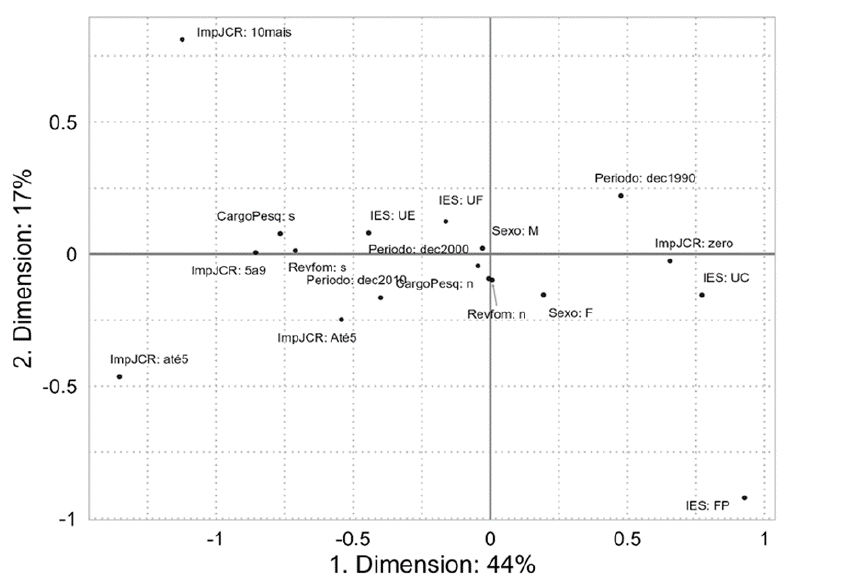
Figure 3 presents the map of properties associated with the supplementary variables in the analysis. These properties were not included in the MCA calculations for statistical reasons or because they were treated as independent variables in our analysis. The properties associated with two of these independent variables are particularly relevant. The first is the type of higher education institution led by the agents analyzed (IES code). The second refers to the periods in which these leaders assumed their positions (Periodo).

The graph shows that rectors who took office in the 1990s (Periodo: 1990s) are concentrated in the upper-left quadrant. This location indicates a relative predominance of a leadership profile characterized by lower levels of scientific capital and by educational backgrounds associated with the biological and health sciences. In a context in which the number of PhD holders in the country was significantly lower, scientific capital appears to have been less relevant for attaining the position of rector, suggesting that appointments were more strongly influenced by political and economic factors.
In contrast, rectors who took office in the 2010s (Periodo: 2010s) are concentrated in the lower-left portion of the plot. This group exhibits a more balanced combination of scientific and temporal forms of capital, with educational backgrounds more closely linked to engineering, strong scientific output, and greater involvement in unions. This shift indicates a change in the leadership profile within these institutions, with an increased emphasis on the combination of academic and political-managerial competencies.
Another variable relevant to the analysis is the positioning of rectors or presidents across different types of higher education institutions. The analysis reveals a clear pattern in the location of leaders from private and confessional institutions (IES: FP; IES: UC), which are concentrated on the right side of the plot. This suggests that these leaders tend to possess lower levels of scientific capital and academic prestige, reflecting the stronger market orientation of these institutions. While leaders of confessional institutions are more centrally positioned along the vertical axis, those from private institutions are more frequently located in the lower part of the plot, indicating that they are more likely to hold doctoral degrees and to possess greater political and economic power.
Leaders of federal (IES: UF) and state (IES: UE) public universities are distributed across all quadrants, indicating a greater diversity of profiles. However, these institutions tend to place much greater value on scientific capital than private institutions. This emphasis is even more pronounced in state universities, which are positioned further to the left in Figure 3 than federal ones. Although, over time, the influence of rectors with backgrounds in engineering, doctoral training abroad, and union engagement has increased, the period analyzed still shows a slight predominance of a more strictly scientific profile linked to the health and biological sciences, as these properties are located in the lower portion of the upper-left quadrant.
DISCUSSION
The analysis conducted demonstrates a significant transformation in the profile of leaders of public higher education institutions over recent decades. In the distribution of agents within the leadership space between 1990 and 2019, a clear polarity emerges between two distinct groups: on one side, leaders with greater accumulation of scientific capital and academic prestige; on the other, those with lower levels of scientific capital but trajectories linked to political and economic power.
This polarization is also reflected across fields of knowledge. As shown by the figures and the MCA analysis, leaders originating from scientific and professional areas dominant within the scientific field - notably medicine and engineering - tend to occupy quadrants associated with higher accumulation of scientific capital, particularly in terms of publications in high-impact journals, academic awards, and internationalization. In contrast, the humanities and social sciences, especially professions associated with the applied social sciences, are positioned in quadrants characterized by lower scientific prestige and a greater concentration of political and economic resources.
These findings allow for a critical reassessment of claims in the literature regarding the loss of autonomy in the field in recent decades due to the growing influence of economic power (Almeida, 2008; Carvalho, 2013; Costa, 2018; Oliveira, 2017). The results indicate that the expansion of private sector actors since the 1990s has been counterbalanced by the growth of scientific autonomy within public universities. A growing division is observed between economic and political power, concentrated within private groups, and scientific power, associated with public universities.
This process has been accompanied by an increasing influence of engineers in the administration of public universities. This finding is consistent with Carlotto (2014) and Barata et al. (2014), who argue that the growing centrality of these professionals in the academic field is driven by a technological paradigm that favors innovation and high-impact scientific production. The analysis also shows that the rise of engineers and other leaders from technical fields is directly related to increased government investment in areas considered strategic for national technological development. Funding programs aimed at technological innovation, applied research, and university-industry collaboration, promoted by federal and state agencies, have favored academic trajectories associated with STEM fields. Similarly, policies aimed at strengthening the healthcare system, biomedical research, and the training of human resources in public health have contributed to the centrality of medicine and the biological sciences within the academic field. These policies have not only expanded opportunities for funding and scientific recognition but have also reinforced the legitimacy of these profiles for occupying university leadership positions.
The transformations observed in the field of leadership in public higher education institutions, marked by a more frequent strategy of accumulating scientific capital, suggest that the culture of scientific production may be becoming a doxa - that is, a collectively accepted and taken-for-granted truth within the university field. Engineers, in particular, have managed to combine the two forms of power identified by Bourdieu (2006): temporal (political) power and atemporal (prestige-based) power, achieved through high-impact scientific activities such as publications in prestigious journals and international academic recognition.
The study also reveals that leaders of public higher education institutions have accumulated temporal power through the occupation of leadership positions within their own institutions and through involvement in unions. This factor may help explain why leaders in the 2010s are positioned in quadrants associated with a moderate accumulation of scientific capital. As Bourdieu (2017), (authors’ own translation) argues:
Specifically university-based power can only be accumulated and maintained at the cost of a constant and significant investment of time … the acquisition and exercise of administrative power in the academic field - such as that of dean or rector - tend to compromise the accumulation of scientific authority, and vice versa (p. 132).
This transformation in the profile of leaders may be related to the increased autonomy in the selection of rectors in public universities since the late 1980s, when elections began to be conducted by the academic community. This process introduced a new strategy of power accumulation, combining the holding of administrative and union positions with the valorization of scientific capital - a powerful symbolic resource within universities and specific to the academic field.
The shift toward a more scientifically oriented profile may also be associated with strategies aimed at subverting dominant power, such as rectoral elections, which have granted greater influence to faculty members in the selection of their leaders. In recent years, there has also been a growing struggle for parity in electoral processes within public universities, with demands for greater participation by historically subordinated groups, such as students and administrative staff, in institutional decision-making.
Another relevant factor concerns the requirements imposed by CAPES following the enactment of the Guidelines and Bases Act (LDB) in the 1990s, which emphasized academic production, as argued by Sguissardi and Silva (2009). These changes had a direct impact on universities - particularly public ones - leading to an increasing demand for applied research. Funding agencies have come to play a central role in structuring the Brazilian university field, intensifying the pressure for international publications (Silva, 2017).
One hypothesis for the transformation in leadership profiles is that academic publication has become naturalized and reproduced, gradually incorporated into the habitus of agents in public higher education institutions, thereby becoming an implicit prerequisite for the selection of rectors. The preference for agents with greater scientific capital may not be consciously calculated but rather constitutes an internalized disposition among agents. The state, through its agents and fractions of the power elite, may have shaped the functioning of this space by establishing policies for higher education, demonstrating that, although universities possess autonomy, they maintain a relationship of interdependence with the field of power.
This dynamic is consistent with the study by Hey (2007), which also highlights the importance of academic capital for advancement to leadership positions. The author shows that researchers with greater academic capital - expressed through scientific production and academic prestige - are those who occupy prominent positions and have greater capacity to shape the academic agenda and influence educational policies. Thus, the present study reinforces these findings, demonstrating that, in public universities, the possession of scientific capital plays an increasingly important role in the selection of rectors.
These transformations, however, appear to be restricted to public universities, as no major changes were observed in the profiles of agents in private higher education institutions. In general, rectors and presidents of these institutions have trajectories that allowed them to accumulate temporal forms of power, such as positions in politics, corporate management, or leadership roles in other universities. This may be related to the increasing competition among private universities, which have progressively adopted business-oriented practices in pursuit of competitiveness, profit, and ‘clients’ (Carvalho, 2013; Oliveira, 2017).
FINAL REMARKS
This article examined the transformations in the social space of rectors of higher education institutions in the Southeast region of Brazil between 1990 and 2019, revealing significant changes in the profile of top university leaders in public institutions, which differ from those in private higher education institutions. From a practical-analytical perspective, the results contribute to understanding the implicit criteria that guide the legitimation of university leadership, particularly in public institutions, offering insights for debates on governance models, internal electoral processes, and leadership development in higher education. From a theoretical standpoint, the article contributes to organizational and higher education studies by demonstrating the potential of Pierre Bourdieu’s relational approach for analyzing university governance, shifting the focus from educational policies or scientific production alone to the leadership elites occupying central decision-making positions. By combining prosopography and multiple correspondence analysis, the study highlights how different forms of capital structure access to and the legitimation of university power, offering a relational interpretation of transformations in the Brazilian academic field.
The study has three main limitations. First, it faced difficulties in capturing the agents’ political capital, as such information is not always available or easily accessible through the Lattes platform, requiring more in-depth biographical analysis. A second limitation relates to inconsistencies and gaps in the organization and updating of Lattes data, which may affect the accuracy of the analysis. Finally, the sample included a relatively small number of leaders from private institutions. This reflects both the research design - focused on institutions with a certain level of research intensity - and the greater availability and standardization of academic trajectory data in the public sector. In any case, the limited number of private-sector leaders constrains the possibility of generalizing findings regarding the dynamics of power and legitimation in private institutions.
Future research may expand the discussion proposed in this article by exploring other regional contexts in Brazil, allowing for an assessment of whether the dynamics observed in the Southeast are reproduced or differ in other regions. Comparative studies involving federal, state, and private universities, as well as analyses incorporating other levels of university governance - such as governing councils, vice-rectorates, and regulatory bodies - may deepen the understanding of power struggles and contemporary forms of legitimation of university authority within the Brazilian academic field. Studies that more directly address the university field of power are also promising, as they may examine internal institutional disputes and interactions with regulatory bodies such as the Ministry of Education (MEC) and CAPES, contributing to a more historical and relational understanding of transformations in higher education. Finally, it would be relevant to develop research aimed at deepening the understanding of the influence of specific professional profiles on the management of public universities, particularly engineers and physicians.
REFERENCES
- Abdi, H., & Valentin, D. (2007). Multiple correspondence analysis. In N. J. Salkind (Ed.) Encyclopedia of Measurement and Statistics (pp. 651-657). Sage Publications.
-
Almeida, A. M. F. (2008). O assalto à educação pelos economistas. Tempo Social, 20, 163-178. https://www.scielo.br/j/ts/a/D6Hmykzm98TyhmcCZC5j9YG/?format=pdf⟨=pt
» https://www.scielo.br/j/ts/a/D6Hmykzm98TyhmcCZC5j9YG/?format=pdf⟨=pt -
Azevedo, M. L. N., Catani, A. M., & Hey, A. P. (2017). Circulação das ideias e internacionalização da Educação Superior: Inferências a partir da teoria dos campos de Pierre Bourdieu. Educação, 40(3), 296-304. http://dx.doi.org/10.15448/1981-2582.2017.3.28980
» http://dx.doi.org/10.15448/1981-2582.2017.3.28980 -
Barata, R. B., Aragão, E., Sousa, L. E. P. F., Santana, T. M., & Barreto, M. L. (2014). The configuration of the Brazilians cientific field. Anais da Academia Brasileira de Ciências, 86(1), 505-521. https://doi.org/10.1590/0001-3765201420130023
» https://doi.org/10.1590/0001-3765201420130023 -
Bathmaker, A., Ingram, N., & Waller, R. (2013). Higher education, social class and the mobilisation of capitals: Recognising and playing the game. British Journal of Sociology of Education, 34(5-6), 723-743. https://www.jstor.org/stable/43818796
» https://www.jstor.org/stable/43818796 - Bourdieu, P., & Wacquant, L. (1992). An invitation to reflexive sociology Polity.
- Bourdieu, P. (1996). The State nobility: Elite schools in the field of power Polity Press.
- Bourdieu, P. (2005). As Estruturas Sociais da Economia Campo das Letras.
- Bourdieu, P. (2006). As estruturas sociais da economia. Campo das Letras.
- Bourdieu, P. (2008). Razões Práticas: Sobre a teoria da ação Papirus.
- Bourdieu, P. (2017). Homo Academicus Ed. da UFSC.
-
Broady, D. (2002). French prosopography: Definition and suggested readings. Poetics, 30(5-6), 381-385. https://doi.org/10.1016/S0304-422X(02)00031-1
» https://doi.org/10.1016/S0304-422X(02)00031-1 -
Candido, S. E. A., Côrtes, M. R., Truzzi, O. M. S., & Sacomano, M. Neto (2017). Campos nos estudos organizacionais: Abordagens relacionais? Gestão & Produção, 25, 68-80. https://doi.org/10.1590/0104-530X2122-16
» https://doi.org/10.1590/0104-530X2122-16 -
Caregnato, C. E., Leite, D. B. C.; & Miorando, B. S. (2016). Pesquisadores e legitimidade científica no campo da educação. Linhas críticas, 22(47), 189-209. https://periodicostestes.bce.unb.br/index.php/linhascriticas/article/view/4813/4384
» https://periodicostestes.bce.unb.br/index.php/linhascriticas/article/view/4813/4384 -
Carlotto, M. C. (2014). Universitas semper reformanda? A história da Universidade de São Paulo e o discurso da gestão à luz da estrutura social. [tese de doutorado em Sociologia]. Faculdade de Filosofia, Letras e Ciências Humanas, Universidade de São Paulo. https://teses.usp.br/teses/disponiveis/8/8132/tde-19032015-171049/publico/2014_MariaCaramezCarlotto_VOrig.pdf
» https://teses.usp.br/teses/disponiveis/8/8132/tde-19032015-171049/publico/2014_MariaCaramezCarlotto_VOrig.pdf -
Carlotto, M. (2021). O campo brasileiro de ensino superior em perspectiva estrutural: Tendências históricas e contemporâneas. Debates, 10(1). https://doi.org/10.34024/pensata.2021.v10.12519
» https://doi.org/10.34024/pensata.2021.v10.12519 -
Carvalho, C. H. A. (2013). A mercantilização da educação superior brasileira e as estratégias de mercado das instituições lucrativas. Revista Brasileira de Educação, 18(54), 761-776. https://doi.org/10.1590/S1413-24782013000300013
» https://doi.org/10.1590/S1413-24782013000300013 -
Catani, A. M. (2011). As possibilidades analíticas da noção de campo social. Educação e Sociedade, 32(114) 189-202. https://www.scielo.br/j/es/a/LqyGHhYg69RCRnfJy5pXdsB/?lang=pt&format=pdf
» https://www.scielo.br/j/es/a/LqyGHhYg69RCRnfJy5pXdsB/?lang=pt&format=pdf -
Catani, A. M., Hey, A. P., & Gilioli, R. D. S. P. (2006). PROUNI: democratização do acesso às Instituições de Ensino Superior? Educar em revista, 125-140. https://doi.org/10.1590/S0104-40602006000200009
» https://doi.org/10.1590/S0104-40602006000200009 -
Cock, J., Antunes, A. L., Rodrigues, R. P., Santos, D. S. L., & Araujo, J. P. F. T. de (2018). Operando com conceitos de Bourdieu: Produtividade em pesquisa e hierarquias acadêmicas no campo da educação. Educação e Pesquisa, 44, 1-19. https://doi.org/10.1590/s1678-4634201844178392
» https://doi.org/10.1590/s1678-4634201844178392 -
Collyer, F. M. (2014). Practices of conformity and resistance in the marketisation of the academy: Bourdieu, professionalism and academic capitalism. Critical Studies in Education, 56(3), 315-331. https://doi.org/10.1080/17508487.2014.985690
» https://doi.org/10.1080/17508487.2014.985690 -
Costa, F. L. O. (2018). Políticas públicas, expansão do ensino superior privado lucrativo e financeirização do capital no Brasil: O caso da Kroton Educacional S.A. Cadernos de Pesquisa, 25(4), 33-51. https://doi.org/10.18764/2178-2229.v25n4p33-51
» https://doi.org/10.18764/2178-2229.v25n4p33-51 -
Emirbayer, M., & Johnson, V. (2008). Bourdieu and organizational analysis. Theory And Society, 37(1), 1-44. https://doi.org/10.1007/s11186-007-9052-y
» https://doi.org/10.1007/s11186-007-9052-y -
Farias, M. D. S., Oliveira, J., & Lorente, L. (2020). Internacionalização da educação superior: Tensões, cenários e estratégias nos casos Brasil e Espanha. Revista Lusófona de Educação, 49, 147-161. https://revistas.ulusofona.pt/index.php/rleducacao/article/view/7457
» https://revistas.ulusofona.pt/index.php/rleducacao/article/view/7457 -
Fitzsimmons, T. W., & Callan, V. J. (2020). The diversity gap in leadership: What are we missing in current theorizing? The Leadership Quarterly, 31(4), 101347. https://doi.org/10.1016/j.leaqua.2019.101347
» https://doi.org/10.1016/j.leaqua.2019.101347 - Fligstein, N. (1990). The transformation of corporate control Harvard University Press.
- Fligstein, N., & McAdam, D. (2012). A theory of fields Oxford University Press.
-
Floyd, A. (2011). Turning Points’: The Personal and Professional Circumstances That Lead Academics to Become Middle Managers’. Educational Management Administration & Leadership, 40(2), 272-284. https://doi.org/10.1177/1741143211427980
» https://doi.org/10.1177/1741143211427980 -
Floyd, A., & Preston, D. (2019). Why do UK academics become Associate Deans and what are their future career plans? Journal of Higher Education Policy and Management, 41(4), 430-443. https://doi.org/10.1080/1360080X.2019.1625220
» https://doi.org/10.1080/1360080X.2019.1625220 - Hallet, T., & Gougherty, M. (2018). Bourdieu and Organizations: Hidden Traces, Macro Influence, and Micro Potential. In, T. Medvetz, & J. J. Sallaz (Eds.). (2018). The Oxford Handbook of Pierre Bourdieu (pp. 273-298). Oxford University Press.
-
Hey, A. P. (2007). Bourdieu epistêmico-prático: O espaço de produção acadêmica em educação superior no Brasil. Educação & Linguagem, 10(16), 86-105. https://doi.org/10.15603/2176-1043/el.v10n16p86-105
» https://doi.org/10.15603/2176-1043/el.v10n16p86-105 -
Jin, J., & Ball, S. J. (2020). ‘Toned Habitus’, self-emancipation and the contingency of reflexivity: A life story study of working-class students at elite universities in China. British Journal of Educational Studies, 68, 241-262. https://doi.org/10.1080/00071005.2019.1644292
» https://doi.org/10.1080/00071005.2019.1644292 -
Larsen A. G. (2022). Package ‘soc.ca’. 0.8.0 https://github.com/Rsoc/soc.ca
» https://github.com/Rsoc/soc.ca - Le Roux, B., & Rouanet, H. (2010). Multiple correspondence analysis Sage.
-
Lebaron, F. (2009). How Bourdieu “quantified” Bourdieu: The geometric modelling of data. In K. Robson, & C. Sanders (Eds.). (2009). Quantifying Theory: Pierre Bourdieu Springer. https://doi.org/10.1007/978-1-4020-9450-7_2
» https://doi.org/10.1007/978-1-4020-9450-7_2 -
Machado-da-Silva, C. L., Guarido Filho, E. R., & Rossoni, L. (2010). Campos organizacionais: Seis diferentes leituras e a perspectiva de estruturação. Revista de Administração Contemporânea, 14, 109-147. https://doi.org/10.1590/S1415-65552010000600006
» https://doi.org/10.1590/S1415-65552010000600006 -
Mendonça, J. R. C. D., Fernandes, D. C., Helal, D. H., & Cassundé, F. R. (2019). Políticas públicas para o Ensino Superior a Distância: Um exame do papel da Universidade Aberta do Brasil. Ensaio: avaliação e políticas públicas em Educação, 28(106), 156-177. https://doi.org/10.1590/S0104-40362019002801899
» https://doi.org/10.1590/S0104-40362019002801899 -
Misoczky, M. C. A. (2003). Implicações do uso das formulações sobre campo de poder e ação de Bourdieu nos estudos organizacionais. Revista de Administração Contemporânea, 7, 9-30. https://doi.org/10.1590/S1415-65552003000500002
» https://doi.org/10.1590/S1415-65552003000500002 -
Ocasio, W., Pozner, J., & Milner, D. (2020). Varieties of political capital and power in organizations: A review and integrative framework. Academy Of Management Annals, 14(1), 303-338. https://doi.org/10.5465/annals.2018.0062
» https://doi.org/10.5465/annals.2018.0062 - Oliveira, R. P. (2017). A financeirização da economia e suas consequências para a educação superior no Brasil. In G. Maringoni. O negócio da Educação (vol. 1, pp. 27-35). Olho D’água.
-
Reay, D., Crozier, G, & Clayton, J. (2009). ‘Strangers in Paradise’? Working-class Students in Elite Universities. Sociology, 43(6), 1103-1121. https://doi.org/10.1177/0038038509345700
» https://doi.org/10.1177/0038038509345700 -
Rossier, T. (2019). Prosopography, Networks, Life Course Sequences, and so on: Quantifying with or beyond Bourdieu? Bulletin of Sociological Methodology, 144(1), 6-39. https://www.jstor.org/stable/26816718
» https://www.jstor.org/stable/26816718 -
Rowlands, J. (2013). Academic boards: Less intellectual and more academic capital in higher education governance? Studies In Higher Education, 38(9), 1274-1289. https://doi.org/10.1080/03075079.2011.619655
» https://doi.org/10.1080/03075079.2011.619655 - Rowlands, J. (2017). Comparing academic governance across Anglophone Nations. In Academic Governance in the Contemporary University Springer.
- Sapiro, G. (2020). Dictionnaire international Bourdieu CNRS Editions.
-
Setton, M. (1999). A divisão interna do campo universitário: Uma tentativa de classificação. Revista Brasileira de Estudos Pedagógicos, 80(196), 451-471. https://doi.org/10.24109/2176-6681.rbep.80i196.985
» https://doi.org/10.24109/2176-6681.rbep.80i196.985 - Sguissardi, V., & Silva, J. R. Júnior (2009). Trabalho intensificado nas federais Pos-graduação e produtivismo acadêmico. Xamã.
- Silva, J. R. S. Júnior (2009). The New Brazilian University: A busca por resultados comercializáveis Canal 6 Editora.
- Silva, J. R. S. Júnior (2017). The new Brazilian university: A busca por resultados comercializáveis. Canal 6 Editora.
-
Silva, J. B. D. (2023). Manutenção das cotas raciais na UFMG em contexto de turbulência (2016-2022). [Dissertação de Mestrado em Administração Pública e Governo]. Escola de Administração de São Paulo, Fundação Getúlio Vargas. https://hdl.handle.net/10438/35115
» https://hdl.handle.net/10438/35115 - Silva, K.C.M. (2019). A exclusão escolar e o Instituto Federal de São Paulo, Campus Bragança Paulista [Dissertação de Mestrado em Gestão de Organizações e Sistemas Públicos]. Universidade Federal de São Carlos.
-
Stone, L. (2011). Prosopografia. Revista de Sociologia e Política, 19(39), 115-137. https://revistas.ufpr.br/rsp/article/view/31689
» https://revistas.ufpr.br/rsp/article/view/31689 -
Trevisol, J. V., & Toledo, J. A. (2021). A educação superior a distância no Brasil: regulação e políticas de expansão 1998-2018). Revista Lusófona de Educação, 51, 29-46. https://revistas.ulusofona.pt/index.php/rleducacao/article/view/7707
» https://revistas.ulusofona.pt/index.php/rleducacao/article/view/7707
-
Plagiarism Check
RAC maintains the practice of submitting all documents approved for publication to the plagiarism check, using specific tools, e.g.: iThenticate.
-
Funding
The authors stated that there was no funding for the research in this article.
-
Peer Review Method
This content was evaluated using the double-blind peer review process. The disclosure of the reviewers’ information on the first page, as well as the Peer Review Report, is made only after concluding the evaluation process, and with the voluntary consent of the respective reviewers and authors.
-
Data Availability
The authors claim that all data used in the research have been made publicly available, and can be accessed via the Harvard Dataverse platform:Freitas, R. de. Candido, S. E. A., & Gonçalves, G. E., 2026, "Replication Data for: Transformations in the Social Space of the Deans of Universities in the Southeast of Brazil published by Revista de Administração Contemporânea", Harvard Dataverse, V1.RAC encourages data sharing but, in compliance with ethical principles, it does not demand the disclosure of any means of identifying research subjects, preserving the privacy of research subjects. The practice of open data is to enable the reproducibility of results, and to ensure the unrestricted transparency of the results of the published research, without requiring the identity of research subjects.
-
Cite as:
Freitas, R., Candido, S. E. A., & Gonçalves, G. E. (2026). Transformations in the social space of the deans of Universities in the Southeast of Brazil. Revista de Administração Contemporânea, 30(3), e250364. https://doi.org/10.1590/1982-7849rac2026250364.en
-
JEL Code:
J23
-
Peer Review Report:
The disclosure of the Peer Review Report was not authorized by its authors/reviewers

Edited by
-
Editor-in-chief:
Paula Chimenti (Universidade Federal do Rio de Janeiro, COPPEAD, Brazil) https://orcid.org/0000-0002-6492-4072
-
Associate Editor:
Elisa Ichikawa (Universidade Estadual de Maringá, Brazil) https://orcid.org/0000-0001-7096-7653
The authors claim that all data used in the research have been made publicly available, and can be accessed via the Harvard Dataverse platform:
Freitas, R. de. Candido, S. E. A., & Gonçalves, G. E., 2026, "Replication Data for: Transformations in the Social Space of the Deans of Universities in the Southeast of Brazil published by Revista de Administração Contemporânea", Harvard Dataverse, V1.
https://doi.org/10.7910/DVN/FHIH5Z
RAC encourages data sharing but, in compliance with ethical principles, it does not demand the disclosure of any means of identifying research subjects, preserving the privacy of research subjects. The practice of open data is to enable the reproducibility of results, and to ensure the unrestricted transparency of the results of the published research, without requiring the identity of research subjects.

 Source: Elaborated by the authors.
 Source: Elaborated by the authors.
 Source: Elaborated by the authors.