 PONTOS QUÂNTICOS DE SULFETOS METÁLICOS: AVANÇOS COMPOSICIONAIS E APLICAÇÕES VERSÁTEIS
Resumo
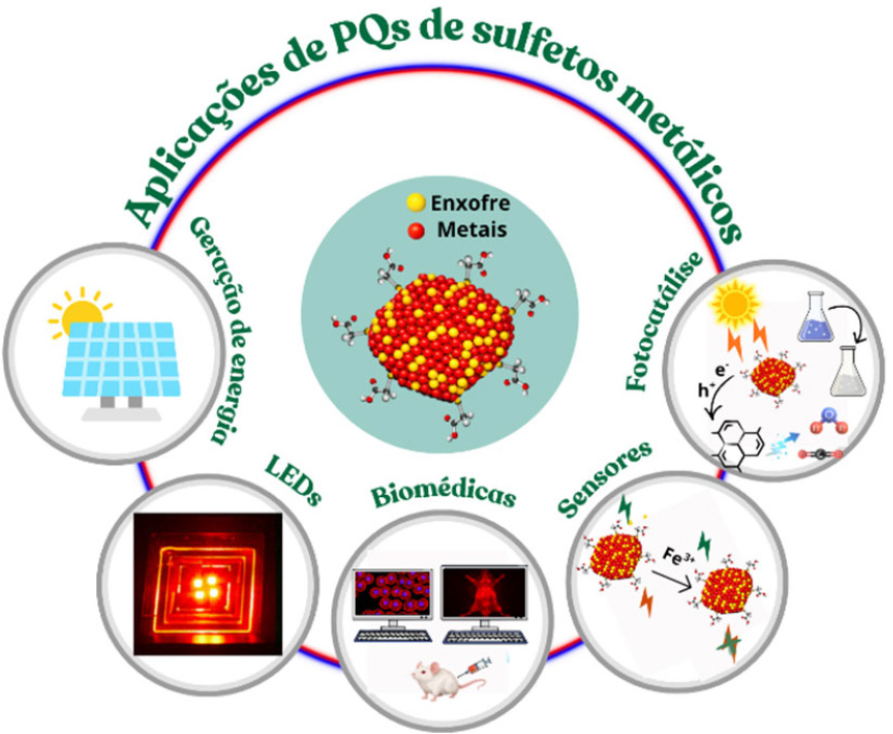
Metal sulfide quantum dots (QDs) have gained remarkable attention in recent years owing to their broad optical tunability, high photochemical stability, and potential to replace toxic cadmium-based systems. These semiconductor nanocrystals exhibit sizeand compositiondependent electronic structures, enabling precise control of their absorption and emission across the visible and near-infrared regions. The transition from binary systems such as ZnS and CdS to more complex ternary and quaternary compositions, including CuInS2, AgInS2, and ZnCuInS/ZnS, has significantly expanded the versatility of these materials. Through compositional engineering and surface modification, it has become possible to optimize parameters such as photoluminescence quantum yield, defect density, and environmental compatibility. Consequently, metal sulfide QDs have emerged as promising candidates for diverse applications, including fluorescence bioimaging, photocatalytic degradation of organic pollutants, and solar energy conversion in next-generation photovoltaic devices. This review provides an integrated perspective on recent advances in the synthesis and compositional design of binary, ternary, and quaternary metal sulfide QDs, emphasizing the relationship between synthetic strategies, composition, and optical properties, particularly in green chemistry approaches. Key challenges are also highlighted, including control over growth mechanisms, surface chemistry, stability, and toxicity, which remain critical for their practical application in sustainable technologies.
 Thumbnail
 Thumbnail
 Thumbnail
 Thumbnail
 Thumbnail
 Thumbnail
 Thumbnail
 Thumbnail
 Thumbnail