 UNDERSTANDING OVERPOTENTIALS IN BIOMASS ELECTROCHEMISTRY THROUGH FREE-ENERGY LANDSCAPES: A GRAPHICAL EDUCATIONAL APPROACH
Abstract
This article takes an educational perspective on a central limitation in biomass electrochemistry: the impossibility of driving multielectron reactions at the global thermodynamic potential. Standard electrode potentials are defined solely by the free-energy difference between global reactants and products (including electrons), whereas experimental operation depends on the stability of adsorbed intermediates formed along the reaction pathway. When free energy must be distributed across many elementary steps, large overpotentials usually arise as an inevitable thermodynamic consequence of multielectron reactions, even before kinetic effects are considered. To make this point clear, a graphical rather than mathematical approach is used to illustrate the thermodynamic origin of overpotentials, first revisiting simple twoand four-electron reactions such as the H+/H2 and O2/H2O couples. These examples highlight how adsorption energies determine the potential-determining step and why even apparently simple and well-understood processes require overpotentials. This framework is then extended to the interconversion of organic functional groups, specifically the alcohol/carbonyl and aldehyde/acid transformations, which represent key steps in the electro-oxidation of biomass-derived molecules.
Keywords:
biomass electrochemistry; thermodynamics; multielectron reactions; electrocatalysis; energy diagrams; alcohol/polyol electro-oxidation.
INTRODUCTION
The growing interest in biomass-derived molecules as fuels and feedstocks for electrochemical devices is motivated by their abundance, renewability, and potential to produce electricity and value-added chemicals.1 Alcohols, aldehydes, and polyols, such as glycerol and glucose, have been extensively studied in the last decades as candidates for anodic reactions in fuel cells or electrolyzers, often with the hope that their replacement by hydrogen or water, respectively, could, at least from a thermodynamic perspective, decrease the energy cost of operation or increase the energy output. Indeed, standard potentials for the complete oxidation of these molecules can appear very favorable when compared to water oxidation, suggesting the possibility of more efficient devices.2,3
However, this conventional argument is misleading if taken at face value. Standard electrode potentials are defined solely by the free-energy difference between global reactants and products. They do not consider the sequence of adsorbed intermediates that necessarily form during electro-oxidation or electro-reduction. Even in apparently simpler reactions, such as oxygen reduction or water oxidation, the four-electron transfer requires intermediates that make the operation close to the reversible potential extremely challenging, as shown in a vast body of literature. When the number of electrons exchanged becomes even larger, as in the complete oxidation of glycerol (14 electrons) or glucose (24 electrons), the free energy must be distributed among a myriad of steps and intermediates. This distribution makes it thermodynamically impossible to drive such multielectron reactions at the global reversible potential.
If the argument in the previous paragraph appears counterintuitive or unfamiliar, that effect is precisely the motivation for the present article. Discussions of (electro)chemical feasibility are often framed solely in terms of global reaction free energies, while the consequences of distributing this free energy across many elementary steps and intermediates are rarely made explicit, particularly in an educational context. The following sections therefore revisit these concepts in a stepwise and graphical manner, starting from simple reactions and gradually increasing complexity. The goal is not to replace more rigorous kinetic or computational analyses found in the specialized literature, but rather to provide an intuitive thermodynamic foundation that prepares the reader to engage with those more detailed treatments.
The discussion in this article begins by revisiting reactions involving twoand four-electron transfers, showing in a simplified manner how their thermodynamics connect to electrochemical potentials, adsorption energies, and the concept of an optimal catalyst. This reasoning is then extended to simple two-electron transformations of functional groups central to organic chemistry and important for several biomass-derived molecule transformations, such as -OH and C=O. These cases serve as didactic stepping stones to understand why, from a purely thermodynamic perspective, large overpotentials may be an unavoidable consequence in multielectron conversions of alcohols, aldehydes, and polyols derived from biomass. At the same time, these simple cases also illustrate an important practical message: while complete oxidation of glycerol or glucose necessarily involves large overpotentials from a thermodynamic standpoint, partial oxidations that exchange only one or two electrons can operate much closer to their thermodynamic potentials and are therefore also very likely to proceed faster, since the same thermodynamic constraints that reduce the required thermodynamic overpotential also likely reduce the kinetic barriers associated with the elementary steps. The central message is that the search for catalysts capable of bringing complete multielectron reactions close to the global thermodynamic potential is futile; instead, progress must come from understanding and controlling the stabilization of intermediates and guiding selectivity along feasible pathways.
KEY CONCEPTS AND SIMPLIFYING ASSUMPTIONS
Before starting, several assumptions are briefly outlined to simplify the discussion and facilitate understanding for non-specialists. These assumptions are not intended to dismiss important complexities, but rather to provide a clear conceptual framework for readers (especially those entering the field) so that the essential thermodynamic arguments can be grasped without being overwhelmed by mechanistic details or equations.
Concerted proton-electron transfer
Concerted proton-electron transfer is assumed, with electrons being transferred one by one. This is a consequence of Marcus’ theory for outer-sphere electron transfer.4 Further discussion of these concepts and their implications for electrocatalysis can be found in other publications.5,6
Focus on relative energies of reactants, intermediates, and products
Only the relative energies of reactants, intermediates, and products are analyzed in this work. Strictly speaking, neglecting transition-state energies is a major simplification in research articles, but it does not introduce any significant drawback in an educational article such as this one. Importantly, the well-known Brønsted-Evans-Polanyi relation,7,8 which establishes that activation barriers often scale with the reaction free energies of elementary steps, implies that stabilizing or destabilizing intermediates also affects the energy of the corresponding transition states and the associated kinetic barriers. As a consequence, many key trends in catalytic activity, such as the appearance of volcano plots, can be rationalized by considering only relative thermodynamic energies. This demonstrates that useful insights into energy optimization can often be gained even from simplified models. This approach has been successfully applied in the literature, including in studies of biomass-derived molecules.9-11
Effect of the electrochemical potential
It is assumed that changing the electrochemical potential alters only the energy of the electrons. For intermediates with inhomogeneous charge distributions, this assumption can introduce errors; however, such limitations are not critical in an article of educational scope where no explicit calculations are performed. Although this oversimplification is acknowledged, the magnitude of these effects is not directly accessible by electrochemical measurements and is usually estimated through computational studies with a considerable degree of arbitrariness. Readers less familiar with this topic are encouraged to review the concepts of the “dipole moment of adsorbed species” and “electrosorption valence”.12
Rate-determining step versus potential-determining step
In electrochemical reactions, it is important to distinguish between the rate-determining step (RDS) and the potential-determining step (PDS). The RDS refers to the elementary step with the largest kinetic barrier and therefore controls the overall reaction rate (it is a concept more familiar to readers, discussed in almost all chemistry courses around the globe), whereas the PDS corresponds to the step with the largest thermodynamic free-energy change at a given potential and determines the minimum overpotential required for the reaction to proceed. While both concepts are essential for a complete mechanistic description, the present work focuses exclusively on the thermodynamic perspective embodied in the PDS, in line with the emphasis on relative energies of reactants, intermediates, and products discussed above. This choice allows the key thermodynamic constraints of multistep electrochemical reactions to be highlighted without introducing additional kinetic complexity. More detailed discussions combining thermodynamic and kinetic analyses can be found in other publications.13,14 In the following sections, these concepts are clarified and illustrated explicitly using the hydrogen reaction as a simple and well-established example.
THERMODYNAMIC CONSIDERATIONS FOR REACTIONS TRANSFERRING TWO ELECTRONS
The hydrogen reduction and oxidation reactions
To introduce the thermodynamic ideas that will be applied later to more complex biomass-derived molecules, it is essential to begin with the hydrogen reaction. The hydrogen reduction and oxidation reactions form the simplest and best-understood electrochemical redox pair, involving only two electrons and one intermediate. By analyzing this case in detail, it can be shown step by step how the free energy of reactants and products relates to the electrochemical potential, how the binding energy of an intermediate determines catalytic performance, and why the concept of an “optimal catalyst” emerges naturally from this analysis.
The H+/H2 redox couple is the most well-known reaction involving the transfer of two electrons. At equilibrium, ∆G = 0 (and, obviously E0(H⁺/H2) = 0.0 V vs. RHE), which implies that the Gibbs free energy of the products equals that of the reactants: (G(H2) = 2 G(H+ + e-)). By definition, this corresponds to 0.0 V vs. standard hydrogen electrode (SHE) under standard conditions, or 0.0 V vs. RHE at any pH.
Under standard conditions, where the activity of H+ is unity and the fugacity of H2 is also unity, the Gibbs free energies are defined in a way such that both states have zero free energy at 0 V vs. SHE.12,15 In other words, the standard potential of the H+/H2 couple is defined as 0 V vs. SHE, which establishes it as the reference point for all other electrochemical potentials.
The hydrogen reaction can proceed through two well-established mechanisms: Volmer-Tafel (Equations 2 and 3) and Volmer-Heyrovsky (Equations 4 and 5), where Equations 2 and 4 show the Volmer step in acidic medium.16
In this mechanism, the Volmer step is an electrochemical adsorption process that generates an adsorbed hydrogen intermediate (Pt-H). Then, two adsorbed intermediates recombine in a purely chemical step (Tafel) to form H2 and regenerate the active sites.
In the case of the Volmer-Heyrovsky mechanism, the first step is identical to the Volmer-Tafel pathway. However, in this case, the second step is electrochemical: an additional proton and electron combine directly with the adsorbed intermediate to release H2.
Figure 1 schematically illustrates the energies of reactants and products for the H+/H2 couple. At equilibrium, under standard conditions, both states are set to 0 V vs. SHE (or 0 V vs. RHE, when the RHE is in the same solution) or ∆G = 0 (green lines). When the potential is shifted to more negative values (overpotential), the energy of the electrons increases (black arrow), raising the free energy of the reactants and making hydrogen evolution a downhill process. Conversely, applying a positive potential lowers the energy of the reactants below that of H2, driving the oxidation reaction.

Energy of the reactants and products for the H+/H2 redox pair at equilibrium (green). Applying a negative overpotential increases the energy of the electrons (black arrow), destabilizing the reactants relative to H2 and promoting reduction
To provide a more complete picture, it is also important to introduce the energy of the intermediate Pt-H, which is common to both mechanisms.6,17,18Figure 2 shows schematic energy diagrams, including reactants, products, and the intermediate, with different possible energies for Pt-H depending on the nature of the catalyst. This relatively simple reaction is often considered a “solved problem”, since at least two catalysts, platinum and the hydrogenase enzyme, can perform it in a nearly reversible way.17,19 It is worth noting that, while the activity of Pt varies with surface structure, for clarity, herein the discussion is restricted to differences in chemical composition.

Energy of the reactants, intermediate, and product for the H+/H2 redox pair via Volmer-Tafel (a) and Volmer-Heyrovsky (b) mechanisms. Red arrows highlight uphill steps arising when hydrogen binds either too weakly or too strongly. The uphill steps define the PDS
When the reaction occurs on Pt (or at the hydrogenase active site), the energy of the Pt-H intermediate is very close to that of the reactants and products.20 In simple terms, binding a hydrogen atom to another hydrogen atom (to form H2) is energetically similar to binding it to Pt.
If a catalyst binds hydrogen more weakly than Pt (such as Cu, Au, or Ag; Figure 3), the M-H intermediate (M-H means hydrogen adsorbed in a metal “M”) lies at a higher energy than the reactants and products. This creates an energetic barrier: adsorption itself becomes the PDS. To overcome this, an overpotential must be applied to raise the free energy of the reactants enough to match that of the intermediate.

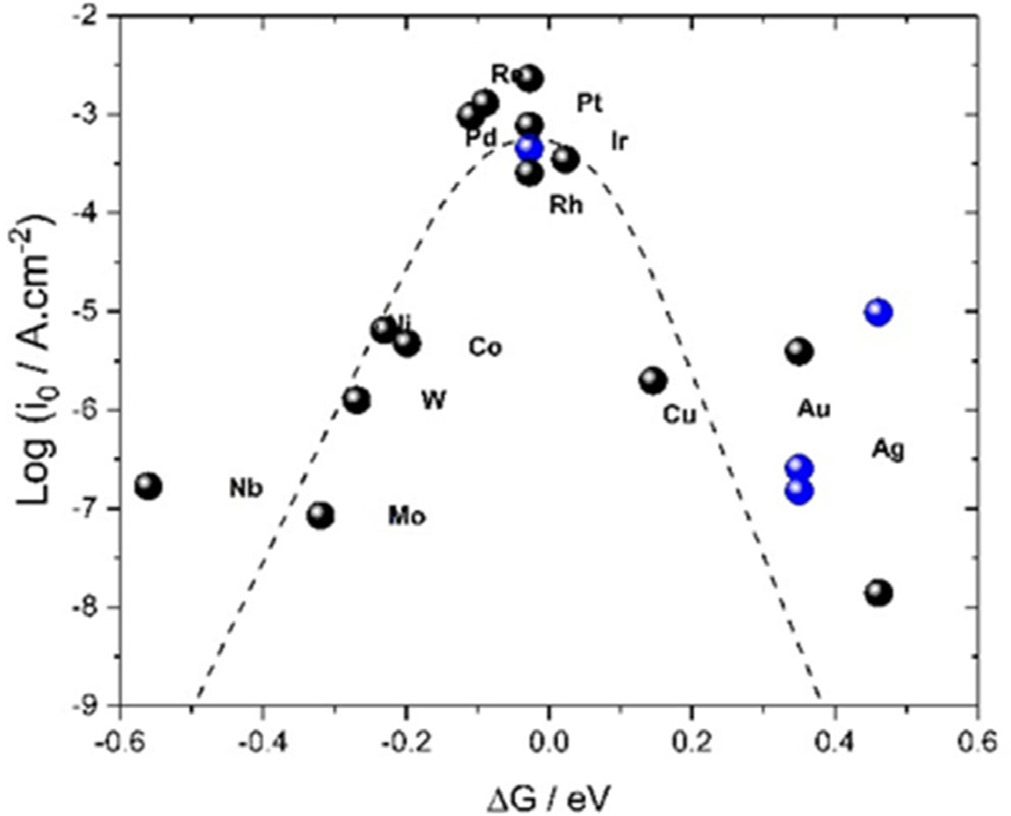
Volcano plot showing the logarithm of the exchange current density vs. the energy of hydrogen adsorption (M-H) (adapted from Skúlason et al.)20 The best catalysts bind hydrogen with energies close to 0 eV. All data were measured with polycrystalline electrodes, except for the blue symbols, which represent (111) single-crystal surfaces. Nb, Mo, and W were excluded in several publications due to partial surface oxidation22
If, on the other hand, a catalyst binds hydrogen more strongly than Pt (such as Pd, Ni, or Co; Figure 3), the situation is different. In this case, adsorption is downhill and not limiting. Instead, the difficulty arises in the desorption of H2: the system must climb the barrier from M-H to H2. Whether this step is strongly affected by the applied potential depends on the mechanism:
-
(i) In the Volmer-Tafel pathway, the second step (the Tafel recombination of two adsorbed H atoms) is purely chemical. In the simple model, it is unaffected by the applied potential. In reality, some potential dependence may appear due to charge redistribution in M-H, but this effect is often small.
-
(ii) In the Volmer-Heyrovsky pathway, the second step is electrochemical, involving the reaction of M-H with a proton-electron pair. In this case, applying a negative overpotential directly lowers the barrier by increasing the electron energy.
This interplay between hydrogen binding energy and the operating mechanism underlies the well-known volcano plots (Figure 3), which map catalytic activity as a function of hydrogen binding energy. These plots remain one of the most powerful conceptual tools for guiding catalyst discovery18,21 and can be rationalized within the framework of Brønsted-Evans-Polanyi (BEP) relations.7
While hydrogen binding energy provides a powerful and intuitive descriptor, its predictive value is not universal and is most reliable at low applied overpotentials, i.e., close to thermodynamic equilibrium (please, see that in Figure 3 and in many volcano Plots in the literature, the exchange current or the current density measured at relatively low overpotentials are plotted). In this regime, all elementary steps remain near reversibility, surface coverages change smoothly with potential, and the relative free energies of intermediates provide a meaningful description of the reaction bottleneck. Under these conditions, the step with the largest uphill free-energy change (the PDS) closely correlates with the observed activity, making binding-energy-based volcano plots particularly effective. As the overpotential increases, however, the reaction is progressively driven far from equilibrium: surface coverages change abruptly, new intermediates may become stabilized, and different elementary steps can take over as the dominant bottleneck. Consequently, a single binding energy can no longer capture the full complexity of the reaction.13,14
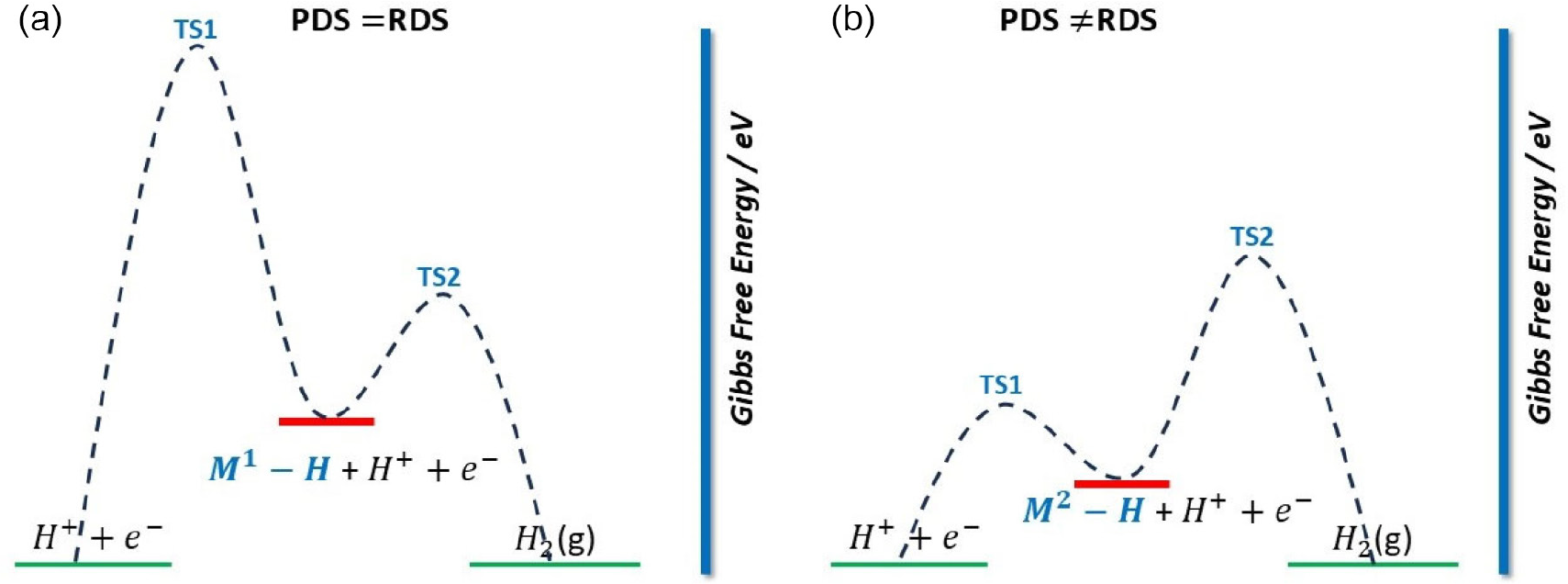
This behavior is closely connected to the experimentally observed changes in Tafel slopes with applied overpotential. Different Tafel slopes indicate that the RDS changes as the potential is varied, reflecting a shift in the dominant kinetic barrier. At low overpotentials, the RDS often coincides with the PDS, so thermodynamic descriptors such as adsorption energies provide useful predictive insight. At higher overpotentials, however, purely kinetic limitations dominate, and the RDS may correspond to a different elementary step than the PDS. In this regime, activity trends inferred from binding energies or volcano plots can break down, as kinetics rather than thermodynamics control the reaction rate. In the present work, the discussion is therefore intentionally restricted to the low-overpotential, thermodynamic regime, where the concept of the PDS is most meaningful and where graphical free-energy diagrams provide the clearest insight. The distinction between PDS and RDS is clarified explicitly in Figure 4 using the hydrogen redox reaction as a simple and well-established example.

Schematic Gibbs free-energy diagrams illustrating the relationship between the PDS and RDS for the hydrogen redox reaction (Volmer-Heyrovsky) on two hypothetical catalysts, M1 (a) and M2 (b). In both cases, reactants (H+ + e-) and products (H2) are aligned at the same reference energy, emphasizing that the overall thermodynamics of the reaction are identical. In both cases, the PDS is the Volmer step. Dashed curves represent the kinetic energy landscape, with TS1 and TS2 denoting the transition states associated with different elementary steps. (a) For catalyst M1, the step that is thermodynamically most demanding (PDS) also exhibits the highest activation barrier, so PDS = RDS. (b) For catalyst M2, stabilization of the intermediate (M2-H) alters the kinetic barriers not following the BPE relationship, such that the highest activation barrier (TS2) does not correspond to the PDS. This comparison illustrates that while the PDS captures thermodynamic requirements, the RDS depends on the energies of the transition-state, and the two do not need to coincide depending on the catalyst
The oxygen reduction and water oxidation reactions
After analyzing the hydrogen redox couple as the simplest case of a two-electron process with a single intermediate, the discussion turns to one of the most important and complex electrochemical transformations: the interconversion between O2 and H2O. The oxygen reduction reaction (ORR) and the oxygen evolution reaction (OER) define the efficiency limits of fuel cells and electrolyzers, respectively, and represent the prototypical four-electron process. From a thermodynamic standpoint, the global free energy of the reaction corresponds to 1.23 V vs. SHE under standard conditions. However, just as for hydrogen, what ultimately governs performance is not only the overall ∆G but the distribution of this energy among intermediates.
For simplicity, it is assumed that the forward (ORR) and backward (OER) mechanisms are the same, and that the transformation proceeds through the well-established associative pathway. The global reaction, O2 + 4H+ + 4e- ⇌ 2H2O, can be decomposed into four one-electron steps (Equations 6-9) involving the intermediates *OOH, *O, and *OH on the catalyst surface:
The thermodynamic “ideal catalyst” would distribute the total free energy change (∆G = 4.92 eV) equally among the four steps, i.e., 1.23 eV per electron transfer (see that 1.23 eV multiplied by 4 equals 4.92 eV). This scenario is shown in Figure 5a, which is analogous to Figures 1 and 2 for the hydrogen couple. When 1.23 V vs. RHE is applied, the positive charge of the electrode increases (or equivalently, the negative charge decreases), making the electrons more stable and decreasing the energy of each step in an amount equal to n × 1.23, being n the number of electrons transferred. Figure 5b schematically shows this situation: the energy of O2, H2O, and all intermediates aligned at equilibrium, and deviations should appear only when the adsorption energies of an intermediate differ from the ideal values, i.e., bind too strongly or weakly to the catalyst. For instance, if *OOH + H+ + e- lies at an energy value more negative than 0 eV (binds too strongly), an applied potential of 1.23 eV will not be enough to align the energy of this intermediate to that of the reactant and product.

Free energy diagrams for the O2/H2O redox couple at 0.00 V vs. RHE (a) and 1.23 V vs. RHE (b). At 0.00 V, all elementary steps are uphill for the H2O oxidation reaction, while the reverse pathway, the O2 reduction reaction, is downhill. When the electrochemical potential is increased to 1.23 V vs. RHE, the electrons are stabilized at 1.23 eV. As a result, reactants, products and intermediates align at the same energy, illustrating the equilibrium condition for the overall four-electron O2/H2O couple
Reality, however, departs significantly from this ideal picture. For most catalysts, at least one of the intermediates (*OOH, *O, or *OH) is stabilized or destabilized relative to the others, creating an uphill step that becomes the PDS. This mismatch is usually unavoidable because adsorption energies of O- and OH-containing species are correlated across transition metal surfaces (several times linearly correlated, which is known as scaling relations). As a result, improving the binding of one intermediate simultaneously shifts the energies of others, preventing all four steps from being at the same level. This is the fundamental thermodynamic reason why the ORR and OER always require an overpotential in practice.
The comparison with hydrogen is instructive. Whereas the H+/H2 couple involves only one intermediate (*H) and thus allows the existence of nearly ideal catalysts such as Pt or hydrogenases, the O2/H2O couple necessarily involves three intermediates, making the “perfect binding” condition unattainable. Consequently, even the best catalysts (e.g., Pt for ORR, IrO2/RuO2 for OER) operate with significant overpotentials.
This simple analysis carries an essential educational message: the large overpotentials observed experimentally for ORR and OER are not merely a kinetic problem but have an intrinsic thermodynamic origin. As with the hydrogen reaction, the central descriptor is the adsorption energy of intermediates, but now constrained by scaling relations that limit how close we can approach the theoretical reversible potential.
INTERCONVERSION BETWEEN ALCOHOLIC AND CARBONYL GROUPS
The analysis of reactions involving biomass-derived resources is more complex but conceptually similar to that of the hydrogen reaction. As a first step, a process involving two electrons and one intermediate is analyzed, as in the case of the interconversion between alcohols and ketones (or aldehydes).
To do this, the inverse mechanism proposed by Bondue et al.23,24 for the reduction of aliphatic ketones to alcohols on Pt electrodes is considered. This choice is made for educational purposes, and it is assumed that the inverse process, i.e., the oxidation of the alcohol, proceeds through the same mechanism. In the first step, the molecule dehydrogenates (by losing its alpha hydrogen), transferring one electron to the electrode and one proton to the solution (Equation 10 and Figure 6). Density functional theory (DFT) studies suggest that the carbinolic carbon loses the hydrogen atom (similar results were reported for glycerol25 and methanol).26,27 However, other studies,7 particularly with methanol, indicate that dehydrogenation of the OH group is the most favorable step in its oxidation.
Relative Gibbs free energy diagram of the reactants and products for the interconversion between an alcohol and a carbonyl group (top). The bottom panel shows the situation after applying a potential equal to the standard potential of the reaction (an arbitrary value of 0.1 V is chosen). Here, the intermediate was chosen to bind to the catalyst through the carbinolic (or carbonyl) carbon. The energy of the intermediate equals that of the reactants and products only when the reaction proceeds on an optimal catalyst. Note that if at least one of the R groups is H, the product is an aldehyde. The electron symbol on the catalyst indicates that, in the corresponding step, one electron is transferred to the electrode
In the second and last step (Equation 11 and Figure 6), the intermediate loses another electron and another proton, this time from the OH group. Thus, in the net reaction, the alcohol releases two protons to the solution and provides two electrons to the electrode to form a carbonyl bond. This situation is analogous to the Volmer-Heyrovsky mechanism: there are two electrochemical steps in a reaction involving the transfer of two electrons and one intermediate.
Figure 6 shows the structure of the molecules involved in the reaction and their arbitrary relative energies. The energy of the reactants and products depends on the nature of the “R” groups and, in the case of the intermediate, also on the catalyst nature and its structure.
The situation is first analyzed without considering the catalyst. In this case, the products are at a higher energy level than the reactants, making the conversion of the alcohol group into the carbonyl group uphill (the choice is arbitrary). Figure 6 (bottom) then shows what happens when a positive overpotential, equal to the standard potential of the reaction, is applied: the products, reactants, and intermediate all align at the same energy. Similar to the previous examples, the optimal energy of the intermediate must coincide with that of the reactants and products; otherwise, there will be one downhill and one uphill step, with the latter becoming the PDS.
Figure 7 illustrates the same reaction as Figure 5 but considers the first dehydrogenation step involving hydrogen withdrawal from the OH group. The analysis is essentially similar to the previous case, but now the optimal catalyst is one that binds to an O atom with the same energy as the O-H bond in the specific molecule undergoing reaction.

Energy of the reactants, intermediate, and products for the interconversion between an alcohol and a carbonyl group when the intermediate binds to the catalyst through the alcoholic oxygen. The electron symbol on the catalyst indicates that, in the corresponding step, one electron is transferred to the electrode. This catalyst must be different from the one in Figure 6, otherwise, it would not likely bind to the intermediate with the same (optimal) energy at the same electrochemical potential
This analysis carries an extremely important conclusion regarding the optimization of the energy adsorption and the intermediate structure. Two possibilities can be considered: binding through the carbinolic carbon (Figure 6) or through the oxygen atom of the OH group (Figure 7). In the first case, the optimal catalyst would bind to the carbinolic carbon with the same energy as the C-H bond in the molecule. In the second case, the optimal catalyst would bind to the oxygen atom with the same energy as the O-H bond in the molecule. A detailed discussion of these alternatives, based on both electrochemical and computational studies on Pt surfaces with different coordination numbers, can be found in other publication.23
An additional and final aspect of this analysis is worth emphasizing. If we imagine that the reaction proceeds exclusively through one of the two possible mechanisms, that is, adsorption via an oxygen atom or via a carbon atom, then the process would involve only a single intermediate. In this case, an optimal catalyst would simply be required to bind to this intermediate with the appropriate strength, so that its energy aligns with that of the reactants and products at the standard potential for the reaction. Under these conditions, the reaction could occur at, or very close to, the standard potential. In other words, this situation would be analogous to the case of the hydrogen redox couple, where the challenge reduces to finding a catalyst that stabilizes the intermediate at the correct energy. Here, unlike in ORR and OER, we do not face the intrinsic difficulty of distributing the free energy among multiple intermediates across several electron-proton transfer steps.
INTERCONVERSION BETWEEN ALDEHYDES AND ACID GROUPS
Finally, an arbitrary equilibrium is analyzed to show how things can get more complicated, even in a reaction that transfers only two electrons.
If the goal is to convert an aldehyde into a carboxyl group (for example, to transform glucose into gluconic acid), an oxygen atom must be added to the molecule, unlike in the previous analysis (Equations 12-15). Thus, the reaction necessarily requires the presence of an oxygenated intermediate coming from another molecule. The most common source of oxygen is water, which also acts as the solvent in most electrochemical reactions involving alcohols and polyols.
Equations 12-14 and Figure 8 show one of the many mechanisms that can be written for this reaction under equilibrium conditions. As stated before, the best catalyst should be one that is able to bind both an -OH (coming from water dissociation as shown in Equation 13) and an acyl group (R1CO) with the same energy as the reactants and products.

Energy of the reactants, intermediates and products for the equilibrium between a carbonyl and a carboxyl group when the intermediate coming from the organic molecule binds to the catalyst through the carbonyl (or carboxyl) C atom. The scheme considers a hypothetical catalyst with two different active sites represented by different colors. Both sites bind to the intermediates with the optimal energy, thus, they have the same energy than the reactants and the product at the equilibrium standard potential. The electron in the catalyst indicate that, in the corresponding step, one electron was transferred to the electrode
Unfortunately, as discussed throughout this article, the condition shown in Figure 8 is almost impossible to attain. The acyl and hydroxyl groups have quite different structures (even if the residue R1 is H). Therefore, the binding energy must be different, even if both sites are equivalent or rather similar. By equivalent sites, this refers, for example, to both intermediates adsorbed in the “on-top” configuration on a Pt atom of a Pt(111) surface. Thus, if one of the intermediates has the same energy as the reactants and products, the other will have lower or higher energy, making one step of the mechanism uphill and requiring an overpotential input.
A similar analysis to that performed for the previous examples shows that the best catalyst must have one very unlikely site, or at least two different adsorption sites with the following characteristics:
-
(i) One site must bind to the acyl group with the same energy as the C of the carbonyl group bound to the H.
-
(ii) The other site must bind to the OH with the same energy as the O bound to the H in the water molecule.
To analyze the interconversion between an alcohol and an acid, the reaction mechanisms of the last two sections must be combined. Thus, for instance, if the mechanism shown in Figures 7 and 8 is considered, the catalyst would need to simultaneously optimize the binding energies of R1HCHO*, R1C*=O, and HO*. However, these adsorption energies cannot, in general, be tuned independently on real catalyst surfaces. Calle-Vallejo et al.28 showed that the adsorption energies of several adsorbates bound through their oxygen atoms, including CH3O* and HO*, scale linearly for different types of transition metal surfaces. As a result, strengthening or weakening the binding of one intermediate inevitably affects the stability of the others. This intrinsic correlation imposes a severe thermodynamic restriction on the oxidation of any aldehyde to the corresponding acid, as it prevents the independent stabilization of chemically distinct intermediates required for near-equilibrium operation.
To test this understanding, a thought experiment can be considered. Imagine that the adsorbates shown in Figure 8 (when the system is at the equilibrium potential) switch their positions: the OH binds on the left site (blue) and the organic residue, the carbonyl intermediate, binds on the right site (yellow) (Figure 9a). To simplify the discussion, it is assumed that OH still adsorbs with the same energy, although this is known to be not realistic based on the arguments previously discussed. However, the organic residue now binds to the catalyst much more strongly, for instance, decreasing its energy by 1 eV.

Energy of the reactants, intermediates and products for the equilibrium between a carbonyl and a carboxyl group. The scheme considers a hypothetical catalyst with two different active sites represented by different colors. In this case, HO* adsorbs at the same energy as the reactants and products but the acyl intermediate is highly stabilized in the yellow site, making its combination with HO* to generate the acid the reaction PDS (a). Thought experiment illustrating a more realistic situation in which both intermediates can adsorb at either site. When the positions are exchanged, the OH* binds more weakly at the blue site (+0.3 eV), while the organic intermediate adsorbs at the right potential at the blue site but becomes strongly stabilized at the yellow site (-1.0 eV). As a result, the organic residue dominates the surface, preferentially occupying both sites and blocking OH* adsorption. This leads to catalyst poisoning and inhibits the water dissociation step, showing why the aldehyde-to-acid conversion cannot occur close to equilibrium on simple catalyst surfaces (b)
If this were the case, the situation for OH would remain as explained before: its adsorption would still be optimal. In contrast, the dehydrogenation of the organic residue at the equilibrium potential would become extremely favorable, and the subsequent combination of this strongly bound adsorbate with OH to form the final product would require a large overpotential (PDS), at least equal to this extra electron-volt of stabilization.
In order to bring this overly stabilized intermediate back to the same energy level as reactants and products, a negative potential would need to be applied to increase the energy of this too stable intermediate by 1 eV. However, this increase in potential would also raise the energy of the OH adsorbate (by the same amount), which was initially at its optimal binding energy! As a consequence, OH adsorption would then become unstable and turn into the new PDS of the reaction.
To further extend this reasoning, a slightly more realistic situation can be considered in which the adsorbates are free to occupy either site. In this case, the OH group is assumed to bind more weakly at the blue site, raising its energy by approximately 0.3 eV, while the organic residue continues strongly stabilized at the yellow site (Figure 9, right).
In this case, the two intermediates that originally had the same energy as the reactants and products at equilibrium can now redistribute: OH can occupy the less favorable site, and the organic residue the more favorable one. The result, however, is detrimental. The strongly stabilized organic intermediate becomes the most stable species on the surface, preferentially occupying both sites whenever possible. This effectively blocks the adsorption of OH and prevents water dissociation from taking place. In other words, the catalyst surface becomes poisoned by the excessively stable organic adsorbate, which hinders the reaction pathway entirely.
This thought experiment highlights, in didactic terms, the fundamental challenge of this transformation. Even if one site provides approximately optimal conditions for OH, the strong stabilization of the organic intermediate dominates surface occupancy. Rather than balancing the energy levels of both intermediates, the catalyst becomes trapped in a state where one adsorbate monopolizes the available sites, making the reaction kinetically and thermodynamically unfeasible.
CONCLUSIONS
This article has used a step-by-step, graphical, and qualitative approach to revisit well-established thermodynamic concepts in electrochemistry and apply them to reactions of increasing complexity relevant to biomass conversion. Rather than introducing new theory, the objective has been to make explicit how the distribution of free energy among intermediates constrains what can (and cannot) be achieved electrochemically, using simple energy diagrams that can be readily interpreted by students and newcomers to the field.
Beginning with the hydrogen redox couple, the analysis shows how a reaction involving a single intermediate provides a clear and intuitive example of how adsorption energies, electrochemical potentials, and the notion of an optimal catalyst are connected. Extending this reasoning to the oxygen reduction and evolution reactions illustrates how the presence of multiple intermediates, together with scaling relations, leads to unavoidable thermodynamic overpotentials even for reactions that are often introduced as benchmarks in electrochemistry courses. These examples establish a conceptual foundation that can be transferred to more complex systems.
Applying the same framework to organic functional groups central to biomass electrochemistry highlights an important pedagogical contrast. The interconversion between alcohols and carbonyls demonstrates that, when only one adsorption mode and one intermediate dominate, operation close to the standard potential is in principle possible. In contrast, the aldehyde-to-acid transformation shows how the need to stabilize chemically distinct intermediates simultaneously imposes severe thermodynamic restrictions. The thought experiments presented here are intended to help readers visualize why surface poisoning and loss of selectivity naturally emerge in such cases.
The overarching lesson for students and practitioners is that large overpotentials in multielectron biomass oxidation reactions are not merely a consequence of slow kinetics, but often reflect fundamental thermodynamic constraints. At the same time, the analysis clarifies why partial oxidations involving one or two electron-proton transfers can operate closer to equilibrium and are therefore more realistic targets for selective catalysis and energy-conversion applications. By emphasizing these concepts graphically and qualitatively, this article aims to provide readers with a conceptual toolkit that facilitates deeper engagement with the more detailed kinetic, computational, and experimental literature.
ACKNOWLEDGMENTS
Financial support from FAPESP (2024/21343-8, 2023/02929-9, 2017/11986-5), Shell and ANP (R&D levy regulation), CNPq (408018/2022 4, 304772/2021-6), CAPES (Finance Code 001). The author acknowledges ANEEL R&D&I project (Low-Cost Green Hydrogen Production Project No. PD-15423-0124/2024), supported by CEE-G and 1s1 Energy.
DATA AVAILABILITY STATEMENT
All data is available in the text.
REFERENCES
-
1 Zhou, H.; Ren, Y.; Yao, B.; Li, Z.; Xu, M.; Ma, L.; Kong, X.; Zheng, L.; Shao, M.; Duan, H.; Nat. Commun. 2023, 14, 1. [Crossref]
» Crossref -
2 Holade, Y.; Tuleushova, N.; Tingry, S.; Servat, K.; Napporn, T. W.; Guesmi, H.; Cornu, D.; Kokoh, K. B.; Catal. Sci. Technol. 2020, 10, 3071. [Crossref]
» Crossref -
3 Braun, M.; Santana, C. S.; Garcia, A. C.; Andronescu, C.; Curr. Opin. Green Sustainable Chem. 2023, 41, 100829. [Crossref]
» Crossref -
4 Marcus, R. A.; J. Chem. Phys. 1956, 24, 966. [Crossref]
» Crossref -
5 Koper, M. T. M.; J. Electroanal. Chem. 2011, 660, 254. [Crossref]
» Crossref -
6 Koper, M. T. M.; Chem. Sci. 2013, 4, 2710. [Crossref]
» Crossref -
7 Fajín, J. L. C.; Cordeiro, M. N. D. S.; Illas, F.; Gomes, J. R. B.; J. Catal. 2014, 313, 24. [Crossref]
» Crossref -
8 Bligaard, T.; Nørskov, J. K.; Dahl, S.; Matthiesen, J.; Christensen, C. H.; Sehested, J.; J. Catal. 2004, 224, 206. [Crossref]
» Crossref -
9 Liu, B.; Greeley, J.; Phys. Chem. Chem. Phys. 2013, 15, 6475. [Crossref]
» Crossref -
10 García-Muelas, R.; López, N.; J. Phys. Chem. C 2014, 118, 17531. [Crossref]
» Crossref -
11 Mehmood, F.; Rankin, R. B.; Greeley, J.; Curtiss, L. A.; Phys. Chem. Chem. Phys. 2012, 14, 8644. [Crossref]
» Crossref -
12 Schmickler, W.; Santos, E.; Interfacial Electrochemistry, 2nd ed.; Springer: Heidelberg, 2010. [Crossref]
» Crossref -
13 Exner, K. S.; ACS Catal. 2019, 9, 5320. [Crossref]
» Crossref -
14 Koper, M. T. M.; J. Solid State Electrochem. 2013, 17, 339. [Crossref]
» Crossref - 15 Sato, N.; Electrochemistry at Metal and Semiconductor Electrodes; Elsevier: Amsterdam, 1998.
-
16 Parsons, R.; Trans. Faraday Soc. 1958, 54, 1053. [Crossref]
» Crossref -
17 Pohl, M. D.; Watzele, S.; Calle-Vallejo, F.; Bandarenka, A. S.; ACS Omega 2017, 2, 27. [Crossref]
» Crossref -
18 Nørskov, J. K.; Bligaard, T.; Logadottir, A.; Kitchin, J. R.; Chen, J. G.; Pandelov, S.; Stimming, U.; J. Electrochem. Soc. 2005, 152, J23. [Crossref]
» Crossref - 19 Koper, M. T. M.; Heering, H. A. In Fuel Cell Science; Kordesh, K.; Simader, G., eds.; John Wiley & Sons, Inc.: Hoboken, 2010
-
20 Skúlason, E.; Tripkovic, V.; Björketun, M. E.; Gudmundsdóttir, S.; Karlberg, G.; Rossmeisl, J.; Bligaard, T.; Jónsson, H.; Nørskov, J. K.; J. Phys. Chem. C 2010, 114, 18182. [Crossref]
» Crossref -
21 Nørskov, J. K.; Abild-Pedersen, F.; Studt, F.; Bligaard, T.; Proc. Natl. Acad. Sci. U. S. A. 2011, 108, 937. [Crossref]
» Crossref -
22 Quaino, P.; Juarez, F.; Santos, E.; Schmickler, W.; Beilstein J. Nanotechnol. 2014, 5, 846. [Crossref]
» Crossref -
23 Bondue, C. J.; Calle-Vallejo, F.; Figueiredo, M. C.; Koper, M. T. M.; Nat. Catal. 2019, 2, 243. [Crossref]
» Crossref -
24 Bondue, C. J.; Koper, M. T. M.; J. Catal. 2019, 369, 302. [Crossref]
» Crossref -
25 Liu, B.; Greeley, J.; J. Phys. Chem. C 2011, 115, 19702. [Crossref]
» Crossref -
26 Gokhale, A. A.; Kandoi, S.; Greeley, J. P.; Mavrikakis, M.; Dumesic, J. A.; Chem. Eng. Sci. 2004, 59, 4679. [Crossref]
» Crossref -
27 García-Muelas, R.; Li, Q.; López, N.; ACS Catal. 2015, 5, 1027. [Crossref]
» Crossref -
28 Calle-Vallejo, F.; Loffreda, D.; Koper, M. T. M.; Sautet, P.; Nat. Chem. 2015, 7, 403. [Crossref]
» Crossref