
 Atypical clinical scrapie in a Dorper ram mimicking spinal cord injury: measuring vacuolar changes in the central nervous system
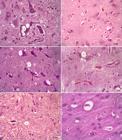
Scrapie is a disease in sheep that manifests with neurological signs and involves prion deposition in the central nervous system. This study aimed to describe an atypical case of scrapie in a sheep and to measure vacuolar changes in the central nervous system. A 3-year-old Dorper ram presented with kyphosis, difficulty standing still, fasciculations, proprioceptive deficits in the pelvic limbs, and a positive scratch test. The lymphoid tissue biopsy from the third eyelid and rectal mucosa, and the enzyme-linked immunosorbent assay (ELISA) were positive for the scrapie isoform of the prion protein (PrPsc). Immunohistochemical and western immunoblot analyses were positive, and the ram genotype was naturally susceptible (ARQ/ARQ). A necropsy revealed no macroscopic changes. After fixation of the brain in 10% buffered formalin, eight serial transverse sections of the brain and one longitudinal section of the cerebellum were obtained. Histological measurement of the number of vacuoles was performed for each region. The vacuoles were counted with a 40x objective, counting three to four randomly selected regions and obtaining the average. The degree of vacuolization was evaluated descriptively on a scale of 0 to 3. The second classification was performed based on the number of affected regions. Histopathological examination revealed multiple well-delimited, round vacuoles of varying sizes in the perikarya of neurons and neuroparenchyma. The areas with the highest average of vacuoles in neuroparenchyma were in the thalamus (average 8), medulla oblongata at the level of the obex (average 6.25) and colliculi (5.5). In neurons, the highest average was observed in the thalamus (average 1), the rostral colliculi (average 0.5), and the medulla oblongata at the level of the obex (average 0.25). This study describes a case of scrapie in a sheep with atypical clinical signs, highlighting the need to consider scrapie when any neurological signs appear. Vacuolizations were most pronounced in the thalamus, rostral colliculi and medulla oblongata at the level of the obex, with degrees of severity ranging from moderate to severe. The distribution of vacuolization, predominantly in the neuropil, reinforces the neuropathological characteristics associated with scrapie. The ARQ/ARQ genotype, linked to susceptibility, was identified, and diagnostic analyses confirmed PrPsc deposition in the brain. These findings highlight the importance of genetic screening and early diagnosis to help control scrapie in sheep populations.
INDEX TERMS:
Nervous system; transmissible spongiform encephalopathy; prion diseases; small ruminants; sheep
 Thumbnail
 Thumbnail
 Thumbnail
 Thumbnail


