 Validity evidence of Thinking About Live Experience Questionnaire for the Brazilian context
Abstract
The present study aimed to test the psychometric parameters of the Thinking About Live Experience Questionnaire (TALE) in a sample of the Brazilian population. For this purpose, a convenience sample of 315 participants (female: 69.52%) aged between 18 and 71 from the five Brazilian regions was selected. The instruments used were the sociodemographic data questionnaire and the TALE. Confirmatory Factor Analysis was used to verify the structure of the TALE, which indicated a good fit for the tested models. The scale also presented good reliability in all its factors: Self Function (α=0.79; ω=0.80), Social Function (α=0.82; ω=0.82), and Directive Function (α=0.76; ω=0.76). The results demonstrated good psychometric adequacy of the TALE for the Brazilian context to assess the functions of autobiographical memory.
Keywords:
Autobiographical memory; Function; Validation
Resumo
O presente estudo teve como objetivo testar os parâmetros psicométricos do questionário Thinking About Live Experience Questionnaire (TALE) em uma amostra da população brasileira. Para isso, contou-se com uma amostra selecionada por conveniência de 315 participantes (sexo feminino: 69,52%) com idades entre 18 e 71 anos das cinco regiões brasileiras. Os instrumentos utilizados foram o questionário de dados sociodemográfico e o TALE. Para verificar a estrutura do TALE foram utilizadas Análises Fatoriais Confirmatórias, que apontaram um bom ajuste dos modelos testados. A escala também apresentou uma boa confiabilidade em todos os seus fatores: Função Self (α=0,79; ω=0,80), Função Social (α=0,82; ω=0,82) e Função Diretiva (α=0,76; ω=0,76). Os resultados demonstraram boa adequação psicométrica do TALE para o contexto brasileiro para avaliar as funções da memória autobiográfica.
Palavras-chave:
Memória autobiográfica; função; validação
Resumen
El presente estudio tuvo como objetivo probar los parámetros psicométricos del Cuestionario Thinking About Live Experience (TALE) en una muestra de la población brasileña. Para ello, se utilizó una muestra por conveniencia de 315 participantes (mujeres: 69,52%) con edades entre 18 y 71 años de las cinco regiones brasileñas. Los instrumentos utilizados fueron el cuestionario de datos sociodemográficos y el TALE. Para verificar la estructura de TALE se utilizó el Análisis Factorial Confirmatorio, que mostró un buen ajuste de los modelos probados. La escala también mostró buena confiabilidad en todos sus factores: Función Automática (α=0,79; ω=0,80), Función Social (α=0,82; ω=0,82) y Función Directiva (α=0,76; ω=0,76). Los resultados demostraron buena idoneidad psicométrica del TALE para el contexto brasileño para evaluar las funciones de la memoria autobiográfica.
Palabras clave:
Memoria autobiográfica; función; validación
Introduction
Autobiographical memories are information about the person who remembers, with records of personal experiences and past events circumscribed in chronological space and time (Bluck et al., 2019; Hallford et al., 2021). This set of information generates memories that are essential for human functioning, being useful for everyday life, for achieving goals and for integrating, as an individual, into a culture and society over time (Burnell et al., 2023; Fivush & Grysman, 2023; Wolf & Demiray, 2019), in addition to playing an important role in the characterization and identity of the individual (Naves et al., 2021; Hallford et al., 2021; Wasti et al., 2021).
Because they are memories of personal experiences, autobiographical memories can be reconstructed and distorted throughout life adaptively in order to make them meaningful to respond to changes that occur in the context (Aydin & Buyukcan-Tetik, 2021; Bluck et al., 2019; Fivush & Grysman, 2023). However, the autobiographical memory must show not only correspondence with reality but also coherence in giving meaning to a person’s life story (Bluck et al., 2019; Fivush & Grysman, 2023; Lind et al., 2019; Vanderveren et al., 2020). Some researchers have detailed how particular stages of life create contexts with goals and concerns that can result in retrieving memories that could serve a purpose (Alea & Ali, 2018; Vranić et al., 2018; Wolf & Demiray, 2019).
From a theoretical point of view, some studies emphasize the usefulness of memory by exploring its functionality (Alea & Ali, 2018; Bluck et al., 2019), and thus, focus efforts on understanding the motivations for thinking and talking about the past (Caci et al., 2020; Sow et al., 2023). It has been hypothesized that memories of life experiences may serve more than one function (Aydin & Buyukcan-Tetik, 2021; Burnell et al., 2020; Sow et al., 2023). In this sense, the theory suggests three main categories, namely, for own reasons (Self Function), social (Social Function), and directive (Directive Function) of autobiographical memory, in which people use the recollection of experienced facts to fulfill a purpose (Bluck, 2003; Bluck & Alea, 2011; Burnell et al., 2023).
The self-function portrays the ability to retrieve autobiographical memories to promote the representation of a self-concept (Jiang et al., 2019; Vanderveren et al., 2020; Wast et al., 2021). Past experiences and events are evaluated and undergo a process of constructing an identity congruent with the subject’s schemes and provide the notion of who they are, maintaining the idea of self-continuity of the self (Bluck et al., 2019; Hallford et al., 2021; Lind et al., 2019). According to the findings of Jiang et al. (2019), individuals with low self-concept clarity are more likely to resort to autobiographical memory, thus achieving greater self-concept clarity and maintaining the structural integrity of the self.
The social function is sharing an individual’s autobiographical memories with others for interpersonal communication and creating social bonds (Burnell et al., 2020; Wasti et al., 2021). It functions as a facilitator, as sharing personal experiences generates intimacy and empathy among peers (Burnell et al., 2023; Lind et al., 2020). Research on the influence of the valence of autobiographical memories has shown that when positive memories are shared, listeners report greater affection for the person sharing the memory. When the valence of the memory is negative, listeners feel greater empathy for it (Wolf et al., 2021).
Finally, the directive function involves retrieving autobiographical memories of past experiences and their consequences as a reference guide for problemsolving and even as a model for the individual’s present and future behaviors (Wast et al., 2021; Vranić et al., 2018). More recent memories may be more likely to serve as behavior-directing functions because they contain lessons (i.e., directives) that are more applicable to the current context and can provide guidance (Lind et al., 2019). Furthermore, when particularly negative, recent memories appear to be used more frequently to avoid past mistakes (Wolf & Demiray, 2019).
The most widely used instrument, although not the only one (Alea & Ali, 2018), that aims to measure the three categories of autobiographical memory functions empirically is the Thinking About Live Experience Questionnaire (TALE; Bluck et al., 2005). Developed to assess the frequency with which people use their personal past in daily life to serve a purpose, the initial version of the TALE, called TALE-30, consisted of 30 items divided into three subscales: self function (10 items), social function (8 items) and directive function (10 items) of autobiographical memory (Bluck et al., 2005). This version has been adapted to a smaller version, known as TALE, consisting of 15 items. This new version maintained the three subscales of the initial version so that each now contains only five items (Bluck & Alea, 2011).
Each subscale corresponds to one of the three functions of autobiographical memory in the initial model proposed by Bluck et al. (2005). The items representing the self-continuity function (self function) ask whether autobiographical memories are used to assess who the individual is today and how they may have changed or remained the same person over time. The items mentioning the social function focus on autobiographical memories used to initiate, maintain, and improve relationships. The items assessing the behavior direction function (directive function) involve asking how often people think or talk about the past to learn lessons, make decisions in the present, and guide future behaviors (Lind et al., 2019).
According to the review carried out by Sow et al. (2023), the model of the three functions of autobiographical memory is corroborated above all by correlational studies that used the TALE to assess the frequency of use of autobiographical memory functions associated with some pathological conditions, such as Alzheimer’s disease (AD) (El Haj et al., 2019) and Huntington’s disease (Carmichael et al., 2019). For example, in the study by El Haj et al. (2019), the authors investigated how people with mild AD reflect on the self-continuity of their self. The results showed that in the first item (“when they want to feel that they are the same person they were before”) (Bluck & Alea, 2011), people with mild AD obtained higher scores than control participants. These findings suggest that people with mild AD retrieve autobiographical memories to reflect on situations in which they want to feel that they are the same person they were before to maintain a sense of self-continuity.
To date, the reduced version of the TALE, consisting of 15 items, has been used in research in several countries (Alea et al., 2015; Alea & Ali, 2018; Caci et al., 2020; Harris et al., 2014; Liao et al., 2015; Maki et al., 2015; Rasmussen & Habermas, 2011; Vranić & Tonković, 2018). In Brazil, according to the searches carried out in this research, no valid scales were found that assess the three functions of autobiographical memory. The only advance in this direction does not present evidence of psychometric adequacy. A study by Naves et al. (2021) aimed to translate and semantically adapt the TALE, which, although presented as an important initiative, does not allow the use of the measure adequately.
For this reason, and also because of everything that has been presented about the importance of evaluating the functions of autobiographical memory, the objective of this research was to verify the evidence of the validity of the version translated and semantically adapted by Naves et al. (2021) of the Thinking About Live Experience Questionnaire (TALE), thus seeking to enable its use in the Brazilian context. This procedure is important as it ensures that the instruments allow the exploration of aspects related to the research objective.
Method
Participants
The convenience sample consisted of 318 participants from the five Brazilian regions, recruited via the Internet through social networks. The participants were aged between 18 and 71 years (M=30.52, SD=11.03), and the majority were female (69.5%) (n=222). At the time of the survey, 50.15% (n=154) of the participants declared their marital status as single, 23.9% (n=76) responded that they were in a relationship, 26.1% (n=81) claimed to be married, only 0.3% (n=1) were widowed, and 1.6% (n=5) were divorced.
Regarding the level of education, 0.3% declared having completed elementary education (n=3), 1.9% responded that they had incomplete secondary education (n=6), 15.7% claimed to have completed secondary education (n=50), 37.4% said they had incomplete higher education (n=119), 23.6% had completed higher education (n=75), and 20.1% had postgraduate degrees (n=64).
Instruments
Sociodemographic questionnaire. Participants were asked to answer a form containing specific questions such as gender, age, marital status, and education level to characterize the sample.
Thinking About Live Experience Questionnaire (TALE). It is a self-report instrument that contains 15 items, organized into three factors (self, social, and directive function), in which each participant must indicate how often they think or talk about life events in various everyday contexts. The items are answered using a five-point Likert scale (1=almost never and 5=very often). In its development study, this TALE structure presented good adjustment indicators, χ²=177.99 (p<0.01); χ²/gl=2.05; GFI=0.92; RMSEA (90% CI)=0.06; IFI=0.94. Regarding reliability, all factors presented values above 0.70: Self Function (α=0.83), Social Function (α=0.74), and Directive Function (α=0.78). This research considered the translation and semantic adaptation of TALE into Brazilian Portuguese carried out by Naves et al. (2021).
Procedures
Participants were recruited via the internet and through social networks. After the first contact, an access link was made available with a brief explanation of the study. The Informed Consent Form (ICF) was presented on the link, which contained information about the guarantee of anonymity and confidentiality of the information provided, the risks and benefits of the research, its objectives, as well as the possibility of the participant withdrawing from the study at any time. In addition, participants completed a sociodemographic questionnaire and the Thinking About Live Experience (TALE) questionnaire. Initial instructions (written) were given to participants to answer the questionnaire to instruct them to answer the items correctly. It took participants an average of 15 minutes to complete the survey. It is worth mentioning that no monetary compensation or other type of reward for participation in the study was granted.
This research follows the line of studies related to the work entitled: “Investigations on the Evocation of Autobiographical Memories and Emotional Regulation Strategies in clinical and non-clinical samples” with approval from the Ethics Committee (information suppressed), following the regulatory standards for research involving human beings, of Resolution No. 466/2012 of the National Health Council (CNS) ensuring anonymity and confidentiality of the data.
Data analysis
Jeffreys’s Amazing Statistics Program (JASP) version 0.16.3 and RStudio (version 2022.07.2) software were used to perform the analyses. In the first, descriptive statistics were conducted to characterize the sample and the reliability coefficients Cronbach’s alpha (α) and McDonald’s omega (ω) to verify the psychometric parameters of the measure.
RStudio, with the lavaan package, was used to perform Confirmatory Factor Analyses (CFAs). In these analyses, the following adjustment indicators were considered: Chi-square test, Chi-square/degrees of freedom ratio (χ²/df); Comparative Fit Index (CFI); Tucker-Lewis Index (TLI); and Root-Mean-Square Error of Approximation (RMSEA), considering its confidence interval (90% CI). Regarding the interpretation of the indicators, χ²/df must be less than 3; RMSEA values (90% CI) must be less than 0.08, with an upper limit of the confidence interval less than 0.10; and CFI and TLI values must be greater than 0.90, preferably above 0.95 (Brown, 2014). The estimation method used for the AFCs was the Weighted Least Squares Mean and Variance Adjusted (WLSMV).
Results
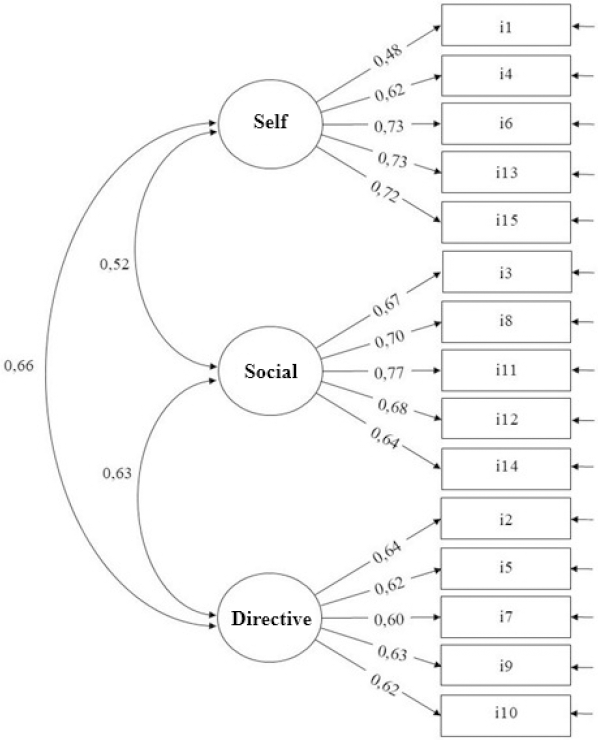
In the first analysis, the theoretical model composed of three factors (Self Function, Social Function, and Directive Function) proposed by the authors in the original version of the TALE (Bluck et al., 2005) was tested. The results showed that all the goodness-of-fit indicators were good, within the limits required by the literature considered (Brown, 2014), namely: χ²=121.93 (p=0.008); gl=87; χ²/gl=1.40; CFI=0.98; TLI=0.98; RMSEA (90% CI)=0.03 (0.01-0.05). The present model can be seen in Figure 1.
As shown in Figure 1, all items presented factor loadings above 0.40, with values ranging from 0.48 (item 1) to 0.77 (item 11). All factor loadings were statistically significant and different from zero (z>1.96, p<0.05). Regarding reliability, the three factors obtained good reliability indices in the two indicators used, and all presented values above 0.70: Self Function (α=0.79; ω=0.80), Social Function (α=0.82; ω=0.82) and Directive Function (α=0.76; ω=0.76).
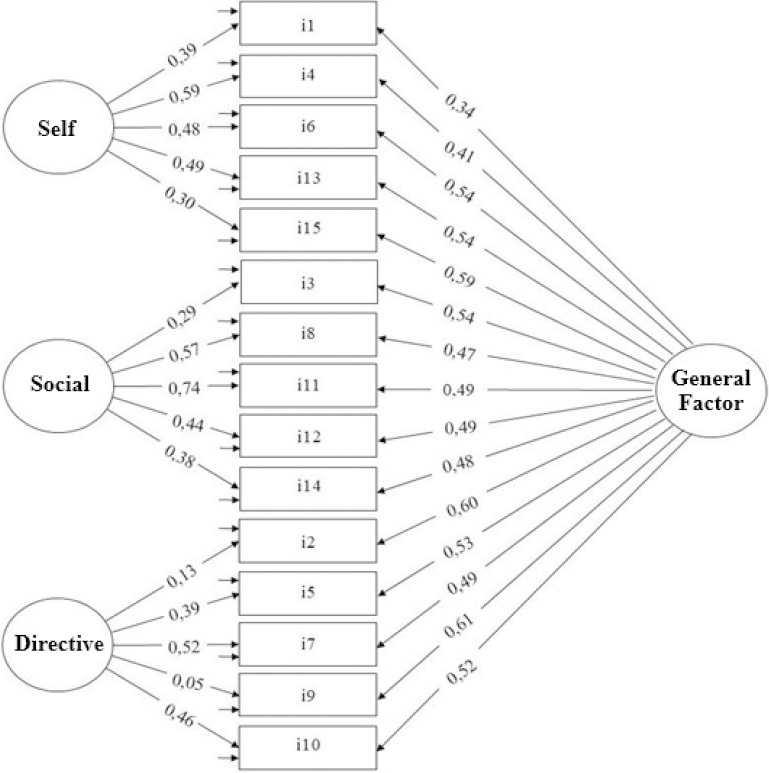
After gathering evidence that favors the use of the proposed theoretical model (Bluck & Alea, 2011), we sought to verify whether the TALE structure could be better explained by a general factor. To this end, the viability of a Bi-factor model was tested. The CFA results showed a slightly better fit than those found in the theoretical model, χ²=84.1 (p=0.221); df=75; χ²/df=1.13; CFI=0.99; TLI=0.99; RMSEA (90% CI)=0.02 (0.0-0.03).
As can be seen in Figure 2, the Bi-factor model presented a general factor that explains all TALE items with high factor loadings, all above 0.30, and values ranging from 0.34 (item 1) to 0.61 (item 9). All factor loadings were statistically significant and different from zero (z>1.96, p<0.05). Compared to the specific factors, the general factor presented slightly higher loadings in 10 of the 15 items of the instrument. Regarding reliability, as with the three-factor model, the model with the general factor also presented good reliability with a value above 0.70, both for Cronbach’s Alpha (α=0.87) and for McDonald’s Omega (ω=0.87).
Finally, according to the evidence presented, the average total score of the participants in the TALE was calculated, considering the average scores for each of the separate specific factors and the general factor. The results are summarized in Table 1.
As Table 1 shows, the sample’s overall mean in relation to the general factor of the TALE was 3.19 (SD=0.76), while in relation to the overall mean of the specific factors, the Directive Function presented the highest score compared to the other two functions.
Discussion
Adapting psychological measures to the national context has been essential for developing research on topics that have not yet been fully explored. This research aimed to carry out the psychometric adaptation of the TALE, a relevant measure for investigating the functions of autobiographical memory that assesses, more specifically, the frequency with which individuals use autobiographical memory to serve the self, social, and directive functions (Bluck et al., 2005). Although this measure has already been adapted in its crosscultural nature to the national context by Naves et al. (2021), it has not yet presented data on its psychometric parameters. The psychometric analysis of the TALE involved investigating the two parameters used in the literature for constructing and adapting measures: validity and accuracy.
To gather evidence of the TALE’s validity, we investigated the coherence of the empirical data collected in this research with the three-factor structure of the autobiographical memory functions proposed by Bluck et al. (2005) and empirically observed, through factor analysis techniques, in the research on the construction and adaptation of the TALE (Bluck et al., 2005; Bluck & Alea, 2011; Vranić & Tonković, 2018).
The investigation was carried out using a CFA, which showed, based on the adjustment indicators considered, an excellent adjustment to the model, even superior to that found in previous studies (Caci et al., 2020; Bluck & Alea, 2011). These CFA findings suggest that the TALE presents evidence of construct validity, considered the most fundamental form of validity (Anastasi & Urbina, 2000; Pasquali, 2003).
The results regarding the accuracy of the TALE were also satisfactory, with Cronbach’s Alpha and McDonald’s Omega values higher than those found in the idealization study of the 15-item version of the TALE. These data suggest that the measure is reliable for research and diagnostic purposes (Nunnally, 1991; Pasquali, 2003). Furthermore, it should be noted that the high values of these indexes also serve as evidence to confer construct validity to the TALE.
In addition to this investigation, considering the high correlation between the factors, we also sought, through a CFA, to verify a Bi-factor model, a structural model in which a general factor, uncorrelated with the other specific factors, should explain all the items on the scale. This model also proved adequate, presenting a slightly better fit than the theoretical model tested. These data suggest that the TALE could, alternatively, provide a general score for the measurement of skills related to the use of autobiographical memory.
Evidence of alternative models for the TALE had already been verified in previous research. In a study by Caci et al. (2020), these researchers used Confirmatory Factor Analysis techniques to compare the theorized three-factor model with two other models, a single-factor model and a three-factor model with a second-order general factor. Unlike the findings of this research, the results found by Caci et al. (2020) indicated an unsatisfactory fit for the three-factor model, which was also evident in the single-factor model. Only the three-factor model with a second-order general factor showed a satisfactory fit.
Given what was presented in this research, it can be suggested that the data generally point to good psychometric adequacy of the measure, considering an alternative model in addition to the theorized model. This characteristic may be evidence of the flexibility of the TALE in assessing autobiographical memory, both considering the specialty of each function and the capacity to use autobiographical memory in general.
Furthermore, it should be noted that, like any study, this research is also subject to some limitations. One of them concerns the conditions for generalizing the sample since the participants were selected for convenience (non-probabilistic), which limits its representativeness and generalizability about the general population. In a way, the intention was not to generalize results but to investigate the evidence of construct validity and accuracy of the TALE in the Brazilian context.
Given this limitation, one future direction is to collect new TALE data from older and younger adults, for example. This will allow us to examine the invariance of the TALE’s factor structure about the age variable, thus improving a reliable tool for measuring self-reported autobiographical memory functions throughout adulthood. It is also suggested that factorial invariance by gender be verified and that other types of validity be investigated, especially those related to external criteria, such as convergent and criterion validity.
However, it is important to highlight that the results of this research may be very relevant to the field of study of autobiographical memory in Brazil. Exploring autobiographical memory from a functional perspective is necessary to understand contextual influences of lifespan, qualitative and cognitive characteristics of memory (emotionality and level of detail remembered), characteristics of the speaker (age, gender, and personality), the familiarity and similarity of the listener with the speaker, the level of responsiveness during the memory sharing process and the nature of the social relationship in which memory sharing occurs (valence and duration of the relationship; Bluck et al., 2005).
In this sense, the results presented are expected to contribute to the instrumentalization and improvement of a measure that evaluates the use of autobiographical memory to fulfill a function or purpose in everyday life. The TALE is, therefore, a brief, easy-to-understand instrument with short items that can be used appropriately in studies that investigate the functions of autobiographical memory in everyday life or in specific contexts.
Acknowledgments
Com aprovação do Comitê de Ética em Pesquisa da Universidade Federal da Paraíba, seguindo as normas regulamentadoras de pesquisas envolvendo seres humanos, da Resolução de no 466/2012 do Conselho Nacional de Saúde (CNS) de número do CAAE: 89401018.5.0000.5188, assegurando anonimato e confidencialidade dos dados.
References
- Alea, N., & Ali, S. (2018). Same TALE in another culture: Validation of the thinking about life experiences scale in a multi-ethnic Trinidad lifespan sample. Caribbean Journal of Psychology, 10(2), 89-99.
-
Alea, N., Bluck, S., & Ali, S. (2015). Function in context: Why American and Trinidadian young and older adults remember the personal past. Memory, 23(1), 55-68. http://dx.doi.org/10.1080/09658211.2014.929704
» http://dx.doi.org/10.1080/09658211.2014.929704 - Anastasi, A., & Urbina, S. (2000). Testagem psicológica (7ª ed.). Artes Médicas.
-
Aydin, C., & Buyukcan-Tetik, A. (2021). Remembering the romantic past: Autobiographical memory functions and romantic relationship quality. PLoS ONE, 16(5), Artigo e0251004. https://doi.org/10.1371/journal.pone.0251004
» https://doi.org/10.1371/journal.pone.0251004 -
Bluck, S. (2003). Autobiographical memory: Exploring its functions in everyday life. Memory, 11(2), 113-123. https://doi.org/10.1080/741938206
» https://doi.org/10.1080/741938206 -
Bluck, S., Alea, N., Habermas, T., & Rubin, D. C. (2005). A tale of three functions: The self-reported uses of autobiographical memory. Social Cognition, 23(1), 91-117. https://doi.org/10.1521/soco.23.1.91.59198
» https://doi.org/10.1521/soco.23.1.91.59198 -
Bluck, S., & Alea, N. (2011). Crafting the TALE: Construction of a measure to assess the functions of autobiographical remembering. Memory, 19(5), 470-486. https://doi.org/10.1080/09658211.2011.590500
» https://doi.org/10.1080/09658211.2011.590500 -
Bluck, S., Alea, N., & Morz, E. (2019). Form follows function: Autobiographical memory in ecological context. Em J. H. Mace (Ed.), The organization and structure of autobiographical memory, pp. 93-110. Oxford University Press. https://doi.org/10.1093/oso/9780198784845.003.0006
» https://doi.org/10.1093/oso/9780198784845.003.0006 -
Burnell, R., Rasmussen, A. S., & Garry, M. (2020). Negative memories serve functions in both adaptive and maladaptive ways. Memory, 28(4), 1-12. https://doi.org/10.1080/09658211.2020.1737133
» https://doi.org/10.1080/09658211.2020.1737133 -
Burnell, R., Umanath, S., & Garry, M. (2023). Collective memories serve similar functions to autobiographical memories. Memory, 31(3), 316-327. https://doi.org/10.1080/09658211.2022.2154804
» https://doi.org/10.1080/09658211.2022.2154804 -
Caci, B., Scrima, F., Cardaci, M., & Miceli, S. (2020). The Italian version of the Thinking About Life Experiences Questionnaire and its relationship with gender, age, and life events on Facebook. Applied Cognitive Psychology, 34(2), 472-488. https://doi.org/10.1002/acp.3635
» https://doi.org/10.1002/acp.3635 -
Carmichael, A. M., Irish, M., Glikmann-Johnston, Y., & Stout, J. C. (2019). Discrete changes in the frequency and functions of autobiographical reminiscence in Huntington’s disease. Memory, 27(10), 1345-1351. https://doi.org/10.1080/09658211.2019.1654519
» https://doi.org/10.1080/09658211.2019.1654519 -
El Haj, M., Boudoukha, A., Antoine, P., Moustafa, A. A., Gallouj, K., & Allain, P. (2019). Memories supporting myself: autobiographical memory supports self-continuity in Alzheimer’s disease. Journal of Alzheimer’s Disease, 70(4), 1217-1224. https://doi.org/10.3233/JAD-190440
» https://doi.org/10.3233/JAD-190440 -
Fivush, R., & Grysman, A. (2023). Accuracy and reconstruction in autobiographical memory: (Re) consolidating neuroscience and sociocultural developmental approaches. Wiley Interdisciplinary Reviews Cognitive Science, 14(3). Artigo e1620. https://doi.org/10.1002/wcs.1620
» https://doi.org/10.1002/wcs.1620 -
Hallford, D., J., Ricarte, J., J., & Hermans, D. (2021). Perceived Autobiographical Coherence Predicts Depressive Symptoms Over Time Through Positive Self-Concept. Frontiers in Psychology, 12(1), Article 625429. https://doi.org/10.3389/fpsyg.2021.625429
» https://doi.org/10.3389/fpsyg.2021.625429 -
Harris, C. B., Rasmussen, A. S., & Berntsen, D. (2014). The functions of autobiographical memory: an integrative approach. Memory, 22(5), 559-581. https://doi.org/10.1080/09658211.2013.806555
» https://doi.org/10.1080/09658211.2013.806555 -
Jiang, T., Chen, Z., & Sedikides, C. (2020). Self-concept lays the foundation for self-continuity: The restorative function of autobiographical memory. Journal of Personality and Social Psychology, 119(4), 945-959. https://doi.org/10.1037/pspp0000259
» https://doi.org/10.1037/pspp0000259 -
Liao, H., Bluck, S., Alea, N., & Cheng., C. (2015). Functions of autobiographical memory in Taiwanese and American emerging adults. Memory, 24(4), 423-436. https://doi.org/10.1080/09658211.2015.1015572
» https://doi.org/10.1080/09658211.2015.1015572 -
Lind, M., Demiray, B., & Bluck, S. (2019). Identifying distinct sets of predictors of specific functions of autobiographical memory. Memory, 27(9), 1313-1318. https://doi.org/10.1080/09658211.2019.1639759
» https://doi.org/10.1080/09658211.2019.1639759 -
Maki, Y., Kawasaki, Y., Demiray, B., & Janssen, S. J. (2015). Autobiographical memory functions in young Japanese men and women. Memory, 23(1), 11-24. c10.1080/09658211.2014.930153
» https://doi.org/c10.1080/09658211.2014.930153 -
Naves, L. H., De Castro Pinto, G. M. U., Dias, M. R. G., & Coutinho, T. V. (2021). Tradução e adaptação semântica da “Thinking About Life Experiences” para avaliação neuropsicológica da memória autobiográfica. Revista Iberoamericana de Psicología, 1(1), 47-59. https://doi.org/10.29327/235829
» https://doi.org/10.29327/235829 - Nunnally, J. C. (1991). Teoria psicométrica. Trilhas.
-
Pillemer, D. (2003). Directive functions of autobiographical memory: The guiding power of the specific episode. Memory, 11(2), 193-202. https://doi.org/10.1080/741938208
» https://doi.org/10.1080/741938208 -
Rasmussen, A.S., & Habermas, T. (2011). Factor structure of overall autobiographical memory usage:The directive, self and social functions revisited. Memory, 19(6), 597-605. https://doi.org/10.1 080/09658211.2011.592499
» https://doi.org/10.1 080/09658211.2011.592499 -
Sow, F., Dijkstra, K., & Janssen, S. M. J. (2023). Developments in the functions of autobiographical memory: An advanced review. Wiley Interdisciplinary Reviews Cognitive Science, 14(3), e1625. https://doi.org/10.1002/wcs.1625
» https://doi.org/10.1002/wcs.1625 -
Vanderveren, E., Bijttebier, P., & Hermans, D. (2020). Autobiographical memory coherence in emotional disorders: The role of rumination, cognitive avoidance, executive functioning, and meaning making. PLoS ONE, 15(4), e0231862. https://doi.org/10.1371/journal.pone.0231862
» https://doi.org/10.1371/journal.pone.0231862 -
Vranić, A., Jelić, M., & Tonković, M. (2018). Functions of autobiographical memory in younger and older adults. Frontiers in psychology, 9(219), 1-10. https://doi.org/10.3389/fpsyg.2018.00219
» https://doi.org/10.3389/fpsyg.2018.00219 -
Wasti, A. S., Aydin, C., Altunsu, B., & Baykent T. B. (2021). Recalling positive and negative events: a cross-cultural investigation of the functions of work-related memories. Journal of Applied Research in Memory and Cognition, 10(1), 65-75. https://doi.org/10.1016/j.jarmac.2020.10.001
» https://doi.org/10.1016/j.jarmac.2020.10.001 -
Wolf, T., & Demiray, B. (2019). The mood-enhancement function of autobiographical memories: Comparisons with other functions in terms of emotional valence. Consciousness Cognition, 70(1), 88-100. https://doi.org/10.1016/j.concog.2019.03.002
» https://doi.org/10.1016/j.concog.2019.03.002 -
Wolf, T., Pociunaite, J., Hoehnne & Zimprich, D. (2021). The valence and the functions of autobiographical memories: Does intensity matter?. Consciousness and Cognition, 91(1), e103119. https://doi.org/10.1016/j.concog.2021.103119
» https://doi.org/10.1016/j.concog.2021.103119