 Smartphone/Internet Dependence and Mental Health: the Moderating Role of Social Support
Abstract
This study aimed to examine the relationships between smartphone and Internet addiction and mental health, and to assess how social support moderates these relationships. Participated 212 college students between the ages of 18 and 55, who answered the Compulsive Internet Use Scale, Smartphone Dependence Scale, General Health Questionnaire, and the Multidimensional Perceived Social Support Scale. Correlation and moderation analyzes were performed using SPSS software. Results indicated positive associations between smartphone and Internet addiction and the factors of the General Health Questionnaire. It was also found that the level of social support moderated the relationship between smartphone addiction and severe depression, and that social support from friends moderated the relationship between compulsive Internet use and severe depression. This study contributes to the understanding of the need for social support for adolescents who overuse smartphones and the Internet to avoid severe mental health problems.
Keywords:
Internet (Addiction); Mental Health; Social Ties
Resumo
Este estudo objetivou examinar as relações entre a dependência de smartphone e de internet com a saúde mental, e avaliar como o suporte social modera essas relações. Participaram 212 estudantes universitários, com idades entre 18 e 55 anos, que responderam à Escala de Uso Compulsivo da Internet, à Escala de Dependência de Smartphone, ao Questionário de Saúde Geral e à Escala Multidimensional de Suporte Social Percebido. Análises de correlação e moderação foram realizadas no SPSS. Verificaram-se relações positivas entre a dependências de smartphone e de internet com os fatores do Questionário de Saúde Geral, que o suporte social moderou a relação entre dependência de smartphone e depressão grave, e que o apoio social de amigos moderou a relação entre uso compulsivo de internet e depressão grave. Este estudo contribui para a compreensão da necessidade de suporte social para adolescentes que fazem uso excessivo de smartphone e internet a fim de preservar sua saúde mental.
Palavras-chave:
internet (dependência); saúde mental; laço social
Resumen
Este estudio objetivó examinar las relaciones entre la adicción al smartphone y la Internet con la salud mental, y evaluar el papel moderador del apoyo social en dichas relaciones. Participaron 212 universitarios con edades entre 18 y 55 años, quienes respondieron a la Escala de Uso Compulsivo de Internet, la Escala de Dependencia a Smartphone, el Cuestionario de Salud General y la Escala Multidimensional de Apoyo Social Percibido. Los análisis de correlación y moderación se realizaron en SPSS. Hubo relaciones positivas entre la adicción al smartphone y la Internet con los factores del Cuestionario de Salud General. El apoyo social moderó la relación entre la adicción a smartphones y la depresión severa. El apoyo social de los amigos moderó la relación entre el uso compulsivo de Internet y la depresión severa. Este estudio contribuye a comprender la necesidad de apoyo social en adolescentes que hacen un uso excesivo de smartphones e Internet para preservar su salud mental.
Palabras clave:
Internet (Adicción); Salud Mental; Apoyo Social
Introduction
The Internet was originally developed in 1969. Since then, the commercial Internet has evolved over the years and has become a virtual entertainment space that people use all the time. The use of the Internet occupies more and more areas of daily life and becomes a means for various employment opportunities. Unexpectedly, the Internet has modernized the way people learn, work, and communicate (Schmidek et al., 2018).
Day by day, the use of the Internet continues to increase. In 2021, the number of users worldwide is estimated at 4.9 billion and in 2022 at 5.3 billion people. Mobile Internet in particular has become more widespread and popular in recent years thanks to the proliferation of smartphones. More specifically, mobile Internet accounts for nearly 57 percent of all Internet traffic worldwide. In 2021, users spent around 192 minutes per day online, mainly via smartphone (Statista, 2023).
The cell phone has rapidly evolved from a device whose sole purpose was to make calls and deliver text messages to a device that can be used to take photos, play music, be connected to the digital world, and perform everyday activities (Caracol et al., 2019). This device is characterized by the fact that it has undergone several technological improvements and offers easy access to the Internet, e-mail, video and audio editing, and GPS, in addition to the functions already mentioned. In this way, its various functions make it an extremely useful device that allows users to solve a number of needs in their lives (e.g. banking, shopping, studying, working, etc.) (Baumhammer et al., 2017).
The globalized society lives in an era of connectivity, mobility, instant messaging through technological resources that create new forms of interaction and communication in online spaces. From this point of view, the trend of using mobile devices such as the smartphone is gradually increasing, driven by easy access to information at any time, quick connection with others, access to stores and differentiated products. These factors are leading to smartphone consolidation and an ever-increasing number of users (Neto et al., 2020).
A 2019 survey conducted by the International Telecommunication Union found that 97% of the world’s population have access to a cell phone signal and 93% have network coverage of 3G or higher. In addition, the survey found that of the 85 countries that provided data on cell phone usage, men outnumber women in 61 countries (United Nations [UN], 2019).
Among the technological information and communication tools that have significant social impact, those associated with the Internet and smartphones are the most important. However, new research suggests that there are significant differences in the social and psychological impacts of the Internet and smartphones. The rapid development of the Internet has led to addiction research taking up more and more space in academia regarding the use and benefits of the Internet. Increased use of the Internet has led to a subtle disconnect between entertainment and pathology, making the topic a challenge for mental health professionals (Klinger et al., 2017).
People who are constantly connected to the Internet may develop Internet addiction. In addition, smartphone misuse can have negative consequences on interpersonal relationships and academic performance (Bispo et al., 2018). Addiction can be defined as a constant obsession with performing tasks or consuming a substance, even if it has negative effects on the individual’s quality of life, physical and mental health, and social, religious, and financial life (Young & Abreu, 2011).
Some disorders that occur in addicted people are the abandonment of real relationships in favor of virtual contacts and the fear of being without the smartphone and its functions. These disorders significantly affect the quality of life and cause stress, insomnia, and anxiety (Bispo et al., 2018). Other problems that can be cited are associated with decreased performance, sloppiness, and lack of organization in the work and learning environment. In addition, ergonomic problems can occur due to poor posture and constant stress on the joints. In addition, sufferers tend to isolate themselves and jeopardize their relationships, as well as cause health damage associated with mental health disorders (Sousa et al., 2018).
Addiction usually exhibits physical and psychological characteristics. The physical component occurs when the individual’s body becomes dependent on the substance or activity and shows withdrawal symptoms when use is discontinued. Although use initially produces a sense of satisfaction, continued use is exacerbated by the lack of suppression of anxiety caused by the absence of the substance, leading the person to compulsivity. Psychological dependence becomes known when the person experiences signs of abstinence such as irritability, insomnia, and depression. Substance and behavioral dependence often arise from psychological dependence (Young & Abreu, 2011).
The most common diagnostic parameters used to identify problems associated with Internet and smartphone addiction are based on those derived from DSM-IV for diagnosing obsessive-compulsive disorder and substance dependence. The most common psychological symptoms associated with addiction are anxiety, impulsivity, poor school performance, depression, shyness, which can also lead to lack of self-confidence and family problems (Medeiros et al., 2021).
In light of this, it is necessary to think about the impact of smartphone and Internet addiction on people’s health. According to the World Health Organization (WHO, 1946, p. 1), health can be defined as “a state of complete physical, mental, and social well-being and not merely the absence of disease or infirmity.” This definition is still valid today, and it is considered that the state of health of a person is a complex, dynamic and multidimensional concept. In order to classify it, it is essential to examine the different perspectives that, although they can be analyzed individually, only in their totality allow the description of a person’s state of health (Carrapato et al., 2017).
Definitions of health and mental health are complex and traditionally influenced by political and social circumstances, as well as by the progress of health interventions. According to WHO (2014), mental health can be defined as “a state of well-being in which an individual recognizes his or her own abilities, can cope with everyday stresses, can work productively, and is able to contribute to his or her community”.
Determinants of health are often grouped into five categories: biological factors, lifestyle factors, social factors, economic factors, and environmental factors. Biological factors refer to individual characteristics, such as gender, genetics, and age. Lifestyle refers to the ability to access knowledge, healthy food, entertainment, etc. The social factor refers to having a support network and belonging to a community. The economic determinant, in turn, is related to living conditions, employment, access to adequate nutrition, and access to the health and education system, unless they are in a socially vulnerable situation. Finally, the environmental determinant refers to access to basic sanitation, water, and good air quality (Garbois et al., 2017).
Regarding mental health, among the determinants of its assessment, there are significant factors such as housing, social vulnerability, education, employment, access to health services, poverty, being a victim of violence, and stressful episodes in life. Given these factors, studies indicate that mental health assessment must be done in its entirety and encompass the entire context of the individual’s life (Leite et al., 2017).
One instrument that can be used to assess mental health using the different dimensions of health is the General Health Questionnaire (GHQ), which aims to screen for non-severe psychiatric disorders and is based on the hypothesis that the presence or absence of mental health is associated with a person’s behavioral deviations compared to others. The GHQ was originally developed by Goldberg (1972) with 60 items and is used to assess mental health by identifying possible psychiatric changes. In this way, the person’s current state is assessed, and it is determined if this state deviates from their normal state. Therefore, this instrument is characterized as a mental health screening instrument (Ribeiro et al., 2015). In this study, we use a short version of this instrument with 28 items, proposed by Goldeberg and Hillier (1979) and validated for the Brazilian context by Heleno et al. (2020).
Considering what has been discussed about addiction, it is important to think about strategies to prevent the problems that arise from it. One of the prevention strategies can be the promotion of social support. Social support is a multidimensional concept that encompasses a range of social interactions and includes love relationships and/or family, friends, relationships with co-workers or neighbors, and political, religious, cultural, and/or recreational relationships. In this way, social support through these support networks is crucial in stimulating individuals’ physical and psychological processes (Pinho et al., 2017).
In this sense, social support can be defined as the subject’s awareness that he or she can receive help from his or her support network, affection, and affiliation when needed. There are three categories of beliefs that help individuals understand their social support: the belief that they are loved and valued, that there are people who show them love and care, and that they belong to a support network (Oliveira & Rezende, 2018).
Social support can be divided into three dimensions: instrumental, emotional, and informational. Instrumental support includes perceived help and trust that there are practical and concrete means in their support network to provide help in the financial and service sense, such as asking for a favor or taking care of the household. Emotional support refers to feeling loved and appreciated and belonging to a community that is trusted. This support is expressed in demonstrations of caring, affection, and empathy expressed through dialog and/or actions. Informational support, on the other hand, refers to explanations, teachings, and advice given by others that help individuals solve their problems or make decisions (Gabardo-Martins et al., 2017).
Another classification of social support refers to the origin of this support, namely formal and informal. Informal support is provided by someone in the person’s support network and is often offered spontaneously by close people such as family, friends, and acquaintances. Formal support, on the other hand, is provided by institutions or professionals that have adequate information and services, whether private or public, such as government programs, medical services, professionals such as social workers, psychologists, physical therapists, etc. (Lima & Souza, 2021).
Social support can be further divided into received and perceived social support. Received support refers to the support that was actually provided to the individual. Perceived support, on the other hand, refers to the understanding that support is available and that the individual can access it when needed. This last type of support is divided into three dimensions: family support - the person’s perception of how much help they receive from their family; friend support - the person’s perception of how much help they receive from their friends; and support from others - the person’s perception of how much help they receive from others outside of their family and friends (Gabardo-Martins et al., 2017). Social support can influence people’s physical and mental health by affecting their actions, feelings, and thoughts, just as it enables the protection and promotion of health. In terms of mental health, social support is a way to regulate and prevent reactions to mental disorders. In this way, social support enables a better quality of life as individuals are able to develop more congruent strategies for coping with adverse situations in their lives. Thus, the larger your support network, the higher your quality of life (Palma, 2019).
A study conducted by Calvetti et al. (2016) examined levels of anxiety, perceived stress, and social support among people with HIV/AIDS undergoing antiretroviral treatment. Social support was found to be inversely correlated with perceived stress, i.e., the greater the social support, the lower the perceived stress, which may influence treatment adherence. In the same vein, the study by Sette and Capitão (2018) examined the moderating effect of social support on depressive symptoms and quality of life in cancer patients and found that social support indeed acted as a moderator of depressive symptoms and correlated positively with mental health and general health status.
Therefore, social support is one of the determinants of health related to satisfaction and self-confident perception of quality of life, as a moderator of stressful events and psychological well-being (Calvetti et al., 2016). Social support as a moderator of health could therefore be a strategic measure to prevent smartphone and Internet addiction and promote better management of this phenomenon.
Although there are already studies in the literature on smartphone and internet addiction, social support, and mental health that relate one to another variable (e.g., Bispo et al., 2018; Palma, 2019; Sousa et al., 2018; Young & Abreu, 2011), no study has been identified that assess all these variables together. Similarly, although there are studies testing the moderating role of social support (e.g., Calvetti et al., 2016; Sette & Capitão, 2018), no published study was found on the moderating effect of this variable in the relationship between smartphone and internet addiction and mental health. Aiming to fill this gap, we propose the present study. Specifically, we aimed to understand the relationship between smartphone and Internet addiction and mental health and to assess the moderating role of social support in the relationship between smartphone and Internet addiction and mental health. To this end, we hypothesize the below.
Hypotheses
Hypothesis 1: Higher levels of smartphone and Internet addiction would be related to worse mental health.
Hypothesis 2: Higher levels of social support would be related to better mental health.
Hypothesis 3: Social support would have a significant moderating role between Internet and smartphone addiction and mental health.
Method
Participants
Participants were 212 Brazilian college students aged 18 to 55 years (M=25.63; SD=7.45), most of whom were female (72.6%), heterosexual (86.8%), single (77.4%), Catholic (40.6%), and middle class (42.5%). This is a non-probabilistic convenience sample. The justification for using a sample of this nature is that data collection took place in a virtual environment, where participants were recruited via social media, and we considered the responses of everyone who was willing to contribute to the study.
Measures
Compulsive Internet Use Scale (CIUS): developed by Meerkerk et al. (2009) and validated for the Brazilian context by Medeiros et al. (2021), this instrument consists of 14 items about Internet use (e.g., “Do you think about the Internet even when you are not online?”). It is a unifactorial measure, where a higher score means greater dependence on the Internet. The response scale is a 5-point Likert scale ranging from 0 (never) to 4 (very often). The measure had a McDonald’s Omega of .90 for the data in this study.
Smartphone Dependence Scale: Adapted by Sales et al. (2018) based on the CIUS. It is a single-factor scale consisting of 14 questions about smartphone use (e.g., “Do you feel anxious, frustrated, or irritable when you cannot use your smartphone?”). It uses a 5-point Likert-type response scale ranging from 0 (never) to 4 (very often). The measure had a McDonald’s Omega of .93 for the data in this study.
General Health Questionnaire (GHQ-28): Originally developed by Goldeberg and Hillier (1979), we used the Brazilian version validated by Heleno et al. (2020). The instrument is designed to examine mental health. It contains 28 items divided into three factors: Psychological Distress (e.g., “Have you felt tense all the time?”), Social Dysfunction (e.g., “Have you felt that you play a useful role in life?”), and Severe Depression (e.g., “Have you thought about the possibility of ending yourself?”). It is also a 4-item Likert questionnaire with four response alternatives. For this instrument, in addition to the specific factors, a total general health factor was also calculated, where higher scores characterized individuals with lower mental health, given the nature of the factors in the instrument. The factors had the following McDonald’s Omegas: Psychological Distress (ω=.92), Social Dysfunction (ω=.85), Severe Depression (ω=.88), and Total General Health (ω=.94).
Multidimensional Scale of Perceived Social Support: developed by Zimet et al. (1988) and validated for Brazilian context by Gabardo-Martins et al. (2017). The scale consists of 12 items divided into three factors: Family Support (e.g., “My family really tries to help me”), Support from Friends (e.g., “I can rely on my friends when something bad happens to me”), and Support from Significant Others (e.g., “There is always a special person near me when I need them”). This instrument uses a 7-point Likert scale ranging from 1 (I strongly disagree) to 7 (I strongly agree). The factors had the following McDonald Omegas with the data from our study: Family Support (ω=.92), Support from Friends (ω=.93), Support from Significant Others (ω=.88), and Total Social Support (ω=.93).
Finally, a sociodemographic questionnaire was used to characterize the sample, which included questions on gender, age, marital status, occupation, religion, etc., and was supplemented by questions on Internet and smartphone use.
Procedure
The research project was first submitted to the ethics committee of the Centro Universitário de Patos (UNIFIP) and received positive evaluation (approval number: 5.159.233). After approval, data collection began, which took place in a virtual environment. The questionnaire with instruments was formulated on the Google Forms platform, and participants were contacted through the authors’ social media (e.g., WhatsApp, Instagram, and Facebook). The purpose of the study and the procedure for responding were explained. An average of 10 minutes was required to complete the study. The present study followed the National Standards for Research Involving Human Subjects (Brazilian Resolution 510/16), which requires free and informed consent from participants and ensures anonymity, confidentiality, and the possibility of withdrawal at any time without consequences. To obtain consent for the online questionnaire, participants were required to check a mandatory item after the informed consent form, in which they acknowledged their knowledge of the objectives of the study and their rights as participants and confirmed their participation. Only after agreeing to this item were participants asked to respond to the measures.
Data analysis
Data were tabulated and analyzed using SPSS (version 23). This included descriptive statistics (e.g., mean, standard deviation, and frequencies) to characterize the sample. No correction was necessary, as there were no missing data. Spearman correlation analyses were performed to examine whether and how the study variables were related, without any control variables. For moderation analysis, we used the PROCESS macro for SPSS to test the moderating effect of social support in the relationship between mental health and smartphone dependence/compulsive internet use. The database used in this study is available in the Open Science Framework (OSF) repository (https://osf.io/3mhsw/?view_only=d902cf97d1154b04878d19fb7bdeb8e1).
Results
First, Kolmogorov-Smirnov normality test were used to analyze whether the factors of social support, general health, and their total scores, as well as compulsive Internet use and smartphone dependence were normally distributed. It was found that none of the variables were normally distributed (p<.05). Therefore, it was decided to perform a nonparametric Spearman correlation between these variables. The results are shown in Table 1.
According to the results, compulsive Internet use was positively and significantly correlated with smartphone dependence, psychological distress, social dysfunction, severe depression, and total general health, and inversely correlated with family support. Smartphone dependence also showed significant and positive correlations with psychological distress, social dysfunction, severe depression, and total general health. The total general health factor showed significant and inversely proportional correlations with family support, support from friends, support from significant others, and total social support score.
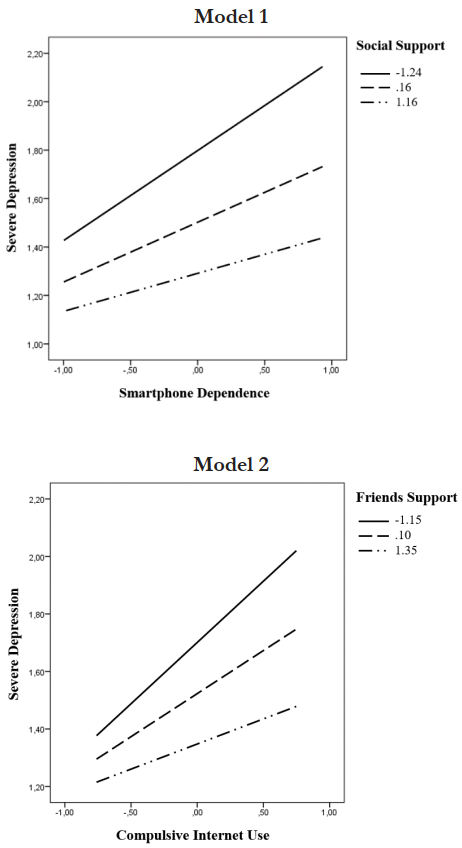
Next, two moderation models were tested. The first model was designed to examine the extent to which the level of social support moderates the relationship between smartphone dependence and severe depression. There was a significant interaction between smartphone dependence and severe depression, indicating the presence of moderation. The second model was designed to examine the extent to which the level of social support from friends moderates the relationship between compulsive Internet use and severe depression. A significant interaction was observed between compulsive Internet use and social support from friends, indicating the presence of a moderating effect. To provide a better understanding of the effect, we used the criterion indicated by Hayes (2018) to divide the moderating variables into three conditions (16th, 50th, and 84th percentiles), which is a procedure widely accepted in the literature. The moderation effects of both models are shown in Table 2.
Model 1 found that the association between smartphone dependence and severe depression was found to have a higher value when the level of social support was low (B=.370; p<.0001). When the level of social support is moderate, the relationship between the predictor and criterion variables remained significant but with lower strength (B=.245; p<.0001). Finally, when social support had a higher value, the association between smartphone dependence and severe depression was lower (B=.156; p<.0009).
In Model 2, the association between compulsive Internet use and severe depression is higher when the level of support from friends is low (B=.422; p<.0001). When friend support is moderate, this relationship loses strength (B=.298; p<.0001). Finally, higher levels of support from friends lead the relationship between compulsive Internet use and severe depression to take on lower values (B=.173; p<.05). Figure 1 shows graphically the effects obtained for different values of the moderating variables in both models.

Discussion
The aims of the present study were to examine the relationship between smartphone dependence, Internet addiction, social support, and mental health and to test the moderating role of social support in the relationship between smartphone dependence/Internet addiction and mental health. To achieve these goals, we tested three hypotheses: H1) higher levels of smartphone and Internet addiction would be related to worse mental health; H2) higher levels of social support would be related to better mental health; and H3) social support would play a significant moderating role between Internet and smartphone addiction and mental health. The obtained results confirmed hypotheses H1 and H2, while hypothesis H3 could only be partially proved, because the tested moderation models consisted only of specific factors of social support and general health. Smartphone dependence and Internet addiction are positively and significantly correlated with all general health factors, suggesting that the higher the level of smartphone and Internet addiction, the worse an individual’s mental health tends to be. It is important to emphasize here that a high score on the general health instrument used (QSG-28) indicates poorer mental health, as it measures high scores for psychological distress, social dysfunction, and severe depression. These results are in line with the literature presented in the introduction of this paper regarding the effects of addiction on individuals’ mental health, as well as on physical health and overall quality of life (Young & Abreu, 2011), which can trigger disorders such as stress and anxiety (Bispo et al., 2018; Sousa et al., 2018). These results are also consistent with the findings of Nunes et al. (2021), who found that smartphone dependence is a precursor to several health problems, including anxiety, physical inactivity, insomnia, depression, back pain, hostility, and suicidal ideation.
Smartphone dependence and Internet addiction are related to a lack of order in the workplace, which negatively affects performance and concentration and affects employee satisfaction (Loureiro et al., 2021). According to the study by Ferreira et al. (2020), excessive Internet use can also lead to memory difficulties, attention deficits, social withdrawal, family discussions, and cyberbullying.
A study conducted with adolescents between 8 and 18 years old found that they spend more than 7 hours a day on the Internet, where they are exposed to various information on social networks, which causes them to become more and more distant from real life outside the networks. This fact has been shown to have several negative consequences, such as the increasing number of adolescents with symptoms of anxiety, depression, attention deficit hyperactivity disorder (ADHD), poor social skills, and difficulty showing empathy, resolving conflicts, controlling impulses, and cooperating (Scott et al., 2017).
In the research conducted by Kim et al. (2018), it was found that smartphone and Internet addiction are associated with interpersonal problems that can lead to the development of depression and anxiety and cause people who are addicted to not seek offline relationships. These authors also observed that Internet- and smartphone-related withdrawal symptoms are likened to substance abuse disorder withdrawal, causing people to develop an obsessive fear of separation from these resources.
Studies by Ivanková et al. (2020) and Tran et al. (2017) indicated that people who use the Internet excessively have a negative impact on their health perceptions, have a lower quality of life, and have difficulty with self-care. Excessive internet use was considered as harmful as alcoholism.
The results of our study show a negative relationship between social support factors and total general health, which confirms hypothesis H2. That is, the more social support you receive from friends, family members, and significant others, the better your mental health. As we presented at the beginning of our paper, social support can act as a protective factor against psychological distress and promote better mental health and quality of life (Palma, 2019). Similar data to ours were found by Calvetti et al. (2016), who identified a negative correlation between social support and stress. Oliveira and Barroso (2020) showed that people who have more social support are less prone to loneliness and depression and are more likely to have good mental health, be more open to new friendships, and have better well-being.
Social support is a strategy to promote quality of life and prevent pain, just as it reduces depressive symptoms and psychological distress, and enables better establishment and maintenance of social relationships (Sette & Capitão, 2018). Thus, social support is considered a protective factor for the health of those affected. Social support is also identified as a factor that allows the development of a sense of security and prevents the occurrence of mental illness, stress and discomfort. In addition, individuals who have higher levels of social support are more efficient at resolving conflicts, demonstrate more self-care, and are more easily able to make sense of life amid adversity (Harandi et al., 2017).
Social support is also seen as a factor that promotes resilience after bereavement and stressful events. It is also classified as an important protective factor for mental health recovery, helping with grief processes, symptoms of depression and loneliness, and the negative symptomatology of some illnesses such as post-traumatic stress disorder and COVID -19 (Saltzman et al., 2020).
In the study conducted by Wang (2018), lower levels of social support were found to be related to severe symptoms of depression, anxiety, and bipolar disorder. It was also found that people who believe they have social support feel less lonely, function better socially, and have a higher quality of life. In the same vein, a study by Jibeen (2016) found that people who have lower levels of family support are more likely to have mental disorders such as depression, post-traumatic stress disorder, and conduct disorder.
The moderating effect of social support was explored by Sette and Capitão (2018) and Calvetti et al. (2016). The first authors found that social support moderates the relationship between quality of life and depressive symptoms, while the latter examined the moderation of this variable between stress and psychological well-being. In the case of the present study, the level of total social support was found to moderate the relationship between smartphone dependence and severe depression, and friends support was found to moderate the relationship between compulsive Internet use and severe depression. Considering that only the severe depression factor of total mental health was included in the model and that the second model included only the friends support factor, our hypothesis H3 is considered partially confirmed. However, this does not diminish the relevance of the findings obtained.
The Smartphone dependence moderation model found that the more the level of total social support increases, the weaker the association between smartphone dependence and severe depression. In other words, individuals who have higher levels of social support are less likely to develop severe depression if they overuse their smartphone. In the moderation model tested for compulsive Internet use, a protective role of social support, particularly from friends, was also observed in the relationship between compulsive use of this network and severe depression. Again, the more support individuals receive from their friends, the lower their propensity to develop severe depression when using the Internet excessively.
In the research conducted by Karaer and Akdemir (2019), the results revealed that the lack of caring and emotional support from parents is a predictive factor for internet addiction. In addition, social support from friends was negatively related to internet addiction, i.e., individuals who reported greater support from their friends were less likely to develop addiction, suggesting that friendship relationships and friends support play an important role in people’s mental health.
These authors also described the associations between Internet addiction and disorders such as anxiety and depression, and that people who are addicted have difficulty recognizing and disclosing their emotions and controlling their impulsivity. Given these data, it can be concluded that social support is a protective phenomenon for Internet addiction and its negative consequences (Karaer & Akdemir, 2019).
People who receive social support have a lower risk of developing mental health problems, especially depression and anxiety. In addition, social support is associated with a decrease in severe cases of depression, which in turn is associated with a decrease in symptoms of suicidal ideation, suggesting that social support is even more important for people who are more emotionally vulnerable (Scardera et al., 2020).
In general, the present study endorses the literature on the importance of social support as a variable that is not only negatively related to depressive symptoms, social dysfunction, and psychological distress, i.e., lower mental health, but also moderates the association between smartphone dependence and compulsive Internet use and severe depression. This can be explained by the fact that people who can count on their family, friends, and others in adverse situations have more security and quality of life. Quality of life and social support have been shown to be interrelated and to have a positive impact on people’s social and academic relationships and mental health, indicating that these two factors are protective against depressive symptoms (Alsubaie et al., 2019).
Despite the relevance of the results found, the study has limitations that should be mentioned. One of them refers to the sample of the study, which lacks diversity and size. The convenience nature of the sample leads to the need for caution when generalizing the study’s results, as it does not consist of a probabilistic sample representative of the general population. Another limitation relates to the self-report nature of the measures, which is subject to the social desirability effect, in which participants attribute desirable behaviors to themselves when answering research questionnaires. These limitations may influence the results and need to be considered when interpreting them, especially since the sample consists of young college students who may have provided socially desirable responses when completing the instruments. Therefore, it is suggested that future research include greater sample diversity and cross-cultural studies. In addition, other study methods should be developed, such as the experimental method, or even other types of measurements should be used, such as implicit measurements. Another possibility is to test the influence of positive mental health variables, self-esteem, and parenting style (authoritative, authoritarian, and permissive) on Internet and smartphone addiction.
Finally, it is important to acknowledge the contributions of the present study in learning about the characteristics of smartphone dependence and compulsive Internet use and how this affects the mental health of the subjects. It is important to emphasize that the problem does not lie in the use of smartphones and the Internet, technologies that greatly enrich the lives of individuals in modern times and help in various areas such as leisure, education, information, communication, and so on. The problem lies in the excessive and isolated use of real social relations with other people and in the fact that the lives of those affected are based on these technologies.
Promoting social support as a prevention strategy for such addictions and mental health problems is essential. Based on the results of this study, it is also possible to think about practical strategies that can improve this reality. Some of them are: the creation of public policies aimed at young people, awareness campaigns in schools and preparation courses for parents of children and adolescents. Finally, this study contributes to the scientific literature on the subject, which is still quite scarce, especially in Brazil.
DATA AVAILABILITY STATEMENT
The research data is not available.
References
-
Alsubaie, M. M., Stain, H. J., Wevster, L. A. D., & Wadman, R. (2019). The Role of Sources of Social Support on Depression and Quality of Life for University Students. International Journal of Adolescence and Youth, 24(4), 484-496. https://doi.org/10.1080/02673843.2019.1568887
» https://doi.org/10.1080/02673843.2019.1568887 -
Baumhammer, P., Silva, M. G., & Freitas-da-Costa, M. (2017). Aspectos Simbólicos do Smartphone e o Eu Estendido: Um Estudo do Comportamento do Consumidor Português. Revista Interdisciplinar de Marketing, 7(2), 175-190. https://periodicos.uem.br/ojs/index.php/rimar/article/view/34904/21615
» https://periodicos.uem.br/ojs/index.php/rimar/article/view/34904/21615 -
Bispo, A., Vieira, T., Euflauzino, I., Lopes, N., & Silva, H. (2018). Uma análise da dependência de internet em alunos da educação profissional baseada no Internet Addiction Test (IAT). Anais do Congresso Nacional de Pesquisa e Ensino em Ciências III, Campina Grande, Paraíba. https://editorarealize.com.br/artigo/visualizar/43400
» https://editorarealize.com.br/artigo/visualizar/43400 -
Calvetti, P. Ü., Giovelli, G. R. M., Gauer, G. J. C., & Moraes, J. F. D. (2016). Níveis de Ansiedade, Estresse Percebido e Suporte Social em Pessoas que Vivem com HIV/Aids. Psicologia: Teoria e Pesquisa, 32(4), 1-4. https://doi.org/10.1590/0102.3772e324317
» https://doi.org/10.1590/0102.3772e324317 -
Caracol, J. H. V., Alturas, B., & Martins, A. (2019). Uma sociedade regida pelo impacto do smartphone: Influência que a utilização do smartphone tem no quotidiano das pessoas. In Rocha, A., Pedrosa, I., Cota, M. P., and Gonçalves, R. (Ed.), 14th Iberian Conference on Information Systems and Technologies. Coimbra. https://repositorio.iscte-iul.pt/handle/10071/25357
» https://repositorio.iscte-iul.pt/handle/10071/25357 -
Carrapato, P., Correia, P., & Garcia, B. (2017). Determinante da Saúde no Brasil: A Procura da equidade na Saúde. Saúde Soc. São Paulo, 26(3), 676-689. https://doi.org/10.1590/S0104-12902017170304
» https://doi.org/10.1590/S0104-12902017170304 -
Ferreira, E. Z., Oliveira, A. M. N., Medeiros, S. P., Gomes, G. C., Cezar-Vaz, M. R., & Ávila, J. A. (2020). A influência da Internet na Saúde Biopsicossocial do Adolescente: Revisão Integrativa. Revista Brasileira de Enfermagem, 73(2), 1-9. https://doi.org/10.1590/0034-7167-2018-0766
» https://doi.org/10.1590/0034-7167-2018-0766 -
Gabardo-Martins, L. M. D., Ferreira, M. C., & Valentini, F. (2017). Propriedades Psicométricas da Escala Multidemensional de Suporte Social Percebido. Temas em Psicologia, 25(4), 1873-1883. https://doi.org/10.9788/TP2017.4-18Pt
» https://doi.org/10.9788/TP2017.4-18Pt -
Garbois, J. A., Sodré, F., & Dalbello-Araujo, M. (2017). Da Noção de Determinação Social à de Determinantes Sociais da Saúde. Saúde Debate, 41(112), 63-76. https://doi.org/10.1590/0103-1104201711206
» https://doi.org/10.1590/0103-1104201711206 -
Goldberg, D. P., & Hillier, V. F. (1979). A scaled version of the General Health Questionnaire. Psychological Medicine, 9(1), 139-145. https://doi.org/10.1017/S0033291700021644
» https://doi.org/10.1017/S0033291700021644 - Goldberg, D. P. (1972). The Detection of Psychiatric Illness by Questionnaire. Oxford University Press.
-
Harandi, T. F., Taghinasab, M. M., & Nayeri, T. D. (2017). The Correlation of Social Support with Mental Health: A Meta-analysis. Electronic Physician, 9. https://www.ncbi.nlm.nih.gov/pmc/articles/pmc5633215/#:~:text=sep%2025.%20doi%3a-,10.19082/5212,-pmcid%3a%20 pmc5633215
» https://www.ncbi.nlm.nih.gov/pmc/articles/pmc5633215/#:~:text=sep%2025.%20doi%3a-,10.19082/5212,-pmcid%3a%20 pmc5633215 - Hayes, A. (2018). Introduction to Mediation, Moderation, and Conditional Process Analysis: A Regression Based Approach. Guilford Press.
-
Heleno, C. T., Borges, L. O., & Agulló-Tomás, E. (2020). Validade Fatorial do Questionário de Saúde Geral (QSG-28). Avaliação Psicológica, 19(3), 322-332. https://dx.doi.org/10.15689/ap.2020.1903.17586.10
» https://dx.doi.org/10.15689/ap.2020.1903.17586.10 -
Ivanková, V., Suhányiová, A., Rigelský, M., Khouri, I., & Sejvl, J. (2020). The Relationship between Internet Addiction and Perceived Health. Adiktologie, 20, 73-80. https://doi.org/10.35198/01-2020-001-0006
» https://doi.org/10.35198/01-2020-001-0006 -
Jibeen, T. (2016). Perceived Social Support and Mental Health Problems Among Pakistani University Students. Community Mental Health Journal, 52(8), 1004-1008. https://doi.org/10.1007/s10597-015-9943-8
» https://doi.org/10.1007/s10597-015-9943-8 -
Karaer, Y., & Akdemir, D. (2019). Parenting Styles, Perceived Social Support and Emotion Regulation in Adolescents with Internet Addiction. Comprehensive Psychiatry, 92, 22-27. https://doi.org/10.1016/j.comppsych.2019.03.003
» https://doi.org/10.1016/j.comppsych.2019.03.003 -
Kim, Y., Jang, H. M., Lee, Y., Lee, D., & Kim, D. (2018). Effects of Internet and Smartphone Addictions on Depression and Anxiety Based on Propensity Score Matching Analysis. International Journal of Environmental Research and Public Health, 15(5), 1-10. https://doi.org/10.3390/ijerph15050859
» https://doi.org/10.3390/ijerph15050859 -
Klinger, E. F., Silva, J. B. F., Marinho,V. L., Miranda, K. W., & Reis, T. V. (2017). Propensão à Dependência da Internet: Um Estudo com Acadêmicos de Um Centro Universitário. Cerus, 9(2), 75-91. http://www.ojs.unirg.edu.br/index.php/1/article/view/1577/534
» http://www.ojs.unirg.edu.br/index.php/1/article/view/1577/534 -
Leite, J. F., Dimenstein, M., Dantas, C. B., Silva, E. L., Macedo, J. P. S., & Sousa, A. P. (2017). Condições de Vida, Saúde Mental e Gênero em Contextos Rurais: Um Estudo A Partir de Assentamentos de Reforma Agrária do Nordeste Brasileiro. Avances en Psicología Latinoamericana, 35(2), 301-316. https://doi.org/10.12804/revistas.urosario.edu.co/apl/a.4768
» https://doi.org/10.12804/revistas.urosario.edu.co/apl/a.4768 -
Lima, T. J. S., & Souza, L. E. C. (2021). O Suporte Social como Fator de Proteção para as Mães de Crianças com Síndrome da Zika Congênita. Ciência Saúde Coletiva 26(8), 3031-3040. https://doi.org/10.1590/1413-81232021268.04912020
» https://doi.org/10.1590/1413-81232021268.04912020 -
Loureiro, L. D., Souza, L. Z., & Flório, F. M. (2021). Avaliação da Interferência de uma Abordagem Educativa Sobre o Uso do Smartphone por Mestrandos da Área da Saúde. Educação Temática Digital, 23(4), 842-861. http://educa.fcc.org.br/scielo.php?pid=S1676-25922021000400843&script=sci_arttext&tlng=pt
» http://educa.fcc.org.br/scielo.php?pid=S1676-25922021000400843&script=sci_arttext&tlng=pt -
Medeiros, E. D., Sales, H. F. S., Lopes, B. J., Nascimento, A. M., Mariano, T. E., & Silva, P. G. N. (2021). Adaptação da Escala de Uso Compulsivo da Internet (CIUS) para o Brasil. Psicologia Argumento, 39(104), 277-292. https://www.researchgate.net/profile/Paulo-Silva-188/publication/351264477_Adaptacao_da_Escala_de_Uso_Compulsivo_da_Internet_CIUS_para_o_Brasil/links/608e2275458515d315edd194/Adaptacao-da-Escala-de-Uso-Compulsivo-da-Internet-CIUS-para-o-Brasil.pdf
» https://www.researchgate.net/profile/Paulo-Silva-188/publication/351264477_Adaptacao_da_Escala_de_Uso_Compulsivo_da_Internet_CIUS_para_o_Brasil/links/608e2275458515d315edd194/Adaptacao-da-Escala-de-Uso-Compulsivo-da-Internet-CIUS-para-o-Brasil.pdf -
Meerkerk, G. J., Van Den Eijnden, R. J. J. M., Vermulst, A. A., & Garretsen, H. F. L. (2009). The Compulsive Internet Use Scale (CIUS): Some Psychometric Properties. CyberPsychology & Behavior, 12(1), 1-6. https://doi.org/10.1089/cpb.2008.0273
» https://doi.org/10.1089/cpb.2008.0273 -
Neto, N. M. G., Sá, G. G. M., Barbosa, L. U., Pereira, J. C. N., Henriques, A. H. B., & Barros, L. M. (2020). Covid-19 e Tecnologia Digital: Aplicativos Móveis Disponíveis para Download em Smartphones. Texto & Contexto Enfermagem, 29, 1-11. https://doi.org/10.1590/1980-265X-TCE-2020-0150
» https://doi.org/10.1590/1980-265X-TCE-2020-0150 -
Nunes, P. P. B., Abdon, A. P. V., Brito, C. B., Silva, F. V. M., Santos, I. C. A., Martins, D. Q., Meira, P. M. F., & Frota, M. A. (2021). Fatores Relacionados à Dependência do Smartphone em Adolescentes de Uma Região do Nordeste Brasileiro. Ciências & Saúde Coletiva, 26(7), 2749-2758. https://doi.org/10.1590/1413-81232021267.08872021
» https://doi.org/10.1590/1413-81232021267.08872021 -
Oliveira, M. S. G., & Rezende, M. M. (2018). As relações Entre Equipes, Suporte Social e Bem-estar Subjetivo. Mudanças - Psicologia da Saúde, 26(1): 35-44. https://www.metodista.br/revistas/revistas-metodista/index.php/MUD/article/view/7579
» https://www.metodista.br/revistas/revistas-metodista/index.php/MUD/article/view/7579 -
Oliveira, N. R., & Barroso, S. M. (2020). Solidão, Depressão e Suporte Social em Estudantes de Psicologia. Trabalho (En)Cena, 5(1), 146-162. https://sistemas.uft.edu.br/periodicos/index.php/encena/article/view/7446
» https://sistemas.uft.edu.br/periodicos/index.php/encena/article/view/7446 -
Palma, R. C. S. (2019). O Papel do Suporte Social na Saúde Mental de Vítimas de Violência na Idade Adulta. [Master’s thesis, Instituto Universitário de Lisboa]. ISCTE. https://repositorio.iscte-iul.pt/handle/10071/18839
» https://repositorio.iscte-iul.pt/handle/10071/18839 -
Pinho, L. G., Pereira, A., Chaves, C., & Rocha, M. L. (2017). Satisfação com o Suporte Social e Qualidade de Vida dos Doentes com Esquizofrenia. Revista Portuguesa de Enfermagem de Saúde Mental, (5), 33-38. http://dx.doi.org/10.19131/rpesm.0164
» http://dx.doi.org/10.19131/rpesm.0164 -
Ribeiro, J. P., Neto, C., Silva, M., Abrantes, C., Coelho, M., Nunes, J., & Coelho, V. (2015). Ulterior Validação do Questionário de Saúde Geral de Goldberg de 28 itens. Psicologia, Saúde & Doenças, 16(3), 278-285. http://dx.doi.org/10.15309/15psd160301
» http://dx.doi.org/10.15309/15psd160301 -
Sales, H. F. S., Silva, F. M. S. M., Lopes, B. J., & Lima, C. F. (2018). Adaptação da escala de uso compulsivo de Internet para avaliar dependência de smartphone. Avances en Psicología Latino Americana, 36(1), 155-166. https://doi.org/10.12804/revistas.urosario.edu.co/apl/a.4649
» https://doi.org/10.12804/revistas.urosario.edu.co/apl/a.4649 -
Saltzman, L. Y., Hansel, T. C., & Bordnick, P. S. (2020). Loneliness, Isolation, and Social Support Factors in Post-COVID-19 Mental Health. Psychological Trauma: Theory, Research, Pratice, and Policy, 12(1), 55-57. http://dx.doi.org/10.1037/tra0000703
» http://dx.doi.org/10.1037/tra0000703 -
Scardera, S., Perret, L. C., Ouellet-Morin, I., Gariépy, G., Juster, R.P., Boivin, M., Turecki, G., Tremblay, R. E., Côté, S., & Geoffroy, M. C. (2020). Association of Social Support During Adolescence with Depression, Anxiety, and Suicidal Ideation in Young Adults. JAMA Network Open, 3(12), e2027491-e2027491. 10.1001/jamanetworkopen.2020.27491
» https://doi.org/10.1001/jamanetworkopen.2020.27491 -
Schmidek, H. C. M. V, Gomes, J. C., Santos, P. L., Carvalho, A. M. P., Pedrão, L. J., & Corradi-Webster, C. M. (2018). Dependência de internet e transtorno de déficit de atenção com hiperatividade (TDAH): revisão integrativa. Jornal Brasileiro de Psiquiatria, 67(2), 126-134. https://doi.org/10.1590/0047-2085000000195
» https://doi.org/10.1590/0047-2085000000195 -
Scott, D. A., Valley, B., & Simecka, B. A. (2017). Mental Health Concerns in The Digital Age. International Journal of Mental Health and Addiction, 15(3), pp. 604-613. https://doi.org/10.1007/s11469-016-9684-0
» https://doi.org/10.1007/s11469-016-9684-0 -
Sette, C. P., & Capitão, C. G. (2018). Efeito Moderador do Suporte Social em Pacientes Oncológicos. Psicologia, Saúde & Doenças, 19(2), 265-277. http://dx.doi.org/10.15309/18psd190209
» http://dx.doi.org/10.15309/18psd190209 -
Sousa, L. L., Silva, N. B., Ferreira, L. S., & Costa, E. F. (2018). Dependência e Internet e o Desempenho Ocupacional de Estudantes. Revista Interinstitucional Brasileira de Terapia Ocupacional, 2(4), 793-815. https://doi.org/10.47222/2526-3544.rbto18473
» https://doi.org/10.47222/2526-3544.rbto18473 -
Statista (2023). Internet usage worldwide - Statistics&Facts. https://www.statista.com/topics/1145/internet-usage-worldwide/#topicOverview
» https://www.statista.com/topics/1145/internet-usage-worldwide/#topicOverview -
Tran, B. X., Huong, L. T., Hinh, N. D., Nhuyen, L. H., Le, B. N., Nong, V. M., Thuc, V. T. M., Tho, T. D., Latkin, C., Zhang, M. W., & Ho, R. C. (2017). A Study on The Influence of Internet Addiction and Online Interpersonal Influences on Health-Related Quality of Life in Young Vietnamese. BMC Public Health, 17(1), 1-8. https://doi.org/10.1186/s12889-016-3983-z
» https://doi.org/10.1186/s12889-016-3983-z -
United Nations (UN). (2019). Estudo da ONU revela que mundo tem abismo digital de gênero. https://news.un.org/pt/story/2019/11/1693711
» https://news.un.org/pt/story/2019/11/1693711 -
Wang, J., Mann, F., Lloyd-Evans, B., Ma, R., & Johnson, S. (2018). Associations between Loneliness and Perceived Social Support and Outcomes of Mental Health Problems: A Systematic Review. BMC Psychiatry, 18(1), 1-16. https://doi.org/10.1186/s12888-018-1736-5
» https://doi.org/10.1186/s12888-018-1736-5 -
World Health Organization (1946). Constitution of The World Health Organization. https://apps.who.int/gb/bd/PDF/bd47/EN/constitution-en.pdf?ua=1
» https://apps.who.int/gb/bd/PDF/bd47/EN/constitution-en.pdf?ua=1 -
World Health Organization (2014). Mental Health: Strengthening Our Response. https://www.who.int/en/news-room/fact-sheets/detail/mental-health-strengthening-our-response
» https://www.who.int/en/news-room/fact-sheets/detail/mental-health-strengthening-our-response - Young, K. S., & Abreu, C. N. (2011). Dependência de Internet. Artmed.
-
Zimet, G. D., Dahlem, N., Zimet, S., & Farley, G. (1988). The Multidimensional Scale of Perceived Social Support. Journal of Personality Assessment, 52(1), 30-41. https://doi.org/10.1207/s15327752jpa5201_2
» https://doi.org/10.1207/s15327752jpa5201_2