 Procrastination, time management and self-efficacy among university students
Abstract
This study sought to verify whether there are differences in rates of procrastination, time management and self-efficacy among university students when scores are controlled by sex or by period of education, and whether self-efficacy scores have predictive power on time management and procrastination. 800 university students participated in the study. The instruments used were the Academic Procrastination Motives Scale, Time Management Inventory and Self-efficacy Scale in Higher Education. A MANOVA test with post-hoc t tests and a structural equation model were performed. Self-efficacy was able to successfully predict procrastination and time management behaviors. A higher rate of procrastination behavior was identified among women at the end of the course when compared to beginners, and a lower rate of procrastination among male students than among female ones. The study is concluded by underlining the importance of programs to foster these skills among undergraduates.
Keywords:
Self-efficacy; Procrastination; Time Management; Higher Education
Resumo
Buscou-se verificar se há diferenças nos índices de procrastinação, gestão do tempo e autoeficácia em estudantes universitários quando os escores são controlados por sexo ou por período da formação, e se os escores de autoeficácia tem poder preditivo sobre a gestão do tempo e a procrastinação. Participaram 800 estudantes universitários. Os instrumentos empregados foram a Escala de Motivos da Procrastinação Acadêmica, o Inventário de Administração do Tempo e a Escala de Autoeficácia na Formação Superior. Foi realizado um teste MANOVA com testes t post-hoc e um modelo de equações estruturais. A autoeficácia foi capaz de predizer a procrastinação e a gestão do tempo. Identificou-se maiores escores de procrastinação em mulheres no final do curso quando comparadas às iniciantes e menores escores de procrastinação em estudantes do sexo masculino do que entre o feminino. Conclui-se enfatizando a importância de programas para desenvolver essas habilidades entre os graduandos.
Palavras-chave:
autoeficácia; procrastinação; gestão do tempo; ensino superior
Resumen
Se buscó verificar si existen diferencias en las tasas de procrastinación, gestión del tiempo y autoeficacia entre estudiantes universitarios cuando se controlan las puntuaciones por sexo o por periodo de formación, y si las puntuaciones de autoeficacia tienen poder predictivo sobre la gestión del tiempo y la procrastinación. Participaron 800 estudiantes. Los instrumentos empleados fueron la Escala de Motivos de la Procrastinación Académica, Inventario de Administración del Tiempo y la Escala de Autoeficacia en la Formación Superior. Se realizó un análisis MANOVA con análisis t post-hoc y un modelo de ecuaciones estructurales. La autoeficacia fue exitosa en la predicción de la procrastinación y la gestión del tiempo. Se identificó una mayor tasa de procrastinación entre las mujeres al final del curso que entre las principiantes, y una menor tasa de procrastinación entre los hombres que entre las mujeres. Se concluye enfatizando la importancia de los programas para desarrollar estas habilidades entre los graduandos.
Palabras clave:
Autoeficacia; Procrastinación; Gestión del tiempo; Educación Superior
Introduction
Upon entering university, undergraduate students are faced with the need to adapt to a new environment, since both the character and the quantity of their responsibilities change. Professors are not as friendly as teachers were in High School and it is necessary for students to act with greater autonomy. New conditions such as increased schedule flexibility, moving to another city away from home, among other challenges, are powerful changes in the lives of many university students (Casanova et al., 2020). The process of adapting to the new academic routine is not thus limited to studying for the sake of getting good grades and requires a range of competencies beyond academic prowess.
From the moment of enrollment, students are expected to demonstrate autonomy, and thus have to develop skills related to studying and learning that are not limited to the mastery of course content. For instance, time management strategies, in face of the various academic demands, is one of the many skills crucial to academic adaptation (Soares et al., 2008), as it facilitates the process of adapting to the new array of responsibilities they are faced with. In spite of this, procrastination remains prevalent among students, as reported by Visser et al. (2018).
Procrastination, as defined by Sampaio et al. (2012), is the non-strategic delay of certain actions. Such delay is not beneficial and must be differentiated from the act of deliberate postponement, which individuals engage in for various reasons, ranging from strategic delay tactics to seeking the tension that comes with working closer to deadlines (Steel & König, 2006). Wypych et al. (2018) state that procrastination encompasses matters such as self-control, emotional self-regulation and impulsivity, and that its rate tends to diminish as people grow older, being thus negatively correlated to age, albeit to a short degree.
Some of the elements associated to procrastination are low motivation, low expectation from professors, depression, self-sabotage, anxiety, task characteristics, fragile self-efficacy beliefs related to the task, low self-esteem, challenges in executing plans, fear of failure, lack of studying strategies, among others (Visser et al., 2018; Rodrigues, 2020; Vieira-Santos & Malaquias, 2022). Among the potential predictors of procrastination are included dysfunctional beliefs, poor academic achievement, poor self-regulation, low self-regulatory self-efficacy beliefs, age and gender, low engagement, among others (Pereira & Ramos, 2021).
Regarding personal characteristics such as age, course stage and gender, there is evidence that women and younger students tend to exhibit maladaptive behaviors such as procrastination more frequently, but the stage in which the student is on in the course does not seem to significantly influence these behaviors (Ganda & Boruchovitch, 2015). However, contradictory evidence exists, indicating that men procrastinate more than women (Dominguez-Lara et al., 2019).
In the university context, it is evident that students who procrastinate more frequently tend to exhibit worse performance in their academic tasks and to portray their undergraduate course experience more negatively (Goroshit, 2018; Visser et al., 2018). It is a common tendency for individuals to procrastinate with the goal of avoiding undesirable tasks, but such behavior, though done with the purpose of avoiding stress, ends up exacerbating it, and students who behave in this manner find themselves in a vicious cycle of low productivity and negative feelings (Steel & König, 2006; Wypych et al., 2018). Lowering procrastination rates, therefore, is crucial for diminishing the suffering that students go through and for promoting a healthier relationship with academic tasks. A good time management system can be a great tool for that purpose. Van Eerde and Klingsieck (2018) suggest that time management and/or assertiveness training are positively effective in reducing procrastinatory behavior.
The time management process is composed of two different types of behavior: planning and managing (Estrada et al., 2011). Planning consists in designing an ideal course of action for a future period, while managing focuses on ensuring that the designed plans are effectively executed. Among the management behaviors involved in this process is the search for efficiency in executing the planned tasks, which involves correcting mistakes during the implementation stage, removing distractions from the environment, fighting procrastination by means of self-control and discipline, among others. As such, if effective time management requires reducing procrastinatory behavior, then it follows that the mutual coexistence of both behaviors is compromised.
A good time management system, when successfully applied, can increase one’s motivation for completing tasks (Allen, 2015) and foster better academic performance (Alyami et al., 2021). Time management, as described by Claessens et al. (2007), consists in a series of behaviors aimed at better matching one’s actions to the completion of specific goals within a defined time frame. Therefore, it is not time itself that is managed, but one’s actions throughout time, by means of self-regulatory strategies.
Such strategies are carried out by means of practices that aim at structuring days and weeks in accordance to the individual’s goals and obligations (Estrada et al., 2011). These practices are done with the help of tools such as schedules, planners, spreadsheets, lists, notebooks, computer programs, smartphone applications and other devices. Regardless of the tool at use, proper mastery over the principles is essential for promoting effective and efficient time management (Allen, 2015).
People don’t have only demands to meet, but also necessities and personal goals of their own (Estrada et al., 2011). The same can be said of students in the University context. It is important for the undergraduate student to get organized in order to use one’s own free time for pursuing both extrinsic goals and personal ambitions. This can be achieved through proper planning and structuring of their days and weeks. One effective approach is to set long-term goals (for example, in intervals of six to 12 months) and to create weekly plans that match these longer-term objectives, allocating tasks and appointments in to-do lists to be completed on a weekly basis (Allen, 2015; Estrada et al., 2011).
This kind of organization is efficacious not only in promoting better academic performance (Soares et al., 2008), but also in stress management (Pellegrini et al., 2012). Oliveira et al. (2016) indicate that students with time management difficulties typically face similar challenges, such as procrastinatory behaviors, delays in engaging necessary activities, waste of significant portions of time in social media websites, difficulties in denying requests from others and in reconciling studies, family life and leisure. The authors conducted an intervention focused on time management and emphasized the students’ interests in learning techniques such as using schedules, planning a balanced daily routine, identifying situations in which wasting time is more likely to occur, discriminating between important and urgent tasks and creating daily schedules that are flexible enough to accommodate contingencies.
Undergraduate students are expected to act with more independence and responsibility in managing their time to meet their demands, to elaborate functional studying strategies, and to set aims that match their goals and academic responsibilities (Oliveira et al., 2016). For this to be accomplished, however, it is necessary for the individual student to believe in their ability to do so, i.e., to have robust self-efficacy beliefs. As proposed by Bandura (1994), self-efficacy consists in a set of beliefs about one’s own skills and abilities. Such beliefs are sufficient for influencing one’s behavior in such a way that individuals with similar experiences in a given domain may display varying levels of performance due to these beliefs (Nuutila et al., 2020; Schunk, 1995).
These beliefs, as proposed by Bandura (1994), are strengthened through: 1) direct experience, which is based on the results of one’s own experiences; 2) vicarious experience, which is based on observing the experiences of others; 3) social persuasion, characterized by a social environment that fosters the perception that one is able to perform well in a given challenge and 4) physical and emotional states, which can influence how one interprets their own abilities before a given task. The first of these means of developing self-efficacy - direct experience -, is considered by the author as the most significant resource for developing robust self-efficacy beliefs. University students with more solid self-efficacy beliefs regarding their own academic skills tend to feel more satisfied with their university experiences and demonstrate greater proactive behaviors towards the accomplishment of their academic tasks (Santos at al., 2019).
Applying Bandura’s (1994) Social Cognitive Theory to the University context, Polydoro and Guerreiro-Casanova (2010) defined Self-Efficacy in Higher Education as the collection of beliefs held by students regarding their abilities to plan and execute the actions required to complete specific academic tasks. Such beliefs would be necessary to sustain a healthy adaptation process. This is illustrated by Casighiri et al. (2020), who propose that academic success demands both self-efficacy beliefs and domain-specific knowledge. In line with this, Teixeira and Costa (2018) identified several variables capable of predicting self-efficacy. They emphasize that the factors explaining self-efficacy should serve as motivators for the development of student support systems and that they must be considered in the process of planning educational interventions that focus on developing self-knowledge and self-agency/autoagency to establish tangible goals.
In a study involving 372 university students, Santos et al. (2019) have moreover found a high level of predictability of the academic satisfaction in function of self-efficacy beliefs. These beliefs would also be related to factors such as social commitment, motivation, self-concept and academic goals, together with social interaction abilities and academic self-regulation. In general, in accordance with Soares et al. (2008), male students have exhibited higher scores in self-efficacy measures than female ones, something that is usually explained by traditional gender roles, which push women towards more passive and subservient behaviors (Rossi et al., 2020).
There is thus reason to infer that self-efficacy beliefs are negatively associated with academic procrastination. Malkoç and Mutlu (2018) have found a negative correlation between these two variables. Besides, Schunk (1995) proposes that there is a positive correlation between self-efficacy and motivation. The present study therefore aims to investigate the hypothesis that individuals with low self-efficacy beliefs will also be less prone to believe that their efforts will yield favorable results, since students with lower self-efficacy scores can be faced with thoughts that motivate them to quit trying even before their first attempt at engaging certain academic tasks (Santos et al., 2019).
Fior et al. (2022), in a study aimed at investigating the relationship between self-efficacy in Higher Education and academic procrastination and at analyzing how these variables relate to those of sex, age and the stage of the course (whether in the first years or the latter years of college), found moderate negative correlations between the constructs. The authors have also identified that senior students exhibit higher self-efficacy scores in all scale dimensions when compared to freshmen. Besides, men and younger participants exhibited higher procrastination rates compared to female and older individuals.
From this, one can infer that strong self-efficacy beliefs in the Higher Education context would result in better time management, as undergraduates with better self-efficacy rates tend to adopt a more proactive attitude in the educational matters and to show more commitment with University goals (Fior et al., 2022; Santos et al., 2019). In a study with 23 students conducted by Basso et al. (2013), it was reported that time management training sessions gave students a greater sense of preparedness to deal with the challenges that academic life brings.
The literature on procrastination and time management in University Students is in need of being expanded, as these constructs are still little explored among academic populations. Although self-efficacy has been deeply studied and consolidated, it is still necessary to investigate the way in which these beliefs interact with domain-specific skills to enhance the adaptation process of students to the university. The present study is justified by the necessity of better comprehending the degree to which self-efficacy can explain procrastinatory and time management behaviors, Considering the motivational aspects of these variables. However, it is important to take into account that this study was carried out during the COVID-19 pandemic, which might have exacerbated study-wise and time management challenges, on top of negatively impacting undergraduate students’ mental health and self-efficacy beliefs (Blando et al., 2021; Zanini et al., 2023). Considering the present information, the present study sought to verify whether there are differences in the procrastination, time management and self-efficacy rates among university students when these variables’ scores are controlled by sex or course stage and whether self-efficacy scores are capable of predicting time management and procrastination.
The present study aims to investigate the following hypotheses: that senior students show higher self-efficacy rates, lower procrastination and better time management than freshmen; that male students have higher self-efficacy rates than female ones, as well as higher levels of procrastination and worse time management rates rates; and that self-efficacy is capable of predicting procrastination and time management rates.
Method
Participants
A total of 800 students completed a questionnaire via Google Forms. The participants were recruited from multiple undergraduate course Facebook groups between June of 2020 and March of 2021. They were all undergraduate students (74% female) with ages between 18 and 30 years old (M=22.59, SD=3.03), enrolled in a Higher Education university course, being either in the first three semesters of their course (freshmen, constituting 48.12% of the sample) or in the seventh to tenth semester (seniors, 51.88% of the sample), with 711 (88.9%) of them being public university students and 89 attending private universities.
Among them, 159 (19.9%) were of socioeconomic class A (higher class), 131 (16.4%) of class B1, 256 (32%) of class B2, 157 (19.6%) of class C1, 85 (10.6%) of class C2 and 12 (0.15%) of classes D and E (lower classes), as categorized by the Brazilian Institute of Research Companies (ABEP, 2019) directive for research conducted in 2020. They were distributed in the following groups: freshmen male students (N=100), senior male students (N=108), freshmen female students (N=285) and senior female students (N=307). Further details about each of these groups’ particularities are provided in Table 1.
Instruments
The Higher Education Self-Efficacy Scale - AEFS (Polydoro & Guerreiro-Casanova, 2010) comprises 34 items, rated on a 10-point Likert scale, in which a rating of 1 indicates that the subject considers themselves to be little capable, while a rating of 10 signifies that they consider themselves to be very capable. The scale contains five factors, which explain 56.68% of the total score variance in the instrument: 1. Academic Self-efficacy (nine items; α=0.88; explained variance of 37.87%): assesses the students’ perceptions of their abilities to understand, demonstrate and utilize the content learned in the course; 2. Self-efficacy in educational self-regulation (seven items; α=0.88; explained variance of 6.15%): assesses the students’ perceptions regarding their own abilities to set goals and make choices related to their education; 3. Self-efficacy in proactive actions (seven items; α=0.85; explained variance of 4.26%): assesses the students’ recognition of their capacity of making good use of opportunities that are presented to them during the course and upon involvement with the educational institution; 4. Self-efficacy in social interaction (seven items; α=0.80; explained variance of 4.85%): assesses the students’ confidence in establishing relationships with colleagues and professors; and 5. Self-efficacy in academic management (four items; α=0.80; explained variance of 3.53%): assesses students’ self-perception of their skills in setting and meeting deadlines for tasks related to their educational goals. There are no reverse-score items in the instrument; its score is obtained by the sum of the scores of each individual item that it comprises. Higher scores indicate more robust self-efficacy beliefs regarding Higher Education settings as a whole or in the component factors. Despite being utilized in an online context in the present study, the validation process for this scale was conducted in an in-person format.
The Reasons for Academic Procrastination Scale - EMPA (Geara et al., 2017) is divided into two sections. The first section, comprising four items, measures procrastination of different kinds of academic tasks and the frequency with which one procrastinates. The second section is divided into two parts, making up a total of 52.73% of explained variance, each of which being composed of four items. Both parts are composed of affirmations displayed on a 5-point Likert scale, where 1 signifies “Never” and 5 signifies “Always”. In this study, only the two factors in part two were employed. They are: Procrastination-demotivation (α=0.61), which, consisting of four items, is related to matters such as lack of energy and/or time, laziness, exhaustion and difficulties in finishing tasks, and is weakly and positively correlated with the variable Depression (r=0.18) and weakly and negatively correlated with the variable Conscientiousness (r=-0.18); and Procrastination-anxiety (α=0.76) which, consisting of four items, relates to feelings of insecurity, perfectionism and worrying, with a weak positive correlation with the variable Depression (r=0.22). To calculate the final score, the scores of each individual item are to be summed, thus obtaining scores respective to each factor. Higher scores indicate higher levels in procrastination, be it due to anxiety, be it due to demotivation. The instrument was validated in an online context.
The Time Management Inventory - ADT (Krausz, 1994), in its original version, comprises 96 items regarding 16 different topics. The instrument is widely used in business settings by Industrial-Organizational psychologists, but was not subjected to a process of statistical validation. In the present study, however, the version being used is the instrument’s adaptation as carried out by Pellegrini et al. (2012), composed of 39 questions regarding 13 topics. They are: 1. time planning; 2. crisis aversion; 3. personal organization and work discipline; 4. communication; 5. decision-making; 6. diagnosing problems; 7. delegation; 8. being able to say “no”; 9. setting priorities; 10. perfectionism; 11. setting personal goals; 12. work flexibility; 13. focusing capabilities. Each item has two possible answers: “yes” and “no”. Each participant selects the response they believe best represents their experience. The “yes” answers are tallied, with each affirmative answer being assigned a value of 1. Higher scores indicate worse time management skills.
Procedures
The data were collected digitally via Google Forms from June of 2020 to March of 2021. All participants were presented with the Free and Clarified Consentment Term, declaring that their participation in the study was voluntary and that they had the option of withdrawing their participation at any time. Afterwards, they were presented with the sociodemographic data questionnaire. The participants then answered the psychometric instruments in the following order: first, the AEFS questionnaire (Polydoro & Guerreiro-Casanova, 2010); then, the EMPA scale (Geara et al., 2017), and lastly the ADT (Krausz, 1994) as adapted by Pellegrini et al. (2021). The anticipated time for completing the questionnaire was approximately 15 minutes. The participants filled the forms individually.
Data analysis
The computer programs JASP (Jasp Team, 2023) and the R programming language (R, Core Team, 2023) were employed to organize and analyze the data. The software package rstatix (Kassambara, 2023) was used to conduct a Multivariate Analysis of Variance (MANOVA), with the EMPA, ADT and AEFS scores treated as dependent variables while sex and course stage (freshmen and seniors) served as independent variables. The Box’s M test was conducted to verify whether the sample would meet the necessary criteria to undergo a MANOVA analysis. Post-hoc t tests with Bonferroni and Welch corrections were conducted; bootstrapped effect sizes (Cohen’s d) comparing the differences between participants were also calculated, with control for sex and course stage. Two more R packages were also used: tidyverse (Wickham et al., 2019), to organize the data, and nortest (Gross & Ligges, 2015), to conduct the Kolmogorov-Smirnov normality test. The Shapiro-Wilk normality test was conducted using base R functions. The JASP software package was employed to analyze a structural equations model with the goal of investigating the relationship among the variables Higher Education self-efficacy, time management and procrastination, with Higher Education self-efficacy serving as the independent variable and time management and procrastination being considered the dependent ones.
Ethical Procedures
All participants signed a Free and Clarified Consentment Term - TCLE, which affirms that they are taking part in the study voluntarily and that they are free to withdraw their participation at any time if they so please. The project was approved by the university’s Research Ethics Committee on October 15th, 2021 under the protocol number 5041159.
Results
The Kolmogorov-Smirnov test indicated a lack of normality of distribution in all variables. The Shapiro-Wilk test pointed to only time management scores among male students being normally distributed (S-W(800)=0.99; p>0.05). Therefore, the MANOVA test was conducted using the Pillai’s Trace extraction method, which is appropriate for non-normal data (Hand & Taylor, 1987). The post-hoc tests were supplemented with bootstrapped confidence intervals (1000 resamples, BCa) in order to estimate effect sizes.
The Box’s M test, conducted prior to MANOVAs, confirmed assumption of homogeneity of variance for both the variables “sex” (Box’s M=12.3; p>0.05) and “course stage” (Box’s M=7.38; p>0.05). The MANOVA results point to a statistically significant effect of both sex (F(3, 794)=9.1; η2=0.0007; p<0.001) and course stage (F(1, 796)=9.1, η2 =0.02; p<0.001) over EMPA scores (sex: F(1, 796)=9.1, p<0.001; course stage: F(1, 796)=6.9, p<0.001), albeit with small effect sizes. There was no significant interaction between sex and course stage (F(3, 794)=0.5; η2=0.001; p>0.05), nor any relevant differences between ADT and AEFS scores.
Given the MANOVA results, the post-hoc tests were employed considering only EMPA scores. They have shown that, when controlled by sex, there are no differences in procrastination levels when comparing freshmen and senior male students, but that it is present amongst women, in which senior female students procrastinate more than their freshmen counterparts. Controlled by course stage, both senior women and freshmen women procrastinate more than men in a similar stage. Table 2 displays these differences. It is noteworthy that although the effect size comparing the means between freshmen and senior male students was higher than that of women in absolute numbers, the confidence intervals still crossed the zero-barrier, that is, one of the extremes is of positive value and the other is negative, leaving room for the possibility that the real effect size is zero. It is possible that the relatively smaller size of the male students sample (compared to the female one) may have impacted these results. However, all effect sizes, even the statistically significant ones, were low, which suggests that their influence over the results was small.
In order to create a structural equations model all scale items were employed. The analysis was conducted using the Robust Diagonally Weighted Least Squares (RDWLS) estimation method, which is well-suited for Likert-type scales (Li, 2016). The model was endorsed by the fit indexes: the Chi-Square per degrees of freedom (χ2 /df) ratio was acceptable (χ2 /df=4,6); the RMSEA index was deemed acceptable (RMSEA=0.067); and the CFI and TLI index were optimal (CFI=0.952; TLI=0.951). Reference values for each of theses fit indexes are as follows: the χ2 /df ratio must be under 5 or, preferably, under 3; CFI and TLI values must be, preferably, above 0.95; and RMSEA values must be inferior to 0.08 or, preferably, to 0.06 (Brown, 2015).
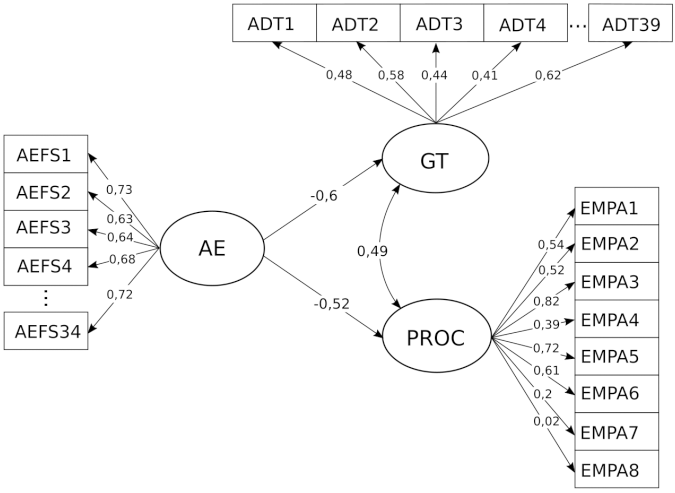
The explained variance (R 2) of the latent variables “time management” and “reasons for procrastination” by the latent variable “Higher Education self-efficacy” were respectively 0.36 and 0.27. The standardized regression coefficients (see Figure 1) of the impact of self-efficacy were of -0.6 for time management and -0.52 over procrastination, with approximated standardized residues of 0.04 for both of them, and both were statistically significant (with p<0.001). The covariance rate between time management and procrastination was that of 0.49.

Structural Equations Model: Self-Efficacy (AE) Predicts Time Management (GT) and Procrastination (PROC)
Note. The unidirectional arrows represent a dependency relationship between the variables, such that the arrow proceeds from the independent variable towards the dependent one. Bidirectional arrows represent mutual influence between the variables. The complete instruments were employed in the process of estimating the factors. Items 5 to 33 of the AEFS and 5 to 38 of the ADT were omitted for the sake of legibility.
The factor loadings of the AEFS scale were all consistent. One item of the EMPA (“EMPA8” in Figure 1) had a negative factor loading, which is unexpected, albeit statistically non-significant (p>0.05). In the ADT scale, nine items displayed negative factor loadings, though five of these were statistically non-significant (p>0.05). Other three items of this scale displayed non-significant factor loadings (p>0.05).
Discussion
The aim of this study was to verify whether there are differences in the procrastination, time management and self-efficacy rates in undergraduate students when scores are controlled by sex or course stage, and whether self-efficacy scores have any predictive power over time management and procrastination. These findings contribute to our understanding of how these variables interact and influence each other in the academic setting.
At first, it was anticipated that senior students would demonstrate higher scores in Higher Education self-efficacy and lower scores in procrastination, due to their having more experience in the university setting as well as being, on average, of more advanced age, since these factors foster greater learning self-regulation capacities (Fior et al., 2022). However, the results didn’t favor these hypotheses. The fact that this study was conducted during the COVID-19 pandemic may have impacted the results, due to the remote modality of studying, which removes students from the university setting, as well as social distancing and other stressors particular to the pandemic.
The results obtained with the MANOVA test did not point to there being significant differences between men and women, be they freshmen or seniors, in self-efficacy or time management scores. Considerable differences were found only regarding their procrastination levels. Post-hoc tests indicate that male students procrastinate less than the female ones. This is not in accordance to the literature, in which men show a higher rate of procrastinatory behavior (Soares et al., 2008; Dominguez-Lara et al., 2019; Fior et al., 2022), though it does corroborate Ganda and Boruchovich’s (2015) findings. Differences between freshmen and senior women were also found, in which the latter were shown to have higher procrastination rates, which, considering the findings by Fior et al. (2022), was unexpected.
The fact that this study was conducted during the COVID-19 pandemic is a possible explanation for such an outcome (Blando et al., 2021; Zanini et al., 2023). As proposed by Comoli and Canto (2020), there is a cultural tendency to attribute a larger volume of household tasks to women than to men. Given the increased time spent at home that the pandemic imposed on people, it is plausible that women were expected to adopt more domestic responsibilities than their male counterparts. The academic life of female students might have been more negatively impacted by the circumstances imposed by the pandemic than that of men, since greater household demands could have been imposed upon them, which in such a case would subtract from the energy that could have been invested in academic tasks.
A structure equations model was used to estimate the latent variables procrastination, time management and self-efficacy and to test the relationship between them, with self-efficacy serving as the independent variable. Indeed, the obtained fit indexes varied from acceptable to optimal; none fell below the acceptable threshold, which supports the hypothesis that the relationship between the variables occurs as proposed by the model. The predictive power of self-efficacy beliefs was significant for both of the dependent variables, which suggests that students with more robust academic self-efficacy beliefs have lower rates of procrastination and better time management skills. As expected, time management and procrastination also have a statistically significant covariance rate between them, which supports the idea that they influence each other mutually.
The scales’ factor loadings, obtained in the modeling process, were appropriate for both the AEFS and EMPA scales, despite there being one item with inadequate values in the EMPA questionnaire. However, the ADT was shown to have multiple statistically non-significant factor loadings, as well as negative factor loadings, contrary to the theory behind it. This suggests that this instrument may have structural problems and that a more appropriate and robust measure for assessing university students’ time management skills has to be developed.
The fact that students’ well-being in academic settings can be considerably impacted by procrastination is noteworthy, as well as that procrastination is commonly followed by negative feelings such as guilt and anxiety. Developing time management skills, therefore, can be useful for university students so that they may develop a higher sense of control over their environment and their tasks and better self-esteem (Oliveira et al., 2016). In the present study, however, it was shown that self-efficacy beliefs regarding academic life are the factor of most importance: the students who believe in their own potential to face and carry out the demands that are imposed upon them both manage better their own time as well as procrastinate less. It is important, then, for the sake of fostering better academic performance and to mitigate academic evasion, that opportunities for strengthening such beliefs be offered more widely.
Conclusion
Being able to manage one’s time is a noteworthy factor in adapting to academic life. However, it is common for undergraduate students to face challenges associated with this skill. Despite that, the production of Brazilian studies about the topic is still small, with this topic being often only briefly mentioned in research about related areas, such as procrastination and emotional self-regulation. Such scarcity is illustrated not only by the low number of articles published about the topic, but also by the absence of a time management questionnaire tailored for the University setting. The adapted version of the ADT is a binary scale (with items whose options consist in either “yes” or “no”). Answers of this kind may not be as representative of how participants feel about phrases such as “I don’t usually plan my day”; a Likert-type scale may offer a higher precision to the self-report process. Moreover, the ADT, though widely adopted, has not been subjected to a process of statistical validation. The version utilized in the present study is an ad hoc adaptation produced by Pellegrini et al. (2012) for investigating the time management skills of engineering students. With this present study, therefore, the authors expect to collaborate on the construction of future endeavors aimed at fostering time management skills in the university context. For that end, support groups and psychoeducation workshops on the topic are of great worth. The importance of developing a time management scale with greater statistical robustness is also noteworthy.
Notwithstanding the importance of time management, it is possible that the development of self-efficacy is of even greater necessity. Since this is a competency that is better developed through experiences of success in domain-specific activities, it is paramount that the opportunity for such experiences occur. This highlights the importance of activities such as extension projects and scientific initiation, as well as other categories of academic activities. However, the mere existence of such projects is not enough: it is necessary that they be widely publicized.
Among the limitations of this study, besides the recently-found limitations that affect the ADT scale, is the fact that the male students’ sample size is inferior to that of the female students. The lack of interviews with the participants also hinders the possibility of giving some qualitative depth to the quantitative results. Among the statistically significant differences between the sexes, a greater procrastination rate was found among female students, suggesting that women procrastinate more than men. With regards to course stage, it was found that senior female students procrastinate more than the freshmen of the same sex. However, with regards to the comparison between men and women, it is possible that the difference in sample sizes may have impacted the results. Besides, both of these results might also have been impacted by the context of the COVID-19 pandemic, since the data was collected between the years of 2020 and 2021. The social impact that resulted from the pandemic might have significantly altered the participants’ routines, especially that of women.
References
-
Allen, D. (2015). A arte de fazer acontecer. Sextante. https://amz.onl/dTwl2Ve
» https://amz.onl/dTwl2Ve -
Alyami, A., Abdulwahed, A., Azhar, A., Binsaddik, A., & Bafaraj, S. M. (2021). Impact of Time-Management on the Student’s Academic Performance: A Cross-Sectional Study. Creative Education, 12, 471-485. https://doi.org/10.4236/ce.2021.123033
» https://doi.org/10.4236/ce.2021.123033 -
Associação Brasileira de Empresas de Pesquisa [ABEP]. (2019). Critérios de Classificação Econômica Brasil. https://www.abep.org/criterio-brasil
» https://www.abep.org/criterio-brasil -
Bandura, A. (1994). Self-Efficacy. Encyclopedia of Human Behavior, 4, 71-81. https://doi.org/10.1002/9780470479216.corpsy0836
» https://doi.org/10.1002/9780470479216.corpsy0836 -
Basso, C., Graf, L., Lima, F., Schmidt, B., & Bardagi, M. (2013). Organização do tempo e métodos de estudo: oficinas com estudantes universitários. Revista Brasileira de Orientação Profissional, 14(2), 277-288. https://www.redalyc.org/articulo.oa?id=203030931012
» https://www.redalyc.org/articulo.oa?id=203030931012 -
Blando, A., Marcilio, F. C. P., Franco, S. R. K., & Teixeira, M. A. P. (2021). Levantamento sobre dificuldades que interferem na vida acadêmica de universitários durante a pandemia de COVID-19. Revista Thema, 20, 303-314.https://doi.org/10.15536/thema.V20.Especial.2021.303-314.1857
» https://doi.org/10.15536/thema.V20.Especial.2021.303-314.1857 - Brown, T. (2015). Confirmatory Factor Analysis for Applied Research (2º ed). Guilford Press.
-
Casanova, J. R., Araújo, A. M., & Almeida, L. S. (2020). Dificuldades na adaptação acadêmica dos estudantes do 1º ano do Ensino Superior. Revista E-Psi, 9(1), 165-181. http://hdl.handle.net/11328/3576
» http://hdl.handle.net/11328/3576 -
Casiraghi, B., Boruchovitch, E., & Almeida, L. S. (2020). Crenças de autoeficácia, estratégias de aprendizagem e o sucesso acadêmico no Ensino Superior. Revista E-psi, 9(1), 27-38. https://revistaepsi.com/artigo/2020-ano9-volume1-artigo2/
» https://revistaepsi.com/artigo/2020-ano9-volume1-artigo2/ -
Claessens, B. J. C., van Eerde, W., Rutte, C. G., & Roe, R. A. (2007). A review of the time management literature. Personnel Review, 36(2), 255-276. https://doi.org/10.1108/00483480710726136
» https://doi.org/10.1108/00483480710726136 - Cohen, J. (1988). Statistical power analysis for the behavioral sciences. Erlbaum.
-
Comoli, E., & Canto, K. (2020, Agosto 18). Pandemia impacta mais a vida das mulheres. Unicamp. https://www.unicamp.br/unicamp/noticias/2020/08/19/pandemia-impacta-mais-vida-das-mulheres
» https://www.unicamp.br/unicamp/noticias/2020/08/19/pandemia-impacta-mais-vida-das-mulheres -
Dominguez-Lara, S., Prada-Chapoñan, R., & Moreta-Herrera, R. (2019). Gender differences in the influence of personality on academic procrastination in Peruvian college students. Acta Colombiana de Psicología, 22(2), 137-147. https://doi.org/10.14718/ACP.2019.22.2.7
» https://doi.org/10.14718/ACP.2019.22.2.7 -
Estrada, R., Flores, G., & Schimith, C. (2011). Gestão do tempo como apoio ao planejamento estratégico pessoal. Revista de Administração da Universidade Federal de Santa Maria. 4(1), 315-332. http://www.redalyc.org/articulo.oa?id=273419420009
» http://www.redalyc.org/articulo.oa?id=273419420009 -
Fior, C. A., Sampaio, R. K. N., Reis, C. A. C., & Polydoro, S. A. J. (2022). Autoeficácia e procrastinação acadêmica em estudantes do ensino superior. Psico, 53(1), https://doi.org/10.15448/1980-8623.2022.1.38943
» https://doi.org/10.15448/1980-8623.2022.1.38943 -
Ganda, D. R., & Boruchovitch, E. (2015). Self-handicapping strategies for learning of preservice teachers. Estudos de Psicologia (Campinas), 32, 417-425. https://doi.org/10.1590/0103-166X2015000300007
» https://doi.org/10.1590/0103-166X2015000300007 -
Geara, G. B. B., Hauck-Filho, N., & Teixeira, M. A. P. (2017). Construção de escala de motivos de procrastinação acadêmica. Psico, 48(2), 140-151. https://doi.org/10.15448/1980-8623.2017.2.24635
» https://doi.org/10.15448/1980-8623.2017.2.24635 -
Goroshit, M. (2018). Academic procrastination and academic performance: An initial basis for intervention. Journal of Prevention & Intervention In The Community, 46(2), 131-142. https://doi.org/10.1080/10852352.2016.1198157
» https://doi.org/10.1080/10852352.2016.1198157 -
Gross, J., & Ligges, U. (2015). Nortest: Tests for normality [Manual]. https://CRAN.R-project.org/package=nortest
» https://CRAN.R-project.org/package=nortest - Hand, D., & Taylor, C. (1987). Multivariate Analysis of Variance and Repeated Measures. Chapman and Hall.
-
JASP Team. (2023). JASP (version 0.17.3) [Computer software]. https://jasp-stats.org/
» https://jasp-stats.org/ -
Kassambara, A. (2023). Rstatix: Pipe-friendly framework for basic statistical tests [Manual]. https://CRAN.R-project.org/package=rstatix
» https://CRAN.R-project.org/package=rstatix - Krausz, R. R. (1994). Inventário de Administração do Tempo (ADT): Manual de aplicação e avaliação. Casa do Psicólogo.
-
Li, C.-H. (2016). Confirmatory factor analysis with ordinal data: Comparing robust maximum likelihood and diagonally weighted least squares. Behavioral Research Methods, 48(3), 936-949. https://doi.org/10.3758/s13428-015-0619-7
» https://doi.org/10.3758/s13428-015-0619-7 -
Malkoç, A., & Mutlu, A. K. (2018). Academic Self-efficacy and Academic Procrastination: Exploring the Mediating Role of Academic Motivation in Turkish University Students. Universal Journal of Educational Research, 6(10), 2087-2093. https://doi.org/10.13189/ujer.2018.061005
» https://doi.org/10.13189/ujer.2018.061005 -
Nuutila, K., Tapola, A., Tuominen, H., Kupiainen, S., Pásztor, A., & Niemivirta, M. (2020). Reciprocal Predictions Between Interest, Self-Efficacy, and Performance During a Task. Frontiers in Education, 5(36), 1-13. https://doi.org/10.3389/feduc.2020.00036
» https://doi.org/10.3389/feduc.2020.00036 -
Oliveira, C. T. D., Carlotto, R. C., Teixeira, M. A. P., & Dias, A. C. G. (2016). Oficinas de gestão do tempo com estudantes universitários. Psicologia: Ciência e Profissão, 36, 224-233. https://doi.org/10.1590/1982-3703001482014
» https://doi.org/10.1590/1982-3703001482014 -
Pellegrini, C., Calais, S., & Salgado, M. (2012). Habilidades sociais e administração do tempo no manejo do estresse. Arquivos Brasileiros de Psicologia, 64(3), 110-129. http://hdl.handle.net/11449/73966
» http://hdl.handle.net/11449/73966 -
Pereira, L. D. C., & Ramos, F. P. (2021). Procrastinação acadêmica em estudantes universitários: uma revisão sistemática da literatura. Psicologia Escolar e Educacional, 25, e223504. https://doi.org/10.1590/2175-35392021223504
» https://doi.org/10.1590/2175-35392021223504 -
Polydoro, S. A. J., & Guerreiro-Casanova, D. C. (2010). Escala de autoeficácia na formação superior: construção e estudo de validação. Avaliação Psicológica: Interamerican Journal of Psychological Assessment, 9(2), 267-278. http://pepsic.bvsalud.org/scielo.php?script=sci_arttext&pid=S1677-04712010000200011&lng=pt&nrm=iso
» http://pepsic.bvsalud.org/scielo.php?script=sci_arttext&pid=S1677-04712010000200011&lng=pt&nrm=iso -
R Core Team. (2023). R: A language and environment for statistical computing [Manual]. R Foundation for Statistical Computing. https://www.R-project.org/
» https://www.R-project.org/ - Rodrigues, I. (2020). Procrastinação acadêmica, autoeficácia e adaptação acadêmica em estudantes universitários [Dissertação de mestrado não-publicada], Universidade Salgado de Oliveira, Niterói.
-
Rossi, T., Trevisol, A., Santos-Nunes, D. D., Dapieve-Patias, N., & Hohendorff, J. V. (2020). Autoeficácia geral percebida e motivação para aprender em adolescentes do Ensino Médio. Acta Colombiana de Psicología , 23(1), 264-271. https://doi.org/10.14718/acp.2020.23.1.12
» https://doi.org/10.14718/acp.2020.23.1.12 -
Sampaio, R., Polydoro, S., & Rosário, P. (2012). Autorregulação da aprendizagem e a procrastinação acadêmica em estudantes universitários. Cadernos de Educação, (42), 119-142. https://doi.org/10.15210/caduc.v0i42.2151
» https://doi.org/10.15210/caduc.v0i42.2151 -
Santos, A., Zanon, C., & Ilha, V. (2019). Autoeficácia na formação superior: seu papel preditivo na satisfação com a experiência acadêmica. Estudos de Psicologia , 36, 1-9. https://doi.org/10.1590/1982-0275201936e160077
» https://doi.org/10.1590/1982-0275201936e160077 -
Schunk, D. (1995). Self efficacy, motivation and performance. Journal of Applied Sport Psychology, 2(7), 112-137. https://doi.org/10.1080/10413209508406961
» https://doi.org/10.1080/10413209508406961 -
Soares, A. B., Ribeiro, R., Alves, P. R. S. da S., Jardim, M. E. de M., & Medeiros, C. A. C. de. (2023). Time management: What do University students think about it? Revista de Estudios e Investigacíon En Psicologia y Educación, 10(1), 1-14. http://dx.doi.org/10.17979/reipe.2023.10.1.9468
» http://dx.doi.org/10.17979/reipe.2023.10.1.9468 -
Soares, A. P., Guisande, A. M., Almeida, L. S., & Páramo, F. M. (2008). Academic achievement in first-year Portuguese college students: the role of academic preparation and learning strategies. International Journal of Psychology, 44(3), 204-212. https://doi.org/10.1080/00207590701700545
» https://doi.org/10.1080/00207590701700545 -
Steel, P., & König, C. (2006). Integrating theories of motivation. Academy of Management Review, 31(4), 889-913. https://doi.org/10.5465/amr.2006.22527462
» https://doi.org/10.5465/amr.2006.22527462 -
Teixeira, M. O., & Costa, C. J. (2018). Fontes de autoeficácia em estudantes do ensino superior. Revista Brasileira de Orientação Profissional , 19(2), 143-155. https://doi.org/1026707/1984-7270/2019v19n2p143
» https://doi.org/1026707/1984-7270/2019v19n2p143 -
Van Erde, W., & Klingsieck, K. B. (2018). Overcoming Procrastination? A Meta-Analysis of Intervention Studies. Educational Research Review, 25, 73-85. https://doi.org/10.1016/j.edurev.2018.09.002
» https://doi.org/10.1016/j.edurev.2018.09.002 -
Vieira-Santos, J., & Malaquias, V. N. R. (2022). Procrastinação acadêmica entre estudantes universitários brasileiros. Educação em Foco, 25(47). https://doi.org/10.36704/eef.v25i47.5816
» https://doi.org/10.36704/eef.v25i47.5816 -
Visser, L., Korthagen, F., & Schoonenboom, J. (2018). Differences in learning characteristics between students with high, average and low levels of academic procrastination. Frontiers in Psychology, 9(808), https://doi.org/10.3389/fpsyg.2018.00808
» https://doi.org/10.3389/fpsyg.2018.00808 -
Wickham, H., Averick, M., Bryan, J., Chang, W., McGowan, L. D., François, R., Grolemund, G., Hayes, A., Henry, L., Hester, J., Kuhn, M., Pedersen, T. L., Miller, E., Bache, S. M., Müller, K., Ooms, J., Robinson, D., Seidel, D. P., Spinu, V., … Yutani, H. (2019). Welcome to the tidyverse. Journal of Open Source Software, 4(43), 1686. https://doi.org/10.21105/joss.01686
» https://doi.org/10.21105/joss.01686 -
Wypych, M., Matuszewski, J., & Dragan, W. Ł. (2018). Roles of Impulsivity, Motivation, and Emotion Regulation in Procrastination - Path Analysis and Comparison Between Students and Non-students. Frontiers in Psychology , 9(891), 1-10. https://doi.org/10.3389/fpsyg.2018.00891
» https://doi.org/10.3389/fpsyg.2018.00891 -
Zanini, M. R. G. C., Rossato, L., & Scorsolini-Comin, F. (2023). Saúde mental, autoeficácia e adaptação universitária à pandemia de COVID-19. Revista de Psicologia, 41(1), 185-218. https://doi.org/10.18800/psico.202301.008
» https://doi.org/10.18800/psico.202301.008