
 Schooling and sports career: dilemmas of the dual career of diving athletes of the Federal District
Abstract
With this study, we aimed to analyze the educational and economic profiles of high-performance diving athletes of a national reference training club. This is a descriptive, exploratory, and transversal study, with data collected through a structured questionnaire. The inferential data analysis was conducted using descriptive and comparative trend measure tests. The results converge on the strong presence of the State as a financier of sports careers and the prioritization of sports mainly at the end of high school. However, dedication to studies, supported by a family background of high levels of schooling, facilitates the reconciliation of the demands of sports and school.
Keywords
dual career; student athlete; diving; high-performance sport
Resumo
O objetivo deste estudo foi analisar os perfis educacional e econômico de atletas de alto rendimento de saltos ornamentais de um clube formador de referência nacional. Trata-se de uma pesquisa descritiva, exploratória e transversal que teve os dados coletados por meio de questionário estruturado. A análise inferencial dos dados se deu por meio de testes para descrição geral e testes de comparação de medidas de tendência. Os resultados convergem para a forte presença do Estado como financiador da carreira esportiva e a priorização do esporte principalmente ao final do ensino médio. No entanto, a dedicação aos estudos, amparada em background familiar com elevados níveis de instrução, favorece o equilíbrio da conciliação entre as demandas do esporte e da escola
Palavras-chave
dupla carreira; estudante atleta; saltos ornamentais; esporte de alto rendimento
Introduction
Sport is a modern phenomenon, with much of its competition structured by the market of Nations, highlighting the role of governments in the growth of sports practices worldwide (Mandell, 1986). Considering characteristics such as athletic performance, the mercantilization of contracts, and the formation of cultures and values that constitute the environment around the athlete, sport (or some sports) could be considered a locus of professional career development (Capranica et al., 2015; Gonçalves & Carvalho, 2006). According to Alfermann and Stambulova (2007), a sports career is defined as an activity voluntarily developed over several years, with the aim of reaching an individual peak of performance at the regional, national, and later international level. In Brazil, the General Law of Sport includes high sports performance through the level of Sports Excellence, which "covers the systematic training directed to the formation of athletes in the pursuit of high performance of different sports modalities" (Lei nº 14.597/2023, our translation).
Thus, training for high-performance sports is long-term and modality-specific, and it can require athletes to dedicate more than 10,000 hours over ten years to reach the stage of sports improvement (Capranica et al., 2015; Gladwell, 2008). The choice to become an elite athlete requires committing hours to training (which can exceed 30 hours per week), making trips to train and compete, ensuring health care, from injury prevention to rehabilitation, and foregoing social events (Capranica et al., 2015; Costa et al., 2021; Schiavon et al., 2011). Given that training athletes for high performance can begin in childhood and continue through adolescence, it is necessary to reconcile the sports routine with mandatory educational demands (Hakkers, 2019; Leite et al., 2019). Thus, the concept of academic-sports dual career (DC) refers to the challenging condition faced by student-athletes in reconciling sports and educational demands in a balanced way (Ryba et al., 2015; Souza et al., 2023).
The importance of balancing sports and educational demands for the integral development of the athlete is recognized by the international academic literature and advances in the discussion of sports training, especially when analyzing both physical and physiological impacts and the concern to understand the educational, psychological, and social impacts caused by transitions (sports and non-sports) throughout training, which involves the change of categories and advancement in school grades, the eventual need to move to a new city (which can lead to a new school/university), and the decisive moment of withdrawing from sports (Ryba et al., 2017). According to Hakkers (2019), among European Union member states, 120,000 young people held dual careers, and only 30% reached the sports elite, underscoring the need to prepare these individuals for the possibility of discontinuing high-performance sports through academic, psychological, and psychosocial development. In addition, half of the young people involved in the dual career reported by Hakkers (2019) expressed satisfaction with the support provided for reconciling high-performance sports and studies, revealing that one in six athletes chooses to abandon high-performance sports in favor of educational development. Among athletes who participated in the Youth Olympic Games, one in five sought lower educational requirements due to the prioritization of elite sport.
For the athlete, the difficulty in balancing the daily routine, filled with training and studies, can mean (i) choosing a lower level of education because of the time dedicated to sports and (ii) abandoning the practice of performance sports to commit to studies. This scenario becomes critical when studies show that (i) athletes often report difficulty transitioning from high school (HS) to higher education (HE) and (ii) half of the athletes are dissatisfied with the support offered for combining studies with sports and experience difficulties in transitioning to a new career (Hakkers, 2019).
This theme has been studied for decades, especially in the United States and in some European countries, such as Spain, Italy, the United Kingdom, and Denmark. Latin America is an emerging space for the production of knowledge about DC, particularly in countries such as Brazil, Colombia, and Argentina (Ricci et al., 2022; Ryba & Stambulova, 2013). Ricci et al. (2022, p. 3, our translation) point out the importance of understanding this object of study, especially to “... sustain a better understanding of the challenges, barriers, and tensions faced by Latin American student-athletes and collaborate with the development of plans and interventions that help them overcome such difficulties”. Although emerging and recent, academic production in Latin America has Brazil as the primary country in terms of the number of publications and researchers involved (Ricci et al., 2022).
Sports and academic reconciliation in Brazil
Current legislation in the country is an important factor in understanding the reconciliation between sports and educational demands (Rocha et al., 2020; Wylleman & Rosier, 2016). In Brazil, Law No. 9,394 of December 20, 1996 (Law of Guidelines and Bases for National Education), provides for the obligation of the citizen to be enrolled in regular education from 4 to 16 years of age, which totals, at the end of this space-time, a minimum of 9,600 class hours, divided between (i) preschool, (ii) elementary school, and (iii) high school (Lei nº 9.394/1996). This mandatory period totals twelve years of training, preventing the athletes from dedicating themselves exclusively to high-performance sports. On the other hand, sports training is an optional process for candidates seeking high athletic performance, demanding dedication to physical, cognitive, and psychological development, and requiring hours spent attending training sessions and competitions, as well as recovering.
However, the organization of the sports market(s) must be clarified (Correia et al., 2020; Mascarenhas et al., 2013; Soares et al., 2011). In Brazil, men's soccer is the sport that most arouses expectations regarding success, especially financial success (Damo, 2007; Gonçalves & Carvalho, 2006). In this sense, job positions in this modality are limited and reflect a reality far from the expectations created: the first and second divisions of Brazilian soccer offer about 1,000 job vacancies, and more than 80% of the country's professional players earn about 1 minimum wage. This reality can vary between states and regions of the country (Catto, 2022; Jornal da Globo, 2009; Rocha, 2017). For modalities such as gymnastics, fencing, and diving (the focus of this research), job opportunities are even more limited in number and have limited potential for private investment to support professionalization (Costa et al., 2021; Mercado & Consumo, 2019). Research on diving showed compatibility between sports and educational formations, with cases of discontinuation during the transition from high school to higher education (Costa et al., 2021). However, some questions were not answered at the time, creating important gaps in the analysis: (i) the economic profile of athletes; (ii) the possible association between financial, sports, and educational variables; and (iii) the relationship between the main social, educational, and family determinants and dedication to success in sports.
In this scenario, the student-athlete in Brazil does not find the legal provision 1robust enough to ensure the conditions for quality performance and the consonance between educational and sports obligations (Figueiredo & Scremin, 2023; Rocha et al., 2020; Rocha, Pinto et al., 2021).
Sports training demands a large part of the daily routine for sports-related activities. Athletes in individual modalities, such as gymnastics, reach the sporting apex at a young age, suggesting specialized practice (at 6 years old), with dedication to long-term training (between 8 and 12 years old), without guarantees of success (Tsukamoto & Nunomura, 2005). Diving is another individual modality demanding technical resources and specific materials (Ferreira et al., 2020). Training in diving begins early, requiring children's dedication to training that, depending on their development and success, can exceed 5 hours per day (Carneiro et al., 2021; Costa & Figueiredo, 2021; Teixeira et al., 2017). In turn, the economic market available through this modality is limited, with the state as the primary source of financial support for the Athlete Scholarship Program. Established in 2004, the program is considered, on the federal government's website, “one of the largest direct incentive programs for athletes worldwide”, supporting high-performance athletes from age 14 with scholarships ranging from R$ 410.00 (student and base categories) to R$ 16,629.00 (Podium Athlete category). Athletes must meet eligibility requirements, such as having a minimum age of 14 years (from 14 and 20 years old in the case of the Student Scholarship), be linked to a sports entity, be in full sports activity, declare any sponsorships or support received, have participated in sports competition at the national or international level in the year prior to the application (except in the Podium Athlete category), be regularly enrolled in an educational institution (in the case of the Student Scholarship), present an annual sports plan, and, in the case of the Podium Athlete category, be among the first twenty places in the world ranking of the modality or event (Lei nº 10.891/2004). When analyzing 9,149 scholarships awarded between 2005 and 2011, Corrêa et al. (2014) found a disparity between those awarded in the Base and Student categories (respectively, 2.35% and 9.57%) compared to the National and International categories (respectively, 56.55% and 27.72%), in addition to the 3.80% awarded in the Olympic category. Although the logic of high-performance sports is based on the inclusion of only the best athletes, such data reinforce the dilemma of reconciling sports and studies, as athletes discontinue sports. This can be related to the lack of continuity and progression of the athlete scholarship, the primary source of investment in modalities with low investment potential.
Therefore, the precocious nature of sports training in diving underscores the need for reconciliation with compulsory basic education. At the same time that athletes must train, compete, recover, and prevent injury, they must also fulfill educational obligations – on-site classes and dedication to studies in the school curriculum, among others. In this sense, in addition to the support to be provided by sports and educational institutions and the State, in the form of the law, the family emerges as the main pillar of initiation, development, and withdrawal in high-performance sports, providing psychosocial and financial support (López de Subijana Hernández & Equiza Vaquero, 2018). Therefore, it is important to understand the economic and educational profiles of athletes in a sport such as diving, which has low private investment potential, revealing a professional market with few and contested opportunities.
In this sense, we aim to describe and analyze the educational and economic profiles of high-performance diving athletes of a team from the Federal District (FD). This team is an important training center for athletes in the sport, offering systematic training from the base categories (children from 5 years of age), an appropriate physical infrastructure (rooms for project administration, physical rehabilitation, and psychological care, among others), and no fees for practicing the modality. Its adult teams have achieved relevant national and international results in both men's and women's categories.
With this study, we aim to understand the factors that constitute the profile of this sport's elite and to analyze the economic interaction in DCs (Souza et al., 2023).
Material and Method
This exploratory study was conducted to formulate hypotheses and deepen understanding of the object of analysis, which, in this case, is the needs of diving athletes. Thus, the field survey gathered information directly from the studied population, namely, diving athletes in real-world DC situations.
Therefore, the first phase of the research concerns mapping the diving training centers. The research was conducted in the Federal District, based on the identification of a Training Center (TC) that met the criteria for training athletes and systematically aimed to achieve national and international results. The second phase was dedicated to a visit to explain to the TC managers/coaches the objectives and procedures of the research and to invite them to be partners in this investigation, formalizing it through the signing of a research invitation. Then, a quantitative survey was conducted to understand the target population, and the research team visited the athletes to clarify the study's objectives and the importance of its development. After this meeting, we sent the questionnaire link to a TC coach, who made it available to the athletes via an instant messaging app.
As an inclusion criterion, athletes should be in the Adult (over 18 years), A (16-18 years), or B (14-15 years) categories and participating in national and/or international competitions. These categories were selected because they encompass periods of extreme importance for peak athletic performance (Stambulova et al., 2009), as well as the compulsory transition from elementary to high school, followed by the non-compulsory transition to higher education or the reconciliation between work and diving. Athletes under 18 years of age filled in the acceptance form with the free and informed consent of their parents and/or guardians, according to the rules of the Research Ethics Committee. There were 27 responses to the questionnaire at the end of the data collection phase, between August and December 2022.
The instrument for data collection, used by Costa et al. (2021), based on the Holistic Athletic Career Model (Wylleman et al., 2013), is composed of five axes: (i) Sports Trajectory, (ii) Educational Trajectory, (iii) Reconciliation between sports and studies, (iv) Family Configuration, and (v) Financial Requirements for DC. The data were tabulated in a Microsoft Excel® spreadsheet, and the analyses were performed using JAMOVI software version 2.3 (The jamovi Project, 2022). Based on the questionnaire responses, we analyzed and deepened three axes of the study: socioeconomic profile, sports practice profile, and educational profile. Shapiro-Wilk tests were performed to verify the normality of the distribution when necessary. Due to the non-normality of the distributions, the median and the first and third quartiles were used as the standard measures of central tendency and to describe the data. In addition, the chosen trend-measure comparison tests were aimed at this distribution profile: Mann-Whitney U for differences between two groups, Kruskal-Wallis for differences between three or more groups, and Dwass-Stell-Critchlow-Fligner for paired comparisons. Chi-Square and Fisher's exact tests were also used, as needed, to assess possible associations between categorical variables.
All data collected for the research were handled in an academic manner, in accordance with the Research Ethics Committee protocol of the School of Health at the Universidade de Brasília (FS-UnB), under Certificate of Submission for Ethical Appraisal (CAAE) number 51469321.0.0000.0030.
Results
Sociodemographic profiles
The sample consisted of 27 athletes, 11 men and 16 women, with a median age of 18 years and first and third quartiles of 16 and 20 years, respectively; the youngest was 13 years of age, and the oldest was 41 years of age. Regarding housing, the majority live in a house/apartment with their parents or relatives (23), while 5 live alone or with their family nucleus.
Regarding the level of schooling of the parents, we highlighted a high level in most of the sample, with 25 having completed higher education, 1 athlete did not know how to answer about their mother's level of schooling, and 3 did not know how to answer about their parents' level of schooling (Table 1).
Regarding the economic classification, the table below shows the frequency distribution according to the Brazil Criteria for Economic Classification proposed by the Associação Brasileira de Empresas de Pesquisa (ABEP, Brazilian Association of Research Companies) (Abep, 2022).2 It is noteworthy that no athletes in categories D and E are described in the analyzed sample. In this sense, the table shows the expected proportions by class in Brazil for analysis and comparison (Table 2).
Distribution of frequencies and proportions by social classes according to the ABEP criterion and proportions of the Brazilian population
As the results demonstrate the absence of athletes in two classes (D and E), no statistical test was performed to confirm the differences evident in the frequency distribution itself. Thus, the tendency of diving athletes to belong to the highest social classes is evident, with 85.1% of the sample distributed between classes A and B.
There were significant associations between the level of schooling of fathers (p=0.009) and mothers (p=0.002) and the social classes of the interviewees. In Class A, all parents had attended higher education, while in Class C, none had reached this level of schooling. In Class B, seven parents had attended higher education, and nine did not. Among the mothers in Class A, only one had not attended higher education, whereas in Class C, none of the four had. For Class B, three had higher education, and eleven did not.
Sports practice profile
The athlete categories were distributed into Adult (9), A (12), and B (6) categories. Of these, 22 (81.5%) traveled to compete and/or train outside Brasilia in 2022, the year the questionnaire was applied. The median number of travel days was 20 (6 and 31 - first and third quartiles). It was found that the median weekly hours dedicated to sports were 24 hours (20 and 30 - first and third quartiles).
Table 3 shows the distribution of frequencies across categories and whether the benefit was received.
Cross-tabulation among the athlete categories and the status of beneficiaries of the Athlete Scholarship Program
Of the 27 athletes, 20 are beneficiaries of the Athlete Scholarship Program. The program beneficiaries are concentrated in the Adult and A categories, with no athletes in Category B. It is also noteworthy that seven of the eight athletes in the Adult category reported that the absence of the benefit would make their careers unfeasible. In the same sense, eleven of the twelve athletes included in Category A also pointed out the same question. The difference in travel days for competing/training and in weekly workload between athletes who benefited and those who did not benefit from the program was compared (Table 4).
Comparison of trend measures between recipients and non-recipients of the Athlete Scholarship Program regarding travel days to train and compete, and weekly hours dedicated to sports
It was observed that athletes covered by the program have a median travel time of 24.5 days per year, while those not covered have a median of 5 days. Regarding training hours, the differences were 29 hours per week for participants and 18 hours for non-participants. The Mann-Whitney test for differences in trend measures was used because the data were non-normally distributed, as indicated by the Shapiro-Wilk test.
To assess differences in variables across categories, the Kruskal-Wallis test was performed on the same variables for athletes in the Adult, A, and B categories (Table 5).
Test of difference of trend measures among the categories by the variables days traveling to train/compete and weekly hours dedicated to the sport, and their respective post-hoc by categories
The results showed no differences between the weekly hours dedicated to sports for athletes. However, there is a difference between travel days for training/competing between the Adult and A categories and category B athletes. The Table shows no difference in the number of days travelling for athletes in the Adult and A categories.
It is understood that there is an association between the Adult and A categories and the Athlete Scholarship Program, and that the athletes who comprise them have a greater commitment to travel days and training hours than those in Category B. However, the weekly hours dedicated to training do not differ significantly among the three categories.
Educational profile
Regarding the educational profile, 22 athletes were enrolled in educational institutions, divided between basic education (15) and undergraduate studies (7). Of these, 14 athletes study at public institutions (13 in basic education, 1 in higher education) and 8 at private institutions (2 in basic education, 6 in higher education). Most of the athletes were enrolled in the day shift (12), while 4 were in the night shift, 2 in the full shift, and 4 chose the distance learning modality. Of the 5 athletes who stated that they were not studying, 2 had completed higher education, 2 had completed high school, and only 1 had interrupted their studies in the first year of high school.
However, there is a strong association between divers who attend basic education (public schools) and those who attend higher education (private institutions) (p=0.002).
Regarding failed classes, only two athletes reported having failed once during basic education, and only one cited sport as a strong reason. Regarding the interruption of studies, three athletes stated that they had interrupted their academic trajectory at some point and that this interruption was strongly motivated by the demands of sports. The same three athletes claimed that the interruption had never been motivated by family or work issues. It is also noteworthy that 70.3% of athletes report some difficulty complying with school/university activities due to sports commitments, either rarely (25.9%), frequently (40.7%), or always (3.7%).
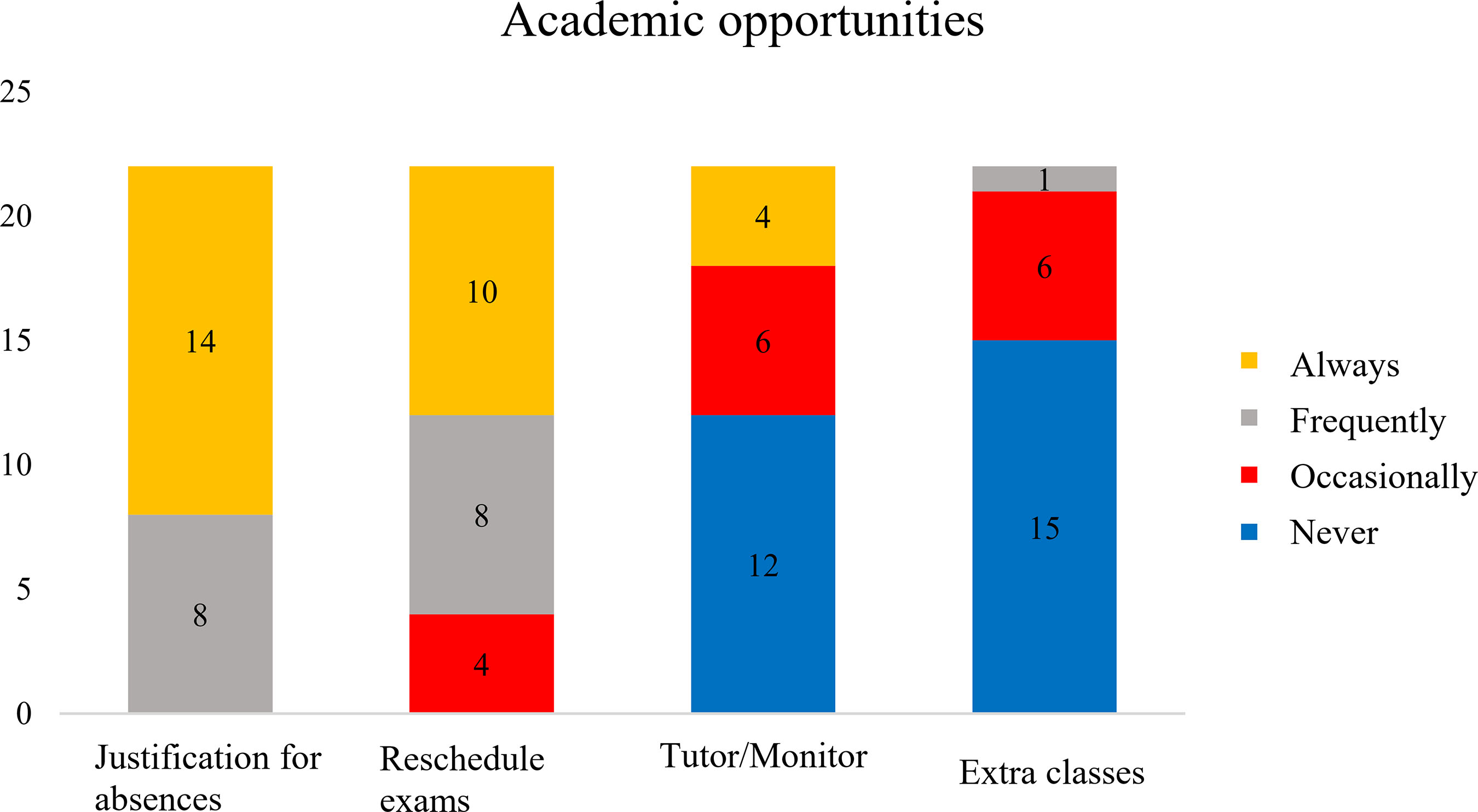
Recognizing the need to travel to fulfill sports commitments, we asked about the strategies the educational institution offers to meet educational demands. The primary device used is the justification of absences and the rescheduling of exams. The offer of tutors/monitors and extra classes is less frequent.

Distribution in percentage proportion of opportunities provided by educational institutions in which athletes were enrolled.
Finally, of the 27 athletes, 18 wished to complete graduate-level education, 8 wished to complete higher education, and only 1 wished to complete high school. No association was found between the desired educational level and economic class (p=1.00), nor was there an association between the desired educational level and the schooling of mothers (p=0.501) or fathers (p=0.473). There was no association between the intended academic degree and the expectation of completion (p=0.628).
Discussion
The athletic training process, in search of national and international sporting success, constitutes a demanding space for investments at different levels: (i) individual (athletes, family, friends, and coaches, among others), (ii) current legislation, especially for long-term performance, and (iii) consolidated public and institutional policies, in addition to the social, cultural, and economic context experienced by the population (De Bosscher et al., 2006).
In Brazil, soccer is the sport that dominates television (Capelo, 2016), making other sports less attractive in terms of exposure and, consequently, in the eyes of sponsors. Thus, diving is a quadrennial media-exposure modality, limiting its potential to attract investment (Costa et al., 2021). In this and similar contexts, the State emerges as an important sponsor of Brazilian sport through different funding initiatives (Carneiro et al., 2018; Mascarenhas et al., 2013; Mazzei et al., 2014; Teixeira et al., 2017) enabling the athlete, the parathlete, and the deaf athlete to develop their sporting condition, either through investments in sports facilities, the development and identification of talents (Mazzei et al., 2014; Teixeira et al., 2017), or by direct funding through the Athlete Scholarship Program (PBA).
The award of the Athlete Scholarship is based on criteria that consider membership in a sports practice entity, participation in competitions (national or international), or participation in finals and medals won (Ministério do Esporte, n.d.). The data analyzed by Costa et al. (2021) revealed a sample with high-performance diving athletes with a strong presence of the State as their sponsor. In this study, this result is repeated for performance sports in the modality; of the 27 athletes, 20 were considered. The seven athletes not considered are in Category B, comprising younger athletes relative to the others (Categories A and Adult). Although there is no significant difference in the number of hours spent on training, the absence of scholarships in Category B can be justified by performance levels between categories, as older athletes have more experience and are in the peak of their sports careers (Stambulova et al., 2009). Therefore, these athletes perform more often and at higher levels of performance, justifying the increase in travel frequency and the possibility of participating and winning medals at the national and international levels, one of the requirements presented by the PBA to apply for scholarships or, when consolidated, to remain in the program.
Therefore, the way to pay for the necessary conditions to achieve better performance levels, travel to competitions, and entry into the PBA is through the family environment. Therefore, the families of the athletes studied belonged to the highest economic strata (89% in strata A and B), with no families in lower categories (D and E) and only one family in category C2. The literature on the impact of the family on the development of student-athlete DCs points to diverse support, going through issues of psychological support and motivation to enter and remain in sports, as well as financial support to enable these processes (Figueiredo & Scremin, 2023; López de Subijana Hernández & Equiza Vaquero, 2018).
Regarding current legislation in Brazil, the national scientific production has highlighted the real need to discuss the recognition of student-athlete status (Carvalho & Haas, 2015; Costa & Figueiredo, 2021; Rocha, Pinto et al., 2021). The formation of an athlete begins in childhood, continues through adolescence, and is shaped by the study time of this young person. Therefore, the permanent accompaniment of DCs is fundamental to success in both sports and professional training (Costa et al., 2018; Folle et al., 2016; Lima et al., 2022; Melo et al., 2020; Rocha, Melo et al., 2021).
Costa et al. (2021) presented a profile of divers who could reconcile sports and school/academic demands; athletes reported interrupting their studies at some point in their training. In this sense, the data from this research indicate the interruption of studies in only one case, which is considered critical because it occurred during compulsory basic education (1st grade of High School). Cases of completion of studies in high school (two cases) and higher education (two cases) were identified. On the one hand, these data reinforce the prioritization of high-performance sports at the expense of studies (interruption during HS and non-continuation into non-compulsory higher education); on the other, they point to the need to assist athletes in higher education with access and completion. It is important to emphasize that compulsory basic education in Brazil takes place until the end of high school (from 4 to 17 years old), with the option of continuing studies at the technical level or in higher education, an option that currently appears as a necessity for professional qualification and the search for better jobs. In this sense, Ribeiro et al. (2025) estimated the wage return of schooling in Brazil between 1995 and 2023. The authors draw attention to a decline in the wage return across all levels of education until 2016, after which this decline is observed only among groups with higher levels of schooling. In addition, the increase in access to higher education led to a mismatch between the supply and demand for skilled labor, allocating better-prepared workers to jobs equivalent to lower levels of schooling, even expanding inequality among groups that previously occupied such positions.
In this case, the literature addresses the transition out of sport, highlighting the diversity of factors that impact the sports career and how athletes deal with these challenges until the transition out of sport and adaptation to a “new life” (Gordon & Lavalle, 2012; Torregrosa et al., 2015; Wylleman & Rosier, 2016). In this sense, Vilanova and Puig (2016) identified two profiles of individuals among 26 Spanish Olympic athletes across different modalities: strategists and non-strategists. The significant difference between the profiles lies in the recognition of the need to prepare for sports withdrawal, invest in education, pursue parallel work, and financial education, among other aspects neglected by the group of non-strategist athletes, who concentrated all their efforts on their sports careers.
In this study, we found an association between school type (public or private) and level of schooling (basic or higher education) (p=0.002). One of the main problems found in dual sports and academic careers is time management and the need to make school demands more flexible (Melo et al., 2014; Wanzeler, 2023). In this sense, given the sporting success achieved, athletes seek solutions to adapt their educational routine so that it has less impact on the demands of their sports careers. In the case of diving, we found the search for public basic education (13 of 15) and private higher education at night (2 of 6), or private distance learning (4 of 6). Only one athlete fulfilled their university routine at a public institution, and during the daytime.
In the Brazilian context, it is necessary to better understand how athletes and their families develop these strategies to establish this conciliation. The literature has shown that athletes can achieve higher levels of schooling than the average for the Brazilian population (Correia & Soares, 2016; Costa et al., 2021; Crema et al., 2023; Maquiaveli et al., 2021; Ricci & Marques, 2023). At the same time, studies in soccer have shown that athletes sometimes choose to attend less prestigious schools or pursue blended learning (Barreto, 2012). Therefore, the quality of the conciliation achieved is an important gap observed in recent years in studies on DCs. It is noteworthy that, despite the increase in studies on soccer, this reality must be considered when comparing it with other modalities, given its cultural and economic appeal.
Another important piece of data for the analysis concerns athletes' expectations for completing higher education (26). Four stated that it was impossible to achieve this expectation, citing a lack of time to study, either due to a lack of motivation with distance learning or due to strong dedication to sports. This scenario shows high expectations for the studies, especially when compared with rowing and soccer (57% and 56%, respectively) (Correia & Soares, 2016). As an essential foundation for the development of the sports career, the family emerges again through the high levels of schooling identified in the data (10 mothers and 15 fathers with complete HE). As in the present study, Costa et al. (2021) reported a high level of parental schooling, thereby reinforcing the importance of family schooling in the decision-making process regarding the development of DCs. However, no significant associations were found between the athletes' desired educational level and the parents' level of education, or between the desired educational level and the athletes' socioeconomic classification. On the other hand, a significant association was identified between parents' level of education and the socioeconomic classification of their children, the interviewed athletes. These results corroborate those reported by Santos et al. (2019), who aimed to evaluate the effects of parental education on the school performance of children in Brazilian public education from data from the Basic Education Evaluation System (SAEB), School Census, and the Social Indicators Platform provided by the Instituto Nacional de Estudos e Pesquisas Educacionais Anísio Teixeira (INEP), for the year 2015. The study verified the indirect impact of parents' level of schooling, via the family's favorable socioeconomic condition, on children's school performance. It was also observed that parents with a complete higher education contribute more indirectly, via socioeconomic status, to their children's school performance than directly through the relationship between level of schooling and school performance.
The logic identified in the sample is that of student-athletes enrolled in the type of education that best meets the need to reconcile the demands of sport and school. At this point, most athletes who attended basic education were enrolled in public educational institutions, while college athletes were enrolled in private institutions. This same configuration was verified in a study investigating the DC process among Brazilian athletes who participated in the Junior Pan American Games in Cali (Wanzeler, 2023). Considering that the greatest difficulty for student athletes is organizing their daily routine between sports and educational activities, and that they come from middle and upper classes, it is possible to believe that enrollment in public basic education is a strategy that prioritizes sports demands over educational training. Therefore, enrollment in higher education at a private institution can occur for several reasons, such as the possibility of teaching being 100% remote, the student being enrolled in the night shift, the availability of scholarships, and exam flexibility, among others.
Given the tension between sports demands and educational obligations in DC, the need for support to develop strategies that enable their full development is highlighted. The data collected on the types of support present in the DCs of the studied athletes converge for the rescheduling of exams and the justification of absences related to travel and participation in competitions. These results are consistent with studies involving athletes across various educational levels and sports modalities, including high-performance university students, representatives, base athletes on the Brazilian national basketball team, and judo athletes (Azevedo, 2012; Costa et al., 2024; Emerick, 2019; Miranda et al., 2020).
These results are similar to those for students who are not athletes, as supported by educational legislation mandating that at least 75% of the school year's total workload be completed and by rescheduling exams for medical treatment (Lei nº 9.394/1996). Thus, the protection of student athletes resides in general principles of the Brazilian Constitution and educational legislation, such as the guarantee of education as the right of all (Articles 205 and 206 of the Federal Constitution), the establishment of adjustments and strategies for remedial classes and school monitoring as the duty of the teaching staff (Article 13, item II, of the LDB), and the minimum compliance with the attendance of 75% in school (Article 24, item IV, of the LDB) without guarantees of adequate support and monitoring to the student athlete, which often happens at the family's initiative in communication with the educational institution (Brasil, 1988; Haas & Carvalho, 2018; Costa & Figueiredo, 2021; Figueiredo & Scremin, 2023). Specifically in the Federal District, since March 2022, the full protection of the rights of the student-athlete has been regulated by Decree No. 43.142, which distinguishes them from sports ties and from the Federal District's representation in competitions. The standard also guarantees compensation for absences, flexibility in exam dates, work delivery, and the replacement of lost content, in person or online. Regarding the latter, 15 of the 22 registered athletes indicated that they were not considered.
It is important to emphasize that the student-athlete must succeed academically in addition to being present at educational institutions. This means that replacing lost content and having a tutor/monitor to assist in organizing their tasks becomes a fundamental support strategy. Thus, it is important to emphasize the need to sensitize both sports and educational institutions about the atypical condition of student-athletes and their needs, so that there is a search for a positive symbiotic relationship between sports and academic careers (Figueiredo & Scremin, 2023; Oliveira et al., 2022; Rocha et al., 2020; Silva & Eherenberg, 2017). In this sense, international scientific production stands out for the proposition of tutoring and mentoring programs addressed to this population, emphasizing support for the pursuit of goals both inside and outside high-performance sports (Hallmann et al., 2023; López-Flores et al., 2021). By way of example, the project “Young Ordinary and Disabled Sports’ Athletes Mentors – YODA Mentors” presents an innovative proposal based on the training of mentors who present both sports and educational profiles to offer specialized support for the development of DC management by student-athletes. The project also foresees the need to establish the program in an online format due to the need to travel to competitions, an aspect identified in the studied sample (López-Flores et al., 2021). Another example of success is found in Portugal, in the project Unidades de Apoio ao Alto Rendimento na Escola (UAARE), which effectively articulates the proper use of both studies and a high-performance sports career for student-athletes in the classroom or athletes who develop their sports career abroad through a virtual teaching and learning system developed specifically for the program (Costa & Figueiredo, 2021).
Given the above, sports demands dictate the prioritization relative to educational commitments, which can be mandatory (basic education) or optional (higher education), illustrating the fluidity of dedication to DCs and, consequently, athletes' performance levels (Samblás, 2020). Therefore, new studies that consider greater diversity within the sample across the regions of Brazil, and with larger sample sizes, can offer broader answers about the conditions of conciliation. In addition, studies that more deeply examine these athletes' coping strategies in the face of DC tensions can provide valuable insights for developing support programs for diving student-athletes in Brazil.
Conclusion
Through this study, we identified the economic and educational profiles of Brazil's elite diving athletes to contribute to the discussion of public and institutional policies regarding their sports and educational training. That said, the Brazilian sports market presents less favorable conditions for sports other than men's field soccer, making the State the primary financier of these athletes, mainly through the Federal Athlete Scholarship Program (PBA). Therefore, the requirements of performance and presence in competitions cause the main tensions in the DCs of diving athletes. The results of this study illustrate the fluidity with which these tensioning factors differ mainly between Category B (younger athletes in specialization) and categories A and Adult (more experienced and consolidated athletes at the peak of sports).
That said, it was found that student-athletes manage to reconcile both careers, even if the sport requires an average of 26.1 hours per week of dedication. In addition, the absence of school delay was identified, with rare cases of repetition, with sport not considered the main motivator. These characteristics, combined with the expectations of completing advanced levels of schooling, reflect the profile of athletes who perceive DCs and, as a result, broaden their planning beyond their sports lives. Such behavior is nurtured by an indirectly favorable family background, with parents' level of schooling influencing socioeconomic status and, in turn, the sample's educational expectations. Despite the favorable situation presented, the logic of the rise in the educational sphere demonstrated by the athletes' profiles converges for the majority of those enrolled in public basic education and for most athletes inserted in private higher education, through the search for better levels of flexibility of educational commitments in favor of high-performance sports demands.
Regarding the need to reconcile both careers with full enjoyment, the results indicate the need for greater support from educational institutions, as managing and fulfilling sports and educational commitments goes beyond mere flexibility in dates and compensation for absences. In this sense, the presence of a tutor becomes essential for athlete guidance and monitoring, including the creation of training programs and professional qualifications to meet such demand.
However, it shows the importance and need to deepen understanding of aspects present both in sports training and performance and in reconciling with educational training, given the multifactorial and dynamic complexity of DCs, presenting various actors and environments that surround and influence the athlete in their ways of dealing with their development as a human being, athlete, student, child, and spouse, among others. In addition, as a limitation of the study, the heterogeneity in age and sports development within the sample reflects the composition of the investigated training center. Although it has not been explored through stratified analyses due to the sample size, it points to relevant paths for future investigations.
In this sense, quantitative studies with larger longitudinal samples are warranted to better understand the development and fluidity of DC in diving, given differences across regions, performance levels, sex, socioeconomic conditions, and generational differences in educational and sports paths. On the other hand, qualitative studies addressed not only to athletes but also to the actors involved in DCs can confer a greater understanding of possibilities and coping strategies in the search for full development, both athletic and educational.
-
Support and funding:
Fundação de Apoio à Pesquisa - UFG, Public Notice No. 47/2021 - FEF/UnB.Fundação de Apoio à Pesquisa do Distrito Federal (FAPDF), Process No. 00193-00002180/2023-11
-
Use of AI:
The author declares that he has not used Artificial Intelligence (AI) resources at any stage of the preparation or elaboration process of the manuscript of his authorship, including, among others, text generation resources, images, code, abstracts, translations, or analyses.
-
Textual review:
Bibliographic standardization (APA 7th Ed.), preparation and textual revision in Portuguese: Mayara Leite revisao@tikinet.com.brEnglish language translation and revision: Mauro Cesar da Silveira Costa comercial@ciadastraducoes.com.br
-
Ethics in research:
The research was submitted to and approved by the Research Ethics Committee of Plataforma Brasil, in accordance with Opinion No. 51469321.0.0000.0030.
-
1
We found this when analyzing the websites of the Legislative Houses of the federative units, observing nine states and the Federal District with approved legislation (PE, AP, MG, AM, RO, TO, PR, RJ), four states with proposed law under analysis (GO, SP, CE, ES), and thirteen states without initiatives regarding recognition or assistance to student-athletes (AC, BA, MA, MS, MT, PA, PB, PI, RN, AL, RS, SC, SE).
-
2
The methodology used to develop the Brazil Criteria is based on the book Estratificação Socioeconômica e Consumo no Brasil (Kamakura & Mazzon, 2013)⠀and on the Household Budget Survey (POF) of the Instituto Brasileiro de Geografia e Estatística (IBGE, Brazilian Institute of Geography and Statistics). According to the outline of class distribution presented in the document, “the estimates for Brazil's total and for the macroregions are based on national probabilistic studies conducted in 2021 by DataFolha and Ipec” (Abep, 2022, our translation).
Data availability:
The authors make the research data available upon request.
References
- Alfermann, D., & Stambulova, N. (2007). Career transitions and career termination. In G. Tenenbaum, & R. C. Eklund (Eds.), Handbook of sport psychology (3rd ed., pp. 712-733). John Wiley & Sons.
-
Associação Brasileira de Empresas de Pesquisa. (2022). Critério de Classificação Econômica Brasil (CCEB 2022) Disponível em: https://abep.org/wp-content/uploads/2024/09/01_cceb_2022.pdf Acessado em: 26 de maio de 2026.
» https://abep.org/wp-content/uploads/2024/09/01_cceb_2022.pdf - Azevedo, M. F. (2012). Conciliações entre formação esportiva e formação escolar: um estudo das seleções brasileiras masculinas de basquetebol de base [Dissertação de mestrado, Universidade Federal do Espírito Santo].
- Barreto, P. H. G. (2012). Flexibilização escolar a atletas em formação alojados em centros de treinamento de futebol: um estudo na Toca da Raposa Cidade do Galo e na Cidade do Galo [Mestrad, Universidade Federal do Espírito Santo.]
- Capelo, R. (2016). O futebol tem três vezes mais transmissões na TV do que vôlei, basquete e tênis juntos Época.
- Capranica, L., Foerster, J., Keldorf, O., Leseur, V., Vandewalle, P., Mojca, D. T., Ābeļkalns, I., Keskitalo, R., Kozsla, T., Figueiredo, A., & Guidotti, F. (2015). The European Athlete As Student Network (“EAS”): Prioritising Dual Career of European Student- Athletes. Kinesiologia Slovenica, 21(2), 5-10.
-
Carneiro, F. H. S., Pereira, C. C., Teixeira, M. R., Húngaro, E. M., & Mascarenhas, F. (2018). Orçamento do esporte no governo Dilma: a primazia dos interesses econômicos e o direito escanteado. Revista Brasileira de Ciencias do Esporte, 41(4), 343-349. https://doi.org/10.1016/j.rbce.2018.03.032
» https://doi.org/10.1016/j.rbce.2018.03.032 -
Carneiro, F. H. S., Teixeira, M. R., Silva, D. S., Santos, M. R. dos, & Mascarenhas, F. (2021). O financiamento federal do esporte de alto rendimento no Ciclo Olímpico e Paralímpico Rio 2016. Revista Brasileira de Ciências do Esporte, 43 https://doi.org/10.1590/rbce.43.e031919
» https://doi.org/10.1590/rbce.43.e031919 -
Carvalho, R. A. T. de, & Haas, C. M. (2015). Conflito na legislação brasileira referente à escolarização de seus jovens atletas. Revista de Estudios e Investigación en Psicología y Educación, 12, 011. https://doi.org/10.17979/reipe.2015.0.12.421
» https://doi.org/10.17979/reipe.2015.0.12.421 -
Catto, R. (2022). Salário médio de jogadores de futebol não alcança nem as 100 maiores remunerações de contratação. G1 Globo https://g1.globo.com/trabalho-e-carreira/noticia/2022/12/04/salario-medio-de-jogadores-de-futebol-nao-alcanca-nem-as-100-maiores-remuneracoes-de-contratacao.ghtml
» https://g1.globo.com/trabalho-e-carreira/noticia/2022/12/04/salario-medio-de-jogadores-de-futebol-nao-alcanca-nem-as-100-maiores-remuneracoes-de-contratacao.ghtml -
Constituição da República Federativa do Brasil de 1988. (1988). Presidência da República. Disponível em: https://www.planalto.gov.br/ccivil_03/constituicao/constituicao.htm Acessado em: 26 de maio de 2026.
» https://www.planalto.gov.br/ccivil_03/constituicao/constituicao.htm -
Corrêa, A. J., Moraes e Silva, M., Mezzadri, F. M., & Cavichiolli, F. R. (2014). Financiamento do esporte olímpico de verão brasileiro: Mapeamento inicial do programa “Bolsa-Atleta” (2005-2011). Pensar a Prática, 17(4). https://doi.org/10.5216/rpp.v17i4.29057
» https://doi.org/10.5216/rpp.v17i4.29057 -
Correia, C. A. J., Melo, L. B. S., & Soares, A. J. G. (2020). Mercado esportivo e escolarização de mulheres atletas. Novos Olhares Sociais, 3(1), 199-217. https://www3.ufrb.edu.br/ojs/index.php/novosolharessociais/article/view/506/243
» https://www3.ufrb.edu.br/ojs/index.php/novosolharessociais/article/view/506/243 - Correia, C. A. J., & Soares, A. J. G. (2016). Escola, expectativas escolares e rotinas esportivas de atletas em formação no futebol e no remo. In A. J. G. Soares (Ed.), Educação do corpo e escolarização de atletas: debates contemporâneos (pp. 79-109). 7Letras.
-
Costa, F. R., & Figueiredo, A. J. (2021). Reflexões sobre a dupla carreira – a harmonia entre a Universidade pública e o esporte de alto rendimento. Revista de Associación Latinoamericana de Estudios Socioculturales del Deporte, 13, 1-16. https://revistas.ufpr.br/alesde/article/view/79904
» https://revistas.ufpr.br/alesde/article/view/79904 -
Costa, F. R., Miranda, I. S., Hagström, L., Santos, C. R. L., & Rezende, A. L. G. (2021). Sports-education dual career: the reality of elite fancy diving athletes in Brazil. Movimento (ESEFID/UFRGS), 27, e27016. https://doi.org/10.22456/1982-8918.109456
» https://doi.org/10.22456/1982-8918.109456 - Costa, F. R., Rocha, H. P. A., Santos, V. P., Scremin, I., & Carneiro, F. (2024). Diagnóstico sobre barreiras e facilitadores encontrados por estudantes-atletas da Universidade de Brasília. Revista Com Censo, 11(4), 54-65.
- Costa, F. R., Rocha, H. P. A., & Cadavid, M. A. A. (2018). Sobre a dupla carreira esportiva e o direito à educação. Temas em Educação Física Escolar, 3(1), 1-6.
-
Crema, A. B. C., Maquiaveli, G., Gonçalves, L., Souza, I. S., & Marques, R. F. R. (2023). A dupla carreira no futsal praticado por mulheres no Brasil: graus acadêmicos e origens familiares de atletas de elite e de categorias de base da Liga Paulista de Futsal. Revista Brasileira de Ciências do Esporte, 45 https://doi.org/10.1590/rbce.45.e20230048
» https://doi.org/10.1590/rbce.45.e20230048 - Damo, A. S. (2007). Do dom à profissão: a formação de futebolistas no Brasil e na França Anpocs.
-
Decreto nº 43.142, de 25 de março de 2022. (2022). Regulamenta a Lei nº 6.791, de 25 de janeiro de 2021, que institui a Proteção Integral aos Direitos do Estudante Atleta Governo do Distrito Federal. Disponível em: https://www.sinj.df.gov.br/sinj/Norma/e3360080523c4e7f8c524fcf83b3af5c/Decreto_43142_25_03_2022.html?utm_source=chatgpt.com Acessado em: 26 de maio de 2026.
» https://www.sinj.df.gov.br/sinj/Norma/e3360080523c4e7f8c524fcf83b3af5c/Decreto_43142_25_03_2022.html?utm_source=chatgpt.com -
De Bosscher, V., De Knop, P., Van Bottenburg, M., & Shibli, S. (2006). A Conceptual Framework for Analysing Sports Policy Factors Leading to International Sporting Success. European Sport Management Quarterly, 6(2), 185-215. https://doi.org/10.1080/16184740600955087
» https://doi.org/10.1080/16184740600955087 - Emerick, D. C. (2019). A escolarização de jovens atletas: a dupla carreira de atletas de elite do judô no Brasil [Dissertação de mestrado, Universidade Federal do Rio de Janeiro].
-
Ferreira, M. C. C., Moraes, L. C. C. A., Reis, C. P., & Costa, V. T. (2020). Recursos financeiros, materiais e humanos para o desenvolvimento de atletas olímpicos brasileiros de saltos ornamentais. Revista Brasileira de Educação Física e Esporte, 34(2), 271-281. https://doi.org/10.11606/1807-5509202000020271
» https://doi.org/10.11606/1807-5509202000020271 -
Figueiredo, A., & Scremin, I. (2023). A exigência do esporte de alta-competição e o desenvolvimento pleno dos atletas: a necessidade de uma relação simbiótica. Revista Brasileira de Ciências do Esporte, 45 https://doi.org/10.1590/rbce.45.e20230079
» https://doi.org/10.1590/rbce.45.e20230079 -
Folle, A., Collet, C., Salles, W. N., & Nascimento, J. V. (2016). Transições no processo de desenvolvimento de atletas do basquetebol feminino. Revista Brasileira de Educação Física e Esporte, 30(2), 477-490. https://doi.org/10.1590/1807-55092016000200477
» https://doi.org/10.1590/1807-55092016000200477 - Gladwell, M. (2008). Outliers: fora de série (Sextante, Org.). Sextante.
-
Gonçalves, J. C. S., & Carvalho, C. A. (2006). A mercantilização do futebol brasileiro: instrumentos, avanços e resistências. Cadernos EBAPE.BR, 4(2), 1-27. https://doi.org/10.1590/S1679-39512006000200003
» https://doi.org/10.1590/S1679-39512006000200003 - Gordon, S.; Lavalle, D. (2012). Career transitions. In P. Morris, T.; Terry (Org.), The New Sport and Exercise Psychology Companion (pp. 567-582). Fitness Information Technology.
-
Haas, C. M., & Carvalho, R. A. T. de. (2018). Escolarização dos talentos esportivos: busca pelo sucesso no esporte, distanciamento da escola e conflitos legais. Revista @mbienteeducação, 11(3), 374–394. https://doi.org/10.26843/ae19828632v11n32018p374a394
» https://doi.org/10.26843/ae19828632v11n32018p374a394 -
Hakkers, S. (2019). Guidebook of Best practices In dual career: how can sport clubs support a talent´s dual career http://www.icdc.eu/documentacio/20190414_Final_ICDC_guidebook_best_practices.pdf
» http://www.icdc.eu/documentacio/20190414_Final_ICDC_guidebook_best_practices.pdf -
Hallmann, K., Breuer, C., & Beermann, S. (2023). Facilitating sporting and non-sporting career goals of elite athletes through mentoring programmes. European Sport Management Quarterly, 23(4), 1200-1220. https://doi.org/10.1080/16184742.2021.1967420
» https://doi.org/10.1080/16184742.2021.1967420 -
Jornal da Globo. (2009). 4ª DIVISÃO: o lado D do futebol: a paixão sem limites dos torcedores. [Broadcast]. Rede Globo. Disponível em: https://globoplay.globo.com/v/1087844/ Acessado em: 26 de maio 2026.
» https://globoplay.globo.com/v/1087844/ - Kamakura, W. A., & Mazzon, J. A. (2013). Estratificação socioeconômica e consumo no Brasil Blucher.
- Lei nº 9.394, de 20 de dezembro de 1996: Estabelece as diretrizes e bases da educação nacional. Diário Oficial da União
- Lei nº 14.597, de 14 de junho de 2023: Institui a Lei Geral do Esporte. Diário Oficial da União
- Lei nº 10.891, de 9 de julho de 2004: Institui a Bolsa-Atleta. Diário Oficial da União
- Leite, M. N., Barbosa, L. M. R., & Assis, A. E. S. Q. (2019). O direito à educação de crianças e adolescentes atletas. Políticas Educativas, 12(2), 72-82.
-
Lima, L. A., Reverdito, R. S., Folle, A., Lopez de Subijana, C., & Galatti, L. R. (2022). Excelência no Handebol: o processo de desenvolvimento esportivo de atletas brasileiras campeãs do mundo. Quaderns de Psicologia, 24(1), e1798. https://doi.org/10.5565/rev/qpsicologia.1798
» https://doi.org/10.5565/rev/qpsicologia.1798 - López de Subijana Hernández, C., & Equiza Vaquero, X. (2018). La retirada en natación: la vida fuera del agua. Revista Española de Educación Física y Deportes REEFD, LXX(421), 101-121.
-
López-Flores, M., Penado, M., Avelar-Rosa, B., Packevičiūtė, A., & Ābeļkalns, I. (2021). May the Mentor be with You! An innovative approach to the Dual Career mentoring capacitation. Cultura, Ciencia y Deporte, 16(47). https://doi.org/10.12800/ccd.v16i47.1698
» https://doi.org/10.12800/ccd.v16i47.1698 - Mandell, R. D. (1986). Historia cultural del deporte (1. ed., Vol. 1). Bellaterra.
- Maquiaveli, G., Fernandes Coelho, G., Vicentini, L., Cortes de Oliveira, F. V., Ricci, C. S., Francisco, R., & Marques, R. (2021). O desafio da dupla carreira: Análise sobre os graus acadêmicos de atletas de elite do futsal feminino brasileiro. Revista da Alesde, 13(1).
-
Mascarenhas, F., Athayde, P. F. A., Santos, M. R. dos, & Miranda, N. N. (2013). O bloco olímpico: Estado, organização esportiva e mercado na configuração da agenda Rio 2016. Revista da ALESDE, 2(2), 15-32. https://doi.org/10.5380/alesde.v2i2.29929
» https://doi.org/10.5380/alesde.v2i2.29929 -
Mazzei, L. C., Bastos, F. C., Böhme, M. T. S., & De Bosscher, V. (2014). Política do esporte de alto rendimento no Brasil: análise da estratégia de investimentos nas confederações olímpicas. Revista Portuguesa de Ciências do Desporto, 14(2), 58-73. https://doi.org/10.5628/rpcd.14.02.58
» https://doi.org/10.5628/rpcd.14.02.58 -
Melo, L. B. S., Rocha, H. P. A., Romão, M. G., Santos, W., & Soares, A. J. G. (2020). Dupla carreira: dilemas entre esporte e escola. Journal of Physical Education, 31, 1-13. https://doi.org/10.4025/jphyseduc.v31i1.3145
» https://doi.org/10.4025/jphyseduc.v31i1.3145 -
Melo, L. B. S., Soares, A. J. G., & Rocha, H. P. A. (2014). Perfil educacional de atletas em formação no futebol no Estado do Rio de Janeiro. Revista Brasileira de Educação Física e Esporte, 28(4), 617-628. https://doi.org/10.1590/1807-55092014000400617
» https://doi.org/10.1590/1807-55092014000400617 -
Mercado e Consumo. (2019, 23 novembro). Conteúdo digital é a fórmula para esportes menos populares conquistarem patrocinadores e fãs Mercado & Consumo. https://mercadoeconsumo.com.br/23/11/2019/noticias/conteudo-digital-e-a-formula-para-esportes-menos-populares-conquistarem-patrocinadores-e-fas/
» https://mercadoeconsumo.com.br/23/11/2019/noticias/conteudo-digital-e-a-formula-para-esportes-menos-populares-conquistarem-patrocinadores-e-fas/ -
Ministério do Esporte. (s.d.). Programa Bolsa Atleta Governo Federal. Disponível em https://www.gov.br/esporte/pt-br/acoes-e-programas/ProgramaBolsaAtleta Acessado em 25 de maio de 2026.
» https://www.gov.br/esporte/pt-br/acoes-e-programas/ProgramaBolsaAtleta -
Miranda, I. S., Loreno, L. T. C., & Costa, F. R. (2020). A dupla jornada do atleta universitário: perspectivas para a conciliação entre estudos e treinos na Universidade de Brasília. Movimento, 26, e26059. https://doi.org/10.22456/1982-8918.100344
» https://doi.org/10.22456/1982-8918.100344 - Ribeiro, M. J., Nakabashi, L., & Barros-Jr., F. (2025). Evolução dos retornos da escolaridade no Brasil. Estudos Econômicos, 55(2).
-
Ricci, C. S., Aquino, R., & Marques, R. F. R. (2022). A dupla carreira acadêmico-esportiva na América Latina entre os anos 2000 e 2020: análise sobre a produção científica publicada em artigos. Movimento, 28, 1-27. https://doi.org/10.22456/1982-8918.117028
» https://doi.org/10.22456/1982-8918.117028 - Ricci, C. S., & Marques, R. F. R. (2023). Relações entre a migração esportiva de atletas homens de futsal de elite e a permanência ou conclusão do ensino superior no Brasil. Revista da ALESDE, 15(2).
-
Rocha, H. P. A., Melo, L. B. S., Costa, M. A. P., & Soares, A. J. G. (2021). Educação e Esporte: analisando o tempo escolar do estudante-atleta de futebol. Educação em Revista, 37, 1-20. https://doi.org/10.1590/0102-469820719
» https://doi.org/10.1590/0102-469820719 -
Rocha, H. P. A., Miranda, I. S. de, Costa e Silva, A. L., & Costa, F. R. (2020). A dupla carreira esportiva no Brasil: um panorama na agenda das políticas públicas. Revista Com Censo: Estudos educacionais do Distrito Federal, 7(2), 52–59. http://www.periodicos.se.df.gov.br/index.php/comcenso/article/view/848
» http://www.periodicos.se.df.gov.br/index.php/comcenso/article/view/848 -
Rocha, H. P. A., Pinto, E. A., & Soares, A. J. G. (2021). Marco Legal da dupla carreira: perspectivas e limites do Projeto de Lei nº 4.393/2019. Revista Da ALESDE, 13(1), 39-53. https://doi.org/10.5380/jlasss.v13i1.76097
» https://doi.org/10.5380/jlasss.v13i1.76097 - Rocha, H. P. A. (2017). O Futebol como Carreira, a Escola como Opção: o dilema do jovem atleta em formação [Tese de doutorado, Universidade Federal do Rio de Janeiro].
-
Ryba, T. V., & Stambulova, N. B. (2013). Athletes’ Careers Across Cultures. Em N. B. Stambulova & T. V. Ryba (Orgs.), Athletes’ careers across cultures (Ebook). Routledge. https://doi.org/10.4324/9780203545683
» https://doi.org/10.4324/9780203545683 -
Ryba, T. V., Stambulova, N. B., Ronkainen, N. J., Bundgaard, J., & Selänne, H. (2015). Dual career pathways of transnational athletes. Psychology of Sport and Exercise, 21, 125-134. https://doi.org/10.1016/j.psychsport.2014.06.002
» https://doi.org/10.1016/j.psychsport.2014.06.002 -
Ryba, T. V., Stambulova, N. B., Selänne, H., Aunola, K., & Nurmi, J. E. (2017). “Sport has always been first for me” but “all my free time is spent doing homework”: Dual career styles in late adolescence. Psychology of Sport and Exercise, 33, 131-140. https://doi.org/10.1016/j.psychsport.2017.08.011
» https://doi.org/10.1016/j.psychsport.2017.08.011 - Samblás, P. M. (2020). La carrera dual de estudiantes-deportistas: una aproximación multidisciplinar [Tese de Doutorado]. Institut Nacional d’Educació Física de Catalunya.
- Santos, M. M. dos, Mariano, F. Z., & Costa, E. M. (2019). Efeitos da educação dos pais sobre o rendimento escolar dos filhos via mediação das condições socioeconômicas. Economia Aplicada, 23(2), 145-182.
-
Schiavon, L. M., Paes, R. R., Moreira, A., & Maia, G. B. M. (2011). Etapas e volume de treinamento das ginastas Brasileiras participantes de Jogos Olímpicos (1980-2004). Motricidade, 7(4), 15-26. https://doi.org/10.6063/motricidade.7(4).81
» https://doi.org/10.6063/motricidade.7(4).81 -
Silva, M. G. Q. da, & Ehrenberg, M. C. (2017). Atividades culturais e esportivas extracurriculares: influência sobre a vida escolar do discente. Pro-Posições, 28(1), 15–32. https://doi.org/10.1590/1980-6248-2015-0055
» https://doi.org/10.1590/1980-6248-2015-0055 -
Soares, A. J. G., Melo, L. B. S. de, Costa, F. R., Bartholo, T. L., & Bento, J. O. (2011). Jogadores de futebol no Brasil: mercado, formação de atletas e escola. Revista Brasileira de Ciências do Esporte, 33(4), 905-921. https://doi.org/10.1590/S0101-32892011000400008
» https://doi.org/10.1590/S0101-32892011000400008 -
Souza, I. S., Oliveira, M. A., & Marques, R. F. R. (2023). Entre futebol e escola: uma análise boudieusiana sobre dupla carreira no Brasil. Educação e Sociedade, 44 https://doi.org/10.1590/ES.269734
» https://doi.org/10.1590/ES.269734 -
Stambulova, N., Alfermann, D., Statler, T., & Côté, J. (2009). ISSP position stand: Career development and transitions of athletes. International Journal of Sport and Exercise Psychology, 7(4), 395–412. https://doi.org/10.1080/1612197X.2009.9671916
» https://doi.org/10.1080/1612197X.2009.9671916 - Teixeira, M. R., Barbosa, W., & Mascarenhas, F. (2017). O esporte olímpico no Brasil: recursos financeiros disponibilizados para Olimpíadas Londres 2012. Revista Brasileira de Ciências do do Esporte, 39(3), 284-290.
-
The jamovi project 2022. Jamovi (Version 2.3)[Computer software]. Disponível em: https://www.jamovi.org/ Acessado em 25 de maio de 2026.
» https://www.jamovi.org/ -
Torregrosa, M., Ramis, Y., Pallarés, S., Azócar, F., & Selva, C. (2015). Olympic athletes back to retirement: A qualitative longitudinal study. Psychology of Sport and Exercise, 21, 50-56. https://doi.org/10.1016/j.psychsport.2015.03.003
» https://doi.org/10.1016/j.psychsport.2015.03.003 - Tsukamoto, M. H. C., & Nunomura, M. (2005). Iniciação Esportiva E Infância: Um Olhar Sobre a Ginástica Artística. Revista Brasileira de Ciências do Esporte, 26(3), 159-176.
- Veloso, D. V., & Costa, F. R. C. (2024). Leis-estaduais de proteção integral aos direitos do estudante-atleta: panorama, lacunas e perspectivas In F. R. C. Costa, & I. Scremin (Orgs.), Anais do IV Seminário sobre Dupla Carreira Esportiva (p. 44). Universidade de Brasília.
-
Vilanova, A., & Puig, N. (2016). Personal strategies for managing a second career: The experiences of Spanish Olympians. International Review for the Sociology of Sport, 51(5), 529-546. https://doi.org/10.1177/1012690214536168
» https://doi.org/10.1177/1012690214536168 - Wanzeler, F. S. C. (2023). Um estudo sobre a conciliação entre carreira esportiva e trajetória educacional: refletindo o apoio ao estudante atleta brasileiro [Tese de doutorado, Universidade de Brasília].
-
Wylleman, P., & Rosier, N. (2016). Holistic Perspective on the Development of Elite Athletes. In M. Raab, P. Wylleman, R. Seiler, A.-M. Elbe, & A. Hatzigeorgiadis (Orgs.), Sport and Exercise Psychology Research (pp. 269-288). Academic Press. https://doi.org/10.1016/B978-0-12-803634-1.00013-3
» https://doi.org/10.1016/B978-0-12-803634-1.00013-3 -
Wylleman, P., Reints, A., & De Knop, P. (2013). A developmental and holistic perspective on athletic career development. In V. De Bosscher & P. Sotiriadou (Eds.), Foundations of sport management: Managing high performance sport Routledge. https://doi.org/10.1017/CBO9781107415324.004
» https://doi.org/10.1017/CBO9781107415324.004
Edited by
-
Responsible editors:
Associate Editor: Edivaldo Góis Junior https://orcid.org/0000-0002-0521-1937Editor-in-Chief: Chantal Medaets https://orcid.org/0000-0002-7834-3834

 Description: The