 GE2-VIKOR MCDM METHOD APPROACH FOR DEFENSE TECHNOLOGY CRITICALITY ASSESSMENT IN DEVELOPING COUNTRIES
ABSTRACT
This paper introduces the Group Extended Entropy VIKOR (GE2-VIKOR) MCDM approach for assessing defense technology criticality in developing countries. GE2-VIKOR addresses uncertainty and complexity in this scenario by leveraging VIKOR’s ability to propose compromise solutions in discrete alternatives’ scenarios. GE2-VIKOR can be applied in both individual and group decision-making, incorporating weights based on decision-makers’ knowledge degree and criteria weights determined by the sponsor or Shannon’s entropy theory. The method aims to offer a compromise solution that maximizes group utility while minimizing individual regret under majority, consensus, or veto rules. A detailed demonstration illustrates GE2-VIKOR’s applicability and effectiveness in assessing defense technology criticality in developing countries. The results highlight the method’s strengths and limitations and suggest future research avenues, particularly exploring its applicability in developed countries, where technology criticality concepts differ.
Keywords:
multicriteria decision making; GE2-VIKOR; technology criticality
1 INTRODUCTION
The research and development (R&D) of critical technologies are among the key vectors that a country must prioritize to effectively express its national power and interests. However, the definition of what constitutes a critical technology varies between developed and developing countries (Girardi et al., 2024).
From the perspective of developed countries, a critical technology is primarily defined as one that expands technological frontiers globally and contributes to technological autonomy. For developing countries, critical technologies have a local innovation impact, they can suffer technological embargo and reduce the technological gap with competitors. Therefore, it is imperative for these countries to pursue new methodologies to reduce this gap, balancing their capabilities, goals, and constraints through national R&D efforts or foreign acquisitions comprising technological transfer processes (Girardi et al., 2024).
However, assessing the degree of criticality of a technology requires a set of criteria that is challenging to obtain. The problem context involves considering the future impacts of decisions, the uncertainty of data, and collecting impressions and opinions from specialists, demanding processes to address cognitive biases and the complexity of mental processes.
As a result, the assessment of defense technology criticality presents a scenario where it is impractical to identify an optimal solution through all criteria. Conflicting opinions, uncertainty, and complexity characterize this situation, highlighting the need for Multi-criteria Decision-Making (MCDM) methods (Cinelli et al., 2020).
The most relevant research found in the Scopus and Web of Science databases on technology criticality assessment includes the following studies: urban sewage sludge by Best-Worst Method (BWM) (Ren et al., 2017), information technology selection by AHP TOPSIS Grey (Oztaysi, 2014), waste-to-energy technologies selection by DEMATEL Fuzzy ANP Fuzzy VIKOR (Ali Shah et al., 2021), emissions reduction from shipping by Fuzzy AHP VIKOR (Ren & Lützen, 2015), green building manufacturing by Fuzzy DEMATEL (Yadegaridehkordi et al., 2020), solid waste treatment and disposal by Fuzzy AHP Fuzzy TOPSIS (Kharat et al., 2019), energy saving technologies by Fuzzy AHP Fuzzy TOPSIS (Mardani et al., 2016), blockchain platform evaluation by DNMA CRITIC (Lai & Liao, 2021), ballast water treatment by BWM CRITIC and extension theory (Ren, 2018), and renewable energy for home heating by TOPSIS (Yang et al., 2018).
On the other hand, the most relevant studies on technology selection problems have addressed: wastewater treatment by BWM-TOPSIS (Salamirad et al., 2023), sustainable waste disposal by Stratified BWM (Torkayesh et al., 2021), sustainable refrigeration by DEA-TOPSIS (Arabi et al., 2024), waste to energy by entropy weighted TOPSIS (Alao et al., 2020), energy storage technology by TOPSIS (Zubiria et al., 2022), renewable energy technology by H-SWARAMULTIMOORA (Maghsoodi et al., 2018), process mining by spherical fuzzy AHP (Dogan, 2021), health-care waste treatment by interval 2-Tuple induced TOPSIS (Lu et al., 2016), waste reduction by THOR 2 (Drei et al., 2024).
In defense field, Costa et al. (2023) applied ELECTRE method to select naval core components, Faveri et al. (2024) assessed investigations distribution in Brazilian Federal Police by SMARTS, Kurnaz et al. (2023) applied Grey SWARA to helicopter pilot selection, Gazibey et al. (2015) addressed main battle tank selection by DEMATEL, and Hamurcu & Eren (2020) proposed the selection of Unmanned Aerial Vehicles by AHP-TOPSIS. No research addressing defense technology criticality was retrieved.
In developing countries, the strategic evaluation of defense technologies is crucial not only for national security, but also for achieving technological independence and progress. Most of retrieved research emphasizes environmental themes, underscoring the need for robust methodologies for assessing technology criticality in sensitive areas. Thus, there remains a distinct absence of methodologies specifically designed to assess the criticality of defense technologies. This study seeks to address this gap by providing an approach that enhances decision-making processes in defense technology management.
This research is thereby significant as it not only contributes to the MCDM field but also offers practical implications for policymakers and stakeholders involved in defense technology assessment. By integrating Operations Research methods into defense technology criticality assessment, this study contributes to foster strategic technological advancement in developing countries.
As noted by Cinelli et al. (2020), each decision problem requires a customized approach, including the definition of problem scope, criteria features, and the decision-making process itself. Therefore, this paper aims to propose the Group Extended Entropy VIKOR (GE2-VIKOR) MCDM method, tailored to assess the criticality of defense technology in developing countries, based on criteria defined by Girardi et al. (2024).
The subsequent sections are organized as follows: Section 2 defines the problem context and the criteria, including limitations and constraints, Section 3 outlines the principles and steps of the GE2-VIKOR method, Section 4 presents a demonstration applying the method, including the intermediate steps of the method, and discusses the main findings. Finally, Section 5 deliberates on the research goals, contributions, limitations, and future research.
2 THEORETICAL FOUNDATION
In this section, the problem context is examined, and a detailed definition of the criteria employed in this study is presented.
2.1 Problem Context
The assessment of defense technology criticality is crucial for strategic decision-making across various sectors, including industries, scientific institutions, and government branches, vital to national security and economic resilience. By evaluating the criticality of technologies, organizations and policymakers can prioritize resource allocation, mitigate supply chain vulnerabilities, and enhance resilience against disruptions. This process not only safeguards national capabilities but also fosters innovation by identifying areas where technological advancements are most urgently needed (Almeida Júnior & Almeida, 2023).
In the context of global competitiveness, understanding the criticality of technologies is essential for maintaining technological independence and reducing dependency on foreign sources. It enables countries to strategically invest in R&D, infrastructure, and workforce training, thereby bolstering their capabilities in key strategic areas. Moreover, technology criticality assessments guide regulatory frameworks and international collaborations, ensuring alignment with national security objectives and sustainable development goals (Girardi et al., 2024).
In this context, research by Guo (2012) highlight the significant emphasis placed on this field by countries such as the United States, Japan, Great Britain, Germany, and South Korea. Almeida Júnior & Almeida (2023) reinforce this importance by stating that controlling the technological lifecycle constitutes a crucial advantage pursued by leading R&D nations.
Girardi et al. (2024) explore this theme by proposing a conceptual framework that underscores the complexity of the decision problem context. The framework highlights the intricate interplay between strategic, economic, and societal factors that influence the criticality of technologies. By elucidating these complexities, Girardi et al. (2024) provide a structured set of criteria to comprehensively evaluate and prioritize technologies crucial for national security and sovereignty.
Given the importance of decision-making process in this field, the application of MCDM methods is particularly apt. These methods offer structured tools to integrate diverse and conflicting criteria, facilitating a balanced and transparent evaluation process. By availing MCDM methods, decision-makers can effectively navigate the complexities involved, enabling robust strategic choices that align with broader national and organizational goals.
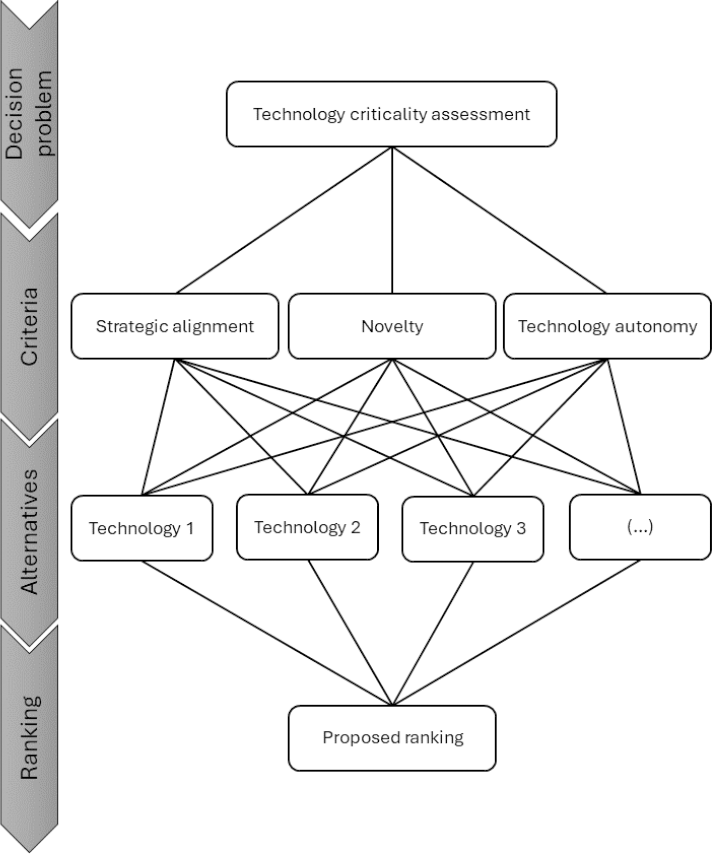
The decision-making process structure proposed in this research, including the criteria proposed by Girardi et al. (2024), is depicted in Figure 1.

2.2 Criteria definition
In this section, the criteria definition and preferences elicitation procedures proposed by Girardi et al. (2024) are presented.
2.2.1 Strategic alignment (C1)
Strategic alignment (C1) is a beneficial-criterion that addresses the importance of a technology in achieving national strategic objectives. Preferences are elicited through a survey, where a panel of specialists, forming a decision-makers’ group, provides their impressions on the impact of technologies on desired operational capabilities. This results in an index ranging from “does not impact” (grade 1) to “great impact” (grade 3).
2.2.2 Novelty (C2)
Novelty (C2) is a cost-criterion that indicates the maturity level of a technology within the country’s context, based on its innovation impact. In developing countries, novelty is framed within a local reference, where “new” does not necessarily imply something unprecedented or disruptive.
As proposed in the framework, it is possible to measure a developing country’s maturity in specific technologies on a Technology Readiness Levels (TRL) scale, customized for defense context, including production repeatability and improvements in updated versions. Thus, the novelty criterion is addressed following the TRL clusters presented in Table 1, where the panel evaluates the maturity level of the technologies.
It is noteworthy that, from the R&D viewpoint, novelty is inversely correlated with the maturity level. A lower maturity level implies a greater perception of novelty, lower national dominance of the technology, and a longer time until production of a defense system. This justifies a high criticality, expressed as a cost objective in MCDM analysis.
2.2.3 Technology autonomy (C3)
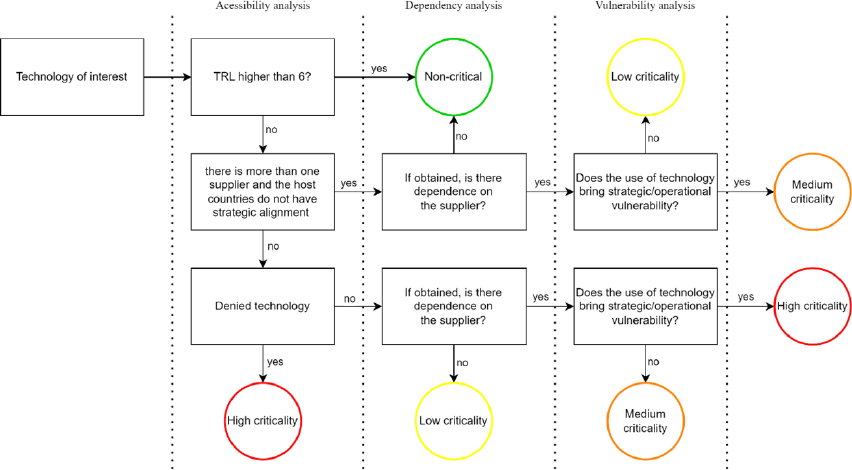
Technology autonomy (C3) is a beneficial-criterion that encompasses the availability of a technology within a country. This criterion analysis is divided in three steps: accessibility analysis, dependency analysis, and vulnerability analysis.
In the accessibility analysis, it is addressed whether a technology of interest is available in the domestic market and can be integrated, the availability of foreign suppliers from geopolitically aligned host countries, and the possibility of a technological embargo.
Depending on the technology acquisition trade, dependency and vulnerability are addressed. If a full technology transfer occurs, the technology features are under the acquirer’s control, with no dependency or vulnerability. In acquisition of Commercial-off-the-Shelf (COTS) or Modifiableoff-the-Shelf (MOTS) systems, the acquirer can be in a dependency position such as logistical, technical, and legal. From this point, the dependency can lead to logistical vulnerability (e.g., supply chain interruption) and operation vulnerability (e.g., alien interference in systems via technical aspects such as cyberwarfare).
Figure 2 presents a diagram that condenses these concepts to facilitate the specialist’s panel assessment. Technologies are graded as “non-critical” (grade 1), “low criticality” (grade 2), “medium criticality” (grade 3), and “high criticality” (grade 4).

3 METHODOLOGY
In this section, the structure of the proposed method is outlined, and the constituent steps are detailed.
3.1 Method Structure
To address the complexity of technology criticality assessment, as detailed in Section 2.1, this paper proposes the Group Extended Entropy VIKOR (GE2-VIKOR) approach. This method is tailored for a formal defense decision-making process where a sponsor establishes a working group composed of specialists (decision-makers) who express their preferences in a panel, demanding flexibility throughout the process.
With this method, the sponsor can:
-
Directly analyze the alternatives or form a specialist panel, depending on the complexity involved.
-
Express criteria weights directly in the method, ensuring strict control of ranking behavior, or address data source uncertainty using Shannon’s entropy equations.
-
Rank alternatives using majority, consensus or veto rules, thereby allowing the sponsor to balance between a “best-to-others” and a “minimal regret” scenario.
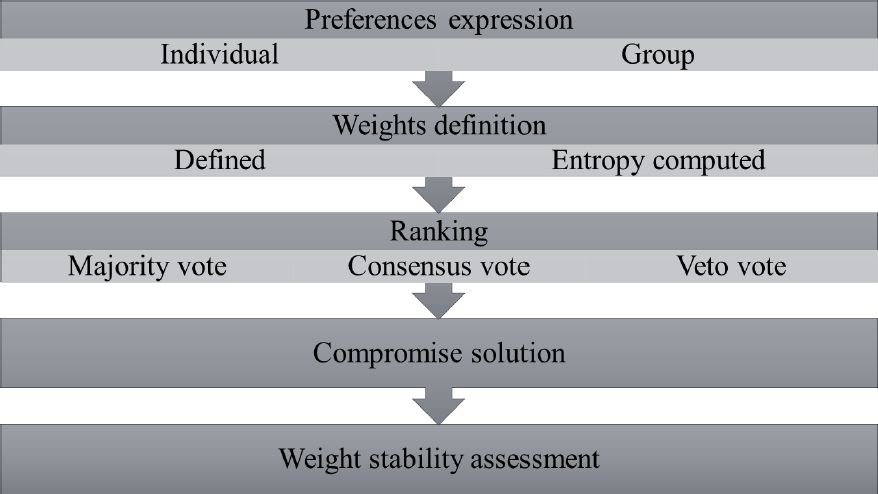
Thus, GE2-VIKOR provides flexibility to the sponsor by modularization of steps, allowing customization at each stage. It employs the multi-scenario feature of the VIKOR method, combined with Shannon’s entropy method to address information source uncertainty, and extends its functionality by including a decision-makers’ group scenario through the weighted aggregation step, accommodating the heterogeneity of the panel. The method’s structure is depicted in Figure 3.

3.2 Individual decision scenario
MCDM methods aim to assist decision-makers in arriving at suitable solutions in complex scenarios where identifying an optimal alternative among all decision criteria is challenging. Decision-maker preferences over criteria are expressed by a decision matrix M m×n , where m denotes the number of alternatives A = {A m } and n represents the number of criteria C = {C n }. Equation 1 illustrates the structure of the decision matrix.
3.3 Group decision scenario
The GE2-VIKOR method enables a group of decision-makers to participate in the process by individually expressing their preferences in a single decision matrix (Equation 1). Through a weighted aggregation step, these preferences are combined into a single matrix.
Each decision-maker k, k = 1, 2, . . . , q expresses their preferences f ijk in a decision matrix (Equation 1), forming a decision matrix, where q represents the number of decision-makers involved.
For determining decision-maker weights set by the sponsor, the Likert’s five points scale (Joshi et al., 2015), as described in Table 2, is proposed.
Each expressed weight e (k) for k=1,2,. . . ,q is then normalized to forms a set D using Equation 2.
Subsequently, the preference matrices are aggregated preference-by-preference into a M m×n matrix, as per Equation 3.
3.4 Weight definition by decision-making sponsor
The process of weight definition by the decision-making sponsor relies on qualitative impressions of the importance grade of each criterion. However, for proper computation in a MCDM method, qualitative data must be converted to quantitative data. The Likert’s five points scale (Joshi et al., 2015), as described on Table 2, is proposed for this conversion.
T he sponsor’s impressions compose a set , j = 1, 2, . . . , n, which must be normalized using Equation 4 to ensure that the sum of the elements of the weight set W is equal 1.
3.5 Weight definition by Shannon’s entropy
Shannon’s entropy method is suitable for measuring information in scenarios where uncertainty is inherent in the data (Razeghi et al., 2015; Shannon, 1948). This method focuses on evaluating the variability among expressed preferences to rank alternatives based on their dispersion, representing the distribution of information that can be distinguished between discrete states in a closed system. Chatterjee & Chakraborty (2016) highlighted that this method is well-suited for integration with the VIKOR method.
The steps of the method, as proposed by Razeghi et al. (2015), are depicted in Figure 4.

Probability values of preferences (p ij ) are obtained using Equation 5.
Normalized Shannon’s entropy for each criterion C n , where ln represents the natural logarithm, is described in Equation 6.
Subsequently, the diversity degree is computed as , and the weight vector is obtained using Equation 7.
3.6 Ranking
The ranking stage is based on VIKOR (VIseKriterijumska Optimizacija I Kompromisno Resenje) method, that aims to identify a compromise solution among a set of alternatives in a discrete decision problem, based on specified criteria (Opricovic & Tzeng, 2004, 2007). In Opricovic & Tzeng (2007), the method was compared to TOPSIS, PROMETHEE, and ELECTRE, highlighting VIKOR’s suitability due to its relative distance assessment feature, which balances maximum group utility for majority decision and minimal regret for the opponent solution.
A compromise solution refers to a feasible closest-to-ideal solution that achieves a balance between criteria, even if it may not be the optimal in any criterion (Chatterjee & Chakraborty, 2016; Opricovic & Tzeng, 2004). The primary outcomes of employing this MCDM method include the compromise ranking, compromise solution, and the determination of weight stability intervals.
The method ranks alternatives by assessing the closeness to the ideal alternative using a L p -metric as an aggregating function to evaluate the distances (Opricovic & Tzeng, 2004; Yu, 1973), as shown in Equation 8, where n is the number of criteria, m the number of alternatives, and w j the weight of j th criteria. For an alternative A i , when i = 1, 2, . . . , m, the expressed preference on j th criterion is denoted by f ij , where denotes the ideal solution, and <mml:math><mml:msubsup><mml:mi>f</mml:mi><mml:mi>j</mml:mi><mml:mo>-</mml:mo></mml:msubsup></mml:math> the worst.
VIKOR method employs L 1,j (Manhattan norm) case to describe the group utility function S i (or “majority” rule), and L ∞,j (Chebyshev norm) as the individual regret function R i . It ranks alternatives based on min S i and min R i as the “closest-to-ideal” metric, and a compromise function Q i is determined balacing S and R rankings.
The steps of VIKOR method, as proposed by Opricovic & Tzeng (2004), are depicted in Figure 5.

The best and the worst values for each criterion (Step 1) are obtained accordingly to Table 3 (Opricovic & Tzeng, 2004).
The S i and R i , i = 1, 2, . . . , m values (Step 2) are computed by Equations 9 and 10.
The optimal solutions S ∗ and R ∗, and worst S − and R − are obtained as defined in Table 4 (Opricovic & Tzeng, 2004).
The values of Q i (Step 3) are computed from Equation 11, where ν represents the balance between S i and R i in three scenarios: voting by a majority rule (ν > 0.5), consensus rule (ν ≈ 0.5), or veto rule (ν < 0.5) (Opricovic & Tzeng, 2004).
The alternatives are ranked in ascending order in three lists by the values of S, R and Q (Step 4). Then, it is proposed a compromise solution a ′ (Step 5), that must satisfy two conditions:
-
Acceptable advantage (C1)
Where a' is the best alternative ranked by the Q list, and a" is the second one.
-
Acceptable stability in decision-making (C2)
-
The alternative a' must also the best by S and/or R rank.
If one of the conditions is not satisfied, then a set of compromise solutions is offered, following the conditions:
-
The set a = {a′, a′′}, if only C2 is not satisfied; or
-
The set a = {a′, a′′, . . . , a M } if C1 is not satisfied, and a M is determined by Q(a M ) − Q(a′) < DQ for the maximum M.
3.7 Weight stability assessment
The weight stability assessment aims to establish intervals within a criterion weight can vary without altering the previous ranking. As noted by Opricovic & Tzeng (2007), VIKOR is not an additive method, necessitating a distinct procedure for determining weight stability intervals.
When considering a determined criterion weight w j , it can be adjusted from its original value, denoted as . To preserve normalization, the remaining weights w n , n ≠ j must maintain their original ratio, expressed as . Consequently, the combination of w j and w n is expressed as , and rearranged as shown in Equation 13.
Based on Equation 13, the λ ratio for the j th criterion is assessed within the 0 ≤ λ ≤ 1/w j interval. Meanwhile, the other weights w n are adjusted by ϕ (λ) during a new iteration of GE2-VIKOR while preserving the original ranking. This process yields the stability interval λ 1 ≤ λ ≤ λ 2. Consequently, the weight stability interval for j th criterion can be expressed using Equation 14.
4 RESULTS AND DISCUSSION
Following the criteria definition and preferences elicitation for defense technology criticality in developing countries outlined in Section 2.1, this section presents a demonstration and discussion of results obtained through GE2-VIKOR application, as described in Section 3.
4.1 Demonstration
In this simulated decision-making process, the sponsor aims to assess five alternatives (T1, T2, T3, T4, T5), establishing a decision-making panel comprising three decision-makers. Preferences and weights for each decision-maker were elicited using a pseudo-random function.
Due to the sensitivity of the data in this context, conducting a real scenario evaluation was not feasible. However, this does not compromise the demonstration of the GE2-VIKOR method.
The decision-makers’ weights set e (k) = {3; 5; 5} was normalized using Equation 2, resulting in the decision-makers’ normalized weight set D = {0.23077; 0.38462; 0.38462}. The decisionmakers’ preferences are outlined in Table 5.
The aggregation of matrices from Table 5 using Equation 3 produced the decision matrix M as shown in Table 6.
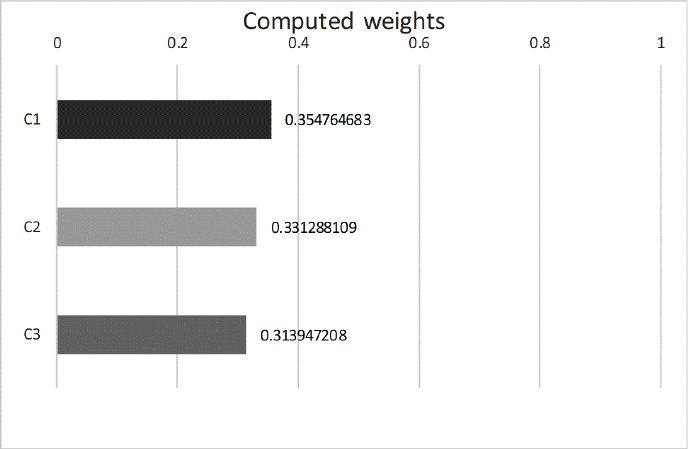
In order to establish the degree of importance of each criterion, computed weights were obtained using Shannon’s entropy Equations 5, 6 and 7 forming the weight vector w as depicted in Table 7.
From Figure 6, it can be stated that criterion C1 is the most valuable in this evaluated scenario, carrying the highest importance, followed by criteria C2 and C3.

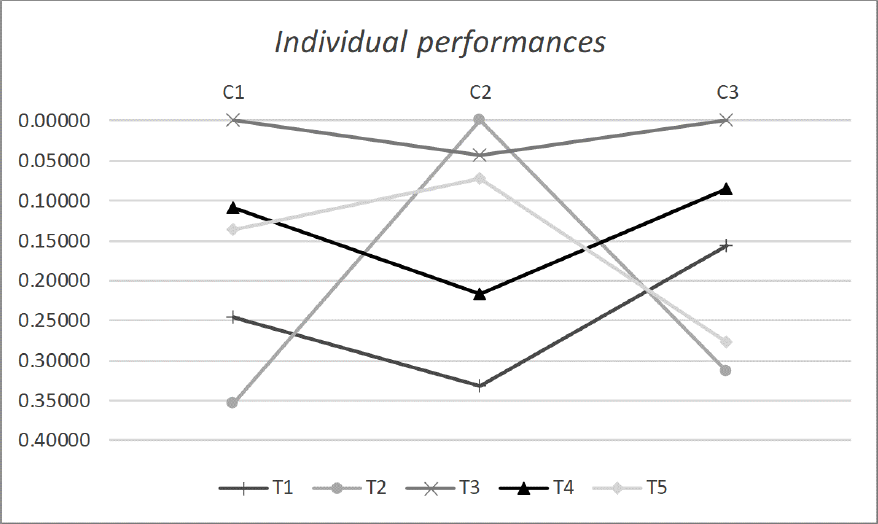
Ranking was based on VIKOR steps (Equations 9, 10, and 11, and Tables 3 and 4), with individual performances illustrated in Figure 7, where alternative T3 showed the best performance on criteria C1 and C3, and alternative T2 performed best on criterion C2.

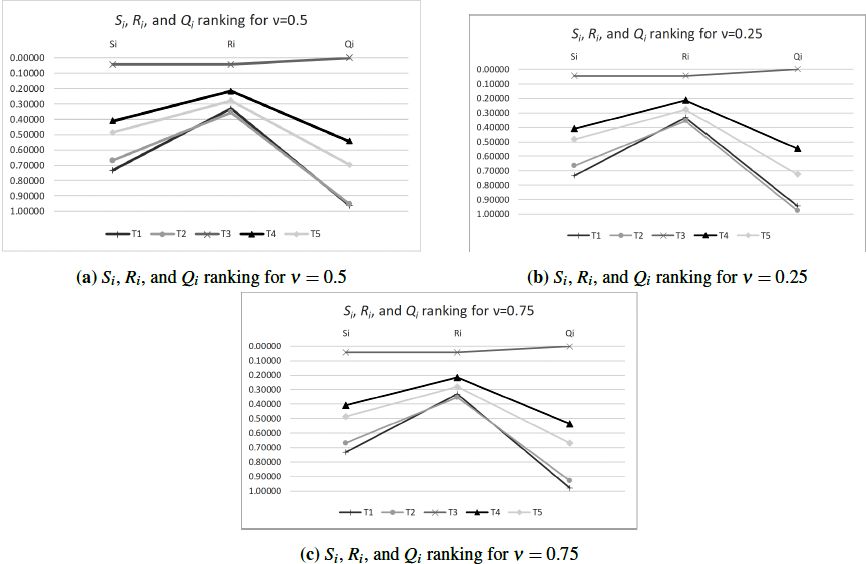
Ranking results for S i , R i , and Q i are provided in Table 8. Figure 8 depicts the results, where it is possible to visualize that alternative T3 is the best in all rankings, confirming T3 as the compromise solution in consensus (ν = 0.5), veto (ν = 0.25), and majority (ν = 0.75) scenarios. It is noteworthy that T1 and T2 perform differently in the R i rankings, justifying a ranking change in the ν = 0.25 scenario.

The final ranking is presented in Table 9, where T3 was elected as the compromise solution.
In order to observe equivalence between alternatives, the solutions were clustered by quartiles, aiding the decision-making process, as presented in Table 10, where T4 and T5 can be assumed to be equivalent options.
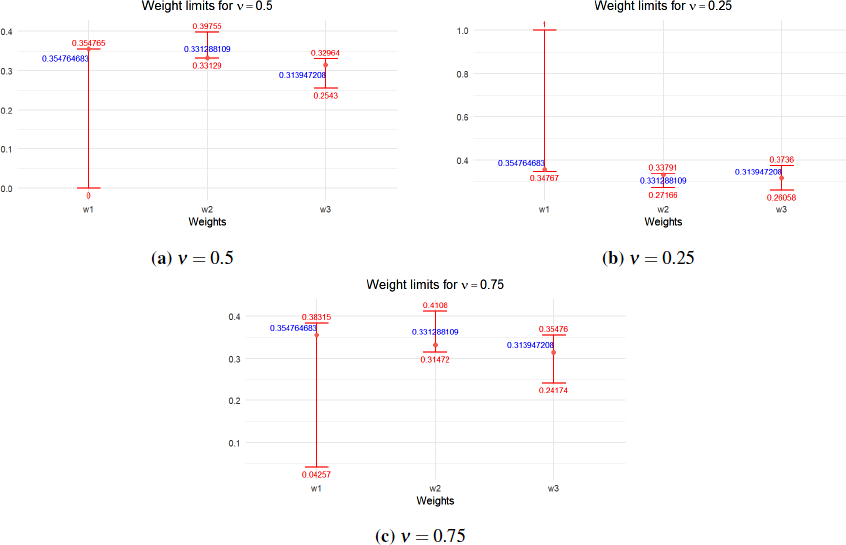
Weights stability, computed using Equations 13 and 14, is detailed in Table 11 and Figure 9. It can be observed that criterion C1 showed a larger range of stability, indicating that it can tolerate higher variance without altering the ranking. Criterion C2 exhibited higher stability under majority rule, with a range of 0.09608, and equivalent stability under the consensus and veto rules (0.06626 and 0.06625, respectively). Criterion C3 is more stable in the majority and veto scenarios (0.11302 in both), and less stable in the consensus scenario (0.07534).
4.2 Discussion
This demonstration highlights the versatility of the GE2-VIKOR method in enhancing defense decision-making processes through flexible and customized stages. By accommodating the diverse perspectives within a specialist panel, this method expands upon the capabilities of the VIKOR approach with its weighted aggregation step, providing new capabilities to that approach.
In the defined criteria weights scenario, the GE2-VIKOR method empowers decision-making process sponsors to control the behavior of each criterion. Utilizing Shannon’s source information entropy in computed criteria weights scenario adds a robust layer to address uncertainty effectively.
From discrete qualitative elicitation of preferences, GE2-VIKOR emerges as a suitable MCDM method for tackling complex defense decision problems. Its flexibility is also expressed through consensus, majority or veto multi-scenario, where “best-to-others” (S ranking) and “minimal regret” (R ranking) are balanced by the ν index in the Q ranking.
The proposed compromise solution ensures a robust recommendation by rigorously selecting the best-ranked alternative, guaranteeing its superiority by measuring if its performance is sufficiently far apart from the other alternatives.
Lastly, the assessment of weight stability provides decision-making sponsors with higher reliability by delineating the range within which the proposed ranking remains consistent.
The GE2-VIKOR method offers a novel approach to defense technology criticality assessment. Tailored to the specific demands and characteristics of decision-making processes in this domain, it represents a new tool in decision-making methods.
5 CONCLUSION
This paper aimed to address the defense technology criticality assessment problem in developing countries through a hybrid MCDM method. Leveraging the suitability of VIKOR for ranking discrete alternatives, the application of Shannon’s entropy theory for data treatment in weights definition, and the proposed extension to group decision-making, GE2-VIKOR emerges as a fitting approach in this problem category.
The Theoretical Foundation section explored the characteristics of a decision-making process of defense technology criticality assessment, the Methodology section delved into the steps and features comprising the method, while the Results and Discussion section presented a demonstration using pseudo-aleatory data. Through graphical demonstrations, this study showcased the analytical possibilities to assist decision-makers in deriving conclusions from both overall and individual alternative performances.
The inability to compute real data due to the lack of reliable sources openly available can be attributed to the sensitive nature of defense technology criticality assessment, often entwined with countries’ policies that demand discretion in data sourcing.
Nevertheless, this paper introduces GE2-VIKOR as a MCDM method and decision-making tool, optimized particularly for uncertain and complex scenarios where data must be sourced from decision-makers with diverse knowledge backgrounds. The incorporation of decision-makers’ weighted preferences enhances the method’s analytical capabilities.
The framework proposed by Girardi et al. (2024) delineate defense technology criticality assessment in developing countries based on strategic alignment, novelty and technology autonomy criteria, primarily through qualitative analysis. However, GE2-VIKOR is adaptable to be applied in quantitative criteria as well, inviting further research to explore additional decision problem domains.
For further research, it is suggested to examine the application of the GE2-VIKOR approach in technology criticality assessment for developed countries and other industrial fields. Given the nuances surrounding the concept of criticality itself, this exploration may necessitate the inclusion of new criteria in the decision-making problem.
References
-
ALAO M, AYODELE T, OGUNJUYIGBE A & POPOOLA O. 2020. Multi-criteria decision based waste to energy technology selection using entropy-weighted TOPSIS technique: The case study of Lagos, Nigeria. Energy, 201. Available at: https://www.scopus.com/inward/record.uri?eid=2-s2.0-85083842766&doi=10.1016%2fj.energy.2020.117675&partnerID=40&md5=207ce18640d77ad1209b102ccae5ef52
» https://www.scopus.com/inward/record.uri?eid=2-s2.0-85083842766&doi=10.1016%2fj.energy.2020.117675&partnerID=40&md5=207ce18640d77ad1209b102ccae5ef52 -
ALI SHAH SA ET AL. 2021. Energy trilemma based prioritization of waste-to-energy technologies: Implications for post-COVID-19 green economic recovery in Pakistan. Journal of Cleaner Production, 284: 124729. Available at: https://www.sciencedirect.com/science/article/pii/S0959652620347739
» https://www.sciencedirect.com/science/article/pii/S0959652620347739 - ALMEIDA JÚNIOR IMD & ALMEIDA FAD. 2023. Sistemas e Aplicações de Tecnologia para o Exército Brasileiro. Análise Estratégica, 29: 75-95.
-
ARABI B, TOLOO M, YANG Z, ZHANG P & XU B. 2024. Sustainable refrigeration technology selection: An innovative DEA-TOPSIS hybrid model. Environmental Science and Policy, 158. Available at: https://www.scopus.com/inward/record.uri?eid=2-s2.0-85193972749&doi=10.1016%2fj.envsci.2024.103780&partnerID=40&md5=ab884ce0e20fbcacad519b1b7efd591e
» https://www.scopus.com/inward/record.uri?eid=2-s2.0-85193972749&doi=10.1016%2fj.envsci.2024.103780&partnerID=40&md5=ab884ce0e20fbcacad519b1b7efd591e -
CHATTERJEE P & CHAKRABORTY S. 2016. A comparative analysis of VIKOR method and its variants. Decision Science Letters, pp. 469-486. Available at: http://www.growingscience.com/dsl/Vol5/dsl_2016_16.pdf
» http://www.growingscience.com/dsl/Vol5/dsl_2016_16.pdf -
CINELLI M, KADZIŃSKI M, GONZALEZ M & SŁOWIŃSKI R. 2020. How to support the application of multiple criteria decision analysis? Let us start with a comprehensive taxonomy. Omega, 96: 102261. Available at: https://www.sciencedirect.com/science/article/pii/S0305048319310710
» https://www.sciencedirect.com/science/article/pii/S0305048319310710 -
COSTA HG, SILVA RC & PESSÔA LAM. 2023. An outranking ELECTRE-based modeling for setting the naval core components of an amphibious task force. Pesquisa Operacional, 43. Available at: https://www.scopus.com/inward/record.uri?eid=2-s2.0-85174321153&doi=10.1590%2f0101-7438.2023.043.00262058&partnerID=40&md5=259500c7abfc5979acfa6eb18dd7e28c
» https://www.scopus.com/inward/record.uri?eid=2-s2.0-85174321153&doi=10.1590%2f0101-7438.2023.043.00262058&partnerID=40&md5=259500c7abfc5979acfa6eb18dd7e28c -
DOGAN O. 2021. Process mining technology selection with spherical fuzzy AHP and sensitivity analysis. Expert Systems with Applications, 178. Available at: https://www.scopus.com/inward/record.uri?eid=2-s2.0-85104592031&doi=10.1016%2fj.eswa.2021.114999&partnerID=40&md5=2a3fb61c08a903cecdf3d47c3c779b6e
» https://www.scopus.com/inward/record.uri?eid=2-s2.0-85104592031&doi=10.1016%2fj.eswa.2021.114999&partnerID=40&md5=2a3fb61c08a903cecdf3d47c3c779b6e -
DREI SM, DOS SANTOS M, GOMES CFS & ANGULO-MEZA L. 2024. Waste reduction using the THOR 2 hybrid method: decision making in the context of lean healthcare. Pesquisa Operacional, 44. Available at: https://www.scopus.com/inward/record.uri?eid=2-s2.0-85187896908&doi=10.1590%2f0101-7438.2023.043.00278889&partnerID=40&md5=0b9f7736151f0df448bcd8ce55c485eb
» https://www.scopus.com/inward/record.uri?eid=2-s2.0-85187896908&doi=10.1590%2f0101-7438.2023.043.00278889&partnerID=40&md5=0b9f7736151f0df448bcd8ce55c485eb -
FAVERI MA, MOTA CMDM & RAMOS FDS. 2024. Distribution of investigations in the Brazilian Federal Police using Agency Theory, Shapley’s value and MCDA model. Pesquisa Operacional, 44: e276108. Available at: https://doi.org/10.1590/0101-7438.2023.043.00276108
» https://doi.org/10.1590/0101-7438.2023.043.00276108 -
GAZIBEY Y, KANTEMIR O & DEMIREL A. 2015. Interaction among the criteria affecting main battle tank selection: An analysis with DEMATEL method. Defence Science Journal, 65(5): 345 - 355. Available at: https://www.scopus.com/inward/record.uri?eid=2-s2.0-84941330743&doi=10.14429%2fdsj.65.8924&partnerID=40&md5=aa01beb60e799ab087c3857fbb91447a
» https://www.scopus.com/inward/record.uri?eid=2-s2.0-84941330743&doi=10.14429%2fdsj.65.8924&partnerID=40&md5=aa01beb60e799ab087c3857fbb91447a -
GIRARDI R, FRANÇA JUNIOR JA & GALDINO JF. 2024. Criticidade tecnológica na área de defesa em países em desenvolvimento: conceitos e critérios. Revista de Gestão e Secretariado, 15(4): e3618. Available at: https://ojs.revistagesec.org.br/secretariado/article/view/3618
» https://ojs.revistagesec.org.br/secretariado/article/view/3618 - GUO W. 2012. Investment value assessment model of the National Critical Technology based on independent innovation. In: 2012 24th Chinese Control and Decision Conference (CCDC). pp. 793-798.
-
HAMURCU M & EREN T. 2020. Selection of Unmanned Aerial Vehicles by Using Multicriteria Decision-Making for Defence. Journal of Mathematics, 2020. Available at: https://www.scopus.com/inward/record.uri?eid=2-s2.0-85088021694&doi=10.1155% 2f2020%2f4308756&partnerID=40&md5=835c8453e31262342200336066141914
» https://www.scopus.com/inward/record.uri?eid=2-s2.0-85088021694&doi=10.1155% 2f2020%2f4308756&partnerID=40&md5=835c8453e31262342200336066141914 -
JOSHI A, KALE S, CHANDEL S & PAL D. 2015. Likert Scale: Explored and Explained. British Journal of Applied Science & Technology, 7(4): 396-403. Available at: https://journalcjast.com/index.php/CJAST/article/view/381
» https://journalcjast.com/index.php/CJAST/article/view/381 - KHARAT MG ET AL. 2019. Fuzzy multi-criteria decision analysis for environmentally conscious solid waste treatment and disposal technology selection. Technology in Society, 57: 20 - 29.
-
KURNAZ S, ÖZDAĞOĞLU A & KELEŞ MK. 2023. Method of evaluation of military helicopter pilot selection criteria: a novel grey SWARA approach. Aviation, 27(1): 27 - 35. Available at: https://www.scopus.com/inward/record.uri?eid=2-s2.0-85149579843&doi=10.3846%2faviation.2023.18596&partnerID=40&md5=ddec7226305fea3bdd607c8550ee8fd3
» https://www.scopus.com/inward/record.uri?eid=2-s2.0-85149579843&doi=10.3846%2faviation.2023.18596&partnerID=40&md5=ddec7226305fea3bdd607c8550ee8fd3 -
LAI H & LIAO H. 2021. A multi-criteria decision making method based on DNMA and CRITIC with linguistic D numbers for blockchain platform evaluation. Engineering Applications of Artificial Intelligence, 101: 104200. Available at: https://www.sciencedirect.com/science/article/pii/S0952197621000476
» https://www.sciencedirect.com/science/article/pii/S0952197621000476 -
LU C, YOU JX, LIU HC & LI P. 2016. Health-carewaste treatment technology selection using the interval 2-Tuple induced TOPSIS method. International Journal of Environmental Research and Public Health, 13(6). Available at: https://www.scopus.com/inward/record.uri?eid=2-s2.0-84973327092&doi=10.3390%2fijerph13060562&partnerID=40&md5=304f97ebebeb65d74af1609cc7cb6803
» https://www.scopus.com/inward/record.uri?eid=2-s2.0-84973327092&doi=10.3390%2fijerph13060562&partnerID=40&md5=304f97ebebeb65d74af1609cc7cb6803 -
MAGHSOODI AI, MAGHSOODI AI, MOSAVI A, RABCZUK T & ZAVADSKAS EK. 2018. Renewable energy technology selection problem using integrated HSWARA-MULTIMOORA approach. Sustainability (Switzerland), 10(12). Available at: https://www.scopus.com/inward/record.uri?eid=2-s2.0-85061116175&doi=10.3390%2fsu10024481&partnerID=40&md5=f7ce57db181085f279e1499042180373
» https://www.scopus.com/inward/record.uri?eid=2-s2.0-85061116175&doi=10.3390%2fsu10024481&partnerID=40&md5=f7ce57db181085f279e1499042180373 - MARDANI A ET AL. 2016. Using fuzzy multiple criteria decision making approaches for evaluating energy saving technologies and solutions in five star hotels: A new hierarchical framework. Energy, 117: 131-148.
-
OPRICOVIC S & TZENG GH. 2004. Compromise solution by MCDM methods: A comparative analysis of VIKOR and TOPSIS. European Journal of Operational Research, 156(2): 445-455. Available at: https://linkinghub.elsevier.com/retrieve/pii/S0377221703000201
» https://linkinghub.elsevier.com/retrieve/pii/S0377221703000201 -
OPRICOVIC S & TZENG GH. 2007. Extended VIKOR method in comparison with outranking methods. European Journal of Operational Research , 178(2): 514-529. Available at: https://linkinghub.elsevier.com/retrieve/pii/S0377221706000555
» https://linkinghub.elsevier.com/retrieve/pii/S0377221706000555 - OZTAYSI B. 2014. A decision model for information technology selection using AHP integrated TOPSIS-Grey: The case of content management systems. Knowledge-Based Systems, 70: 44-54.
-
RAZEGHI B, OKATI N & HODTANI GA. 2015. A novel approach to mathematical multiple criteria decision making methods based on information theoretic measures. In: 2015 Iran Workshop on Communication and Information Theory (IWCIT). pp. 1-6. Tehran, Iran: IEEE. Available at: http://ieeexplore.ieee.org/document/7140219/
» http://ieeexplore.ieee.org/document/7140219/ - REN J. 2018. Technology selection for ballast water treatment by multi-stakeholders: A multiattribute decision analysis approach based on the combined weights and extension theory. Chemosphere, 191: 747-760.
- REN J, LIANG H & CHAN FT. 2017. Urban sewage sludge, sustainability, and transition for Eco-City: Multi-criteria sustainability assessment of technologies based on best-worst method. Technological Forecasting and Social Change, 116: 29-39.
- REN J & LÜTZEN M. 2015. Fuzzy multi-criteria decision-making method for technology selection for emissions reduction from shipping under uncertainties. Transportation Research Part D: Transport and Environment, 40: 43-60.
-
SALAMIRAD A, KHEYBARI S, ISHIZAKA A & FARAZMAND H. 2023. Wastewater treatment technology selection using a hybrid multicriteria decision-making method. International Transactions in Operational Research, 30(3): 1479 - 1504. Available at: https://www.scopus.com/inward/record.uri?eid=2-s2.0-85103626646&doi=10.1111%2fitor.12979&partnerID=40&md5=10845cb923252f31296d0e19fb483a75
» https://www.scopus.com/inward/record.uri?eid=2-s2.0-85103626646&doi=10.1111%2fitor.12979&partnerID=40&md5=10845cb923252f31296d0e19fb483a75 -
SHANNON CE. 1948. A Mathematical Theory of Communication. Bell System Technical Journal, 27(3): 379-423. Available at: https://onlinelibrary.wiley.com/doi/abs/10.1002/j.1538-7305.1948.tb01338.x
» https://onlinelibrary.wiley.com/doi/abs/10.1002/j.1538-7305.1948.tb01338.x -
TORKAYESH AE, MALMIR B & RAJABI ASADABADI M. 2021. Sustainable waste disposal technology selection: The stratified best-worst multi-criteria decision-making method. Waste Management, 122: 100-112. Available at: https://www.sciencedirect.com/science/article/pii/S0956053X21000040
» https://www.sciencedirect.com/science/article/pii/S0956053X21000040 - YADEGARIDEHKORDI E ET AL. 2020. Assessment of sustainability indicators for green building manufacturing using fuzzy multi-criteria decision making approach. Journal of Cleaner Production , 277: 122905.
-
YANG Y ET AL. 2018. Using multi-criteria analysis to prioritize renewable energy home heating technologies. Sustainable Energy Technologies and Assessments, 29: 36-43. Available at: https://www.sciencedirect.com/science/article/pii/S2213138817304824
» https://www.sciencedirect.com/science/article/pii/S2213138817304824 -
YU PL. 1973. A Class of Solutions for Group Decision Problems. Management Science, 19(8): 936-946. Available at: https://doi.org/10.1287/mnsc.19.8.936
» https://doi.org/10.1287/mnsc.19.8.936 -
ZUBIRIA A, MENÉNDEZ A, GRANDE HJ, MENESES P & FERNÁNDEZ G. 2022. Multi-Criteria Decision-Making Problem for Energy Storage Technology Selection for Different Grid Applications. Energies, 15(20). Available at: https://www.scopus.com/inward/record.uri?eid=2-s2.0-85140777530&doi=10.3390%2fen15207612&partnerID=40&md5=d3f7b3656d584537171fcb4cf8f76370
» https://www.scopus.com/inward/record.uri?eid=2-s2.0-85140777530&doi=10.3390%2fen15207612&partnerID=40&md5=d3f7b3656d584537171fcb4cf8f76370

 Source: