
 Racial equity and tobacco control: an analysis of the inclusion of Black and quilombola populations in State and Municipal Health Plans
Abstract
Introduction: State Health Plans (PES) and Municipal Health Plans (PMS) are the foundation for organizing priorities, goals, and actions across federative levels in Brazil. The incorporation of racial equity and tobacco-control agendas into these instruments is strategic, especially given the persistent inequalities affecting Black and quilombola populations in terms of access, health outcomes, and exposure to social and commercial determinants of health. Despite well-established national guidelines, significant gaps remain in the integration of race/skin color and tobacco-control policies, underscoring the relevance of this discussion within the broader field of health equity.
Objective: To analyze the inclusion of actions, guidelines, and indicators related to tobacco control aimed at Black and quilombola populations in PES (2020-2023; 2024-2027) and in PMS from state capitals and municipalities with the largest quilombola populations (2018-2021; 2022-2025), assessing their level of institutionalization, continuity, and mainstreaming.
Methods: Qualitative documentary analysis was carried out using 178 planning instruments, including 54 State Plans, 54 capital-city plans, and 72 municipal plans from areas with substantial quilombola populations. The assessment followed a three-dimensional methodological framework: (A) situational analysis and equity guidelines; (B) institutionalization of tobacco control and National Tobacco Control Policy programmatic structure; and (C) presence, evolution, and continuity of these themes across cycles.
Results: Low institutionalization of the race/skin color variable was observed, along with limited references to quilombola populations. Most plans present descriptive mentions without associated goals or indicators. Tobacco control appeared in a fragmented manner, primarily as a general risk factor for chronic diseases. Very few documents integrated tobacco control with racial-equity considerations.
Conclusion: The analysis revealed that tobacco control actions targeting the Black and quilombola populations are poorly linked to health diagnoses, with little mention of planning that considers ethnic-racial issues.
Keywords:
Tobacco control; Black population; Quilombola population; Health planning; Social determinants of health.
Resumo
Introdução: Os Planos Estaduais de Saúde (PES) e Planos Municipais de Saúde (PMS) constituem a base da organização das prioridades, metas e ações dos entes federativos. A incorporação das agendas de equidade racial e de controle do tabagismo nesses instrumentos é estratégica, sobretudo diante das desigualdades que afetam a população negra e quilombola no acesso, nos desfechos e no impacto dos determinantes sociais e comerciais da saúde. Apesar de diretrizes normativas consolidadas, permanecem lacunas importantes na integração entre raça/cor da pele e políticas de controle do tabaco, situando essa discussão como importante questão no âmbito da equidade em saúde.
Objetivo: Analisar a inclusão de ações, diretrizes e indicadores referentes ao controle do tabagismo relacionados às populações negra e quilombola nos PES (2020-2023; 2024-2027) e nos PMS das capitais e dos municípios com maiores contingentes quilombolas (2018-2021; 2022-2025), avaliando seu grau de institucionalização, continuidade e transversalização.
Métodos: Realizou-se análise documental qualitativa de 178 instrumentos de planejamento, incluindo 54 Planos estaduais, 54 planos das capitais e 72 Planos municipais com elevada presença quilombola. A avaliação seguiu um quadro metodológico estruturado em três dimensões para leitura e análise: (A) análise situacional e diretrizes de equidade; (B) institucionalização do tabagismo e estrutura programática do PNCT; (C) presença, evolução e continuidade dos temas entre ciclos.
Resultados: Observou-se baixa institucionalização da variável raça/cor e menções ainda limitadas à população quilombola. A maioria dos planos apresenta referências descritivas, sem metas, indicadores. O tabagismo aparece de forma fragmentada, predominantemente como fator de risco para outras doenças. Raríssimos documentos integram tabagismo e equidade racial.
Conclusão: A análise revelou que as ações de controle do tabagismo voltadas à população negra e quilombola estão pouco articuladas ao diagnóstico de saúde, com baixa menção a planejamentos que consideram as questões étnico-raciais.
Palavras-chave:
Tabagismo; População negra; População quilombola; Planejamento em saúde; Determinantes sociais.
Introduction
The management of the Brazilian Unified Health System (SUS) is structured by planning instruments that guide priorities, goals, and responsibilities at different federative levels (Brasil, 2013). Among these instruments, the State Health Plans (Planos Estaduais de Saúde - PES) and the Municipal Health Plans (Planos Municipais de Saúde - PMS) play a fundamental role, as they define the strategic directions of management in each territory and establish the actions that will be executed throughout their validity. The plans are essential documents for establishing public health policies that will be operationalized in the various contexts that constitute the Brazilian territory (Brasil, 2016a). Furthermore, their relevance stems from the fact that they materialize national guidelines and commitments assumed by the federative entity, allowing the identification of which themes will be prioritized in each territory, and how resources will be distributed. Thus, the presence or absence of certain themes in the plans reveals trends, silences, and management choices that directly impact some population groups, especially the Black and quilombola populations.
The racial equity agenda within the SUS, in its fundamental guidelines, addresses this need both within the constitutional framework and in the SUS legislation itself, which consolidated universality and equity as fundamental principles of the system (Brasil, 1988; 1990a; 1990b). Other normative frameworks have been giving substance to equity actions and expanding the reach of racial equality policies and programs within the SUS. Programs such as the Quilombola Brazil program recognize the territorial and sociocultural specificities of these communities (Brasil, 2004); the National Policy for Comprehensive Health of the Black Population (Política Nacional de Saúde Integral da População Negra - PNSIPN) establishes the mandatory inclusion of an ethnic-racial perspective in planning and management (Brasil, 2009); Ordinance No. 344/2017 made the collection of race/color data mandatory in information systems (Brasil, 2017), and more recently, Decree No. 11,447/2023 established the Aquilombola Brazil Program, expanding the state’s commitment to territorial, social, and cultural rights, and strengthening intersectoral actions aimed at quilombola communities (Brasil, 2023a). These normative frameworks are significant advances, but they also impose the need to assess their effective incorporation into health planning instruments.
In this normative and political context, the interface between the racial equity agenda and tobacco control policies emerges as the central axis of this study. Data from the National Health Survey - Pesquisa Nacional de Saúde (Brasil, 2020) indicate that smoking has higher prevalence rates among Black (13.5%) and mixed-race (13.3%) people compared to white people (11.6%), in addition to greater exposure to secondhand smoke (10.4% and 10.1% versus 7.9%). Considering these dynamics in the planning of health policies is essential to understand how structural factors shape risk, illness, and access to care.
From a historical perspective, smoking in Brazil has been accumulating excellent results with decreasing usage curves among the general population. In this process, an important milestone was the ratification of the Framework Convention on Tobacco Control, which took place in 2003. This Convention was effectively adopted in 2006, with the publication of the presidential decree, and serves as the basis for guiding the implementation of the National Tobacco Control Policy (Política Nacional de Controle do Tabagismo - PNCT) in Brazil (Brasil, 2023b). The Convention recognizes that social and economic inequalities shape consumption patterns and must be addressed through integrated and equity-oriented public policies, reinforcing the responsibility of the Brazilian State to consider inequalities in its tobacco control strategies (WHO, 2005).
Based on these frameworks, analyzing how smoking is described in State and Municipal Health Plans allows us to identify how this problem is prioritized. Similarly, it allows us to verify whether the plans incorporate specific actions for historically vulnerable groups and pay attention to the implications of smoking as a socially determined disease.
Studies on smoking related to the most vulnerable groups address the topic tangentially, generally limited to the risks of other chronic diseases or describing traditional uses (Buti, 2022; Cardoso et al., 2018). There is a lack of studies that specifically address smoking based on its relationship with social and commercial determinants and the degree of institutionalization of policies with equity actions (Silva, 2022). Therefore, this study is an analytical effort in the face of the scarcity of more comprehensive studies on smoking and the Black and quilombola population in Brazil.
Method
The capitals were included due to their political-administrative centrality, and the municipalities with the largest quilombola population were selected to capture relevant territorial dynamics. The selection of municipalities with the largest quilombola population was based on the 2022 Demographic Census and considered three population ranges: above 10,000, between 5,000 and 10,000, and below 5,000 inhabitants (Brasil, 2022a; 2022b; 2023c). In total, 178 documents were analyzed: 54 State Health Plans (including the Federal District), 52 Municipal Health Plans from capital cities, and 72 Municipal Health Plans from municipalities with the largest quilombola population. All documents were obtained through the Health Information System for Primary Care - Digital (DigiSUS) (Brasil, 2024a).
The analysis of the State and Municipal Health Plans followed a methodological framework structured in three dimensions (Chart 1): (A) situational analysis; guidelines, objectives, goals, and actions; (B) specific dimensions of smoking; (C) presence of the theme and continuity between cycles, always considering the transversality of the race/skin color variable, references to the quilombola population, and actions related to smoking. In all dimensions, the degree of detail of each category and how these are articulated with the health agendas of the population, quilombola people, and their relationship with smoking were analyzed.
The analysis faced limitations resulting from the large volume of documents and the lack of standardization between State and Municipal Health Plans, which made the process of extracting and comparing information more complex.
Results
Situational analysis by race/color and quilombola population (Cycles 2020-2023 and 2024-2027)a
General health data
In the 2020-2023 and 2024-2027 cycles, indicators disaggregated by race/skin color were present in approximately 40% of the states, reflecting that, although there is recognition of the importance of this variable, it is not yet consolidated as a structuring element of health plans. The increase from 15% to 26% in mentions of the quilombola population between cycles is progress, but still restricted to just over a quarter of the federative units. This points to an unequal and fragmented institutionalization of this variable in state plans. The states of Alagoas and Paraná stand out for establishing clear goals to improve records on the health of the Black and quilombola population, something that is still absent in many other states.
Morbidity and mortality causes
Regarding the causes of morbidity and mortality, the analysis revealed a modest increase in the inclusion of race/skin color and the quilombola population in the plans, which went from 37% to 41%, while the inclusion of the quilombola population increased from 7% to 19%. This progress, although positive, is still limited, without a structured shift in health diagnoses and the proposal of programmatic actions.
States such as Maranhão and Pernambuco specifically mentioned the high mortality rates among young Black people and racial inequalities in the causes of morbidity and mortality, but, again, without the necessary depth in the policies to address them.
Demographic and socioeconomic aspects
In terms of demographics and socioeconomics, the incorporation of the race/skin color variable in state plans showed a slight increase but remained fragmented. Mention of the quilombola population showed more significant progress, especially in the states of Pernambuco and Maranhão, which highlighted the socioeconomic conditions of this population.
Violence and health
Among the categories analyzed, violence in healthcare stands out due to the scarcity of mentions in state health plans. This category, although extremely relevant, especially in the context of Black and quilombola populations, remains underrepresented. In states that provide more detailed information, such as Rio de Janeiro and Minas Gerais, data on violence suggests a certain degree of incorporation of this indicator in the planning of actions and monitoring. Furthermore, they highlight violence as a social determinant of health and a preponderant factor in inequalities in access, especially in contexts of institutional racism.
The states of Alagoas and Paraná stand out for establishing goals to improve the recording of violence. An important step towards making this serious health problem visible. Pernambuco and Rio Grande do Sul point to the highest prevalence of violence against Black and mixed-race people, something that points to a framework of structural racism present in social relations and in the health system. Maranhão details an alarming increase in homicides among young Black people. The state of Goiás, in turn, exposes allegations of institutional prejudice, religious intolerance, and homicides in quilombola communities, pointing to a broader territorial dimension of violence, associated with ethnic-racial racism and social exclusion.
These findings reveal that the topic is still marginalized in health plans, even given its centrality in studies on health and structural racism. None of the Municipal Health Plans analyzed establish an explicit relationship between smoking and violence in the black and quilombola population. The documents mention both topics separately, without articulation between social determinants, territorial vulnerabilities, or combined impacts on these groups. Graph 1 presents the percentage distribution of mentions in each of the categories analyzed.

Topics covered in the State and Federal District Health Plans (Cycles 2020-2023 and 2024-2027)
Equity guidelines and actions (Cycles 2020-2023 and 2024-2027)
Most plans contain more descriptive mentions, with generic links to the guidelines of the National Policy for Comprehensive Health of the Black Population (PNSIPN). These states mention the policy, but without presenting clear goals, resources, or operational mechanisms, suggesting an implementation that is still in its early stages.
The mentions also remain at a more descriptive stage, emphasizing the identification of challenges such as the difficulty in collecting data on race/skin color, without clear indicators of strategies and budget forecasts.
Some states stand out for presenting programmatic and institutional mentions, evidencing concrete efforts to adapt and operationalize the PNSIPN. Among these states are Paraíba, Pernambuco, Maranhão, Rio Grande do Sul, and Goiás, which report the creation of technical committees, state forums, and protocols to combat institutional racism. In addition, Maranhão and Minas Gerais have their own policies and specific committees to promote anti-discrimination guidelines and the comprehensive health of the Black population. Another relevant example is the state of Goiás, which formally established the Technical Committee on the Health of the Black Population, adopting a structured position in the formulation of actions and strategies against institutional racism.
The results indicate stagnation in most states regarding the adoption of guidelines and actions for the Black population, which accounted for approximately 40% of the states in both periods. For the quilombola population, the growth in mentions was significant, rising from 15% to 37% in the plans, reflecting progress between 2020-2023 and 2024-2027. Regarding the Policy for Promoting Equity in Health, there was stagnation in mentions of the Black population, with 44% of the states, indicating a partial incorporation of the topic. However, among the quilombola population, there was considerable progress, with mentions increasing from 26% (2020-2023) to 51% (2024-2027) (in state plans), reflecting greater inclusion of equity in planning and management processes. The PNSIPN also progressed between cycles, with 37% (2020-2023) of states mentioning the policy and rising to 44% (2024-2027) in the following cycle. For the quilombola population, the presence of the PNSIPN showed progress with a slight increase, from 19% to 22%.
Below, Graph 2 shows the percentages of states that mention these categories in their respective plans.

Ethnic-racial guidelines in the State and Federal District Health Plans (Cycles 2020-2023 and 2024-2027)

Smoking and other risk factors and the structure and financing of smoking (Cycles 2020-2023 and 2024-2027)
Risk factors for non-communicable diseases were the most frequently mentioned, appearing in 63% of documents in the first cycle and 67% in the second. The National Tobacco Control Program (PNCT) was mentioned by 37% of states in the 2020-2023 cycle and by 33% in the 2024-2027 cycle. The results indicate a significant reduction in mentions of the acquisition of medications and supplies for cessation, from 41% of states in the first cycle to 18% in the second. Finally, the Saber Saúde Program, despite being one of the structuring axes of the PNCT, has low visibility in state planning instruments: only 14% of plans mention it in the first cycle (2020-2023) and 4% in the second (2024-2027).
Ethnic-racial aspects and smoking in the Municipal Health Plans of Brazilian capitals (Cycles 2018-2021 and 2022-2025): results and highlights by region
Records on smoking indicate that the topic is addressed in the documents, with descriptive and programmatic records. The topic is generally approached as a risk factor for non-communicable diseases and in the context of increasing the percentage of Basic Health Units and providing medications and pharmaceutical supplies for cessation.
Northern Region: In the city of Macapá, the proposal to create a health committee focused on the Black population stands out. The city of Rio Branco also stands out, with a technical area focused on the health of the Black population, aiming to combat racism, promote access to health, and qualify professionals in Basic Health Units. The examples attest the institutionalization of policies.
-
Northeastern Region: In the city of Recife, the plan is presented as one of the most robust examples, proposing a series of institutional actions aimed at racial equity in health. Among the initiatives, the training of professionals on the policy for the Black population, the creation of Black youth health forums in the territories, and the monitoring of the implementation of policies for populations in situations of greater vulnerability stand out. The city also commits to presenting reports on the race/skin color variable to the Municipal Health Council, in addition to bulletins with excerpts on the health situation of the Black population. In the capital city of Salvador, noteworthy initiatives include workshops focused on serving the quilombola population and tobacco control programs in urban quilombola areas, representing one of the few plans to integrate tobacco control with specific policies for this population. In the capital cities of Maceió, Aracaju, and Natal, the significant composition of Black and mixed-race individuals in the population is recognized, but concrete actions are not expressed in the municipal plans, being limited to descriptive mentions.
-
Central-West Region: the capital city of Campo Grande stands out for mentioning the promotion of equity for the Black and quilombola population in an institutionalized way, incorporating the policy into its organizational structure with a technical area focused on the comprehensive health of the Black and quilombola population.
-
Southeast Region: the capital cities of São Paulo and Rio de Janeiro provided detailed data on the Black population. However, most capital cities in this region present the Black and quilombola population within the context of minority groups and without further details on how the policy will be implemented.
-
Southern Region: the capitals of this region stand out for the creation of technical committees on the health of the black population and for the mainstreaming of the PNSIPN (National Policy for the Comprehensive Health of the Black Population) in municipal plans.
Graph 4 presents the percentages for capital cities in relation to mentions of the Black population, the quilombola population, and smoking.

Ethnic-racial aspects and smoking in the Municipal Health Plans of Brazilian capitals (Cycles 2018-2021 and 2022-2025)

Addressing tobacco use in Brazilian Municipal Plans with higher concentrations of quilombola populations (Cycles 2018-2021 and 2022-2025)
Analysis of Municipal Health Plans in Brazil: health care policies for the Black population, quilombola communities, and tobacco use
For the analysis of municipalities with the highest concentration of quilombola population according to data from the 2022 Census, the following were selected: Senhor do Bonfim (BA), Campo Formoso (BA), Feira de Santana (BA), Vitória da Conquista (BA), Alcântara (MA), Itapecuru Mirim (MA), Santa Rita (MA), Abaetetuba (PA), Baião (PA), Cametá (PA), Macapá (AP), São Mateus (ES), Cavalcante (GO), Berilo (MG), Janaúba (MG), Bom Conselho (PE), Custódia (PE), Garanhuns (PE), Cacimbas (PB), Conde (PB), Laranjeiras (SE), Santa Luzia do Itanhy (SE), Campos dos Goytacazes (RJ), Cabo Frio (RJ), Magé (RJ), Armação dos Búzios (RJ), Ubatuba (SP), Lapa (PR), Palmas (PR), Araquari (SC), Capivari de Baixo (SC), Canguçu (RS), Formigueiro (RS), Corumbá (MS), Vila Bela da Santíssima Trindade (MT) and Poconé (MT). These municipalities represent diverse realities in terms of quilombola density, institutional capacity, territorial characteristics and organization of health networks, constituting a heterogeneous and relevant panorama for understanding the incorporation of the theme in municipal planning instruments.
-
a) The municipalities that showed progress demonstrated the following actions:
-
Development of municipal plans focused on the quilombola population;
-
Training of teams in ethnic-racial care;
-
Creation or strengthening of mechanisms for quilombola participation in councils;
-
Territorial mapping and formal recognition of the communities;
-
Integration of quilombola communities as a priority public in surveillance, health promotion, and primary care programs.
-
These advances reflect greater technical density, with explicit goals, indicators, and institutional responsibilities. They are more consistent descriptions of the territorial, socioeconomic, and historical dimensions of the quilombola population, moving beyond a merely descriptive character to the formulation of structured and contextualized responses.
-
b) The municipalities that maintained the theme in both plans generally reproduce the same information from previous cycles with fragmented, dispersed approaches and little or no articulation with objectives, goals, or programmatic guidelines. The municipal plans mentioned above tend to:
-
Limiting oneself to presenting socioeconomic descriptions of quilombola communities;
-
Applying specific mentions in conference annexes or participatory diagnoses, without incorporating the content into the structural body of the plan;
-
Not establishing clear goals, monitoring mechanisms, or resource forecasting;
-
Not deepening the dialogue between the diagnosis and the proposed actions.
-
-
c) The third group consists of municipalities that have declined in mentions of the topics covered, either due to persistent absence or a reduction in the quality and density of references. It was found in these municipalities that:
-
There is a lack of specific diagnoses, even in territories with a strong quilombola presence;
-
The topic appears in a diluted form, associated with other vulnerable groups without identification of specificities;
-
There is a reduction in goals or actions present in the previous cycle;
-
Planning remains disconnected from territorial reality, ignoring historically documented inequalities;
-
There is no articulation with the PNSIPN, with equity policies, or with community participation processes.
-
Such setbacks compromise the institutionalization of the agenda and reveal a tendency to render invisible the health, socioeconomic, and territorial needs of quilombola communities.
-
d) In the context of smoking, the mentions are descriptive or programmatic:
-
Explicit inclusion of goals for expanding treatment availability;
-
Detailed description of actions such as educational campaigns, cessation groups, and integration of smoking cessation into care pathways (mental health, elderly health, etc.);
-
Recognition of smoking cessation within the context of pharmaceutical care;
-
Reference to specific health units as centers for structured care;
-
Linking the topic to health promotion actions in schools or the School Health Program (PSE);
-
Integration of smoking cessation actions into the context of risk factor surveillance.
-
In a few cases, there was reference to smoking linked to the structuring of specialized units, such as Psychosocial Care Centers (CAPS AD) or Family Health Units. Mention of facilities directly linked to quilombola territories is even less frequent. A significant number of municipalities maintained the same pattern of mention in both cycles, generally descriptive in nature, with little or no programmatic linkage. In these cases, smoking appears:
-
As one of the risk factors;
-
Associated with chronic non-communicable diseases;
-
Mentioned in general lists of health problems;
-
Without specific goals or actions, without operational details;
-
PNCT (National Tobacco Control Program) disconnected from the Saber Saúde Strategy.
Thus, smoking often emerges in some cases as part of campaigns, such as those for men’s, women’s, or elderly people’s health, which is quite positive, but dispersed in primary care, without programmatic continuity. The absence of goals, indicators, or structured actions reinforces a crystallized position of the PNCT in planning. In some municipalities, smoking is absent in both cycles or appears programmatically in the first cycle but loses density or disappears in the following plan. In municipalities that follow this trend, the main characteristics are:
-
Smoking is no longer mentioned;
-
Mentions of actions related to cessation groups or educational campaigns disappear;
-
References to the PNCT are removed;
-
There is a return to exclusively descriptive mentions;
-
The topic is now treated only as a component of pharmaceutical care, in a restricted and decontextualized way;
-
There is a break between diagnosis and programming.
Discussion
The analysis of the Plans reveals structural weaknesses in the incorporation of data disaggregated by race and skin color, despite the normative requirements that demand diagnoses sensitive to the territorial and social inequalities existing in the country (Feliciello, 2021; Lima; Cortes; Castro, 2022). In a large part of the documents, race/skin color, quilombola population, and smoking appear in a dispersed or absent manner, making it difficult to identify groups in greater vulnerability and restricting the capacity of the plans to guide actions compatible with the social and commercial determinants that structure health inequities.
In the case of quilombola communities, the mentions are mostly limited to territorial characterization, with the presentation of population data or location of the communities, without articulation with morbidity and mortality profiles, socioeconomic conditions, or specific environmental determinants. This limitation compromises the institutionalization of guidelines aimed at equity, since fundamental dimensions such as environmental racism, geographical barriers, food insecurity, and lack of healthcare are not incorporated into the diagnoses.
Violence is the most neglected aspect, even though it is recognized as a central social determinant of living conditions and health. The plans present a very low frequency of information on violence, even though studies demonstrate its relevance to understanding vulnerabilities, especially in the case of quilombola women (Alves et al., 2023). Considering this, these women face structural barriers, inequalities in access to services, domestic violence, and discrimination associated with institutional racism, elements widely documented in the literature (Bunchaft et al., 2024).
The invisibility of this issue compromises the responsiveness of the plans and reinforces the reproduction of inequalities that affect this population, including those related to tobacco consumption patterns and possibilities of accessing smoking cessation treatment.
In the field of equity guidelines and actions, significant gaps are observed. The institutionalization of the racial agenda remains incipient, with little integration of the PNSIPN, absence of specific goals, undefined responsibilities, and lack of resource allocation.
This limitation is influenced by historical processes and patterns of racial inequalities in the shaping of Brazilian society. Furthermore, ethnic-racial policies have been marked by discontinuity and institutional setbacks motivated by the broad political polarization experienced in the country (El País, 2020). As an example, one can mention the approval of Constitutional Amendment No. 95/2016, which restricted public investments and affected social policies (Brazil, 2016b), finding support in the subsequent government, when institutional dismantling initiatives were observed that directly affected structures related to racial equity. An emblematic example was the interference in the processes conducted by the Palmares Cultural Foundation, whose management during that period was marked by public attacks on the rights agendas of the Black population and by the paralysis of processes for the recognition of quilombola communities and territories. These events possibly contributed to the weakening of equity policies and directly impacted the ability of federative entities to incorporate this dimension into their planning instruments during that period.
With the change in the political-governmental landscape at the federal level, there was a resumption of the racial equity agenda in the SUS, especially from 2023 onwards. In this context, there was a reconstitution of ministries and state secretariats focused on the issue of racial equality, where old and new initiatives were resumed. This is the case of the Health without Racism Program and the reorganization of the monitoring bodies of the PNSIPN. This effort, although relevant, is not yet fully expressed in the plans analyzed, revealing the time lag between the current national normative advancement and its incorporation into the management of states and municipalities.
Another structural point is the territorial disparities that cross the SUS and, consequently, the most vulnerable population, such as the quilombola population. These intersections represent significant barriers to access and reveal the need for intersectoral strategies and the strengthening of professional training for work in ethnic-racial contexts (Amador et al., 2024; Almeida et al., 2019; Franchi et al., 2018).
Smoking appears in a diluted form in health plans, mainly in subsets of morbidity, risk factors, and occasionally associated with indicators of mortality and chronic diseases, reinforcing generalist practices. The consolidated analysis reveals that on the topic of smoking, even in the face of a strong national regulatory framework and the existence of a structuring policy such as the PNCT, a descriptive character predominates, with few municipalities establishing clear programmatic actions in their plans, often in a fragmented way. Campaigns or punctual actions are cited, without connection to care pathways, municipal goals, or monitoring structure, reproducing aspects already observed in state documents. This suggests that the tobacco control strategy lacks greater territorialization, interculturality, and articulation with social determinants. It was found, therefore, that the federative entities rarely presented specific strategies for the Black or quilombola population in the context of smoking in their planning, even in the face of evidence that attests differentiated exposure patterns and historically constituted vulnerabilities.
Although the PNCT is a structured program present in all Brazilian states, this capillarity was not reflected in greater programmatic visibility in the Health Plans. None of the plans analyzed provided for resources from other sources for tobacco control, and mentions of pharmaceutical supplies or structured actions remained scarce. The decline in these mentions may be related to the context of the Covid-19 pandemic, a period in which there was a 66% drop in demand for cessation treatment in 2020, compared to 2019 (Brazil, 2021). This scenario impacted the organization and planning of the entire set of health actions.
In quilombola communities, tobacco use is not only a risk factor for disease, but also part of historical trajectories of resistance, sociability, and inequality (Buti, 2022). The use of roll tobacco, pipes, and snuff has significant cultural value, while at the same time implying risks that demand intercultural and territorialized approaches.
Among adolescents from quilombola communities, even the seemingly low percentage of tobacco experimentation does not signify less vulnerability. These data need to be interpreted considering the social conditions that structure the daily lives of these young people, in which the presence of tobacco is normalized by domestic and community practices, by coexistence with smoking adults, and by traditional use (Gomes et al., 2022; 2024; Cardoso et al., 2018). In this environment, initiation tends to occur early, and there are limitations in access to information and care.
The low mention of smoking, when compared to other diseases in the PES, may be related to the absence of an agreed-upon indicator with specific target definitions and systematic monitoring. Furthermore, there is a generalization of smoking as a risk factor for other diseases, and not as a chronic disease. This factor likely impacts the programmatic prioritization of topics addressed in the analyzed plans.
Conclusion
In recent years, significant institutional progress has been observed regarding the inclusion of Black and quilombola populations in public health policies, notably the inclusion of the quilombola population in the 2022 Demographic Census (Brasil, 2022a). In addition to this aspect, a growing number of states are adopting measures to incorporate the health of the Black and quilombola population into their agendas.
Addressing tobacco use among Black and quilombola populations requires a coordinated set of measures integrated into the existing institutional framework. It is essential to improve situational diagnoses through the systematic incorporation of the race/skin color variable based on data produced by large population surveys, health surveillance bulletins for the Black population, and monitoring of adherence to the PNSIPN. In this sense, it is fundamental to include ethnic-racial considerations in the PNCT training programs with states, the Federal District, and municipalities to promote the production of adaptations that incorporate ethnic-racial and territorial specificities, in the prevention, promotion, and care of tobacco use. Furthermore, it is urgent to stimulate intersectoral investigations that cross-reference epidemiological, socioeconomic, and cultural information to reveal the multiple dimensions of tobacco consumption and its health outcomes for the Black and quilombola population.
Therefore, there are limitations to be overcome in tobacco control when we talk about actions focused on more vulnerable groups. The results show that approaches dissociated from factors such as socioeconomic inequalities, precarious housing, greater exposure to secondhand smoke, and unequal access to health services persist.
Acknowledgements
This article was published with resources from the Sustentabilidade Project of PNCT, coordinated by the Tobacco Control Division (Divisão de Controle do Tabagismo - DITAB) of the Prevention and Surveillance Coordination (Coordenação de Prevenção e Vigilância) of the National Cancer Institute, with support from Vital Strategies, Bloomberg Philanthropies, and the Center for Studies, Research and Technological Development in Public Health (Centro de Estudos, Pesquisa e Desenvolvimento Tecnológico em Saúde Coletiva - Cepesc) of the State University of Rio de Janeiro (UERJ).
Note
-
Reviewers:
Ronaldo Teodoro e Daniela Oliveira do Vale Tafner
-
All research data are available in this text.
References
- ALMEIDA, C. B. de; SANTOS, A. S. dos; VILELA, A. B. A. Reflexão sobre o controle do acesso de quilombolas à saúde pública brasileira. Avances en Enfermería, Bogotá, v. 37, n. 1, p. 92-103, 2019.
- ALVES, H. J.; SOARES, M. R. P.; COSTA, R. R. S. Saúde da Família, territórios quilombolas e a defesa da vida. Trabalho, Educação e Saúde, Rio de Janeiro, v. 21, 2023.
- AMADOR, E. O.; PINHEIRO, P. N. Q.; SILVA, P. A. Determinantes sociais em saúde como fator de impacto na assistência em saúde para populações quilombolas: uma revisão sistemática. Revista Acervo Saúde, Rio de Janeiro, v. 16, e14721, 2024.
-
BRASIL. Constituição da República Federativa do Brasil de 1988. Brasília, DF: Senado Federal, 1988. Disponível em: https://www.planalto.gov.br/ccivil_03/constituicao/constituicao.htm Acesso em 3 jun. 2025.
» https://www.planalto.gov.br/ccivil_03/constituicao/constituicao.htm -
BRASIL. Decreto nº 11.447, de 21 de março de 2023. Institui o Programa Aquilomba Brasil e o seu Comitê Gestor. Diário Oficial da União: Brasília, DF, 21 mar. 2023a. Disponível em: https://bibliotecadigital.mdh.gov.br/jspui/handle/192/8889 Acesso em: 15 ago. 2025.
» https://bibliotecadigital.mdh.gov.br/jspui/handle/192/8889 -
BRASIL. Emenda Constitucional nº 95, de 15 de dezembro de 2016. Altera o Ato das Disposições Constitucionais Transitórias, para instituir o Novo Regime Fiscal, e dá outras providências. Diário Oficial da União: seção 1, Brasília, DF, p. 2, 15 dez. 2016b. Disponível em: http://www.planalto.gov.br/ccivil_03/constituicao/emendas/emc/emc95.htm Acesso em: 15 nov. 2025.
» http://www.planalto.gov.br/ccivil_03/constituicao/emendas/emc/emc95.htm -
BRASIL. Instituto Brasileiro de Geografia e Estatística (IBGE). Brasil Quilombola: Resultados do Censo 2022. Brasília: IBGE, 2023c. Disponível em: https://www.ibge.gov.br/brasil-quilombola/ Acesso em: 15 ago. 2025.
» https://www.ibge.gov.br/brasil-quilombola/ -
BRASIL. Instituto Brasileiro de Geografia e Estatística (IBGE). Censo Demográfico 2022: Resultados preliminares. Rio de Janeiro: IBGE, 2022a. Disponível em: https://www.ibge.gov.br Acesso em: 25 maio 2024.
» https://www.ibge.gov.br -
BRASIL. Instituto Brasileiro de Geografia e Estatística (IBGE). Perfil dos Municípios Brasileiros. Rio de Janeiro: IBGE, 2022b. Disponível em: https://biblioteca.ibge.gov.br/visualizacao/livros/liv101985.pdf Acesso em: 21 out. 2024.
» https://biblioteca.ibge.gov.br/visualizacao/livros/liv101985.pdf -
BRASIL. Instituto Brasileiro de Geografia e Estatística. Pesquisa nacional de saúde: 2019: percepção do estado de saúde, estilos de vida, doenças crônicas e saúde bucal: Brasil e grandes regiões. Rio de Janeiro: IBGE, Coordenação de Trabalho e Rendimento, 2020. Disponível em: https://biblioteca.ibge.gov.br/visualizacao/livros/liv101764.pdf Acesso em: 28 maio 2024.
» https://biblioteca.ibge.gov.br/visualizacao/livros/liv101764.pdf -
BRASIL. Instituto Nacional de Câncer. Tabagismo e coronavírus Rio de Janeiro: INCA, 2021. Disponível em: https://www.inca.gov.br/programa-nacional-de-controle-dotabagismo/tabagismo-e-coronavirus Acesso em: 08 ago. 2025.
» https://www.inca.gov.br/programa-nacional-de-controle-dotabagismo/tabagismo-e-coronavirus -
BRASIL. Lei nº 8.080, de 19 de setembro de 1990. Dispõe sobre as condições para a promoção, proteção e recuperação da saúde, a organização e o funcionamento dos serviços correspondentes. Diário Oficial da União, Brasília, DF, 20 set. 1990a. Disponível em: https://www.camara.leg.br/proposicoesWeb/prop_mostrarintegra?codteor=208299 Acesso em: 24 maio 2024.
» https://www.camara.leg.br/proposicoesWeb/prop_mostrarintegra?codteor=208299 -
BRASIL. Lei nº 8.142, de 28 de dezembro de 1990. Dispõe sobre a participação da comunidade na gestão do SUS e sobre transferências intergovernamentais de recursos da saúde. Diário Oficial da União, Brasília, DF, 31 dez. 1990b. Disponível em: https://www.planalto.gov.br/ccivil_03/leis/l8142.htm Acesso em: 17 maio 2024.
» https://www.planalto.gov.br/ccivil_03/leis/l8142.htm -
BRASIL. Ministério da Saúde. DigiSUS: Downloads. DigiSUS, 2024a. Disponível em: https://digisusgmp.saude.gov.br/v1.5/transparencia/downloads Acesso em: 25 jul. 2025.
» https://digisusgmp.saude.gov.br/v1.5/transparencia/downloads - BRASIL. Ministério da Saúde. Diretrizes para Monitoramento e Governança da Política Nacional de Saúde Integral da População Negra. Brasília: Ministério da Saúde, 2024b.
-
BRASIL. Ministério da Saúde. Política Nacional de Saúde Integral da População Negra (PNSIPN). Brasília: Ministério da Saúde, 2009. Disponível em: https://bvsms.saude.gov.br/bvs/publicacoes/politica_nacional_saude_integral_populacao_negra.pdf Acesso em: 27 mai. 2024.
» https://bvsms.saude.gov.br/bvs/publicacoes/politica_nacional_saude_integral_populacao_negra.pdf -
BRASIL. Ministério da Saúde. Portaria nº 2.135, de 25 de setembro de 2013. Estabelece diretrizes para elaboração dos instrumentos do planejamento no SUS. Diário Oficial da União, Brasília, DF, 26 set. 2013. Disponível em: https://bvsms.saude.gov.br/bvs/saudelegis/gm/2013/prt2135_25_09_2013.html Acesso em: 14 mar. 2025
» https://bvsms.saude.gov.br/bvs/saudelegis/gm/2013/prt2135_25_09_2013.html -
BRASIL. Ministério da Saúde. Portaria nº 344, de 1º de fevereiro de 2017. Dispõe sobre o preenchimento do quesito raça/cor nos formulários dos sistemas de informação em saúde. Brasília: Ministério da Saúde, 2017. Disponível em: https://bvsms.saude.gov.br/bvs/saudelegis/gm/2017/prt0344_01_02_2017.html Acesso em: 27 mai. 2024.
» https://bvsms.saude.gov.br/bvs/saudelegis/gm/2017/prt0344_01_02_2017.html -
BRASIL. Ministério da Saúde. Portaria Conjunta nº 10, de 16 de abril de 2020. Aprova o Protocolo Clínico e Diretrizes Terapêuticas do Tabagismo. Diário Oficial da União: seção 1, Brasília, DF, 17 abr. 2020. Disponível em: https://bvsms.saude.gov.br/bvs/saudelegis/saes/2020/poc0010_24_04_2020.html . Acesso em: 13 nov. 2025.
» https://bvsms.saude.gov.br/bvs/saudelegis/saes/2020/poc0010_24_04_2020.html -
BRASIL. Ministério da Saúde. Portaria GM/MS nº 502, de 1º de junho de 2023. Institui o Programa Nacional de Controle do Tabagismo (PNCT) no âmbito do SUS. Diário Oficial da União, Brasília, 2023b. Disponível em: https://bvsms.saude.gov.br/bvs/saudelegis/gm/2023/prt0502_13_06_2023.html Acesso em: 13 nov. 2025.
» https://bvsms.saude.gov.br/bvs/saudelegis/gm/2023/prt0502_13_06_2023.html -
BRASIL. Ministério da Saúde. Secretaria de Vigilância em Saúde. Indicadores de Saúde: conceitos e aplicações. Brasília: MS, 2008. Disponível em: http://tabnet.datasus.gov.br/tabdata/livroidb/2ed/indicadores.pdf Acesso em: 25 ago. 2025.
» http://tabnet.datasus.gov.br/tabdata/livroidb/2ed/indicadores.pdf -
BRASIL. Ministério da Saúde. Manual de Planejamento no SUS Brasília, DF: Ministério da Saúde; Fiocruz, 2016a. Série Articulação Interfederativa, v. 4. 138 p. Disponível em: https://bvsms.saude.gov.br/bvs/publicacoes/articulacao_interfederativa_v4_manual_planejamento_atual.pdf Acesso em: 13 nov. 2025.
» https://bvsms.saude.gov.br/bvs/publicacoes/articulacao_interfederativa_v4_manual_planejamento_atual.pdf -
BRASIL. Secretaria Especial de Políticas de Promoção da Igualdade Racial. Programa Brasil Quilombola. Brasília: SEPPIR, 2004. Disponível em: https://www.gov.br/mdh/pt-br/assuntos/noticias/2018/julho/programa-brasil-quilombola-promove-a-cidadania-das-comunidades-no-brasil Acesso em 2 jul. 2025.
» https://www.gov.br/mdh/pt-br/assuntos/noticias/2018/julho/programa-brasil-quilombola-promove-a-cidadania-das-comunidades-no-brasil -
BUNCHAFT, Maria Eugênia; SILVA, Leonardo Rabelo de Mattos; MENDONÇA, Gustavo Proença da Silva. Violência contra mulheres quilombolas: uma reflexão sobre a aplicação de uma perspectiva interseccional à luz da ideia de contra públicos subalternos de Fraser. Revista Brasileira de Políticas Públicas, v. 10, n. 2, p. 359-382, 2024. Disponível em: https://www.publicacoes.uniceub.br/RBPP/article/view/6766 Acesso em: 17 ago 2025.
» https://www.publicacoes.uniceub.br/RBPP/article/view/6766 -
BUTI, Rafael Palermo. O tesouro, a cerca, o fumo, os mortos e a guerra no quilombo Linha Fão (RS): relatórios antropológicos e os sentidos da história quilombola. Universidade da Integração Internacional da Lusofonia Afro-Brasileira, 2022. Disponível em: https://www.scienceopen.com/document?vid=2cdaacf1-d35a-4665-a3b2-007499fcab7b . Acesso em: 9 jul. 2025.
» https://www.scienceopen.com/document?vid=2cdaacf1-d35a-4665-a3b2-007499fcab7b - CARDOSO, C. S.; MELO, L. O.; FREITAS, D. A. Condições de saúde nas comunidades quilombolas. Revista de Enfermagem UFPE On Line, Recife, v. 12, n. 2, p. 329-339, 2018.
-
EL PAÍS. Fundação Palmares sob Sergio Camargo: desmonte institucional e ataques ao movimento negro. El País Brasil, São Paulo, 2020. Disponível em: https://brasil.elpais.com Acesso em: 15 nov. 2025.
» https://brasil.elpais.com -
FELICIELLO, E. A determinação social do processo saúde-doença e a vigilância em saúde: bases para o planejamento no SUS. Cadernos de Pesquisa em Saúde, Rio de Janeiro, v. 29, n. 90, p. 1-17, 2021. Disponível em: https://www.ensp.fiocruz.br Acesso em: 15 fev. 2025.
» https://www.ensp.fiocruz.br -
FRANCHI, E. P. L. P.; TERRA, M. F.; NASCIMENTO-ROCHA, J. M.; MARQUEZAN, R. F.; ODORIZZI, V. F. A formação de profissionais de saúde no cuidado às comunidades quilombolas: um relato de experiência. Revista Brasileira de Medicina de Família e Comunidade, Rio de Janeiro, v. 13, n. 40, p. 1-11, 2018. Disponível em: https://rbmfc.org.br/rbmfc/article/view/1620 Acesso em: 27 set. 2025.
» https://rbmfc.org.br/rbmfc/article/view/1620 -
GOMES, R. F.; OLIVEIRA, P. S. D.; SILVA, M. L. O.; MIRANDA, S. V. C.; SAMPAIO, C. A. Itinerários terapêuticos no cuidado em saúde em comunidades quilombolas rurais no norte de Minas Gerais, Brasil. 2024. Disponível em: https://cienciaesaudecoletiva.com.br/artigos/itinerarios-terapeuticos-no-cuidado-em-saude-em-comunidades-quilombolas/18776?id=18776 Acesso em: 12 ago. 2025.
» https://cienciaesaudecoletiva.com.br/artigos/itinerarios-terapeuticos-no-cuidado-em-saude-em-comunidades-quilombolas/18776?id=18776 -
GOMES, W. S.; GURGEL, I. G. D.; FERNANDES, S. L. Determinação social da saúde numa comunidade quilombola: análise com a matriz de processos críticos. Serviço Social & Sociedade, v. 143, p. 140-161, 2022. Disponível em: https://pesquisa.bvsalud.org/portal/resource/pt/biblio-1357441 Acesso em: 10 jun. 2025.
» https://pesquisa.bvsalud.org/portal/resource/pt/biblio-1357441 -
LIMA, R. T.; CORTES, S. V.; CASTRO, A. L. Planejamento em saúde e capacidades estatais: reflexões para o fortalecimento da gestão no SUS. In: BRASIL. Ministério da Saúde. Secretaria de Articulação Interfederativa. Articulação interfederativa no SUS: manual de planejamento Brasília, DF: Ministério da Saúde, 2022. p. 33-54. Disponível em: https://www.gov.br/saude Acesso em: 15 fev. 2025.
» https://www.gov.br/saude -
Brasil. Ministério da Igualdade Racial. Relatório de Ações e Políticas do biênio 2023-2024. Brasília, DF: Ministério da Igualdade Racial, 2024. 26 p. Disponível em: https://www.gov.br/igualdaderacial/pt-br/assuntos/copy2_of_noticias/mir-apresenta-relatorio-de-acoes-e-politicas-desenvolvidas-no-bienio-2023-2024 Acesso em: 13 nov. 2025.
» https://www.gov.br/igualdaderacial/pt-br/assuntos/copy2_of_noticias/mir-apresenta-relatorio-de-acoes-e-politicas-desenvolvidas-no-bienio-2023-2024 - ORGANIZAÇÃO MUNDIAL DA SAÚDE. Convenção-Quadro para o Controle do Tabaco Genebra: OMS, 2003. Ratificada pelo Brasil em 2005.
-
SILVA, A. L. O. da; MOTA, C. de L.; PEREIRA, R. A.; NOGUEIRA, S. M.; MOREIRA, J. C. As cores do Tabagismo: relação entre raça e consumo de tabaco no Brasil. Revista Brasileira de Cancerologia, v. 68, n. 1, e-151552, 2022. Disponível em: https://rbc.inca.gov.br/index.php/revista/article/view/1552 Acesso em: 5 jun. 2024.
» https://rbc.inca.gov.br/index.php/revista/article/view/1552 -
TOMASIELLO, D. et al. Desigualdades raciais e de renda no acesso à saúde nas cidades brasileiras. Texto para Discussão Ipea, n. 2832, 2023. Disponível em: https://repositorio.ipea.gov.br/handle/11058/11454 Acesso em: 9 set. 2024.
» https://repositorio.ipea.gov.br/handle/11058/11454
-
Editor:
Jane Russo
All research data are available in this text.

 Source: Own elaboration, based on information from PES (2020-2023 and 2024-2027).
 Source: Own elaboration, based on information from PES (2020-2023 and 2024-2027).
 Source: Own elaboration, based on information from PES (2020-2023 and 2024-2027).
 Source: Own elaboration, based on information from Municipal Health Plans (2018-2021 and 2022-2024).
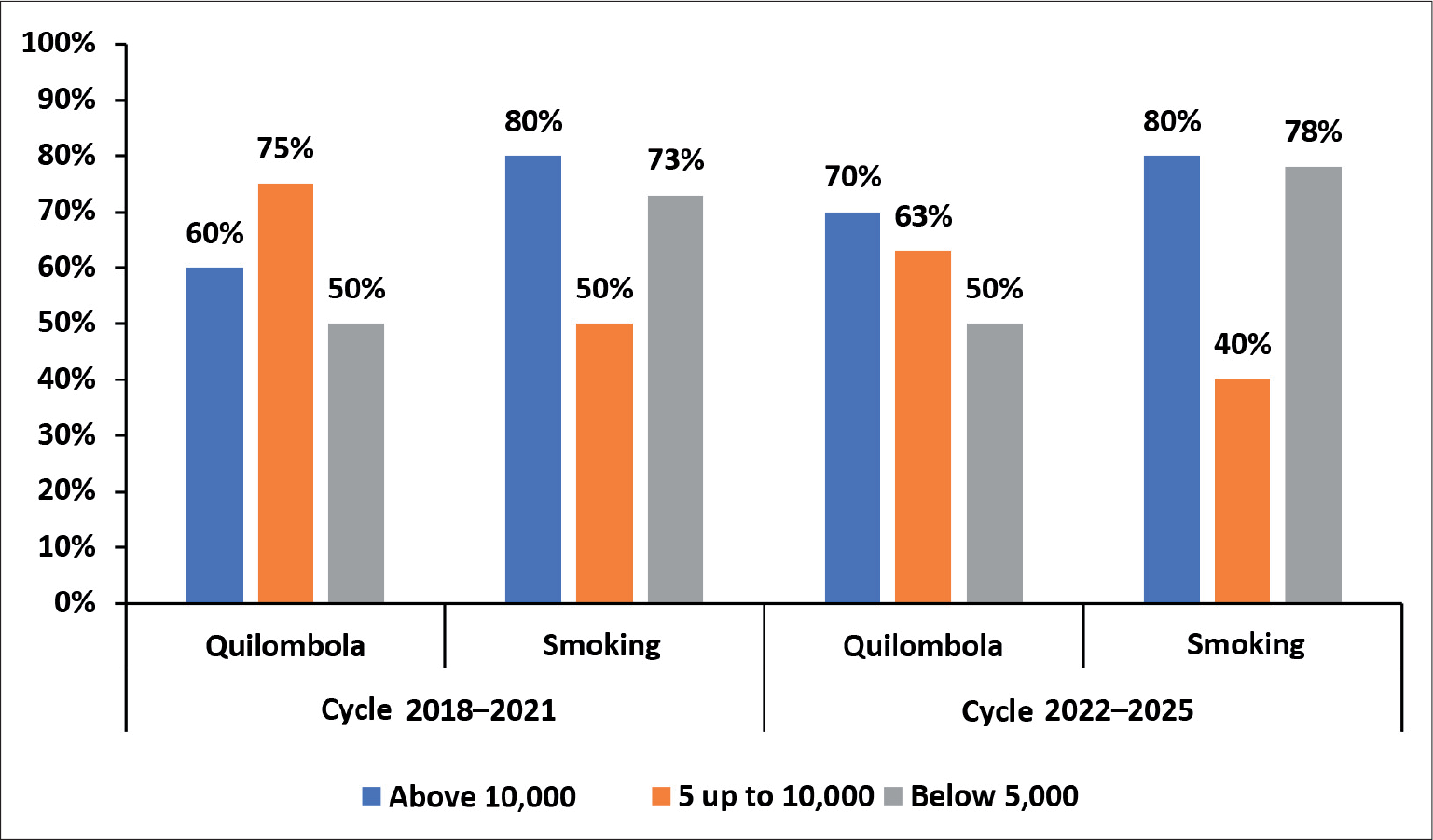 Source: Own elaboration, based on information from Municipal Health Plans (2018-2021 and 2022-2024).