
 THE SEQUENTIAL LEARNING METHOD AND THE DEVELOPMENT OF CHILDREN WITH ADHD
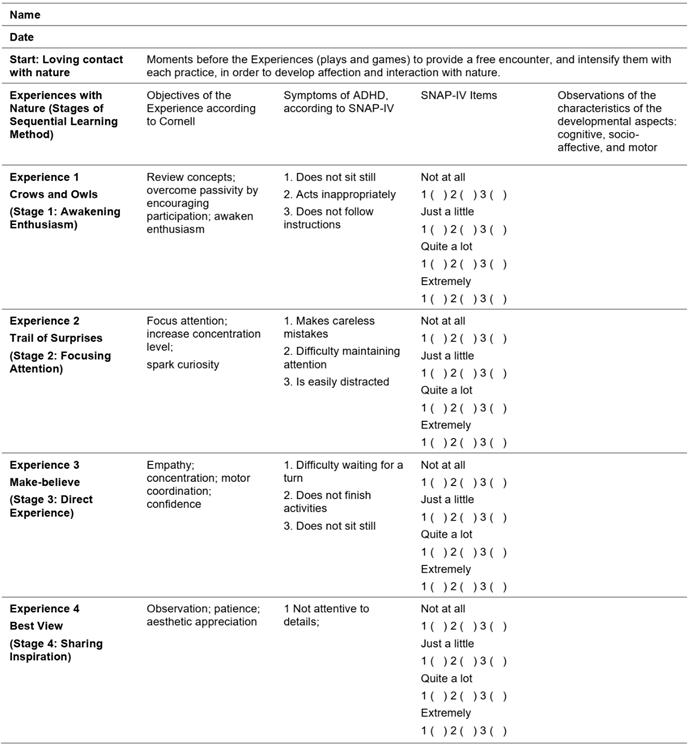
This article investigated how contact with nature affects the biopsychosocial development of children with Attention Deficit Hyperactivity Disorder (ADHD). The study was qualitative, exploratory, and descriptive, based on literature and field research. It followed the principles of the Sequential Learning Method proposed by Joseph Cornell. Field research was conducted with a group of children diagnosed with ADHD who were regularly enrolled in a municipal public school in the municipality of Crato, state of Ceará, and who were between the ages of 7 and 12 at the beginning of the study. The activities were carried out in the Public Use Zone (ZUP) of the Araripe-Apodi National Forest (FLONA), in the Riacho do Meio Ecological Park, and at Sítio Pinheiros, in the municipality of Barbalha. Technical procedures included observation, recording in guides and field journals, and data interpretation. It was a multiple-case study conducted through socioenvironmental intervention. The study showed that, through direct contact with nature, in addition to children experiencing genuine experiences, they presented a minimization of specific ADHD symptoms at the time of the intervention. They also demonstrated better cognitive development (greater knowledge and understanding) and socio-affective development (improved communication skills, teamwork, values, and self-perceptions).
Keywords:
Experiences with nature; ADHD; biopsychosocial development
 Thumbnail
 Source: The authors (2019).