 Effectiveness of Drinking a Sweet-Tasting Snack Before Local Anesthetic Injection on Pain Perception among 5-Year-Old Children: A Split-Mouth Cross-Over Study
ABSTRACT
Objective: To investigate the pain-relieving property of consuming sweet-tasting solution before dental injections.
Material and Methods: In this single-blinded split-mouth study, fifty-two 5-year-old children who needed bilateral mandibular deciduous molars pulpotomies participated. The effect of drinking a cool liquid snack containing 10 milliliters of 12% sucrose solution (study group) or cool tap water (control group) with a straw before inferior alveolar nerve block injection was assessed regarding pain perception. The degree of discomfort was recorded after dental injections using the Wong-Baker Faces Pain Scale (WBFPS). Data were analyzed using SPSS version 26 and the Independent Sample Test. The statistical significance level was set at p<0.05.
Results: Significantly lower WBFPS scores were reported for the test group (2.9231) compared to the study group (5.0000) (p<0.001).
Conclusion: Drinking a cool sucrose solution with a straw before dental injections can aid in reducing the associated discomfort, resulting in better interaction with the child during dental sessions.
Keywords:
Dentistry; Injections; Mandibular Nerve; Pain; Anesthetics, Local
Introduction
The pain associated with venipuncture and dental injections has always been a source of fear, discomfort, and dental avoidance among children. Many techniques have been proposed to minimize the pain of venipunctures, such as administration of sweet-tasting solutions, distraction with the aid of dolls and baby rattles, use of pacifiers (non-nutritional sucking) or baby bottles containing sweet solutions (nutritional sucking) [1].
In a dental setting, techniques such as audio and video distraction, application of counter-irritation, rubbing or applying pressure or vibration near the injection site, applying higher concentrations of topical anesthetic agents on the injection site, low-level laser therapy, and novel injection devices are introduced to reduce dental injection pain perception [2,3].
Despite all the aforementioned methods, dental injections are still considered the most painful and fear-provoking procedures for pediatric patients. Thus, studies continue to search for strategies to further reduce dental injections' pain and discomfort. In this regard, Janiani et al. [4] conducted a study to assess the effect of consuming 5 milliliters of honey solution before dental injections. It has been stated that the administration of sweet solutions can increase endogenous opioid production by stimulating endorphin receptors, which leads to lower levels of pain perception [5]. Ghaderi et al. [6] evaluated the effect of sweet-tasting solutions on dental injection pain perception among children who were instructed to hold and then spit out 10 milliliters of 30% sucrose solution or 10 milliliters of water. In both Janiani et al. [4] and Ghaderi et al. [6] studies, the sweet solution groups reported lower levels of pain associated with dental injections.
The aim of this study was to compare the effect of sucrose solution versus drinking water on pain perception of inferior alveolar nerve blocks in 5-year-old children.
Material and Methods
Study Design and Sampling
The present single-blinded split-mouth study was carried out on 52 children, 5 years old, who were referred to a private pediatric dentistry clinic in Kerman and needed at least two pulpotomy treatments to be carried out on mandibular primary molars (one tooth on each side of the mandible). Cooperative children (Frankl 3 or 4) who were in good physical health, with no history of hospitalization or clinical dental experience, were included.
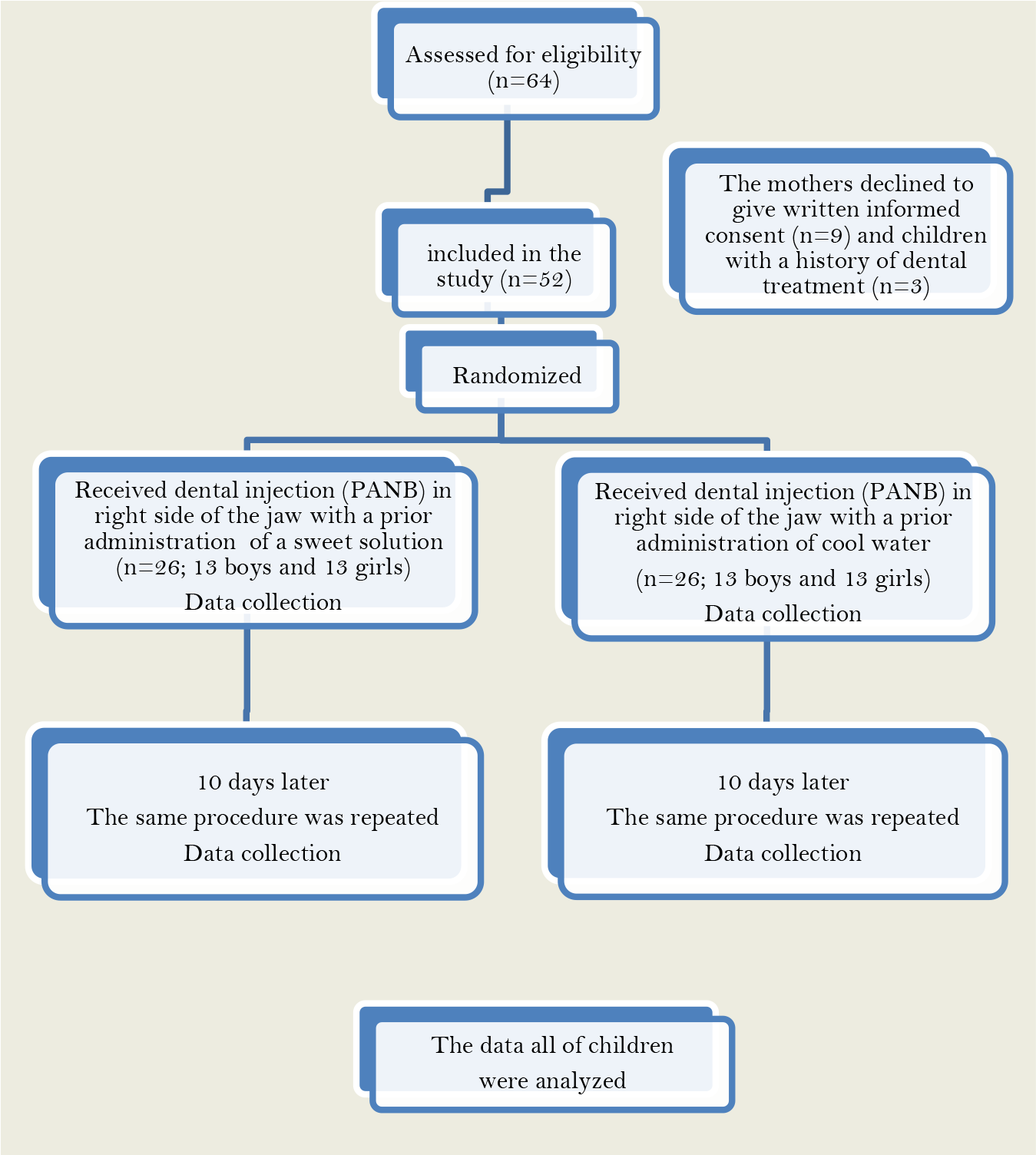
The convenience sampling method was used to recruit cooperative children (26 girls and 26 boys). In other words, parents were asked for their children's participation in the study, and positive responses were selected. This selection process was carefully conducted for 4 months of the children with equal percentages of boys and girls. During this time, 64 children were examined, but 12 were excluded (Figure 1). The mentioned sample size was determined considering similar articles [6,7].
Data Collection
Two dental appointments with intervals of 10 days were considered for each child (Figure 1). Simple randomization was used for the groups. In this relation, a coin toss was carried out to determine which side would be treated in the first session (the opposite side would be treated after 10 days).
An experienced pediatric dentist performed all the dental procedures. In each session prior to inferior alveolar nerve block, the child was given 10 milliliters of a cool sweetened solution containing 12% sucrose (Mr. Q, Pars Golbarg Co., Shiraz, Iran) or cool drinking tap water (temperatures for both 10-15 oC) and was instructed to drink it slowly with a straw within 5 minutes. Whichever solution was used in the first session, the other was considered for the next session, and the pediatric dentist was blind and unaware of the type of solution consumed. The dental assistant scheduled half of the girls and half of the boys (half of the participants) to consume the sweetened beverage in the first session, and half consumed drinking water first.
After 5 minutes, only one cartridge (1.8 ml) of the anesthetizing solution lidocaine 2%, 1:100,000 epinephrine (DarouPakhsh Pharmaceutical MFG Co., Tehran, Iran) was administered to perform the inferior alveolar nerve block injection (IANB) with a short & 30-gauge needle, length 25 mm, (Ava Pezeshk Co., Tehran, Iran). Following the injection, the children were asked to determine the degree of their discomfort using the Wong-Baker Faces Pain Scale (WBFPS); after that, the pulpotomy procedure was carried out.
Data Analysis
Data were analyzed using SPSS software, version 26 (IBM Corp., Armonk, NY, USA) and the independent sample t-test. The statistical significance level was defined at p<0.05.
Ethical Clearance
The Ethics Committee, Kerman University of Medical Sciences, Kerman, Iran, approved the study protocol under the code IR.KMU.REC.1399.479. The study protocol and its aim were explained to the parents, and informed consent was obtained.
Results
Data analysis showed the mean WBFPS scores for the sweet-tasting solution and water to be 2.9231 and 5.0000, respectively. There was a statistically significant difference between the mean scores of the two groups, and the sweet-tasting solution effectively reduced pain perception (p<0.001) (Table 1).
However, there was no statistically significant difference between the mean scores based on children's gender (p>0.05) (Table 2).
Discussion
The present clinical study indicated that 12% sucrose solution (study group) before dental injections can significantly reduce pain perception in children compared to the control group. In this regard, Janiani et al. [4] conducted a study on 9-year-old children to assess the effect of the honey solution before dental procedures on the discomfort induced by injections. Of 72 children who participated in the study, 44 received an inferior alveolar nerve block, and 30 received a maxillary infiltration. The pain perception rated by the Wong-Baker Faces Pain Rating Scale (WBFPS) was reported to be significantly lower in the study group who consumed the honey solution.
As mentioned in Janianis' study [4], dental injections were carried out in the upper and lower jaw. However, inferior alveolar nerve blocks were the only injections used in our research. Furthermore, participants held 5 milliliters of honey solution in their mouths; then they spitted it, considering the concept that honey carbohydrates stimulate endorphin receptors in the oral mucosa [4].
Honey contains about 40% fructose, 30% glucose, and 1% sucrose [8]. In the present study, participants were instructed to drink 10 milliliters of 12% sucrose solution; however, the concentration of honey solution was not stated in the Janiani et al. [4] study. Sucrose is a disaccharide composed of 50% glucose and 50% fructose, breaking into the stated subunits after digestion. Janiani et al. [4] reported the mean WBFPS score to be 3.5 and 6 after consuming honey solution and water, respectively. The lower WBFPS scores reported in the current study, 2.9 for the study group who consumed sucrose solution and 5 for the control group, may be related to the following reasons: The concentration of carbohydrates was not mentioned in Janiani et al. [4] study, this comes into mind that maybe its concentration was lower than 12%. Furthermore, as participants of the present study preferred to use a straw for drinking the sucrose solution or water, the rhythmic movements of oral muscles may have played a role in the decreased pain perception. It has been stated that the rhythmic movements of oral muscles when using a straw, pacifier, or baby bottle result in an analgesic and relaxing effect due to the increased level of serotonin secretion [9,10].
Ghaderi et al. [6] evaluated the effect of sweet-tasting solution on dental injection pain in children aged 8 to 10 who needed bilateral maxillary infiltrations. They were instructed to hold and then spit out 10 milliliters of 30% sucrose solution or 10 milliliters of water. The authors concluded that a tasting solution helps to control dental injection pain based on the visual analog scale [6].
The exact mechanism by which sweet solutions reduce pain perception is not well known yet. However, animal studies have shown that opioid receptors play the leading role in the pain-relieving properties of sweetened solutions. When monosaccharides bind to the opioid receptors, endogenous opioids and beta-endorphins are released, which produce an effect similar to the administration of a weak opioid, reducing pain transmission to the central nervous system [5].
Many studies have been carried out evaluating the effect of consuming sweet-tasting solutions on pain perception in children and toddlers receiving vaccines and venipunctures [1,4-7], and they all concluded that a positive impact is observed regarding pain perception (reduced duration of crying in study groups compared to the control group). The studies mentioned above used sucrose solution in a concentration of 12 to 75 percent [1,4-7]. The present study used a 12% sucrose solution.
Studies have been carried out on infants and toddlers receiving vaccines, in which the effect of nutritive sucking (breastfeeding or using baby bottles containing milk or sweet solutions) and non-nutritive sucking (the use of pacifiers) has been reported on pain perception. As stated earlier, the rhythmic muscular movements while sucking results in a calming and analgesic effect. The use of straw in the present study may have helped alleviate pain in a similar manner. Although not significant, in the current study, boys reported lower pain levels than girls. In this regard, some biopsychosocial mechanisms, such as sex hormones, endogenous opioid function, pain coping, and catastrophizing may be reasons for higher levels of coping capacity in the face of painful stimuli in males compared to females [11].
Lewkowski et al. [12] evaluated the effect of sweet-tasting chewing gum and non-flavored chewing gum on pain perception during vaccination of 7 to 12 and 9 to 11 years children and reported the analgesic effect of sweet-tasting chewing gum as insignificant. The analgesic effect, which was noted even when non-flavored chewing gum was consumed, was related to the rhythmic oral movements while chewing, which increases the release of serotonin, resulting in the activation of analgesic mechanisms [12]. Shiiba et al. [13] showed that oral sucrose and xylitol administration may relieve pain associated with local anesthetic injections in children but not adults.
The result of the aforementioned study about children is in line with the result of the current study. However, in the current study, adults were not evaluated. It is stated that children tend to have a much stronger sweet preference than adults. This exaggerated sweet preference has been described as a need for energy to invest in skeletal growth, indicating that there is a physiological basis for it [14].
Padmanabh et al. [15] showed an affordable technique to alleviate the pain and anxiety associated with local anesthesia injections in children to be cryotherapy and sweet-tasting solution, which minimizes the dread of pain related to the procedure involving children with Frankel's Behaviors III and IV. The outcomes of our investigation are consistent with the study by Padmanabh et al. [15], but we did not apply cryotherapy. Aminabadi and Farahani [3] showed cooling the injection site of the local anesthetic agent to reduce perceived pain during injection significantly. In the current study, the liquids used were cool, not cold, perhaps if the sweet snack was cold, it could be more effective in reducing pain during local anesthetic agent injection. Overall, based on the current study, this analgesic effect may not wholly be related to the carbohydrates in the solution, as the method of consumption, which was sucking with a straw, or even the coolness of the solution, may also play a role in this regard. More studies should be carried out on this issue.
Conclusion
The pain-relieving property of drinking a liquid snack containing sucrose with a straw before receiving an inferior alveolar nerve block injection in children. Based on the current study, drinking a cool sucrose solution with a straw prior to dental injections can aid in reducing the associated discomfort, resulting in better interaction with the child during dental sessions.
Data Availability
The data used to support the findings of this study can be made available upon request to the corresponding author.
-
Financial Support
None.
References
-
[1] Kassab M, Foster JP, Foureur M, Fowler C. Sweet-tasting solutions for needle-related procedural pain in infants one month to one year of age. Cochrane Database Syst Rev 2012; 12(12):CD008411. https://doi.org/10.1002/14651858.CD008411.pub2
» https://doi.org/10.1002/14651858.CD008411.pub2 - [2] Ghaderi F, Ghaderi R, Davarmanesh M, Bayani M, Arabzade Moghadam S. Pain management during needle insertion with low level laser. Eur J Paediatr Dent 2016; 17(2):151-154.
- [3] Aminabadi NA, Farahani R. The effect of pre-cooling the injection site on pediatric pain perception during the administration of local anesthesia. J Contemp Dent Pract 2009; 10(3):43-50.
- [4] Janiani P, Gurunathan D. Effectiveness of pre-administered natural sweet-tasting solution for decreasing pain associated with dental injections in children: A split-mouth randomized controlled trial. J Contemp Dent Pract 2021; 22(12):1434-1437.
-
[5] Kracke GR, Uthoff KA, Tobias JD. Sugar solution analgesia: The effects of glucose on expressed mu opioid receptors. Anesth Analg 2005; 101(1):64-68. https://doi.org/10.1213/01.ANE.0000152617.11003.42
» https://doi.org/10.1213/01.ANE.0000152617.11003.42 -
[6] Ghaderi F, Ahmadbeigi M, Vossoughi M, Sardarian A. The efficacy of administrating a sweet-tasting solution for reducing the pain related to dental injections in children: A randomized controlled trial. Int J Paediatr Dent 2021; 31(2):184-190. https://doi.org/10.1111/ipd.12697
» https://doi.org/10.1111/ipd.12697 -
[7] Hatfield LA, Gusic ME, Dyer AM, Polomano RC. Analgesic properties of oral sucrose during routine immunizations at 2 and 4 months of age. Pediatrics 2008; 121(2):e327-334. https://doi.org/10.1542/peds.2006-3719
» https://doi.org/10.1542/peds.2006-3719 -
[8] Aljohar HI, Maher HM, Albaqami J, Al-Mehaizie M, Orfali R, Orfali R, et al. Physical and chemical screening of honey samples available in the Saudi market: An important aspect in the authentication process and quality assessment. Saudi Pharm J 2018; 26(7):932-942. https://doi.org/10.1016/j.jsps.2018.04.013
» https://doi.org/10.1016/j.jsps.2018.04.013 -
[9] Shah PS, Aliwalas LI, Shah V. Breastfeeding or breast milk for procedural pain in neonates. Cochrane Database Syst Rev 2006; 19:(3):CD004950. https://doi.org/10.1002/14651858.CD004950.pub2
» https://doi.org/10.1002/14651858.CD004950.pub2 -
[10] Aarts C, Hornell A, Kylberg E, Hofvander Y, Gebre-Medhin M. Breastfeeding patterns in relation to thumb sucking and pacifier use. Pediatrics 1999; 104(4):e50. https://doi.org/10.1542/peds.104.4.e50
» https://doi.org/10.1542/peds.104.4.e50 -
[11] Bartley EJ, Fillingim RB. Sex differences in pain: A brief review of clinical and experimental findings. Br J Anesth 2013; 111(1):52-58. https://doi.org/10.1093/bja/aet127
» https://doi.org/10.1093/bja/aet127 -
[12] Lewkowski MD, Barr RG, Sherrard A, Lessard J, Harris AR, Young SN. Effects of chewing gum on responses to routine painful procedures in children. Physiol Behav 2003; 79(2):257-265. https://doi.org/10.1016/s0031-9384(03)00098-2
» https://doi.org/10.1016/s0031-9384(03)00098-2 -
[13] Shiiba S, Sakamoto E, Sago T, Furuta H, Yamamoto T, Tada Y, et al. Effect of sweet solutions on pain tolerance threshold in pediatric oral mucosa. Pediatr Dent J 2012; 22(1):22-26. https://doi.org/10.1016/S0917-2394(12)70248-3
» https://doi.org/10.1016/S0917-2394(12)70248-3 -
[14] Van Belkom B, Van Lier I, Umanets A, Van Mil E, Havermans RC. Sweetness in a glass: A study on children's sweet preference and sensitivity. Food Qual Prefer 2023; 110(11):104939. https://doi.org/10.1016/j.foodqual.2023.104939
» https://doi.org/10.1016/j.foodqual.2023.104939 -
[15] Padmanabh SK, Gangurde VB, Jhamb V, Gori N. Effect of cryoanesthesia and sweet tasting solution in reducing injection pain in pediatric patients aged 7-10 years: A randomized controlled trial. J Dent Anesth Pain Med 2024; 24(1):37-45. https://doi.org/10.17245/jdapm.2024.24.1.37
» https://doi.org/10.17245/jdapm.2024.24.1.37
Edited by
-
Academic Editor:
Catarina Ribeiro Barros de Alencar