
 Plant mites (Arachnida: Acariformes, Parasitiformes) in Caatinga remnants from Piauí State, Brazil
Abstract
The Caatinga is a highly threatened Brazilian biome that may host numerous unknown plant mite species, as little is known about its mite fauna. Thus, our aim was to assess plant mite species from Caatinga vegetation remnants in Piauí State, Northwestern Brazil. The assessment was conducted through sampling mites in two natural vegetation remnants in the southern region of Piauí during December 2015. Species richness was estimated using the Jackknife 1 method (999 randomizations), while observed richness was calculated using the Mao-Tao method. Estimated and observed richness were compared using a species accumulation curve, set with a 95% confidence interval. In total, 177 mites belonging to nine species were sampled from the Caatinga vegetation remnants. The Iolinidae family accounted for the largest number of individuals, followed by Eriophyidae. The predator mite Pronematus sp. was the most abundant taxon in our samples followed by the phytophagous Aculus sp. (Eriophyidae) and Oligonychus sp. (Tetranychidae) The estimated richness (Jackknife 1) did not differ from the observed richness (Mao Tao). Furthermore, Neoseiulus tunus (De Leon) (Phytoseiidae) was recorded for the first time in the state of Piauí. This is the first scientific work to report mite species on plants from remnants of native vegetation exclusively in Piauí State, Brazil.
Keywords:
Acari; Mesostigmata; Mite diversity; Natural vegetation; Phytoseiidae
INTRODUCTION
Many predatory mites are used in biological control programs and have been shown to be effective in controlling phytophagous mite populations on several crops (Gerson et al., 2003). In addition to feeding on plant resources such as pollen and nectar, these mites can also use leaf structures (e.g., acarodomatia) as breeding and nesting sites (Romero & Benson, 2005; McMurtry et al., 2013; De Moraes & Flechtmann, 2008). Consequently, the knowledge of predatory mites in natural vegetation remnants proves essential to support pest management programs in agroecosystems, as many native plants can provide shelter and food resources for predatory species with potential for use in biological control. Furthermore, the identification of native plant species that host a high diversity and abundance of predatory mites is crucial, but in Brazil most acarological studies focus on agroecosystems and livestock systems rather than natural ecosystems (Araújo & Daud, 2017; Pallini et al., 2007).
Most studies conducted in Brazilian natural vegetation remnants have focused on plant mites sampled in the Atlantic Forest and Cerrado biomes of the Southwest and Midwest regions (review in Araújo & Daud, 2017), and they have highlighted the importance of plants in native vegetation remnants as reservoirs of several predatory mite species (e.g., Buosi et al., 2006; Demite et al., 2009, 2011, 2017; Lofego et al., 2009; Castro & De Moraes, 2010; Rezende & Lofego, 2011; De Moraes et al., 2013; Rezende et al., 2014; Abreu et al., 2017; Teixeira et al., 2017; Cavalcante et al., 2021; Moraes et al., 2022). For example, Demite et al. (2009) sampled high diversity of mites in native Cerrado plants in the state of Mato Grosso, identifying it as an important reservoir for predatory mites, especially Phytoseiidae. In Goiás State, Teixeira et al. (2017) and Abreu et al. (2017) studied plant mites in Cerrado native habitats near mining areas and found significant predatory mite biodiversity with potential for biological pest control, despite high anthropogenic impacts in the sampled areas. In the Atlantic Forest, Castro & De Moraes (2010) and De Moraes et al. (2013) surveyed the diversity of Phytoseiidae mites in plants from São Paulo, while Buosi et al. (2006) documented herbivorous and predatory species, providing a relevant species inventory for future studies. Conceição et al. (2021) sampled 30 species of Phytoseiidae on native plant species in the Amazon, Cerrado, and Pantanal biomes of the state of Mato Grosso. They found 15 species of Phytoseiidae on 10 native Cerrado plants, 14 species on 10 Amazonian plants, and 23 species on 10 Pantanal plants, for a total of 30 species of Phytoseiidae. Moreover, Mendonça et al. (2019) found 35 Phytoseiidae species on 40 native plants in Pantanal vegetation remnants from Mato do Grosso do Sul State, Brazil.
The Caatinga biome covers 800,000 km² in northeastern Brazil, accounting for 10% of Brazil’s territorial area (Leal et al., 2003, de Andrade Lima, 1954). The biome is characterized by a complex vegetation structure with low, crooked trees with thorns. In general, plants lose their leaves during the dry season and many cactus species have structures for water storage (de Andrade Lima, 1954). According to Giulietti et al. (2004), the Caatinga biome is a vegetation that occurs in contiguous areas under hot and semi-arid climates, but surrounded by areas of more humid climate, with plants that have morphological and physiological adaptations to hydric deficit. The Caatinga is one of the most threatened Brazilian biomes, suffering from constant human impact, mainly due to agricultural expansion, livestock and extractivism (Silva, 2002). Additionally, the Caatinga faces desertification as a result of deforestation caused by man-made fires. According to Moura et al. (2023), by 2,060, over 99% of plant communities in the Caatinga will experience species loss, with a decline in beta diversity leading to biotic homogenization in 40% of the region. In addition, at least 90% of the plant communities will undergo a shift as narrowly distributed woody species are replaced by broadly distributed non-woody species (Moura et al., 2023).
The Caatinga hosts many species of mites on plants (Rodrigues et al., 2020, 2025), however, few studies have been conducted on mite biodiversity in this biome, compared to the number of studies conducted in other Brazilian biomes (e.g., Farias et al., 1979; Lawson-Balagbo et al., 2008; Gonçalves et al., 2015; Rocha et al., 2015; Mendonça et al., 2019; Demite et al., 2021; Conceição et al., 2021; Mendes et al., 2021; Bezerra & De Matos Andrade, 2022; Brito et al., 2024; Castro et al., 2024). Rodrigues et al. (2020) recorded some mite genera on Caatinga native habitats, predominantly from the families Iolinidae, Phytoseiidae, Tarsonemidae, Tenuipalpidae, Tetranychidae, Tydeidae and Winterschmidtiidae, while the most literature review of Phytoseiidae species in Caatinga was recently published by Araújo & Rodrigues (2023). Furthermore, Rodrigues et al. (2025) recently published a study reporting mite species occurrence in remnants of native vegetation in the Caatinga biome. The study recorded 32 species in 12 families and provided the formal description of a new species of Phytoseiidae (Araújo & Rodrigues et al., 2025).
Given the economic importance of some mite species, such as Phytoseiidae for biocontrol programs, and the intense and continuous impact of human activities on natural areas, the need for mite biodiversity studies is urgent. Here, our aim was to assess plant mite species from Caatinga vegetation remnants in Piauí State, Brazil. Furthermore, the theoretical potential of these remnants in conserving mite species richness was also estimated according to the samples in our study.
MATERIAL AND METHODS
Mites were sampled in two natural remnants of Caatinga vegetation in the southern region of Piauí State, Brazil, during a single collection in December 2015 (Fig. 1): (i) Area 1 = Alvorada do Gurguéia Municipality (08°16′43.87″S and 43°39′39.23″W) and (ii) Area 2 = Bom Jesus Municipality (09°04′26.60″S and 44°22′42.96″W). The climate of the region is Aw according to the Köppen classification, characterized as hot and semi-humid with two well-defined seasons: the dry season, from May to October, and another rainy season, from November to April (Ribeiro & Walter, 1998). Both areas consist of arboreal Caatinga with dry forest and are in transition zones between the Caatinga and Cerrado biomes (Fernandes, 2000). The arboreal Caatinga is characterized by medium-sized trees, such as Juazeiro (Ziziphus joazeiro Mart.), (Rhamnaceae), Angico (Anadenanthera colubrina (Vell.) Brenan), (Fabaceae) and Aroeira (Myracrodruon urundeuva (Allemão) Engl.), (Anarcadiaceae), with twisted trunks and deciduous leaves adapted to the semi-arid climate (Oliveira et al., 2020).

Sampling sites for plant mite collection in natural Caatinga vegetation remnants in the southern of Piauí State, Brazil. Reference: (A) Neotropic and Brazil; (B) Piauí state; (C) Sampling sites in Alvorada do Gurguéia and Bom Jesus.
In each Caatinga remnant, we established 5 m × 5 m plots in parallel pairs at 10 m and 60 m from the edge of the remnant vegetation (Fig. 2). A total of four pairs of plots (eight plots) were distributed in Area 1, while three pairs (six plots) were distributed in Area 2. The plots were spaced at least 10 m apart. All plants in the plots with a canopy circumference equal to or greater than 15 cm were selected, identified and quantified. Then, 10 leaves from the median canopy extract of each selected plant in the plot were collected and stored in independent paper bags. Leaves from each plant were fully washed and agitated in 1L plastic containers with 200 mL of 70% alcohol for 40 seconds, to collect the mites harboring them. After this procedure, the leaves were carefully removed, and the plastic container was labeled. Each container represents the mite assemblage of each selected plant in the plot. Lastly, the samples were taken to the laboratory, observed under a stereomicroscope and all the mites found were fixed in microscopy slides with Hoyer’s medium (De Moraes & Flechtmann, 2008). Mites were identified under phase contrast microscope.
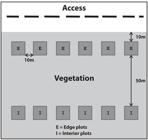
Sampling design used to collect plant mites from Caatinga vegetation remnants in the Southern portion of Piauí State, Brazil. (E) Plots of edge (at 10 m from the edge of remnant), (I) Plots of interior (at 60 m from the edge).
To estimate the potential richness of mite species, Jackknife 1 was performed with 999 randomizations, while the observed richness was calculated using the Mao Tao procedure. From this, 95% confidence intervals were calculated for all richness values. Estimated and observed richness were compared using a species accumulation curve with a 95% confidence interval. All analyses were performed with R software version 4.3.1 (R Core Team, 2024) with the package “vegan” (Oksanen et al., 2013).
RESULTS
A total of 177 mites belonging to nine species, nine genera and eight families were sampled on plants in the two Caatinga vegetation remnants (Table 1). The mites were collected from seven plant species of five families (Table 2). The plant species with the highest mite species richness was Piptadenia moniliformis Benth. (Fabaceae) with eight mite species, while Andira paniculata Benth. (Fabaceae) harbored the greatest number of mites with a total of 117 individuals (Table 2). Area 1 showed the highest mite abundance with 171 mites sampled, and only six mites were collected in Area 2. Area 1 also had a higher mite species richness than Area 2 (Table 2).
Mite species and abundance according to their host plant int the two Caatinga vegetation remnants, at Piauí State, Brazil. Area 1 = Alvorada do Gurguéia; Area 2 = Bom Jesus.
Predatory mites were the most frequent in the samples, accounting for 68% of the mites collected, while phytophagous mites represented 31% of the total sample, followed by species with unknown feeding behavior, representing 1% of the samples. Plots established at the edge (10 m from the edge) had higher abundance of predatory species, albeit more phytophagous mites were sampled in the interior plots (Table 1).
The most frequent predatory species recorded in our study were Pronematus sp. (Iolinidae) (93 specimens). The most abundant phytophagous species recorded were Aculus sp. (Eriophyidae) (30), Oligonychus sp. (Tetranychidae) (13) and Brevipalpus yothersi Baker (Tenuipalpidae) (5). Four taxa were identified to species level, namely Euseius citrifolius Denmark & Muma, Neoseiulus tunus DeLeon (Phytoseiidae), Tarsonemus bilobatus Suski (Tarsonemidae), and B. yothersi (Table 1).
Phytoseiidae and Iolinidae were represented by two species each. Nevertheless, Iolinidae showed the largest overall number of mites, encompassing 63% of the samples, followed by Eriophyidae with 30 individuals collected belonging to the genus Aculus, representing 17% of the mites sampled. Among taxa identified up to genus level, Pronematus sp. was the most abundant in our samples followed by the phytophagous Aculus sp. and Oligonychus sp. (Table 1).
The estimated richness (Jackknife 1) did not differ from the observed richness (Mao Tao), as indicated by the overlap of the error bars (confidence intervals at 95%) with the mean values for all samples. Furthermore, the estimated and observed richness curves tend to asymptote from the 16th sample onwards (Fig. 3).

Estimated (Jackknife 1) and observed (Mao Tao) mite species richness for Caatinga vegetation remnants, Piauí State, Brazil. Reference: Estimated richness (Jackknife 1) = Gray circles; Observed richness (Mao Tao) = black circles. Lines extending from points indicate confidence intervals of 95%.
DISCUSSION
Most studies of mites in the Caatinga biome to date have consisted of quantitative analyses of individuals found in the biome, with limited taxonomic depth or records of new genera or species (e.g., de Sousa et al., 2015; Barbosa & De Moraes, 2020, 2021). For instance, Santos & Santos (2012) sampled 278 arthropods in an abandoned pasture area in the early successional stage of the Caatinga, from which 99 mites were collected, but the specimens were only identified to the order level (Santos & Santos, 2012). Nascimento (2019) sampled the arthropod diversity in soil litter, limiting the identification of some of the collected Mesostigmata mites to the genus level.
On the other hand, some studies exclusively focusing on mites from natural Caatinga vegetation have assessed the diversity of plant mites associated with the biome (Lofego et al., 2013; Silva et al., 2016; de Sousa et al., 2015; Rodrigues et al., 2020, 2025; Mendes et al., 2021). For example, Rodrigues et al. (2020) recorded fourteen mite families on Myrtaceae plants, with most individuals belonging to the families Iolinidae, Phytoseiidae, Tetranychidae, Tarsonemidae, Tenuipalpidae, Tydeidae, and Winterschmidtiidae. Except for Tydeidae and Winterschmidtiidae, the other families were also recorded in the remnants of Alvorada do Gurguéia and Bom Jesus. Rodrigues et al. (2025) also documented the occurrence of mite families such as Ascidae, Cheyletidae, Cunaxidae, Eriophyidae, Erythraeidae, Iolinidae, Phytoseiidae, Tarsonemidae, Tenuipalpidae, Tetranychidae, Tydeidae, and Winterschmidtiidae on several plant families within the natural vegetation of the Caatinga biome. Among these, Eriophyidae, Winterschmidtiidae, and Iolinidae had the highest individual abundance (Rodrigues et al., 2025). Moreover, the family Iolinidae was the most abundant among predatory mites in the study by Rodrigues et al. (2025), with Pronematus being the most abundant predatory mite. These findings are consistent with the results of the present study.
The predominant abundance of Iolinidae may be related to their feeding behavior, as these mites can feed on a variety of sources, including other mites, mite eggs, and pollen (Bellini et al., 2005). Bellini et al. (2005) reported a Pronematus species feeding on the eggs of Eutetranychus banksi (McGregor) (Tetranychidae) in rubber trees (Hevea brasiliensis Muell. Arg., Euphorbiaceae). Because these mites consume different food sources, the number of predatory mites may exceed the number of phytophagous mites on plants, as observed in our study. Furthermore, our results revealed a significant abundance of predatory mites of the genus Pronematus, as well as phytophagous mites of the genus Aculus. Previous studies have suggested an association between the occurrence of Iolinidae and Eriophyidae, possibly due to predator-prey interactions (O’Dowd & Wilson, 1997). The co-occurrence of both mite families has recently been documented in remnants of native vegetation in the Caatinga biome (Rodrigues et al., 2025), which reinforce the possible ecological interactions between these two families.
Two species of Phytoseiidae were sampled in the Caatinga remnants evaluated. Usually, this mite family is often reported in high diversity on plants from remnants of natural vegetation in Brazil (review in Araújo & Daud, 2017). Recently, Araújo & Rodrigues (2023) documented all Phytoseiidae species recorded in the Caatinga biome, registering 65 species of phytoseiids. Euseius citrifolius has been also previously recorded in the Amazon biome (e.g., Gondim Jr. et al., 2012; Vasconcelos & Silva, 2015; Conceição et al., 2021; Demite et al., 2021; Araújo et al., 2022), Caatinga (e.g., Lofego et al., 2013; Rodrigues et al., 2020, 2025), Cerrado (e.g., Rezende & Lofego, 2011; Demite et al., 2017; Moraes et al., 2022), Atlantic Forest (Demite & Feres, 2005; Buosi et al., 2006; Demite et al., 2011; De Moraes et al., 2013), and Pantanal (Mendonça et al., 2019) while N. tunus has been recorded on native plants in the Cerrado biome (e.g., Rezende & Lofego, 2011; Demite et al., 2017; Teixeira et al., 2017), Atlantic Forest (e.g., Buosi et al., 2006; Demite & Feres, 2005; Demite et al., 2011), and Pampas (Toldi et al., 2021). Similarly, N. tunus sampled here on Copaifera langsdorffii (Jacq.) (Fabaceae), has been previously reported on the same plant species in Cerrado remnants by Demite et al. (2009). Phytoseiid mites are known for their predatory habits, but some species may also consume pollen, fungi, and other food sources (McMurtry et al., 2013; De Moraes & Flechtmann, 2008).
Some phytophagous mite species are considered pests of cultivated plants (De Moraes & Flechtmann, 2008). Among those reported in this study, species from the genus Aculus were the most representative in our samples, followed by Oligonychus and Brevipalpus species. Species of Aculus have been reported in Atlantic Forest remnants in São Paulo State (Demite & Feres, 2005). Some Oligonychus species have been recorded in the states of Alagoas, Bahia, Ceará, Goiás, Maranhão, Mato Grosso, Pará, Pernambuco, Rio Grande do Norte, and São Paulo in native vegetation from the Amazon, Caatinga, Cerrado, and Atlantic Forest (e.g., Demite et al., 2013, 2016; Rezende et al., 2014; de Sousa et al., 2015; Rodrigues et al., 2020, 2025). Conversely, Brevipalpus species have been reported in Atlantic Forest and Cerrado remnants in São Paulo and Goiás states (Rezende et al., 2014; Daud & Feres, 2005), and recently recorded in the Caatinga areas of Alagoas, Ceará, and Paraíba states (Rodrigues et al., 2025).
The species accumulation curve showed a tendency to reach an asymptote for the mite fauna sampled in the Caatinga vegetation remnants, which means that it is unlikely that new mite taxa will be recorded in the remnants as sampling effort increases. Thus, the acarofauna survey conducted in this study was representative for the Caatinga vegetation remnants evaluated. On the other hand, this observation differs from the pattern shown in other studies, since it is unusual for plant mite species accumulation curves to reach an asymptote for assemblages sampled in natural vegetation remnants (e.g., Demite et al., 2013; Teixeira et al., 2017; Carvalho et al., 2018).
Lastly, N. tunus is recorded for the first time in the state of Piauí. This is also the first study to document plant mite species in native vegetation remnants based exclusively on sampling conducted in Piauí State, Brazil. The present work contributed to increase the knowledge of plant mite occurrence in the Caatinga, a biome poorly studied. Moreover, the plant species of the Caatinga biome showed the potential to host a diversity of mites similar to that found in other phytogeographic domains. For instance, the host plants P. moniliformis and A. paniculata hosted different mite species belonging to various feeding guilds. Thus, the Caatinga vegetation remnants can be managed more appropriately to maintain and maximize the ecosystem services provided by the mites (e.g., natural biological control) aiming for ecosystem sustainability.
ACKNOWLEDGEMENTS:
Thanks to Rodrigo Neves Ribeiro for help with data collection, and taxonomic identification of specimens and Danillo Alves Santos Vendrametto Granzotti for reviewing the manuscript. The first author was sponsored by a grant from CAPES (Fundação Coordenação de Aperfeiçoamento de Pessoal de Nível Superior).
REFERENCES
-
Abreu, K.M.; Araújo, F.G.; Lima, E.L. & Daud, R.D. 2017. Mites (Arachnida, Acari) on Astronium fraxinifolium Schott (Anacardiaceae) from the Cerrado remnants associated with nickel mining areas. Acarologia, 57(2): 223-232. https://doi.org/10.1051/acarologia/20164151
» https://doi.org/10.1051/acarologia/20164151 -
Araújo, F.G.; De Lima, E.L.; Costa, E. & Daud, R.D. 2022. Influence of natural vegetation conservation on the distribution of mites in rubber tree crops. Systematic and Applied Acarology, 7(8): 1629-1647. https://doi.org/10.11158/saa.27.8.13
» https://doi.org/10.11158/saa.27.8.13 -
Araújo, I.F. & Rodrigues, J.K. 2023. Revisão dos Ácaros Phytoseiidae (Acari: Mesostigmata) associados ao bioma Caatinga: compilação de dados e checklist. Journal of Neotropical Biology, 20(2): 54-70. https://doi.org/10.5216/rbn.v20i2.75417
» https://doi.org/10.5216/rbn.v20i2.75417 -
Araújo, W.S. & Daud, R.D. 2017. Insights on plant mite occurrence in natural vegetation remnants from Brazil. Systematic and Applied Acarology, 2(2): 302-322. https://doi.org/10.11158/saa.22.2.12
» https://doi.org/10.11158/saa.22.2.12 -
Barbosa, M.F. & De Moraes, G.J. 2020. Rhizoglyphus mites (Acari: Astigmata: Acaridae) from Brazil, with complementary description of Rhizoglyphus vicantus Manson. Systematic and Applied Acarology, 25(2): 360-378. https://doi.org/10.11158/saa.25.2.12
» https://doi.org/10.11158/saa.25.2.12 -
Barbosa, M.F. & De Moraes, G.J. 2021. Mites of the family Winterschmidtiidae (Acari: Sarcoptiformes: Astigmatina) from agricultural habitats in Brazil, with description of a new species and a key to species reported. Systematic and Applied Acarology, 26(6): 1040-1054. https://doi.org/10.11158/saa.26.6.3
» https://doi.org/10.11158/saa.26.6.3 -
Bellini, M.R.; De Moraes, G.J. & Feres, R.J.F. 2005. Ácaros (Acari) de dois sistemas comuns de cultivo de seringueira no noroeste do estado de São Paulo. Neotropical Entomology, 34(3): 475-484. https://doi.org/10.1590/S1519-566X2005000300017
» https://doi.org/10.1590/S1519-566X2005000300017 -
Bezerra, C.W.F. & De Matos Andrade, L. 2022. Diversidade da artropodofauna de serapilheira de mata ciliar e caatinga em região semiárida de Pernambuco, Brasil. Revista Brasileira de Meio Ambiente, 10(2): 149-171. https://doi.org/10.5281/zenodo.7321735
» https://doi.org/10.5281/zenodo.7321735 -
Brito, E.A.; Castro, I.S.; Noronha, A.C.S. & Ferla, N.J. 2024. Mites associated with açaí palm trees (Euterpe oleracea: Arecaceae) in native and cultivated areas of the state of Pará (Eastern Amazon, Brazil). Experimental and Applied Acarology, 93(1): 229-252. https://doi.org/10.1007/s10493-024-00925-4
» https://doi.org/10.1007/s10493-024-00925-4 -
Buosi, R.; Feres, R.J.F.; Oliveira, A.R.; Lofego, A.C. & Hernandes, F.A. 2006. Ácaros plantícolas (Acari) da “Estação Ecológica de Paulo de Faria”, Estado de São Paulo, Brasil. Biota Neotropica, 6(1): 1-20. https://doi.org/10.1590/S1676-06032006000100009
» https://doi.org/10.1590/S1676-06032006000100009 -
Carvalho, T.A.; Reis, P.R.; Bernardi, L.F.; Marafeli, P.P. & Martinez, P.A. 2018. Edaphic mites and their response to the incorporation of organic matter from various species of fabaceae into the soil beneath coffee trees. Acarina, 26(2): 183-195. https://doi.org/10.21684/0132-8077-2018-26-2-183-195
» https://doi.org/10.21684/0132-8077-2018-26-2-183-195 -
Castro, I.S.; De Azevedo, A.O.; Vinhas, N.; Schlemer, S.; Wurlitzer, W.B.; de Freitas, E.M. & Heiden, G. 2024. Phytoseiid mites associated with Asteraceae plants in the Pampa biome with description of two new species. International Journal of Acarology, 50(7): 570-586. https://doi.org/10.1080/01647954.2024.2387717
» https://doi.org/10.1080/01647954.2024.2387717 -
Castro, T.M.G. & De Moraes, G.J. 2010. Diversity of phytoseiid mites (Acari: Mesostigmata: Phytoseiidae) in the Atlantic Forest of São Paulo. Systematics and Biodiversity, 8(2): 301-307. https://doi.org/10.1080/14772001003801375
» https://doi.org/10.1080/14772001003801375 -
Cavalcante, A.C.C.; Demite, P.R.; Lofego, A.C. & Hernandes, F.A. 2021. Phytoseiidae (Acari: Mesostigmata) from the Atlantic Forest in Rio de Janeiro, Brazil, with complementary description of Amblyseius impeltatus Denmark & Muma. Papéis Avulsos de Zoologia, 61(98): 1-7, e20216198. https://doi.org/10.11606/1807-0205/2021.61.98
» https://doi.org/10.11606/1807-0205/2021.61.98 -
Conceição, E.M.; Demite, P.R.; Rezende, J.M.; Carniello, M.A. & Lofego, A.C. 2021. Phytoseiidae (Acari: Parasitiformes: Mesostigmata) inhabiting native plants from three biomes in Mato Grosso State, Brazil, with description of a new species. Systematic and Applied Acarology, 26(12): 2268-2286. https://doi.org/10.11158/saa.26.12.6
» https://doi.org/10.11158/saa.26.12.6 -
Daud, R.D. & Feres, R.J.F. 2005. Diversidade e flutuação populacional de ácaros (Acari) em Mabea fistulifera Mart. (Euphorbiaceae) de dois fragmentos de Mata Estacional Semidecídua em São José do Rio Preto, SP. Neotropical Entomology, 34(2): 191-201. https://doi.org/10.1590/S1519-566X2005000200007
» https://doi.org/10.1590/S1519-566X2005000200007 - de Andrade Lima, D. 1954. Contribution to the study of the flora of Pernambuco, Brazil Recife, Universidade Rural de Pernambuco.
- De Moraes, G.J. & Flechtmann, C.H.W. 2008. Manual de Acarologia: Acarologia básica e ácaros de plantas cultivadas no Brasil Ribeirão Preto (SP), Holos Editora.
-
De Moraes, G.J.; Barbosa, M.F.D.C. & de Castro, T.M.M.G. 2013. Phytoseiidae (Acari: Mesostigmata) from natural ecosystems in the state of São Paulo, Brazil. Zootaxa, 3700(3): 301-347. https://doi.org/10.11646/zootaxa.3700.3.1
» https://doi.org/10.11646/zootaxa.3700.3.1 -
de Sousa, J.M.D.; Gondim Jr., M.G.C.; Lofego, A.C. & De Moraes, G.J. 2015. Mites on Annonaceae species in northeast Brazil and in the state of Para. Acarologia, 55(1): 5-18. https://doi.org/10.1051/acarologia/20152147
» https://doi.org/10.1051/acarologia/20152147 -
Demite, P.R. & Feres, R.J.F. 2005. Influência de vegetação vizinha na distribuição de ácaros em seringal (Hevea brasiliensis Muell. Arg., Euphorbiaceae) em São José do Rio Preto, SP. Neotropical Entomology, 34(5): 829-836. https://doi.org/10.1590/S1519-566X2005000500016
» https://doi.org/10.1590/S1519-566X2005000500016 -
Demite, P.R.; Dias, M.A.; Cavalcante, A.C.C.; Ramos, M.V.V. & Lofego, A.C. 2017. Phytoseiid mites (Acari: Mesostigmata: Phytoseiidae) associated with Cerrado biome plants in Brazil, with description of a new species. Systematic and Applied Acarology, 22(12): 2141-2177. https://doi.org/10.11158/saa.22.12.9
» https://doi.org/10.11158/saa.22.12. -
Demite, P.R.; Feres, R.J.F.; Lofego, A.C. & Oliveira, A.R. 2009. Plant inhabiting mites (Acari) from the Cerrado biome of Mato Grosso State, Brazil. Zootaxa, 2061(1): 45-60. https://doi.org/10.11646/zootaxa.2061.1.3
» https://doi.org/10.11646/zootaxa.2061.1.3 -
Demite, P.R.; Flechtmann, C.H. & Feres, R.J. 2016. Tetranychidae (Acari) in forest fragments in the State of São Paulo, Brazil. Acarologia, 56(4): 435-449. https://doi.org/10.1051/acarologia/20162245
» https://doi.org/10.1051/acarologia/20162245 -
Demite, P.R.; Lofego, A.C. & Feres, R.J.F. 2011. Phytoseiidae (Acari) in forest fragments in the State of São Paulo, Brazil. Zootaxa, 3086(1): 31-56. https://doi.org/10.11646/zootaxa.3086.1.2
» https://doi.org/10.11646/zootaxa.3086.1.2 -
Demite, P.R.; Lofego, A.C. & Feres, R.J.F. 2013. Mite (Acari; Arachnida) diversity of two native plants in fragments of a semideciduous seasonal forest in Brazil. Systematics and Biodiversity, 11(2): 141-148. https://doi.org/10.1080/14772000.2013.806368
» https://doi.org/10.1080/14772000.2013.806368 -
Demite, P.R.; Rezende, J.M.; Lofego, A.C.; Amaral, F.S.; Barreto, M.R. & De Moraes, G.J. 2021. Phytoseiid mites (Acari: Mesostigmata: Phytoseiidae) from Mato Grosso State, Central-Western Brazil. Anais da Academia Brasileira de Ciências, 93(suppl. 3): e20200729. https://doi.org/10.1590/0001-3765202120200729
» https://doi.org/10.1590/0001-3765202120200729 - Farias, A.R.N.; Flechtmann, C.H.W.; De Moraes, G.J. & McMurtry, J.A. 1979. Predadores do ácaro verde da mandioca no nordeste do Brasil. Pesquisa Aagropecuaria Brasileira, 16(3): 313-317.
- Fernandes, A. 2000. Fitogeografia brasileira Fortaleza, Multigraf.
-
Gerson, U.; Smiley, R.L. & Ochoa, R. 2003. Mites (Acari) for pest control Oxford, Blackwell Science. https://doi.org/10.1002/9780470750995
» https://doi.org/10.1002/9780470750995 - Giulietti, A.M.; Bocage Neta, A.L.; Castro, A.A.J.; Gamarra-Rojas, C.F.L.; Sampaio, E.V.S.; Virgínio, J.F.; Paganucci de Queiroz, L.; Figueiredo, M.A.; Nogueira Rodal, M.J.; Vasconsellos Barbosa, M.R. & Harley, R.M. 2004. Diagnóstico da vegetação nativa do bioma Caatinga. Biodiversidade da Caatinga: áreas e ações prioritárias para a conservação Brasília, Ministério do Meio Ambiente.
-
Gonçalves, D.; Cunha, U.D.; Bampi, P.M.; De Moraes, G.D. & Ferla, N.J. 2015. Phytoseiid mites (Acari: Mesostigmata) from Araucaria Forest of the State of Rio Grande do Sul, Brazil, with new records and descriptions of four new species. Zootaxa, 4032(5): 569-581. https://doi.org/10.11646/zootaxa.4032.5.6
» https://doi.org/10.11646/zootaxa.4032.5.6 -
Gondim Jr., M.G.C.; Castro, T.M.M.G.; Marsaro, A.L.; Navia, D.; Melo, J.W.S.; Demite, P.R. & De Moraes, G.J. 2012. Can the red palm mite threaten the Amazon vegetation? Systematics and Biodiversity, 10(4): 527-535. https://doi.org/10.1080/14772000.2012.752415
» https://doi.org/10.1080/14772000.2012.752415 -
Lawson-Balagbo, L.M.; Gondim Jr., M.G.C.; De Moraes, G.J.; Hanna, R. & Schausberger, P. 2008. Exploration of the acarin fauna on coconut palm in Brazil with emphasis on Aceria guerreronis (Acari: Eriophyidae) and its natural enemies. Bulletin of Entomological Research, 98(1): 83-96. https://doi.org/10.1017/S0007485307005421
» https://doi.org/10.1017/S0007485307005421 - Leal, I.R.; Tabarelli, M. & Silva, J.M.C. 2003. Ecologia e conservação da Caatinga Recife, Editora Universitária.
-
Lofego, A.C.; Demite, P.R.; Kishimoto, R.G. & De Moraes, G.D. 2009. Phytoseiid mites on grasses in Brazil (Acari: Phytoseiidae). Zootaxa, 2240(1): 41-59. https://doi.org/10.11646/zootaxa.2240.1.3
» https://doi.org/10.11646/zootaxa.2240.1.3 -
Lofego, A.C.; Rezende, J.M.; Verona, R.L.C. & Feres, R.J.F. 2013. Mites (Acari) associated with three species of the genus Jatropha (Euphorbiaceae) in Brazil, with emphasis on Jatropha curcas Systematic and Applied Acarology, 18(4): 411-423. https://doi.org/10.11158/saa.18.4.10
» https://doi.org/10.11158/saa.18.4.10 -
McMurtry, J.; De Moraes, G.J. & Sourassou, N.F. 2013. Revision of the lifestyles of phytoseiid mites (Acari: Phytoseiidae) and implications for biological control strategies. Systematic and Applied Acarology, 18(4): 297-320. https://doi.org/10.11158/saa.18.4.1
» https://doi.org/10.11158/saa.18.4.1 -
Mendes, J.A.; Lima, D.B.; Monteiro, N.V.; Gondim Jr., M.C.G. & Melo, J.W.D. 2021. Phytoseiid mites in cashew trees: diversity and seasonality. International Journal of Acarology, 47(4): 339-345. https://doi.org/10.1080/01647954.2021.1908423
» https://doi.org/10.1080/01647954.2021.1908423 -
Mendonça, A.L.; Lofego, A.C.; Pott, A.; Daud, R.D. & Demite, P.R. 2019. Phytoseiidae (Parasitiformes: Mesostigmata) from the Pantanal, Mato Grosso do Sul State, Brazil. Systematic and Applied Acarology, 24(4): 587-612. https://doi.org/10.11158/saa.24.4.6
» https://doi.org/10.11158/saa.24.4.6 -
Moraes, V.D.S.; Nunes, S.N.; Demite, P.R. & Daud, R.D. 2022. Vegetation structure define mite assemblage on plants: a case study in Cerrado biome. Entomological Communications, 4: 1-4, ec04029-ec04029. https://doi.org/10.37486/2675-1305.ec04029
» https://doi.org/10.37486/2675-1305.ec04029 -
Moura, M.R.; do Nascimento, F.A.; Paolucci, L.N.; Silva, D.P. & Santos, B.A. 2023. Pervasive impacts of climate change on the woodiness and ecological generalism of dry forest plant assemblages. Journal of Ecology, 111(8): 1762-1776. https://doi.org/10.1111/1365-2745.14139
» https://doi.org/10.1111/1365-2745.14139 -
Nascimento, J.N.D. 2019. Ácaros edáfitos em bioma Caatinga (Final Course Project). UFAL, Campus Arapiraca, Unidade Educacional ARAPIRACA. 2019. Available: https://ud10.arapiraca.ufal.br/repositorio/publicacoes/3395
» https://ud10.arapiraca.ufal.br/repositorio/publicacoes/3395 -
O’Dowd, D.J. & Wilson, M.F. 1997. Leaf domatia and the distribution and abundance of foliar mites in broadleaf deciduous forest in Wisconsin. The American Midland Naturalist, 137(2): 337-348. https://doi.org/10.2307/2426853
» https://doi.org/10.2307/2426853 -
Oksanen, J.; Simpson, G.L.; Guillaume Blanchet, F.; Kindt, R.; Legendre, P.; Minchin, P.R.; O’Hara, R.B.; Solymos, P.; Henry, M.; Stevens, H.; Szoecs, E.; Wagner, H.; Barbour, M.; Bedward, M.; Bolker, B.; Borcard, D.; Borman, T.; Carvalho, G.; Chirico, M.; De Caceres, M.; Durand, S.; Evangelista, H.B.A.; FitzJohn, R.; Friendly, M.; Furneaux, B.; Hannigan, G.; Hill, M.O.; Lahti, L.; Martino, C.; McGlinn, D.; Ouellette, M.-H.; Cunha, E.R.; Smith, T.; Stier, A.; Ter Braak, C.J.F. & Weedon, J. 2013. Package ‘vegan’. Community ecology package [software]. Ver. 2.9. Available: https://cran.r-project.org/web/packages/vegan Access: 02/12/2024.
» https://cran.r-project.org/web/packages/vegan -
Oliveira, J.B.B.; Pereira, B.A.; Silva, A.S.; Bezerra, I.C. & Araújo, W.S. 2020. Effects of vegetation structure and edge proximity on insect distribution in an arboreal Caatinga area in Brazil. Journal of Environmental Analysis and Progress, 5(3): 329-336. https://doi.org/10.24221/jeap.5.3.2020.3021.329-336
» https://doi.org/10.24221/jeap.5.3.2020.3021.329-336 - Pallini, A.; Fadini, M.A.M.; Venzon, M.; De Moraes, G.J. & Barros-Battesti, D.M. 2007. Demandas e perspectivas para a Acarologia no Brasil. Neotropical Biology and Conservation, 2(3): 169-175.
-
R Core Team. 2024. R: A Language and Environment for Statistical Computing R Foundation for Statistical Computing. Version 2024.09.1+394. Avaliable: Avaliable: https://www.R-project.org Access: 02/12/2024.
» https://www.R-project.org -
Rezende, J.M. & Lofego, A.C. 2011. Phytoseiidae (Acari: Mesostigmata) on plants of the central region of the Brazilian cerrado. Acarologia, 51(4): 449-463. https://doi.org/10.1051/acarologia/20112027
» https://doi.org/10.1051/acarologia/20112027 -
Rezende, J.M.; Lofego, A.C.; Nuvoloni, F.M. & Navia, D. 2014. Mites from Cerrado fragments and adjacent soybean crops: does the native vegetation help or harm the plantation? Experimental and Applied Acarology, 64: 501-518. https://doi.org/10.1007/s10493-014-9844-5
» https://doi.org/10.1007/s10493-014-9844-5 - Ribeiro, J.F. & Walter, B.M.T. 1998. Fitofisionomias do bioma Cerrado. In: Sano, S.M. & de Almeida, S.P. Cerrado: ambiente e flora Planaltina (DF), EMBRAPA-CPAC. p. 89-166.
-
Rocha, M.; dos Santos Silva, G.L.; Oliveira da Silva, J.; de Freitas, E.M. & Ferla, N.J. 2015. Phytoseiid mites (Acari: Phytoseiidae) in the northern coastal region of the Rio Grande do Sul State, Brazil. Neotropical Biodiversity, 1(1): 22-35. https://doi.org/10.1080/23766808.2015.1052230
» https://doi.org/10.1080/23766808.2015.1052230 -
Rodrigues, J.K.; Almeida-Neto, M.; Demite, P.R.; Silva, L.R.A.; Araújo, I.F.; Castro, E.B.; Gondim Jr., M.G.C. & Lofego, A.C. 2025. Mites on Caatinga remnants vegetation in Northeast Brazil, with description of a new species of Phytoseiidae (Acari: Mesostigmata). Systematic and Applied Acarology, 30(2): 243-266. https://doi.org/10.11158/saa.30.2.5
» https://doi.org/10.11158/saa.30.2.5 -
Rodrigues, J.K.; Furtado, I.P. & Lofego, A.C. 2020. Mites (Arachnida: Acari) associated with plants of family Myrtaceae from the Caatinga Domain, Brazil. Systematic and Applied Acarology, 25(5): 942-956. https://doi.org/10.11158/saa.25.5.14
» https://doi.org/10.11158/saa.25.5.14 -
Romero, G.Q. & Benson, W.W. 2005. Biotic interactions of mites, plants and leaf domatia. Current Opinion in Plant Biology, 8(4): 436-440. https://doi.org/10.1016/j.pbi.2005.05.006
» https://doi.org/10.1016/j.pbi.2005.05.006 - Santos, A.C.A. & Santos, L.M.J. 2012. Riqueza, abundância e composição de artrópodes em diferentes estágios de sucessão secundária na Caatinga. Revista de Biologia e Farmácia, 8(2): 151-9.
-
Silva, A.S.; Tavares, S.R.S.; Lofego, A.C.; Almeida, E.H.N. & Silva, E.S. 2016. Predatory mites (Acari: Mesostigmata) associated with Polyphagotarsonemus latus (Prostigmata: Tarsonemidae) on solanaceous plants. Systematic and Applied Acarology, 21(8): 1133-1144. https://doi.org/10.11158/saa.21.8.13
» https://doi.org/10.11158/saa.21.8.13 - Silva, J.M.C. 2002. Caatinga. In: Maury, C.M. Biodiversidade brasileira: Avaliação e identificação de áreas e ações prioritárias para conservação, utilização sustentável e repartição dos benefícios da biodiversidade nos biomas brasileiros Brasília, Ministério do Meio Ambiente (MMA) . p. 133-173. (Biodiversidade 5)
-
Teixeira, J.V.; Ribeiro, R.N. & Daud, R.D. 2017. Mites on Curatella americana L. (Dilleniacea) from Cerrado vegetation remnants in mining site vicinities. International Journal of Acarology, 43(4): 302-307. https://doi.org/10.1080/01647954.2017.1284899
» https://doi.org/10.1080/01647954.2017.1284899 -
Toldi, M.; de Freitas, E.M.; da Silva, V.L.; Caumo, M.; Ferla, J.J.; Orlandi, C.R. & Ferla, N.J. 2021. Communities of predatory mites (Phytoseiidae and Stigmaeidae) in different environments of the Brazilian Pampa. Acarologia, 61(1): 20-30. https://doi.org/10.24349/acarologia/20214413
» https://doi.org/10.24349/acarologia/20214413 - Vasconcelos, G.D. & Silva, N.D. 2015. Plant-inhabiting mites (Arachnida: Acari) in Amazonian agroecosystems. In: Sant’Anna, B.S.; Takeara, R. & Abegg, M.A. Amazonian Resources: microbiota, fauna, and flora Hauppauge, New York, Nova Science Publishers. Capítulo 7, p. 99-113.


