 Performance of leafy vegetables with gliricidia and elephant grass mulch1
ABSTRACT
The dependence on external inputs, combined with their limited availability and regulatory restrictions in organic systems, represents a major challenge to the sustainability of vegetable production. This study aimed to determine the effects of the use of mulch formed from gliricidia straw and elephant grass on the agronomic performance and on the transfer of N from mulch to vegetables grown in the succession lettuce-Indian spinach, in an organic system. The design was randomized blocks, with four replications. The treatments were: mulch with 100 % of gliricidia, 75 % of gliricidia + 25 % of elephant grass, 50 % of gliricidia + 50 % of elephant grass, 25 % of gliricidia + 75 % of elephant grass, 100 % of elephant grass, and no mulch. Agronomic traits and transfer of N from straw to vegetables were evaluated. The biomass yield in the vegetables was higher in the treatments with 75 % or more of gliricidia. The transfer of N from straws with higher proportions of gliricidia to lettuce varied between 45 and 50 %. For the Indian spinach, mulching with gliricidia promoted nitrogen transfer ranging from 26 to 38 %. Mulching with gliricidia also resulted in higher rates of nitrogen transfer to the vegetables. There was no difference in the efficiency of N recovery from straw for the vegetables between the mulches made of gliricidia or elephant grass.
KEYWORDS:
Lactuca sativa; Basella alba; Gliricidia sepium; Pennisetum purpureum; organic agriculture.
RESUMO
A dependência de insumos externos, associada à sua disponibilidade limitada e às restrições da legislação para uso em sistemas orgânicos, representa um dos principais desafios para a sustentabilidade da produção de hortaliças. Objetivou-se determinar os efeitos do uso de cobertura morta formada por palhada de gliricídia e capim-elefante no desempenho agronômico e na transferência de N da cobertura morta para hortaliças cultivadas em sucessão (alface-bertalha), em sistema orgânico. Utilizou-se delineamento experimental em blocos ao acaso, com quatro repetições. Os tratamentos incluíram: cobertura morta com 100 % de gliricídia, 75 % de gliricídia + 25 % de capim-elefante, 50 % de gliricídia + 50 % de capim-elefante, 25 % de gliricídia + 75 % de capim-elefante, 100 % de capim-elefante e ausência de cobertura morta. Foram avaliadas as características agronômicas e a transferência de N da palhada para as hortaliças. A produtividade de biomassa das hortaliças foi maior nos tratamentos com 75 % ou mais de gliricídia. A transferência de N de palhadas com maiores proporções de gliricídia para a alface variou entre 45 e 50 %. Para o cultivo de bertalha, a cobertura morta com gliricídia promoveu transferência de N variando entre 26 e 38 %. A cobertura morta com gliricídia proporcionou maiores taxas de transferência de N para as hortaliças. Não houve diferença na eficiência de recuperação de N da palhada para as hortaliças entre as coberturas mortas de gliricídia ou capim-elefante.
PALAVRAS-CHAVE:
Lactuca sativa; Basella alba; Gliricidia sepium; Pennisetum purpureum; agricultura orgânica.
INTRODUCTION
Organic agriculture, in Brazil, has expanded in the three dimensions of sustainability: economic, social, and environmental (Pashaei Kamali et al. 2017). This is due to the growing awareness in society of the importance of issues related to human and environmental health, favoring the increased consumption of food and other products from sustainable farms that use inputs with low ecotoxicological risks (Oliveira et al. 2024).
In fertilization management, especially the cultivation of vegetables in green belts, there is a high dependence on the availability of animal manure (Xiang et al. 2022). However, the reduction in supply, or even the distance between animal and vegetable production areas, represents an obstacle to the maintenance of vegetable farming in these regions, regardless of whether the production is conventional or organic (Cordeiro et al. 2025). In addition, the Brazilian organic legislation (Brasil 2011) restricts the use of raw manure, which must be composted, requiring extra efforts within the agricultural unit. Another situation is that of producers with low investment capacity, for whom the use of inputs produced on the agricultural unit itself is recommended (Goodman 2020).
Given this, the management of plant biomass in organic units is an important tool for crop fertilization, since the natural processes of photosynthesis and biological nitrogen fixation can be improved in situ by considering designs that favor the introduction of plant species that are efficient in biomass production and that are associated with diazotrophic microorganisms, allowing fixed C and N to be added to the production system as organic matter in the form of mulch (Ladha et al. 2022, Yang et al. 2023).
The effects of using mulch are usually positive on the agronomic performance of vegetables, adding organic matter to the soil surface, which, together with the decomposition process, will release nutrients potentially available to crops, such as N, through the process of transferring this nutrient from green manure to cultivated plants, in addition to promoting surface protection of the soil (Rodríguez-Espinosa et al. 2023).
One strategy for optimizing plant biomass management is to value trees, especially in intensely degraded biomes with intensive agricultural production (Fahad et al. 2022). In this sense, mulch can be generated from scheduled pruning, favoring nutrient recycling in the agricultural unit itself (Sima & Shemelis 2025). When the chosen species are from the legume family, there is an extra gain in biomass quality, resulting from the incorporation of N derived from biological nitrogen fixation (De et al. 2021). However, their plant biomass generally has a lower C/N ratio than other botanical families, resulting in higher rates of release of nutrients contained in the mulch, with a shorter residence time of the residue on the soil surface (Fernández 2023).
One possibility for using mulch to extend soil cover longevity and ensure adequate nutrient supply is to formulate mixtures combining legumes, which have a low C/N ratio, and grasses, which have a high C/N ratio (Watthier et al. 2020). This can be achieved with mulch from Gliricidia sepium (gliricidia) legume and Pennisetum purpureum grass, cultivar Cameroon (elephant grass) (Leal et al. 2013a). Legumes such as gliricidia decompose rapidly and release substantial amounts of nutrients, improving soil chemical, physical, and biological properties, as well as crop yield (Santos et al. 2020, Silva et al. 2023). In addition, they contribute to the maintenance of both labile and recalcitrant organic matter fractions (Iwata et al. 2021). In contrast, grasses generally have a higher C/N ratio and decompose more slowly, resulting in longer persistence of mulch on the soil surface (Watthier et al. 2020).
In this context, this study integrates biomass quality (C/N ratio), decomposition dynamics, and nitrogen transfer processes within a practical organic production system, providing empirical evidence under field conditions in a tropical environment. Thus, it aimed to determine the effects of gliricidia and elephant grass mulch on the agronomic performance and nitrogen transfer to vegetables grown in succession under organic management.
MATERIAL AND METHODS
The study was conducted in 2022 (July-December) and 2023 (July-December), in two independent experiments, at the Km 47 Agroecological Farm, in Seropédica, Rio de Janeiro state, Brazil (22º45′S, 43º41′W, and 33 m of altitude). The soil at the experimental site is classified as Acrisol (Red-Yellow) (IUSS 2022), and the climate is Aw, according to the Köppen classification, with mean annual temperature of 26 ºC and annual rainfall of approximately 1,300 mm.
In 2022, the experimental area was established in a site previously cultivated with common bean (Phaseolus vulgaris) and arugula (Eruca sativa), between rows of pigeon pea (Cajanus cajan), spaced 5 m apart. In 2023, the area had been previously cultivated with peanut (Arachis hypogaea) and black oat (Avena strigosa). Crop water requirements were supplied by a sprinkler irrigation system in 2022 and by a drip irrigation system in 2023. Weed control was performed manually after harvest.
In 2022, seedlings of lettuce (Lactuca sativa) and Indian spinach (Basella alba) were produced using polystyrene trays filled with substrate composed of 83 % of vermicompost, 15 % of charcoal fines, and 2 % of castor bean cake. Seeds of curly lettuce, Vera cultivar, and locally produced agroecological Indian spinach were used.
Soil samples were collected from the experimental area at a depth of 0-20 cm for the chemical analysis of macronutrients. Calcium (Ca) and magnesium (Mg) readings were taken using an atomic absorption device, whereas phosphorus (P) was measured colorimetrically and potassium (K) by flame photometry. The analysis revealed the following values: pH (water): 6; Al+3: 0 cmolc dm-3; Ca+2: 4 cmolc dm-3; Mg⁺2: 2 cmolc dm-3; available P: 43 mg dm-3; K⁺: 143 mg dm-3; V (%): 72. According to the analysis, no liming or fertilization with P and K sources was performed. The soil in the area was prepared with a drag harrow and subsequent raising of beds, 1 m wide and 0.2 m high.
Prior to cultivation, 100 g m-2 of fermented bokashi-type organic compost, produced according to Siqueira & Siqueira (2013), were distributed and incorporated along the furrows in the beds. Samples of the bokashi used as fertilizer were separated and dried in a forced-air oven at 65 ºC, until a constant dry mass was obtained, and sent to the laboratory for chemical analysis. Ca and Mg readings were taken using an atomic absorption device, whereas P was measured colorimetrically, K by flame photometry, and N using the semi-micro Kjeldahl digestion method. The results presented the following macronutrient values: N: 37.9 g kg-1; P: 8.1 g kg-1; K: 10.5 g kg-1; Ca: 7.1 g kg-1; Mg: 4.3 g kg-1.
The experimental design was randomized blocks, with six treatments and four replicates. The treatments consisted of soil management types: mulch with 100 % of gliricidia (100 % GL); mulch with 75 % of gliricidia + 25 % of elephant grass (75 % GL); mulch with 50 % of gliricidia + 50 % of elephant grass (50 % GL); mulch with 25 % of gliricidia + 75 % of elephant grass (25 % GL); mulch with 100 % of elephant grass (100 % of Pennisetum purpureum - PE) and no mulch. Each plot had an area of 2 m2, with the usable area consisting of four central plants in each plot.
Mulch was distributed over the beds, originating from shredded material from mixtures of dry straw, shade-grown gliricidia and elephant grass, at a dosage of 2.5 kg of dry mass of mulch, totaling 5 kg plot-1. Mulch samples were collected, dried, ground, and sent for chemical analysis and determination of N content, according to the methodology described for bokashi. The results were: 100 % GL: N content of 27.4 g kg-1 and C/N ratio of 14.8; 75 % GL: N content of 18.3 g kg-1 and C/N ratio of 22.7; 50 % GL: N content of 12.2 g kg-1 and C/N ratio of 33.7; 25 % GL: N content of 6.8 g kg-1 and C/N ratio of 60.8; 100 % PE: N content of 4.9 g kg-1 and C/N ratio of 83.1. The values for 100 % PE corroborated Leal et. al. (2013b), who observed N content of 6.2 g kg-1 and C/N ratio of 80.5.
The lettuce was transplanted on August 3, and 200 g m-2 of bokashi were applied the day before. The used spacing was 0.25 m between seedlings, with a population density of 16 plants m-2. Harvest was carried out at 66 days after sowing and 69 days after distributing the mulch.
The Indian spinach was transplanted on September 8, using the same spacing and population density as for the lettuce. Other 200 g m-2 of bokashi were applied, bringing the total amount of this input to 500 g m-2. The Indian spinach harvest was carried out on four occasions. The first harvest took place on October 8, 2022, corresponding to 65 days after sowing and 110 days after mulch application. Plants were cut at 10 cm above the ground, leaving two shoots per plant to allow regrowth. The subsequent harvests were performed on October 26, November 9, and November 17, and the total yield was calculated as the sum of all harvests.
At the collection time of each vegetable, the fresh mass was evaluated. Subsamples of this material were removed and taken to the oven until the dry matter was obtained. The material was ground in a knife mill (2-mm sieve) and sent to the laboratory for chemical analysis and determination of N content, according to the methodology previously described for bokashi.
In 2023, the methodologies for soil collection and chemical analysis, soil preparation, and lettuce planting were the same as those used in the 2022 experiment. The results of the soil chemical analysis showed the following values: pH (water): 5.8; Al+3: 0 cmolc dm-3; Ca+2: 4.4 cmolc dm-3; Mg+2: 2 cmolc dm-3; available P: 62 mg dm-3; K⁺: 187 mg dm-3; V (%): 79.5.
Lettuce was sown on trays on July 18, 2023, and transplanted to the beds 30 days later, with the same spacing and population density as in 2022. One week before transplanting, fertilization was carried out, with the distribution and incorporation of 150 g m-2 bed-1 of bokashi.
At 4 days after transplanting the lettuce seedlings, ammonium sulfate marked with 15N was distributed to indirectly study the N derived from the mulch applied after the fertilizer. For this purpose, a dose of 15 kg ha-1 of ammonium sulfate was used. The fertilizer was enriched with 10 % excess 15N atoms, and portions with 0.46 g were weighed and applied to the soil at a depth of 2 cm and a distance of 2 cm from the lettuce plant. After distributing the marked fertilizer, mulch was applied to the beds, following the same methodology used in 2022. The lettuce was harvested on September 29, 2023, at 73 days after sowing and 36 days after distributing the mulch.
Following the lettuce, Indian spinach was grown, sown directly into the beds on October 14, following the same spacing as for lettuce. No organic fertilization was performed. Harvest was divided into three stages, with the first cut taking place at 53 days after sowing, on December 6, and the regrowth harvests taking place on December 14 and 22.
The fresh and dry mass assessments of lettuce and Indian spinach in 2023 followed the same methodologies used in the 2022 experiment. During the processing of the dry matter samples of the vegetables, they were ground in a knife mill and ball mill and sent for chemical analysis of plant tissue to determine the total N content by the Kjeldahl method.
The transfer of N derived from mulch to lettuce and Indian spinach, grown in succession within the soil-plant system, was estimated by sampling the shoots of four plants near the points where the fertilizer marked with 15N was distributed within the central area of the plots of each treatment, at the time of vegetable collection.
The quantification of N transfer contained in the mulch formed by gliricidia and elephant grass was performed using the isotopic dilution technique of 15N. The N in the lettuce and Indian spinach, originating from the mulch, was calculated according to the equations of Araújo et al. (2011).
The results of the experiment were submitted to homogeneity and normality tests, using the SAEG software. Statistical analysis was performed using the Sisvar 5.6 software (Ferreira 2019), and the means of the treatments were compared by the Scott-Knott test, with significance of 5 % of probability.
RESULTS AND DISCUSSION
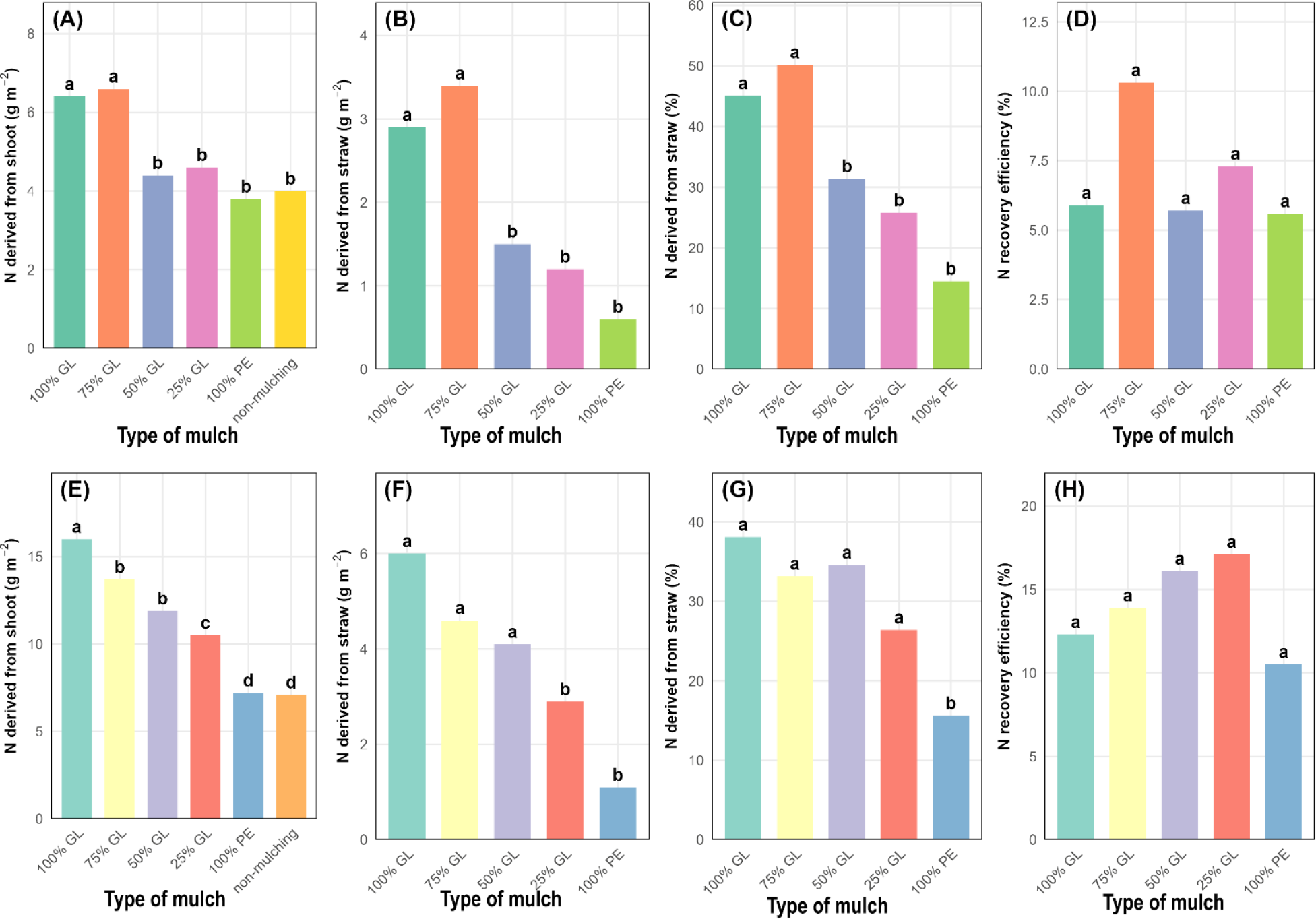
The N from the mulch transferred to lettuce and Indian spinach was above 30 % in the treatments with mulch with gliricidia above 50 % (Figure 1), corroborating the results obtained by Bah & Rahman (2001), who evaluated the N recovered from gliricidia leaves in corn cultivation. The N from mulch in lettuce and Indian spinach was 26 % in the 25 % GL treatment (Figure 1), corroborating the results found by Paulino et al. (2009), who observed that 22 % of the N fixed by gliricidia were transferred to soursop plants.
Accumulated N, N derived from straw (g m-2), N derived from straw (%) and N recovery efficiency in vegetables (lettuce - A, B, C, and D; Indian spinach - E, F, G, and H). Averages followed by the same letter in the bars do not differ from each other according to the Scott-Knott test at 5 % of probability. 100 % GL: 100 % of Gliricidia sepium; 75 % GL: 75 % of G. sepium + 25 % of Pennisetum purpureum; 50 % GL: 50 % of G. sepium + 50 % of P. purpureum; 25 % GL: 25 % of G. sepium + 75 % of P. purpureum; 100 % PE: 100 % of P. purpureum.
The transfer of N from the mulch to lettuce in 2023 showed that the highest values of N from the mulch were observed in treatments with coverings containing more than 75 % GL, which provided a greater amount of N accumulated in the lettuce biomass (Figure 1). In N from mulch to Indian spinach, the highest values were observed in treatments that had material with some proportion of gliricidia in their composition, influencing a greater amount of N accumulated in the biomass of Indian spinach, mainly in the 100 % GL, 75 % GL, and 50 % GL treatments (Figure 1).
The accumulated amount of N in lettuce from mulch was higher in the 100 % GL and 50 % GL treatments, with value close to 3 g m-2 (Figure 1). In Indian spinach cultivation, the accumulated amount of N from mulch was higher in the 100 % GL treatment, with 6 g m-2, whereas the 100 % PE treatment had an accumulated amount of N below 3 g m-2 (Figure 1).
The efficiency of 15N recovery from straw for lettuce showed no statistical difference between the treatments, with 10.3 % of N being recovered in the treatment with 75 % GL cover (Figure 1). The efficiency of 15N recovery from straw for Indian spinach showed no statistical difference among the treatments, with coverings containing gliricidia showing values between 12.3 and 17.1 %, whereas the 100 % PE covering showed N recovery efficiency of 10.5 % (Figure 1).
Apolinário et al. (2016) observed that N cycling through gliricidia litter in two consecutive years was 105 and 109 kg ha-1, respectively. Araújo et al. (2011) observed N recovery efficiency values in cabbage derived from mucuna (Mucuna aterrima) of 9 % and sorghum of 8 %, lower than those found in this study. However, when the same authors used pig bean straw, the N recovery efficiency by cabbage was 16 %, close to that found in this study when using straw with 50 % GL and 25 % GL.
Diouf et al. (2017) analyzed the recovery of N by corn fixed by gliricidia, which was influenced by the inoculation of symbiotic microorganisms, with values of 17 and 26 % of N applied as organic material from gliricidia over two years, respectively. Araújo et al. (2019) evaluated isotopic methods of applying 15N in the soil to determine the efficiency of N recovery derived from green manure by corn and found, through an indirect method, a recovery efficiency of 13.93 % of N derived from pig bean straw, a value close to that found in this study when using mulch containing gliricidia biomass.
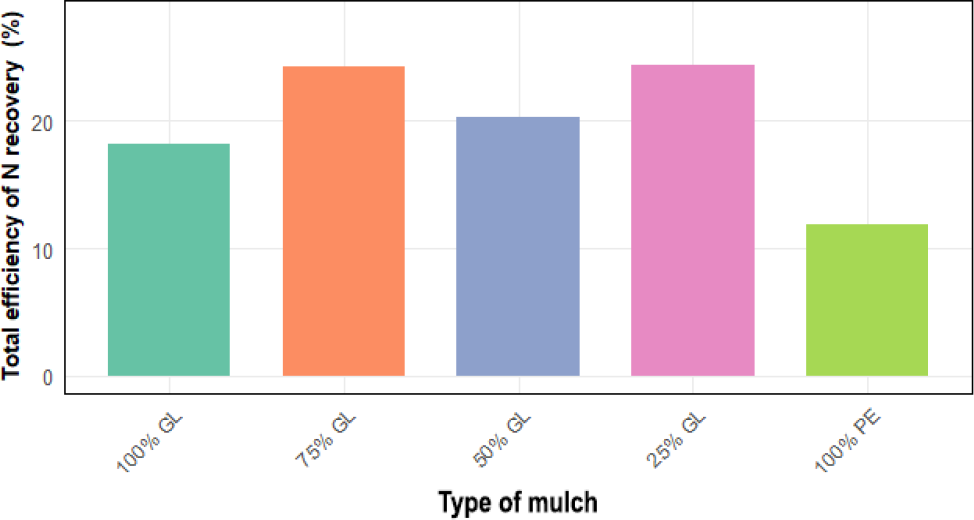
The total recovery efficiency of 15N from the mulch showed no difference among the treatments, with values ranging from 11.9 to 24.4 % of N recovered by the vegetables (Figure 2). Araújo et al. (2011) obtained N recovery efficiency values derived from pig bean straw for cabbage plants ranging from 9 to 16 %, whereas Koucher et al. (2017) observed a 4 % recovery efficiency of N from residues used as mulch in onion. It should be noted that, although the isotopic dilution methodology is very practical, it tends to overestimate values due to the primer effect caused by soil N contained in organic matter, which contributes to diluting the applied N.
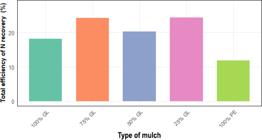
Total efficiency of N recovery from straw by vegetables (lettuce and Indian spinach). 100 % GL: 100 % of Gliricidia sepium; 75 % GL: 75 % of G. sepium + 25 % of Pennisetum purpureum; 50 % GL: 50 % of G. sepium + 50 % of P. purpureum; 25 % GL: 25 % of G. sepium + 75 % of P. purpureum; 100 % PE: 100 % of P. purpureum.
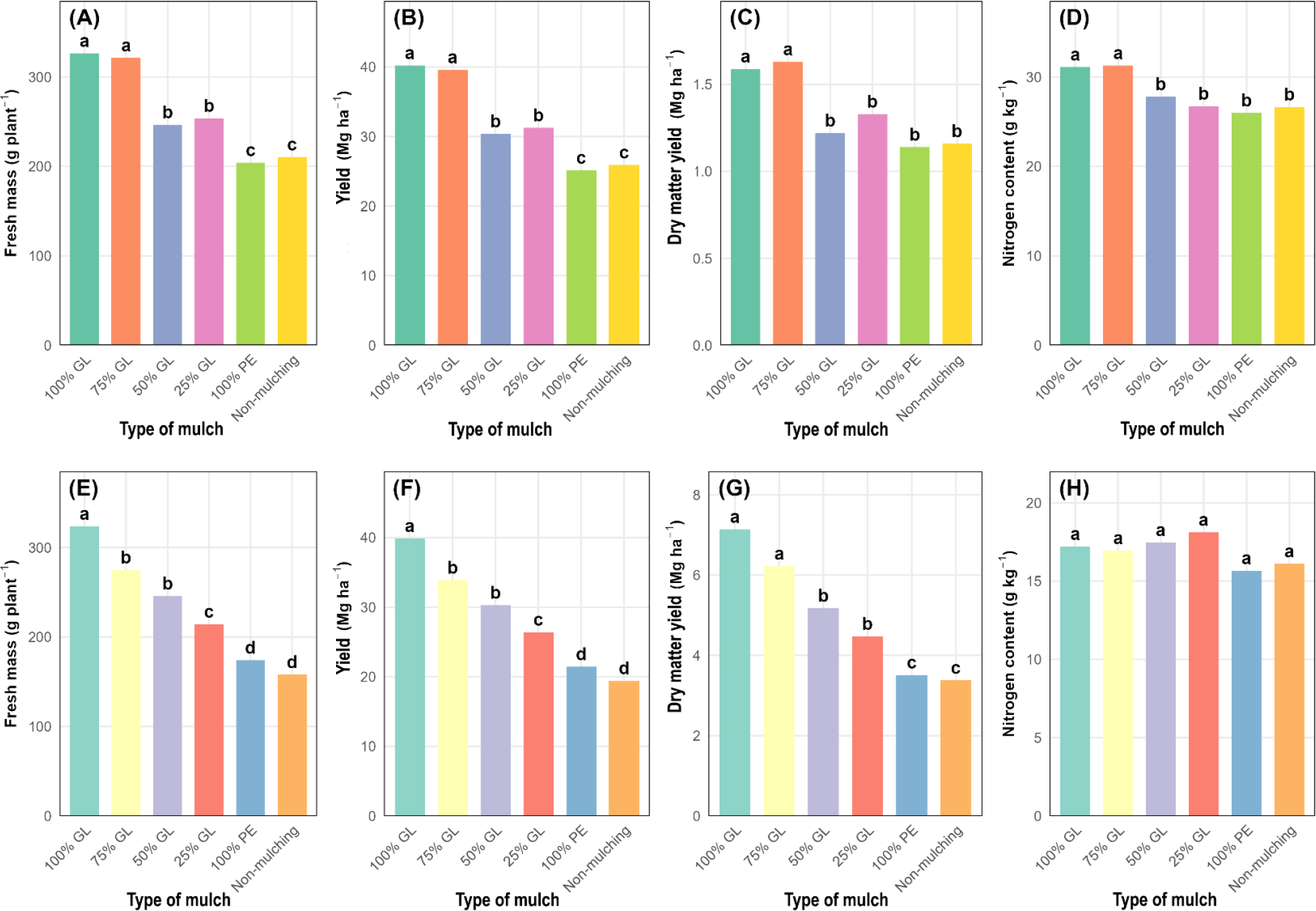
The agronomic performance of the vegetables showed that, in the 2022 and 2023 experiments, the best values were obtained for the 75 % GL and 100 % GL treatments (Figures 3 and 4). The average fresh mass yield of the aforementioned treatments was 19 t ha-1 for lettuce and 53 t ha-1 for Indian spinach in 2022, and 40 t ha-1 for lettuce and 36 t ha-1 for Indian spinach in 2023. Oliveira et al. (2021), analyzing three species of shrubby legumes, reported that gliricidia had the greatest potential for corn fertilization.
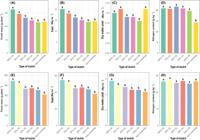
Production (A) and yield (B) of fresh matter, dry matter yield (C), and N content (D) in lettuce plants; production (E) and yield (F) of fresh matter, dry matter yield (G), and N content (H) in Indian spinach plants. Means followed by the same letter in the bars do not differ from each other by the Scott-Knott test at 5 % of probability. 100 % GL: 100 % of Gliricidia sepium; 75 % GL: 75 % of G. sepium + 25 % of Pennisetum purpureum; 50 % GL: 50 % of G. sepium + 50 % of P. purpureum; 25 % GL: 25 % of G. sepium + 75 % of P. purpureum; 100 % PE: 100 % of P. purpureum.
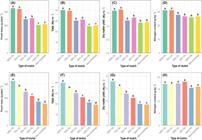
Fresh mass production (A) and yield (B), dry mass yield (C), and N content (D) in lettuce plants; fresh mass production (E) and yield (F), dry mass yield (G), and N content (H) in Indian spinach plants. Means followed by the same letter in the bars do not differ from each other according to the Scott-Knott test at a 5 % of probability. 100 % GL: 100 % of Gliricidia sepium; 75 % GL: 75 % of G. sepium + 25 % of Pennisetum purpureum; 50 % GL: 50 % of G. sepium + 50 % of P. purpureum; 25 % GL: 25 % of G. sepium + 75 % of P. purpureum; 100 % PE: 100 % of P. purpureum.
The production and fresh mass yield of lettuce in 2022 showed the highest values in the 75 % GL and 100 % GL treatments, with averages of 150 g plant-1 of fresh mass and 19 t ha-1 of fresh mass yield (Figures 3A and 3B), values lower than those found by Antunes et al. (2018) for the same variables. The fresh mass yield in this study, in treatments where mulch with proportions equal to or less than 50 % of gliricidia were used, did not differ from the 100 % PE and no mulch treatments (Figure 3B).
The fresh mass production of Indian spinach in 2022 was higher in the 75 % GL and 100 % GL treatments, with values above 400 g plant-1 (Figure 3E). The fresh mass yield of Indian spinach showed that the 100 % GL and 75 % GL treatments outperformed the others, with values above 51 t ha-1 (Figure 3F), higher than the national average, which, according to Brasil (2010), can vary between 15 and 37 t ha-1. The observed dry mass yield of Indian spinach showed that the 100 % GL treatment outperformed the others (Figure 3G). No difference was observed among the treatments in terms of N content in Indian spinach (Figure 3H).
The fresh lettuce mass production in 2023 showed that the 100 % GL and 75 % GL treatments had values equal to or greater than 321 g plant-1 (Figure 4A), higher than the 233 g plant-1 observed by Peixoto Filho et al. (2013). Oliveira et al. (2008) obtained 348 and 206 g plant-1 of fresh lettuce mass in two growing cycles, respectively. The fresh mass yield of lettuce in this study, observed in the 100 % GL and 75 % GL treatments, was close to 40 t ha-1 (Figure 4B), higher than the 36 t ha-1 found by Peixoto Filho et al. (2013) .The dry mass yield of lettuce in the 100 % GL and 75 % GL treatments averaged 1.6 t ha-1, exceeding the results found in the other evaluated treatments (Figure 4C).
The production and fresh mass yield of Indian spinach in 2023 were higher in the 100 % GL treatment, followed by 75 % GL, 50 % GL, and 25 % GL, with the lowest results in the 100 % PE and no mulch treatments (Figures 4E and 4F). The fresh mass and yield of Indian spinach observed in the 100 % GL treatment were 324 g plant-1 and 40 t ha-1, respectively (Figures 4E and 4F).
The dry mass yield values found for Indian spinach showed that the treatments were separated into three groups, with the group with the best values represented by 100 % GL and 75 % GL, followed by the 50 % GL and 25 % GL, and with the worst values for 100 % PE and no mulch (Figure 4G). The N content values in Indian spinach showed that there was no difference among the evaluated treatments (Figure 4H).
Future research should evaluate long-term effects on the soil, test other vegetables, and analyze the economic viability of using gliricidia under different growing conditions.
CONCLUSIONS
-
1. Gliricidia-based mulch promotes higher nitrogen (N) transfer to lettuce (Lactuca sativa) and Indian spinach (Basella alba), when compared to mulch composed exclusively of elephant grass or the absence of mulch;
-
2. There was no difference in the efficiency of N recovery from mulch to vegetables in covered or uncovered soils;
-
3. Mulch with 75 % or more of gliricidia are more suitable for successive vegetable cultivation.
Data Availability Statement:
Research data are only made available by authors upon request.
REFERENCES
- ANTUNES, L. F. de S.; SCORIZA, R. N.; FRANÇA, E. M.; SILVA, D. G.; CORREIA, M. E. F.; LEAL, M. A. de A.; ROUWS, J. R. C. Desempenho agronômico da alface crespa a partir de mudas produzidas com gongocomposto. Revista Brasileira de Agropecuária Sustentável, v. 8, n. 3, p. 57-65, 2018.
- APOLINÁRIO, V. X. O.; DUBEUX JUNIOR, J. C. B.; LIRA, M. A.; SAMPAIO, E. V. S. B.; AMORIM, S. O.; SILVA, N. G. M.; MUIR, J. P. Arboreal legume litter nutrient contribution to a tropical silvopasture. Agronomy Journal, v. 108, n. 6, p. 2478-2484, 2016.
- ARAÚJO, E. da S.; GUERRA, J. G. M.; ESPINDOLA, J. A. A.; URQUIAGA, S.; BODDEY, R. M.; MARTELLETO, L. A. P.; ALVES, B. J. R. Recuperação no sistema solo-planta de nitrogênio derivado da adubação verde aplicada à cultura do repolho. Pesquisa Agropecuária Brasileira, v. 46, n. 7, p. 729-735, 2011.
- ARAÚJO, E. da S.; SILVA, B. F.; CHIEZA, E. D.; URQUIAGA, S.; GUERRA, J. G. M.; COSTA, J. R.; ESPÍNDOLA, J. A. A. Comparison of 15N isotope methods to determine the recovery efficiency of nitrogen from green manure. Pesquisa Agropecuária Brasileira, v. 54, e00721, 2019.
- BAH, A. R.; RAHMAN, Z. A. Gliricidia (Gliricidia sepium) green manures as a potential source of N for maize production in the tropics. The Scientific World Journal, v. 1, n. S2, p. 90-95, 2001.
- BRASIL. Ministério da Agricultura, Pecuária e Abastecimento. Instrução normativa nº 46, de 6 de outubro de 2011. Estabelece o regulamento técnico para os sistemas orgânicos de produção. Diário Oficial da União, Poder Executivo, Brasília, DF, 07 out. 2011. Seção 1, p. 46.
- BRASIL. Ministério da Agricultura, Pecuária e Abastecimento. Manual de hortaliças não-convencionais Brasília, DF: MAPA, 2010.
- CORDEIRO, A. A. S.; ANTUNES, L. F. S.; SANTOS, G. C. R.; GUERRA, J. G. M.; BERBARA, R. L. L.; ARAÚJO, E. S.; ESPINDOLA, J. A. A. Fertilization with fermented composts improves agroeconomic performance and sustainability in organic lettuce and forage sorghum cropping systems in northwestern Minas Gerais, Brazil. Organic Agriculture, v. 15, n. 3, p. 423-438, 2025.
- DE, B.; BANDYOPADHYAY, S.; MUKHOPADHYAY, D. Tillage-mulch-nutrient interaction effect on N, P and K balance in soil and plant uptake in maize-black gram cropping system in an acid soil of North Bengal. Journal of the Indian Society of Soil Science, v. 69, n. 1, p. 50-59, 2021.
- DIOUF, A.; NDIAYE, M.; FALL-NDIAYE, M. A.; DIOP, T. A. Maize crop N uptake from organic material of Gliricidia sepium coinoculated with Rhizobium and arbuscular mycorrhizal fungus in sub-Saharian Africa sandy soil. American Journal of Plant Sciences, v. 8, n. 3, p. 428-440, 2017.
- FAHAD, S.; CHAVAN, S. B.; CHICHAGHARE, A. R.; UTHAPPA, A. R.; KUMAR, M.; KAKADE, V.; PRADHAN, A.; JINGER, D.; RAWALE, G.; YADAV, D. K.; KUMAR, V.; FAROOQ, T. H.; ALI, B.; SAWANT, A. V.; SAUD, S.; CHEN, S.; POCZAI, P. Agroforestry systems for soil health improvement and maintenance. Sustainability, v. 14, e22, 2022.
- FERNÁNDEZ, C. Effects of post-fire application of straw mulch strips on soil erosion, soil moisture and vegetation regeneration in European dry heathlands in NW Spain. Ecological Engineering, v. 196, e107095, 2023.
- FERREIRA, D. Sisvar: a computer analysis system to fixed effects split plot type designs. Revista Brasileira de Biometria, v. 37, n. 4, e529, 2019.
- GOODMAN, B. Utilization of waste straw and husks from rice production: a review. Journal of Bioresources and Bioproducts, v. 5, n. 3, p. 143-162, 2020.
- INTERNATIONAL UNION OF SOIL SCIENCES (IUSS). World reference base for soil resources 2022: international soil classification system for naming soils and creating legends for soil maps. 4. ed. Vienna: IUSS, 2022.
- IWATA, B. D. F.; BRANDÃO, M. L. S. M.; BRAZ, R. D. S.; LEITE, L. F. C.; COSTA, M. C. G. Total and particulate contents and vertical stratification of organic carbon in agroforestry system in Caatinga. Revista Caatinga, v. 34, n. 2, p. 443-451, 2021.
- KOUCHER, L. D. P.; BRUNETTO, G.; MÜLLER JÚNIOR, V.; SOUZA, M.; LIMA, A. P.; GIACOMINI, S. J.; COUTO, R. D. R.; KURTZ, C.; CARRANCA, C. L. V. D. A. F.; COMIN, J. J. Nitrogen transfer from cover crop residues to onion grown under minimum tillage in southern Brazil. Revista Brasileira de Ciência do Solo, v. 41, e0160347, 2017.
- LADHA, J. K.; PEOPLES, M. B.; REDDY, P. M.; BISWAS, J. C.; BENNETT, A.; JAT, M. L.; KRUPNIK, T. J. Biological nitrogen fixation and prospects for ecological intensification in cereal-based cropping systems. Field Crops Research, v. 283, e108541, 2022.
- LEAL, M. A. de A.; BALIEIRO, F. de C.; INÁCIO, C. T.; CAMPOS, D. V. B.; GUERRA, J. G. M.; ZONTA, E.; FREIRE, L. R. Uso e manejo da matéria orgânica para fins de fertilidade do solo. In: FREIRE, L. R. (org.). Manual de calagem e adubação do estado do Rio de Janeiro Rio de Janeiro: Embrapa Solos, 2013. p. 143-165.
- LEAL, M. A. de A.; GUERRA, J. G. M.; ESPINDOLA, J. A. A.; ARAÚJO, E. da S. Compostagem de misturas de capim-elefante e torta de mamona com diferentes relações C:N. Revista Brasileira de Engenharia Agrícola e Ambiental, v. 17, n. 11, p. 1195-1200, 2013a.
- OLIVEIRA, F. F. D.; GUERRA, J. G. M.; ALMEIDA, D. L.; RIBEIRO, R. D. L.; ESPINDOLA, J. A. A.; RICCI, M. D. S.; CEDDIA, M. B. Avaliação de coberturas mortas em cultura de alface sob manejo orgânico. Horticultura Brasileira, v. 26, n. 2, p. 216-220, 2008.
- OLIVEIRA, F. R.; DIAS, C. T.; SOUZA, H.; LIMA, B. L.; COSTA, M. C. Tree legumes with fertilizer potential: a multivariate approach. Revista Ciência Agronômica, v. 52, e20196831, 2021.
- OLIVEIRA, M. A. D.; MACHADO, G. A.; PEREIRA, M. S.; PANTOJA, M. J. Inovações na agricultura orgânica: revisão sistemática e bibliométrica de literatura. Revista de Economia e Sociologia Rural, v. 62, n. 2, e269069, 2024.
- PASHAEI KAMALI, F.; MEUWISSEN, M. P. M.; DE BOER, I. J. M.; VAN MIDDELAAR, C. E.; MOREIRA, A.; OUDE LANSINK, A. G. J. M. Evaluation of the environmental, economic, and social performance of soybean farming systems in southern Brazil. Journal of Cleaner Production, v. 142, n. 1, p. 385-394, 2017.
- PAULINO, G. M.; ALVES, B. J. R.; BARROSO, D. G.; URQUIAGA, S.; ESPINDOLA, J. A. A. Fixação biológica e transferência de nitrogênio por leguminosas em pomar orgânico de mangueira e gravioleira. Pesquisa Agropecuária Brasileira, v. 44, n. 12, p. 1598-1607, 2009.
- PEIXOTO FILHO, J. U.; FREIRE, M. B. G. D. S.; FREIRE, F. J.; MIRANDA, M. F. A.; PESSOA, L. G. M.; KAMIMURA, K. M. Produtividade de alface com doses de esterco de frango, bovino e ovino em cultivos sucessivos. Revista Brasileira de Engenharia Agrícola e Ambiental, v. 17, n. 4, p. 419-424, 2013.
- RODRÍGUEZ-ESPINOSA, T.; PAPAMICHAEL, I.; VOUKKALI, I.; GIMENO, A. P.; CANDEL, M. B. A.; NAVARRO-PEDREÑO, J.; ZORPAS, A. A.; LUCAS, I. G. Nitrogen management in farming systems under the use of agricultural wastes and circular economy. Science of The Total Environment, v. 876, e162666, 2023.
- SANTOS, L. E. B. D.; SILVA, P. S. L. E.; OLIVEIRA, V. R. D.; OLIVEIRA, A. K. D. Branches of Gliricidia sepium used as mulch for weed control in corn. Revista Ciência Agronômica, v. 51, n. 1, e20186564, 2020.
- SILVA, J. H. C. S.; BARBOSA, A. D. S.; GOMES, D. D. S.; AQUINO, I. D. S.; SILVA, J. R. Dynamics of plant organic matter decomposition in different agricultural landscapes. Revista Caatinga, v. 36, n. 1, p. 135-144, 2023.
- SIMA, D. B.; SHEMELIS, A. Assessing the impact of fruit tree-based agroforestry, parkland agroforestry, and boundary planting on soil fertility and carbon stock in Erer District, Ethiopia. Journal of Landscape Ecology, v. 18, n. 2, p. 35-50, 2025.
- SIQUEIRA, A. P. P.; SIQUEIRA, M. F. B. Bokashi: adubo orgânico fermentado. Niterói: Secretaria de Agricultura e Pecuária, 2013. (Manual técnico, 40).
- WATTHIER, M.; PERALTA, A. N.; GOMES, J. A.; ROCHA, S. B. F.; SANTOS, R. H. S. Decomposition of green manure with different grass: legume ratios. Archives of Agronomy and Soil Science, v. 66, n. 7, p. 913-924, 2020.
- XIANG, Y.; LI, Y.; LUO, X.; LIU, Y.; YUE, X.; YAO, B.; XUE, J.; ZHANG, L.; FAN, J.; XU, X.; LI, Y. Manure properties, soil conditions and managerial factors regulate greenhouse vegetable yield with organic fertilizer application across China. Frontiers in Plant Science, v. 13, e1009631, 2022.
- YANG, Y.; LIU, H.; WU, J.; ZHANG, S.; GAO, C.; ZHANG, S.; TANG, D. W. S. Soil enzyme activities, soil physical properties, photosynthetic physical characteristics and water use of winter wheat after long-term straw mulch and organic fertilizer application. Frontiers in Plant Science, v. 14, e1186376, 2023.