 Bone meal and hydrogel enhance soil fertility with cashew farming in semi-arid areas
ABSTRACT
Cashew trees are often cultivated in semi-arid regions with poor soil and limited rainfall, presenting significant challenges for soil management. This study aimed to evaluate soil fertility based on varying doses of bone meal (0, 250, 500, 750 and 1,000 g pit−1), mixed into the planting pit with or without moisture-retaining hydrogel (0 and 5 g pit−1), in dwarf cashew ‘BRS 226’ cultivation. The soil chemical attributes were monitored over two growing seasons. The bone meal application increased the soil pH by 221 % along the two years and boosted the organic matter by 13 % in the first year and 28 % in the second one. The use of 5 g of hydrogel per pit, combined with 1,000 g of bone meal per pit, is recommended to improve the soil fertility in semi-arid cashew-growing areas over a two-year period. The bone meal fertilization in cashew planting promotes beneficial changes in the soil, and the hydrogel has a great potential in cashew farming, offering an alternative for expanding the fruit production in regions with low rainfall and sandy soils.
KEYWORDS
Anacardium occidentale ; soil nutrient availability; soil conditioner
RESUMO
Cajueiros são frequentemente cultivados em regiões semiáridas com solo pobre e chuvas limitadas, apresentando desafios significativos para o manejo do solo. Objetivou-se avaliar a fertilidade do solo com base em doses variáveis de farinha de ossos (0; 250; 500; 750; e 1.000 g cova−1), misturadas na cova de plantio com ou sem hidrogel retentor de umidade (0 e 5 g cova−1), em cultivo de cajueiro anão ‘BRS 226’. Os atributos químicos do solo foram monitorados ao longo de duas estações de cultivo. A aplicação de farinha de ossos aumentou o pH do solo em 221 % ao longo dos dois anos e impulsionou a matéria orgânica em 13 % no primeiro ano e 28 % no segundo. O uso de 5 g de hidrogel por cova, combinado com 1.000 g de farinha de ossos por cova, é recomendado para melhorar a fertilidade do solo em áreas semiáridas de cultivo de cajueiro ao longo de um período de dois anos. A fertilização com farinha de ossos no plantio de cajueiro promove mudanças benéficas no solo, e o hidrogel tem grande potencial no cultivo de cajueiro, oferecendo uma alternativa para expandir a produção de frutas em regiões com baixa precipitação e solos arenosos.
PALAVRAS-CHAVE
Anacardium occidentale ; disponibilidade de nutrientes do solo; condicionador do solo
INTRODUCTION
Soil degradation is a significant challenge in semi-arid regions of Brazil, where the critical scenario represented by scarce rainfall and fragile soils is exacerbated by human intervention (Pereira et al. 2022). This degradation compromises soil quality, limiting plant production due to nutrient poverty and poor water retention (Diatta et al. 2020). Additionally, these soils have low levels of organic matter and essential nutrients (N, P and K) and often exhibit high acidity (Cunha et al. 2010).
A promising solution to this problem is the use of organic fertilizers (Wan et al. 2021) and innovative technologies such as hydrogel. However, while traditional fertilizers increase agricultural productivity, their excessive use causes environmental pollution (Penuelas et al. 2023). In contrast, organic fertilizers, such as those based on bone meal, increase the soil organic matter content and promote the reuse of by-products, showing promising results (Bogush et al. 2018, Nogalska & Zaluszniewska 2021, Zaluszniewska & Nogalska 2022).
The meal is obtained during the processing of raw materials of animal origin and includes slaughterhouse residues not intended for human consumption, e.g., heads, hooves, blood, fat, feathers, bones and offal (Zaluszniewska & Nogalska 2022). Bone meal is also a low-cost alternative rich in essential nutrients such as nitrogen, phosphorus and calcium, as well as organic matter, components that are slowly released into the soil, preventing nutrient leaching and promoting a sustainable plant growth (Nogalska & Zaluszniewska 2021). Furthermore, studies have shown that bone meal has a promising potential for reducing soil acidity (Zaluszniewska & Nogalska 2022).
Expanding this approach, biodegradable carrier hydrogels emerge as an innovative technology capable of enhancing the efficiency in delivering nutrients to plants (Das & Ghosh 2022). These hydrogels can store large nutrient amounts and release them gradually into the soil, maintaining an optimal concentration for longer periods and under ideal conditions for crop growth (Das & Ghosh 2022).
Cashew tree is a prominent plant species in Brazil, with fruit production reaching 122.2 thousand tons in 2023, with approximately 90.9 % of this output coming from the Northeast region (Conab 2023). This crop holds a significant commercial importance and is widely used in the food industry. Both the pseudofruit and the nuts are consumed fresh, while the pseudofruit is also processed into juices and sweets. Cashew nuts are incorporated into flour production and used as fuel in the manufacture of paints and varnishes (Oliveira et al. 2020). Additionally, the leaves and stem bark exhibit various pharmacological properties, such as antioxidant and antimicrobial effects (Costa et al. 2022).
In the Northeast region, cashew trees are frequently grown under rainfed conditions in soils with low nutrient levels, often coupled with inadequate nutritional management during their initial growth period (Cavalcante Júnior et al. 2019). These factors have significantly hindered the plants’ ability to reach their maximum productive potential, as nutrient uptake plays a crucial role in the cashew tree development, with nutrient accumulation following the order of N > K > P > Mg > Ca > S > Fe > Mn > Cu > B > Zn (Cavalcante Júnior et al. 2019).
From this perspective, this study tested the hypothesis that combining bone meal and hydrogel could improve soil fertility and reduce aluminum saturation in semi-arid regions cultivated with cashew trees. This approach aligns with the 2030 Agenda for Sustainable Development, particularly the Goal 15, which focuses on conserving and sustainably using terrestrial ecosystems, and Goal 2, which aims to end hunger, achieve food security, improve nutrition and promote a sustainable agriculture (United Nations 2023). Thus, it aimed to evaluate the soil fertility in response to bone meal doses and the use of hydrogel, in areas cultivated with cashew trees over a two-year period.
MATERIAL AND METHODS
The experiment was carried out from April 2017 to May 2019, in the municipality of Boa Saúde, Rio Grande do Norte state, Brazil (6°07′06.4″S, 35°33′30.0″W and altitude of 110 m). According to the Köppen classification (Alvares et al. 2013), the region’s climate is classified as As’ and Bsh’, characterized as semi-arid tropical with a rainy season in the summer, average annual rainfall of 700 mm concentrated from March to June, average annual temperature of 28 °C, and air humidity at 75 %.
The soil in the experimental area has a sandy loam texture in the 0-20 cm layer, with 810, 126 and 64 g kg−1 of sand, clay and silt, respectively, being classified as Ultissol (USDA 2014). The soil chemical attributes are as it follows: pH = 5.2; P = 3.01 mg dm−3 (Mehlich 1 Extractor ); K = 56.15 mg dm−3 (Mehlich 1 Extractor); Na=0.01 cmolc dm−3 (Mehlich 1 Extractor ); Fe = 10.86 cmol dm−3 (diethylenetriaminepentaacetic acid - DTPA); Zn = 0.99 cmolc dm−3 (DTPA); Cu = 0.16 cmolc dm−3 (DTPA); Mn=3.26 cmolc dm−3 (DTPA); Ca = 0.23cmolc dm−3 (KCl 1M); Mg = 0.15 cmolc dm−3 (KCl 1M); H+Al = 1.62 cmolc dm−3 (calcium acetate 0.5 M; pH 7.0); Al = 0.10 cmolc dm−3 (KCl 1M); sum of bases = 0.52 cmolc dm−3; cation exchange capacity = 2.15 cmolc dm−3; base saturation = 24.79 %; aluminum saturation = 15.77 %; and soil organic matter = 5.64 g kg−1.
The orchard was established in a randomized block design, following a 5 × 2 factorial arrangement for 10 treatments with four replications and 3 plants plot−1, each in its own planting pit, with cashew plants being used as edges (Paiva et al. 2003, Vale et al. 2014). The treatments consisted of five doses of bone meal, which were mixed in the planting pits (0, 250, 500, 750 and 1,000 g pit−1) with or without the application of moisture retainer hydrogel (0 and 5 g pit−1, respectively). The bone meal doses were based on the soil P content and the P recommendation for the crop (Serrano 2016) by establishing values above and below the recommended ones. The hydrogel concentration followed the manufacturer’s recommendation for fruit trees.
The bone meal used in the experiment came from the animal waste processing industry and was obtained after cooking cattle carcasses, eliminating the fat and drying and crushing the bones. The results of its chemical analysis were as it follows: organic carbon = 27.02 %; organic matter = 46.58 %; N = 41.13 g kg−1; P = 28.10 g kg−1; K = 0.14 g kg−1; Ca = 294.35 g kg−1; Mg = 17.81 g kg−1; S = 4.15 g kg−1; B = 2.00 mg kg−1; Cu = 2.00 mg kg−1; Fe = 259.00 mg kg−1; Mn = 7.50 mg kg−1; and Zn = 68.00 mg kg−1.
The orchard was set up by completely cleaning the experimental area and preparing the soil through heavy harrowing followed by light harrowing for leveling.
Planting pits measuring 0.4 × 0.4 × 0.4 m (width × length × depth) were manually dug with hoes by observing a spacing of 10 m between plants and 10 m between rows (Serrano & Cavalcanti Junior 2016), totaling 1.2 ha of experimental area. The plants were grown without irrigation to simulate the conditions that most cashew producers use in the region (Paiva et al. 2003). Fertilization at planting was carried out by applying 90 g pit−1 of single superphosphate (18 % of P2O5, 10 % of S and 18 % of Ca), 90 g pit−1 of potassium chloride (60 % of K2O), and 100 g pit−1 of FTE BR 12® (source of oxysilicate micronutrients) composed of 1.08 % of B, 0.8 % of Cu, 2 % of Mn, 9 % ofZn and 1.0 % ofS. Fertilization was based on soil analysis and followed recommendations by Serrano (2016). Liming was not carried out because studies show that bone meal corrects soil acidity (Zaluszniewska & Nogalska 2022).
The seedlings were produced in polyethylene bags (11 × 23 cm) filled with a substrate consisting of hydromorphic soil and dried and shredded carnaúba bagasse (leaf fibers after wax extraction) in a 2:1 ratio (Serrano & Cavalcanti Junior 2016). At the time of planting, the seedlings had an average height of 19.0 ± 1.5 cm, average stem diameter of 10.0 ± 3.0 mm and four to six fully expanded leaves (Serrano & Cavalcanti Junior 2016).
Planting took place on May 10, 2017, in pre-prepared pits. The hydrated polymer was applied at planting, following the manufacturer’s guidelines, and covered 50 % of the seedling clods.
The hydrogel was characterized by the manufacturer as a potassium copolymer of polyacrylate/polyacrylamide in white grains, with particle sizes ranging from 100 to 800 µm and a pH of 5.5 to 6.0. It can release up to 95 % of the stored solution to the plant (with 5 % retained under high tension) and can absorb up to 300 times its mass in water and 100 times its volume. The hydrogel is compatible with most agricultural inputs, has water retention capacity and a useful life of up to five years. It is hydrated and placed exclusively in the planting pit.
Topdressing fertilization was carried out after planting by applying 60 g plant−1 of ammonium sulfate and 90 g plant−1 of potassium chloride, split into two applications, one at 60 days and another at 90 days after planting. The fertilizer was distributed in circular furrows, based on soil analysis, and following recommendations of Serrano (2016). In the second year, no topdressing fertilization was carried out, so that the residual effect of bone meal and hydrogel could be analyzed.
Four annual pesticide sprayings were carried out to prevent pest attack using a Deltamethrin-based insecticide and an adhesive spreader, at the recommended doses for the crop. Weed control was performed by periodic harrowing between rows and manual weeding within a radius of 0.5 m in the first year and 1.0 m in the second year.
Soil samples were taken in 2018 and 2019, 12 and 24 months after planting, respectively, for chemical analysis. Fifteen simple samples were collected from each experimental plot, from the 0 to 20 cm layer under the canopy projection, using a Dutch auger. The samples were homogenized to form a composite sample, placed in labeled plastic bags, dried in a forced-air circulation oven at 60 °C, and sieved through a 2-mm mesh.
The parameters analyzed at the laboratory included the soil organic matter content, determined using the chromic acid wet oxidation method (Walkley & Black 1933), and soil pH measured in water (1:2.5) (Teixeira et al. 2017). The available phosphorus (P) and exchangeable potassium (K) contents were determined using the Mehlich-1 extractor, whereas the exchangeable calcium (Ca) and exchangeable magnesium (Mg) contents were determined using the KCl extractor (Teixeira et al. 2017). Potential acidity (H + Al) was obtained using calcium acetate buffered to pH 7.0 (Teixeira et al. 2017). The total soil nitrogen was determined by automated combustion (Yeomans & Bremner 1991).
The soil cation exchange complex is represented by the following equations: SB = Ca2+ + Mg2+ + K+ + Na+; CEC = SB + H + Al3+; V = 100 (SB/CEC); and m = 100 Al3+/(SB + Al3+), where: SB represents the sum of exchangeable bases (cmolc dm−3); CEC is the cation exchange capacity (cmolc dm−3); V is the soil base saturation (%); and m is the aluminum saturation (%).
The data were initially tested for normality using the Shapiro-Wilk test (p ≤ 0.05) and homogeneity of variances using the Bartlett test (p ≤ 0.05), followed by analysis of variance using the F-test (p ≤ 0.05). The effects of hydrogel application were compared using the F-test, whereas the bone meal doses were adjusted by polynomial regression analysis up to the second degree by adopting as a selection criterion the significance of the equation parameters (p ≤ 0.05). All analyses were conducted with the R software, version 4.0.0 (R Core Team 2020).
RESULTS AND DISCUSSION
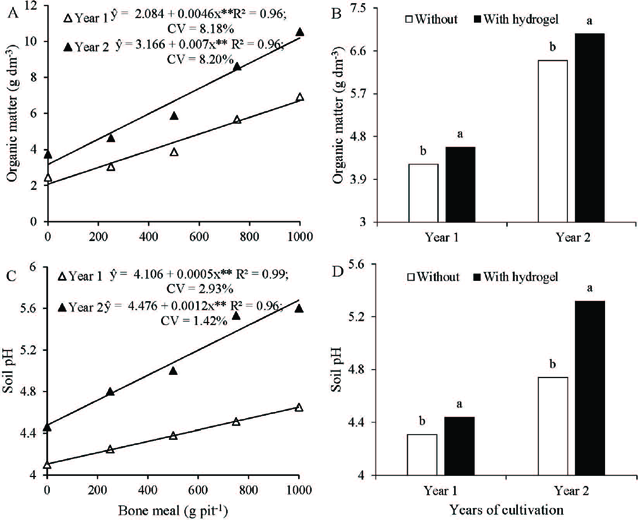
There was no interaction between bone meal doses and hydrogel application on the soil organic matter content and soil pH. The soil organic matter content increased linearly with the addition of bone meal doses (0 to 1,000 g pit−1) over the two years, with increases amounting to 221 % for the first and second years (Figure 1A). The use of bone meal as an ecological amendment not only enriches the soil with nutrients and stabilizes heavy metals, but also promotes bacterial balance and increases the abundance of bacteria involved in nutrient cycling, as observed by Zheng et al. (2023). This finding justifies the increase in the soil organic matter content throughout the two cashew farming cycles.
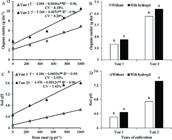
Organic matter (A and B), soil pH (C and D) and doses of bone meal with and without hydrogel, in two years of dwarf cashew farming.
The hydrogel application also contributed to increasing the soil organic matter content, when compared to the treatment without this component, with increases amounting to 8 and 9 % in the first and second years, respectively (Figure 1B). The soil organic matter content was higher in the second year. Soils with low organic matter and high sand contents are typically poorly structured and unstable (Cunha et al. 2010). However, the use of hydrogels formed by synthetic polymers and biopolymers significantly increases soil stability by strongly binding soil particles, resulting in a more rigid and aggregated system with less sliding of primary soil particles (Buchmann et al. 2015).
Furthermore, hydrogel application improves water retention, plant nutrition and soil protection, and stimulates microbial activity, thus accumulating benefits over time (Wei et al. 2023). These combined effects favor an increase in the soil organic matter content in the long term, what explains the higher soil organic matter content in the second year of farming.
Similarly to the soil organic matter content, the soil pH also increased linearly with bone meal doses (0 to 1,000 g pit−1), increasing from 4.1 to 4.6 in the first year and from 4.4 to 5.6 in the second year (Figure 1C). The hydrogel increased the pH from 4.3 to 4.4 in the first year, and from 4.7 to 5.3 in the second year (Figure 1D). The pH was also higher in the second year for both treatments.
The higher pH values resulting from the bone meal application indicate its role as an effective soil pH conditioner. It is important to note that liming was not performed in the experimental area to isolate the effect of bone meal on pH, supporting the findings of Zaluszniewska & Nogalska (2022), who observed that the calcium in bone meal reduces the soil acidity. The hydrogel application also contributed to increased soil organic matter and soil pH, particularly in the second year. These results stem from the improved physical properties hydrogel provides, such as enhanced soil porosity and water retention (Navroski et al. 2016, Felippe et al. 2021), which likely promoted microbial activity and boosted soil organic matter content. Similarly, Navroski et al. (2016) observed an increase in pH linked to hydrogel use, noting changes in substrate characteristics during Eucalyptus seedling production.
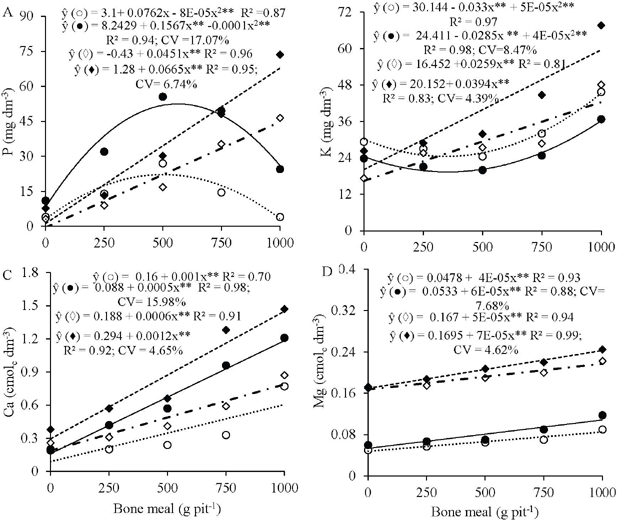
There was a significant interaction (p ≤ 0.01) between bone meal doses and hydrogel application on the P content. The soil P content fit a quadratic model in the first year of farming, during which hydrogel application reached a maximum of 69.63 mg dm−3, with an estimated bone meal dose of 784 g pit−1, then decreasing, whereas the maximum P content (21.24 mg dm−3) without hydrogel was reached with the bone meal dose of 476 g pit−1. The increase was linear in the second year, with the highest value associated with 66.78 mg dm−3 of hydrogel corresponding to the bone meal dose of 1,000 g pit−1. On the other hand, in the absence of hydrogel, the maximum P content was 44.67 mg dm−3 at the same bone meal dose, corresponding to an increase of 49.49 % with the use of hydrogel, if compared to its absence, representing a statistical difference (Figure 2A). The higher values observed in the presence of hydrogel can be explained by the polymer chains of the hydrogel containing ions, mainly K+, which may have played a role in binding with P (Oliveira Neto et al. 2024).

Contents of P (A), K (B), Ca (C) and Mg (D) in the soil cultivated with early dwarf cashew as a function of bone meal doses with (•) and without hydrogel (○) in the first year of farming, and with (♦) and without hydrogel (◊) in the second year of farming.
The phosphorus content in the first year of farming increased with bone meal doses up to approximately 500 g pit−1, regardless of hydrogel use. During the second year, phosphorus levels increased linearly with the bone meal application. The P content is dependent on soil pH, moisture content and organic matter (Zaluszniewska & Nogalska 2022). Consequently, as the use of bone meal increased the pH and soil organic matter levels, the P concentration increased as a result of increased bone meal doses, especially in the second year.
Bogush et al. (2018) concluded that bone meal contains high levels of P, Ca and K. In another study, Römer & Steingrobe (2018) determined that bone meal availability ranges from 74 to 100 %, if compared to triple superphosphate, which can replace conventional fertilizers. According to Malavolta et al. (2002), bone meal has a faster release of organic P than other organic fertilizers.
There was also a significant interaction (p ≤ 0.01) for soil K, Ca, Mg, sum ofbases, base saturation (V) and aluminum saturation (m), showing that both the bone meal and hydrogel act simultaneously on these variables.
The soil K content also fit the quadratic model in the first year of farming, decreasing with the addition of bone meal doses to a minimum of 24.69 mg dm−3, with the bone meal dose of 330 g pit−1 and no hydrogel, increasing after higher doses. On the other hand, in the presence of hydrogel, the minimum K content of 19.33 mg dm−3 was reached at the estimated bone meal dose of 356 g pit−1 (Figure 2B). The soil K content in the second year of farming increased as a function of bone meal doses both in the absence and presence of hydrogel, with respective increases of 157 and 195 % for the range of 0 to 1,000 g pit−1 (Figure 2B). These increases differed significantly, indicating a notable impact of hydrogel on the soil K content.
The soil Ca content increased linearly with increasing bone meal doses (0 to 1,000 g pit−1) in the two years of farming, especially with hydrogel application, resulting in increases of 568 and 408 % in the first and second years of farming, respectively. In contrast, in the absence of hydrogel, the increases amounted to 625 and 319 %, respectively (Figure 2C). Similarly to Ca, the soil Mg content also increased linearly with the bone meal doses in the two years, with higher values in the second year (Figure 2D). In the first year, the Mg content increased by 83 and 112 % without and with hydrogel, respectively, whereas, in the second year, the increases amounted to 30 and 41 %. These increases differed significantly, indicating a notable impact of hydrogel on soil Ca and Mg.
The linear increases in the soil contents of Ca and K as a function of bone meal addition can be explained by the high content of these nutrients in the bone meal. Studying the viability of bone meal as an organic fertilizer, Stçpień & Wojtkowiak (2015) observed, as in the present study, increases in the soil P content as a response to increasing bone meal doses. However, those authors also found that the soil pH and K content did not differ significantly, unlike in the present study, although this result depends on several factors (e.g., climate, soil, management and material used to form the bone meal).
The superior performance of most soil nutritional parameters in the second year, when compared to the first one, can be explained by the fact that bone meal contains some nutrients that are released fast and others that are released slowly (Liu et al. 2019). The macronutrients N, P and K are solubilized more slowly and are less readily available soon after application, explaining their highest values in the second year (Mondini et al. 2008). According to Jeng et al. (2006), readily available P from bone meal applied to the soil varies from 33 to 40 % in the first year of farming, with a 50 % efficiency in solubilization.
The higher soil levels of P, K, Ca and Mg with the use of hydrogel in both years of farming, but especially in the second year, can be attributed to the physical effects promoted by the conditioner, which, when incorporated into the soil, promotes a greater water and nutrient retention, making these nutrients slowly available to plants as a function of uptake and release cycles (Lopes et al. 2017). However, nutrient availability can be influenced by the type and particle size of the hydrogel used, with larger cationic particles (0.8-1.0 mm) being more efficient (Bai et al. 2010). Furthermore, according to these authors, the high cation exchange capacity of hydrogel reduces nutrient leaching.
On the other hand, the lower soil K content with the use of hydrogel in the first year may have been due to water availability in the soil and the size of hydrogel particles. A strong exchange reaction occurs between cations contained in the hydrogel and the K+ present in soil colloids, mainly because this nutrient has a high mobility in the soil (Bai et al. 2010).
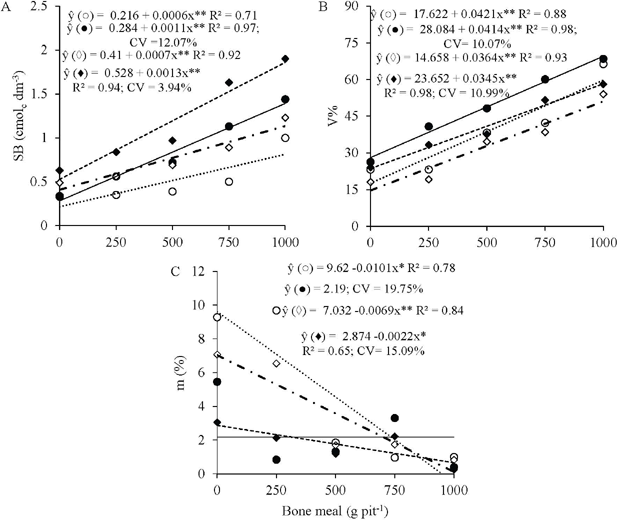
The sum of bases also increased with the addition of bone meal doses in the two years of farming, especially with hydrogel application. In the presence of hydrogel, the sum of bases increased by 387 % in the first year and by 246 % in the second year. On the other hand, when hydrogel was not present, the increases amounted to 278 and 171 % in the first and second years, respectively (Figure 3A). These increases differed significantly, indicating a notable impact of hydrogel on the sum of bases.

Sum of bases (SB), base saturation (V%) and aluminum saturation (m) of the soil (A, B and C) cultivated with early dwarf cashew as a function of bone meal doses with (•) and without hydrogel (○) in the first year of farming, and with (♦) and without hydrogel (◊) in the second year of farming.
Similarly to the sum of bases, the base saturation (V) increased by 239 and 248 % with the hydrogel application in the first and second years, respectively. In the absence of hydrogel, the increases amounted to 147 and 146 % (Figure 3B). This was probably due to the constituents present in the bone meal, which is very rich in P, N, CO, Ca and Mg, as well as the ability of the polymer to promote the gradual release of nutrients from the organic fertilizer and greater water retention capacity, resulting in more fertile soil even in arid conditions (Rizwan et al. 2021).
The increase in the nutritional values with hydrogel, and consequently in the base saturation, is due to the fact that the polymer alters the soil fertility, absorbing nutrients present in the soil solution, retaining them in its polymer chains and releasing them slowly, in addition to the nutrients binding to the hydrogel matrices (-COO- K+-), which will act on the soil’s cation exchange capacity, and the ions are made available when necessary for the crop, in addition to the issue of greater moisture retention (Oliveira Neto et al. 2024).
While the aluminum saturation decreased by 24 % for each bone meal increment in the first year without hydrogel, the hydrogel had no effect on aluminum saturation as bone meal doses increased. In the second year, both treatments, with and without hydrogel, showed reductions in aluminum saturation of 24 and 19 %, respectively, for each increase in the bone meal dose (Figure 3C).
This effect is primarily due to the high phosphate content in bone meal. When incorporated into the soil, the bone meal releases phosphate, which reacts with Al3+ to form insoluble complexes or precipitates (Shi et al. 2017). These complexes reduce the amount of Al3+ available in the soil, decreasing its toxicity and improving soil fertility (Shi et al. 2017). Additionally, the reduction in aluminum saturation promotes root growth and nutrient uptake by plants, as well as an increase in the soil pH (Bai et al. 2010, Costa et al. 2024).
The results reveal that the use of hydrogel, in combination with bone meal, enhances soil fertility and pH by maintaining the base saturation. This study demonstrates that both the bone meal and hydrogel significantly improve soil characteristics, promoting plant growth, particularly in cashew crops, where the leaf nutrient content increased under these conditions, as noted by Costa et al. (2024).
CONCLUSIONS
-
The soil pH, organic matter, P, K, Ca, Mg and base saturation increase proportionally with increasing bone meal doses, especially in the presence of hydrogel, while aluminum saturation decreases;
-
The use of 5 g pit−1 of hydrogel, associated with 1,000 g pit−1 of bone meal, is an alternative to improve soil fertility in semi-arid cashew areas over a two-year farming period;
-
Fertilization with bone meal in cashew farming areas promotes beneficial changes in the soil;
-
The use of hydrogel has a great potential in cashew farming, and could be an alternative for expanding fruit growing in regions with low rainfall rates and sandy soils.
ACKNOWLEDGMENTS
The authors thank the Coordenação de Aperfeiçoamento de Pessoal de Nível Superior (Capes) and the Dean for Research at the Universidade Federal da Paraíba, for the facilities and financial support; and the Fundação de Apoio à Pesquisa do Estado da Paraíba (Fapesq) (Grant nº 2165/2023), for awarding the second author a postdoctoral fellowship.
REFERENCES
- ALVARES, C. A.; STAPE, J. L.; SENTELHAS, P. C.; GONÇALVES, J. L. M.; SPAROVEK, G. Köppen’s climate classification map for Brazil. Meteorologische Zeitschrift, v. 22, n. 6, p. 721-728, 2013.
- BAI, W.; ZHANG, H.; LIU, B.; WU, Y.; SONG, J. Effects of super-absorbent polymers on the physical and chemical properties of soil following different wetting and drying cycles. Soil Use and Management, v. 26, n. 1, p. 253-260, 2010.
- BOGUSH, A. A.; STEGEMAN, J. A.; WILLIAMS, R.; WOOD, I. G. Element speciation in UK biomass power plant residues based on composition, mineralogy, microstructure and leaching. Fuel, v. 211, n. 1, p. 712-725, 2018.
- BUCHMANN, C.; BENTZ, J.; SCHAUMANN, G. E. Intrinsic and model polymer hydrogel-induced soil structural stability of a silty sand soil as affected by soil moisture dynamics. Soil and Tillage Research, v. 154, n. 1, p. 22-33, 2015.
- CAVALCANTE JÚNIOR, L. F.; SOARES, I.; TANIGUCHI, C. A. K.; SERRANO, L. A. L.; MELO, D. S. Nutrient accumulation and nutritional efficiencies of cashew genotypes. Journal of Plant Nutrition, v. 42, n. 4, p. 344-350, 2019.
-
COMPANHIA NACIONAL DE ABASTECIMENTO (Conab). Análise mensal de castanha de caju: novembro de 2023. 2023. Available at: <https://www.conab.gov.br/info-agro/analises-do-mercado-agropecuario-e-extrativista/analises-do-mercado/historico-mensal-de-castanha-de-caju/item/22529-castanha-de-caju-analise-mensal-novembro-2023 >. Access in: Feb. 2024.
» https://www.conab.gov.br/info-agro/analises-do-mercado-agropecuario-e-extrativista/analises-do-mercado/historico-mensal-de-castanha-de-caju/item/22529-castanha-de-caju-analise-mensal-novembro-2023 - COSTA, A. R.; SILVA, J. R. L.; PEREIRA, P. S.; ALMEIDA-BEZERRA, J. W.; OLIVEIRA, M. A. S.; RIBEIRO, P. R. V.; BRITO, E. S.; DRUMOND, M. A.; CALIXTO JÚNIOR, J. T.; KAMDEM, J. P.; DUARTE, A. E.; BARROS, L. M.; COUTINHO, H. D. M. Influence of abiotic factors on phytochemical diversity of Anacardium occidentale L. Food Bioscience, v. 49, n. 1, e101911, 2022.
- COSTA, J. E.; SOUSA, V. F. O.; PEREIRA, W. E.; MAIA JÚNIOR, S. O.; SERRANO, L. A. L.; LIMA, R. L. S. Effects of bone meal and hydrogel on the leaf contents of dwarf cashew. Pesquisa Agropecuária Tropical, v. 54, e77071, 2024.
- CUNHA, T. J. F.; PETRERE, V. G.; SILVA, D. J.; MENDES, A. M. S.; MELO, R. F. de; OLIVEIRA NETO, M. B. de; SILVA, M. S. L. da; ALVAREZ, I. A. Caracterização dos solos do semiárido. In: CUNHA, T. J. F.; PETRERE, V. G.; SILVA, D. J.; MENDES, A. M. S.; MELO, R. F. de; OLIVEIRA NETO, M. B. de; SILVA, M. S. L. da; ALVAREZ, I. A. Principais solos do semiárido tropical brasileiro: caracterização, potencialidades, limitações, fertilidade e manejo. Petrolina: Embrapa Semiárido, 2010.
- DAS, S. K.; GHOSH, G. K. Hydrogel-biochar composite for agricultural applications and controlled release fertilizer: a step towards pollution free environment. Energy, v. 242, n. 1, e122977, 2022.
- DIATTA, A. A.; FIKE, J. H.; BATTAGLIA, M. L.; GALBRAITH, J. M.; BAIG, M. B. Effects of biochar on soil fertility and crop productivity in arid regions: a review. Arabian Journal of Geosciences, v. 13, n. 1, e595, 2020.
- FELIPPE, D.; NAVROSKI, M. C.; PEREIRA, M. O.; BAPTISTA, K. R. S. P. Hydrogel in the seedling growth of Eucalyptus dunnii Maiden under different irrigation management. Revista Ambiente & Água, v. 16, n. 1, e2582, 2021.
- JENG, A. S.; HARALDSEN, T. K.; GRONLUND, A.; PEDERSEN, P. A. Meat and bone meal as nitrogen and phosphorus fertilizer to cereals and ryegrass. Nutrient Cycling in Agroecosystems, v. 76, n. 1, p. 183-191, 2006.
- LIU, X.; SELONEN, V.; STEFFEN, K.; SURAKKA, M.; RANTALAINEN, A. L.; ROMANTSCHUK, M.; SINKKONEN, A. Meat and bone meal as a novel biostimulation agent in hydrocarbon contaminated soils. Chemosphere, v. 225, n. 1, p. 574-578, 2019.
- LOPES, M. B. S.; TAVARES, T. C. O.; VELOSO, D. A.; SILVA, N. C.; FIDELIS, R. R. Cowpea bean production under water stress using hydrogels. Pesquisa Agropecuária Tropical, v. 47, n. 1, p. 87-92, 2017.
- MALAVOLTA, E.; GOMES, F. P.; ALCARDE, J. C. Adubos e adubações. São Paulo: Nobel, 2022.
- MONDINI, C.; CAYUELA, M. L.; SINICCO, T.; SÁNCHEZ-MONEDERO, M. A.; BERTOLONE, E.; BARDI, L. Soil application of meat and bone meal: short-term effects on mineralization dynamics and soil biochemical and microbiological properties. Soil Biology and Biochemistry, v. 40, n. 2, p. 462-474, 2008.
- NAVROSKI, M. C.; ARAÚJO, M. M.; CUNHA, F. S.; BERGHETTI, Á. L. P.; PEREIRA, M. O. Redução da adubação e melhoria das características do substrato na produção de mudas de Eucalyptus dunnii. Ciência Florestal, v. 26, n. 4, p. 1155-1165, 2016.
- NOGALSKA, A.; ZALUSZNIEWSKA, A. The effect of meat and bone meal (MBM) on crop yields, nitrogen content and uptake, and soil mineral nitrogen balance. Agronomy, v. 11, e2307, 2021.
- OLIVEIRA NETO, E. D.; LIMA, C. J. G. S.; SILVA JÚNIOR, G. B. S.; DUTRA, A. F.; BARBOZA JÚNIOR, C. R. A.; BARROS, P. E. O.; ASSUNÇÃO, D. S.; BRIOZO, M. E. O. Hydrogel application alters physical and chemical properties of soil, reducing fertirrigation needs in tomato crop. Scientia Horticulturae, v. 334, e113305, 2024.
- OLIVEIRA, N. N.; MOTHÉ, C. G.; MOTHÉ, M. G.; OLIVEIRA, L. G. Cashew nut and cashew apple: a scientific and technological monitoring worldwide review. Journal of Food Science Technology, v. 57, n. 1, p. 12-21, 2020.
- PAIVA, J. R.; BARROS, L. M.; CAVALCANTI, J. J. V. Seleção de clones de cajueiro-anão precoce para o cultivo em sequeiro na região Nordeste. Fortaleza: Embrapa Agroindústria Tropical, 2003.
- PENUELAS, J.; COELLO, F.; SARDANS, J. A better use of fertilizers is needed for global food security and environmental sustainability. Agriculture & Food Security, v. 12, n. 1, e5, 2023.
- PEREIRA, A. A. P. A.; MENDES, L. W.; OLIVEIRA, F. A. S.; ANTUNES, J. E. L.; MELO, V M. M.; ARAUJO, A. S. F. Land degradation affects the microbial communities in the Brazilian Caatinga biome. Catena, v. 211, n. 1, e105961, 2022.
- R CORE TEAM. R: a language and environment for statistical computing. Vienna: R Foundation for Statistical Computing, 2020.
- RIZWAN, M.; GILANI, S. R.; DURANI, A. I.; NASEEM, S. Materials diversity of hydrogel: synthesis, polymerization process and soil conditioning properties in agricultural field. Journal of Advanced Research, v. 33, n. 1, p. 15-40, 2021.
- RÖMER, W.; STEINGROBE, B. Fertilizer effect of phosphorus recycling products. Sustainability, v. 10, n. 4, e1166, 2018.
- SERRANO, L. A. L. Implantação e tratos culturais do pomar de cajueiro. In: SERRANO, L. A. L. (org.). Sistema de produção do caju. 2. ed. Brasília, DF: Embrapa Informação Tecnológica, 2016. p. 60-73.
- SERRANO, L. A. L.; CAVALCANTI JUNIOR, A. T. Produção de mudas de cajueiro. In: SERRANO, L. A. L. (org.). Sistema de produção do caju. 2. ed. Brasília, DF: Embrapa Informação Tecnológica, 2016. p. 43-54.
- SHI, R. Y.; LI, J. Y.; NI, N.; MEHMOOD, K.; XU, P. K.; QIAN, W. Effects of biomass ash, bone meal, and alkaline slag applied alone and combined on soil acidity and wheat growth. Journal of Soils Sediments, v. 17, n. 8, p. 2116-2126, 2017.
- STEPIEÑ, A.; WOJTKOWIAK, K. Variability of mineral nitrogen contents in soil as affected by meat and bone meal used as fertilizer. Chilean Journal of Agricultural Research, v. 75, n. 1, p. 105-110, 2015.
- TEIXEIRA, P. C.; DONAGEMMA, G. K.; FONTANA, A.; TEIXEIRA, W. G. Manual de métodos de análise de solo. 3. ed. Brasília, DF: Embrapa, 2017.
-
UNITED NATIONS. Transforming our world: the 2030 agenda for sustainable development. 2023. Available at: https://sdgs.un.org/2030agenda. Access on: Nov. 15, 2023.
» https://sdgs.un.org/2030agenda. - UNITED STATES DEPARTMENT OF AGRICULTURE (USDA). Soil Survey Staff. Keys to soil taxonomy. 12. ed. Washington, DC: USDA, 2014.
- VALE, E. H.; HAWERROTH, M. C.; CAVALCANTI, J. J. V; VIDAL NETO, F. C.; MELO, D. S. Desempenho de híbridos de cajueiro-anão-precoce no litoral do estado do Ceará. Revista Brasileira de Fruticultura, v. 36, n. 4, p. 940-949, 2014.
- WALKLEY, A.; BLACK, I. A. An examination of the Degtjareff method for determining soil organic matter, and a proposed modification of the chronic acid titration method. Soil Science, v. 37, n. 1, p. 29-38, 1933.
- WAN, J.; TIAN, Y.; HE, M.; ZHENG, Y.; LYU, Q.; XIE, R.; MA, Y.; DENG, L.; YI, S. Effects of chemical fertilizer combined with organic fertilizer application on soil properties, citrus growth physiology, and yield. Agriculture, v. 11, n. 12, e1207, 2021.
- WEI, X.; CHEN, H.; LIN, D.; XU, H.; WANG, J.; ZHANG, J.; HU, Z.; DENG, J.; GAO, J. P.; LI, H.; LI, X.; LIU, Y.; ZHANG, Y. A field study of nano-FeS loaded lignin hydrogel application for Cd reduction, nutrient enhancement, and microbiological shift in a polluted paddy soil. Chemical Engineering Journal, v. 451, n. 3, e138647, 2023.
- YEOMANS, J. C.; BREMNER, J. M. Carbon and nitrogen analysis of soils by automated combustion techniques. Communications in Soil Science and Plant Analysis, v. 22, n. 9, p. 843-850, 1991.
- ZALUSZNIEWSKA, A.; NOGALSKA, A. The effect of meat and bone meal (MBM) on phosphorus (P) content and uptake by crops, and soil available P balance in a six-year field experiment. Sustainability, v. 14, n. 5, e2855, 2022.
- ZHENG, X.; ZHANG, B.; LAI, W.; WANG, M.; TAO, X.; ZOU, M.; ZHOU, J.; LU, G. Application of bovine bone meal and oyster shell meal to heavy metals polluted soil: vegetable safety and bacterial community. Chemosphere, v. 313, n. 1, e137501, 2023.