 Climate suitability for sugarcane in the Triângulo Mineiro region, Brazil, under future scenarios
ABSTRACT
The sugarcane production is vital for the economy of the Triângulo Mineiro region, in Brazil. However, its is likely to be affected by climate change, due to the increase of gases in the atmosphere. This study aimed to classify the climate suitability of sugarcane for the region, considering the current and future climate change scenarios. Historical series of rainfall and air temperature from 1981 to 2021 were employed, and each location was classified as suitable, restricted or unsuitable, according to the average temperature and annual water deficit. The RCP 2.6, RCP 4.5, RCP 6.0 and RCP 8.5 scenarios were considered to analyze the projections for the end of the 21st century (2081-2100). The region presents an average temperature of 23.2 °C (±1.36 °C) and annual water deficit of 189 mm (±77.54 mm). Currently, 85 % of the area is considered as suitable. The Ituiutaba microregion, located in the west, shows a pronounced water deficit, which restricts the sugarcane cultivation. The results from the projections indicate a reduction in the suitability for sugarcane production in the tested scenarios, with the effects on the water regime being more pronounced than those on temperature. For example, the area classified as suitable would decrease to 44.35 and 9.87 %, respectively, in the RCP 6.0 and RCP 8.5 scenarios.
KEYWORDS
Saccharum spp.; water deficit; climate zoning
RESUMO
A produção de cana-de-açúcar é importante para a economia do Triângulo Mineiro. No entanto, é provável que seja afetada por mudanças climáticas, devido ao aumento de gases na atmosfera. Objetivou-se classificar a aptidão climática da cana-de-açúcar para a região, considerando-se os cenários de mudanças climáticas atual e futuros. Foram utilizadas séries históricas de precipitação e temperatura do ar entre 1981 e 2021, e cada localidade foi classificada como apta, restrita ou inapta, de acordo com a temperatura média e o déficit hídrico anual. Foram utilizados os cenários RCP 2.6, RCP 4.5, RCP 6.0 e RCP 8.5 para analisar as projeções do final do século XXI (2081-2100). A região apresenta temperatura média de 23,2 °C (±1,36 °C) e 189 mm (±77,54 mm) de déficit hídrico. Atualmente, 85 % da área é considerada apta. A microrregião de Ituiutaba, localizada a oeste, possui déficit hídrico acentuado, apresentando restrição ao cultivo da cultura. Os resultados derivados das projeções indicam redução na aptidão do cultivo da cana-de-açúcar nos cenários testados, sendo os efeitos no regime hídrico mais pronunciados do que na temperatura. A área ocupada pela classe apta, por exemplo, decresceria para 44,35 e 9,87 %, respectivamente, nos cenários RCP 6.0 e RCP 8.5.
PALAVRAS-CHAVE
Saccharum spp.; déficit hídrico; zoneamento climático
INTRODUCTION
Sugarcane stands out as one of the most important agricultural crops produced worldwide, particularly in tropical and subtropical regions, due to its significance in the production of sucrose, ethanol and energy (Dalri et al. 2021).
Brazil is the world's largest producer of this crop. In the 2023/2024 season, its production reached a historic record of 713.2 million tons, an increase of 16.8 %, when compared to the previous harvest (Conab 2024). This was driven by favorable climatic conditions and investments in the sector.
The Triângulo Mineiro is among the most productive and promising regions in Brazil, with agribusiness playing a significant role. The region is notable for being the leading grain producer in the Minas Gerais state and is significant in the sugar and ethanol sectors, processing a large portion of the state's sugar and alcohol production (Santos 2019). Sugarcane is grown throughout the state, but the highest production concentrations are in the Triângulo region, particularly in the municipalities of Uberaba, Frutal, Santa Vitória, Conceição das Alagoas and Campo Florido, which are responsible for 29.7 % of the state's production (Seapa 2017).
According to Manzatto et al. (2009), climate zoning essentially involves defining areas that are suitable for the cultivation of specific crops, where ideal water-thermal conditions for growth and yield are identified. Since sugarcane is a plant with C4 metabolism, that is, forming four-carbon organic compounds, it is well-adapted to conditions of high light intensity and elevated temperatures (30 to 40 °C) (Marin et al. 2013), which are found in the Triângulo Mineiro region. The water requirements of the crop vary with its phenological stage, with the highest demand during the growth phase, characterized by stalk elongation (Gava et al. 2011). Therefore, changes in temperature patterns and rainfall volumes due to climate change can impact the economic activities of a region (Thayer et al. 2020), such as the sugarcane yield and profitability (Ferreira et al. 2017).
Climate change is one of the greatest challenges today, and its negative effects, particularly on agriculture, reduce the capacity of countries to achieve a sustainable development (Cramer et al. 2018). Over the last century, global temperatures have risen by 1 °C (± 0.2 °C), and, according to the Intergovernmental Panel on Climate Change (IPCC 2023), forecasts for 2100 predict increases between 1.5 and 6 °C. Presumably, climate change will have significant implications for climate zones (Zhai & Helman 2019).
The vulnerability of crops to climate change and the agricultural sector's ability to adapt to new conditions vary regionally. In a study by Almeida et al. (2013) on the agroclimatic zoning of sugarcane, it was observed that the Triângulo Mineiro region of the Minas Gerais state shows the largest climatically suitable area. However, the same authors concluded that, compared to zoning done in the 1960s, a reduction in areas suitable for sugarcane cultivation has been observed. Therefore, studying future scenarios allows for predicting changes in the crop's climatic suitability in the region and enables more assured decision-making.
Given the current importance of sugarcane, studies related to the impacts of climate change (FAO Sustainable Development Goal, SDG, number 13) on the crop's climatic suitability are crucial. Such studies help in developing mechanisms for climate change planning in less developed countries like Brazil (SDG target 13b), as well as seeking strategic measures to adapt policies and planning (SDG target 13.2) (United Nations 2024).
In light of this, this study aimed to classify the climatic suitability of sugarcane for the Triângulo Mineiro region, Brazil, for the current scenario and for future projections for the end of the 21st century (2081-2100).
MATERIAL AND METHODS
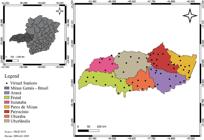
The study was carried out for the Triângulo Mineiro mesoregion, mainly characterized by the Cerrado (Brazilian Savanna) biome. The region is comprised by 66 municipalities, divided into seven microregions (Figure 1), and covers an area of 90.545 km², with average altitude of 769 m (Silva-Fuzzo et al. 2024).
The region's climate is Aw, according to the Köppen classification, characterized as tropical with alternating wet and dry seasons, with average annual rainfall of 1,374 mm and average annual temperature of 24.7 °C (Silva-Fuzzo et al. 2024).
The NASA Power system (Stackhouse et al. 2015), developed to provide meteorological information for direct use in architecture, energy generation and agrometeorology, was used. Daily data were retrieved between 1981 and 2021, via http requests, including total rainfall (mm) and average temperatures (°C). Virtual stations (Figure 1) were employed for all the 66 municipalities in the Triângulo Mineiro region.
The meteorological data aimed to meet the recommendation of the Brazilian Ministry of Agriculture and Supply to adopt a climatic historical series with at least 15 years of meteorological data to satisfy the requirements for agricultural climate zoning (Brasil 2014).
For climate suitability studies, it was necessary to determine the climatic water balance, which was calculated according to Thornthwaite & Mather (1955) and applied to the sugarcane crop, allowing the quantification of values for soil water storage, water surplus and water deficit.
In order to determine the potential evapotranspiration, the equation proposed by Thornthwaite (1948), which shows a good accuracy in estimating the potential evapotranspiration for the region (Rosa et al. 2023), was used, as it follows: ETP = ETp × Cor; Cor = (ND/30) × (N/12); I = (0.2 × Tn)1.514; ETp = -415.85 + 23.24 × T - 0.43 × T2, for T ≥ 26.5 °C; and ETp = 16 × [10 x (T/I)], for 0 °C ≤ T ≤ 26.5 °C, where: ETP it the potential evapotranspiration (mm day-1); T the average air temperature (°C); ND the number of days; N the photoperiod (hours); Tn the average monthly temperature (°C); and I the monthly heat index (°C).
The calculated water balance used an available water capacity of 100 mm, which is the value that represents the soil characteristics of the region and considers the depth of the sugarcane root system (Collicchio et al. 2015). A mean crop coefficient (Kc) of 1.0 was adopted for sugarcane (Doorenbos & Kassam 1994).
Regarding the water and thermal indices required for the crop's development, these were classified according to the necessities of sugarcane and divided into suitable (the thermal and water conditions of the area are favorable for the good development and economic-scale production of the crop), restricted (the area shows restricted water or thermal conditions that may eventually hinder the crop's development stages, thus negatively affecting the crop production) and unsuitable (the normal climate characteristics of the area do not prove to be adequate for the economic exploitation of the crop due to severe water and thermal limitations, implying a significant impact on its production) (Manzatto et al. 2009).
The water and thermal indices required by sugarcane and the classification of its suitability were carried out according to Table 1.
The representative concentration pathways (RCPs) are named according to the levels of radiative forces in W m-2 (Hartin et al. 2015), and are related to greenhouse gas (GHG) emissions and their impact on the Earth's radiation balance. In this study, scenarios of low GHG emissions (RCP 2.6), stabilization of medium GHG emissions (RCP 4.5 and RCP 6.0) and high GHG emissions (RCP 8.5) were considered. The projection analyses were conducted for the end of the 21st century, between the years 2081 and 2100, using the global climate model BCC-CSM2MR developed by the Beijing Climate Center.
The descriptive analyses of average annual temperature and water deficiency were carried out by grouping the municipalities into seven microregions of the Triângulo Mineiro, as proposed by IBGE (2024): Araxá, Frutal, Ituiutaba, Patos de Minas, Patrocínio, Uberaba and Uberlândia (Figure 1).
The suitability for sugarcane cultivation in the tested scenarios allowed the generation of maps using the interpolation method, with the IDW model, nearest neighbor, and a resolution of 0.25 ° (25 km), using the QGIS software.
RESULTS AND DISCUSSION
The climate suitability for sugarcane was based on the specification of the thermal and water conditions of the location. Consequently, a characterization using historical data of the area's current average annual temperature and water deficiency was conducted.
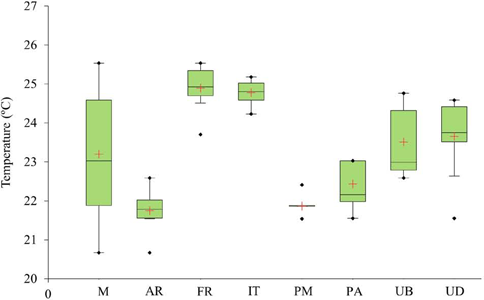
The air temperature in the Triângulo Mineiro region showed an annual variation across the microregions (Figure 2). The average annual air temperatures ranged from 20.7 to 25.5 °C, with average of 23.2 °C (±1.36 °C) (Figure 2), typical of tropical or subtropical regions. These regions are known for their high annual thermal amplitude, with hot summers and cold winters (Moreira et al. 2017).

Box plot graph for the mean annual temperature in the Triângulo Mineiro region. M: mean; AR: Araxá; FR: Frutal; IT: Ituiutaba; PM: Patos de Minas; PA: Patrocínio; UB: Uberaba; UD: Uberlândia.
The Araxá microregion, located in the center-east of the Triângulo Mineiro, shows milder temperatures, with an annual average of 21.7 °C (±0.49 °C). In contrast, the microregions of Ituiutaba in the west and Frutal in the southwest present higher annual average temperatures of 24.9 °C (±0.51 °C) and 24.8 °C (±0.36 °C), respectively.
The Triângulo Mineiro region features a topographical decline toward the Paraná River (at the junction of the Parnaíba and Grande rivers), which influences the distribution of temperature and consequent evapotranspiration (Novais et al. 2018). In the higher elevations to the east, in the Araxá microregion, the average annual temperatures are close to 20 °C. In the Ituiutaba microregion, located in the west, the below 400 m of altitude and continentality cause the average temperature to exceed 25 °C (Novais et al. 2018).
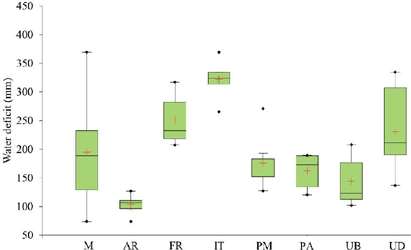
The annual water deficit for the Triângulo Mineiro region shows variation among the microregions, with the average water deficit being 189 mm (±77.54 mm), with maximum and minimum values of 74 and 369.7 mm, respectively (Figure 3).

Box plot graph for the annual water deficit for the Triângulo Mineiro region. M: mean; AR: Araxá; FR: Frutal; IT: Ituiutaba; PM: Patos de Minas; PA: Patrocínio; UB: Uberaba; UD: Uberlândia.
The Uberlândia and Frutal microregions presented the greatest variation in water deficit, while the Araxá microregion had the lowest average water deficit, with 104.58 mm (±14.90 mm). Two factors contribute to the lower water deficit values in this region: reduced evapotranspiration demands due to milder temperatures and increased rainfall from orographic effects concentrated in that area (Fernandes et al. 2016).
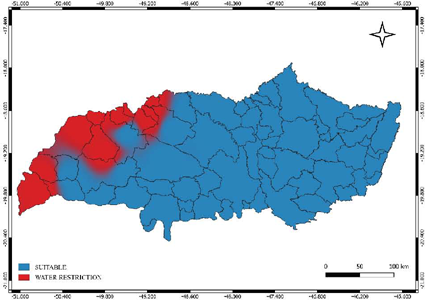
Due to the rise in temperature and evapotranspiration, and reduced rainfall toward the west, the Ituiutaba microregion experiences a higher water deficit, with values ranging between 265.5 and 369.7 mm, and average of 324.15 mm (±34.34 mm) (Figure 3). Therefore, the spatial distribution of sugarcane climate suitability, based on historical averages, presents water restrictions in the western part of the Triângulo Mineiro, where water deficit values exceed 300 mm (Figure 4).
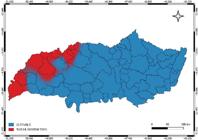
Climate suitability for the cultivation of sugarcane in the Triângulo Mineiro region, Brazil.
Water restriction areas were observed as latitude decreased and longitude increased. For other locations, the sugarcane crop shows a favorable climatic suitability for establishment and development (Figure 4). This highlights the importance of considering regional differences in current and future agricultural planning and adaptation (Linnenluecke et al. 2020).
Moreover, the Triângulo Mineiro region is known for its vast fertile lands and a climate conducive to sugarcane development (Pereira et al. 2015), with a moderate water deficit (below 300 mm) identified in approximately 85 % of the region. This is adequate, since the crop requires a dry period for maturation and sucrose concentration (Inman-Bamber 2004), in addition to facilitating activities in the harvest period.
Regarding possible climate change scenarios for the 2081-2100 period, the end of the 21st century, variations were observed in the suitability of sugarcane cultivation in the Triângulo Mineiro region (Figure 5).

Climate suitability for the cultivation of sugarcane in the Triângulo Mineiro region, Brazil, under climate change scenarios. RCP 2.6; RCP 4.5 and RCP 6.0; RCP 8.5: scenarios of low, medium and high greenhouse gas emissions, respectively.
Expansions of the areas with water restrictions were observed, advancing from the west toward the east. This correlates with projections of increasing greenhouse gas concentrations (RCPs), indicating likely changes in water regimes in the region. Supporting these results, Collicchio et al. (2015) found that climate change scenario simulations indicated significant water restrictions for the Tocantins state, Brazil, with a substantial reduction in areas considered suitable and marginal, and an increase in areas restricted for sugarcane cultivation.
In future scenarios, changes in the distribution of climatic zones will mainly be caused by combined variations in temperature and rainfall, leading to the expansion of arid regions (Zhang et al. 2017). In accordance, Sylla et al. (2015) predicted that global warming will increase evapotranspiration and the frequency and intensity of extreme weather events in the 21st century, altering the soil water storage and expanding regions with water deficits, as observed in this study's projections.
Reports indicate that water deficiency is one of the abiotic factors affecting sugarcane most expressively, due to its detrimental effects on plant development, primarily through reduced cell expansion (Gava et al. 2011). This also impacts bud emergence (Fischer Filho et al. 2022) and decreases the number of emerging leaves (Rodolfo Júnior et al. 2016).
When applying climate change scenarios to the Triângulo Mineiro region, a reduction in suitable areas and an increase in areas with water restrictions are observed, with no instances of thermal restrictions or unsuitable areas (Table 2). This highlights that the effects of water deficit will be more pronounced by the end of the 21st century.
Percentage values of the Triângulo Mineiro region, Brazil, showing climate suitability for sugarcane in current and future climate change scenarios, for the 2081-2100 period.
For the RCP 8.5 scenario, characterized by high levels of climate change, there is a predominance of areas classified as presenting water restrictions, with this subtype occupying 90.13 % of the region (Table 2). This is worrying, as reduced soil moisture can lead to a decrease in agricultural yield in the region (Srivastava et al. 2018). As a consequence of increased water restrictions, sugarcane plants may experience significant declines in biomass production as a physiological response, potentially reaching reductions of up to 35 % (Machado et al. 2010).
The impact of climate change on sugarcane is not limited to reduced yield; it is also connected to the quality of the raw material, as well as phytosanitary, economic and social aspects. Silva et al. (2013), in a study on the climate risk of sugarcane in Northeast Brazil, demonstrated that water deficits may result in lower sucrose content in stalks, thus compromising the quality of the crop. Furthermore, water deficits caused by climate change may increase the vulnerability of the crop to weeds, pests (Kriticos et al. 2003, Cilas et al. 2016) and diseases such as brown and orange rust (Ghosh et al. 2019). It may also interfere with social and environmental aspects, aiming to meet environmental regulations and balance the competition between food and energy in resources (Zhao & Li 2015). Consequently, based on the simulations conducted for the 2081-2100 period, it is probable that sugarcane cultivation will become unfeasible in the Triângulo Mineiro region under dryland farming conditions, which is the current model.
Finally, revisiting the targets 13b and 13.2 of the Sustainable Development Goals (United Nations 2024), several political and strategic applications must be implemented to reduce or mitigate the impacts projected in this study, such as: i) increasing public awareness (target 13.3), particularly among farmers, regarding the effects of climate change on sugarcane cultivation; ii) regulating social and environmental norms and legislation for new climatic conditions; iii) providing resources and financing for the installation of irrigation systems to mitigate the effects of water deficit; iv) planning for the development of new varieties resistant to prolonged droughts, thereby maintaining a satisfactory yield and technological quality, in order to ensure the sector's profitability.
Promoting mechanisms for planning, such as genetic breeding and the use of irrigation systems, along with the adoption of social and environmental policies, will be crucial for addressing any of the projected scenarios.
CONCLUSIONS
-
The characterization of thermal and hydric indices in the Triângulo Mineiro region, Brazil, showed an average temperature of 23.2 °C (±1.36 °C) and a water deficit of 189.0 mm (±77.54 mm). Currently, with historical data, the region is mostly classified as suitable for sugarcane cultivation, standing out in the Brazilian sugar-energy market;
-
Climate change projections indicate a reduction in areas classified as suitable for sugarcane cultivation across all scenarios, along with advances in areas facing water restrictions. The RCP 8.5 scenario (high greenhouse gas emissions) presents, for the end of the 21st century, the most concerning situation, as the region may experience drastic changes in sugarcane cultivation.
ACKNOWLEDGMENTS
To the Fundação de Amparo à Pesquisa do Estado de Minas Gerais (Fapemig), for the financial support and for granting a scholarship to the third author; Programa de Bolsas de Produtividade em Pesquisa (PQ/UEMG), for granting scholarships to the first and fourth authors; and Programa Institucional de Apoio à Pesquisa (PAPQ/UEMG), for granting a scholarship to the second author.
REFERENCES
- ALMEIDA, T. S.; CALIJURI, M. L.; PINTO, L. B. Zoneamento agro-climático da cana-de-açúcar para o estado de Minas Gerais com base em regressões múltiplas. Revista Brasileira de Meteorologia, v. 28, n. 3, p. 352-355, 2013.
- BRASIL. Ministério da Agricultura, Pecuária e Abastecimento (MAPA). Portaria n° 74/2013 de 8 de julho de 2013. Aprova o zoneamento agrícola de risco climático para a cultura de soja no estado de São Paulo, ano-safra 2013/2014. Diário Oficial da União, Brasília, DF, 11 jul. 2013. Seção 1, p. 189-196.
- BRUNINI, O.; PRADO, H.; LANDELL, M. G. A.; CARVALHO, J. P.; BRUNINI, A.; MORAIS, J. F. L. Zoneamento de culturas bioenergéticas no estado de São Paulo: aptidão edafoclimática da cana-de-açúcar. Campinas: IAC, 2008.
- CILAS, C.; GOEBEL, F. R.; BABIN, R.; AVELINO, J. Tropical crop pests and diseases in a climate change setting: a few examples. In: TORQUEBIAU, E. (ed.). Climate change and agriculture worldwide. Dordrecht: Springer, 2016. p. 73-82.
- COLLICCHIO, E.; ROCHA, H. D.; VICTORIA, D. D. C.; BALLESTER, M. V. R.; TOLEDO, A. M. A. Implicações das mudanças do clima no zoneamento agroclimático da cana-de-açúcar no estado do Tocantins, considerando o modelo GFDL. Revista Brasileira de Geografia Física, v. 8, n. 6, p. 1730-1747, 2015.
- COMPANHIA NACIONAL DE ABASTECIMENTO (Conab). Acompanhamento da safra brasileira de cana-de-açúcar. Brasília, DF: Conab, 2024.
- CRAMER, W.; GUIOT, J.; FADER, M.; GARRABOU, J.; GATTUSO, J. P.; IGLESIAS, A.; LANGE, M. A.; LIONELLO, P.; LLASAT, M. C.; PAZ, S.; PEÑUELAS, J.; SNOUSSI, M.; TORETI, A.; TSIMPLIS, M. N.; XOPLAKI, E. Climate change and interconnected risks to sustainable development in the Mediterranean. Nature Climate Change, v. 8, n. 11, p. 972-980, 2018.
- DALRI, A. B.; COELHO, A. P.; SILVA, V. C. D.; FARIA, R. T. D.; FISCHER FILHO, J. A. Adaptation and responsiveness of sugarcane cultivars under irrigated and rainfed production systems. Engenharia Agrícola, v. 41, n. 5, p. 496-503, 2021.
- DOORENBOS, J.; KASSAM, A. H. Efeito da água no rendimento das culturas. Campina Grande: Ed. UFPB, 1994. (Irrigação e drenagem, 33).
- FERNANDES, A. L. T.; TAVARES, T. D. O.; SANTINATO, F.; FERREIRA, R. T.; SANTINATO, R. Viabilidade técnica e econômica da irrigação localizada do cafeeiro, nas condições climáticas do planalto de Araxá, MG. Coffee Science, v. 11, n. 3, p. 347-358, 2016.
- FERREIRA, T. H.; TSUNADA, M. S.; BASSI, D.; ARAÚJO, P.; MATTIELLO, L.; GUIDELLI, G. V.; RIGHETTO, G. L.; GONÇALVES, V. R.; LAKSHMANAN, P.; MENOSSI, M. Sugarcane water stress tolerance mechanisms and its implications on developing biotechnology solutions. Frontiers in Plant Science, v. 8, e1077, 2017.
- FISCHER FILHO, J. A.; CAVICHIOLI, T. H.; DALRI, A. B.; COELHO, A. P.; MARTINS, I. P.; ZANINI, J. R. Effect of subsurface irrigation on the productivity and technological quality of sugarcane. Emirates Journal of Food & Agriculture, v. 34, n. 11, p. 963-970, 2022.
- GAVA, G. J. D. C.; SILVA, M. D. A.; SILVA, R. C. D.; JERONIMO, E. M.; CRUZ, J.; KÖLLN, O. T. Produtividade de três cultivares de cana-de-açúcar sob manejos de sequeiro e irrigado por gotejamento. Revista Brasileira de Engenharia Agrícola e Ambiental, v. 15, n. 3, p. 250-255, 2011.
- GHOSH, A.; REJA, H.; ROY, K.; KANTHAL, S. Effect of climate change on agriculture. Indian Farmer, v. 6, n. 1, p. 44-50, 2019.
- HARTIN, C. A.; PATEL, P.; SCHWARBER, A.; LINK, R. P.; BOND-LAMBERTY, B. P. A simple object-oriented and open-source model for scientific and policy analyses of the global climate system-Hector v1.0. Geoscientific Model Development, v. 8, n. 4, p. 939-955, 2015.
- INMAN-BAMBER, N. G. Sugarcane water stress criteria for irrigation and drying off. Field Crops Research, v. 89, n. 1, p. 107-122, 2004.
-
INSTITUTO BRASILEIRO DE GEOGRAFIA E ESTATÍSTICA (IBGE). Cidades e estados: Minas Gerais. 2024. Available at: https://www.ibge.gov.br/cidades-e-estados/mg.html. Access on: May 8, 2024.
» https://www.ibge.gov.br/cidades-e-estados/mg.html. - INSTITUTO BRASILEIRO DE GEOGRAFIA E ESTATÍSTICA (IBGE). Malha municipal. Rio de Janeiro: IBGE, 2022.
- INTERGOVERNMENTAL PANEL ON CLIMATE CHANGE (IPCC). Summary for policymakers. In: LEE, H.; ROMERO, J. (ed.). Climate change 2023: synthesis report: contribution of working groups I, II and III to the sixth assessment report of the Intergovernmental Panel on Climate Change. Geneva: IPCC, 2023. p. 1-34.
- KRITICOS, D. J.; SUTHERST, R. W.; BROWN, J. R.; ADKINS, S. W.; MAYWALD, G. F. Climate change and the potential distribution of an invasive alien plant: Acacia nilotica ssp. indica in Australia. Journal of Applied Ecology, v. 40, n. 1, p. 111-124, 2003.
- LINNENLUECKE, M. K.; ZHOU, C.; SMITH, T.; THOMPSON, N.; NUCIFORA, N. The impact of climate change on the Australian sugarcane industry. Journal of Cleaner Production, v. 246, e118974, 2020.
- MACHADO, R. S.; RIBEIRO, R. V.; MARCHIORI, P. E. R.; MACHADO, D. F. S. P.; MACHADO, E. C.; LANDELL, M. G. A. Respostas biométricas e fisiológicas ao déficit hídrico em cana-de-açúcar em diferentes fases fenológicas. Pesquisa Agropecuária Brasileira, v. 44, n. 12, p. 1575-1582, 2010.
- MANZATTO, C. V.; ASSAD, E. D.; BACA, J. F. M.; ZARONI, M. J.; PEREIRA, S. E. M. Zoneamento agroecológico da cana-de-açúcar. Rio de Janeiro: Embrapa Solos, 2009.
- MARIN, F. R.; JONES, J. W.; SINGELS, A.; ROYCE, F.; ASSAD, E. D.; PELLEGRINO, G. Q.; JUSTINO, F. Climate change impacts on sugarcane attainable yield in southern Brazil. Climatic Change, v. 117, n. 1-2, p. 227-239, 2013.
- MOREIRA, A.; FONTANA, D. C.; KUPLICH, T. M.; CARDOSO, M. A. Dados meteorológicos estimados em condições de clima subtropical e a relação com índices de vegetação. Revista Brasileira de Cartografia, v. 69, n. 6, p. 1075-1091, 2017.
- NOVAIS, G. T.; BRITO, J. L. S.; SANCHES, F. O. Unidades climáticas do Triângulo Mineiro/Alto Paranaíba. Revista Brasileira de Climatologia, v. 23, n. 1, p. 223-243, 2018.
- PEREIRA, R. M.; ALVES JÚNIOR, J.; CASAROLI, D.; SALES, D. L.; RODRIGUEZ, W. D. M.; SOUZA, J. M. F. Viabilidade econômica da irrigação de cana-de-açúcar no Cerrado brasileiro. Irriga, v. 1, n. 2, p. 149-157, 2015.
- RODOLFO JÚNIOR, F.; RIBEIRO JUNIOR, W. Q.; RAMOS, M. L. G.; ROCHA, O. C.; BATISTA, F. P. S.; LIMA, C. A. de. Respostas fisiológicas em variedades de cana soca submetidas ao déficit hídrico. Irriga, v. 21, n. 4, p. 806-816, 2016.
- ROSA, G. B.; FUZZO, D. F. S.; FISCHER FILHO, J. A. Modelos de estimativa da evapotranspiração de referência para a região sul do Triângulo Mineiro, Brasil. Revista Brasileira de Climatologia, v. 33, n. 1, p. 81-97, 2023.
- SANTOS, H. F. Modernização da agricultura e dinâmica do agronegócio globalizado no Triângulo Mineiro/Alto Paranaíba. Geografia em Questão, v. 12, n. 1, p. 9-36, 2019.
- SECRETARIA DE ESTADO DE AGRICULTURA, PECUÁRIA E ABASTECIMENTO DE MINAS GERAIS (SEAPA). Projeções do agronegócio: Minas Gerais: 2017 a 2027. Belo Horizonte: SEAPA, 2017.
- SILVA, V. D. P.; OLIVEIRA, S. D. D.; SANTOS, C. A.; SILVA, M. T. Risco climático da cana-de-açúcar cultivada na região Nordeste do Brasil. Revista Brasileira de Engenharia Agrícola e Ambiental, v. 17, n. 2, p. 180189, 2013.
- SILVA-FUZZO, D.; ASSUNÇÃO, F. J. M.; FUZZO, B. E.; FISCHER FILHO, J. A. Tendências e padrões de variação em séries temporais de temperatura do ar e precipitação na microrregião de Frutal - MG. Revista Brasileira de Geografia Física, v. 17, n. 3, p. 1977-1991, 2024.
- SRIVASTAVA, A. K.; MBOH, C. M.; ZHAO, G.; GAISER, T.; EWERT, F. Climate change impact under alternate realizations of climate scenarios on maize yield and biomass in Ghana. Agricultural Systems, v. 159, n. 1, p. 157-174, 2018.
- STACKHOUSE, P. W.; WESTBERG, D.; HOELL, J. M.; CHANDLER, W. S.; ZHANG, T. Prediction of worldwide energy resource (POWER): agroclimatology methodology (1.0° latitude by 1.0° longitude spatial resolution), v 1.0.2. Washington, DC: NASA, 2015.
- SYLLA, M. B.; GIORGI, F.; PAL, J. S.; GIBBA, P.; KEBE, I.; NIKIEMA, M. Projected changes in the annual cycle of high-intensity precipitation events over west Africa for the late twenty-first century. Journal of Climate, v. 28, n. 16, p. 6475-6488, 2015.
- THAYER, A. W.; VARGAS, A.; CASTELLANOS, A. A.; LAFON, C. W.; MCCARL, B. A.; ROELKE, D. L. Integrating agriculture and ecosystems to find suitable adaptations to climate change. Climate, v. 8, n. 1, p. 10-16, 2020.
- THORNTHWAITE, C. W. An approach toward a rational classification of climate. Geographical Review, v. 38, n. 1, p. 55-94, 1948.
- THORNTHWAITE, C. W.; MATHER, J. R. The water balance. Centerton: Drexel Institute of Technology, 1955.
-
UNITED NATIONS. Transforming our world: the 2030 agenda for sustainable development. 2024. Available at: https://sdgs.un.org/2030agenda. Access on: Apr. 11, 2024.
» https://sdgs.un.org/2030agenda. - ZHAI, Z. J.; HELMAN, J. M. Implications of climate changes to building energy and design. Sustainable Cities and Society, v. 44, n. 1, p. 511-519, 2019.
- ZHANG, X.; YAN, X.; CHEN, Z. Geographic distribution of global climate zones under future scenarios. International Journal of Climatology, v. 37, n. 12, p. 4327-4334, 2017.
- ZHAO, D.; LI, Y. R. Climate change and sugarcane production: potential impact and mitigation strategies. International Journal of Agronomy, v. 2015, e47386, 2015.