 Agro-morphological and grain-quality responses of barley accessions to zinc foliar application
Abstract
The objective of this work was to evaluate the influence of zinc foliar application on the agro-morphological attributes and grain quality of 50 barley accessions. The experiment was carried out in a randomized complete block design with three treatments: 0.25 and 0.50% zinc as ZnSO4; and the control, without zinc. Compared with the control, zinc foliar application at 0.25 and 0.50%, respectively, caused the following increases in the agro-morphological and grain quality traits of barley: 10.5 and 13.42% in plant height, 3.40 and 5.23% in the maturity index, 11.89 and 13.54% in spike length, 31.63 and 32.80% in spike weight, 28.96 and 33.06% in biomass, 6.74 and 19.03% in chlorophyll a, 0.73 and 0.57% in chlorophyll b, 12.20 and 12.90% in total chlorophyll, 31.83 and 43.68% in grain manganese content, and 23.06 and 38.08% in zinc. Therefore, zinc foliar application improved barley agro-morphological and grain quality performances, with variability among treatments and accessions. The foliar application of ZnSO4 at 0.25 and 0.50%, especially at 0.50%, enhances the chlorophyll content, agro-morphological characteristics, and nutrient concentrations of barley grains.
Index terms:
Hordeum vulgare; biofortificiation; foliar application; grain nutrients; zinc
Resumo
O objetivo deste trabalho foi avaliar a influência da aplicação foliar de zinco nos atributos agromorfológicos e na qualidade de grãos de 50 acessos de cevada. O experimento foi conduzido em delineamento de blocos ao acaso, com três tratamentos: 0,25 e 0,50% de zinco como ZnSO4; e controle, sem zinco. Em comparação ao controle, a aplicação foliar de zinco a 0,25 e 0,50%, respectivamente, ocasionou os seguintes aumentos nas características agromorfológicas e de qualidade de grãos de cevada: 10,5 e 13,42% em altura da planta, 3,40 e 5,23% no índice de maturidade, 11,89 e 13,54% em comprimento da espiga, 31,63 e 32,80% em peso da espiga, 28,96 e 33,06% em biomassa, 6,74 e 19,03% em clorofila a, 0,73 e 0,57% em clorofila b, 12,20 e 12,90% em clorofila total, 31,83 e 43,68% em teor de manganês nos grãos, e 23,06 e 38,08% em zinco. Portanto, a aplicação foliar de zinco melhora o desempenho agromorfológico e a qualidade de grãos de cevada, com variabilidade entre tratamentos e acessos. A aplicação foliar de ZnSO4 a 0,25 e 0,50%, especialmente a 0,50%, aumenta o teor de clorofila, as características agromorfológicas e a concentração de nutrientes nos grãos de cevada.
Termos para indexação:
Hordeum vulgare; biofortificação; aplicação foliar; nutrientes nos grãos; zinco
Introduction
Barley (Hordeum vulgare L.) is among the earliest domesticated crops commonly grown for livestock feed and is an important source of fermentable material for beer, as well as an essential component of different human health foods (Chutimanitsakun et al., 2013). Moreover, this crop’s grain is a rich source of proteins, carbohydrates, phosphorus, calcium, vitamin B, and dietary mineral nutrients, including manganese and iron (Geng et al., 2022). Barley can also be used as suitable model to study the genomics of Triticeae due to its diploid nature (Griffey et al., 2010; Martin et al., 2020).
Although wild barley shows a high adaptation to a wide variety of climatic conditions, cultivated barley is comparatively more vulnerable regarding resistance to both biotic and abiotic stresses, which may be attributed to the presence of distinct alleles and gene regulators (Hao et al., 2021). Added to this challenge, barley production has declined qualitatively and quantitatively over the past years due to less productive landraces, the lack of diverse germplasm and improved varieties, and the availability of market-valued crops, as well as to land fragmentation and climatic variation (Tadesse & Derso, 2019).
Another factor that can reduce crop yield and may affect grain nutritional quality for humans is the deficiency of micronutrients, specifically of zinc (Khalid et al., 2013; Cakmak & Kutman, 2018; Ali et al., 2020). Zinc deficiency in the soil, for example, leads to a low level of the micronutrient in crop grains and to interactions with other soil nutrients (Imran et al., 2016).
In the context of crop nutrition, foliar application is considered an advanced way to supply micronutrients directly to the aerial parts of the plants. Ayenew et al. (2025) suggested that the foliar application of zinc as a nanofertilizer may enhance the absorption and bioavailability of this micronutrient, also reducing leaching. In this line, other authors reported a significant improvement in barley crop yield and grain quality, which they attributed to the direct absorption of zinc through leaf surface, without environmental and soil effects (Moshfeghi et al., 2019; Khalifa et al., 2022). In other crops, zinc foliar application has been shown to increase the concentration of this micronutrient by 73% (Zhang et al., 2012). However, research focusing on the effect of this application on barley agro-morphological and grain quality attributes is still limited for most accessions of this crop. To evaluate a large number of accessions, aiming to identify those with a high potential for zinc use, Cakmak (2008) highly recommend the adoption of a reliable germplasm screening procedure in a relatively short time.
The objective of this work was to evaluate the influence of zinc foliar application on the agro-morphological attributes and grain quality of 50 barley accessions.
Materials and Methods
The study was carried out in Swat, Pakistan (34°40'N, 72°12'E, at approximately 1,010 m above sea level). According to Köppen’s classification, the climate of the area is subtropical humid (Cfa subtype) with an annual rainfall of 864 mm and mean annual temperature of 15°. The driest and wettest months are November (average precipitation of 22 mm) and August (average precipitation of 134 mm), respectively. The experimental site has a deep and well-drained basic soil, with characteristic smooth and fine-textured particles, pH 8.1, and electrical conductance of 0.23 dS m-1. The physicochemical properties of the soil are 29.8% sand, 17% clay, 65% silt, 2.40% lime, and 1.08% organic matter. The analysis for micronutrients revealed 336 ppm potassium, 1.16 mg kg-1 zinc, 447 mg kg-1 manganese, 16.4 mg kg-1 copper, 0.36% nitrogen, and 7.0 ppm phosphorus.
The experimental design was in randomized complete blocks, with the following three treatments, with three replicates: foliar application of zinc as ZnSO4 at 0.25 and 0.50%; and the control, without ZnSO4.
The evaluated plants consisted of 50 barley accessions provided by Bio-Resources Conservation Institute of National Agriculture Research Centre, located in Islamabad, Pakistan (Table 1). Seeds from each experimental barley accession were first germinated on moist filter papers on petri dishes; after full germination, seedlings were transferred to the field. The seedlings were transplanted into 3.0 m long rows, each forming an experimental unit, with a 30 cm inter-row spacing. For a proper seedling growth, normal weeding and agricultural practices were performed according to Elshafei et al. (2024). Foliar ZnSO4 was applied when the plants entered the tillering stage.
Origin in Pakistan of the 50 experimental barley (Hordeum vulgare) accessions used in the study.
Seven days after zinc foliar application, fresh leaves were harvested from each replicate to measure chlorophyll a, chlorophyll b, and total chlorophyll contents using the method of Hiscox & Israelstam (1979), with minor modifications. Approximately 0.5 g fresh leaf tissues were collected and then placed in test tubes containing 6.0 mL dimethyl sulfoxide and kept in a preheated water bath for about 35 min at 65°C. Afterwards, 4.0 mL dimethyl sulfoxide were added to all samples in order to reach a total final volume of 10 mL. The absorbance of the extract was read with the UV-1602UV-Vis spectrophotometer (Shimadzu Corporation, Kyoto, Japan) at 645 and 663 nm.
The evaluated agro-morphological attributes were determined according to Elshafei et al. (2024). Aerial dry biomass and the maturity index were obtained as described in Kahraman et al. (2024). Using the method of Hagenblad et al. (2019), the following characteristics were determined for spikes collected from each row: shape, attitude, glaucosity, weight, glume color, awn color, lemma awn barbs, glume and awn length, and grain coverings.
Seed micronutrient concentrations were determined using the methods of Shiri et al. (2019) and Hao et al. (2021). Briefly, samples of 1.0 g grain flour obtained from each accession were mixed with 5.0 mL HNO3 and heated for 1 hour on an electric plate. This procedure was repeated after the addition of another 5.0 mL HNO3 and heating for about 50 min. Then, 2.5 mL hydrogen peroxide (35% H2O2) were added to the reaction mixture and slightly heated until reaching a 25 mL volume. Afterwards, the reaction mixture was cooled and filtered through Whatman filter paper. The AAS vario 6 atomic absorption spectrometer (Analytik Jena GmbH+Co, Jena, Germany), equipped with cathode lamps, was used to measure zinc, manganese, and copper contents at 213.9, 279.5, and 324.8 nm, respectively. The micronutrients were analyzed following the standard method of Association of Official Analytical Chemists (AOAC) (Cunniff, 1995).
The collected data were subjected to the analysis of variance using the Statistix 8.1. software (Analytical Software, Tallahassee, FL, USA). A heatmap of Pearson’s correlation was used to determine variability relationships. Box-violin plots were employed to depict a graphical summary of all studied traits using the ggplot2 package and the Jamovi software (Wickham et al., 2018).
Results and Discussion
Zinc foliar application greatly affected all evaluated barley traits (Table 2). Significant differences among treatments, accessions, and their interactions were depicted through the analysis of variance, specifically regarding spike weight, spike length, plant height, and the maturity index. Chlorophyll and micronutrient contents also differed between treatments (Table 3).
Summary of the statistics of the evaluated traits of the studied barley (Hordeum vulgare) accessions(1).
Variance analysis and percentage variations of the mean values obtained for the agro-morphological traits of 50 experimental barley (Hordeum vulgare) accessions regarding the influence of the foliar application of ZnSO4(1).
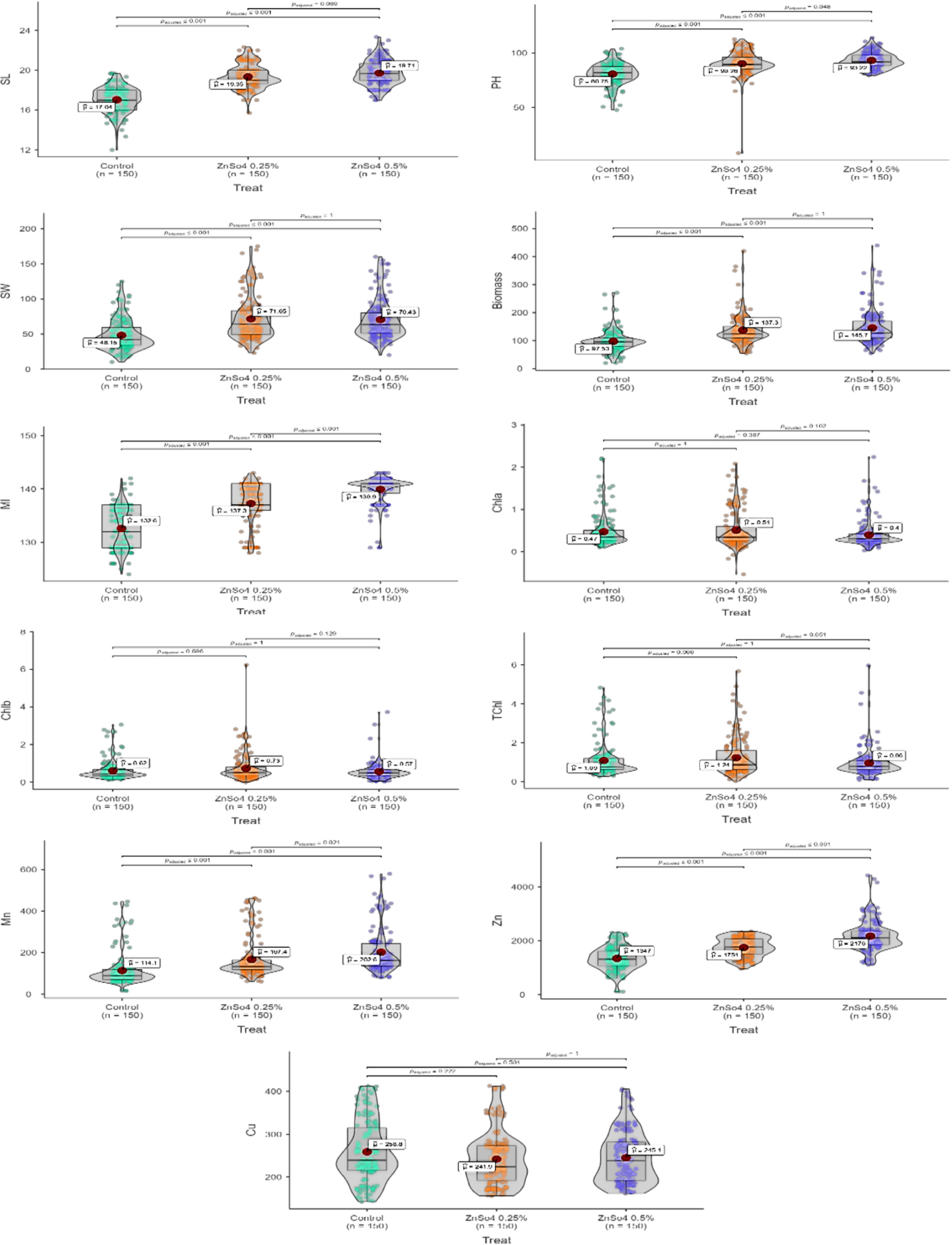
The studied barley accessions showed variable responses to zinc foliar application (Table 3 and Figure 1). Plant height increased by 10.5 and 10.4% when treated with 0.25 and 0.50% ZnSO4, respectively. These results are in general agreement with those of Genc et al. (2004), Moshfeghi et al. (2019), Noreen et al. (2021), and Roshani et al. (2021), who found that zinc foliar application significantly enhanced the morpho-physiological traits of barley cultivars, including photosynthetic pigments, antioxidant enzyme activities, the harvest index, and yield.

Box-violin plots presenting the studied morpho-physiological and agronomic attributes of 50 barley (Hordeum vulgare) accessions under the treatments: 0.25% ZnSO4, 0.50% ZnSO4, and control (without ZnSO4). SL, spike length; PH, plant height; SW, spike weight; MI, maturity index; Chla, chlorophyll a; Chlb, chlorophyll b; TChl, total chlorophyll; Mn, manganese; Zn, zinc; and Cu, copper.
An increased maturity index of 5.23 was recorded under 0.50% ZnSO4 (Table 3), as similarly observed by Janmohammadi et al. (2016). Concerning spike weight, there was an increase of 32.8% with 0.25% ZnSO4 in comparison with the control, which is in alignment with Sadeghzadeh et al. (2009).
The results obtained for spike length and biomass are shown in Tables 2 and 3. Spike length was the longest for plants treated with 0.50% ZnSO4, but showed an increase of 11.9 and 13.5% under 0.25 and 0.50% ZnSO4, respectively, when compared with control. Plant dry biomass increased from 97.5 g in the control to 145.7 g with the foliar application of 0.50% ZnSO4.
Improvements in barley traits due to zinc foliar application were also reported by other authors, such as Moshfeghi et al. (2019) in their study on cultivars of this species. Similarly, Noreen et al. (2021) and Roshani et al. (2021) observed improved growth, antioxidant enzyme activities, and harvest index in barley grown under salt and drought stress conditions. This confirms the significant role that micronutrients, specifically zinc, play in plant biochemical and physiological processes. Ali et al. (2022), for instance, concluded that the proper supply of zinc significantly enhanced plant physiological activities, including photosynthetic pigments.
A high chlorophyll content was observed with the foliar application of ZnSO4 at both concentrations, but especially at the lowest one (Tables 2 and 3). In the control treatment, chlorophyll a was 0.47 mg g-1, increasing to 0.50 mg g-1 when 0.25% ZnSO4 was applied, but decreasing to 0.40 mg g-1 with 0.50% ZnSO4 (Figure 1). In the case of chlorophyll b, its content was enhanced by 16.2% due to the foliar application of 0.25% ZnSO4, when compared with the control, representing a much more promising result. Total chlorophyll content also increased significantly with the foliar application of 0.25% ZnSO4, showing a net reduction with 0.50% ZnSO4 (Table 2 and Figure 2).
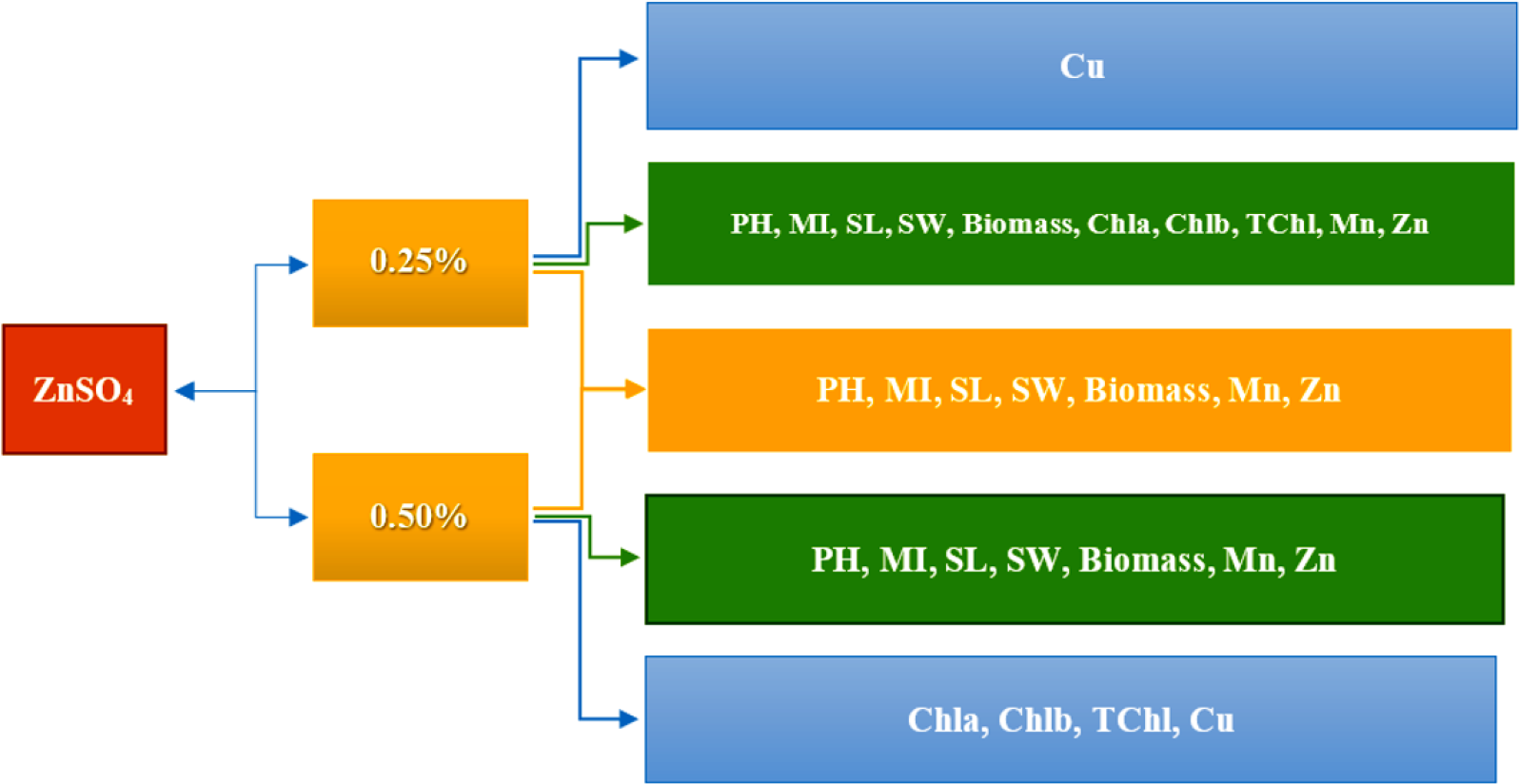
Overview of the effects of the foliar application of 0.25 and 0.50% zinc on the studied agro-morphological and physiological attributes of barley (Hordeum vulgare) accessions. Green, positive effect; blue, negative/decreased effect; and yellow, positive effect under both treatments. Cu, copper; PH, plant height; MI, maturity index; SL, spike length; SW, spike weight; Chla, chlorophyll a; Chlb, chlorophyll b; TChl, total chlorophyll; Mn, manganese; and Zn, zinc.
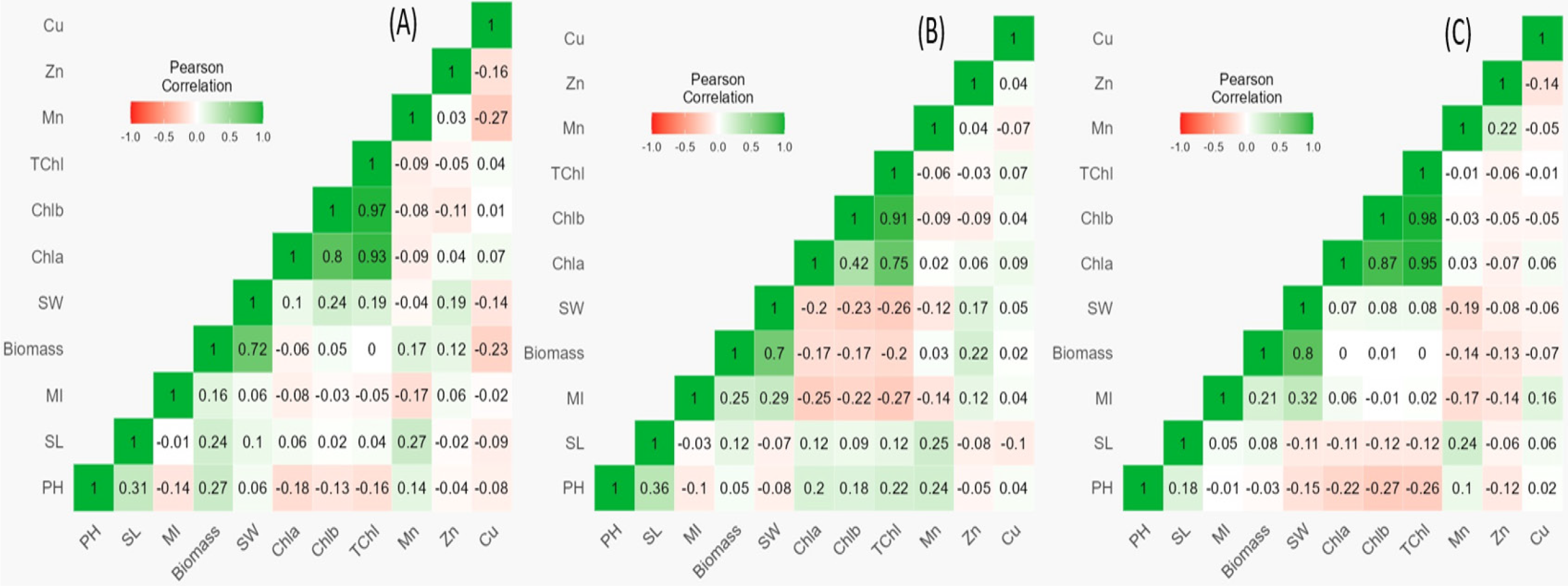
Regarding the observed correlations, the one between total chlorophyll content and chlorophyll b was highly positive for grown control plants treated with 0.50% ZnSO4 (r=0.94 and 0.98, respectively), as shown in Figure 3. Likewise, the correlation between total chlorophyll content and chlorophyll a was also highly positive (r=0.95) in plants under 0.50% ZnSO4. In addition, the correlation of spike weight and biomass was highly positive (r=0.80) in plants treated with 0.50% ZnSO4, but was lower in the control (r=0.72). More associations between variables were also recorded for the other studied attributes, including grain micronutrients.
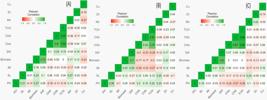
Heatmap of Pearson’s correlation coefficient and associated probabilities among barley (Hordeum vulgare) accessions, showing the relationship of the studied traits (n = 10) under the following treatments: A, control, without ZnSO4; B, foliar application of 0.25% ZnSO4; and C, foliar application of 0.50% ZnSO4. Significant correlations are shown in green (positive) and red (negative) at p ≤ 0.05, ≤ 0.01, ≤ 0.001, respectively. PH, plant height; SL, spike length; MI, maturity index; SW, spike weight; Chla, chlorophyll a; Chlb, chlorophyll b; TChl, total chlorophyll; Mn, manganese; Zn, zinc; and Cu, copper.
The photosynthesis process is regulated by various factors that affect it either directly, as light, carbon dioxide, and water, or indirectly, as soil pH and nutrient availability through altered enzymatic actions (Kinaci & Kinaci, 2005). In the present study, the photosynthetic pigments were significantly enhanced by the foliar application of zinc, which can act as a structural component of the enzymes and proteins involved in the synthesis of these pigments (Wani et al., 2022; Ali et al., 2022). The results obtained here are in agreement with those of Moshfeghi et al. (2019), Noreen et al. (2021), and Roshani et al. (2021), who found that zinc foliar application significantly increased barley photosynthetic pigments compared with the control. Similar findings have also been reported for other crop cultivars, including those of wheat (Triticum aestivum L.) by Sattar et al. (2022) and mung bean [Vigna radiata (L.) R.Wilczek] by Samreen et al. (2017).
Spike physiognomic characteristics showed variable responses to the applied treatments. Glaucosity was classified as completely absent, somewhat weak, strong, somewhat strong, and mostly strong (Table 4). Spike attitude went from erect to recurved, whereas spike shape ranged from tapering to parallel-parallel to fusiform-tapering to fusiform. The other spike attributes also varied, including grain covering, glume color, glume length, awn color, and awn length.
Spike qualitative characteristics of the 50 studied barley (Hordeum vulgare) accessions regarding the influence of the foliar application of ZnSO4.
The foliar application of ZnSO4 showed a significant effect on grain micronutrient concentrations (Table 3 and Figures 1 and 2). The recorded zinc contents in the grown control plants was 1,347 µg g-1, which was further enhanced to 1,751 and 2,176 µg g-1 under 0.25 and 0.50 ZnSO4, respectively. Moreover, grain zinc content was improved by 23.1 and 38.1% with the foliar application of 0.25 and 0.50% ZnSO4, respectively, in comparison with the control. However, copper contents were negatively affected by both concentrations of ZnSO4, being 258.7 µg g-1 in the control and reducing to 241.9 and 245.1 µg g-1 under 0.25 and 0.50% ZnSO4, respectively. Similarly, manganese contents decreased from 1,14.1 µg g-1 in the control to 202.6 µg g-1 when treated with 0.50% ZnSO4.
Foliar-applied zinc has been reported to enhance the concentration of micronutrients in cereal grains (Cakmak & Kutman, 2018; Drissi et al., 2018). Under field conditions, for example, a substantial increase of up to 85% was observed in zinc content (Ram et al., 2016; Aziz et al., 2019; Melash et al., 2019). In addition, Melash et al. (2019) reported an increase of 82.5% in micronutrient concentrations in response to zinc foliar application. These results are consistent with the findings of Shariatipour et al. (2020), who also observed a significant increase in zinc concentration due to zinc foliar application when evaluating wheat. Likewise, Moshfeghi et al. (2019) and Rehman et al. (2020) found that zinc concentration increased through foliar application. Yagmur et al. (2017), Al Mutairi et al. (2020), and Roshani et al. (2021) also verified an increase in nutrient concentration due to zinc foliar application.
In the present research, the levels of zinc, manganese, and copper in the grains of the studied barley accessions increased in varying degrees, showing different responses in terms of concentration and bioavailability. These differences may be due to variations in barley accessions, soil types, and timing of zinc foliar application as previously concluded by Cakmak (2008) and Hao et al. (2021). Despite these variations, the nutrient content in the barley seeds increased as with the increase in zinc concentration through foliar application.
Although several approaches show potential to improve both the yield and nutritional quality of an agricultural crop for human diet (Aziz et al., 2019), biofortification stands out as an alternative, particularly in areas where people suffer from malnutrition (Ali et al., 2022). In this scenario, the foliar application of nutrients has been used to improve the yield of cereal crops, maintaining balanced nutrients and reducing the risk of nutrient losses (Aziz et al., 2019).
The results obtained in the present study allow of inferring that zinc foliar application is a promising way of improving the concentration of zinc and other micronutrients in barley grains, with a consequently better bioavailability for human consumption. However, organic matter, soil composition, and soil pH may affect the availability of these nutrients (Salim & Raza, 2020), explaining the different responses of the evaluated barley accessions to zinc foliar application. This is an indicative that further research is needed to explore the optimum levels of foliar-applied zinc.
Conclusions
-
1. The foliar application of 0.25 and 0.50% ZnSO4, especially of the highest concentration, enhances the chlorophyll content, agro-morphological characteristics, and nutrient concentration of barley (Hordeum vulgare) grains.
-
2. Zinc foliar application improves barley performance considering the applied concentrations and used accessions.
References
-
AL MUTAIRI, A.A.; CAVAGNARO, T.R.; KHOR, S.F.; NEUMANN, K.; BURTON, R.A.; WATTS-WILLIAMS, S.J. The effect of zinc fertilisation and arbuscular mycorrhizal fungi on grain quality and yield of contrasting barley cultivars. Functional Plant Biology, v.47, p.122-133, 2020. DOI: https://doi.org/10.1071/FP19220
» https://doi.org/10.1071/FP19220 -
ALI, A.; ULLAH, Z.; ALAM, N.; NAQVI, S.M.S.; JAMIL, M.; BUX, H.; SHER, H. Genetic analysis of wheat grains using digital imaging and their relationship to enhance grain weight. Scientia Agricola, v.77, e20190069, 2020. DOI: https://doi.org/10.1590/1678-992X-2019-0069
» https://doi.org/10.1590/1678-992X-2019-0069 -
ALI, I.; KHAN, A.; ALI, A.; ULLAH, Z.; DAI, D.Q.; KHAN, N.; KHAN, A.; AL-TAWAHA, A.R.; SHER, H. Iron and zinc micronutrients and soil inoculation of Trichoderma harzianum enhance wheat grain quality and yield. Frontiers in Plant Science, v.13, art.960948, 2022. DOI: https://doi.org/10.3389/fpls.2022.960948
» https://doi.org/10.3389/fpls.2022.960948 -
AYENEW, B.M.; SATHEESH, N.; ZEGEYE, Z.B.; KASSIE, D.A. A review on the production of nanofertilizers and its application in agriculture. Heliyon, v.11, e41243, 2025. DOI: https://doi.org/10.1016/j.heliyon.2024.e41243
» https://doi.org/10.1016/j.heliyon.2024.e41243 -
AZIZ, M.Z.; YASEEN, M.; ABBAS, T.; NAVEED, M.; MUSTAFA, A.; HAMID, Y.; SAEED, Q.; XU, M.-G. Foliar application of micronutrients enhances crop stand, yield and the biofortification essential for human health of different wheat cultivars. Journal of Integrative Agriculture, v.18, p.1369-1378, 2019. DOI: https://doi.org/10.1016/S2095-3119(18)62095-7
» https://doi.org/10.1016/S2095-3119(18)62095-7 -
CAKMAK, I. Enrichment of cereal grains with zinc: agronomic or genetic biofortification? Plant and Soil, v.302, p.1-17, 2008. DOI: https://doi.org/10.1007/s11104-007-9466-3
» https://doi.org/10.1007/s11104-007-9466-3 -
CAKMAK, I.; KUTMAN, U. B. Agronomic biofortification of cereals with zinc: a review. European Journal of Soil Science, v.69, p.172-180, 2018. DOI: https://doi.org/10.1111/ejss.12437
» https://doi.org/10.1111/ejss.12437 -
CHUTIMANITSAKUN, Y.; CUESTA-MARCOS, A.; CHAO, S.; COREY, A.; FILICHKIN, T.; FISK, S.; KOLDING, M.; MEINTS, B.; ONG, Y.-L.; REY, J.I.; ROSS, A.S.; HAYES, P.M. Application of marker-assisted selection and genome-wide association scanning to the development of winter food barley germplasm resources. Plant Breeding, v.132, p.563-570, 2013. DOI: https://doi.org/10.1111/pbr.12086
» https://doi.org/10.1111/pbr.12086 - CUNNIFF, P. (Ed.). Official Methods of Analysis of AOAC International 16th ed. Arlington: AOAC Internatinal, 1995. Official Method 985.01.
-
DRISSI, S.; HOUSSA, A.A.; AMLAL, F.; DHASSI, K.; LAMGHARI, M.; MAATAOUI, A. Barley responses to copper foliar spray concentrations when grown in a calcareous soil. Journal of Plant Nutrition, v.41, p.2266-2272, 2018. DOI: https://doi.org/10.1080/01904167.2018.1509993
» https://doi.org/10.1080/01904167.2018.1509993 -
ELSHAFEI, A.A.; IBRAHIM, E.I.; ABDELLATIF, K.F.; SALEM, A.E.-A.K.; MOUSTAFA, K.A.; AL-DOSS, A.A.; MIGDADI, H.M.; HUSSIEN, A.M.; SOUFAN, W.; RAHMAN, T.A. EL.; ELDEMERY, S.M. Molecular and agro-morphological characterization of new barley genotypes in arid environments. BMC Biotechnology, v.24, art.41, 2024. DOI: https://doi.org/10.1186/s12896-024-00861-6
» https://doi.org/10.1186/s12896-024-00861-6 -
GENC, Y.; MCDONALD, G.K.; GRAHAM, R.D. Differential expression of zinc efficiency during the growing season of barley. Plant and Soil, v.263, p.273-282, 2004. DOI: https://doi.org/10.1023/B:PLSO.0000047741.52700.29
» https://doi.org/10.1023/B:PLSO.0000047741.52700.29 -
GENG, L.; LI, M.; ZHANG, G.; YE, L. Barley: a potential cereal for producing healthy and functional foods. Food Quality and Safety, v.6, p.1-13, 2022. DOI: https://doi.org/10.1093/fqsafe/fyac012
» https://doi.org/10.1093/fqsafe/fyac012 -
GRIFFEY, C.; BROOKS, W.; KURANTZ, M.; THOMASON, W.; TAYLOR, F.; OBERT, D.; MOREAU, R.; FLORES, R.; SOHN, M.; HICKS, K. Grain composition of Virginia winter barley and implications for use in feed, food, and biofuels production. Journal of Cereal Science, v.51, p.41-49, 2010. DOI: https://doi.org/10.1016/j.jcs.2009.09.004
» https://doi.org/10.1016/j.jcs.2009.09.004 -
HAGENBLAD, J.; LEINO, M.W.; HERNÁNDEZ AFONSO, G.; AFONSO MORALES, D. Morphological and genetic characterization of barley (Hordeum vulgare L.) landraces in the Canary Islands. Genetic Resources and Crop Evolution, v.66, p.465-480, 2019. DOI: https://doi.org/10.1007/s10722-018-0726-2
» https://doi.org/10.1007/s10722-018-0726-2 -
HAO, B.; MA, J.; JIANG, L.; WANG, X.; BAI, Y.; ZHOU, C.; REN, S.; LI, C.; WANG, Z. Effects of foliar application of micronutrients on concentration and bioavailability of zinc and iron in wheat landraces and cultivars. Scientific Reports, v.11, art.22782, 2021. DOI: https://doi.org/10.1038/s41598-021-02088-3
» https://doi.org/10.1038/s41598-021-02088-3 -
HISCOX, J.D.; ISRAELSTAM, G.F. A method for extraction of chlorophyll from leaf tissue without maceration. Canadian Journal of Botany, v.57, p.1332-1334, 1979. DOI: https://doi.org/10.1139/b79-163
» https://doi.org/10.1139/b79-163 -
IMRAN, M.; REHIM, A.; SARWAR, N.; HUSSAIN, S. Zinc bioavailability in maize grains in response of phosphorous-zinc interaction. Journal of Plant Nutrition and Soil Science, v.179, p.60-66, 2016. DOI: https://doi.org/10.1002/jpln.201500441
» https://doi.org/10.1002/jpln.201500441 -
JANMOHAMMADI, M.; SABAGHNIA, N.; DASHTI, S.; NOURAEIN, M. Investigation of foliar application of nano-micronutrient fertilizers and nano-titanium dioxide on some traits of barley. Biologia, v.62, p.148-156, 2016. DOI: https://doi.org/10.6001/biologija.v62i2.3340
» https://doi.org/10.6001/biologija.v62i2.3340 -
KAHRAMAN, A.; TUNC, M.; RAMAZANOGLU, E.; ALMARIE, V.; SEZER, R.; BASDEMIR, F.; KAYA, C.; SENBAYRAM, M. Zinc outperforms other foliar fertilisers in enhancing lentil yield and harvest index in semi-arid regions. Acta Agriculturae Scandinavica Section B - Soil and Plant Science, v.74, art.2412767, 2024. DOI: https://doi.org/10.1080/09064710.2024.2412767
» https://doi.org/10.1080/09064710.2024.2412767 - KHALID, M.; MAHMOOD, T.; RASHEED, A.; KAZI, A.G.; ALI, A.; KAZI, A.M. Glu-DT 1 allelic variation in synthetic hexaploid wheats derived from durum cultivar ‘Decoy’ x Aegilops tauschii accessional crosses. Pakistan Journal of Botany, v.45, p.409-414, 2013.
-
KHALIFA, T.H.; MARIEY, S.A.; GHAREEB, Z.E.; KHATAB, I.A.; ALYAMANI, A. Effect of organic amendments and nano-zinc foliar application on alleviation of water stress in some soil properties and water productivity of barley yield. Agronomy, v.12, art.585, 2022. DOI: https://doi.org/10.3390/agronomy12030585
» https://doi.org/10.3390/agronomy12030585 -
KINACI, G.; KINACI, E. Effect of zinc application on quality traits of barley in semi arid zones of Turkey. Plant, Soil and Environment, v.51, p.328-334, 2005. DOI: https://doi.org/10.17221/3594-PSE
» https://doi.org/10.17221/3594-PSE -
MARTIN, M.J.; CHICAIZA, O.; CAFFAREL, J.C.; SALLAM, A.H.; DRUKA, A.; WAUGH, R.; ORDON, F.; KOPAHNKE, D.; KEILWAGEN, J.; PEROVIC, D.; FETCH JR, T.G.; JIN, Y.; FRANCKOWIAK, J.D.; STEFFENSONET, B.J. Development of barley introgression lines carrying the leaf rust resistance genes Rph1 to Rph15 Crop Science, v.60, p.282-302, 2020. DOI: https://doi.org/10.1002/csc2.20057
» https://doi.org/10.1002/csc2.20057 -
MELASH, A.A.; MENGISTU, D.K.; ABERRA, D.A.; TSEGAY, A. The influence of seeding rate and micronutrients foliar application on grain yield and quality traits and micronutrients of durum wheat. Journal of Cereal Science, v.85, p.221-227, 2019. DOI: https://doi.org/10.1016/j.jcs.2018.08.005
» https://doi.org/10.1016/j.jcs.2018.08.005 -
MOSHFEGHI, N.; HEIDARI, M.; ASGHARI, H.R.; ABADI, M.B.F.; ABBOTT, L.K.; CHEN, Y. Effect of zinc foliar application and mycorrhizal inoculation on morpho-physiological traits and yield parameters of two barley cultivars. Italian Journal of Agronomy, v.14, art.1354, 2019. DOI: https://doi.org/10.4081/ija.2019.1354
» https://doi.org/10.4081/ija.2019.1354 -
NOREEN, S.; SULTAN, M.; AKHTER, M.S.; SHAH, K.H.; UMMARA, U.; MANZOOR, H.; ULFAT, M.; ALYEMENI, M.N.; AHMAD, P. Foliar fertigation of ascorbic acid and zinc improves growth, antioxidant enzyme activity and harvest index in barley (Hordeum vulgare L.) grown under salt stress. Plant Physiology and Biochemistry, v.158, p.244-254, 2021. DOI: https://doi.org/10.1016/j.plaphy.2020.11.007
» https://doi.org/10.1016/j.plaphy.2020.11.007 -
RAM, H.; RASHID, A.; ZHANG, W.; DUARTE, A.p.; PHATTARAKUL, N.; SIMUNJI, S.; KALAYCI, M.; FREITAS, R.; RERKASEM, B.; BAL, R.S.; MAHMOOD, K.; SAVASLI, E.; LUNGU, O.; WANG, Z.H.; BARROS, V.L.N.P. de; MALIK, S.S.; ARISOY, R.Z.; GUO, J.X.; SOHU, V.S.; ZOU, C.Q.; CAKMAK, I. Biofortification of wheat, rice and common bean by applying foliar zinc fertilizer along with pesticides in seven countries. Plant and Soil, v.403, p.389-401, 2016. DOI: https://doi.org/10.1007/s11104-016-2815-3
» https://doi.org/10.1007/s11104-016-2815-3 -
REHMAN, A.; FAROOQ, M.; ULLAH, A.; NADEEM, F.; IM, S.Y.; PARK, S.K.; LEE, D.-J. Agronomic biofortification of zinc in Pakistan: status, benefits, and constraints. Frontiers in Sustainable Food Systems, v.4, art.591722, 2020. DOI: https://doi.org/10.3389/fsufs.2020.591722
» https://doi.org/10.3389/fsufs.2020.591722 -
ROSHANI, R.; SOLYMANI, A.; MAHLOOJI, M.; NADERI, M.R. Evaluation of the effect of foliar application on some physiological indicators affecting the growth and yield of barley cultivars under drought stress conditions. Crop Science Research in Arid Regions, v.3, p.319-337, 2021. DOI: https://doi.org/10.22034/CSRAR.2022.297001.1111
» https://doi.org/10.22034/CSRAR.2022.297001.1111 -
SADEGHZADEH, B.; RENGEL, Z.; LI, C. Differential zinc efficiency of barley genotypes grown in soil and chelator-buffered nutrient solution. Journal of Plant Nutrition, v.32, p.1744-1767, 2009. DOI: https://doi.org/10.1080/01904160903150974
» https://doi.org/10.1080/01904160903150974 -
SALIM, N.; RAZA, A. Nutrient use efficiency (NUE) for sustainable wheat production: a review. Journal of Plant Nutrition, v.43, p.297-315, 2020. DOI: https://doi.org/10.1080/01904167.2019.1676907
» https://doi.org/10.1080/01904167.2019.1676907 -
SAMREEN, T.; HUMAIRA; SHAH, H.U.; ULLAH, S.; JAVID, M. Zinc effect on growth rate, chlorophyll, protein and mineral contents of hydroponically grown mungbeans plant (Vigna radiata). Arabian Journal of Chemistry, v.10, S.1802-1807, 2017. DOI: https://doi.org/10.1016/j.arabjc.2013.07.005
» https://doi.org/10.1016/j.arabjc.2013.07.005 -
SATTAR, A.; WANG, X.; UL-ALLAH, S.; SHER, A.; IJAZ, M.; IRFAN, M.; ABBAS, T.; HUSSAIN, S.; NAWAZ, F.; AL-HASHIMI, A.; AL MUNQEDHI, B.M.; SKALICKY, M. Foliar application of zinc improves morpho-physiological and antioxidant defense mechanisms, and agronomic grain biofortification of wheat (Triticum aestivum L.) under water stress. Saudi Journal of Biological Sciences, v.29, p.1699-1706, 2022. DOI: https://doi.org/10.1016/j.sjbs.2021.10.061
» https://doi.org/10.1016/j.sjbs.2021.10.061 -
SHARIATIPOUR, N.; ALAVIKIA, S.-S.; VAHED, M.M.; VELU, G.; HEIDARI, B. Foliar applied zinc increases yield, zinc concentration, and germination in wheat genotypes. Agronomy Journal, v.112, p.961-974, 2020. DOI: https://doi.org/10.1002/agj2.20117
» https://doi.org/10.1002/agj2.20117 -
SHIRI, M.; MEHRABAN, A.; TOBE, A. Effect of micronutrient foliar application on morphology, yield and iron and zinc grain concentration of durum wheat genotypes. Journal of Agricultural Sciences, v.64, p.225-238, 2019. DOI: https://doi.org/10.2298/JAS1903225S
» https://doi.org/10.2298/JAS1903225S -
TADESSE, D.; DERSO, B. The status and constraints of food barley production in the North Gondar highlands, North Western Ethiopia. Agriculture and Food Security, v.8, art.3, 2019. DOI: https://doi.org/10.1186/s40066-018-0248-3
» https://doi.org/10.1186/s40066-018-0248-3 -
WANI, S.H.; KHAN, H.; RIAZ, A.; JOSHI, D.C.; HUSSAIN, W.; RANA, M.; KUMAR, A.; ATHIYANNAN, N.; SINGH, D.; ALI, N.; KANG, M.S.; TAEIQ, M.; KEYANI, R.; KHALID, F.; JAMIL, M.; NAPAR, A.Z.; RAJARAM, S.; MUJEEB-KAZI, A. Genetic diversity for developing climate-resilient wheats to achieve food security goals. Advances in Agronomy, v.171, p.255-303, 2022. DOI: https://doi.org/10.1016/bs.agron.2021.08.006
» https://doi.org/10.1016/bs.agron.2021.08.006 -
WICKHAM, H.; CHANG, W.; HENRY, L.; PEDERSEN, T.L.; TAKAHASHI, K.; WILKE, C.; WOO, K. RSTUDIO. ggplot2: create elegant data visualisations using the grammar of graphics. 2018. [R package]. Available at: <https://CRAN.R-project.org/package=ggplot2>. Accessed on: Jan. 25 2025.
» https://CRAN.R-project.org/package=ggplot2 - YAGMUR, M.; ARPALI, D.; GULSER, F. Effects of zinc and urea as foliar application on nutritional properties and grain yield in barley (Hordeum vulgare L. conv. Distichon) under semi-arid condition. Fresenius Environmental Bulletin, v.26, p.6085-6092, 2017.
-
ZHANG, Y.-Q.; DENG, Y.; CHEN, R.-Y.; CUI, Z.-L.; CHEN, X.-P.; YOST, R.; ZHANG, F.-S.; ZOU, C.-Q. The reduction in zinc concentration of wheat grain upon increased phosphorus-fertilization and its mitigation by foliar zinc application. Plant and Soil, v.361, p.143-152, 2012. DOI: https://doi.org/10.1007/s11104-012-1238-z
» https://doi.org/10.1007/s11104-012-1238-z