 Selectivity of herbicides applied at planting of hybrid forage grasses seedlings
Abstract
The objective of this work was to evaluate the selectivity of herbicides applied during planting of seedlings of SCS315 giant missionary grass (Axonopus catharinensis) and Tifton-85 bermudagrass (Cynodon spp.) cultivars. The study was carried out in a greenhouse with 18 preand post-emergence herbicides. Phytotoxicity, the normalized difference vegetation index (NDVI), the chlorophyll index, plant height, tiller number, and forage yield were evaluated. The treatments that showed a low phytotoxicity, similarly to the control, were selected for the field trials. The field experiments were arranged in a randomized complete block design with six selected treatments and a control without herbicide application, with four replicates. After cutting to simulate grazing, the evaluations of phytotoxicity, NDVI, plant height, tiller density, solar radiation interception, sward height, and forage yield were repeated. Dunnett’s test was used to compare the means of the treatments with those of the control. Despite their visible phytotoxicity, none of the field treatments caused reductions in the productive parameters of both grasses. Pendimethalin, mesotrione + atrazine, bentazon, saflufenacil, aminopyralid + 2,4-D, and aminopyralid + fluroxypyr show potential for application on 'SCS315' giant missionary grass, and pendimethalin, s-metolachlor, pyroxasulfone, bentazon, metsulfuron-methyl, and 2,4-D, on 'Tifton 85' bermudagrass.
Index terms:
Axonopus catharinensis; Cynodon spp.; phytotoxicity; weed control.
Resumo
O objetivo deste trabalho foi avaliar a seletividade de herbicidas aplicados durante o plantio de mudas das cultivares missioneira-gigante (Axonopus catharinensis) SCS315 e capim-bermuda (Cynodon spp.) Tifton 85. O estudo foi realizado em casa de vegetação com 18 herbicidas de pré e pós-emergência. Foram avaliados fitotoxicidade, índice de vegetação por diferença normalizada (NDVI), índice de clorofila, altura das plantas, número de perfilhos e produção de forragem. Os tratamentos que apresentaram baixa fitotoxicidade, semelhantemente à testemunha, foram selecionados para experimentos em campo. Os experimentos em campo foram realizados em delineamento de blocos ao acaso, com seis tratamentos selecionados e uma testemunha sem aplicação de herbicida, com quatro repetições. Após corte simulando pastejo, foram repetidas as avaliações de fitotoxicidade, NDVI, densidade de perfilhos, interceptação de radiação solar, altura e produção de forragem. Utilizou-se o teste de Dunnett para comparar as médias dos tratamentos com às da testemunha. Apesar de sua fitotoxicidade visível, nenhum dos tratamentos em campo causou reduções nos parâmetros produtivos de ambas as gramíneas. Pendimethalin, mesotriona + atrazina, bentazona, saflufenacil, aminopiralida + 2,4-D e aminopiralida + fluroxipir têm potencial para aplicação em missioneira-gigante 'SCS315', e pendimethalin, s-metolacloro, piroxasulfona, bentazona, metsulfuron-metil e 2,4-D, em capim-bermuda 'Tifton 85'.
Termos para indexação:
Axonopus catharinensis; Cynodon spp.; fitotoxicidade; controle de plantas daninhas.
Introduction
The SCS315 giant missionary grass (Axonopus catharinensis Valls.) cultivar is a spontaneous hybrid between Axonopus jesuiticus (A.A.Araújo) Valls and Axonopus scoparius (Humb. & Bonpl. ex Flüggé) Kuhlm. (Valls et al., 2000). It is highly adapted to the edaphoclimatic conditions of Southern Brazil and Argentina, exhibiting a high resistance to spittlebugs, pests, diseases, drought, moderate shade, and low temperatures, in addition to being easy to manage and highly accepted by animals (Hanisch et al., 2022). This cultivar presents a potential productivity from 12 to 20 Mg ha-1 dry matter per year, crude protein content from 12 to 14%, neutral detergent fiber of 55%, and in vitro dry matter disappearance from 65 to 70% (Miranda et al., 2012; Jochims et al., 2017).
In the Brazilian context, the Tifton 85 bermudagrass (Cynodon spp.) cultivar is the most widely used of the Cynodon genus. It is a perennial, stoloniferous, and rhizomatous forage grass (Silva et al., 2017), with a high quality and productive potential ranging from 19 to 25.4 Mg ha-1 dry matter per hectare, depending on growing season and regrowth time, as well as a crude protein content varying from 7 to 15% (Ottoni et al., 2021; Silva et al., 2021).
Since both giant missionary grass and Cynodon spp. are hybrid species, they do not generate seeds, which is why the primary method for establishing these pastures is through vegetative propagation using stolons, rhizomes, or rooted seedlings (Lajús et al., 2011; Hanisch et al., 2022). In this planting method, it is common to observe the concomitant development of weeds after soil tillage due to the longer time taken to establish the pasture. This requires weed control for pasture management, in order to reduce competition and allow of full pasture development (Dias-Filho, 2012).
For the recommendation of selective herbicides in pastures, there is a high technical demand for those that minimize weed interference without causing phytotoxic effects on the target crop (Brighenti et al., 2020), especially when applied at post-seedling planting. Unfortunately, to date, there are no selective herbicides recommended for weed management in both of the aforementioned pastures.
For Cynodon spp., most studies on weed control were carried out in already-established pasture (Dyer et al., 2024; Janak et al., 2015) or before planting (Unamuzaga et al., 2024). The same was observed for selectivity researches with the species, in which herbicide applications were also only tested in established pasture or before planting (Araujo, 2018; Begitschke et al. 2018; Brighenti et al., 2020).
Regarding giant missionary grass, no known studies about herbicide selectivity were found in the literature. As it is a relatively new commercial cultivar, researches have focused on agronomic and botanical parameters (Lajús et al., 2011; Baldissera et al., 2016; Jochims et al., 2017; Hanisch et al., 2022), response to organic fertilizers or green manuring (Miranda et al., 2012; Krahl et al., 2021), grazing quality (Patzlaff, 2021; Dal-Pizzol et al., 2019), and pest occurrence (Chiaradia et al., 2013).
The objective of this work was to evaluate the selectivity of herbicides applied during planting of seedlings of SCS315 giant missionary grass and Tifton-85 bermudagrass cultivars.
Materials and Methods
The screening trials were carried in a greenhouse at Centro de Ciências Agroveterinárias of Universidade do Estado de Santa Catarina, located in the municipality of Lages, in the state of Santa Catarina, Brazil (27°47'34"S, 50°18'05"W, at 904 m altitude). The climate of the region is classified as Cfb, subtropical highland, according to Köppen-Geiger.
Each forage grass was evaluated in an individual experiment. The used 'SCS315' giant missionary grass seedlings and 'Tifton 85' bermudagrass stolons were donated by Empresa de Pesquisa Agropecuária e Extensão Rural de Santa Catarina, from their experimental station located in the municipality of Lages, in the state of Santa Catarina. The seedlings of each grass were planted in August 2022, and the subsequent screening trials were conducted in February 2023.
For the screening trials, 8.0 L pots containing Cambissolo Húmico, according to the Brazilian Soil System Classification (Santos et al., 2018), equivalent to a Humic Cambisol, were used. The soil was fertilized after analysis, following the agronomic recommendations for a high pasture productivity (Manual…, 2016); two seedlings were transplanted per pot. The experimental design was completely randomized with 19 treatments, with four replicates (Table 1). The treatments consisted of 18 herbicides with potential selective use in grasses, plus one untreated control. The herbicides were applied preand post-emergence on the same day the seedlings were transplanted and seven days after, respectively.
Description, active ingredients, application method, and doses of the treatments (control and herbicides) applied under greenhouse conditions to SCS315 giant missionary grass (Axonopus catharinensis) and Tifton 85 bermudagrass (Cynodon spp.) cultivars.
Herbicide applications were performed using the AIXR 110.015 CO2-pressurized backpack sprayer (Teejet, Glendale Heights, IL, USA), equipped with four flat fan nozzles with air induction, at a constant pressure of 208 kPa, a movement speed of 1.0 m s-1, and application rate of 150 L ha-1. The climatic conditions at the time of application, recorded using a digital thermo-hygro-anemometer, were as follows: 15.6°C, 68% relative humidity, and wind speed of 5.6 km h-1 for giant missionary grass; and 24°C, 61.5% relative humidity, and wind speed of 2.5 km h-1 for bermudagrass. After application, the pots were kept under a controlled environment in the greenhouse, at 15 to 30ºC and 30 to 60% relative humidity, without photoperiod. Manual weeding was performed as needed, and pots were irrigated manually three times a week.
Phytotoxicity evaluations were carried out at 7, 14, and 28 days after herbicide application (DAA), using a visual rating scale ranging from 0 to 100%, where 0 represents no phytotoxicity and 100, plant death (Kuva et al., 2016). At 28 DAA, the following crop productive parameters were measured: plant height, using a graduated ruler to measure from the base to the tip of the extended leaves; number of tillers per pot; and shoot dry mass (gram per pot), obtained by cutting the plants at ground level, followed by drying in an oven, at 55°C, for 72 hours and subsequent weighing.
In the experiments with bermudagrass, the normalized difference vegetation index (NDVI) proposed by Rouse et al. (1974) was evaluated at 14 and 28 DAA, using the portable FieldScout cm 1000 NDVI Meter (Spectrum Technologies, Inc., Aurora, IL, USA). In addition, the chlorophyll index was measured in the middle third of four complete expanded leaves per pot using the SPAD-502 Plus device (Konica Minolta, Inc., Tokyo, Japan); the obtained values composed the mean of the pot.
After the screening trials, field experiments were conducted in an experimental area at the Lages Experimental Station of Empresa de Pesquisa Agropecuária e Extensão Rural de Santa Catarina, located in the state of Santa Catarina, Brazil (27°47'52"S, 50°19'31"W, at 905 m altitude). The treatments selected for these experiments were those that behaved similarly to the control in the screening trials, i.e., that showed a low or no phytotoxicity, in addition to forage mass production, according to the principal component analysis (PCA).
Before seedling planting, the fallow area was tilled on September 1, 2023, with plowing followed by harrowing. Sequentially, two herbicide applications were carried out to eliminate weeds and reduce the seed bank. The first burndown was conducted on October 25, 2023, with glyphosate (1,550 g ha-1), and the second, on November 19, 2023, with diquat (500 g ha-1). The soil of the area is classified as a Cambissolo Húmico, according to the Brazilian Soil System Classification (Santos et al., 2018), equivalent to a Humic Cambisol. Soil chemical characteristics in the 0-10 cm layer were: pH 5.4, 6.8 mg dm-3 P, 64 mg dm-3 K, 12.1 cmolc dm-3 Ca, 3.8 cmolc dm-3 Mg, 0.0 cmolc dm-3 Al, 3.71 cmolc dm-3 H+Al, base saturation of 81.25%, and 30% clay. The climate of the region is classified by Köppen-Geiger as Cfb, subtropical highland. Rainfall and maximum, minimum, and average temperatures during the period of the field experiments are shown in Figure 1.
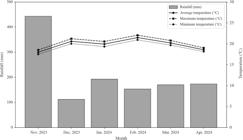
Rainfall accumulation and average, maximum, and minimum temperatures recorded during the field experiments in the municipality of Lages, in the state of Santa Catarina, Brazil.
Fertilization was applied after seedling planting according to the recommendations of Comissão de Química e Fertilidade do Solo (Manual…, 2016). Seedlings of 'Tifton-85' bermudagrass were planted on November 21, 2023, and those of 'SCS315' giant missionary grass, on November 22, 2023. The seedlings were spaced at 0.15 x 0.15 m, aiming for a rapid canopy closure and consequent weed suppression. The experimental design was a randomized complete block with seven treatments (six selected herbicides and a control) and four blocks. Plot dimensions were 2.0 x 3.0 m. Each grass formed a unique experiment.
Herbicide application was carried out using the Back Pack CO2-pressurized backpack sprayer (Allka Bandeirinhas, Maringá, PR, Brazil), equipped with four TT110.015 flat fan nozzles with air induction (Teejet, Glendale Heights, IL, USA), at a constant pressure of 208 kPa, a movement speed of 1.0 m s-1, and an application rate equivalent to 150 L ha-1. Pre emergence herbicides were applied immediately after seedling planting, and post-emergence herbicides, after full seedling establishment, approximately 14 days after transplanting. For bermudagrass, the dates and the climatic conditions at the time of application were as follows: November 21, 2023, at 31.2°C, 37% relative humidity, and wind speed of 2.0 km h-1 for pre-emergence herbicides; and December 8, 2023, at 24°C, 63% relative humidity, and wind speed of 1.8 km h-1 for post-emergence herbicides. For giant missionary grass, pre-emergence herbicides were applied on November 24, 2023, and post-emergence herbicides on December 8, 2023, under the respective conditions of 20.2 and 24°C, 50.2 and 63% relative humidity, and wind speeds of 1.4 and 1.8 km h-1.
The phytotoxicity evaluations in the field also followed the scale proposed by Kuva et al. (2016), ranging from 0 to 100%, representing no phytotoxicity and plant death, respectively. Evaluations were performed at 7, 14, and 28 DAA. Simultaneously, proximal NDVI was assessed using the portable FieldScout cm 1000 NDVI Meter (Spectrum Technologies, Inc., Aurora, IL, USA).
Canopy height was evaluated at 28 DAA, 50 days after transplant (DAT), according to Barthram (1986), by averaging ten random points per plot using a sward stick. Additionally, the interception of photosynthetically active radiation by the canopy was determined at 28 DAA by measuring the difference between the radiation levels above and below the canopy using the LP-80 ACCUPAR device (METER Group, Inc., Pullman, WA, USA).
Forage mass (Mg ha-1 dry matter) was obtained by cutting the plants at ground level using an adapted electric wool clipper, in a 0.5x0.5 m area marked with a template, representative of average plot height. The samples were then dried in ovens, at 55°C, until reaching a constant mass and weighed on a digital scale; the obtained values were converted into productivity estimates in Mg ha-1 dry matter. Immediately after sampling, the entire plot was cut to a 12.5 cm height to simulate the height remaining after animal grazing under an intermittent system. The same procedure was repeated whenever the pastures reached a height of 20 cm or more, simulating a target grazing height for the evaluated grasses, with three cuts and forage collections.
Tiller density was evaluated at 28 DAA, by counting the number of tillers at three random points of the plot in 0.25x0.25 cm frames; the final value was calculated as the average of the three frames, being subsequently converted into tiller density per square meter.
Data from the screening trials were subjected to the analysis of variance and to correlation analysis. Subsequently, they were analyzed by the PCA with a 5% confidence level, using the Scikit-learn and Matplotlib packages in Python 3, version 3.12.0 (Turner, 2023). Data from the field experiments were subjected to normality by Shapiro-Wilk’s test, being transformed into √(x+0.5) in cases of non-normality. The analysis of variance was performed, and treatment means were compared with those of the control using Dunnett’s test (α = 0.05) through the online SAS software (SAS Institute Inc., Cary, NC, USA).
Results and Discussion
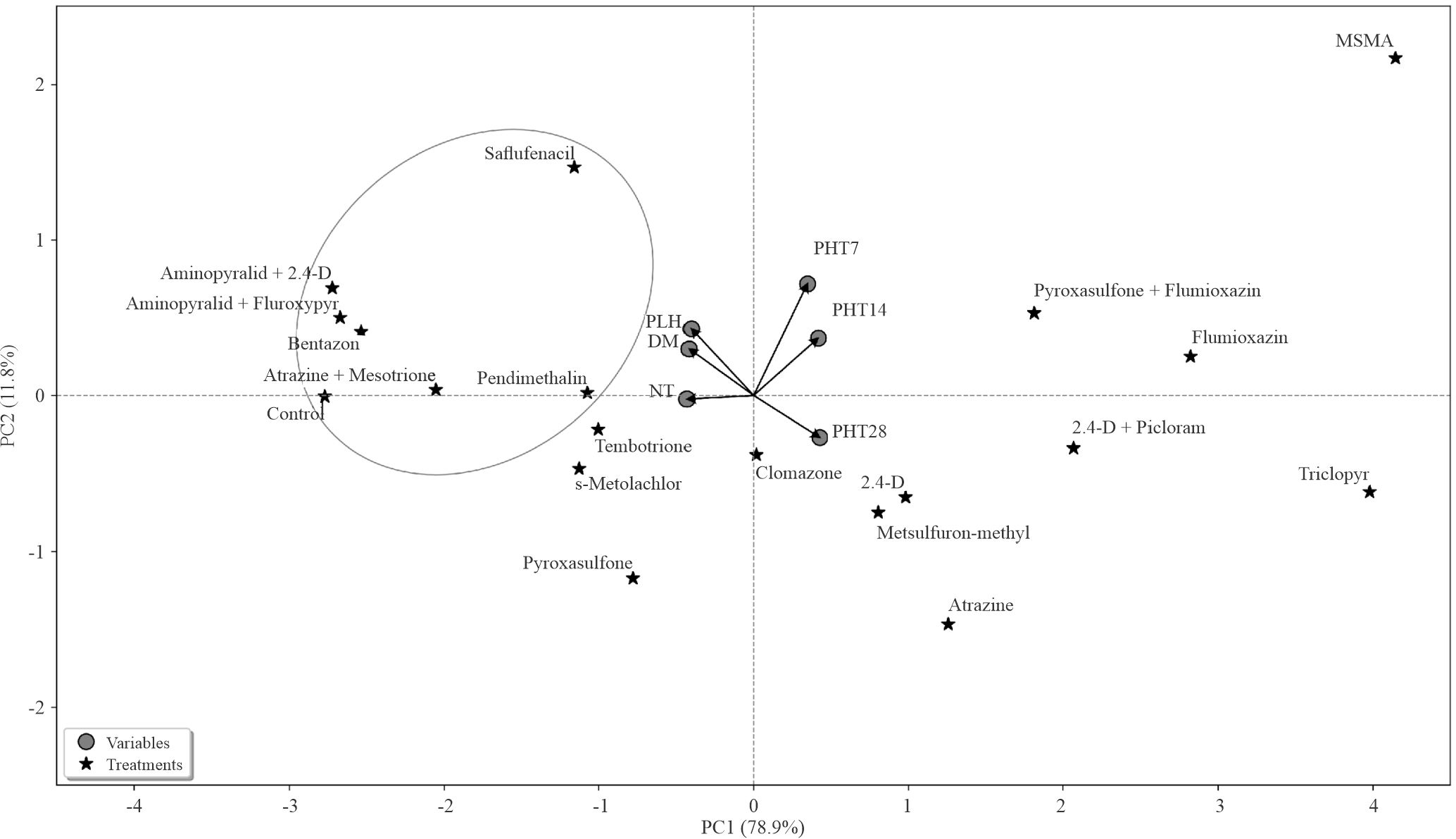
For the SCS315 giant missionary cultivar, the first and second principal components (PC1 and PC2, respectively) of the PCA had eigenvalues of 4.99 and 0.75, accounting for 78.9% and 11.8% of data variance, respectively (Figure 2). Together, these two components explained 90.7% of experimental variance. In PC1, all variables obtained eigenvectors close to 0.4, with a negative relationship between the productive parameters. In PC2, which is predominantly explained by phytotoxicity at 7 DAA, the eigenvector was close to 0.72.
Principal component analysis distribution of variables and treatments in a greenhouse experiment with SCS315 giant missionary grass (Axonopus catharinensis) cultivar. Highlighted in the ellipse are the treatments (control and herbicides) selected for the field trials. PHT7, phytotoxicity at 7 days after application (DAA); PHT14, phytotoxicity at 14 DAA; PHT28, phytotoxicity at 28 DAA; PLH, plant height; NT, number of tillers; DM, dry mass; and MSMA, monosodium methyl arsenate.
Although the treatments did not form well-defined clusters, the distribution of the variables in the PCA and the behavior of the control allowed of identifying the herbicides in the greenhouse trial with potential for selective use in the implementation of giant missionary grass, i.e.: pendimethalin, mesotrione + atrazine, bentazon, saflufenacil, aminopyralid + 2,4-D, and aminopyralid + fluroxypyr. The obtained results are partially aligned with those reported by Monquero et al. (2012), when evaluating herbicide selectivity at post-planting of ornamental carpetgrass [Axonopus comprerssus (Sw.) P.Beauv.]. In the present study, the active ingredients bentazon (0.72 g ha-1), 2,4-D (670 g ha-1), and atrazine (2,000 g ha-1) were also selective in the greenhouse, while sulfentrazone (800 g ha-1) caused injuries.
Regarding phytotoxicity ratings in the field trials, all giant missionary grass treatments at 7 DAA differed statistically from the control (Table 2). The highest and lowest phytotoxicities were observed in the treatments with aminopyralid + 2,4-D and bentazon, respectively. Pendimethalin was the only herbicide to show a decrease in phytotoxicity at 14 DAA and, together with bentazon, was among the few treatments that did not differ from the control. However, at 28 DAA, all treatments different significantly from the control regarding phytotoxicity. The aminopyralid + 2,4-D treatment maintained its previous behavior, recording the highest phytotoxicity at 14 and 28 DAA.
Phytointoxication, pasture quality, and productivity of SCS315 giant missionary grass (Axonopus catharinensis) cultivar in the field experiment(1).
In carpetgrass, Monquero et al. (2012) also observed a higher phytotoxicity caused by bentazon at 14 DAA, with plant recovery at 28 DAA. Studying the same species, Dias (2018) confirmed the selectivity of atrazine (1,250 g ha-1) and bentazon (600 g ha-1), which did not cause injuries to the grass or interfere with its green coverage rate. The latter author also noted that the application of flumioxazin (30 g ha-1) led to phytotoxicity, characterized by severe chlorotic injuries (>20%), as observed in the initial screening in the present work.
Regarding pasture productivity and quality, no treatment differed significantly from the control at 28 DAA, at 50 DAT, regarding proximal NDVI evaluations or tiller density.
In the evaluation of photosynthetically active radiation interception, the treatment with aminopyralid + 2,4-D differed from the control, intercepting 61.4% of incident radiation. This result, coupled with the higher observed phytotoxicity, indicates that this treatment caused a reduction in the leaf area of giant missionary grass and delayed canopy closure. Despite this, the number of tillers and the health of the vegetation, as indicated by the NDVI, were not affected. Baldissera et al. (2016) found a significant linear relationship between canopy height and light interception in C4 grasses, including giant missionary grass. This may be an indicative that greater canopy heights are independent of light interception levels, a behavior observed in the present study for developing pastures, i.e., where the plants are still in growth.
Canopy height and plant dry mass did not differ between the treatments and the control. Among the treatments, no significant difference was observed in the dry mass obtained from the three performed cuts. According to these results, although some treatments showed a higher phytotoxicity and possible reductions or delays in canopy closure, all of them allowed of a plant growth and forage mass comparable to those of the untreated control, showing selectivity towards giant missionary grass.
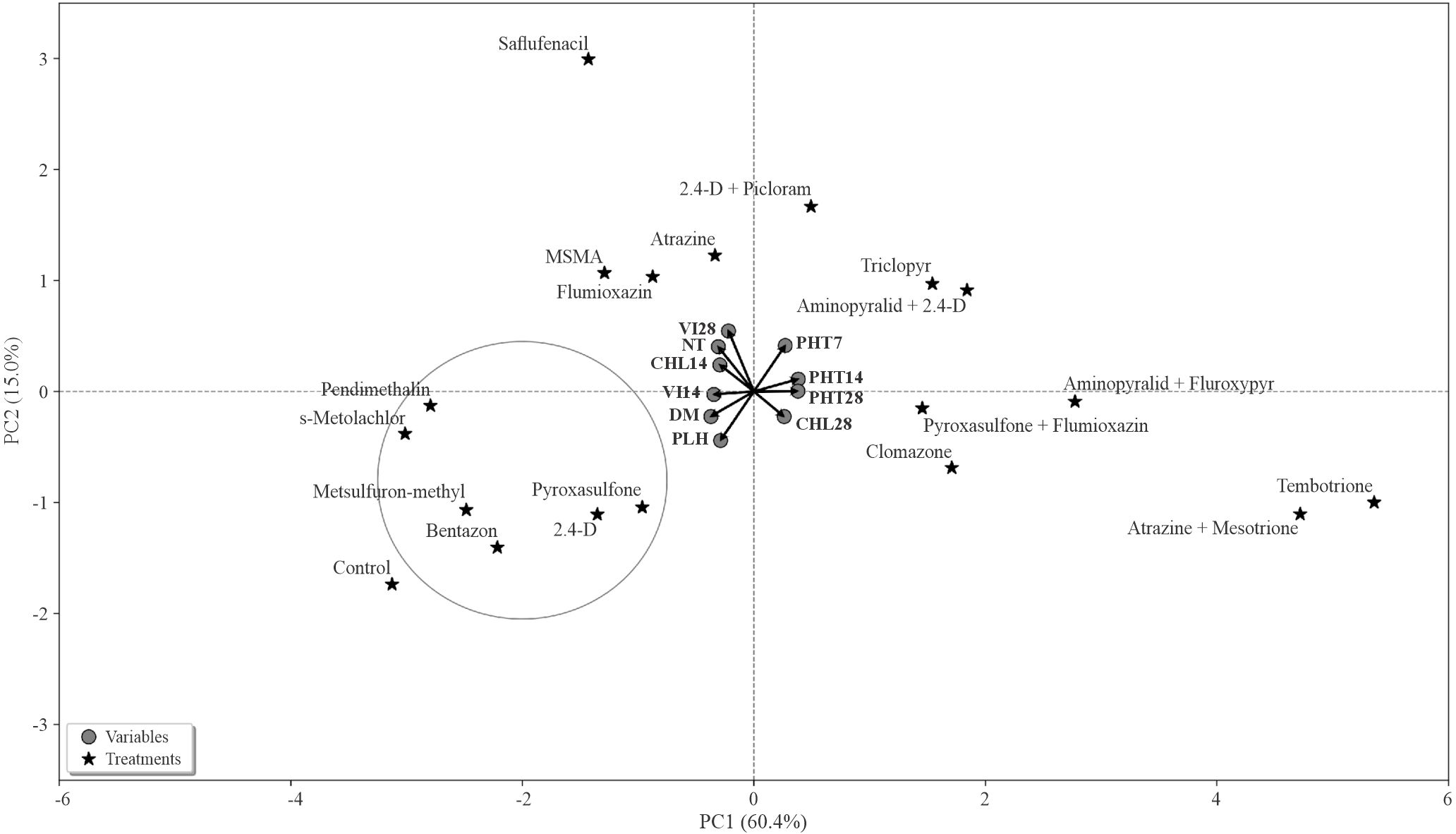
For bermudagrass, the PCA explained 75.4% of data variance, i.e., 60.4 and 15% through PC1 and PC2, respectively (Figure 3). The eigenvalues in PC1 ranged from 0.27 to 0.38 for phytotoxicity and from -0.37 to -0.22 for productivity. The largest variance in PC2 was explained by the vegetation index at 28 DAA, with an eigenvector equal to 0.549. The obtained grouping indicated the following treatments that showed potential for selective use in the implementation of bermudagrass pasture: s-metolachlor, pendimethalin, pyroxasulfone, bentazon, metsulfuron-methyl, and 2,4-D.
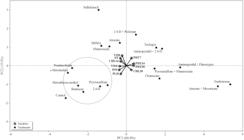
Principal component analysis distribution of variables and treatments in a greenhouse experiment with Tifton 85 bermudagrass (Cynodon spp.) cultivar. Highlighted in the ellipse are the treatments (herbicides) selected for field trials. PHT7, phytotoxicity at 7 days after application (DAA); PHT14, phytotoxicity at 14 DAA; PHT28, phytotoxicity at 28 DAA; PLH, plant height; NT, number of tillers; DM, dry mass; CHL14, chlorophyll index at 14 DAA; CHL28, chlorophyll index at 28 DAA; VI14, vegetation index at 14 DAA; VI28, vegetation index at 28 DAA; and MSMA, monosodium methyl arsenate.
In African star grass (Cynodon nlemfuensis Vanderyst), Brighenti et al. (2019) also found that the application of fluroxypyr + aminopyralid, fluroxypyr + triclopyr, and atrazine + tembotrione caused phytotoxicity, while the use of 2,4-D, 2,4-D + picloram, bentazon, imazapyr, monosodium methyl arsenate, and atrazine + s-metolachlor did not reduce the dry matter production of the plants. As in the present study, 2,4-D and bentazon also proved to be selective for plants of the Cynodon genus, even when applied at different stages of pasture development. Likewise, the use of fluroxypyr + aminopyralid caused symptoms in cultivar Tifton-85 in the greenhouse experiment. Furthermore, bermudagrass showed a decreased growth five weeks after the application of triclopyr (800 g ha-1), triclopyr + metsulfuron-methyl (900 g ha-1 + 300 g ha-1), and triclopyr + fluroxypyr (0.25% v/v + 0.09% v v-1), as also observed by Janak et al. (2015).
For bermudagrass in the field experiment (Table 3), only the phytotoxicity of the bentazon treatment did not differ from that of the control at 7 DAA. Notably, the treatments with s-metolachlor and pyroxasulfone exhibited the highest phytotoxicity. At 14 DAA, all treatments differed from the control, with the lowest and highest averages recorded for bentazon and pyroxasulfone, respectively. At 28 DAA, a decrease in phytotoxicity was observed for 2,4-D, as well as for bentazon and metsulfuron-methyl; however, the last two differed significantly from the control. The treatment that caused the most significant injuries to bermudagrass was pyroxasulfone.
Phytointoxication, pasture quality, and productivity of Tifton 85 bermudagrass (Cynodon spp.) cultivar in the field experiment(1).
Brighenti et al. (2020) compared the response of 'Tifton 85' bermudagrass to different herbicides, concluding that bentazon, imazapyr, and monosodium methyl arsenate were the most selective, while fluroxypyr + aminopyralid, fluroxypyr + triclopyr, and glyphosate caused a greater phytotoxicity and reduction in dry matter content. These data are partially in alignment with those obtained in the present work, where the use of monosodium methyl arsenate led to phytotoxicity in the greenhouse screening, as well as to decreases in the height and dry mass of bermudagrass plants. The observed difference may have been due to the timing of herbicide application, which was performed on a fully established pasture and not at the time of seedling transplant in the previously cited study. However, in both researches, the selectivity of bentazon was confirmed for Cynodon spp. in early post-emergence or after full pasture establishment.
When considering the productivity parameters and physiological components of bermudagrass, proximal NDVI, photosynthetically active radiation interception, and tiller density did not differ significantly between the control and any of the treatments. A similar behavior was observed for canopy height and plant dry mass, which did also not differ between the treatments and the control. These results contrast with those reported by Begitschke et al. (2018), who concluded that the use of the prodiamine (0.59 kg ha-1), dithiopyr (0.56 kg ha-1), atrazine + s-metolachlor (1.12 + 0.86 kg ha-1), simazine (2.24 kg ha-1), s-metolachlor (2.78 kg ha-1), flumioxazin (0.29 kg ha-1), and indaziflam (0.03 kg ha-1) pre-emergence herbicides affected the time it took bermudagrass to reach 50% establishment, considering area coverage, the NDVI, and chlorophyll content.
The visual symptoms due to herbicide application were not sufficient to promote reductions in grass forage production, whose levels were comparable to those of the untreated control. In the first evaluation at 50 DAT, some plots had not yet reached the defined cutting height of 20 cm, which explains the high height in the first cut at 70 DAT, reflecting the longer period without pasture lowering and a consequent greater accumulation of dry mass. Contrariwise, Araujo (2018) found that, 60 days after being cut, Cynodon spp. treated with 2,4-D (1,209 g a.i. ha-1) and atrazine (2,000 g a.i. ha-1) showed a reduced regrowth dry mass when compared with the control (without herbicide). This author also noted that, among all herbicides tested, only tembotrione (84 g a.i. ha-1) did not differ from control. However, in the greenhouse trials, tembotrione was highly phytotoxic to bermudagrass, as shown by the PCA (Figure 3). These differences once again highlight the importance of researches about the timing of herbicide application and the phytotoxic effect on cultivated crops. Therefore, experiments to confirm selectivity at different stages of forage development are essential to ensure the safe use of herbicides.
As observed in the initial screening experiment, herbicides from the same mode of action group can exhibit differential effects on the target crop. Although most of the five auxin mimics tested were phytotoxic and caused injuries to the evaluated grasses, there were the following exceptions: aminopyralid + 2,4-D and aminopyralid + fluroxypyr for giant missionary grass and 2,4-D for bermudagrass. This shows the need to for the conduction of further studies to seek the best usage protocols for selective herbicides.
The visual injuries caused by the evaluated herbicides on both grass species in the field experiments were mild and decreased with the progression and establishment of the forages. This means that the observed symptoms were not sufficient to cause reductions in productivity, evaluated through tiller emission, regrowth capacity, and dry mass production. Furthermore, both pre-emergence and early post-emergence herbicides were selective for the SCS315 giant missionary and Tifton 85 bermudagrass cultivars, allowing of the development of comprehensive protocols for weed control.
Conclusions
-
1. The herbicides selected in the greenhouse and field experiments that show potential use in the implementation and initial establishment of SCS315 giant missionary grass (Axonopus catharinensis) cultivar are: pendimethalin, mesotrione + atrazine, bentazon, saflufenacil, aminopyralid + 2,4-D, and aminopyralid + fluroxypyr.
-
2. The herbicides selected in the greenhouse and field experiments that show potential use in the implementation and initial establishment of Tifton 85 bermudagrass (Cynodon spp.) cultivar are: pendimethalin, s-metolachlor, pyroxasulfone, bentazon, metsulfuron-methyl, and 2,4-D.
Declaration of use of AI technologies
No generative artificial intelligence (AI) was used in this study.
Acknowledgments
To Coordenação de Aperfeiçoamento de Pessoal de Nível Superior (CAPES ), for financing, in part, this study (Finance Code 001); to Conselho Nacional de Desenvolvimento Científico e Tecnológico (CNPq) and to Fundação de Amparo à Pesquisa e Inovação do Estado de Santa Catarina (FAPESC), for financial support; and to Empresa de Pesquisa Agropecuária e Extensão Rural de Santa Catarina (EPAGRI), for the experimental area to conduct the protocol in the field.
Disclaimer/Publisher’s note
The statements, opinions, and data contained in all texts published in Pesquisa Agropecuária Brasileira (PAB) are solely those of the individual author(s) and not of the journal’s publisher, editor, and editorial team, who disclaim responsibility for any injury to people or property resulting from any referred ideas, methods, instructions, or products.
The mention of specific chemical products, machines, and commercial equipment in the texts published in this journal does not imply their recommendation by the publisher.
Data availability statement
Data available upon request: research data are only available upon reasonable request to the corresponding author.
References
-
BALDISSERA, T.C.; PONTES, L. da S.; GIOSTRI, A.F.; BARRO, R.S.; LUSTOSA, S.B.C.; MORAES, A. de; CARVALHO, P.C. de F. Sward structure and relationship between canopy height and light interception for tropical C4 grasses growing under trees. Crop and Pasture Science, v.67, p.1199-1207, 2016. DOI: https://doi.org/10.1071/CP16067
» https://doi.org/10.1071/CP16067 - BARTHRAM, G.T. Experimental techniques: the HFRO sward stick. In: ALCOCK, M.M. (Ed.). Biennial report of the Hill Farming Research Organization Midlothian: Hill Farming Research Organization, 1986. p.29-30.
-
BEGITSCHKE, E.G.; MCCURDY, J.D.; TSENG, T.-M.; BARICKMAN, T.C.; STEWART, B.R.; BALDWIN, C.M.; RICHARD, M.P.; WARD, J.K. Pre-emergence herbicide effects on establishment and tensile strength of sprigged hybrid bermudagrass. Agronomy Journal, v.110, p.2243-2249, 2018. DOI: https://doi.org/10.2134/agronj2017.12.0720
» https://doi.org/10.2134/agronj2017.12.0720 -
BRIGHENTI, A.M.; BENITES, F.R.G.; SOUZA SOBRINHO, F. African star grass response to postemergence herbicides. Ciência e Agrotecnologia, v.43, e026918, 2019. DOI: https://doi.org/10.1590/1413-7054201943026918
» https://doi.org/10.1590/1413-7054201943026918 -
BRIGHENTI, A.M.; SOUZA SOBRINHO, F.; BENITES, F.R.G. Differential tolerance and selectivity of herbicides in forages of the genus Cynodon. Grassland Science, v.66, p.88-94, 2020. DOI: https://doi.org/10.1111/grs.12259
» https://doi.org/10.1111/grs.12259 - CHIARADIA, L.A.; MIRANDA, M.; FEDATTO, V.J. Flutuação populacional de cigarrinhas-das-pastagens na grama-missioneira-gigante. Revista Agropecuária Catarinense, v.26, p.70-75, 2013.
- MANUAL de adubação e calagem para os estados do Rio Grande do Sul e Santa Catarina. 11.ed. Porto Alegre: Sociedade Brasileira de Ciência do Solo, Núcleo Regional Sul, 2016. 376p.
- ARAUJO, F.C. de. Tolerância de Tifton 85 e Jiggs (Cynodon dactylon L.) a herbicidas aplicados em pós emergência 2018. 27p. Dissertação (Mestrado) - Instituto Federal Goiano, Urutaí.
- SILVA, A.C.C. da; LIMA, L.A.; ALMEIDA, W.F. de; THEBALDI, M.S.; SILVA, A.C. da. Tifton 85 production under deficit irrigation. FCA UNCUYO, v.49, p.117-126, 2017.
-
DAL-PIZZOL, J.G.; BIASIOLO, R.; RAUPP, G.T.; BALDISSERA, J.N.C.; ALMEIDA, E.X.; RIBEIRO FILHO, H.M.N. Consumo de forragem por ovinos ingerindo grama missioneira gigante com ou sem acesso a amendoim forrageiro. Arquivo Brasileiro de Medicina Veterinária e Zootecnia, v.71, p.623-630, 2019. DOI: https://doi.org/10.1590/1678-4162-10404
» https://doi.org/10.1590/1678-4162-10404 - DIAS, R. de C. Seletividade de herbicidas aplicados em pós-emergência em espécies de grama 2018. 92p. Dissertação (Mestrado) - Universidade Estadual Paulista Júlio de Mesquita Filho, Botucatu.
-
DIAS-FILHO M.B. Formação e manejo de pastagens Belém: Embrapa Amazônia Oriental, 2012. 9p. (Embrapa Amazônia Oriental. Comunicado técnico, 235). Available at: <https://www.infoteca.cnptia.embrapa.br/handle/doc/937485>. Accessed on: Oct. 1 2024.
» https://www.infoteca.cnptia.embrapa.br/handle/doc/937485 -
DYER, L.M.; HENRY, G.M.; MCCULLOUGH, P.E.; BELCHER, J.; BASINGER, N.T. Evaluation of herbicide programs for the control of knotroot foxtail [Setaria parviflora (Poir.) Kerguélen] in bermudagrass pasture. Weed Technology, v.38, e3, 2024. DOI: https://doi.org/10.1017/wet.2023.98
» https://doi.org/10.1017/wet.2023.98 -
HANISCH, A.L.; ALMEIDA, E.X de; FLARESSO, J.A.; DALLA COSTA, M. SCS315 Catarina-gigante: cultivar de gramínea perene de verão produtiva e adaptada às condições de Santa Catarina. Agropecuária Catarinense, v.35, p.74-77, 2022. DOI: https://doi.org/10.52945/rac.v35i2.1443
» https://doi.org/10.52945/rac.v35i2.1443 -
INMET. Instituto Nacional de Meteorologia. Tabela de Dados das Estações: Estação LAGES (A865). 2024. Available at: <https://tempo.inmet.gov.br/TabelaEstacoes/A865>. Accessed on: Oct. 1 2024.
» https://tempo.inmet.gov.br/TabelaEstacoes/A865 -
JANAK, T.; BAUMANN, P.A.; JANAK, S.E.; GRICHAR, W.J. Use of selected herbicides and application methods for tolerance to Tifton 85 bermudagrass [Cynodon dactylon (L.) Pers.]. American Journal of Experimental Agriculture, v.8, p.289-298, 2015. DOI: https://doi.org/10.9734/AJEA/2015/17727
» https://doi.org/10.9734/AJEA/2015/17727 - JOCHIMS, F.; SILVA, A.W.L. da; PORTES, V.M. Espécies forrageiras mais utilizadas em pastagens na Região Oeste de Santa Catarina. Agropecuária Catarinense, v.30, p.15-18, 2017.
-
KRAHL, G.; ZANINI, R.L.B.; FERRETTO, M.; GIUSTI, P.B.; TODESCHINI, L. Impacto do Arachis pintoi cv. Belmonte sobre a resposta do Axonopus catharinensis Valls ao sombreamento. Agropecuária Catarinense, v.34, p.87-92, 2021. DOI: https://doi.org/10.52945/rac.v34i3.1255
» https://doi.org/10.52945/rac.v34i3.1255 - KUVA, M.A.; SALGADO, T.P.; REVOREDO, T.T.O. Experimentos de eficiência e praticabilidade agronômica com herbicidas. In: MONQUERO, P.A. (Org.). Experimentação com herbicidas São Carlos: Rima, 2016. p.75-98.
-
LAJÚS, C.R.; SCHEFFER-BASSO, S.M.; MIRANDA, M.; DENARDIN, R.B.N.; VALLS, J.F.M. Morphophysiological characterization of giant missionary grass accessions. Revista Brasileira de Zootecnia, v.40, p.2302-2307, 2011. DOI: https://doi.org/10.1590/S1516-35982011001100004
» https://doi.org/10.1590/S1516-35982011001100004 -
MIRANDA, M.; SCHEFFER-BASSO, S.M.; ESCOSTEGUY, P.A.V.; LAJÚS, C.R.; SCHERER, E.E.; DENARDIN, R.B.N. Dry matter production and nitrogen use efficiency of giant missionary grass in response to pig slurry application. Revista Brasileira de Zootecnia, v.41, p.537-543, 2012. DOI: https://doi.org/10.1590/S1516-35982012000300009
» https://doi.org/10.1590/S1516-35982012000300009 -
MONQUERO, P.A.; MIGUEL FILHO, J.; GUTIERREZ, A.B.; BARBOSA, L.N. Seletividade de herbicidas em espécies de gramas ornamentais. Revista Brasileira de Herbicidas, v.11, p.296-304, 2012. DOI: https://doi.org/10.7824/rbh.v11i3.171
» https://doi.org/10.7824/rbh.v11i3.171 -
OTTONI, D.; TEIXEIRA, A. de M.; GONÇALVES, L.C.; SILVA, N.T.A. da; CRUZ, D.S.G.; CÔRTES, I.H.G.; OLIVEIRA, J.P.C.A. de; JAYME, D.G. Optimization Tifton-85 grass cutting for productivity and nutrient value. Bioscience Journal, v.37, e37009, 2021. DOI: https://doi.org/10.14393/BJ-v37n0a2021-48179
» https://doi.org/10.14393/BJ-v37n0a2021-48179 -
PATZLAFF, N.L. Características produtivas da pastagem missioneira-gigante em cultivo estreme e em consórcio com amendoim-forrageiro sob pastejo. Revista Científica Rural, v.23, p.54-68, 2021. DOI: https://doi.org/10.30945/rcr-v23i1.3965
» https://doi.org/10.30945/rcr-v23i1.3965 - ROUSE JR, J.W.; HAAS, R.H.; SCHELL, J.A.; DEERING, D.W. Monitoring vegetation systems in the Great Plains with ERTS. In: NASA. Goddard Space Flight Center 3d ERTS-1 Symposium Washington, 1974. v.1, p.309-317.
- SANTOS, H.G. dos; JACOMINE, P.K.T.; ANJOS, L.H.C. dos; OLIVEIRAS, V.Á. de; LUMBRERAS, J.F.; COELHO, M.R.; ALMEIDA, J.A. de; ARAÚJO FILHO, J.C. de; OLIVERIA, J.B. de; CUNHA, T.J.F. Sistema brasileiro de classificação de solos 5.ed. rev. e ampl. Brasília: Embrapa, 2018. 356p.
-
SILVA, A.W.L. da; PAZ, L.L.; CAGLIARI, A.R.; BORTESE, H.P.; BEGNINI, N.J.; MARTINS, H.; BACKES, R.G. Acúmulo mensal de forragem em pastagem de Tifton 85 no Oeste Catarinense. Brazilian Journal of Development, v.7, p.7233-7249, 2021. DOI: https://doi.org/10.34117/bjdv7n1-489
» https://doi.org/10.34117/bjdv7n1-489 -
TURNER, A. (Ed.). What’s new in Python 3.12 2023. Available at: <https://docs.python.org/3/whatsnew/3.12.html>. Accessed on: May 27 2025.
» https://docs.python.org/3/whatsnew/3.12.html -
UNAMUZAGA, L.V.G.; RAMÃO, E.A.M.; KASPER, N.F.; SCHNEIDER, C.R.; BRAGANÇA, L.F.; KROLOWM, R.H.; AZEVEDO, E.B. de; CASTAGNARA, D.D. Estratégias de controle de daninhas em pré-emergência e fitossociologia na implantação do Tifton 85. Brazilian Journal of Animal and Environmental Research, v.7, p.1-14, 2024. DOI: https://doi.org/10.34188/bjaerv7n2-075
» https://doi.org/10.34188/bjaerv7n2-075 - VALLS, J.F.M.; SANTOS, S.; TCACENCO, F.A.; GALDEANO, F. A grama missioneira gigante: híbrido entre duas forrageiras cultivadas do gênero Axonopus (Gramineae). In: CONGRESSO NACIONAL DE GENÉTICA, 46., 2000. Águas de Lindóia, SP. Anais Águas de Lindóia: SBG, 2000.
-
Chief editor:
Edemar Corazza
-
Edited by:
Mírian Baptista