 Feeding levels for the Embrapa 051 laying hen in a free-range system
Abstract
The objective of this work was to evaluate whether providing different volumes of feed during rearing affects the productive potential and egg quality of the Embrapa 051 laying hen lineage in a free-range system. A total of 860 pullets were reared from 6 to 61 weeks of age. The experimental design was completely randomized with four treatments and five replicates of 43 birds each. Treatments consisted of different feeding levels for pullets in the rearing phase: 93, 100, 107, and 120% of the feeding level recommended by a reference guide available in the literature. During the rearing phase, the body weight and feed conversion ratio variables were evaluated. During the production phase, egg production, egg mass, feed conversion ratio per dozen eggs, and internal/external quality of the eggs were analyzed. The animals’ body weight increased with the increase in feeding level, especially in the rearing phase. Layers that are heavier at the time of transfer reach the laying peak earlier, but their persistency and production characteristics are reduced.
Index terms:
egg production; extensive husbandry; feed consumption; growth period; laying hens
Resumo
O objetivo deste trabalho foi avaliar se o fornecimento de diferentes volumes de ração durante a recria afeta o potencial produtivo e a qualidade dos ovos da linhagem de poedeira Embrapa 051, em sistema free range. Um total de 860 poedeiras foram criadas de 6 a 61 semanas de idade. O delineamento experimental foi inteiramente casualizado com quatro tratamentos e cinco repetições de 43 aves cada uma. Os tratamentos consistiram em diferentes níveis de ração para poedeiras na fase de recria: 93, 100, 107 e 120% do nível de ração recomendado por guia de referência disponível na literatura. Durante a fase de recria, foram avaliadas as variáveis peso corporal e razão de conversão alimentar. Durante a fase de produção, foram analisadas a produção de ovos, a massa de ovos, a taxa de conversão alimentar por dúzia de ovos e a qualidade interna/externa dos ovos. O peso corporal dos animais aumentou com o aumento do nível de ração, especialmente na fase de recria. As aves mais pesadas no momento da transferência atingem o pico de postura mais cedo, mas sua persistência e suas características produtivas são reduzidas.
Termos para indexação:
produção de ovos; criação extensiva; consumo de ração; período de crescimento; galinha poedeira
Introduction
The term “cage-free eggs” is becoming a common label on egg cartons to identify production systems that improve animal welfare (Vizzier-Thaxton et al., 2016), a reason why an increasing number of consumers choose to purchase these products (Amaral et al., 2016). Free-range egg production is predominantly carried out by small producers using native chicken breeds, which are better adapted to the region’s soil and climatic conditions (Fonteque et al., 2014; Machado et al., 2018; Rocha et al., 2019; Carvalho et al., 2020). However, it is important to understand the nutritional requirements of these rustic birds in order to develop new genetic lines that have a high aptitude for foraging and a good adaptability to various environmental conditions, including forage type, climate variations, and extreme thermal conditions (Dabbou et al., 2020; Forgiarini et al., 2022).
In the 2000’s, Centro Nacional de Pesquisa de Suínos e Aves, the research center for swine and poultry of Empresa Brasileira de Pesquisa Agropecuária (EMBRAPA), began a breeding program for laying hens to be used in family farming (Forgiarini et al., 2022). The result was the Embrapa 051 (E051) hen lineage, a hybrid of the Rhode Island Red and White Plymouth Rock breeds selected at the research center (Avila et al., 2020). These hens produce table eggs with brown shells and are robust and adapted to less intensive production systems, i.e., are intended for rearing in free-range systems. They start laying at approximately 21 weeks of age, maintaining a good productivity for 70 weeks, with a potential production of 345 eggs per housed bird, in addition to reaching a weight of 2.6 kg at the end of the cycle, which allows of their use for meat production (Figueiredo & Albino, 2000; Ledur et al., 2011; Avila et al., 2017).
The E051 is, thus far, the only poultry breed developed by an official research institution in Brazil for small family farmers, who are less-resource intensive and have a low capital (Avila et al., 2020). For these farmers, the benefit is an increased productivity compared with that of non-selected chicken rearings, which, on average, produce 80 eggs per bird per cycle and weigh ~1.8 kg (Avila et al., 2017; Forgiarini et al., 2022). For small and medium-scale producers with good technical skills and access to commercial genetic lines, the benefit is a reduction of up to 5% in production costs due to the hen’s greater robustness and ease of handling (Miele et al., 2008).
For laying hens to reach their genetic potential and maximize their egg production and feed use efficiency, it is crucial for them to achieve a proper body weight and feed intake capacity at the beginning of the production phase (Braz et al., 2011). In this phase, any issues affecting these parameters in the rearing phase are unlikely to be corrected (Coronado et al., 2023). In addition, low or high levels of feeding not only influence body weight but can also have a significant impact on production costs (Rama Rao et al., 2014). For these reasons, it is important to determine the ideal feed intake of the E051 laying hens, aiming to improve their feed use efficiency and performance.
The objective of this work was to evaluate whether providing different volumes of feed during rearing affects the productive potential and egg quality of the E051 laying hen lineage in a free-range system.
Materials and Methods
All procedures carried out in the study were approved by the ethics committee for animal use of x, under protocol number 043/2021.
A total of 860 pullets from the E051 lineage, with an initial average weight of 415±10 g, were reared from 6 to 61 weeks of age in a free-range system. The pullets were housed in 20 experimental pens measuring 1.4×4.0 m (5.6 m2), with 43 birds each at a density of 7.6 birds per square meter. Each unit was lined with fresh wood-shavings bedding, approximately 10 cm deep, and equipped with tubular feeders, nipple drinkers, and perches, with access to external paddocks (15.6 m2) all day long.
The temperature and relative humidity inside the poultry house were recorded daily using the 175 H1 data logger (Testo do Brasil, Campinas, SP, Brazil), with an accuracy of 0.1°C and 0.1% relative humidity. The values obtained for average temperature and humidity were 21.4±3.88°C and 82.2±5.54%, respectively. Internal temperature was controlled through curtain handling and fans positioned along the house.
Three feeding phases were adopted (Table 1): initial, first to sixth week; rearing, seventh to fifteenth week; and pre-laying, sixteenth to nineteenth week. The experimental diets were based on corn and soybean meal and formulated to meet the nutritional requirements recommended by the Hy-Line Brown Management Guide (Hy-Line International, 2011). The feeds were mashed and weighed daily according to the treatments, being offered once a day in the morning.
Ingredients, nutritional composition, and metabolizable energy of the experimental diets used in each period of the rearing phase of Embrapa 015 layers.
Up to the eighteenth week, a conventional lighting program was used, with a decreasing photoperiod: 20–22 hours of light in the first week, gradually reduced in the following weeks down to 10–12 hours of light by the eighteenth week.
From the eighteenth week onwards, eight nests were installed for egg collection, and an increasing photoperiod began, starting with 14 hours of light and gradually increasing to 16 hours of light by the twenty-fourth week. Egg production was recorded based on four collections per day, at 9 a.m., 11 a.m., 2 p.m., and 5.p.m. In each collection, the number of eggs produced, the location of laying (bedding or nest), and any identifiable dirty, cracked, deformed, or double-yolked eggs were noted.
During the production phase after the eighteenth week, all birds received the same amount of feed. The nutritional composition of the diets was divided into four periods (Table 2): peak, nineteenth to thirty-second week; lay II, thirty-third to forty-forth week; lay III, forty-fourth to fifty-sixth week; and lay IV, fifty-seventh to sixty-first week. Throughout this phase, each hen had access to 30 g of forage (Pennisetum purpureum Schumach. cultivar Mott and Lolium multiflorum Lam.) per day.
Ingredients, chemical composition, and metabolizable energy of the experimental diets used in each period of the production phase of Embrapa 015 layers.
The performance of the pullets was measured at their sixth, ninth, eleventh, thirteenth, seventeenth, and twentieth week of age. On the first day of each week, all birds were weighed individually using the DD-500 precision digital dynamometer (Instrutherm Instrumentos de Medição Ltda., São Paulo, SP, Brazil), with an accuracy of 0.01 g, in order to determine their average body weight and calculate their feed conversion ratio (FCR).
Performance was also evaluated from the twentieth to the sixty-first week of age in 12 week cycles: twentieth to thirty-second, thirty-third to forty-fourth, forty-fifth to fifty-sixth, and fifty-seventh to sixty-one weeks. Laying rate (%) was determined by recording the daily egg production per bird in each experimental unit, in each cycle. The FCR per dozen eggs (FCRd) was calculated using the following formula: FCRd = kilogram of feed consumed/dozen of eggs produced. Egg mass (%) was obtained by multiplying the percentage of eggs produced per bird per day by the average egg weight in each replicate, multiplied by 100.
During the production phase, every six weeks, 20 eggs were selected from the total eggs produced, based on their average weight. Cracked or deformed eggs were not included.
Of the 20 eggs, 10 were weighed individually on a digital scale with a precision of 0.01 g, and the data were used to evaluate egg quality. Yolk color was measured using the CR-410 digital colorimeter (Konica Minolta Sensing Americas, Inc., Ramsey, NJ, USA) based on the Commission Internationale de l’Éclairage system: L*, luminosity; a*, red/green coordinate; and b*, yellow/blue coordinate. Parameters a* and b* were used to calculate parameter C* (chroma), a measurement of color saturation, through the formula: C* = (a*2+b*2)½. After all analyzes were finished, the eggshells were washed with running water, air-dried at room temperature for 72 hours, and weighed individually on a digital scale with a precision of 0.01g. Eggshell thickness was measured using the 536-101 digital caliper (Mitutoyo, Aurora, IL, USA) at three equidistant points around the equatorial region of the egg (Barbosa et al., 2012 Sem referência)
The remaining 10 eggs were subjected to a shell strength test using the TA.XTplusC texture analyzer (Stable Micro Systems, Surry, United Kingdom) with a 2.00 mm rupture probe. The force required to break the shell, expressed in kilograms-force, was recorded. The contents of the eggs were placed on a glass plate, where albumen height was measured using the 3000 micrometer (Baxlo: Measuring and Precision Instruments, Barcelona, Spain). This parameter was used to calculate the Haugh unit through the equation: HU = 100 × log (h − 1.7 × w0.37 + 7.57), where HU is the Haugh unit, h is albumen height (mm), and w is egg weight (g).
The experimental design was completely randomized, with four treatments with five replicates of 43 birds each. Each pen was considered an experimental unit. The treatments consisted of the following feeding levels for pullets in the rearing phase: 93, 100, 107, and 120% of the level recommended by the Hy-Line Brown Management Guide (Hy-Line International, 2011). This guide was used instead of the newer version released in 2016, because the E051 is a continuation of a research that followed the previous guide of 2011 (Forgiarini et al., 2022; Silva et al., 2020).
The data were subjected to assumptions check. Normality, homoscedasticity, and independence of errors were verified using Shapiro-Wilk’s, Bartlett’s, and Durbin-Watson’s tests, respectively. All assumptions were met. The one-way analysis of variance was performed. When significance was detected, orthogonal contrasts were conducted, adjusted for an unequal spacing between treatments (93, 100, 107, and 120% of the reference feed), in order to evaluate the linear and quadratic effects of the different feed quantities on bird performance during the rearing and production phases and on egg quality. All analysis and results were considered at 5% of significance. All statistical procedures were conducted with the R, version 4.0.5, software (R Core Team, 2018) using the lme linear mixed-effects models package (Bates et al., 2015).
Results and Discussion
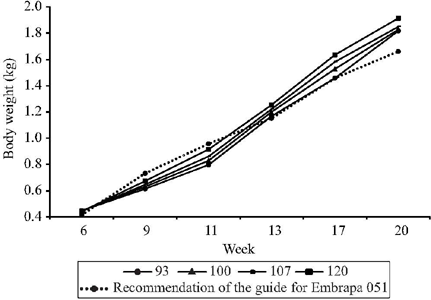
Feeding level was positively related to the body weight of the pullets in the nineteenth, eleventh, thirteenth, seventeenth, and twentieth week of age (p<0.001). The pullets that received 120% of the recommended feeding level from the ninth to twentieth week showed a heavier body weight than those subjected to the other treatments (Figure 1). However, from the thirteenth week onwards, all feeding levels resulted in a heavier body weight than that recommended by the E051 lineage guidelines (Figure 1).
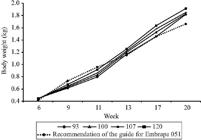
Body weight from the sixth to the twentieth week of age of Embrapa 015 layers in the rearing phase fed with different feeding levels.
The FCR from the sixth to eleventh week was linearly reduced with increasing feeding levels (p<0.05), as shown in Table 3. From the sixth to seventeenth and from the sixth to twentieth weeks, the effect of feeding level on FCR was quadratic (p=0.012 and p=0.002, respectively). Furthermore, the feeding level of 93% presented the best FCR in both of these periods.
Means, standard error of the means (SEM), and statistical results of the linear (L) and quadratic (Q) orthogonal contrasts for the feed conversion ratio (g g−1) of Embrapa 015 layers in three different periods of the rearing phase and at four feeding levels.
The obtained results are an indicative that the greater the amount of feed supplied during the rearing period, the heavier the animal and the higher their egg production. In this line, several authors concluded that the weight of the pullet is the most practical and common way to gauge flock quality, as heavier birds at the onset of production tend to yield larger eggs with a higher laying persistence (Bryden et al., 2021; Coronado et al., 2023). However, relying solely on body weight at the time of transfer to the production house is not recommended and should be accompanied by the bird’s developmental history.
According to Zuidhof (2020), the growth of laying hens exhibits a multi-phase pattern. In the literature, three growth-wave spams have been highlighted: the first, approximately from the first to the sixth week of age, marked by a rapid development of the digestive system and vital organs; the second, from the sixth to the twelfth week of age, when bone, muscle, and feather development is accentuated; and the third, from the twelfth week until the end of the rearing phase, when the bird’s reproduction system is fully developed (Coronado et al., 2023; Zuidhof, 2020; Klein et al., 2020). Ensuring an optimal growth in each of these phases will directly impact the future productivity of the layers. Moreover, fat reserve is also preferred at the end of the rearing phase because it will maintain egg production over time, even if the birds are still growing and consuming less feed (Van Eck et al., 2023).
The variation in feeding level during rearing had an impact on laying rate both at the beginning and at the end of the production phase (Table 4). During the peak laying period (twentieth to thirty-second week of age), a linear response in egg production was observed as feeding level was increased throughout rearing (p<0.01). Heavier birds at the time of transfer started egg production earlier, showing an overall higher production in the evaluated period.
Means, standard error of the means (SEM), and statistical results of the linear (L) and quadratic (Q) orthogonal contrasts for the laying rate (percentage per bird per day) of Embrapa 015 layers in four different periods of the rearing phase and at four feeding levels.
Evaluating free-range layers with different metabolizable energy requirements in the production phase, Brainer et al. (2016) observed that those with an adequate body weight during rearing were able to maintain production in the initial weeks even when dietary energy was low. This finding highlighted the importance of preliminary rearing phases for egg production, as also verified in the present study, in which there was an association between this variable and body weight. In this case, birds with a lower feed consumption showed lower body weights at the end of rearing and lower laying rates than those treated with higher feeding levels.
Towards the end of the production cycle in the fifty-seventh to sixty-first week, a quadratic response was observed in the laying rate (p<0.001) with increasing feeding levels during rearing (Table 4). Birds receiving 120% of the recommended feeding level showed the lowest rates of 76.80% per bird per day. According to Lara et al. (2019), heavier pullets tend to become heavier hens throughout the entire production cycle, showing a reduced laying persistence, typically observed towards the end of the production cycle (Bain et al., 2016). These findings are in agreement with the results of the present study, in which layers that consumed 120% of feed during rearing were heavier and, therefore, had a lower laying persistence from the fifty-seventh to sixty-first week of age.
Sonkamble et al. (2020) evaluated average egg production in hens subjected to different degrees of feed restrictions during rearing (control plus 20 and 30% of feed restriction), but did not observe any differences between feed-restrained birds and the control group. Araujo et al. (2008) and Neto (2003) found that approximately 80% of the dietary energy consumed by poultry is allocated to maintenance, while the remaining 20% is used for egg production, which would explain the lack of differences reported by Sonkamble et al. (2020).
Compared with other breeds, E051 laying hens showed an increased body weight, which may be attributed to their more efficient feed conversion due to their dual-purpose nature. This aligns with the findings of Silva et al. (2020), who studied the effect of feeding levels on E051 and Lohmann Brown hens, observing a greater size and production for E051 hens. In the present work, egg mass and FCRd were linearly affected at the sixty-first week (p<0.05), showing a reduction and an increase with higher feeding levels, respectively (Table 5).
Means, standard error of the means (SEM), and statistical results of the linear (L) and quadratic (Q) orthogonal contrasts for the egg mass (EM) and feed conversion ratio (FCRd) of Embrapa 015 layers at seven different ages in the rearing phase and at four feeding levels.
The layers fed 93% of the reference diet maintained their laying rate and other productive characteristics throughout the production phase, whereas those that consumed 120% reached peak production faster than those subjected to the other treatments. However, the overall results suggest that being overweight contributed to a decrease in laying rate and to a worse egg mass and FCRd. These negative results in the evaluated production variables could be explained by the higher proportion of fatty liver in medium and heavy layers during the production phase (Sibanda et al., 2020). Since other authors did not observed any effect of increasing dietary metabolizable energy on egg mass (Jalal et al., 2007; Wu et al., 2008; Murugesan & Persia, 2013), it is likely that this variable is more associated with genetic factors or hen weight.
There was no effect of feeding level during the rearing phase on the egg quality variables in any of the evaluated periods (Table 6). The exception was yolk color in twenty-fifth and fiftieth weeks, when quadratic and linear effects, respectively, were observed (p<0.05). Although Silva et al. (2020) did not find any differences in the yolk color of hens fed with different nutritional levels, this variable can be affected by the diet provided during the laying phase, including type of commercial feed, alternative ingredients, grass intake, and form and amount of carotenoids available (Hernandez, 2001; Reis et al., 2017).
Means, standard error of the means (SEM), and statistical results of the linear (L) and quadratic (Q) orthogonal contrasts for the internal (Haugh unit, albumen, and yolk color) and external (eggshell thickness and resistance to breakage) quality of the eggs of Embrapa 015 layers at seven different ages in the rearing phase and at four feeding levels.
Conclusion
During the production phase, Embrapa 015 layers that are heavier at the time of transfer reach their laying peak earlier, but with reductions in egg persistency and production characteristics.
Acknowledgments
To Coordenação de Aperfeiçoamento de Pessoal de Nível Superior (CAPES), for financing, in part, this study (Finance Code 001); and to Centro Nacional de Pesquisa de Suínos e Aves (CNPSA), the research center of Embrapa Suínos e Aves, for providing the facilities, animals, and equipment to conduct the study.
References
- Sem citação ACIOLI, M. A importância da qualidade de uma franga. Revista do Ovo, v.4, p.14-18, 2012.
- AMARAL, G.F.; GUIMARÃES, D.D.; NASCIMENTO, J.C. de O.F. do; CUSTODIO, S. Avicultura de postura: estrutura da cadeia produtiva, panorama do setor no Brasil e no mundo e o apoio do BNDES. BNDES Setorial, v.43, p.167-207, 2016.
-
ARAUJO, D. de M.; SILVA, J.H.V. da; ARAUJO, J.A. de; RIBEIRO, M.L.G.; PASCOAL, L.A.F.; COSTA, F.G.P. Farelo de trigo e complexo enzimático na alimentação de frangas de reposição. Revista Ciência e Agrotecnologia, v.32, p.1960-1967, 2008. DOI: https://doi.org/10.1590/S1413-70542008000600040
» https://doi.org/10.1590/S1413-70542008000600040 - Sem citação ARAÚJO, J.S.; PEIXOTO, R.R. Levels of metabolizable energy in diets for brown-egg layers under Brazil deep south winter conditions. Archivos de Zootecnia, v.54, p.13-23, 2005.
- AVILA, V.S. de; FIGUEIREDO, E.A.P. de; KRABBE, E.L.; DUARTE, S.C. Poedeira Colonial Embrapa 051. In: RETORE, M.; PEZARICO, C.R. (Ed.). Tecnologias para a agricultura familiar. 4. ed. rev. e atual. Dourados: Embrapa Agropecuária Oeste, 2020. p.143-148. (Embrapa Agropecuária Oeste. Documentos, 122).
- AVILA, V.S. de; FIGUEIREDO, E.A.P. de; KRABBE, E.L.; DUARTE, S.C.; SAATKAMP, M.G. Poedeira Embrapa 051: guia de manejo das poedeiras coloniais de ovos castanhos. Concórdia: Embrapa Suínos e Aves, 2017. 10 p.
-
BAIN, M.M.; NYS, Y.; DUNN, I.C. Increasing persistency in lay and stabilizing egg quality in longer laying cycles. What are the challenges? British Poultry Science, v.57, p.330-338, 2016. DOI: https://doi.org/10.1080/00071668.2016.1161727
» https://doi.org/10.1080/00071668.2016.1161727 -
BATES, D.; MAECHLER, M.; BOLKER, B.; WALKER, S. Fitting linear mixed-effects models using lme4. Journal of Statistical Software, v.67, p.1-48, 2015. DOI: https://doi.org/10.18637/jss.v067.i01
» https://doi.org/10.18637/jss.v067.i01 -
BRAZ, N. de M.; FREITAS, E.R.; BEZERRA, R.M.; CRUZ, E.B.; FARIAS, N.N.P.; SILVA, N.M. da; SÁ, N.L.; XAVIER, R.P. de S. Fibra na ração de crescimento e seus efeitos no desempenho de poedeiras nas fases de crescimento e postura. Revista Brasileira de Zootecnia, v.40, p.2744-2753, 2011. DOI: https://doi.org/10.1590/S1516-35982011001200019
» https://doi.org/10.1590/S1516-35982011001200019 -
BRAINER, M.M.A.; RABELLO, C.B.V.; SANTOS, M.J.B.; LOPES, C.C.; LUDKE, J.V.; SILVA, J.H.V.; LIMA, R.A. Prediction of the metabolizable energy requirements of free-range laying hens. Journal of Animal Science, v.94, p.117-124, 2016. DOI: https://doi.org/10.2527/jas.2015-9272
» https://doi.org/10.2527/jas.2015-9272 -
BRYDEN, W.L.; LI, X.; RUHNKE, I.; ZHANG, D.; SHINI, S. Nutrition, feeding and laying hen welfare. Animal Production Science, v.61, p.893-914, 2021. DOI: https://doi.org/10.1071/AN20396
» https://doi.org/10.1071/AN20396 -
CARVALHO, D.A. de; MARTÍNEZ, A.M.; CAROLINO, I.; BARROS, M.C.; VALLEJO, M.E.C.; SANTOS-SILVA, F.; ALMEIDA, M.J. de O.; CAROLINO, N.; BERMEJO, J.V.D.; SARMENTO, J.L.R. Diversity and genetic relationship of free-range chickens from the Northeast region of Brazil. Animals, v.10, art.1857, 2020. DOI: https://doi.org/10.3390/ani10101857
» https://doi.org/10.3390/ani10101857 -
CORONADO, A.; SOARES, C.E. da S.; ARTIFON JUNIOR, C.; BERNARDES, P.A.; MAIORKA, A.; DAHLKE, F. The importance of weight control at rearing in the productive aspects of free-range hens. International Journal of Poultry Science, v.22, p.66-72, 2023. DOI: https://doi.org/10.3923/ijps.2023.66.72
» https://doi.org/10.3923/ijps.2023.66.72 -
DABBOU, S.; GASCO, L.; LUSSIANA, C.; BRUGIAPAGLIA, A.; BIASATO, I.; RENNA, M.; CAVALLARIN, L.; GAI, F.; SCHIAVONE, A. Yellow meaworm (Tenebrio molitor L.) larvae inclusion in diets for free-range chickens: effects on meat quality and fatty acid profile. Renewable Agriculture and Food Systems, v.35, p.571-578, 2020. DOI: https://doi.org/10.1017/S1742170519000206
» https://doi.org/10.1017/S1742170519000206 - FIGUEIREDO, E.A.P. de; ALBINO, J. Linhagens comerciais de galinhas para corte e postura. Concórdia: Embrapa Suínos e Aves, 2000. 6 p. 1 fôlder..
-
FORGIARINI, J.; KRABBE, E.L.; ALVES, D.A.; ÁVILA, V.S. de; SILVA, S.N. da; XAVIER, E.G.; RUTZ, F.; ROLL, V.F.B. Impact of feeding volumes on performance and bone characteristics of Embrapa 051 laying hens housed in a cage-free system. Animal Production Science, v.62, p.880-890, 2022. DOI: https://doi.org/10.1071/AN20384
» https://doi.org/10.1071/AN20384 -
FONTEQUE, G.V.; BATTILANA, J.; PALUDO, E.; LIMA-ROSA, C.A. da V. Genetic polymorphism of fifteen microsatellite loci in Brazilian (blue-egg Caipira) chickens. Pesquisa Veterinária Brasileira, v.34, p.98-102, 2014. DOI: https://doi.org/10.1590/S0100-736X2014000100016
» https://doi.org/10.1590/S0100-736X2014000100016 - HERNÁNDEZ, J.M. Stable pigmenting carotenoids: a new concept for least cost pigmentation. Journal Animal Feed Science and Technology, v.5, p.43-47, 2001. DOI:.
- HY-LINE INTERNATIONAL. Hy-Line Brown®: management guide. West Des Moines, 2011. p.
-
JALAL, M.A.; SCHEIDELER, S.E.; PIERSON, E.M. Strain response of laying hens to varying dietary energy levels with and without Avizyme supplementation. Journal of Applied Poultry Research, v.16, p.289-295, 2007. DOI: https://doi.org/10.1093/japr/16.3.289
» https://doi.org/10.1093/japr/16.3.289 -
KLEIN, S.A.S. van der; KWAKKEL, R.P.; DUCRO, B.J.; ZUIDHOF, M.J. Multiphasic nonlinear mixed growth models for laying hens. Poultry Science, v.99, p.5615-5624, 2020. DOI: https://doi.org/10.1016/j.psj.2020.08.054
» https://doi.org/10.1016/j.psj.2020.08.054 - LARA, L.J.C.; AMARAL, L.M.M.; TRIGINELLI, M.V. Nutrição e alimentação nas fases de cria e recria. In: FARIA, D.E. de; FARIA FILHO, D.E. de; MAZALLI, M.R.; MACARI, M. Produção e processamento de ovos de poedeiras comerciais. Campinas: Facta, 2019. p.205-217.
- LEDUR, M.C.; FIGUEIREDO, E.A.P. de; SCHMIDT, G.S.; AVILA, V.S. de; PEIXOTO, J. de O. O melhoramento genético de aves no Brasil e as contribuições da Embrapa Suínos e Aves. In: SOUZA, J.C.P.V.B.; TALAMINI, D.J.D.; SCHEUERMANN, G.N.; SCHMIDT, G. S. (Ed.). Sonho, desafio e tecnologia: 35 anos de contribuições da Embrapa Suínos e Aves. Concórdia: Embrapa Suínos e Aves, 2011. p. 293-316.
- MACHADO, L.P.M. Curva de crescimento e características de carcaças de galinhas Canela-Preta em diferentes sistemas de criação. 2018. 67f. Dissertação (Mestrado em Zootecnia) - Universidade Federal do Piauí, Bom Jesus.
- MIELE, M.; GIROTTO, A.F.; RALHARES, J.C.P.; FIGUEIREDO, E.A.P. de; SAATKAMP, M.G. Avaliação dos impactos econômicos, sociais e ambientais da poedeira Colonial Embrapa 051. In: CONGRESSO DA SOCIEDADE BRASILEIRA DE ECONOMIA, ADMINISTRAÇÃO E SOCIOLOGIA RURAL, 46., 2008, Rio Branco. Anais.. Rio Branco: SOBER, 2008. Não paginado..
-
MURUGESAN, G.R.; PERSIA, M.E. Validation of the effects of small differences in dietary metabolizable energy and feed restriction in first-cycle laying hens. Poultry Science, v.92, p.1238-1243, 2013. DOI: https://doi.org/10.3382/ps.2012-02719
» https://doi.org/10.3382/ps.2012-02719 - NETO, G.J. Aspectos nutricionais que afetam as características específicas do ovo de incubação. In: CONFERÊNCIA APINCO DE CIÊNCIA E TECNOLOGIA AVÍCOLA, 2003, Santos. Anais... Santos: Facta, 2003. p.145-164.
-
R CORE TEAM. R: a language and environment for statistical computing. Vienna, 2018. Available at: <https://www.R-project.org>. Accessed on: 20 Sept. 2023.
» https://www.R-project.org -
RAMA RAO, S.V.; RAVINDRAN, V.; RAJU, M.V.L.N.; SRILATHA, T.; PANDA, A.K. Effect of different concentrations of metabolizable energy and protein on performance of White Leghorn layers in a tropical climate. Poultry Science, v. 55, p.532-539, 2014. DOI: https://doi.org/10.1080/00071668.2014.935997
» https://doi.org/10.1080/00071668.2014.935997 - REIS, L.H. de C.; SILVA, L.A.S. da; SOUZA, C.L. de; SILVA, P.H.A. da; VIOLA, T.H. Efeito do consumo de gramíneas sobre a cor da gema de ovos de galinhas caipiras. In: JORNADA DE INICIAÇÃO CIENTÍFICA DA EMBRAPA MEIO-NORTE, 3., 2017, Teresina, PI. Anais... Teresina: Embrapa Meio-Norte, 2017. p. 50..
-
ROCHA, A.O.; CARVALHO, D.A. de; SARMENTO, J.L.R.; CARVALHO, A.A. de; BARBOSA, B.L. Polymorphism in the leptin receptor gene in Brazilian breeds of free-range chickens (Gallus gallus). Revista Científica de Produção Animal, v.21, p.45-48, 2019. DOI: https://doi.org/10.15528/2176-4158/rcpa.21245-48
» https://doi.org/10.15528/2176-4158/rcpa.21245-48 -
SIBANDA, T.Z.; KOLAKSHYAPATI, M.; WALKDEN-BROWN, S.W.; VIELA, J. de S.; COURTICE, J.M.; RUHNKE, I. Body weight sub-populations are associated with significant different welfare, health and egg production status in Australian commercial free-range laying hens in an aviary system. European Poultry Science, v.84, e295, 2020. DOI: https://doi.org/10.1399/eps.2020.295
» https://doi.org/10.1399/eps.2020.295 -
SILVA, S.N. da; FORGIARINI, J.; ALVES, D.A.; KRABBE, E.L.; AVILA, V.S.; LOPES, D.C.N.; XAVIER, E.G. Performance and egg quality of Embrapa 051 laying hens subjected to different feeding programs. Medicina Veterinária, v.14, p.64-73, 2020. DOI: https://doi.org/10.26605/medvet-v14n1-3715
» https://doi.org/10.26605/medvet-v14n1-3715 - SONKAMBLE, V.V.; SRIVASTAVA, A.K.; PAWAR, M.M.; CHAUHAN, H.D.; ANKUYA, K.J.; JAIN, A.K. Effect of feed restriction during growing period on growth and egg production performance of White Leghorn layers. The Haryana Veterinarian, v.59, p.25-28, 2020.
-
VAN ECK, M.; ENTING, H.; CARVALHIDO, I.J.; CHEN, H.; WAKKEL, R.P. Lipid metabolism and body composition in long-term producing hens. World’s Poultry Science Journal, v.79, p.243-264, 2023. DOI: https://doi.org/10.1080/00439339.2023.2189206
» https://doi.org/10.1080/00439339.2023.2189206 -
VIZZIER-THAXTON, Y.; CHRISTENSEN, K.D.; MENCH, J.A.; RUMLEY, E.R.; DAUGHERTY, C.; FEIERG, B.; PARKER, M.; SIEGEL, P.; SCANES, C.G. Symposium: animal welfare challenges for today and tomorrow. Poultry Science, v.95, p.2198-2207, 2016. DOI: https://doi.org/10.3382/ps/pew099
» https://doi.org/10.3382/ps/pew099 -
WU, G.; GUNAWARDANA, P.; BRYANT, M.M.; ROLAND, D.A. Influence of dietary energy and antibiotic on performance, egg solids, and egg quality in Bovans White and Dekalb White hens. Journal of Applied Poultry Research, v. 17, p.323-330, 2008. DOI: https://doi.org/10.3382/japr.2007-00096
» https://doi.org/10.3382/japr.2007-00096 -
ZUIDHOF, M.J. Multiphasic poultry growth models: method and application. Poultry Science, v.99, p.5607-5614, 2020. DOI: https://doi.org/10.1016/j.psj.2020.08.049
» https://doi.org/10.1016/j.psj.2020.08.049