 Performance of elite upland rice lines at low temperatures
Abstract
The objective of this work was to evaluate the phenotypic performance of elite upland rice lines subjected to different temperature conditions during the booting stage (R2). Eight elite lines from an upland rice breeding program were evaluated under six temperatures: 12, 17, 20, 25, 29, and 32°C. The experiment was conducted in a greenhouse and climatic chambers with photoperiod control. The experimental design was completely randomized, with three replicates. Number of days to flowering, plant height, number of panicles, and spikelet sterility were measured. The upland rice lines do not tolerate the low temperatures of 12 and 17°C, which result in a low performance in yield components and a grain sterility of 100%. The lowest rates of spikelet sterilization occur at the temperatures of 25 and 29°C. Cultivar BRSMG Caçula is a promising candidate to integrate the crop succession system.
Index terms:
Oryza sativa
; cropping system; reproductive stage
Resumo
O objetivo deste trabalho foi avaliar o desempenho fenotípico de linhagens elite de arroz de terras altas submetidas a diferentes condições de temperatura durante o estágio de emborrachamento (R2). Foram avaliadas oito linhagens elite do Programa de Melhoramento Genético de Arroz de Terras Altas, sob seis temperaturas: 12, 17, 20, 25, 29 e 32°C. O experimento foi conduzido em casa de vegetação e em câmaras climatizadas com controle de fotoperíodo. O delineamento experimental foi inteiramente casualizado, com três repetições. Foram mensurados número de dias para o f lorescimento, altura da planta, número de panículas e esterilidade de espiguetas. As linhagens de arroz de terras altas não toleram as baixas temperaturas de 12 e 17°C, o que resulta em baixo desempenho dos componentes de rendimento e esterilidade de 100% dos grãos. As menores taxas de esterilização de espiguetas ocorrem nas temperaturas de 25 e 29°C. A cultivar BRSMG Caçula é uma candidata promissora para integrar o sistema de produção em sucessão.
Termos para indexação:
Oryza sativa
; sistema de produção; estádio reprodutivo
Introduction
Over the years, the world population has suffered from an unequal food distribution, in which people living in poverty do not have easy access to food or find it at a very high price (Fujimori et al., 2022). One way to reduce the price of food crops is to reduce production costs by increasing productivity, which has been sought through research on crop management practices and plant breeding (Vicente, 2022).
A crop with potential to improve food security is rice (Oryza sativa L.), especially due to its nutritional balance (Prasad, 2019). Its composition includes 75 to 80% starch, 7.0% protein, and essential minerals such as magnesium, phosphorus, calcium, iron, zinc, copper, and manganese (Kowsalya et al., 2022).
In Brazil, most of the rice is cultivated in lowland rice systems. According to Companhia Nacional de Abastecimento (CONAB) (Acompanhamento…, 2024), of the total area of 1.57 Mha planted with this cereal grass in the 2023/2024 crop season, 1.25 Mha were under the lowland system and only the remaining 20.38% under the upland system. However, in lowland systems, the flooded soils create anaerobic conditions due to the action of methanogenic bacteria, contributing significantly to emissions of methane, a potent greenhouse gas (Nan et al., 2021). These medium- to long-term impacts can lead to serious environmental problems (Yuan et al., 2021; Pathak, 2022). Conversely, when grown in upland systems, rice is subjected to aerobic conditions, which produce lower amounts of methane (Jiang et al., 2022).
To ensure the competitiveness of upland rice, the expansion into different cultivation areas is essential. In Brazil, a promising planting window is in succession to crops such as soybean [Glycine max (L.) Merr.] and common bean (Phaseolus vulgaris L.), which is possible since the winter in the country is not as cold and rigorous as in the Northern Hemisphere (Oliveira-Busatto et al., 2022). Quevedo et al. (2022) highlighted the economic and social benefits of these legume-grass successions.
However, there are challenges associated with integrating rice as a second crop in a succession cropping system, mainly related to extreme temperatures (either low or high). Although winter is not rigorous in Brazil, low temperatures, ranging from 17 to 22°C, occur in April and May, when the rice plant would be in its reproductive stage, the most sensitive to temperature stress (Steinmetz et al., 2013). This concern regarding temperature is related to air temperature in upland rice and water temperature in lowland rice, whose young panicles would still be below water surface during the booting stage (R2), i.e., the period of 7 to 14 days before panicle emergence (Collinson et al., 1995; Lanna et al., 2021). Therefore, depending on the development stage of the plant, the observed impacts can be exacerbated (Hussain et al., 2019). According to Yoshida (1981) and Promchote et al. (2022), the flowering and anthesis stages are the most sensitive to temperature extremes. Hayase et al. (1969) and Unan et al. (2022) found that low temperatures during the initial stages of plant development, pre-flowering, or flowering caused a delayed flowering and spikelet sterility, with the later resulting in significant losses in grain yield.
To obtain information on plant behavior at low temperatures, particularly in the upland system, which produces less methane, the study of high-quality rice lines is impor tant due to their potential of being released sooner into the consumer market. Furthermore, the selection of short-cycle rice genotypes is relevant when planning to integrate upland rice into a succession cropping system.
The objective of this work was to evaluate the phenotypic performance of elite upland rice lines subjected to different temperature conditions during the R2 stage.
Materials and Methods
The experiment was carried out from February 2022 to April 2023 at a greenhouse and at the Central Seed Analysis Laboratory, located in the Department of Agriculture of Universidade Federal de Lavras (UFLA), in the state of Minas Gerais, Brazil.
Eight elite rice lines were evaluated: a commercial one (cultivar BRSMG Caçula); and seven (CMG ERF 81-2, CNAx20665-B-6, CNAx20658-B-12, 1 P 95-8 CNAx18360-B-3-B-B, OBS1819-126-9, P85-15-CNAx18874-B-5-6, and CNAx20663-B-14) from the upland rice breeding program of UFLA, part of a cooperation with Empresa Brasileira de Pesquisa Agropecuária (EMBRAPA) and Empresa de Pesquisa Agropecuária de Minas Gerais (EPAMIG). All genotypes were subjected to six temperatures (12, 17, 20, 25, 29, and 32ºC) during the R2 stage, characterized by panicle growth inside the leaf sheath (Counce et al., 2015).
The data were collected over one single experimental year, using a longitudinal study to evaluate genotype vs. environment interactions. During this single year, the experiment was conducted in a greenhouse (30 m in length x 2.31 m in height) and in climatic chambers with photoperiod control. Therefore, the genotypes were subjected to controlled environments, decreasing environmental sources of variation. In addition, since the used genotypes were homozygous lines, the genotypic sources of variation were also decreased.
The experimental design was completely randomized, in an 8x6 factorial design (eight rice lines and six temperature treatments), with three replicates. The experiment consisted of 144 pots, and the experimental unit was one pot with one plant. Each pot was filled with 1.69 L substrate made of a mixture containing Latossolo Vermelho distrófico (an Oxisol), a commercial substrate (Carolina Soil, Santa Cruz do Sul, Rio Grande do Sul), and sand, in a 2.0:1.0:0.5 ratio, respectively. Based on the soil chemical analysis, the fertilizer rates were calculated. At sowing, 300 kg ha-1 of the 08-28-16 (NPK) fertilizer formula were used, and, at the V3 stage, 100 kg ha-1 urea were applied as topdressing.
The pots were initially housed in the greenhouse until reaching the R2 stage. There, temperature was kept at 25°C, and moisture was not monitored. After the R2 stage, the pots were transferred to EL222/3 climatic chambers (Eletrolab, São Paulo, SP, Brazil), which were used to simulate the temperatures of each treatment under a photoperiod of 10 hours of darkness and 14 hours of light; moisture was not controlled. The plants remained in the chambers until the anthesis stage (R4), as adapted from Cruz et al. (2006). After the R4 stage, the plants were returned to the greenhouse to complete their growth cycle, being kept at 25°C.
The following traits were evaluated: number of days to flowering (NDF), i.e., the number of days from sowing until flowering; plant height (cm), measured from the base of the stem at the soil level up to the top of the plant; number of panicles per plant; and spikelet sterility (%), calculated as the ratio between the number of sterile spikelet and the total number of spikelets × 100 (Xu et al., 2020; Chidambaranathan et al., 2021).
The assumptions of normality of residuals, independence of errors, and homoscedasticity were checked. These assumptions were met, and a factorial analysis of variance was carried out. Scott Knott’s test was used to compare treatment means at 5% probability. The R software (R Core Team, 2013) and ExpDes package (Ferreira et al., 2014) were used. The adopted statistical model was:
where Yijk is the observed value of the trait for the j-th replicate of the combination of the i-th level of factor A (rice line) with the k-th level of factor B (temperature treatment); µ is the overall average efect; αi is the efect of the i-th level of factor A on the trait; βk is the efect of the k-th level of factor B on the trait; (αβ)(ik) is the efect of the interaction between the i-th level of factor A and the k-th level of factor B; and εijk is the mean experimental error associated with observation ijk.
Results and Discussion
For each trait, the coefficient of variation (CV) was obtained in order to measure experimental precision (Table 1). The CV for NDF and plant height was below 10%, indicating a high experimental precision (Pimentel-Gomes, 2009). The number of panicles per plant and spikelet sterility showed high CV values of 33.30 and 23.28%, respectively, which is commonly observed. Gupta et al. (2022), for example, found a 22.36% phenotypic CV for number of panicles when studying 32 rice genotypes. A possible explanation for the high CVs obtained for number of panicles (typically over 20%) could be that this trait is quantitative, being affected by multiple genetic factors, and highly influenced by temperature (Xu et al., 2019; Lu et al., 2022). If a higher number of plants had been analyzed, the CV values could have been lower; however, this was not possible in the present study due to the number of climatic chambers available.
Results of the analysis of variance for number of days to flowering (NDF), plant height, number of panicles (NP), and percentage of spikelet sterility (SS) of upland elite rice (Oryza sativa) lines.
The results of the analysis of variance showed significant differences (p≤0.05) for almost all evaluated traits regarding the levels of rice lines, treatments, and the rice lines x treatments interaction.
According to Moe et al. (2019), in a given environ ment, grain yield is deter mined by the following yield components developed during the different phenophases of the rice crop: number of panicles per square meter, number of spikelets per panicle, spikelet fertility, and a thousand-grain weight. These components are influenced by the environmental conditions during each plant stage (Shrestha et al., 2012).
Observing the rice line factor, cultivar BRSMG Caçula showed the shortest NDF, followed by CMG ERF 81-2 (Table 2), both blooming up to 100 days at the most. Then, came CNAx20665-B-6 and 1P 95-8 CNAx18360-B-3-B-B, taking 117 and 118 days to bloom, respectively. The NDF is directly related to the rice crop cycle, i.e., the shorter the NDF, the earlier the rice cycle will be and the fewer the days the crop will remain in the field. Therefore, the selection of early-flowering and, consequently, short-cycle rice lines is important to integrate upland rice into a succession cropping system or as a second harvesting (Morais et al., 2014). According to Castro et al. (2019), rice lines that bloom up to 90 days after sowing are considered short cycle, which was the case for most of the rice lines evaluated at 25ºC in the present study.
Means of the variables number of days to flowering (NDF), plant height (PH), number of panicles (NP), and percentage of spikelet sterility (SS) of eight upland elite rice (Oryza sativa) lines evaluated at six temperatures(1).
For plant height, the ‘BRSMG Caçula’ line stood out again, with values 17% higher than the general mean. OBS1819-126-9 and CNAx20663-B-14 did not reach an adequate height for mechanical harvesting, both with heights below 70 cm, which is an indicative that extremes of temperatures are more harmful to these genotypes.
For number of panicles, ‘BRSMG Caçula’ and 1 P 95-8 CNAx18360-B-3-B-B were highlighted. Although the difference between these genotypes and the others was not high, it is significant since, in field conditions, a higher plant density affects productivity.
In terms of the treatment factor (Table 3), the effect of temperature on the studied traits varied. For NDF, the shortest period was observed at 32°C, followed by 25 and 29°C. At 12°C, the flowering cycle was two months longer when compared to the general mean.
Means of the variables number of days to flowering (NDF), plant height (PH), number of panicles (NP), and percentage of spikelet sterility (SS) of eight upland elite rice (Oryza sativa) lines evaluated at six temperatures (treatments)(1).
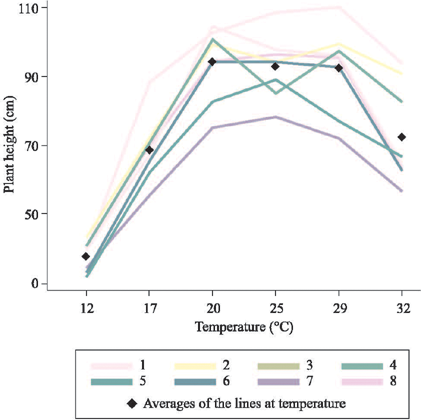
For plant height, the rice lines performed better at 20, 25, and 29°C, reaching almost 1.0 m, the ideal height for mechanical harvesting. However, at 12°C, the plants showed the worst performance, with a 38 cm height.
For panicle development, the ideal temperatures were 20 and 25°C. Again, 12°C had a noticeable negative influence on plant development. Soda et al. (2018) found that, under heat stress conditions, the number of panicles and total yield were 35 and 86% lower, respectively, in rice kept at 40°C during the day and 35°C during the night for 15 days and, then, at 28°C after the treatment. Cruz et al. (2006) added that temperatures below 17°C cause negative effects on rice yield components, such as poor panicle exertion, deformation of the panicle apexes, and a relatively slow panicle emission. Therefore, the obtained results suggest that the number of panicles is strongly influenced by high and low extremes of temperatures. However, there is also a genetic component, considering that, in the present study, the rice lines had a higher average number of panicles than ‘BRSMG Caçula’ and 1P95-8CNAx18360-B-3-B-B.
For spikelet sterility, the rice lines subjected to the temperatures of 25 and 29°C presented the lowest rates. However, at lower temperatures, spikelet sterility reached 100%, which is in alignment with the findings of other studies. Several authors reported that the occurrence of low temperatures, especially in the reproductive stage of rice, seriously hinders crop production due to the high rates of spikelet sterility (Hayase et al., 1969; Martins et al., 2007; Shimono & Kanda, 2008). Similarly, Jia et al. (2022) found a reduction in rice pollen grain and in the percentage of fertile pollen under low temperature conditions. However, high temperatures also cause a high spikelet sterility, influencing the final yield of rice (Chidambaranathan et al., 2021). Jagadish et al. (2007), evaluating the IR64 rice cultivar, verified that spikelet fertility was reduced by 7.0% for each degree of temperature above 30°C.
Although each studied variable behaved differently, in general, most genotypes showed a poor performance at 12 and 17°C, as well as a better one at 25°C. There was a relationship between NDF and temperature, in which the different rice lines performed equally at 17, 20, and 25°C (Table 4). However, an inverse relationship was observed between plant cycle and temperature. At 12°C, ‘BRSMG Caçula’ stood out from the rest, with the shortest period between sowing and flowering. This line, together with CMG ERF 81-2 and OBS1819-126-9, did not show any variation in the trait at 12 and 17°C, differently from the rest of the genotypes. At 25, 29, and 32°C, ‘BRSMG Caçula’ behaved similarly to the increased temperatures regarding NDF. This same line and CMG ERF 81-2 presented the shortest cycle at 29 and 32°C, respectively. Therefore, according to the obtained results, at 12 and 17°C, the elite rice lines had a prolonged flowering period, meaning that they should not be cultivated at this temperature range.
Means of the variable number of days to flowering of eight elite upland rice (Oryza sativa) lines evaluated at six temperatures (treatments)(1).
The significant relationships between NDF and temperature and between plant cycle and temperature seem to be related to the actions and interactions of several genes, whose behavior is highly influenced by the environment (Singh et al., 2022). Shim & Jang (2020) concluded that the flowering period is extremely influenced by external environmental conditions such as drought and temperature.
For rice plants, the transition from the vegetative to the reproductive stage is considered a critical event. Soares et al. (2005) found that, in general, short-cycle rice cultivars performed better than the long-cycle ones in terms of grain yield in the state of Minas Gerais, Brazil, most likely because flowering coincides with the rainfall season and high temperatures, suitable for cultivation in the region. Contrastingly, under low temperatures, there are reports of sterility and delayed flowering in the rice crop (Yoshida, 1981; Cruz & Milach, 2000). The IR8 photoperiod-insensitive cultivar, for example, takes 140 days to bloom in cold regions such as California, but only 90 days in hot regions such as the Philippines (Carnahan et al., 1972). Evaluating seven rice cultivars, Mukamuhirwa et al. (2019) found that the average NDF decreased from 120.5 to 90.3, respectively, when temperatures went from low (26/23°C day/night) to high (30/27°C day/night).
Based on the averages obtained for plant height, the rice lines vs. treatments interaction was plotted (Figure 1). In general, there was variability among the studied rice lines. ‘BRSMG Caçula’ and CNAx20663-B-14 maintained the same relative position as the best and the worst performing, respectively, throughout the different treatments. Furthermore, the extremes of temperatures reduced plant height, which was more noticeable at 12°C. The optimal temperatures for most rice lines were 20 and 25°C; however, at 25°C, the genotypes showed different behaviors, which, in some cases, caused changes in their ranking.

Effect of temperature on the plant height of upland elite rice (Oryza sativa) lines. Lines: 1, ‘BRSMG Caçula’; 2, CMG ERF 81-2; 3, CNAx20665-B-6; 4, CNAx20658-B-12; 5, 1 P 95-8 CNAx18360-B-3-B-B; 6, OBS1819-126-9; 7, P85-15-CNAx18874-B-5-6; and 8, CNAx20663-B-14.
For upland rice, plant height should not exceed 100 cm (Saito et al., 2018; Castro et al., 2019), especially since tall plants are susceptible to lodging. However, a height shorter than 60 cm is also not recommended because it hinders an optimal mechanical harvesting, resulting in low yields.
Conclusions
-
Temperatures below 25°C lead to a low performance of the studied elite upland rice (Oryza sativa) lines.
-
Cultivar BRSMG Caçula is a promising candidate to integrate a crop succession system.
Acknowledgments
To Coordenação de Aperfeiçoamento de Pessoal de Nível Superior (CAPES), for financing, in part, this study (Finance Code 001); and to Conselho Nacional de Desenvolvimento Científico e Tecnológico (CNPq) and to Fundação de Amparo à Pesquisa do Estado de Minas Gerais (FAPEMIG), for financial support.
References
-
ACOMPANHAMENTO DA SAFRA BRASILEIRA [DE] GRÃOS: safra 2023/24: oitavo levantamento, v.11, n.8, maio 2024. Available at: <https://www.conab.gov.br/info-agro/safras/graos/boletim-da-safra-de-graos>. Accessed on: May 30 2024.
» https://www.conab.gov.br/info-agro/safras/graos/boletim-da-safra-de-graos - CARNAHAN, H.L.; ERICKSON, J.R.; MASTENBROEK, J.J. Tolerance of rice to cool temperatures – USA. In: INTERNATIONAL RICE RESEARCH INSTITUTE. Rice breeding Los Baños: International Rice Research Institute, 1972. p.535-540.
- CASTRO, D.G.; FERNANDES, M.C.N.; FÉLIX, M.R.; CAZASSA, R.S.; TOMÉ, L.M.; BOTELHO, F.B.S. Estimativas de associação entre caracteres agronômicos na seleção de genótipos de arroz de terras altas. MAGISTRA, v.30, p.359-367, 2019.
-
CHIDAMBARANATHAN, P.; BALASUBRAMANIASAI, C.; BEHURA, N.; PURTY, M.; SAMANTARAY, S.; SUBUDHI, H.; NGANGKHAM, U.; DEVANNA, B.N.; KATARA, J.L.; KUMAR, A.; BEHERA, L. Effects of high temperature on spikelet sterility in rice (Oryza sativa L.): association between molecular markers and allelic phenotypic effect in field condition. Genetic Resources and Crop Evolution, v.68, p.1923-1935, 2021. DOI: https://doi.org/10.1007/s10722-021-01106-7
» https://doi.org/10.1007/s10722-021-01106-7 -
COLLINSON, S.T.; ELLIS, R.H.; SUMMERFIELD, R.J.; ROBERTS, E.H. Relative importance of air and floodwater temperatures on the development of rice (Oryza Sativa). Experimental Agriculture, v.31, p.151-160, 1995. DOI: https://doi.org/10.1017/S0014479700025230
» https://doi.org/10.1017/S0014479700025230 -
COUNCE, P.A.; SIEBENMORGEN, T.J.; AMBARDEKAR, A.A. Rice reproductive development stage thermal time and calendar day intervals for six US rice cultivars in the Grand Prairie, Arkansas, over 4 years. Annals of Applied Biology, v.167, p.262-276, 2015. DOI: https://doi.org/10.1111/aab.12226
» https://doi.org/10.1111/aab.12226 -
CRUZ, R.P. da; MILACH, S.C.K. Melhoramento genético para tolerância ao frio em arroz irrigado. Ciência Rural, v.30, p.909-917, 2000. DOI: https://doi.org/10.1590/s0103-84782000000500031
» https://doi.org/10.1590/s0103-84782000000500031 -
CRUZ, R.P. da; MILACH, S.C.K.; FEDERIZZI, L.C. Rice cold tolerance at the reproductive stage in a controlled environment. Scientia Agricola, v.63, p.255-261, 2006. DOI: https://doi.org/10.1590/s0103-90162006000300007
» https://doi.org/10.1590/s0103-90162006000300007 -
FERREIRA, E.B.; CAVALCANTI, P.P.; NOGUEIRA, D.A. ExpDes: an r package for anova and experimental designs. Applied Mathematics, v.5, p.2952-2958, 2014. DOI: https://doi.org/10.4236/am.2014.519280
» https://doi.org/10.4236/am.2014.519280 -
FUJIMORI, S.; WU, W.; DOELMAN, J.; FRANK, S.; HRISTOV, J.; KYLE, P.; SANDS, R.; VAN ZEIST, W.-J.; HAVLIK, P.; DOMÍNGUEZ, I.P.; SAHOO, A.; STEHFEST, E.; TABEAU, A.; VALIN, H.; VAN MEIJL, H.; HASEGAWA, T.; TAKAHASHI, K. Land-based climate change mitigation measures can affect agricultural markets and food security. Nature Food, v.3, p.110-121, 2022. DOI: https://doi.org/10.1038/s43016-022-00464-4
» https://doi.org/10.1038/s43016-022-00464-4 - GUPTA, H.; PURUSHOTTAM; YADAV, G.; YADAV, S.K.; SINGH, S.; KUMAR, S. Genetic variability, heritability and genetic advance for yield and its related traits in rainfed upland rice (Oryza sativa L.) genotypes. The Pharma Innovation Journal, v.11, p.2520-2524, 2022.
-
HAYASE, H.; SATAKE, T.; NISHIYAMA, I.; ITO, N. Male sterility caused by cooling treatment at the meiotic stage in rice plants: II. The most sensitive stage to cooling and the fertilizing ability of pistils. Japanese Journal of Crop Science, v.38, p.706-711, 1969. DOI: https://doi.org/10.1626/jcs.38.706
» https://doi.org/10.1626/jcs.38.706 -
HUSSAIN, S.; KHALIQ, A.; ALI, B.; HUSSAIN, H.A.; QADIR, T.; HUSSAIN, S. Temperature Extremes: impact on rice growth and development. In: HASANUZZAMAN, M.; HAKEEM, K.R.; NAHAR, K.; ALHARBY, H.F. (Ed.). Plant Abiotic Stress Tolerance. Cham: Springer, 2019. p.153-171. DOI: https://doi.org/10.1007/978-3-030-06118-0_6
» https://doi.org/10.1007/978-3-030-06118-0_6 -
JAGADISH, S.V.K.; CRAUFURD, P.Q.; WHEELER, T.R. High temperature stress and spikelet fertility in rice (Oryza sativa L.) . Journal of Experimental Botany, v.58, p.1627-1635, 2007. DOI: https://doi.org/10.1093/jxb/erm003
» https://doi.org/10.1093/jxb/erm003 -
JIA, Y.; LIU, H.; WANG, H.; ZOU, D.; QU, Z.; WANG, J.; ZHENG, H.; WANG, J.; YANG, L.; MEI, Y.; ZHAO, H. Effects of root characteristics on panicle formation in japonica rice under low temperature water stress at the reproductive stage. Field Crops Research, v.277, 108395, 2022. DOI: https://doi.org/10.1016/j.fcr.2021.108395
» https://doi.org/10.1016/j.fcr.2021.108395 -
JIANG, M.; XU, P.; WU, L.; ZHAO, J.; WU, H.; LIN, S.; YANG, T.; TU, J.; HU, R. Methane emission, methanogenic and methanotrophic communities during rice-growing seasons differ in diversified rice rotation systems. Science of the Total Environment, v.842, art.156781, 2022. DOI: https://doi.org/10.1016/j.scitotenv.2022.156781
» https://doi.org/10.1016/j.scitotenv.2022.156781 -
KOWSALYA, P.; SHARANYAKANTH, P.S.; MAHENDRAN, R. Traditional rice varieties: a comprehensive review on its nutritional, medicinal, therapeutic and health benefit potential. Journal of Food Composition and Analysis, v.114, art.104742, 2022. DOI: https://doi.org/10.1016/j.jfca.2022.104742
» https://doi.org/10.1016/j.jfca.2022.104742 -
LANNA, A.C.; COELHO, G.R.C.; MOREIRA, A.S.; TERRA, T.G.R.; BRONDANI, C.; SARAIVA, G.R.; LEMOS, F. da S.; GUIMARÃES, P.H.R.; MORAIS JÚNIOR, O.P.; VIANELLO, R.P. Upland rice: phenotypic diversity for drought tolerance. Scientia Agricola, v.78, e20190338, 2021. DOI: https://doi.org/10.1590/1678-992x-2019-0338
» https://doi.org/10.1590/1678-992x-2019-0338 -
LU, Y.; CHUAN, M.; WANG, H.; CHEN, R.; TAO, T.; ZHOU, Y.; XU, Y.; LI, P.; YAO, Y.; XU, C.; YANG, Z. Genetic and molecular factors in determining grain number per panicle of rice. Frontiers in Plant Science, v.13, art.964246, 2022. DOI: https://doi.org/10.3389/fpls.2022.964246
» https://doi.org/10.3389/fpls.2022.964246 -
MARTINS, A.F.; VIEIRA, E.A.; KOPP, M.M.; LUZ, V.K. da; CARVALHO, M.F. de; BRANCO, J.S.C.; CRUZ, R.P. da; CARVALHO, F.I.F. de; OLIVEIRA, A.C. de. Caracterização de famílias mutantes de arroz para tolerância ao frio nos períodos vegetativo e reprodutivo. Bragantia, v.66, p.227-233, 2007. DOI: https://doi.org/10.1590/s0006-87052007000200006
» https://doi.org/10.1590/s0006-87052007000200006 -
MOE, K.; HTWE, A.Z.; THU, T.T.P.; KAJIHARA, Y.; YAMAKAWA, T. Effects on NPK status, growth, dry matter and yield of rice (Oryza sativa) by organic fertilizers applied in field condition. Agriculture, v.9, p.109, 2019. DOI: https://doi.org/10.3390/agriculture9050109
» https://doi.org/10.3390/agriculture9050109 - MORAIS, O.P. de; SOARES, A.A.; CASTRO, A.P. de; REIS, M. de S.; UTUMI, M.M.; CORDEIRO, A.C.C. BRSMG 355: primeira cultivar brasileira superprecoce de arroz de terras altas obtida por seleção recorrente. Santo Antônio de Goiás: Embrapa Arroz e Feijão, 2014. (Embrapa Arroz e Feijão. Comunicado técnico, 218).
-
MUKAMUHIRWA, A.; HOVMALM, H.P.; BOLINSSON, H.; ORTIZ, R.; NYAMANGYOKU, O.; JOHANSSON, E. Concurrent drought and temperature stress in rice – a possible result of the predicted climate change: effects on yield attributes, eating characteristics, and health promoting compounds. International Journal of Environmental Research and Public Health, v.16, art.1043, 2019. DOI: https://doi.org/10.3390/ijerph16061043
» https://doi.org/10.3390/ijerph16061043 -
NAN, Q.; XIN, L.; QIN, Y.; WAQAS, M.; WU, W. Exploring long-term effects of biochar on mitigating methane emissions from paddy soil: a review. Biochar, v.3, p.125-134, 2021. DOI: https://doi.org/10.1007/s42773-021-00096-0
» https://doi.org/10.1007/s42773-021-00096-0 -
PATHAK, H. Impact, adaptation, and mitigation of climate change in Indian agriculture. Environmental Monitoring and Assessment, v.195, art.52, 2022. DOI: https://doi.org/10.1007/s10661-022-10537-3
» https://doi.org/10.1007/s10661-022-10537-3 - PIMENTEL-GOMES, F. Curso de estatística experimental 15.ed. Piracicaba: Degaspari, 2009. 451p.
-
PRASAD, R. Agricultural sciences in India and struggle against famine, hunger and malnutrition. Indian Journal of History of Science, v.54, p.334-347, 2019. DOI: https://doi.org/10.16943/ijhs/2019/v54i3/49744
» https://doi.org/10.16943/ijhs/2019/v54i3/49744 -
PROMCHOTE, P.; WANG, S.-Y.S.; YOON, J.H.; JOHNSON, P.G.; CREECH, E.; SHEN, Y.; YAO, M.H. On the changing cool season affecting rice growth and yield in Taiwan. Agronomy, v.12, art.2625, 2022. DOI: https://doi.org/10.3390/agronomy12112625
» https://doi.org/10.3390/agronomy12112625 -
QUEVEDO, M.G.; CANEVER, M.D.; JANSEN, A.C.; SELAU, F. Ganhos comerciais na rotação das culturas de arroz e soja no Rio Grande do Sul. Organizações Rurais & Agroindustriais, v.24, e1819, 2022. DOI: https://doi.org/10.48142/2420221819
» https://doi.org/10.48142/2420221819 - R CORE TEAM. R: a language and environment for statistical computing. Vienna: R Foundation for Statistical Computing, 2013.
-
SAITO, K.; ASAI, H.; ZHAO, D.; LABORTE, A.G.; GRENIER, C. Progress in varietal improvement for increasing upland rice productivity in the tropics. Plant Production Science, v.21, p.145-158, 2018. DOI: https://doi.org/10.1080/1343943x.2018.1459751
» https://doi.org/10.1080/1343943x.2018.1459751 -
SHIM, J.S.; JANG, G. Environmental signal-dependent regulation of flowering time in rice. International Journal of Molecular Sciences, v.21, art.6155, 2020. DOI: https://doi.org/10.3390/ijms21176155
» https://doi.org/10.3390/ijms21176155 -
SHIMONO, H.; KANDA, E. Does regional temperature difference before the panicle initiation affect the tolerance for low temperature-induced sterility in rice? Plant Production Science, v.11, p.430-433, 2008. DOI: https://doi.org/10.1626/pps.11.430
» https://doi.org/10.1626/pps.11.430 -
SHRESTHA, S.; ASCH, F.; DUSSERRE, J.; RAMANANTSOANIRINA, A.; BRUECK, H. Climate effects on yield components as affected by genotypic responses to variable environmental conditions in upland rice systems at different altitudes. Field Crops Research, v.134, p.216-228, 2012. DOI: https://doi.org/10.1016/j.fcr.2012.06.011
» https://doi.org/10.1016/j.fcr.2012.06.011 -
SINGH, V.K.; WAHI, N.; MISHRA, S.K.; SINGH, B.D.; SINGH, N.K. Studies on genetic variability, correlation analysis, character association and path analysis of phenotypic characteristics of twelve mega varieties of rice and its near-isogenic lines carrying high grain number per panicle QTL qGN4.1. Current Trends in Biotechnology and Pharmacy, v.16, p.35-45, 2022. DOI: https://doi.org/10.5530/ctbp.2022.1.4
» https://doi.org/10.5530/ctbp.2022.1.4 - SOARES, A.A.; REIS, M. de S.; CORNÉLIO, V.M. de O.; SOARES, P.C.; SANTOS, P.G.; SOUSA, M.A. de. BRSMG Conai: cultivar de arroz superprecoce para terras altas. Revista Ceres, v.52, p.721-727, 2005.
-
SODA, N.; GUPTA, B.K.; ANWAR, K.; SHARAN, A.; GOVINDJEE; SING-PAREEK, S.L.; PAREEK, A. Rice intermediate filament, OsIF, stabilizes photosynthetic machinery and yield under salinity and heat stress. Scientific Reports, v.8, art.4072, 2018. DOI: https://doi.org/10.1038/s41598-018-22131-0
» https://doi.org/10.1038/s41598-018-22131-0 -
STEINMETZ, S.; DEIBLER, A.N.; SILVA, J.B. da. Estimativa da produtividade de arroz irrigado em função da radiação solar global e da temperatura mínima do ar. Ciência Rural, v.43, p.206-211, 2013. DOI: https://doi.org/10.1590/s0103-84782013000200003
» https://doi.org/10.1590/s0103-84782013000200003 -
UNAN, R.; GENCTAN, T.; PEDROSO, R.M. Cold stress reduces rice grain yield in temperate conditions. Revista Brasileira de Engenharia Agrícola e Ambiental, v.26, p.947-952, 2022. DOI: https://doi.org/10.1590/1807-1929/agriambi.v26n12p947-952
» https://doi.org/10.1590/1807-1929/agriambi.v26n12p947-952 -
VICENTE, O. Improving agricultural production and food security under climate change conditions. AgroLife Scientific Journal, v.11, p.241-252, 2022. DOI: https://doi.org/10.17930/AGL2022128
» https://doi.org/10.17930/AGL2022128 -
XU, J.; HENRY, A.; SREENIVASULU, N. Rice yield formation under high day and night temperatures: a prerequisite to ensure future food security. Plant, Cell & Environment, v.43, p.1595-1608, 2020. DOI: https://doi.org/10.1111/pce.13748
» https://doi.org/10.1111/pce.13748 -
XU, Z.; MIAO, Y.; CHEN, Z.; GAO, H.; WANG, R.; ZHAO, D.; ZHANG, B.; ZHOU, Y.; TANG, S.; ZHANG, H.; LIU, Q. Identification and fine mapping of qGN1c, a QTL for grain number per panicle, in rice (Oryza sativa). Molecular Breeding, v.39, art.129, 2019. DOI: https://doi.org/10.1007/s11032-019-1039-7
» https://doi.org/10.1007/s11032-019-1039-7 - YOSHIDA, S. Fundamentals of rice crop science Los Baños: International Rice Research Institute, 1981.
-
YUAN, S.; LINQUIST, B.A.; WILSON, L.T.; CASSMAN, K.G.; STUART, A.M.; PEDE, V.; MIRO, B.; SAITO, K.; AGUSTIANI, N.; ARISTYA, V.E.; KRISNADI, L.Y.; ZANON, A.J.; HEINEMANN, A.B.; CARRACELAS, G.; SUBASH, N.; BRAHMANAND, P.S.; LI, T.; PENG, S.; GRASSINI, P. Sustainable intensification for a larger global rice bowl. Nature Communications, v.12, art.7163, 2021. DOI: https://doi.org/10.1038/s41467-021-27424-z
» https://doi.org/10.1038/s41467-021-27424-z