
 Life, Work, and Purpose: Interrelations and Implications for Meaning-Making Processes
Abstract
Human action is intentional and guided by purposes or goals. These purposes, in the plural, indicate that human action is sectoral, organized according to distinct human activities across various areas. Each of these activities has its own specific purposes. Thus, human actions within the area of family life are distinct from those in the area of work, as they aim at different ends. However, these same actions can also be viewed as part of a totality, an integrated whole. In this case, purpose, taken in the singular, functions as a totalizing and organizing sign. This article seeks to capture this dual nature of purpose by discussing the purpose of work and its relationship with other areas of human activity and action. As a theoretical contribution, it proposes a distinction between purpose in and purpose of life, and between purpose in and purpose of work, developed through a semantic analysis. It then situates this discussion within the broader literature on the topic and further explores it through the lens of the historical-cultural approach. It is possible to say that this perspective supports a more integrative understanding of the phenomenon, particularly by emphasizing the intrinsic relationship between purposes and the meaning-making process. The article concludes by highlighting areas of tension and alignment between purposes and life areas, and by outlining implications for research and intervention.
Keywords:
purpose; meaning of work; work-family balance; life project
Resumo
A ação humana é intencional. Ela é orientada por propósitos ou objetivos. Tais propósitos, no plural, indicam que a ação humana é setorial, ou seja, que ela se organiza conforme as distintas atividades humanas, em variadas esferas. Cada uma dessas atividades possui seus respectivos propósitos. Assim, as ações humanas na esfera da família são distintas das ações na esfera do trabalho. Visam a diferentes coisas. Porém, essas mesmas ações podem ser vistas como totalidade, um conjunto integrado. Neste caso, tem-se o propósito tomado no singular como um signo totalizante e organizador. O artigo propõe capturar essa dupla natureza do propósito a partir de uma discussão sobre o propósito do trabalho e sua relação com outras esferas de atividade e ação humanas. Para isso, o artigo, de natureza teórica, propõe uma distinção entre propósito na e da vida, e no e do trabalho. Desenvolve tal distinção a partir de uma análise semântica. Em seguida, situa a discussão do propósito na literatura mais ampla acerca do tema. Na sequência, escolhe a aprofunda em uma perspectiva em particular, representada pela abordagem histórico-cultural. Argumenta-se que essa perspectiva favorece o desenvolvimento de uma visão mais integrativa sobre o tema, especificamente por sua defesa de uma relação intrínseca entre propósitos e o processo de significação. O artigo destaca algumas zonas de tensão e realinhamento entre propósitos e as esferas de vida. Finaliza com implicações para o campo da pesquisa e intervenção.
Palavras-chave:
propósito; sentido do trabalho; equilíbrio trabalho-família; projeto de vida
Introduction
Understanding the meaning and purpose of life is a long-standing philosophical question. This inquiry stems largely from the undeniable fact of human finitude and our capacity to position ourselves as objects of self-reflection. As such, the human species is arguably the only one for whom the meaning of its own existence becomes a genuine topic of investigation. The form and intensity of this inquiry vary across historical periods and are subject to social and cultural forces. Major world wars, for instance, bring the search for life’s meaning to the forefront, as do global pandemics. The COVID-19 pandemic, in particular, has foregrounded questions about the use of space and time, the value of sociability, and the imminent risk of death. The accelerated incorporation of new technologies across multiple areas of life and work is another manifestation of this dynamic.
In times of relative peace and progress, however, the theme of purpose tends to recede from the public sphere as an explicit topic of debate. It becomes confined to certain institutions – such as religious or philosophical ones – and to the private area of individuality. The notion of purpose can be experienced at various levels. One might consider the purpose of a nation (its imagined origin and destiny), of a species, or of a social group. In these collective areas, purpose is instituted and materialized through symbols, narratives, and shared values. But what about the individual area? After all, the individual is objectively confronted with their own finitude and the need to decide which path to take – for example, in their emotional and professional lives, which constitute the main focus of this article. Various life events affect people differently, shaping their priorities and acquiring distinct meanings depending on the importance attributed to each area of life and its purpose. One of these highly relevant areas is work.
Our interest in this topic arises from decades of studies and interventions on the meanings of work. Even across different theoretical and methodological approaches, numerous reflections and instruments have been developed in this field. Much of the literature that informed these studies reaffirmed the centrality of work in people’s lives, granting them purpose and structure. However, advances in empirical research on the topic have revealed the complexity of how workers apprehend meaning and have indicated potential links between work and life purposes. This has opened up analytical possibilities for exploring the relationship between work purpose and meaning in a contemporary context where the value of work in human life is increasingly questioned, as is the quality of multiple, fragmented work experiences.
In the 1960s, for example, a pioneering study sought to quantify, on a scale from 0 to 100, the impact of adverse events on health and the perception of stressors in people’s lives (Holmes & Rahe, 1967). The death of a spouse ranked first, with a score of 100. Work ranked eighth, with 47 points, and retirement ranked 11th, with 45 points. Other events, such as divorce, the death of a loved one, illness, and moving, also demonstrated a strong negative impact on health. Sixty years later, a change might have taken place. Marriage might not be as central as it once was, and the centrality of work seems to have shifted, influenced by an overlap of personal and professional life and ongoing technological changes. If we accept that there is a link between the importance of health-related existential events and quality of life, then it is necessary to analyze which areas have the strongest guiding influence on the meaning and purpose of and in life.
The relevance of the various areas of life rests on the assumption that purpose operates sectorally and is not identical across all domains of existence. From this perspective, the purpose of work may be to provide benefits such as remuneration, professional development, usefulness, or meaning (what to do with one’s time). The purpose of marriage, in turn, may include forming a family or fostering the emotional and affective development of partners. However, little is known about how these sectoral purposes contribute to – or determine – the meaning of life. Is the latter merely the “sum” of the specific purposes associated with each life area – in this case, the professional and affective areas – or is the whole greater than the sum of its parts?
As a counterargument, one can present the opposing view: that there is a broader, overarching meaning of life that shapes or influences the meanings or purposes of each particular area. For example, for someone who bases their existence on a religious view of life, the ultimate purpose might be to secure their own salvation. Accordingly, all other areas would be guided by this fundamental assumption. In certain Calvinist traditions, for example, work becomes a means to achieve salvation, along the lines of what Weber (1967) demonstrated in his analysis of Protestant ethics and the spirit of capitalism. Marriage, similarly, would serve that same end, reflected in the regulation of sexuality, the emphasis on morally strict childrearing, and the limits imposed on work (“God rested on the seventh day”), among others.
Thus, we face an apparent dilemma. On one hand, we have specific purposes associated with different areas of life (personal, family, professional, and spiritual). On the other hand, purpose, as a totalizing sign, could determine or influence a person’s life as a whole, shaping all areas of experience. Applied to the case of work, this raises two possibilities: either the purpose of work is one among several individual purposes, or it represents a totality, i.e., one that sets the tone for all others.
This article explores this apparent dilemma from the perspective of an initially linguistic distinction between purpose in and purpose of life, and, correspondingly, between purpose in and purpose of work. We argue that this distinction extends beyond mere wordplay; it has heuristic value for understanding both the circumstantial and enduring dynamics of reflection on purpose. Furthermore, we argue that purposes are intimately linked to, and expressed through, meanings. Meanings provide a privileged form of accessing and understanding human action – for instance, our choices, our understanding of the place of work, and its relationship with other life areas. This discussion can contribute to a critical reassessment of people management policies in organizational contexts, considering that purposes may be shared, incorporated, and transmitted through broader organizational cultures.
We understand that the apparent dilemma between specific purposes in each area of life and purpose as a whole involves a single, intricate phenomenon, grounded in the fact that human beings are intentional agents whose actions are not mere movements or reflexes but components of deliberate, goal-directed acts. Human life is organized both materially and semiotically: we create segmentations, meaning structures, and hierarchies. Thus, we examine the relationships between the specific and general dimensions of human action, captured through a discussion of meanings and purposes, with particular attention to work and its interconnection with life purpose, and vice versa. In doing so, we aim to critique initiatives that, consciously or not, treat the dimension of life as a whole from the specific dimension of work in an undifferentiated or dissociated manner. In other words, we are critical of attempts to isolate work as belonging solely to the “professional area,” as in the often-invoked opposition between personal and professional life in debates about quality of life.
Our objective, therefore, is to analyze the conceptual distinction between the purpose of life and in life, advancing an understanding of the purpose of work and in work, and to examine the interrelations between these purposes. First, we conduct a semantic discussion of these concepts, clarifying what each refers to. Next, we present a narrative review of the topic, highlighting key developments and limitations of existing approaches. Third, we discuss how the historical-cultural psychology framework can help overcome some of these limitations and point toward new ways of thinking about the relationship between purpose and work. Finally, we present conclusions derived from this theoretical construction, outlining implications for interventions aimed at promoting the purpose of life and work, initiatives that can be adopted by those responsible for people management within organizations and beyond.
Purpose of and in life, and in and of work
We may not always notice it, but upon closer examination, it is possible to distinguish different levels of purpose in everyday language. More than mere wordplay, these levels, captured through linguistic analysis, open possibilities for fruitful reflection on purpose and its relationship with work.
One way to grasp the relationship between purpose and life is through prepositions. When we add a preposition to the word purpose – for example, in or of – the preposition signals the type of relationship established with the word life. Thus, there is, in principle, a difference between purpose in life and purpose of life. With the preposition in, purpose is embedded within the very events of life. With the preposition of, life is treated as an abstract object, considered in its entirety. Therefore, when we speak of the purpose of life, the implicit meaning is that life as a whole possesses a specific direction, one that reverberates across all other areas in which life manifests. Given that work is one of the central areas of life, we can analogously differentiate between the purpose of work and the purpose in work.
When referring to of life or of work, we are dealing with a more abstract, comprehensive, and directional category. The purpose of work, as a totality or overarching category, could be understood, for instance, as the human labor of transforming nature. Conversely, when we employ in life or in work, we focus on elements that are present or absent within the concrete areas of life and work, which serve as indicators of purpose. Although qualitatively distinct, the purpose of life/work and in life/work are closely interconnected, forming juxtapositions that, at certain stages of life, may shift and generate tension. Figures 1a and 1b, presented as Venn diagrams, illustrate possible interrelationships that give rise to such tensions.

Figure 1a addresses the purpose of and purpose in life. When analyzing the image, focusing on the purpose of life, the various areas of life compete and influence one another, converging, neutralizing, or hierarchizing around a purpose that represents life as a whole. A person’s stage of life (e.g., adolescence, singleness, or marriage), socialization process, expectations, and future projects all shape the configuration of this purpose. When the analysis focuses on the purpose in life, we search for meaning within life itself, which implies the segmentation of areas and, consequently, distinct levels of relevance. At this segmented level, it is possible, and even likely, that, from the perspective of a given existence, work may assume a singular prominence that structures and energizes the purpose of life. In other words, work can come to hierarchize and subordinate the other areas of life.
Figure 1b addresses the relationship between the purpose of and purpose in work. The purpose of work relates to its generic characteristic (serving as a means of transforming nature through instruments and mediations). Thus, the purpose of human labor, concrete labor (as opposed to abstract labor), concerns its value to a species that does not simply accept nature as a “given,” but treats it as something to be transformed into something else: a stone into a house, a river into a power generator, and so on. This generalization fails to account for the distinct forms in which work has historically manifested itself. Conversely, when we consider purpose in work, we acknowledge that it can materialize in different areas. Contextual (work configurations), cultural (symbolically shared), and personal experiences create, expand, or exclude areas of work materialization in everyday life.
Figure 1b presents only two of these areas of work materialization, which we believe adequately represent working life in modern society: (a) the capitalist economic system (paid work), and (b) the organization of domestic life, which requires subsistence labor (domestic work). These areas shape individuals’ feelings about work and its purpose in life, including through their absence. For instance, the lack of formal job opportunities and career prospects may lead someone to question whether work activity has meaning and purpose. When reflecting on a generation of individuals who do not study and also do not work, as portrayed by Blanch (2014), Figure 1b would appear largely empty. This could have implications for the purpose in life in other areas represented in Figure 1a. One particular case that deserves attention is volunteer work. Its purpose may be multifaceted: (a) the pleasure derived from performing an activity for which the individual may not be remunerated; (b) the autonomy afforded by the absence of financial compensation, considering that such compensation determines how the activity is performed and its purpose; (c) the fulfillment of free time made available by the absence of conventional paid work; or (d) the pursuit of alternative forms of engagement with society, which may, eventually, be leveraged as distinctive characteristics of professional integration.
In short, depending on one’s stage of life and the influence of generational, cultural, and contextual variables, the two areas represented in Figure 1b may expand or contract, creating tensions due to conflicting priorities. For example, a person who, throughout their life, has pursued financial stability through paid work and aimed to retire with enough income to meet their needs might later redefine their purpose at work by engaging in volunteer or social activities, especially if work remains a key part of their self-identity. A different case is a woman who has dedicated her entire life to meeting her family’s needs. Once she realizes that her adult children have established their own lives and careers and have left home, she may face the need to find a new purpose through paid work, potentially starting a late professional career.
The purpose of having a purpose
In the previous section, we proposed an analytical exercise focused on linguistic distinctions in the term purpose. We now turn to definitions of purpose found in the literature, seeking to situate them according to the distinctions between levels.
At its various levels, purpose provides a sense of direction (Ryff, 1989), endowing personal and social life with meaning (Damon et al., 2003). It also serves as a self-organizing principle (Kashdan & McKnight, 2009; McKnight & Kashdan, 2009), enabling individuals to realize their full potential (Kosine et al., 2008). The purpose of life serves to establish goals that guide one’s existence as a whole, to foster affective positivity and fulfillment, and ultimately, to engage individuals in prosocial actions that transcend self-interest (Hill et al., 2010).
Purpose in life, as we have seen, manifests through the specificities, derivations, and specializations of the more general purpose of life. For example, a person’s purpose of life might be to respect and treat others fairly, which manifests concretely in each of the areas illustrated in Figure 1a. In the work area, this purpose could translate into specific actions that promote respect and fairness in the workplace. Such a person would likely leave a well-paid job if confronted with unfairness or disrespect that compromised the fulfillment of their purpose of life. In other words, the purpose of life would be at risk within the work area, creating tensions that force the individual to reconsider their hierarchy of values and decide whether to reorient their purpose of life to avoid cognitive dissonance or reorient their purpose in work to preserve their original purpose of life.
The purpose of life operates at a more abstract level and is connected to at least three fundamental dimensions: epistemological (truth), aesthetic (beauty), and ethical–moral (good/right) (Metz, 2021). These dimensions influence how people judge the value of their own lives (Frankl, 1963), affecting different areas of life. This also impacts how sense and meaning are assigned to each of these areas. The purpose of life thus incorporates both abstract principles that encompass the understanding of immediate and concrete life (naturalism) and spiritual life, where the ethical-moral dimension resides. Consequently, these principles manifest in particular ways in the purposes in life, as they seek to dialogue with each person’s concrete experience, adapting to circumstances and to the tensions generated between the purposes of and in life.
Naturalist theories of the purpose of life are deeply rooted in the physical world and the scientific method. According to this perspective, the meaning of life lies in expanding human knowledge and mastery over the world. Supernatural theories, on the other hand, locate purpose in the spiritual realm (the divine). From this standpoint, the purpose of life is to fulfill God’s plan for the universe and to perfect the immortal soul, across all areas in which life manifests. Thus, the purpose of life resonates with the purposes in life. Naturalism encompasses two strands: a moderate one, which allows for the reconciliation of rational life with a spiritual domain, and a more radical one, which denies such reconciliation.
Naturalism also comprises two facets: objective and subjective (Metz, 2021). For the author, the objective facet is grounded in collective, shared narratives that engage individuals in the pursuit of morality (the good), inquiry (the true), and creativity (the beautiful). The subjective facet, in contrast, rests on the belief that the meaning of life varies from person to person, arising from dialogue with concrete everyday existence. However, this subjective facet has lost strength in light of the pressing problems that increasingly threaten both the planet and human existence. Environmental crises caused by human activity, for example, demand consensus-based responses regarding the purpose of life, responses that must translate into concrete actions. Even when life’s purposes converge (e.g., ensuring the survival of future generations), conflicts and tensions driven by economic interests generate intense and competitive disputes over the purpose in life to save the planet, aiding victims of disasters, and so on.
Finally, within the scope of supernatural or transcendental theories, purpose centers on a metaphysical dimension whose contours vary according to the tradition that articulates it. What these traditions share, however, is that such beliefs inform social conduct and embody an ethical and moral dimension. One example is a tradition in which purpose centers on the soul and the figure of God. In this view, the soul is immortal—either ascending to paradise (transcendentalism) or reincorporating into another body in earthly life (spiritualism). The soul thereby gives meaning to the struggle against injustice, for instance. Thus, the belief in human freedom of choice brings us closer to the condition of moral beings in search of perfection.
Levels and relationships between purposes and meaning-making
A provisional conclusion at this point is that purpose, whether in or of life, is translated into meaning-making processes, with senses and meanings, two interrelated but distinct notions. To align with our analytical aim, we also differentiate between levels.
In psychology, Vygotsky (1997) proposed an analysis of the meaning-making process using words as an example. A word has two interrelated facets. First, it has a meaning, a social and shared element that implies its use among people and within certain areas, materialized in dictionaries, for example. It is the most tangible and manifest facet of meaning-making, acquired through processes of socialization and internalization. According to Vygotsky, this is the facet of language’s communicative function that allows two people to share the contents of their consciousness and achieve mutual understanding. The meaning of a word is the facet that enables sharing.
According to Vygotsky’s (1997) proposal, sense is the individual appropriation of shared meaning through socialization and internalization processes. It is like a ray of light striking a liquid surface: it does not penetrate the water directly but is refracted, depending on the medium’s density. Using this metaphor, something similar occurs in the meaning-making process: meanings are internalized not passively or automatically, but are reworked internally (Coelho-Lima, Varela & Bendassolli, 2021; Pino, 2005; Zittoun & Gillespie, 2015), shaped by a person’s affective, cognitive, and experiential dimensions, as well as their personal expectations.
Once reworked, senses are externalized into culture and, over time, help generate new meanings that are then shared and retransmitted, also through culture, to other people, including future generations. This entire process unfolds because senses constitute the material of one’s internal language, guiding one’s orientation in the world. Thus, they reveal less about how a person understands others and more about how that person organizes their own consciousness and actions.
In the meaning-making process, senses and meanings form a unity. On the one hand, meaning is the cornerstone of the sense: from the internalized meaning, a person can rework and infuse it with the contents of their consciousness and affectivity, transforming it into an instrument that guides their actions. On the other hand, meanings only fulfill their communicative function when they also make sense to people. Without social use and circulation, i.e., without being incorporated into interpersonal relationships, certain meanings fade away. These relationships continuously renew meanings through collective elaboration. Therefore, the unity between sense and meaning is dialectical, marked by constant tension, reworking, updating, and overcoming.
Thus, we can identify two bases for understanding the relationship between meanings and purposes. The first is meaning, or the process of symbolic production that enables individuals to operate with signs, symbols, and their linguistic representations. Meanings are shared and allow people to construct a comprehensive narrative of their lives in direct relation to broader social narratives of meaning-making. They are also collective forces that align and converge individual actions. The second basis is sense, which provides direction, functioning as the driving force that propels a person’s actions toward specific ends, even if, in the case of life, such an end is not fixed but processual. Sense also refers to the value attributed to a particular aspect of life, a decision, an object, or an event. In the meaning-making process, sense is what leads a person to decide and remain committed to a chosen course of action. These may be deeply internalized values or beliefs that serve as reference points amid the infinite possibilities of meaning-making in one’s life and work. Thus, sense constitutes the foundation upon which life (and work) purposes are developed. It is important to emphasize that the construction of the purpose of life (a collective process) or the purpose in life (a personal process) is not arbitrary. Nor is there a mechanical correspondence between the elements of this binomial – as discussed earlier, they may diverge, generating tensions and alignments. Moreover, the transition from meaning to sense is essentially a process of translation, not transforming one into the other. An active rather than mechanical process. It is not a simple transposition of social meaning into the individual area of consciousness. Instead, it involves the enrichment, distortion, expansion, and adaptation of meanings to the whole already present in the subject’s consciousness (Vygotsky, 1997). Thus, the subject’s experience in the social here and now, in their social situation of development, is appropriated in a particular way according to that person’s biography. Meanings are the foundation, but they do not exhaust sense. The social medium opens up possibilities for meaning-making, but not for its specific realization. The subject’s active participation, shaped by personal history, is indispensable for the elaboration of sense.
From a historical-cultural perspective, specifically within the scope of activity theory, Leontiev (1978) proposed an analysis that enhances our understanding of the interaction among purpose, meaning, and work. He differentiated work as activity into two levels: operations and actions. Operations are the expressions of internalized, well-established, and automated schemes. For instance, a skilled typist does not consciously think about hand positioning on the keyboard (e.g., QWERTY) or finger movement each time they start to work. They simply convert thought into characters on the screen quickly and smoothly through coordinated hand and finger movements. In earlier times, of course, mediation occurred not between keyboard and screen, but between pen and paper.
The action level, by contrast, comprises the set of operations organized into concatenated segments directed toward a specific goal. Continuing with the example of writing a text, at the level of action, one must consciously access information: it is not enough to know how to type; one must also mentally organize what is to be written and translate that into language. Thus, actions involve thinking, drafting, revising, printing, and sending the text, each action oriented toward a concrete objective. Every action has a purpose; it is not merely automatic execution. The purpose of composing the text is to convey information; the purpose of sending it is to elicit a response, and so forth.
Purpose or meaning refers to the activity level, which encompasses the underlying reason for doing something. Why do we write a text? Is it a love letter addressed to someone dear, or a scientific article destined for a high-impact journal? The activity level involves higher mental functions such as imagination, creativity, and social intention. Activity integrates purposes and goals that transcend the immediate actor. Aristotle (2009) made a similar distinction between movements and activities. Movements are factual expressions observed between the human agent and their context: raising an arm or moving a hand in the air are mere physical motions. Activity, however, pertains to gestures, acts endowed with meaning. The same arm raised in the air may signify a greeting or a farewell to an interlocutor.
An important conclusion to be drawn from Leontiev’s (1978) analysis of level, where meaning relates to activity, is the fragmentation observable in many contemporary work arrangements. We will return to this point in the next section. For now, it is essential to note that a person can work without perceiving the purpose of their work. Here, we can integrate the two discussions: activity and senses and meanings. A person may perform tasks that require no deep reflection on the broader purpose of their labor; for them, work may simply be a means of earning a salary. A worker can competently execute tasks by knowing only the meanings of the various actions performed during the workday, without access to the overarching purpose of their work (in the field of people management, a related dichotomy describes this situation as tactical versus strategic action). Leontiev uses the concept of alienation to describe this condition. The worker becomes alienated because, although they perform movements and actions normally, they neither understand nor wish to understand why that activity makes sense – for themselves (internalization) or for society, i.e., its social value or the purpose of work. In the next section, we further develop this argument by analyzing tensions among levels of sense and meaning, between activities and tasks, and between work and employment.
Work as a specific area of life: Tensions and alignments
Figure 1b, highlighting domestic and paid work, shows that work can be both an object through which a person questions its broader and more abstract purpose and a specific object that manifests in various possibilities of realization (through tasks, movements, and actions). As previously emphasized, the area of work can both influence and be influenced by other areas of life. In particular, this relationship can generate tensions and alignments that reshape the meaning-making processes (that is, the dynamics between senses and meanings) of both work and life more broadly. We analyze some of these tensions in this section.
A first tension concerns the distinction between work and employment. Figure 1b represents possibilities for work as an abstract area of existence related to the transformation of nature. We have seen that paid work is one of the forms through which purpose in work is materialized. Paid work, in turn, appears in many forms. One of the most discussed is its expression as employment, with the immediate goal of subsistence. In this context, purpose in work is often reduced to the means by which most people earn the income needed to support other aspects of their lives, such as family, leisure, and community.
From the 1980s onward, the employment model that had prevailed since the Industrial Revolution became a source of contention. Rifkin (1995), for example, prophesied the end of this form of work, envisioning in its place a “workless” society. This prediction sparked a debate on the supposed loss of work’s centrality. One way to capture this discussion is through the new career concepts that emerged during that period. At their core lay the same premise: the end of work (understood as employment) and the need for individuals to find ways to position themselves in an increasingly dynamic and unstable labor market, reshaped by continuous organizational transformations, hierarchical flattening, and job reductions. It was in this context that notions such as boundaryless careers, portfolio careers, and career metamorphosis emerged (Bendassolli, 2009). The central question that arises is whether these discussions about the “end of work” have affected (and continue to affect) the meaning of work and, consequently, its purpose.
Historically, Marx (2015) predicted that, as technological development advanced, “dead labor” would increasingly be performed by machines. In a society that had overcome labor exploitation as the foundation of production, the free time resulting from this process would allow people to devote themselves to personal projects beyond work as a means of survival. In other words, other areas of existence could flourish, no longer constrained by the instrumental dimension represented by work-as-employment. Similarly, one might expect that, with the “end” of jobs as structured since the Industrial Revolution, there would be an intensification of the search for a broader, more diverse purpose in life. In practice, however, the supposed “death” of the labor society (Arendt, 2018) led instead to widening social inequalities and intensified worker exploitation. Another serious consequence has been the deepening segmentation of society between a large group of people who live from and depend on work (in its paid or informal forms) and another group who enjoy greater decision-making power and material freedom to dedicate themselves to integrating work and non-work areas into a more cohesive development of life’s meanings.
When the purpose of work is reduced solely to earning an income – as it has historically been in the form of wage labor/employment or independent work – it becomes trapped in an instrumental meaning. Thus, a tension arises between the material basis of work and its social meaning. On the one hand, there is a broader understanding of the purpose of work (as a means of transforming reality and the individual). On the other hand, this understanding is denied in concrete forms of work that, due to their characteristics in contemporary capitalism (e.g., intensification and fragmentation), hinder the possibility of experiencing work as a transformative activity. Frequently changing jobs may enhance purpose at work, yet it does not necessarily bridge the gap between work as an activity of self and world transformation and the set of specific tasks a person must perform in exchange for a salary that often merely ensures survival (Figure 2).
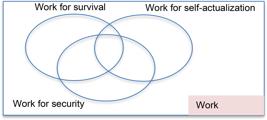
A second tension arises from the previous one and concerns the relationship between work as an end in itself and work as a means to something else. While both can coexist, this is not the case for most workers facing degrading working conditions. One way to illustrate this is to hypothesize that work functions as a means when its purpose comes from another area of life. For example, when work becomes a means of achieving family-related goals (or work for security in Figure 2). The less purpose (sense and meaning) a person experiences in a particular job, the less it serves as a source of meaning-making. Consequently, the individual may seek other sources of meaning-making, and at this point, family often comes to the fore. The situation of app-based delivery drivers highlights how this process worsens in today’s society. These workers usually come from the most unstable parts of the working class and see platform-based work as a chance to improve their financial situation. Many were not delivery professionals before the emergence of digital platforms and describe entering this activity primarily to earn an income (Wolf et al., 2025). While this represents an extreme case of the loss of purpose in work linked to the activity itself, it is also a context actively exploited by the platforms. As Coelho-Lima et al. (2023) point out, the main focus of these companies is on the promise of higher pay for delivery workers. Therefore, both the workers and the companies deny any inherent meaning in the activity itself. They both dismiss the sense and meaning of this work, viewing it explicitly as a means to an end.
When work is experienced as an end in itself, it tends to create conditions for stronger identification and engagement by the individual, which can initially lead to greater salience or centrality of this area of life. In this case, the purpose of work is perceived in its entirety as a source of personal fulfillment. Several factors may contribute to this situation. For instance, the nature of the activity performed and its social value. The world of the arts is an emblematic case, particularly within the so-called creative industries (Bendassolli & Borges-Andrade, 2011). In these contexts, creativity plays a central role, alongside more independent and diverse work arrangements. Not surprisingly, some authors have proposed that the creative industries represent a contemporary prototype of artisanal work and, therefore, function as a reservoir of possibilities to be explored by other economic sectors that are more technology-, standardization-, and control-intensive (Menger, 2009).
A third tension involves the purpose and meaning in work. Referring back to the distinction proposed by Leontiev (1978) in the previous section, we can identify three levels in the experience of concrete work: operations, actions, and activity. The issue – and thus the tension – is that these levels can become separated in real work conditions. They are not always felt as parts of a unified whole. As noted earlier, it is very possible under current labor conditions that the focus is on actions rather than on the broader activity. The meaning of a series of actions is embedded in those actions. For example, a grill cook in a fast-food chain knows the necessary actions to perform their tasks. These include specific goals like preparing the griddle, cooking the food, and cleaning the workspace afterward. In such a setting, the cook only needs to know how to carry out these actions efficiently. There’s no need for deliberate or deep reflection on the purpose of these actions within the overall activity of feeding others, or on the social division of labor as a historical and potentially changeable phenomenon.
To better illustrate this point, compare the grill cook’s work in the restaurant to another part of their life, such as preparing a meal for their family. In this case, their work is not defined by a set of specific, timed, and standardized actions but rather as a shared activity: feeding the family. The purpose here takes on a meaning entirely different from that of the previous situation. It is not surprising, therefore, that eating together around a table remains a symbol of sociability in many cultures, even as the spread of fast food disrupts these rituals of meaningful sharing within families.
Other economic sectors, such as the creative industries or knowledge-intensive fields, can expand our understanding of this argument. Consider, for example, the aeronautics industry. A person producing an airplane, even within a fragmented production process, may still have a sense of the broader purpose of their activity, encompassing both social purpose and personal fulfillment. This sector, among others, offers greater potential for experiencing work as a whole, i.e., as operation–action–activity, and, consequently, as purpose of and in work and of and in life. There is a stronger possibility of “communicating vessels” between the two. The same could apply to the car industry, which tended to structure workers’ sociability, families, communities, and even entire cities. In these cases, there is a sense of pride around the goods produced. Many families emerged within such industrial environments, with intermarriages and dense friendship networks forming around work. Life and work were closely interwoven, organically integrated into the social fabric of these industries.
However, technological changes have significantly altered these contexts, leading to some of the shifts already discussed regarding the “end of jobs.” More importantly, they have transformed the work–life relationship and its purpose. When a worker in such sectors realizes that their job may become obsolete or vanish entirely, it can deeply impact the very meaning of work at its most abstract and fundamental level. The individual may start questioning the meaning of work in modern society and, above all, its role in their personal life, especially if they cannot see themselves engaging in another meaningful activity. As a sign of this loss of purpose in both work and life, we see workers supporting far-right political movements that claim to restore a “lost past,” reestablishing the sense of harmony once provided by more holistic work arrangements in relation to all aspects of life.
If we move from intellectual or creative work to typically Fordist or Taylorist forms of labor, this tension becomes even more evident. Such cases abound in today’s world of work. Consider, for example, a worker in a meatpacking plant. Strictly speaking, this is an industry of death: part of the worker’s activity involves killing, even if that act is socially legitimized. The social justification of death, however, does not erase the “real work” (Clot, 1999) of killing.
Second, what is the result of the worker's efforts, the outcome through which they justify their purpose, and ultimately, their sense of meaning? There is no outcome except the packaging and distribution of parts of dead animals. The tension here is clear between the purpose in work and of work. On one side, the purpose of work is the goal or objective of the worker’s daily actions on the production line (beyond automated operations). A trained worker understands how and why a specific action must be performed. On the other side, when it comes to the purpose of this worker’s activity, or the examined purpose of work, the issue of death arises. And it is connected to the workers’ (and their families’) survival.
In the example above, the tension between the purpose of and purpose in work is clear. This conflict can cause cognitive and emotional dissonance for the worker. One way to deal with this dissonance is to reduce work to just a source of income, whether for immediate survival or to meet family goals (like raising a child, which then becomes the meaning of work). Although this may seem like an extreme case (the “death industry”), similar tensions are present in many other types of work, many of which will likely be automated in the future.
Returning to the example of app-based delivery drivers, we can see a similar dynamic of emptied purpose in both dimensions of work. The act of delivery, the mediation of a commercial transaction, no longer conveys meaning in either the purpose of or purpose in work. The instrumental value of money becomes central to both.
In conclusion, the tension arising from the mismatch between senses, meanings, and purpose cannot be resolved merely by transforming the purpose of work through the purpose in work. If this were possible—if the latter could compensate for the former—work-related suffering or illness would not exist. As other authors (e.g., Bendassolli, 2024) have shown, work-related depression can have profound implications for the tension between sense and meaning. At the same time, it is crucial to acknowledge the complexity of the process of work-related illness, since it is determined not only by the conditions under which work occurs but also by the subjective dynamics that mediate a person’s relationship with it.
The holistic model developed by Lips-Wiersma and Morris (2009) shows that human beings construct meaning at work through a complex value orientation expressed in two dimensions: one focused on the promotion of the self (development and expression of potential) or on serving others (serving others and maintaining a unity of identity with them); and another concerning the relationship between being and doing.
Finally, it is important to recognize the limited scope of theories such as job enrichment, proposed by Hackman and Oldham (1976). The goal here is to add meaning to work or to provide reasons and motives for people to make sense out of their work. Theories and actions aimed at this purpose help improve work and working conditions. It is crucial to emphasize discussions that address tensions and mismatches between the sense and meaning of work. These tensions originate from factors internal to the processes of meaning-making. Most importantly, they stem from the concrete, material conditions of work in an era of highly intensified capitalism.
Practical implications and reflections
What are the implications of our association between purpose and meaning-making? The first lies in developing theories that connect different fields of literature. On one hand, studies on sense and meaning, and on the other, those concerning the centrality of work. The second involves proposing concrete initiatives to address the tensions and alignments between the different levels of the purpose of work.
The implications of purpose as meaning
The first implication is literal: defining purpose as a meaning. As such, the characteristics discussed in the previous sections apply – meanings are socialized, shared, relatively stable, and integral to human culture, though shaped by historical and social variations. More specifically, both the purpose of life and the purpose of work can be understood as meanings. They are abstract and general constructs, conditioned by the web of social relations of a given era. For instance, the meaning and purpose of work have evolved: while in the medieval period work’s purpose involved tax payment, survival, and atonement for sins, under capitalism it has shifted toward income generation, self-expression, and self-affirmation, integrating senses that reaffirm individual values, preferences, and expectations.
Although meanings evolve within particular social relations across historical periods and communities, they are always elaborated upon a material reality. They constitute abstract representations of concrete processes. This applies to both life and work: the purposes of each are elaborated collectively by societies and communities based on the material organization of life and labor within them.
A second implication is that purpose, as meaning, is also internalized and individually reinterpreted based on how it resonates with the affective dimensions of one’s unique biography (that is, one’s senses). This process creates ongoing tensions and alignments, as people may develop interpretations of their purpose of, or in, their lives that differ from or even conflict with those emphasized in their social groups or cultures. Still, the socially shaped purpose of life inevitably becomes part of one’s inner world, whether it is denied, reinterpreted, or affirmed. Therefore, an individual’s active process of creating meaning, and by extension purpose in life and work, remains essential. This ongoing process enables the emergence of meanings opposed to dominant ones and allows for their creative transformation through personal interpretation and experience.
Third, purpose can be understood as a higher-order meaning. In this sense, it functions as an organizing principle that links, coordinates, or even propels the process of meaning-making itself. Purpose channels a person’s vital energy, cognition, and emotions toward a future direction. When internalized and imbued with affective and mnemonic elements, purpose becomes a purpose in life, capable of mobilizing the individual as a whole. To endow something with meaning is thus to create a focal point for affective and cognitive engagement and for the convergence of action toward a goal.
A fourth implication concerns the relative independence between the material processes that organize life, the development of the purpose of life, and the purpose in life. Although interconnected and mutually influencing, each part of this triad has unique characteristics. Therefore, in a specific social context, a purpose of life can emerge that contradicts the material processes of that society, or even a purpose in life that moves in the opposite direction. The socio-environmental crisis is a clear example: while climate change accelerates and threatens human survival, consumerism continues as a way to fulfill a purpose of and in life, ironically worsening the very crisis it aims to address. This tension creates ongoing pressures for rethinking and highlights the need for collective efforts toward transformation.
Initiatives and Possibilities
The first and most significant initiative in reflecting on the purpose of work is recognizing the limits that currently constrain the consolidation of purposes of and in work that enhance human existence. In other words, there is a persistent dissonance between the material foundations of work and its meaning-making process. Attempts to overcome this tension solely at the individual level inevitably lead to suffering and illness. Thus, the horizon toward which we must move involves developing purposes of and in work through collective action. This is not a secondary point, since the dilemmas of contemporary work are experienced collectively. Signs of such collective reactions have emerged at various moments (for instance, in the so-called “Great Resignation” during the COVID-19 pandemic), in movements advocating shorter working hours, and in initiatives calling for the abolition of exploitative labor practices.
However, creating purposes of and in work that support human existence is not limited to a future outlook. There are already initiatives that realize these possibilities by aiming to reconcile the triad of work process–purpose of work–purpose in work. One example is the solidarity economy (Gaiger, 2013; Souza & Augusto Jr., 2020), a movement that for centuries has connected the purpose of work to the purpose of life by focusing on human needs and potential. In Brazil, the Landless Workers’ Movement (Caetano & Wanderley, 2022) demonstrates the transformative power of a triad that goes beyond exploited labor. Another example is self-employment. Despite being constrained by neoliberal ideology and labor exploitation, many groups of precarious workers (e.g., platform workers) have started organizing work around principles of mutual care and heteromanagement (Coelho-Lima & Bendassolli, 2018). To some extent, these movements aim to create new purposes of work and of life.
We return, finally, to our starting point. The search for purpose represents humanity’s enduring attempt to confront the anguish and suffering that stem from the awareness of finitude. We constantly strive to endow life, work, and the other areas that shape human existence with purpose, even through its denial. As emphasized in the introduction, the relationship between meaning and purpose is complex and must be understood through their interdependence across personal and socially shared life paths.
Purpose, manifested through meanings and senses that guide human action in its many facets, exists in a continuous, dispersive movement, oscillating between critical estrangement from lived reality (the concrete world) and utopian projections of a future not always attainable (the projected world). Organizational and social systems, and particularly professionals in people management, must recognize the importance of enabling pathways for constructing purposes of and in work. Such pathways should allow workers to align with collective purposes grounded in values that dignify work, endowing it with sense and meaning. At the same time, it is essential to expand opportunities for workers to discover shared senses in their work, thereby strengthening collective practices that sustain purpose in life and in work.
References
- Arendt, H. (2018). The human condition Chicago: University of Chicago Press.
- Aristotle. (2009). Nicomachean Ethics (D. Ross, Trad.). Oxford: Oxford University Press.
- Bendassolli, P.F. (2024). Work and depression: a meaning-making perspective. Culture & Psychology, 30, 1-12. doi/10.1177/1354067X241226452
- Bendassolli, P.F. (2009). Recomposição da relação sujeito-trabalho nos modelos emergentes de carreira. RAE - Revista de Administração de Empresas, 49, 387-400. doi.org/10.1590/S0034-75902009000400003
- Bendassolli, P.F., & Borges-Andrade, J.E. (2011). Significado do trabalho nas indústrias criativas. RAE - Revista de Administração de Empresas, 51, 143-159. doi.org/10.1590/S0034-75902011000200003
-
Blanch, J.M. (2014). La juventud NINI, un agujero negro psicosocial. Revista Psicologia Organizações e Trabalho, 14 (4), 355-366. Recuperado em 25 de janeiro de 2024, de http://pepsic.bvsalud.org/scielo.php?script=sci_arttext&pid=S1984-66572014000400003&lng=pt&tlng=pt
» http://pepsic.bvsalud.org/scielo.php?script=sci_arttext&pid=S1984-66572014000400003&lng=pt&tlng=pt - Caetano, G.F.C., & Wanderley, S.E.P.V. (2022). Autogestão do trabalho num assentamento do MST. Farol-Revista de Estudos Organizacionais e Sociedade, 9 (24), 13-59. doi.org/10.25113/farol.v9i24.6181
- Clot, Y. (1999). La fonction psychologique du travail. Paris: PUF.
-
Coelho-Lima, F., & Bendassolli, P.F. (2018). A ideologia e o significado do trabalho para trabalhadores por conta própria. Estudos de Psicologia (Natal), 23 (3), 259-270. doi.org/10.22491/1678-4669.20180025
» https://doi.org/10.22491/1678-4669.20180025 - Coelho-Lima, F., Varela, V., & Bendassolli, P.F. (2021). Ideology, sense, and meaning: A theoretical-methodological approach. Culture & Psychology, 27 (1), 152-171. doi.org/10.1177/1354067X21993795
- Coelho-Lima, F., Keppler, I.L., Leocádio, L.A., Bezerra, I.P.L., Barbosa, S.S.A.C., França, L.M.P., & Paes, M.L. (2023). A ideologia do trabalho e o autogerenciamento subordinado nas empresas-plataforma de entrega de mercadoria. Revista Brasileira de Sociologia, 11 (29), 151-176. doi.org/10.20336/rbs.959
- Damon, W., Menon, J., & Bronk, K.C. (2003). The development of purpose during adolescence. Applied Developmental Science, 7, 119-128. doi.org/10.1207/S1532480XADS0703_2
- Frankl, V.E. (1963). Man's search for meaning. New York: Washington Square Press.
- Frigotto, G. (2024). Quatro décadas do MST: reforma agrária e educação. Revista Trabalho Necessário, 22 (47), 01-04. doi.org/10.22409/tn.v22i47.61701
- Gaiger, L.I. (2013). A economia solidária e a revitalização do paradigma cooperativo. Revista Brasileira de Ciências Sociais, 28, 211-228. doi.org/10.1590/S0102-69092013000200013
-
Hackman, J.R., & Oldham, G.R. (1976). Motivation through the design of work: test of a theory. Organizational Behavior and Human Performance, 16, 250-279. doi.org/10.1016/0030-5073(76)90016-7
» https://doi.org/10.1016/0030-5073(76)90016-7 - Hill, P.L., Burrow, A.L., O'Dell, A.C., & Thornton, M.A. (2010). Classifying adolescents' conceptions of purpose in life. The Journal of Positive Psychology, 5 (6), 466-473, doi.org/10.1080/17439760.2010.534488
- Holmes, T.H., & Rahe, R.H. (1967). The Social Readjustment Rating Scale. Journal of Psychosomatic Research, 11 (2), 213-218. doi.org/10.1016/0022-3999(67)90010-4
-
Kashdan, T.B., & McKnight, P.E. (2009). Origins of purpose in life: Refining our understanding of a life well lived. Psychological Topics, 18 (2), 303-316. Retrieved from http://hrcak.srce.hr/48215
» http://hrcak.srce.hr/48215 -
Kosine, N.R., Steger, M.F., & Duncan, S. (2008). Purposecentered career development: A strengths-based approach to finding meaning and purpose in careers. Professional School Counseling, 12, 133-136. https://doi.org/10.5330/PSC.n.2010-12.133
» https://doi.org/10.5330/PSC.n.2010-12.133 - Leontiev, A.N. (1978). Activity, consciousness, and personality. New Jersey: Prentice-Hall.
-
Lips-Wiersma, M., & Morris, L. (2009). Discriminating Between "Meaningful Work" and the "Management of Meaning." Journal of Business Ethics, 88 (3), 491-511. doi:10.1007/s10551-009-0118-9
» https://doi.org/10.1007/s10551-009-0118-9 - Marx, K. (2015). Manuscritos econômico-filosóficos São Paulo: Boitempo Editorial.
-
McKnight, P.E., & Kashdan, T.B. (2009). Purpose in life as a system that creates and sustains health and well-being: An integrative, testable theory. Review of General Psychology, 13, 242-251. https://doi.org/10.1037/a0017152
» https://doi.org/10.1037/a0017152 - Menger, P.M. (2009). Le travail createur. Paris: Gallimard.
-
Metz, T. (2021) The Meaning of Life. The Stanford Encyclopedia of Philosophy (Winter 2021 Edition), Edward N. Zalta (ed.), Retrieved form https://plato.stanford.edu/archives/win2021/entries/life-meaning
» https://plato.stanford.edu/archives/win2021/entries/life-meaning - Pino, A. (2005). As marcas do humano: às origens da constituição cultural da criança na perspectiva de Lev S. Vigotski. São Paulo: Cortez.
- Rifkin, J. (1995). The end of work New York: Putnam Publishing Group.
-
Ryff, C.D. (1989). Beyond Ponce de Leon and life satisfaction: New directions in quest of successful ageing. International Journal of Behavioral Development, 12, 35-55. https://doi.org/10.1177/016502548901200102
» https://doi.org/10.1177/016502548901200102 - Souza, A.R., & Júnior, F.A. (2020). A economia solidária como resposta à crise pandêmica e fator de outro tipo de desenvolvimento. P2P e Inovação, 7, 8-25.
- Vygotsky, L.S. (1997). The collected works of L.S. Vygotsky (Vol. 4, R.W. Rieber, Ed., M.J. Hall, Trans.). New York: Plenum Press.
-
Zittoun, T., & Gillespie, A. (2015). Internalization: How culture becomes mind. Culture & Psychology, 21 (4), 477-491. https://doi.org/10.1177/1354067X15615809
» https://doi.org/10.1177/1354067X15615809 - Weber, M. (1967). A ética protestante e o espírito do capitalismo. São Paulo: Pioneira.
-
Wolf, A.B., Coelho-Lima, F., Keppler, I.L.D.S., Ferreira, M.D.S., Dall'Asta, C., Florez, M.E.R., & Figueroa, M. (2025). 'Be Your Own Boss?'Explaining Variation in Worker Response to the Gig Economy's Ideology in the Global North and South. British Journal of Industrial Relations, 63, 01-15. https://doi.org/10.1111/bjir.12887
» https://doi.org/10.1111/bjir.12887
-
Inclusive language:
The authors use inclusive language that acknowledges diversity, respects all people, recognizes differences, and promotes equal opportunities.
-
Plagiarism check:
O&S submits all documents approved for publication to a plagiarism check using a specific tool.
-
Data availability:
O&S encourages data sharing; however, out of respect for ethical principles, it does not require the disclosure of any information that could identify research participants, thereby fully protecting their privacy. The practice of open data aims to ensure transparency of research findings without compromising participant anonymity.
-
Funding:
The authors would like to thank the Brazilian National Council for Scientific and Technological Development (CNPq) for its financial support through a research productivity grant recognizing the academic contributions of the first two authors of this article.
-
Associate Editor:
Claudia Simone Antonello
O&S encourages data sharing; however, out of respect for ethical principles, it does not require the disclosure of any information that could identify research participants, thereby fully protecting their privacy. The practice of open data aims to ensure transparency of research findings without compromising participant anonymity.

 Source: Elaborated by the authors
 Source: Elaborated by the authors.