
 Towards a new analytical-conceptual framework for the field of Social Technology
Abstract
This article presents a theoretical framework for analyzing experiences in the field of Social Technology (ST). For that purpose, we used elements identified through a bibliographic review, reflections developed in academic exchange spaces on ST, and the experiences gained from implementing technological extension projects. We begin the article with an introduction highlighting the relevance of the topic. Next, demonstrating that the concept of ST is still under construction and that there is a dispute concerning its definition, we present a bibliographic review, quoting different authors and providing a synthesis of articles that sought to characterize the field, based on a review of the SciELO database. In the following section, we explain the methodological foundations that guided us in developing this article. We then present the core element of this paper: proposing nine parameters for analyzing experiences that aim to align with the principles of the ST field, clarifying the reasons for this proposal and its intended approach. We conclude the article with our final considerations, emphasizing the importance of building a qualified debate on the topic in our current times.
social technology; technological extension; experience analysis; public policies; participatory methodology
Resumo
Este artigo apresenta um arcabouço teórico para análise de experiências no campo da Tecnologia Social (TS). Para tal, utilizaram-se elementos identificados em uma revisão bibliográfica, reflexões construídas a partir de espaços acadêmicos de intercâmbio no campo da TS e as experiências adquiridas na realização de projetos de extensão tecnológica. Iniciamos o artigo com uma introdução que busca destacar a relevância do tema. Em seguida, explicitando como o conceito de TS está em construção e a disputa que há em torno de sua definição, apresentamos uma revisão bibliográfica citando diferentes autores e trazendo uma síntese de artigos que buscaram caracterizar o campo, em um recorte bibliográfico feito a partir da base SciELO. Na seção seguinte, explicamos as bases metodológicas que nos guiaram no desenvolvimento deste artigo. Apresentamos então o elemento central deste artigo: a proposição de nove parâmetros para a análise de experiências que buscam alinhar-se aos princípios do campo da TS, explicitando os motivos dessa proposta e a abordagem que se pretende com ela. Finalizamos o artigo com as considerações finais, buscando denotar a importância de se construir um debate qualificado sobre isso nos dias atuais.
tecnologia social; extensão tecnológica; análise de experiências; políticas públicas; metodologia participativa
Introduction
The term Social Technology (ST), or Social Technologies in the plural, has been used in various ways to designate a process of producing a technology, technique, tool, or methodology with specific and distinct characteristics from those that identify the development process of technologies targeted at the capitalist environment, which can also be referred to as Conventional Technology (CT) (Dagnino, 2014; Novaes & Dias, 2010; Souza & Nunes, 2022).
The development of capitalist technologies relies on a robust institutional framework, mobilizing not just private capitalist companies—generally considered the most directly interested parties—but also the state (through funding, tax exemptions, supportive legislation, etc.) and educational and research institutions, particularly public universities. Conventional Technology typically features: orientation toward the economic benefit of a single individual or small group (profit); inclusion of workers as a production factor that must adapt to the demands of the technical system; separation of planning, execution, and control functions in an organization; and a structure that does not encourage workers to understand the entire process (Dagnino, 2014; Feenberg, 2018; Novaes & Dias, 2010; Souza & Nunes, 2022).
Additionally, in CT, the development process is hierarchical, generally excluding workers from decision-making and disregarding the empirical and popular knowledge present in day-to-day work. Social Technology, in an initial perspective, positions itself as an alternative to Conventional Technology and, therefore, its main features invert those of CT (Addor, 2020; Dagnino, 2014; Freitas & Segatto, 2014; Souza & Nunes, 2022).
Hence, from a dichotomous viewpoint, technology could be classified as either Conventional or Social. However, this classification falls far short of encompassing the varied possibilities of understanding technology, whether Social or Conventional. It is also insufficient to label all technologies that are not considered conventional as social, or vice versa. Therefore, a path must be followed in consolidating the concept and field of Social Technology; along that path, one must recognize that conceptual construction is not purely theoretical-conceptual or etymological exercise, but rather a political dispute for recognition and appreciation (including funding) of these experiences. The prospect of renewed public policies for this field, spurred by the federal government’s change in 2023, further highlights the need for a deeper reflection not only on what is meant by ST but, above all, on what one hopes to achieve with these projects.
The literature suggests that the term Social Technology may be seen as a modification/upgrade — extending beyond mere semantics to new features — of the concept of Appropriate Technology (AT), whose principal references include technologies developed in Indian villages in the late 19th century and disseminated by Gandhi in the 1920s (Dagnino, 2004; Garcia, 1987; Rodrigues & Barbieri, 2008). The concept gained traction in the 1960s and 1970s, a period when numerous works on AT were written, most notably Small is Beautiful (1973) by Ernst Friedrich Schumacher (Garcia, 1987).
Initially, Appropriate Technology and Social Technology share several conceptualizations that emphasize addressing social problems. However, AT has often been questioned regarding its ability to alter the status quo in poor countries, given that it was developed, almost always, by large corporations that retain ownership and control over the technology’s modus operandi (Rodrigues & Barbieri, 2008). Unlike ST, AT does not intrinsically incorporate a perspective of democratizing the technological process or providing transformative educational experiences for the workers involved.
In recent years, the term ST has gained more visibility and prominence. On the one hand, this is a great opportunity to publicize the debate about the non-neutrality of technology and the need to consider a technological paradigm other than the hegemonic model. On the other hand, a certain superficiality in the use of the term has become apparent, along with a lack of transformative commitment in many experiences and institutions that label themselves as proponents of ST. The definitions of ST found in the literature are often too general and disconnected from reality, making it difficult to examine a technological process based on concrete parameters that would identify its connection to the field. Furthermore, the renewed attention to public policies in this realm, especially after the creation of the Department of Social Technology, Solidarity Economy, and Assistive Technology within the Ministry of Science, Technology, and Innovation (MCTI), highlights the challenge of identifying practices within this field, including the need to certify these experiences.
Given this context, this paper aims to contribute to the construction of a clear and concrete theoretical framework that enables an analysis of transformative experiences and the extent to which they manage to develop processes grounded in the principles proposed by ST. Different from other approaches, we do not intend to create a quantitative tool to define whether an experience or technology “is Social Technology or is not Social Technology,” because we believe such binary classification and the fetish of labeling undermine the concept by attempting to fit multiple cases within the ST field, rather than fostering a generative, methodological, and transformative reflection on these experiences.
More specifically, this paper proposes nine guidelines for analyzing a technological development process that may also function as a tool for enhancing these experiences. Practically, the framework we present can guide those who are implementing ST-based initiatives and seeking an assessment mechanism to continuously refine them, as well as funding agencies that are interested in promoting and characterizing ST-related endeavors.
This article is organized into six sections, beginning with this introduction. The second section explores the concept of Social Technology based on a theoretical review. The third section outlines the methodological design and data sources we used to build our proposed framework. In the fourth section, we discuss nine guidelines for analyzing Social Technology experiences. The fifth section provides our concluding remarks, followed by the references.
Social technology: a concept under construction
As noted above, the concept of Social Technology is far from fully established. Over the past few decades, numerous studies have addressed this topic from various perspectives. Searching the term “Tecnologia Social” [Social Technology in Portuguese] on the SciELO platform, without date restrictions but limited to article titles, produced 136 results, with 92 of them appearing between 2013 and 2023 (search conducted on July 5, 2023). An equivalent search in the Emerald platform yielded seven results, while Science Direct returned 17 results. On Google Scholar, searching for the term (without citations) between 2012 and 2023 yielded more than 14,000 items. Considering the relevance of the SciELO, Science Direct, and Emerald platforms, we believe that analyzing the works found there allows us to identify the main issues surrounding the ST concept.
Except for the Google Scholar results, we compiled and reviewed the abstracts of all papers from the other platforms in an electronic spreadsheet. We selected those whose abstracts revealed some conceptual debate on ST. Consequently, an article such as Souza and Pozzebon (2020) — which explicitly discusses the ST concept — was included, while a paper focusing on unequal access to technology in Brazilian favelas (Nemer & Hakken, 2016) was excluded. Since our perspective on the conceptual development of ST is national, no searches were conducted in foreign languages.
In addition to the papers sourced from these platforms, this work employs a concept developed by Professor Renato Dagnino, one of Brazil’s leading authorities on the topic. One of his most recent publications in ST, Tecnologia Social: contribuições conceituais e metodológicas, was published in 2014. Dagnino emphasizes that ST presupposes a participatory approach in its development and that the end product should be collectively owned:
[ST] would result from the actions of a group of producers on a work process which, due to a socioeconomic context (that engenders collective ownership of the means of production) and a social agreement (which legitimizes associativism), in a productive environment shaped by (self-managed) control and (voluntary and participatory) cooperation, allows for a modification in the product that can be appropriated according to the group’s decision (Dagnino, 2014, p. 144).
Similarly, Ana Clara Souza and Marlei Pozzebon (2020) claim that ST can be regarded as a process that takes into account the context in which it is developed. According to the authors, social groups engage in ST development through five interdependent key mechanisms: valuing tacit knowledge; collectively constructing new perspectives; fostering a sense of belonging; reclaiming social roles; and transforming the perception of local reality. Clearly, these mechanisms center on a local perspective that emphasizes territoriality. One may say that these mechanisms support the practices of social groups, which are shaped by and aimed at developing tools and methods in a context that enables a sociotechnical reconfiguration of technology. The authors propose that ST can be viewed as:
[…] the result of a political process of sociotechnical reconfiguration, through which social practices mobilize methods and tools designed to promote social transformations that help solve problems and address exclusion and poverty (Souza & Pozzebon, 2020, p. 234).
Other authors stress the formative and democratic aspect that the ST field implies. Felipe Addor (2020) argues that the definition of ST does not lie in the technology produced but rather in how the analysis of problems and construction of technological solutions are carried out, underscoring that this process democratizes technological development and offers a space for workers’ technical and political education; the author also highlights the Freirean perspective underlying ST experiences (Addor & Ravelo, 2020). In two subsequent articles co-authored by Addor (Addor, Eid, & Sansolo, 2021; Addor & Santos, 2022), this conceptualization is expanded:
The central aim of experiences in the field of social technology is to democratize the process of technological development, so that the results emerge from a collective, participatory, cooperative process, enabling intense exchange of diverse knowledge, properly aligned with the sociocultural and environmental values of the community/territory, and ensuring collective ownership among all participants to promote autonomy and emancipation from external actors for developing and maintaining technologies that affect their reality (Addor & Santos, 2022, p. 331).
All of these conceptualizations incorporate issues related to sociotechnical adaptation or reconfiguration. This is further reinforced in works like Valadão, Andrade, and Cordeiro (2014) and Santos and Rocha (2021), which address Sociotechnical Adaptation. When conceptualizing ST, the importance of sociotechnical adaptation (STA) should be noted, since it underscores the political component of ST construction. It seeks to distance itself from merely technical and economic views of technology, adopting a broader approach that accounts for the various ways science, nature, and society intersect and emphasizes technology’s non-neutrality (Delizoicov & Auler, 2011; Oliveira, 2003; Santos & Auler, 2019). In this sense, STA occurs when there is a shift in or the use of scientific and technological knowledge—whether explicit (embedded in equipment, supplies, or production management) or tacit (e.g., popular knowledge) (Dagnino, 2010; Novaes & Dias, 2010; Valadão et al., 2014).
Beyond academic work, three organizations stand out in promoting ST’s development and conceptualization. First, the Social Technology Network (RTS), which was crucial to the field until it was disbanded in 2011 and whose role Lemos and Dechandt (2019) deeply examined. According to RTS, ST “includes products, techniques, and/or reproducible methodologies developed in interaction with the community, representing effective solutions for social transformation (RTS, 2009, p. 8).
Second is the Banco do Brasil Foundation (FBB, n.d.), which defines Social Technology in the plural: “Social technologies are products, techniques, or methodologies that can be reapplied, are developed in interaction with the community, and represent effective social transformation solutions”.
Lastly, the Social Technology Institute (ITS) defines ST as a “[…] set of transformative techniques and methodologies, developed and/or applied in interaction with the population and appropriated by it, representing solutions for social inclusion and better living conditions” (ITS, 2004, p. 25). The ITS also presents four principles that underpin the ST concept: (1) learning and participation are reciprocal processes, one implying the existence of the other; (2) social transformation must be seen from a systemic perspective in which the various elements of reality manifest themselves in a combined manner; (3) social transformation takes place when local contexts and identities are respected; and (4) individuals are capable of generating knowledge within their cultural environment.
Although the concepts proposed by FBB, RTS, and ITS emphasize social interaction as a key element of ST, a comparison of these institutional definitions with academic work such as Dagnino (2014), Souza and Pozzebon (2020), and Addor and Santos (2022) reveals that the latter strive to formulate a more robust concept that goes beyond technical, scientific, and economic dimensions. In this broader definition, ST is a means of challenging the process of control and power exercised by Conventional Technology, thereby proposing a new technological development paradigm. It is important to note that both the ITS and, occasionally, the FBB tend to measure ST by using the term in the plural form, usually accompanied by a list of technological artifacts. This approach does not seem to offer a political, non-deterministic lens on technology.
Some authors call attention to the risk of fetishizing technology and adopting a perspective that focuses on classifying artifacts, assigning them as either social or conventional. state:
Identifying a solution, a machine, a tool, a system, as ST is not linked to the product itself nor to the problem that was solved. It is not the fact that a technology has solved a social problem that classifies it as ST, nor simply because a technology is low-cost or originates from popular knowledge that it aligns with this field. What characterizes the field of Social Technology is the process, not the product (Addor and Santos, 2022, p. 331).
Dagnino clarifies his critique of using the term “Social Technologies” (plural), explaining that the concept of ST “denotes a broad range of elements shaped by a specific rationale that differs from that which governs the development of capitalist technology” (2014, p. 210). He continues:
Using the term in the plural creates the mistaken impression that we are referring to technologies with certain attributes […] ready to be deployed, replicated, or reapplied by social actors who presumably want to use them. The use of the singular helps to avoid the impertinent, unanswerable question—‘Is this technology a social technology?’—which I often hear. This question aims to distinguish, after the fact, social from conventional technologies, and perhaps reward or store in a database for future use or reapplication those that meet certain criteria. It is as if the features of an already-produced sociotechnical artifact were the key to identifying whether a given technology is ST. However, the important issue for labeling a particular technology as ST is not the characteristics of an already-produced artifact (Dagnino, 2014, p. 210).
Thus, these authors critique the trend of treating technology as an object (“artefatização”) and quantifying the ST concept to build a catalog or database. They emphasize a process-based perspective, underscoring that every technological development in the ST field is unique and cannot be replicated exactly, though it can inspire valuable lessons whose systematization might inform other transformative experiences.
Being a concept in development and dispute, ST appears with increasing frequency in academic publications. Table 1 below presents a chronology of articles that examine the ST concept and its features, drawn from the SciELO database between 2013 and 2023 (search conducted on November 18, 2023) using “Tecnologia Social” and “Social Technology” as search terms in article titles. SciELO was chosen as a reference because it returned more articles in Portuguese than Science Direct or Web of Science. That search retrieved 30 articles, which were read and analyzed; only those texts that dedicated a specific portion to conceptualizing ST were selected.
In addition to these SciELO articles, many other works explore ST characterization and propose frameworks for its analysis. Garcia, Carvalho, and Gutierrez (2022) emphasize the need to evaluate ST in three distinct realms: Civil Society Organizations, Academia, and Public Policy. Pintucci and Fraga (2021) and Silva and Moesch (2022) also highlight the significance of viewing ST as an instrument of universities.
Thus, given various academic references for constructing and analyzing ST, an essential question arises—one that motivates this paper: How can one analyze a technology development experience to measure its adherence to the principles advanced by Social Technology, and for what purpose should we conduct this analysis?
For instance, FBB created a “bank of social technologies” (using the plural) to certify artifacts and processes eligible for funding. ITS has devised parameters for analyzing ST as well as a Social Technology Analysis System (SATECS). The ITS parameters include the following: (1) the raison d’être of ST, which must address social needs; (2) decision-making, which must be democratic with community participation; (3) how ST is organized and planned; (4) knowledge creation, which must emerge from practice; (5) economic, social, and environmental sustainability; and (6) the potential for ST to generate new experiences and thus expand in scale (Garcia et al., 2022).
SATECS is a web-based system designed to define ST experiences and produce indicators that inform the organization and success of public policies related to ST. Although the need to establish a process or system for identifying and supporting ST is evident, SATECS seems predominantly concerned with quantifying ITS’s areas of interest rather than understanding whether ST fosters real social transformation.
Methodological design
This work is grounded in a constructivist approach. In social constructivism, people seek to understand the world they live in, and researchers approach it by exploring the complexity of perspectives on the research problem (Creswell & Creswell, 2021). Accordingly, this work outlines a conceptual proposal for ST, incorporating features that appear in the praxis of technology creation.
It can also be said that this study offers a critical perspective on ST, endeavoring to unpack the power and ideological relations embedded in the social practices of ST creation (Rosa & Strieder, 2019).
To achieve our goal of contributing to a theoretical framework for ST, we relied not only on the academic literature described earlier but, crucially, on our experiences in developing technological extension projects at two Brazilian public universities.
At both institutions, the extension projects followed an action-research methodology (Thiollent, 2022) grounded in popular education (Freire, 2010) and in the principles of solidarity economy (Azambuja, 2011) — notably self-management, democracy, and respect for nature. Furthermore, from a philosophical standpoint, these projects employed the Critical Theory of Technology (Dagnino, 2009; Freitas & Segatto, 2014; Castelfranchi & Fernandes, 2015), which underscores the need for technology to serve as a medium for more democratic social relations.
In summary, Figure 1 illustrates the reference sources we used for this paper. In other words, a diagram showing the sources of this work, which were: Theoretical framework, Practical experiences, Critical Theory of Technology, Popular Education, Solidarity Economy/Self-management, Technological extension → supporting the ST guidelines.
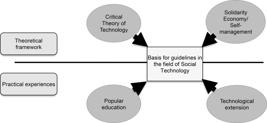
These technological extension projects, conducted in a dialogical approach (Freire, 2010), were carried out with fishing, Quilombola, and riverside communities, encampments and settlements of agrarian reform, sewing cooperatives, associations of recyclable waste pickers, artisans, favelas, peripheral communities, and more. Over about 20 years of extension experiences, we developed and reflected on collective technology-building processes, as well as tested other elements identified in the literature review, such as sociotechnical adaptation, reducing inequalities and oppression, constructing democratic decision-making environments, finding alternative relationships with nature, and consistently designing technical and political educational processes involving both workers and the broader community.
We drew on these references to propose an analytical framework for the ST field, which is detailed in the next section.
Proposal of an analytical framework for examining experiences in the social technology field
The essence of Social Technology focuses on the process in which innovation and technology are generated to support a work or organizational process. Rather than judging the resultant artifact or its impact, we must emphasize two fundamental elements: democratizing technology development so that diverse existing forms of knowledge are valued and so that the workers or technology users can participate meaningfully throughout; and employing a popular education perspective not only to promote technical and political training but also to strengthen collective organization and the capability of those involved to transform their own reality. In many ST-like experiences, the artifact itself is simply a pedagogical tool to reinforce these two elements. Of course, this “pedagogical tool” must be useful and applicable to the local context, but it can still serve as a testing ground for fostering broader transformative processes.
In this paper, we do not attempt to classify or categorize experiences as either belonging or not belonging to ST, nor to define a single pattern that everyone must follow. Instead, our analytical tool aims to provide a methodological and political reference framework that can guide practices toward deeper transformations for groups, enterprises, communities, or territories. It can serve, for example, as a self-assessment tool to help individuals and groups reflect upon the methodological steps and guiding principles of technological development, identifying where improvements could be made.
Like any representation, our proposal simplifies reality, which does not break down neatly according to the parameters we propose. Moreover, a particular experience may not lend itself to clear analysis under some of these parameters, while others may be easier to evaluate. This does not invalidate the analysis, particularly as our objective is not to see whether a process or experience meets all parameters. Rather, our goal is to use these guidelines as a reflective tool to pinpoint how methods and practices might be enhanced to pursue more transformative outcomes — materially and subjectively — both in the short and long term, including both training and organizing those involved.
It is worth mentioning the article by Professor Genauto França Filho (2018), which inspired the initial reflections that shaped this proposal (see Addor, 2020), especially the notion of adopting observable parameters and methods in technological development experiences rather than relying on very complex and abstract ST definitions far removed from everyday technological practice.
Grounded in this approach, we propose nine parameters to serve as an analytical lens for examining any technology development process under review.
1. Purpose
It is crucial to determine the driving force behind the technological process. Of course, there will usually be multiple aims and interests at play. For instance, in a conventional capitalist setting, the process might be driven primarily by a business owner’s profit motive, finding ways to lower production costs or add value to maximize returns.
Sometimes, that development can address social or environmental concerns — for instance, improving internet access in marginalized areas or reducing air pollution. Concepts such as Social Innovation, Social Entrepreneurship, or Social Business may appear here. Nevertheless, the central driver of these experiences remains financial return on investment. If that return becomes insufficient, the endeavor is quickly abandoned in favor of a more lucrative one.
Conversely, a technology development process deeply aligned with Social Technology may stem from a collective or community issue that affects many people. This can certainly be economic, such as increasing the income of farmers or optimizing waste management for a recycling cooperative. Yet behind that economic objective lies a drive for collective well-being, relying on cooperation — rather than an individual pursuit of financial gain.
Indeed, many innovations or technological processes may start with one purpose but shift over time as new interests arise. Therefore, it is vital to consider the origin of the process and especially to critically analyze its current guiding force.
2. Generation dynamics
ST emphasizes that those who live the reality one intends to change should fully understand the political and technical aspects of technological development in their enterprise or territory. They should take the lead in shaping the direction of the work. Therefore, using a Freirean perspective (Addor & Ravelo, 2020), an educational environment must evolve that fosters workers’ autonomy and control over technological trajectories. In that sense, the technology’s entire development should involve those workers/users from the outset.
In capitalist logic, an external team of specialists typically diagnoses a problem, proposes a solution, and then implements it, regardless of the workers’ wishes. Over centuries, from the late 18th-century Industrial Revolution through Taylorism, Fordism, and modern remote work trends, this has characterized conventional capitalist management.
Under ST, workers must be active participants in technology design from day one. Interventions by external actors (public administrators, NGOs, universities) are welcome but must foster local ownership, ensuring everyone understands the technology well enough to manage it independently after implementation.
3. Work organization method
Capitalist production is predicated on individualism. Its classical theoretical framework maintains that each economic actor’s quest for individual gain maximizes overall gains — “greed is good.” This extends into conventional technology development: each actor seeks private advantage in a zero-sum struggle, enforcing patents and protecting knowledge from competitors.
In ST, by contrast, technology development and ownership are collective endeavors, whether among members of a worker cooperative, a community, or both, supporting the entire group’s well-being. Sometimes, individuals may ultimately use the tool or technology personally, but as an outcome of collective learning that shares knowledge. Rather than seeing outsiders as competitors, ST fosters a spirit of sharing insights with other communities or territories. Consequently, ST resonates with Solidarity Economy, favoring democracy, solidarity, and respect, rather than capitalism’s hierarchical, centralized, and exploitative systems.
4. Relationship with nature
Another dimension of ST criticism is the process’s relationship with nature. The dominant technological paradigm views nature as a factor of production, assessed for its profit potential. This has led to countless environmental crimes and disasters—from direct pollution of oceans by oil companies or the collapse of mining waste dams, to indirect global warming and disease outbreaks (like COVID-19). The most marginalized communities suffer the most from these impacts, despite having the least participation in the decision-making that causes them, illustrating the concept of environmental injustice (Acselrad, 2006).
ST advocates a development process that understands, respects, and values nature from the start — not merely applying mitigations (like “sustainable development” or “green economy” discourse) but integrating nature within the fundamental design and decision-making (Marques, 2011).
5. Mode of sociotechnical adaptation
In capitalist technology development, typically driven by external experts, there is often a “universal solution” that local workers must adopt—even if it conflicts with their practices or culture. ST takes the opposite view: technology must be rooted in the local reality and collectively defined. While new technology may require the adoption of different processes or customs, that should follow an informed decision by local actors, so that the innovation emerges from local experience and culture.
Preexisting solutions from other contexts can be beneficial as long as a sociotechnical adaptation process (Dagnino, 2014) is employed to critically evaluate and adapt them to align with local values and interests. This approach is known as “reapplication,” contrasting with strict replication.
6. Relationship with diversity
The non-neutrality of science and technology means social inequalities are often reproduced by these technologies. Numerous innovations reinforce biases and oppressions, such as older elevator panels designed with buttons too high for wheelchair users, computer cameras unable to detect Black faces, or car seat belts that fit poorly on women’s bodies. These reflect the predominantly White, male composition of technology-development teams.
Conversely, ST must incorporate the struggle against racism, sexism, LGBT-phobia, and other oppressions, ideally including marginalized groups as co-creators. For instance, in rural areas with strong patriarchal attitudes, it is essential to adapt machines so that women can operate them effectively, thereby boosting their independence and income.
Moreover, ST must challenge capitalism’s dualism between “productive” and “reproductive” work, recognizing and valuing all labor needed to sustain life—largely done by women without recognition or pay (Vasconcellos, Dias, & Fraga, 2017; Vasconcellos & Fraga, 2019). Even if these concerns appear tangential to the technological solution itself, a Freirean educational process should place them on the agenda to ensure technology choices help dismantle, rather than bolster, systemic inequalities.
7. Form of access
In capitalist development, access to technology is generally exclusive, available only to those who can pay. Even if solving a vital social problem, the technology is sold at a profit, pricing out poorer communities.
ST, on the other hand, seeks to expand access to the innovation it generates. Sometimes, this implies designing cheaper solutions (Dagnino, 2014). However, low-cost technology is not mandatory if the solution meets the needs of, say, a recycling cooperative or an agrarian reform settlement—solutions that can be complex or costly. Even so, the design must also include a political articulation process to ensure that cost does not become a barrier to access, either through public financing or community mobilization.
An illustrative example is the “One Million Cisterns Program” (P1MC) in the Brazilian semiarid region. Although a cistern is relatively low-cost, it is still unaffordable for many families, so social organizations—including the Brazilian Semi-Arid Articulation (ASA)—organized to secure government funding, enabling large-scale adoption.
8. Dominant perspective on public policy
ST questions mainstream policy views that treat the State as the sole policy maker and society as mere beneficiary (Dagnino, Olvera & Panfichi, 2006). In the capitalist model, the State finances or assists private companies (through building roads, offering tax breaks, cheap loans, relaxed environmental regulations, etc.). The entrepreneurs, in turn, lobby the government to secure advantageous legal frameworks, without involving local communities or workers.
For an ST initiative to scale up and benefit broader groups, it must consider how to establish an institutional arrangement—State and civil society—that fosters public policies consistent with ST. That can be challenging because public policy tends to demand large-scale, quantitative results, whereas ST calls for a time-consuming participatory approach (Costa & Dias, 2013).
Therefore, reconceiving “public policy” is crucial—rejecting a top-down, state-centered framework in favor of one where multiple social actors co-create and implement public initiatives (Addor, 2016). Once again, the P1MC example shows how grassroots-driven action eventually persuaded the government to fund more than a million cisterns, benefiting millions.
9. Continuity perspective
Lastly, we must consider how to ensure the ongoing use, maintenance, and evolution of a technology once its initial development ends. Rather than sustaining dependency on outside actors or companies, ST fosters local autonomy. Ideally, participants will have sufficient technical ability to handle maintenance, repairs, and improvements themselves.
Some technologies do require specialized knowledge—e.g., coding a virtual platform for agroecological product sales or advanced electrical engineering for solar panel systems. While it may be difficult for workers to acquire the same depth of expertise as an engineer or programmer, training sessions can still enhance local capacity. Consequently, ST always seeks to maximize local ownership and self-reliance, even if complete independence from specialists is occasionally unachievable.
Table 2 contrasts these nine parameters from the perspective of Social Technology vs. Conventional/Capitalist Technology.
Again, rather than encouraging a binary classification of “is” or “is not” ST, we propose these parameters as a framework for analyzing how a given experience or process aligns with ST’s principles. Nor do we recommend assigning quantitative scores to each parameter. Instead, we suggest evaluating the extent to which each of the nine parameters was effectively developed, in partnership with the local stakeholders who participated in the project, highlighting strengths and areas for improvement.
Based on these nine parameters, we can propose a second framework listing guiding directives for those seeking a transformative ST approach (see Table 3).
This table can facilitate a productive conversation among those engaged in technology development seeking to embrace ST’s guiding principles. By critically examining each parameter, stakeholders can gain insight into their methods and identify where improvements could bring about deeper social transformation.
Conclusion
This article presented a proposed theoretical framework for analyzing experiences in the Social Technology field. The framework was built on elements identified in our literature review as well as our practice in designing technology extension projects using dialogical approaches in various communities.
Against the background in which ST is conceptualized, we introduced nine parameters that can help those involved in experiences reflecting the ST principles review and assess their methods. These nine parameters are: Purpose, Generation Dynamics, Work Organization Method, Relationship with Nature, Mode of Sociotechnical Adaptation, Relationship with Diversity, Form of Access, View of Public Policy, and Continuity Perspective. Each parameter indicates differences between a process of technology development rooted in ST principles and one grounded in a conventional, capitalist approach.
This work is an important but not a final step. Certainly, it can be enriched by being put into practice, by interfacing with other proposals, or by deepening the analysis for a particular sector or territory. The ST field still requires considerable discussion and construction. Nonetheless, the guidelines set forth here can be useful for assessing ST experiences and, for instance, designing public policy tools like calls for proposals and indicators. Universities, through well-structured and dialogical extension programs, can also play a crucial role in implementing and refining these guidelines.
Future research might include analyzing existing ST initiatives using this framework or contrasting it with other methodological tools. Continuing to conceptualize ST and building instruments that help us reflect on our practices is not an idle academic pursuit. Such endeavors are essential for ensuring that, as public policies for ST expand, we maintain clarity about the field’s transformative vision, preventing it from being used in a superficial or distorted manner.
Acknowledgements
The authors thank the Brazilian Association for Teaching, Research, and Extension in Social Technology - ABEPETS.
References
- Acselrad, H. (2006). Tecnologias sociais e sistemas locais de poluição. Horizontes Antropológicos, 12, 117-138.
- Addor, F. (2016). Teoria democrática e poder popular na América Latina. Florianópolis: Editora Insular.
- Addor, F., & Santos, A. M. (2022). Incubadoras tecnológicas de Economia Solidária e o campo da Tecnologia Social: resgate histórico, análise do contexto atual e perspectivas. In H. T. Novaes (Ed.), Educação para além do capital e políticas educacionais na América Latina. Marília, SP: Oficina Universitária; Cultura Acadêmica.
- Addor, F., Eid, F., Sansolo, D. G. (2021). Introdução - Por um outro paradigma tecnológico para o campo. In Addor, Eid, Sansolo (Eds.), Tecnologia social e reforma agrária popular (Vol. 2, pp. 33-54). Marília, SP: Lutas Anticapital.
-
Addor, F. (2020). Extensão tecnológica e Tecnologia Social: Reflexões em tempos de pandemia. NAU Social, 11(21), 395-412. doi: 10.9771/ns.v11i21.38644
» https://doi.org/10.9771/ns.v11i21.38644 - Addor, F., & Ravelo, N. (2020). A Extensão Universitária e o Movimento da Tecnologia Social: uma perspectiva freireana. In L. Zart & L. Bitencourt (Eds.), Culturas e práticas sociais solidárias: leituras Freireanas (pp. 213-235). Cáceres, MT: UNEMAT Editora.
-
Andrade, J. A. D., & Valadão, J. D. A. D. (2017). Análise da instrumentação da ação pública a partir da teoria do ator-rede: tecnologia social e a educação no campo em Rondônia. Revista de Administração Pública, 51, 407-430. doi: 10.1590/0034-7612153318
» https://doi.org/10.1590/0034-7612153318 -
Azambuja, L. R. (2011). Os valores da economia solidária. Sociologias, 282-317. doi: 10.1590/S1517-45222009000100012
» https://doi.org/10.1590/S1517-45222009000100012 -
Castelfranchi, Y., & Fernandes, V. (2015). Teoria crítica da tecnologia e cidadania tecnocientífica: resistência,"insistência" e hacking. Revista de Filosofia Aurora, 27(40), 167-196. doi: 10.7213/aurora.27.040.DS07
» https://doi.org/10.7213/aurora.27.040.DS07 -
Cejas, N., Martínez Coenda, V., & Vanoli, F. (2018). El lugar de los artefactos en procesos sociales. Reflexiones sobre una experiencia de tecnología social en Bariloche, Argentina. PAAKAT: revista de Tecnología Y Sociedad, 7(13). doi:10.32870/pk.a7n13.294
» https://doi.org/10.32870/pk.a7n13.294 - Costa, A. B., & Dias, R. B. (2013). Políticas públicas e tecnologia social: algumas lições das experiências em desenvolvimento no Brasil. In A. B. Costa (Ed.), Tecnologia Social e Políticas Públicas. São Paulo, SP: Instituto Pólis; Brasília, DF: Fundação Banco do Brasil.
- Creswell, J. W., & Creswell, J. D. (2021). Projeto de pesquisa: Métodos qualitativo, quantitativo e misto. Porto Alegre, RS: Penso.
- Dagnino, E., Olvera, A., & Panfichi, A. (2006). Introducción: para otra lectura de la disputa por la construcción democrática en América Latina. In E. Dagnino, A. J. Olvera, & A. Panfichi (Eds.), La disputa por la construcción democrática en América Latina (pp. 15-99). Mexico City: FCE, CIESAS, Universidad Veracruzada.
- Dagnino, R. (2004). A tecnologia social e seus desafios. In Fundação Banco do Brasil, Tecnologia Social: uma estratégia para o desenvolvimento. Rio de Janeiro, pp.187-210.
- Dagnino, R. (2009). Elementos para uma teoria crítica da tecnologia. Revista Brasileira de Ciência, Tecnologia e Sociedade, 1(1), 3-33.
- Dagnino, R. (Org.) (2010). Estudos sociais da ciência e tecnologia e política de ciência e tecnologia: Alternativas para uma nova América Latina. Campina Grande: EDUEPB.
- Dagnino, R. (2011). Tecnologia social: Base conceitual. Ciência & Tecnologia Social, 1(1), 1-12.
- Dagnino, R. (2014). Tecnologia Social: Contribuições conceituais e metodológicas. Campina Grande: Eduepb.
- Delizoicov, D., & Auler, D. (2011). Ciência, tecnologia e formação social do espaço: questões sobre a não-neutralidade. Alexandria: Revista de educação em ciência e tecnologia, 4(2), 247-273.
- Feenberg, A. (2018). Tecnologia, modernidade e democracia. Lisboa: Inovatec Press.
- França, G. C., Filho (2018). Inovação social e incubação tecnológica em economia solidária: na fronteira de um paradigma em CT&I. In F. Addor & C. R. Laricchia (Eds.), Incubadoras Tecnológicas de Economia Solidária: Concepção, metodologia, prática e avaliação Rio de Janeiro, RJ: Editora UFRJ.
- Freire, P. (2010). Extensão ou comunicação (14th reimpr.). Rio de Janeiro, RJ: Paz e Terra.
-
Freitas, C. C. G., & Segatto, A. P. (2014). Ciência, tecnologia e sociedade pelo olhar da Tecnologia Social: um estudo a partir da Teoria Crítica da Tecnologia. Cadernos EBAPE.BR, 12, 302-320. doi: 10.1590/1679-39517420
» https://doi.org/10.1590/1679-39517420 -
Fundação Banco do Brasil (FBB) (n.d.). Transforma! Rede de Tecnologia Sociais Retrieved from https://transforma.fbb.org.br/sobre-nos
» https://transforma.fbb.org.br/sobre-nos -
Garcia, R. M. (1987). Tecnologia apropriada: amiga ou inimiga oculta? Revista de administração de empresas, 27, 26-38. doi: 10.1590/S0034-75901987000300004
» https://doi.org/10.1590/S0034-75901987000300004 -
Garcia, S. G. (2014). A tecnologia social como alternativa para a reorientação da economia. Estudos Avançados, 28(82), 251-275. doi: 10.1590/S0103-40142014000300015
» https://doi.org/10.1590/S0103-40142014000300015 - Garcia, J. C. D., Carvalho, S. M. S. & Gutierrez, D. M. D. (2022). Avaliação de Tecnologias Sociais: complexidades e necessidades nas organizações da sociedade civil, políticas públicas e academia. In R. A. T. Costa & A. S. Souza (Eds.), Estudos Avançados Interdisciplinares (Vol. 5). Brasília, DF: Enterprising.
- Harvey, D. (2005). A produção capitalista do espaço São Paulo, SP: Annablume.
-
Instituto de Tecnologia Social (2004). Caderno de Debate: tecnologia social no Brasil. Brasília, DF. Retrieved from https://drive.google.com/file/d/1pSB4DlxqDIiBL15M3epNToby-yDnQ5Xo/view
» https://drive.google.com/file/d/1pSB4DlxqDIiBL15M3epNToby-yDnQ5Xo/view -
Lemos, M. A. C., & Dechandt, S. G. (2019). The social technology network: analysis of the articulation in light of the social management concept. Organizações & Sociedade, 26(90), 513-534. doi: 10.1590/1984-9260906
» https://doi.org/10.1590/1984-9260906 - Marques, I. C. (2011). Engenharias brasileiras e a recepção de fatos e artefatos. In S. Lianza & F. Addor (Eds.), Tecnologia e desenvolvimento social e solidário Porto Alegre, UFRGS.
-
Nemer, D., & Hakken, D. (2016). Digital inequalities in Brazil: A Weberian analysis of technology use in the favelas. In Communication and Information Technologies Annual: Digital Empowerment: Opportunities and Challenges of Inclusion in Latin America and the Caribbean (pp. 277-297). Emerald Group Publishing Limited. doi: 10.1108/S2050-206020160000012017
» https://doi.org/10.1108/S2050-206020160000012017 - Novaes, H. T., & Dias, R. (2010). Contribuições ao marco analítico-conceitual da tecnologia social. In R. P. Dagnino (Ed.), Tecnologias sociais: Ferramenta para construir outra sociedade (pp. 17-53). Campinas: Unicamp.
-
Oliveira, M. B. D. (2003). Considerações sobre a neutralidade da ciência. Trans/form/ação, 26(1), 161-172. doi: 10.1590/S0101-31732003000100008
» https://doi.org/10.1590/S0101-31732003000100008 -
Pintucci, G. O., & Fraga, L. S. (2021). Agências de inovação nas universidades: uma análise sob a ótica da sua relação com a tecnologia social. Revista Tecnologia e Sociedade, 17(46), 131-151. doi: 10.3895/rts.v17n46.11909
» https://doi.org/10.3895/rts.v17n46.11909 - Rede de Tecnologia Social (2009). Tecnologia Sociais: Caminhos para a sustentabilidade Brasília, DF.
-
Rezzoagli, B. A., Dechandt, S. G., & Lemos, M. A. C. (2019). Redes interorganizacionales, gestión social y desarrollo territorial: el caso de la red de tecnología social, Brasil. Pampa, (20), 120-138. doi: 10.14409/pampa.2019.20.e0014
» https://doi.org/10.14409/pampa.2019.20.e0014 -
Rodrigues, I., & Barbieri, J. C. (2008). A emergência da tecnologia social: revisitando o movimento da tecnologia apropriada como estratégia de desenvolvimento sustentável. Revista de Administração Pública, 42(6), 1069-1094. doi: 10.1590/S0034-76122008000600003
» https://doi.org/10.1590/S0034-76122008000600003 -
Rosa, S. E. D., & Strieder, R. B. (2019). Não Neutralidade da Ciência-Tecnologia: verbalizações necessárias para potencializar a constituição de uma cultura de participação. Linhas Críticas, 25, 124-149. doi: 10.26512/lc.v25.2019.19701
» https://doi.org/10.26512/lc.v25.2019.19701 -
Santos, R. A. D., & Auler, D. (2019). Práticas educativas CTS: busca de uma participação social para além da avaliação de impactos da Ciência-Tecnologia na Sociedade. Ciência & Educação, 25, 485-503. doi: 10.1590/1516-731320190020013
» https://doi.org/10.1590/1516-731320190020013 -
Santos, A. L. M., & Rocha, M. B. (2021). Estudo sobre tecnologia social e meio ambiente: levantamento em dissertações e teses brasileiras. Revista Tecnologia e Sociedade, 17(46), 73-91. doi: 10.3895/rts.v17n46.11818
» https://doi.org/10.3895/rts.v17n46.11818 -
Silva, C. L. D., Bolson, C. R., & Ferrigoti, C. M. S. (2016). Tecnologia e inclusão social: Cooperativa Catamare. Interações, 17, 516-527. doi: 10.20435/1984-042X-2016-v.17-n.3(13)
» https://doi.org/10.20435/1984-042X-2016-v.17-n.3(13) -
Silva, D. N., & Moesch, M. C. S. (2022). Tecnologia social e universidade: uma relação necessária para inclusão e desenvolvimento sustentável. Revista Gestão e Conhecimento, 16(1), 45-53. doi: 10.55908/RGCV16N1-004
» https://doi.org/10.55908/RGCV16N1-004 -
Souza, A. C. A. A. D., & Pozzebon, M. (2020). Práticas e mecanismos de uma tecnologia social: proposição de um modelo a partir de uma experiência no semiárido. Organizações & Sociedade, 27, 231-254. doi: 10.1590/1984-9270934
» https://doi.org/10.1590/1984-9270934 -
Souza, S. R., & Nunes, N. A. (2022). Análise da tecnologia social no Brasil: uma pesquisa bibliométrica Analysis of social technology in Brazil: a bibliometric survey. Brazilian Journal of Development, 8(2), 14720-14734. doi: 10.34117/bjdv8n2-410
» https://doi.org/10.34117/bjdv8n2-410 - Thiollent, M. (2022). Metodologia da pesquisa-ação. São Paulo, SP: Cortez.
- Valadão, J. D. A. D., Andrade, J. A., & Cordeiro, J. R. C, Neto. (2014). Abordagens sociotécnicas e os estudos em tecnologia social. Revista Pretexto, 15(1), 44-61.
- Vasconcellos, B. M., Dias, M. K., & Fraga, L. S. (2017). Tecendo metodologias (com)preendendo as relações de gênero e (in)visibilidade na engenharia de materiais. In D. P. Caetano, G. P. Gubiani, & L. S. Fraga (Eds.), Educação, diversidade e relações de gênero. Belo Horizonte, MG: Marcados.
- Vasconcellos, B. M., & Fraga, L. S. (2019). Gênero e trabalho reprodutivo nos empreendimentos econômicos solidários: desafios e potencialidades para a tecnologia social. Cadernos de Estudos Sociais, 34, 205-228.
-
The FBB has a Social Technologies Bank (https://transforma.fbb.org.br//), which has been gathering experiences identified within the field. The experiences are submitted and evaluated by the foundation to be registered or not in the bank. The FBB awards prizes to the highest-rated experiences, which serves as an incentive for the experiences to apply.
-
Inclusive language:
The authors use inclusive language that acknowledges diversity, conveys respect to all people, is sensitive to differences, and promotes equal opportunities.
-
Plagiarism check:
O&S submit all documents approved for publication to the plagiarism check, using specific tools.
-
Data availability:
O&S encourages data sharing. However, in compliance with ethical principles, it does not demand the disclosure of any means of identifying research participants, preserving fully their privacy. The practice of open data seeks to ensure the transparency of the research results, without requiring the identity of research participants.
-
Funding:
The authors received no financial support for the research, authorship, and/or publication of this article.
-
Associated Editor:
Marlei Pozzebonfelipe@nides.ufrj.br
O&S encourages data sharing. However, in compliance with ethical principles, it does not demand the disclosure of any means of identifying research participants, preserving fully their privacy. The practice of open data seeks to ensure the transparency of the research results, without requiring the identity of research participants.

 Sources: elaborated by the authors.