 The Categorization Process from the Becoming Perspective
Abstract
Current approaches to market categories are predominantly rooted in a substantialist ontology, where categories are perceived as static entities with a consensual symbolic composition among producers, consumers, and intermediaries. From this standpoint, categories change from one phase to another, followed by stabilization, with market actors periodically reaching a consensus on the symbolic constitution of a category. This theoretical essay argues for a paradigm shift toward viewing the symbolic constitution of market categories as an ongoing process aligned with the ontology of becoming rather than adhering to a substantialist perspective. A theoretical model is proposed to support this argument, grounded on three interconnected components: market actors, interactional processes, and the radial structure of categories. The model posits that categorization is an ongoing process of symbolic constitution facilitated by interactional processes among market participants. This process results in a categorical radial structure characterized by a core containing relatively consensual meanings and a periphery featuring a greater dispersion of dissenting meanings. The continuous interplay between central and peripheral meanings drives the evolution of market categories, akin to the internal contradictions observed in Hegelian dialectics.
market category; categorization; becoming
Resumo
As abordagens atuais sobre categorias de mercado estão estritamente centradas numa ontologia substancialista. Isso significa que categorias são concebidas como elementos estáticos e de composição simbólica consensual entre produtores, consumidores e intermediários. Nesta perspectiva, categorias mudam de uma fase a outra, e então tendem à estabilidade, ou seja, após momentos pontuais de reconfiguração, os atores do mercado novamente formam consenso sobre a constituição simbólica atual da categoria. Neste ensaio teórico, nosso argumento é de que a constituição simbólica de uma categoria de mercado está em constante devir, abordagem alinhada à ontologia do becoming e oposta à perspectiva substancialista. Propomos um modelo teórico baseado na tríade: atores do mercado – processos interacionais – estrutura radial da categoria. Para isso, apresentamos uma nova explicação: a categorização de um processo contínuo (ongoing) de constituição simbólica que ocorre via processos interacionais entre diferentes atores participantes do mercado, o que resulta em uma estrutura radial categórica com maior aglutinação dos significados relativamente consensuais em seu núcleo e maior dispersão dos significados de maior dissenso em sua periferia. Desta forma, o contínuo contraste entre significados mais centrais e significados mais periféricos operam como o fator becoming das categorias de mercado, como as contradições internas da dialética hegeliana.
categoria de mercado; categorização; becoming.
Introduction
We categorize people, objects, and phenomena using socially constructed labels to comprehend and interpret the world around us (Lamont & Molnár, 2002). These categories not only reflect the reality of the objects they represent but also are the foundational elements of these objects (Kennedy & Fiss, 2013). Through a process of collective agreement, products, services, producers, and audiences are sorted into their respective market categories (Negro, Koçak, & Hsu, 2010). These categories function as cognitive and normative interfaces facilitating interactions between audiences and producers (Durand & Khaire, 2017). Moreover, consumers are grouped into social categories based on their consumption patterns (Douglas & Isherwood, 2013). Categories play a crucial role in organizing society and are essential for the smooth functioning and routinization of market exchanges. The market, in essence, is a socially constructed arena where the buying and selling of goods and services occur, populated by actors who occupy various positions of power and engage in interactions based on shared understandings (Fligstein & McAdam, 2012).
The study of categories in markets plays a pivotal role in contributing to simplifying complex situations (Durand & Paolella, 2013), instill coherence (Lounsbury & Rao, 2004), define expected characteristics and behaviors (Negro et al., 2010), shape expectations about the organization (Durand & Paolella, 2013), influence audience perceptions (Hsu, 2006), and serve as evaluative tools (Arjaliès & Durand, 2019). They provide meaning to entities within the market (Negro et al., 2010), form organizational identities (Battilana & Dorado, 2010), and represent specific forms of collective identity (Negro et al., 2010). As conceptual lenses, categories enable producers to identify competitors, consumers to compare offerings, and evaluators to classify products and organizations (Khaire & Wadhwani, 2010). Moreover, categories function as cognitive structures within the market, enabling and constraining the actions of the various social actors (Durand & Paolella, 2013).
Despite the recent surge in research1 on categories, this field of inquiry remains dispersed, primarily grounded in cognitive psychology and sociology (Vergne & Wry, 2014). Publications within organizational studies often overlook crucial discussions and exhibit clear limitations in both ontological and epistemic aspects2. Categories inherited a perspective rooted in cognitive psychology and are frequently treated solely as mental representations, with explanations confined to cognitive realms and focused strictly on individual cognition (e.g., Johnson & Mervis, 1997; Hampton, 1996). Cognitive approaches tend to overlook the contextual properties of the categorization process, providing limited explanatory power regarding the procedural mechanisms of significance and organization of reality. Conversely, sociological approaches often emphasize the impact of context and determinism, highlighting constraints and inflexibility, as exemplified in Zuckerman's (1999) article “The Categorical Imperative” (e.g., Durand & Paolella, 2013; Kennedy, Lo, & Lounsbury, 2010; Zuckerman, 2017). Rooted in sociology, some organizational theories, such as organizational ecology (e.g., Hannan, 2010; Kovács & Hannan, 2015) and neoinstitutionalism (e.g., Durand & Thornton, 2018; Kennedy et al., 2010), discuss categories from a substantialist ontology, theorizing based on assumptions of homogeneity, stability, and the limiting capacities of categories. Based on a substantialist ontology, we point out as an ontoepistemic gap the fact that studies in this area tend to privilege established and stable phenomena instead of flux, homogeneity over heterogeneity, consensus over contradiction, static instead of continuous change, and the product over the activity (Langley & Tsoukas, 2017). As a theoretical gap, there is a lack of explanations regarding how and why market categories acquire hierarchically organized meanings, with some meanings being relatively more stable and forming the categorical core, while others, seemingly more open to transformation, constitute its periphery.
Grounded in substantialist premises, cognitive psychology and sociological perspectives tend to oversimplify market categories’ ontological and theoretical complexity. The former overlooks the role of interactional processes between actors in shaping meanings, favoring a purely cognitive understanding. The latter prioritizes consensus, homogeneity, and constancy, neglecting market categories’ dynamic, relational, and heterogeneous nature. Given these limitations, we advocate for the adoption of an ontology of becoming to comprehend the constitution of market categories. Interactional processes laden with meanings occur continually rather than solely during moments of emergence or transition (Tsoukas & Chia, 2002; Arjaliès & Durand, 2019). Social reality is characterized by continuous change (Tsoukas & Chia, 2002; James, 1920), wherein change is intrinsic to things rather than an external force acting upon them (Langley, Smallman, Tsoukas & Van De Ven, 2013). Therefore, the perceived staticity of categories is an illusion perpetuated by prevailing analytical perspectives, concealing the ongoing tensions and interactional processes among social actors (Pedeliento, Andreini & Dalli, 2019). As a dialectical reality, the world constantly changes due to internal tensions within each element (Hegel, 1992; Singer, 2011). This dialectical mechanism also applies to the relative consensus surrounding category meanings, which is tenuously upheld primarily by its central members. With a radial structure revealing inherent contradictions, the supposed stability of category meanings is buttressed by the core and its most prototypical members, while the category’s periphery accommodates more contradictions, both internally within the peripheral space and in relation to the core (Lakoff, 1987; Tsoukas & Chia, 2002). The notion that a market category exists independently or can be unilaterally created by a single actor is likewise illusory; it is constructed relationally through an ongoing process of interactions between consumers and various classes of producers, including initial producers and intermediaries.
In this context, we introduce a theoretical model that elucidates the interplay between relative stability and categorical instability resulting from the infusion of nuclear and radial meanings into market categories through interactional processes among actors occupying similar and disparate market positions. For instance, Kjeldgaard, Askegaard, Rasmussen, and Østergaard (2017) examined consumers as a collective capable of reshaping the dynamics of the categorical system. Hannan (2010) demonstrated how audience members exhibit varying degrees of consensus regarding category meanings, while McCracken (2007) emphasized the fluidity of meanings, constantly shifting among the world, different actors, and consumer goods. Furthermore, Durand and Khaire (2017) argued that category creation occurs not solely through producers or the interactions between producers and consumers but also involves intermediaries between these players. This suggests that actors in different positions of power can influence the categorization process diversely. Studies indicate that certain actors may impose their meanings onto others, fostering relative consensus and upholding the relative stability of the categorical core (e.g, Anand & Jones, 2008; Vaara & Monin, 2010; McCracken, 2007). However, the role of intermediaries in negotiating category meanings has been underexplored (Coslor, Crawford, & Leyshon, 2019; Khaire & Wadhwani, 2010). Intermediaries play a pivotal role in uncertain markets, acting as gatekeepers and contributing to an artist’s success (Di Gaetano, Mazza, & Mignosa, 2019) or selecting buyers (Coslor, Crawford, & Leyshon, 2019). Given this theoretical gap, we propose investigating the ongoing negotiation of meanings through interactional processes among market actors in the categorization process.
Challenging the static, stable, homogenizing, substantialist, and solely cognitive perspective, we posit that the categorization process is inherently dynamic and continuously evolving through the dialectical interplay of interactional processes among actors, which imbue meanings into the core and periphery of categories. This perspective elucidates the dynamics and relative stability inherent in categorization. This theoretical essay introduces a novel conceptual framework for understanding categorization, contributing to the advancement of the field at a domain level. The update of the theoretical corpus of market categories provides avenues for future research from an unexplored perspective (MacInnis, 2011). For MacInnis (2011), advancing an idea at the level of field domain fosters interdisciplinary collaboration, facilitates knowledge diffusion, and encourages sharing among researchers from diverse areas. According to Lakoff (1987, p. 9), “To change the concept of category itself is to change our understanding of the world.”
In the subsequent section of this essay, we delve into how the literature on market categories has traditionally developed its theoretical framework from a substantialist perspective. In the third section, we introduce an alternative viewpoint and delineate the assumptions underpinning the ontology of becoming. Following this, we propose a novel approach to understanding market categories through a procedural lens. Subsequently, in the fifth section, we elaborate on a theoretical model that elucidates the categorization mechanism from the perspective of becoming, aligning with the ontological assumptions outlined in sections 3 and 4. Finally, we offer concluding remarks, emphasizing how the ontology of becoming can enhance future research in the field and bridge the ontoepistemic gap inherent in the traditional substantialist treatment of market categories, which often oversimplifies their complexity and explanatory capacity. A comprehension of market categories as constantly evolving entities fosters an enhanced understanding of social complexity, organizations, and markets.
Market categories and categorization: the substantialist treatment
Aristotle’s classical model is widely regarded as pioneering in the field of categorization (Negro et al., 2010). It is founded on the principle of grouping objects based on their identical and necessary characteristics. For instance, according to this model, a chair is defined by its possession of four legs. By this logic, a wheelchair, an office chair, and a beach chair are not considered members of the same category, as they do not share the same attributes (in this case, four legs). It is noteworthy that in the classical view, human interpretation is deemed irrelevant. Categorization is perceived as objective and solely based on objects’ inherent characteristics. Consequently, all members are considered equally representative of the set, without any distinction between them (Lakoff, 1987).
Dissatisfied with the constraints of the classical model, Eleanor Rosch, a cognitive psychologist, was among the first to approach categorization as a subject worthy of investigation. According to Rosch (1975), categorization hinges on specific human abilities such as perception, mental imagery, learning, memory, and organizational skills. Building on a series of experiments, Rosch and Mervis (1975) introduced the prototypical categorization model, which remains widely used and influential today.
The prototypical cognitive model posits that individuals group members based on their similarities rather than identical characteristics. Consequently, wheelchairs, office chairs, and beach chairs are all considered members of the same category. The concept of family resemblance suggests that members can belong to the same category even without sharing identical properties as long as they possess related and similar characteristics. This model integrates the individual into the categorization process and introduces the notion of central elements within the category. These central elements, known as prototypes, epitomize the category’s purest and most representative forms (Lakoff, 1987; Rosch & Mervis, 1975).
Prototypical categorization represents just one of several plausible models. Durand and Paolella (2013) proposed alternative and more nuanced explanations for the pure similarity among members, such as the causal-model and the goal-based approach. While these models do not necessarily contradict prototypical categorization, they offer different avenues for research within the field. While the perspective of cognitive psychology has been fundamental in understanding categorization, its contributions to new ideas in organizational studies have been relatively limited in recent years.
The literature on market categories has emerged as a robust field of study in its own right, albeit relatively recent. Some of the most influential research in organizational studies dates back to 1999 (e.g., Zuckerman, 1999; Rosa, Porac, Runser-Spanjol, & Saxon, 1999). However, until 2009, concepts related to market categories were primarily utilized as constituent elements of other theories, with the field's consolidation only occurring in the past fifteen years (Vergne & Wry, 2014).
Within organizational studies, the sociological perspective, particularly the notion of the categorical imperative (Zuckerman, 1999), predominates in the literature. Zuckerman’s (1999) seminal work discusses the repercussions organizations face for failing to conform to established categories. According to this perspective, categories serve as socially accepted role models, and for a product to compete effectively in the market, it must unequivocally belong to a specific market category. Audiences typically evaluate the most prototypical and pure members most favorably. Table 1 provides a summary of the evolution of the theoretical corpus on market categories.
Following Zuckerman's (1999) seminal work, the literature on market categories experienced significant growth, albeit less cohesive, yielding various concepts despite sharing common ontological and epistemic premises. The publication by Durand and Paolella (2013) stands out as a milestone, proposing new categorization models with advanced knowledge in the field. However, all the ideas summarized in Table 1 were constructed from substantialist perspectives. Within this ontology, categories explored through different theoretical lenses, such as strategy (e.g., Arjaliès & Durand, 2019), organizational identity (e.g., Glynn & Navis, 2013), organizational ecology (e.g., Kovács & Hannan, 2015), and neo-institutionalism (e.g., Lounsbury & Rao, 2004), have contributed to a fragmented research domain (Vergne & Wry, 2014). The latter two perspectives are particularly prominent in research on market categories within organizational studies.
In neoinstitutionalist-based research, market categories are perceived as cognitive structures that both enable and constrain organizations’ actions. The categorization process is crucial in shaping organizational identities, as membership in specific categories guides audience expectations. That said, certain behaviors and characteristics are expected from members of a given category. According to this perspective, audiences typically respond more favorably to pure category members closely aligned with the prototype. Consequently, organizations often benefit from striving for typicity and seeking membership in a smaller number of categories (Durand & Paolella, 2013; Negro et al., 2010).
Market categories facilitate a deeper understanding of the dynamics between organizations and their environments, serving as cultural interfaces that bridge the internal and external realms (Durand & Thornton, 2018; Negro, Hannan, & Rao, 2010; Zuckerman, 1999). Within this framework, categories are considered integral components of broader systems of rules and norms. The category concept is adopted to explain how organizations and their environmental constituencies achieve fit. However, this perspective tends to overlook dynamic processes, dialectical interaction, negotiation, and distribution of meanings inherent in categorization.
The functionalist perspective, grounded on the assumption of balance and consensus offered by categories, permeates investigations on various fronts. It is evident in studies on imitation (DiMaggio & Powell, 1983), organizational adaptation to more or less defined categories with both positive and negative connotations (Kennedy et al., 2010), innovation, where pressure for conformity and categorical purity is observed (Zuckerman, 2017), and research exploring cross-fertilization between categories and institutional logics (Durand & Thornton, 2018).
Another significant line of research on market categories finds its origins in the organizations’ population ecology theory. This approach focuses on how organizations adapt to their environments, employing the population metaphor to elucidate their relationship with the external milieu (Hannan & Freeman, 2005). According to this perspective, organizational action is shaped by form, derived not only from the organization’s formal structure but also from cognitive constructs – or ways of organizing deemed appropriate and correct for relevant sectors of the environment. In this context, categories work as guiding principles for organizational strategies (Negro et al., 2010).
Studies rooted in this perspective aim to explore how categorization intersects with the broader processes of selection and evolution within the organizational landscape (Negro et al., 2010). Scholars in organizational ecology have predominantly taken a functionalist approach, often employing quantitative methods to investigate various aspects such as the scope of categories and audience perceptions of ambiguity (Hsu, 2006), the contrast between categories and their impact on audience perceptions (Negro et al., 2010), the partial membership of entities in categories (Hannan, 2010a), and the structure of the conceptual space defined by categories (Kovács & Hannan, 2015).
Despite their differing theoretical foundations, the literature on market categories, whether rooted in organizational ecology or neo-institutionalism, shares common ontological underpinnings. However, these shared characteristics often constrain and limit the study of categories. While neo-institutionalism tends to emphasize rigidity and limitations, organizational ecology often prioritizes numerical analysis over exploring interactional processes rich in meaning (Durand & Paolella, 2013; Kennedy & Fiss, 2013). Contemporary literature emphasizes the stability of categories and the inertia of categorical systems, often overlooking the categorization process as a dynamic and dialectical flux (Delmestri & Greenwood, 2016).
Several efforts have emerged to challenge the notion of market categories as purely cognitive, highly restrictive, predominantly static, and homogenizing (e.g., Glynn & Navis, 2013; Kennedy & Fiss, 2013). Among the pioneers in problematizing the dominant perspective of the categorical imperative in market category literature are Durand and Paolella (2013). The authors introduce new categorization approaches, focusing on audience goals and the category’s causal power. Subsequently, various studies have highlighted the imperative to shift attention toward understanding the dynamics inherent in categorization. Glynn and Navis (2013) suggest that categories allow for interpretation, exhibiting more tolerance and less rigidity than theory has traditionally assumed. Kennedy and Fiss (2013) advocate for an ontological shift in category studies, aiming for a deeper comprehension of category emergence and dissolution. Delmestri and Greenwood (2016) delve into the phenomenon of status recategorization, while Durand and Khaire (2017) explore the creation and emergence of categories. These scholarly endeavors collectively signal a growing inclination among researchers toward a post-substantialist research agenda.
n this line of reasoning, we identify three onto-epistemic and theoretical gaps that a potential departure from substantialism could address. The first gap concerns the atomized understanding of the categorization process, which has traditionally been approached solely from the perspective of individual cognitive aspects. This narrow focus results from its predominant grounding in cognitive psychology, limiting the analysis to the individual level of analysis. The second gap refers to the lack of explanations regarding the fluctuating nature of market categories and the underlying mechanisms behind their varying degrees of stability. The existing literature often fails to elucidate why certain categories exhibit more or less stable meanings over time. The third gap relates to the static conceptualization of market categories, which are often portrayed as rigid, immutable constructs with minimal variation and essentialist characteristics.
In alignment with Glynn and Navis (2013), we contend that the categorization process is far more intricate than commonly depicted in current literature. This complexity arises from the underlying conceptualization of reality that informs research in this area, which tends to overlook the dynamic nature of categorization processes. To address this, we advocate for an ontology of becoming, which prioritizes the recognition of continuous flux and activity. For a comprehensive understanding of the categorization process, it is essential to consider not only the individual actor and cognition but also the interplay between actors, their practices, and the meanings they attribute. Embracing the ontology of becoming allows for a holistic perspective that acknowledges categorization as an interactional process characterized by constant flux, thereby challenging the notion of stability and the fixed formation of categorical substance.
The ontology of becoming
The core concept of the ontology of becoming revolves around the notion of ongoing change, characterized as a “reweaving of actors’ webs of beliefs and habits of action to accommodate new experiences,” which emerges from local interactions and circumstances” (Tsoukas & Chia, 2002, p. 567). This perspective adopts a procedural view of change, considering it as an inherent and constant process within human action (Tsoukas & Chia, 2002). In this paradigm, there are no pre-existing, static entities but entities in perpetual construction (James, 1920). The continuous nature of this process means that adaptations, variations, improvisations, and day-to-day creativity manifest as constant and subtle changes, illustrating the dynamic nature of existence. While this process may appear natural and nuanced, it has the potential for profound revelations (Tsoukas & Chia, 2002).
The ontology of becoming draws inspiration from the philosophical ideas of thinkers such as Heraclitus and Hegel. Heraclitus famously stated that you cannot step into the same stream twice, emphasizing the ever-changing nature of reality. According to this perspective, both the stream and the individual are in a perpetual state of flux:
Louder than Anaximander, Heraclitus proclaimed: “I see nothing other than becoming. Be not deceived. It is the fault of your myopia, not of the nature of things, if you believe you see land somewhere in the ocean of coming-to-be and passing away. You use names for things as though they rigidly, persistently endured; yet even the stream into which you step a second time is not the one you stepped into before”. (Nietzsche, 1989, p. 19)
Heraclitus’ philosophical tenets serve as the foundational pillars guiding the perspective of becoming. Firstly, he espoused the concept of continuous flux, asserting that a universe devoid of perpetual change is essentially lifeless; thus, becoming permeates all things at all times. Secondly, Heraclitus delved into the harmony of opposites, a concept extensively explored in Hegelian dialectics. He famously proclaimed, “Opposites are concordant, and from the discordant comes beautiful harmony” (Heraclitus, 2002, frag. VI). This concept suggests that change arises from the inherent antagonism in reality; conflicting elements form two sides of the same coin, paradoxically existing in contradiction and harmony. In his third idea, Heraclitus employs the metaphor of fire as a symbol of his philosophical worldview: “The cosmos, the same for all, no god nor man did create, but it ever was and is and will be: ever-living fire, kindling in measures and being quenched in measures” (Heraclitus, 2002, frag. XXIX). Here, fire symbolizes the essence of reality, embodying perpetual motion and transformation. Despite its appearance of constancy, fire is in a perpetual state of becoming – transforming from wax to flame, from flame to smoke, and from smoke to air, illustrating the ceaseless flux inherent in existence.
Drawing heavily from Heraclitus, Hegel expounds upon the concept of transformation rooted in contradiction. According to the philosopher, society operates under dialectics, where being and reality are in a perpetual state of flux and evolution. Like Heraclitus, Hegel perceives everything as inherently contradictory yet in constant flux, rejecting a substantialist view of existence in favor of a dynamic process. Dialectics serves as Hegel’s framework for comprehending reality, portraying it as both contradictory and harmonious, continually evolving through the collision of ideas. In Hegel’s view, the abstract categories that structure our thought, in their state of “pure being,” exist as an indeterminate void without substance. This pure being lacks definition and comprehension. Through a dialectical movement, the concept of “being” (thesis) transitions into its antithesis, “nothing.” Consequently, being and nothingness are both opposites and manifestations of the same underlying reality. The truth of being and nothingness manifests in becoming – the constant transition between the two states. The inherent opposition within our thoughts leads to the dissolution of apparent stability, paving the way for the emergence of synthesis – a new state reconciling the prior thesis and antithesis while generating its own internal tensions. For Hegel, dialectics represent a method of articulating ideas that mirrors the fundamental workings of the world itself (Hegel, 1992; Singer, 2011).
Hegel and Heraclitus stand as pillars of process philosophy, a paradigm rooted in the ontology of becoming that has gained considerable traction in organizational studies. Their philosophies offer fresh perspectives on process, dialectics, and change. Through their insights, we develop a new lens to perceive change as an ongoing phenomenon, fostering an understanding of the fluidity and intricacies of reality. This view of change acknowledges everyday contingencies, disruptions, exceptions, opportunities, and unforeseen events, enriching our comprehension of dynamic processes (Orlikowski, 1995; Tsoukas & Chia, 2002). The procedural outlook inherited from Heraclitus and Hegel liberates us from a substantialist worldview fixated on seeking the essence of things in their isolated states. Simultaneously, recognizing dialectical reality accommodates the contradictions and heterogeneity inherent in the world, offering a more nuanced understanding of its complexity (Langley & Tsoukas, 2017).
Understanding stability or continuous transformation requires different levels of analysis. For instance, while we might observe an acrobat maintaining balance, a closer examination reveals constant adjustments in posture. Change, therefore, is not a discrete event but an ongoing process of adaptation (Tsoukas & Chia, 2002). This process-oriented approach challenges atomized thinking and prevalent substantialist perspectives that prioritize essence over activity, individuality over interaction, and stability over flux (Nayak, 2008; Nayak & Chia, 2011; Tsoukas & Chia, 2002). A substantialist ontology assumes an atomized, indivisible actor. According to this view, what is indivisible remains unchanged and is externally influenced, relating to others and the environment only superficially (Cobb, 2007). In contrast, relational ontology, inherent to the ontology of becoming, places processes, relationships, and interactions at the forefront. It sees the world as a dynamic process, with transformation being a fundamental attribute of reality. Procedural ontology elucidates how becoming (entirety) constitutes being (a part), emphasizing the interplay between the two (James, 1920; Nayak & Chia, 2011).
The literature’s current understanding of market categories is confined by a substantialist conception of reality. However, the category both exists and evolves and to grasp its complexity, we must delve into its categorization process. Scholars have argued that categories are not as stable and inert as commonly portrayed; overlooking their dynamism, development, and evolution limits the depth of studies in the field (Delmestri & Greenwood, 2016; Durand & Paolella, 2013). This contention opens the door to the ontology of becoming, which challenges static representations constrained by language. Masked by inert concepts, the dynamism of everyday life is perpetually present in action (Nayak & Chia, 2011; Tsoukas & Chia, 2002; Weick & Sutcliffe, 2005).
Assumptions of market category becoming
Every phenomenon, object, or individual embodies a unique and often contradictory essence. Yet, when we classify and categorize them for the sake of comprehension, they appear to assume a facade of homogeneity, stability, and consensus. However, it is important to recognize that these qualities are only conferred upon their abstract representations. In our attempts to theorize about phenomena, whether in academic discourse or everyday quest to understand the material world, we inevitably reduce nuanced and tangible events to static explanations. Notwithstanding, change and contradiction are inherent in every category, abstraction, or idea. These are the intrinsic elements of linguistic representation within a category that, by their very nature, fail to capture the nuanced complexities of concrete experiences (Nayak & Chia, 2011; Singer, 2011; Tsoukas & Chia, 2021).
The organizational patterns governing categories arise from a fundamental understanding of change as an inherent element of reality. Constructed by social actors, categories are perpetually subject to unforeseen interpretations, modifications, and transformations. The illusory stability of human action renders consensus and dissensus regarding their meanings in a constant state of negotiation and flux. Consequently, we must continually attend to categories’ relative and superficially consensual stability as they teeter on the brink of evolving into something altogether different (Tsoukas & Chia, 2002).
The dynamics and stability of a category can be elucidated through its radial structure. At its core lies a realm of more significant agreement, while the periphery embodies substantial contradictions. The precarious maintenance of relative consensus on category meanings is chiefly upheld by the most prototypical instances – the prime representatives within the nucleus. In contrast, the periphery, composed of marginal and non-prototypical members deviating from the purest representatives, constitutes the most unstable segment with significant potential for change. Marginal situations inherently invite greater improvisation, eliciting natural confusion regarding the appropriate course of action or resolution (Tsoukas & Chia, 2002).
Categories do not represent static systems with rigid boundaries; they are dynamic and adaptable, accommodating multiple and partial memberships. Category boundaries differentiate one category from another by delineating the limits of what falls within and outside a particular category (Vergne & Wry, 2014). These boundaries are contingent upon the cognitive categorization model, which organizes elements into a set based on similar attributes (as in prototypical categorization) or the achievement of objectives (as in the goal-based approach), among other criteria. The delineation of boundaries between categories is not always straightforward; they can vary in clarity, and there may be differing levels of consensus regarding their limits (Vergne & Wry, 2014; Wittgenstein, 2014). From this perspective, membership in a category is not binary (belonging or not belonging) but instead exists along a spectrum, with gradations and the potential for multiple affiliations. This concept allows for recognizing the heterogeneous nature of reality (Hannan, 2010).
Market categories, viewed through the ontological lens of becoming, as shown in Table 2, are characterized by their relational nature, dynamism, diffuse boundaries, and the presence of members with partial and overlapping memberships. They exhibit a radial structure and harbor meanings that may not necessarily achieve consensus among all actors, often embodying inherent contradictions. Relational, these categories cannot be comprehended in isolation; rather, their significance arises from their placement within a broader framework of shared cultural understandings. Dynamically, they are in a perpetual state of flux, shaped by the prevailing cognitive models within a given society. Their stability is inherently relative, tenuously upheld by the core, while the periphery accommodates even greater contradictions. These categories undergo a transformation not only during moments of emergence and dissolution but also through daily negotiations and situational contexts. They exist in a state of constant flux, experiencing fluctuations of varying magnitudes, and remain perpetually engaged in an ongoing process of categorization.
In a substantialist ontology, market categories are often treated as stable entities, yet they possess limited explanatory power once established practices and actors are identified (Durand & Thornton, 2019). However, adopting a perspective that views market categories as continually evolving allows for a deeper understanding of the processes of variation and transformation, even beyond periods of emergence and instability. We conceptualize a market category as a socially and relationally constructed label characterized by a relative level of cognitive agreement among various actors who recognize and distinguish it. Such categories possess symbolic attributes, are rife with contradictions, exhibit fuzzy boundaries, adopt a radial structure, and are in constant flux. They serve as normative and cognitive interfaces between different parties, facilitating market exchanges (Lamont & Molnár, 2002; Durand & Khaire, 2017; Durand & Thornton, 2018).
The dialectical process of categorization from the perspective of becoming
Market category transformations unfold in an ongoing process of categorization. Understanding this process is a prior and inherently fundamental endeavor, preceding any potential consequences that may arise from a market category:
Understanding how categories emerge and change is important because the emergence process underlies and is causally prior to this disciplining function of categories. That is, we need categories to tell us what exists and what to pay attention to before we can use them to determine the desirability of things that fit them, or fail to. (Kennedy & Fiss, 2013, p. 1142)
We argue that the categorization process encompasses two dimensions: cognitive and sociopolitical. The cognitive dimension unfolds within individuals’ minds as they engage as social actors within their sociocultural environments. Within this dimension, different processes were identified, such as prototypical categorization (Rosch & Mervis, 1975), and the categorization through the causal-model and the goal-based approach (Durand & Paolella, 2013). In contrast, the sociopolitical dimension involves grouping members based on the practices associated with them (Delmestri & Greenwood, 2016).
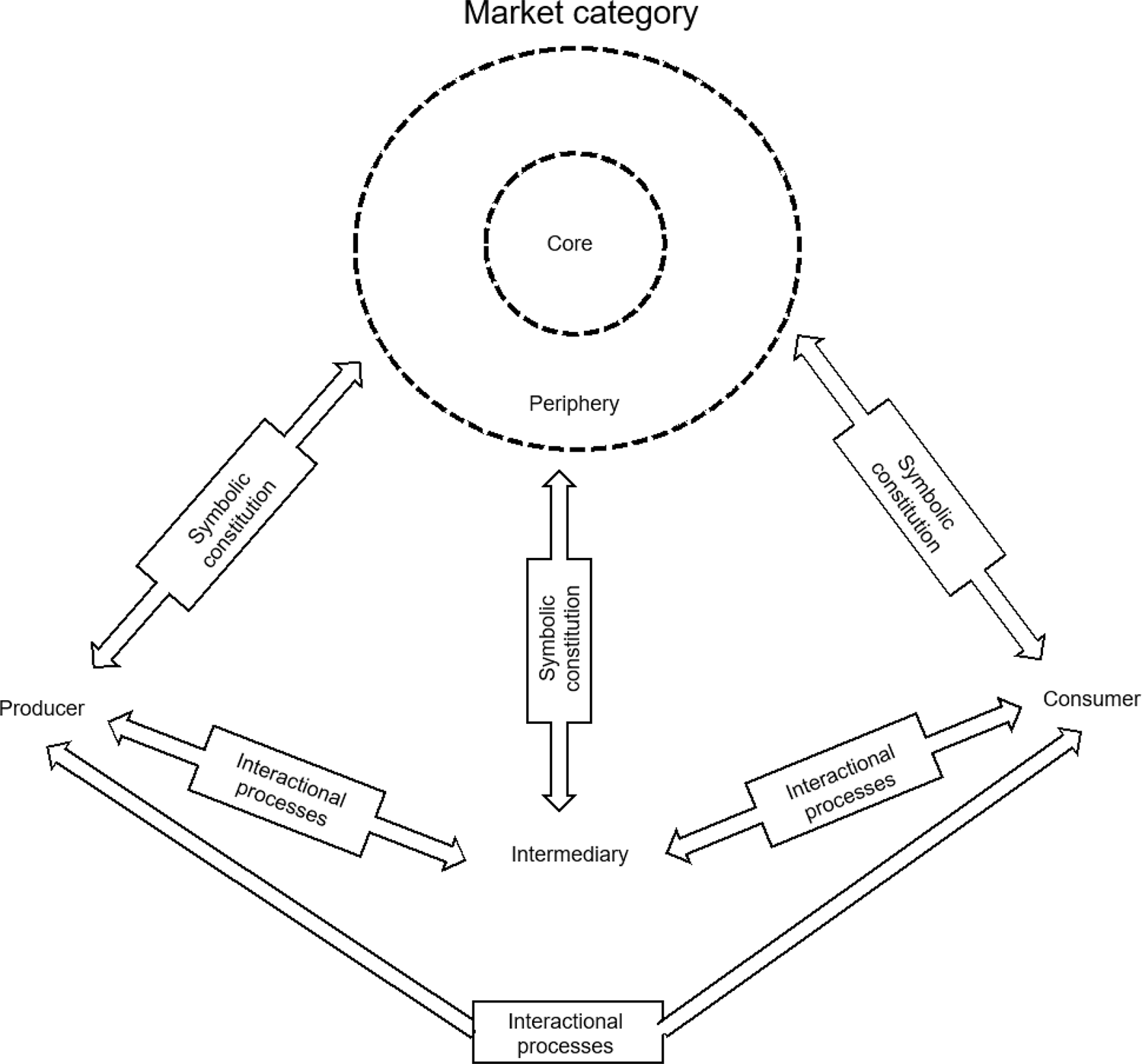
The cognitive dimension does not exist independently of the context; rather, its research focuses on individual and non-relational levels, as shown in Table 3. It is important to note that these two dimensions are not mutually exclusive and do not represent a hierarchy of events; instead, they co-occur, and their theoretical separation provides valuable insights. As depicted in Figure 1, the sociopolitical dimension encompasses contextual issues, interactional processes, and power relations between actors. The proposed categorization model describes an ongoing process that unfolds in a relational and dialectical manner, in addition to the cognitive dimension. It focuses on the dynamic relationship between market actors who are continually constructing and reconstructing meanings in a continuous process.

In the proposed model, the market serves as the locus, the arena where the exchange of products and services takes place, facilitated by market categories. The concept of an arena refers to a collection of actors directing their actions toward one another (Fligstein & McAdam, 2011), including producers, consumers, and intermediaries. From this standpoint, market participants occupy distinct positions, forming reproducible role structures. In essence, actors within a market are organized into participant groups recognized by their positions (Fligstein & Calder, 2015, p, p. 2). Membership in a specific market is not determined by objective criteria but by subjective positioning. Therefore, the boundaries of this arena and its categories are not fixed but contingent upon circumstances. Over time, a shared understanding is developed among participating actors, who hold varying degrees of power (Fligstein & McAdam, 2012).
In accordance with the ontology of becoming, the categorization process embodies the whole within its parts. Hence, the ongoing interactional processes among actors occupying various positions (including those within the same market position) present contradictions and internal dialectical movements related to the entirety. Market participants are engaged in constant negotiation, leading to the creation, recreation, and co-creation of meanings (O’Brien, 2006). Negotiation stands out as a primary interactional process shaping the negotiated order within the arena, albeit not the sole one. Persuasion, manipulation, education, threat, and coercion are among the strategies actors employ to achieve their objectives (Strauss, 2011). These processes often culminate in agreements/understandings that are subsequently renegotiated (Strauss, 2017).
Categorization permeates every relationship. Within this process, contradiction and relative consensus coexist, akin to Heraclitus and Hegel’s proposed harmony of opposites. Consequently, following the radial structure of market categories (Tsoukas & Chia, 2002), meanings with the highest consensus among actors and prototypical members are situated at the core. Conversely, the most contentious processes harbor contradictory meanings, thus relegating them to the periphery of the market category.
The proposed model unveils a process capable of elucidating the radial dynamics of market categories, encompassing their purported stability and instability. It hinges on the intricate interactional processes among producers, consumers, and intermediaries within the marketplace. These meanings are forged through a vast network of shared and often contradictory societal experiences and understandings (Lakoff, 1987; Tsoukas & Chia, 2002), continually constructed through actor interactions. Thus, the existence of a market category is contingent upon the symbiotic relationship among producers, consumers, and intermediaries, who imbue it with symbolic significance and are themselves influenced by its sway. This attribution of meaning to the category is far from unanimous, rife with tensions and contradictions perpetually negotiated, forming the dialectical bedrock that reinforces the radial dynamics of the category. The outcomes of these negotiations delineate the meanings and members that assume centrality or peripherality within the market category, thereby elucidating its dynamic nature.
The categorization model’s focus on the actors – producers, consumers, and intermediaries – redirects our attention toward a more agency-oriented perspective, simultaneously considering micro and macro processes. Categorization emerges not as a mechanical, automated procedure but as a nuanced sociopolitical endeavor, entailing the perpetual negotiation of meanings within interactional realms. Actors play a pivotal role in co-creating market categories; as Glynn and Navis (2013) posited, categories are symbolically constituted through their practices and relationships. It is a collective endeavor of social construction accentuating the fluidity of the category and the active involvement of audiences in its evolution and development.
Comprehending the construction and accommodation of category meanings is crucial for elucidating our social organization, markets, organizations, identities, and actions (Glynn & Navis, 2013).
Conclusions
In this theoretical article, we argue that the dynamics of market categories, including their relative stability and instability, can be elucidated by an ongoing categorization process. In this process, producers, intermediaries, and consumers interact symbolically to constitute the category, resulting in a radial categorical structure. This structure exhibits a higher concentration of relatively consensual meanings in its core and a greater dispersion of dissenting meanings in its periphery.
The relationship among market actors occupying both similar and diverse positions explains the sociopolitical dimension of categorization, which unfolds in a continuous flux of co-construction and transformation. This proposal is rooted in an ontology of becoming and addresses a theoretical gap in the literature on market categories: the understanding of categorization beyond an individual, exclusively cognitive, and mechanical approach. It explores how and why market categories acquire relatively more or less stable meanings. This perspective offers a novel lens for examining the domain of market categories, as outlined by MacInnis (2011), representing a revision process that reevaluates established concepts and processes from a fresh standpoint.
The proposed theoretical model also tackles another gap: the static and homogenizing treatment often given to market categories. Through ongoing categorization, market categories are seen as in constant flux, socially and relationally constructed by market actors – i.e., producers, consumers, and intermediaries. This framework, echoing MacInnis’s (2011) notion of an alternative frame of reference, presents a new vision for the theoretical corpus, fostering opportunities for further research. In this dialectical process, the market category is both stable and evolving, with its essence lying in the ongoing categorization process. This understanding enhances comprehension of the complexity and fluidity of society, organizations, and markets. Emphasizing interactional processes among various types of actors, the ongoing categorization process encourages interdisciplinary studies, spanning sociology, organizational studies, marketing, and consumption.
References
-
Anand, N., & Jones, B. C. (2008). Tournament rituals, category dynamics, and field configuration: The case of the booker prize. Journal of Management Studies, 45 (6), 1036-1060. https://doi.org/10.1111/j.1467-6486.2008.00782.x
» https://doi.org/10.1111/j.1467-6486.2008.00782.x -
Arjaliès, D., & Durand, R. (2019). Product categories as judgment devices: The moral awakening of the investment industry. Organization Science, 30, 5, 1-27. https://doi.org/10.1287/orsc.2018.1267
» https://doi.org/10.1287/orsc.2018.1267 - Battilana, J. & Dorado, S. (2010). Building sustaninable Hybrid Organizations: the case of commercial microfinance organizations. Academy of Management Journal 53 (6), 1419-1440.
-
Cobb, J. B. (2007). Person-in-community: Whiteheadian insights into community and institution. Organization Studies, 28 (4), 567-588. https://doi.org/10.1177/0170840607075268
» https://doi.org/10.1177/0170840607075268 -
Coslor, E., Crawford, B., & Leyshon, A. (2019). Collectors, investors and speculators: gatekeeper use of valorous categories in the art market. Organization Studies, 41, 7, 1-23. doi:10.1177/0170840619883371
» https://doi.org/10.1177/0170840619883371 -
Delmestri, G., & Greenwood, R. (2016). How cinderella became a queen: theorizing radical status change. Administrative Science Quarterly, 61 (4), 507-550. https://doi.org/10.1177/0001839216644253
» https://doi.org/10.1177/0001839216644253 -
Di Gaetano, L., Mazza, I., & Mignosa, A. (2019). On the allocation of talents in the contemporary art market. Journal of Cultural Economics, 43 (1), 121-143. doi:10.1007/s10824-018-9331-7
» https://doi.org/10.1007/s10824-018-9331-7 -
DiMaggio, P. J., & Powell, W. W. (1983). The iron cage revisited: Institutional isomorphism and collective rationality in organizational fields author(s). American Sociological Review, 48 (2), 147-160. https://doi.org/10.1016/S0742-3322 (00)17011-1
» https://doi.org/10.1016/S0742-3322 (00)17011-1 - Douglas, M. & Isherwood, B. (2013). O mundo dos bens: para uma antropologia do consumo (2a ed). Rio de Janeiro: Editora UFRJ.
-
Durand, R., & Khaire, M. (2017). Where do market categories come from and how? Distinguishing category creation from category emergence. Journal of Management, 43 (1), 87-110. https://doi.org/10.1177/0149206316669812
» https://doi.org/10.1177/0149206316669812 -
Durand, R., & Paolella, L. (2013). Category stretching: Reorieting research on categories in strategy, entrepreneurship, and organization Theory. Management Studies, 50 (6), 1100-1123. doi:10.1111/j.1467-6486.2011.01039.x
» https://doi.org/10.1111/j.1467-6486.2011.01039.x -
Durand, R., & Thornton, P. H. (2018). Categorizing institutional logics, institutionalizing categories: A review of two literatures. Academy of Management Annals, 12 (2), 631-658. https://doi.org/10.5465/annals.2016.0089
» https://doi.org/10.5465/annals.2016.0089 - Fligstein, N., & Calder, R. (2015 ). Architecture of Markets. In Emerging Trends in the Social and Behavioral Sciences: An Interdisciplinary, Searchable, and Linkable Resource, (pp. 1-14).
- Fligstein, N., & McAdam, D. (2012). A Theory of Fields Oxford: Oxford University Press.
-
Fligstein, N., & McAdam, D. (2011). Toward a General Theory of Strategic Action Fields. Sociological Theory, 29 (1), 1-26. doi:10.1111/j.1467-9558.2010.01385.x
» https://doi.org/10.1111/j.1467-9558.2010.01385.x -
Glynn, M. A., & Navis, C. (2013). Categories, identities, and cultural classification: Moving beyond a model of categorical constraint. Journal of Management Studies, 50 (6), 1124-1137. https://doi.org/10.1111/joms.12023
» https://doi.org/10.1111/joms.12023 -
Hampton, J. A. (1996). Conjunctions of visually based categories: Overextension and compensation. Journal of Experimental Psychology: Learning Memory and Cognition, 22 (2), 378-396. https://doi.org/10.1037/0278-7393.22.2.378
» https://doi.org/10.1037/0278-7393.22.2.378 -
Hannan, M. T. (2010). Partiality of memberships in categories and audiences. Annual Review of Sociology, 36 (1), 159-181. http://dx.doi.org/10.1146/annurev-soc-021610-092336
» http://dx.doi.org/10.1146/annurev-soc-021610-092336 - Hannan, M. T., & Freeman, J. (2005). Ecologia populacional das organizações. RAE -Revista de Administração de Empresas Clássicos, 45 (3), 70-91.
- Hegel, G. W. F. (1992). Fenomenologia do espírito (2a ed.). Petrópolis: Vozes.
- Heráclito. Fragmentos contextualizados (2002). In Heráclito. Os fragmentos de Heráclito e seus Contextos (p. 1-126). Rio de Janeiro: Difel, 2002.
-
Hsu, G. (2006). Jacks of all trades and masters of none: Audiences' reactions to spanning genres in feature film production. Administrative Science Quarterly, 51 (3), 420-450. https://doi.org/10.2189/asqu.51.3.420
» https://doi.org/10.2189/asqu.51.3.420 - James, W. (1920). A Pluralistic Universe New York: Longmans, Green, and Co.
-
Johnson, K. E., & Mervis, C. B. (1997). Effects of varying levels of expertise on the basic level of categorization. Journal of Experimental Psychology: General, 126 (3), 248-277. doi:10.1037//0096-3445.126.3.248
» https://doi.org/10.1037//0096-3445.126.3.248 -
Kennedy, M. T., & Fiss, P. C. (2013). An ontological turn in categories research: From standards of legitimacy to evidence of actuality. Journal of Management Studies, 50 (6), 1138-1154. https://doi.org/10.1111/joms.12031
» https://doi.org/10.1111/joms.12031 -
Kennedy, M. T., Lo, J. Y. C., & Lounsbury, M. (2010). Category currency: The changing value of conformity as a function of ongoing meaning construction. Research in the Sociology of Organizations, 31, p. 369-397. doi:10.1108/S0733-558X(2010)0000031014
» https://doi.org/10.1108/S0733-558X(2010)0000031014 -
Khaire, M., & Wadhwani, R. D. (2010). Changing landscapes: The construction of meaning and value in a new market category - Modern Indian art. Academy of Management Journal, 53 (6), 1281-1304. https://doi.org/10.5465/amj.2010.57317861
» https://doi.org/10.5465/amj.2010.57317861 -
Kjeldgaard, D., Askegaard, S., Rasmussen, J. Ø., & Østergaard, P. (2017). Consumers' collective action in market system dynamics: A case of beer. Marketing Theory, 17 (1), 51-70. https://doi.org/10.1177/1470593116658197
» https://doi.org/10.1177/1470593116658197 -
Kovács, B., & Hannan, M. T. (2015). Conceptual spaces and the consequences of category spanning. Sociological Science, 2, 252-286. doi:org/10.15195/v2.a13
» https://doi.org/10.15195/v2.a13 - Lakoff, G. (1987). Women, fire, and dangerous things. What categories reveal about the mind Chicago: The University of Chicago Press.
-
Lamont, M., & Molnár, V. (2002). The study of boundaries in the social sciences. Annual Review of Sociology, 28, 167-195. https://doi.org/10.1146/annurev.soc.28.110601.141107
» https://doi.org/10.1146/annurev.soc.28.110601.141107 -
Langley, A., Smallman, C., Tsoukas, H., & Van De Ven, A. H. (2013). Process studies of change in organization and management: Unveiling temporality, activity, and flow. Academy of Management Journal, 56 (1), 1-13. https://doi.org/10.5465/amj.2013.4001
» https://doi.org/10.5465/amj.2013.4001 - Langley, A., & Tsoukas, H. (Eds.). (2017). The Sage handbook of process organization studies London: Sage Publications Ltd.
-
Lounsbury, M., & Rao, H. (2004). Sources of durability and change in market classifications: A study of the reconstitution of product categories in the american mutual fund industry, 1944-1985. Social Forces, 82 (3), 969-999. https://doi.org/10.1353/sof.2004.0046
» https://doi.org/10.1353/sof.2004.0046 -
MacInnis, D. J. (2011). A Framework for Conceptual Contributions in Marketing. Journal of Marketing, 75, 136-154. https://doi.org/10.1509/jmkg.75.4.13
» https://doi.org/10.1509/jmkg.75.4.13 - Mertens, D. M. (2014). Ethical use of qualitative data and findings. In Flick, U. The SAGE handbook of qualitative data analysis. London: Sage Publications.
-
McCracken, G. (2007). Cultura e consumo: uma explicação teórica da estrutura e do movimento do significado cultural dos bens de consumo. Revista de Administração de Empresas, 47(1), 99-115. https://doi.org/10.1590/S0034-75902007000100014
» https://doi.org/10.1590/S0034-75902007000100014 -
Nayak, A. (2008). On the way to theory: A processual approach. Organization Studies, 29 (02), 173-190. https://doi.org/10.1177/017084060708222
» https://doi.org/10.1177/017084060708222 - Nayak, A., & Chia, R. (2011). Thinking becoming and emergence: Process philosophy and organization studies. Research in the Sociology of Organizations, 32, 281-309.
-
Negro, G., Hannan, M. T., & Rao, H. (2010). Categorical contrast and audience appeal: Niche width and critical success in winemaking. Industrial and Corporate Change, 19 (5), 1397-1425. https://doi.org/10.1093/icc/dtq003
» https://doi.org/10.1093/icc/dtq003 - Negro, G., Koçak, O., & Hsu, G. (Ed.). (2010). Categories in markets: origins and evolution. Research in the Sociology of Organizations (Vol. 31). Leeds: Emerald Group Publishing Limited. 10.1108/S0733-558X(2010)31
- Nietzsche, F. (1989). A Filosofia na época tragíca dos gregos. In Nietzsche, F. Os Pré-socráticos (R. R. Torres Filho Trad.). São Paulo: Nova Cultural.
- O'Brien, J. (2006). The production of reality (4th ed.). Seattle: Pine Forge Press.
-
Orlikowski, W. J. (1995). Improvising organizational transformation over time: A situated change perspective. Information Systems Research, 7 (1), 63-92. https://doi.org/10.1287/isre.7.1.63
» https://doi.org/10.1287/isre.7.1.63 -
Pedeliento, G., Andreini, D., & Dalli, D. (2019). From mother's ruin to ginaissance: Emergence, settlement and resettlement of the gin category. Organization Studies, 41(7), 969-992. https://doi.org/10.1177/017084061988336
» https://doi.org/10.1177/017084061988336 -
Rosa, J. A., Porac, J. F., Runser-Spanjol, J., & Saxon, M. S. (1999). Sociocognitive dynamics in a product market. Journal of Marketing, 63 (1999), 64-77. https://doi.org/10.1177/00222429990634s108
» https://doi.org/10.1177/00222429990634s108 -
Rosch, E. (1975). Cognitive representations of semantic categories. Journal of Experimental Psychology: General, 104 (3), 192-233. https://doi.org/10.1037/0096-3445.104.3.192
» https://doi.org/10.1037/0096-3445.104.3.192 -
Rosch, E., & Mervis, C. B. (1975). Family resemblances: Studies in the internal structure of categories. Cognitive Psychology, 7, 573-605. https://doi.org/10.1016/0010-0285 (75)90024-9
» https://doi.org/10.1016/0010-0285 (75)90024-9 - Schatzki, T. R. (2002). The site of the social Pennsylvania: The Pennsylvania State University Press.
- Strauss, A. L. (2017). Creating sociological awareness: collective imagens and symbolic representations. New Brunswick: Transaction Publisher.
- Strauss, A. (2011). Continual permutations of action. New York: Aldine de Gruyter.
- Singer, P. (2011). Hegel: a very short introduction. Oxford: Oxford University Press.
-
Tsoukas, H., & Chia, R. (2002). On organizational becoming: Rethinking organizational change. Organization Science, 13 (5), 567-582. doi:10.1287/orsc.13.5.567.7810
» https://doi.org/10.1287/orsc.13.5.567.7810 -
Vaara, E., & Monin, P. (2010). A recursive perspective on discursive legitimation and organizational action in mergers and acquisitions. Organization Science, 21 (1), 3-22. https://doi.org/10.1287/orsc.1080.0394
» https://doi.org/10.1287/orsc.1080.0394 -
Vergne, J. P., & Wry, T. (2014). Categorizing categorization research: Review, integration, and future directions. Journal of Management Studies, 51 (1), 56-94. https://doi.org/10.1111/joms.12044
» https://doi.org/10.1111/joms.12044 -
Weick, K. E., & Sutcliffe, K. M. (2005). Organizing and the process of sensemaking. Organization Science, 16(4), 409-421. https://doi.org/10.1287/orsc.1050.0133
» https://doi.org/10.1287/orsc.1050.0133 - Wittgenstein, L. (2014). Investigações filosóficas (9ª ed.). Rio de Janeiro: Vozes.
-
Zuckerman, E. W. (1999). The categorical imperative: Securities analysts and the illegitimacy discount. American Journal of Sociology, 104 (5), 1398-1438. https://doi.org/10.1086/210178
» https://doi.org/10.1086/210178 - Zuckerman, E. (2017). The categorical imperative revisited: Implications of categorization as theoretical tool. In R. Durrand, N. Granqvist, A. Tyllström (Ed.). From Categories to Categorization: Studies in Sociology, Organizations and Strategy at the Crossroads (Vol. 51, pp. 31-68). Emerald Publishing Limited.
Notes
-
1
. For instance, a rapid search on the Web of Science database reveals that, within the field of management, 6,309 articles were published between 1975 and 2019, utilizing the keyword “categor*” as a primary topic. Among these, 5,735 (90%) were published after 1999, with 4,552 (72%) emerging after 2009.
-
2
. Theories pertain to concrete phenomena, whereas ontology addresses the conceptual understanding of elements and the fundamental principles governing social structure. Ontologies do not serve as explanatory frameworks themselves; rather, they delineate the elemental makeup of reality and furnish foundational principles for theories (Schatzki, 2002). Ontology and epistemology represent philosophical assumptions. The former concerns reality, while the latter pertains to knowledge and the interaction between the researcher and the subject of study (Mertens, 2014).
-
Inclusive language
The authors use inclusive language that acknowledges diversity, conveys respect to all people, is sensitive to differences, and promotes equal opportunities.
-
Plagiarism check
O&S submit all documents approved for publication to the plagiarism check, using specific tools.
-
Data availability
O&S encourages data sharing. However, in compliance with ethical principles, it does not demand the disclosure of any means of identifying research participants, preserving fully their privacy. The practice of open data seeks to ensure the transparency of the research results, without requiring the identity of research participants.
-
Funding:
The authors declare that they did not receive any funding for the research, authorship, or publication of this article.
Edited by
-
Associate Editor:
Letícia Dias Fantinel
O&S encourages data sharing. However, in compliance with ethical principles, it does not demand the disclosure of any means of identifying research participants, preserving fully their privacy. The practice of open data seeks to ensure the transparency of the research results, without requiring the identity of research participants.