 Morphoagronomic characterization of ornamental pepper accesses
Abstract
Pepper plants are an important source of minerals, being widely used in the food industry. Furthermore, this crop has relevant ornamental potential, but still little explored. In this sense, the characterization of ornamental pepper accesses is of great relevance to identify genotypes that present desirable characteristics, as well as measuring genetic variability. Given the above, the objective of the present research was to carry out the morphoagronomic characterization of ornamental pepper accesses. The experiments were conducted under greenhouse conditions belonging to the Pernambuco Agronomic Institute (IPA), situated in Recife. The market seeks plants in which there is harmony between the plant’s architecture and the size of the pot, owing both plant height and crown diameter be 1.5 to 2 times the height of the vase, thus, only accesses 404, 408, 410, and 423 would fit this criterion. For the characteristics of immature fruit color (CIM) and mature fruit color (CMD), accesses 408 and IFV presented colors that greatly attract the attention of consumers, combined with the compact architectures that both have, indicate that these accesses may be promising. Finally, the characterization of ornamental pepper access proved to be a highly relevant tool for selecting genotypes that present characteristics desired by the consumer market for this type of pepper.
Keywords:
Capsicum annuum
; genetic breeding; genetic variability; pot plants
Resumo
As pimenteiras são uma importante fonte de minerais, sendo muito empregada na indústria alimentícia. Além disso, essa cultura apresenta um relevante potencial ornamental, porém ainda pouco explorado. Nesse sentido, a caracterização de acessos de pimenteiras ornamentais é de grande relevância para identificar os genótipos que apresentem características desejáveis, quanto também mensurando a variabilidade genética. Diante do exposto, o objetivo da presente pesquisa foi realizar a caracterização morfoagronômica de acessos de pimenteiras ornamentais. Os experimentos foram conduzidos em condições de casa de vegetação pertencente ao Instituto Agronômico de Pernambuco (IPA), situado em Recife. Foram utilizados 20 acessos de pimenteiras ornamentais, pertencentes ao banco de germoplasma de Capsicum, do IPA. O mercado busca por plantas em que haja harmonia entre a arquitetura da planta e o tamanho do vaso, devendo tanto a altura de planta quanto o diâmetro da copa serem de 1,5 a 2 vezes a altura do vaso, assim apenas os acessos 404, 408, 410 e 423 se encaixariam nesse critério. Para as características a cor do fruto imaturo (CIM) e cor do fruto maduro (CMD) os acessos 408 e IFV apresentaram cores que atraem muito a atenção dos consumidores, aliadas as arquiteturas compactas que ambas possuem, indicam que esses acessos podem ser promissores. Por fim, a caracterização dos acessos de pimenteiras ornamentais demonstrou ser uma ferramenta de grande relevância para a seleção de genótipos que apresentem características desejadas pelo mercado consumidor desse tipo de pimenta.
Palavras-chave:
Capsicum annuum
; melhoramento genético; plantas em vaso; pré-melhoramento; variabilidade genética.
Introduction
Pepper (Capsicum annuum L.) is a species belonging to the Solanaceae family, whose genus Capsicum contains about 38 species. There are reports in the literature that the genus Capsicum has as centers of origin Central and South America, however, it is already present in cultivation areas of tropical and temperate regions in different parts of the world (Costa et al., 2021; Karim et al., 2021).
Brazil is an important center of diversity for the Capsicum genus, with domesticated, semi-domesticated and wild species. Peppers are cultivated in all regions of the country, with emphasis on the Southeast and Central-West regions, with the main producing states being Minas Gerais, Goiás, São Paulo, Ceará, and Rio Grande do Sul, totaling 75 thousand tons in 5 thousand hectares of cultivated area, with productivity ranging from 10 to 30 t ha-1, depending on the type of pepper, cultivar and technological level used (Santo et al., 2024).
Since ancient times, peppers have been used as condiments by Indians and ancient civilizations, with the aim of making food more pleasant to the palate, as well as being used as preservatives in food, thus increasing its shelf life. Furthermore, it also falls into the category of medicinal plant (Neves et al., 2021; Cavalcanti et al., 2024).
Peppers are an important source of natural antioxidants, such as vitamin E, vitamin C and carotenoids. In addition, they are rich in capsaicinoids, which are phenolic compounds responsible for the degree of pungency of the fruits (Sahid et al., 2022; Pessoa et al., 2023).
In addition to their food and industrial potential, there is also the ornamental potential of pepper plants, which is still little explored. So much so that in Brazil there are still few pepper cultivars focused on ornamental issues, even though the Capsicum genera germplasm banks have numerous accesses with characteristics that can be genetically improved, in order to meet this demand (Castro et al., 2022; Cruz et al., 2025).
In this sense, the characterization of ornamental pepper accesses from germplasm banks is of great relevance for genetic improvement programs, identifying genotypes that present desirable characteristics, as well as measuring genetic variability, since this is essential for the successful development of new cultivars (Morais et al., 2020; Martínez-Ispizua et al., 2022). According to Aquino et al. (2022) and Sudré et al. (2025), morphoagronomic characterization is a very important tool for evaluating the ornamental potential of accesses, as well as obtaining estimates of genetic parameters for the development of new cultivars.
In the literature, several studies are reported on the characterization of pepper plants for use in genetic improvement programs, among which we can mention the study developed by Costa et al. (2016), which measured the variability and genetic diversity of pepper parents and interspecific hybrids through morphological characterization and molecular analysis, which efficiently determined the genetic diversity between parents and interspecific hybrids.
Still in this context, in the research by Silva Neto et al. (2014), they evaluated the variability of the base population of ornamental pepper plants, concluding that the selection made within the population was efficient for the Ornamental Pepper Plant Improvement Program, developed by the Federal University of Paraíba. In view of the above, the objective of this research was to perform the morphoagronomic characterization of ornamental pepper accesses.
Material and Methods
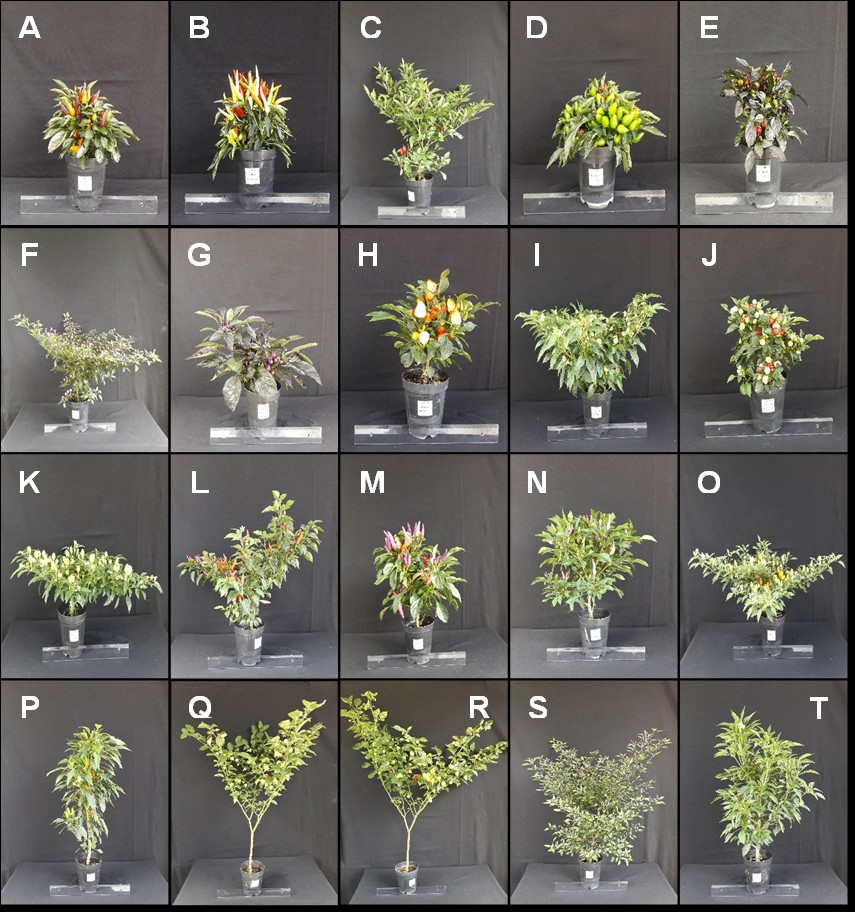
The experiments were conducted in a greenhouse belonging to the Instituto Agronômico de Pernambuco (IPA), located in Recife - Pernambuco, Brazil (8° 03’ 50.00” S, 34° 55’ 33.95” W). Twenty accesses of ornamental pepper plants belonging to the Capsicum germplasm bank were used, being: 403, 404, 407, 408, 410, 411, 414.1, 414.2, 416, 423, 424, 429, 431, 435, 436, 439, 442, 443, Canudos, and IFV (Fig. 1).

Ornamental pepper accesses belonging to the Capsicum germplasm bank, Agronomic Institute of Pernambuco (IPA). (A) 403; (B) 404; (C) 407; (D) 408; (E) 410; (F) 411; (G) 414.1; (H) 414.2; (I) 416; (J) 423; (K) 424; (L) 429; (M) 431; (N) 435; (O) 436; (P) 439; (Q) 442; (R) 443; (S) Canudos; (T) IFV.
All 20 accesses studied originate from the IPA. They were obtained in the city of Recife - Pernambuco. Which exhibits wide genetic variability, as can be seen in Fig. 1. The accesses used in this study were chosen because they exhibit high ornamental potential in the present germplasm bank.
The first stage consisted of a self-fertilization cycle of pepper access, in order to guarantee their genetic purity. Forty seeds of each accession were sown in 200 cell expanded polystyrene trays containing coconut powder, which had been previously washed and autoclaved twice at 121 ºC for 1 hour (vertical autoclave AV 75 - Phoenix). After 30 days of sowing, the seedlings were transplanted into plastic pots with a volumetric capacity of 800 ml, containing coconut powder substrate.
The plants were irrigated according to water requirements, with a nutrient solution prepared based on Rheinnheimer and Silva (2025) and Furlani et al. (1999), with the following composition in g per 1000 L: 1000 g calcium nitrate; 1250 g potassium nitrate; 250 g MKP; 500 g magnesium sulfate; 1.5 g boric acid; 25 g quelatec AZ; 25 g ultraferro; 110 g potassium chloride and 150 g potassium sulfate. In the seedling phase, the solution was diluted until the electrical conductivity (EC) reached a value of 0.6 dS m-1, this value being increased regularly until it reached 1.4 dS m-1 in the growth phase. Pest and disease control was carried out preventively at one-week intervals throughout the crop cycle.
At the beginning of the reproductive phase, the plants were individually protected with white tulle fabric until the fruits set, after which the tulle was removed. When the fruits were ready for harvest, they were removed to obtain the seeds, which were stored in suitable conditions in a refrigerator at around 10 ºC (Rosa et al., 2023).
For the characteristics related to seed germination, the experiment was implemented in a randomized block design, with the experimental plot consisting of 60 seeds with 4 replicates. The seeds were sown in 200-cell Styrofoam trays with autoclaved coconut powder substrate, irrigation was carried out with the nutrient solution mentioned above.
At 30 (thirty) days after sowing, the seedlings were evaluated for the following characteristics: Emergence percentage (PE), in %; Seedling height (AP), in cm; Emergence speed index (IVE), dimensionless; Mean emergence time (TME), in days/seeds. The characteristics PE, IVE, and TME were calculated using the following formulas:
, in which:
N - Total number of germinated seeds;
A - Total number of sown seeds;
, in which:
E1, E2,..., En - Number of normal seedlings emerged in the first, second until the last count;
N1, N2,..., Nn - Number of days from sowing to the first, second until the last count;
, in which:
Ni - Number of seeds emerged per day;
Ti - Incubation time (days);
Thirty days after sowing, the seedlings were transplanted into plastic pots with a volumetric capacity of 800 ml with autoclaved coconut powder substrate, following the methodology described above. At this stage, the experiment was implemented in a randomized block design, each plot consisting of five plants, with three plants as a useful plot, with four replicates.
Irrigation and fertigation management were conducted as described in the previous experiment. Pest and disease control was carried out preventively at two-week intervals throughout the crop cycle (Pessoa et al., 2025).
From the flowering to fruiting phase (45 to 130 days after sowing), the evaluations recommended for the genus Capsicum by the International Plant Genetic Resources Institute (IPGRI, 1995) were carried out, these characteristics can be grouped into three categories, those related to the plant, the flower and the fruit.
Plant related traits: Plant height (ATP), in cm; Crown diameter (DCP), in cm; Height of first sprouting (APB), in cm; Growth habit (HCR), dimensionless; Branching density (DRM), dimensionless; Leaf density (DFL), dimensionless; Leaf color (CFH), dimensionless.
Characters related to the flower: Flowering beginning (IFC), in days; Corolla color (CCR), dimensionless; Flower position (PFL), dimensionless.
Characters related to the fruit: Fruit length (CFR), in mm; Largest fruit diameter (MDF), in mm; Smallest fruit diameter (MEF), in mm; Beginning of fruiting (IFT), in days; Number of fruits (NFR), in units; Anthocyanin spots on the fruit (MAT), dimensionless; Immature fruit color (CIM), dimensionless; Intermediate fruit color (CID), dimensionless; Ripe fruit color (CMD), dimensionless.
The data obtained were subjected to analysis of variance and, when necessary, a comparison was made between the treatment means using the Scott-Knott test, at a 5% probability level, using the GENES software (Cruz, 2013).
Results and Discussion
Analyzing Table 1, which lists the accesses averages for the 13 quantitative traits analyzed, for the seedling height (AP) variable, accesses 431 and 435 presented the highest averages, differing statistically from the others, on the other hand, the lowest averages were obtained by accesses 403 and 424.
As for the emergence percentage (PE), accesses 403, 404, 407, 408, 410, 411, 414.2, 416, 423, 429, 431, 435, 436, 439, 442, 443, and IFV presented the highest values, differing statistically from the others. Canudos access showed the lowest emergence, reaching 41.25% PE, indicating some genetic/physiological mechanism that mitigates this emergence, given that all seeds from all accesses were obtained at the same time and stored in a suitable environment, and the vast majority had high PE’s.
For the variables emergency speed index (IVE) and average emergency time (TME), both exhibit very similar behavior, since the best rates were observed for accesses 404 and 442, differing statistically from the others, which also had the shortest average emergency times, at 5.98 and 6.42 days, respectively. On the other hand, the lowest IVE was obtained for Canudos access, as well as for TME, which had a TME of 11.95 days. Thus, it can be inferred that the IVE is influenced to some extent by the TME, so that higher TME values result in lower IVE values.
This inversely proportional relationship was also observed by Campos et al. (2018), who, evaluating the emergence of Jutaí-açú seedlings, obtained a TME of 23.03 and an IVE of 0.23 in one genotype, and quantified a TME of 14.86 and an IVE of 1.27 for another genotype. Given these data, there is some relationship between these traits.
For the plant height (ATP) trait, access 442 and 443 presented the highest values, differing statistically from the others. However, the lowest value was obtained by access 408. However, considering the market demand for ornamental pepper plants, according to Barbosa et al. (2002), for pepper plants to fit into this segment, as a rule, there must be harmony between the plant’s architecture and the pot’s size. Both the plant’s height and the canopy diameter should be 1.5 to 2 times the pot’s height.
According to this rule, twice the height of the pot, which was 10 cm, this classification would apply to plants 20 cm or less in height. Only accesses 404, 408, 410, and 423 would meet this criterion. However, there are some subjective characteristics and market appeal that must be considered for this classification.
According to Ribeiro et al. (2024), the use of intraspecific crosses can be a viable strategy to reduce the number of plants that do not meet commercial standards, but possess important ornamental characteristics, resulting in improved genotypes.
Regarding the crown diameter characteristic (DCP), accesses 411, 442, 443 and Canudos exhibited the highest values, differing statistically from the others. In contrast, the accesses that presented the lowest numbers were accesses 404, 408, 410 and 423. It is important to remember that according to the parameter used by Barbosa et al. (2002), in which, for pepper plants to be classified as ornamental, the plant must have a DCP of 1.5 to 2 times the height of the pot. Therefore, according to this criterion, none of the accesses fell within this range. However, accesses 404, 408, 410, and 423 were very close to this range.
It was observed that for the height of first sprouting (APB), access 442 presented the highest value, differing statistically from the others. In contrast, accesses 403, 404, 407, 408, 410, 411, 414.1, 414.2, 416, 423, 424, 435, 436, and Canudos. It’s worth mentioning that this characteristic is related to the plant’s size. For the ornamental pepper market, it’s important for plants to be compact in size, which is influenced by APB.
Regarding the characteristics of the reproductive parts of accesses, the early flowering trait (IFC) is of great importance for crops, and for plants intended for the ornamental market, it becomes even more important. Therefore, plants that begin flowering earlier are attractive, as they can be available on the market sooner, thereby reducing the cost of plant production (Acevedo et al., 2020).
In this sense, the lowest values for IFC were observed for accesses 403, 404, 408, 410, 411, 414.1, 414.2, 416, 423, 429, 431, 435, 436, and Canudos, differing statistically from the others, with an average value of 48.91 days to the beginning of flowering. These accesses presented lower IFC’s than the Capsicum annuum species studied by Almeida et al. (2023), highlighting the ornamental potential of these materials.
On the other hand, access 443 was the latest to begin flowering, averaging 107.95 days. This is undesirable for the ornamental pepper production market, furthermore, this access presented high ATP and APB, which are not recommended for this market segment.
For the fruit length characteristic (CFR), access 404 obtained the highest value, differing statistically from the others, while the lowest values were observed in accessions 410, 411, and Canudos. It is worth noting that the characteristics visualized externally on the fruit, such as fruit length (CFR), largest fruit diameter (MDF), smallest fruit diameter (MEF), and number of fruits (NFR) are significant variables in the ornamental market’s preferences.
In this sense, accesses 404, 411, and Canudos presented the lowest values for MDF, and accesses 404, 407, 429, 431, 435, 436, 442, 443, and Canudos exhibited the lowest MEF. However, considering the subjectivity of the ornamental plant segment, these characteristics cannot be decisive factors in genotype selection, but rather one more factor to be taken into consideration. The highest data for MDF were displayed at 414.2 and 442, for MEF, access 416 obtained the highest value.
The beginning of fruit set (IFT), which encompasses the number of days from sowing to the beginning of fruit growth, showed that access 431 was the earliest, with an IFT of 66.83 days, on the other hand, the latest accesses were 442 and 443, with 130.08 and 139.50 days, respectively.
Knowledge about this characteristic is very important for florist planning, so that plant production can be planned for a specific date.
To identify the ornamental potential of pepper plants, it is necessary to consider, in addition to quantitative characteristics, some qualitative characteristics. In this sense, in Table 2, 10 qualitative characteristics were evaluated in ornamental pepper plants.
Regarding growth habit (HCR), access 436 was identified as HCR as prostrate, 403, 407, 408, 411, 416, 423, 424, and 429 as intermediate, and accesses 404, 410, 414.1, 414.2, 431, 435, 439, 442, 443, Canudos, and IFV as erect. For the branching density attribute DRM, accesses 414.1, 431, 442, 443, and IFV had sparse DRM, accesses 403, 407, 410, 414.2, 423, 424, 429, and 435 showed intermediate DRM, and accesses 404, 408, 411, 416, 436, and Canudos showed dense DRM.
Regarding leaf density (DFL), which is a strong indicator of the plant’s leaf area, and is also very important for the ornamental pepper market, accesses 442, 443, and IFV had sparse DFL, while accesses 403, 404, 408, 411, 416, 429, 436, and Canudos had dense DFL, the remaining accesses had intermediate DFL.
Leaf color (CFH), is also another highly relevant attribute for the ornamental plant consumer market. In this sense, it was observed that there was variation among the colors identified in the accesses studied, where accesses 404, 416, 423, 424, 431, 436, 439, 442, 443, and IFV obtained green CFH, accesses 403, 407, 408, 411, 414.2, 429, 435, and Canudos expressed dark green CFH, and only accesses 410 and 414.1 exhibited purple leaf color, contrasting sharply with the other genotypes evaluated.
Regarding the characteristic flower position (PFL), three distinct groups can be seen, the group with erect PFL, formed by accesses 403, 404, 407, 408, 410, 411, 414.1, 416, 424, 429, 431, 435, 436, 439, Canudos, and IFV. The second group, consisting of accesses 414.2, 423, and 443, presents an intermediate PFL, while the group with hanging PFL contains only access 442.
Another important characteristic to be discussed when monitoring ornamental plants concerns anthocyanin spots on the fruit (MAT), in which only accesses 414.2, 416, 423, 431, and 436 presented anthocyanin spots (purple) on their fruits. culminating in distinctive and attractive plants for the consumer market, which yearns for new and unique products.
Still referring to the interests of the ornamental pepper market, color during the fruit development stages plays a significant role in the process of choosing the genotype to purchase (Melo et al., 2014). In this sense, for the color of the immature fruit (CIM), the formation of four groups was noticeable, group 1 had a black CIM (accesses 403, 410, 414.1, and Canudos), group 2 had a CIM classified as lemon yellow (accesses 404, 414.2, 416, 423, 424 and 436), group 3 had a purple CIM (accesses 407, 411, 429, 431, and 435), and group 4 had a lilac/brown/green CIM (mixture of colors) (accesses 408, 439, 442, 443, and IFV).
Also, for intermediate fruit color (CID), the formation of several groups was observed, with group 1 consisting of accesses 403, 410, and Canudos, which exhibited green CID, group 2 had an orange CID (accesses 404, 414.2, 423, 429, 431, 435, 442, and 443), group 3 had a CID classified as other (accesses 407, 408, 439, and IFV), group 4 had a yellow CID (411, 424, and 436), and group 5 had a purple CID (access 414.1).
Regarding the color of the ripe fruit (CMD), the accesses were divided into three groups, in which group 1 corresponds to orange CMD (accesses 403, 411, 436, and 439), group 2 with dark red CMD, comprised the majority of accesses (404, 407, 408, 410, 414.1, 414.2, 423, 429, 431, 435, 442, 443, Canudos, and IFV), and group 3 with pale yellow-orange CMD (accesses 416 and 424).
Regarding the characteristics related to fruit color, which attract a lot of attention from consumers, the color of the immature fruit (CIM) and the color of the ripe fruit (CMD), accesses 408, 442, 443, and IFV presented purple/brown/green (mixture of colors) and dark red colors, respectively. However, accessions 442 and 443 exhibit ATP outside the market standard for potted ornamental pepper plants, making these genotypes undesirable.
Conclusions
The adequate characterization of ornamental pepper accessions has proven to be a highly relevant tool for the selection of genotypes that present characteristics desired by the consumer market for this type of pepper.
For the characteristics of immature fruit color (CIM) and ripe fruit color (CMD), accesses 408 and IFV presented colors that greatly attract the attention of consumers, combined with the compact architectures that both have, indicating that these accessions may be promising.
Acknowledgments
The authors declare that there are no acknowledgments to be made.
Data availability statement
Data will be made available upon request to the authors.
References
-
ACEVEDO, A.K.O.S.; MEDEIROS, A.M.; BARROSO, P.A.; COSTA, G.N.; LOPES, A.C.A.; GOMES, R.L.F. Genetic parameters and simultaneous selection using traits of ornamental interest in pepper plants. Horticultura Brasileira, v.38, n.4, p.394-399, 2020. http://dx.doi.org/10.1590/s0102-053620200409
» http://dx.doi.org/10.1590/s0102-053620200409 -
ALMEIDA, B.M.; FEITOZA, L.L.; LOPES, Â.C.A.; GOMES, R.L.F.; ALMEIDA, R.C.; MARTINS, L.V.; SILVA, V.B. Morphological diversity among Brazilian Capsicum peppers Ciência Rural, v.53, v.1, p.1-9, 2023. http://doi.org/10.1590/0103-8478cr20210559
» http://doi.org/10.1590/0103-8478cr20210559 -
AQUINO, H.F.; MEDEIROS, J.E.; CARVALHO FILHO, J.L.S.; RIBEIRO, C.M.C.M.; MACIEL, M.I.S.; DANTAS, J.R.F. Morpho-agronomic characterization and genetic divergence among pepper accessions. Revista Ceres, v.69, n.2, p.187-194, 2022. https://doi.org/10.1590/0034-737X202269020009
» https://doi.org/10.1590/0034-737X202269020009 -
BARBOSA, R.I.; LUZ, F.J.F.; NASCIMENTO-FILHO, H.R.; MADURO, C.B. Capsicum peppers cultivated in Roraima, Brazilian Amazonia. I. Domestic species. Acta Amazônica, v.32, n.2, p.177-192, 2002. https://doi.org/10.1590/1809-43922002322192
» https://doi.org/10.1590/1809-43922002322192 -
CAMPOS, M.V.A.; LEÃO, N.V.M.; SHIMIZU, E.S.C.; FREITAS, A.D.D.; FELIPE, S.H.S. Atributos biofísicos de frutos e sementes e emergência de plântulas de Jutaí-Açú. Enciclopédia Biosfera, v.15, n.27, p.124-132, 2018. https://doi.org/10.18677/encibio_2018a12
» https://doi.org/10.18677/encibio_2018a12 -
CASTRO, A.C.R.; CORREIA, D.; SOUZA, F.V.D.; SOUZA, E.H.; FRANCO, J.; CAVALCANTI, T.B.; SILVA, D.A. Brazilian ornamental phytogenetic resources in Embrapa germplasm banks: obstacles and opportunities. Ornamental horticulture, v.28, n. 4, p.396-406, 2022. https://doi.org/10.1590/2447-536X.v28i4.2549
» https://doi.org/10.1590/2447-536X.v28i4.2549 -
CAVALCANTI, T.F.M.; SUDRÉ, C.P.; VIEIRA, C.V.; SOARES FILHO, E.S.; ARAÚJO, M.S.B.; BISPO, R.B.; RODRIGUES, R. Ornamental peppers: there is some accounting for taste. Ornamental Horticulture, v.30, n.1, p.01-06, 2024. https://doi.org/10.1590/2447-536X.v30.e242724
» https://doi.org/10.1590/2447-536X.v30.e242724 -
COSTA, M.P.S.D.; RÊGO, E.R.; GUEDES, J.F.S.; CARVALHO, M.G.; SILVA, A.R.; RÊGO, M.M. Selection of genotypes with ornamental potential in an F4 population of ornamental peppers (Capsicum annuum L.) based on multivariate analysis. Comunicata Scientiae, v.12, n.1, p.01-08, 2021. https://doi.org/10.14295/CS.v12.3511
» https://doi.org/10.14295/CS.v12.3511 -
COSTA, M.P.S.D.; RÊGO, M.M.; SILVA, A.P.G.; RÊGO, E.R.; BARROSO, P.A. Characterization and genetic diversity of pepper (Capsicum spp) parents and interspecific hybrids. Genetics and Molecular Research, v.15, n.2, p.1-12, 2016. http://dx.doi.org/10.4238/gmr.15027652
» http://dx.doi.org/10.4238/gmr.15027652 -
CRUZ, C.D. GENES - a software package for analysis in experimental statistics and quantitative genetics. Acta Scientiarum. Agronomy, v.35, n.3, p.271-276, 2013. https://doi.org/10.4025/actasciagron.v35i3.21251
» https://doi.org/10.4025/actasciagron.v35i3.21251 -
CRUZ, J.G.; SILVEIRA, T.; BARBIERI, R.L.; NEITZKE, R.S. Pre-breeding of a Capsicum annuum accession with ornamental potential. Revista Caatinga, v.38, n.1, p.01-07, 2025. http://doi.org/10.1590/1983-21252025v3812278rc
» http://doi.org/10.1590/1983-21252025v3812278rc - FURLANI, P.R.; SILVEIRA, L.C.P.; BOLONHEZI, D.; FAQUIM, V. Cultivo hidropônico de plantas. Campinas: IAC, 1999. 52p.
- IPGRI. International Plant Genetic Resources Institute. Roma. Descriptores para Capsicum (Capsicum spp). Roma: IPGRI, 1995. 51p.
-
KARIM, K.M.R.; RAFII, M.Y.; MISRAN, A.B.; ISMAIL, M.F.B.; HARUN, A.R.; KHAN, M.D.M.H.; CHOWDHURY, M.S.T.F.N. Current and prospective strategies in the varietal improvement of chilli (Capsicum annuum L.) specially heterosis breeding. Agronomy, v.11, n.1, p.01-15, 2021. https://doi.org/10.3390/agronomy11112217
» https://doi.org/10.3390/agronomy11112217 -
MARTÍNEZ-ISPIZUA, E.; CALATAYUD, Á.; MARSAL, J.I.; MATEOS-FERNÁNDEZ, R.; DÍEZ, M.J.; SOLER, S.; VALCÁRCEL, J.V.; MARTÍNEZ-CUENCA, M. Phenotypic divergence among sweet pepper landraces assessed by agro-morphological characterization as a biodiversity source. Agronomy, v.12, n.3, p.01-24, 2022. https://doi.org/10.3390/agronomy12030632
» https://doi.org/10.3390/agronomy12030632 -
MELO, L.F.; GOMES, R.L.F.; SILVA, V.B.; MONTEIRO, E.R.; LOPES, Â.C.A.; PERON, A.P. Potencial ornamental de acessos de pimenta. Ciência Rural, v.44, n.11, p.2010-2015, 2014. https://doi.org/10.1590/0103-8478cr20131306
» https://doi.org/10.1590/0103-8478cr20131306 -
MORAIS, G.C.; SILVA, L.S.N.; MAGALHÃES, L.O.; LIMA, L.O.; SILVA, M.R.; SILVA, R.N.O. Identificação do potencial ornamental e avaliação de desempenho de genótipos de pimenteiras. Revista Brasileira de Gestão Ambiental e Sustentabilidade, v.7, n.16, p.1041-1055, 2020. https://doi.org/10.21438/rbgas(2020)071637
» https://doi.org/10.21438/rbgas(2020)071637 -
NEVES, L.C.; RODRIGUES, R.N.S.; OLIVEIRA, D.M.; SHAHAB, M.; KOYAMA, R.; ROBERTO, S.R. Bioactive compounds and descriptors analysis of six cultivars of Capsicum spp. Revista Agro@mbiente On-line, v.15, n.1, p.01-20, 2021. http://dx.doi.org/10.18227/1982-8470ragro.v15i0.7122
» http://dx.doi.org/10.18227/1982-8470ragro.v15i0.7122 -
PESSOA, A.M.S.; RÊGO, E.R.; SILVA, A.P.G.; RÊGO, M.M. Diversity among Capsicum annuum L. genotypes based on phenotypic and molecular markers and parental selection. Revista Brasileira de Engenharia Agrícola e Ambiental, v.29, n.2, p.01-06, 2025. http://doi.org/10.1590/1807-1929/agriambi.v29n2e278261
» http://doi.org/10.1590/1807-1929/agriambi.v29n2e278261 -
PESSOA, A.M.S.; RÊGO, E.R.; SILVA, B.R.S.; RÊGO, M.M. Performance of pepper cultivars, for fresh market, based on fruit traits. Horticultura Brasileira, v.41, n.1, p.01-05, 2023. http://dx.doi.org/10.1590/s0102-0536-2023-e2495
» http://dx.doi.org/10.1590/s0102-0536-2023-e2495 -
RHEINNHEIMER, K.B.; SILVA, V.N. Manejo nutricional na produção de pimenta ornamental envasada. Acta Biológica Catarinense, v.12, n.1, p.31-40, 2025. https://doi.org/10.21726/abc.v12i1.2407
» https://doi.org/10.21726/abc.v12i1.2407 -
RIBEIRO, J.C.; PIMENTA, S.; CUSTÓDIO, G.C.A.; FARIA, R.A.N.; BARBOSA, A. K.P.; OLIVEIRA, F.C.; SILVA, N.S.; GOMES, W.S. Atributos genéticos dos frutos de pimenteira ornamental para seleção. Caderno Pedagógico, v.21, n.5, p.01-17, 2024. https://doi.org/10.54033/cadpedv21n5-171
» https://doi.org/10.54033/cadpedv21n5-171 -
ROSA, C.O.; SILVA, F.A.; CRUZ, D.R.C.; SANTOS, S.G.F. Importância da secagem e armazenamento adequados na manutenção da qualidade de sementes de pimenta (Capsicum). Research, Society and Development, v.12, n.8, p.01-14, 2023. http://dx.doi.org/10.33448/rsd-v12i8.43000
» http://dx.doi.org/10.33448/rsd-v12i8.43000 -
SAHID, Z.D.; SYUKUR, M.; MAHARIJAYA, A.; NURCHOLIS, W. Total phenolics, flavonoids, antioxidant activity, and α-glucosidase inhibitory activity of ornamental pepper and several other lines. Ornamental Horticulture, v.28, n.2, p.230-238, 2022. https://doi.org/10.1590/2447-536X.v28i2.2424
» https://doi.org/10.1590/2447-536X.v28i2.2424 -
SANTO, L.M.E.; MENEZES, B.R.S.; CARMO, M.G.F. Estimation of genetic parameters and trail analysis in Capsicum spp. for consumption in natura. Revista Observatório de la Economia Latino-americana, v.22, n.1, p.2548-2567, 2024. https://doi.org/10.55905/oelv22n1-132
» https://doi.org/10.55905/oelv22n1-132 -
SILVA NETO, J.J.; RÊGO, E.R.; NASCIMENTO, M.F.; SILVA FILHO, V.A.L.; ALMEIDA NETO, J.X.; RÊGO, M.M. Variabilidade em população base de pimenteiras ornamentais (Capsicum annuum L.). Revista Ceres, v.61, n.1, p.084-089, 2014. https://doi.org/10.1590/S0034-737X2014000100011
» https://doi.org/10.1590/S0034-737X2014000100011 - SUDRÉ, C.P.; CAVALCANTI, T.F.M.; BENTO, C.S.; ARAÚJO, M.S.B.; BISPO, R.B.; CUNHA, J.M.; SILVA, F.S.A.; ALENCAR, A.A.S.; GOMES, V.M.; RODRIGUES, R. Contribuições de um banco de germoplasma: conservando pimentas brasileiras. Revista RG News, v.11, n.1, p.35-52, 2025.