Changes and challenges in artisanal fishery: unpacking the impact of a mining waste disaster
Abstract
The Fundão dam failure in the Rio Doce basin in 2015 triggered a significant socioecological regime shift. In this study, changes and strategies employed by small-scale fisheries (SSFs) in the wake of dam failure were analyzed. From 2021 to 2022, 441 semi-structured interviews were conducted with fishers in Espírito Santo municipalities, using the snowball method to sample 20% of total fishers. The interviews focused on socioeconomic aspects and post-disaster changes. Responses were statistically analyzed according to data type (chi-square test, ANOVA, or Kruskal–Wallis’s test). Overall, 96.35% of surveyed participants were impacted by the dam failure. The strategies adopted after the disaster characterized three groups: the first abandoned the fishery, the second made adaptations in their fisheries, and the third did not make any changes. In this context, we highlighted two aspects for study: (1) understanding the characteristics of the most affected groups and (2) understanding the main adaptations found. The first aspect mainly involved those farther from the coastal zone, including a higher proportion of women and older and more experienced individuals who currently have a lower mean income and greater economic dependence on monetary indemnities. The second aspect involved those who managed to make adaptations, largely aimed at maintaining fishing activities, often by changing the target species and/or fishing area. All groups identified environmental contamination as the main current challenge. This study contributes to the deepening of knowledge about local impacts and recovery strategies following human-made disasters. Moreover, understanding the experiences of groups affected to varying degrees, each with distinct implications and structural differences, can facilitate the development of collective strategies for more effective coping with the challenges faced by SSFs. This case presents potential for improvement by adopting more participatory frameworks aimed at implementing mitigation and recovery measures.
Keywords:
Adaptation; Socioeconomic impacts; Socioecological system; Small-scale fishery; Resilience
INTRODUCTION
Artisanal or small-scale fisheries (SSFs) support the livelihoods of many coastal communities around the world (World Bank, 2012 ; Pauly, 2018 ; FAO, 2020 ; Schuhbauer et al., 2020 ; Mattos et al., 2022 ). SSFs account for approximately 40% of the world’s fishery production, employing 60 million people, representing 90% of the jobs in the fishing industry, with significant women’s participation. (FAO, 2020 ). Despite their unequivocal importance, SSFs have received insufficient attention and suffer a lack of public policies (Schuhbauer et al., 2020 ; Gonçalves-Neto et al., 2021 ; Mattos et al., 2022 ), in addition to experiencing constant conflicts, whether with industrial fishing (Pauly, 2006 ; Knox and Trigueiro, 2014 ; Dadalto et al., 2020 ; Schuhbauer et al., 2020 ), installation of large projects in coastal zones (Knox and Trigueiro, 2014 ; Dadalto et al., 2020 ), or aquaculture (Longo et al., 2015 ; Pauly, 2018 ). In recent years, Brazil has been experiencing a new conflict—one related to mining.
Mining is an industry of high worldwide impact. Although mineral extraction has been carried out with little regard for the environment (Jain et al., 2017 ), it results in an enormous participation in negative environmental and social impacts, especially at the local level (Mancini and Sala, 2018 ). Among the negative effects of mining activity, tailings dam failure has a clear and recurring impact. From 1915 to 2020, 366 large-scale episodes were recorded worldwide (Bowker and Chambers, 2017 ; Islam and Murakami, 2021 ). Before 2000, these incidents were predominantly observed in developed countries. However, from 2010 onward, there has been a noticeable shift, with a surge in occurrences documented in developing nations (Lyu et al., 2019 ; Islam and Murakami, 2021 ). Notably, Brazil showed a pronounced increase in notifications during this period (Islam and Murakami, 2021 ).
Brazil also exhibited an increase in the number of dam failures after 2000 (Ibrahin, 2021 ). Among the records was the collapse of an iron ore tailings dam upstream of the Rio Doce in the Mariana municipality, state of Minas Gerais, Brazil, on November 5, 2015. This tailings dam resulted from the extraction of iron by Samarco S.A. and BHP Billiton. This case was one of the most serious disruptions ever to occur in the world and certainly the largest ever observed in the country (Hatje et al., 2017 ; Lima et al., 2020a ). With the “Fundão tailings dam disaster,” 30 to 60 million cubic meters of contaminated tailings were dumped into the Rio Doce watershed, covering two Brazilian states, Minas Gerais (MG) and Espírito Santo (ES). Studies of the resulting contamination, as well as its deleterious impacts on society and the environment, are ongoing, and an abundance of evidence has been gathered regarding the impact of contamination on aquatic life, as well as changes in the way of life of riverside and coastal populations (Fernandes et al., 2016 ; Carlos, 2020 ; Botelho et al., 2021 ; Niquito et al., 2021 ; dos Santos Vergilio et al., 2021; Gomes et al., 2021 ; Tognella et al., 2022 ; Vieira et al., 2022 ). Regarding the biodiversity of the ichthyofauna, resulting from the dam collapse, tons of fish died (Neves et al., 2016 ). Fish assemblage also changed, favoring increased non-native abundance (Salvador et al., 2022 ). The use of modeling and simulations pointed to relevant losses of functional diversity (Trindade-Santos et al., 2018 ). Heavy metal contamination has been observed in fish (Mourão et al., 2023 ) and ichthyoplankton (Bonecker et al., 2022 ). In the face of the damage caused, mainly as a stock recovery measure, the fishing of native fish was banned in the state of Minas Gerais (IEF-MG, 2017 ). Meanwhile, in the state of Espírito Santo, a fishing ban area was established at the mouth of the Rio Doce due to environmental contamination via a court action (MPF, 2016 ).
These impacts particularly affected the most vulnerable communities, such as fishing communities (Lima et al., 2020b ). In this context, the loss of cultural connections with the river and the abandonment of their way of life were observed (Dadalto et al., 2020 ; Ibrahin, 2021 ), resulting in some cases of abandonment of fishing activity (Oliveira et al., 2020 ). As a way of mitigating the damage caused, the Renova Foundation instituted the Mediated Indemnity Program throughout the river basin. This program provides monetary compensation to those affected; however, it is widely questioned by those affected, researchers, and the Public Prosecutor’s Office since its implementation (Losekann et al., 2020 ).
Given the above, it can be concluded that the Fundão dam failure caused an abrupt transformation in the socioecological system (SES) (Scheffer and Carpenter, 2003 ; Chaffin et al., 2016 ; Rocha et al., 2018 ) concerning SSFs, either by changes in fish population and substantial environmental contamination or by the prohibition of fishing activity in certain areas. Clearly, understanding this drastic change, which usually follows major disasters, is essential to the restoration, adaptation, and promotion of environmental, productive, and socioeconomic sustainability (Furman et al., 2021 ).
Resilience, adaptive capacity, and vulnerability are concepts that compose one of the theoretical frameworks used to understand post-disaster changes. These three concepts have been approached complementarily and have different definitions. Vulnerability can be understood as the existing social conditions before and after a disaster (Jepson and Colburn, 2013 ). Moreover, it can be analyzed based on three components: exposure and sensitivity to the disaster and the capacity to anticipate, respond to, and recover from the disaster (Adger, 2006 ). On the other hand, the resilience of a socioecological system refers to the capacity to develop and maintain human well-being in various contexts in the face of continuous or abrupt changes via adaptation or transformation (Folke, 2016 ). Adaptive capacity can also be seen as a process that may or may not result in adaptation to changes, being related to resilience and vulnerability in this way.
The definition of adaptive capacity can be broadly understood as the conditions that sustain people’s ability to anticipate and respond to changes, to recover and minimize the consequences of change, and to seize new opportunities (Smit and Wandel, 2006 ; Cinner et al., 2015 ). Adaptive capacity can also be understood and analyzed from its components: (a) assets, understood as access to financial, technological, and service resources in times of need; (b) flexibility, referring to the opportunities for adopting different strategies in the face of change; (c) social organization, the ability of society to cooperate, promote collective actions, and share knowledge; (d) learning, the ability to recognize and respond to changes by incorporating new information; and (e) agency, the ability of individuals or society to respond freely to environmental changes (Cinner et al., 2018 ).
Within this theoretical framework, SSFs’ adaptive capacity and resilience have been studied in relation to environmental disasters (Marín, 2019 ; Turner et al., 2020 ; Rosas-Muñoz and Baquedano-Rodríguez, 2022 ) and climate change (Cinner et al., 2015 ; Silva et al., 2019 ; Ilosvay et al., 2022 ; Villasante et al., 2022 ). Although these are concepts in development, they can be seen as processes based on actors’ choices at different scales (Ungar, 2018 ). Thus, identifying adaptive capacity depends on the scale of the study adopted (Osbahr et al., 2010 ). In this sense, studies have addressed adaptation from the local scale, such as individual, household, and livelihood adaptations (Osbahr et al., 2010 ; Blythe et al., 2014 ; Abu Samah et al., 2019 ; Huynh et al., 2021 ; Rosas-Muñoz and Baquedano-Rodríguez, 2022 ), communities (Sievanen, 2014 ; Shaffril et al., 2022 ), and even institutions engaged in promoting adaptive capacity (Turner et al., 2020 ). Regardless of the scale, it is important to note that adaptation occurs in a nonhomogeneous manner, influenced by technological, social, cultural, and class factors (Nielsen and Reenberg, 2010 ).
This study focused on the adaptations SSFs made in response to changes. The research questions that guided this study are as follows: 1) Did the shift in the ecological component resulting from the mining disaster have homogeneous impacts? 2) Considering the trajectory of the socioecological system, what is the relationship between fishers and fishing currently? And 3) Can socioeconomic attributes play a role in characterizing their adaptive strategies? Expanding our knowledge of these factors allows developing appropriate public policies and reparation actions that meet the social demand.
METHODS
Study Area
The study area comprised the mainland municipalities of Espírito Santo that border the Rio Doce and coastal municipalities close to its mouth ( Figure 1 ). These include Baixo Guandu (19°0’6’‘S–41°0’44’’W), Colatina (19°32’20”S–40°37’51”W), Marilândia (19°24’46”S–40°32’31”W), Linhares (19°23’27”S–40°04’19”W), Aracruz (19°49’12”S–40°16’22”W), and Fundão (19°55’58”S–40°24’25”W). In this way, it covers continental fishing in rivers and lagoons, as well as estuarine/coastal and high seas, given the diversity of ecosystems. In the coastal region of Linhares and Aracruz, the fishing exclusion area was explained earlier (MPF, 2016 ).

Study area in the state of Espírito Santo, Brazil, and the type of fishing practiced in the different coastal and adjacent environments.
Procedures
From May 2021 to April 2022, which coincides with the sixth year following the dam collapse, a total of 441 fishers were interviewed utilizing a semi-structured questionnaire. The goal of the sampling approach was to obtain a randomized minimum sample of 20% of the overall number of fishers in fishing communities, encompassing both genders. In cases where the number of fishers was less than 30 individuals, the aim was to apply the semi-structured questionnaire to all individuals involved in fishing activities in the area (Barbetta, 2007 ). The minimum number of fishers to be interviewed in each community was estimated from the total number obtained from the most experienced fishers and local entities. Fishers were located using the snowball method or chain of informants (Biernacki and Waldorf, 1981 ), in which, from an individual, others are indicated, increasing the sampling based on knowledge and recognition of peers. For the interviews, people recognized as fishers were considered even if, after the dam collapse, they had stopped fishing or selling their products.
The semi-structured questionnaire addressed questions on (a) changes in the socioecological system of fishing activity before and after the dam collapse, such as abandonment of fishing activity, adoption of a new economic activity as a secondary source of income, changes in fishing area, gear, or target species and main stressors encountered when fishing at present; (b) socioeconomic characterization, with the descriptors: gender, schooling, age, fishing experience, municipality of residence, main economic activity, and income.
Answers about adaptive measures undertaken after dam failure allowed us to understand the strategies adopted and the factors that may have influenced the adaptation strategy. From these analyses, the ongoing changes were characterized. Thus, the regime-shift adaptation strategies were grouped into three classes: maintenance, adjustment, and rupture ( Table 1 ).
After the initial grouping stage, it was feasible to understand the strategies adopted by each group. To confirm the existence of these groups only after the disaster, it was tested whether such groups had already been established prior to the dam failure. For this, the chi-square test (Zar, 2010 ) was applied. The current information on fishing within each group was also analyzed, including the current fishing area, main occupation, gear, and boats used, as well as the main stressors to be overcome. The stressors encountered were divided into two categories: (a) fishing activity and (b) problems resulting from the dam collapse. A Sankey diagram was constructed to analyze the results. Subsequently, socioeconomic factors that could be correlated with the strategies adopted in each group were sought. Information on gender, schooling, city of origin, age, fishing experience, and income was used. To assess these factors within each group, the chi-square test (Zar, 2010 ) was applied to the gender, city of origin, and schooling variables. When the test was significant, a post hoc test was applied to determine the locations of the differences. Analysis of variance (ANOVA) was used for quantitative variables, such as fishing experience and age, as the parametric distribution met the assumptions of a normal distribution and homogeneity of residues (Zar, 2010 ). On the other hand, income did not meet the assumptions of homogeneity and normal distribution of residuals and was evaluated using the Kruskal‒Wallis’s test (Corder and Foreman, 2009 ; Zar, 2010 ).
The research project was approved by the Research Ethics Committee of the Federal University of Espírito Santo (authorization number 4.622.996). The project was also registered in the Brazilian National Management System of Genetic Heritage and Associated Traditional Knowledge (SISGEN, number A3803D3). Before interviews, the project and its objectives were explained to potential participants, and only after consent where they carried out. Participants signed an informed consent form.
RESULTS
Changes in socioecological system trajectories after dam collapse
As the first step of the analysis, we evaluated whether the dam failure constituted a disruptive event in the socioecological system based on the criteria presented in Table 1 , despite the event occurring six years prior. We examined whether adaptive strategies adopted prior to dam failure were already characteristic of the established groups. We found no significant differences between the groups (chi 2 = 14,60, d.f. = 8, p value = 0.07). Most interviewees indicated that no strategies had been adopted before the disaster among the three groups. However, post-disaster, the three groups showed differences ( Figure 2 ). Of the total number of respondents, 96.35% were somehow impacted by the disaster; of these, 48.96% made adjustments related to fishing activities, while 47.39% experienced a disruptive event and ceased their fishing activities. Only 3.63% reported no significant changes.
Considering the adaptations made after the dam failure, the Adjustment group significantly improved their strategies once they were affected and found ways to continue fishing. Changing the target species was the most frequently observed adaptation, driven by reduced availability of larger fishes such as pacu ( Batrachoides spp .), wolf fish ( Hoplias spp .), snook ( Centropomus spp .), gray mullet ( Mugil spp .), and grouper ( Epinephelus spp .). Additionally, the isolation of lagoons from the Rio Doce initially brought modifications to the ichthyofauna. Changes in fishing areas were often linked to a shift toward fishing in lagoons or more distant coastal zones. Only 4.62% engaged in secondary economic activities, and 12.04% pursued secondary sources of income associated with changes in fisheries, such as targeting different species or fishing in alternative areas. These secondary activities often involved informal and temporary employment, such as assisting in construction, painting, or cooking. In summary, the adaptation process primarily involved changes related to fishing practices, with limited diversification into other livelihoods.


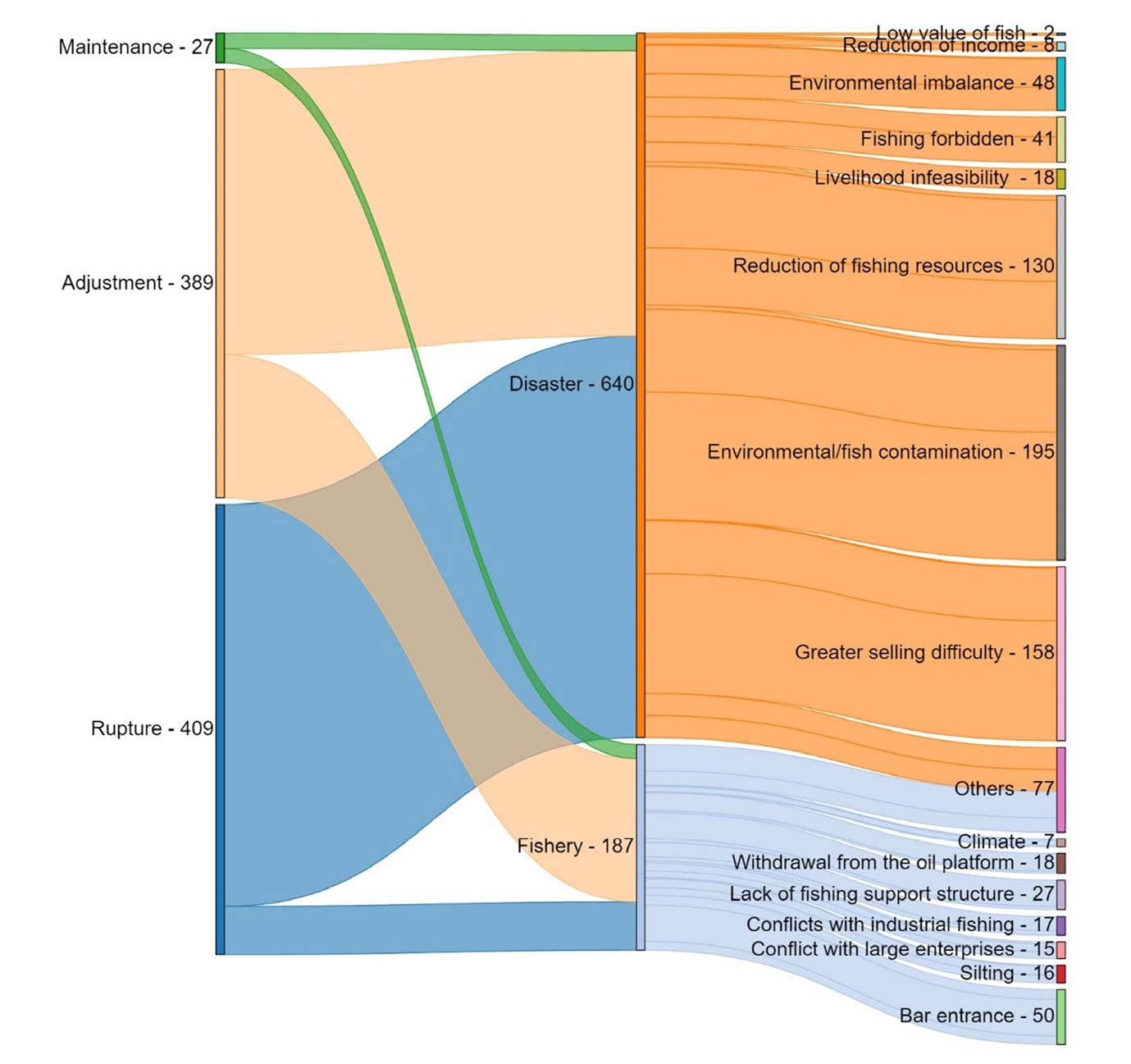
Sankey diagram with the main stressors pointed out by the three groups, separated by problems resulting from the disaster and problems more intrinsic to the fisheries. Rupture is related to more stressors than other groups, and because of this, it has a larger number of stressors.
Among the main stressors, the three groups indicate that the aftermaths of dam failure were the greatest challenge to overcome. The greatest stressor was “environmental and/or fish contamination,” which was the main problem reported by the Maintenance group and the second most reported problem by the Adjustment and Rupture groups. The “reduction of fishing resources” and the “greater difficulty in selling” were other challenges pointed out with many mentions by the three groups ( Figure 3 ). Stressors related to fisheries were less frequent, with the most reported being the “closure of the sandbar channel” and the “lack of infrastructure for fishing activity” ( Figure 3 ).
In summary, it can be noted that, to some degree, the groups continue to be affected by dam failure. All groups need to find a way to manage stressors such as environmental contamination and reduce fish stocks. At the same time, marketing also faces new hurdles, with greater fish rejection.
Characterization of the groups formed from adaptation strategies
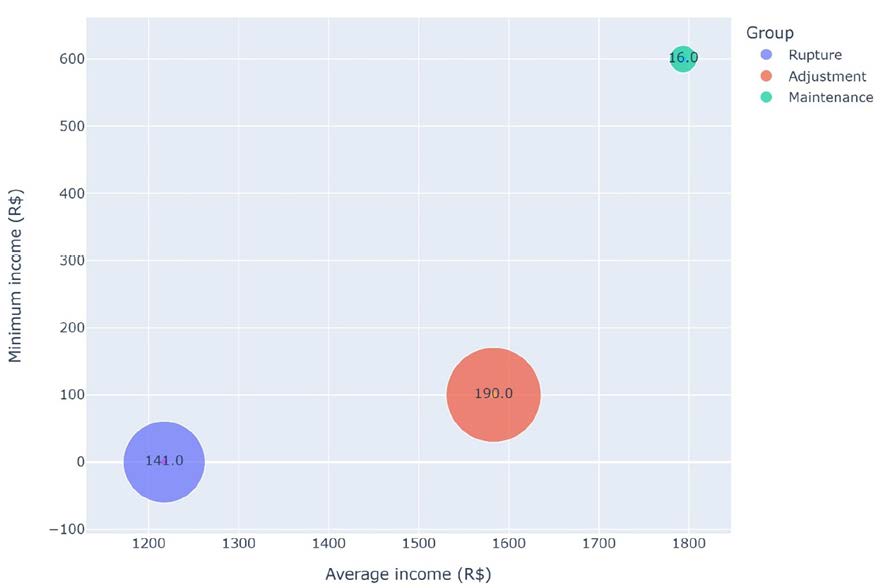
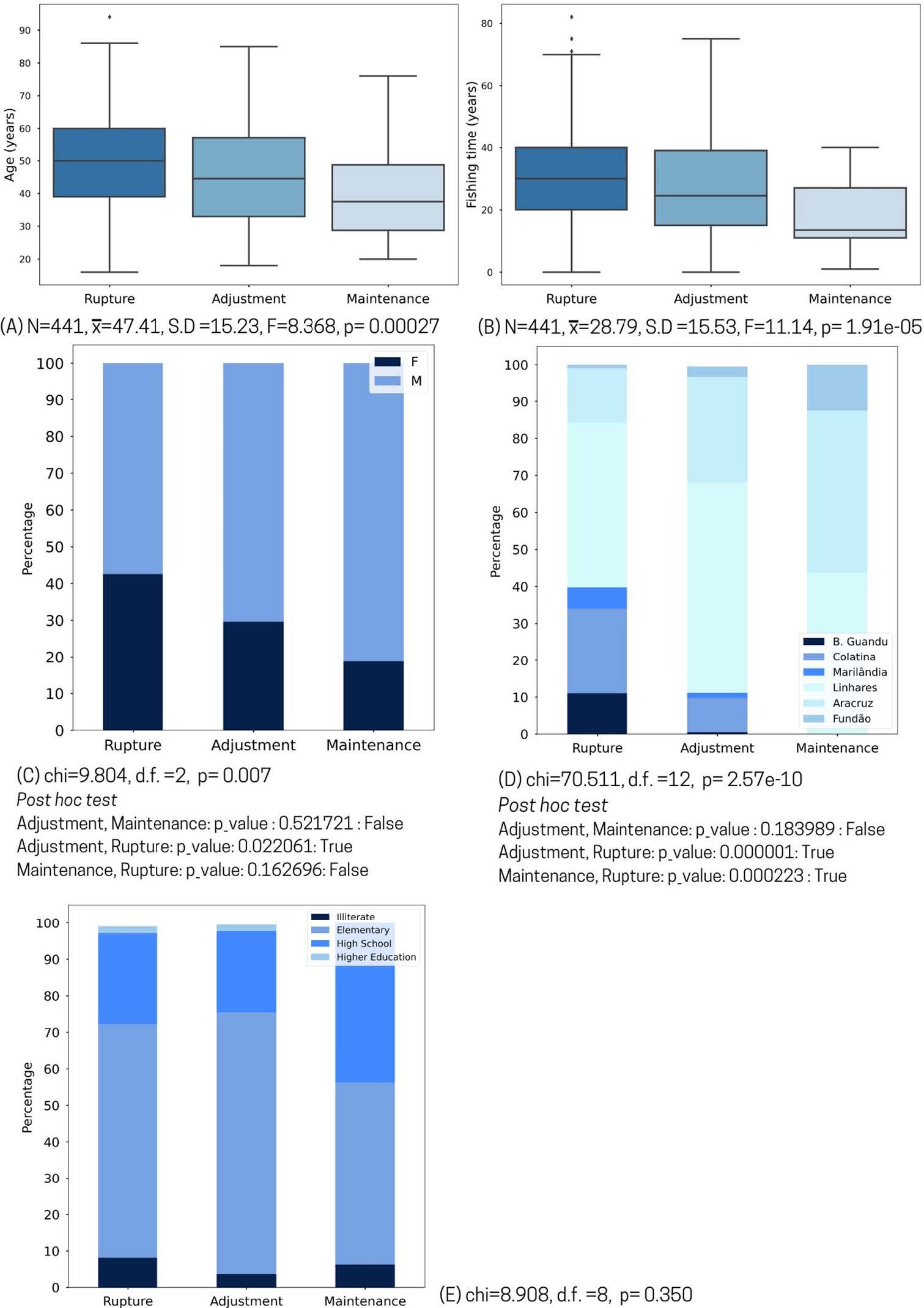
The Rupture group has the lowest average income of R$ 1,217.24 (SD = 582.66) and is the only group with a minimum income of zero ( Figure 4 ). This group also was characterized by older fishers, with a mean age of 50.39 years (SD = 15.12), and more experienced, with a mean time in the activity of 32.01 years (SD = 15.81) ( Figure 5 A and B). It has a higher proportion of residents from municipalities closer to the dam failure and women. The invisibility of women in fishing is highlighted by the higher number of complaints to the Renova Foundation’s ombudsman, given the lack of recognition of the economic and subsistence activities previously performed in the fisheries value chains of the region (FGV, 2019 ).
The Adjustment group had an average age of 45.02 years (SD = 14.78) and an average of 26.45 years working in fishing (SD = 14.70) ( Figure 5 A and B). The proportion of women and residents closer to the dam failure is intermediate between other groups, as is the income, which has an average of R$ 1,583.16 (SD = 1037.60) but also has the highest internal variation, considering the value of the standard deviation ( Figure 4 ).
The Maintenance group is composed of younger people, with a mean age of 40.94 years (SD = 15.99), and less experienced people, with a mean of 18.25 years (SD = 12.71) ( Figure 5 A and 5 B). The proportion of women is the lowest in the three groups and only fishers from the coastal zone. It is the group with the highest average income of R$ 1,793.95 (SD = 727.06) and has the highest minimum income ( Figure 4 ).
Only regarding schooling have the groups shown no distinction, with completed or incomplete primary education (from two to eight years of schooling) being the most frequent schooling level. This demonstrates the low schooling level of the three groups, hindering assessments on whether higher schooling levels would represent a greater opportunity or bring any possibility of increased adaptive capacity. The other evaluated parameters showed statistically significant differences between the groups. Analyzing gender, a post hoc test showed statistically significant differences between Rupture and Adjustment, and it is possible to observe the proportion among genders in each group ( Figure 5 C) and consider that the municipalities Rupture is significantly different from the others ( Figure 5 D).
Relationship between the lowest monthly income and the average income in each group. The size of the circle indicates the number of people in each group, and the interviews are inside. Kruskal‒Wallis’s test result: H = 10.623, p value = 0. 00494

Socioeconomic parameters for the characterization of each of the groups in view of the adaptation strategies. The parameters are (A) Age, (B) Fishing time, (C) Gender, (D) Municipality, and (E) Schooling. Graphics C, D, and E show the proportion of classes; however, chi square tests were performed to determine the absolute number.
DISCUSSION
Barriers to adaptation
Corroborating other studies, we observed that the adaptive process is not uniform (Osbahr et al., 2010 ; Sievanen, 2014 ; Marín, 2019 ; Silva et al., 2019 ; Huynh et al., 2021 ) and is linked to socioeconomic factors (Nielsen and Reenberg, 2010 ; Sievanen, 2014 ; Abu Samah et al., 2019 ; Huynh et al., 2021 ). There are geographic and social barriers to be overcome to reduce the vulnerability of some groups.
There is a longitudinal gradient of impact from the region closest to dam failure toward the coast, which indicates a greater exposure to damage, considering exposure as a component of vulnerability (Adger, 2006 ). This proximity also indicates a lack of flexibility in fishing activities (Cinner, et al., 2018 ; Cinner and Barnes, 2019 ; Barnes et al., 2020 ), which is a component of adaptative capacity. Flexibility in this study refers to the possibility of changing fishing areas and targeted species. However, this explanation only covers part of the problem. Social barriers, such as gender, age, and experience time, also contribute to the situation, which is described in this study.
Gender analysis reveals that fisherwomen were more impacted. The importance of women in fishing has been neglected, with difficulties in recognizing their participation in catches, promoting food security, generating income (Kleiber et al., 2015 ; Harper Id et al., 2020 ), implementing public policies (Lawless et al., 2021 ), and as a research focus (Andrade et al., 2021 ). In Burkina Faso, a study on climate adaptations concluded that aspects such as gender and class (Nielsen and Reenberg, 2010 ) need to be recognized and overcome. There is also a need to understand the local gender contract, which often demands modification to promote the adaptive capacity of the community (Caretta and Börjeson, 2015 ). In Brazil, the description of fisherwoman’s activity also involves a double workday, taking care of the home and children (Andrade et al., 2021 ). In this study, the double workday and responsibility for household chores may be one of the factors that hinders fisherwoman’s adaptation since, in this case, the adaptive response is linked to offshore fishing, far from land, with less flexibility in schedules and, therefore, less room for adaptation. Although this is a crucial issue in the Decade of Ocean Science for Sustainable Development and the 2030 Agenda, the creation of programs and policies on this bias is still necessary (Andrade et al., 2021 ). This shows a latent issue and specifically supports the results of this study.
Higher age as an adaptation limiting factor has been observed in other studies, in which conditions such as health issues, reduced mobility, and skill decline have been highlighted (Sievanen, 2014 ; Abu Samah et al., 2019 ). Here, once again, adaptation focused on offshore fishing may be a limiting factor due to physical exertion and time spent away from land. Moreover, when new economic activities were adopted, they were mostly related to the construction industry, which requires greater physical strength, making it even more difficult for older individuals to engage in productive activities. In addition, in the more adapted group, one of the factors that may have influenced the lower age is the influx of younger people into fishing activities due to the high unemployment rates that have plagued the country since 2015 (IBGE, 2022 ).
Typically, greater experience has the potential to generate substantial local knowledge, which could facilitate learning about the system, as was observed in Spain (Villasante et al., 2022 ). This learning is desirable both as a promoter of adaptive capacity (Cinner et al., 2018 ; Cinner and Barnes, 2019 ; Barnes et al., 2020 ) and as a builder of resilient systems (Biggs et al., 2009 ). In this case, with abrupt and unprecedented changes, the scenario becomes more complex. Rapid modifications combined with a lack of understanding about the severity of the situation limit fishers’ perception and hinder the development of possible solutions (Oliveira et al., 2020 ). However, given the magnitude of the impact of the dam failure (Hatje et al., 2017 ), it is expected that no isolated expertise is capable of identifying solutions. The lack of social participation in the repair process (Losekann et al., 2020 ) highlights this paradox since the local knowledge of more experienced fishers is excluded, leaving a knowledge gap.
Adaptation strategies
Apart from socioeconomic factors, it is imperative to demonstrate that the Rupture group, which discontinued its fishing practices, faced the most adverse conditions, characterized by low income and challenges in seeking alternative occupations. The adaptations observed were directly linked to changes within the fishing activity in the Adjustment group. This reinforces that the assumption that fishers will readily alter their way of life when confronted with extreme difficulties may not hold true (Partelow et al., 2020 ) due to the high degree of satisfaction generated by fishing activity (Seara et al., 2017 ; Partelow et al., 2020 ). An analysis of the recovery of SSF on the US coast after a severe lobster mortality event showed that fishers had not fully recovered after 20 years, with ongoing social and psychological impacts (Seara et al., 2022 ).
The adoption of new livelihoods has been identified as a factor that promotes adaptive capacities (Ilosvay et al., 2022 ); however, in this case, it was not frequent. Further strategies require adjustments, as factors such as low levels of schooling, advanced age, and commitment to household duties seem to have acted as limiting factors. The adoption of new technologies that reduce the physical effort dependence in fishing activity can also be an option to include older fishers (Blythe et al., 2014 ). Financial support is also required, as it was found to be a hindrance to the most affected group, who presented the lowest monthly income. Similarly, investments in infrastructure (Silva et al., 2020 ) can be a factor in increasing adaptive capacity, with incentives toward adding value to fishery products.
Other aspects need to be considered in the recovery process. Strengthening social capital and social networks has been shown to be a relevant factor in this process (Cinner and Bodin, 2010 ; Crona and Bodin, 2010 ; Marín et al., 2015 ; Cinner and Barnes, 2019 ; Marín, 2019 ; Kluger et al., 2020 ). It is worth noting that the opposite path was taken in the recovery of this case study, as social fragmentation occurred since the compensation process (Losekann et al., 2020 ).
Social participation and the need for the inclusion of local and traditional knowledge for natural resource management have a vast literature (Medeiros et al., 2014 ; Defeo et al., 2016 ; Ungar, 2018 ; Crona et al., 2019 ; Mozumder et al., 2020 ; Silva et al., 2020 ). In the case of post-disaster recovery, there is still a field of research to be further explored, especially in human-made disasters. However, knowledge coproduction in natural disasters has been identified as a promising choice. It is a relevant factor in the engagement and construction of more sustainable trajectories in contrast to a model of isolated decision-making, either by the government or private initiatives that have not worked (Rayamajhee et al., 2022 ).
Nevertheless, none of these strategies avoid or mitigate the main stressors observed. The polluted environment and contaminated fish stocks, as well as the challenge in selling due to the risk of consuming the catch and reduced selling prices, affect all groups. Other studies show similar difficulties encountered by SSF in contaminated areas (Estevo et al., 2021 ). Thus, identifying whether there are safe fishing areas, potentially in lagoons, tributaries, or more remote coastal zones, coupled with actions for restoring native fish stocks, could drive strategies aimed at sustainable fishing. The diversification of economic activities can be linked to the fishery sector, adding value and enhancing the proximity of fishers to fishing, thereby improving fishery activity. Furthermore, the proper communication of environmental monitoring becomes urgent for decision-making regarding necessary actions.
Unfortunately, the disaster risk similar to the one studied here remains present, as the global scenario points to an increasing global demand for minerals, and thus, the realization that tailings dams will be increasingly larger, with high volume and based on the “incremental construction” model (Owen et al., 2020 ). Brazil is an example of this, as it has already experienced another major disaster resulting from the collapse of a mining tailings dam in the Paraopeba River, state of Minas Gerais (de Lima et al., 2020b ; Chateauraynaud and Debaz, 2021 ).
CONCLUSION
The dam failure was a disruptive event in the socioecological system of the Rio Doce basin, and the drastic change in the environmental component resulted in several changes in the social component. This research focused on the small-scale fisheries and analyzed changes at the local level in the social component of human-made disasters. Consistent with observations in natural disasters, the results indicate that adaptive capacity was not homogeneous. For instance, the group most affected is located further away from the coastal zone and has a higher proportion of women, experienced fishers, and older adults. This group also has lower income and is economically more dependent on indemnities. The distinction of social groups highlights the importance of local-scale studies on adaptations in socioecological systems. At the same time, the primary adaptation strategies are focused on fishing activities, particularly by capturing other target species and changes in fishing areas. Identifying whether there are safe fishing locations and implementing actions for the restoration of fish stocks can bolster these strategies. All affected groups reported main stress factors related to the catastrophe, highlighting the importance of a recovering environmental quality. Considering that the affected population has not had opportunities for participation and decision-making in the recovery from this disaster, and given the complexity of this issue, it is worth highlighting the potential for improvement via the implementation of more participatory frameworks focused on mitigation and recovery measures. Our findings highlight the challenges associated with post-disaster reconstruction after a regime shift.
ACKNOWLEDGMENTS
To the fishers who voluntarily collaborated with this research. To the PMAP team for their work and dedication. The present work was carried out with funding from the Renova Foundation, as part of the fulfillment of the Conduct Adjustment Transaction Term (TTAC), through the Project for Fishery Monitoring Program, contract number 8600002299, developed by the Fisheries Institute and Federal University of Espírito Santo. The Renova Foundation is the entity responsible for the reparation of the damages caused by the collapse of the Fundão dam in Mariana (MG, Brazil). It is a nonprofit organization, the result of a legal commitment called Transaction and Conduct Adjustment Term (TTAC), and it did not play any role in the interpretation of the results or preparation of the manuscript. The authors also thank the anonymous reviewers for their contributions.
REFERENCES
-
Abu Samah, A., Shaffril, H. A. M., Hamzah, A. & Abu Samah, B. 2019. Factors affecting small-scale fishermen’s adaptation toward the impacts of climate change: reflections from Malaysian fishers. SAGE Open, 9(3). DOI: https://doi.org/10.1177/2158244019864204
» https://doi.org/10.1177/2158244019864204 -
Adger, W. N. 2006. Vulnerability. Global Environmental Change, 16(3), 268–281. DOI: https://doi.org/10.1016/j.gloenvcha.2006.02.006
» https://doi.org/10.1016/j.gloenvcha.2006.02.006 -
Adger, W. N., Dessai, S., Goulden, M., Hulme, M., Lorenzoni, I., Nelson, D. R., Naess, L. O., Wolf, J. & Wreford, A. 2009. Are there social limits to adaptation to climate change? Climatic Change, 93(3–4), 335–354. DOI: https://doi.org/10.1007/s10584-008-9520-z
» https://doi.org/10.1007/s10584-008-9520-z -
Amadu, I., Armah, F. A. & Aheto, D. W. 2021. Assessing livelihood resilience of artisanal fisherfolk to the decline in small-scale fisheries in Ghana. Sustainability (Switzerland), 13(18). DOI: https://doi.org/10.3390/su131810404
» https://doi.org/10.3390/su131810404 -
Andrade, M. M. de, Xavier, L. Y., Grilli, N. de M., Oliveira, C. C. de, de Andrade, D. A. de, Barreto, G. C., Hellebrandt, L., Galvão, M. C., Silva, S. T. da, Mont’alverne, T. C. F. & Gonçalves, L. R. 2021. Gender and small-scale fisheries in Brazil: Insights for a sustainable development agenda. Ocean and Coastal Research, 69, 1–19. DOI: https://doi.org/10.1590/2675-2824069.21033mmda
» https://doi.org/10.1590/2675-2824069.21033mmda - Barbetta, P. A. 2007. Estatística aplicada às Ciências Sociais (7. ed.), Florianópolis, UFSC.
-
Barnes, M. L., Wang, P., Cinner, J. E., Graham, N. A. J., Guerrero, A. M., Jasny, L., Lau, J., Sutcliffe, S. R. & Zamborain-Mason, J. 2020. Social determinants of adaptive and transformative responses to climate change. Nature Climate Change, 10(9), 823–828. DOI: https://doi.org/10.1038/s41558-020-0871-4
» https://doi.org/10.1038/s41558-020-0871-4 -
Biernacki, P. & Waldorf, D. 1981. Snowball Sampling: Problems and Techniques of Chain Referral Sampling. Sociological Methods & Research, 10(2), 141–163. DOI: https://doi.org/10.1177/004912418101000205
» https://doi.org/10.1177/004912418101000205 -
Biggs, R., Carpenter, S. R. & Brock, W. A. 2009. Turning back from the brink: detecting an impending regime shift in time to avert it. Proceedings of the National Academy of Sciences of the United States of America, 106(3), 826–831. DOI: https://doi.org/10.1073/pnas.0811729106
» https://doi.org/10.1073/pnas.0811729106 -
Blythe, J. L., Murray, G. & Flaherty, M. 2014. Strengthening threatened communities through adaptation: Insights from coastal Mozambique. Ecology and Society, 19(2). DOI: https://doi.org/10.5751/ES-06408-190206
» https://doi.org/10.5751/ES-06408-190206 -
Bonecker, A. C. T., Menezes, B. S., Dias Junior, C., Silva, C. A. da, Ancona, C. M., Dias, C. de O., Longhini, C. M., Costa, E. S., Sá, F., Lázaro, G. C. S., Mill, G. N., Rocha, G. M., Lemos, K. do N., Conceição, L. R., Demoner, L. E., Fernandes, L. F. L., Castro, M. S. de, Alves, M. M., Laino, P. de S., Auer, P. P. B., Cagnin, R. C., Ghisolfi, R. D., Neto, R. R. & Bonecker, S. L. C. 2022. An integrated study of the plankton community after four years of Fundão dam disaster. Science of The Total Environment, 806, 150613. DOI: https://doi.org/10.1016/J.SCITOTENV.2021.150613
» https://doi.org/10.1016/J.SCITOTENV.2021.150613 -
Botelho, M. R., Faria, M. P., Mayr, C. T. R. & Oliveira, L. M. G. de. 2021. Rompimento das barragens de Fundão e da Mina do Córrego do Feijão em Minas Gerais, Brasil: decisões organizacionais não tomadas e lições não aprendidas. Revista Brasileira de Saúde Ocupacional, 46, 1–10. DOI: https://doi.org/10.1590/2317-6369000018519
» https://doi.org/10.1590/2317-6369000018519 -
Bowker, L. & Chambers, D. 2017. In the dark shadow of the supercycle tailings failure risk & public liability reach all time highs. Environments, 4(4), 75. DOI: https://doi.org/10.3390/environments4040075
» https://doi.org/10.3390/environments4040075 -
Caretta, M. A. & Börjeson, L. 2015. Local gender contract and adaptive capacity in smallholder irrigation farming: a case study from the Kenyan drylands. Gender, Place & Culture, 22(5), 644–661. DOI: https://doi.org/10.1080/0966369X.2014.885888
» https://doi.org/10.1080/0966369X.2014.885888 -
Carlos, E. 2020. Civil society and social mobilizations in the context of the rio doce socioenvironmental disaster. Integrated Environmental Assessment and Management, 16(5), 681–690. DOI: https://doi.org/10.1002/ieam.4282
» https://doi.org/10.1002/ieam.4282 -
Chaffin, B. C., Garmestani, A. S., Gunderson, L. H., Benson, M. H., Angeler, D. G., Arnold, C. A., Cosens, B., Craig, R. K., Ruhl, J. B. & Allen, C. R. 2016. Transformative Environmental Governance. Annual Review of Environment and Resources, 41(1), 399–423. DOI: https://doi.org/10.1146/annurev-environ-110615-085817
» https://doi.org/10.1146/annurev-environ-110615-085817 -
Chateauraynaud, F. & Debaz, J. 2021. Plurality of temporalities, complexity and contingency in repairing after dam failures in Minas Gerais. Rethinking Post-Disaster Recovery, 143–161. DOI: https://doi.org/10.4324/9781003184782-10
» https://doi.org/10.4324/9781003184782-10 -
Cinner, J. E., Adger, W. N., Allison, E. H., Barnes, M. L., Brown, K., Cohen, P. J., Gelcich, S., Hicks, C. C., Hughes, T. P., Lau, J., Marshall, N. A. & Morrison, T. H. 2018. Building adaptive capacity to climate change in tropical coastal communities. Nature Climate Change, 8, 117-123. DOI: https://doi.org/10.1038/s41558-017-0065-x
» https://doi.org/10.1038/s41558-017-0065-x -
Cinner, J. E. & Barnes, M. L. 2019. Social Dimensions of Resilience in Social-Ecological Systems. One Earth, 1(1), 51–56. DOI: https://doi.org/10.1016/j.oneear.2019.08.003
» https://doi.org/10.1016/j.oneear.2019.08.003 -
Cinner, J. E. & Bodin, Ö. 2010. Livelihood diversification in tropical coastal communities: A network-based approach to analyzing livelihood landscapes. PLoS ONE, 5(8). DOI: https://doi.org/10.1371/journal.pone.0011999
» https://doi.org/10.1371/journal.pone.0011999 -
Cinner, J. E., Huchery, C., Hicks, C. C., Daw, T. M., Marshall, N., Wamukota, A. & Allison, E. H. 2015. Changes in adaptive capacity of Kenyan fishing communities. Nature Climate Change, 5(9), 872–876. DOI: https://doi.org/10.1038/nclimate2690
» https://doi.org/10.1038/nclimate2690 -
Cohen, P. J., Lawless, S., Dyer, M., Morgan, M., Saeni, E., Teioli, H. & Kantor, P. 2016. Understanding adaptive capacity and capacity to innovate in social–ecological systems: Applying a gender lens. Ambio, 45(S3), 309–321. DOI: https://doi.org/10.1007/s13280-016-0831-4
» https://doi.org/10.1007/s13280-016-0831-4 - Corder, G. W. & Foreman, D. I. 2009. Nonparametric Statistics for Non-Statisticians: A Step-by-Step Approach. John Wiley & Sons.
-
Crona, B. & Bodin, Ö. 2010. Power Asymmetries in Small-Scale Fisheries: a Barrier to Governance Transformability? Ecology And Society, 15(4). Available from: http://www.ecologyandsociety.org/vol15/iss4/art32/ Access date: 2023 July 11
» http://www.ecologyandsociety.org/vol15/iss4/art32/ -
Crona, B., Käll, S. & van Holt, T. 2019. Fishery Improvement Projects as a governance tool for fisheries sustainability: A global comparative analysis. PLoS ONE, 14(10), 1–20. DOI: https://doi.org/10.1371/journal.pone.0223054
» https://doi.org/10.1371/journal.pone.0223054 -
Dadalto, M. C., Rodrigues, I., Claudino, J. & Fernandes, L. F. L. 2020. Changes perceived by traditional fishing communities after a major dam disaster in Brazil. International Journal of Environmental Studies, 77(3), 412–420. DOI: https://doi.org/10.1080/00207233.2019.1663628
» https://doi.org/10.1080/00207233.2019.1663628 -
Defeo, O., Castrejón, M., Pérez-Castañeda, R., Castilla, J. C., Gutiérrez, N. L., Essington, T. E. & Folke, C. 2016. Comanagement in Latin American small-scale shellfisheries: Assessment from long-term case studies. Fish and Fisheries, 17(1), 176–192. DOI: https://doi.org/10.1111/faf.12101
» https://doi.org/10.1111/faf.12101 -
Estevo, M. de O., Lopes, P. F. M., Oliveira Júnior, J. G. C. de, Junqueira, A. B., Santos, A. P., Lima, J. A. da S., Malhado, A. C. M., Ladle, R. J. & Campos-Silva, J. V. 2021. Immediate social and economic impacts of a major oil spill on Brazilian coastal fishing communities. Marine Pollution Bulletin, 164, 111984. DOI: https://doi.org/10.1016/j.marpolbul.2021.111984
» https://doi.org/10.1016/j.marpolbul.2021.111984 -
FAO (Food and Agriculture Organization). 2020. The state of world fisheries and aquaculture 2020. Sustainability in action. DOI: https://doi.org/10.4060/ca9229en
» https://doi.org/10.4060/ca9229en -
Fernandes, G. W., Goulart, F. F., Ranieri, B. D., Coelho, M. S., Dales, K., Boesche, N., Bustamante, M., Carvalho, F. A., Carvalho, D. C., Dirzo, R., Fernandes, S., Galetti, P. M., Millan, V. E. G. G., Mielke, C., Ramirez, J. L., Neves, A., Rogass, C., Ribeiro, S. P., Scariot, A. & Soares-Filho, B. 2016. Deep into the mud: ecological and socioeconomic impacts of the dam breach in Mariana, Brazil. Natureza & Conservação, 14(2), 35–45. DOI: https://doi.org/10.1016/j.ncon.2016.10.003
» https://doi.org/10.1016/j.ncon.2016.10.003 - FGV (Fundação Getúlio Vargas). 2019. A situação das mulheres atingidas pelo desastre do rio doce a partir dos dados da ouvidoria da Fundação Renova, Rio de Janeiro, Fundação Getúlio Vargas.
-
Folke, C. 2016. Resilience. In: Oxford Research Encyclopedia of Environmental Science, Oxford; Oxford University Press. DOI: https://doi.org/10.1093/acrefore/9780199389414.013.8
» https://doi.org/10.1093/acrefore/9780199389414.013.8 -
Furman, K. L., Aminpour, P., Gray, S. A. & Scyphers, S. B. 2021. Mental models for assessing coastal social-ecological systems following disasters. Marine Policy, 125, 104334. DOI: https://doi.org/10.1016/j.marpol.2020.104334
» https://doi.org/10.1016/j.marpol.2020.104334 -
Gomes, V. A. P., Jankowsky, M., Carvalho, R. M. de & Freitas, R. R. de. 2021. Aspectos sociais, pré e pós rompimento da barragem de Fundão, na bacia do Rio Doce, Brasil. Brazilian Journal of Production Engineering – BJPE, 41–62. DOI: https://doi.org/10.47456/bjpe.v6i8.33948
» https://doi.org/10.47456/bjpe.v6i8.33948 -
Gonçalves-Neto, J. B., Goyanna, F. A. de A., Feitosa, C. V., Soares, M. O., Neto, J. B. G., Goyanna, F. A. de A., Feitosa, C. V. & Soares, M. O. 2021. A sleeping giant: the historically neglected Brazilian fishing sector. Ocean & Coastal Management, 209(February), 105699. DOI: https://doi.org/10.1016/j.ocecoaman.2021.105699
» https://doi.org/10.1016/j.ocecoaman.2021.105699 -
Harper Id, S., Adshade, M., Lam, V. W. Y., Pauly, D. & Rashid Sumaila, U. 2020. Valuing invisible catches: Estimating the global contribution by women to small-scale marine capture fisheries production. Plos ONE, 4. DOI: https://doi.org/10.1371/journal.pone.0228912
» https://doi.org/10.1371/journal.pone.0228912 -
Hatje, V., Pedreira, R. M. A., Rezende, C. E. de, Schettini, C. A. F., Souza, G. C. de, Marin, D. C. & Hackspacher, P. C. 2017. The environmental impacts of one of the largest tailing dam failures worldwide. Scientific Reports, 7(1), 10706. DOI: https://doi.org/10.1038/s41598-017-11143-x
» https://doi.org/10.1038/s41598-017-11143-x -
Huynh, P. T. A., Le, N. D., Le, S. T. H. & Tran, T. N. 2021. Adaptive livelihood strategies among small-scale fishing households to climate change-related stressors in Central Coast Vietnam. International Journal of Climate Change Strategies and Management, 13(4–5), 492–510. DOI: https://doi.org/10.1108/IJCCSM-04-2020-0034
» https://doi.org/10.1108/IJCCSM-04-2020-0034 -
IBGE (Instituto Brasileiro de Geografia e estatística). 2022. PME – Pesquisa Mensal de Emprego. Available from: https://www.ibge.gov.br/estatisticas/sociais/trabalho/9180-pesquisa-mensal-de-emprego.html?=&t=destaques Access date: 2022 July 4.
» https://www.ibge.gov.br/estatisticas/sociais/trabalho/9180-pesquisa-mensal-de-emprego.html?=&t=destaques -
Ibrahin, F. R. C. de A. 2021. A morte do Rio Doce: um estudo sobre os impactos do “desastre da Samarco” na vida dos pescadores e moradores do município de Tumiritinga/MG. (Doctoral Thesis). Pontifícia Universidade Católica de São Paulo, São Paulo. Available from: https://tede2.pucsp.br/handle/handle/23675 Acess date: 2024 june 7.
» https://tede2.pucsp.br/handle/handle/23675 -
IEF-MG (Instituto Estadual de Florestas de Minas Gerais). 2017. Portaria n. 40, de 11 de maio de 2017. Dispõe sobre a proibição da pesca na bacia do rio Doce. Belo Horizonte: Instituto Estadual de Florestas. Accessed: http://jornal.iof.mg.gov.br/xmlui/handle/123456789/182096
» http://jornal.iof.mg.gov.br/xmlui/handle/123456789/182096 -
Ilosvay, X. É. E., Molinos, J. G. & Ojea, E. 2022. Stronger adaptive response among small-scale fishers experiencing greater climate change hazard exposure. Communications Earth and Environment, 3(1), 1–9. DOI: https://doi.org/10.1038/s43247-022-00577-5
» https://doi.org/10.1038/s43247-022-00577-5 -
Islam, K. & Murakami, S. 2021. Global-scale impact analysis of mine tailings dam failures: 1915–2020. Global Environmental Change, 70, 102361. DOI: https://doi.org/10.1016/j.gloenvcha.2021.102361
» https://doi.org/10.1016/j.gloenvcha.2021.102361 - Jain, R. K., Cui, Z. C. & Domem, J. 2017. Environmental Impact of Mining and Mineral Processing - Management, Monitoring and Auditing Strategies. Oxford, Butterworth-Heinemann.
-
Jepson, M. & Colburn, L. L. 2013. Development of Social Indicators of Fishing Community Vulnerability and Resilience in the U.S. Southeast and Northeast Regions. Technical Memorandum NMFS-F/SPO-129. Available from: https://repository.library.noaa.gov/view/noaa/4438 . Acess date: 2024 june 7.
» https://repository.library.noaa.gov/view/noaa/4438 -
Kleiber, D., Harris, L. M. & Vincent, A. C. J. 2015. Gender and small-scale fisheries: A case for counting women and beyond. Fish and Fisheries, 16(4), 547–562. DOI: https://doi.org/10.1111/faf.12075
» https://doi.org/10.1111/faf.12075 -
Kluger, L. C., Gorris, P., Kochalski, S., Mueller, M. S., Romagnoni, G. & Lotta Kluger, C. C. 2020. Studying human-nature relationships through a network lens: A systematic review. People and Nature, 2(4), 1100–1116. DOI: https://doi.org/10.1002/pan3.10136
» https://doi.org/10.1002/pan3.10136 -
Knox, W. & Trigueiro, A. 2014. A pesca artesanal, conflitos e novas configurações. Revista Espaço de Diálogo e Desconexão, 8(2). DOI: https://doi.org/https://doi.org/10.32760/1984-1736/REDD/2014.v8i2.6956
» https://doi.org/10.32760/1984-1736/REDD/2014.v8i2.6956 -
Lawless, S., Cohen, P. J., Mangubhai, S., Kleiber, D. & Morrison, T. H. 2021. Gender equality is diluted in commitments made to small-scale fisheries. World Development, 140, 105348. DOI: https://doi.org/10.1016/J.WORLDDEV.2020.105348
» https://doi.org/10.1016/J.WORLDDEV.2020.105348 -
Lejano, R. P., Haque, C. E. & Berkes, F. 2021. Coproduction of risk knowledge and improvement of risk communication: A three-legged stool. International Journal of Disaster Risk Reduction, 64, 102508. DOI: https://doi.org/10.1016/j.ijdrr.2021.102508
» https://doi.org/10.1016/j.ijdrr.2021.102508 -
Lima, A. T., Bastos, F. A., Teubner, F. J., Neto, R. R., Cooper, A. & Barroso, G. F. 2020. Strengths and Weaknesses of a Hybrid Post-disaster Management Approach: the Doce River (Brazil) Mine-Tailing Dam Burst. Environmental Management, 65(6), 711–724. DOI: https://doi.org/10.1007/s00267-020-01279-4
» https://doi.org/10.1007/s00267-020-01279-4 -
Lima, R. E. de, Lima Picanço, J. de, Silva, A. F. da & Acordes, F. A. 2020. An anthropogenic flow type gravitational mass movement: the Córrego do Feijão tailings dam disaster, Brumadinho, Brazil. Landslides. DOI: https://doi.org/10.1007/s10346-020-01450-2
» https://doi.org/10.1007/s10346-020-01450-2 -
Longo, S. B., Clausen, R. & Clark, B. 2015. The Tragedy of the Commodity, New Brunswick, Rutgers University Press. Available from: http://www.jstor.org/stable/j.ctt16xwb3r Acess date: 2021 june 7.
» http://www.jstor.org/stable/j.ctt16xwb3r -
Losekann, C., Dias, T. H. & Camargo, A. V. M. 2020. The Rio Doce mining disaster: Legal framing in the Brazilian justice system. The Extractive Industries and Society, 7(1), 199–208. DOI: https://doi.org/10.1016/j.exis.2019.11.015
» https://doi.org/10.1016/j.exis.2019.11.015 -
Lyu, Z., Chai, J., Xu, Z., Qin, Y. & Cao, J. 2019. A Comprehensive Review on Reasons for Tailings Dam Failures Based on Case History. Advances in Civil Engineering, 2019, 1–18. DOI: https://doi.org/10.1155/2019/4159306
» https://doi.org/10.1155/2019/4159306 -
Mancini, L. & Sala, S. 2018. Social impact assessment in the mining sector: Review and comparison of indicators frameworks. Resources Policy, 57, 98–111. DOI: https://doi.org/10.1016/J.RESOURPOL.2018.02.002
» https://doi.org/10.1016/J.RESOURPOL.2018.02.002 -
Marín, A. 2019. Adaptive Capacity to Coastal Disasters: Challenges and Lessons from Small-Scale Fishing Communities in Central-Southern Chile. In: Maritime Studies (vol. 13, pp. 51–78). New York: Springer. DOI: https://doi.org/10.1007/978-3-319-76078-0_3
» https://doi.org/10.1007/978-3-319-76078-0_3 -
Marín, A., Bodin, Ö., Gelcich, S. & Crona, B. 2015. Social capital in post-disaster recovery trajectories: Insights from a longitudinal study of tsunami-impacted small-scale fisher organizations in Chile. Global Environmental Change, 35, 450–462. DOI: https://doi.org/10.1016/j.gloenvcha.2015.09.020
» https://doi.org/10.1016/j.gloenvcha.2015.09.020 -
Mattos, S. M. G. de, Mendonça, J. T., Ferreira, B. M. P., Souza Mattos, M. P. de, Wojciechowski, M. J. & Gerhardinger, L. C. 2022. Coastal Small-Scale Fisheries in Brazil: Resentment Against Policy Disarray BT - Blue Justice: Small-Scale Fisheries in a Sustainable Ocean Economy. In: Jentoft, S., Chuenpagdee, R., Bugeja Said, A. & Isaacs, M. (Ed.). Blue Justice (vol. 26, pp. 35–54). New York: Springer International Publishing. DOI: https://doi.org/10.1007/978-3-030-89624-9_3
» https://doi.org/10.1007/978-3-030-89624-9_3 -
Medeiros, R. P., Serafini, T. Z. & McConney, P. 2014. Fortalecendo o ecosystem stewardship na pesca artesanal: perspectivas para a América Latina e Caribe. Desenvolvimento e Meio Ambiente, 32, 181–191. DOI: https://doi.org/10.5380/dma.v32i0.38819
» https://doi.org/10.5380/dma.v32i0.38819 -
Mitchell, J. K., O’Neill, K., McDermott, M. & Leckner, M. 2016. Toward a Transformative Role for Local Knowledge in Post-Disaster Recovery: Prospects for Co-Production in the Wake of Hurricane Sandy. Journal of Extreme Events, 3(1), 1650003. DOI: https://doi.org/10.1142/s2345737616500032
» https://doi.org/10.1142/s2345737616500032 -
Mourão, A. O., Santos, M. S., Costa, A. S. V. da, Silva, H. T. da, Maia, L. F. O., Faria, M. C. da S., Rodriguez, M. del V. R. & Rodrigues, J. L. 2023. Assessment of health risk and presence of metals in water and fish samples from Doce River, Brazil, after Fundão dam collapse. Archives of Environmental Contamination and Toxicology, 29. DOI: https://doi.org/10.1007/s00244-023-00991-6
» https://doi.org/10.1007/s00244-023-00991-6 -
Mozumder, M. M. H., Pyhälä, A., Wahab, M. A., Sarkki, S., Schneider, P. & Islam, M. M. 2020. Governance and power dynamics in a small-scale hilsa shad (Tenualosa ilisha) fishery: A case study from Bangladesh. Applied Sciences (Switzerland), 12(14), 1–24. DOI: https://doi.org/10.3390/su12145738
» https://doi.org/10.3390/su12145738 -
Ministério Público Federal. 2016. Ação Civil Pública 0002571-13.2016.4.02.5004. Brasília, DF. Available from: http://www.mpf.mp.br/mg/sala-de-imprensa/docs/acp-samarco . Access date: 2024 june 7.
» http://www.mpf.mp.br/mg/sala-de-imprensa/docs/acp-samarco -
Neves, A. C. O., Nunes, F. P., Carvalho, F. A. de & Fernandes, G. W. 2016. Neglect of ecosystems services by mining, and the worst environmental disaster in Brazil. Natureza & Conservação, 14, 24–27. DOI: https://doi.org/10.1016/j.ncon.2016.03.002
» https://doi.org/10.1016/j.ncon.2016.03.002 -
Nielsen, J. Ø. & Reenberg, A. 2010. Cultural barriers to climate change adaptation: A case study from Northern Burkina Faso. Global Environmental Change, 20(1), 142–152. DOI: https://doi.org/10.1016/j.gloenvcha.2009.10.002
» https://doi.org/10.1016/j.gloenvcha.2009.10.002 -
Niquito, T. W., Pozzobon, F., Halmenschlager, V. & Ribeiro, F. G. 2021. Human-made disasters and economic impact for a developing economy: evidence from Brazil. Natural Hazards, 109(3), 2313–2341. DOI: https://doi.org/10.1007/s11069-021-04921-4
» https://doi.org/10.1007/s11069-021-04921-4 -
Oliveira, P. D. C., di Beneditto, A. P. M., Quaresma, V. da S., Bastos, A. C. & Zappes, C. A. 2020. Traditional knowledge of Fishers versus an environmental disaster from mining waste in Central Brazil. Marine Policy, 120, 104129. DOI: https://doi.org/10.1016/j.marpol.2020.104129
» https://doi.org/10.1016/j.marpol.2020.104129 -
Osbahr, H., Twyman, C., Adger, W. N. & Thomas, D. S. G. 2010. Evaluating Successful Livelihood Adaptation to Climate Variability and change in Southern Africa. Ecology and Society, 15(2), 22. DOI: https://doi.org/10.5751/ES-03388-150227
» https://doi.org/10.5751/ES-03388-150227 -
Owen, J. R., Kemp, D., Lèbre Svobodova, K. & Pérez Murillo, G. 2020. Catastrophic tailings dam failures and disaster risk disclosure. International Journal of Disaster Risk Reduction, 42, 101361. DOI: https://doi.org/10.1016/J.IJDRR.2019.101361
» https://doi.org/10.1016/J.IJDRR.2019.101361 -
Partelow, S., Schlüter, A., Armitage, D., Bavinck, M., Carlisle, K., Gruby, R. L., Hornidge, A.-K. K., Le Tissier, M., Pittman, J. B., Song, A. M., Sousa, L. P., Văidianu, N. & Van Assche, K. 2020. Environmental governance theories: a review and application to coastal systems. Ecology and Society, 25(4). DOI: https://doi.org/10.5751/ES-12067-250419
» https://doi.org/10.5751/ES-12067-250419 - Pauly, D. 2006. Major Trends in Small-Scale Marine Fisheries, with Emphasis on Developing Countries, and Some Implication from Social Sciences. Maritime Studies, 4(2), 7–22.
-
Pauly, D. 2018. The future of artisanal fishing. Science, 360(6385), 161. DOI: https://doi.org/10.1126/science.aas9431
» https://doi.org/10.1126/science.aas9431 -
Rayamajhee, V., Storr, V. H. & Bohara, A. K. 2022. Social entrepreneurship, coproduction, and post-disaster recovery. Disasters, 46(1), 27–55. DOI: https://doi.org/10.1111/disa.12454
» https://doi.org/10.1111/disa.12454 -
Rocha, J. C., Peterson, G., Bodin, Ö. & Levin, S. 2018. Cascading regime shifts within and across scales. Science, 362(6421), 1379–1383. DOI: https://doi.org/10.1126/science.aat7850
» https://doi.org/10.1126/science.aat7850 -
Rosas-Muñoz, J. & Baquedano-Rodríguez, M. 2022. What can we learn about the natural disasters and multidimensional poverty link for artisanal fishery in Chile? Marine Policy, 144, 105225. DOI: https://doi.org/10.1016/j.marpol.2022.105225
» https://doi.org/10.1016/j.marpol.2022.105225 -
Salvador, G. N., Montag, L. F. A., Hughes, R. M., Almeida, S. M., Prudente, B. S., Pessali, T. C., Barroso, T. A., Cianciaruso, M. V., Ligeiro, R., Juen, L., & Carlucci, M. B. 2022. Influences of multiple anthropogenic disturbances coupled with a tailings dam rupture on spatiotemporal variation in fish assemblages of a tropical river. Freshwater Biology, 67, 1708–1724. https://doi.org/10.1111/fwb.13967
» https://doi.org/10.1111/fwb.13967» https://doi.org/10.1111/fwb.13967 -
Scheffer, M. & Carpenter, S. R. 2003. Catastrophic regime shifts in ecosystems: linking theory to observation. Trends in Ecology & Evolution, 18(12), 648–656. DOI: https://doi.org/10.1016/j.tree.2003.09.002
» https://doi.org/10.1016/j.tree.2003.09.002 -
Schuhbauer, A., Skerritt, D. J., Ebrahim, N., Le Manach, F. & Sumaila, U. R. 2020. The Global Fisheries Subsidies Divide Between Small- and Large-Scale Fisheries. Frontiers in Marine Science, 7. DOI: https://doi.org/10.3389/fmars.2020.539214
» https://doi.org/10.3389/fmars.2020.539214 -
Seara, T., Owens, A., Pollnac, R., Pomeroy, R. & Dyer, C. 2022. Lessons learned from a natural resource disaster: The long-term impacts of the Long Island Sound lobster die-off on individuals and communities. Marine Policy, 136, 104943. DOI: https://doi.org/10.1016/j.marpol.2021.104943
» https://doi.org/10.1016/j.marpol.2021.104943 -
Seara, T., Pollnac, R. B., Poggie, J. J., Garcia-Quijano, C., Monnereau, I. & Ruiz, V. 2017. Fishing as therapy: Impacts on job satisfaction and implications for fishery management. Ocean & Coastal Management, 141, 1–9. DOI: https://doi.org/10.1016/j.ocecoaman.2017.02.016
» https://doi.org/10.1016/j.ocecoaman.2017.02.016 -
Setten, G. & Lein, H. 2019. “We draw on what we know anyway”: The meaning and role of local knowledge in natural hazard management. International Journal of Disaster Risk Reduction, 38(May), 101184. DOI: https://doi.org/10.1016/j.ijdrr.2019.101184
» https://doi.org/10.1016/j.ijdrr.2019.101184 -
Shaffril, H. A. M., Abu Samah, A. & Samsuddin, S. F. 2022. The Impacts of Fishermen’s Resilience toward Climate Change on Their Well-Being. Sustainability (Switzerland), 14(6), 1–19. DOI: https://doi.org/10.3390/su14063203
» https://doi.org/10.3390/su14063203 -
Sievanen, L. 2014. How do small-scale fishers adapt to environmental variability? Lessons from Baja California, Sur, Mexico. Maritime Studies, 13(1), 1–19. DOI: https://doi.org/10.1186/s40152-014-0009-2
» https://doi.org/10.1186/s40152-014-0009-2 -
Silva, M. R. O., Pennino, M. G. & Lopes, P. F. M. 2019. Social-ecological trends: managing the vulnerability of coastal fishing communities. Ecology and Society, 24(4). DOI: https://doi.org/10.5751/ES-11185-240404
» https://doi.org/10.5751/ES-11185-240404 -
Silva, M. R. O., Pennino, M. G. & Lopes, P. F. M. 2020. A social-ecological approach to estimate fisher resilience: A case study from Brazil. Ecology and Society, 25(1). DOI: https://doi.org/10.5751/ES-11361-250123
» https://doi.org/10.5751/ES-11361-250123 -
Sitas, N., Reyers, B., Cundill, G., Prozesky, H. E., Nel, J. L. & Esler, K. J. 2016. Fostering collaboration for knowledge and action in disaster management in South Africa. Current Opinion in Environmental Sustainability, 19, 94–102. DOI: https://doi.org/10.1016/j.cosust.2015.12.007
» https://doi.org/10.1016/j.cosust.2015.12.007 -
Smit, B. & Wandel, J. 2006. Adaptation, adaptive capacity and vulnerability. Global Environmental Change, 16(3), 282–292. DOI: https://doi.org/10.1016/j.gloenvcha.2006.03.008
» https://doi.org/10.1016/j.gloenvcha.2006.03.008 -
Souza, I. B. S. de, Oliveira, L. L. F. de, Thomé, R. G., Santos, H. B. dos, Paiva, M. C. de & Chequer, F. M. D. 2021. Poluição hídrica e seu potencial genotóxico: Uma análise da bacia do rio Doce após o rompimento da barragem de Fundão. Research, Society and Development, 10(7), e17010716374. DOI: https://doi.org/10.33448/rsd-v10i7.16374
» https://doi.org/10.33448/rsd-v10i7.16374 -
Tognella, M. M. P., Falqueto, A. R., Espinoza, H. D. C. F., Gontijo, I., Gontijo, A. B. P. L., Fernandes, A. A., Schmildt, E. R., Soares, M. L. G., Chaves, F. de O., Schmidt, A. J., Lopes, D. M. de S., Barcelos, U. D., d’Addazio, V., Lima, K. O. de O., Pascoalini, S. S., Paris, J. O., Brites Júnior, N. V. de, Porto, L. A., Almeida Filho, E. de, Oliveira, C. P. de, Leopoldo, R. V. dos S., Leite, S., Berribilli, M. P., Vieiras, S. F. R., Rosa, M. B. da, Sá, F., Neto, R. R., Ghisolfi, R. D., Castro, M. de S. M., Rigo, D., Tosta, V. C. & Albino, J. 2022. Mangroves as traps for environmental damage to metals: The case study of the Fundão Dam. Science of The Total Environment, 806, 150452. DOI: https://doi.org/10.1016/J.SCITOTENV.2021.150452
» https://doi.org/10.1016/J.SCITOTENV.2021.150452 -
Trindade-Santos, I., Eduardo, A. A., Moyes, F., Martinez, P. A., Magurran, A. E. & Gouveia, S. F. 2018. Simulating shifts in taxonomic and functional β-diversity of ray-finned fishes: Probing the Mariana disaster. Perspectives in Ecology and Conservation, 16(4), 186–192. DOI: https://doi.org/10.1016/j.pecon.2018.09.002
» https://doi.org/10.1016/j.pecon.2018.09.002 -
Turner, R., McConney, P. & Monnereau, I. 2020. Climate Change Adaptation and Extreme Weather in the Small-Scale Fisheries of Dominica. Coastal Management, 48(5), 436–455. DOI: https://doi.org/10.1080/08920753.2020.1795970
» https://doi.org/10.1080/08920753.2020.1795970 -
Ungar, M. 2018. Systemic resilience: principles and processes for a science of change in contexts of adversity. Ecology and Society, 23(4). DOI: https://doi.org/10.5751/ES-10385-230434
» https://doi.org/10.5751/ES-10385-230434 -
Vieira, C. E. D., Marques, J. A., Silva, N. G. da, Bevitório, L. Z., Zebral, Y. D., Maraschi, A. C., Costa, S. R., Costa, P. G., Damasceno, E. M., Pirovani, J. C. M., Vale-Oliveira, M. do, Souza, M. M., Martins, C. M. G., Bianchini, A. & Sandrini, J. Z. 2022. Ecotoxicological impacts of the Fundão dam failure in freshwater fish community: Metal bioaccumulation, biochemical, genetic and histopathological effects. Science of The Total Environment, 832, 154878. DOI: https://doi.org/10.1016/j.scitotenv.2022.154878
» https://doi.org/10.1016/j.scitotenv.2022.154878 -
Villasante, S., Macho, G., Silva, M. R. O., Lopes, P. F. M., Pita, P., Simón, A., Balsa, J. C. M., Olabarria, C., Vázquez, E. & Calvo, N. 2022. Resilience and Social Adaptation to Climate Change Impacts in Small-Scale Fisheries. Frontiers in Marine Science, 9. DOI: https://doi.org/10.3389/fmars.2022.802762
» https://doi.org/10.3389/fmars.2022.802762 -
World Bank. 2012. Hidden harvest. The global contribution of capture fisheries. (No. Report no. 66469-GLB). Available from: https://documents.worldbank.org/pt/publication/documents-reports/documentdetail/515701468152718292/hidden-harvest-the-global-contribution-of-capture-fisheries . Acess date: 2024 june 7.
» https://documents.worldbank.org/pt/publication/documents-reports/documentdetail/515701468152718292/hidden-harvest-the-global-contribution-of-capture-fisheries - Zar, J. H. 2010. Biostatistical Analysis (5. ed.). Hoboken, Pearson Prentice Hall.
Edited by
-
Associate Editor:
Francesc Maynou