
 Territories of Resistance: actions of agrarian and urban socio-territorial movements against processes of deterritorialization during the pandemic
This article seeks to understand the actions carried out by agrarian and urban movements in Brazil between 2020 and 2022 regarding evictions. In addition to the COVID-19 pandemic, there was a political context that was adverse to social participation and constant confrontations with the Federal Government, in which the movements were targets of violent attacks. With great national repercussion, several evictions of families were witnessed from areas that did not fulfill their social function (unproductive areas, areas of social and economic interest, etc.). It is understood that decent housing and access to land are part of the construction of the socio-territorial identity and human dignity of these subjects, a material and immaterial relationship that manifests the territorial inseparability present in the practices and actions of organized subjects. In this sense, the databases of the DATALUTA Network - Research Network of Struggles for Spaces and Territories - were used to construct a geographic reflection based on news published in the media and analyzed through the categorization of the movements, their actions and agendas. A diversity of strategies used by the movements in an attempt to stop these evictions can be observed, such as taking legal action, marches, blocking roads, in addition to notes of denunciation and repudiation.
Key-words:
Collective actions; eviction; pandemic; agrarian socioterritorial movements; urban socioterritorial movements.
 Thumbnail
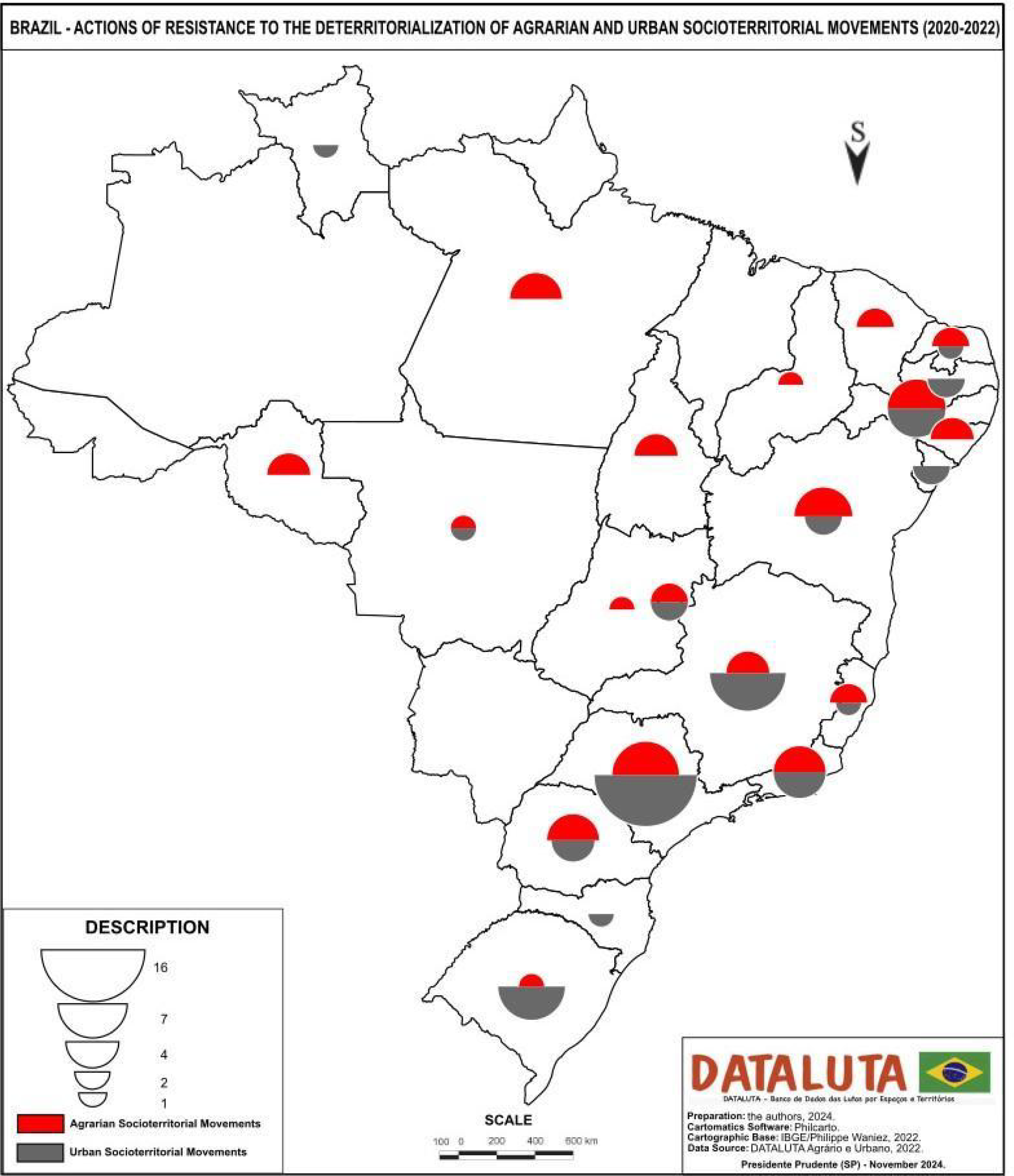 Source: DATALUTA Agrarian and Urban, 2024. Prepared by: The authors, 2024.