
 Territories of Resistance: actions of agrarian and urban socio-territorial movements against processes of deterritorialization during the pandemic
Abstract
This article seeks to understand the actions carried out by agrarian and urban movements in Brazil between 2020 and 2022 regarding evictions. In addition to the COVID-19 pandemic, there was a political context that was adverse to social participation and constant confrontations with the Federal Government, in which the movements were targets of violent attacks. With great national repercussion, several evictions of families were witnessed from areas that did not fulfill their social function (unproductive areas, areas of social and economic interest, etc.). It is understood that decent housing and access to land are part of the construction of the socio-territorial identity and human dignity of these subjects, a material and immaterial relationship that manifests the territorial inseparability present in the practices and actions of organized subjects. In this sense, the databases of the DATALUTA Network - Research Network of Struggles for Spaces and Territories - were used to construct a geographic reflection based on news published in the media and analyzed through the categorization of the movements, their actions and agendas. A diversity of strategies used by the movements in an attempt to stop these evictions can be observed, such as taking legal action, marches, blocking roads, in addition to notes of denunciation and repudiation.
Key-words:
Collective actions; eviction; pandemic; agrarian socioterritorial movements; urban socioterritorial movements.
Resumo
Este artigo busca compreender as ações protagonizadas pelos movimentos agrários e urbanos no Brasil, entre os anos de 2020 e 2022, no que se refere aos despejos. Além da pandemia da COVID-19, vivenciava-se um contexto político adverso à participação social e de constantes enfrentamentos com o Governo Federal, em que os movimentos foram alvos de ataques violentos. Com grande repercussão nacional, presenciou-se diversos despejos de famílias de áreas que não cumpriam a sua função social (áreas improdutivas, de interesse social e econômico, etc.). Entende-se que a moradia digna e o acesso à terra fazem parte da construção da identidade socioterritorial e da dignidade humana desses sujeitos, relação material e imaterial que manifesta a indissociabilidade territorial presente nas práticas e ações dos sujeitos organizados. Nesse sentido, utilizou-se os bancos de dados da Rede DATALUTA - Rede de Pesquisa das Lutas por Espaços e Territórios, para se construir uma reflexão geográfica a partir de notícias veiculadas na mídia e analisadas através da categorização dos movimentos, de suas ações e pautas. Observa-se uma diversidade de estratégias utilizadas pelos movimentos na tentativa de frear esses despejos, como o acionamento à justiça, as passeatas, bloqueio de vias, além das notas de denúncia e repúdio.
Palavras-chave:
Ações coletivas; despejo; pandemia; movimentos socioterritoriais agrários; movimentos socioterritoriais urbanos.
Resumen
Este artículo busca comprender las acciones realizadas por los movimientos agrarios y urbanos en Brasil, entre los años 2020 y 2022, en materia de desalojos. A la pandemia de COVID-19 se sumó un contexto político adverso a la participación social y constantes enfrentamientos con el Gobierno Federal, en los que los movimientos fueron blanco de ataques violentos. Con gran repercusión nacional, se produjeron varios desalojos de familias de zonas que no cumplían con su función social (zonas improductivas, zonas de interés social y económico, etc.). Se entiende que la vivienda digna y el acceso a la tierra son parte de la construcción de la identidad socioterritorial y la dignidad humana de estos sujetos, relación material e inmaterial que manifiesta la inseparabilidad territorial presente en las prácticas y acciones de los sujetos organizados. En este sentido, utilizamos las bases de datos de la Red DATALUTA - Red de Investigación de Luchas por Espacios y Territorios, para construir una reflexión geográfica a partir de noticias publicadas en los medios de comunicación y analizadas a través de la categorización de los movimientos, sus acciones y agendas. Existe diversidad de estrategias utilizadas por los movimientos para intentar frenar estos desalojos, como acciones legales, marchas, bloqueos de carreteras, además de denuncias y notas de repudio.
Palabras-clave:
Acciones colectivas; desalojo; pandemia; movimientos socioterritoriales agrarios; movimientos socioterritoriales urbanos.
Introduction
In August 2020, the governor of Minas Gerais, acting in alignment with the actions of the Federal Government, authorized the eviction of families from the Landless Rural Workers' Movement (MST) from the area of the Ariadnópolis Plant, located in Campo do Meio, in the southern region of Minas Gerais. According to accounts from representatives of the movement, this was: "the 12th eviction in the history of the site, an area with 11 encampments, more than 2,000 people, and an annual production of over 500 tons of coffee and other pesticide-free food products" (Estado de Minas, 2020). By 2021, representatives of the Movement for Struggles in Neighborhoods, Villages, and Slums (MLB) reported an eviction operation carried out by the Military Police in the João Mulungu occupation, in Aracaju, Sergipe. According to an MLB representative: "There was no notification whatsoever to the families regarding the eviction order, and the eviction took place on a Sunday at 4:30 a.m., which is prohibited by law" (UOL, 2021).
These were just a few of the many evictions that took place across the country between 2020 and 2022, amid a public health crisis caused by the COVID-19 pandemic, compounded by science denialism, democratic backsliding, and political degradation led by the government of Jair Bolsonaro (Avritzer, Kerche, & Marona, 2021). Sociospatial and socioterritorial movements active in both agrarian and urban spaces have been targets of material and symbolic violence on various scales. This dynamic intensified after 2018, with statements such as the one made by the then-presidential candidate after the first round of elections, in which he declared: "We are going to put an end to all activism in Brazil" (Abers, 2019, p. 1).
The onset of the pandemic and the necessity of social isolation as a strategy to contain the virus imposed new challenges on agrarian and urban socio-spatial and socio-territorial movements. The public health crisis laid bare deep-seated inequalities in Brazil, bringing urgent debates to the forefront regarding gender, race, class, and territory. The collective actions of these movements not only addressed these issues but also sought to combat the inequalities exacerbated by the crisis, particularly in terms of access to land and housing. Amid institutional attacks and political tensions, these groups had to reinvent themselves to sustain their struggles, developing new strategies to confront and resist the actions of the Federal Government.
One example was the widespread panelaços (pot-banging protests), which gained momentum in mid-2020, accompanied by chants of "Fora Bolsonaro" (Bolsonaro Out). At the same time, social media became a central battleground for narrative disputes and the mobilization of millions of people. Socio-spatial and socio-territorial movements in both rural and urban contexts organized themselves to protect the most vulnerable populations-not only from the virus but also from the worsening of severe food insecurity and the intensification of impoverishment. According to the Second National Survey on Food Insecurity in the Context of the COVID-19 Pandemic in Brazil, hunger escalated in 2022, affecting 33.1 million people. As evidence, we present the "Nós por Nós" (Us for Us) campaign1.
In a country marked by high levels of violence, this scenario exacerbated conflicts in both rural and urban areas, where the most marginalized and vulnerable populations struggle to survive. Many of these conflicts were related to forced removals, also known as evictions. This context led agrarian and urban movements to advocate for the right of families to remain in their territories through various actions, including protests, public denunciations, and legal proceedings.
This mobilization was supported by other civil society organizations, culminating in the creation of the "Despejo Zero" (Zero Eviction) National Campaign in July 2020. The campaign aimed to protect houseless and landless individuals across the country during the pandemic, ensuring their constitutional right to housing. The neoliberal rationality that underpins the production of both urban and rural spaces was also a driving force behind territorial disputes (Dardot & Laval, 2016). In this context, social movements played a crucial role in challenging inequalities and promoting social justice amid an unprecedented crisis.
This article seeks to analyse the actions carried out by agrarian and urban socio-territorial movements in Brazil between 2020 and 2022 in opposition to evictions and in resistance to deterritorialization, fostering resistance and strengthening popular struggles in both rural and urban contexts. The goal is to understand how these movements developed strategies and mobilized mass support to resist and persist in the fight for access to territory, recognizing that “conflicts over land and housing are also extremely complex and dynamic processes, involving multiple actors, motivations, strategies, and, at times, both progress and setbacks" (Cerejo et al, 2023, p. 11).
To achieve our objective, we adopted the research methodology of the Brazilian Network of Researchers on Struggles for Spaces and Territories (REDE DATALUTA), which is detailed in the second section of this article. In the third section, we explore the relationship between urban and agrarian spaces, drawing from the socio-territorial approach. The fourth section presents and analyzes data on the actions, strategies, and mobilizations employed by agrarian and urban socio-territorial movements against evictions and deterritorialization attempts in Brazil between 2020 and 2022. Finally, we provide the concluding remarks and the bibliographic references used in the development of this study.
Methodology
Within REDE DATALUTA, the research on "Socio-Territorial Movements in a Comparative Perspective" is conducted by teams working across four domains of investigation: Agrarian, Water, Forest, and Urban (Souza et al, 2022). For this article, we relied on the participation of the DATALUTA Agrarian and Urban teams. Both categories follow the same methodological procedures to identify and systematize the actions of socio-spatial and socio-territorial movements within their respective contexts. The data is collected through news alerts received by researchers via Google Alerts, using pre-registered keywords that include the names of movements, specific terminologies, and their actions in both domains.
The news articles captured using our methodology are saved as PDFs, archived in the research’s Google Drive, and recorded on the JotForm platform. These records include information such as the name of the movement, location of the action, type of Matrix and Derived Actions, purpose, agenda, involved institutions, and their connection to the Sustainable Development Goals (SDGs) (Almeida, Santos & Baratelli, 2023).
The JotForm records are organized into Excel spreadsheets, allowing for greater efficiency in systematizing actions and facilitating the development of synthesis products, such as graphs, charts, tables, and maps (Fernandes & Sobreiro Filho, 2023). In both DATALUTA Agrarian and Urban, we work with Matrix and Derived Actions to develop classification typologies and analyse the actions of social movements. According to Fernandes and Sobreiro Filho (2023):
[...] matrix actions are associated with the dimensions of spaces and/or territories, such as the economic, political, cultural, environmental, and social dimensions; whereas derived actions are linked to the developments of these dimensions, including production, struggles, disputes, education, health, music, literature, events, public policies, demonstrations, occupations, negotiations, etc." (Fernandes & Sobreiro Filho, 2023, p. 350).
Within the DATALUTA framework, 11 matrix actions and 40 agendas have been identified in the agrarian space, while in the urban space, there are 9 matrix actions and 27 agendas. For this analysis, we used spreadsheets from the years 2020, 2021, and 2022, aiming to select actions focused on opposing evictions and resisting deterritorialization. In this context, evictions refer to expropriation processes and the forced removal of families from their territories. These processes constitute a resistance dynamic led by social movements, which confront State and corporate actions, highlighting a struggle that unfolds in both material and symbolic dimensions. In quantitative terms, we identified 52 actions in DATALUTA Agrarian and 57 actions in DATALUTA Urban, totalling 109 actions. Based on the selection of news articles, we aggregated the spreadsheets and systematized the Matrix and Derived Actions, identifying similarities and specificities across the different spaces, as presented in Table 1.
The Communicative Matrix Action refers to the argumentative dialogue that agrarian and urban socio-spatial and socio-territorial movements construct, based on everyday problems they experience, which are debated and transformed into demands (Mendonça, 2006) through open letters, statements of repudiation, and denunciation statements.
Regarding the Collective Displacement Matrix Action, it refers to the act of moving collectively from one point to another, as seen in demonstrations (passeatas), which are understood as manifestations where socio-spatial and socio-territorial movements present their demands through chants, banners, and other resources to draw attention, foster debate, and pressure institutions (Sobreiro Filho, 2016).
The Matrix Action called Gathering refers to the opportunity for movements to engage in dialogue with other institutions in their fight for rights. This includes meetings held to discuss historically demanded issues or negotiation meetings with the State and other organizations.
Judicialization is understood here from two perspectives: a) The legal claims process initiated by movements through the Judiciary, seeking reparation for material and immaterial damages and ensuring that the law is upheld in the defence and guarantee of rights. b) The criminalization process of socio-spatial and socio-territorial movements' demands, where there is an abuse of judicial power aimed at weakening and demobilizing these movements (Burckhart, 2017, p. 246). The judicialization action is subdivided into: i) judicial victory: a favourable ruling in a legal process involving the various territories of the movements; ii) judicial claim: an action taken by socio-territorial movements to submit proposals for a Direct Action of Unconstitutionality (ADI) or another legal instrument of contestation; iii) judicial defeat: an unfavourable ruling in a legal process involving the various territories; and iv) legal violence: violence inflicted upon movements by the Judiciary.
Finally, the Matrix Action called Occupation is related to actions carried out by socio-territorial movements, including the occupation of unproductive lands, properties that fail to fulfil their social function, and the blockade of federal or state highways. It also involves the occupation of public buildings, such as Secretariats or Ministries, and private buildings, such as corporate offices in conflict with agrarian and urban movements.
Regarding the content of the actions carried out by agrarian and urban socio-spatial and socio-territorial movements, these are understood in our study as agendas. For this article, we focus specifically on agendas opposing evictions and resisting deterritorialization. Eviction is an action that forcibly removes communities from their territories, meaning it deterritorializes them, violates their rights, and disregards both the social function of land and the struggle for territory. These practices are often associated with actions of integration or reintegration of possession, which are used to restore elite control over properties in both rural and urban areas.
Following evictions, movements maintain a stance of denunciation and resistance, frequently reoccupying the territory, thus generating a form of resistance to deterritorialization. Resistance to deterritorialization consists of acts or actions aimed at opposing the State's and corporations’ incursions, particularly in response to their criminalization of social movements' struggles, their socio-territorial identities, and the ridicule of their agendas, demands, and proposals-such as access to territory. As a result, the actions of these groups lead to both material and immaterial attempts at deterritorialization, which disrupt the connection between peoples, their territorialities, and their territories.
Socio-territorial approach to the rural-urban relationship
The foundations of our perspective on the rural-urban relationship are not based on the rationality of dichotomy, which considers them as separate and independent entities. For years, a perspective has been constructed that portrays the countryside as a producer of food for the city, while the city supplies industrial goods and technical services to the countryside. In this study, we adopt the socio-territorial approach to interpret this relationship, particularly from the perspective of disputes, confrontations, proposals, and claims made by agrarian and urban socio-spatial and socio-territorial movements.
According to Pedon (2009), the socio-territorial approach:
[...] encompasses a broader set of issues that involve the development of society and its relationship with the territory. In this context, socio-territorial movements constitute an organic element of this approach (Pedon, 2009, p. 168, emphasis added).
We understand that the countryside and the city are not merely two distinct spaces in form and content, but rather continuities and discontinuities within a logic shaped by fragmentation, rupture, crisis, and expropriation. This perspective prompts us to reflect on the need for a relational reading of spaces as a means to overcome the challenges imposed by neoliberalism. The socio-territorial approach significantly enriches this discussion, particularly by challenging the fixed "roles" assigned to the city and the countryside within the capitalist system. Breaking away from this perspective is fundamental for the construction of new analytical horizons, particularly in studies of conflicts and disputes between the State, corporations, and agrarian and urban socio-territorial movements.
As highlighted by Fernandes (2005), conflictuality is inherent to territorial studies. The territory:
[...] is the space appropriated by a given social relationship that produces and sustains it through a form of power. This power, as previously stated, is granted by receptivity. The territory is simultaneously a convention and a confrontation. Precisely because the territory has limits and borders, it is a space of conflictualities. (Fernandes, 2005, p. 27)
Building on Fernandes (2005), we observe that territory encompasses different geographical processes, such as territorializationdeterritorialization-reterritorialization (TDR), which are related, respectively, to the production and expansion of territories, their destruction and expulsion, and finally, their reconstruction. Therefore, these processes involve access to and direct conflicts over territory, whether in the countryside, city, forests, or waters. The forms of use and organization of territories are understood as territoriality, which may be local or external to the territories, encompassing both autonomy and subordination of communities and movements. These geographical processes occur across all scales and dimensions, reflecting the territorial diversity outlined by Fernandes (2009).
According to Fernandes (2009), there are consistent theoretical elements that support a typology of territories, in which: the first type of territory is the State governance space, which is contested across all its scales by other types of territories. The second type consists of collective and private properties, spanning rural areas, cities, forests, and waters. Properties are contained within the first territory, but they differ based on the social relations that produce and sustain them. The first and second territories are fixed, whereas the third territory is fluid. This third territory is identified as the territory of the body, objects, knowledge, paradigms, and relationships. Within this theoretical framework, there exists a diversity of territories, constructed across different dimensions and scales-both material (the tangible world of objects and actions) and immaterial (knowledge, expertise, paradigms, and contested ideas), meaning that:
Immaterial territories form the foundation of all other territories. They are collectively constructed and contested. Territorial disputes are fuelled by organizations and their think tanks. It is impossible to conceptualize diverse territories without considering immaterial territories, as well as the people and groups that shape them (Fernandes, 2009, p. 212).
From this perspective, we understand that rural and urban spaces are territories in dispute, both in material and immaterial terms. From the first territory (the governance space), through collective and private properties (the second territory), to the political projects and development models that shape relationships within and between spaces (the third territory), we observe different dimensions and scales of a historical conflictuality, occurring in both territorialization processes and territorialities. This understanding reinforces the contributions of Carneiro (1998), who argues that rural-urban relations are complex and heterogeneous, depending on contexts and conjunctures, and especially on how subjects perceive, appropriate, and contest transformations within spaces and the ways in which they are organized.
In this sense, the countryside and the city are configured as spaces of confrontation between divergent interests, that is, immaterial territories, where the right to the second territory becomes one of the main disputes and claims of social actors, challenging the hegemonic ideology of the State and corporations. The relationship between urban and agrarian spaces in Brazil reveals a continuity that challenges the often-established dichotomy between them. Although they have distinct forms, contents, and dynamics, urban and agrarian spaces are part of a spatial totality that is produced, articulated, and shaped by the rationality of the neoliberal offensive and the resistance of movements and communities.
Space, both in rural and urban areas, is simultaneously a product and a producer of social contradictions, uniquely expressing struggles over territory as an inseparable condition for the existence of social actors and groups. As evidence of this, Brazil’s urbanization process cannot be historically understood in isolation from agricultural modernization and the deterritorialization of rural communities (Baldassarini, 2021). The mass migration of previously territorialized rural populations to urban areas from the second half of the 20th century onward illustrates the interdependence of these spaces.
The displacement of these populations to urban peripheries generated a new form of exclusion: while in rural areas they were marginalized by land concentration, growing inequalities, and violence, in cities they territorialized themselves in precarious spaces, often in unsanitary conditions and without access to basic rights such as sanitation, healthcare, leisure, and education. From the perspective of the Latin American agrarian question, this represents a similarity between Brazil and other countries in the regional bloc. According to Traspadini (2018):
The agrarian question marks the centrality of history as disputes, contradictions, and complex social relations that define what is understood as life, land, social being, and sociability for each group [...] The agrarian question assumes a dimension that does not originate in capitalism but, within it, takes on new forms, with a content centred on private land ownership. Thus, it conditions freedom, disconnecting it from possession, use, and survival possibilities beyond the sphere of buying and selling. (Traspadini, 2018, p. 1697).
In Brazil, the agrarian question is shaped by colonial invasion and the genocide of Indigenous communities; land concentration and the deterritorialization of peasant populations; the hegemony of land grabbers, large landowners, and, more recently, transnational corporations in agrarian spaces; the degradation, exploitation, and appropriation of natural resources; and the conflicts led by socio-territorial movements organized across rural areas, forests, waters, and cities. Furthermore, Buscioli (2024) highlights that historical land concentration remains one of the main pillars reinforcing territorial disputes in Brazil, representing an open wound of the national agrarian question:
Conflicts in the Brazilian countryside are primarily caused by land concentration, which, through various policies, carries within its historical trajectory the conflicts arising from the very processes that led to such concentration. Land conflicts are present across all Brazilian macro-regions, occurring at multiple scales-in rural areas, cities, and forests, and at local, regional, state, and national levels (Buscioli, 2024, p. 82).).
As deterritorialization advanced, historical land concentration intensified simultaneously, making it increasingly difficult for populations to return to rural areas (Baldassarini, 2021), that is, to reterritorialize. The displacement of rural populations has contributed to the rapid and unregulated expansion of urban peripheries and the intensification of real estate speculation. In Brazil, urban contradictions deepened after 1930, when capital accumulation became dependent on the controlled participation of the popular masses in the economic and political system (Raichelis, 1988). This dynamic led to a new urban configuration, particularly in the metropolises of Rio de Janeiro and São Paulo, where the hyper-concentration of productive and reproductive capital activities became established.
Moisés (1985) observes that this process led to the formation of large population masses that were forced to territorialize themselves in urban peripheries due to rural exodus, in a phenomenon recognized as "urbanization through peripheral expansion," characterized by social discrimination with ecological features. This process of industrialization, urbanization, and rural exodus not only transformed the lives of the working class, creating new needs, but also worsened their impoverishment and intensified conflicts over land, housing, and, ultimately, territory.
Urbanization rates between 1940 and 2000 illustrate this transition, rising from 26.35% in 1940 to 81.25% in 2000. The new arrivals in cities, displaced by the deterritorialization of rural areas, territorialized themselves in urban peripheries under extremely precarious living conditions. These groups, incorporated as cheap labour in both corporate agriculture (boias-frias) and in industries and the urban service sector, formed what Gohn (1982) describes as a subproletariat, excluded from formal labour protections.
The rapid urbanization process created an increasing demand for urban infrastructure while simultaneously exacerbating inadequate housing conditions, leading to the growth of favelas, peripheral neighbourhoods, and occupations in irregular areas, such as hillsides and slopes. These spaces also became territories of resistance, where new forms of social organization emerged, articulating the struggle for the right to the city. In this context, the right to the city, as proposed by Lefebvre (1968), is affirmed not only as the right to urban infrastructure and services but also as the right to actively participate in the construction and transformation of urban space. This struggle is, therefore, inseparable from the disputes over territorial and social justice that define the contemporary urban and agrarian landscape in Brazil.
The occupation and appropriation of space by socio-territorial movements, particularly urban movements advocating for housing, transcend a mere territorial claim. These processes constitute political practices that challenge the foundations of the neoliberal city, while simultaneously articulating the construction of new forms of urbanity and sociability. The neoliberal city, grounded in market logic and the economic valorisation of spaces, intensifies dynamics of segregation, fragmentation, and socio-spatial self-segregation (Sposito & Sposito, 2020), deepening the divide between the concepts of city and community. This logic prioritizes capital over collective needs, exacerbating inequalities and marginalizing populations that do not conform to market-driven consumption patterns.
However, urban and agrarian popular movements challenge this logic by proposing collective reappropriation of spaces, resisting speculative practices and promoting alternative ways of inhabiting, producing, and reinterpreting territories and landscapes. The occupation of vacant lots and abandoned buildings, for instance, represents a resistance strategy that transforms spaces of exclusion into places of solidarity, emancipation, autonomy, and socio-political struggle. By acting within urban spaces, these movements not only critique the commodification of the city but also create diverse landscapes that reflect the multiplicity of struggles and demands for social justice (Souza & Bejarano, 2024).
Geographically, the city is conceived as the product of multi-scalar processes, involving the unequal and contradictory interaction of different agents-the State, the market, and socio-spatial and socio-territorial movements. This approach highlights that the city is not merely a physical structure, but rather a relational space in constant transformation, produced through every day and institutional practices. Replacing the question "What is the city?" with "What makes the city?" emphasizes the agency of social actors in the construction of the urban environment, particularly social movements that, through their actions, critique the neoliberal model and advocate for more democratic forms of access to urban space.
The sociological analysis of popular movements further underscores how urban resistance practices connect with struggles in agrarian spaces. In both contexts, there is a rejection of deterritorialization and displacement dynamics imposed by capital, alongside a struggle for reterritorialization based on social justice and the preservation of community ties. While agrarian movements fight for the right to land and collective production, urban movements advocate for the democratization of urban land and the creation of alternatives to the speculative model. This articulation reveals that territorial struggles - whether rural or urban - are interdependent, forming a broader field of disputes that permeates society as a whole.
The geographical and sociological perspective thus allows us to understand the production of urban space as an inherently political process, where urban landscapes are not mere reflections of hegemonic policies, but rather arenas of struggle that express the antagonisms of capital and the possibilities for constructing alternative ways of life. In the case of Brazilian cities, urban socio-territorial movements, particularly those engaged in housing struggles, play a central role in contesting the right to the city. Their practices offer a concrete critique of neoliberal logic by proposing social behaviours that prioritize the commons and well-being as guiding principles.
These movements thus emerge as one of the few viable alternatives for the construction of a less fragmented and more inclusive city. By establishing forms of resistance and solidarity in opposition to the commodification of urban space, they foster the reconstruction of community ties and the creation of landscapes that reflect values of equity and social justice. By articulating the struggle for both rural and urban territories, they demonstrate that transforming the city and the countryside is inseparable from the broader fight for a more just, supportive, and sustainable society.
The concept of "urban colonization," as defined by Santos (2002), refers to the appropriation and control of urban space by external logics that are detached from local social life, particularly those linked to global capital and the market. According to Santos, this colonization is marked by the imposition of a technical and economic rationality that fragments urban space, exacerbating social and spatial inequalities. In this context, the city ceases to be a space for collective coexistence and is instead reduced to an object of speculation and economic valorisation, where social relations are shaped by the dynamics of capital and the interests of the ruling classes.
Rolnik (2015) expands on this analysis by exploring how the struggle for land use and control in Brazilian cities reflects deep social tensions. Her notion of "the war of places" describes the intense contestation over urban space among different actors, including the State, the real estate market, and social movements. These disputes often result in forced displacements and removals of vulnerable populations, shaping the neoliberal city as a space of socio-spatial segregation, where territory is commodified and appropriated by elites at the expense of the rights of impoverished communities.
These perspectives converge in explaining the fragmented and exclusionary logic that characterizes the contemporary city, understood as a product of the neoliberal order. Unequal urbanization produces a social and spatial fabric marked by fractures, where enclaves of wealth coexist with precariousness and marginalization. However, this fragmentation is not confined to urban space; it is intrinsically linked to processes affecting rural areas, further highlighting the interdependence between the rural and the urban. In rural areas, the logic of land concentration and commodification intensifies expulsion and deterritorialization dynamics, fostering migration flows that, upon entering urban space, further amplify conflicts over land and housing.
Within this landscape of inequality and exclusion, socio-territorial movements emerge to challenge neoliberal logic, advocating for the democratization of spatial access and proposing alternative forms of territorial appropriation. These movements, active in both rural and urban settings, rise as a response to hegemonic forces, contesting the meaning of what the city is and what it can become.
As Zanotelli (2021) highlights, contemporary neoliberalism, though subordinated to market logic, still maintains an interventionist State that plays a central role in the commodification of territory. This state model directs investments toward providing infrastructure for capital, legitimizing the expropriation of spaces and deepening social and spatial inequalities. In Brazil, this dynamic is evident both in rural areas, where large-scale infrastructure projects and agribusiness disrupt traditional communities, and in urban areas, where populations are displaced to make way for high-profit real estate developments.
A notable example of this conflict is found in downtown São Paulo, where former buildings, once designated for other purposes, have been reclaimed by housing movements and transformed into spaces of resistance. These urban territories, often linked to cultural and political practices, represent a counterpoint to hegemonic logic, demonstrating that conflict over space is intrinsic to the very production of the urban environment. In this sense, the city is a locus of disputes, where urban forms and landscapes are shaped by unequal and contradictory relations.
Conceiving the city from this relational perspective means recognizing that spatial inequalities are a product of social inequalities and that urban space, like agrarian space, is a constant field of contestation. The unequal production of the city is not merely a reflection of economic dynamics, but also the result of resistance efforts that challenge these logics and propose new ways of inhabiting and producing territory. Thus, the articulation between rural and urban spaces, mediated by socio-territorial movements, becomes central to understanding the possibilities for building a more just and solidaristic society.
In this sense, rural and urban spaces are not separate, but interconnected by a logic of exploitation that transcends physical boundaries. The process of deterritorialization in rural areas created the conditions for capitalist expansion in cities, fuelling the chaotic and exclusionary urbanization that characterizes Brazil’s major metropolitan regions. According to Traspadini (2018, p. 1710),
Whether in the countryside or in the city, it is the land-speculated upon, transformed into a commodity, and concentrated in the hands of a few-that defines the dynamics of much of the population, expelled and concentrated in cities, shaping what is conceived as peripheral landscapes. Through these landscapes, we recover, from the perspective of the rightless, the concrete history of those who, heirs of the land, became the condemned.
Understanding this continuity between urban and agrarian spaces is crucial to comprehending the struggles of socio-territorial movements that unfold in both rural and urban settings, particularly under the Bolsonaro government, in which these movements were perceived as enemies of the State. Various movements operating in agrarian and urban spaces have faced material and immaterial violence on multiple scales, beginning with the statements of the then-presidential candidate at the end of the first round of elections in 2018, such as: "We are going to put an end to all activism in Brazil." (Abers, 2019, p. 1) Moreover, the political stance of refusing dialogue with social actors, the government's symbolic attacks on these movements at every possible opportunity, and the marginalization of their agendas reinforced its antagonistic position toward popular demands in both rural and urban contexts.
Although the organizational structures and specific challenges faced by these movements may differ-urban movements focus on issues such as housing, transportation, and infrastructure, while agrarian movements centre their struggles on land rights, agrarian reform, and agroecology-both share a common fight for the guarantee of basic rights, including the right to territory and human dignity. Such struggles and demands can become even more challenging and prolonged, depending on the political context, as seen during the Jair Bolsonaro government. These mobilizations give rise to various types of organizations and joint actions, such as the alliance between the Landless Workers' Movement (MST) and the Homeless Workers' Movement (MTST). These movements recognize that the fight for land in rural areas and the fight for housing in urban areas are part of the same structure of exclusion and exploitation, rooted in the Brazilian capitalist development model. By demanding the right to territory-whether rural or urban-, these movements not only challenge the forms of land appropriation and use but also question the logic of accumulation that defines spatial production in Brazil.
Analysis of resistance actions against deterritorialization in rural and urban spaces during the pandemic
The actions carried out by agrarian and urban socio-territorial movements against evictions and deterritorialization attempts can be understood as mobilizations to claim the right to land and housing, that is, the right to territory, while also challenging the actions of the State and corporations. These actions in Latin America reflect a historical context of social inequality and violence, which has persisted from the colonial period to the present day. According to Cerejo et al (2023, p. 01), many communities were threatened with eviction: "without a judicial warrant, particularly in rural areas or state-owned properties, with no housing provisions in place to relocate these families, which often include children and the elderly."
In Brazil, when examining the struggle for land and housing, we observe that most of the actions undertaken by social movements-particularly during the period analysed in this article-are directly related to State policies, especially at the federal government level. These actions can be interpreted as forms of contestation against attacks on rights or as demands for public policies, but they are always tied to the full functioning of democracy, as: "social mobilizations in Latin America have been and continue to be carriers of democracy" (Aranibar, 2012, p. 15).
In this sense, the actions led by movements in Brazil between 2020 and 2022 are analysed in this article through the lens of conflictuality and political threats, to which social actors had to respond, particularly in relation to the dimensions of the political process (Tatagiba & Galvão, 2019). Conflictuality is a constant reality for social movements, and in an authoritarian far-right political context, dominant political forces seek to create, conquer, and control their territories. Evictions represent one of the most radical expressions of this process and have been used as a mechanism of State control over peasant, quilombola, and Indigenous territories, as well as over urban spaces, particularly in peripheral areas.
By analysing the data collected and systematized in DATALUTA Agrário and DATALUTA Urbano from 2020 to 2022, we identified 109 actions opposing evictions and resisting deterritorialization. In quantitative terms, we recorded 52 actions in DATALUTA Agrário and 57 actions in DATALUTA Urbano. This process unfolds within the historical conflict between movements, the State, and corporate interests, particularly those linked to real estate speculation. Table 2 presents the socio-territorial movements that operated in both agrarian and urban spaces in an effort to combat evictions and resist deterritorialization processes during this period, along with the specific actions mobilized in each Brazilian state.
Agrarian and urban socio-territorial movements and actions against evictions and deterritorialization attempts by federal units (2020-2022).
From Table 2, we observe the central role of the MST (Landless Workers’ Movement) and MTST (Homeless Workers’ Movement) as the main resistance movements against evictions and deterritorialization attempts in Brazil during the analysed period. Regarding forms of resistance, our findings indicate that communicative actions, collective displacements, judicialization, and occupations are the predominant strategies employed by these movements. Several cases identified in our research highlight communicative actions as a key tool of resistance against deterritorialization attempts, particularly due to their capacity for digital dissemination, which exposes the violence faced by rural and urban families.
One example is the 2022 deterritorialization attempt against the community of Ocupação Ana Primavesi, organized by the MST and located in the Núcleo Rural de Rio Preto, in Planaltina (DF). This region is emblematic for its intense land speculation processes, making it a strategic site for movements, the State, and both national and transnational corporations. As reported by Brasil de Fato (2022): "On the evening of Tuesday (3), landowners blocking access to the Ana Primavesi Occupation set fire to the surrounding areas and threatened landless families, who have been in the public area since April 30."
In addition to organizing families to resist in the area, the MST-DF issued a denunciation statement through its communication channels, exposing the complicity of the Military Police in the landowners’ criminal actions. The statement also emphasized that: "Even though the MST has been seeking negotiations with the government to resolve the issue, landowners continue their attacks." (Brasil de Fato, 2022). Thus, the persistence and resistance of these families intensify the regional conflict, heightening tensions with the government, corporations, and landowners, while reinforcing the MST's long-standing demand for the establishment of new rural settlements in the disputed area.
Regarding struggles and resistance in urban spaces, a key example is the collective displacement actions organized by the MTST in the state of São Paulo in 2020, demanding a halt to evictions during the pandemic. One such action was the August 13, 2020 march, which began in the Morumbi region, in the southern zone of São Paulo, and proceeded to Palácio dos Bandeirantes, the seat of the São Paulo state government. The march followed a meeting between MTST leaders and state government representatives, where discussions on suspending evictions during the pandemic and releasing frozen housing funds took place. However, the meeting ended without an agreement between the parties (G1, 2020). As stated by Josué Rocha, from the MST's national coordination:
At a time when workers are most vulnerable, state authorities have refused to commit to halting evictions or releasing the housing funds that were frozen by the government this year. Let's resume the demonstrations to pressure the São Paulo government to respect workers' rights (G1, 2020).
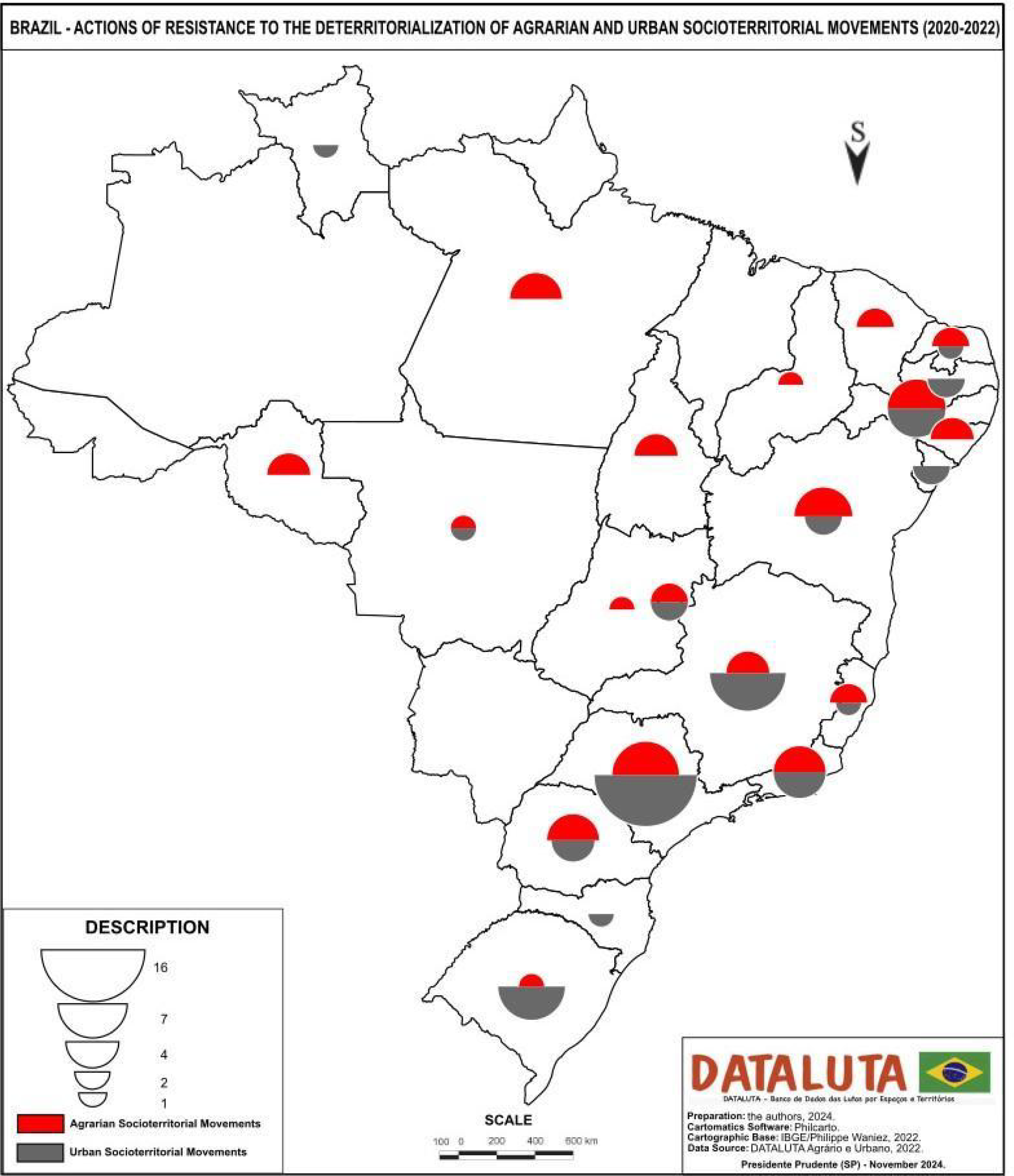
In the examples mentioned above, we observe the communicative action organized by MST-DF and the collective displacements mobilized by MTST-SP as materializations of the strategies of struggle for access to territory in both rural and urban spaces, that is, resistance to deterritorialization. Given the need to spatialize these actions across Brazil, we produced the map in Figure 1, using the comparative representation technique with proportional semicircles, highlighting the distribution of these actions between agrarian and urban spaces. With the map, it becomes possible to visually assess not only the distribution of these actions but also the similarities and specificities of both spaces.

Brazil: resistance actions against deterritorialization led by agrarian and urban socio-territorial movements (2020-2022).
Observing Figure 1, we confirm the presence of struggles against deterritorialization across all regions of the country, with a higher concentration of resistance actions in the Northeast and Southeast, in both agrarian and urban spaces. We also note the predominance of actions led by urban socio-territorial movements in the states of São Paulo, Rio Grande do Sul, and Minas Gerais. This phenomenon may be related to the higher levels of urbanization in these regions. In 2022, the urban population of São Paulo state was 45.14 million inhabitants, making it the most populous state in the country, followed by Minas Gerais, with a population of 20,539,989 inhabitants (IBGE, 2022).
Regarding agrarian movements, we observe a higher number of actions in the states of Alagoas, Pará, Tocantins, and Rondônia. We can infer that these regions are less populated and urbanized and still contain vast areas dedicated to agriculture, often marked by constant conflicts, as seen in Pará, Tocantins, and Rondônia. Additionally, it is noteworthy that in the states of Rio de Janeiro, Pernambuco, Mato Grosso, and the Federal District, we observe a balanced presence of both agrarian and urban movements, highlighting the variety of disputes and conflicts between rural and urban areas in the struggle for access to territory and community resistance.
From Figure 01, we are also prompted to reflect on the absence of identified resistance actions in certain states, particularly in the North region, where no data was recorded for Acre, Amazonas, and Amapá. We hypothesize that these areas also experienced violence through eviction attempts and deterritorialization, particularly affecting Indigenous communities, extractivist populations, and other forest peoples2. The rising deforestation and the intensification of illegal mining in the Amazon region during the pandemic years were frequent topics in the news, with both processes serving as evidence of escalating tensions and conflicts between forest communities and sectors linked to agribusiness.
Final remarks
Between 2020 and 2022, Brazil experienced overlapping crises, which had violent consequences for specific social groups, including Indigenous peoples, peasants, quilombolas, peripheral communities, and families occupying spaces that failed to fulfil their social function. The authoritarian government of Bolsonaro and his supporters sought to dismantle democratic institutions through an aggressive campaign against socio-territorial movements at all levels. In line with the objectives of this article, we observed the concrete violence faced by residents of encampments and occupations in both rural and urban areas. These populations were directly targeted by police interventions, often coordinated with agribusiness sectors and real estate companies, resulting in an intense wave of evictions and expulsion attempts.
Despite their varying capacities, the 23 agrarian and urban socio-territorial movements identified in this study developed resistance strategies against these attacks. Based on the DATALUTA Network database, we identified that these movements engaged in denunciation statements, public condemnations, collective displacements, mediation meetings, and legal actions to halt evictions. At the same time, they continued to organize protests, marches, and occupations to directly confront the interests of the State and corporations. In 2020, socio-territorial movements played a more subdued role, largely due to the pandemic and social distancing measures. However, as attacks against them intensified, they reorganized in 2021 and 2022, leading to an increase in collective actions to resist evictions and deterritorialization attempts.
The Northeast and Southeast regions recorded the highest number of evictions and deterritorialization attempts, as well as the strongest resistance efforts, reaffirming the historical social and regional inequalities of Brazil. Additionally, we identified key areas of struggle in rural territories, particularly in the states of Alagoas, Pará, Tocantins, and Rondônia, which have a long history of agrarian conflicts. The urban territorial struggle was most intense in São Paulo, Rio Grande do Sul, and Minas Gerais, reflecting the high level of urbanization in these areas. Finally, the cases of Rio de Janeiro, Pernambuco, Mato Grosso, and the Federal District stand out as unique instances, where agrarian and urban movements operated in a well-balanced manner, highlighting the complex web of disputes and conflicts in the struggle for territorial access and community resistance.
We observed a significant number of socio-territorial movements defending their territories in this context, demonstrating the strength and potential of movements in both rural and urban spaces. Even under a far-right government and the challenges of a pandemic, these movements continued to fight for solidarity, care, and life itself. Communicative actions, collective displacements, meetings, judicialization efforts, and occupations illustrate the diverse strategies developed by these movements. This is exemplified by the MST-DF’s resistance against deterritorialization attempts in the Ana Primavesi Occupation, as well as the MTST-SP’s mobilizations demanding the suspension of eviction actions by the state of São Paulo.
-
How to cite this article
MOURA, Joana Tereza Vaz de; SOUZA, Wilians Ventura Ferreira; LIMA, Wuelliton Felipe Peres. Territories of Resistance: actions of agrarian and urban socio-territorial movements against processes of deterritorialization during the pandemic. Revista NERA, v. 28, n. 1, e10721, jan.-mar., 2025. DOI: 10.47946/rnera.v28i1.10721en.
-
1
The "Nós por Nós" campaign has existed since 2015, and with the health, social, and economic crisis caused by the novel coronavirus, it intensified its efforts through food collection and solidarity work (Brasil de Fato, 2020a).
-
2
These data are available in the DATALUTA Forest Network team database, but as previously mentioned, they were not the focus of this article and may be explored in future research proposals.
Acknowledgments
We would like to thank all the researchers of the DATALUTA NETWORK, with special mention to the teams of DATALUTA Agrário and DATALUTA Urbano, who were directly responsible for the preparation of this article. We also express our gratitude for the support and funding from the National Council for Scientific and Technological Development (CNPq) through the Productivity Fellowship Level PQ-2 for the first author, process no. 302842/2022-5; and from the São Paulo Research Foundation (FAPESP), for funding the second and third authors, with respective processes no. 2023/04409-2 and no. 2024/09458-4.
References
-
ABERS, Rebecca N. Os movimentos sociais e o ativismo no governo Bolsonaro. Nexo, 2019. Disponível em: https://www.nexojornal.com.br/os-movimentos-sociais-e-o-ativismo-no-governo-bolsonaro Acesso em: 16 set. 2024.
» https://www.nexojornal.com.br/os-movimentos-sociais-e-o-ativismo-no-governo-bolsonaro -
ALMEIDA, F. A.; SANTOS, L. L.; BARATELLI. Tempo e espaço na leitura das ações dos movimentos socioterritoriais e socioespaciais. BOLETIM DATALUTA, [S. l.], v. 16, n. 181, 2023. Disponível em: https://periodicos.unb.br/index.php/BD/article/view/52732 Acesso em: 10 set. 2024.
» https://periodicos.unb.br/index.php/BD/article/view/52732 - AVRITZER, Leonardo; KERCHE, Fábio; MARONA, Marjorie. Governo Bolsonaro: Retrocesso democratico e degradação política. Belo Horizonte: Autêntica, 2021.
- ARANIBAR, A. Prefacio a la coleccion de cuadernos de prospectiva politica. In: CALDERÓN, F. La protesta social en América Latina Buenos Aires: Siglo Veintiuno Editores, 2012.
- BALDASSARINI, J. de S. As crises da relação sociedade-natureza: um diálogo em busca das (re)conexões. 211f. Tese (Doutorado em Geografia). Faculdade de Ciências e Tecnologia da Universidade Estadual Paulista (FCT/UNESP), Presidente Prudente, 2021
-
BRASIL DE FATO. MST denuncia ameaças e incêndios em área próxima a ocupação no Distrito Federal 04 maio 2022. Disponível em: https://www.brasildefato.com.br/2022/05/04/mst-denuncia-ameacas-e-incendios-em-area-proxima-a-ocupacao-no-distrito-federal Acesso em: 18 out. 2024.
» https://www.brasildefato.com.br/2022/05/04/mst-denuncia-ameacas-e-incendios-em-area-proxima-a-ocupacao-no-distrito-federal -
BRASIL DE FATO. Campanha "Nós por nós contra o coronavírus" recebe medalha de direitos humanos 31 ago 2020. Disponível em: https://www.brasildefato.com.br/2020/08/31/campanha-nos-por-nos-contra-o-coronavirus-recebe-medalha-de-direitos-humanos Acesso em 19 out 2024.
» https://www.brasildefato.com.br/2020/08/31/campanha-nos-por-nos-contra-o-coronavirus-recebe-medalha-de-direitos-humanos - BUSCIOLI, L. D. Paradigmas e estratégias do MST para o desenvolvimento de territórios agroecológicos. Presidente Prudente, 2024, 362f. Tese (Doutorado em Geografia) - Faculdade de Ciências e Tecnologia, Universidade Estadual Paulista, Presidente Prudente, 2024.
- BURCKHART, T. R. Entre o político e o jurídico: a judicialização dos movimentos sociais e a capacidade de resiliência dos movimentos sócio-ambientais. Revista Brasileira de Direito e Sociedade, v.05, n.01. 2017.
- CARNEIRO, M. J. Ruralidade: novas identidades em construção. Estudos, Sociedade e Agricultura, 11, p. 53-75, out. 1998.
- CEREJO, L. N. et al. Despejos durante a pandemia de COVID-19 e o direito à moradia, a atuação da Campanha Nacional Despejo Zero. Anais XX ENANPUR, Belém, maio de 2023.
- DARDOT, Pierre; LAVAL, Christian. A nova razão do mundo Boitempo editorial, 2017.
- FERNANDES, B. M. Movimentos Socioterritoriais e Movimentos Socioespaciais: contribuição teórica para uma leitura geográfica dos movimentos sociais. Revista NERA, ano 8, n. 6, p. 14-34, 2005.
- FERNANDES, B. M. Sobre a tipologia de territórios. In: SAQUET, M. A.; SPOSITO, E. S. (Orgs.). Territórios e territorialidades: teorias, processos e conflitos. 1 ed. São Paulo: Expressão Popular, p. 197-215, 2009.
- FERNANDES, B. M.; SOBREIRO FILHO, J. Teoria dos Movimentos Socioterritoriais e Socioespaciais. In: SPOSITO, E.; CLAUDINO, G. (Orgs). Teorias na Geografia - mundos possíveis Rio de Janeiro: Consequência Editora. 2023. p. 335-363.
- GOHN, M. da G. Abordagens teóricas no estudo dos movimentos sociais na América Latina. Caderno CRH, v. 21, p. 439-455, 2008.
-
G1. MTST faz nova manifestação contra despejos durante a pandemia do coronavirus em São Paulo. Portal G1, publicado em: 13 ago. 2020. Disponível em: https://g1.globo.com/sp/sao-paulo/noticia/2020/08/13/mtst-faz-nova-manifestacao-contra-despejos-durante-a-pandemia-do-coronavirus-em-sao-paulo.ghtml Acesso em: 18 out 2024.
» https://g1.globo.com/sp/sao-paulo/noticia/2020/08/13/mtst-faz-nova-manifestacao-contra-despejos-durante-a-pandemia-do-coronavirus-em-sao-paulo.ghtml - INSTITUTO BRASILEIRO DE GEOGRAFIA E ESTATÍSTICA (IBGE). Censo Brasileiro de 2022 Rio de Janeiro: IBGE, 2022.
- MENDONÇA, R. F. Movimentos sociais e interação comunicativa: A formação da comunicação sem sujeito. Contemporânea, v. 4, n. 1, p.73-98, 2006.
- MOISÉS, José Álvaro. Cidade, povo e poder. Rio de Janeiro: Paz & Terra, 1985.
- PEDON, N. R. Movimentos Socioterritoriais: Uma Contribuição Conceitual à Pesquisa Geográfica. 235 f. Teses (Doutorado em Geografia) - Faculdade de Ciências e Tecnologia da Universidade Estadual Paulista (FCT/UNESP), Presidente Prudente, 2009.
- RAICHELIS, R. Legitimidade popular e poder público. São Paulo: Editora Cortez, 1988.
- ROLNIK, R. O que é cidade São Paulo: Brasiliense, 1988.
- TATAGIBA, L.; GALVÃO, A. Os protestos no Brasil em tempos de crise (2011-2016). Opinião Pública, v.25, n.01, pp. 63-97, 2019.
- QUINTANS, M. T. D.; da SILVA, R. de L. G.; SOBRINHO, T. de C. Despejos e luta pelo direito à moradia na pandemia: resistências femininas na experiência da Ocupação Novo Horizonte. Rev. Direito e Práx., Rio de Janeiro, Vol. 13, N.3, 2022, p.1897-1916.
- SANTOS, M. A natureza do espaço: técnica e tempo, razão e emoção. Edusp, 2002.
- SOBREIRO FILHO, J.. Contribuição à construção de uma teoria geográfica sobre movimentos socioespaciais e contentious politics: produção do espaço, redes e lógicaracionalidade espaço-temporal no Brasil e Argentina. 440f Tese (Doutorado em Geografia) - Universidade Estadual Paulista Júlio de Mesquita Filho, Presidente Prudente, 2016.
- SPOSITO, E. S.; SPOSITO, M. E. B. Fragmentação socioespacial. Mercator (Fortaleza), v. 19, p. e19015, 2020.
- SOUZA, W. V. F. et al. O Banco da Luta pela Terra em questão: uma abordagem teórico-conceitual e metodológica dos movimentos socioterritoriais no Brasil. . In: V Encontro Internacional Participação, Democracia e Políticas Públicas (PDPP), 2022, Natal. Anais do V Encontro Internacional Participação, Democracia e Políticas Públicas (PDPP), 2022.
- SOUZA, Wilians Ventura Ferreira; BEJARANO, Maria Eduarda Grecco. Movimentos em movimento: análise das disputas e ações dos movimentos socioespaciais e socioterritoriais urbanos entre 2020 e 2022. Revista Movimentos Sociais e Dinâmicas Espaciais, v. 13, n. 1, p. 1-28, 2024.
- TRASPADINI, R. Questão agrária e América Latina: breves aportes para um debate urgente. Rev. Direito & Práxis, Rio de Janeiro, v. 9, n. 3., p. 1694-1713, 2018,
-
UOL. MLB denuncia despejo de 80 famílias em Aracaju (SE). Portal UOL, publicado em: 24 mai. 2021. Disponível em: https://cultura.uol.com.br/noticias/23387_jesse-sama.html Acesso em: 20 set. 2024.
» https://cultura.uol.com.br/noticias/23387_jesse-sama.html - ZANOTELLI, C. L. A cidade neoliberal no Brasil de uma perspectiva foucaultiana. GEOUSP, v. 25, n. 3, p. e172194, 2021.
-
This article was edited by Lorena Izá Pereira and Camila Ferracini Origuela.

 Source: DATALUTA Agrarian and Urban, 2024. Prepared by: The authors, 2024.