
 Analysis of Markets and Marketing Channels in Brazilian Agrarian Reform Settlements
Abstract
This study aims to analyze markets in Brazilian agrarian reform settlements, considering market typologies and the diversification of marketing channels. To this end, it analyzed 436 agrarian reform settlers across Brazil. The results reveal the predominance of conventional markets, associated with agro-industrial chains and intermediation, which limit farmers’ autonomy and expose them to economic instability. On the other hand, proximity and territorial markets demonstrate a greater capacity to promote autonomy and resilience by strengthening local ties, solidarity networks, and short food supply chains. The diversification of channels emerges as a central strategy, especially in contexts where there is greater institutional and territorial articulation. The location of settlements also shapes market access, favoring more conventional models in areas close to urban centers and more autonomous dynamics in intermediate territories. The study concludes that articulated public policies, adequate infrastructure, and the strengthening of cooperative networks are essential to expand economic autonomy, reduce inequalities, and foster the sustainable development of settlements.
Keywords:
Family farming; autonomy; commercialization; channel diversification; agrifood markets.
Resumo
Este estudo visa analisar os mercados em assentamentos da reforma agrária brasileira, considerando as tipologias de mercado, e a diversificação dos canais de comercialização. Para isso, analisou 436 agricultores assentados de reforma agrária no Brasil. Os resultados revelam a predominância dos mercados convencionais, associados a cadeias agroindustriais e à intermediação, que limitam a autonomia dos agricultores e os expõem à instabilidade econômica. Por outro lado, mercados de proximidade e territoriais demonstram maior capacidade de promover autonomia e resiliência, ao fortalecer vínculos locais, redes solidárias e circuitos curtos de comercialização. A diversificação dos canais surge como estratégia central, especialmente em contextos onde há maior articulação institucional e territorial. A localização dos assentamentos também condiciona o acesso aos mercados, favorecendo modelos mais convencionais nas áreas próximas às sedes urbanas e dinâmicas mais autônomas em territórios intermediários. O estudo conclui que políticas públicas articuladas, infraestrutura adequada e fortalecimento de redes cooperativas são essenciais para ampliar a autonomia econômica, reduzir desigualdades e promover o desenvolvimento sustentável dos assentamentos.
Palavras-chave:
Agricultura familiar; autonomia; comercialização; diversificação de canais; mercados agroalimentares.
Resumen
Este estudio tiene como objetivo analizar los mercados en asentamientos de la reforma agraria brasileña, considerando las tipologías de mercado y la diversificación de los canales de comercialización. Para ello, se analizaron 436 agricultores asentados de la reforma agraria en Brasil. Los resultados revelan la predominancia de los mercados convencionales, asociados a cadenas agroindustriales y a la intermediación, que limitan la autonomía de los agricultores y los exponen a la inestabilidad económica. Por otro lado, los mercados de proximidad y territoriales demuestran una mayor capacidad de promover autonomía y resiliencia, al fortalecer vínculos locales, redes solidarias y circuitos cortos de comercialización. La diversificación de los canales surge como estrategia central, especialmente en contextos donde existe una mayor articulación institucional y territorial. La localización de los asentamientos también condiciona el acceso a los mercados, favoreciendo modelos más convencionales en las áreas cercanas a los centros urbanos y dinámicas más autónomas en territorios intermedios. El estudio concluye que políticas públicas articuladas, infraestructura adecuada y el fortalecimiento de redes cooperativas son esenciales para ampliar la autonomía económica, reducir desigualdades y promover el desarrollo sostenible de los asentamientos.
Palabras clave:
Agricultura familiar; autonomía; comercialización; diversificación de canales; mercados agroalimentarios.
Introduction
Approximately one million Brazilian families are registered as beneficiaries of agrarian reform, distributed across nearly 9,000 settlements created or recognized by the National Institute for Colonization and Agrarian Reform (Instituto Nacional de Colonização e Reforma Agrária - INCRA) (Castilhos, 2025). This magnitude makes settlements the country's largest social laboratory of agri-food production. It reinforces the importance of understanding how these collectives and families are integrated into, or excluded from, marketing circuits and/or markets.
Despite recent advances that have shifted the analysis of agri-food markets toward an institutional and relational approach - emphasizing (i) governance through rules and polycentric arrangements (Ostrom, 2010), (ii) social meanings, valuations, and circuits of exchange (Zelizer, 2010), and (iii) the social construction of markets in family farming and their typologies (Schneider, 2016), in addition to understanding the active role of the State and the creation of public value in the constitution of markets (Mazzucato; Ryan-Collins, 2022) - comparative empirical evidence is still lacking regarding how the diversity of marketing channels influences the economic autonomy of agrarian reform settler families in Brazil. It should be noted that the available academic literature devotes clearly insufficient attention to marketing strategies and to the forms of organization and functioning of these markets; however, such dimensions are crucial for the social reproduction of settled farmers (Souza, 2024) and for the formulation of policies that effectively strengthen family farming (Schneider, 2016).
The research that gave rise to this study covered settlements located in different regions of Brazil, distributed across the states of Amazonas (Lábrea), Ceará (Aiuaba, Arneiroz, Tauá), Goiás (Flores de Goiás), Maranhão (Itapecuru Mirim), Mato Grosso do Sul (Bonito, Campo Grande, Sidrolândia), Paraná (Diamante d’Oeste), and Rio Grande do Sul (Canguçu, Dom Pedrito, Jóia, Palmeira das Missões, Piratini, Pontão, Santana do Livramento, and Viamão). This territorial diversity reflects a wide range of socioeconomic realities, production systems, and institutional challenges faced by settlements in the country. In summary, our objective is to analyze markets in Brazilian agrarian reform settlements.
In addition to this introduction, the article is organized into four further sections. The following section presents the theoretical framework addressing the main elements of Institutional Economic Sociology. Next, the methodology employed for data selection and analysis is described. Subsequently, the results and discussion are presented, followed by final considerations.
Markets and Agrarian Reform
Agrarian reform is one of the main instruments for addressing rural inequalities in Brazil, as it secures land access for thousands of rural working families. However, the consolidation of settlements requires more than land redistribution: it involves strengthening the productive capacities and forms of social organization of settler families (Sauer, 2006), as well as building institutional conditions capable of sustaining the economic and political reproduction of these territories (Fernandes, 2009). In particular, access to markets constitutes a central challenge to the economic viability of these establishments, since commercial integration takes place in arenas regulated by norms and crossed by unequal power relations (Schneider, 2003), which reintroduces structural limits to autonomy and reinforces the centrality of public policies and arrangements of market coordination (Grisa; Schneider, 2015).
In the specific case of Brazil’s Southern Region, data from the 2017 Agricultural Census show that agrarian reform settlements accounted for more than 3,700 establishments distributed across the region’s three states, representing approximately 8% of the national total of settlement production units (Marques, França, Del Grossi, 2022). However, strong internal heterogeneity among settlements can be observed. Classic studies had already identified significant differences in access to credit, technical assistance, and marketing channels Leite et al., 2004). More recent evidence, based on national databases and updated indicators, shows that these inequalities persist, with parts of the settlements still facing significant limitations in infrastructure, commercialization, and collective organization (Marques; França; Del Grossi, 2022). In many cases, production is primarily intended for self-consumption, including staple foods such as maize, beans, cassava, milk, poultry, and pork. However, a significant share is allocated to local circuits and public food procurement programs. Nevertheless, settlements depend on conventional marketing channels and intermediaries, which offer low remuneration and limit families' bargaining power (Leite et al., 2004). On the other hand, experiences linked to proximity and territorial markets reveal a greater capacity to generate added value and strengthen local ties but remain restricted to contexts with stronger collective organization and institutional support.
Access to markets constitutes a central challenge for settled family farmers, since the marketing of production cannot be reduced to a purely economic transaction: it is conditioned by institutions, social relations, and territorial embeddedness. In Polanyi (2000), this is expressed through the idea that markets are historically instituted and regulated; in van der Ploeg (2008), through the emphasis on asymmetries and peasant strategies of autonomy in the face of relations of dependence; and, in Schneider (2016), through the analysis of the diversity of markets and marketing channels that structure opportunities and constraints for family farming. In the same vein, New Economic Sociology emphasizes that markets are social constructions: Grandmaster's (1985) perspective highlights their embeddedness in networks of sociability and trust, while Zelizer (2010) shows how valuations, meanings, and moral boundaries organize exchanges and influence power relations.
From this perspective, markets are not mere arenas of exchange; they are social institutions that distribute opportunities and constraints for agriculture in agrarian reform areas. We examine how different arrangements - conventional, institutional, territorial, and proximity-based - shape the economic integration and autonomy of families, using primary data collected in settlements across different regions of the country. By articulating typologies of channels and markets, location, and forms of coordination (contracts, cooperativism, rural extension services, and credit), we propose an analytical framework to explain variations in performance and vulnerability, offering evidence for the design of public policies. The theoretical approach, grounded in Institutional Economic Sociology, draws on Karl Polanyi (2000) to affirm that markets are historically instituted forms; engages with Jan Douwe van der Ploeg (2008) by emphasizing peasant strategies and disputes surrounding autonomy in the face of asymmetric relations; and incorporates Sergio Schneider (2010) by highlighting the diversity of markets and marketing channels in family farming. In this sense, markets are understood as institutionalized and socially constructed arenas, permeated by norms, power relations, and symbolic disputes.
Markets and Diversification Strategies
Understanding markets as social constructions is essential for interpreting the relationships between family farmers and spaces of commercialization (Souza, 2024). Far from being neutral environments, markets are shaped by power relations, institutions, and cultural norms. They function as social arenas in which farmers compete for spaces of integration and recognition (Zurek et al., 2022). This study adopts the perspective that markets are historically situated institutional constructions (Polanyi), crossed by asymmetries and conflicts in which domination and resistance coexist (van der Ploeg). In dialogue with Schneider's emphasis on the plurality of markets and marketing channels, it is argued that farmers mobilize strategies to expand their autonomy, especially through the diversification of sales channels (Souza, 2024).
In imperfect-market contexts, the reproduction of family farming tends to depend on adaptive responses and coordination mechanisms that reduce uncertainty and transaction costs (Timmer, 1997). In this direction, economic governance may be understood as a problem of institutional design. Rather than a single center of command, polycentric arrangements articulate multiple levels and actors in the production and enforcement of rules (Ostrom, 2010).
The institutional dimension of markets is also expressed in the way rules, conventions, and interactions structure exchanges, making them dynamic spaces subject to historical transformation (Azevedo, 2016; Darnhofer, 2021). This argument converges with approaches that reject the idea of markets as “natural” or passive arenas: by emphasizing the joint action of the State, civil society, and the private sector, such perspectives show how markets can be deliberately shaped and oriented toward the production of public value (Mazzucato & Ryan-Collins, 2022; Arnall, 2015). In this sense, market construction itself involves normative disputes and controversies over which values and objectives should guide public and private action (Fukumoto; Bozeman, 2019).
Polanyi’s framework (2012a, 2012b) sustains that the economy is an “instituted process”, socially embedded and regulated by norms, institutions, and values. Contemporary sociology recognizes that markets are socially embedded and that their dynamics depend on networks, norms, and organizational forms, especially in rural contexts (Gaiger; Nyssens; and Wanderley, 2019). From a complementary perspective, recent studies emphasize that this embeddedness assumes specific configurations in rural areas, shaped by territorial arrangements and exchange circuits (Wong, 2020). The theory of "structural holes" explains how actors positioned between disconnected groups operate as brokers of information and value (Burt, 1992). In agri-food contexts, middlemen tend to capture intermediation rents where horizontal ties among families are weak; by contrast, collective organization and territorial arrangements increase closure/cohesion and reduce dependence on brokers (Schneider, 2016; Schneider, 2022). From this derive the hypotheses for this study: (i) greater participation in organizations and territorial channels is associated with market diversification and lower price variance; (ii) dependence on a few intermediaries increases risk and vulnerability; (iii) "social proximity" (trust, recurrence, reputation) mediates the effects of geographic distance on market integration. Based on this approach, farmers' autonomy is understood as relational and situated, expressed in the capacity to negotiate rules, create local institutions, and redefine market strategies in search of social inclusion and sustainability in rural territories (Souza, 2024).
The key contribution to this discussion lies in the works of van der Ploeg (2008, 2018), who sustains the idea of autonomy as a relational construction, strengthened by productive diversification and the building of proximity ties. Long (2007) highlights that autonomy is related to the subjects' capacity for agency in the face of institutional structures. Schneider (2016, 2022) categorizes the markets accessed by family farming into conventional, institutional, territorial, and proximity markets, showing that their plurality shapes farmers' autonomy. Our analytical hypothesis is that multiple markets coexist, compete for space, and engage in struggles among themselves, leading to the emergence of distinct types of markets. Considering this, we propose a market typology based on the characterization of the different marketing channels suppliers create and use to transact products. This typology will therefore allow us to describe market structures.
Schneider (2016) proposes a typology that seeks to encompass markets as locus, as principles of social ordering, and as social constructions, stratifying markets into four types: proximity markets; territorial markets; conventional markets; and public/institutional markets. According to the author, proximity markets are linked to local context, and exchange relations are based on reciprocity and mutual knowledge, so that trust and friendship dominate the regulation of established social relations. Territorial markets have a regional scope and are characterized by a greater volume of production predominantly destined for sale. Their forms of regulation are based both on trust and reputation, as well as on indicators of origin and price. Conventional markets are characterized by a competitive structure and are guided by prices and contracts between buyers and sellers, with a national and, above all, global spatial scope. In turn, public and institutional markets are those that involve sales to the general public or to government authorities through institutional procurement schemes. In this sense, they are markets strongly regulated by laws and contracts that do not prioritize competition among agents, but rather compliance with technical and regulatory requirements, guided by legal instruments such as public tenders and legislation. Table 1 presents the market typologies of family farmers developed by Schneider (2016).
Following this reference, we argue that the greater the possibilities of choice, the greater the sales options and, consequently, the greater the room for maneuver and the actors' "market power", understood here as the capacity for agency to deal with the objective circumstances faced in the process of market transactions. Regarding the factors that influence family farmers' choice of marketing channels, Djalalou-Dine et al. (2014) argued that issues related to product availability, attributes, and prices may influence choice, as may geographic distance and transport costs, as well as the quality and cost of information. Coughlan et al. (2013) define marketing channels as the routes used to sell products and services within markets.
In this sense, understanding which marketing channels exist and how they operate becomes a key element in analyzing market dynamics. In these terms, the diversification of marketing channels enabled the classification into three types: exclusive, when production units access only one marketing channel; diversified, when they access two to three channels; and super-diversified, when they access four or more channels. For Deggerone and Schneider (2022) and Cenci and Schneider (2023), the issue of diversity and diversification refers to the "ways of producing and organizing available resources and technologies which, in heterogeneous social contexts, require devices of efficiency, coordination, cooperation, and control". Thus, the issue of diversity and diversification in family farming concerns how "heterogeneous individuals and social groups organize themselves and build mechanisms for the distribution of resources" (Schneider, 2010: 64).
Methodology
For data collection, a survey-type instrument composed predominantly of closed-ended questions was used (Table 3). The questionnaires were administered in person to 436 settled farmers from November 2022 to November 2023. The research was conducted in 40 settlements across 17 municipalities in seven Brazilian states (Table 2).
It is important to emphasize that the research does not have a statistically representative character with respect to the universe of settlements in Brazil. According to data from the National Institute for Colonization and Agrarian Reform (INCRA), the country has approximately 9,000 rural settlements created or recognized to date (INCRA, 2023). Therefore, the 436 analyzed cases should be understood as a specific sample resulting from methodological choices and fieldwork conditions.
The researchers selected settlements linked to each state in a non-random manner, considering ease of access to the areas and families' willingness to participate in the interviews. In regions with difficult mobility, such as the North (e.g., Lábrea, Amazonas), the reduced number of interviews is due to logistical barriers and long distances. Likewise, in the Northeast (the case of Itapecuru Mirim, Maranhão), the small sample reflects both the choice of specific municipalities and local availability for participation in the research.
The identification of resident families began from records made available by the National Institute for Colonization and Agrarian Reform (INCRA, 2022). Subsequently, consultations were held with key informants, including community leaders, Emater technicians, health agents, and long-term residents of the settlements. Based on this initial mapping, household visits were conducted to invite all families to participate in the study. This procedure constituted a census-based approach. To ensure sample coverage, those not found during the first visit were sought again in up to two additional attempts, conducted on different days.
The variables collected pertained to the characterization of rural establishments and to market-related characteristics (Table 3).
The collected data were organized and systematized in electronic spreadsheets using Excel and SPSS software. For data analysis, descriptive statistics, including means and frequencies, were employed. The classification of channels and the typification of markets were conducted based on the theoretical-methodological framework of Schneider (2016), who categorizes agri-food markets into four typologies: proximity markets, territorial markets, conventional markets, and public/institutional markets.
Market Typologies in Agrarian Reform Settlements
This section presents data on marketing channels, the number of marketing channels used, and the existence of sales contracts. Its purpose is to present the functioning and dynamics of markets in the rural settlements analyzed. Accordingly, Table 4 presents the market typologies and marketing channels identified in agrarian reform settlements in Brazil.
Table 4 presents the marketing channels classified by market typology and shows the frequency of access through these channels. A total of 16 marketing channels were identified within the research universe. The dominant marketing channel among settlers is agro-industrial cooperatives, accessed by 147 settlers, representing 33.71% of the total universe of 436 observations. Agro-industrial cooperatives are large enterprises that purchase crop production and use a payment system based on quantity supplied and supplier loyalty. This channel is followed by intermediaries (20.41%) and, in third place, private companies (17.43%), followed by supermarkets. It should be recalled that the study by Leite et al. (2004) had already identified intermediaries as the most frequently accessed marketing channel in their research universe, revealing the persistence of this pattern over time. This finding suggests that, even after two decades, settlements continue to face difficulties in accessing institutional or proximity markets that could offer greater stability and better negotiating conditions.
The data indicate a broad predominance of conventional markets, which represent more than 72% of marketing channels in the analyzed context, reflecting a dynamic subordination typical of highly intermediated markets. This configuration, strongly dependent on intermediaries and private companies, expresses what Polanyi (2012a, 2012b) characterizes as the predominance of markets disembodied from social logic, in which economic relations become regulated primarily by market forces, to the detriment of principles of reciprocity, redistribution, and solidarity. This configuration shows that most of the gross income generated does not arise from equitable relations or short marketing circuits, but rather from dynamics marked by dependence and subordination vis-à-vis external agents, as van der Ploeg (2008) discusses. Analytically, these are markets socially organized through power asymmetries, in which certain actors can impose rules, positions, and competitive advantages (Fligstein and Dauter, 2012).
Conventional markets, as noted by Fligstein and Dauter (2012), are social fields structured by asymmetric power relations in which settled farmers occupy subordinate positions, with little capacity to influence prices or negotiating conditions. This asymmetry is reflected in settlers' dependence on intermediaries, which may compromise both their economic autonomy and their capacity for social reproduction (van der Ploeg, 2008; 2018).
By contrast, the limited participation of institutional markets is noteworthy, accounting for only 3.21% of channels, despite their strategic potential to ensure fair prices, demand stability, and expanded autonomy for family farmers (Schneider, 2016; Grisa, Schneider, 2015). This low percentage does not reflect the irrelevance of these markets, but rather the weaknesses of current public policies, which are marked by discontinuity, bureaucratization, and insufficient structural investments. The limited presence of institutional channels, therefore, cannot be naturalized: it is the result of political and institutional choices that restrict the reach of programs such as PAA and PNAE, precisely those capable of breaking the asymmetries imposed by conventional markets.
These results become even more striking given that they concern productive units located in agrarian reform settlements, whose historical purpose was precisely to expand the economic and social opportunities of families previously excluded from land and market access (Souza, 2024). The predominant dependence on conventional channels - generally more concentrated and with clearly defined dominant positions - tends to reduce settlers' margins of economic decision-making (Schneider, 2003). In these arrangements, transactions are crossed by power asymmetries and by control mechanisms exercised by external agents, which structure relations of dependence within the very functioning of the market (Fligstein, Dauter, 2012). Therefore, autonomy is compromised, and forms of subordination may be reproduced that, in part, re-edit conditions experienced prior to land access (van der Ploeg, 2008). In analyzing the trajectory of agrarian reform, Fernandes (2009) and Sauer (2006) had already warned that access to land, without the strengthening of productive capacities and inclusive market policies, does not ensure the emancipation of settlements. Therefore, the hegemony of conventional channels and the marginalization of institutional ones not only reduce families’ gross income but also undermine the political project of rural development based on social justice, food sovereignty, and sustainability.
On the other hand, proximity and territorial market typologies, although less representative in quantitative terms, reveal alternative commercialization strategies anchored in social and territorial ties and in the construction of solidarity networks (Granovetter, 1985). These market forms align with the concept of socially embedded markets, advanced by Polanyi (2012a), who understands markets not merely as spaces of economic exchange, but as arenas of social interaction and collective construction.
Thus, following the arguments of Souza (2024) and van der Ploeg (2008; 2018), it is possible to affirm that farmers’ autonomy does not arise from simple market insertion, but from the capacity to negotiate rules, build local institutions, and diversify their marketing channels. This relational and situated autonomy becomes a central element in settlers’ struggle for economic inclusion, social justice, and sustainable development. Within this analytical context, Figure 1 illustrates the typologies of marketing channels identified in agrarian reform settlements in this study.

Figure 1 presents the channel typology, showing that more than half of settled farmers (53.9%) use between two and three marketing channels. This indicates an active search for alternative sales outlets, reducing risks and expanding opportunities. The channel typology reveals that although settlements have a good level of commercial diversification, one-third still depend on a single channel, which compromises their economic security. Strengthening market plurality and commercial autonomy should be a strategic pillar of agrarian policy and rural extension services.
By contrast, 34.4% of settled farmers still depend on a single sales channel (Exclusive). This makes them highly vulnerable to price fluctuations and changes in demand. There is therefore a need for technical and organizational support to expand access to new markets, especially proximity and territorial ones. Figure 2 shows the association between market typologies and the main categories of products commercialized by settled farmers.

The results (Figure 2) allow us to understand which markets concentrate which types of production, which is fundamental for defining commercialization strategies, technical assistance, and public policies. The association between market typologies and product categories reveals productive dynamics that reflect power relations and institutional structures (Polanyi, 2012a; 2012b). In proximity markets, the predominance of horticulture, processing activities, and animal production evidence strategies based on short supply chains, territorial ties, and value-added generation, aligned with the construction of autonomy and resilience (van der Ploeg, 2008; Granovetter, 1973). Territorial markets combine diversified production and regional integration, with the potential to serve both local consumers and public policies such as PAA and PNAE. This configuration reflects polycentric arrangements (Ostrom, 2010), thereby strengthening the articulation among producers, consumers, and institutions.
By contrast, conventional markets concentrate large-scale production, such as temporary crops and livestock, reinforcing settlers' dependence on intermediaries and private companies. This limits farmers' autonomy, reduces their bargaining power, and makes them more vulnerable (Fligstein and Dauter, 2012; Schneider, 2016). This dynamic reinforces the understanding of markets as social and institutional constructions (Mazzucato; Ryan-Collins, 2022), requiring public policies that strengthen direct marketing, cooperativism, and institutional markets. From this perspective, Figure 3 presents the diversification of marketing channels by market typology.

Diversification of channels by market typology in agrarian reform settlements in the sample.
The diversification of marketing channels emerges as a key indicator of economic autonomy and agency among settled farmers. These results (Figure 3) dialogue directly with Polanyi's institutionalist perspective (2012a, 2012b), for whom markets are not neutral spaces, but social constructions shaped by institutions, norms, and power relations. In the case of conventional markets, although they are environments marked by a strong dependence on intermediaries and agro-industrial chains (Schneider, 2016; Fligstein & Dauter, 2012), they show the highest concentration of both exclusive and diversified channels, in addition to a significant presence of super-diversification (Figure 3). This reveals that, even in concentrated contexts, some farmers mobilize diversification strategies to expand their relative autonomy and reduce economic vulnerability.
In proximity markets, a more balanced distribution of diversification levels confirms Grandmaster's (1985) analysis, according to which social networks and territorial ties are decisive in economic organization. Physical and social proximity allows settlers to access short supply chains, strengthen trust relationships, and explore market niches sensitive to quality, origin, and sustainable practices-attributes that are increasingly valued, as highlighted by Renting, Marsden, and Banks (2003) in their analysis of short food supply chains in Europe. The territorial typology, although numerically smaller, presents dynamics that point to the consolidation of hybrid markets, in which elements of the market economy and the solidarity economy coexist. According to Gaiger, Nyssens, and Wanderley (2019), this process is characteristic of socio-productive arrangements structured through cooperative networks, territorial production chains, and public policies oriented towards local development.
In turn, institutional markets, although they account for a smaller share of cases, display a relevant qualitative pattern, with a balanced distribution across the distinct levels of diversification. This configuration reinforces Ostrom's (2010) thesis on the importance of polycentric arrangements, in which multiple centers of decision-making - such as associations, cooperatives, local governments, and public consortia - act in complementary ways in market regulation and the promotion of territorial development. Moreover, it confirms the arguments of Mazzucato and Ryan-Collins (2022), who contend that markets are collective constructions, deeply influenced by public action, support policies, and shared governance. The data also align with Darnhofer's (2021) understanding of agricultural systems as dynamic processes in which resilience is not merely a capacity for resistance but also for the active transformation of economic and social trajectories.
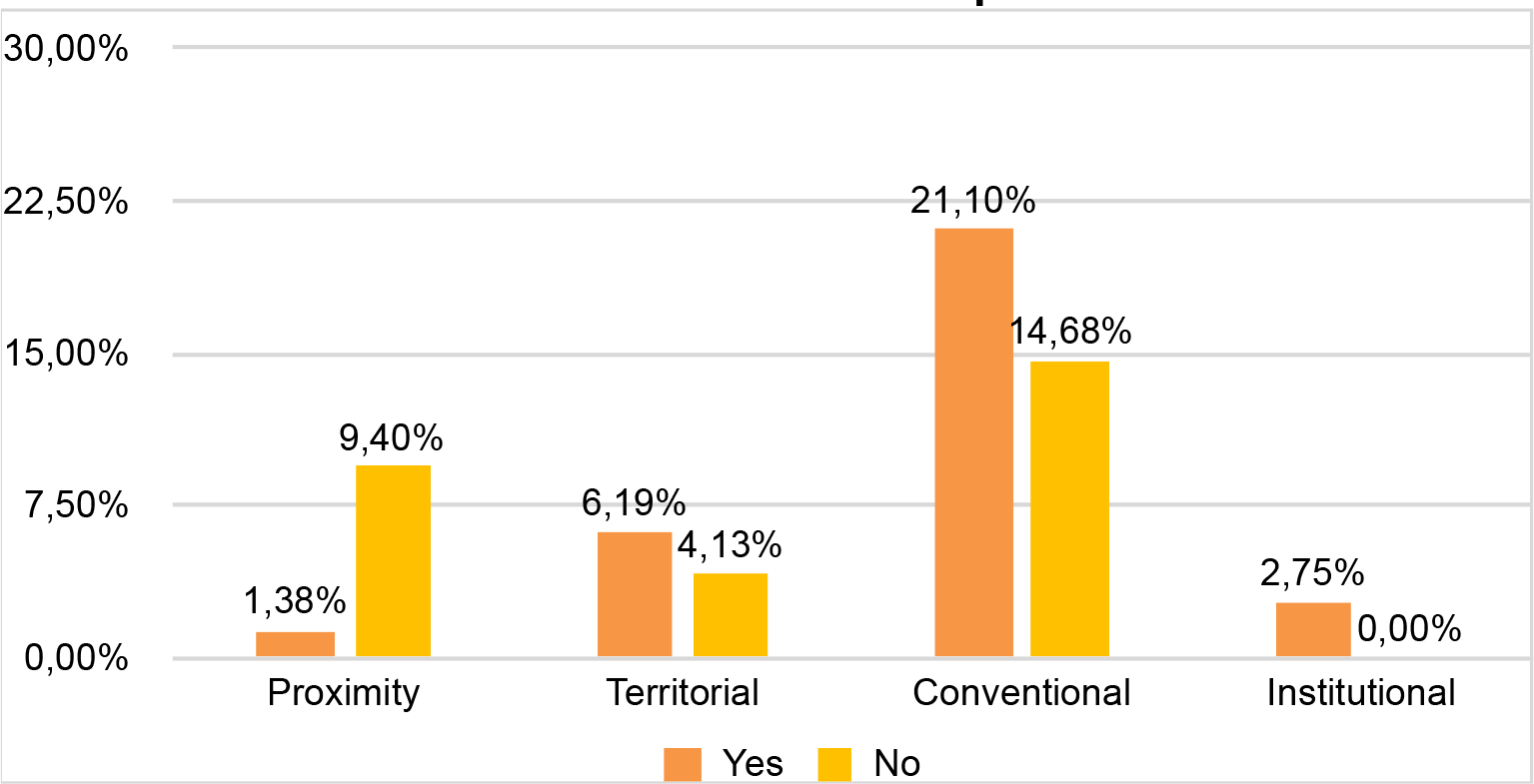
Given the above, Figure 4 presents the formalization of the existence of contracts by market typology. The formalization of sales relations through contracts is a central indicator of the institutional dynamics that structure markets and directly affect the economic security of settled farmers.

Formalization of commercial relations by market typology in agrarian reform settlements in the sample.
The greater presence of contracts in conventional markets (21.10%) (Figure 4) reflects on the one hand, the logic of agro-industrial chains, in which contracts are used as instruments of control, coordination, and risk reduction in commercial relations (Williamson, 1985). On the other hand, it also evidences that, even in these environments, a significant share of informal relations persists (14.68%), revealing the coexistence of formal and informal dynamics typical of agricultural markets in Brazil (Schneider, 2016; Fligstein; Dauter, 2012).
This duality aligns with Polanyi's (2012a) analyses, which demonstrate that markets are not purely economic spaces but arenas where formal norms, social relations, and power asymmetries intersect. In conventional markets, contracts may offer a degree of predictability. However, they do not eliminate unequal relations, especially when terms are set by companies and intermediaries, with settled farmers having limited bargaining power (Souza, 2024). In territorial markets, the higher proportion of contractual arrangements compared with informal ones (6.19% versus 4.13%) (Figure 4) suggests an environment of institutional strengthening, supported by cooperative networks, local agro-industries, and partnerships with the public sector. In this context, contracts operate not only as economic instruments, but also as mechanisms of social and territorial regulation (Mazzucato; Ryan-Collins, 2022).
By contrast, the predominance of informality in proximity markets (9.40% without contracts and only 1.38% with formalization) is directly related to the relational nature of these markets, based on trust, reciprocity, and direct interaction between producers and consumers (Granovetter, 1973; Renting, Marsden, Banks, 2003). Although this configuration offers advantages, such as less bureaucracy and greater flexibility, it also exposes farmers to risks, including demand fluctuations, seasonality, and the absence of formal guarantees for marketing production. This situation reveals a paradox: while proximity markets promote greater autonomy in pricing and commercial relations, the absence of contracts may create economic insecurity. This leads Darnhofer (2021) to reflect that the resilience of agricultural systems depends not only on the capacity to adapt to change, but also on the construction of institutions that ensure stability and predictability for producers.
The finding that formalization is more present in territorial markets is particularly relevant, as it points to the strategic role of public policies such as PNAE and PAA in inducing productive organization, collective articulation, and the generation of contractual commitments. According to Boyer and Drache (1997), markets only function efficiently when accompanied by mechanisms of social, legal, and institutional regulation capable of balancing relations among agents.
Therefore, the analysis demonstrates that contractual formalization is not an exclusively economic phenomenon, but a reflection of the institutional structures, social networks, and territorial arrangements that sustain different market types. As argued by Souza (2024) and van der Ploeg (2008; 2018), the construction of the economic autonomy of settled farmers depends fundamentally on their capacity to negotiate fairer conditions, build robust collective organizations, and participate in markets structured by clear, transparent, and socially legitimate rules. In this scenario, another essential element of commercialization concerns the distances between farmers and marketing locations. Table 5 presents the distribution of settlements by market typology and distance from the municipal center.
Spatial distribution of market typologies in relation to the municipal center in agrarian reform settlements.
Most settlements are in the "near" (52%) and "intermediate" (30.7%) categories (Table 5), which suggests relative connectivity with urban centers. However, significant disparities exist among market typologies. The conventional typology, which accounts for the largest number of cases (308), is concentrated in the category near the municipal center (58.8%), which may be related to greater dependence on already consolidated logistical and commercial structures, such as agro-industrial cooperatives, grain traders, and networks of intermediaries. Markets classified as proximity and institutional display a distinct pattern of behavior. In proximity markets, 62.1% of settlements are in intermediate regions (20.01 to 50 km), and only 1.7% are situated remarkably close to municipal centers. Leite et al. (2004) also explain that, in addition to distances, poor road conditions make the outflow of production more difficult. On the other hand, local markets are saturated, which in turn requires integration into other markets to commercialize production.
The institutional typology shows a higher relative proportion in intermediate (57.1%) and near (28.6%) areas, with no distant settlements. This is consistent with the logistical requirements of public programs such as PNAE and PAA, which require regular deliveries and coordination with municipal governments, schools, and public agencies, which are generally located in urban centers. In turn, territorial markets show a relatively balanced distribution between the near (45.7%) and intermediate (39.1%) categories, revealing regional articulation with potential for strengthening cooperative networks, local agri-food circuits, and territorially based public policies.
Closing remarks
This study aimed to analyze markets in Brazilian agrarian reform settlements. The results show that the predominance of conventional markets, associated with agro-industrial logic and intermediation, points to a subordinate form of market integration in which settlers have reduced bargaining power and are more exposed to market instability. By contrast, proximity and territorial markets, although less voluminous, reveal more promising trajectories for building economic autonomy. In these markets, farmers invest in production diversification, trust-based relationships with consumers, and short marketing channels that add value to production and strengthen local agri-food systems.
The diversification of sales channels emerges as one of the main indicators of market autonomy. Farmers operating across multiple channels can expand their strategic options, reduce dependencies, and strengthen their resilience in the face of economic adversity. However, this diversification is conditioned by market typology, collective organization, and the territorial location of settlements. The territorial dimension, in turn, proves decisive. Settlements located closer to urban centers tend to be linked to conventional markets, whereas those situated in intermediate areas reveal greater integration into institutional and proximity markets. This relationship between location and market typology highlights the strategic role of territory in shaping settlers' commercial practices.
From a sociological perspective, markets are spaces where economic, social, and symbolic capital intersect. When settlers build and control their own marketing circuits - through farmers' markets, public procurement, or digital platforms - they strengthen not only their income, but also their identity and social recognition. This social construction of markets contributes to the objectives of agrarian reform, reorganizes food systems, and promotes food sovereignty practices.
Moreover, these experiences foster social innovation, collective learning, and new organizational arrangements, such as solidarity networks, cooperatives, and intermunicipal consortia. These spaces restore to families control over the rules of the economic game and transform consumers into political allies. Investing in market diversity, therefore, is more than a strategy of productive inclusion: it is a commitment to social transformation, peasant protagonism, and rural development rooted in territories.
Considering this context, it is concluded that integrated public policies sensitive to the social and territorial complexity of markets are necessary. Measures such as expanding infrastructure, strengthening cooperatives, valuing institutional markets, and promoting direct marketing are essential for consolidating sustainable and fair trajectories that advance the economic autonomy of agrarian reform settlers in Brazil.
Concerning limitations, it should be emphasized that the results derive from a specific territorial sample and from a temporal snapshot; therefore, we recommend monitoring settlements through panel data (before/after) and constructing a replicable index of market autonomy combining channel diversity, the presence of contracts, access to rural extension services/credit, and collective participation. Such an indicator would enable monitoring policies and comparing trajectories across regions. It is also worth highlighting the need for a minimum coordination package: continuous, market-oriented rural extension services; the restoration and predictability of public procurement programs (PAA/PNAE); credit accompanied by assistance (rather than credit volume alone); and support for logistics/storage and contractual formalization. This set of measures tends to reduce dependence on intermediaries, expand channel diversification, and stabilize income. It is important to emphasize that future research should incorporate gender and youth dimensions (which capture the margins of autonomy), as well as climate shocks and price volatility as risk factors. Digitalization (traceability, sales platforms) also deserves attention: digital devices may reconfigure quality assurance mechanisms, reduce transaction costs, and open new niches for settlements.
How to cite this article
1
Research data availability statement
Regarding the availability of research data, the authors of the manuscript state that:
The full dataset supporting the results of this study has been published within the article itself.
References
- ARNALL, A. Adaptive capacity, resilience and the collapse of society: Learning from an indigenous pastoralist system in East Africa. Global Environmental Change, v. 31, p. 10-21, 2015.
- AZEVEDO, M. S. A construção social dos mercados: elementos teóricos e empíricos. Revista de Economia e Sociologia Rural, v. 54, n. 1, p. 31-48, 2016.
- BOYER, R.; DRACHE, D. (Org.). States against markets: The limits of globalization. Londres: Routledge, 1997.
-
BURT, R. S. Structural Holes: The Social Structure of Competition Harvard University Press, 1992. JSTOR, http://www.jstor.org/stable/j.ctv1kz4h78 Accessed 4 July 2026.
» http://www.jstor.org/stable/j.ctv1kz4h78 -
BRASIL. Ministério da Agricultura Pecuária e Abastecimento. Instrução Normativa nº 76 Brasília, DF: MAPA. Diário Oficial da República Federativa do Brasil, 2018. Disponível em: https://www.gov.br/agricultura/pt-br/ Acesso em: 10 set. 2020
» https://www.gov.br/agricultura/pt-br/ -
CASTILHOS, W. Os obstáculos da reforma agrária Humanamente, Rio de Janeiro, 17 fev. 2025. Disponível em: https://humanamente.fiocruz.br/agora/os-obstaculos-da-reforma-agraria/ Acesso em: 27 mai. 2025.
» https://humanamente.fiocruz.br/agora/os-obstaculos-da-reforma-agraria/ -
CENCI, A.; SCHNEIDER, S. Impacto da Covid-19 nos canais de comercialização e mercados das agroindústrias familiares da Serra Gaúcha. Organizações Rurais & Agroindustriais, v. 25, e196, 2023. Doi: http://dx.doi.org/10.48142/2520231961
» http://dx.doi.org/10.48142/2520231961 - COUGHLAN A. T.; ANDERSON, E.; STERN L. W.; EL-ANSAR, A. Marketing Channels 7th ed. New York: Pearson. 2013.
- DARNHOFER, I. Resilience and why it matters for farm management. European Review of Agricultural Economics, v. 48, n. 3, p. 639-668, 2021.
-
DEGGERONE, Z. A.; SCHNEIDER, S. Os canais de comercialização utilizados pelos agricultores familiares em Aratiba-RS. Organizações rurais & agroindustriais, v. 24, p. e1892-e1892, 2022. http://dx.doi.org/10.48142/2420221892
» http://dx.doi.org/10.48142/2420221892 -
DJALALOU-DINE A.A., PASCUCCI A.R.L., COULIBALY G.H., Omta O.S.W. (2014). Marketing Channel Selection by Smallholder Farmers. Journal of Food Products Marketing, v. 21, n. 4, p. 337-57, 2014. https://doi.org/10.1080/10454446.2013.856052
» https://doi.org/10.1080/10454446.2013.856052 -
FAO - Food and Agriculture Organization of the United Nations. Building a common vision for sustainable food and agriculture: Principles and approaches Rome: FAO, 2014. Disponível em: https://www.fao.org/3/i3940e/i3940e.pdf Acesso em: 29 mai. 2025.
» https://www.fao.org/3/i3940e/i3940e.pdf - FERNANDES, B. M. A formação do campesinato no Brasil: a luta pela terra e a construção do território camponês. Revista Estudos Sociedade e Agricultura, Rio de Janeiro, v. 17, n. 1, p. 45-73, 2009.
- FLIGSTEIN, N.; DAUTER, L. The sociology of markets. Caderno CRH, v. 25, p. 481-504, 2012.
- FUKUMOTO, E; BOZEMAN, B. Public values theory: What is missing?. The American Review of Public Administration, v. 49, n. 6, p. 635-648, 2019.
- GAIGER, L. I.; NYSSENS, M.; WANDERLEY, F. (Org.). Economia solidária: práticas, teorias e desafios. São Paulo: Editora Fundação Perseu Abramo, 2019.
- GRANOVETTER, M. Economic action and social structure: The problem of embeddedness. American Journal of Sociology, v. 91, n. 3, p. 481-510, 1985.
- GRANOVETTER, M. The strength of weak ties. American Journal of Sociology, v. 78, n. 6, p. 1360-1380, 1973.
- GRISA, C.; SCHNEIDER, S. Políticas públicas de desenvolvimento rural no Brasil Porto Alegre: Editora da UFRGS, 624 p. 2015.
-
INCRA - Instituto Nacional de Colonização e Reforma Agrária. Base de dados de assentamentos da reforma agrária. Brasília: INCRA, 2022. Disponível em: https://www.gov.br/incra/pt-br Acesso em: 29 maio 2025.
» https://www.gov.br/incra/pt-br -
LEITE, S. et al. Impactos dos assentamentos: um estudo sobre o meio rural brasileiro. Brasília, DF: Instituto Interamericano de Cooperação para a Agricultura; Núcleo de Estudos Agrários e Desenvolvimento Rural; São Paulo: Unesp, 2004. 392 p. (Estudos NEAD, n. 6). Disponível em : https://www.gov.br/mda/pt-br/acervo-nucleo-de-estudos-agrarios/nead-estudos-1/23-impactos-dos-assentamentos-um-estudo-sobre-o-meio-rural-brasileiro.pdf
» https://www.gov.br/mda/pt-br/acervo-nucleo-de-estudos-agrarios/nead-estudos-1/23-impactos-dos-assentamentos-um-estudo-sobre-o-meio-rural-brasileiro.pdf - LONG, N. Sociology of development: actor perspectives. London: Routledge, 2007.
- MARQUES, V. P. M. de A. DE FRANÇA, C. G.; DEL GROSSI, M. E. Um retrato da reforma agrária na região Sul do Brasil com base no censo agropecuário 2017. DRd-Desenvolvimento Regional em debate, v. 12, n. ed. esp. Dossiê , p. 38-64, 2022.
- MAZZUCATO, M.; RYAN-COLLINS, J. Modern economic theory is broken - and the solution calls for a new collective value creation framework. UCL Institute for Innovation and Public Purpose, Working Paper, n. 2022-05, 2022.
- OSTROM, E. Governing the commons: The evolution of institutions for collective action. Cambridge: Cambridge University Press, 2010.
- POLANYI, K. A grande transformação: As origens da nossa época. 2. ed. Rio de Janeiro: Campus, 2012a.
- POLANYI, K. A subsistência do homem e ensaios correlatos Rio de Janeiro: Contraponto, 2012b.
- RENTING, H.; MARSDEN, T. K.; BANKS, J. Understanding alternative food networks: Exploring the role of short food supply chains in rural development. Environment and Planning A, v. 35, n. 3, p. 393-411, 2003.
- SAUER, S. A reforma agrária no governo Lula: limites e contradições. Revista NERA, Presidente Prudente, v. 9, n. 9, p. 1-25, 2006.
- SCHNEIDER, S. Explicando o Projeto Mapeamento e Tipologia dos Mercados Alimentares 2022. Projeto CNPq intitulado Estudo e Análise de Mercados Alimentares no Brasil - comparando casos nacionais. Arquivo em PDF. Material não publicado, 2022.
- SCHNEIDER, S. Mercados e agricultura familiar. In: MARQUES, F. C.; CONTERATO, M. A.; SCHNEIDER, S. (orgs.). Construção de mercados e agricultura familiar: desafios para o desenvolvimento rural. Porto Alegre: Editora da UFRGS, 2016. p. 93-135.
- SOUZA, A. L. de. A construção da autonomia através das relações com os mercados: um estudo sobre as estratégias de comercialização no assentamento Ander Rodolfo Henrique na região oeste do Paraná. 2024. 312f. Tese (Doutorado em Sociologia) - Universidade Federal do Rio Grande do Sul, Porto Alegre, 2024.
- TIMMER, C. P. Farmers and markets: the political economy of new paradigms. American Journal of Agricultural Economics, v. 79, n. 2, p. 621-627, 1997.
- VAN DER PLOEG, J. D. Camponeses e impérios alimentares: lutas por autonomia e sustentabilidade na era da globalização. Porto Alegre: Editora da UFRGS, 2008.
- VAN DER PLOEG, J. D. The importance of peasant agriculture: a neglected truth. Sociologia Ruralis, v. 58, n. 4, p. 527-550, 2018.
- WILLIAMSON, O. E. The Economic Institutions of Capitalism: Firms, Markets, Relational Contracting. New York: The Free Press, 1985.
- WONG, J. De-commodifying food: Alternative food networks in China. Journal of Rural Studies, v. 76, p. 176-185, 2020.
- ZELIZER, V. A. Economic lives: How culture shapes the economy Princeton: Princeton University Press, 2010.
-
ZUREK, M.; HEBINCK, A.; LEIP, A.; VERVOORT, J.; KUIPER, M.; Food system resilience: concepts, issues, and challenges. Annual Review of Environment and Resources, v. 47, p. 511-534, 2022. https://doi.org/10.1146/annurev-environ-112320-050744
» https://doi.org/10.1146/annurev-environ-112320-050744

 Source: Prepared by the authors (2025).
 Source: Prepared by the authors (2025).
 Source: Prepared by the authors (2025).
 Source: Prepared by the authors (2025).