
 Agrofuels for climate change? Probable impacts and contradictions of the recent expansion of corn ethanol in Brazilian agrarian space
This article analyzes the expansion of the corn ethanol agroindustry in Brazil, highlighting its probable socio-environmental impacts and contradictions within the context of climate change and the energy transition. The research, grounded in a critical theoretical framework and empirical data, demonstrates that corn ethanol production has been growing rapidly, driven by public policies, financial incentives, and agribusiness demands. Although presented as a “sustainable” alternative to fossil fuels, this form of agroenergy reproduces historical patterns of land concentration, intensive monoculture, excessive use of natural resources, and the worsening of agrarian conflicts. The research employs a qualitative approach grounded in descriptive analysis of official data and information obtained through direct observation and unstructured interviews conducted during exploratory fieldwork in municipalities of the Brazilian Midwest. The collection of secondary and empirical data supported the analysis and interpretation of the expansion process of the corn ethanol agroindustry in Brazil, in accordance with research ethics principles. The study, still in progress, indicates that the sector’s expansion tends to strengthen large agroindustrial corporations, increase ecosystem degradation, stimulate deforestation, and restrict agrarian reform and food sovereignty. Thus, it is concluded that corn ethanol does not represent a just or effectively climate-oriented energy transition, but rather the perpetuation of an exclusionary agroindustrial development model that subordinates nature and traditional populations to the logic of capital reproduction and accumulation.
Keywoods:
Biofuels; energy transition; territorialization of capital; deterritorialization; agrarian question
 Thumbnail
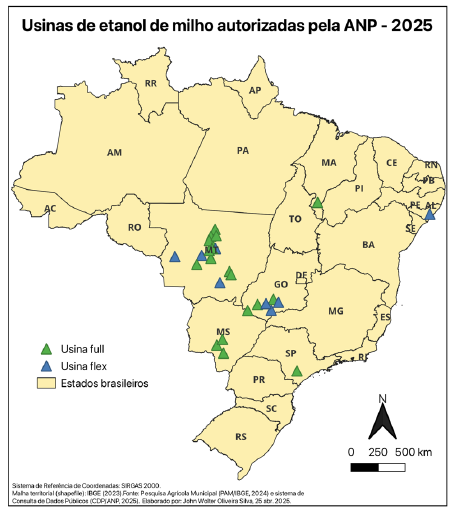 Fonte: elaborado pelo autor (2025).