
 The Expansion of Wind and Hybrid Energy in Bahia: Socio-Environmental Conflicts and Energy Injustice in Fundo and Fecho de Pasto Territories
Abstract
The Northeast Region of Brazil, especially the Semi-Arid Region, concentrates the expansion of solar and wind power plants in the country; however, this expansion gave rise to socio-environmental conflicts, particularly with traditional communities. The state of Bahia leads in wind energy production and offers the most favorable conditions for the development of hybrid (wind and solar) projects. The state has encouraged these projects by relaxing environmental and land-use regulations. Nevertheless, this expansion has produced negative impacts on the “Fundo e Fecho de Pasto” Communities (CFFP), which occupy public lands in the Semi-Arid region. The goal of this article is to analyze the expansion of wind and hybrid power plants in Bahia and, using energy justice as an analytical framework, to understand their impacts on CFFP communities. Based on bibliographic and documentary research, as well as semi-structured interviews, the study concludes that energy policies and renewable power plants have created energy injustices and green grabbing, transforming CFFP territories into “green sacrifice zones.”
Keywords:
Traditional communities; renewable energy; extractivism; environmental impacts; energy transition.
Resumo
O Nordeste, especialmente o Semiárido, concentra a expansão de usinas solares e eólicas no Brasil; contudo, esse avanço tem gerado conflitos socioambientais, particularmente com comunidades tradicionais. A Bahia lidera a produção de energia eólica e reúne as melhores condições para o desenvolvimento de projetos híbridos (eólicos e solares). O estado impulsiona esses projetos ao flexibilizar as legislações ambiental e fundiária. Entretanto, essa expansão tem produzido rebatimentos negativos sobre as Comunidades de Fundo e Fecho de Pasto (CFFP), que ocupam terras devolutas no Semiárido. O objetivo deste artigo é analisar a expansão dos projetos eólicos e híbridos na Bahia e, usando a justiça energética como ferramenta analítica, compreender seus impactos sobre as CFFP. Com base em pesquisa bibliográfica, documental e em entrevistas semiestruturadas, concluiu-se que as políticas energéticas e as usinas renováveis têm produzido injustiças energéticas e green grabbing, transformando os territórios das CFFP em "zonas de sacrifício verde".
Palavras-chave:
Comunidades tradicionais; energias renováveis; extrativismo; impactos ambientais; transição energética.
Resumen
La Región Nordeste, especialmente la Región Semiárido, concentra la expansión de parques solares y eólicos en Brasil; sin embargo, este avance ha generado conflictos socioambientales, particularmente con comunidades tradicionales. El estado de Bahía lidera la producción de energía eólica y reúne las mejores condiciones para el desarrollo de proyectos híbridos (eólicos y solares). El estado impulsa estos proyectos al flexibilizar las legislaciones ambiental y agraria. No obstante, esta expansión ha producido efectos negativos sobre las Comunidades de Fundo y Fecho de Pasto (CFFP), que ocupan tierras públicas en el Semiárido. El objetivo de este artículo es analizar la expansión de los proyectos eólicos e híbridos en Bahía y, utilizando la justicia energética como herramienta analítica, comprender sus impactos sobre las CFFP. Con base en investigación bibliográfica, documental y en entrevistas semiestructuradas, se concluyó que las políticas energéticas y las plantas renovables han producido injusticias energéticas y acaparamiento verde, transformado los territorios de CFFP en “zonas de sacrificio verde”.
Palabras-clave:
Comunidades tradicionales; energías renovables; extractivismo; impactos ambientales; transición energética.
Introduction
Bahia leads Brazil in wind energy generation and ranks second in solar energy, with installed capacities of 20.47 GW and 26.6 GW, respectively (Aneel, Jan. 2025). In Aneel energy auctions, the state stands as the main destination for new developments, concentrating 21.41% of new wind projects and 30.12% of solar projects (CCEE, 2024). The areas with the greatest wind and solar potential are concentrated in Bahia’s Semi-arid region (Schubert, 2013; AWS Truepower et al., 2018). Moreover, the state offers the best conditions for the development of wind-solar hybrid projects (Santos et al., 2020).
The expansion of renewable sources and the industries associated with them has been promoted as a strategy for sustainable regional development (Almeida, 2025). In this context, since 2009, the government of Bahia has actively fostered the sector through public incentive policies, the identification of priority areas for the installation of power plants, the flexibilization of environmental licensing, and changes in land regulations. At the same time, it has disseminated a narrative linking the expansion of renewable energy plants to job and income generation.
However, largely controlled by foreign companies which, in January 2024, owned 72.8% of wind farms (Pereira, 2024), wind and hybrid energy generation has assumed the characteristics of a “green” extractive activity (Dunlap; Verweijen; Tornel, 2024). Policies promoting the rapid expansion of these plants have favored green grabbing1 of state public lands. In addition, they have caused energy injustice2 against the state’s traditional peoples and communities (TPCs), especially the Fundo and Fecho de Pasto Communities (CFFP) (Silva et al., 2022).
Now valued for their wind and solar potential, CFFPs have traditionally used public lands in Bahia’s Semi-arid region for extensive livestock raising, articulated with low impact extractivism and subsistence agriculture. This production mode is referred to as the “fundo de pasto system” (Bianchini, Lima, and Barreto, 2022).
In response to the advance of renewable plants in the Semi-arid region, resistance actions by the Fundo e Fecho de Pasto movement (FFP), represented by the State Articulation of Fundo e Fecho de Pasto (AEFFP), have intensified, with support from research institutions such as GeografAR/UFBA3, and social organizations such as the Pastoral Land Commission (CPT)4, the Association of Lawyers for Rural Workers (AATR)5 , and the Regional Institute for Appropriate Small Agriculture (Irpaa)6 (AEFFP et al., 2020), resulting in multiple socio-environmental conflicts in different municipalities of Bahia.
Within the discourse of combating climate change, the corporate energy transitions currently being disseminated prioritize green extractivism and purely technological solutions, without altering consumption and production patterns, to expand markets and legitimize the ongoing exploitation of resources (Dunlap, Verweijen, and Tornel, 2024). In this context, green grabbing advances as a form of total territorial appropriation and material and symbolic dispossession of the ways of life that depend on it, driven by economic agreements that subordinate countries of the Global South as suppliers of raw materials for the decarbonization of the Global North, by the flexibilization of environmental and land regulations, and by the discursive construction of traditional territories as “empty” spaces to be developed (Barbosa and Nóbrega, 2025).
It is argued that the accelerated expansion of incentive policies for renewable energy and the implementation of wind and hybrid plants have transformed Fundo and Fecho de Pasto territories, which are already more vulnerable to climate change (Gaivizzo et al., 2019), into “green sacrifice zones”, that is, areas sacrificed in the name of energy transition projects (Zografos and Robbins, 2020).
This article analyses the expansion of wind and hybrid energy in Bahia and its impacts on CFFPs. It examines the main public policies aimed at promoting these sources in the state and, using energy justice as an analytical tool, investigates how such policies and the projects they foster have affected CFFPs. In addition, it analyses the forms of reaction and mobilization of the FFP movement in response to these processes.
Beyond this introduction, the article presents a methodology and analytical framework section, followed by four additional sections and a final considerations section. In the first section after the methodology, I present the energy mapping analysis. In the second, I discuss the process of simplifying the environmental licensing of wind farms. In the third, I examine changes in land regulations. Finally, in the fourth section, I analyze how the expansion of hybrid projects and “hybridization,” as well as the disposal of wind and solar equipment, constitute an imminent problem for these groups.
Methodology and Analytical Framework
Given the rapid expansion of renewable energy sources, it has become necessary to develop a critical analysis of how this dynamic materializes in territories and which groups are affected by it. To understand the impacts of energy policies and projects, energy (in)justice emerges as both a concept and an analytical tool that identifies where injustices occur and which groups are affected. It is structured around four dimensions: distributive (the allocation of benefits and harms), procedural (transparency and participation in decision-making processes), recognition (acknowledgment of the specificities of marginalized groups), and restorative (reparation for damages in accordance with the ways of life of affected communities) (Copena, 2022).
Accordingly, this study employed energy justice as an analytical framework to examine the impacts of wind and hybrid energy expansion on CFFPs. The research combined a literature review with documentary analysis of policies, technical reports, energy mapping, governmental agency data, and grey literature. In addition, six semi-structured interviews were conducted between September 2023 and January 2024 with key actors: representatives of AEFFP and Irpaa; members of the Superintendence of Agrarian Development (SDA), signatory to Normative Instruction (NI) SDE/SDR/CDA/PGE No. 01/2020 (Bahia, 2020), which established a procedure to accelerate the land regularization of state lands with wind potential; and representatives of the Secretariat for the Promotion of Racial Equality and Traditional Peoples and Communities (Sepromi), responsible for overseeing policies and projects affecting TPCs in the state.
The methodological procedures followed recognized ethical norms and guidelines. The interview transcripts were subjected to thematic analysis; finally, data triangulation was applied, providing a deeper understanding of the phenomena under investigation. To ensure confidentiality, quotations from interviews reproduced in the article do not identify participants by name, indicating only the institution or agency of origin.
Energy Mapping
The Mapping of CFFPs in the State of Bahia, the first carried out in the state, identified 980 CFFPs organized into 675 associations distributed across 56 municipalities (Germani and Oliveira, 2020). When these data are cross-referenced with information on wind plants authorized by Aneel up to March 2025, it is observed that of the 598 wind plants in the state (20.48 GW), 272 (45.48%) were in municipalities with CFFP associations. In the case of solar energy, of the 628 authorized plants (26.54 GW), 369 (58.76%) were situated in municipalities with CFFP associations.
Regarding projects in the study phase, 194 wind plants and 997 solar plants were recorded, of which 160 (82.47%) of the wind projects and 622 (62.39%) of the solar projects affected municipalities with associations. Considering all stages of implementation, 30 (53.57%) of the municipalities with CFFP associations have renewable energy projects in at least one of these stages. Figure 1 shows that the state's areas of greatest wind potential are concentrated in regions with a high density of CFFP associations.

Even though there is the possibility of CFFPs existing in areas of wind potential, the so-called “wind corridors”, and although their territorial rights are guaranteed in State Law No. 12.910/2013 (Bahia, 2013), as well as their recognition as one of the 28 TPCs under the National Policy for the Sustainable Development of Traditional Peoples and Communities (Brazil, 2007), the Bahia Wind Atlas (Schubert, 2013) does not mention their existence, citing only Indigenous and Quilombola lands, which constitutes an injustice of recognition. In 2018, the potential for hybrid wind-solar generation was mapped in the Bahia Solar Atlas (AWS Truepower et al., 2018); however, it likewise does not mention the presence of CFFPs in these areas.
These injustices of recognition are associated with the historical erasure of different TPCs by the State, as highlighted by the AEFFP interviewee in the following excerpt:
The State insists on denying the existence of other segments [of traditional peoples and communities] when it comes to access to public policies and to these impact-related issues when such developments arise. If it is not in an Indigenous or Quilombola community, then everything is fine, everything is okay; without realizing that there are also other segments in Brazil that are likewise heavily impacted by these developments, just like Quilombolas and Indigenous peoples, and Bahia is no different. [...] The State does not see this; it only sees Quilombolas and Indigenous peoples, perhaps because they seem to be the two segments with the greatest legal protection (interview with AEFFP member, 2024).
This invisibilization contributes to the weakening of protection for FFP communities, favoring new forms of energy injustice by exempting renewable energy companies and the State from legal obligations in environmental licensing and land regularization processes, as discussed below, thereby facilitating the implementation of such projects in their territories.
Environmental Licensing
Bahia simplified the environmental licensing of wind energy projects through Cepram Resolution No. 4,180/2001 (Bahia, 2001), later updated by Cepram Resolution No. 4,636/2018 (Bahia, 2018), allowing small-scale developments (up to 30 wind turbines) and medium-scale developments (31 to 120 wind turbines) to submit only a Simplified Environmental Report (RAS). According to Barrero, Freitas, and Marques (2021), this framework creates loopholes that fragment large projects (with more than 120 wind turbines) by creating Special Purpose Entities (SPEs) for each wind farm. In this way, even when the wind complex is owned by a single company, the requirement for an Environmental Impact Assessment and Environmental Impact Report (EIA-RIMA) is avoided.
This practice has become recurrent in the licensing processes of wind complexes submitted to the Institute for the Environment and Water Resources (Inema). Even in situations requiring EIA-RIMA, such as cases involving impacts on endangered and/or endemic avifauna, or on TPCs (Bahia, 2018), the state environmental agency has flexibilized the rules and granted simplified licenses for wind projects in vulnerable areas.
Campo Formoso constitutes an example of this process. The municipality has attracted companies from the wind sector for approximately 15 years, with some of the largest complexes in Bahia located there. However, this expansion has been marked by energy injustices. The Morrinhos Wind Complex (CEM), for example, generated negative socio-environmental impacts on the CFFPs of Borda da Mata, Belas, and Fazenda Quina (Araújo, 2017). The CFFP Fazenda Quina is the most affected, as it is located within the Directly Affected Area (ADA)7, less than 500 meters from the wind turbines of the Sertão Energias Renováveis Park (SER), which forms part of the CEM.
Dantas, Sampaio, and Souza (2022), based on documentary analysis of SER’s environmental licenses, identified several irregularities, including the recording of endangered and migratory avifauna. Such a finding should have motivated Inema to require an EIA-RIMA, which did not occur. Barrero, Freitas, and Marques (2021), based on analysis of environmental licenses and aerospace data, demonstrate that all wind complexes in Campo Formoso were licensed through the fragmentation of large projects.
Thus, the simplified studies submitted by wind projects in Bahia do not reach the level of depth required to understand the cumulative impacts of the concentration of plants in the same locality, resulting in overlapping socio-environmental risks for surrounding communities and biodiversity. This scenario is aggravated by scientific controversies surrounding the impacts of wind energy, especially regarding the negative effects of turbine noise on human health, which hinder the formulation of adequate regulatory policies (Alamir, Hansen, and Catcheside, 2021; Maciel et al., 2024).
The injustices of recognition in energy mapping, combined with procedural and distributive injustices in environmental licensing, contribute to the production of new energy injustices, as legislation requires public hearings only in cases that require EIA-RIMA (Bahia, 2018). Thus, by omitting CFFPs in mapping exercises and adopting simplified licensing procedures, the EIA-RIMA is waived, and, consequently, the social participation of communities through public hearings is also dispensed with, deepening procedural injustices.
Beyond public hearings, AEFFP claims the right of CFFPs to Free, Prior, and Informed Consultation (FPIC), as provided for in ILO Convention No. 169. FPIC has characteristics distinct from public hearing. It must occur prior to any decision and throughout all stages of legislative processes or projects affecting TPCs. Moreover, it must be conducted by their representative institutions, respecting socio-cultural contexts and their own consultation protocols (Yamada and Oliveira, 2013).
The non-compliance with FPIC is denounced by AEFFP, which points to the transfer, by Inema, of responsibility for consulting communities to private companies, thereby compromising the legitimacy of the process and the decision-making autonomy of CFFPs:
Consultation is not actually taking place as it should because it is the State - mainly Inema, the licensing body - that has the responsibility to conduct prior consultation and to give communities full autonomy to decide (interview with AEFFP member, 2024).
The absence of social participation in wind projects also constitutes a restorative injustice, since it prevents CFFPs from participating in the definition of compensatory measures compatible with their ways of life, as evidenced in the statement from Irpaa:
It is necessary that communities be minimally consulted, that they be heard, and, if they accept [the installation of the project], that they receive guidance so they can indicate where it is possible to create space for these parks. If it is to happen, [they should be asked] what kind of compensation they want: not an association, not an artesian well, but what basic infrastructure communities may have access to compensate for these other losses (interview with Irpaa member, 2024).
Land Regularization
Many areas with wind potential in Bahia consist of rural public lands that have not yet been incorporated by the State or transferred to private actors, creating obstacles for wind energy companies, which are required to prove land-use rights to participate in Aneel energy auctions (MME, 2008). To address this impasse, Normative Instruction No. 01/2020 was issued, which, according to the SDA, was intended to guide land regularization in wind corridors and prevent irregularities.
Until the Normative Instruction on wind corridors, things were very loose, because we already had regularization procedures here, but companies were seeking other formats. One commonly pursued route was adverse possession, and there was significant conflict, including with the State. The State had to intervene in these proceedings because they were almost always on public land, which cannot be subject to adverse possession. So many cases were rejected and returned to the ordinary regularization process. At the time, the administration established this NI largely to avoid that route, which we do not recommend, but which had been reaching us. Therefore, it guides [regularization] based on existing regulations (interview with SDA member, 2024).
Green grabbing through usucapião8 became recurrent in Bahia. According to AATR, this practice enabled public lands to be judicially recognized as the property of wind energy companies. An emblematic case occurred in Gentio de Ouro, where Paranaense de Participações Energia S.A. obtained ownership of nearly eight thousand hectares through adverse possession (AATR, 2017).
Normative Instruction No. 01/2020 was presented as an achievement for the state, capable of “stimulating the local economy, generating employment and income, as well as occupying a barren area and giving it a socially appropriate destination” (SDE, 2020, author’s emphasis). However, it was denounced by the FFP movement for disregarding the fact that these wind corridors are also traditionally occupied by CFFPs, for failing to guarantee FPIC, and for not involving Sepromi in its drafting process (AEFFP et al., 2020), thereby constituting a case of procedural and recognition injustice.
After protests, Normative Instruction No. 01/2020 was amended in 2021, establishing that, when CFFPs are identified in areas with wind potential, land regularization must be conducted by Sepromi and the SDA, as already provided for in Law No. 12.910/2013 (Bahia, 2021). This law, however, established a deadline of 31 December 2018 for CFFPs to request certification of recognition from Sepromi, a necessary requirement for obtaining the Real Right of Use Concession (CDRU) over the lands they occupy (Bahia, 2017). This “temporal landmark” was later declared unconstitutional by the Supreme Federal Court in 2023 (Brazil, 2023). Nevertheless, the absence of land regularization continues to leave many CFFPs vulnerable to land grabbing and land conflicts; in 2022, 43% of land conflicts in Bahia involved these communities (CPT, 2023).
The state of Bahia presents Normative Instruction No. 01/2020 as a benefit to CFFPs. However, according to AEFFP, land regularization aims to ensure the legal security of renewable energy companies rather than recognizing CFFPs’ territorial rights, prioritizing areas in wind corridors.
The land regularization provided for in this Normative Instruction is not intended to guarantee the right of traditional communities to remain in their territory. It is intended to guarantee the installation of wind complexes in territories they call “wind corridors,” but along these wind corridors lie the territories of many traditional communities. [...] What has the State done so far after the 2013 law? It has signed only three Real Right of Use Concession contracts, but why did it sign those contracts, and mainly only in one region, in Brotas [de Macaúba]? [Because] these contracts open the possibility for communities, after the contract is signed and registered, to lease the land directly to wind energy companies. This greatly constrains communities' right to decide, because the contract already provides that you may lease the land, thereby opening the way for communities to do so or for companies to pressure them [into doing so] (interview with AEFFP member, 2024).
In 2011, the first wind complex in Bahia was installed in Brotas de Macaúba, originally owned by Desenvix and now controlled by Statkraft, which seeks to transform it into a hybrid project (Statkraft, 2023). For approximately a decade, the Pastoral Land Commission (CPT) has denounced the socio-environmental damages and land grabbing caused by the project in the CFFPs of Mangabeira, Boa Vista, and Papagaio (CPT, 2014). The conflict established is primarily related to lease contracts, marked by legal insecurity, low remuneration, and long duration, as well as by the absence of state mediation or oversight, given that the company itself requested the regularization of the collective areas. Although some contractual clauses were revised following the FFP movement's action, the contracts remained unfavorable to the communities (Ribeiro and Oliveira, 2020).
The lack of state oversight in land regularization and in the implementation of wind farms may favor the grabbing of FFP lands. Regarding this omission, the SDA states that the State cannot intervene in lease contracts because they are instruments of private law.
The [contract] is a relationship between private parties. The State does not arbitrate duration, nor the values practiced, because that is prohibited. It is the community that signs the contract with the companies. Therefore, it is not the State’s role to consult the community, as the State's work is to regularize the community's land tenure. Once regularized, whether the community signs a contract with the wind energy company is a decision for the community. [...] It is not public work; it is not a State project; it is a private investment, and contracts apply if the other party has an interest. If the community does not sign, the company will not install the wind park there. It cannot sell that project at auction if it does not have the guarantee of a signed contract (interview with SDA member, 2024).
Furthermore, the SDA notes that:
From a land tenure standpoint, there is no transfer of land to companies; public land is transferred to communities and to farmers, whether family farmers or not. Land regularization is conducted for this public. Afterward, it is this public that signs the contracts, and these are temporary contracts, land-use concession contracts. There is no transfer of ownership (interview with SDA member, 2024).
However, although leasing does not formally transfer land possession to companies, as the SDA claims, in practice it removes control from small farmers due to the long duration of contracts and the restrictions on use and circulation imposed by the infrastructure of the plants, such as roads and transmission lines, which render the effective use of property unfeasible (Maia et al., 2024). According to the FFP movement, wind farms reduce the grazing territory available to animals.
When one of these companies arrives, it reduces these areas [Fundo and Fecho de Pasto] by fencing them off to isolate [the wind park]. In doing so, it reduces the possibility of income generation for families, as free-range livestock raising is already part of their culture and will interfere with their way of life. Thus, access to territories is impeded and, consequently, the herd is reduced, as available areas decrease (interview with Irpaa member, 2024).
In addition, the impacts of wind farms on species that share the same territories as the FFP impose further challenges on these communities.
We have cases in Sento Sé where [Fundo de Pasto] communities lost more than 2,000 animals, including goats and sheep, because the areas where wind parks were installed, up in the mountain ranges, were jaguar habitats, where these animals still predominate in the Caatinga. With the presence of people there, these animals began descending to grazing areas where people already raise livestock, and they then started causing losses because they began killing the herds (interview with Irpaa member, 2024).
In addition to Sento Sé, attacks on livestock by jaguars have also occurred in CFFPs located in Campo Formoso, Juazeiro, Umburana, and Sobradinho, in the surroundings of Boqueirão da Onça National Park (Santana, 2022), as well as in Uibaí (UMBU, Liga, and GAMBÁ, 2024). According to Esteves and Campos (2022), wind farms have altered jaguar behavior and habitat use, causing them to travel greater distances to avoid wind turbines and move closer to rural communities, thereby generating conflict.
Free-range livestock raising constitutes the productive and identity-based foundation of CFFPs. Thus, given the scarcity of studies on the behavioral and physiological impacts of wind projects on animal husbandry (Blanco-Penedo et al., 2025) and the growing number of complaints by small farmers regarding damages caused to their agricultural activities (Silva, Sarinho, and Santos, 2022), specific research on the impacts of wind farms on the fundo de pasto system is considered necessary.
In this context, Sepromi states that it faces difficulties in acting preventively in CFFP territories in cases involving wind farms due to limited personnel and staff discontinuity. At present, the Fundo e Fecho de Pasto coordination unit has only two civil servants, which restricts its action to emergency situations, when conflicts are already established, and Sepromi is called upon by the communities themselves.
We have only been at Sepromi for one year. This entire team is new. When we realized that Normative Instruction [01/2020] did not include Sepromi’s name, we immediately sent an official letter demanding this from the competent bodies, because we understand that it is important to participate in all regulations involving traditional communities, the ten segments, even though we are not the agency responsible for land matters. It is also important to say that the Fundo e Fecho de Pasto team consists of only two people, and it is difficult for us to serve the entire state, with 417 municipalities, with only two people. We try to respond to demands according to urgency (interview with Sepromi members, 2024).
The absence of regulation in the wind sector, especially norms concerning land contracts (Maia et al., 2024), combined with the lack of socio-environmental safeguards for vulnerable groups in the face of the rapid expansion of renewable plants in the Northeast (Nordeste Potência, 2024), exposes CFFPs to greater socio-environmental risks, favoring the production of energy injustices and the green grabbing of public lands by renewable energy megaprojects.
By contrast, the Bahia government constructs a win-win narrative (in which all parties benefit) surrounding the expansion of wind farms, anchored in the promise of job creation and income generation. These positive socioeconomic impacts, however, are temporary and concentrated in the construction phase of the plants (Sales, Maia, and Costa, 2025). This narrative is expressed, for example, in the signing of the CCDRUs of the CFFPs of Malhada and Papagaio (SDA, 2022a) and Mangabeira and Boa Vista (SDA, 2022b).
The benefit, which will reach approximately 25 families residing in productive areas with wind potential, will guarantee these families legal certainty for the preservation of the traditional community’s rights and the implementation of the enterprise, contributing to the generation of income and sustainable energy, while preventing speculation, land grabbing, and land conflicts (SDA, 2022a).
Following the publication of Normative Instruction No. 01/2020, these were the first CCDRUs signed in Bahia (SDA, 2022b), reinforcing the FFP movement’s thesis that the State prioritizes the regularization of traditional territories with wind potential to enable projects, reduce territorial conflicts, and promote the social acceptance of such developments.
New Problems Ahead
For AEFFP, the tendency is for conflicts involving wind farms to intensify in the coming years, especially with the expansion of hybrid projects and the “hybridization” of wind complexes.
We have observed that with this Normative Instruction, there has been a major increase in the search by wind and solar energy companies for territories, especially territories of traditional communities. Throughout the northern and northeastern regions of Bahia, this search by energy companies has advanced considerably, and not only wind energy. Here, in three municipalities of the region - Jaguarari, Juazeiro, Campo Formoso - there is a major hybrid energy project, solar and wind, which will impact many communities and an immense area of the Caatinga. According to them, 50 thousand hectares will be deforested to install solar panels. They will have to clear the entire Caatinga. This is an incredible contradiction: much is said about commitment to climate change and environmental preservation, and then solar panels are installed through the deforestation of the Caatinga. This is an absurd contradiction! (interview with AEFFP member, 2024).
In the region between Campo Formoso, Jaguarari, and Juazeiro, Quinto Energy is developing the Manacá Complex, the largest hybrid project in Brazil, comprising more than 500 wind turbines and 1.5 million photo voltaic panels (4.4 GW) spread across 50,000 hectares. This enterprise, however, was reported to the Public Prosecutor’s Office of Bahia by the “Salve as Serras” movement due to the risk it poses to the springs of the Jaguarari mountain ranges and to local communities, including the CFFPs of Lagoa Cavada, Sítio, and Borda da Mata. According to the complaint, Inema ignored this risk when it classified the project as having low polluting potential in granting a preliminary license in September 2023 (Bianchi, 2024). For Salve as Serras, the current model of wind expansion in Bahia promotes ecocide9 in the state’s mountain ranges (Marques, Barrero, and Maia, 2021).
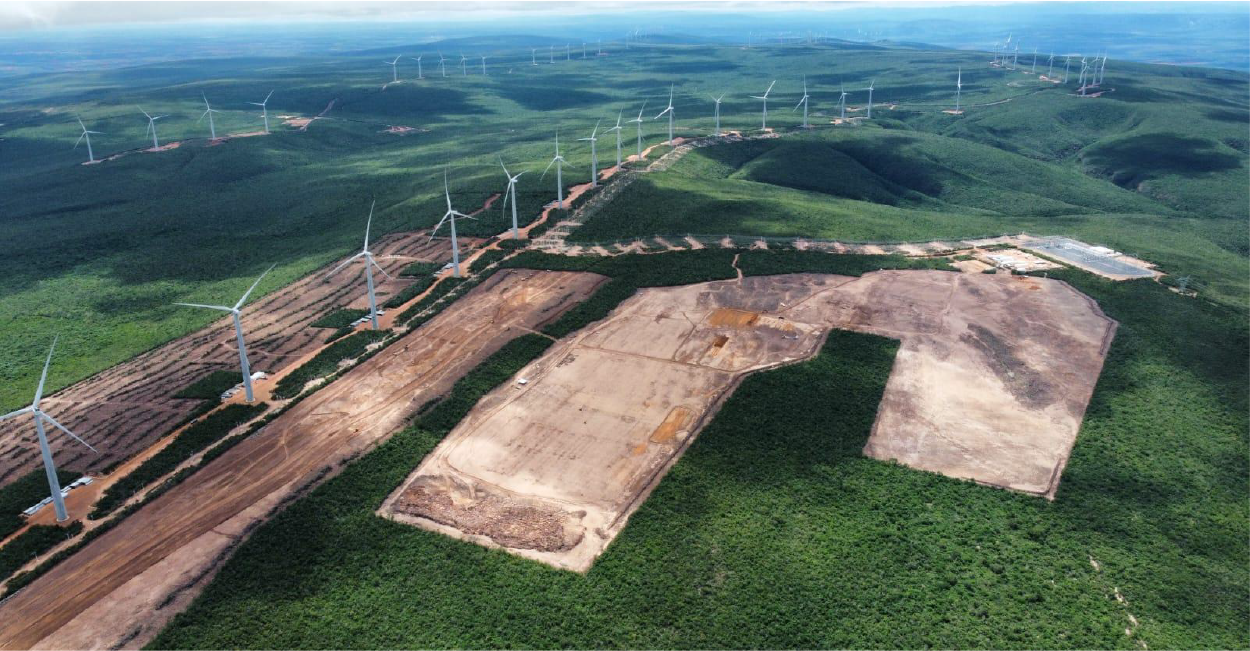
Another emblematic case of conflict has arisen from the “hybridization” of the Ventos de Santa Eugênia Wind Complex (CEVSE), owned by Statkraft, located between the municipalities of Uibaí and Ibipeba. At the end of 2023, the company announced the implementation of the Santa Eugênia Solar Complex (CSSE), occupying 1,724 hectares. Figure 2 illustrates the deforestation carried out for the installation of the CSSE photo voltaic panels.
This process of “hybridization” has produced energy injustices for the CFFPs of Poço and Boca d’Água, in Uibaí. The communities denounce the overlapping of areas historically destined for communal grazing, the absence of Free, Prior and Informed Consultation (FPIC), deforestation and suppression of native vegetation in groundwater recharge areas, as well as gaps in environmental licensing that should have required an Environmental Impact Assessment/Environmental Impact Report (EIA/RIMA), which did not occur (UMBU; Liga; GAMBÁ, 2024).
In view of these irregularities, the Public Prosecutor’s Office of Bahia ordered the suspension of CSSE works on 25 November 2024. Subsequently, however, Statkraft obtained authorization to resume installation of the complex upon submission of new technical data (Bezerra, 2025). This decision triggered protests by the local population, which organized the “Cry of the Caatinga” demonstration on 6 January 2025 at the CFFP in Boca d'água (Alves, 2025).
Another critical issue on the horizon concerns the decommissioning and disposal of equipment from wind and hybrid plants that are replaced during repowering. Brazil still lacks specific legislation for the decommissioning of such plants (EPE, 2020), and the National Solid Waste Policy does not address waste generated by wind farms (Brazil, 2010). In the case of photo voltaic solar plants, Decree No. 10,240/2020 assigns importers and suppliers’ responsibility for the recycling of solar panels (Brazil, 2020). However, since more than 90% of the components of solar panels are imported, the effective implementation of this regulation becomes difficult (Bezerra, 2023).
The absence of regulation already produces negative effects, as evidenced by the case of the Casa Nova I wind park, in the municipality of Casa Nova. The enterprise was supposed to be the first in Bahia, but Companhia Hidrelétrica do São Francisco (Chesf) abandoned it in 2014 after the bankruptcy of the consortium's leader, IMPSA, because of the 2008 financial crisis. For approximately six years, 30 wind turbines remained abandoned, generating environmental liabilities for the CFFP of Malvão (Caramel, 2022). Only in 2020 did Companhia Hidrelétrica do São Francisco (Chesf) announce the resumption of the project and its conversion into a hybrid complex (Chesf, 2020). The case signals that if these normative gaps are not resolved, CFFPs will also bear the impacts of inadequate equipment disposal from renewable plants. Such a process constitutes further restorative and distributive injustices for CFFPs.
Closing remarks
In countries of the Global South, the State induces and enables green extractivism through incentive policies and the creation of regulations that, by simplifying environmental licensing and land regularization, weaken the territorial rights of traditional peoples and communities (TPCs), legitimizing such actions under the discourse of sustainable development.
The conflicts analyzed reveal weaknesses in environmental and land policies, as well as the absence of socio-environmental safeguards in the energy transition process. Given the expected expansion of renewable energy sources in Brazil, it is urgent to revise sectoral regulations, strengthen licensing instruments, and ensure greater social participation in projects. Moreover, it is essential to expand research on the socio-environmental impacts of renewable plants, especially hybrid projects, which remain a novelty in the Brazilian context.
If no changes occur in how the expansion of renewable plants has been promoted, TPCs such as the CFFPs - which already suffer disproportionately from the effects of climate change - will bear an even greater burden of socio-environmental risks and energy injustice generated by the energy transition, becoming converted into green sacrifice zones.
-
1
Green grabbing refers to the large-scale appropriation of land ownership and/or control by domestic and international capital, legitimized through environmental and climate policies (Fairhead, Leach and Scoones, 2012).
-
2
Energy injustice refers to the unequal distribution of benefits, negative impacts, and responsibilities arising from energy policies and infrastructures (Copena, 2022).
-
3
A research group affiliated with the Graduate Program in Geography at the Federal University of Bahia.
-
4
An organization of the National Conference of Bishops of Brazil that supports and advocates for rural workers and traditional peoples and communities (TPCs).
-
5
A Bahia-based organization that provides grassroots legal assistance to social movements, traditional peoples and communities (TPCs), and rural workers.
-
6
An institute dedicated to promoting sustainable coexistence with Brazil’s Semi-arid region.
-
7
Area where the direct physical interventions, installation, and operation of a development project will take place.
-
8
Usucapião is the legal right to acquire ownership of property through its continuous possession or use for a specified period, in accordance with statutory requirements.
-
9
Ecocide is any unlawful or arbitrary act committed with the knowledge that it is likely to cause severe damage to the environment.
-
Translator’s Notes
For the purposes of accuracy and contextual fidelity, certain Portuguese terms referring to specific Brazilian legal, territorial, and socio-cultural realities have been retained in the original language throughout this article. Brief explanations are provided below at their first mention.Fundo de pasto: A traditional communal land-use system found in Brazil’s Semi-arid region, especially in Bahia, based on the collective use of common lands for free-range livestock raising, combined with subsistence agriculture and low-impact extractive activities. The term is maintained in Portuguese due to the absence of a direct equivalent in English and its specific territorial, historical, and legal meaning.Quilombo/Quilombola:Quilombos are historically constituted Afro-Brazilian communities, many of which originated in processes of resistance to slavery and racial oppression. Quilombola refers to the people, communities, or identities linked to these territories. Both terms are preserved in Portuguese because of their historical, legal, and political specificity in Brazil.Usucapião: A Brazilian legal mechanism through which ownership rights may be acquired through continuous possession of land or property for a legally prescribed period, subject to statutory requirements. The term is maintained in Portuguese because, although broadly comparable to adverse possession, it has distinct legal characteristics in the Brazilian system.
-
How to cite this article
ALMEIDA, Edna de; TONI, Fabiano. The Expansion of Wind and Hybrid Energy in Bahia: Socio-Environmental Conflicts and Energy Injustice in Fundo and Fecho de Pasto Territories. Revista NERA, v. 29, n. 1, e11389, 2026. https://doi.org/10.1590/1806-675520262911389en.
Acknowledgements
The first author acknowledges the National Council for Scientific and Technological Development (CNPq) for the award of a master’s scholarship (process no. 133675/2025-4), which supported the development of this research.
Research data availability statement
Regarding the availability of research data, the authors of the manuscript state that:
The full dataset supporting the results of this study is included within the article itself.
References
-
AATR - ASSOCIAÇÃO DE ADVOGADOS DE TRABALHADORES RURAIS NO ESTADO DA BAHIA (org.). No rastro da grilagem - formas jurídicas da grilagem contemporânea. Salvador: AATR, 2017. Disponível em: https://www.academia.edu/37323002/No_Rastro_da_Grilagem_Formas_Jur%C3%ADdicas_da_Grilagem_Contempor%C3%A2nea Acesso em: 17 abr. 2025.
» https://www.academia.edu/37323002/No_Rastro_da_Grilagem_Formas_Jur%C3%ADdicas_da_Grilagem_Contempor%C3%A2nea -
AEFFP - ARTICULAÇÃO ESTADUAL DE FUNDO E FECHO DE PASTO; ASSOCIAÇÃO DE ADVOGADOS DE TRABALHADORES RURAIS NO ESTADO DA BAHIA; COMISSÃO PASTORAL DA TERRA; INSTITUTO REGIONAL DA PEQUENA AGROPECUÁRIA APROPRIADA; GRUPO DE PESQUISA GEOGRAFAR. Análise da Instrução Normativa n. 01/2020 Salvador, 2020. Disponível em: https://www.aatr.org.br/post/bahia-organiza%C3%A7%C3%B5es-publicam-an%C3%A1lise-da-in-01-2020-dos-corredores-de-vento-1#:~:text=Publicada%20em%20plena%20pandemia%2C%20a,e%20fecho%20de%20pasto%20e Acesso em: 17 abr. 2025.
» https://www.aatr.org.br/post/bahia-organiza%C3%A7%C3%B5es-publicam-an%C3%A1lise-da-in-01-2020-dos-corredores-de-vento-1#:~:text=Publicada%20em%20plena%20pandemia%2C%20a,e%20fecho%20de%20pasto%20e -
ANEEL - AGÊNCIA NACIONAL DE ENERGIA ELÉTRICA. Sistema de Informações de Geração de Energia da ANEEL. Brasília: Aneel, 2025. Disponível em: https://app.powerbi.com/view?r=eyJrIjoiNGE3NjVmYjAtNDFkZC00MDY4LTliNTItMTVkZTU4NWYzYzFmIiwidCI6IjQwZDZmOWI4LWVjYTctNDZhMi05MmQ0LWVhNGU5YzAxNzBlMSIsImMiOjR9 Acesso em: 27 ago. 2025.
» https://app.powerbi.com/view?r=eyJrIjoiNGE3NjVmYjAtNDFkZC00MDY4LTliNTItMTVkZTU4NWYzYzFmIiwidCI6IjQwZDZmOWI4LWVjYTctNDZhMi05MmQ0LWVhNGU5YzAxNzBlMSIsImMiOjR9 -
ALAMIR, Mahmoud A.; HANSEN, Kristy L.; CATCHESIDE, Peter. Penalties applied to wind farm noise: Current allowable limits, influencing factors, and their development. Journal of Cleaner Production, v. 295, p. 126393, 2021. https://doi.org/10.1016/j.jclepro.2021.126393
» https://doi.org/10.1016/j.jclepro.2021.126393 -
ALMEIDA, Edna de. O farol da transição energética: extrativismo verde, justiça energética e conflitos socioambientais no Nordeste brasileiro 2025. 158 p. Dissertação (Mestrado em Desenvolvimento Sustentável) - Universidade de Brasília, Brasília, 2025. Disponível em: https://repositorio.unb.br/handle/10482/52785 Acesso em: 24 dez. 2025.
» https://repositorio.unb.br/handle/10482/52785 -
ALVES, Ales. Manifestação em Uibaí denuncia o INEMA por liberar desmatamento da caatinga para instalação de usina solar. Irecê Notícias, 07 jan. 2025. Disponível em: https://www.irecenoticias.com.br/noticia/manifestacao-em-uibai-denuncia-o-inema-por-liberar-desmatamento-da-caatinga-para-instalacao-de-usina-solar/ Acesso em: 05 fev. 2026.
» https://www.irecenoticias.com.br/noticia/manifestacao-em-uibai-denuncia-o-inema-por-liberar-desmatamento-da-caatinga-para-instalacao-de-usina-solar/ -
ARAÚJO, Cosme da Silva. Os impactos socioambientais do empreendimento eólico em comunidades de fundo de pasto no município de Campo Formoso. 2017. 87 p. Monografia (Bacharelado em Direito) - Universidade do Estado da Bahia, Salvador, 2017. Disponível em: https://geografar.ufba.br/sites/geografar.ufba.br/files/2017_cosme_da_silva_araujo.pdf Acesso em: 24 ago. 2025.
» https://geografar.ufba.br/sites/geografar.ufba.br/files/2017_cosme_da_silva_araujo.pdf -
AWS TRUEPOWER; CAMARGO SCHUBERT; FIEB; SENAICIMATEC. Atlas solar: Bahia Salvador, 2018. 76 p. Disponível em: http://sit.infraestrutura.ba.gov.br/docs/download/mapas/atlas-solar-Bahia-2018.pdf Acesso em: 17 abr. 2025.
» http://sit.infraestrutura.ba.gov.br/docs/download/mapas/atlas-solar-Bahia-2018.pdf -
BAHIA. Instrução Normativa Conjunta SDE/SDR/CDA/PGE nº 01, de 1º de julho de 2020 Dispõe sobre os procedimentos de regularização fundiária em terras devolutas estaduais com potencial de geração de energia eólica. Salvador: Secretária de Desenvolvimento Econômico, Secretária de Desenvolvimento Rural, Coordenação de Desenvolvimento Agrário e Procuradoria Geral do Estado, 2020. Disponível em: https://www.sda.sdr.ba.gov.br/documentos/instrucoes-normativas Acesso em: 17 abr. 2025.
» https://www.sda.sdr.ba.gov.br/documentos/instrucoes-normativas -
BAHIA. Lei nº 12.910, de 11 de outubro de 2013 Dispõe sobre a regularização fundiária de terras públicas estaduais, rurais e devolutas, ocupadas tradicionalmente por comunidades remanescentes de quilombos e por fundos de pastos ou fechos de pastos e dá outras providências. Diário Oficial do Estado da Bahia, Salvador, 12 out. 2013. Disponível em: https://static.poder360.com.br/2023/09/lei-ba-12910-2013.pdf Acesso em: 27 ago. 2025.
» https://static.poder360.com.br/2023/09/lei-ba-12910-2013.pdf -
BAHIA. Portaria nº 10, de 6 de julho de 2017. Revoga a Portaria nº 007, de 31 de março de 2014, institui o Cadastro das Comunidades de Fundos de Pasto e Fechos de Pasto do Estado da Bahia, define os procedimentos para a certificação destas comunidades e dá outras providências. Salvador: Secretaria da Promoção de Igualdade Racial, 7 jul. 2017. Disponível em: https://www.ba.gov.br/sepromi/sites/site-sepromi/files/migracao_2024/arquivos/File/portaria0010cadastodefundoefechodepasto.pdf Acesso em: 23 ago. 2025.
» https://www.ba.gov.br/sepromi/sites/site-sepromi/files/migracao_2024/arquivos/File/portaria0010cadastodefundoefechodepasto.pdf - BAHIA. Portaria nº 21, de 15 de junho de 2021. Altera a Instrução Normativa Conjunta SDE/SDR/CDA/PGE nº 01/2020, de 1º de julho de 2020. Diário Oficial do Estado da Bahia, Salvador, ed. 23.188, n. 021, p. 38, 15 jun. 2021.
-
BAHIA. Resolução nº 4.636, de 28 de setembro de 2018 Estabelece critérios e procedimentos para o licenciamento ambiental de empreendimentos de geração de energia elétrica a partir de fonte eólica em ambientes terrestres no Estado da Bahia e dá outras providências. Salvador: Conselho Estadual de Meio Ambiente, 29 set. 2018. Disponível em: https://www.tributa.net/legislacao/resolucao-cepram-n-4-636-de-28-de-setembro-de-2018#:~:text=Estabelece%20crit%C3%A9rios%20e%20procedimentos%20para,Bahia%20e%20d%C3%A1%20outras%20provid%C3%AAncias Acesso em: 23 ago. 2025.
» https://www.tributa.net/legislacao/resolucao-cepram-n-4-636-de-28-de-setembro-de-2018#:~:text=Estabelece%20crit%C3%A9rios%20e%20procedimentos%20para,Bahia%20e%20d%C3%A1%20outras%20provid%C3%AAncias -
BAHIA. Resolução nº 4.180, de 29 de abril de 2011 Aprova a Norma Técnica NT- (01/2011) e seus Anexos, que dispõe sobre o Processo de Licenciamento Ambiental de Empreendimentos de Geração de Energia Elétrica a partir de fonte eólica no Estado da Bahia. Salvador: Conselho Estadual de Meio Ambiente, 30 abr. 2011. Disponível em: https://www.cnmp.mp.br/portal/images/CMA/arquivos/Anexo_Manual_Energias_Renov%C3%A1veis/Resolucao_CEPRAM_4180_2011_lic_amb_gera_energia_de_fonte_e%C3%B3lica_1.pdf Acesso em: 23 ago. 2025.
» https://www.cnmp.mp.br/portal/images/CMA/arquivos/Anexo_Manual_Energias_Renov%C3%A1veis/Resolucao_CEPRAM_4180_2011_lic_amb_gera_energia_de_fonte_e%C3%B3lica_1.pdf -
BARBOSA, Lia Pinheiro; NÓBREGA, Luciana Nogueira. Estratégias de green grabbing no contexto da transição energética: um estudo a partir da apropriação integral do território na América Latina. Revista NERA, v. 28, n. 3, 2025. https://doi.org/10.1590/1806-675520252811122
» https://doi.org/10.1590/1806-675520252811122 - BARRERO, Flávio Marques; FREITAS, Helder Ribeiro; MARQUES, Juracy. Complexo Eólico de Campo Formoso: Asas no Chão - Norte e Sul. In: MARQUES, Juracy; BARRERO, Flávio Marques; MAIA, Ícaro (org.). O Cárcere dos Ventos: destruição das Serras pelos complexos eólicos. Paulo Afonso: SABEH, 2021. p. 87-155.
-
BEZERRA, Camila. Complexo solar na Bahia aumenta o desmatamento da Caatinga. Jornal GGN, publicado em 17 jan. 2025. Disponível em: https://jornalggn.com.br/meio-ambiente/complexo-solar-bahia-aumenta-desmatamento-caatinga/ Acesso em: 26 abr. 2025.
» https://jornalggn.com.br/meio-ambiente/complexo-solar-bahia-aumenta-desmatamento-caatinga/ -
BEZERRA, Francisco Diniz. Energia Solar. Caderno Setorial ETENE, Recife, v. 8, n. 295, 2023. Disponível em: https://www.bnb.gov.br/revista/cse/article/view/2649 Acesso em: 17 abr. 2025.
» https://www.bnb.gov.br/revista/cse/article/view/2649 -
BIANCHI, Paula. Bahia aprova megaprojeto de eólicas sem estudo completo de impacto ambiental Salvador, 2024. Disponível em: https://reporterbrasil.org.br/2024/06/bahia-aprova-megaprojeto-eolicas-sem-estudo-completo-impacto-ambiental/ Acesso em: 26 abr. 2025.
» https://reporterbrasil.org.br/2024/06/bahia-aprova-megaprojeto-eolicas-sem-estudo-completo-impacto-ambiental/ - BIANCHINI, Fabricio; LIMA, Paola Hernandez Cortez; BARRETO, Rebeca Mascarenhas Fonseca. 16.2. Comunidades Tradicionais Fundo de Pasto: manejo da agrobiodiversidade da Caatinga nos territórios historicamente ocupados pelas Comunidades Tradicionais Fundo de Pasto no Sertão do São Francisco baiano. In: CUNHA, Manuela Carneiro da; ADAMS, Cristina (org.). Povos tradicionais e biodiversidade no Brasil. São Paulo: SBPC, 2022. p. 77-126.
-
BLANCO‑PENEDO, Isabel et al Relación entre las estructuras físicas asociadas a las energías renovables y la salud y el bienestar del ganado extensivo: revisión bibliográfica. Itea - Información Técnica Económica Agraria, v. 121, n. 1, p. 17-38, 2025. https://doi.org/10.12706/itea.2024.014
» https://doi.org/10.12706/itea.2024.014 -
BRASIL. Decreto nº 6.040, de 7 de fevereiro de 2007 Institui a Política Nacional de Desenvolvimento Sustentável dos Povos e Comunidades Tradicionais. Brasília: Casa Civil, 2007. Disponível em: https://www.planalto.gov.br/ccivil_03/_ato2007-2010/2007/decreto/d6040.htm Acesso em: 27 ago. 2025.
» https://www.planalto.gov.br/ccivil_03/_ato2007-2010/2007/decreto/d6040.htm -
BRASIL. Decreto nº 10.240, de 12 de fevereiro de 2020. Regulamenta o inciso VI do caput do art. 33 e o art. 56 da Lei nº 12.305, de 2 de agosto de 2010, e complementa o Decreto nº 9.177, de 23 de outubro de 2017, quanto à implementação de sistema de logística reversa de produtos eletroeletrônicos e seus componentes de uso doméstico. Diário Oficial da União: seção 1, Brasília, 13 fev. 2020. Disponível em: https://www.planalto.gov.br/ccivil_03/_ato2019-2022/2020/decreto/d10240.htm Acesso em: 27 ago. 2025.
» https://www.planalto.gov.br/ccivil_03/_ato2019-2022/2020/decreto/d10240.htm -
BRASIL. Lei nº 12.305, de 2 de agosto de 2010. Institui a Política Nacional de Resíduos Sólidos; altera a Lei nº 9.605, de 12 de fevereiro de 1998; e dá outras providências. Diário Oficial da União: seção 1, Brasília, 3 ago. 2010. Disponível em: https://www.planalto.gov.br/ccivil_03/_ato2007-2010/2010/lei/l12305.htm?utm_source=chatgpt.com Acesso em: 27 ago. 2025.
» https://www.planalto.gov.br/ccivil_03/_ato2007-2010/2010/lei/l12305.htm?utm_source=chatgpt.com -
BRASIL. Supremo Tribunal Federal. Ação Direta de Inconstitucionalidade 5.783. Relatora: Ministra Rosa Weber. Brasília, DF, 6 set. 2023. Disponível em: https://portal.stf.jus.br/processos/detalhe.asp?incidente=5266042 Acesso em: 27 ago. 2025.
» https://portal.stf.jus.br/processos/detalhe.asp?incidente=5266042 -
CARAMEL, Lilian. Energia eólica avança sobrepondo-se a territórios de comunidades. Dialogue Earth 2022. Disponível em: https://dialogue.earth/pt-br/nao-categorizado/60621-energia-limpa-avanca-pela-bahia-sobrepondo-se-a-territorios-de-comunidades-tradicionais/ Acesso em: 26 abr. 2025.
» https://dialogue.earth/pt-br/nao-categorizado/60621-energia-limpa-avanca-pela-bahia-sobrepondo-se-a-territorios-de-comunidades-tradicionais/ -
CCEE - CÂMARA DE COMERCIALIZAÇÃO DE ENERGIA ELÉTRICA. Balanço 2023 Brasília, 2024. Disponível em: https://www.ccee.org.br/o/ccee/documentos/CCEE_1141904 Acesso em: 27 ago. 2025.
» https://www.ccee.org.br/o/ccee/documentos/CCEE_1141904 -
CHESF. Chesf investe R$ 90 milhões em planta híbrida 2020. Disponível em: https://www.chesf.com.br/_layouts/15/chesf_noticias_farm/noticia.aspx?idnoticia=645 Acesso em: 26 abr. 2025.
» https://www.chesf.com.br/_layouts/15/chesf_noticias_farm/noticia.aspx?idnoticia=645 -
CPT - COMISSÃO PASTORAL DA TERRA. Comunidades rurais de Gentio do Ouro preocupadas com ação de empresas da energia eólica na região CPT. 2014. Disponível em: https://cptba.org.br/comunidades-rurais-de-gentio-do-ouro-preocupadas-com-acao-de-empresas-da-energia-eolica-na-regiao/ Acesso em: 26 abr. 2025.
» https://cptba.org.br/comunidades-rurais-de-gentio-do-ouro-preocupadas-com-acao-de-empresas-da-energia-eolica-na-regiao/ -
CPT - COMISSÃO PASTORAL DA TERRA. Conflitos no campo Brasil 2022 1ª ed. Goiânia: CPT, 2023. Disponível em: https://cptnacional.org.br/documento/livro-2022-v21-web Acesso em: 26 abr. 2025.
» https://cptnacional.org.br/documento/livro-2022-v21-web - COPENA, Damián. O desenvolvimento das energias renováveis e a justiça energética: um achegamento ao debate existente e a dinâmica histórica. In: MAIA, Fernando Joaquim Ferreira; BATISTA, Marcela Peixoto; SILVA, Tarcísio Augusto Alves da; COPENA RODRÍGUEZ, Damián (org.). Energia Eólica: contratos, renda da terra e regularização fundiária. 1a ed. Rio de Janeiro: Lumen Juris, 2022. p. 115-135.
-
DANTAS, Livia Silva; SAMPAIO, Sarah Andrade; SOUZA, Sirius Oliveira. Estudo documental dos impactos ambientais de um parque eólico no município de Campo Formoso - BA. Geografia em Atos (Online), v. 6, p. 1-26, 2022. Disponível em: https://revista.fct.unesp.br/index.php/geografiaematos/article/view/8852 Acesso em: 3 abr. 2025.
» https://revista.fct.unesp.br/index.php/geografiaematos/article/view/8852 -
DUNLAP, Alexander; VERWEIJEN, Judith; TORNEL, Carlos. The political ecologies of “green” extractivism(s): An introduction. Journal of Political Ecology, v. 31, n. 1, p. 436-463, 2024. https://doi.org/10.2458/jpe.6131
» https://doi.org/10.2458/jpe.6131 -
EPE - EMPRESA DE PESQUISA ENERGÉTICA. Plano Nacional de Energia 2050 Brasília: MME, 2020. 243 p. Disponível em: https://www.epe.gov.br/sites-pt/publicacoes-dados-abertos/publicacoes/PublicacoesArquivos/publicacao-227/topico-563/Relatorio%20Final%20do%20PNE%202050.pdf Acesso em: 27 ago. 2025.
» https://www.epe.gov.br/sites-pt/publicacoes-dados-abertos/publicacoes/PublicacoesArquivos/publicacao-227/topico-563/Relatorio%20Final%20do%20PNE%202050.pdf -
ESTEVES, Carolina; CAMPOS, Claudia. Wind farms: a new challenge in the conservation of big cats in the Brazilian semiarid region. Wild Felid Research and Management Association, v. 16, n. 1, p. 21-38, 2022. Disponível em: https://www.researchgate.net/publication/363415512_Wind_farms_a_new_challenge_in_the_conservation_of_big_cats_in_the_Brazilian_semiarid_region Acesso em: 17 abr. 2025.
» https://www.researchgate.net/publication/363415512_Wind_farms_a_new_challenge_in_the_conservation_of_big_cats_in_the_Brazilian_semiarid_region -
FAIRHEAD, James; LEACH, Melissa; SCOONES, Ian. Green Grabbing: a new appropriation of nature? Journal of Peasant Studies, v. 39, n. 2, p. 237-261, 2012. https://doi.org/10.1080/03066150.2012.671770
» https://doi.org/10.1080/03066150.2012.671770 -
GAIVIZZO, Larisa Ho Bech; LITRE, Gabriela; FERREIRA, Julia Lopes; SILVA, Romero Gomes Pereira da; SOARES, Daniela Nogueira; REIS, Rafael Moraes; ALMEIDA, Ana Claudia; DAVALOS, Nelson Eduardo Bernal; MENDES, Priscylla Dayse Almeida Gonçalves; LINDOSO, Diego Pereira; BRITO, Adriane Michels; RODRIGUES-FILHO, Saulo; SAITO, Carlos Hiroo. Resiliência à mudança climática em Comunidades de Fundo de Pasto na região semiárida do Estado da Bahia, Brasil. Sociedade & Natureza, v. 31, p. 1-23, 2019. https://doi.org/10.14393/SN-v31-2019-46331
» https://doi.org/10.14393/SN-v31-2019-46331 -
GEOGRAFAR. Mapas: Espacialização dos Empreendimentos de Energias Renováveis na Bahia, 2021 Salvador: UFBA, 2021. Disponível em: https://geografar.ufba.br/ Acesso em: 28 ago. 2025.
» https://geografar.ufba.br/ -
GERMANI, Guiomar; OLIVEIRA, Gilca. Mapeamento das Comunidades de Fundo e Fechos de Pasto no Estado da Bahia Salvador: GeografAR/UFBA; Sepromi, 2020. Disponível em: https://geografar.ufba.br/sites/geografar.ufba.br/files/relatoriofinal_mapeamentoffp_vf.pdf Acesso em: 28 ago. 2025.
» https://geografar.ufba.br/sites/geografar.ufba.br/files/relatoriofinal_mapeamentoffp_vf.pdf -
MACIEL, Nadine Gabryella Pontes; LEITE, Régia Maria Batista; SANTOS, Suely Emilia de Barros; NASCIMENTO JUNIOR, José Adelson Alves do; COSTA, André Monteiro. Processos de vulnerabilização de empreendimentos eólicos em comunidade camponesa no Agreste Meridional de Pernambuco. Saúde debate, v. 48, p. e8570, 2024. https://doi.org/10.1590/2358-28982024E18570P
» https://doi.org/10.1590/2358-28982024E18570P -
MAIA, Fernando Joaquim Ferreira; BATISTA, Marcela Peixoto; SILVA, Tarcísio Augusto Alves da; COPENA RODRÍGUEZ, Damián. O arrendamento de terras para produção de energia eólica: um novo capítulo da questão agrária brasileira. Revista Direito GV, v. 20, e2413, 2024. https://doi.org/10.1590/2317-6172202413
» https://doi.org/10.1590/2317-6172202413 - MARQUES, Juracy; BARRERO, Flávio Marques; MAIA, Ícaro (org.). O Cárcere dos Ventos: destruição das Serras pelos complexos eólicos Paulo Afonso: SABEH, 2021. p. 161.
-
MINISTÉRIO DE MINAS E ENERGIA. Portaria nº 21, de 18 de janeiro de 2008. Brasília, 18 jan. 2008. Disponível em: https://www.gov.br/mme/pt-br/acesso-a-informacao/legislacao/portarias/2008/portaria-n-21-2008.pdf/view Acesso em: 28 ago. 2025.
» https://www.gov.br/mme/pt-br/acesso-a-informacao/legislacao/portarias/2008/portaria-n-21-2008.pdf/view -
NORDESTE POTÊNCIA. Salvaguardas socioambientais para energia renovável 2024. p. 27. Disponível em: https://nordestepotencia.org.br/wp-content/uploads/2024/01/Salvaguardas-para-renovaveis.pdf Acesso em: 27 ago. 2025.
» https://nordestepotencia.org.br/wp-content/uploads/2024/01/Salvaguardas-para-renovaveis.pdf -
PEREIRA, Lorena Izá. Quem controla o vento? Uma análise da territorialização das empresas de energia eólica no estado da Bahia, Brasil. GEOGRAFIA, v. 49, n. 1, p. 525-550, 2024. https://doi.org/10.1590/2317-6172202413
» https://doi.org/10.1590/2317-6172202413 -
RIBEIRO, Carolina Silva; OLIVEIRA, Gilca Garcia de. Conflitos socioambientais no meio socioeconômico: o caso de Brotas de Macaúbas, Bahia. Revista Brasileira de Energia, v. 26, n. 4, p. 19-29, 2020. https://doi.org/10.47168/rbe.v26i4.577
» https://doi.org/10.47168/rbe.v26i4.577 -
SALES, Marciel Antonio de; MAIA, Fernando Joaquim Ferreira; COSTA, Hirdan Katarina de Medeiros. Ilusão do crescimento econômico advindo da exploração eólica para a produção energética no Semiárido. Revista Geotemas, v. 15, p. e02508, 2025. https://doi.org/10.33237/2236-255X.2025.6858
» https://doi.org/10.33237/2236-255X.2025.6858 -
SANTANA, Fernanda. O outro lado da energia eólica: conflitos e perdas no sertão baiano. Correio 24 Horas, Salvador, 28 ago. 2022. Disponível em: https://www.correio24horas.com.br/entre/o-outro-lado-da-energia-eolica-conflitos-e-perdas-no-sertao-baiano-0822 Acesso em: 17 abr. 2025.
» https://www.correio24horas.com.br/entre/o-outro-lado-da-energia-eolica-conflitos-e-perdas-no-sertao-baiano-0822 -
SANTOS, José Alexandre Ferraz de Andrade; JONG, Pieter de; COSTA, Caiuby Alves da; TORRES, Ednildo Andrade. Combining wind and solar energy sources: Potential for hybrid power generation in Brazil. Utilities Policy, v. 67, p. 101084, 2020. https://doi.org/10.1016/j.jup.2020.101084
» https://doi.org/10.1016/j.jup.2020.101084 -
SCHUBERT. Atlas eólico Bahia Salvador, 2013. Disponível em: https://www.ba.gov.br/secti/sites/site-secti/files/migracao_2024/arquivos/File/atlas_eolico/atlaseolicobahia2013.pdf Acesso em: 26 abr. 2025.
» https://www.ba.gov.br/secti/sites/site-secti/files/migracao_2024/arquivos/File/atlas_eolico/atlaseolicobahia2013.pdf -
SDA - SUPERINTENDÊNCIA DE DESENVOLVIMENTO AGRÁRIO. Comunidades rurais de Brotas de Macaúbas celebram o Contrato de Concessão de Direito Real de Uso de Áreas de Fundo de Pasto Salvador, 2022a. Disponível em: https://www.sda.sdr.ba.gov.br/noticias/2022-12-29/comunidades-rurais-de-brotas-de-macaubas-celebram-contrato-de-concessao-de-direito-real-de-uso-de-areas-de-fundo-de-pasto Acesso em: 26 abr. 2025.
» https://www.sda.sdr.ba.gov.br/noticias/2022-12-29/comunidades-rurais-de-brotas-de-macaubas-celebram-contrato-de-concessao-de-direito-real-de-uso-de-areas-de-fundo-de-pasto -
SDA. Estado e entidades de Fundo e Fecho de Pasto de Brotas de Macaúbas celebram os primeiros Contratos de Direito Real de Uso. Superintendência de Desenvolvimento Agrário, Salvador, 2022b. Disponível em: https://www.sda.sdr.ba.gov.br/noticias/2022-03-30/estado-e-entidades-de-fundo-e-fecho-de-pasto-de-brotas-de-macaubas-celebram-primeiros-contratos-de-direito-real-de-uso Acesso em: 26 abr. 2025.
» https://www.sda.sdr.ba.gov.br/noticias/2022-03-30/estado-e-entidades-de-fundo-e-fecho-de-pasto-de-brotas-de-macaubas-celebram-primeiros-contratos-de-direito-real-de-uso -
SDE. A Bahia é pioneira em medida que orienta regularização fundiária em áreas com potencial eólico. Secretaria de Desenvolvimento Econômico, Salvador, 2020. Disponível em: https://www.ba.gov.br/sde/2020/07/01/bahia-e-pioneira-em-medida-que-orienta-regularizacao-fundiaria-em-areas-com-potencial-eolico Acesso em: 26 abr. 2025.
» https://www.ba.gov.br/sde/2020/07/01/bahia-e-pioneira-em-medida-que-orienta-regularizacao-fundiaria-em-areas-com-potencial-eolico -
SILVA, Amanda Santos; SANTOS, Carivaldo Ferreira dos; RIBEIRO, Carolina Silva; ARAÚJO, Cloves dos Santos; GERMANI, Guiomar Inez; SALLES, Ísis Fernanda; SCHMIDT, Johannes; CHAMO, Laura; ANDRADE DE SOUZA, Maria José; OBERHOFER, Maria; ROCHA, Marina; KLINGLER, Michael; SANTOS, Natiele; PEREIRA DE SOUZA, Renata; BAUER, Thomas. Dossiê: Energias renováveis na Bahia: Caminhos e descaminhos. Salvador, 2022. p. 56. Disponível em: https://www.dossienergiasrenovaveis.com.br/dossie.pdf Acesso em: 26 abr. 2025.
» https://www.dossienergiasrenovaveis.com.br/dossie.pdf - SILVA, Tarcísio Augustos Alves da; SARINHO, Bárbara Santos; SANTOS, Luana Rayssa da Silva. Impactos sociais e ambientais da monocultura dos ventos: evidências empíricas e lutas políticas. In: MAIA, Fernando Joaquim Ferreira; BATISTA, Marcela Peixoto; SILVA, Tarcísio Augusto Alves da; COPENA RODRÍGUEZ, Damián (org.). Energia Eólica: Contratos, renda da terra e regularização fundiária 1a ed. RJ: Lumen Juris, 2022. p. 65-89.
-
STATKRAFT. Statkraft aprova a construção de dois projetos Solares Híbridos na Bahia. , Statkraft Notícias, publicado em: 19 dez. 2023. Disponível em: https://www.statkraft.com.br/sala-de-comunicacao/ultimas-noticias/2023/statkraft-aprova-a-construcao-de-dois-projetos-solares-hibridos-na-bahia/ Acesso em: 26 abr. 2025.
» https://www.statkraft.com.br/sala-de-comunicacao/ultimas-noticias/2023/statkraft-aprova-a-construcao-de-dois-projetos-solares-hibridos-na-bahia/ -
UMBU - UNIÃO MUNICIPAL EM BENEFÍCIO DE UIBAÍ; LIGA - LIGA COLABORATIVAS DOS POVOS; GAMBÁ - GRUPO AMBIENTALISTA DA BAHIA. Relatório de pesquisa e escuta livre: indícios de violações e impactos do Complexo Solar Santa Eugênia. Uibaí, 20 dez. 2024. 40 p. Disponível em: https://drive.google.com/file/d/1lK1el0--tTumXHnu0WTk2V6EWcPmkQjE/view Acesso em: 27 ago. 2025.
» https://drive.google.com/file/d/1lK1el0--tTumXHnu0WTk2V6EWcPmkQjE/view -
YAMADA, Erika M.; OLIVEIRA, Lúcia Alberta Andrade de. A Convenção 169 da OIT e o Direito à Consulta Livre, Prévia e Informada 1ª ed. Brasília: Funai/GIZ, 2013. Disponível em: https://www.gov.br/funai/pt-br/arquivos/conteudo/ascom/2014/doc/11-nov/convencaooit.pdf Acesso em: 16 abr. 2025.
» https://www.gov.br/funai/pt-br/arquivos/conteudo/ascom/2014/doc/11-nov/convencaooit.pdf -
ZOGRAFOS, Christos; ROBBINS, Paul. Green Sacrifice Zones, or Why a Green New Deal Cannot Ignore the Cost Shifts of Just Transitions. One Earth, v. 3, n. 5, p. 543-546, 2020. https://doi.org/10.1016/j.oneear.2020.10.012
» https://doi.org/10.1016/j.oneear.2020.10.012
-
This article was edited by Lorena Izá Pereira.

 Source: GeografAR (2024).
 Source: UMBU, Liga, and Gambá (2024).