
 Description of a new species of freshwater crab in the genus Ghatiana Pati and Sharma, 2014 (Brachyura: Gecarcinucidae) from the central Western Ghats, India
Abstract
A new species of freshwater crab, Ghatiana dhritiarum sp. nov., is described from the central Western Ghats of India in the Uttara Kannada District of the Karnataka State. The new species inhabits water-filled holes of tree trunks and laterite boulders in evergreen forests, with an omnivorous diet. Characterized mainly by a proportionately broad carapace, slender eyestalks, and a medially distinctly curved male first gonopod with a relatively long ultimate article, G. dhritiarum sp. nov. also exhibits other unique morphological features and a distinct coloration in life. This new species can be distinguished from its morphologically closest congener, Ghatiana dvivarna Pati, Thackeray, Bajantri and Hegde, 2022, by differences in the distance between the frontal margin and the anterior margin of the epistome, the relative size of the eyes, the shape of the male first gonopod, and the size of the vulvae, as well as live coloration. This discovery raises the total number of known species in Ghatiana Pati and Sharma, 2014, to 14, including seven species from Karnataka, emphasizing the need for continued exploration, especially in the central Western Ghats region.
Keywords:
Crustacea; Decapoda; Karnataka; Oriental region; taxonomy; Western Ghats
INTRODUCTION
The genus GhatianaPati and Sharma, 2014, is a group of gecarcinucid freshwater crabs exclusively found in the Western Ghats of India (Pati and Thackeray, 2018; 2021; Pati and Pradhan, 2020; Pati et al., 2024). With 13 currently recognized species, this genus has been the subject of several recent taxonomic studies (Klaus et al., 2014; Pati and Sharma, 2014; Pati et al., 2016; 2022a; 2023a; 2024; Pati and Thackeray, 2018; 2021). The central Western Ghats, particularly in the State of Karnataka, remains fertile ground for discovering new species within this genus. Recent descriptions of four new species of Ghatiana from this region (Klaus et al., 2014; Pati and Thackeray, 2021; Pati et al., 2022a; 2023a; 2024) underscore the potential for further discoveries.
Recently, some specimens of a hitherto unknown species were collected from the evergreen forests of the central Western Ghats within the Uttara Kannada District of Karnataka, India. These specimens are herein described as a new species, Ghatiana dhritiarum sp. nov.
MATERIAL AND METHODS
The types and additional material examined are deposited in the Zoological Survey of India, Western Regional Centre, Pune, Maharashtra, India (ZSI-WRC). The comparative material is from the ZSI-WRC, as well as from the Indian Institute of Science, Centre for Ecological Sciences, Bangalore, India (IISc-CES).
The terminologies are adapted from Ng (1988), Davie et al. (2015), Guinot et al. (2013), and Pati et al. (2023 b ). The measurement methods follow Pati et al. (2022b) for the carapace and Pati (2021) for the female sternum and vulvae. The measurements of the carapace were taken using a digital caliper. Most of the smaller body parts (e.g., mouthparts, sternum, pleon, and gonopods) were photographed and measured under a Leica EZ4 HD stereomicroscope attached with an inbuilt camera and the Leica Application Suite version 4.12.0. A series of photographs taken at different depths for a particular body part was stacked with the CombineZP software to achieve the final image. The digital line drawing method using the GNU Image Manipulation Program (GIMP) software follows Montesanto (2015, 2016).
The following abbreviations are used: a.s.l., above sea level; CH, height of carapace; CL, length of carapace; coll. collected by; CW, width of carapace; FW, frontal margin width; G1, male first gonopod; G2, male second gonopod; P3, pereiopod 3; s1-s8, thoracic sternites 1 to 8, respectively; s4/s5, s5/s6, s6/s7, s7/s8, suture between adjacent thoracic sternites, respectively; SW, maximum width of female sternum; VD, closest distance between vulvae.
SYSTEMATICS
Superfamily Gecarcinucoidea Rathbun, 1904
Family Gecarcinucidae Rathbun, 1904
Genus Ghatiana Pati and Sharma, 2014
Type species. Ghatiana aurantiacaPati and Sharma, 2014, by original designation; gender of genus feminine.
Ghatiana dhritiarum sp. nov.
Zoobank: urn:lsid:zoobank.org:pub:F0995E71-889F-4AF4-A4B0-55A54B8140C1

Ghatiana dhritiarum sp. nov., holotype male (CW 16.4 mm, CL 8.9 mm), ZSI-WRC C.2587. A, overall dorsal view; B, cephalothorax in frontal view; C, overall ventral view; D, mouth parts exposed; E, left maxilliped 3; F, thoracic sternites with G1 and G2; G, left G1 in dorsal view; H, left G2. Scale bars = 5 mm (A-C), 1 mm (D, E), 2 mm (F), 0.5 mm (G, H).
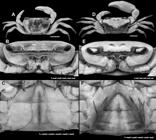
Ghatiana dhritiarum sp. nov. A-C, paratype male (CW 14.9 mm, CL 8.5 mm), ZSI-WRC C.2589; D-F, paratype female (CW 18.3 mm, CL 9.7 mm), ZSI-WRC C.2588. A, D, overall dorsal view; B, E, cephalothorax in frontal view; C, F, thoracic sternites, pleonal somites 4-6, and telson. Scale bar = 5 mm.

Ghatiana dhritiarum sp. nov.: A-I, holotype male (CW 16.4 mm, CL 8.9 mm), ZSI-WRC C.2587; J, paratype male (CW 14.9 mm, CL 8.5 mm), ZSI-WRC C.2589; K, paratype female (CW 18.3 mm, CL 9.7 mm), ZSI-WRC C.2588. Ghatiana dvivarnaPati, Thackeray, Bajantri and Hegde, 2022: L, M, holotype male (CW 24.7 mm, CL 13.6 mm), ZSI-WRC C.2075; N, paratype female (CW 30.0 mm, CL 16.0 mm), ZSI-WRC C.2076. A, cephalothorax in dorsal view; B, L, cephalothorax in frontal view; C, major or right chela in outer view; D, pleon and telson; E, left G1 in ventral view; F, left G1 ultimate article in ventral view; G, left G1 ultimate article in dorsal view; H, J, M, left G1 in dorsal view; I, left G2; K, N, thoracic sternites (s5 and s6) with vulvae. Scale bars = 5 mm (A-C, N), 2 mm (D, K), 0.5 mm (E-J), 10 mm (L), 1 mm (M).

Ghatiana dhritiarum sp. nov., color in life: A, adult male, holotype (CW 16.4 mm, CL 8.9 mm), ZSI-WRC C.2587; B, adult male, paratype (CW 15.0 mm, CL 8.3 mm), ZSI-WRC C.2589; C, adult male, paratype (CW 14.9 mm, CL 8.5 mm), ZSI-WRC C.2589; D, adult male, paratype (CW 14.5 mm, CL 7.9 mm), ZSI-WRC C.2588; E, subadult male (CW 13.4 mm, CL 7.3 mm), ZSI-WRC C.2591; F, subadult male (CW 9.2 mm, CL 5.3 mm), ZSI-WRC C.2590; G, subadult male (CW 8.9 mm, CL 4.7 mm), ZSI-WRC C.2591; H, adult female, paratype (CW 18.3 mm, CL 9.7 mm), ZSI-WRC C.2588; I, adult female, paratype (CW 18.1 mm, CL 9.9 mm), ZSI-WRC C.2588; J, adult female (CW 17.5 mm, CL 10.0 mm), ZSI-WRC C.2590; K, adult female (CW 15.5 mm, CL 8.4 mm), ZSI-WRC C.2590; L, adult female, paratype (CW 15.3 mm, CL 8.2 mm), ZSI-WRC C.2589; M, adult female (CW 15.3 mm, CL 8.4 mm), ZSI-WRC C.2591; N, subadult female (CW 13.0 mm, CL 6.9 mm), ZSI-WRC C.2591; O, subadult female (CW 9.9 mm, CL 5.4 mm), ZSI-WRC C.2591. Ghatiana dvivarnaPati, Thackeray, Bajantri and Hegde, 2022, color in life: P-R, not collected.

Ghatiana dhritiarum sp. nov., habitats. A, a crab in the tree trunk hole holding the wing of a termite at Hiremane; B, a crab in the hole of a laterite boulder in the open area at Hiremane; C, a crab emerging out of the hole (yellow arrow sign) of a laterite boulder in the well-shaded area at Tarimane. None of these crabs were collected.
Type material. Holotype: adult male (CW 16.4 mm, CL 8.9 mm, CH 6.2 mm, FW 6.8 mm), ZSI-WRC C.2587, India, Karnataka, Uttara Kannada District, Hiremane, 14.83908°N 74.33303°E, elevation 536 m a.s.l., 21 September 2024, coll. G.D. Naik et al. - Paratypes: 1 male (CW 14.5 mm, CL 7.9 mm, CH 5.9 mm, FW 6.0 mm), 2 females (CW 18.3 mm, CL 9.7 mm, CH 7.6 mm, FW 7.1 mm; CW 18.1 mm, CL 9.9 mm, CH 7.7 mm, FW 6.9 mm), ZSI-WRC C.2588, same collection data as for holotype; 2 males (CW 15.0 mm, CL 8.3 mm, CH 6.0 mm, FW 6.2 mm; CW 14.9 mm, CL 8.5 mm, CH 6.2 mm, FW 6.2 mm), 1 female (CW 15.3 mm, CL 8.2 mm, CH 5.9 mm, FW 6.2 mm), ZSI-WRC C.2589, India, Karnataka, Uttara Kannada District, Tarimane, 14.77304°N 74.42611°E, elevation 565 m a.s.l., 20 September 2024, coll. G.D. Naik et al.
Additional material examined. 1 male (CW 9.2 mm, CL 5.3 mm), 2 females (CW 17.5 mm, CL 10.0 mm; CW 15.5 mm, CL 8.4 mm), ZSI-WRC C.2590, same collection data as for holotype; 2 males (CW 13.4 mm, CL 7.3 mm; CW 8.9 mm, CL 4.7 mm), 3 females (CW 15.3 mm, CL 8.4 mm; CW 13.0 mm, CL 6.9 mm; CW 9.9 mm, CL 5.4 mm), ZSI-WRC C.2591, India, Karnataka, Uttara Kannada District, Tarimane, 14.77304°N 74.42611°E, elevation 565 m a.s.l., 20 September 2024, coll. G.D. Naik et al.
Comparative material. Ghatiana dvivarnaPati, Thackeray, Bajantri and Hegde, 2022: holotype male (CW 24.7 mm, CL 13.6 mm), ZSI-WRC C.2075, India, Karnataka, Uttara Kannada District, Bare, 14.801°N 74.486°E, elevation 656 m a.s.l., 7 July 2021, coll. P.P. Bajantri and G.D. Hegde; paratype female (CW 30.0 mm, CL 16.0 mm), ZSI-WRC C.2076, same collection data as for holotype. - Ghatiana basalticola (Klaus, Fernandez and Yeo, 2014): holotype male (CW 17.3 mm, CL 10.1 mm), IISc-CES uncatalogued, India, Karnataka, Belagavi District, Bhimagad Wildlife Sanctuary, Jiroli, 15.566°N 74.411°E, elevation 852 m a.s.l., September 2010, coll. Katrina Fernandez.
Diagnosis. Carapace in adult proportionately broad (CW/CL approximately 1.7-1.9), strongly arched (CH/CL approximately 0.7-0.8); lateral margins strongly convex; frontal margin some distance from anterior margin of epistome, exposing antennular fossae (Figs. 1A, B, 2A, B, D, E, 3A, B). Eyes relatively large as compared to orbital space; each eye with relatively slender eyestalk (Figs. 1A, B, 2A, B, D, E, 3A, B). Maxillipeds 1, 2 each with vestigial flagellum on exopod; maxilliped 3 lacking flagellum on exopod (Fig. 1 D , E). Major chela in adult male with palm relatively slender; ventral margin of fixed finger and distal half of palm gently concave (Figs. 1C, 3C). Ambulatory legs relatively long (P3 length/CL approximately 2.5-2.6) (Figs. 1A, C, 2A, D). Male pleonal somite 6 subquadrate, slightly broader than long (Figs. 1C, 2C, 3D). G1 relatively slender, medially distinctly curved outwards at angle of approximately 20° from longitudinal axis; ultimate article relatively slender, straight from base to tip, relatively long, approximately 0.5 times length of penultimate article; penultimate article relatively slender (Figs. 1G, 3E-H, J). Adult female pleon broadly subtriangular, with lateral margins of telson gently concave (Fig. 2 F ). Vulvae in adult relatively closely positioned (VD/SW approximately 0.2), relatively large, occupying approximately 0.6 times length of s6, positioned close to s5/s6 (Fig. 3 K ).
Description of male holotype. Carapace transversely ovate, distinctly broad (CW/CL approximately 1.8), strongly arched (CH/CL approximately 0.7); dorsal surface glabrous, smooth except for epigastric cristae and fine striae on posterolateral surfaces, strongly convex in frontal view; lateral margins strongly convex; anterolateral margins short, subcristate; posterolateral margins long, concave medially; frontal region broad (FW/CW approximately 0.4), trapezoidal, strongly deflexed anteriorly; frontal margin smooth, cristate, some distance from anterior margin of epistome, exposing antennular fossae; frontal medial triangle incomplete, with dorsal margin only, lateral margins indiscernible; epigastric cristae low, only visible as 2 broad, rugose protuberances; postorbital cristae indiscernible; external orbital angle indistinct, low; epibranchial tooth indiscernible; postorbital region shallow; branchial regions inflated, slightly rugose; cervical grooves shallow, narrow, interrupted; mesogastric groove shallow, narrow, long, bifurcated posteriorly; H-shaped groove visible; subhepatic region rugose; suborbital region generally smooth; pterygostomial region anteriorly with low tubercles; supraorbital margin sinuous, cristate, smooth; suborbital margin concave, subcristate, smooth, continuous with supraorbital margin; epistome posterior margin with well-developed, broadly triangular medial tooth and gently concave lateral parts (Figs. 1A-C, 3A, B). Eyes large as compared to orbital space; eyestalk long, slender; cornea moderately large, pigmented (Figs. 1A, B, 3A, B).
Antennules short, folded in transversely broad fossae; antennae conspicuously reduced (Figs. 1B, 3B). Mandibular palp with 2 articles; terminal article bilobed, anterior lobe stouter, shorter, approximately 0.5 times length of posterior lobe (Fig. 1 D ). Maxillipeds 1, 2 each with vestigial flagellum on exopod (Fig. 1 D ). Maxilliped 3 cover most of buccal cavity when closed; ischium subrectangular, longer than broad, with short, shallow, longitudinal groove; merus subquadrate, slightly broader than long, anteroexternal angle not produced; exopod slender, distally narrow, reaching half-length of merus, completely lacking flagellum (Fig. 1 B , C, E).
Chelipeds generally smooth, glabrous, unequal, right chela conspicuously larger (Fig. 1 A , C). Major chela with 4 or 5 low, sharp teeth on each finger, remaining teeth small or inconspicuous, fingers forming conspicuous gape when completely closed; dactylus curved, stout, longer than upper margin of palm; palm slender, longer than high, generally smooth, minutely punctate, distal half of palm and ventral margin of fixed finger gently concave; carpus generally smooth, minutely punctate, gently inflated, inner margin with 3 low, blunt teeth; merus smooth except for low tubercles on margins, lacking subterminal spine (Figs. 1A, C, 3C).
Ambulatory legs slender, shorter than major cheliped, P3 length/CL approximately 2.6, anterior and posterior margins with tufts of 2-5 short brown setae with yellowish tips; merus elongated, lacking subdistal spine; propodus with distinct, sharp chitinous spines on posterior margins; dactylus gently recurved, subequal in length to propodus, with distinct, sharp chitinous spines on anterior and posterior margins (Fig. 1 A , C).
Thoracic sternites minutely punctate, generally glabrous; s1-s4 completely fused forming single structure, lacking suture or groove; s4/s5 shallow, narrow, medially interrupted; s5/s6 shallow, narrow, medially interrupted, each half extending anteriorly to join s4/s5; s6/s7 shallow, narrow, medially joining with longitudinal groove on s6; s7/s8 shallow, narrow, medially interrupted by longitudinal groove on s7, lacking transverse ridge; s8 almost covered by pleon, narrowed medially, longitudinal medial groove indiscernible (Fig. 1 C , F). Pleonal locking mechanism with prominent tubercle on distal quarter of s5 (Fig. 1 F ). Sternopleonal cavity deep, conspicuously long, reaching beyond imaginary line joining basis of maxilliped 3 (Fig. 1 C , F).
Pleon narrow, T-shaped, with strongly concave lateral margins; pleonal somite 1 subrectangular, shortest, broadest; pleonal somites 2-4 progressively longer, trapezoidal, with straight lateral margins; pleonal somite 5 subtrapezoidal, with concave lateral margins; pleonal somite 6 subquadrate, slightly broader than long, proximal width approximately 1.1 times medial length, longest among pleonal somites, distinctly shorter than telson, with sinuous lateral margins (Figs. 1C, 3D). Telson elongated, medial length approximately 1.3 times proximal width, with gently concave lateral margins, apex narrow (Figs. 1C, 3D).
G1 slender, medially distinctly curved outwards at angle of approximately 20° from longitudinal axis, short, tip reaching half-length of s6 in situ; ultimate article conical, slender, long, approximately 0.5 times length of penultimate article, straight from base to tip, tip blunt; penultimate article stouter than ultimate article, broad proximally, relatively narrow distally, outer margin sinuous, inner margin gently convex; groove for G2 ventral on penultimate article and marginal on ultimate article (Figs. 1F, G, 3E-H). G2 conspicuously shorter than G1, approximately 0.6 times G1 length; ultimate article conspicuously short, approximately 0.1 times length of penultimate article (Figs. 1F, H, 3I).
Paratypes. The male paratypes of G. dhritiarum sp. nov. essentially resemble the holotype in key morphological characters. However, the gap between the frontal margin and the anterior margin of the epistome is more obvious (Fig. 2 B ), and the heterochely is relatively less pronounced (Fig. 2 A ) in a paratype male (CW 14.9 mm, CL 8.5 mm, ZSI-WRC C.2589) than in the holotype. This male paratype also possesses a carapace that is relatively narrower (CW/CL 1.7) (Fig. 2 A ) compared to the carapace of the holotype and the remaining paratype males. Additionally, color variations were observed in the male paratypes (see Color in life section).
The female paratypes of G. dhritiarum sp. nov. share most of the non-sexual diagnostic character states with males, including a proportionately broad carapace (CW/CL 1.8-1.9) (Fig. 2 D ), a clear gap between the frontal margin and the anterior margin of the epistome (Fig. 2 E ), relatively large eyes with relatively slender eyestalks (Fig. 2 D , E), a vestigial flagellum on the exopod of maxillipeds 1 and 2 each, and relatively long legs (P3 length/CL approximately 2.5-2.6) (Fig. 2 D ). The heterochely is also more pronounced in the female paratypes (Fig. 2 D ). The paratype females, however, show variations in live coloration (see Color in life section).
The pleon in the female paratypes forms a broadly subtriangular outline and covers the thoracic sternites except for the lateral edges when closed (Fig. 2 F ). Their pleonal somite 1 is the shortest; pleonal somites 2-5 are progressively longer; pleonal somite 6 is the longest, conspicuously broader than long, shorter than the telson, with gently convex lateral margins; the telson is triangular, broader than long, with a broad apex and gently concave lateral margins (Fig. 2 F ). The vulvae in the female paratypes are located relatively close to each other (VD/SW approximately 0.2) on s6, with each vulva subovate, large (occupying approximately 0.6 times the length of s6), positioned close to s5/s6 but not touching s5/s6, surrounded by a low broad rim, and completely covered by a soft membranous operculum, without any trace of sternovulvar cover (Fig. 3 K ).
Color in life. Ghatiana dhritiarum sp. nov. shows color variations (Fig. 4 A -O). The dorsal surface of the carapace in adult males is mostly dark purplish brown with varying degrees of white or grayish white anteriorly (Fig. 4 A-D ). The dorsal surface of the carapace in subadult males is also mostly dark purplish brown (Fig. 4 E-G ), with some having a brownish-white anterior surface (Fig. 4 G ). The dorsal surface of the carapace in adult females is mostly white with varying degrees of dark purplish brown posteriorly (Fig. 4 H-M ). Some adult females may have a dorsal surface of the carapace that is completely white with an orangish tinge (Fig. 4 I ) or predominantly grayish white (Fig. 4 K ). Subadult females have a dorsal surface of the carapace that is mostly dark purplish brown (Fig. 4 N , O), similar to subadult males. The chelipeds in adult males and females are generally white (Fig. 4 A , H, I, L) with occasional brownish or orangish tinges (Fig. 4 B , C, J, K, M). Their fingers may be blanched or lighter in color (Fig. 4 C , D, J, K, M). The chelipeds of subadult males and females are similar to those of adults in general color, with a tendency towards lighter shades (e.g. brownish white) (Fig. 4 E-G , N, O). The ambulatory legs in adult males and females are mostly orange or light orange (Fig. 4 A , C, H-L ), with some individuals having light to dark purplish brown legs (Fig. 4 B , D, M). The ambulatory legs of subadult males and females tend to be lighter shades such as light purplish brown or brown (Fig. 4 E-G , N, O). The eyestalks in adult males and females are generally white externally and dark purplish brown internally (Fig. 4 A-C , H, I, L), with some individuals who may have light brown to dark purplish brown externally (Fig. 4 D , J, K, M). The eyestalks in subadult males and females are generally dark purplish brown (Fig. 4 E , F, O), with possible lighter external shades (light brown to brown) (Fig. 4 G , N). The color patterns seem more influenced by life stage. Further, no major difference was observed between males and females except for carapace colors.
Etymology. The specific epithet "dhritiarum" is formed directly from the personal name "Dhriti" honoring two ladies. First, it recognizes Dr. Dhriti Banerjee, the present Director of the Zoological Survey of India, whose leadership and scholarly work have been instrumental in advancing our understanding of Indian fauna. Secondly, it honors the daughter of one of the authors, G.D. Naik, whose name is also "Druthi" (has the same pronunciation as “Dhriti” in Kannada dialect).
The proposed common name for the new species is “Dhritis’ Ghat Crab”.
Ecological notes. Ghatiana dhritiarum sp. nov. is primarily found in the evergreen forests of the central Western Ghats and encountered particularly during the rainy season from June to September. Crabs of the new species inhabit water-filled tree trunk holes (Fig. 5 A ) and inside the holes of laterite boulders in both open and well-shaded areas (Fig. 5 B , C). Ghatiana dhritiarum sp. nov. is omnivorous and its primary diet consists of moss growing on laterite boulders, rotten leaves and bark, insects (including termites and mosquito larvae) (Fig. 5 A , B), and small worms (G.D. Naik, personal observation). The new species is typically found at elevations ranging from 500 to 600 m a.s.l. and confined to an area of approximately 24 km2 (Fig. 6).

Map showing the distribution of Ghatiana dhritiarum sp. nov. and Ghatiana dvivarnaPati, Thackeray, Bajantri and Hegde, 2022, in the central Western Ghats, Uttara Kannada District, Karnataka, India.
Type locality. India, Karnataka State, Uttara Kannada District, Hiremane, 14.83908°N 74.33303°E, elevation 536 m a.s.l.
Geographic distribution. Ghatiana dhritiarum sp. nov. is currently known from two nearby localities in the central Western Ghats within the Uttara Kannada District of Karnataka State, India (Fig. 6).
Remarks. Among congeners, G. dhritiarum sp. nov. most resembles G. dvivarna in having similar color in life (especially due to the predominant white coloration; Fig. 4), a proportionately broader carapace (CW/CL approximately 1.7-1.9) (Figs. 1A, 2A, D, 3A; see Pati et al., 2022 a : fig. 3A), the more slender eyestalks (Figs. 1B, 2B, E, 3B, L), the relatively more slender palm of the major chela in adult males with the ventral margin of the fixed finger and distal half of the palm being gently concave (Fig. 3 C ; see Pati et al., 2022a: fig. 4B), the subquadrate male pleonal somite 6 (Figs. 1C, 2C, 3D; see Pati et al., 2022a: fig. 4C), the relatively more slender G1, with a more slender, straight and relatively long ultimate article (approximately 0.5 times the length of the penultimate article) and a more slender penultimate article (Figs. 1G, 3E-H, J, M), and the proportionately closely positioned vulvae with respect to each other and s5/s6 (Fig. 3K, N). While the new species possesses a dorsal surface of the carapace with a complex pattern of dark purplish brown (Fig. 4B-G, L-O) or white (Fig. 4A, H-K), G. dvivarna has a carapace that is mostly white anteriorly and dark red-violet posteriorly (Fig. 4P-R). The most striking difference is in their ambulatory legs. Ghatiana dhritiarum sp. nov. has ambulatory legs that are mostly orange or light orange (Fig. 4A, C, H-L), with some individuals having light to dark purplish brown legs (Fig. 4B, D-G, M-O). In contrast, G. dvivarna has ambulatory legs that are red-violet (Fig. 4P-R). The frontal margin is some distance from the anterior margin of the epistome, exposing the antennular fossae in G. dhritiarum sp. nov. (Figs. 1B, 2B, E, 3B), whereas these margins are relatively close to each other, hiding the antennular fossae in G. dvivarna (Fig. 3L). The eyes are relatively larger in G. dhritiarum sp. nov. (Figs. 1B, 2B, E, 3B) than in G. dvivarna (Fig. 3L) when compared to their orbital spaces. The most important difference between these two species is noticed in the G1 structure, which is medially distinctly curved outwards at an angle of approximately 20° from the longitudinal axis in G. dhritiarum sp. nov. (Figs. 1G, 3E, H, J) but almost straight in G. dvivarna (Fig. 3M). Moreover, the vulvae are relatively large, occupying approximately 0.6 times the length of s6 in G. dhritiarum sp. nov. (Fig. 3K) against the relatively smaller vulvae, measuring approximately 0.5 times the length of s6 in G. dvivarna (Fig. 3N). Most of the species of Ghatiana show disjunct distribution (Pati and Thackeray, 2018; 2021; Pati et al., 2022a; 2023a; 2024). Even within the Uttara Kannada District of Karnataka, G. dvirupaPati, Bajantri and Hegde, 2024, G. dvivarna, and G. sanguinolenta Pati, Thackeray and Pawar, 2023, are found in considerably distant localities (Pati et al., 2022a; 2023a; 2024). Surprisingly, G. dhritiarum sp. nov. and G. dvivarna are known from nearby areas of the Uttara Kannada District (Fig. 6). Interestingly, G. dhritiarum sp. nov. seems restricted to two adjacent hydrobasins between elevations of 500 to 600 m a.s.l. (Fig. 6), whereas G. dvivarna is so far known only from a separate hydrobasin and occurs at relatively higher elevations (600 to 700 m a.s.l.), with no overlapping distributional range with the new species (Fig. 6).
With a conspicuously broader carapace (CW/CL approximately 1.6-1.9) (Figs. 1A, 2A, D, 3A; see Pati and Thackeray, 2018: fig. 5A) and a medially distinctly curved G1 (approximately 20°-25° outwards from the longitudinal axis) (Figs. 1G, 3E, H, J; see Pati and Thackeray, 2018: fig. 5D, E), G. dhritiarum sp. nov. also bears resemblance to G. basalticola from Karnataka. Ghatiana dhritiarum sp. nov. is nevertheless distinguished from G. basalticola mainly by its relatively more slender eyestalks (Figs. 1B, 2B, E, 3B) (versus eyestalks relatively stouter; see Pati and Thackeray, 2018: fig. 5B) and the relatively long G1 ultimate article, approximately 0.5 times the length of the penultimate article (Figs. 1G, 3H, J) (versus G1 ultimate article relatively short, approximately 0.3 times the length of the penultimate article; see Pati and Thackeray, 2018: fig. 5D). The live coloration of G. dhritiarum sp. nov. is never like that of G. basalticola, which possesses a bright red carapace, chelipeds, and ambulatory legs (Klaus et al., 2014: fig. S1). Although both species are found in Karnataka, they occupy noticeably different elevations within two separate districts on isolated mountain ranges situated some 80 km apart, with the Kali River forming a major geographic barrier between them. Specifically, G. basalticola is found only at higher elevations, ranging from 778 m to 852 m a.s.l., in the Belagavi District (see Klaus et al., 2014; Pati and Thackeray, 2018; Pati and Pradhan, 2020).
Apart from G. dvivarna and G. basalticola, G. atropurpureaPati, Thackeray and Khaire, 2016, G. dvirupa, G. rouxiPati and Thackeray, 2021, and G. sanguinolenta, are known from Karnataka (Klaus et al., 2014; Pati and Thackeray, 2021; Pati et al., 2022a; 2023a; 2024). Ghatiana dhritiarum sp. nov. is less likely to be confused with these species of Ghatiana from Karnataka because the carapace is proportionately broader, CW/CL approximately 1.7-1.9, in G. dhritiarum sp. nov. (Figs. 1A, 2A, D, 3A) (versus carapace proportionately narrow, CW/CL approximately 1.2-1.5, in G. atropurpurea and G. rouxi; see Pati and Thackeray, 2018: fig. 3A; 2021: fig. 4A, B); the lateral margins of the carapace are strongly convex in G. dhritiarum sp. nov. (Figs. 1A, 2A, D, 3A) (versus carapace lateral margins gently convex in G. rouxi; see Pati and Thackeray, 2021: fig. 4A, B); the frontal margin is some distance from the anterior margin of the epistome, exposing the antennular fossae in G. dhritiarum sp. nov. (Figs. 1B, 2B, E, 3B) (versus frontal margin relatively close to the anterior margin of the epistome, hiding the antennular fossae in G. atropurpurea, G. rouxi, and G. sanguinolenta; see Pati and Thackeray, 2018: fig. 3B; 2021: fig. 4C; Pati et al., 2023a: fig. 2B); the eyes are relatively larger as compared to the orbital spaces in G. dhritiarum sp. nov. (Figs. 1B, 2B, E, 3B) (versus eyes are relatively smaller as compared to the orbital spaces in G. dvirupa; see Pati et al., 2024: fig. 2B); the major chela of adults has a relatively more slender palm and a gently concave ventral margin formed by the fixed finger and distal half of the palm in G. dhritiarum sp. nov. (Fig. 3C) (versus major chela of adults with a relatively stouter palm and a strongly concave ventral margin formed by the fixed finger and distal half of the palm in G. dvirupa, G. rouxi, and G. sanguinolenta; see Pati and Thackeray, 2021: fig. 5B; Pati et al., 2023a: fig. 2F; 2024: fig. 3C); the male pleonal somite 6 is subquadrate, slightly broader than long in G. dhritiarum sp. nov. (Figs. 1C, 2C, 3D) (versus male pleonal somite 6 quadrate, as broad as long in G. atropurpurea; see Pati and Thackeray, 2018: fig. 3C); the G1 ultimate article is straight from base to tip in G. dhritiarum sp. nov. (Figs. 1G, 3E-H, J) (versus G1 ultimate article medially distinctly curved inwards as in G. atropurpurea or distally gently curved inwards as in G. dvirupa and G. rouxi or distally gently curved outwards as in G. sanguinolenta; see Pati and Thackeray, 2018: fig. 3D, E; 2021: fig. 5D, E; Pati et al., 2023a: fig. 2H, I; 2024: fig. 3E-G); the G1 ultimate article is relatively longer, approximately 0.5 times the length of the penultimate article in G. dhritiarum sp. nov. (Figs. 1G, 3H, J) (versus G1 ultimate article relatively shorter, approximately 0.4 times the length of the penultimate article in G. dvirupa and G. sanguinolenta; see Pati et al., 2023a: fig. 2H; 2024: fig. 3E); the G1 penultimate article is relatively slender in G. dhritiarum sp. nov. (Figs. 1G, 3E, H, J) (versus G1 penultimate article relatively stouter in G. rouxi; see Pati and Thackeray, 2021: fig. 5D, E); and the vulvae are relatively large, occupying approximately 0.6 times the length of s6 in G. dhritiarum sp. nov. (Fig. 3K) (versus vulvae relatively small, occupying approximately 0.4-0.5 times the length of s6 in G. atropurpurea, G. dvirupa, G. rouxi, and G. sanguinolenta; see Pati and Thackeray, 2018: fig. 3H; 2021: fig. 5H; Pati et al., 2023a: fig. 3E; 2024: fig. 4F).
The addition of Ghatiana dhritiarum sp. nov. brings the total number of known species of Ghatiana to 14 and marks the seventh species of the genus to be identified in Karnataka (Pati et al., 2024). This discovery underscores the ongoing importance of taxonomic research in the Western Ghats, a region recognized for its high decapod crustacean diversity and endemism (Raghavan et al., 2015). It also highlights the need for continued exploration, especially in the central Western Ghats region.
ACKNOWLEDGEMENTS
The authors express their gratitude to Dr. Dhriti Banerjee, the Director of the Zoological Survey of India, Kolkata, for providing research facilities and for her kind permission to use her first name as the basis for the specific epithet of the new species. Her leadership and support have been instrumental in advancing our research. The second author (GDN) acknowledges Mr. Subhash Malkhede, the Principal Chief Conservator of Forests (Wildlife) and Chief Wildlife Warden, Karnataka Forest Department, for granting permission to collect the crabs of the new species. GDN also thanks the following officials of the Karnataka Forest Department for support and encouragement: Mr. Vasantha Reddy K.V., Conservator of Forests, Kanara Circle; Mr. Prashantkumar K.C., Deputy Conservator of Forests (DCF), Haliyal; Mr. Ravishankar C. and Mr. Manjunath G. Navi, DCF, Karwar; Mr. K.C. Jayesh, Assistant Conservator of Forests (ACF), Ankola; Mr. K.D. Nayak, ACF, Karwar; Mr. Raghavendra M. Naik, Range Forest Officer (RFO), Kundapur; Mr. Vishwanath A.V., RFO, Bhatkal; Mr. Gajanan Naik and Mr. Kiran Manavachari, RFO, Karwar; and Mr. Naveen M. Setty, Deputy RFO, Karwar. The authors would like to sincerely thank the reviewers for their valuable comments and suggestions, which significantly enhanced the quality and clarity of this manuscript.
REFERENCES
-
Davie PJF; Guinot D and Ng PKL. 2015. Anatomy and functional morphology of Brachyura. p. 11-163. In: Castro P, Davie PJF , Guinot D , Schram FR and von Vaupel Klein JC (Eds.), Treatise on Zoology - Anatomy, Taxonomy, Biology. The Crustacea. Volume 9 (Part C-I). Decapoda: Brachyura (Part 1). Leiden: Brill. https://doi.org/10.1163/9789004190832_004
» https://doi.org/10.1163/9789004190832_004 -
Guinot D ; Tavares M and Castro P 2013. Significance of the sexual openings and supplementary structures on the phylogeny of brachyuran crabs (Crustacea, Decapoda, Brachyura), with new nomina for higher-ranked podotreme taxa. Zootaxa, 3665(1): 1-414. https://doi.org/10.11646/zootaxa.3665.1.1
» https://doi.org/10.11646/zootaxa.3665.1.1 -
Klaus S; Fernandez K and Yeo DCJ 2014. Phylogeny of the freshwater crabs of the Western Ghats (Brachyura, Gecarcinucidae). Zoologica Scripta, 43(6): 651-660. https://doi.org/10.1111/zsc.12078
» https://doi.org/10.1111/zsc.12078 -
Montesanto G 2015. A fast GNU method to draw accurate scientific illustrations for taxonomy. ZooKeys, 515: 191-206. https://doi.org/10.3897/zookeys.515.9459
» https://doi.org/10.3897/zookeys.515.9459 -
Montesanto G 2016. Drawing setae: a GNU way for digital scientific illustrations. Nauplius, 24: e2016017. https://doi.org/10.1590/2358-2936e2016017
» https://doi.org/10.1590/2358-2936e2016017 - Ng PKL 1988. The freshwater crabs of Peninsular Malaysia and Singapore. Singapore, Department of Zoology, National University of Singapore, Shinglee Press, 156 p.
-
Pati SK 2021. Two new species of freshwater crabs of the genus Potamiscus Alcock, 1909 (Brachyura: Potamidae) from Nagaland, northeastern India. Nauplius , 29: e2021006. https://doi.org/10.1590/2358-2936e2021006
» https://doi.org/10.1590/2358-2936e2021006 -
Pati SK and Pradhan RN 2020. An overview of the freshwater crabs (Brachyura: Gecarcinucidae) of the Western Ghats, India. Oceanography & Fisheries Open Access Journal, 12: 555836. https://doi.org/10.19080/OFOAJ.2020.12.555836
» https://doi.org/10.19080/OFOAJ.2020.12.555836 -
Pati SK and Sharma RM 2014. Description of Ghatiana, a new genus of freshwater crab, with two new species and a new species of Gubernatoriana (Crustacea: Decapoda: Brachyura: Gecarcinucidae) from the Western Ghat Mountains, India. Journal of Natural History, 48(21-22): 1279-1298. https://doi.org/10.1080/00222933.2013.859315
» https://doi.org/10.1080/00222933.2013.859315 -
Pati SK and Thackeray T 2018. The freshwater crab genera Ghatiana Pati & Sharma, Gubernatoriana Bott, and Inglethelphusa Bott (Crustacea: Decapoda: Brachyura: Gecarcinucidae) revisited, with descriptions of a new genus and eleven new species. Zootaxa , 4440(1): 1-73. https://doi.org/10.11646/zootaxa.4440.1.1
» https://doi.org/10.11646/zootaxa.4440.1.1 -
Pati SK and Thackeray T 2021. Five new species of freshwater crabs of the genera Ghatiana Pati & Sharma, 2014 and Sahyadriana Pati & Thackeray, 2018 from India (Decapoda: Brachyura: Gecarcinucidae). Zoosystema, 43(26): 627-647. https://doi.org/10.5252/zoosystema2021v43a26
» https://doi.org/10.5252/zoosystema2021v43a26 -
Pati SK; Bajantri PP and Hegde GD 2023b. A new genus and new species of freshwater crab (Decapoda: Brachyura: Gecarcinucidae) from the Central Western Ghats of India. Zootaxa , 5285(1): 161-175. https://doi.org/10.11646/zootaxa.5285.1.7
» https://doi.org/10.11646/zootaxa.5285.1.7 -
Pati SK ; Bajantri PP and Hegde GD 2024. The “Mr. and Mrs. Ghat crab”, Ghatiana dvirupa sp. nov. (Decapoda: Brachyura: Gecarcinucidae) from the Central Western Ghats of India. Zootaxa , 5443(1): 116-126. https://doi.org/10.11646/zootaxa.5443.1.6
» https://doi.org/10.11646/zootaxa.5443.1.6 -
Pati SK ; Mandal S and Jaiswal D 2022b. Description of a new species of Spiralothelphusa Bott, 1968, and redescription of Spiralothelphusa wuellerstorfi (Heller, 1862) (Decapoda: Brachyura: Gecarcinucidae). European Journal of Taxonomy, 798: 1-29. https://doi.org/10.5852/ejt.2022.798.1629
» https://doi.org/10.5852/ejt.2022.798.1629 -
Pati SK ; Thackeray T and Khaire A 2016. Five new species of freshwater crabs of the genera Ghatiana Pati & Sharma, 2014, and Gubernatoriana Bott, 1970 (Crustacea, Decapoda, Brachyura: Gecarcinucidae Rathbun, 1904) from the Western Ghats, India. Zootaxa , 4083(4): 569-586. https://doi.org/http://dx.doi.org/10.11646/zootaxa.4083.4.7
» https://doi.org/http://dx.doi.org/10.11646/zootaxa.4083.4.7 -
Pati SK ; Thackeray T and Pawar S 2023a. Ghatiana sanguinolenta, a new species of freshwater crab (Brachyura: Gecarcinucidae) from the Central Western Ghats of India. Zootaxa , 5353(4): 372-378. https://doi.org/10.11646/zootaxa.5353.4.4
» https://doi.org/10.11646/zootaxa.5353.4.4 -
Pati SK ; Thackeray T ; Bajantri PP and Hegde GD 2022a. A new species of the freshwater crab genus Ghatiana Pati and Sharma, 2014 (Brachyura: Gecarcinucidae) from the Central Western Ghats, India. Nauplius , 30: e2022019. https://doi.org/10.1590/2358-2936e2022019
» https://doi.org/10.1590/2358-2936e2022019 -
Raghavan R; Dahanukar N; Philip S; Iyer P; Kumar B; Daniel B and Molur S 2015. The conservation status of decapod crustaceans in the Western Ghats of India: an exceptional region of freshwater biodiversity. Aquatic Conservation: Marine and Freshwater Ecosystems, 25(2): 259-275. https://doi.org/10.1002/aqc.2490
» https://doi.org/10.1002/aqc.2490 -
Rathbun MJ 1904. Les crabes d’eau douce (Potamonidae). Nouvelles Archives du Muséum d’Histoire Naturelle, Paris, Série 4, 6: 225-312. https://www.biodiversitylibrary.org/item/111906#page/243/mode/1up
» https://www.biodiversitylibrary.org/item/111906#page/243/mode/1up
-
Zoobank:
http://zoobank.org/urn:lsid:zoobank.org:pub:F0995E71-889F-4AF4-A4B0-55A54B8140C1
-
Consent for publication
All authors declare that they have reviewed the content of the manuscript and gave their consent to submit the document.
-
Funding and grant disclosures
Not applicable.
-
Study association
Not applicable.
-
Study permits
The permission (KFD/WL/E2(RE)/77/2024) to collect and transport the crab specimens of the new species was granted to Gopal Diggya Naik by the Principal Chief Conservator of Forests (Wildlife) and Chief Wildlife Warden, Karnataka Forest Department.
-
Data availability
All study data are included in the article.
All study data are included in the article.


