Effect of Boriding on the Tribological Behavior of Monel 400 Alloy
Abstract
The Monel 400 alloy, composed primarily of nickel and copper, offers excellent corrosion resistance but exhibits relatively low wear resistance, limiting its durability in demanding applications such as maritime industries, pumps, and valves. To address this, boriding thermochemical treatment was applied to enhance the surface hardness and wear resistance of the alloy. The process used a boriding powder containing 90% B4C and 10% KBF4 at 900 °C for 4 hours, avoiding silicon activators to prevent the formation of less hard nickel silicides. The resulting boride layer, predominantly Ni2B, Ni3B, and Ni4B3, was characterized using X-ray diffraction (XRD) and evaluated for adhesion via Rockwell C indentation (VDI 3198 standard). Wear performance was assessed through pin-on-disk tests on treated and untreated samples, analyzing wear rates, removed volume, and surface roughness using profilometry, confocal microscopy, and SEM. The borided layer achieved a hardness of up to 1600 HV0,01, demonstrating significantly improved wear resistance while maintaining strong adhesion to the substrate. This study highlights the potential of boriding as an effective treatment to extend the service life of Monel 400 in abrasive environments.
Keywords:
Tribological; behavior; Monel; alloys; boriding
1. Introduction
The Monel 400 alloy is a single-phase solid solution nickel-copper alloy, known for its excellent resistance to corrosion and oxidation in aggressive environments such as seawater, acids, and bases. This resistance makes Monel 400 ideal for use in maritime applications, such as ship propellers, submerged pipelines, and valves in saltwater systems. Additionally, the alloy is widely used in chemical processes, marine engineering, electrical and electronic components, crude oil distilleries, food processing, gasoline production, electric power generation, and heat exchangers. Monel 400 also stands out for its resistance to atmospheric corrosion, especially in alkaline, salty, and acidic environments. However, despite its many advantages, Monel 400 has low hardness and wear resistance, which limits its applications in situations where these properties are critical. Furthermore, the alloy does not exhibit a ductile-to-brittle transition at sub-zero temperatures and can be easily formed and machined, facilitating its use in various industries1-4.
To address the limitation of low wear resistance, surface modification techniques such as boriding have been investigated. Boriding has been employed in nickel-based alloys to enhance surface hardness and wear resistance while preserving essential material properties such as corrosion resistance. Boron’s small atomic radius allows it to readily diffuse and form hard intermetallic compounds with metals. In nickel alloys, an intermetallic nickel boride layer forms on the material's surface with high hardness5-7.
Several studies have evaluated the effects of boriding on nickel alloys, particularly Monel 400, under varying conditions. In Monel 400, differences in results have been observed depending on the type of boriding powder used. In a study using Ekabor1-V2, a hardness of up to 1050 HV was obtained with the presence of silicides. Using a powder composed of 90 wt% B4C and 10 wt% NaBF4 resulted in the formation of a nickel boride layer without the presence of silicon, achieving a hardness of up to 1714 HV8,9. The presence of hard nickel borides such as Ni2B, Ni3B, and Ni4B3 has been associated with hardness values up to 1600 HV in Monel 400 when silicon is absent10, and around 1050 HV when silicides are also formed8. In Inconel 600 and 718, boriding similarly results in high hardness, ranging from 1600 to 2000 HV, due to the presence of nickel borides5,11. These boride-enriched surface layers have been shown to reduce material loss during wear tests, reflecting an improvement in the tribological performance compared to untreated materials. The increased hardness and the formation of a protective boride layer are the primary factors contributing to this enhanced wear resistance.
The aim of this research is to investigate the influence of thermochemical boriding treatment on the microstructural, mechanical, and wear resistance properties of the Monel 400 alloy. For this purpose, alloy samples were subjected to solid-state boriding treatment at 900 °C for 4 hours. The samples were characterized in terms of the formed phases, surface hardness, and tribological behavior. Tribological tests were conducted using a pin-on-disk tribometer without lubrication at room temperature, where the volume of material removed and the coefficient of friction were measured. The results obtained were compared with those of untreated samples to evaluate the effectiveness of the treatment in improving the properties of the Monel 400 alloy.
2. Materials and Methods
From a forged bar of Monel 400, with a composition of 0.11 wt% C, 2.25 wt% Fe, 0.96 wt% Mn, 65.03 wt% Ni, and 30.27 wt% Cu, quarter-disk shaped pieces with a thickness of 5 mm were sectioned. The process involved wire electrical discharge machining for dimensional precision, followed by surface grinding for uniformity and sanding with 320-grit SiC paper for a standardized finish.
2.1. Boriding treatment
The boriding treatment was conducted in a muffle furnace without atmospheric control, using a stainless steel crucible filled with 30 mm of boriding powder on each face, composed of 90 wt% B4C and 10 wt% KBF4. The treatment was carried out at 900°C for 4 hours. The samples were cleaned with acetone in an ultrasonic bath to remove impurities and substances that could interfere with the treatment. After the treatment, the samples were cooled inside the open furnace to room temperature.
2.2. Characterization
To verify the phases formed on the surface of the treated material, X-ray diffraction (Shimadzu 6000 model) was used with 2θ ranging between 20º and 120º, utilizing Cu-Kα radiation. The roughness of both borided layer and untreated sample (which was ground up to 320 grit) was measured using a Leica DCM3D confocal microscope. A pin-on-disk tribological test was conducted without lubrication at room temperature. Four tests were performed for each condition. An alumina ball with a diameter of 6 mm and a hardness of 2113 HV was used. The wear track radius was 4 mm with a total distance of 1000 m. The sliding speed was 0.1 m/s with an applied load of 10 N. The samples were cleaned in an acetone bath for 5 minutes and weighed with a precision balance (5 decimal places) before and after the wear tests. The volume (V) of material removed was calculated by multiplying the average wear track area, obtained by profilometry, by the wear track length. For each studied condition, four repetitions were performed, and the wear rate was calculated based on the average volume of material removed. The coefficient of friction was monitored by measuring the friction force throughout the test. The wear coefficient was calculated by dividing the volume (V) by the applied normal force (F) and the length of the wear track (m).
Wear mechanisms were identified by scanning electron microscopy (SEM) and energy dispersive spectroscopy (EDS) analysis. Roughness was measured using confocal microscopy. Cross-sectional images of the sample were obtained with Scanning Electron Microscopy (SEM) and Energy Dispersive X-ray Spectroscopy (EDS), analyzing the thickness, morphology, and composition of the layer.
3. Results and Discussion
3.1. Microstructural characterization
The X-ray diffraction pattern for Monel 400 borided at 900 °C for 4 hours is presented in Figure 1. The main elements constituting the Monel 400 alloy are nickel and copper. The thermochemical boriding treatment promoted the formation of different types of nickel borides such as Ni3B, Ni2B, and Ni4B3. The formation of K3Ni2F7 is due to the adherence of the boriding powder on the sample surface, and the presence of Cu phases was identified. Analyzing the images obtained through scanning electron microscopy (SEM) and Energy Dispersive Spectroscopy (EDS), Figure 2 shows the cross-section of the sample borided at 900 °C for 4 h, where three regions are observed. The first region (I) is the layer formed by nickel borides, with an average thickness of 9.62 ± 2.20 µm, and region (II) consists of the diffusion of borides between the grain boundaries. The total layer thickness, constituted by the sum of regions (I) and (II), is 58.05 ± 4.00 µm. There are points with copper concentration, highlighted in Figure 2 between regions (I) and (II). Region (III) is the substrate without the presence of borides.


Through the analysis of Rockwell C indentations on the surface of the samples, it was observed that there was no delamination of the areas near the indentation. Only circumferential and radial cracks around the indentation were detected. This indicates that the adhesion between the formed boride layer and the Monel 400 substrate is satisfactory, being classified between HF1 and HF2 according to the adhesion map of the VDI 3198 standard. This can also be attributed to the higher hardness of the boride layer compared to the substrate and the region with copper agglomerates8. Although the adhesion to the substrate is adequate, the presence of cracks suggests that the formed layer exhibits brittle behavior. Another factor is the presence of copper agglomerates between regions (I) and (II), which may be facilitating crack formation. The indentation is shown in Figure 3.
SEM micrographs of the Rockwell C adhesion tests on the Monel 400 alloy borided at 900 °C for 4 h.
Figure 4 shows the hardness profile measured in the cross-section of the borided sample, starting at 10 μm from the surface. The hardness in the region near the surface is approximately 1600 HV0.01, and at 20 µm there is a sharp drop in hardness, which is the region where copper agglomerates after the thermochemical boriding treatment. At 40 µm, the hardness reaches approximately 800 HV0.01, which is the region of boride diffusion at the grain boundary. After 80 µm, the hardness stabilizes, indicating that the layer and grain boundary diffusion region has ended. Borided samples with the presence of silicon in the composition can reach hardness values of up to 1050 HV0.058. Layers formed only by Ni2B vary between 1002 HV and 1476 HV12, while the presence of Ni3B, Ni2B, and Ni4B3 can form layers that exceed 2000 HV.

3.2. Tribological analysis
Figure 5 shows the evolution of the coefficient of friction (CoF) over the distance and established conditions. The steady-state regime was reached at a distance of approximately 150 m, when the coefficient of friction stabilized. The average coefficient of friction for the samples treated at 900 °C for 4 hours was 0.59, while for the untreated sample it was 0.27. With the thermochemical boriding treatment, an increase in the coefficient of friction is observed compared to the untreated condition, an increase of approximately 118.5%.

Evolution of the coefficient offriction with sliding distance for Monel 400 untreated and treated at 900 °C and 4 h.
As shown in Table 1, the borided Monel 400 presented a surface hardness of approximately 1600 HV, a coefficient of friction (CoF) of 0.59. In comparison, Inconel 600 subjected to electrochemical boriding achieved hardness values between 1600 and 2100 HV and exhibited superior wear resistance under dry conditions, with shallower wear depths ranging from 2 to 2.5 µm. AISI D2 tool steel, after pack boriding, reached hardness levels around 20.7 GPa (≈2110 HV) and demonstrated moderate wear resistance, although its CoF against aluminum increased significantly. Similarly, borided A286 superalloy displayed hardness in the range of 1450–1700 HV, with improved wear resistance depending on the treatment temperature and time. Finally, CoCrMo alloy borided at 900 °C formed a cobalt boride layer with hardness up to 1935 HV, offering excellent wear resistance, particularly under grooving abrasion, but at the cost of increased CoF. These comparisons highlight that the boriding treatment applied to Monel 400 effectively improved its wear resistance. Although the achieved hardness is comparable to that of other borided alloys, it is worth noting that the presence of copper-rich regions in the alloy’s microstructure may influence the local hardness distribution in the borided layer.
After the thermochemical boriding treatment, there is an increase in the sample's roughness, as shown in Figure 6. The average surface roughness of the untreated sample is 1.80 ± 0.027 µm, while for the borided sample, the value is 7.25 ± 0.74 µm. High roughness causes the initial coefficient of friction to be low due to the small real contact area16. At the beginning of the tribological test, the coefficient of friction increases rapidly due to the asperity breaking mechanisms rather than plastic deformation, owing to the high hardness presented after boriding. This causes an increase in the contact area between the ball and the sample, quickly raising the coefficient of friction8.

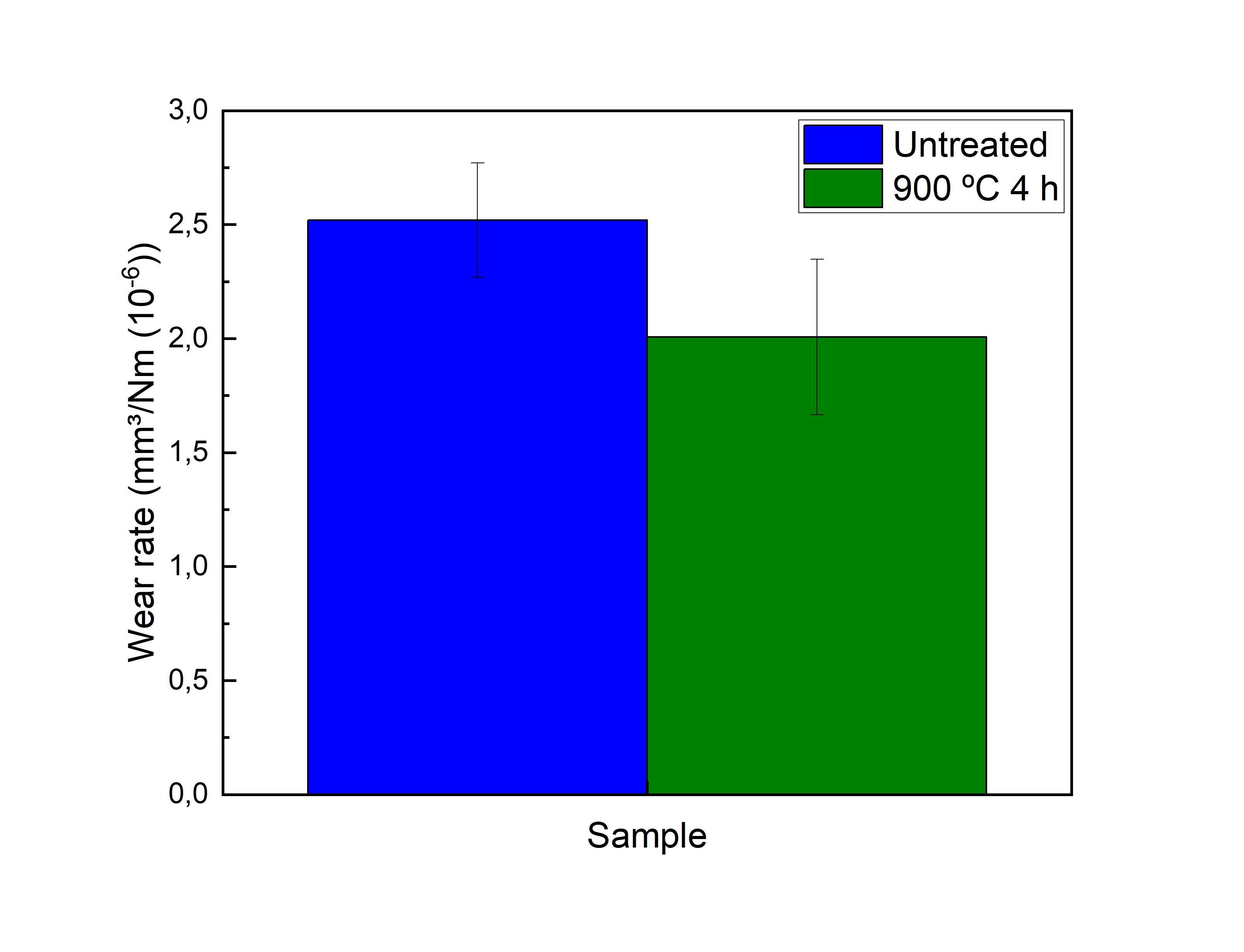
Figure 7 shows the wear rate for the two conditions analyzed. With a rate of 2.00 x 10⁻⁶ mm3/Nm, the borided sample showed a 20.6% reduction in wear rate compared to the untreated sample, which has a wear rate of 2.52 x 10⁻⁶ mm3/Nm. This reduction is associated with the lower amount of material removed, indicating that the thermochemical boriding treatment is effective in increasing the wear resistance of the Monel 400 alloy. Studies with Inconel 718 show that the wear rate is halved after thermochemical boriding treatment17. In pure nickel, some studies indicate an increase in wear resistance of over 50%7.

Küçük et al.18 reported a significant reduction in volume loss compared to the untreated sample. For the alloy boriding, a boriding powder containing iron was used, presenting FeB and Fe2B phases with hardness ranging from 12.76 to 17.83 GPa. The presence of copper precipitates in the layer, especially at higher temperatures such as 1000°C, results in a reduction in wear resistance. This occurs because the precipitates form weak layers in the boride layer, which decreases the structural integrity of the coating. Additionally, the quantity and size of Cu precipitates increase significantly with boriding time and temperature, particularly between the diffusion zone and the boride layer. These precipitates, being more ductile and less hard than the borides, create weak points that are more susceptible to fractures and delamination under wear conditions, resulting in greater volume loss18.
The EDS analysis was performed on the wear track region of the borided sample, as shown in Figure 8. A significant presence of oxygen was detected, likely due to the oxidation of wear debris generated during testing and the degradation of the Al2O3 counter body. Furthermore, the borided Monel 400 alloy exhibited aluminum within the track, originating from the wear of the Al2O3 sphere. The presence of fluorine and potassium is attributed to residual boriding powder adhering to the sample surface, despite cleaning with an ultrasonic bath and acetone. Silicon was identified as part of the inherent composition of Monel 400.

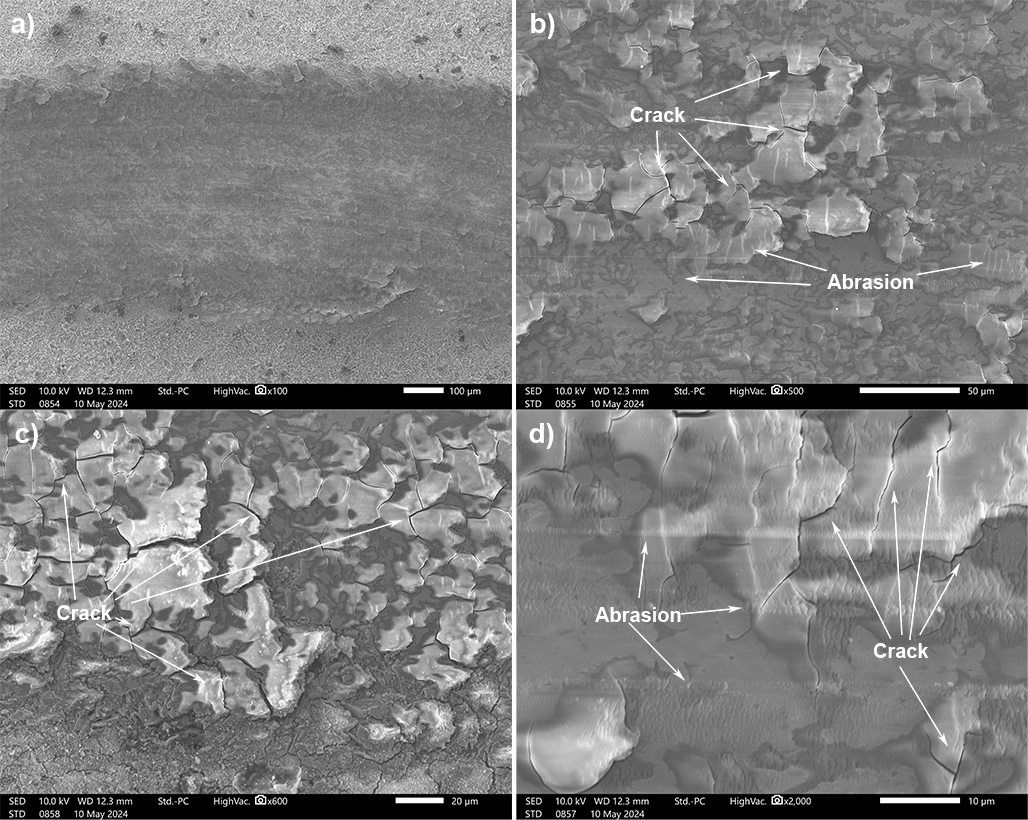
In the untreated sample, abrasive wear in the form of scratches in the sliding direction, as well as indications of plastic deformation, can be observed (Figure 9b). Due to the ductility of the material, it is susceptible to this type of wear mechanism. Under sliding conditions, wear particles or debris are removed and can adhere to the counter body, further promoting the formation of abrasive wear19. Wear debris can be observed in Figures 9c and 9d. Cracks are highlighted in Figures 9c and 9d; these cracks may be associated with delamination. Being a ductile material, this association becomes stronger when analyzing Figure 9c, where cracks are present near the delaminated region20.

The borided sample exhibited a large number of cracks in the wear track and scratches in the sliding direction, can be observed (Figure 10). The formation of cracks is favored by the presence of copper agglomerates below the boride layer18. Despite this, no spalling or delamination was observed in the studied case, which corroborates the adhesion test results according to the VDI 3198 standard (Figure 3). The deepest wear track for the borided sample reached 1.86 ± 0.44 μm from the surface, not reaching the region with copper agglomerates. In Figure 8, the presence of copper within the track is not detected, reaffirming that there was not enough material removal for this region to be exposed.

SEM images of the wear tracks of Monel 400 alloy borided at 900 °C for 4 h with different amplifier.
4. Conclusion
This study investigated the effects of thermochemical boriding treatment on the Monel 400 alloy, focusing on microstructural, mechanical, and wear resistance properties. The thermochemical boriding treatment proved effective in improving the tribological properties of the Monel 400 alloy, increasing surface hardness and wear resistance without compromising corrosion resistance. These results indicate that boriding is a promising technique for applications where wear resistance is critical. The obtained results allowed us to conclude that:
-
Boriding at 900°C for 4 hours resulted in the formation of a nickel boride layer (Ni2B, Ni3B, Ni4B3) on the surface of the Monel 400 alloy.
-
The average thickness of the boride layer was 9.62 ± 2.20 µm, with a total layer thickness of 58.05 ± 4.00 µm, including the boride diffusion region.
-
The surface hardness of the boride layer reached approximately 1600 HV0.01, with a sharp drop in hardness in regions with copper agglomerates. The presence of borides significantly increased surface hardness compared to the untreated sample.
-
The adhesion between the boride layer and the Monel 400 substrate was classified as satisfactory according to the VDI 3198 standard, with a classification between HF1 and HF2. The presence of circumferential and radial cracks around the Rockwell C indentations indicated a brittle behavior of the formed layer.
-
The coefficient of friction of the treated samples was higher (0.59) compared to the untreated samples (0.27), representing an increase of 118.5%.
-
The wear rate of the treated samples was reduced by 20.63% compared to the untreated samples, indicating an improvement in wear resistance.
-
The surface roughness of the treated samples increased significantly after boriding, from 1.80 ± 0.027 µm to 7.25 ± 0.74 µm. The increase in initial roughness contributed to the elevation of the coefficient of friction during the tribological tests.
5. Acknowledgements
The authors acknowledges financial support from CAPES (Coordenação de Aperfeiçoamento de Pessoal de Nível Superior-Brazil)-Finance Code 001 and for the Doctoral scholarship; CNPq (Conselho Nacional de Desenvolvimento Científico e Tecnológico), CEC: Nº 310045/2023-1; FAPESC (Fundação de Apoio à Pesquisa e Inovação do Estado de Santa Catarina) – 2023TR000566; Multi-User Facility infrastructure from Santa Catarina State University's Technological Sciences Center.
-
Data Availability
Data will be made available on request.
6. References
-
1 Parida AK, Maity K. Comparison the machinability of Inconel 718, Inconel 625 and Monel 400 in hot turning operation. Eng Sci Technol Int. J. 2018;21(3):364-70. http://doi.org/10.1016/j.jestch.2018.03.018
» http://doi.org/10.1016/j.jestch.2018.03.018 -
2 Kumar R. Comparative study of TIG and MIG welding for Bi-metallic weld of AISI 304 and monel 400. Mater Today Proc. 2021;37:3501-4. http://doi.org/10.1016/j.matpr.2020.09.395
» http://doi.org/10.1016/j.matpr.2020.09.395 -
3 Zhu Y, Liu H, Zhang D, Wang J, Yan F. Effect of polarization potentials on tribocorrosion behavior of Monel 400 alloy in seawater environment. Tribol Int. 2022;168:107445. http://doi.org/10.1016/j.triboint.2022.107445
» http://doi.org/10.1016/j.triboint.2022.107445 -
4 Kukliński M, Bartkowska A, Przestacki D. Microstructure and selected properties of Monel 400 alloy after laser heat treatment and laser boriding using diode laser. Int J Adv Manuf Technol. 2018;98(9-12):3005-17. http://doi.org/10.1007/s00170-018-2343-9
» http://doi.org/10.1007/s00170-018-2343-9 -
5 Campos-Silva I, Contla-Pacheco AD, Figueroa-López U, Martínez-Trinidad J, Garduño-Alva A, Ortega-Avilés M. Sliding wear resistance of nickel boride layers on an Inconel 718 superalloy. Surf Coat Tech. 2019;378:124862. http://doi.org/10.1016/j.surfcoat.2019.06.099
» http://doi.org/10.1016/j.surfcoat.2019.06.099 -
6 Gunes I, Kayali Y. Investigation of mechanical properties of borided Nickel 201 alloy. Mater Des. 2014;53:577-80. http://doi.org/10.1016/j.matdes.2013.07.001
» http://doi.org/10.1016/j.matdes.2013.07.001 -
7 Ueda N, Mizukoshi T, Demizu K, Sone T, Ikenaga A, Kawamoto M. Boriding of nickel by the powder-pack method. Surf Coat Tech. 2000;126(1):25-30. http://doi.org/10.1016/S0257-8972(00)00517-X
» http://doi.org/10.1016/S0257-8972(00)00517-X -
8 Krelling AP, Melo FS, Almeida EAS, Da Costa CE, Milan JCG. Microstructure and properties of borided Monel 400 alloy. Mater Res Express. 2019;6(10):106410. http://doi.org/10.1088/2053-1591/ab387a
» http://doi.org/10.1088/2053-1591/ab387a -
9 Günen A, Keddam M, Erdoğan A, Karakaş MS. Pack-boriding of Monel 400: microstructural characterization and boriding kinetics. Met Mater Int. 2022;28(8):1851-63. http://doi.org/10.1007/s12540-021-01066-8
» http://doi.org/10.1007/s12540-021-01066-8 -
10 Pacheco C, Jeronimo JL, Krelling AP, Costa CE, Milan JCG. Influence of boriding treatment on the mechanical properties of Monel 400. Results Surf Interf. 2025;18:100436. http://doi.org/10.1016/j.rsurfi.2025.100436
» http://doi.org/10.1016/j.rsurfi.2025.100436 -
11 Sista V, Kahvecioglu O, Kartal G, Zeng QZ, Kim JH, Eryilmaz OL, et al. Evaluation of electrochemical boriding of Inconel 600. Surf Coat Tech. 2013;215:452-9. http://doi.org/10.1016/j.surfcoat.2012.08.083
» http://doi.org/10.1016/j.surfcoat.2012.08.083 -
12 Jeronimo JL, Krelling AP, Pacheco C, Bonetti I, Silva R, Milan JCG, et al. Microstrutural, mechanical characterizations and corrosion behaviour of borides layers on Inconel 718 superalloy. RINENG. 2022;16:100783. http://doi.org/10.1016/j.rineng.2022.100783
» http://doi.org/10.1016/j.rineng.2022.100783 -
13 Reséndiz-Calderón CD, Cao-Romero-Gallegos JA, Farfan-Cabrera LI, Campos-Silva I, Soriano-Vargas O. Influence of boriding on the tribological behavior of AISI D2 tool steel for dry deep drawing of stainless steel and aluminum. Surf Coat Tech. 2024;484:130832. http://doi.org/10.1016/j.surfcoat.2024.130832
» http://doi.org/10.1016/j.surfcoat.2024.130832 -
14 Günen A, Keddam M, Alkan S, Erdoğan A, Çetin M. Microstructural characterization, boriding kinetics and tribo-wear behavior of borided Fe-based A286 superalloy. Mater Charact. 2022;186:111778. http://doi.org/10.1016/j.matchar.2022.111778
» http://doi.org/10.1016/j.matchar.2022.111778 -
15 Reséndiz-Calderón CD, Farfan-Cabrera LI, Oseguera-Peña JE, Rodríguez-Castro GA. Wear and friction of boride layer in CoCrMo alloy under different micro-abrasion modes (rolling and grooving abrasion). Mater Lett. 2020;279:128500. http://doi.org/10.1016/j.matlet.2020.128500
» http://doi.org/10.1016/j.matlet.2020.128500 -
16 Holmberg K, Matthews A, Ronkainen H. Coatings tribology: contact mechanisms and surface design. Tribol Int. 1998;31(1-3):107-20. http://doi.org/10.1016/S0301-679X(98)00013-9
» http://doi.org/10.1016/S0301-679X(98)00013-9 -
17 Wu Z, Liu Y, Shao M, Wang J, Li Y, Peng J, et al. Insights into the microstructure and load-dependent wear characteristics of the boride layer on Inconel 718 alloy. Tribol Int. 2025;202:110298. http://doi.org/10.1016/j.triboint.2024.110298
» http://doi.org/10.1016/j.triboint.2024.110298 -
18 Küçük Y, Döleker KM, Gök MS, Dal S, Altınay Y, Erdoğan A. Microstructure, hardness and high temperature wear characteristics of boronized Monel 400. Surf Coat Tech. 2022;436:128277. http://doi.org/10.1016/j.surfcoat.2022.128277
» http://doi.org/10.1016/j.surfcoat.2022.128277 -
19 Krelling AP, Milan JCG, Costa CE. Tribological behaviour of borided H13 steel with different boriding agents. Surf Eng. 2015;31(8):581-7. http://doi.org/10.1179/1743294414Y.0000000423
» http://doi.org/10.1179/1743294414Y.0000000423 -
20 Zhu Y, Liu H, Wang J, Yan F. Antagonistic effect of electrochemical corrosion on the mechanical wear of Monel 400 alloy in seawater. Corros Sci. 2022;198:110120. http://doi.org/10.1016/j.corsci.2022.110120
» http://doi.org/10.1016/j.corsci.2022.110120
Edited by
-
Associate Editor:
Igor Vasconcelos.
-
Editor-in-Chief:
Luiz Antonio Pessan.
Data will be made available on request.